Angola VAT (IVA) guidelines
| FACTSHEET | |
|---|---|
| Country code | AO |
| Tax name | Value added tax — Imposto sobre o Valor Acrescentado (IVA) |
| Tax Authority | Administração Geral Tributária (AGT) |
Overview
Angola's value added tax is the Imposto sobre o Valor Acrescentado (IVA). It is charged on supplies of goods and services located in Angola and on imports of goods.
Authority. IVA is administered by the Administração Geral Tributária (AGT), which runs both the tax offices and customs, so IVA on imports is collected at customs clearance. Registration, returns, payment and e-invoicing go through the AGT Portal do Contribuinte.
Statute. The IVA Code (Código do Imposto sobre o Valor Acrescentado, "CIVA") was approved by Lei n.º 7/19, de 24 de Abril, and amended and republished by Lei n.º 14/23, de 28 de Dezembro. Annual budget laws amend it further; the 2026 budget law, Lei n.º 14/25, de 30 de Dezembro (OGE 2026), changed the regime rules and added a 5% rate for industrial equipment. [1] [2] Invoicing and e-invoicing are governed by the Regime Jurídico das Facturas, approved by Presidential Decree (Decreto Presidencial) n.º 71/25, de 20 de Março. [3]
Layering. One national tax, with no provincial or municipal layer. The only territorial variation is the special regime for the Province of Cabinda, taxed at 1% (see Rates).
Currency. Kwanza (AOA, written "Kz"). Amounts in a foreign currency are converted at the National Bank of Angola (BNA) selling rate on the date the tax becomes chargeable (CIVA art. 17.º n.º 8). [1]
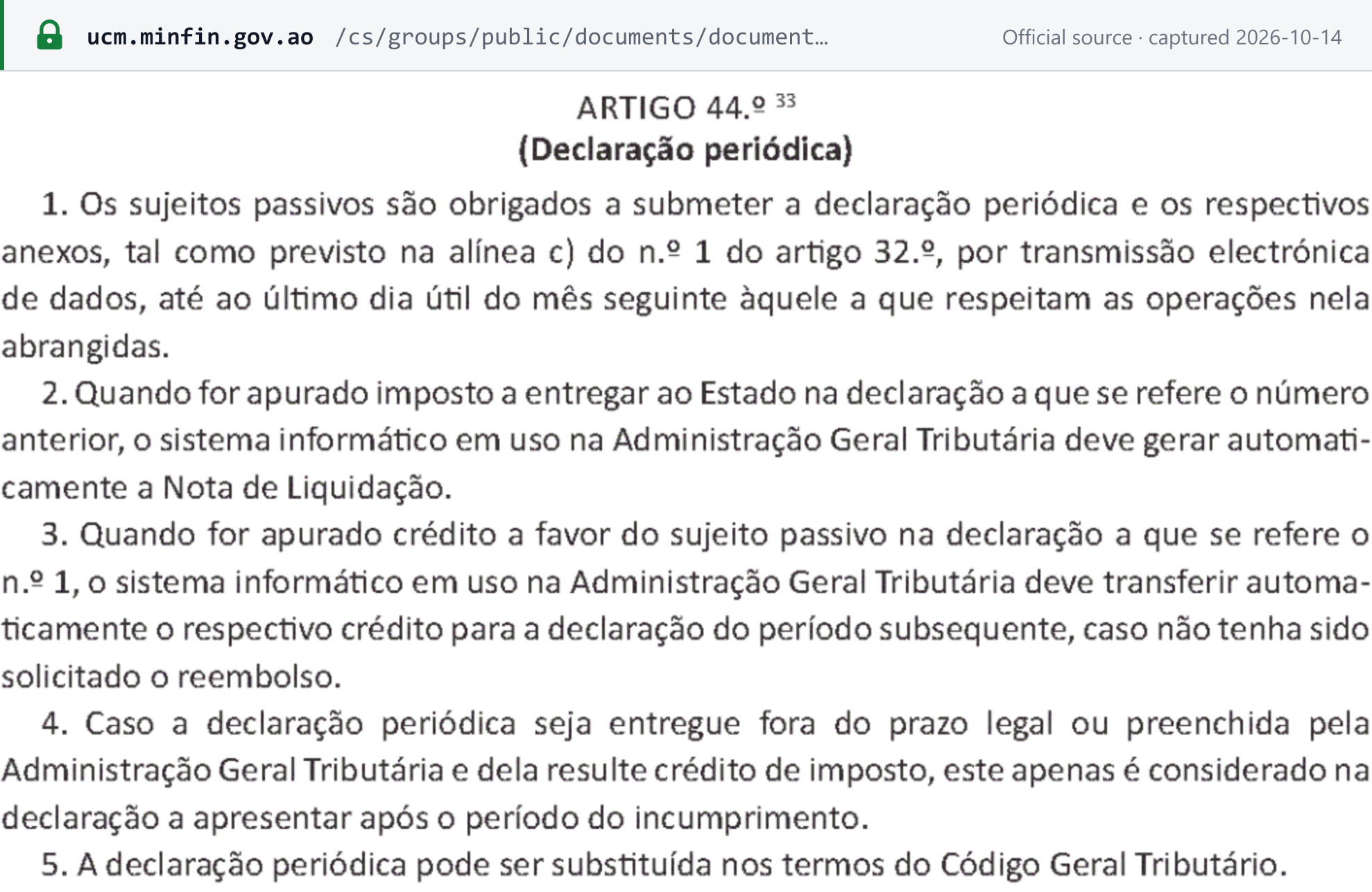
Tax period. The calendar month. Taxpayers must "entregar mensalmente a declaração periódica" — file the periodic return monthly — for the operations of the preceding month (CIVA art. 32.º n.º 1 c)). [1]
This guide states the law and AGT's published practice as at 14 October 2026.
For the Portuguese system on which Angola's terminology draws, see the Portugal VAT guide.
Registration
Who should register
Anyone who carries on an economic activity in Angola must register with AGT and obtain a NIF (Número de Identificação Fiscal). A declaração de início de actividade (start-of-activity declaration) is filed electronically 15 days before the activity starts (CIVA art. 43.º n.º 1). [1]
Registration threshold
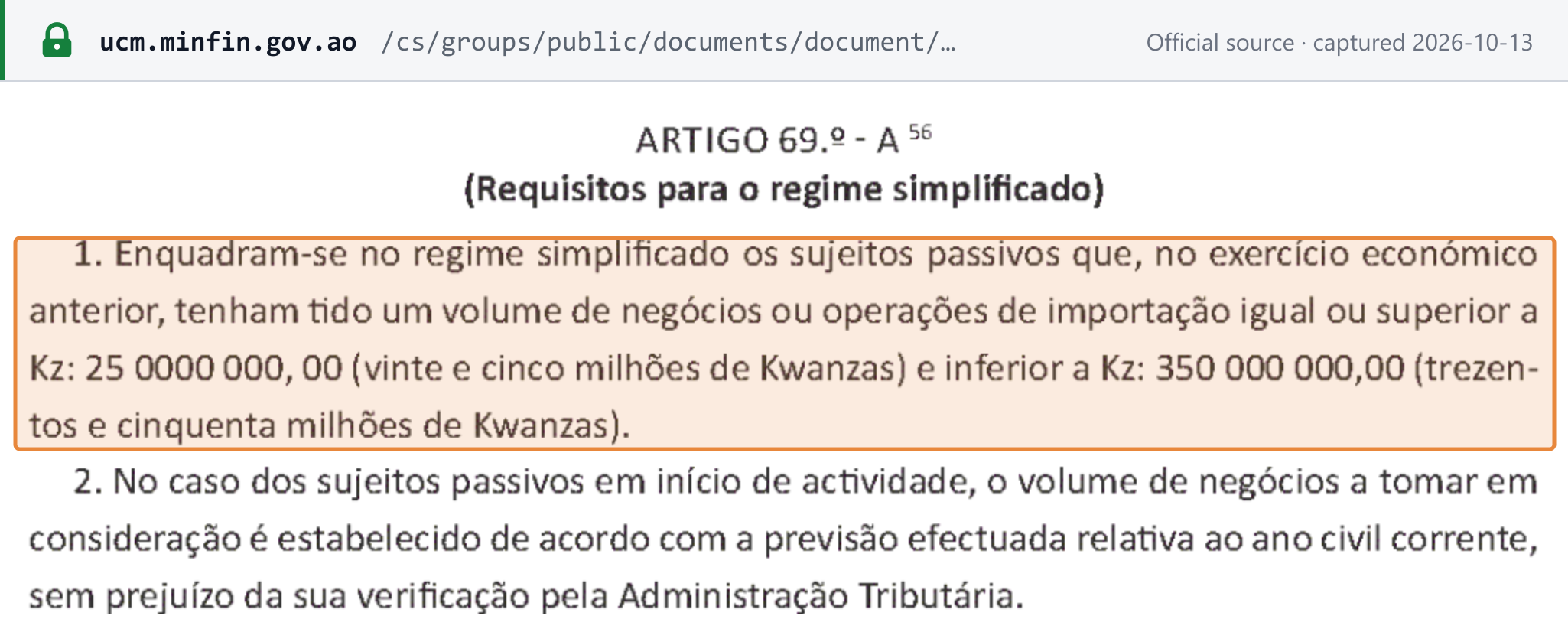
Angola has no turnover threshold for registering: every business registers. Turnover (or imports) in the previous financial year decides which IVA regime applies: [1] [5]
| Regime | Turnover or imports, previous financial year | Treatment |
|---|---|---|
| Exclusão (exclusion) | Below Kz 25,000,000 | No IVA charged; invoices carry the words «IVA — Regime de Exclusão» |
| Simplificado (simplified) | Kz 25,000,000 up to, but not including, Kz 350,000,000 | 7% on turnover actually received; 10% of input tax deductible; monthly simplified return |
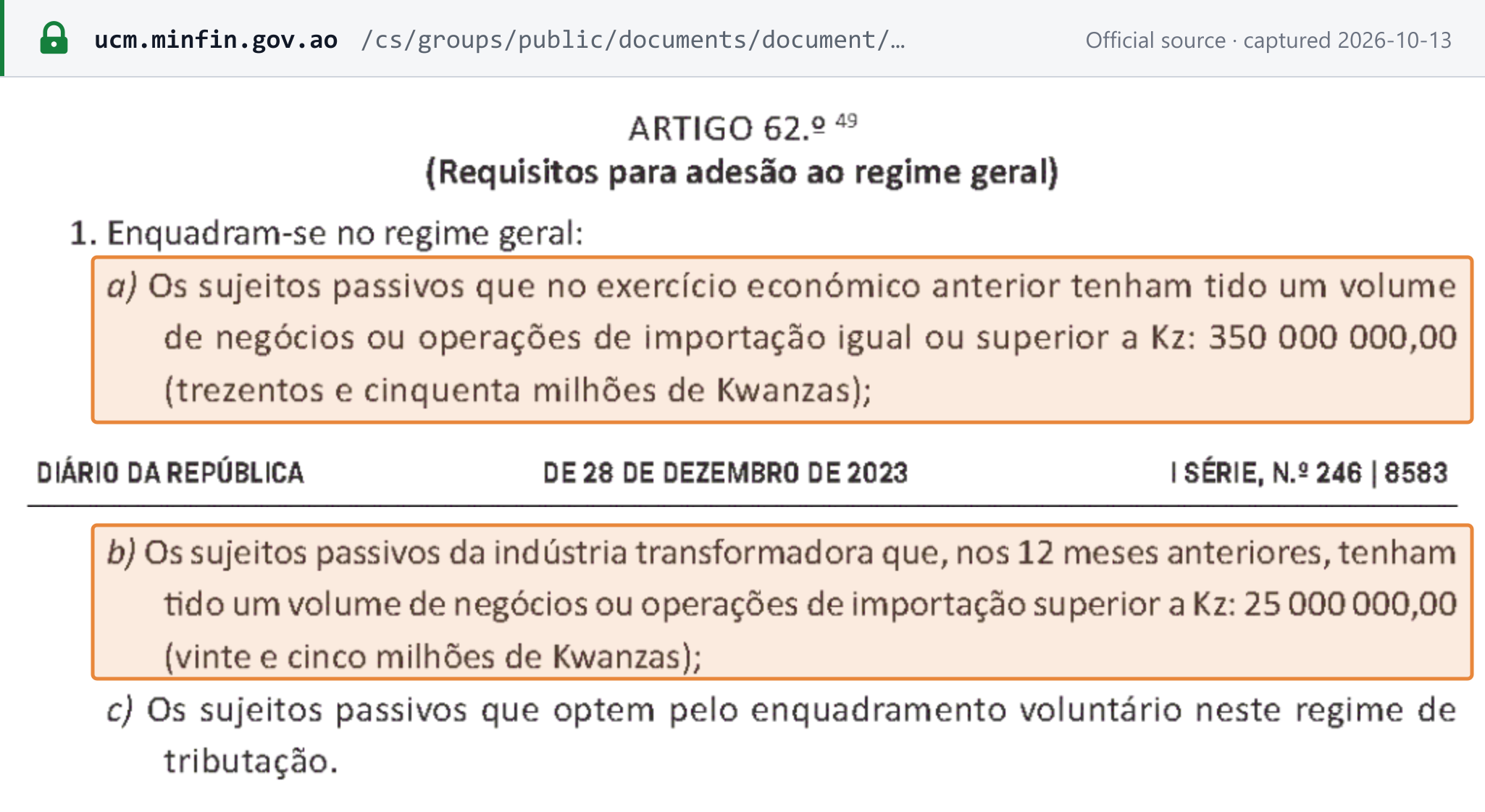
| Geral (general) | Kz 350,000,000 or more | Full IVA: charge IVA on invoices, deduct input tax |
- Also in the general regime: manufacturers whose turnover or imports in the previous 12 months exceeded Kz 25,000,000, and any taxpayer that opts in (CIVA art. 62.º).
- Only general-regime taxpayers charge IVA on the invoice: "A liquidação do imposto na factura compete exclusivamente aos sujeitos passivos do regime geral do IVA" (art. 34.º n.º 4).
- Changing regime (from 2026). A taxpayer whose turnover crosses a limit must change regime by the end of the following month; if it does not, AGT can change the regime itself (Lei 14/25 art. 23.º n.ºs 2–3). [2]
Non-resident registration
There is no separate threshold for non-residents, and what a foreign business must do depends on what it sells and to whom (see Foreign companies selling into Angola):
- Services to Angolan taxable persons (B2B): the Angolan customer accounts for the IVA under the reverse charge, so the foreign supplier does not register for these supplies (CIVA art. 29.º n.º 2).
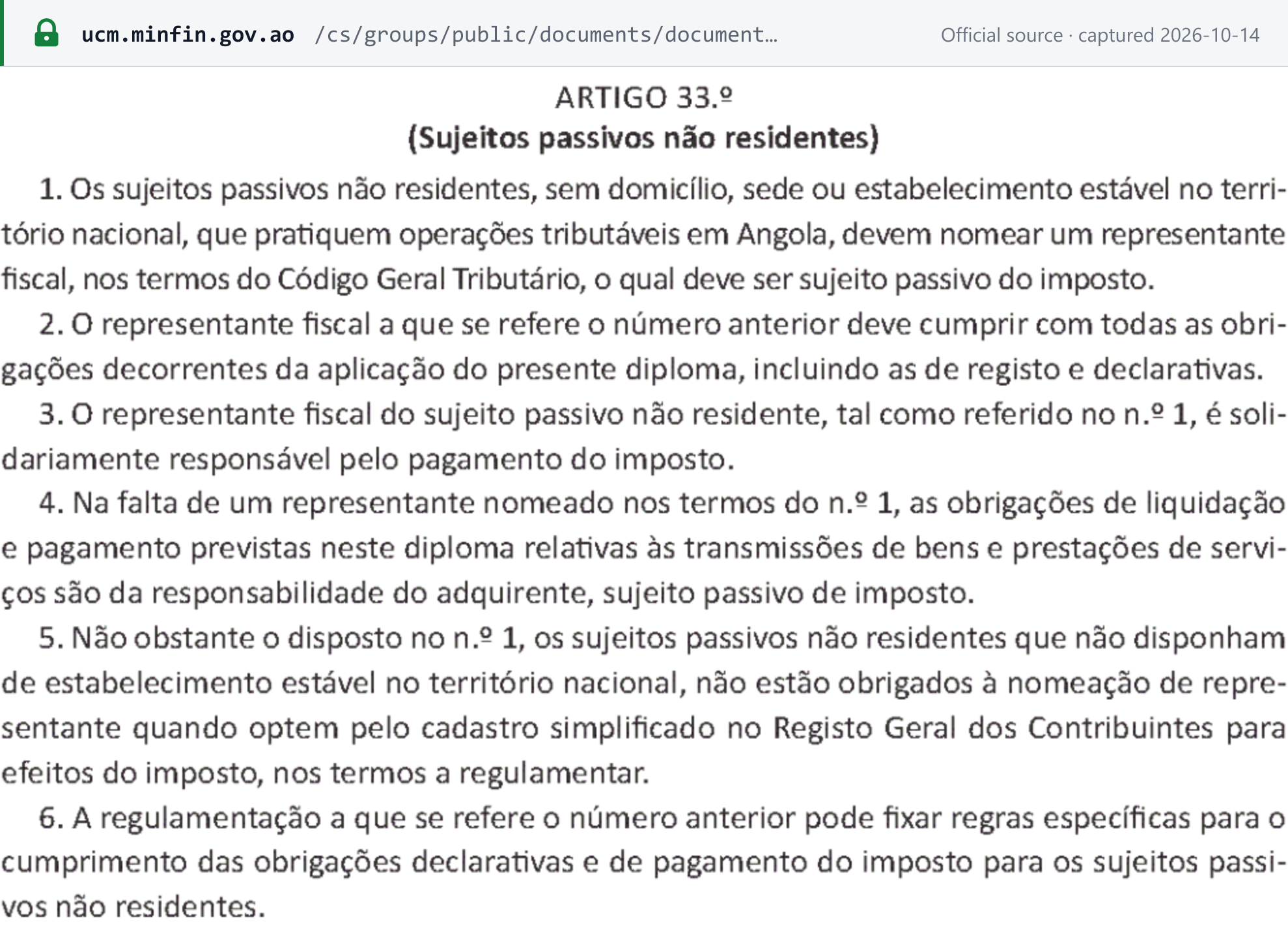
- Any other taxable supplies in Angola, including to consumers: "Os sujeitos passivos não residentes … que pratiquem operações tributáveis em Angola, devem nomear um representante fiscal" — non-residents making taxable supplies in Angola must appoint a fiscal representative, who must itself be an IVA taxpayer and is jointly liable for the tax (art. 33.º n.ºs 1–3).
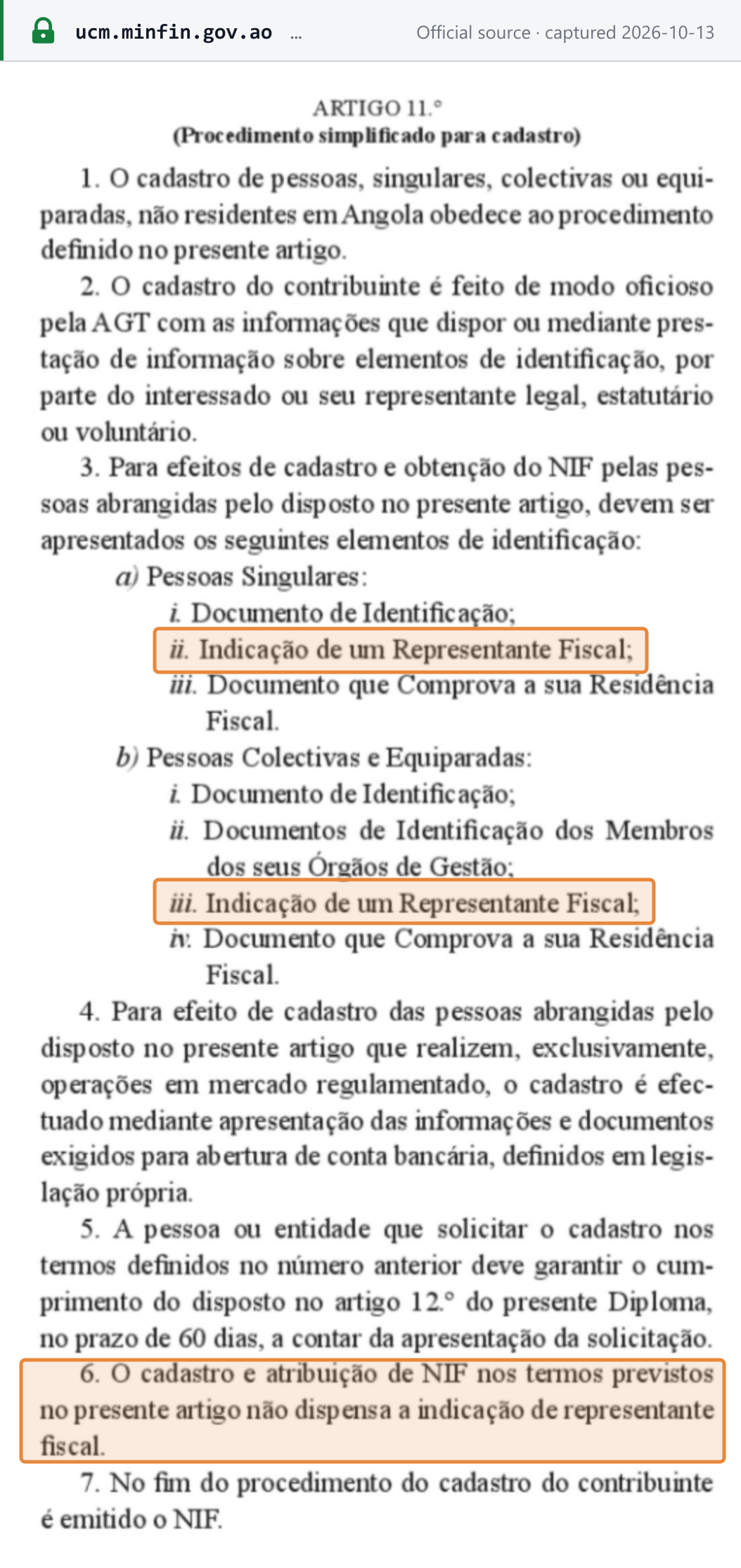
To obtain a NIF, a non-resident individual or company must name a fiscal representative, and registering does not remove that duty (Presidential Decree 245/21 art. 11.º). [1] [14]
Tax identification number
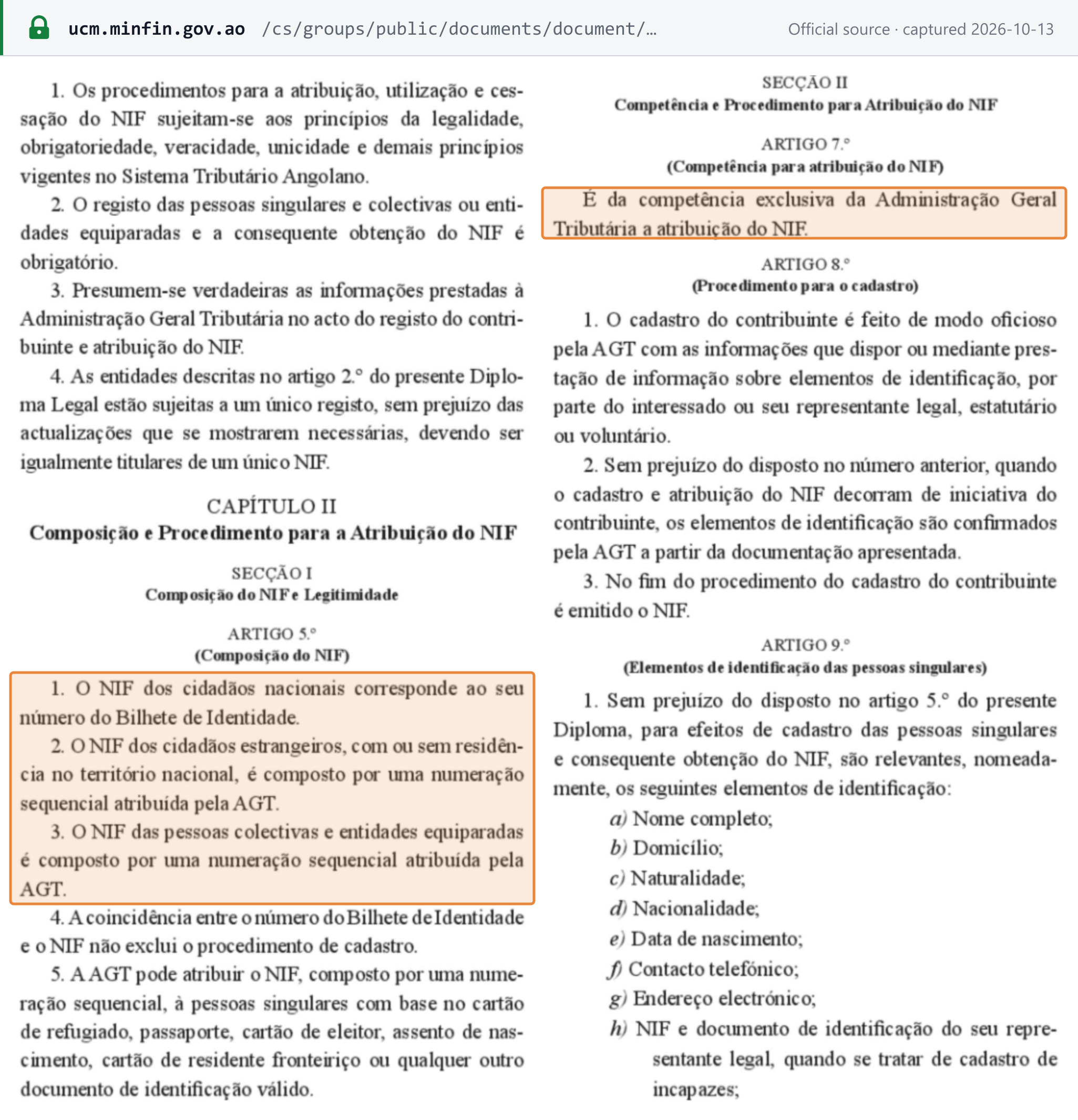
Angola has no separate IVA number: a business is identified by its NIF, and its IVA regime is a field on the NIF record. AGT alone assigns NIFs (Presidential Decree 245/21 art. 7.º). For Angolan citizens the NIF is their Bilhete de Identidade number; foreign individuals and companies receive a sequential number assigned by AGT (art. 5.º). [14]
For the NIF's format, how suspension works and how to check a number, see the Angola tax ID guide, or check a NIF's format with the Angola NIF validator.
How to register
Registration and the start-of-activity declaration are filed electronically through the Portal do Contribuinte. Changes to registered details are notified within 15 days with a declaração de alteração (CIVA art. 45.º n.º 2). [1]
Voluntary registration
A taxpayer below Kz 350,000,000 may opt into the general regime (CIVA art. 62.º n.º 1 c)), which lets it charge IVA and deduct input tax in full. An opting taxpayer must stay in the general regime for at least 5 years (art. 61.º n.º 3). [1]
Deregistration
- Deadline: the declaração de cessação is filed electronically "no prazo de 30 dias a contar da data de cessação" — within 30 days of ceasing activity (CIVA art. 46.º n.º 1).
- Deemed cessation: no taxable activity for two consecutive years (the remaining business assets are then treated as supplied), the business's assets are used up, or the business is transferred (art. 46.º n.º 2).
- Ex officio: AGT can declare cessation itself (art. 46.º n.º 3).
- Refund of a credit: on cessation, an IVA credit can be refunded without waiting (art. 26.º n.º 3 a)).
Group registration
Not available. The IVA Code, as republished by Lei 14/23, contains no provision for IVA grouping: each taxpayer registers and files on its own.
Rates
| Rate | Applies to |
|---|---|
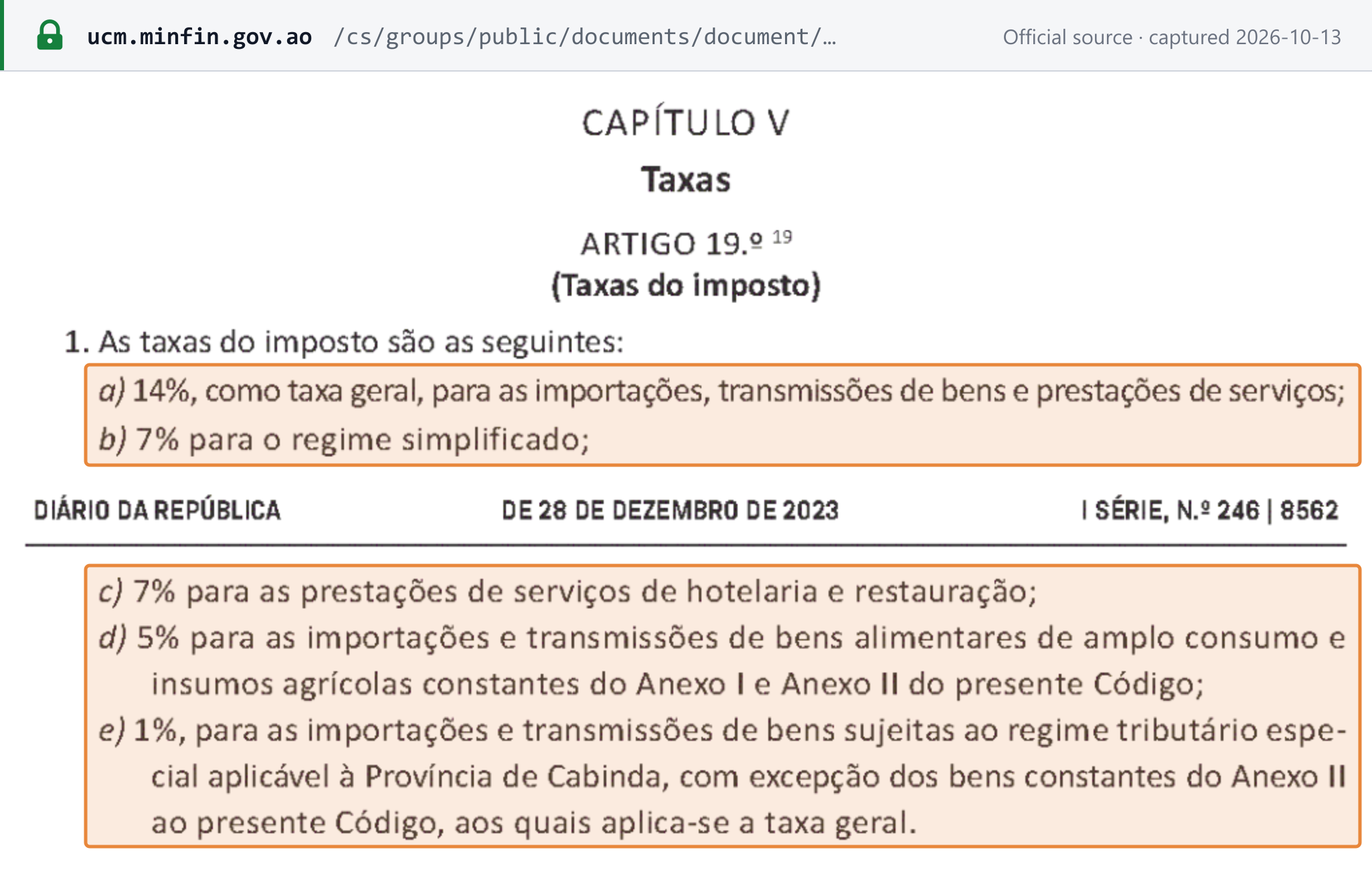
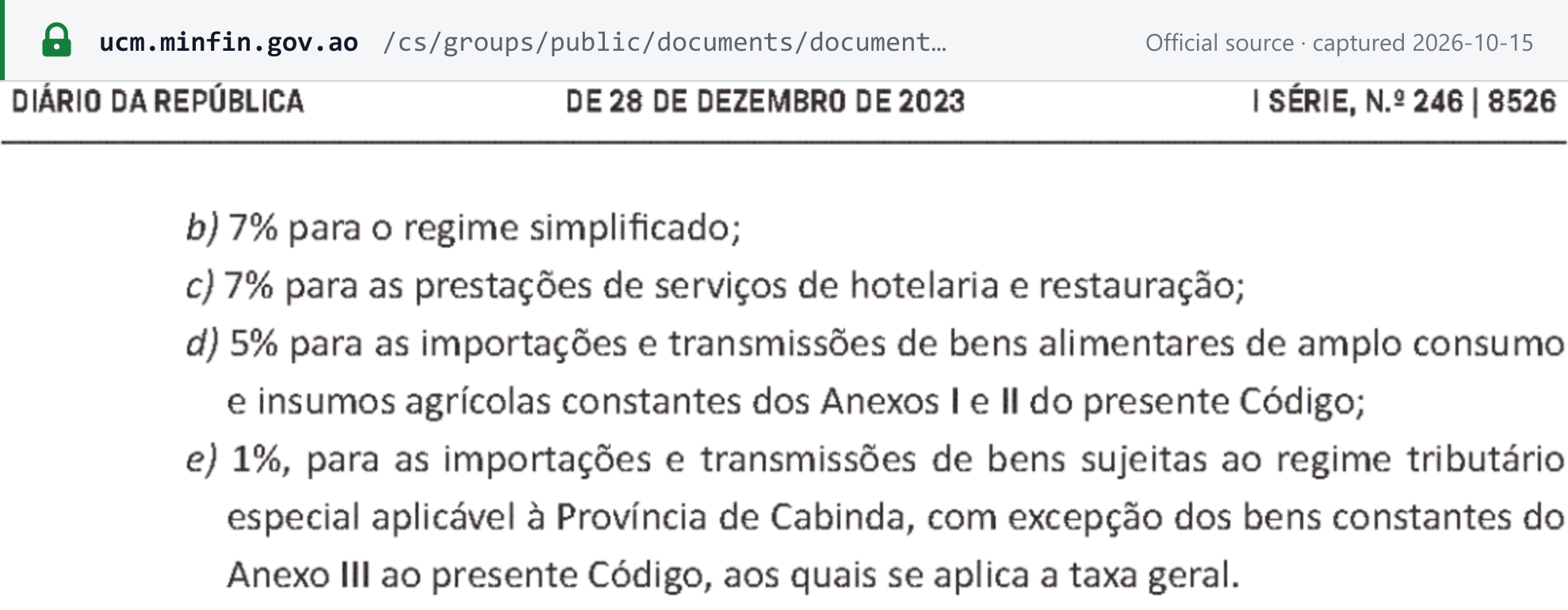
| 14% (taxa geral) | Imports, supplies of goods and services not covered by another rate |
| 7% | All supplies of simplified-regime taxpayers, on turnover received |
| 7% | Hotel and restaurant services, only by suppliers that meet four conditions (below) |
| 5% | Basic foods and agricultural inputs listed in Annexes I and II of the IVA Code |
| 5% | Industrial equipment imported or supplied by its manufacturer (from 2026) |
| 1% | Imports and supplies under the special regime of the Province of Cabinda, except Annex III goods (such as alcohol, tobacco, jewellery, vehicles and arms), which pay 14% |
General rate 14%. "14%, como taxa geral, para as importações, transmissões de bens e prestações de serviços" (CIVA art. 19.º n.º 1 a)).
Hotels and restaurants at 7%. The reduced rate "apenas é aplicada pelos prestadores dos referidos serviços que cumpram cumulativamente" — applies only to suppliers that meet all four of these conditions (art. 19.º n.º 2):
- all real estate they own or use for the business is registered;
- all motor vehicles they own or use for the business are registered;
- they issue invoices through electronic invoicing systems;
- they have filed their tax returns for previous years.
Basic foods and farm inputs at 5%. Annex I ("Bens alimentares de Amplo Consumo") lists foods such as meat, fish (other than shark, salmon and cod), milk, eggs, vegetables, fruit, cereals, flour, cooking oil (other than olive oil), sugar, pasta, bread, water and salt. Annex II lists agricultural inputs.
Industrial equipment at 5%. The 2026 budget law taxes industrial equipment imported or supplied by the manufacturer at 5%, subject to AGT verification (Lei 14/25 art. 23.º n.º 1). AGT's Circular 01/GACA/GJ/AGT/2026 limits it to equipment "que tenham como finalidade potenciar a indústria nacional" — intended to strengthen national industry — and requires an updated registration showing a manufacturing activity, and an industrial licence plus a technical sheet. [2] [5]
No zero rate. Angola has no 0% rate. Exports are exempt with the right to deduct, which has the same effect (see Exemptions).
Announced changes. None. The 2026 budget law leaves the 14% rate unchanged.
Cross-border rules
Imports and exports
Imports of goods. IVA is charged on the customs value plus duties and other charges and incidental costs up to the first destination in Angola (CIVA art. 18.º), and "é pago nos serviços aduaneiros competentes no acto do desembaraço alfandegário" — paid to customs at clearance (art. 30.º n.º 4). Exempt imports (art. 14.º) include goods whose domestic supply is exempt, gold and currency imported by the BNA, humanitarian and disaster-relief goods, goods for oil and mining operations, and donations to the State. [1]
Courier and postal parcels. Goods sent through postal or express-courier operators can be cleared under a simplified procedure at a 16% flat rate (taxa forfetária) when they are worth up to Kz 1,500,000; goods above that value are declared under the general customs regime (Lei 14/25 art. 28.º n.ºs 2–3; AGT Circular 01/GACA/GJ/AGT/2026, point 11). [2] [5]
Exports. "As transmissões de bens expedidos ou transportados com destino ao estrangeiro pelo exportador" are exempt (art. 15.º n.º 1 a)), with the right to deduct input tax (art. 22.º n.º 3 b) i.). The same applies to supplies for ships and aircraft and to international transport. The proof is the appropriate customs documents or declarations issued by the customer stating the destination of the goods or services; without them the supplier owes the IVA (art. 32.º n.ºs 3–4). [1]
Free zones and customs warehouses. Goods are exempt while they stay under the regime (art. 16.º).
Services from abroad. An Angolan taxable customer accounts for the IVA on services bought from a non-resident (see below).
Digital products and services
Services are taxed in Angola where the customer has its domicile, seat or permanent establishment there (CIVA art. 10.º n.º 1), and "as prestações de serviços utilizadas ou cuja exploração efectiva ocorra em território nacional, são sempre tributáveis" — services used or effectively exploited in Angola are always taxable (art. 10.º n.º 4). Distance sales of goods in international e-commerce are located in Angola when the buyer is established there or when payment originates in Angola or passes through an Angolan financial institution (art. 9.º n.º 5). [1]
No threshold. The IVA Code sets no turnover threshold for foreign sellers. See VAT on digital services by non-resident suppliers.
Foreign companies selling into Angola — B2B and B2C
- Selling services to Angolan businesses (B2B). Where the supplier is a non-resident with no permanent establishment in Angola and the customer is a taxable person, "o imposto é devido por esse mesmo adquirente" — the customer owes the IVA under the reverse charge (CIVA art. 29.º n.º 2). A simplified-regime customer self-assesses at 7% (art. 69.º-C n.º 3). The customer enters these invoices by hand in the supplier annex (anexo de fornecedores) of its return. The foreign supplier does not register for these supplies. [1] [9]
- Making taxable supplies in Angola, including to consumers (B2C). A non-resident without a domicile, seat or permanent establishment must appoint a fiscal representative, who must be an IVA taxpayer, carries out all the IVA obligations and is jointly liable for the tax (art. 33.º n.ºs 1–3). If none is appointed, a taxable customer takes over the obligations to charge and pay the tax (n.º 4). Invoices issued by the representative show its NIF and address (art. 34.º n.º 3).
- Simplified registration. Art. 33.º n.º 5 lets a non-resident without a permanent establishment register through a cadastro simplificado instead of appointing a representative, "nos termos a regulamentar" — on terms to be set by regulation. Art. 77.º allows non-resident e-commerce sellers to pay over, without penalty, IVA they charged before the simplified registration system is implemented ("antes da implementação do sistema de cadastro simplificado").
Marketplace / platform deemed-supplier liability
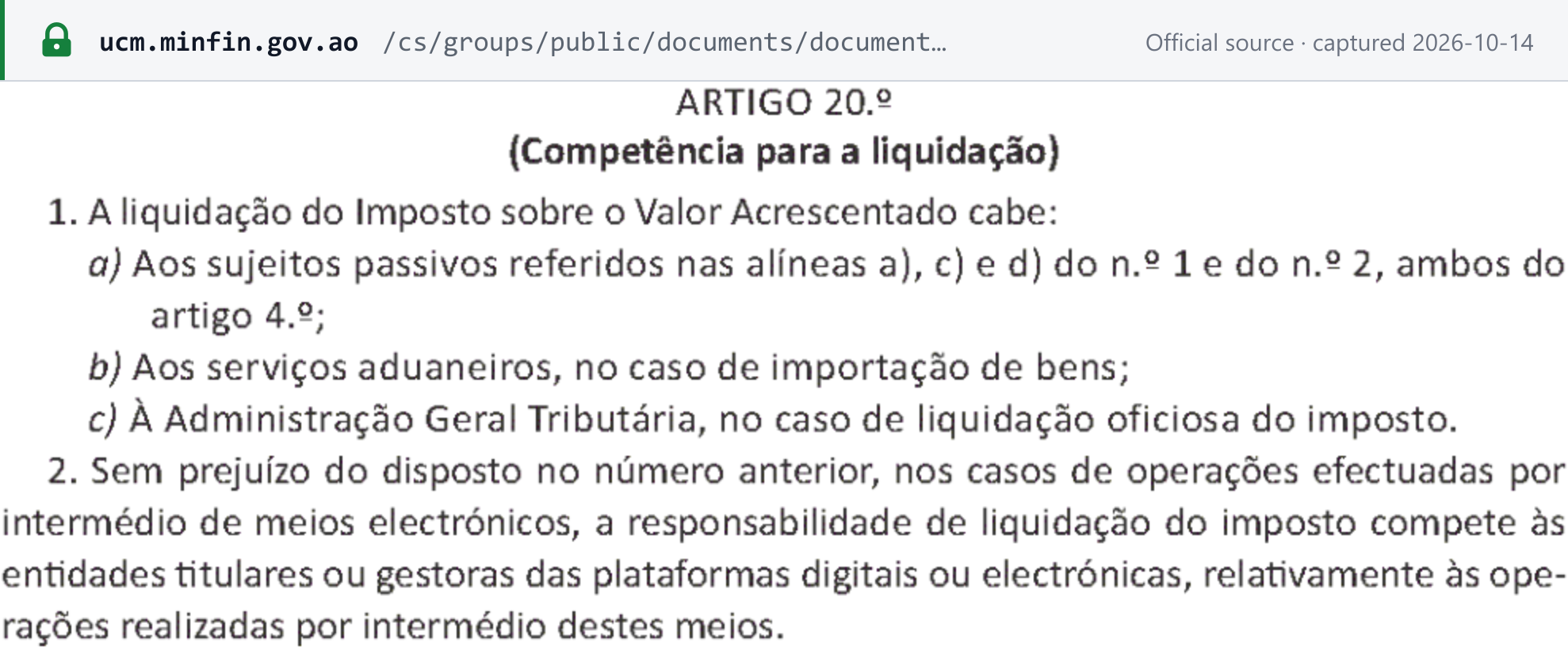
For operations made through electronic means, "a responsabilidade de liquidação do imposto compete às entidades titulares ou gestoras das plataformas digitais ou electrónicas" — the owner or operator of the digital platform charges the IVA (CIVA art. 20.º n.º 2), and is also responsible for paying it over (art. 29.º n.º 6). The Code sets no threshold for this rule. [1]
See marketplace deemed-supplier rules.
Place of supply
- Goods: where the goods are when transport to the customer begins, or where they are put at the customer's disposal. International e-commerce distance sales are located in Angola as described above (art. 9.º).
- Services, general rule: "quando nele o adquirente possui domicílio, sede ou estabelecimento estável" — where the customer has its domicile, seat or permanent establishment (art. 10.º n.º 1).
- Always located in Angola (art. 10.º n.º 2): services connected with Angolan real estate; hotel and restaurant services performed there; work on movable goods; passenger transport for the Angolan leg; means of transport made available there; and cultural, sporting and educational services performed there.
- Use and enjoyment: services used or effectively exploited in Angola are always taxable (art. 10.º n.º 4).
Invoice requirements
"É obrigatória a emissão de factura em todas as transmissões de bens, prestações de serviços, adiantamento ou pagamentos antecipados" — an invoice is compulsory for every supply of goods or services, and every advance or prepayment, located in Angola (Presidential Decree 71/25 art. 4.º n.º 1). [3]
How invoices are issued:
- General and simplified regime: through invoicing software validated by AGT (art. 7.º n.º 1).
- Exclusion regime: validated software, invoice books from AGT-authorised printers, or the Portal do Contribuinte, which is capped at 300 invoices and other documents a year (arts. 7.º n.º 2 and 9.º).
- Equipment failure: with AGT's authorisation, printed invoice books may be used for up to 45 calendar days (art. 7.º n.º 6).
Mandatory content
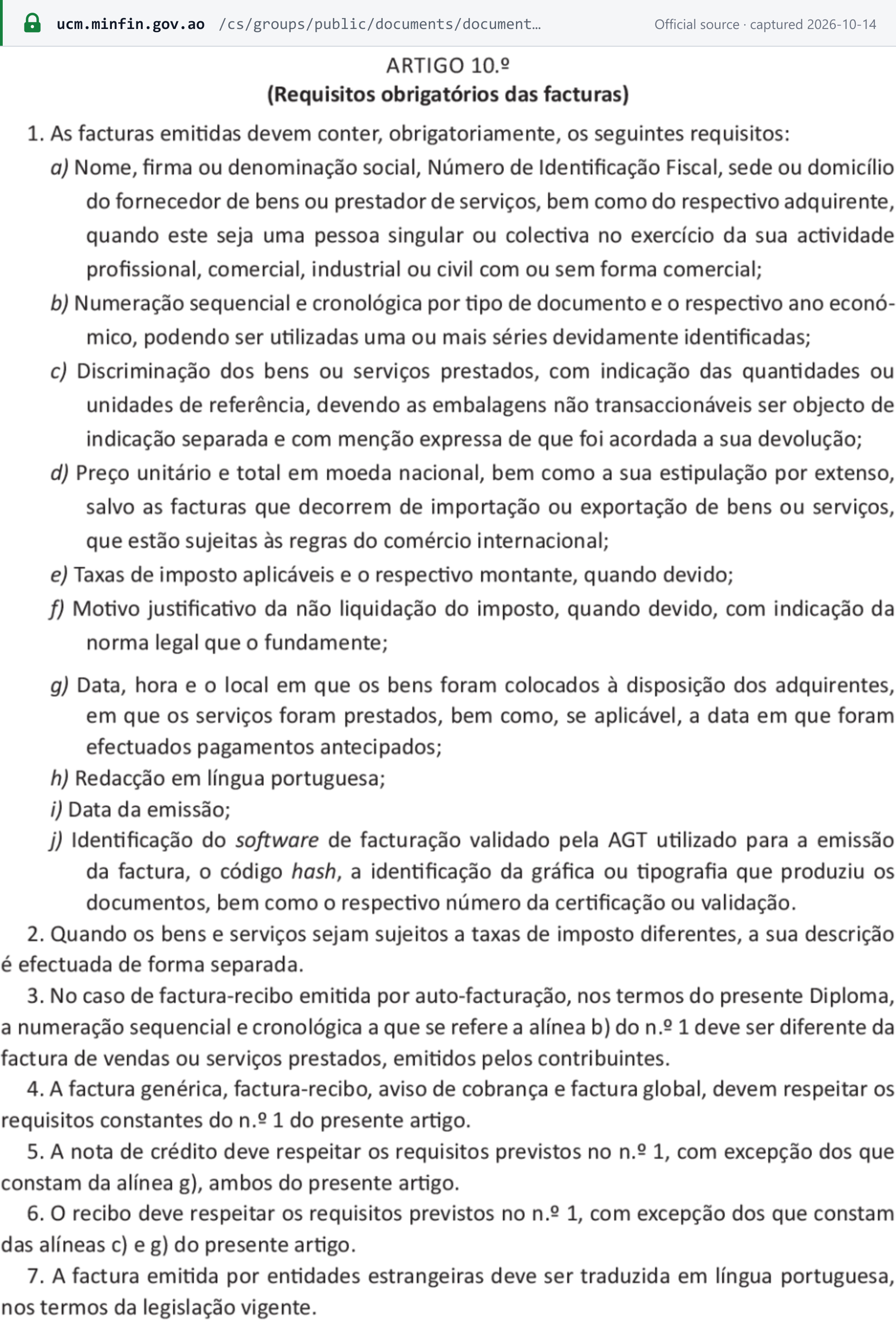
"As facturas emitidas devem conter, obrigatoriamente, os seguintes requisitos" — every invoice must contain (Presidential Decree 71/25 art. 10.º n.º 1): [3]
| Art. 10.º n.º 1 | Field |
|---|---|
| a) | Name, NIF and seat or domicile of the supplier, and of the customer when it acts in a business or professional capacity |
| b) | Sequential and chronological number by document type and economic year; several identified series are allowed |
| c) | Description of the goods or services, with quantities or units; non-returnable packaging shown separately |
| d) | Unit and total price in kwanza, also written out in words (por extenso) — except invoices for imports and exports |
| e) | Tax rate(s) applied and the tax amount |
| f) | Where no tax is charged, the reason, citing the legal provision |
| g) | Date, time and place the goods were made available or the services performed, and the date of any prepayment |
| h) | Portuguese language |
| i) | Issue date |
| j) | The AGT-validated invoicing software used, its hash code, the printer of any pre-printed books, and the certification or validation number |
Further rules in art. 10.º:
- Lines taxed at different rates are shown separately (n.º 2).
- A factura genérica, factura-recibo, aviso de cobrança and factura global must meet the same requirements (n.º 4).
- Credit notes may omit item g), and receipts items c) and g) (n.ºs 5–6).
- "A factura emitida por entidades estrangeiras deve ser traduzida em língua portuguesa" — invoices from foreign entities must be translated into Portuguese (n.º 7).
Other mandatory mentions: «IVA — Regime Simplificado» or «IVA — Regime de Exclusão» for taxpayers in those regimes; «original» on the first print and «2.ª via, em conformidade com a original» on a reprint (art. 7.º n.ºs 4–5); «Auto-Facturação» on self-billed invoices (art. 12.º); and receipts must show any tax withheld, including IVA cativo (art. 6.º n.º 3). [3]
Issuance deadline
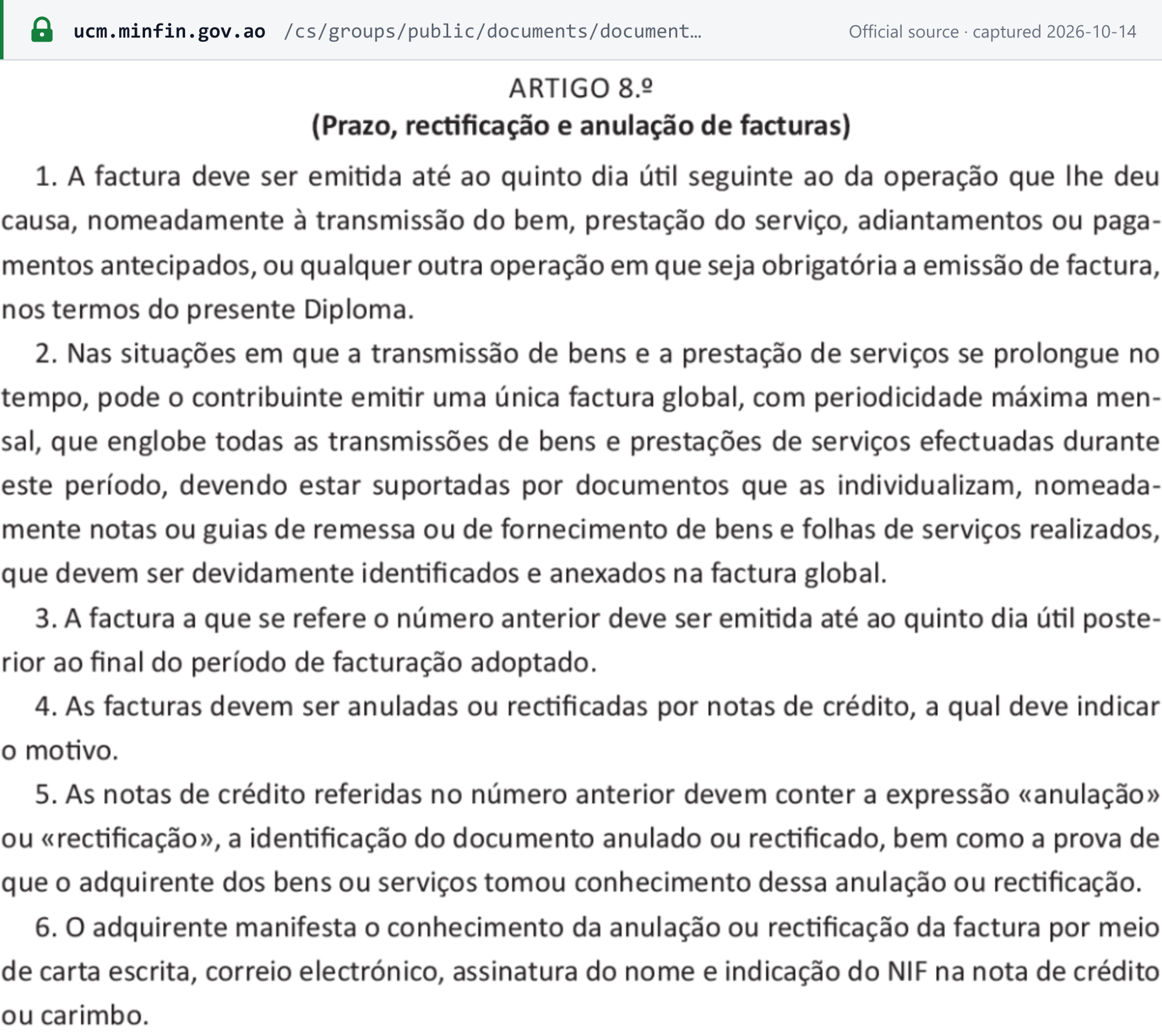
"A factura deve ser emitida até ao quinto dia útil seguinte ao da operação" — the invoice is due by the fifth working day after the operation (supply, advance or prepayment) (art. 8.º n.º 1). For continuing supplies, a single global invoice covering at most a month is allowed if it is backed by delivery notes or service sheets, and is due by the fifth working day after the end of the period (art. 8.º n.ºs 2–3). [3]
Numbering and sequencing
Invoices are numbered sequentially and chronologically by document type and economic year, in one or more identified series (art. 10.º n.º 1 b)). For e-invoicing software, AGT generates the series (Executive Decree 683/25 art. 4.º). Invoices in a series not communicated to AGT are treated as not issued (Presidential Decree 71/25 art. 35.º n.º 4). [3] [4]
Credit and debit notes
- Credit notes are the only way to cancel or correct an invoice (art. 8.º n.º 4). The credit note states the reason, the word «anulação» or «rectificação», the document it cancels or corrects, and proof that the customer knew of it — a letter, an email, the customer's signature and NIF on the credit note, or its stamp (n.ºs 5–6). The customer is presumed to know if it adjusts the tax in the State's favour (n.º 7).
- Exception: an error in identifying the parties may be voided in the validated software without a credit note, as may an invoice never sent to the customer (n.ºs 8–9). Advance invoices are settled by credit note (n.º 10).
- Debit notes carry no IVA. They are used where no invoice is due, for multi-purpose vouchers and for costs recharged in a third party's name (arts. 3.º m) and 4.º).
- IVA adjustments follow CIVA art. 48.º.
Currency and language
- Currency: prices in kwanza and in words (art. 10.º n.º 1 d)); import and export invoices follow international trade rules. A foreign-currency taxable amount is converted at the BNA selling rate on the date the tax becomes chargeable (CIVA art. 17.º n.º 8). [1]
- Language: Portuguese (art. 10.º n.º 1 h)).
Document types
- Invoice-type documents (all subject to art. 10.º n.º 1): factura, factura-recibo, factura genérica, factura global and aviso de cobrança.
- Not invoices: pro-formas, delivery notes, orders, quotations, credit notes and debit notes (art. 4.º n.º 9).
- No value threshold for a simplified invoice. Only three kinds of sale to individuals are released from the invoice (art. 5.º): vending machines, bearer tickets and licensed street vendors — and even then "a dispensa não afasta a obrigação da emissão de Talão de Venda/Factura-Recibo": a sales slip or invoice-receipt is still due on request.
- Receipts are compulsory for every payment unless a document that serves as a receipt was already issued (art. 6.º).
Self-billing
Angolan-resident entities that keep accounts may self-bill when they buy, from individuals who cannot issue invoices, primary-sector goods (agriculture, forestry, fisheries, livestock, crafts), manufactured goods or services. The regime also covers the State, and registrable goods bought from individuals who have used them for more than 6 months (Presidential Decree 71/25 art. 11.º). The document carries «Auto-Facturação» and its own numbering series (arts. 10.º n.º 3 and 12.º). [3]
Retention and audit trail
- Retention. Taxpayers must keep all invoices and fiscally relevant documents, and the records of their computer processing, "nos prazos estabelecidos no Código Geral Tributário" — for the periods set by the General Tax Code (art. 26.º n.º 1).
- Electronic archiving is allowed. Backups must be available for immediate consultation, and the archive must guarantee integrity, detect any alteration or destruction, recover from incidents and produce legible copies (arts. 26.º–27.º).
- Audit trail (art. 22.º). The invoicing system must control integrity, detect unauthorised changes, allow backups, and stop operating if its integrity is compromised until the producer files a technical report. It must give AGT controlled access and exact data exports, whatever the software version. The taxpayer keeps the system's technical documentation (data model and dictionary, operating cycles, controls).
- AGT access (art. 23.º). AGT may inspect on site, access the software directly or demand the data in a standard digital format. If the software or archive is hosted outside Angola, the taxpayer must give that access from inside Angola (n.º 3).
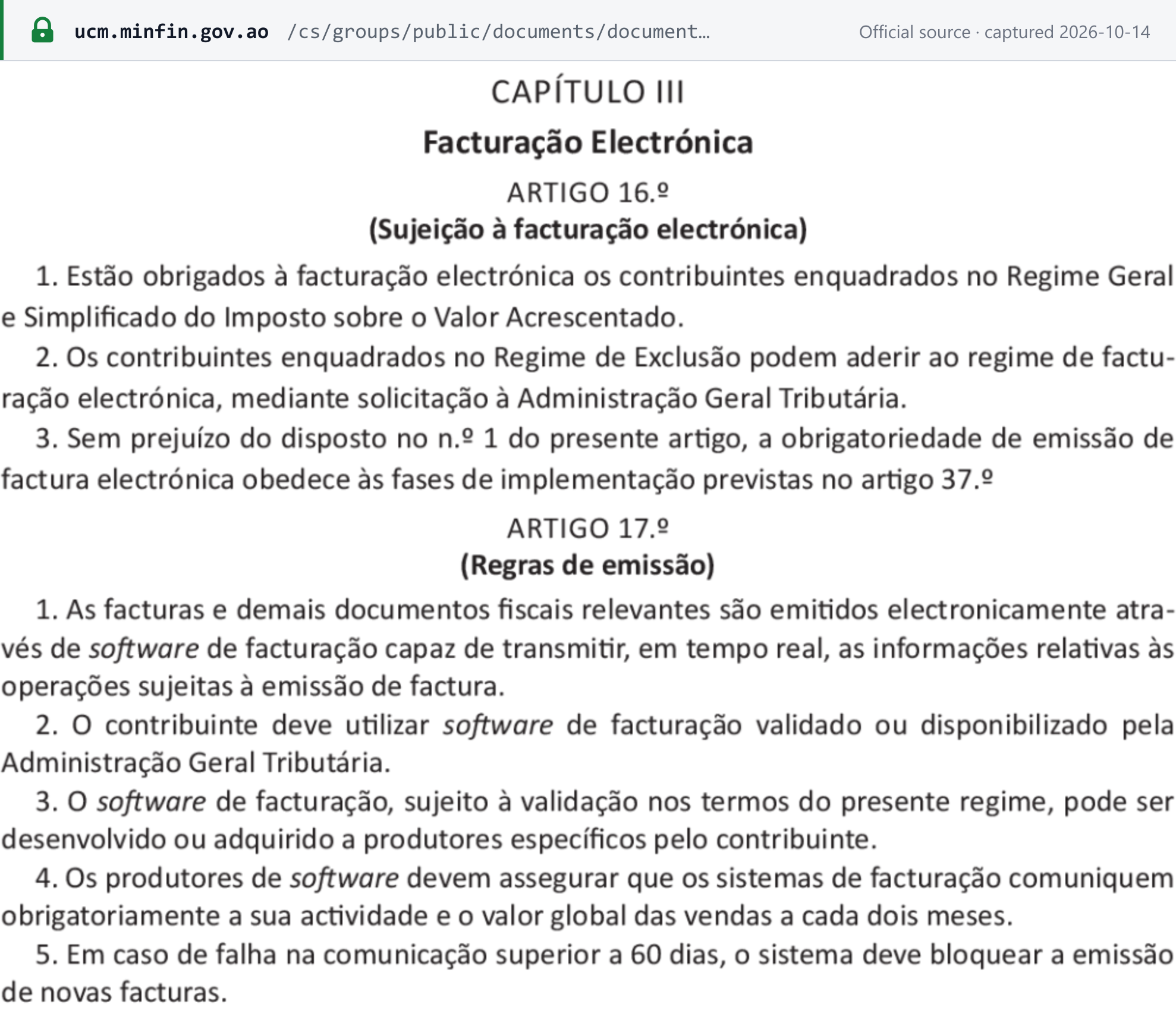
- Communication lock. E-invoicing software must block new invoices after more than 60 days without communicating with AGT (art. 17.º n.º 5).
A specimen of a compliant invoice
AGT publishes no annotated specimen invoice; Executive Decree 683/25 defines the e-invoice as a JSON data structure, not a printed layout. Below, Lookuptax lays out the Presidential Decree 71/25 art. 10.º particulars for a domestic general-regime supply of services sold to a commercial bank, which withholds 50% of the IVA. Every name, number and amount is fictional:
FACTURA
| DescriptionArt 10.1 c) | QtyArt 10.1 c) | Unit price (Kz)Art 10.1 d) | RateArt 10.1 e) | Total (Kz)Art 10.1 d) |
|---|---|---|---|---|
| IT consulting services, September 2026 | 1 | 1,000,000.00 | 14% | 1,000,000.00 |
- Taxable amountArt 10.1 d)
- Kz 1,000,000.00
- IVA 14%Art 10.1 e)
- Kz 140,000.00
- TotalArt 10.1 d)
- Kz 1,140,000.00
- In wordsArt 10.1 d)
- um milhão, cento e quarenta mil kwanzas
- Issued with AGT-validated invoicing software "SpecimenSoft 1.0", certificate no. SPECIMEN/AGT/0000, hash extract XXXX (Art 10.1 j)).
- The customer is a commercial bank, which withholds 50% of the IVA (IVA cativo, CIVA art. 21.º n.º 2): it pays Kz 1,070,000.00 and the receipt must show the Kz 70,000.00 withheld (Art 6.3).
- If a line were exempt, the invoice would give the reason and cite the legal provision instead of a rate (Art 10.1 f)).
- Issued by the fifth working day after the supply (Art 8.1).
E-invoicing status
Status: phased and mandatory, on a real-time reporting model. Invoices are issued in AGT-validated software "capaz de transmitir, em tempo real" — able to transmit the invoice data to AGT in real time (Presidential Decree 71/25 art. 17.º n.º 1) — or on the Portal do Contribuinte. [3]
| Phase | Who | From |
|---|---|---|
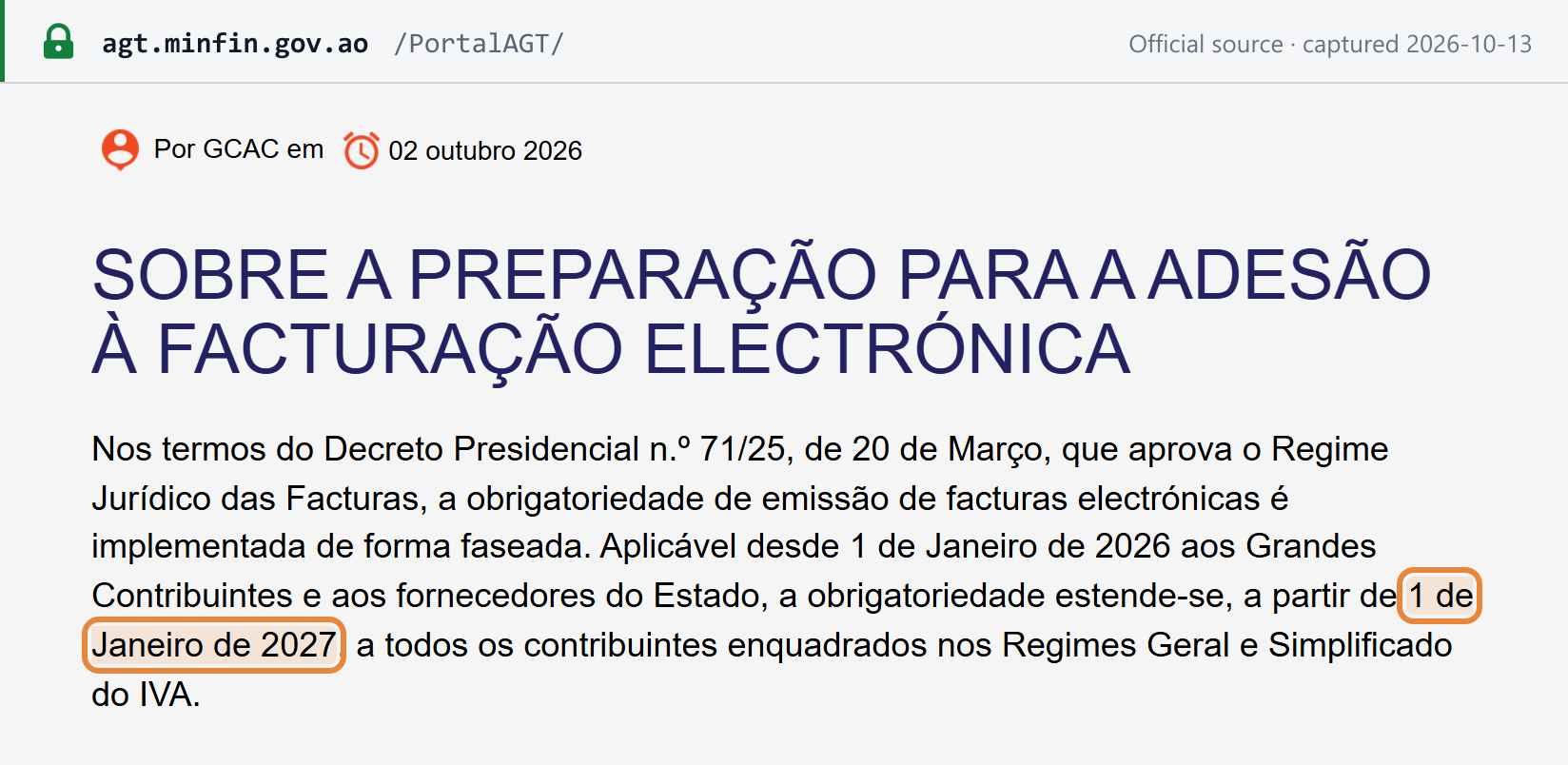
| 1 | Taxpayers of the 1st and 2nd Large Taxpayers' Tax Offices (enrolled automatically) and suppliers to the State | 1 January 2026 |
| 2 | All taxpayers in the general and simplified IVA regimes | 1 January 2027 |
| Optional | Exclusion-regime taxpayers, on request to AGT | — |
AGT, 2 October 2026: "Aplicável desde 1 de Janeiro de 2026 aos Grandes Contribuintes e aos fornecedores do Estado, a obrigatoriedade estende-se, a partir de 1 de Janeiro de 2027, a todos os contribuintes enquadrados nos Regimes Geral e Simplificado do IVA." On 6 May 2026 the AGT chair said "não haverá prorrogação do prazo" — the deadline will not be extended. [6] [15]
- Scope. The obligation attaches to the issuer, so once a taxpayer is in scope it covers every invoice it issues — B2B, B2G and B2C. Exclusion-regime taxpayers may opt in on request to AGT (art. 16.º n.º 2); AGT treats a taxpayer that opts in as fully bound by the obligation. [7]
- Format. JSON web services defined in Executive Decree (Decreto Executivo) n.º 683/25, de 22 de Agosto, Annex I. The "Solicitar Registo de Factura Electrónica" service carries fields such as
schemaVersion,submissionGUID,taxRegistrationNumber,submissionTimeStampandsoftwareInfo; it is signed with a JWS (jwsSoftwareSignature) using the software producer's private key; one call carries at most 30 invoices; and document numbers follow the SAF-T (AO) numbering. [4] - Contingency. Offline issuance in the software when the connection to AGT fails, marked as issued in contingency (art. 18.º), or AGT-authorised printed books for up to 45 days if equipment fails (art. 7.º n.º 6).
- SAF-T. General- and simplified-regime taxpayers that e-invoice "estão dispensados da submissão dos Ficheiros Normativos de Inspecção Tributária (SAF-T)" — they no longer submit the SAF-T invoicing file (AGT, 24 March 2026). The accounting SAF-T (by 10 April) and the inventory file (by 15 February) are still due (art. 24.º n.º 1 d)–e)). [8]
- Sanctions. The invoicing fines apply (see Offences and penalties), and State suppliers that do not comply are barred from supplying the State and restricted in the State's financial management system (SIGFE). [7]
- Adoption. On 7 May 2026 AGT reported about 46,000 companies issuing e-invoices and about 400,000 invoices reported to it each day. [15]
For Angola alongside other countries, see the e-invoicing status and networks table, and for how real-time reporting differs from clearance, CTC e-invoicing models.
Filing and payment
Filing frequency
Monthly, for both the general and the simplified regime. General-regime taxpayers file the declaração periódica (Modelo 7); simplified-regime taxpayers file a simplified return. The return is due even with no operations (CIVA art. 32.º n.º 2), and a return filed without its annexes and adjustment schedules "considera-se não entregue" — is treated as not filed (art. 32.º n.º 5). [1]
Return due date
The statutory rule. The periodic return and its annexes are filed electronically "até ao último dia útil do mês seguinte àquele a que respeitam as operações" — by the last working day of the month after the month of the operations (CIVA art. 44.º n.º 1). Filing generates the payment slip (Nota de Liquidação) automatically, and a credit rolls forward to the next return unless a refund is requested (art. 44.º n.ºs 2–3). [1]
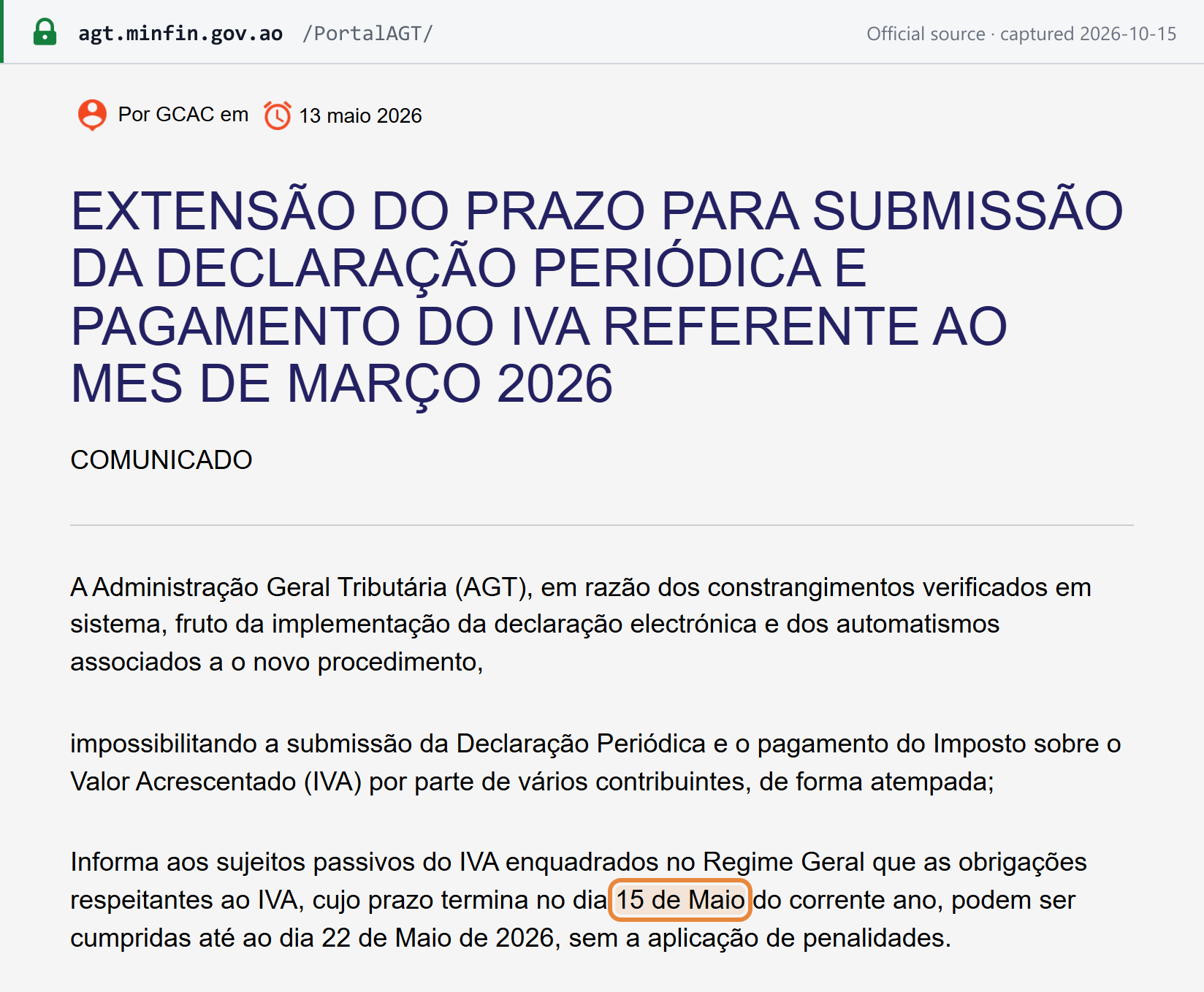
One-off extensions in 2026. AGT has extended specific general-regime deadlines, without penalties:
- obligations falling due on 15 April 2026 could be met by 30 April 2026; [11]
- for the March 2026 return and payment, obligations falling due on 15 May 2026 could be met by 22 May 2026. [10]
These notices give 15 April and 15 May as the original due dates, which differ from the last-working-day date in the Code; AGT has not published the basis. [10] [11]
AGT announces such extensions on its website and the Portal do Contribuinte.
Payment due date and method
IVA is paid by the same deadline as the return: "até ao último dia útil do mês seguinte" (CIVA art. 30.º n.º 1), using the Nota de Liquidação generated on filing; the one-off 2026 extensions above covered payment as well as the return. Filing and payment are electronic, through the Portal do Contribuinte. IVA on imports is paid to customs at clearance (art. 30.º n.º 4). [1]
Additional listings
- Supplier annex (anexo de fornecedores). Pre-filled from suppliers' SAF-T files and e-invoices. For each invoice the taxpayer chooses to deduct, not deduct, defer or reject it; a deferral lasts at most 12 months, after which the deduction is lost. Automatic submission is compulsory for the whole general regime except oil investment companies (AGT, 26 February 2026). [12]
- Entered by hand: invoices for services from foreign suppliers with no Angolan establishment, and IVA cativo invoices (AGT, 1 June 2026). [9]
- Annual files: the accounting SAF-T for the previous year by 10 April, and the inventory file as at 31 December by 15 February (Presidential Decree 71/25 art. 24.º n.º 1 d)–e)). [3]
IVA cativo (withholding by the customer)
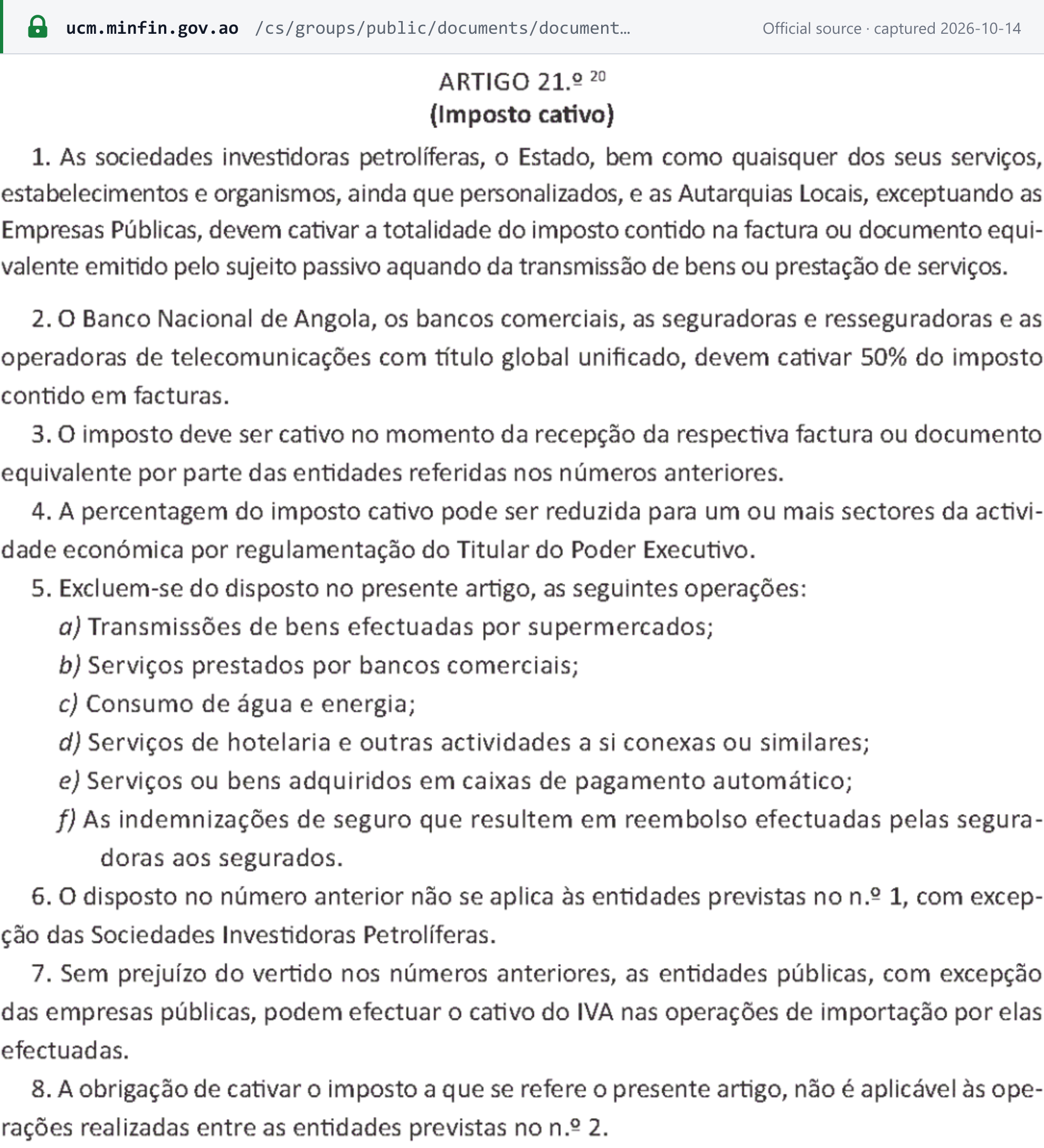
Angola makes certain customers withhold the IVA on the invoices they receive (CIVA art. 21.º): [1]
| Customer | Withholds |
|---|---|
| Oil investment companies, the State and its services and bodies, and local authorities (not public companies) | 100% of the IVA on the invoice |
| National Bank of Angola, commercial banks, insurers and reinsurers, and telecom operators with a unified global licence | 50% of the IVA on the invoice (not on supplies between themselves) |
- When: on receipt of the invoice (n.º 3).
- Excluded from withholding (n.º 5): goods sold by supermarkets, commercial-bank services, water and energy, hotel services, purchases at automatic payment terminals and insurance indemnities. These exclusions apply to the 50% withholders and to oil investment companies, not to the State or local authorities (n.º 6).
- Supplier's side: the supplier deducts the withheld IVA in the return for the period in which it issued the invoice (art. 22.º n.º 6), and its receipt must show the amount withheld. If the customer does not withhold, the supplier pays the IVA itself (art. 29.º n.º 5).
- Withholder's side: withheld IVA is paid over by the last working day of the following month (art. 31.º n.º 1).
- Simplified-regime suppliers: the State withholds on payments to them made through SIGFE (art. 69.º-D).
Input-tax recovery and blocked items
- Documents: input tax is deductible only on documents in the taxpayer's name and NIF — general-regime invoices and import receipts (CIVA art. 23.º n.º 3).
- Timing: the deduction is made in the return for the invoice's period or the one after (art. 23.º n.º 2), and within 12 months of the invoice.
- Pro-rata: a taxpayer with taxable and exempt supplies deducts by annual turnover, rounded up; at 98% or more, all input tax is deductible (art. 27.º).
- Simplified regime: only 10% of input tax is deductible (art. 69.º-C n.º 4).
- Blocked (art. 24.º n.º 1): the purchase, lease, insurance, use and repair of passenger cars ("viaturas de turismo"), pleasure boats, helicopters, planes and motorcycles; accommodation, food, drink and entertainment; and tobacco. The block lifts where the item is resold in a taxable sale (n.º 2). Oil investment companies have their own wider list (art. 25.º).
Refunds
- Default: an excess of input tax is carried forward to later periods (CIVA art. 26.º n.º 1).
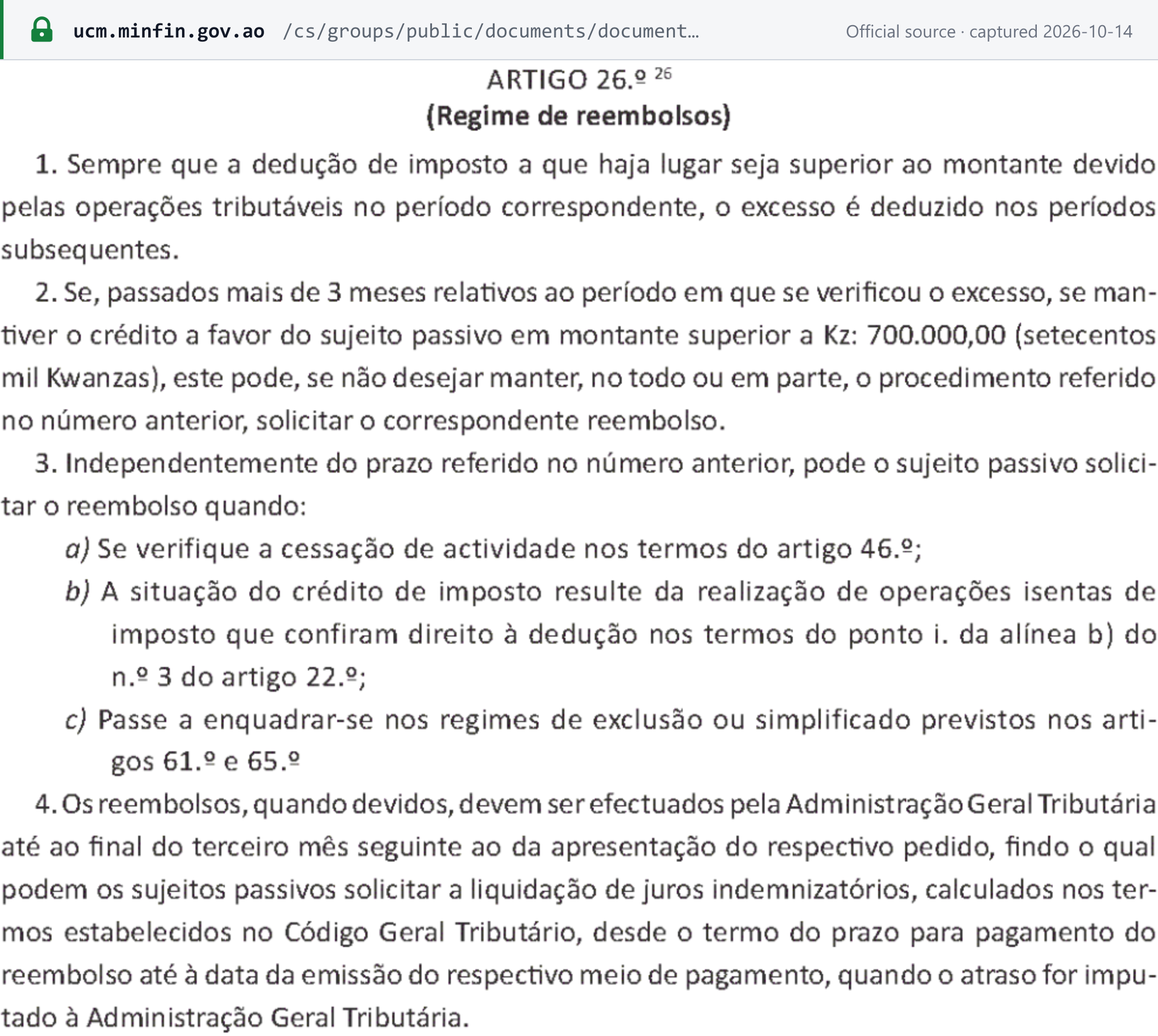
- Refund request: if, more than 3 months after the period of the excess, the credit is still above Kz 700,000, the taxpayer may ask for a refund (art. 26.º n.º 2).
- At any time: on ceasing activity, when the credit comes from exports or other exempt supplies with the right to deduct, or on moving into the exclusion or simplified regime (art. 26.º n.º 3).
- AGT's deadline: "até ao final do terceiro mês seguinte ao da apresentação do respectivo pedido" — by the end of the third month after the request; after that the taxpayer may claim compensatory interest if AGT caused the delay (art. 26.º n.º 4). AGT can suspend the deadline for 30 days while it waits for documents (n.º 5), or for up to 6 more months if it suspects a tax crime (n.º 9).
- Form: cash or a tax credit certificate (n.º 7).
- Simplified regime: a refund can be requested only after 12 months (n.º 10).
- Non-residents: the IVA Code has no refund scheme for foreign businesses that are not registered in Angola.
In 2026, 20% of IVA receipts are paid into a dedicated Refund Account (Lei 14/25 art. 9.º n.º 5). [2]
Exemptions
Exempt supplies
Exempt without the right to deduct (CIVA art. 12.º n.º 1) — examples: [1]
- medicines and medical equipment (Annex IV); disability aids, braille and sight and hearing aids;
- books, including digital books, other than pornographic ones;
- renting out real estate, other than hotel and similar accommodation, and transfers of real estate;
- public passenger transport and ambulance transport;
- financial intermediation (Annex VI), other than fee-based services; health insurance, and life insurance and reinsurance;
- petroleum products (Annex V);
- education, and medical services other than cosmetic ones.
Option to tax. Available only for medicines and books (art. 12.º n.º 2); once chosen it binds for 5 years (art. 13.º n.º 4).
New for 2026. "Ficam isentas do Imposto sobre o Valor Acrescentado e Imposto de Selo as transacções efectuadas através de plataformas de pagamento e transferências instantâneas móveis devidamente autorizadas pelo Banco Nacional de Angola" — payments and instant transfers through BNA-authorised mobile payment platforms are exempt from IVA and stamp duty (Lei 14/25 art. 35.º). [2]
Exempt is not zero-rated. Input tax is deductible only for taxed supplies and for exports and the other operations in arts. 15.º and 16.º (art. 22.º n.º 3). So an art. 12.º supply carries no IVA and the IVA on purchases used to make it cannot be recovered, while an export carries no IVA and keeps the full deduction. General-regime taxpayers whose supplies are all exempt without deduction pay 1% stamp duty on their receipts instead (art. 74.º). [1]
Special regimes
- Simplified and exclusion regimes for small and mid-sized businesses (see Registration).
- Cabinda: imports and supplies under the special regime of the Province of Cabinda are taxed at 1%, except the goods in Annex III, which pay the general rate (art. 19.º n.º 1 e), as amended by Lei 14/23 art. 1).
- Free zones and customs warehouses: exempt while goods stay under the regime (art. 16.º).
- Margin scheme for second-hand goods, works of art, collectors' items and antiques bought for resale from identified non-taxable persons: tax on the difference between selling and purchase price (art. 17.º n.º 3 f)).
- Oil sector: 100% IVA cativo, its own block on deductions (art. 25.º), and exempt imports for oil and mining operations (art. 14.º).
- Industrial equipment: for industrial equipment imported or supplied by the manufacturer, IVA can be deferred for up to 12 months without surcharges when the equipment is for the start of activity ("para início de actividade", art. 78.º n.º 1), or paid in up to 12 monthly instalments without surcharges, whether or not activity is starting (art. 78.º n.º 2); the 5% rate applies from 2026.
Offences and penalties
Offences
Criminal tax offences — tax fraud (fraude fiscal), aggravated tax fraud, including the use of invoices for operations that did not take place, and abuse of tax trust (abuso de confiança fiscal), such as keeping IVA collected or withheld instead of handing it to the State — are defined and punished, including with imprisonment, by the General Tax Code (Código Geral Tributário, Lei n.º 21/14 as originally enacted, arts. 172.º–179.º). [13]
Other unlawful conduct, punished with the fines below: failing to issue an invoice, issuing invoices from software not validated by AGT or in series not communicated to it, failing to file the return, and failing to withhold or pay over IVA cativo. Fraud in the invoice prize draw is referred for criminal proceedings (Presidential Decree 71/25 art. 33.º).
Penalties
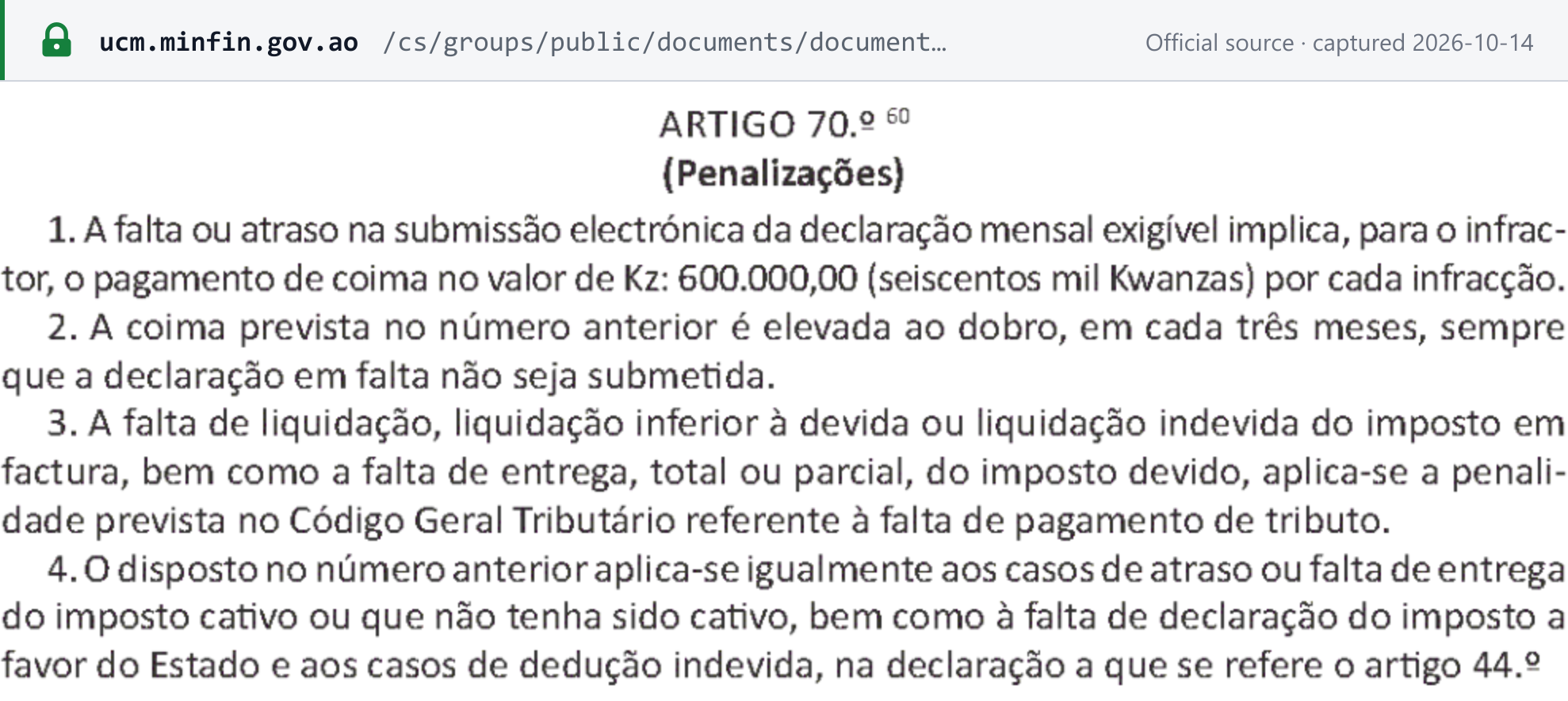
Returns and payment (IVA Code art. 70.º).
- Late or missing monthly return: a fine of Kz 600,000 per infraction, doubled for every three months the return remains missing (n.ºs 1–2).
- Under-charging, not paying, late or missing payment of IVA cativo, or undue deduction: the General Tax Code penalty for non-payment of tax applies (n.ºs 3–4).
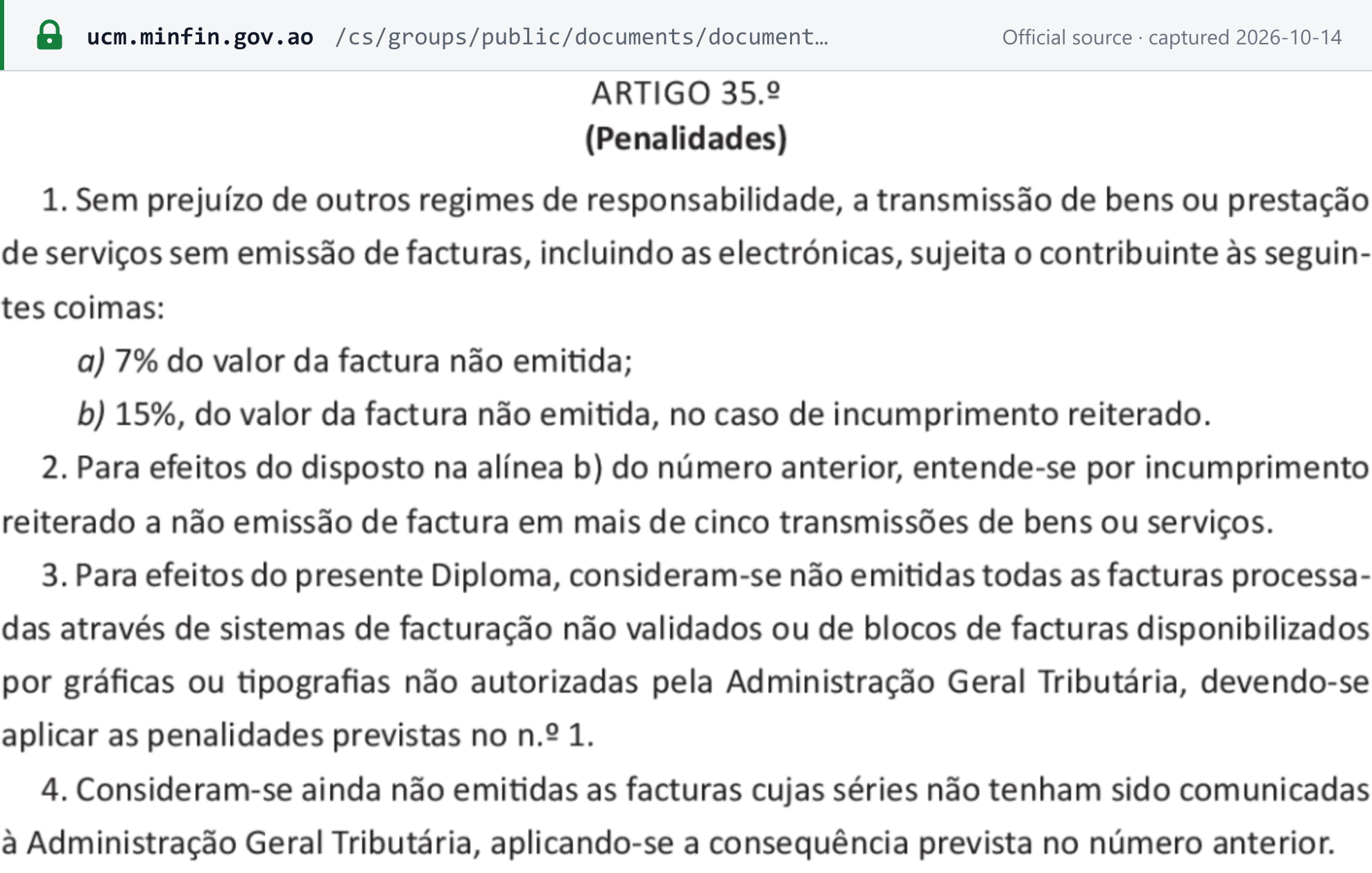
Invoicing (Presidential Decree 71/25 art. 35.º). [3]
| Breach | Fine | Art. 35.º |
|---|---|---|
| No invoice issued, including e-invoices | 7% of the value of the invoice not issued | n.º 1 a) |
| Repeated non-issue (more than five supplies) | 15% of the value of the invoice not issued | n.º 1 b), n.º 2 |
| Invoice omitting or misstating the price, NIF, address, issuer's name or validated software | 5% per invoice | n.º 8 a) |
| Invoice omitting or misstating any other element | 1% per invoice | n.º 8 b) |
| Late invoice (after the fifth working day) | 0.2% of each invoice | n.º 10 |
| No receipts, or failure to archive | 1% per invoice | n.º 9 |
| SAF-T omissions, or no SAF-T for more than 3 consecutive periods | 7% | n.ºs 11–12 |
| SAF-T failure caused by the software producer | Kz 600,000 per period, charged to the producer | n.º 13 |
- Deemed not issued: invoices from non-validated software, from unauthorised printers, or in series not communicated to AGT are treated as not issued, so the 7% or 15% fine applies (n.ºs 3–4).
- First offence: penalties are halved for a first violation of the decree (n.º 15).
NIF rules. Entities that breach the NIF regime face a fine of Kz 200,000 (Presidential Decree 245/21). [14]
Frequently asked questions
Our customer is the State or an oil company and paid our invoice without the IVA. Is that right?
Yes. Under article 21 of the IVA Code, oil investment companies, the State and its services, and local authorities (but not public companies) withhold the whole of the IVA on the invoices they receive. The National Bank of Angola, commercial banks, insurers and reinsurers, and telecom operators with a unified global licence withhold 50%. You deduct the withheld amount in the return for the period in which you issued the invoice, and your receipt must show it.
Is there a VAT registration threshold in Angola?
Not in the sense of a turnover below which you stay unregistered. Anyone carrying on an economic activity must register with AGT and hold a NIF. Turnover or imports in the previous financial year decide the IVA regime: below Kz 25,000,000 you are in the exclusion regime and charge no IVA; from Kz 25,000,000 to below Kz 350,000,000 you are in the simplified regime and pay 7% on turnover received; at Kz 350,000,000 or more you are in the general regime and charge IVA on your invoices.
We are a foreign software company selling to Angolan businesses. Do we have to register for IVA?
Not for services you supply from abroad to Angolan taxable persons. Where the supplier is non-resident with no permanent establishment in Angola, the Angolan business customer accounts for the IVA itself under the reverse charge (IVA Code article 29(2)); a simplified-regime customer applies 7%. A non-resident that makes taxable supplies in Angola must appoint a fiscal representative, who is jointly liable for the tax (article 33).
What if we sell digital services to Angolan consumers?
Services used or effectively exploited in Angola are always taxable there. A non-resident making taxable supplies in Angola must appoint an Angolan fiscal representative, who is jointly liable for the tax. Article 33(5) of the IVA Code provides a simplified registration instead for non-residents without a permanent establishment, on terms to be set by regulation. Where the sale is made through a digital platform, the platform's owner or operator charges and pays the IVA.
When do we have to issue e-invoices?
According to AGT, e-invoicing has applied since 1 January 2026 to taxpayers of the 1st and 2nd Large Taxpayers' Tax Offices and to suppliers to the State, and applies from 1 January 2027 to all taxpayers in the general and simplified IVA regimes. Exclusion-regime taxpayers may opt in.
Do we still file SAF-T if we e-invoice?
Not the SAF-T invoicing file: AGT announced on 24 March 2026 that general- and simplified-regime taxpayers who issue e-invoices no longer submit it. The annual accounting SAF-T for the previous year (due 10 April) and the inventory file as at 31 December (due 15 February) are still due.
Can we invoice in US dollars?
Prices must be shown in kwanza and also written out in words, except on invoices for imports and exports, which follow international trade rules. Where the taxable amount is in a foreign currency, it is converted at the National Bank of Angola selling rate on the date the tax becomes chargeable.
When is the IVA return due?
The IVA Code sets the last working day of the month after the month of the operations, for both the return and the payment. AGT occasionally extends specific deadlines: in 2026 it extended obligations falling due on 15 April to 30 April, and the March 2026 obligations falling due on 15 May to 22 May. AGT's notices give 15 April and 15 May as the original due dates, which differ from the date in the Code; AGT has not published the basis.
Can we recover IVA on company cars or staff meals?
No. Article 24 of the IVA Code blocks input tax on passenger cars, pleasure boats, helicopters, planes and motorcycles (including their lease, insurance and repair), on accommodation, food, drink and entertainment, and on tobacco, unless the item is resold in a taxable sale.
Important websites
| Site | Purpose |
|---|---|
| Portal do Contribuinte | Register, file the IVA return (Modelo 7), pay, sign up for e-invoicing, issue invoices in the exclusion regime, and check your NIF status |
| AGT — Consultar NIF | AGT's public NIF lookup (protected by a reCAPTCHA check) |
| Modelo 7 user guide (PDF) | AGT's guide to completing the general-regime periodic return |
| Certified e-invoicing software list (PDF) | AGT's list of validated invoicing software, October 2026 |
| AGT tax simulator | AGT's tax and customs-duty simulator |
| Guiché Único da Empresa | One-stop shop for incorporating a company |
| AGT | News, notices, legislation library; taxpayer support on (+244) 923 167 010 or [email protected] |
| Angola NIF validator | Check a NIF's format with Lookuptax |
Recent changes
- 2026-10-02 — AGT confirms that e-invoicing extends to all general- and simplified-regime IVA taxpayers from 1 January 2027. (AGT)
- 2026-06-01 — AGT: the periodic return is pre-filled on the 1st of each month from e-invoices and SAF-T files; foreign-service and IVA cativo invoices are entered by hand. (AGT)
- 2026-05-13 — AGT extends the general-regime IVA deadline of 15 May 2026 (March 2026 operations) to 22 May 2026. (AGT)
- 2026-03-24 — AGT releases general- and simplified-regime e-invoicers from submitting the SAF-T invoicing file. (AGT)
- 2026-02-26 — AGT makes automatic submission of the supplier annex compulsory for the general regime and caps invoice deferral at 12 months. (AGT)
- 2026-01-01 — E-invoicing becomes mandatory for large taxpayers and suppliers to the State. (AGT)
- 2026-01-01 — OGE 2026 (Lei 14/25) in force: regime changes by the end of the following month, 5% IVA on manufacturers' industrial equipment, and mobile payments exempt. (Lei 14/25)
For the full chronology, see Angola tax changes on Lookuptax.
Reference links
- IVA Code, republished by Lei n.º 14/23, de 28 de Dezembro (Diário da República I Série n.º 246, PDF)
- Lei n.º 14/25, de 30 de Dezembro — State Budget (OGE) 2026 (PDF)
- Presidential Decree n.º 71/25, de 20 de Março — Regime Jurídico das Facturas (PDF)
- Executive Decree n.º 683/25, de 22 de Agosto — e-invoicing technical rules (PDF)
- AGT Circular n.º 01/GACA/GJ/AGT/2026 — OGE 2026 tax measures (PDF)
- AGT — Sobre a preparação para a adesão à facturação electrónica (2 October 2026)
- AGT — e-invoicing in force for large taxpayers and State suppliers (5 January 2026)
- AGT — SAF-T waiver for e-invoicing taxpayers (24 March 2026)
- AGT — periodic return pre-filling and supplier annex (1 June 2026)
- AGT — extension of the deadline for the March 2026 IVA return (13 May 2026)
- Portal do Contribuinte — extension of the 15 April 2026 IVA deadline
- AGT — supplier annex and automatic submission (26 February 2026)
- Código Geral Tributário, Lei n.º 21/14, de 22 de Outubro (PDF)
- Presidential Decree n.º 245/21 — NIF regime (PDF)
- AGT — e-invoicing adoption and no extension of the deadline (7 May 2026)
Related on Lookuptax: