Bangladesh VAT guidelines
| FACTSHEET | |
|---|---|
| Country code | BD |
| Tax name | Value Added Tax (VAT) — মূল্য সংযোজন কর (মূসক, "Mushak"); Turnover Tax for enlisted small businesses |
| Tax Authority | National Board of Revenue (NBR) |
| Currency | Bangladeshi taka (BDT, Tk) |
| Tax period | One calendar month; returns monthly from 1 October 2026 |
Overview
Bangladesh levies Value Added Tax — mulya sanjojan kar (মূল্য সংযোজন কর), shortened to Mushak (মূসক), the name every NBR form carries — under the Value Added Tax and Supplementary Duty Act 2012 (Act No. 47 of 2012). The National Board of Revenue (NBR) administers it. Supplementary duty, an excise-type levy on listed goods and services, sits in the same Act and is reported on the same return. VAT is a single national tax: there is no provincial or municipal layer. Amounts are in taka (BDT, Tk), and the tax period is one calendar month. [24]
The standard rate is 15%; reduced rates of 5%, 7.5% and 10% and fixed per-unit amounts apply to goods and services in the Act's Third Schedule. Separately, goods supplied at the local trading stage carry 7.5% (medicines 3%, listed petroleum fuels 2%), and land developers, real-estate sellers and certain wholesalers have their own rates of 1.5% to 4.5% (see Rates). Businesses with turnover above BDT 3,000,000 but not above the BDT 5,000,000 registration threshold pay Turnover Tax instead. [1] [5]
Three instruments shaped the rules as they stand on 4 November 2026:
- The Finance Act, 2026 (Act No. 96 of 2026, dated 30 June 2026, in force from 1 July 2026) made a BIN a precondition for banking and other business services, substituted section 20 on imported services, replaced the turnover-tax rule in section 63, and briefly moved VAT returns to a quarterly cycle. [13] [12]
- The Value Added Tax and Supplementary Duty (Amendment) Ordinance, 2026 (Ordinance No. 38 of 2026), dated 14 October 2026 and deemed in force from 1 October 2026, restored monthly returns. It is an Ordinance made by the President under Article 93(1) of the Constitution while Parliament was not in session, not an Act of Parliament. [39] [25]
- The 2025 interim-government Ordinance that lowered the registration and enlistment thresholds from 9 January 2025 was later passed by Parliament as the VAT and Supplementary Duty (Amendment) Act 2026 (Act No. 77 of 2026, 10 April 2026). [5]
Separately, three Statutory Regulatory Orders (SROs) of June 2026 sit outside the Finance Act: SRO 146 caps VAT on locally made refrigerators, freezers, air conditioners and compressors at 7.5%; SRO 156 exempts pesticide raw materials; and SRO 147 exempts NBR-registered startups (see Exemptions). [33] [34] [35]
For the dated history of these changes, see Bangladesh tax changes on Lookuptax.
Registration
Who should register
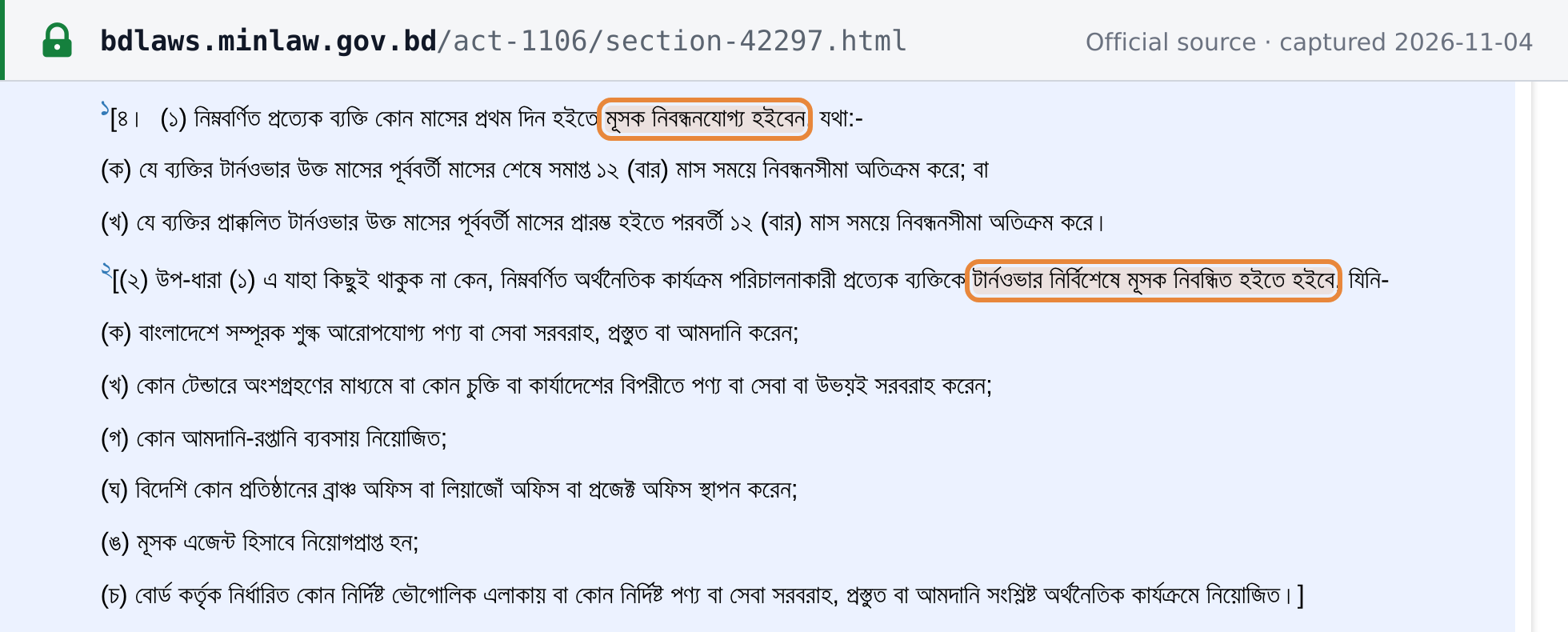
The liability rule is in section 4 of the Act. A person becomes registrable from the first day of a month if either: [6]
- its turnover in the 12 months ending with the previous month exceeded the registration threshold; or
- its estimated turnover for the 12 months starting with the previous month will exceed it.
Regardless of turnover, section 4(2) requires VAT registration of every person who: [6]
- supplies, makes or imports goods or services subject to supplementary duty in Bangladesh;
- supplies goods or services through a tender, or under a contract or work order;
- is engaged in an import or export business;
- sets up a branch, liaison or project office of a foreign entity;
- is appointed as a VAT agent (see Cross-border rules); or
- is engaged in activities in a geographical area, or in goods or services, specified by the Board.
The registration threshold does not apply to these persons (section 2(57), proviso), so the figures below decide registration only for businesses outside the six categories. [5]
 Source snapshot captured 2026-11-04 — original
Registration threshold
| Trigger | Threshold (since 9 January 2025) | Notes |
|---|---|---|
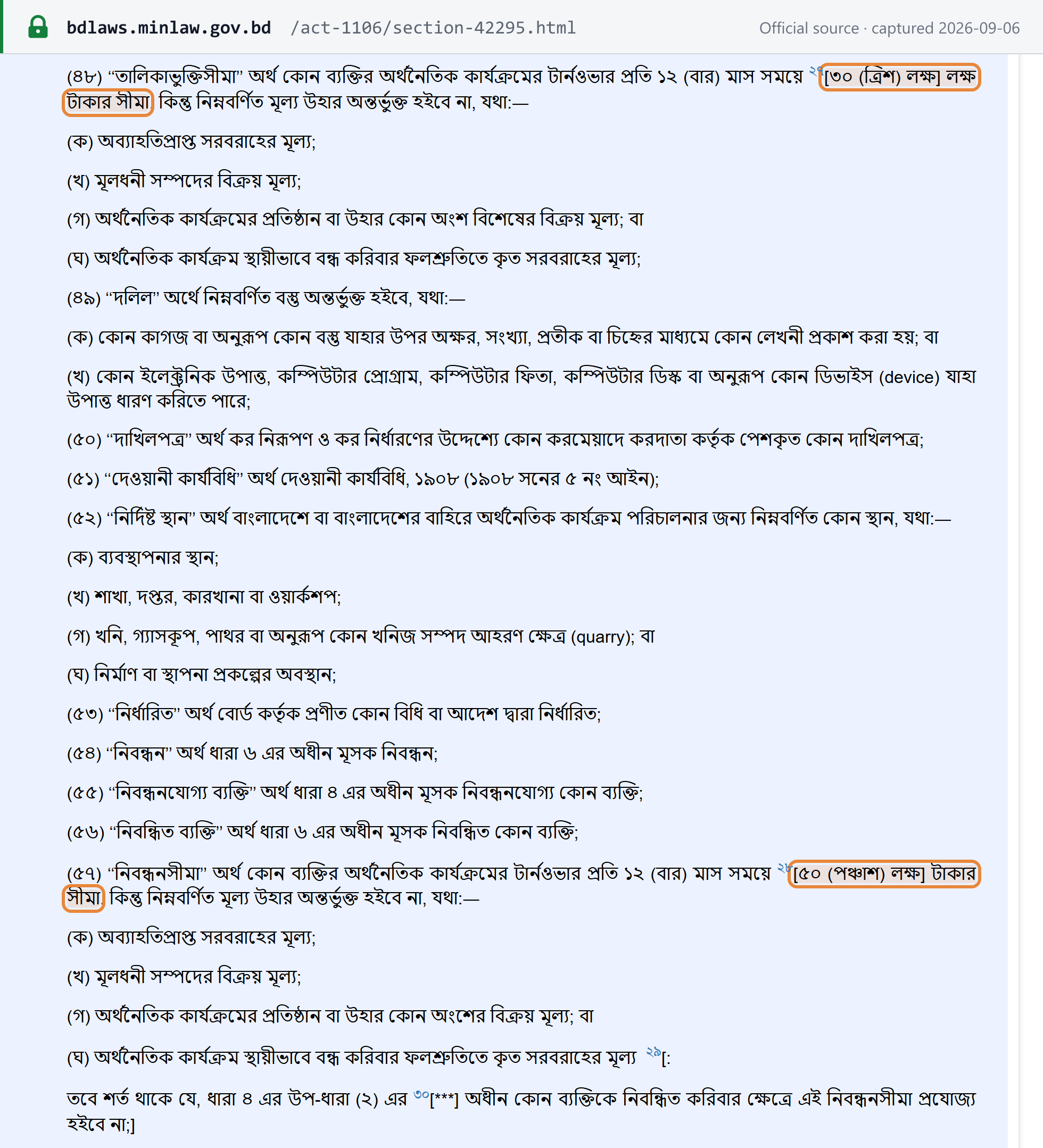
| VAT registration | Turnover of economic activities above BDT 5,000,000 in 12 months | Section 2(57). The figure has applied since 9 January 2025, when it replaced BDT 30,000,000. Apply within 15 days of becoming registrable, on Form VAT-2.1 (residents) or VAT-2.2 (non-residents). [5] [11] |
| Turnover Tax enlistment | Turnover above BDT 3,000,000, but not above the registration threshold | Section 2(48), at this level since 9 January 2025. Apply for enlistment through eVAT within 30 days of crossing the threshold; eVAT approves the application and issues the certificate at once (section 10, as substituted by the Finance Act, 2026). [5] [10] |
| Below the enlistment threshold | Turnover not above BDT 3,000,000 | No registration or enlistment is required, unless section 4(2) applies. [5] [6] |
What counts as turnover. Section 2(57) leaves four amounts out of the registration test: the value of exempt supplies, sales of capital assets, the sale of the business or part of it, and supplies made on permanently closing the business. The threshold does not apply to a person who must register under section 4(2). [5]
 Source snapshots captured 2026-09-06 — original
NBR's English VAT FAQ page still prints the original 2012 registration threshold of BDT 8,000,000. The Act, as amended, is the current law. [38]
Non-resident registration
The Act sets no separate registration threshold for non-residents, and it does not say whether, or how, the BDT 5,000,000 threshold applies to a non-resident supplier. A non-resident without a fixed place of business in Bangladesh must act through a VAT agent, and a person appointed as VAT agent must register regardless of turnover. Non-residents apply on Form VAT-2.2. See Foreign companies selling into Bangladesh. [6] [16] [11]
Tax registration number (BIN)
VAT registration or Turnover Tax enlistment produces a Business Identification Number (BIN). NBR's homepage search takes the 13-digit BIN and returns basic taxpayer information. The BIN is separate from the e-TIN used for income tax. [36] For formats and worked examples, see our Bangladesh TIN and BIN number guide. To check a BIN, use our Bangladesh BIN validator or follow How to verify a BIN number in Bangladesh.
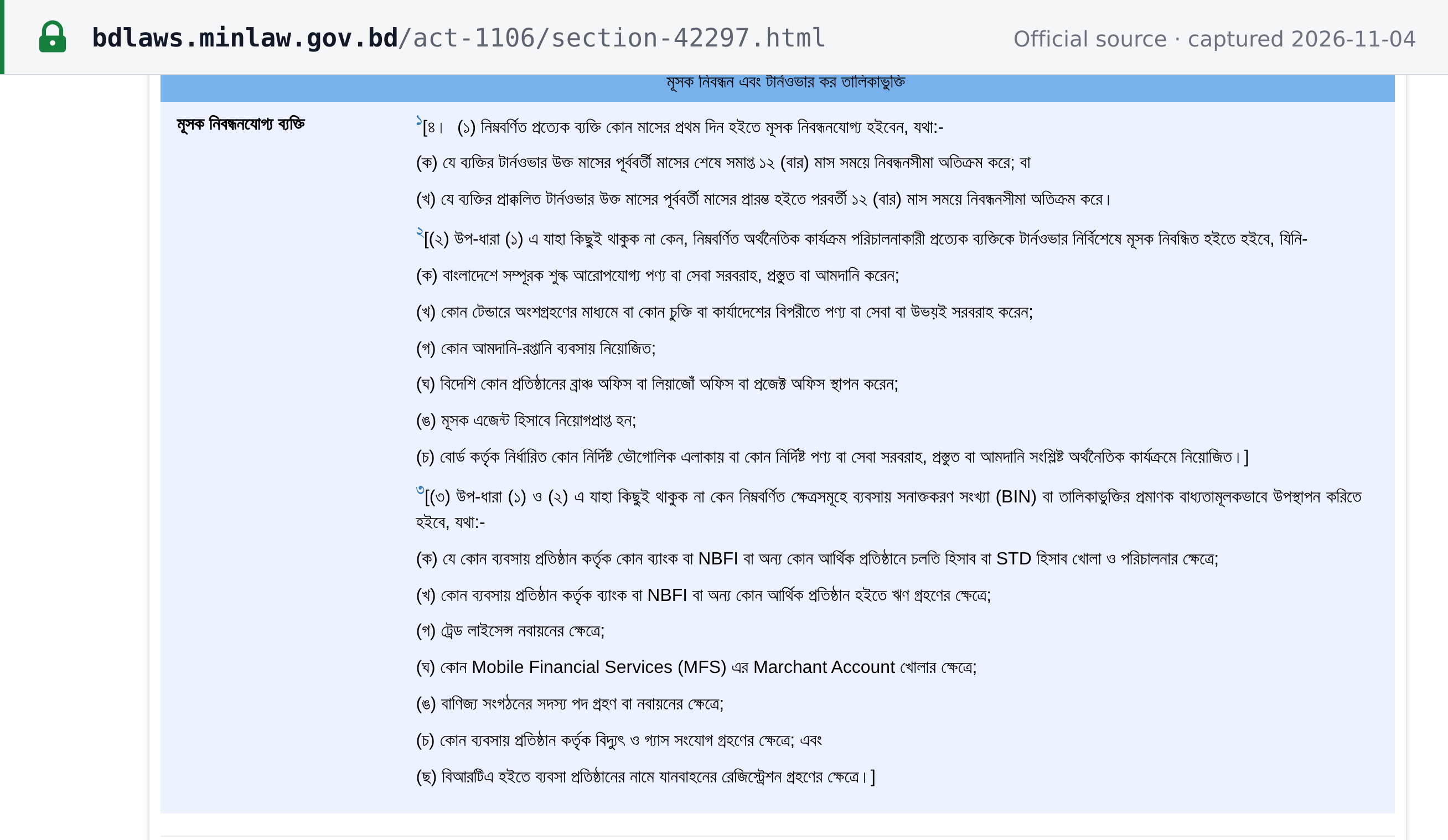
A BIN is now a precondition for ordinary business life. From 1 July 2026, section 4(3) (inserted by the Finance Act, 2026) requires a BIN or proof of enlistment before a person can: [6] [12]
- open or operate a current or STD account with a bank or non-bank financial institution (NBFI);
- take a loan from a bank or NBFI;
- renew a trade licence;
- open a Mobile Financial Services (MFS) merchant account;
- obtain or renew membership of a trade body;
- obtain an electricity or gas connection; or
- register a vehicle in a business name with the Bangladesh Road Transport Authority (BRTA).
 Source snapshot captured 2026-11-04 — original
Businesses near the thresholds therefore have a practical reason to register before the turnover test requires it.
How to register
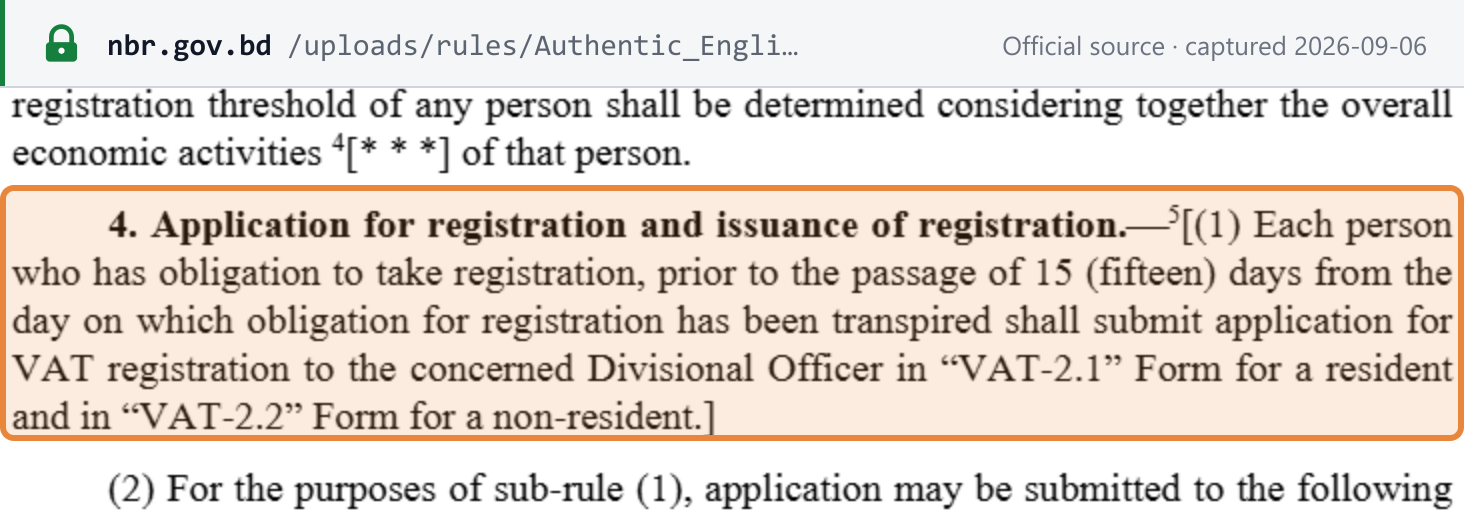
Registration and enlistment are online, through NBR's eVAT system at vat.gov.bd. Under rule 4(1) of the VAT Rules 2016, a person obliged to register applies within 15 days, on Form VAT-2.1 (resident) or VAT-2.2 (non-resident). [11]
 Source snapshot captured 2026-09-06 — original
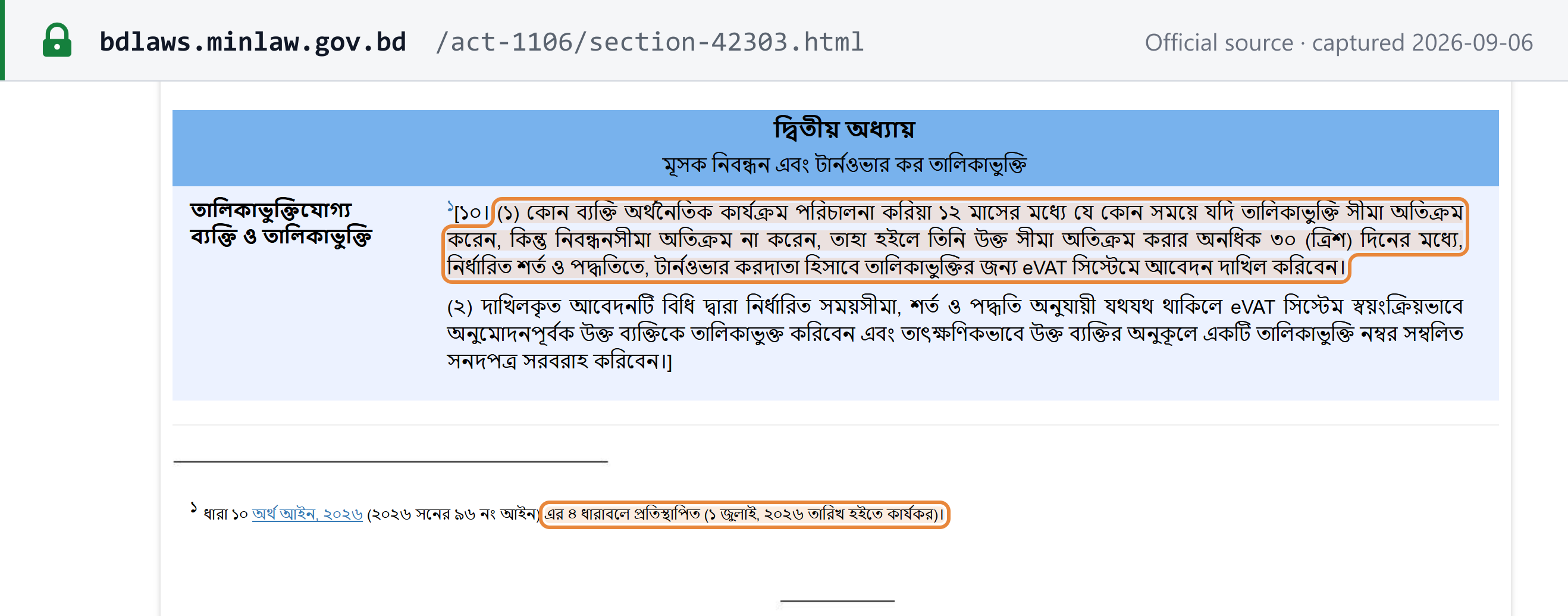
Turnover Tax enlistment is applied for through eVAT within 30 days of crossing the enlistment threshold (section 10(1), as substituted by the Finance Act, 2026). [10]
 Source snapshot captured 2026-09-06 — original
Voluntary registration
A person below the threshold may register voluntarily under section 8. A voluntarily registered person must comply with every provision of the Act like any other registered person, and may not apply to cancel the registration until at least one year after the registration date (section 8(3)). [8]
Deregistration
Under section 9, a registered person may apply to cancel its registration when it stops its economic activity, or when it is no longer required to be registered; after cancellation, the officer may enlist it as a Turnover Tax payer if it is enlistable (section 9(5)). On cancellation it must at once stop issuing tax invoices, withholding certificates, receipts, credit notes and debit notes, return its registration certificate and certified copies to the relevant officer, pay any tax due and file a final VAT return within the prescribed time (section 9(6)). Site verification after online registration can also lead to cancellation (section 9(7)). [9]
Group registration
The VAT and Supplementary Duty Act 2012 contains no provision for grouping separate persons under one registration. Section 5 instead lets one person with several units take a single central registration, where it supplies the same or similar goods or services from one or more places and keeps all accounts, tax payments and records centrally in automated software. Different goods or services supplied from different places need separate registrations, tobacco under the section 58 special scheme is excluded, and movements between centrally registered units are not supplies. [7]
Rates
| Rate | Applies to |
|---|---|
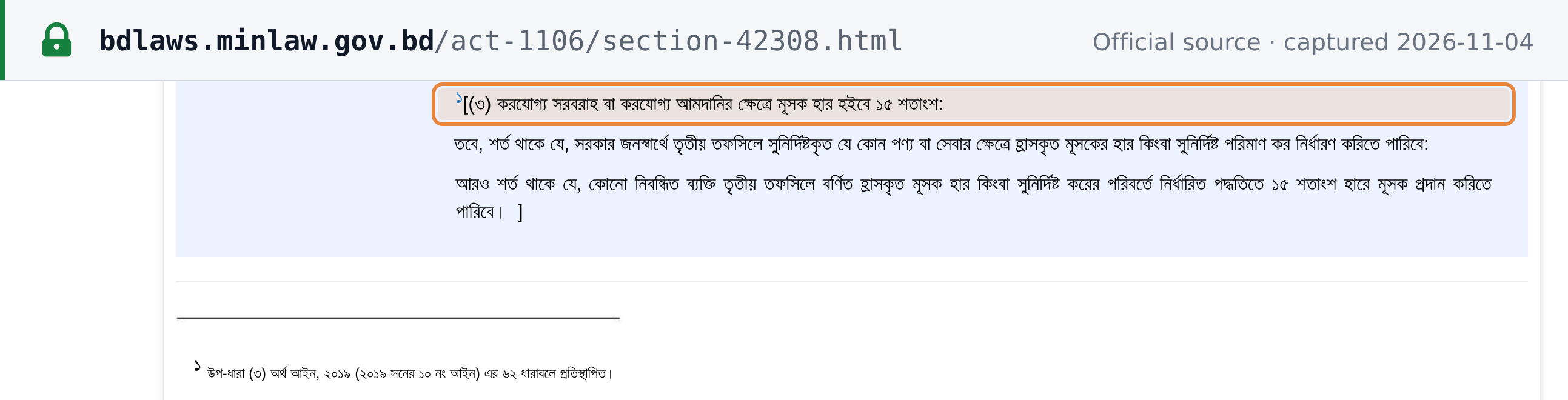
| 15% (standard) | Taxable supplies and taxable imports (section 15(3), as substituted by the Finance Act 2019), and imported services under section 20 from 1 July 2026. A registered person may choose to pay 15% instead of a Third Schedule rate. [1] [17] |
| 10% (Third Schedule, Table-3) | Local supply of listed goods and services, for example construction firms, air-conditioned or air-cooled launch services, and procurement providers. [2] |
| 7.5% (Third Schedule, Table-2) | Local supply of listed goods and services, for example LP gas, simplex paper, barbed wire, aluminium household articles, stainless-steel blades, and furniture manufacturers and showrooms. [2] |
| 5% (Third Schedule, Table-1) | Local supply of listed goods and services, for example powder milk made from liquid milk, ground spices, rapeseed and mustard oil, coal from the Boro Pukuria mine, ride sharing, internet agencies, IT-enabled services, English-medium schools and electricity distribution. [2] |
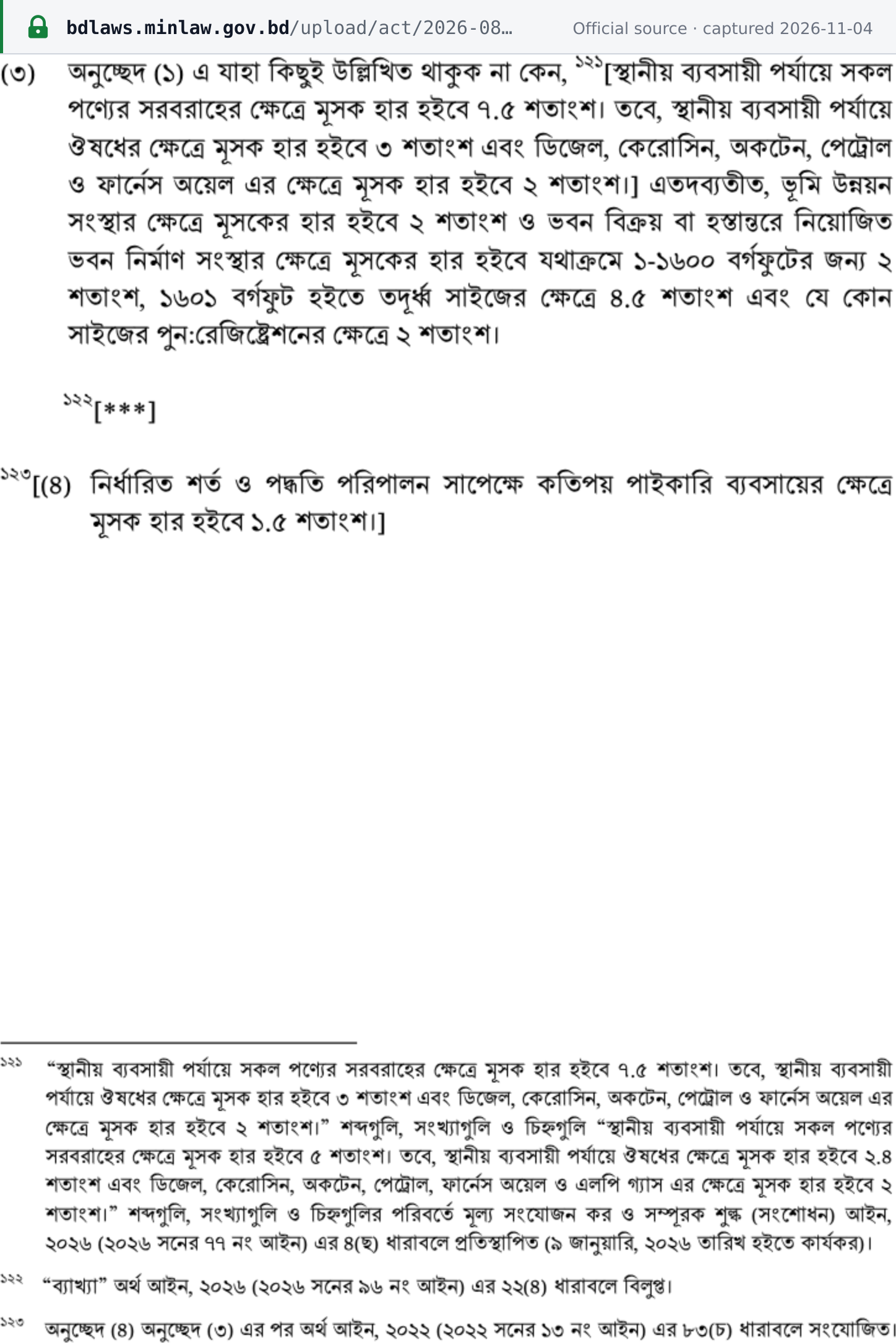
| 7.5% / 3% / 2% (Third Schedule, paragraph (3)) | Supply of all goods at the local trading stage: 7.5%; medicines 3%; diesel, kerosene, octane, petrol and furnace oil 2%. [2] [43] |
| 2% / 4.5% (Third Schedule, paragraph (3)) | Land developers 2%; building sale or transfer by real-estate firms 2% for 1–1,600 sq ft, 4.5% for 1,601 sq ft and above, and 2% on re-registration of any size. [2] [43] |
| 1.5% (Third Schedule, paragraph (4)) | Certain wholesale businesses, subject to prescribed conditions. [2] [43] |
| Fixed amounts (Third Schedule, Table-4) | Per-unit tax instead of a percentage on local supply of listed goods, for example newsprint Tk 1,600 per metric ton, cotton yarn Tk 5 per kg, bricks Tk 500–800 per thousand, and M.S. products Tk 1,900–3,400 per metric ton (amounts substituted by the Finance Act, 2026 from 1 July 2026). [2] [42] |
| 0% (zero-rated) | Supplies under sections 22–24: land outside Bangladesh, exports of goods, and zero-rated services (section 21). [3] |
| 4% (Turnover Tax) | Enlisted persons (turnover above BDT 3,000,000, not above BDT 5,000,000), from 1 July 2026, until the Government notifies sector-specific fixed amounts capped at BDT 200,000 (section 63(1)). [4] |
| 7.5% cap (SRO concession, not a Schedule rate) | Local manufacture of refrigerators, freezers, air conditioners and compressors (HS 84.14, 84.15, 84.18) under SRO No. 146-Ain/2026/351-Mushak, effective 11 June 2026 and valid to 30 June 2030, subject to BIDA registration, minimum in-house machinery and a 30% value-addition test; their raw materials and spare parts are VAT-exempt. [33] |
 Source snapshot captured 2026-08-06 — original
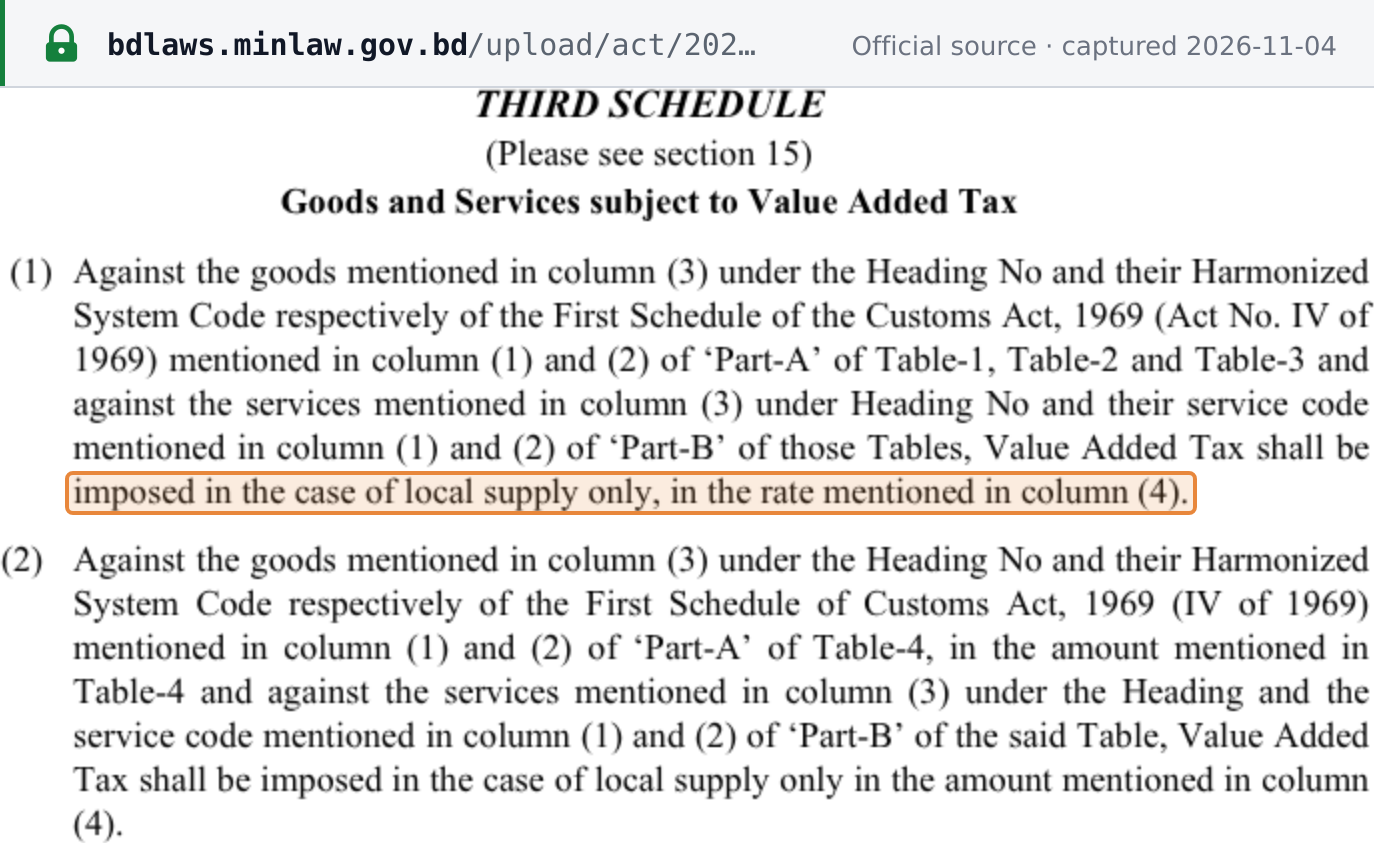
How the reduced rates work. Section 15(3) lets the Government set reduced rates or specific amounts only for goods and services listed in the Third Schedule. The Schedule applies them in the case of local supply only. [1] [2] The Finance Act, 2026 (section 22) amended the Third Schedule from 1 July 2026. It raised the fixed amounts for scrap (Tk 1,500 per metric ton) and M.S. products, added fixed amounts for locally made spirits and unprocessed tobacco, and moved goldsmiths and jewellers from the 5% rate to per-unit amounts. [42] It also replaced Table-4 Part-B, dropping the Tk 300 fixed amount on SIM and e-SIM cards. [42] Paragraphs (3) and (4) of the Schedule add trading-stage, real-estate and wholesale rates (see the table); the Finance Act, 2026 deleted the explanation in paragraph (3) that defined "trader". [43]
 Source snapshot captured 2026-11-04 — original
 Source snapshot captured 2026-11-04 — original
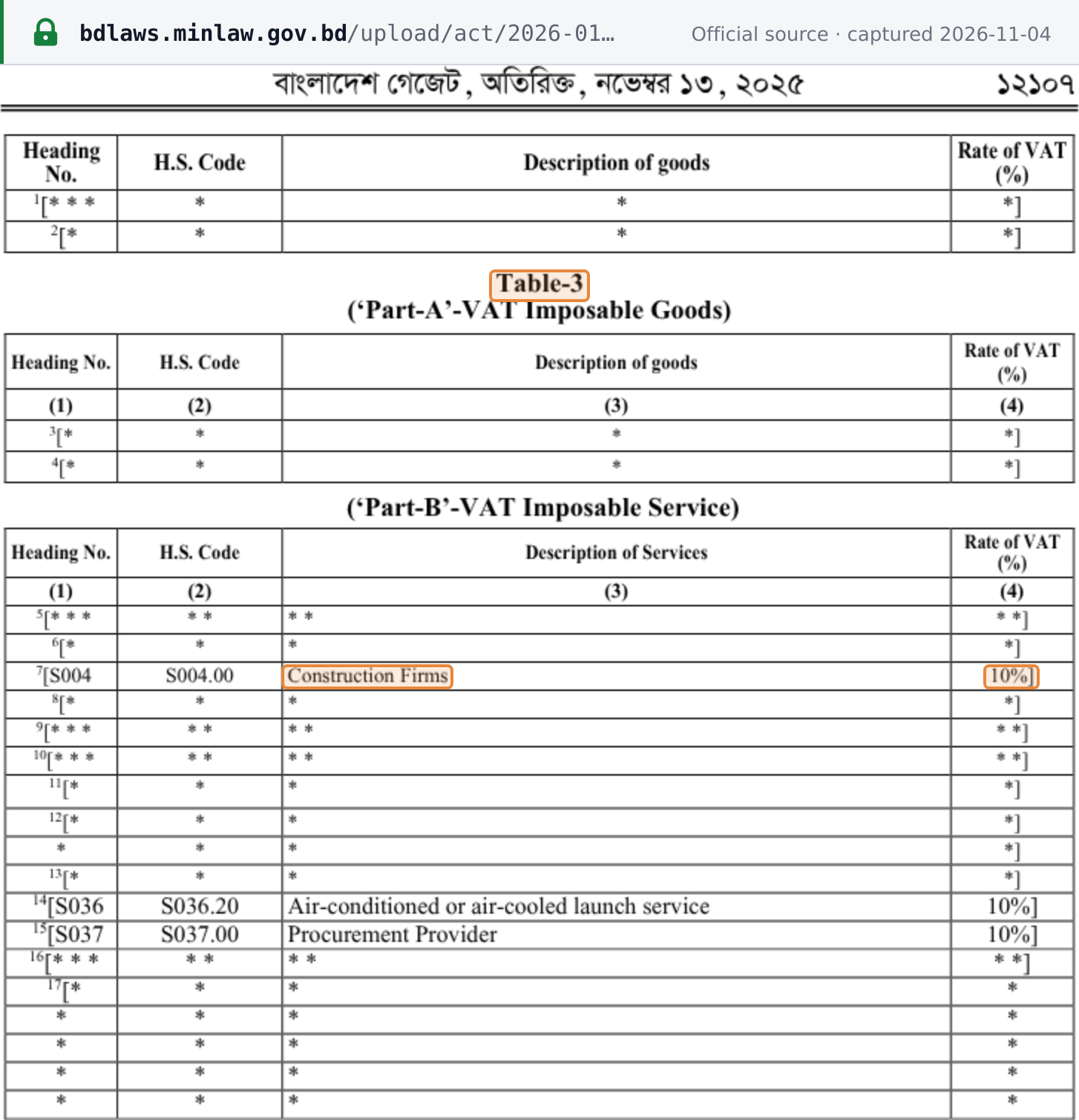 Source snapshots captured 2026-11-04 — original
Turnover Tax. An enlisted person pays Turnover Tax on its turnover, issues Form VAT-6.9 invoices, and cannot take input credit or make decreasing adjustments (section 63(4)). The tax for a period must be paid before that period's return is filed (section 63(2)). [4]
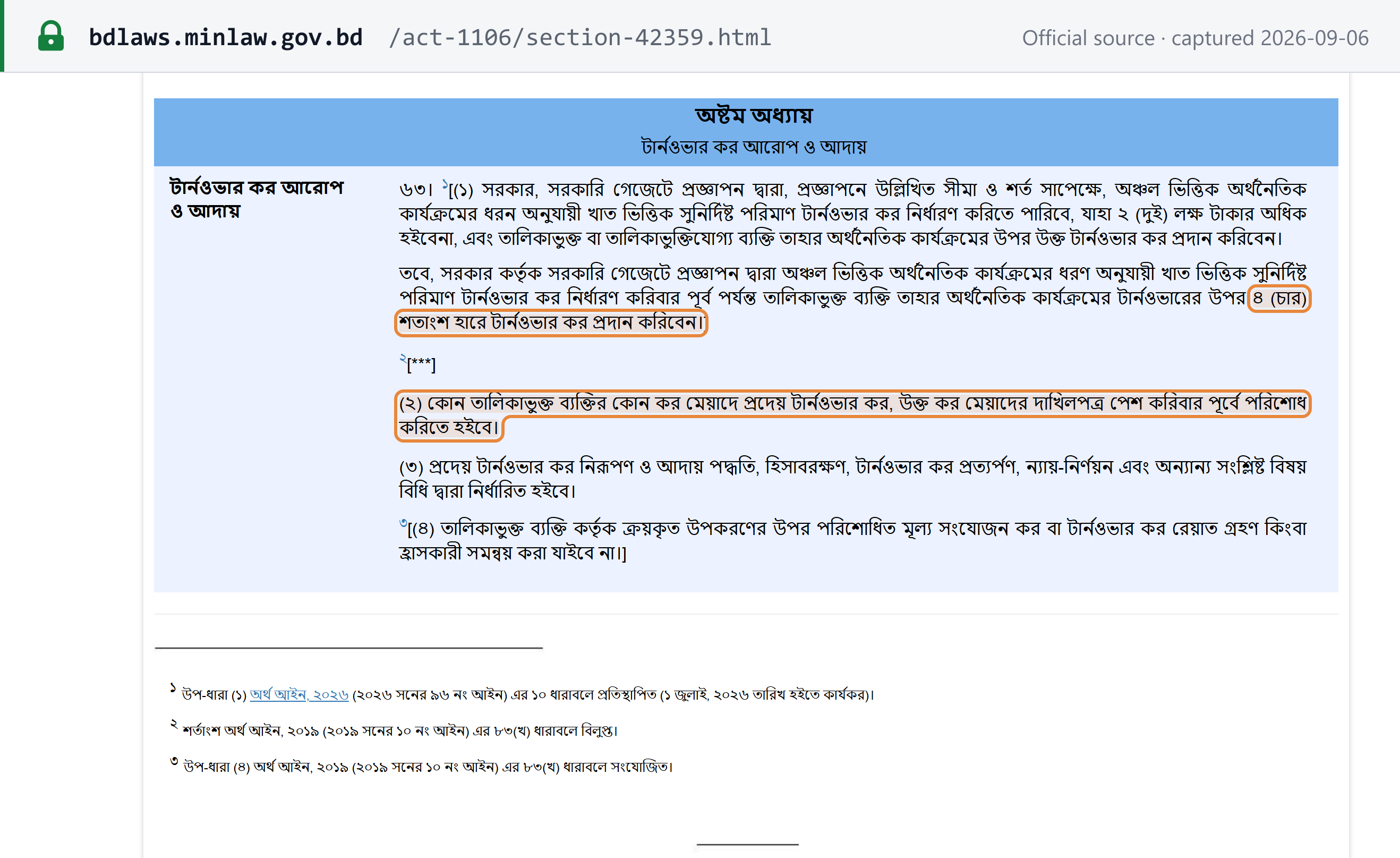 Source snapshot captured 2026-09-06 — original
Cross-border rules
Imports and exports
Imports of goods are taxable imports at 15% (section 15(3)); the Third Schedule states its reduced rates for local supply only. [1] [2] Exports of goods and zero-rated services are taxed at 0% under section 21, and where a supply is both exempt and zero-rated it is treated as zero-rated. [3] An importer or exporter must register regardless of turnover (section 4(2)). [6]
Imported services
From 1 July 2026, section 20 (substituted by the Finance Act, 2026) makes every service imported into Bangladesh a taxable supply at 15%, except the exempt services in the First Schedule: [17]
- Liability. The value is set under section 32, and the VAT is the recipient's liability and its output tax (section 20(2)).
- Collection. When a bank, other financial institution or authorised foreign-exchange dealer pays all or part of the price on behalf of the service importer, it deposits the VAT on that amount to the treasury against the importer's circle code and economic code, at the time of payment, and gives the importer a copy of the treasury challan (section 20(4)).
- Invoice. That treasury challan serves as the importer's tax invoice; no Mushak-6.3 from the foreign supplier is needed.
- Credit. Section 20(5) provides for input tax credit on the VAT.
For how this compares with self-assessed reverse charge elsewhere, see our reverse charge explainer.
Foreign companies selling into Bangladesh: B2B and B2C
B2C, including digital services. Section 17 treats certain supplies by a non-resident with no fixed place in Bangladesh to a person not registered for VAT as made in Bangladesh, including an electronic service supplied to a person located in Bangladesh at the time of supply. Services physically performed in Bangladesh, services related to land there, broadcasting received at a Bangladeshi address and certain telecommunications are caught too. [14] "Electronic service" (section 2(18)) means services provided over a telecommunications or information network, including websites, web hosting and remote maintenance, software and its remote updating, images, text and information, database access, self-education packages, and music, films and games. [5]
VAT agent. A non-resident that does not carry on its economic activity from a fixed place in Bangladesh must appoint a VAT agent (section 19(1)). The agent performs the non-resident's duties under the Act, but the non-resident stays liable for the tax, fines, penalties and interest, and the registration is in the non-resident's name. [16] Rule 16(2) of the VAT Rules limits who can be a VAT agent, for example a VAT consultant, a member of ICAB or ICMAB, a Bar Council advocate, a retired VAT official, an FBCCI nominee, a chartered secretary, or a registered consultancy, chartered-accountancy or law firm, with the non-resident's consent. [11]
Threshold. The Act states no separate threshold for non-residents, and it does not say whether a non-resident B2C supplier is tested against the BDT 5,000,000 threshold or must register from its first supply.
B2B. A service supplied by a registered non-resident to a registered recipient that operates from a fixed place in Bangladesh, and is supplied for that activity, is made in Bangladesh (section 18). [15] Where the foreign supplier is not registered, the Bangladeshi business customer is liable for the VAT on the imported service under section 20, collected through its bank as described above. [17]
Marketplace and platform liability
The Act's place-of-supply and non-resident provisions (sections 17–19) contain no deemed-supplier rule that makes a marketplace or platform operator liable for VAT on third-party sales.
Invoice requirements
Who must issue a tax invoice
Section 51 of the Act, as substituted by the Finance Act 2019, is one sentence: every registered or enlisted person must issue a tax invoice for a taxable supply on or before the date the tax becomes payable, in the manner prescribed by rules. The particulars are in rule 40(1)(c) of the VAT and Supplementary Duty Rules 2016. [18] [11]
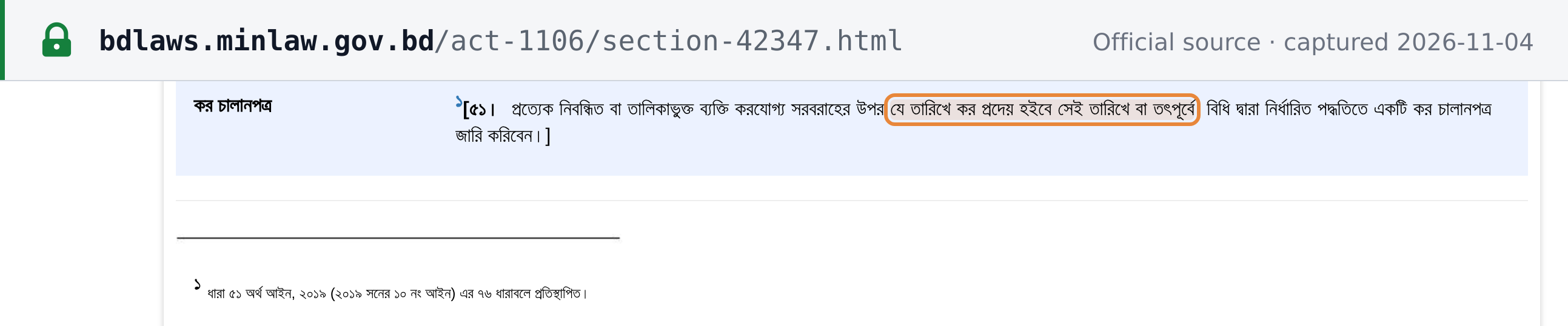 Source snapshot captured 2026-11-04 — original
Mandatory content
Rule 40(1)(c), in NBR's authentic English text of the Rules (consolidated to the Gazette of 10 November 2025): [11]
| # | Required particular | Notes |
|---|---|---|
| (i) | Form VAT-6.3 (Mushak-6.3) | One against each supply. |
| (ii) | Actual date and time of issue | |
| (iii) | Supplier's name, address and BIN | Always. |
| (iv) | Purchaser's name, address and BIN (where applicable) | Only if the value of the supply exceeds Tk 25,000. Substituted by SRO 135-Law/2024/241-VAT from 27 May 2024. |
| (v) | Description of the goods, amount, date and time of supply, and the nature and number of the transport | |
| (vi) | Value of supply without VAT | |
| (vii) | VAT rate applicable | |
| (viii) | Amount of VAT payable | |
| (ix) | Total of value and VAT | |
| (x) | Serial number, numbered by fiscal year | |
| (xi) | Separate serial series for each place of supply, with that place's name, address and invoice number | Where the person supplies from more than one place. |
| — | At least 2 copies | The original goes to the purchaser and travels with the goods; the registered person keeps the copy. |
| — | Any other information the Board determines |
A defective or incomplete VAT invoice, withholding certificate, debit note or credit note is not documentary evidence for input credit or an adjustment (rule 40(3)). [11]
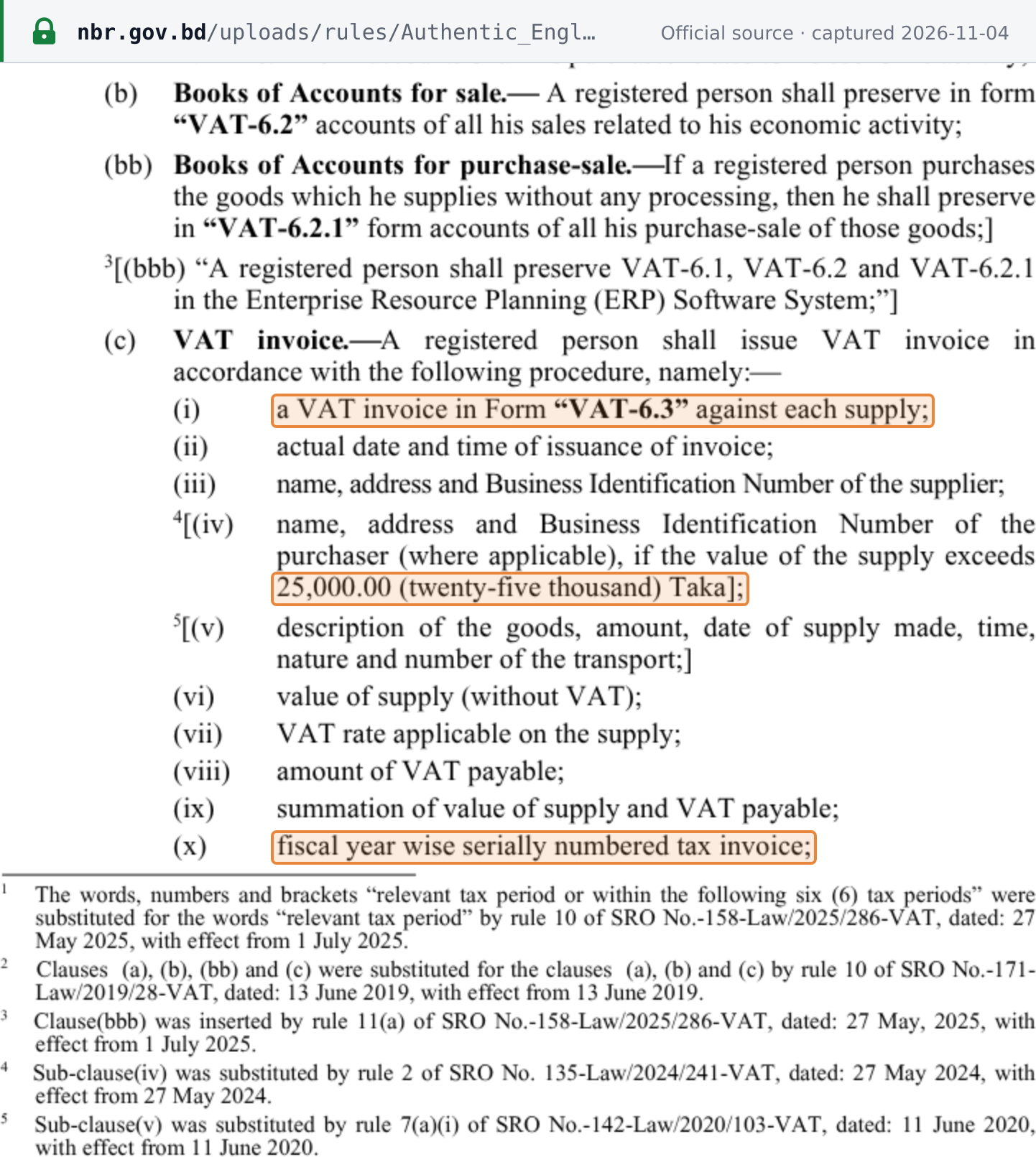 Source snapshot captured 2026-11-04 — original
Issuance deadline and numbering
The invoice is due on or before the date tax becomes payable on the supply (section 51). [18] Tax invoices are serially numbered by fiscal year, with a separate series for each place of supply (rule 40(1)(c)(x)–(xi)). The same fiscal-year numbering applies to the turnover-tax invoice, VAT-6.9 (rule 41(b)). [11]
Reporting large invoices. A registered or enlisted person must send the details of any VAT or turnover-tax invoice worth more than Tk 200,000 (2 lakh) that it issues or receives to the VAT computer system on Form VAT-6.10, online, before or after filing the period's return (rule 42(1)). This is not required where the Board-determined purchase and sale data already reaches the system through an automated system under rule 42(3), (5) or (6) (rule 42(7)). [11]
Credit and debit notes
Changes to an issued invoice go on a credit note (Form VAT-6.7), which supports a decreasing adjustment, or a debit note (Form VAT-6.8), which supports an increasing adjustment (rule 40(1)(g)). [11] Under section 52, where the VAT effect exceeds Tk 5,000, the note must show the recipient's name, address and BIN (where applicable), and a credit note without them cannot support a decreasing adjustment (section 52(1)(cha) and 52(2)). [19] Only one original tax invoice, credit note or debit note may be issued for a supply or adjustment; if a registered recipient reports the original lost, the issuer may provide a copy marked "Duplicate". [11]
Currency and language
The Act and the Rules state their invoice values in taka, and neither contains a general rule allowing a domestic tax invoice in another currency or prescribing an invoice language. The Rules let a registered person keep the prescribed forms in its own format, with additional business information, provided the form's name, every prescribed particular and the minimum number of copies are kept (rule 40(2)); the Board may also declare a registered person's own-format invoice or bill to be a tax invoice by gazette order (rule 40(7)). [11]
Document types
| Document | Who issues it, and when |
|---|---|
| VAT-6.3 tax invoice (Mushak-6.3) | A registered person, for each taxable supply (rule 40(1)(c)). [11] |
| VAT Smart (VS) Challan | The Mushak-6.3 generated by NBR-approved EFD, SDC or PKI point-of-sale software, with a QR code and digital signature, in the business categories listed in E-invoicing status. [23] |
| VAT-6.9 turnover-tax invoice | An enlisted person, for each supply, serially numbered by fiscal year, in 2 copies (rule 41(b)). [11] |
| Treasury challan | The bank's deposit receipt for VAT on imported services; it serves as the importer's tax invoice (section 20(4)). [17] |
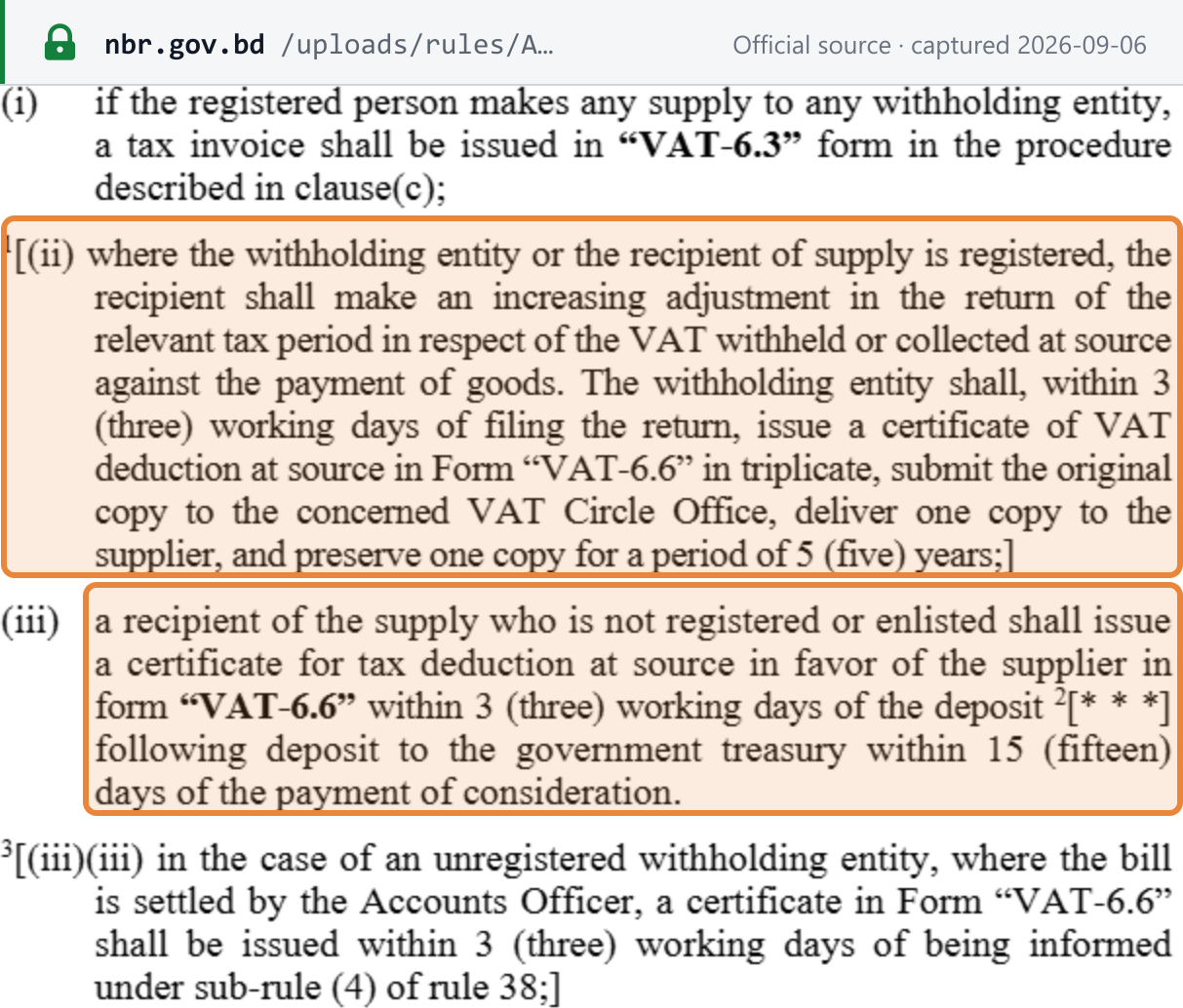
| VAT-6.6 withholding certificate | The withholding entity, when it pays a registered supplier and deducts VAT at source (section 53; rule 40(1)(f)). [20] [11] |
The Act and the Rules provide no simplified or reduced-content invoice and no value below which a tax invoice is not needed. The only value-based variation is the Tk 25,000 purchaser-details threshold. [11] For how withholding works across countries, see our VAT withholding explainer.
 Source snapshot captured 2026-09-06 — original
Self-billing
Neither section 51 of the Act nor rules 40–44 of the VAT Rules 2016 provide for self-billing: the tax invoice is issued by the supplier. Rule 43 only allows a registered representative to issue documents in the principal supplier's name (43(1)) or to receive documents due to the principal recipient (43(2)). [11]
Retention and audit trail
- Retention. A registered person keeps its accounts, documents and other records for 5 years (section 107(1)). Records linked to a pending proceeding must be kept until it ends, even after 5 years (section 107(3)). [21]
- Electronic records. From 1 July 2026, section 107(2A) (substituted by the Finance Act, 2026) lets a registered person keep tax documents and records on a server, with proper security, through ERP software or NBR-specified VAT software. Records kept this way are legally admissible and may be presented to the VAT authority electronically. [21]
- ERP ledgers. Since 1 July 2025, the purchase and sales books (VAT-6.1, VAT-6.2 and VAT-6.2.1) must be kept in an ERP software system (rule 40(1)(bbb)). [11]
- Tamper evidence. Where data tampering, alteration, data sharing or reporting through NBR-approved VAT software is used to evade VAT, both the software supplier and the user face a penalty of at least the evaded tax and up to double it (section 85(1), item (tha), added by the Finance Act, 2026). [29]
A specimen of a compliant invoice
NBR publishes the blank Mushak-6.3 form, its own specimen of the tax invoice. Its header reads "মূসক-৬.৩ / কর চালানপত্র" (Mushak-6.3, tax invoice) and cites rule 40(1), clauses (c) and (f). Its fields follow rule 40(1)(c): the registered person's name, BIN and invoice-issue address; the buyer's name, BIN and delivery destination; the invoice number, issue date and issue time; and line items with description, unit, quantity, unit price before tax, total price, supplementary duty, VAT rate or specific tax, VAT amount and the price including all duties and taxes, then the signatory's name, designation, signature and seal. [22]
 Source snapshot captured 2026-08-06 — original
The 2019 form still carries a footnote saying that, for a supply subject to VAT deduction at source, it serves as an integrated tax invoice and withholding certificate. The Act no longer provides for that: the Finance Act 2021 deleted the word "integrated" from section 107(2), and the withholding certificate is now Form VAT-6.6, issued by the withholding entity (section 53; rule 40(1)(f)). [21] [20]
E-invoicing status
Status in November 2026: no clearance or continuous transaction control (CTC) mandate. The VAT and Supplementary Duty Act 2012 and the VAT Rules 2016 contain no invoice-clearance or real-time reporting requirement. Rule 42(5) lets the Board, by order, draw sales data into the VAT computer system from a taxpayer's POS, ECR, software or other sales machine. [11]
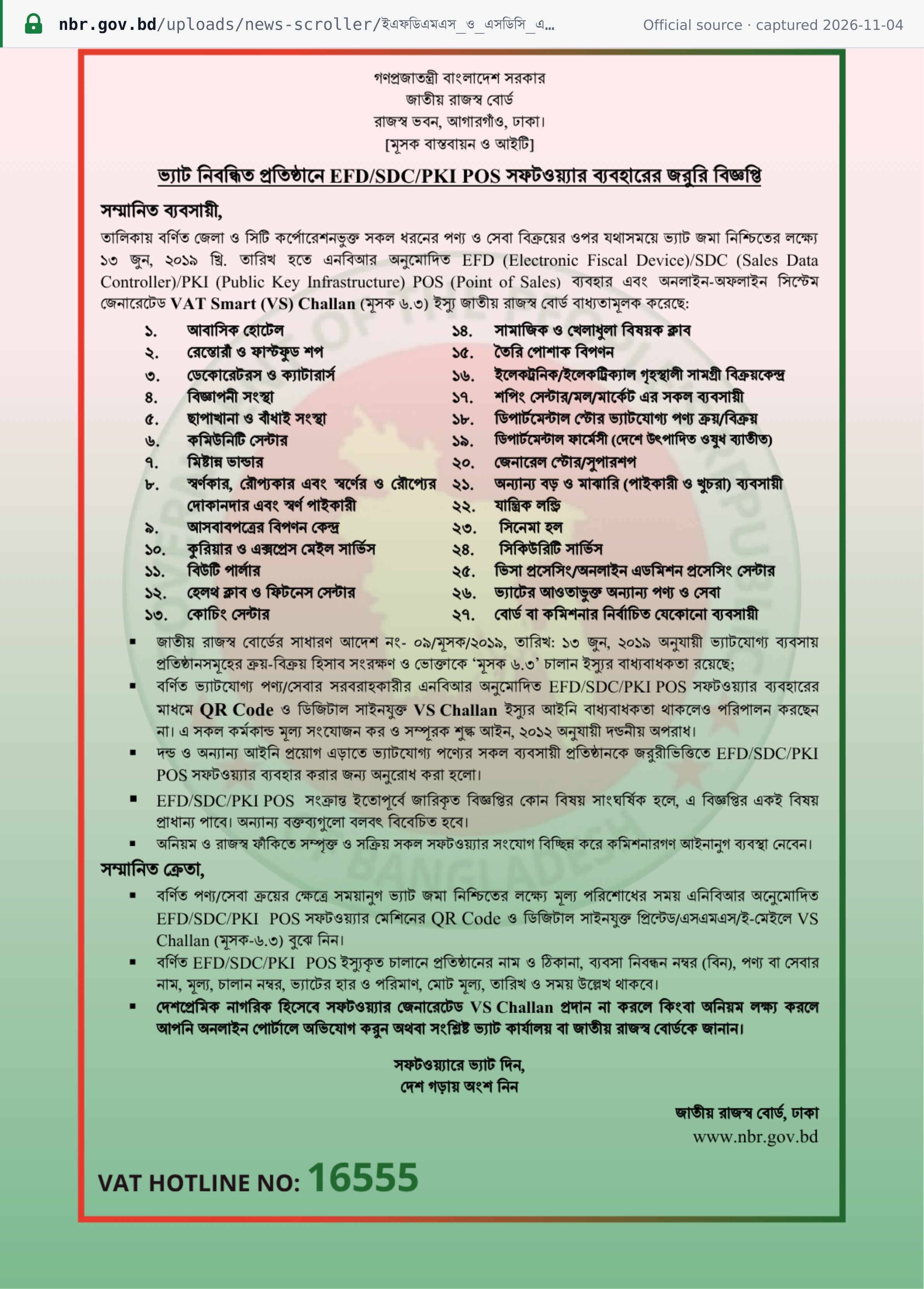
Fiscal devices and the VAT Smart Challan. NBR's notice on EFD/SDC/PKI POS use (VAT Implementation and IT wing) states that from 13 June 2019 NBR made it mandatory, for sales of goods and services in the districts and city corporations named in its list, for the listed businesses to use NBR-approved EFD (Electronic Fiscal Device), SDC (Sales Data Controller) or PKI (Public Key Infrastructure) POS software and to issue a system-generated VAT Smart (VS) Challan (Mushak-6.3), online or offline. The notice cites NBR General Order No. 09/Mushak/2019 of 13 June 2019 for the duty to keep purchase and sales accounts and give consumers a Mushak-6.3 challan. [23]
- Scope: 27 business categories, including residential hotels, restaurants and fast-food shops, decorators and caterers, sweet shops, gold and silver shops, furniture showrooms, beauty parlours, health clubs, coaching centres, ready-made garment retailers, electronics and electrical stores, shopping-centre and mall traders, department stores, general stores and supershops, other large and medium wholesale and retail traders, cinemas, security services, visa and online-admission processing centres, and any business the Board or a Commissioner selects.
- Content: the VS Challan shows the business's name and address, BIN, the goods or service, price, challan number, VAT rate and amount, total, date and time, and carries a QR code and digital signature.
- Consequence: the notice describes failure to issue the QR-coded, digitally signed VS Challan as an offence under the 2012 Act.
 Source snapshot captured 2026-11-04 — original
Scope by customer type. Where it applies, the VS Challan covers all sales by the listed categories, B2C and B2B alike. Outside those categories, B2B, B2G and B2C supplies are invoiced on Mushak-6.3 from the supplier's own systems or on paper, and there is no separate B2G e-invoicing channel in the Act or the Rules. NBR publishes a searchable list of EFD/SDC users.
Filing and payment
Filing frequency
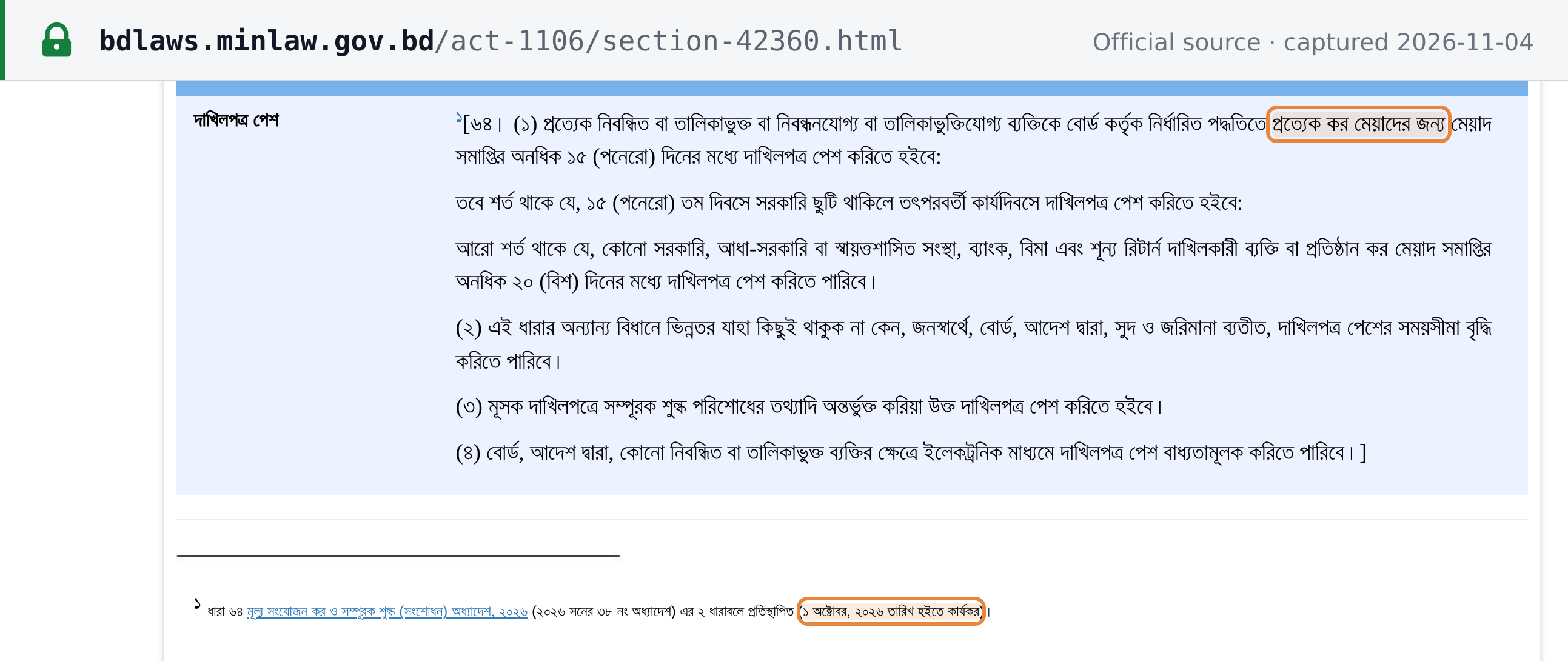
Monthly, from the October 2026 tax period. The Value Added Tax and Supplementary Duty (Amendment) Ordinance, 2026 (Ordinance No. 38 of 2026), dated 14 October 2026, substituted section 64 of the Act and is deemed in force from 1 October 2026. Every registered, enlisted, registrable or enlistable person must submit a return for each tax period, and a tax period is one calendar month. [25] [24] [39] Frequency does not depend on turnover or taxpayer class. There is no quarterly option and no separate instalment.
The Ordinance was made by the President under Article 93(1) of the Constitution; its preamble recites that Parliament was not in session and that immediate action was needed. It is an Ordinance, not an Act of Parliament. [39]
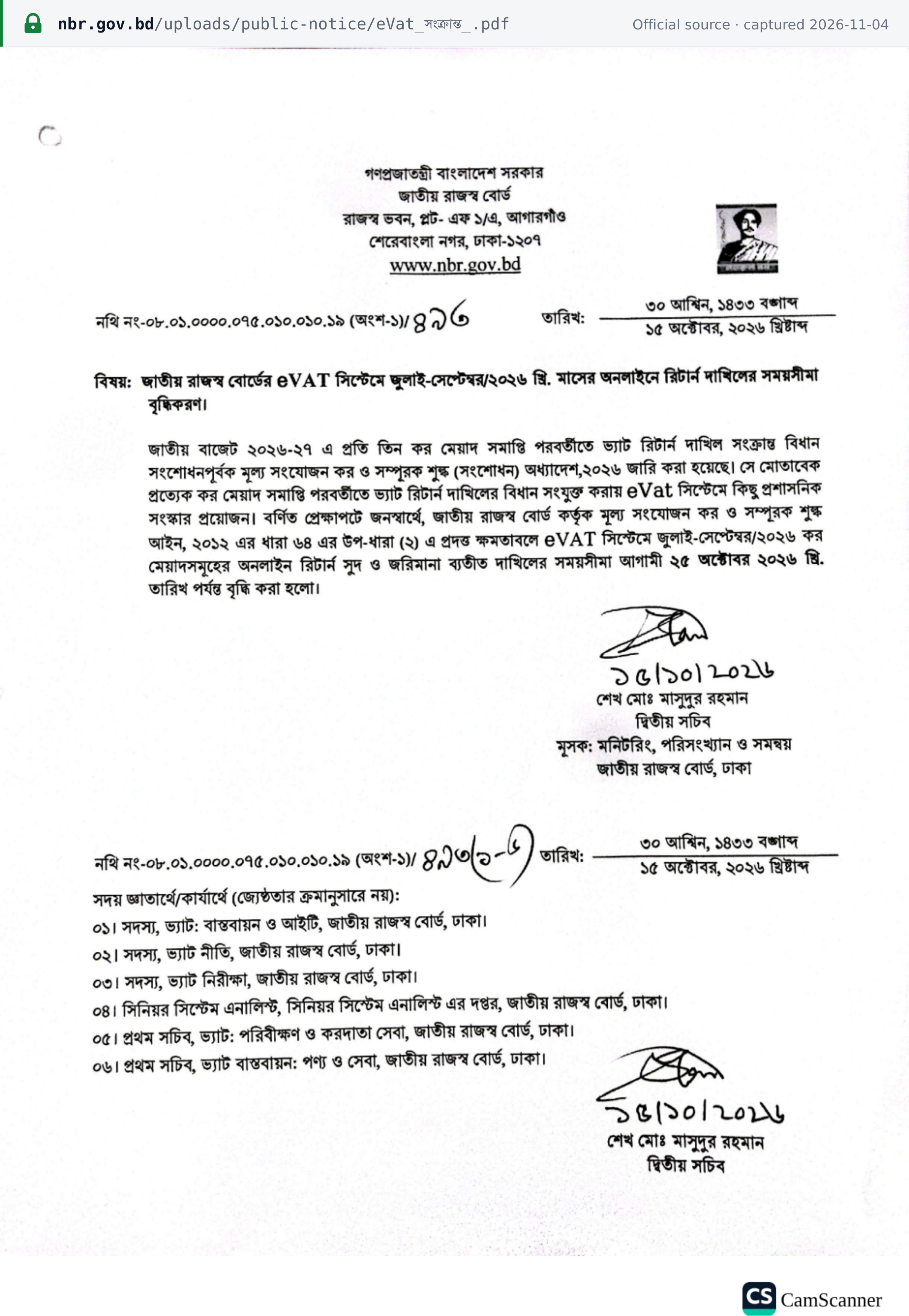
The July–September 2026 interlude. From 1 July to 30 September 2026, section 64 as substituted by the Finance Act, 2026 required a return only within 15 days after every three tax periods. NBR's order of 15 October 2026, made under the new section 64(2), records that the Ordinance replaced that rule, and extends the deadline for online returns for the July–September 2026 tax periods to 25 October 2026, without interest or penalty. An earlier order of 1 October 2026, made under the then section 64(3), had extended the July and August 2026 returns to 15 October 2026. [26] [40]
Return due date
| Filer | Due (section 64(1), from 1 October 2026) |
|---|---|
| Registered, enlisted, registrable or enlistable persons | Within 15 days after the end of each monthly tax period; if the 15th is a public holiday, the next working day |
| Government, semi-government and autonomous bodies, banks, insurers, and nil-return filers | Within 20 days after the end of the tax period |
By that rule, the return for October 2026 is due by 15 November 2026. The Board may extend the deadline by order, without interest or penalty (section 64(2)); the return must include supplementary-duty payment details (section 64(3)); and the Board may make electronic filing mandatory by order (section 64(4)). [24]
 Source snapshot captured 2026-11-04 — original
 Source snapshot captured 2026-11-04 — original
Forms and online filing
- Forms. Registered persons file the VAT return on Form VAT-9.1 (Mushak-9.1); enlisted persons file the Turnover Tax return on Form VAT-9.2 (rule 47(1)). The blank Mushak-9.1 carries a monthly tax-period field. [11] [37]
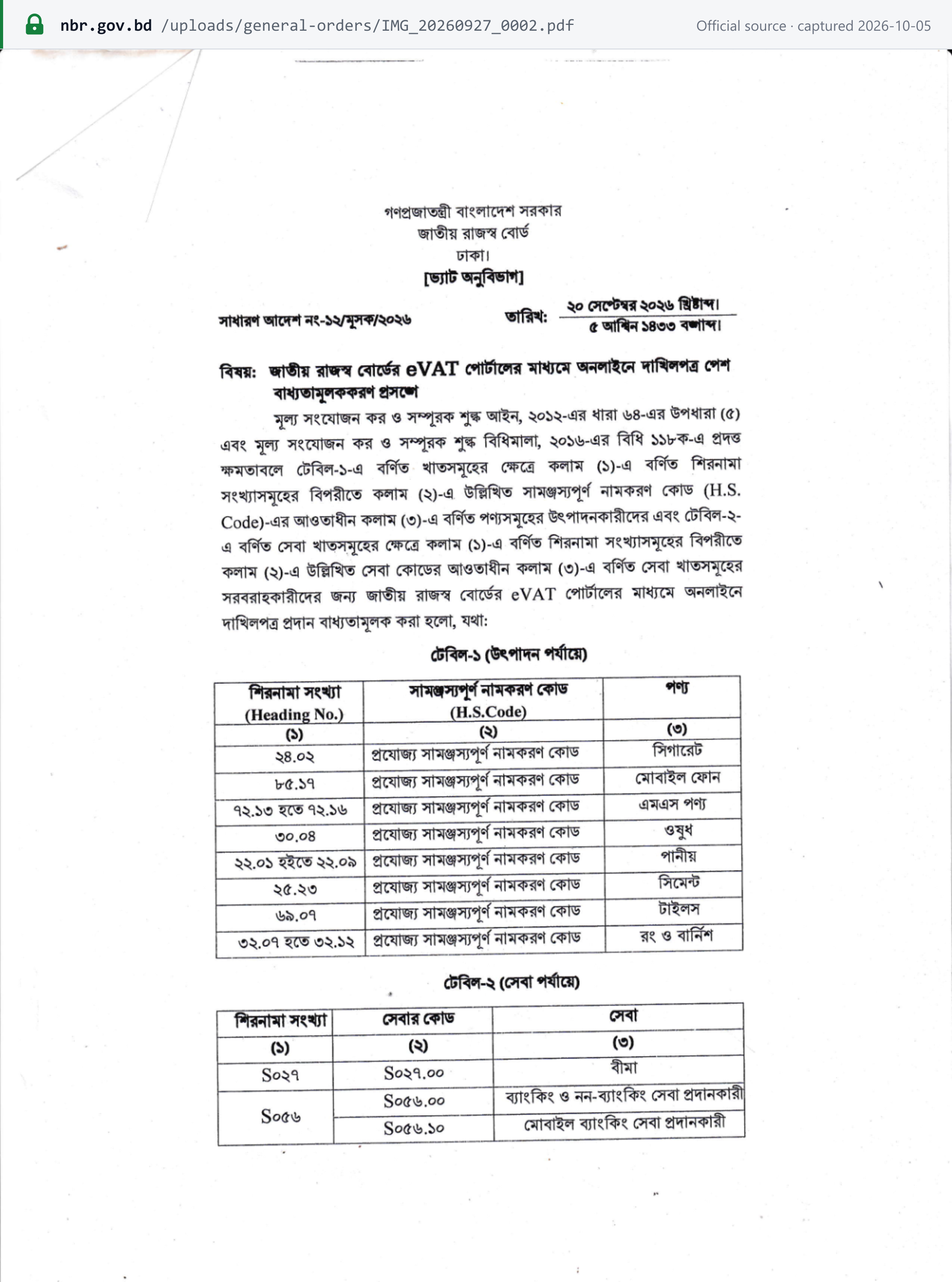
- Mandatory online filing. NBR General Order No. 12/Mushak/2026 of 20 September 2026 requires the return to be filed online through eVAT by producers of cigarettes, mobile phones, M.S. products, medicine, beverages, cement, tiles, and paints and varnishes, by suppliers of insurance, banking and non-banking, and mobile banking services, and by a registered person supplying both listed and other goods or services. It cancels earlier orders on mandatory online filing. The order was issued under section 64(5) as it then stood; under the Ordinance the power to require electronic filing is in section 64(4). [27] [24]
 Source snapshot captured 2026-10-05 — original
Payment
Net VAT for a tax period must be paid before the return is submitted (section 45(2)); Turnover Tax likewise (section 63(2)). The payment date is therefore the filing date at the latest, and there is no separate monthly instalment. [28] [4] Interest on late payment is in Offences and penalties.
Late returns
On application, the Commissioner may allow a return to be filed late, but the permission cannot put back the date tax is actually paid by more than one month, and it does not change liability for interest (section 65). [31]
Additional filings
- Large invoices. Invoices above Tk 200,000 are reported on VAT-6.10 (see Issuance deadline and numbering). [11]
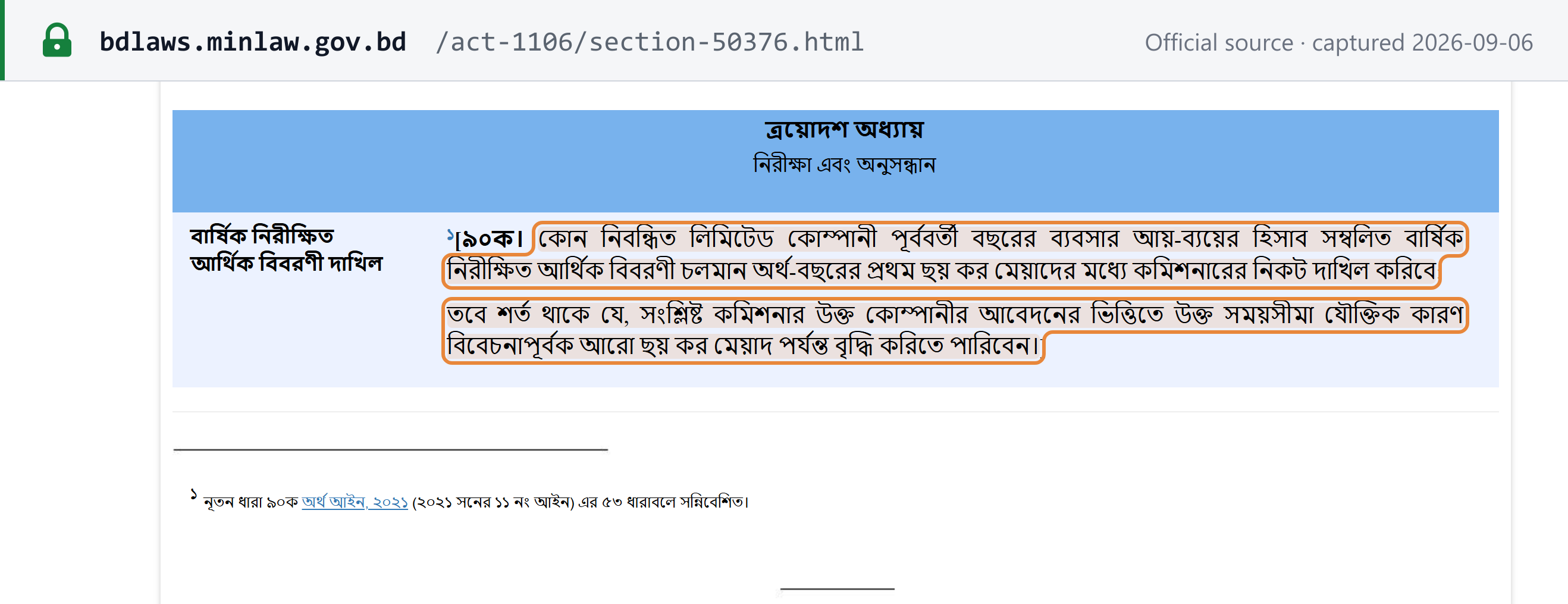
- Annual audited accounts. A registered limited company files its annual audited financial statements for the previous year with the Commissioner within the first six tax periods of the running financial year, which runs from 1 July; the Commissioner may extend this by six more tax periods (section 90A). [41]
 Source snapshot captured 2026-09-06 — original
Input tax and refunds
Input tax credit is claimed against a valid VAT-6.3 invoice, VAT-6.6 withholding certificate, or debit or credit note; a defective or incomplete document does not support credit (rule 40(3)). VAT on imported services is creditable under section 20(5). Enlisted Turnover Tax payers get no input credit (section 63(4)). [11] [17] [4]
Exemptions
Exempt is not zero-rated. A zero-rated supply (section 21) is taxable at 0%, and where a supply is both exempt and zero-rated it is treated as zero-rated. [3] Exempt supplies are listed in the First Schedule, and their value does not count towards the registration threshold (section 2(57)). [5] Exempt suppliers still have duties under sections 51, 53, 54, 64 and 107, with a Tk 25,000 penalty for failing them (section 85(1) table). [29]
Startup establishments. Under SRO No. 147-Ain/2026/352-Mushak, dated 7 June 2026 and made by the Ministry of Finance under section 126(1) of the Act, a registered startup establishment is exempt from VAT on: [35]
- all VAT chargeable on its local supplies;
- all VAT chargeable on its import of any service; and
- all VAT chargeable on its renting of space and premises.
The SRO took effect on 1 July 2026 and runs until 30 June 2035. "Startup" means a startup establishment as defined in Part 2 of the Eighth Schedule of the Income Tax Act 2023 that has also registered as a startup with the NBR; ordinary BIN and VAT registration is a separate step. A registered startup may keep its records through ERP or NBR-specified VAT software under section 107(2A), and a withholding entity buying from a registered startup must not deduct VAT at source. [35]
 Source snapshot captured 2026-08-18 — original
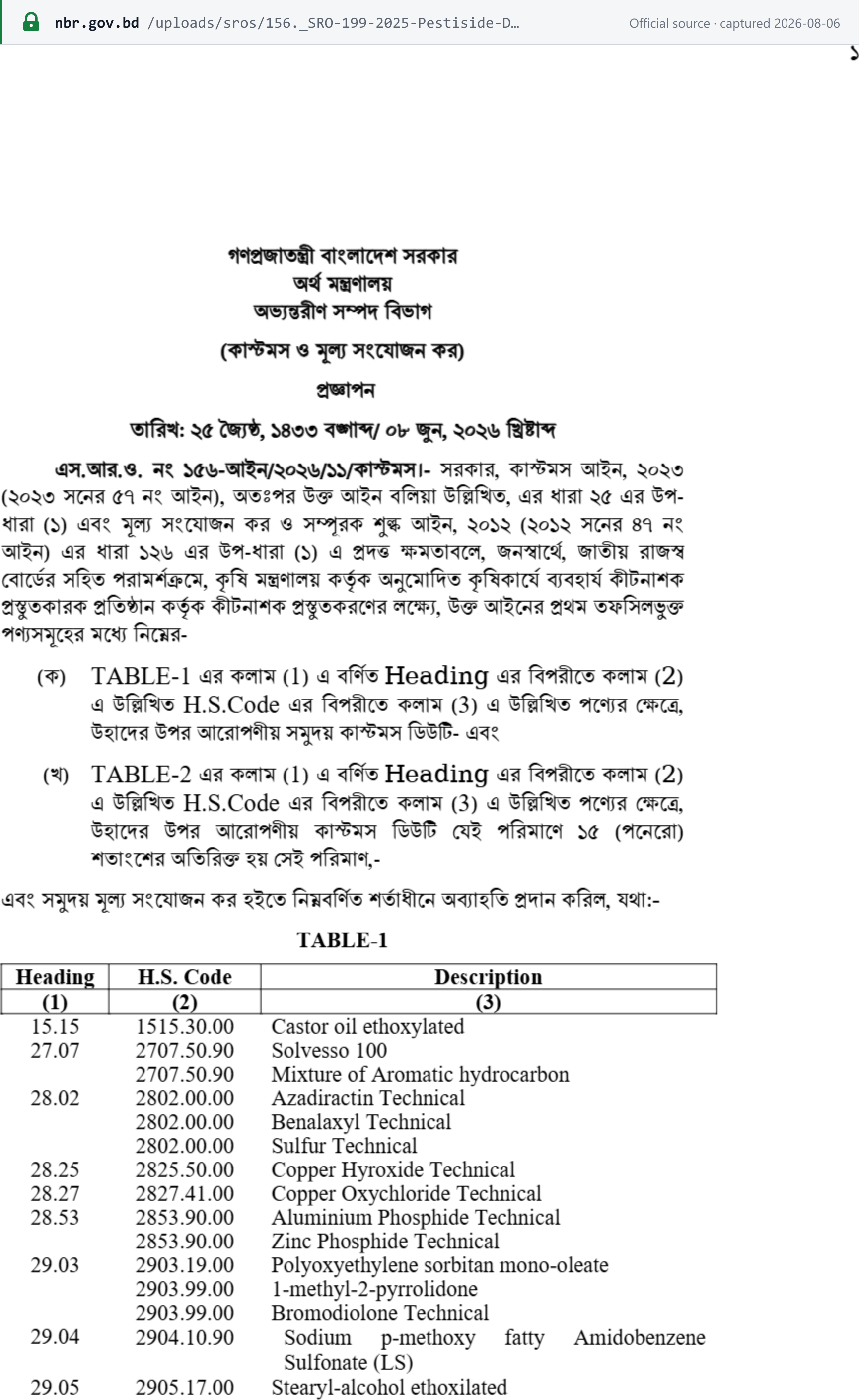
Pesticide raw materials. SRO No. 156-Ain/2026/11/Customs, dated 8 June 2026, effective 11 June 2026 and valid to 30 June 2030, exempts more than 100 listed pesticide raw materials, mostly technical-grade active ingredients, imported by manufacturers approved by the Ministry of Agriculture, from customs duty and VAT, and about 36 other inputs from VAT and from customs duty above 15%. It replaces SRO No. 199-Ain/2025/21/Customs. [34]
 Source snapshot captured 2026-08-06 — original
Appliance manufacturing. SRO 146's 7.5% cap and input exemption for refrigerators, freezers, air conditioners and compressors is listed under Rates.
Small business scheme. Turnover Tax for enlisted persons is the small-business regime (see Registration threshold and Rates).
Offences and penalties
Offences
Section 111(1) makes it an offence, with dishonest intent, to: [32]
- make or use a VAT registration or Turnover Tax certificate, tax invoice or withholding certificate carrying a fake BIN;
- make or use a fake tax invoice, credit note, debit note or withholding certificate;
- produce, keep, move, market or use fake or reused stamps or banderols, or deal in goods carrying them, or in goods that should carry them but do not;
- evade tax payable by any other means; or
- claim a refund not due.
The penalty on conviction is imprisonment of up to 1 year, or a fine equal to the tax payable, or both. Giving false information in an online registration or enlistment application exposes the applicant to action under existing law (section 111(2)). [32]
Penalties
Administrative penalties under the section 85(1) table: [29]
| Failure | Penalty |
|---|---|
| Not applying for registration or enlistment in time | Tk 10,000 |
| Not displaying the registration or Turnover Tax certificate | Tk 10,000 |
| Not filing a VAT or Turnover Tax return by the due date | Tk 2,000 (reduced from Tk 5,000 by the Finance (2025-2026 FY) Act 2026, Act No. 89 of 2026) |
| Leaving output tax out of the return | ½ to 1 times the omitted tax |
| Claiming more input credit than allowed | 30% to 50% of the credit |
| Not issuing a tax invoice, credit note, debit note or withholding certificate | Tk 10,000 |
| Not keeping records as prescribed | Tk 10,000 |
| Wilful evasion | ½ to 1 times the evaded tax |
| An exempt supplier failing its duties under sections 51, 53, 54, 64 or 107 | Tk 25,000 |
| Data tampering or sharing through NBR-approved VAT software to evade VAT | 1 to 2 times the evaded tax, on both the software supplier and the user |
No late-return penalty applies for the months a business was temporarily closed, made no supplies, and then reopened (section 85(4A)). [29]
Interest. Unpaid tax carries simple interest of 1% per month from the day after the due date until payment, for at most 24 months; VAT that should have been withheld at source carries 2% per half-year (section 127(1)). [30]
Frequently asked questions
Are Bangladesh VAT returns filed monthly or quarterly?
Monthly again, from the October 2026 tax period. The Value Added Tax and Supplementary Duty (Amendment) Ordinance, 2026 (Ordinance No. 38 of 2026), dated 14 October 2026 and deemed in force from 1 October 2026, substituted section 64 of the VAT Act. Every registered, enlisted, registrable or enlistable person must submit a return for each tax period, which is one calendar month, within 15 days of the end of the period, or on the next working day if the 15th is a public holiday. Government, semi-government and autonomous bodies, banks, insurers and nil-return filers may file within 20 days. By that rule the October 2026 return is due by 15 November 2026. From 1 July to 30 September 2026 the Finance Act, 2026 had required a return only after every three tax periods, and NBR's order of 15 October 2026 extended the deadline for the July–September 2026 returns to 25 October 2026, without interest or penalty. Producers and service providers listed in NBR General Order No. 12/Mushak/2026 must file online through eVAT. [25] [24] [26] [27]
What are the VAT registration and turnover tax thresholds in Bangladesh, and who must register regardless of turnover?
A person must register for VAT once the turnover of its economic activities exceeds BDT 5,000,000 in 12 months (section 2(57) of the VAT Act; that figure has applied since 9 January 2025, when it replaced BDT 30,000,000). The test runs month by month: a person becomes registrable from the first day of a month if turnover in the 12 months ending with the previous month exceeded the threshold, or if turnover expected in the 12 months from the start of the previous month will exceed it (section 4(1)). Exempt supplies, sales of capital assets, the sale of the business or part of it, and supplies made on permanently closing the business are left out of turnover. Some persons must register regardless of turnover (section 4(2)): those who supply, make or import goods or services subject to supplementary duty, suppliers under tenders or contracts, importers and exporters, branch, liaison or project offices of foreign entities, appointed VAT agents, and persons in areas or activities the Board specifies. A person whose turnover exceeds BDT 3,000,000 but not the registration threshold enlists for Turnover Tax instead (section 2(48)) and, from 1 July 2026, pays 4% of turnover until the Government notifies sector-specific fixed amounts, which may not exceed BDT 200,000 (section 63(1)). NBR's VAT FAQ page still prints the original 2012 threshold of BDT 8,000,000, which is superseded. [5] [6] [4] [38]
What is the standard VAT rate in Bangladesh, and is a BIN now required to open a bank account?
The standard VAT rate is 15% on taxable supplies and taxable imports, under section 15(3) of the Value Added Tax and Supplementary Duty Act 2012. And yes: the Finance Act, 2026 (Act No. 96 of 2026, dated 30 June 2026) inserted section 4(3) into the VAT Act with effect from 1 July 2026. A Business Identification Number (BIN) or proof of enlistment must now be produced to open or operate a current or STD account with a bank or NBFI, take a bank or NBFI loan, renew a trade licence, open a Mobile Financial Services merchant account, obtain or renew membership of a trade body, obtain an electricity or gas connection, and register a vehicle with the BRTA in a business name. [1] [6] [12]
How is VAT charged on services imported into Bangladesh?
Under section 20 of the VAT Act, as substituted by the Finance Act, 2026 from 1 July 2026, every service imported into Bangladesh, except the exempt services in the First Schedule, is a taxable supply at 15% VAT. The VAT is the liability of the recipient of the service and counts as its output tax. Collection runs through the payment: when a bank, other financial institution or authorised foreign-exchange dealer pays all or part of the price on behalf of the importer, it deposits the VAT to the treasury against the importer's circle code and economic code, and gives the importer a copy of the treasury challan, which serves as the importer's tax invoice. Section 20(5) provides for input tax credit on that VAT. [17]
Does a foreign company selling digital services to consumers in Bangladesh have to register for VAT?
Section 17 of the VAT Act treats an electronic service supplied by a non-resident with no fixed place in Bangladesh to a person who is not registered for VAT, and who is in Bangladesh at the time, as supplied in Bangladesh, so it falls within Bangladeshi VAT. Electronic services include websites, web hosting and remote maintenance, software and its remote updating, images, text and information, database access, self-education packages, and music, films and games. A non-resident without a fixed place in Bangladesh must appoint a VAT agent, who carries out its VAT duties; the registration is in the non-resident's name, and the non-resident stays liable for the tax, fines, penalties and interest (section 19). Non-residents apply on Form VAT-2.2. The Act sets no separate registration threshold for non-residents and does not say how the BDT 5,000,000 threshold applies to them. Registered business customers in Bangladesh instead account for VAT on imported services themselves under section 20, collected through the paying bank. [14] [5] [16] [11] [17]
Is e-invoicing mandatory in Bangladesh?
Not as a clearance system. The VAT Act and the VAT Rules 2016 contain no continuous transaction control or invoice-clearance requirement (as at 4 November 2026). What NBR mandates instead is fiscal point-of-sale equipment. According to NBR's notice on EFD/SDC/PKI POS use, which cites General Order No. 09/Mushak/2019 of 13 June 2019, NBR made it mandatory from 13 June 2019 for 27 listed business categories to use NBR-approved Electronic Fiscal Devices, Sales Data Controllers or PKI point-of-sale software and to issue a system-generated VAT Smart (VS) Challan, which is the Mushak-6.3 tax invoice carrying a QR code and digital signature. The categories include residential hotels, restaurants and fast-food shops, sweet shops, gold and silver shops, ready-made garment retailers, electronics shops, shopping-mall traders, supershops, cinemas and any business the Board or a Commissioner selects. Other registered persons issue Mushak-6.3 invoices on paper or from their own systems, and report invoices above Tk 200,000 to the VAT computer system on Form VAT-6.10 unless their sales data already reaches it automatically. [11] [23]
Are NBR-registered startups exempt from VAT in Bangladesh?
Yes, on three specific items. SRO No. 147-Ain/2026/352-Mushak, dated 7 June 2026 and made under section 126(1) of the VAT and Supplementary Duty Act 2012, exempts a startup establishment, as defined in Part 2 of the Eighth Schedule of the Income Tax Act 2023 and registered as a startup with the NBR, from VAT on: (a) its local supplies, (b) its import of any service, and (c) its renting of space or premises. The exemption took effect on 1 July 2026 and runs until 30 June 2035. It does not cover a startup's other taxable activity, and it does not replace the startup's own BIN and VAT registration obligations. [35]
Important websites
| Site | Purpose |
|---|---|
| eVAT — NBR VAT online system | VAT registration, Turnover Tax enlistment and online returns |
| National Board of Revenue | 13-digit BIN search on the homepage; VAT rules, orders and notices; links to challan payment services |
| NBR — EFD/SDC user list | Search the businesses using NBR-approved fiscal devices |
| NBR — VAT SROs | Exemptions and rate concessions issued by SRO |
| Laws of Bangladesh — VAT and Supplementary Duty Act 2012 | Consolidated Act, including the Third Schedule rates |
| NBR — Form Mushak-6.3 · Form Mushak-9.1 | Blank tax invoice and VAT return forms |
| VAT hotline 16555 | NBR helpline, as printed on NBR's EFD/SDC notice |
| LookupTax — Bangladesh BIN validator | Check a BIN's format |
Recent changes
- 2026-10-15 — NBR order under the new section 64(2) extends the deadline for online VAT returns for the July–September 2026 tax periods to 25 October 2026, without interest or penalty. (National Board of Revenue)
- 2026-10-01 — The VAT and Supplementary Duty (Amendment) Ordinance, 2026 (Ordinance No. 38 of 2026), dated 14 October 2026 and deemed in force from 1 October 2026, substitutes section 64: returns are due for each monthly tax period within 15 days (20 days for government, semi-government and autonomous bodies, banks, insurers and nil-return filers), replacing the three-period cycle that applied from 1 July 2026. See Filing and payment. (Laws of Bangladesh)
- 2026-09-20 — NBR General Order No. 12/Mushak/2026 makes online VAT return submission through eVAT mandatory for listed producers (cigarettes, mobile phones, M.S. products, medicine, beverages, cement, tiles, paints and varnishes) and service providers (insurance, banking and non-banking, mobile banking). (National Board of Revenue) — see event
- 2026-07-01 — SRO No. 147-Ain/2026/352-Mushak, dated 7 June 2026, exempts NBR-registered startups from VAT on local supplies, imported services and premises rent until 30 June 2035. (National Board of Revenue) — see event
- 2026-07-01 — The Finance Act, 2026 inserts section 4(3): a BIN or proof of enlistment is required to open or operate bank and NBFI accounts, take loans, renew trade licences, open MFS merchant accounts, join trade bodies, obtain electricity or gas connections, and register business vehicles. (Laws of Bangladesh) — see event
- 2026-07-01 — The Finance Act, 2026 substitutes section 20: all imported services except First Schedule exemptions are taxable at 15%, as the recipient's output tax, collected by the paying bank or authorised dealer against a treasury challan that serves as the tax invoice. (Laws of Bangladesh) — see event
- 2026-07-01 — The Finance Act, 2026 substitutes section 63(1): Turnover Tax is 4% of turnover until the Government notifies sector-specific fixed amounts capped at BDT 200,000. (Laws of Bangladesh) — see event
- 2026-06-11 — SRO No. 146-Ain/2026/351-Mushak caps VAT at 7.5% at the local manufacturing stage for refrigerators, freezers, air conditioners and compressors, valid to 30 June 2030. (National Board of Revenue) — see event
For the full chronology, see Bangladesh tax changes on Lookuptax.
Reference links
- VAT and Supplementary Duty Act 2012, s.15 (VAT rate) — Laws of Bangladesh
- VAT and Supplementary Duty Act 2012, Authentic English Text (Gazette of 13 November 2025), including the Third Schedule
- VAT and SD Act 2012, s.21 (zero rate)
- VAT and SD Act 2012, s.63 (Turnover Tax)
- VAT and SD Act 2012, s.2 (definitions, thresholds, electronic service)
- VAT and SD Act 2012, s.4 (registration, BIN precondition)
- VAT and SD Act 2012, s.5 (central registration)
- VAT and SD Act 2012, s.8 (voluntary registration)
- VAT and SD Act 2012, s.9 (cancellation of registration)
- VAT and SD Act 2012, s.10 (Turnover Tax enlistment)
- VAT and Supplementary Duty Rules 2016, Authentic English Text (Gazette of 10 November 2025) — National Board of Revenue
- Finance Act, 2026 (Act No. 96 of 2026) — Bangladesh Gazette Extraordinary, via NBR
- Finance Act, 2026 (Act No. 96 of 2026) — Laws of Bangladesh
- VAT and SD Act 2012, s.17 (place of supply)
- VAT and SD Act 2012, s.18 (services by registered non-residents)
- VAT and SD Act 2012, s.19 (VAT agent)
- VAT and SD Act 2012, s.20 (imported services)
- VAT and SD Act 2012, s.51 (tax invoice)
- VAT and SD Act 2012, s.52 (credit and debit notes)
- VAT and SD Act 2012, s.53 (withholding certificate)
- VAT and SD Act 2012, s.107 (records)
- NBR — Form Mushak-6.3, tax invoice
- NBR — notice on the use of EFD/SDC/PKI POS software in VAT-registered businesses
- VAT and SD Act 2012, s.64 (return), as substituted by Ordinance No. 38 of 2026
- VAT and SD (Amendment) Ordinance, 2026 (Ordinance No. 38 of 2026), s.2 — substitution of s.64
- NBR — order of 15 October 2026 extending the July–September 2026 return deadline to 25 October 2026
- NBR — General Order No. 12/Mushak/2026 (mandatory online returns)
- VAT and SD Act 2012, s.45 (net tax and payment)
- VAT and SD Act 2012, s.85 (penalties)
- VAT and SD Act 2012, s.127 (interest)
- VAT and SD Act 2012, s.65 (late return)
- VAT and SD Act 2012, s.111 (offences)
- NBR — SRO No. 146-Ain/2026/351-Mushak (refrigerators, freezers, air conditioners, compressors)
- NBR — SRO No. 156-Ain/2026/11/Customs (pesticide raw materials)
- NBR — SRO No. 147-Ain/2026/352-Mushak (startup exemption)
- National Board of Revenue — homepage (13-digit BIN search)
- NBR — Form Mushak-9.1, VAT return
- NBR — VAT FAQ (English; partly out of date)
- VAT and SD (Amendment) Ordinance, 2026 (Ordinance No. 38 of 2026) — Laws of Bangladesh
- NBR — order of 1 October 2026 extending the July and August 2026 return deadline
- VAT and SD Act 2012, s.90A (annual audited financial statements)
- Finance Act, 2026 (Act No. 96 of 2026), s.22 — amendment of the Third Schedule — Laws of Bangladesh
- VAT and Supplementary Duty Act 2012, First, Second and Third Schedules (Bengali consolidation, August 2026) — Laws of Bangladesh
Related LookupTax guides: