Barbados VAT guidelines
| FACTSHEET | |
|---|---|
| Country code | BB |
| Tax name | Value Added Tax (VAT) |
| Tax Authority | Barbados Revenue Authority (BRA) |
Overview
Barbados levies Value Added Tax (VAT) under the Value Added Tax Act, Cap. 87 and the Value Added Tax Regulations, 1996. Section 7(1) of the Act imposes it "(a) on the taxable supply in Barbados of goods or services by a registrant; and (b) on goods imported into Barbados." [1] English is the only official language, so the tax has no second name.
The Cap. 87 text the BRA publishes is a Laws of Barbados consolidation from before 2009. The current rates, threshold and invoice deadline come from the amending Acts the BRA hosts on its VAT Act legislation page; each figure below cites the Act that set it.
Authority. VAT is administered by the Barbados Revenue Authority (BRA). The Act gives its functions to the "Comptroller"; the amending Acts refer to the Revenue Commissioner and the Barbados Revenue Authority. In the BRA's words, "Each party in the chain of supply (manufacturer, wholesaler and retailer) acts as a VAT collector." [25]
Currency. The Barbados dollar (BBD; the statutes write "$"). Records must be kept in Barbados, "expressed in the English language and the currency of Barbados" (s.75(1)). [1]
Tax period. Two months by default, on one of two cycles the Comptroller assigns: periods beginning 1 January, March, May, July, September and November, or periods beginning 1 February, April, June, August, October and December (s.44(2)). Taxable periods are calendar months for a large taxpayer (taxable supplies of BBD 25,000,000 or more in the preceding 12 months) and for anyone who applies in writing (s.44(1), (5)). Other taxpayers may apply for longer periods, up to one year (s.44(6)). [1]
Layering. None. VAT is a single national tax. The tourism levies under the Tourism Levy Act, 2019-57 (room rate levy, product development levy, shared economy levy) are separate charges, not VAT.
For a Caribbean neighbour, see the Trinidad and Tobago VAT guide.
Registration
Who should register
A person who makes taxable supplies in Barbados must register unless it is a small supplier. A person who is not a small supplier must apply to the Comptroller "within 21 days after making the supply" (s.34(3)). [1]
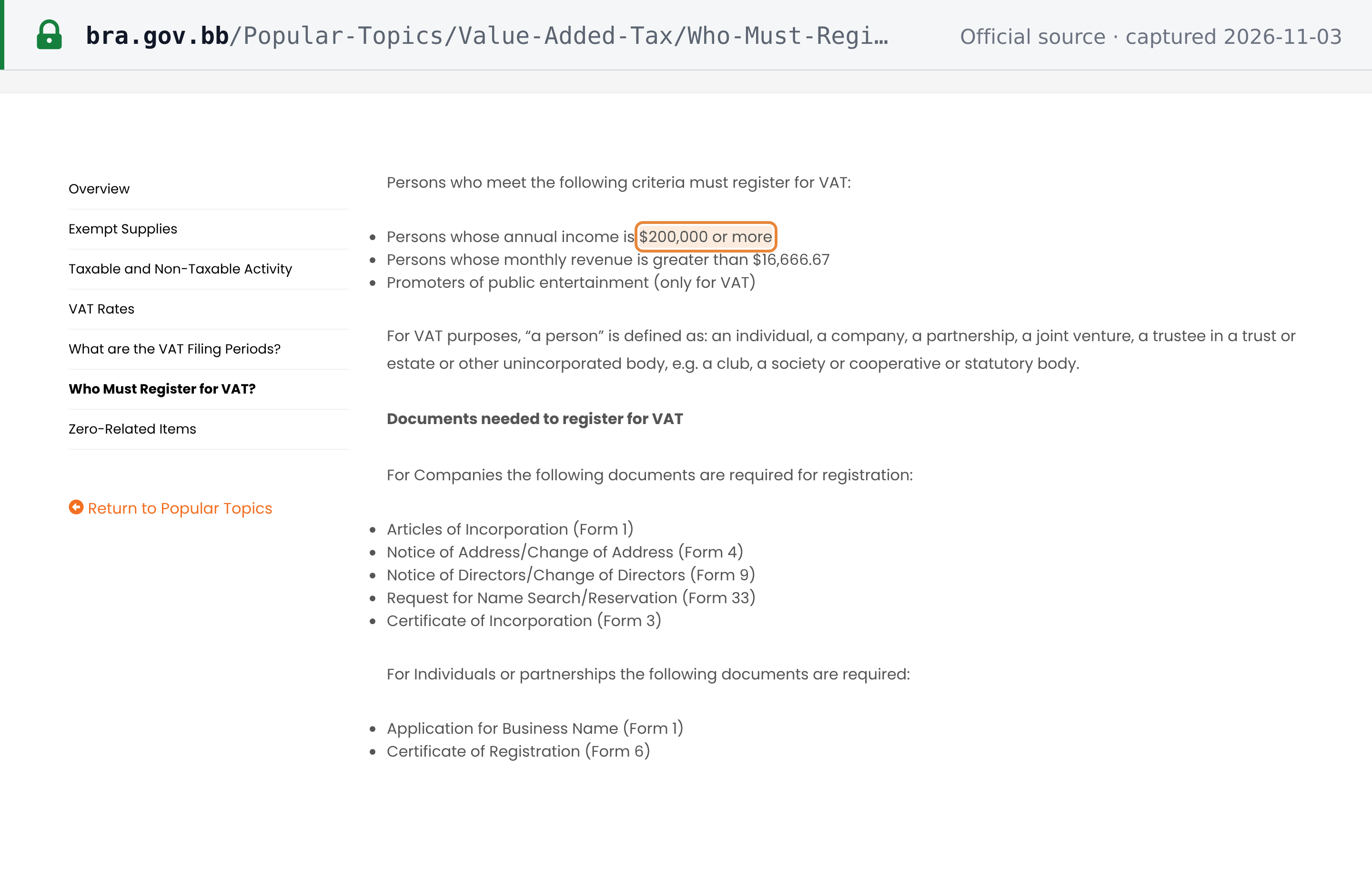
Promoters of public entertainment, and licensees and proprietors of places of public entertainment, must register whatever their turnover (s.34(6)). The BRA lists "Promoters of public entertainment (only for VAT)" alongside the turnover tests. [11]
Registration threshold
BBD 200,000 of taxable supplies in the preceding 12 months (as at 2026-11-03). Section 33(1), as substituted by section 2 of the VAT (Amendment) Act, 2017-18, makes a person a small supplier throughout a month where:
-
"(a) where the person began to carry on taxable activities at least 12 months before the beginning of the month, the total value of all taxable supplies, other than sales of goods that are capital property of the person, made by the person and his associates in the twelve-month period ending immediately before the beginning of the particular month is less than $200 000; and"
-
"(b) where the person began to carry on taxable activities less than 12 months before the beginning of the month …, the average monthly value … of all taxable supplies … made by the person and his associates is less than $16 667." [6]
-
Measurement. A rolling 12 months, tested at the start of each month, on taxable supplies (excluding sales of capital property). A business trading for less than 12 months uses the average monthly value, BBD 16,667.
-
Aggregation. Supplies of the person's associates count. A corporation and another person are associates where that person and its other associates own or control "more than 50 percent of the outstanding voting stock or shares of the corporation" (s.33(2)(a)). [1]
-
Effective date. Section 6(1) of Act 2017-18 deems the new figure to "take effect from the 1st day of January, 2016". It replaced BBD 80,000, which had applied from 1 December 2010.
-
The BRA's wording. "Persons whose annual income is $200,000 or more / Persons whose monthly revenue is greater than $16,666.67". The statute's test is taxable supplies, not income. [11]
 Source snapshot captured 2026-11-03 — original
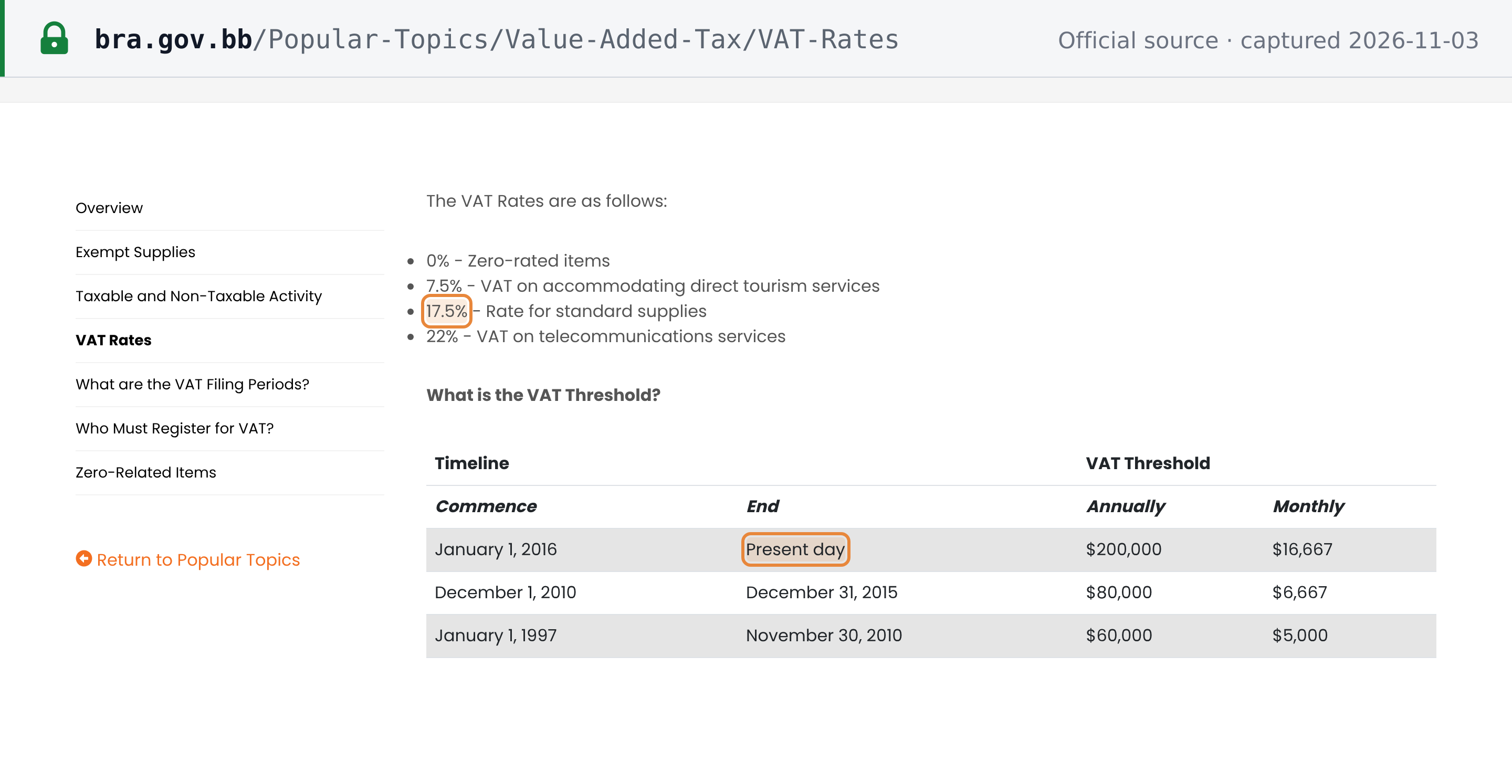
The BBD 350,000 budget proposal is not law. The 2026 Budget (16 March 2026) announced an increase to BBD 350,000 from 1 October 2026. As at 2026-11-03 no amending Act, Bill or Order giving effect to it had been published in the Barbados Parliament's bills list or the Official Gazette, and the BRA's VAT Rates page still shows BBD 200,000 running from 1 January 2016 to "Present day". [26] [10]
Non-resident registration
The VAT Act has no separate non-resident threshold and no non-resident registration scheme. The small-supplier test in s.33 applies to "a person", with no residence condition. Whether a non-resident's supply is made in Barbados at all is a place-of-supply question: see Foreign companies selling into Barbados. The Act requires no fiscal representative.
Tax identification number
Registration in the BRA's TAMIS system issues a 13-digit Taxpayer Identification Number (TIN). The BRA's TIN page: "When a person or entity is registered in TAMIS, they will receive a unique 13-digit Taxpayer Identification Number (TIN)." Its worked example is 1000122133144. An applicant may instead receive a case reference such as REG101364, which "means that a BRA officer has to first vet your application before issuance of a TIN." [12] The BRA publishes no check-digit algorithm.
The TIN replaced the old VAT registration number: "The new TIN replaces the VAT registration number and must be shown on quotations, invoices and receipts." [13]
For format detail, see the Barbados TIN guide. To check the format of a number, use the Barbados TIN validator.
How to register
- Companies, sole traders and partnerships register with CAIPO first. "Before registering with the Authority, companies must have been registered with the Corporate Affairs and Intellectual Property Office." Sole traders and partnerships "must first register with the Corporate Affairs and Intellectual Property Office (CAIPO)". [16]
- Register in TAMIS at tamis.bra.gov.bb: "Register Now", activate the account from the e-mail, log in, then "Register New Taxpayer" as an individual or a non-individual entity. TAMIS asks for an e-mail address, bank or credit-union details and identification. [12]
- Documents for VAT. Companies: Articles of Incorporation (Form 1), Notice of Address (Form 4), Notice of Directors (Form 9), Request for Name Search/Reservation (Form 33) and Certificate of Incorporation (Form 3). Individuals or partnerships: Application for Business Name (Form 1) and Certificate of Registration (Form 6). [11]
- Certificate. The Comptroller issues a certificate of registration, which must be displayed "in a conspicuous place at each location at which he engages in taxable activities" (s.36(2)); failure carries a penalty of up to BBD 1,000 (s.36(3)). [1]
Timeline. The BRA publishes no processing time.
Voluntary registration
Available. "A small supplier may at any time apply to the Comptroller to be registered under this Act" (s.34(5)). The Comptroller registers a small supplier that "maintains adequate books and records" and is "otherwise capable of complying" (s.35(1)(b)). [1]
A person about to start business may apply in advance. Under s.34(4B), as substituted by Act 2017-18, the Comptroller "(a) shall, if the applicant intends to carry on taxable activities to the value of $200 000 or more annually; or (b) may, if the applicant intends only to carry on taxable activities to the value of less than $200 000 annually, cause the applicant to be registered." [6]
The usual reason to register voluntarily is to recover input tax on purchases, which an unregistered business cannot do.
Late registration. A person who fails to apply in time is compulsorily registered, pays a penalty of up to BBD 1,000, and is "not … entitled to a refund of input tax under section 47 for the period during which that person should have been registered" (s.34(4), as substituted by Act 2015-33 s.8). [5]
Deregistration
- On application. The Comptroller may cancel a registration where the person has been a small supplier throughout the preceding two years, or no longer carries on taxable activities or intends to make taxable supplies, and it is reasonable to expect taxable supplies in the next 12 months to be "less than $200 000" (s.38(2), as amended by Act 2017-18 s.4). [6]
- By the Comptroller. Without an application, after a notice "giving him 15 days to show cause why the registration should not be cancelled" (s.38(4)).
- Final return. Due "within 21 days after the end of the last taxable period during which he was registered" (s.45(2)). [1]
- Claw-back. On cancellation, input tax previously credited on assets still held is brought back as output tax in the last period (s.51(1)(b), as substituted by Act 2015-33 s.11).
Group registration
Not available. Cap. 87 and the amending Acts on the BRA's legislation page contain no VAT grouping provision.
Branch registration is available. A registrant that carries on taxable activities "in more than one branch or division" may apply "for a separate registration in respect of taxable activities carried on at each particular branch or division" (s.41(2)). Each branch must keep an independent accounting system and be separately identifiable. The legal entity as a whole is still tested against the small-supplier threshold (s.41(4)(a)). [1]
Rates
| Rate | Applies to | Basis |
|---|---|---|
| 17.5% (standard) | Taxable supplies and imports not zero-rated, exempt or at another rate | VAT Act s.7(2)–(3), as substituted by Act 2011-10; indefinite under Act 2012-10 |
| 10% | Accommodation in a guest house, hotel, inn, apartment or similar place, and "direct tourism services" | VAT Act s.7(11), as substituted by the Tourism Levy Act, 2019-57, Sixth Schedule (from 1 January 2020) |
| 22% | Mobile voice, data and text messaging services | VAT Act s.7(13), inserted by Act 2015-33 (from 1 January 2016) |
| 0% | First Schedule supplies: exports of goods and services, international transport, the zero-rated basket of goods, among others | VAT Act s.8 and First Schedule |
Standard rate: 17.5% (as at 2026-11-03). The VAT (Amendment) Act, 2011-10 substituted s.7(2): "The tax imposed by subsection (1) on a taxable supply of goods or services by a registrant is equal to 17.5 per cent of the value of the supply". The same rate applies to imported goods (s.7(3)). It took effect "from the 1st day of December, 2010" for "a period not exceeding 18 months" (s.7(3A)). The VAT (Amendment) Act, 2012-10 replaced those words with "until further notice". [3] [4] The BRA's VAT Rates page lists "17.5% - Rate for standard supplies". [10]
 Source snapshot captured 2026-11-03 — original
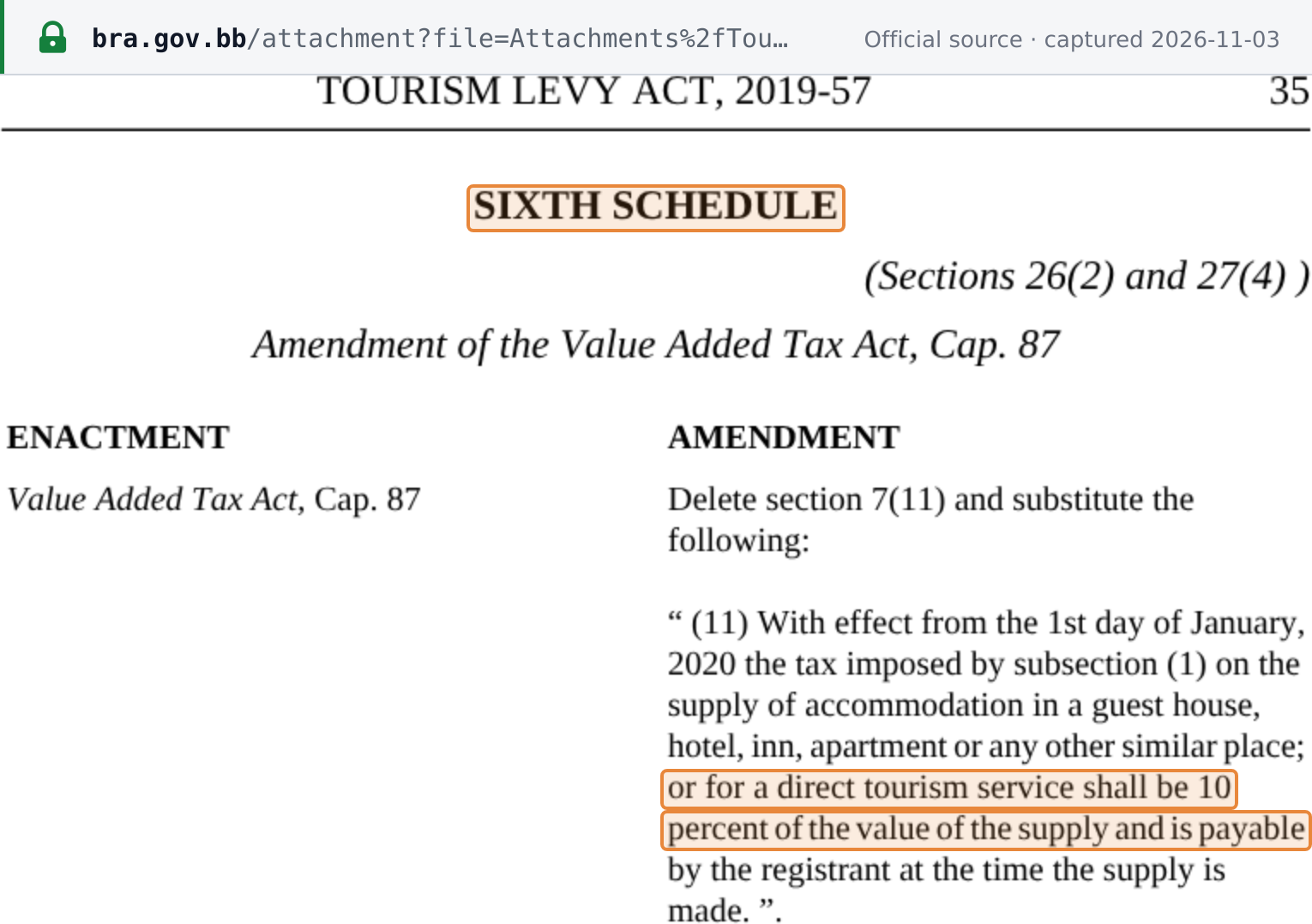
Reduced rate: 10% on accommodation and direct tourism services (since 1 January 2020). The BRA's VAT Rates page still shows 7.5% for this category. That was the rate set by the VAT (Amendment) Act, 2013-22. [24] The Tourism Levy Act, 2019-57, Sixth Schedule, deleted s.7(11) and substituted: "With effect from the 1st day of January, 2020 the tax imposed by subsection (1) on the supply of accommodation in a guest house, hotel, inn, apartment or any other similar place; or for a direct tourism service shall be 10 percent of the value of the supply and is payable by the registrant at the time the supply is made." [8]
 Source snapshot captured 2026-11-03 — original
A "direct tourism service" is "the provision of goods and services by a person who (a) has a licence from the Barbados Tourism Product Authority; and (b) is also registered or licensed by" one of the bodies the Act lists, such as the Barbados Hotel and Tourism Association, Small Hotels of Barbados or the Cultural Industries Development Authority (Tourism Levy Act s.2). The goods and services covered include entertainment, non-international cruises, sport and recreation, marinas, spas, conference facilities, and meals, drinks and dining. [8]
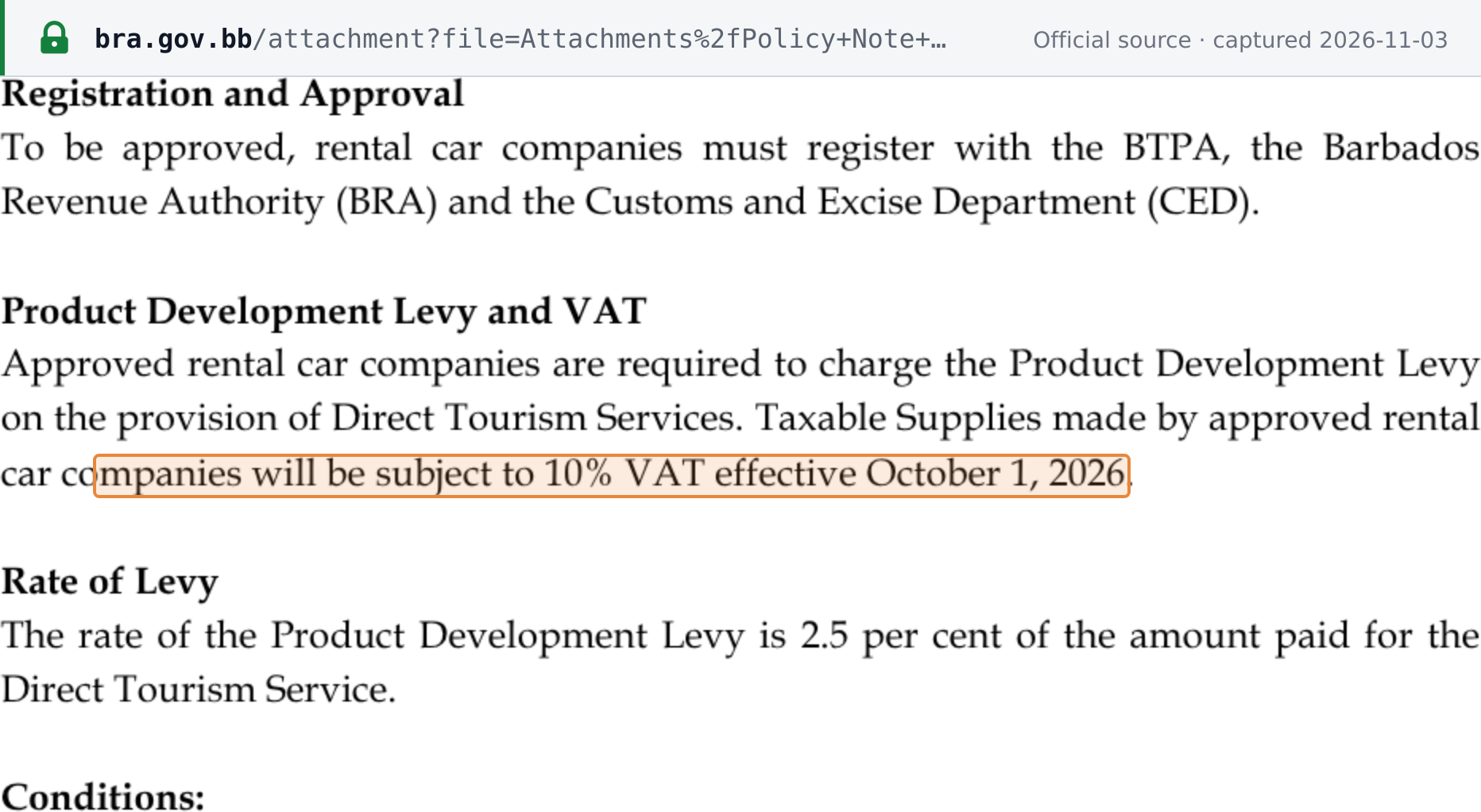
Rental cars from 1 October 2026. BRA Policy Note OGC No. 004/2026 (30 September 2026) designates approved rental car companies as Direct Tourism Services providers: "Taxable Supplies made by approved rental car companies will be subject to 10% VAT effective October 1, 2026." They also charge the 2.5% Product Development Levy, which is a tourism levy, not VAT. [9]
 Source snapshot captured 2026-11-03 — original
Higher rate: 22% on mobile services (since 1 January 2016). Section 7(13), inserted by the VAT (Amendment) (No. 2) Act, 2015-33: "with effect from the 1st day of January, 2016, the tax imposed on the supply of the mobile services of voice, data and text messaging is 22 percent". The BRA's rates page describes this more broadly as "22% - VAT on telecommunications services"; the statute covers mobile voice, data and text messaging. [5]
Zero rate. "A taxable supply of goods or services that is specified in the First Schedule and is not specified in the Second Schedule is taxable at the rate of zero percent" (s.8). [1] Examples:
- exported goods, and services to non-residents for foreign-currency consideration (First Schedule paras. 1 and 4(1));
- international freight transport, and services to ships and aircraft in international commercial service (paras. 2–3);
- water and sewerage supplied by the Barbados Water Authority (para. 5A);
- the "Zero-Rated Basket of Goods effective September 1, 2015", which the BRA publishes as a tariff-coded list; [27]
- from 1 April 2022, items including "sanitary towels and tampons, baby and adult diapers, antiperspirants, vitamins and multi-minerals, Glucerna, Ensure and Enterex". [19]
The First Schedule has been amended many times by Order, so the list above gives examples, not the full schedule.
Domestic electricity (historic). The VAT (Amendment) Act, 2023-6 set 7.5% on domestic electricity up to 250 kWh, inclusive of the customer charge, deemed in effect from 1 August 2022 and ending 30 September 2023 (s.7(14), (17)). [17] A BRA policy note extended the period to March 2024. [18] The BRA has published no later extension, so this page does not list it as a current rate.
Announced future rates. None. The only 2026 rate change is the rental-car designation at 10% above. See the Barbados tax-changes chronology.
See worldwide tax rates for other countries.
Cross-border rules
Imports and exports
Imports. VAT on imported goods "is equal to 17.5 per cent of the value of the goods and is payable, at the time the goods are entered for use within Barbados, by the importer, proprietor or other person who is liable under the Customs Act to pay duties on the goods" (s.7(3), as substituted by Act 2011-10). [3] The VAT Act sets no de-minimis value for imports.
Exports. Goods exported in compliance with the Customs Act, or delivered outside Barbados, are zero-rated (First Schedule para. 1). So are services supplied to "(a) an unregistered non-resident person, other than an individual, or (b) a non-resident individual who is outside Barbados when the service is performed, for consideration that is payable in a currency other than that of Barbados" (para. 4(1)). [1]
Reverse charge on imported services
Not applicable. Cap. 87, as amended to 2023, contains no reverse-charge or self-assessment provision. Section 7(1) taxes only supplies "by a registrant" and imports of goods. Instead, s.15(3) deems a B2B supply by a non-resident to a registrant who uses it exclusively for taxable supplies to take place outside Barbados (see Place of supply). For how other countries handle this, see reverse charge explained.
Digital products and services
The VAT (Amendment) (No. 2) Act, 2015-33 defines an "electronic service" as "an essentially automated service which is supplied via the internet or a similar electronic network and cannot be obtained without the use of information technology", and deems providing one to be "a supply of services" (s.13(3A)). [5] Electronic services are in Barbados when "utilised in Barbados" (s.15(1)(b)(ii)). No separate digital-services registration regime or threshold appears in the Act or on the BRA site; the ordinary BBD 200,000 test applies.
Online purchases (Act 2019-9). The VAT (Amendment) Act, 2019-9 (7 March 2019) added two collection regimes:
- Part IIIA, registrants selling online: an "electronic invoice shall be issued to the purchaser at the time of payment and the invoice shall indicate the amount of the tax paid" (s.28D(1)).
- Part IVA, foreign vendors: "Where goods or services are purchased online from a vendor outside Barbados for consumption in Barbados, the tax on the supply of those goods and services is payable at the time of purchase" (s.32B(1)). The foreign vendor issues an electronic invoice showing the tax (s.32B(2)). The Government may license "tax collecting agents" or payment processors to collect it (s.32E). The BRA may direct internet service providers to block a foreign vendor or payment processor that fails to transmit the tax (s.32F(1)).
Section 32B(1) "applies with effect from such day as the Minister may by order appoint" (s.32B(6)). The BRA's legislation page lists no appointing order, so this page gives no start date for foreign-vendor collection. [7] For the wider picture, see VAT on digital services by non-resident suppliers.
Foreign companies selling into Barbados — B2B and B2C
- B2B, to a registrant making taxable supplies. The supply is deemed outside Barbados under s.15(3), unless both parties agree otherwise. The foreign supplier charges no Barbados VAT and the customer self-accounts for none.
- B2C, and B2B where the customer does not use the supply exclusively for taxable supplies. A service performed or utilised in Barbados, or goods located there, are supplied in Barbados (s.15(1)(b)). The non-resident is then a "person" subject to the ordinary BBD 200,000 small-supplier test. There is no zero threshold and no simplified registration. Goods sold online are also within the Part IVA collection rules above.
Marketplace / platform deemed-supplier liability
VAT: none. Cap. 87 has no deemed-supplier rule for marketplaces. Part IVA defines a "foreign vendor" to include "persons selling on platforms such as Amazon and Ebay" (s.32A), and lets payment processors and licensed tax-collecting agents collect the tax. It does not make the platform the supplier. [7]
Tourism levies (not VAT). From 17 January 2026, the Tourism Levy (Amendment) Act, 2026-1 requires any person who "operates an online marketplace or acts as a marketplace facilitator" for tourist accommodation or direct tourism services to "register with the Barbados Tourism Product Authority and Barbados Revenue Authority". [22] See marketplace deemed-supplier rules for other countries.
Place of supply
Section 15(1): "a supply shall, subject to subsections (3) and (4), be deemed to have taken place in Barbados if (a) the supplier is resident in Barbados; or (b) the supplier is not resident in Barbados but (i) in the case of goods, the goods are located in Barbados at the time of the supply, or (ii) in the case of services, the services are physically performed or utilised in Barbados."
Section 15(3): "Where a supplier who is not resident in Barbados and is not registered or liable to be registered … makes a supply to a registrant … and the registrant is acquiring the goods or services exclusively for the purpose of making taxable supplies, the supply shall be deemed to have taken place outside Barbados unless the supplier and the recipient agree that the supply is to be regarded as having taken place in Barbados." [1]
Goods and services follow different tests: goods by location at the time of supply, services by where they are performed or used.
Invoice requirements
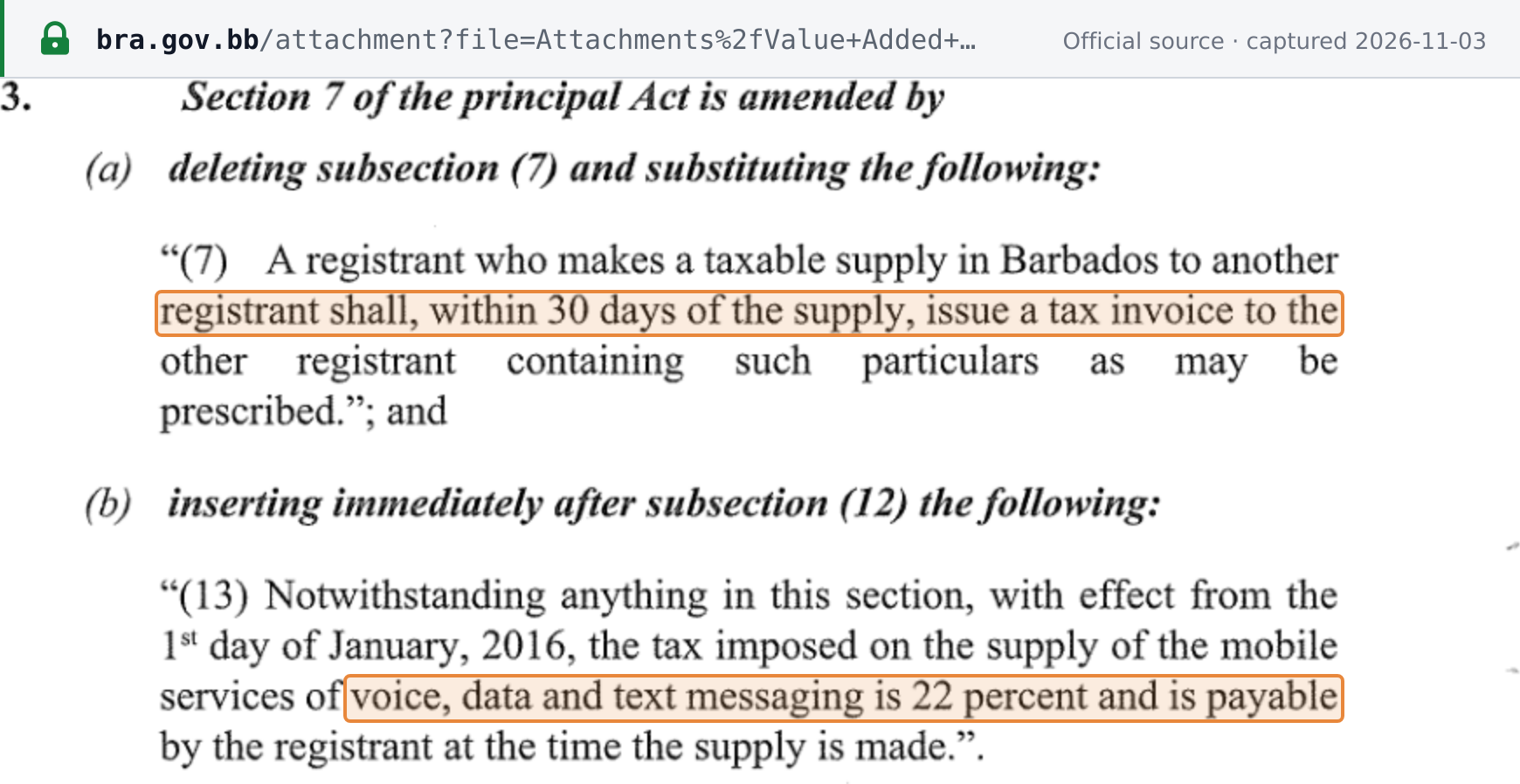
A registrant "who makes a taxable supply in Barbados to another registrant shall, within 30 days of the supply, issue a tax invoice to the other registrant containing such particulars as may be prescribed" (s.7(7), as substituted by Act 2015-33 s.3(a), in force 28 December 2015). Tax invoices are also issued under s.56(2) and s.57(3). [5] The particulars are prescribed by regulation 2 of the Value Added Tax Regulations, 1996.
Mandatory content
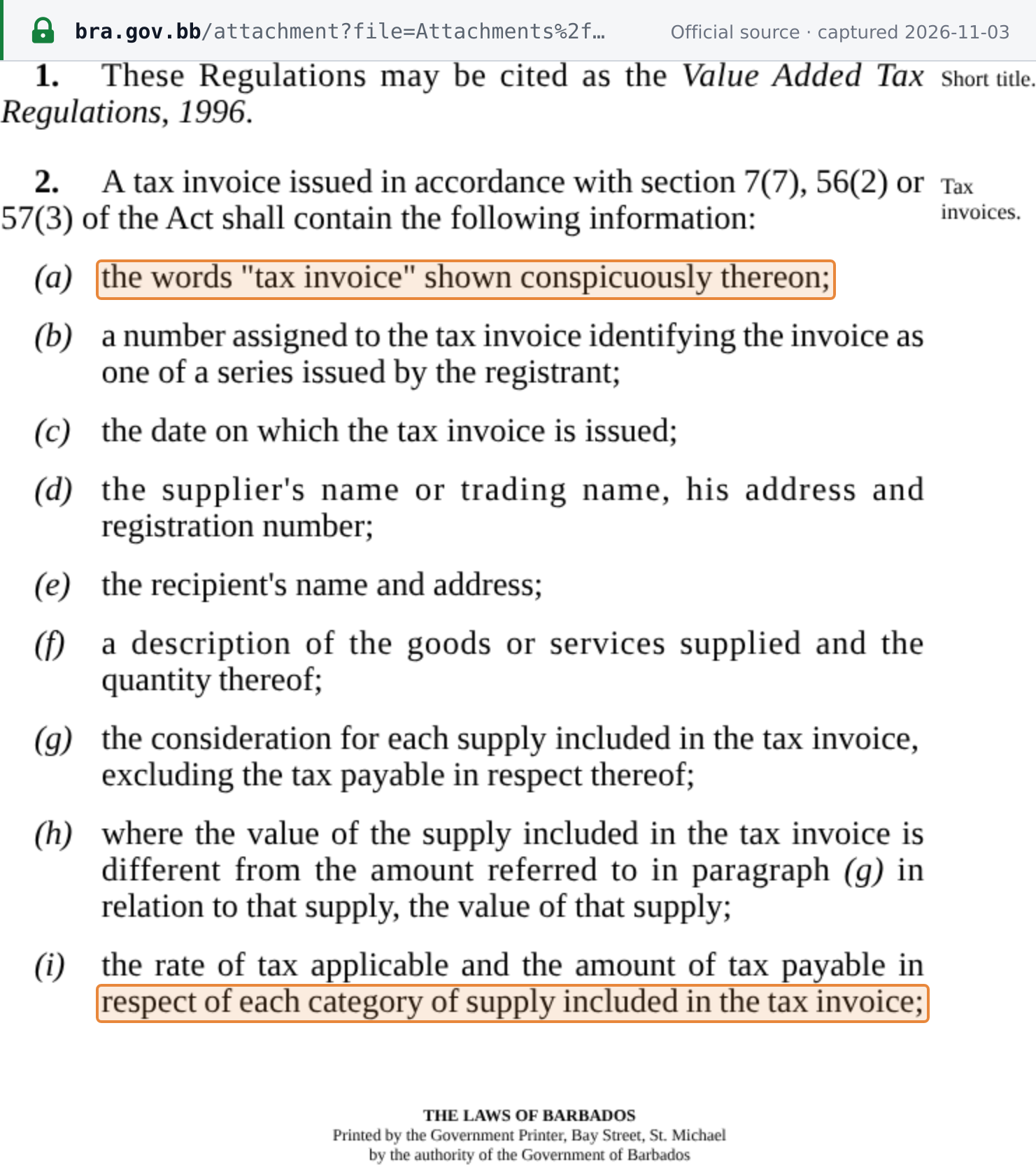
Regulation 2: "A tax invoice issued in accordance with section 7(7), 56(2) or 57(3) of the Act shall contain the following information": [2]
| # | Particular | Reg. 2 |
|---|---|---|
| 1 | The words "tax invoice" shown conspicuously | (a) |
| 2 | A number identifying the invoice "as one of a series issued by the registrant" | (b) |
| 3 | The date of issue | (c) |
| 4 | The supplier's name or trading name, address and registration number (now the 13-digit TAMIS TIN) | (d) |
| 5 | The recipient's name and address (the recipient's TIN is not prescribed) | (e) |
| 6 | A description of the goods or services and their quantity | (f) |
| 7 | The consideration for each supply, excluding tax | (g) |
| 8 | Where the value of a supply differs from that consideration, the value of the supply | (h) |
| 9 | The rate of tax and the amount of tax for each category of supply | (i) |
| 10 | The total amount of tax payable on the invoice | (j) |
| 11 | The total consideration and tax payable by the recipient | (k) |
 Source snapshot captured 2026-11-03 — original
The registration number in (d) is now the TIN: BRA's 2019 notice says "The new TIN replaces the VAT registration number and must be shown on quotations, invoices and receipts." [13]
Issuance deadline
Within 30 days of the supply, for a taxable supply to another registrant (s.7(7)). Before 28 December 2015 the Act required a tax invoice only on the other registrant's request.
 Source snapshot captured 2026-11-03 — original
Related rules in s.7: [1]
- Failure to issue. "A registrant who fails to issue a tax invoice as required under this Act is liable to pay a penalty of such amount not exceeding $1 000 as the Comptroller may determine" (s.7(8)).
- Overstated tax. Where an invoice shows more tax than is payable, "the amount indicated in the tax invoice shall be deemed to be the tax payable" (s.7(9)).
- Date of issue. An invoice is deemed issued "on the date appearing on the tax invoice", absent evidence to the contrary (s.7(10)).
Numbering and sequencing
Tax invoices, credit and debit notes and receipts must each carry a number "identifying [it] as one of a series issued by the registrant" (regs. 2(b), 3(e), 5(c)). The Regulations prescribe no format, prefix or gap rule beyond that.
Credit and debit notes
Where, after a supply, the consideration changes because the supply is cancelled, goods or services are returned, the tax on the invoice was wrong, or for any other reason (other than a s.19(4) adjustment), the supplier "shall, at that time, issue" a credit or debit note (s.52(1)). Only one note per adjustment may be issued, other than a copy "clearly marked as such" to replace a lost original (s.52(2)). [1]
Regulation 3 requires on the note: [2]
- the words "credit note" or "debit note", shown conspicuously;
- the date of issue;
- the supplier's name or trading name, address and registration number;
- the recipient's name and address;
- a serial number;
- the amount by which the tax is reduced or increased;
- where a tax invoice was issued, its serial number, date and the tax shown on it; where none was issued, enough detail to identify the supply, its date and the original tax;
- "a brief explanation of the circumstances giving rise to the issue of the credit note or debit note".
Currency and language
The Act and Regulations set no explicit currency or language rule for the invoice itself. Records must be kept "in the English language and the currency of Barbados" (s.75(1)). Foreign-currency consideration is valued "in Barbados currency at the rate of exchange at which the Central Bank of Barbados would, at the time of the supply, have purchased that currency in the form of notes" (s.21). [1] An invoice may therefore be priced in a foreign currency, but the VAT value and the records must be in BBD at that rate.
Document types
- Tax invoice (reg. 2): supplies to another registrant; also exports (s.57(3)) and educational institutions (s.56(2)).
- Receipt (s.9 and reg. 5): every registrant supplying a consumer must issue a receipt "where the value of the goods or services … is $20 or more" (s.9(1)). The receipt carries the registrant's name or trading name, registration number, a serial number, the total consideration, the date, and the rate and amount of tax for each category of supply (reg. 5). It needs no customer details and no tax-exclusive line values. [1] [2]
- Electronic invoice for online sales (Act 2019-9): issued "at the time of payment" and showing "the amount of the tax paid" (ss.28D, 32B(2)), with no BBD 20 floor.
- Credit and debit notes (s.52 and reg. 3), above.
Self-billing
Not provided for. Cap. 87 and the VAT Regulations contain no provision for recipient-created tax invoices.
Retention and audit trail
- Period. Records and books must be kept "until the expiration of 7 years after the end of the year to which the records and books of account relate" (s.75(3)), and longer while an objection or appeal is open or on the Comptroller's demand (s.75(4)–(5)). [1]
- Electronic records. Allowed: they "shall be kept in a retrievable format that is easily accessible by the Comptroller" (s.75(1A), Act 2015-33 s.15). "The Electronic Transactions Act, Cap. 308B, applies, mutatis mutandis" (s.73(5), Act 2015-33 s.14). [5]
- What to keep (reg. 7). Originals of tax invoices received and copies of those issued, pro forma invoices, sales invoices and receipts, a summary of sales of BBD 20 or more for each period, stock records, a per-period summary statement cross-referenced to the supporting records (First Schedule to the Regulations), and "computer print-outs and audit reports as the Comptroller may require". [2]
- Audit. BRA officers may enter premises and inspect records (s.76).
- Tamper-evidence. Beyond "one of a series" numbering and the summary statement, the Act and Regulations impose no hash, certified-software or fiscal-device requirement.
A specimen of a compliant invoice
The BRA's VAT pages, its VAT FAQ and policy notes, Cap. 87 and the VAT Regulations contain no specimen tax invoice. (Regulation 4's "Price excluding tax $100 / Tax $15 / Total price $115" is a shelf-price display format at the old 15% rate, not an invoice.) Below, Lookuptax lays out the regulation 2 particulars for an illustrative B2B sale at 17.5%. Every name, number and amount is fictional:
Tax invoice — illustrative
| Descriptionreg. 2(f) | Qtyreg. 2(f) | Unit price excl. VAT | Consideration excl. VATreg. 2(g) | VAT ratereg. 2(i) |
|---|---|---|---|---|
| Laser printer, model EX-1 | 2 | BBD 1,200.00 | BBD 2,400.00 | 17.5% |
| Installation and set-up | 1 | BBD 300.00 | BBD 300.00 | 17.5% |
- Standard-rated supplies (17.5%)reg. 2(i)
- BBD 2,700.00
- VAT at 17.5%reg. 2(i)
- BBD 472.50
- Total tax payablereg. 2(j)
- BBD 472.50
- Total payable (consideration + tax)reg. 2(k)
- BBD 3,172.50
- Issue within 30 days of the supply — VAT Act s.7(7).
- Where the value of a supply differs from the consideration shown, state that value too — reg. 2(h).
- A supplier with supplies in more than one rate category (for example 10% direct tourism services) shows the rate and tax for each category — reg. 2(i).
- Foreign-currency amounts are valued in BBD at the Central Bank of Barbados note-buying rate at the time of supply — VAT Act s.21.
- Keep records in English and BBD for 7 years — VAT Act s.75.
E-invoicing status
None as at 2026-11-03. The BRA publishes no e-invoicing, clearance (CTC) or fiscal-device requirement, and names no e-invoicing system, network, format or phase timeline. No B2B, B2G or B2C mandate applies.
The only statutory "electronic invoice" is the one Act 2019-9 requires for online sales (ss.28D, 32B(2); see Digital products and services). It is a content rule for a receipt, not a clearance system. In October 2026 the BRA reported hosting Tax Administration Jamaica for "a three-day peer-to-peer study visit focused on the implementation and enhancement of their digital tax services"; the announcement sets no Barbados e-invoicing measure. [21]
For the regional picture, see e-invoicing status and networks worldwide.
Filing and payment
Filing frequency
Bi-monthly by default, on one of the two cycles in s.44(2) (see Overview). Monthly for large taxpayers (BBD 25,000,000 or more of taxable supplies in the preceding 12 months) and for registrants who apply. Longer periods, up to one year, are possible on application (s.44(6)). The BRA's VAT filing periods table lists each period with the taxpayer categories (A to G) it applies to; the BRA does not publish a legend for those categories on that page. [15]
Return due date
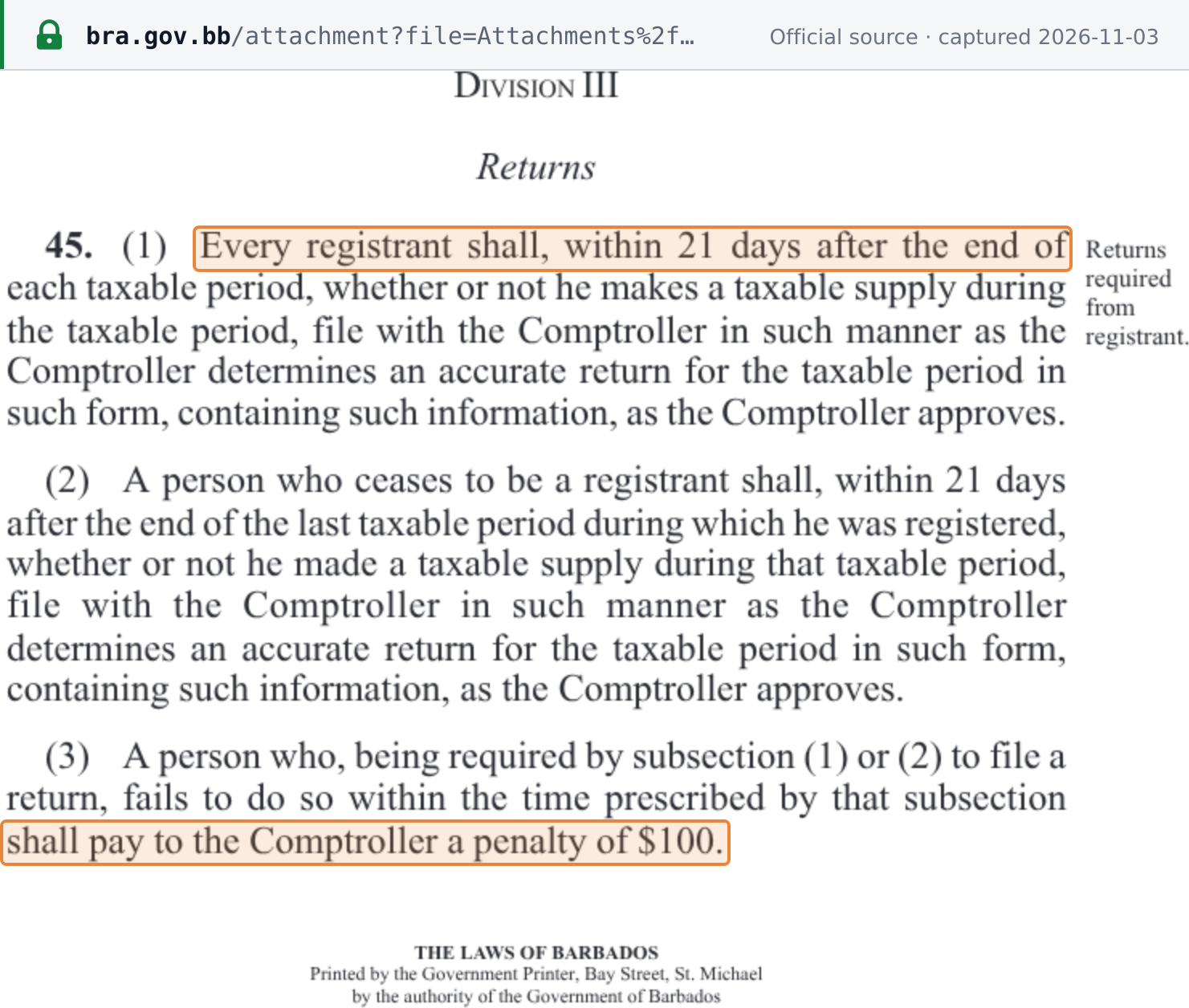
Within 21 days after the end of each taxable period, including nil returns: "Every registrant shall, within 21 days after the end of each taxable period, whether or not he makes a taxable supply during the taxable period, file with the Comptroller … an accurate return for the taxable period" (s.45(1)). The Comptroller may extend the time for filing in writing (s.45(4)). [1]
 Source snapshot captured 2026-11-03 — original
Payment due date and method
The same day as the return: "Every registrant shall, within 21 days after the end of each taxable period, pay to the Comptroller all of the output tax payable by him for the taxable period" (s.46(1)). The Comptroller may extend the time for payment (s.46(1A), Act 2015-33 s.9). [5] Where the filing date is extended, interest still runs "as if the time for filing the return had not been extended" (s.46(6)(b)). Returns are filed and paid through TAMIS; the BRA's payment page lists the other payment channels.
Additional listings
None. Cap. 87 requires no sales or purchase listing. Each registrant must keep, not file, a summary statement for each period (reg. 7 and the First Schedule to the Regulations).
Promoters of public entertainment. A non-resident registered promoter must pay "an amount equal to 5 per cent of the value of the tickets printed for that entertainment" at least 48 hours before the event (s.34(8)); a resident promoter pays within 7 days after it (s.34(8A)). [1]
Input-tax recovery and blocked items
- Full recovery where all supplies are taxable, including zero-rated supplies.
- Mixed supplies. Costs used for both are apportioned by the ratio of "the total value of all taxable supplies" to "the total value of all supplies" in the period (s.48(1)(b)(iii)). A registrant "shall be deemed to have made no exempt supplies if the total of all exempt supplies of the registrant represents less than 2% of the value of total supplies" (s.48(5)). [1]
- Motor cars. Input tax on a motor car used as capital property is capped at the standard rate multiplied by BBD 125,000, cumulatively across the car and its improvements (s.49(2)(a)). The cap does not apply to cars held for lease or hire.
- Late registrants lose input-tax refunds for the period they should have been registered (s.34(4)(c)).
- Entertainment. Cap. 87 contains no specific block.
Refunds
- Credit position. Excess input tax is refunded, after offset against any tax debts (s.47(1)). The refund must be claimed in a return filed "within 5 years after the end of that taxable period", and all earlier returns must have been filed (s.47(2)). [1] An unpaid refund may be carried forward against the next period's output tax (s.47(3A)).
- Interest. Payable to the registrant at the prescribed rate if the refund is not paid "within 6 months after the month in which the return for the taxable period was filed" (s.47(4)(c)). The prescribed rate is "one per cent per month or part of a month" (reg. 6). [2]
- Bad-debt relief (s.53). Available where a taxable, non-zero-rated supply to an unconnected person was included in a return and the tax paid, and the debt has been written off. The deduction is taken in "the later of the taxable period in which the bad debt is written off and the first taxable period that ends at least one year after the consideration became due and payable" (s.53(2)). A debtor-registrant must repay input tax claimed on a debt the supplier has written off (s.22A, Act 2015-33). [1]
- Non-residents. No refund scheme for unregistered foreign businesses. Separate refund provisions cover diplomatic missions (s.58) and the international financial sector (s.59).
Exemptions
Exempt supplies
Exempt supplies are listed in the Second Schedule (s.10). Examples: [1]
- financial services, including insurance (advice and the professional services of accountants, lawyers and actuaries are not exempt) (para. 1);
- sales of real property, leases of 25 years or more, and "a supply of a dwellinghouse (whether real property or a chattel house)" (para. 2);
- passenger transport by bus, minibus, taxi, maxi-taxi, tour coach, limousine or route-taxi (para. 3);
- medical, dental, nursing and paramedical services by registered practitioners, hospitals and ambulances (paras. 7–9);
- education by approved institutions (para. 10);
- lotteries, betting and games of chance (para. 12);
- from 1 April 2019, vacation rental properties registered with the Barbados Tourism Product Authority (para. 16, added by the Tourism Levy Act, Fifth Schedule). These pay the shared economy levy instead. [8]
Exempt is not zero-rated. The BRA: "Exempt supplies are supplies that are not subject to VAT. It should be noted that where a registrant makes exempt supplies, he is NOT entitled to recover allowable input tax in respect of goods and services he has acquired or imported for the purposes of making such exempt supplies." [14] A zero-rated supplier, such as an exporter, charges 0% and still recovers its input tax.
Special regimes
- Tourism. 10% VAT on accommodation and direct tourism services; vacation rentals exempt but subject to the shared economy levy; approved rental car companies at 10% from 1 October 2026 (see Rates).
- Second-hand goods. A scheme is available with the Comptroller's approval (s.42). The approved person keeps a register of items, sellers, purchase and sale dates and prices, profit and output tax (reg. 8).
- Government contracts. VAT due to a registrant on a contract with the Government "shall be paid directly to the Comptroller by the accounting officer" (s.28A, as inserted by Act 2015-33 s.7). Act 2019-9 later inserted a different s.28A (online sales) in a new Part IIIA, so cite each by its amending Act. [5]
- Free zones, cash accounting, flat-rate or small-business schemes. Not provided in Cap. 87. A business below BBD 200,000 simply stays unregistered.
Offences and penalties
Offences
| Offence | Fine / imprisonment | Provision |
|---|---|---|
| Failure to issue a consumer receipt of BBD 20 or more | BBD 5,000 or 1 year, or both | s.9(2) |
| Consumer failing to report a receipt not issued | BBD 2,500 or 6 months, or both | s.9(3) |
| Displaying a false registration certificate | BBD 10,000 or 1 year, or both | s.36(4) |
| Knowingly issuing a false tax invoice | BBD 5,000 or 6 months, or both | s.96 |
| False representation of tax to a recipient | BBD 10,000 or 1 year, or both | s.97 |
| Tax evasion | A fine of at least 50% of the tax evaded, up to the greater of BBD 25,000 and 200% of it, or 2 years' imprisonment, or both | s.98(2) |
| Failure to keep adequate records | BBD 1,000 to BBD 5,000 | s.75(7) |
| Any contravention with no other penalty provided | BBD 25,000 | s.99(1), as substituted by Act 2015-33 s.21 |
Section 96 covers knowingly issuing a tax invoice where there is no taxable supply, tax is not payable, the tax shown exceeds the tax payable, or "the tax invoice is incorrect in any other material particular". [1] [5] Prosecutions may be brought within 7 years (s.100(1)).
Penalties
| Exposure | Amount | Provision |
|---|---|---|
| Late registration | Up to BBD 1,000, compulsory registration, and no input-tax refund for the unregistered period | s.34(4), as substituted by Act 2015-33 s.8 |
| Failure to display the registration certificate | Up to BBD 1,000 | s.36(3) |
| Failure to issue a tax invoice | Up to BBD 1,000 | s.7(8) |
| Late return | BBD 100 per return | s.45(3) |
| Late payment | 10% of the output tax in default, plus interest at 1% per month or part of a month on the largest unpaid tax and penalty in each month | s.46(4); reg. 6 |
| False or reckless statement in a return, invoice or record | The greater of BBD 250 and the tax understated or refund overclaimed | s.95 |
| Representing an amount as tax that exceeds the tax payable | An amount equal to the excess | s.94 |
Section 46(4): a registrant in default pays "(a) a penalty equal to 10 per cent of the amount of output tax in default; and (b) interest at the prescribed rate calculated for each month or part of a month during which any amount of tax and penalty remained unpaid". [1] The BRA may also levy distress on goods (s.91A), garnish bank accounts (s.91(6A)) and publish certificates of unpaid tax in newspapers (s.90(3)), powers added by Act 2015-33.
Frequently asked questions
Is VAT on hotels and tourism services in Barbados 7.5% or 10%?
10%. The Tourism Levy Act, 2019-57 (Sixth Schedule) replaced section 7(11) of the VAT Act with effect from 1 January 2020: VAT on the supply of accommodation in a guest house, hotel, inn, apartment or any other similar place, or for a direct tourism service, is 10 percent of the value of the supply. The BRA's VAT Rates page still lists 7.5%, the rate the 2020 amendment replaced. BRA Policy Note OGC No. 004/2026 applies 10% VAT to approved rental car companies from 1 October 2026.
Did the Barbados VAT registration threshold rise to BBD 350,000 on 1 October 2026?
Not in law as at 2026-11-03. The 2026 Budget of 16 March 2026 announced an increase from BBD 200,000 to BBD 350,000 from 1 October 2026, but no amending Act, Bill or Order giving effect to it had been published, and the BRA's VAT Rates page still shows the BBD 200,000 threshold as running from 1 January 2016 to the present day. The statutory test remains BBD 200,000 until an enacting instrument is published.
Do we have to self-account for VAT on foreign software or consulting services our Barbados business buys?
No. The VAT Act contains no reverse-charge provision. Section 15(3) deems a supply by a non-resident who is not registered or liable to be registered, made to a registrant who acquires the goods or services exclusively for the purpose of making taxable supplies, to take place outside Barbados unless the supplier and the recipient agree otherwise. Where the services are not acquired exclusively for taxable supplies, section 15(3) does not apply; any VAT liability then rests with the foreign supplier, not the buyer.
Can we still print our old VAT registration number on invoices?
No. BRA notices of 7 June 2019 and 11 September 2019 tell VAT registrants that the 13-digit TAMIS Taxpayer Identification Number (TIN) replaces the VAT registration number and must be shown on quotations, invoices and receipts.
Does a VAT-registered customer have to ask for a tax invoice before we issue one?
No, not since 28 December 2015. Before then, section 7(7) of the VAT Act required a tax invoice only on the other registrant's request. The VAT (Amendment) (No. 2) Act, 2015-33 replaced it: a registrant who makes a taxable supply in Barbados to another registrant must issue a tax invoice within 30 days of the supply. Failing to issue one carries a penalty of up to BBD 1,000 (section 7(8)).
If the BRA extends our VAT filing date, does interest stop running?
No. The Comptroller may extend the time for filing a return (section 45(4)). Output tax reported in that return must then be paid within the extended time, but interest is payable as if the time for filing had not been extended (section 46(6)(b)). The 10% late-payment penalty applies only to tax not paid within the extended time (section 46(6)(c)).
Important websites
| Site | Purpose |
|---|---|
| TAMIS | Register, file VAT returns and pay |
| BRA online services | BRA's online services hub |
| Register for a TIN | BRA's step-by-step TAMIS registration guide |
| CAIPO | Company and business-name registration, required before BRA registration |
| Pay the BRA | Payment options, including foreign-currency transfers |
| VAT Rates | BRA rate list and threshold timeline (its 7.5% tourism line is out of date; the rate is 10%) |
| VAT filing periods | Period table with taxpayer categories |
| BRA tax calendar | Due dates |
| BRA policy notes | Where the BRA announces rate and administrative changes |
| VAT Act legislation page | Cap. 87 and every amending Act as PDFs |
| Parliament bills | Track a VAT amendment Bill |
| Official Gazette | Enacted Acts and statutory instruments |
| TIN verification | The BRA publishes no public TIN lookup. Check a number's format with the Barbados TIN validator |
| E-invoicing portal | None (no mandate) |
Recent changes
- 2026-10-01 — Approved rental car companies are designated Direct Tourism Services providers; their taxable supplies are subject to 10% VAT, plus the 2.5% Product Development Levy. (BRA Policy Note OGC No. 004/2026) — see event
- 2026-01-17 — The Tourism Levy (Amendment) Act, 2026-1 requires online marketplaces and marketplace facilitators for tourist accommodation and direct tourism services to register with the BTPA and the BRA (a tourism-levy rule, not VAT). (Official Gazette, 19 January 2026)
- 2023-02-20 — The VAT (Amendment) Act, 2023-6 sets a temporary 7.5% rate on the first 250 kWh of domestic electricity, deemed in effect from 1 August 2022; the BRA later extended it to March 2024. (Act 2023-6)
- 2022-04-01 — Sanitary products, diapers, antiperspirants, vitamins and diabetes-control items are zero-rated. (BRA policy note)
- 2020-01-01 — The rate on accommodation and direct tourism services rises from 7.5% to 10%. (Tourism Levy Act, 2019-57, Sixth Schedule)
For the full chronology, see Barbados tax changes on Lookuptax.
Reference links
- Value Added Tax Act, Cap. 87 — Laws of Barbados consolidation (BRA)
- Value Added Tax Regulations, 1996 (BRA)
- Value Added Tax (Amendment) Act, 2011-10 (BRA)
- Value Added Tax (Amendment) Act, 2012-10 (BRA)
- Value Added Tax (Amendment) (No. 2) Act, 2015-33 (BRA)
- Value Added Tax (Amendment) Act, 2017-18 (BRA)
- Value Added Tax (Amendment) Act, 2019-9 (BRA)
- Tourism Levy Act, 2019-57 (BRA)
- BRA Policy Note OGC No. 004/2026 — Approved Rental Car Companies
- BRA — VAT Rates
- BRA — Who Must Register for VAT?
- BRA — Register for Taxpayer Identification Number
- BRA — VAT Number Notice (11 September 2019); see also Update VAT Number NOTICE (7 June 2019)
- BRA — Exempt Supplies
- BRA — What are the VAT Filing Periods?
- BRA — Registration services
- Value Added Tax (Amendment) Act, 2023-6 (BRA)
- BRA policy note — VAT on electricity reduction period extension to March 2024
- BRA policy note — Items zero-rated for VAT (1 April 2022)
- BRA — VAT Act legislation page (Cap. 87 and amending Acts)
- BRA — BRA hosts Jamaica for tax study visit (7 October 2026)
- Official Gazette, 19 January 2026, Part A Vol. CLXI No. 9 — Tourism Levy (Amendment) Act, 2026-1
- BRA — VAT FAQs
- Value Added Tax (Amendment) Act, 2013-22 (BRA)
- BRA — Value Added Tax overview
- Barbados Parliament — bills search
- BRA — Zero-Rated Basket of Goods (16 August 2016)
Related on Lookuptax: