Belarus VAT guidelines
| FACTSHEET | |
|---|---|
| Country code | BY |
| Tax name | Value added tax — налог на добавленную стоимость (НДС) |
| Tax Authority | Ministry of Taxes and Duties of the Republic of Belarus (MNS) |
Overview
Belarus levies value added tax — налог на добавленную стоимость (НДС) — under Chapter 14 (Arts 112–144) of the Tax Code of the Republic of Belarus, Special Part (Law No. 71-З of 29 December 2009). The chapter sits in Section V, "РАЗДЕЛ V РЕСПУБЛИКАНСКИЕ НАЛОГИ, СБОРЫ (ПОШЛИНЫ) ГЛАВА 14 НАЛОГ НА ДОБАВЛЕННУЮ СТОИМОСТЬ" (Section V. Republican taxes, levies (duties). Chapter 14. Value added tax). This guide follows the consolidated text on the National Legal Internet Portal, current to the amendments of Law No. 127-З of 30 December 2025, as read on 2026-11-03. [1]
Authority. VAT is administered by the Ministry of Taxes and Duties of the Republic of Belarus (Министерство по налогам и сборам, MNS). VAT on imports at the border is collected by the customs authorities (Art 138); VAT on goods imported from other Eurasian Economic Union (EAEU) states is collected by the tax authorities (Art 139). [1]
Currency. The Belarusian rouble (BYN). Values and VAT in an electronic invoice are stated in roubles: "Стоимость товаров (работ, услуг), имущественных прав и сумма налога на добавленную стоимость в электронном счете-фактуре указываются в национальной валюте Республики Беларусь" (Art 131 p1). [1]
Tax period. The VAT tax period is the calendar year; the reporting period is a calendar month or a calendar quarter (Art 127). Telecom suppliers report monthly; organisations on the simplified tax system and individual entrepreneurs report quarterly; everyone else chooses, and reports monthly if they do not notify the tax authority of a quarterly choice (Art 127 p2–p3). See Filing and payment. [1]
Layering. None. VAT is a republican (national) tax; there is no regional VAT.
For neighbouring EAEU systems, see the Russia VAT guide, the Kazakhstan VAT guide and the Armenia VAT guide.
Registration
Who should register
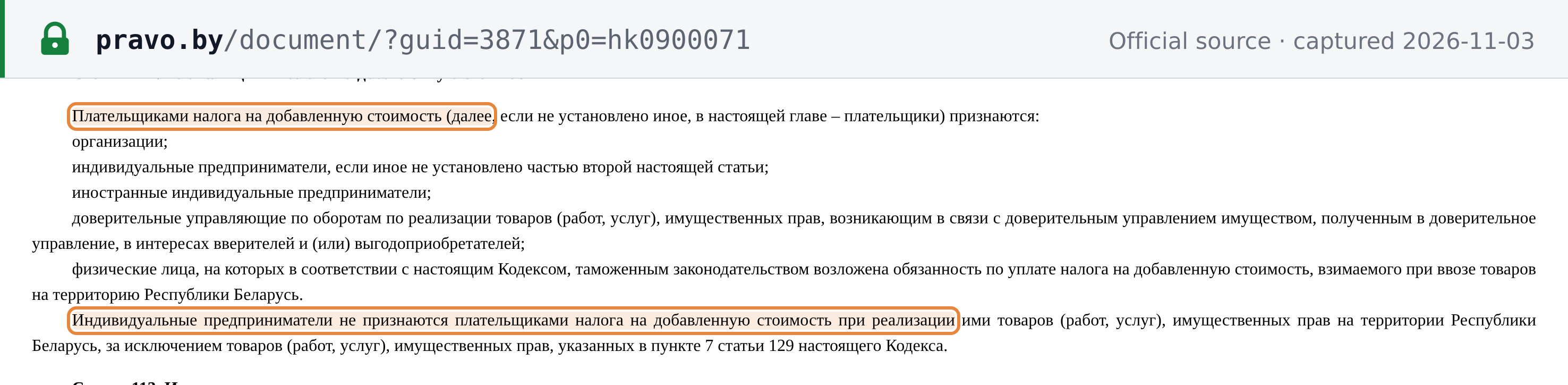
VAT liability in Belarus follows status, not turnover. Art 112, part one: "Плательщиками налога на добавленную стоимость (далее, если не установлено иное, в настоящей главе – плательщики) признаются: организации; индивидуальные предприниматели, если иное не установлено частью второй настоящей статьи; иностранные индивидуальные предприниматели; доверительные управляющие … ; физические лица, на которых в соответствии с настоящим Кодексом, таможенным законодательством возложена обязанность по уплате налога на добавленную стоимость, взимаемого при ввозе товаров на территорию Республики Беларусь." [1]
VAT payers are: organisations; individual entrepreneurs, unless part two provides otherwise; foreign individual entrepreneurs; trustees; and individuals liable for VAT on imported goods.
There is no separate VAT registration. Every payer is registered with the tax authority and receives a payer account number (UNP) under Art 69 of the General Part (see Tax identification number), and VAT liability follows from its status.
Individual entrepreneurs are outside domestic VAT. Art 112, part two: "Индивидуальные предприниматели не признаются плательщиками налога на добавленную стоимость при реализации ими товаров (работ, услуг), имущественных прав на территории Республики Беларусь, за исключением товаров (работ, услуг), имущественных прав, указанных в пункте 7 статьи 129 настоящего Кодекса." (Individual entrepreneurs are not VAT payers on their sales in Belarus, except those listed in Art 129 p7.) Art 129 p7 deals with VAT shown to buyers in excess, so an individual entrepreneur that shows VAT on a document must pay it over, unless it corrects the excess VAT (a reconciliation act signed by both parties plus an additional or corrected ESCHF signed by the buyer) or the buyer is a consumer or a foreign taxpayer (Art 129 p7.2). Individual entrepreneurs remain liable for import VAT. [1]
 Source snapshot captured 2026-11-03 — original
Registration threshold
None for domestic VAT. Chapter 14 of the Tax Code sets no turnover threshold for domestic VAT liability; liability attaches to the organisation's status under Art 112.
The nearest equivalent is the simplified tax system (USN), which is an opt-in regime, not a VAT threshold. For an organisation on the simplified system, the simplified-system tax replaces VAT on domestic sales, but not VAT on imports or VAT on purchases from foreign organisations without a permanent establishment (Art 326 p1.2). Entry is open to organisations whose average headcount over the first nine months of the preceding year "не превышает 50 человек и валовая выручка нарастающим итогом за эти девять месяцев составляет не более 2 800 000 белорусских рублей" (does not exceed 50 people and whose cumulative gross revenue over those nine months is not more than BYN 2,800,000) (Art 327 p2). The regime ends "с месяца, следующего за отчетным периодом, в котором валовая выручка организации нарастающим итогом в течение календарного года превысила 3 735 000 белорусских рублей" (from the month after the reporting period in which cumulative calendar-year gross revenue exceeded BYN 3,735,000) (Art 327 p6.4). Figures as at 2026-11-03. [1]
Non-resident registration
Foreign sellers fall into two cases, and they work differently.
B2B: no registration — the Belarusian buyer pays (reverse charge). Art 114 p1: when goods, work, services or property rights are sold in Belarus by foreign organisations or foreign individual entrepreneurs not registered with the Belarusian tax authorities, "обязанность по исчислению и уплате в бюджет налога на добавленную стоимость возлагается, если иное не установлено статьями 141 и 141 1 настоящего Кодекса, на состоящие на учете в налоговых органах Республики Беларусь организации и индивидуальных предпринимателей, приобретающих данные товары (работы, услуги), имущественные права" (the duty to calculate and pay VAT falls, unless Arts 141 and 141¹ provide otherwise, on the registered Belarusian organisations and individual entrepreneurs that acquire them). A foreign organisation that is, or must be, registered — for example through a permanent establishment — pays VAT "с начала осуществления такой деятельности" (from the start of that activity) (Art 114 p2). See reverse charge explained. [1]
B2C electronic services and e-commerce: register above EUR 10,000 a year. General Part Art 70 p1.7, part three: "Обязанность постановки на учет в налоговом органе возникает у иностранной организации, иностранного индивидуального предпринимателя, оказывающих услуги в электронной форме, иностранной организации, иностранного индивидуального предпринимателя, осуществляющих электронную дистанционную продажу товаров, в случае, когда оборот по реализации таких услуг, товаров в текущем календарном году превышает сумму, эквивалентную 10 000 евро (без учета налога на добавленную стоимость), определенную исходя из курса центрального банка государства по месту государственной регистрации этих иностранной организации, иностранного индивидуального предпринимателя на последнее число последнего месяца квартала, в котором услуги, товары были реализованы покупателю услуг Республики Беларусь и (или) покупателю товаров Республики Беларусь." [2]
The obligation to register arises for a foreign organisation or individual entrepreneur supplying electronic services, or making electronic distance sales of goods, when its turnover from such services or goods in the current calendar year exceeds the equivalent of EUR 10,000 (excluding VAT), converted at the central-bank rate of its state of registration on the last day of the last month of the quarter in which they were sold to a Belarusian customer.
- Threshold: EUR 10,000, excluding VAT, per calendar year, the same for electronic services and for goods (as in force on 2026-11-03).
- Where and when: electronically, with the MNS Inspectorate for the City of Minsk, through the single e-services portal, "до истечения квартала, в котором возник объект налогообложения налогом на добавленную стоимость" (before the end of the quarter in which the VAT liability arose) (Art 70 p1.7, part one). [2]
- Before registration: a registered Belarusian individual entrepreneur that buys the electronic services pays the VAT (Special Part Art 141 p1, part two), and Art 141 p3 shifts it to Belarusian intermediaries in the payment chain. [1]
- Who counts as a Belarusian customer: for services, an individual (including an individual entrepreneur) for whom at least one of these is in Belarus: residence, paying bank or e-money provider, IP address, or phone country code, postal code or country code (Art 141 p2). For goods, a delivery address in Belarus (Art 141¹ p2). [1]
Returns, rates and payment for these sellers are under Digital services and e-commerce.
 Source snapshot captured 2026-11-03 — original
Tax identification number (UNP)
Every payer receives one учетный номер плательщика (UNP) for all taxes, levies and customs payments. General Part Art 69 p1: "При постановке на учет каждому плательщику присваивается единый по всем налогам, сборам (пошлинам), в том числе по таможенным платежам, учетный номер плательщика. Учетный номер плательщика, постановка на учет которого осуществляется при его государственной регистрации, аналогичен регистрационному номеру в Едином государственном регистре юридических лиц и индивидуальных предпринимателей. Плата за присвоение учетного номера плательщика … не взимается." (Each payer is assigned a single payer account number for all taxes, levies and customs payments. For a payer registered at state registration, it is the same as its number in the Unified State Register of Legal Entities and Individual Entrepreneurs. No fee is charged.) [2]
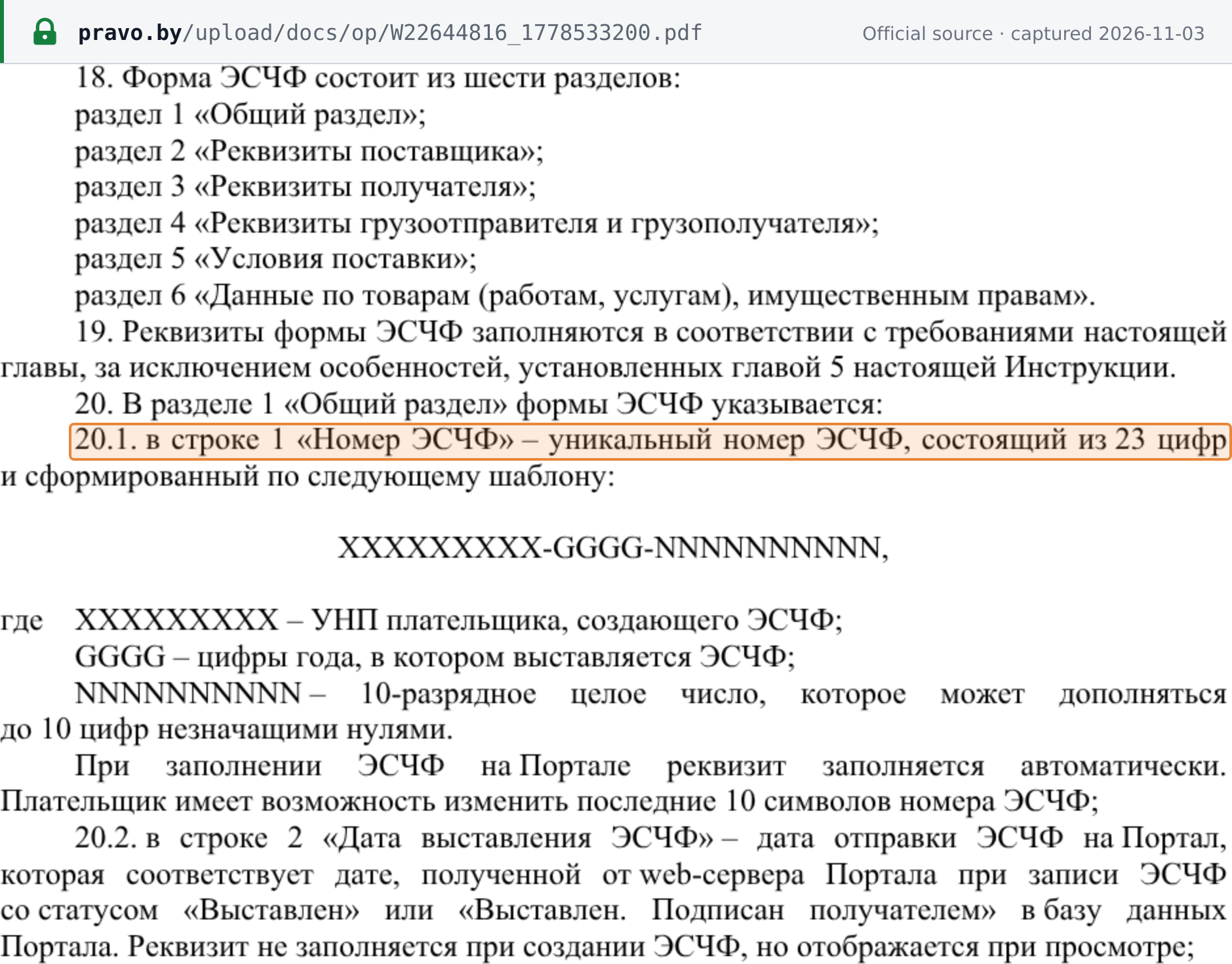
- Format. 9 positions. MNS Resolution No. 14 reserves exactly nine positions for "УНП плательщика, создающего ЭСЧФ" in the ESCHF number pattern
XXXXXXXXX-GGGG-NNNNNNNNNN(Instruction p20.1). Neither the Tax Code nor Resolution No. 14 sets out a character set for individuals, a regional coding or a check-digit algorithm; Art 69 leaves the rules for assigning the UNP to the MNS. [3] - More detail: Belarus UNP guide · check a UNP's format: Belarus UNP validator.
How to register
- Belarusian organisations and individual entrepreneurs receive their UNP automatically at state registration (Art 69, quoted above); no separate VAT application is made.
- Foreign e-service and e-commerce sellers register electronically with the MNS Inspectorate for the City of Minsk through the single e-services portal (Art 70 p1.7).
- Looking up a payer: the MNS State Register of Payers, grp.nalog.gov.by («Поиск юридических лиц в ГРП РБ»).
For the general process across countries, see how to register for VAT, sales tax or GST.
Voluntary registration
Not applicable as a VAT procedure. Chapter 14 contains no voluntary VAT registration procedure, because VAT status follows legal form and regime (Art 112). An organisation that wants to charge VAT, and recover input VAT, stays on or returns to the general regime instead of the simplified system: Art 327 lets an organisation refuse the simplified system from the start of a tax period. [1]
Deregistration
Removal from the tax register is governed by General Part Art 69, and Art 70 for foreign organisations. There is no separate VAT deregistration, because VAT status follows the payer's status. [2]
Group registration
Not available. Chapter 14 of the Tax Code (Arts 112–144) contains no VAT grouping or consolidated-payer provision. [1]
Rates
| Rate | Applies to | Tax Code |
|---|---|---|
| 20% (standard) | Sales of goods, work and services not listed at 0%, 10% or 25%; transfers of property rights; imports not listed at 10%; electronic services | Art 122 p3 |
| 10% (reduced) | Listed agricultural produce; foodstuffs and children's goods on the Annex 26 list; medicines and medical devices | Art 122 p2 |
| 25% (increased) | Telecommunications (электросвязь) services | Art 122 p4 |
| 0% | Exports under the customs export procedure; goods dispatched to EAEU member states; exported services and the other items listed in p1.3–p1.12 | Art 122 p1 |
| Exempt | Sales listed in Art 118 (see Exemptions) | Art 118 |
Rates are as set by Tax Code Art 122 in the text in force on 2026-11-03. The consolidated Code does not date individual paragraphs, so it does not show when each rate took effect. [1]
 Source snapshot captured 2026-11-03 — original
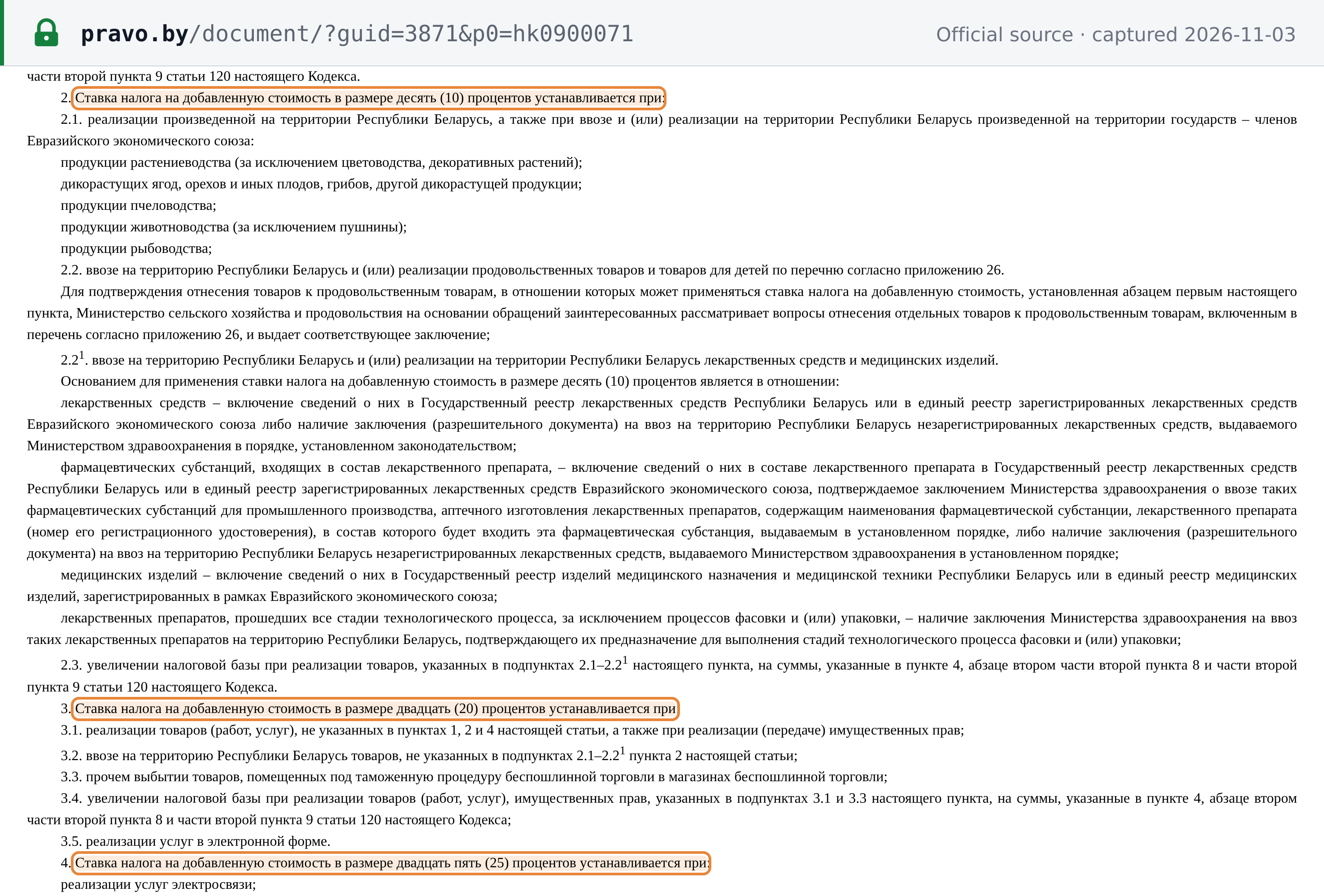
Standard rate: 20%. Art 122 p3: "Ставка налога на добавленную стоимость в размере двадцать (20) процентов устанавливается при: 3.1. реализации товаров (работ, услуг), не указанных в пунктах 1, 2 и 4 настоящей статьи, а также при реализации (передаче) имущественных прав; 3.2. ввозе на территорию Республики Беларусь товаров, не указанных в подпунктах 2.1–2.2 1 пункта 2 настоящей статьи; … 3.5. реализации услуг в электронной форме." (20% applies to sales of goods, work and services not listed in points 1, 2 and 4, and transfers of property rights; imports not listed at 10%; … electronic services.)
Reduced rate: 10%. Art 122 p2 applies 10% to:
- 2.1 crop produce (except floriculture and ornamental plants), wild berries, nuts, mushrooms and other wild produce, beekeeping, livestock (except fur) and fish-farming produce produced in Belarus, and such produce made in EAEU states when imported or sold in Belarus;
- 2.2 imports and sales of "продовольственных товаров и товаров для детей по перечню согласно приложению 26" (foodstuffs and children's goods on the list in Annex 26);
- 2.2¹ imports and sales of "лекарственных средств и медицинских изделий" (medicines and medical devices), based on their entry in the Belarusian or EAEU registers or a Ministry of Health import permit.
The 10% rate is optional: "При ввозе и (или) реализации товаров, указанных в пункте 2 настоящей статьи, плательщики могут применить ставку налога на добавленную стоимость, установленную пунктом 3 настоящей статьи" (for these goods, payers may apply the 20% rate instead) (Art 122 p8).
Increased rate: 25% on telecom. Art 122 p4: "Ставка налога на добавленную стоимость в размере двадцать пять (25) процентов устанавливается при: реализации услуг электросвязи; увеличении налоговой базы при реализации услуг электросвязи …" (25% applies to sales of telecommunications services and to increases in their tax base). This is a higher rate, not a reduced one.
Zero rate. Art 122 p1 applies 0% to "реализации товаров, помещенных под таможенную процедуру экспорта, при условии документального подтверждения фактического вывоза товаров за пределы территории Республики Беларусь в порядке, установленном статьей 123" (goods placed under the export procedure, subject to documentary proof of removal under Art 123) and to goods removed to EAEU member states with proof under Art 124. Among the further items in p1 are, for example, export processing of tolling raw materials (Art 125), directly related loading, escort, storage and customs-representative services, exported transport services including transit (p1.5), listed works and services for foreign persons (p1.6), Belarusian Railway services to foreign railways (p1.7), airport and air-navigation services for international flights (p1.8), bunker fuel (p1.9), duty-free shop supplies (p1.10), tax-free retail sales to non-EAEU visitors (p1.11) and repair of foreign-registered vehicles (p1.12).
Announced future rates. No rate change is announced in the Tax Code as consolidated to Law No. 127-З of 30 December 2025, whose tranches run to 1 January 2027. That law amends Art 122 only at p9.1, adding that the election to charge 20% on exempt sales does not apply where the sale is paid for from budget funds. [4]
See worldwide tax rates for other countries.
Cross-border rules
Imports and exports
- Imports. VAT on goods imported across the border is collected by customs (Art 138); VAT on goods imported from EAEU member states is collected by the tax authorities (Art 139). The import rate is 20%, or 10% for the goods in Art 122 p2.1–2.2¹. [1]
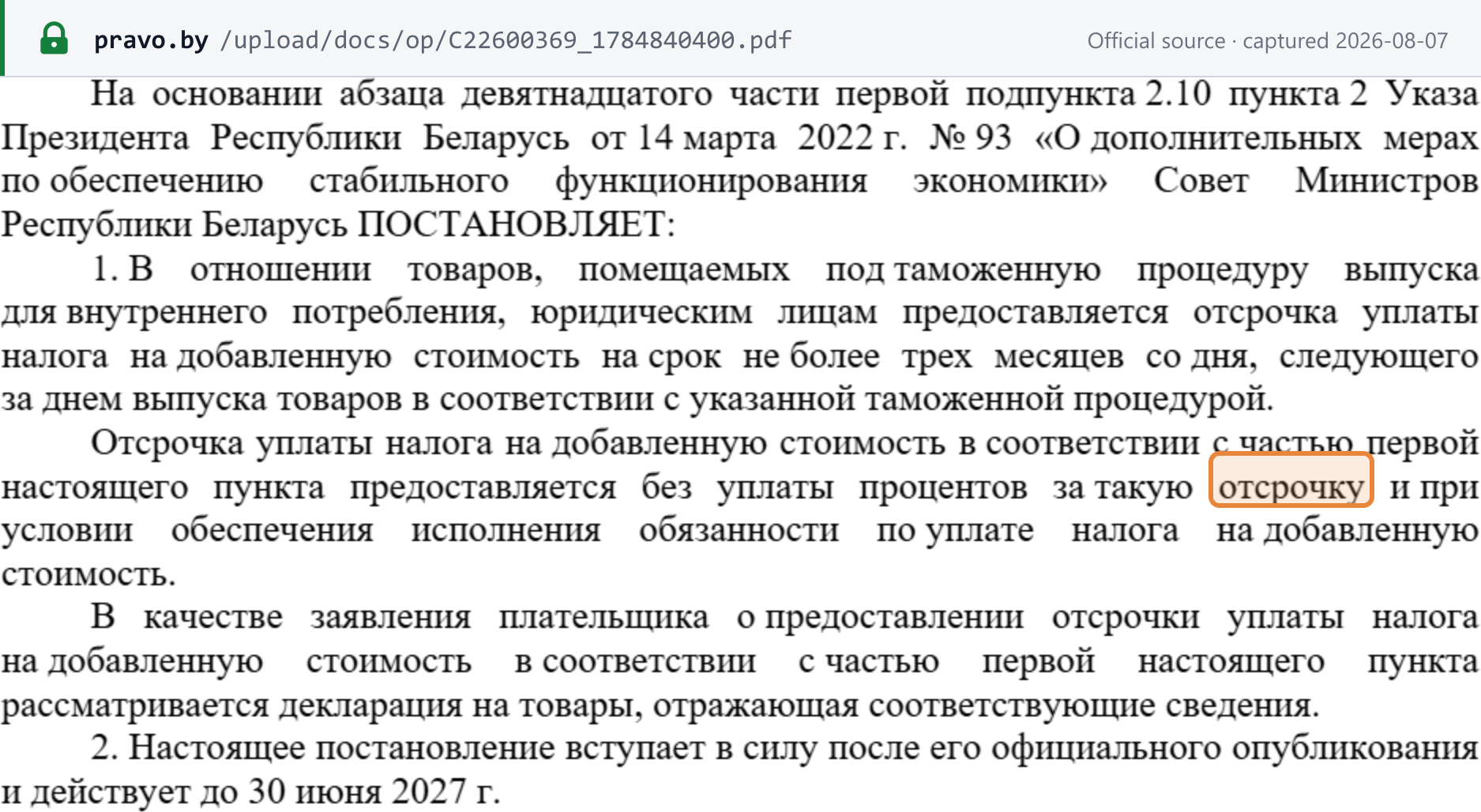
- Import VAT deferral (until 30 June 2027). Council of Ministers Resolution No. 369 of 23 July 2026 gives legal entities an interest-free deferral of import VAT of up to three months from the day after release for domestic consumption, against security, with the customs declaration serving as the application. [5]
 Source snapshot captured 2026-08-07 — original
- Exports. Zero-rated under Art 122 p1.1 with documentary proof of removal (Art 123); dispatches to EAEU member states under Art 122 p1.2 with proof under Art 124. For zero-rated exports of goods, the ESCHF is sent to the Portal on the timing of Art 123 p5, and no later than the 20th of the month after the reporting period in which the sale is declared (Art 131 p8, part two). [1]
Foreign suppliers: B2B and B2C
- B2B (selling to a registered Belarusian business): no Belarusian registration needed. The buyer calculates and pays the VAT under Art 114 p1 (quoted in Non-resident registration) and creates the ESCHF itself (Art 131 p2.4). The same applies to organisations on the simplified system: their regime does not release them from VAT on purchases from foreign organisations without a permanent establishment (Art 326 p1.2).
- B2C electronic services and distance sales of goods: the foreign seller registers above EUR 10,000 a year (General Part Art 70 p1.7) and files and pays itself, as below.
Digital services and e-commerce
For foreign organisations and individual entrepreneurs registered under Art 70 p1.7 (Special Part Arts 141 and 141¹): [1]
- Period: "Налоговым периодом налога на добавленную стоимость для иностранных организаций, иностранных индивидуальных предпринимателей признается календарный квартал" (the tax period is the calendar quarter) (Art 141 p7).
- Tax: the tax is calculated on the VAT-inclusive price as the rate divided by 100 plus the rate — 20/120 for electronic services (Art 141 p8); for goods, 10/110 for the goods in Art 122 p2 and 20/120 otherwise (Art 141¹ p8).
- No input VAT for e-service sellers: VAT charged to foreign suppliers of electronic services on their own purchases is not deductible (Art 141 p9). The parallel point 9 of Art 141¹, for distance sellers of goods, has been deleted.
- Return: a VAT return, or the alternative turnover information, filed electronically through the payer's personal cabinet with the MNS Inspectorate for the City of Minsk "не позднее 20-го числа месяца, следующего за истекшим налоговым периодом" (no later than the 20th of the month after the quarter) (Art 141 p10).
- Payment: "не позднее 22-го числа месяца, следующего за истекшим налоговым периодом" (no later than the 22nd of the month after the quarter) (Art 141 p11).
- Exchange rate: foreign-currency prices are converted at the National Bank of the Republic of Belarus official rate on the date of the supply (Art 141 p5).
- No ESCHF: registered foreign suppliers of electronic services to individuals do not create ESCHFs (Art 131 p3.12).
For how other countries tax non-resident digital suppliers, see VAT on digital services by non-resident suppliers.
Invoice requirements
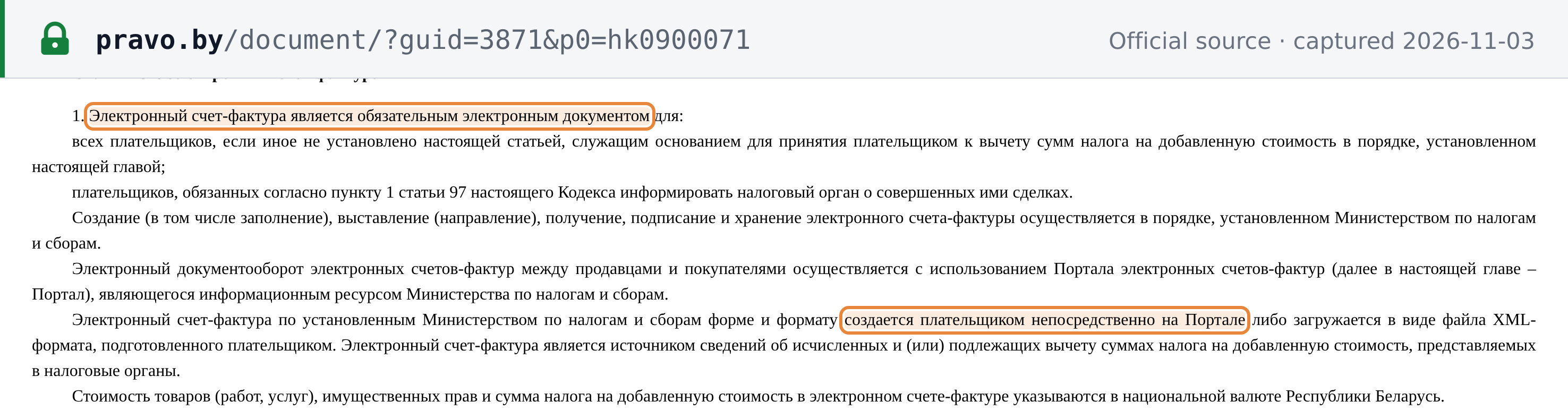
The VAT invoice in Belarus is electronic: the электронный счет-фактура (ESCHF, ЭСЧФ), created on the MNS Portal of Electronic Invoices. Art 131 p1: "Электронный счет-фактура является обязательным электронным документом для: всех плательщиков, если иное не установлено настоящей статьей, служащим основанием для принятия плательщиком к вычету сумм налога на добавленную стоимость … Электронный счет-фактура по установленным Министерством по налогам и сборам форме и формату создается плательщиком непосредственно на Портале либо загружается в виде файла XML-формата, подготовленного плательщиком." [1]
The e-invoice is a mandatory electronic document for all payers, unless the article provides otherwise, and is the basis for deducting VAT. It is created in the form and format set by the MNS directly on the Portal, or uploaded as an XML file prepared by the payer.
The seller must, for each sale, issue an ESCHF to the buyer or, in the cases the article lists, send it to the Portal (Art 131 p4). The form and the filling Instruction are set by MNS Resolution No. 14 of 31 March 2026 «Об электронном счете-фактуре», in force from 13 May 2026. [3]
 Source snapshot captured 2026-11-03 — original
Mandatory content
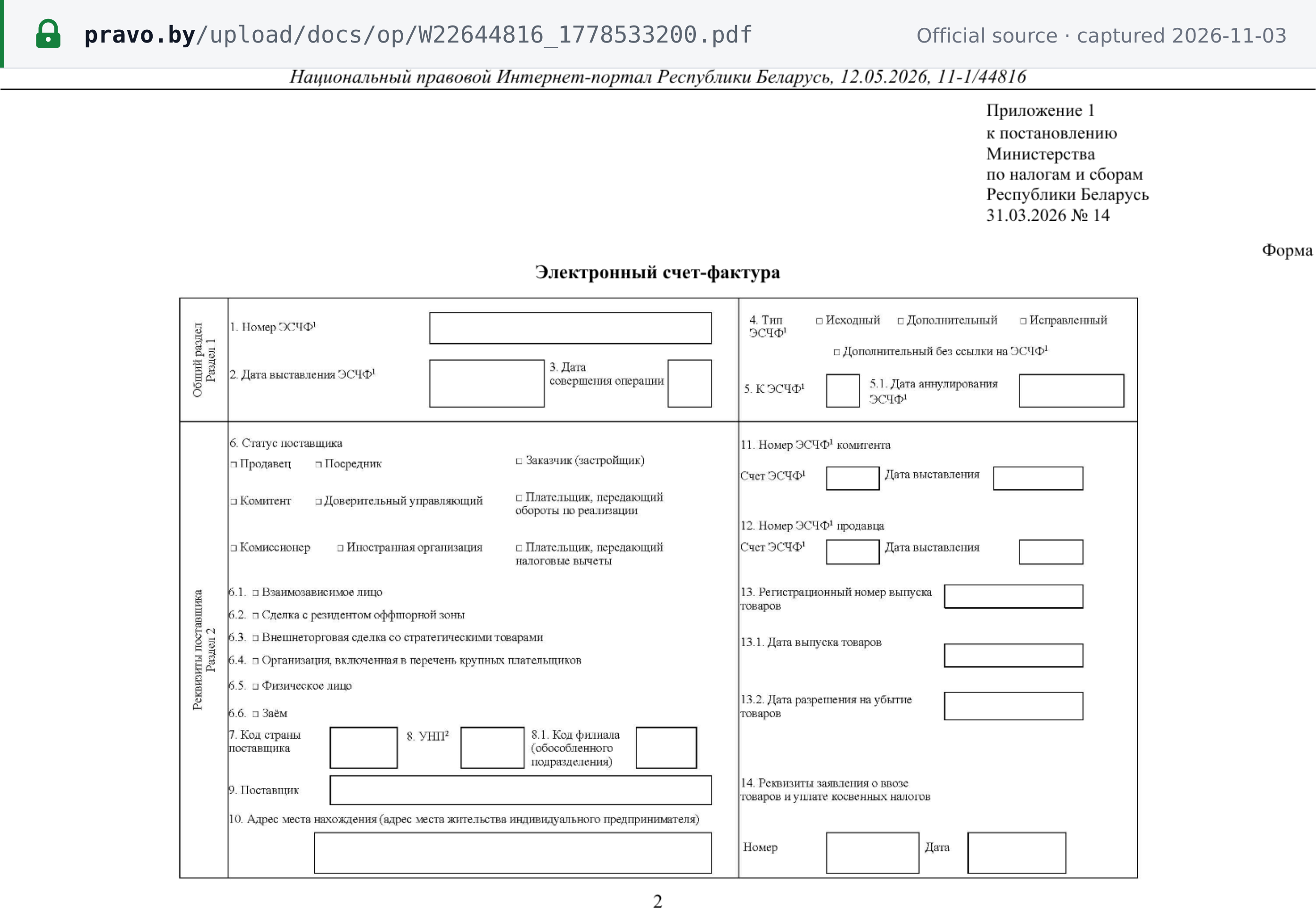
Instruction p18 to Resolution No. 14: "Форма ЭСЧФ состоит из шести разделов" (the ESCHF form consists of six sections). The fields, by line number on the official form: [3]
| Section | Lines |
|---|---|
| 1 «Общий раздел» (general) | 1 ESCHF number · 2 date of issue · 3 date of the operation · 4 ESCHF type (original, additional, corrected, additional without reference) · 5 reference to an earlier ESCHF · 5.1 date of annulment |
| 2 «Реквизиты поставщика» (supplier) | 6 supplier status (seller, intermediary, commission agent, foreign organisation and others) with flags 6.1–6.6 (related party, offshore counterparty, strategic goods, major taxpayer, individual, loan) · 7 country code · 8 UNP · 8.1 branch code · 9 name · 10 address · 11–12 principal's or seller's ESCHF number · 13–13.2 customs release details · 14 import application details |
| 3 «Реквизиты получателя» (recipient) | 15 recipient status (buyer, commission principal, consumer and others) with flags 15.1–15.6 · 16 country code · 17 UNP · 17.1 branch code · 18 name · 19 address · 20–21.1 customs and import details |
| 4 Consignor and consignee | 22–25 consignor country code, UNP, name, dispatch address · 26–29 consignee country code, UNP, name, delivery address |
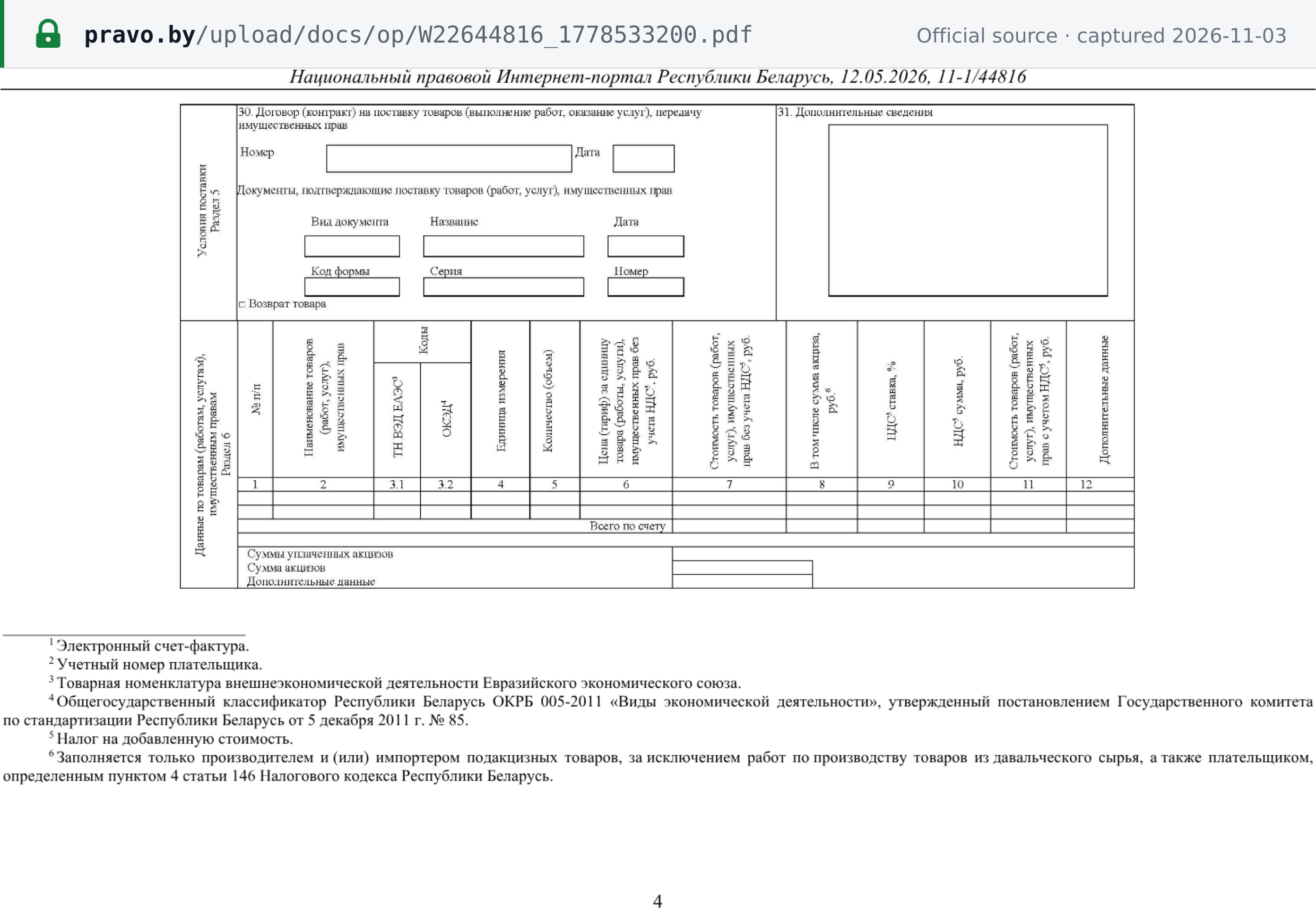
| 5 «Условия поставки» (terms of supply) | 30 contract number and date; supporting documents (type, name, date, form code, series, number); return-of-goods flag · 31 additional information |
| 6 Goods, work, services, property rights | Columns 1 line no. · 2 description · 3.1 EAEU commodity code (ТН ВЭД ЕАЭС) · 3.2 activity code (ОКЭД) · 4 unit · 5 quantity · 6 unit price excl. VAT · 7 value excl. VAT · 8 of which excise · 9 VAT rate % · 10 VAT amount · 11 value incl. VAT · 12 additional data; total «Всего по счету» |
VAT shown separately. "В электронных счетах-фактурах и первичных учетных (расчетных) документах соответствующие сумма и ставка налога на добавленную стоимость выделяются отдельной строкой" (in e-invoices and primary documents the VAT amount and rate are shown as a separate line) (Art 130 p3). Sales without VAT are documented with the note or stamp «Без НДС» (without VAT) (Art 130 p6). [1]
Issuance deadline
- To a buyer: "не ранее дня отгрузки товаров (выполнения работ, оказания услуг), передачи имущественных прав … и не позднее 10-го числа месяца, следующего за месяцем, на который приходится день отгрузки" (no earlier than the day of shipment, performance or transfer, and no later than the 10th of the month following the month of shipment) (Art 131 p5). If the moment of actual supply has not occurred by then, or primary documents are missing, the ESCHF is issued within three working days of that moment or of the documents.
- Sent to the Portal only — exempt sales, sales to taxpayers of foreign states and the other cases in p8: by the 20th of the month after the moment of actual supply, unless p8 sets another date (for example, zero-rated exports of goods follow Art 123 p5, no later than the 20th of the month after the reporting period in which the sale is declared) (Art 131 p8).
- Portal outage: within five working days of the Portal being restored (Art 131 p24). [1]
 Source snapshot captured 2026-11-03 — original
Numbering and sequencing
Instruction p20.1: "уникальный номер ЭСЧФ, состоящий из 23 цифр и сформированный по следующему шаблону: XXXXXXXXX-GGGG-NNNNNNNNNN, где XXXXXXXXX – УНП плательщика, создающего ЭСЧФ; GGGG – цифры года, в котором выставляется ЭСЧФ; NNNNNNNNNN – 10-разрядное целое число, которое может дополняться до 10 цифр незначащими нулями." (a unique 23-digit number: the creator's 9-position UNP, the year of issue, and a 10-digit integer padded with leading zeros.) The Portal fills the number automatically and the payer may change its last 10 characters. The Instruction requires the number to be unique; it sets no gap-free sequence rule. [3]
 Source snapshot captured 2026-11-03 — original
Credit and debit notes
There are no separate credit or debit notes. Corrections are made with further ESCHFs; Instruction p6 lists four types: "исходный, дополнительный, исправленный, дополнительный без ссылки на ЭСЧФ" (original, additional, corrected, additional without reference). [3]
- Corrected ESCHF — annuls the earlier ESCHF (if the buyer has signed the earlier one, the annulment needs the buyer's consent, given by signing the corrected ESCHF); it "должен содержать: новые показатели, необходимые для исчисления налога на добавленную стоимость, включая нулевые; ссылку на номер ранее выставленного (направленного) аннулируемого электронного счета-фактуры" (must contain the new figures, including zeros, and the number of the ESCHF it annuls) (Art 131 p10.2).
- Additional ESCHF — for a change that does not require annulment, such as a price increase or decrease or a partial or full return of goods. It quotes the original ESCHF number and carries the difference in the tax base and VAT "с положительными значениями – в случае корректировки налоговой базы в сторону увеличения; с отрицательными значениями – в случае корректировки налоговой базы в сторону уменьшения" (as positive values for an increase, negative for a decrease) (Art 131 p11). [1]
Currency, language and exchange rate
- Currency: values and VAT in BYN (Art 131 p1, quoted in Overview); the form's money columns are headed "руб." (roubles).
- Language: neither Art 131 nor Resolution No. 14 states a language rule; the form and its Instruction are in Russian.
- Exchange rate: for foreign e-service suppliers, foreign-currency prices are converted at the National Bank official rate on the date of supply (Art 141 p5).
Document types
The ESCHF is the VAT invoice; there is no paper VAT invoice. Sales to individuals who are not individual entrepreneurs are covered by one summary ESCHF per reporting period (see E-invoicing status). No ESCHF is created in the cases in Art 131 p3, among them banks' exempt financial operations (p3.1), insurance (p3.9), zero-base sales (p3.11) and registered foreign suppliers of electronic services to individuals (p3.12). [1]
Self-billing
Where a registered Belarusian buyer pays VAT on a purchase from an unregistered foreign supplier (Art 114 p1), the buyer creates the ESCHF itself (Art 131 p2.4).
Retention and audit trail
- Signing and status. ESCHFs are issued and received in the Portal's «Личный кабинет», entered with an electronic digital signature (ЭЦП) key (Instruction p8). They can be keyed in, uploaded as XML and signed on the Portal, or uploaded already signed through the Portal web service from the payer's accounting system (p9). The Portal checks the signature, XML structure and that the creator's UNP matches the signature and the supplier or recipient, then stamps the date of issue (line 2) and sets the status «Выставлен» (issued); the buyer signs to set «Выставлен. Подписан получателем» (p11, p12, p14).
- No edits after issue. "ЭСЧФ, получивший статус «Выставлен» или «Выставлен. Подписан получателем», не может корректироваться и (или) удаляться" (an ESCHF with these statuses cannot be corrected or deleted) (p12).
- Archive. ESCHFs move to the archive part of the personal cabinet two years after issue and stay available there (p17). [3]
- Retention period. Tax Code General Part Art 22 p1.14 requires payers to keep accounting and tax documents "в течение сроков, установленных законодательством" (for the periods set by legislation); the Tax Code itself sets no number of years. The two-year archive move is not a retention period. [2]
Invoice sample: the official ESCHF form
The MNS publishes the ESCHF form itself as Annex 1 to Resolution No. 14 of 31 March 2026 ("Форма. Электронный счет-фактура"). It is a blank form, not a filled-in example, but it is the authority's own layout with every numbered line. Sections 1 and 2:
 Source snapshot captured 2026-11-03 — original
Sections 5 and 6, where the contract, supporting documents, VAT rate and VAT amount sit:
 Source snapshot captured 2026-11-03 — original
Below, Lookuptax fills the main lines of that form for an illustrative domestic B2B sale at 20%. Every name, number and amount is fictional:
Электронный счет-фактура (ESCHF) — illustrative
| 2. Descriptioncol. 2 | 4. Unitcol. 4 | 5. Qtycol. 5 | 6. Price excl. VAT, BYNcol. 6 | 7. Value excl. VAT, BYNcol. 7 | 9. VAT ratecol. 9; Art 122 p3 | 10. VAT, BYNcol. 10 | 11. Value incl. VAT, BYNcol. 11 |
|---|---|---|---|---|---|---|---|
| Office chairs, model EX-1 | pcs | 4 | 250.00 | 1,000.00 | 20% | 200.00 | 1,200.00 |
| Delivery | service | 1 | 100.00 | 100.00 | 20% | 20.00 | 120.00 |
- Всего по счету — value excl. VATcol. 7
- BYN 1,100.00
- Всего по счету — VATcol. 10; Art 130 p3
- BYN 220.00
- Всего по счету — value incl. VATcol. 11
- BYN 1,320.00
- Line 30: contract number and date, and the supporting primary document (for example a waybill) by type, name, date, form code, series and number.
- Values in Belarusian roubles — Art 131 p1.
- Issued on the MNS Portal (vat.gov.by) and signed with an electronic digital signature; the buyer counter-signs — Res. 14, p8 and p14.
- A price change or return is made by an additional ESCHF quoting this number; an error that needs annulment by a corrected ESCHF, which the buyer must sign once it has signed this one — Art 131 p10.2 and p11.
E-invoicing status
Status (as at 2026-11-03): mandatory for all VAT payers. Every VAT invoice is an ESCHF that passes through the MNS Portal of Electronic Invoices (Портал электронных счетов-фактур), an information resource of the Ministry of Taxes and Duties (Art 131 p1: "являющегося информационным ресурсом Министерства по налогам и сборам"). The Portal checks each ESCHF before it receives the status «Выставлен» (Instruction p11–p12). [1] [3]
- System: the Portal at www.vat.gov.by, entered with an electronic digital signature key (Instruction p8).
- Format: the MNS form and XML format; documents keyed in on the Portal, uploaded as XML, or sent through the Portal web service from an accounting system (Instruction p9).
- Scope:
- B2B and B2G — issued to the buyer.
- Exempt sales, sales to taxpayers of foreign states and the other p8 cases — sent to the Portal only, by the 20th of the following month unless p8 sets another date, such as for zero-rated exports (Art 131 p8).
- B2C — "плательщиком по итогам отчетного периода создается один итоговый электронный счет-фактура, который направляется на Портал не позднее 20-го числа месяца, следующего за истекшим отчетным периодом" (one summary ESCHF per reporting period, sent to the Portal by the 20th of the following month) (Art 131 p8.8).
- Instrument change, 13 May 2026. MNS Resolution No. 14 of 31 March 2026 (registered 29 April 2026 as 11-1/44816, published 12 May 2026) set a new ESCHF form and Instruction from 13 May 2026. The National Register records 13 May 2026 as the date MNS Resolution No. 15 of 25 April 2016, the previous ESCHF instrument, ceased to apply. [6] [7]
For how Belarus compares with other countries, see e-invoicing status and networks worldwide.
Filing and payment
Filing frequency
The reporting period is set by Art 127 p2: [1]
- Calendar month — telecom suppliers (p2.1).
- Calendar quarter — organisations on the simplified tax system and individual entrepreneurs, among others listed in p2.2–2.3.
- Calendar month or quarter, by choice — all other payers (p2.4); the default is "календарный месяц – при неинформировании налогового органа по месту постановки на учет в порядке, установленном пунктом 3 настоящей статьи" (the calendar month, if the payer does not notify the tax authority as point 3 provides). The quarterly choice is notified in the return by 20 January.
- Foreign e-service sellers — calendar quarter (Art 141 p7).
Return and payment due date
Art 136: "1. Плательщики представляют в налоговые органы налоговую декларацию (расчет) по налогу на добавленную стоимость не позднее 20-го числа месяца, следующего за истекшим отчетным периодом. 2. Уплата налога на добавленную стоимость производится не позднее 22-го числа месяца, следующего за истекшим отчетным периодом." [1]
- Return: by the 20th of the month after the reporting period.
- Payment: by the 22nd of the month after the reporting period.
 Source snapshot captured 2026-11-03 — original
The ESCHF is the "источником сведений об исчисленных и (или) подлежащих вычету суммах налога на добавленную стоимость, представляемых в налоговые органы" (source of the data on VAT calculated and deductible reported to the tax authorities) (Art 131 p1). The MNS links its taxpayer personal cabinet from its site; foreign e-service sellers must file through it (Art 141 p10).
Input-tax recovery
The ESCHF is the basis for deducting input VAT (Art 131 p1). The deduction rules and blocked items are set in Arts 132–134 of the Tax Code. Foreign suppliers of electronic services registered under Art 70 p1.7 cannot deduct input VAT at all (Art 141 p9). [1]
Exemptions
Exempt supplies
Art 118 of the Tax Code lists the exempt sales. It is long; among others it covers banking operations (p1.37) and insurance (p1.40), alongside medical and educational services. Under Art 122 p9.1 a payer may elect to charge 20% on exempt sales, except, from Law No. 127-З, where the buyer pays from budget funds. The full list is in Art 118 of the consolidated Tax Code. [1] [4]
Exempt is not zero-rated. An exempt sale carries no VAT and is documented «Без НДС» (Art 130 p6); its ESCHF goes to the Portal only (Art 131 p8.1). A 0% sale under Art 122 p1 is taxable at a zero rate and needs documentary proof of removal (Arts 123–126). The input-VAT consequence of each is set in Arts 132–134.
Special regimes
- Simplified tax system (USN). Replaces VAT on domestic sales for qualifying organisations; entry up to 50 staff and BYN 2,800,000 of nine-month revenue, exit above BYN 3,735,000 of calendar-year revenue (Arts 326–327; see Registration threshold).
- Individual entrepreneurs. Outside domestic VAT, except that VAT shown on their documents must be paid over, unless it corrects the excess VAT (a reconciliation act signed by both parties plus an additional or corrected ESCHF signed by the buyer) or the buyer is a consumer or a foreign taxpayer (Art 129 p7.2) (Art 112, part two; Art 129 p7).
- Second-hand vehicles. From 2026, Art 120 p42.3 part three compares a used vehicle's sale price, net of VAT, with its appraised value without VAT and/or residual value; the MNS explained the rule in letter No. 2-1-12/Ro-01085 of 1 September 2026. [8]
 Source snapshot captured 2026-09-21 — original
Offences and penalties
Offences and fines for VAT and ESCHF failures, including late filing, late payment and failure to issue an ESCHF, are set in the Code of Administrative Offences of the Republic of Belarus, not in the Tax Code.
Frequently asked questions
We sell an app subscription to consumers in Belarus from abroad. Do we have to register for VAT from the first sale?
No. Under Tax Code General Part Art 70 p1.7, a foreign organisation or individual entrepreneur supplying electronic services, or making electronic distance sales of goods, to Belarusian customers must register once such turnover in the current calendar year exceeds the equivalent of EUR 10,000, excluding VAT. The same threshold applies to services and to goods. Registration is electronic, with the MNS Inspectorate for the City of Minsk, before the end of the quarter in which the VAT liability arose. Until the supplier registers, a Belarusian individual entrepreneur that buys its electronic services pays the VAT instead (Special Part Art 141 p1).
We are a foreign company with no Belarusian tax registration, selling services to a Belarusian business. Who pays the VAT?
The buyer. Under Tax Code Special Part Art 114 p1, when a foreign organisation or individual entrepreneur that is not registered with the Belarusian tax authorities sells goods, work or services in Belarus, the registered Belarusian organisation or individual entrepreneur buying them calculates and pays the VAT. The exceptions are electronic services and electronic distance sales of goods to individuals, which Arts 141 and 141¹ govern.
An ESCHF we issued has an error and the buyer has already signed it. Can we edit or delete it?
No. Under the Instruction to MNS Resolution No. 14 (p12), an ESCHF with the status «Выставлен» (issued) or «Выставлен. Подписан получателем» (issued, signed by the recipient) cannot be corrected or deleted. Issue a corrected ESCHF, which annuls the earlier one and quotes its number; because the buyer has already signed, the annulment takes effect only once the buyer signs the corrected ESCHF (Tax Code Art 131 p10.2). Alternatively, for a price change or a return of goods, an additional ESCHF that carries the difference as a positive or negative amount and quotes the original number (Art 131 p11).
Our accounting software still cites MNS Resolution No. 15 of 2016 for the ESCHF. Is that still the governing form?
No. MNS Resolution No. 14 of 31 March 2026 «Об электронном счете-фактуре» set a new ESCHF form and filling Instruction in force from 13 May 2026, and the National Register of Legal Acts records 13 May 2026 as the date Resolution No. 15 of 25 April 2016 ceased to apply. Resolution No. 14 sets a six-section form and a 23-digit ESCHF number.
Do we need to issue an ESCHF for every retail sale to a consumer?
No. For sales to individuals who are not acting as individual entrepreneurs, Tax Code Art 131 p8.8 has the seller create one summary ESCHF for the reporting period and send it to the Portal no later than the 20th of the following month, rather than one per sale.
We are an individual entrepreneur in Belarus. Do we charge VAT on our sales?
Generally not. Tax Code Art 112, part two, provides that individual entrepreneurs are not VAT payers on their sales of goods, work, services and property rights in Belarus, except for VAT covered by Art 129 p7, which deals with VAT shown to buyers in excess: an individual entrepreneur that shows VAT on a document must pay it over, unless it corrects the excess VAT (a reconciliation act signed by both parties plus an additional or corrected ESCHF signed by the buyer) or the buyer is a consumer or a foreign taxpayer (Art 129 p7.2). They remain liable for VAT on imports, and documents for sales without VAT carry the note «Без НДС» (without VAT) under Art 130 p6.
Important websites
| Site | Purpose |
|---|---|
| Ministry of Taxes and Duties (MNS) | Tax authority home page |
| MNS personal cabinet | Taxpayer personal cabinet; foreign e-service sellers file their returns here (Art 141 p10) |
| Portal of Electronic Invoices | Create, issue, receive and sign ESCHFs |
| State Register of Payers | Look up a payer by UNP |
| Tax Code, Special Part (consolidated) | VAT rules (Chapter 14, Arts 112–144), including the rates in Art 122 |
| Tax Code, General Part (consolidated) | Registration with the tax authority (Arts 69–70) |
| Belarus UNP validator | Check a UNP's format |
For other countries' registers, see check a VAT number — official lookups by country.
Recent changes
- 2026-07-25 — Interest-free import-VAT deferral of up to three months for legal entities, against security, until 30 June 2027 (Council of Ministers Resolution No. 369). (pravo.by) — see event
- 2026-05-13 — New ESCHF form and filling Instruction (MNS Resolution No. 14 of 31 March 2026) replace MNS Resolution No. 15 of 25 April 2016. (pravo.by)
- 2026-01-01 — Used-vehicle resale: the sale price compared with appraised or residual value is taken net of VAT (Tax Code Art 120 p42.3, part three; MNS letter of 1 September 2026). (MNS) — see event
- 2026-01-01 — Law No. 127-З of 30 December 2025 in force in tranches (1 January, 1 April and 1 July 2026, and 1 January 2027); for VAT it adds a budget-funded carve-out to the election to charge 20% on exempt sales (Art 122 p9.1). (pravo.by)
For the full chronology, see Belarus tax changes on Lookuptax.
Reference links
- Tax Code of the Republic of Belarus, Special Part (Law No. 71-З of 29 December 2009), consolidated — National Legal Internet Portal
- Tax Code of the Republic of Belarus, General Part (Law No. 166-З of 19 December 2002), consolidated — National Legal Internet Portal
- MNS Resolution No. 14 of 31 March 2026 «Об электронном счете-фактуре» — official publication (PDF)
- Law of the Republic of Belarus No. 127-З of 30 December 2025 — official publication (PDF)
- Council of Ministers Resolution No. 369 of 23 July 2026 — National Legal Internet Portal
- National Register card — MNS Resolution No. 14 of 31 March 2026
- National Register card — MNS Resolution No. 15 of 25 April 2016
- MNS — clarification on the VAT base for resale of vehicles (letter No. 2-1-12/Ro-01085 of 1 September 2026)
- MNS — Tax Code page (links to the consolidated text)
Related on Lookuptax: