Brazil VAT (CBS/IBS) guidelines
| FACTSHEET | |
|---|---|
| Country code | BR |
| New taxes | CBS (Contribuição Social sobre Bens e Serviços, federal) + IBS (Imposto sobre Bens e Serviços, state and municipal) + IS (Imposto Seletivo, federal excise from 2027) |
| Taxes being replaced | PIS/Pasep and Cofins (federal, from 2027); ICMS (state) and ISS (municipal), phased out 2029–2032 and extinguished in 2033. IPI is reduced to zero from 2027 except on products with incentivised manufacturing in the Manaus Free Trade Zone |
| Tax authorities | Receita Federal do Brasil (CBS); Comitê Gestor do IBS — CGIBS (IBS); Comitê Gestor do Simples Nacional (Simples Nacional) |
| 2026 rates | CBS 0.9% + IBS 0.1% (test year; offset against PIS/Cofins; not applied to Simples Nacional optants) |
| Registration | CNPJ, per establishment, before starting activity — no turnover threshold |
| E-invoicing | Mandatory electronic fiscal documents (NF-e, NFC-e, NFS-e, CT-e and others), authorised before use |
| Currency | Brazilian real (BRL, R$) |
Overview
Brazil is part-way through replacing its consumption taxes with a dual VAT. Three new taxes are created: the federal CBS (Contribuição Social sobre Bens e Serviços), the IBS (Imposto sobre Bens e Serviços) shared by the states and municipalities, and the federal IS (Imposto Seletivo), an excise on specific goods. Receita Federal lists the taxes that will cease to exist as PIS/Pasep, Cofins, ICMS and ISS. IPI is not abolished: in Receita's words, from 2027 it "terá alíquota reduzida a zero para quase todos os produtos" (will have its rate reduced to zero for almost all products) and "será mantido apenas para preservar a competitividade da Zona Franca de Manaus" (will be kept only to preserve the competitiveness of the Manaus Free Trade Zone). (Receita Federal — Entenda a reforma)
The constitutional rule is ADCT art. 126 of Emenda Constitucional 132/2023: from 2027 the IPI "terá suas alíquotas reduzidas a zero, exceto em relação aos produtos que tenham industrialização incentivada na Zona Franca de Manaus" — its rates go to zero except for products whose manufacture is incentivised in the Manaus Free Trade Zone. (EC 132/2023, Senado Federal)
Legal instruments — what is law and what is regulation
| Instrument | Date | Status | What it does |
|---|---|---|---|
| Emenda Constitucional 132/2023 | 20 December 2023 | Constitutional amendment (enacted) | Creates CBS, IBS and IS and fixes the 2026–2033 transition |
| Lei Complementar 214/2025 | 16 January 2025 | Complementary law (enacted) | Institutes IBS, CBS and IS, creates the IBS Management Committee and amends tax legislation |
| Lei Complementar 227/2026 | 13 January 2026 | Complementary law (enacted) | Institutes the CGIBS and the IBS administrative tax process; inserts the IBS/CBS penalty rules into LC 214/2025, including arts. 341-C, 341-F, 341-G and 341-H |
| Decreto nº 12.955/2026 | 29 April 2026 | Federal regulation | CBS regulation |
| Resolução CGIBS nº 6/2026 | 30 April 2026 | CGIBS regulation | IBS regulation (same article numbering as the CBS regulation) |
| Atos Conjuntos RFB/CGIBS | 2025–2026 | Joint administrative acts | Document start dates, waivers, the 2026 compliance programme |
Sources: Receita Federal — Principais marcos regulatórios; LC 227/2026, Senado Federal; Resolução CGIBS nº 6/2026.
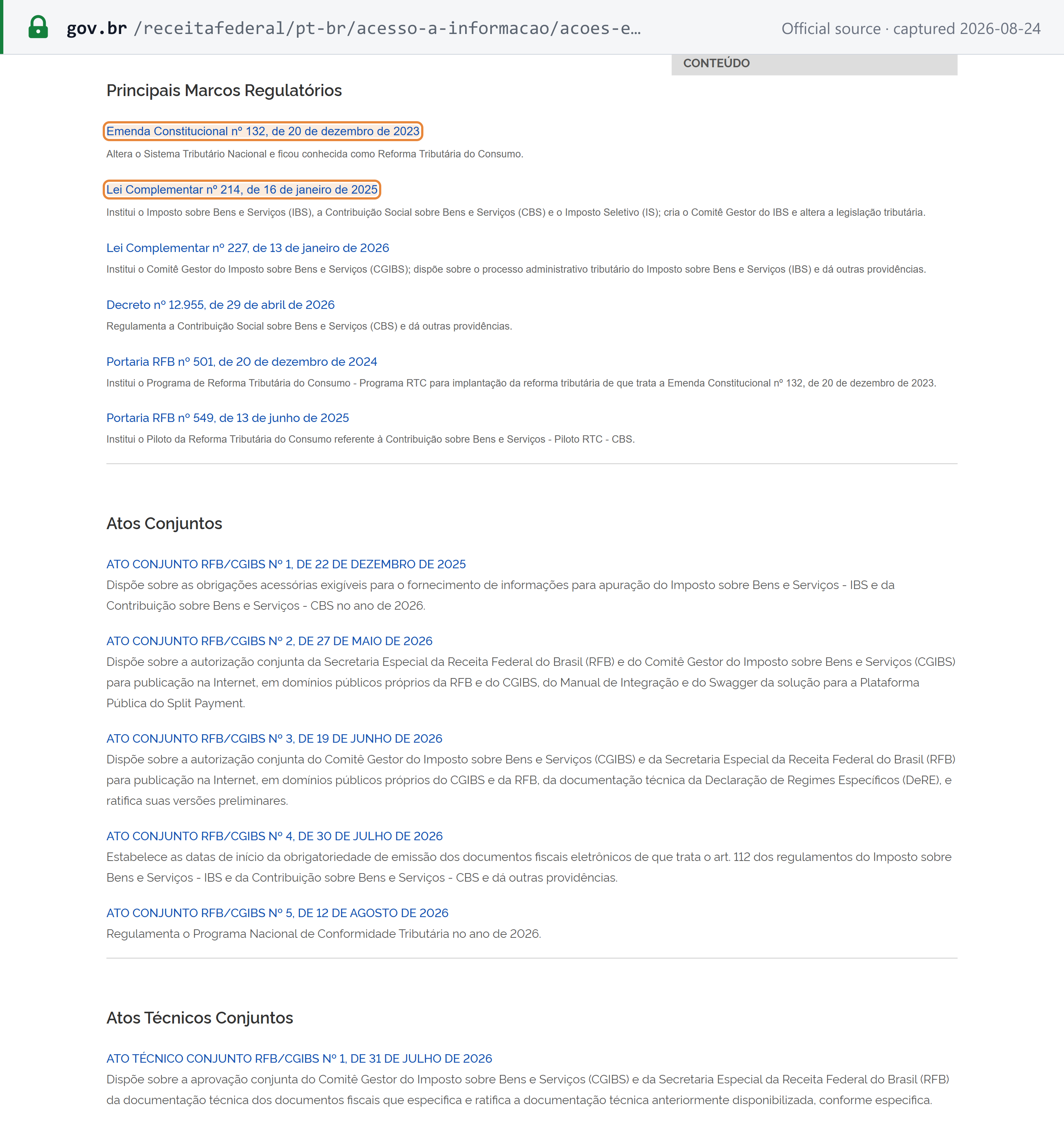 Source snapshot captured 2026-08-24 — original
Implementation runs under Receita Federal's Consumption Tax Reform Programme (Portaria RFB nº 501/2024), with a CBS pilot under Portaria RFB nº 549/2025.
Authority, currency, period and layering
- Layering. CBS is federal and administered by Receita Federal do Brasil. IBS is one tax with a state rate and a municipal rate, administered by the Comitê Gestor do IBS (CGIBS) with the states and municipalities. The national NFS-e standard is run by the CGNFS-e, and the Simples Nacional by the Comitê Gestor do Simples Nacional (CGSN). Under the IBS regulation a fiscal document may only be used after "autorização de uso pela RFB, pelo CGNFS-e ou pelo CGIBS" (art. 118). (Resolução CGIBS nº 6/2026)
- Currency. Brazilian real (BRL, R$).
- Period. "O período de apuração do IBS e da CBS será mensal" — IBS and CBS are assessed monthly (LC 214/2025, art. 43). (LC 214/2025, Senado Federal)
- 2026 is a dual year. PIS/Cofins, ICMS, ISS and IPI remain fully due. CBS and IBS run alongside them at test rates that are offset or waived (see Rates).
Registration
Who should register
There is one register: the CPF for individuals, the CNPJ for legal persons and unincorporated entities, and the CIB for property. Article 105 of the IBS regulation states the liability rule — anyone subject to IBS and CBS, as taxpayer or responsible party, must register each establishment in the CNPJ before starting activity:
"As pessoas físicas e jurídicas e as entidades sem personalidade jurídica sujeitas ao IBS e à CBS, na condição de contribuinte ou de responsável tributário, são obrigadas, antes do início de suas atividades, em relação a cada estabelecimento que mantiverem, a se registrar em cadastro com identificação única, mediante inscrição no CNPJ."
Individuals, legal persons and unincorporated entities subject to IBS and CBS, as taxpayers or responsible parties, must, before starting their activities, register each establishment they maintain in the single-identification register, by enrolling in the CNPJ.
The obligation also covers digital platforms, "inclusive a domiciliada no exterior" (including those domiciled abroad) (§ 1). Even without opting into the regular regime, a condomínio edilício, a nanoempreendedor, a rural producer and an independent cargo carrier (TAC) are also obliged to register (§ 3, VI), subject to the waivers below. For an individual, the registration "produz efeitos exclusivamente em relação à legislação do IBS e da CBS" — it has effect only for IBS and CBS legislation (§ 4). The CBS regulation (Decreto nº 12.955/2026) carries the same article number. (Resolução CGIBS nº 6/2026, art. 105)
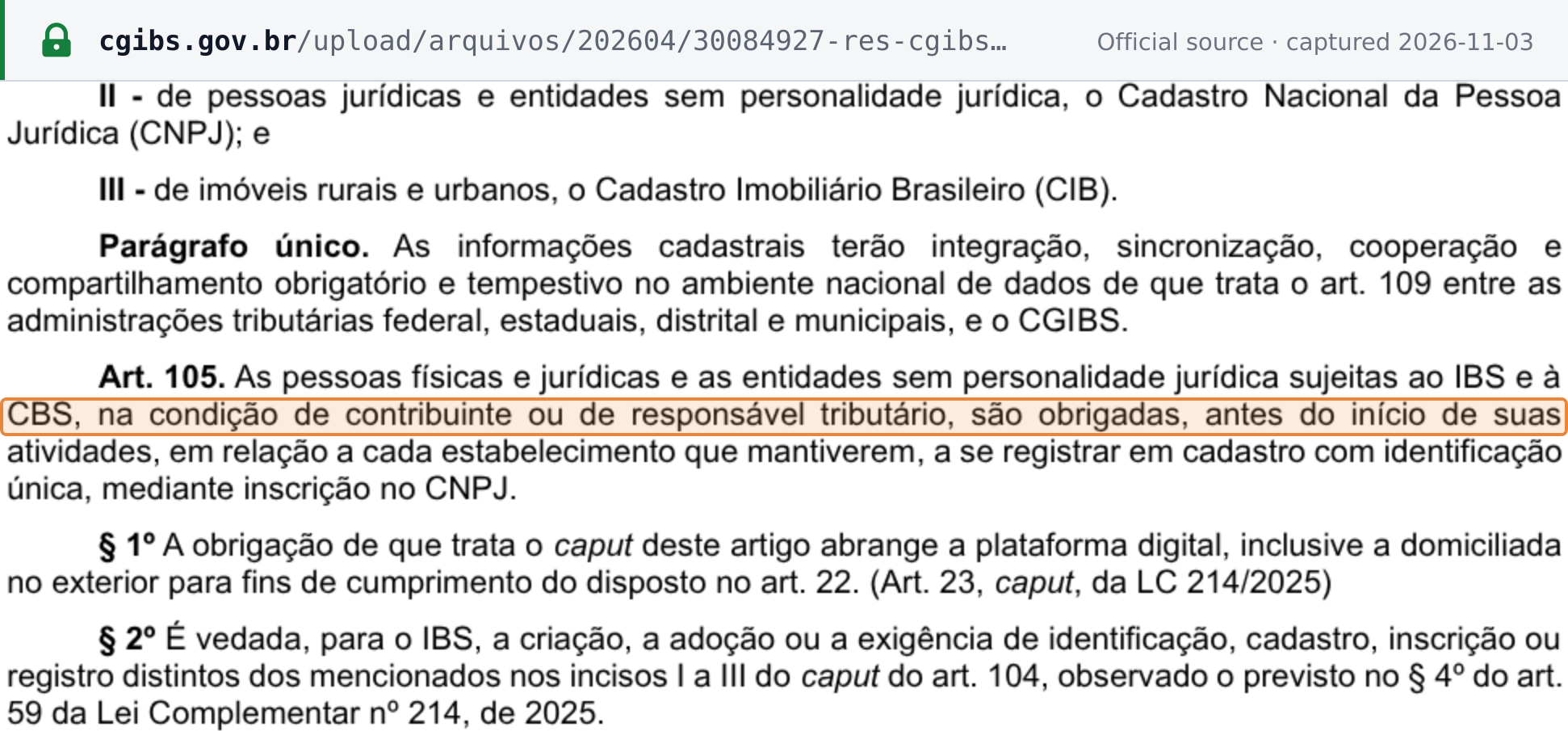 Source snapshot captured 2026-11-03 — original
The general CNPJ obligation outside the reform is in Chapter II (arts. 3–4) of Instrução Normativa RFB nº 2.119, of 6 December 2022. (Receita Federal — Quem está obrigado a se inscrever no CNPJ)
Individuals (pessoas físicas) — from 1 January 2027. Decreto nº 13.075, of 21 July 2026 (DOU of 22 July 2026), amended the CBS regulation so that CNPJ registration and fiscal-document issuance by individuals who are CBS taxpayers or responsible parties, and by the individual rural producer of art. 239, are postponed to 1 January 2027: "A obrigatoriedade de emissão de documentos fiscais de que trata este artigo produz efeitos a partir de 1º de janeiro de 2027". Receita Federal adds that "até 31 de dezembro de 2026, permanecem válidos os mecanismos atualmente utilizados para identificação fiscal das pessoas físicas". (Decreto nº 13.075/2026, Senado Federal; Receita Federal, 22 July 2026)
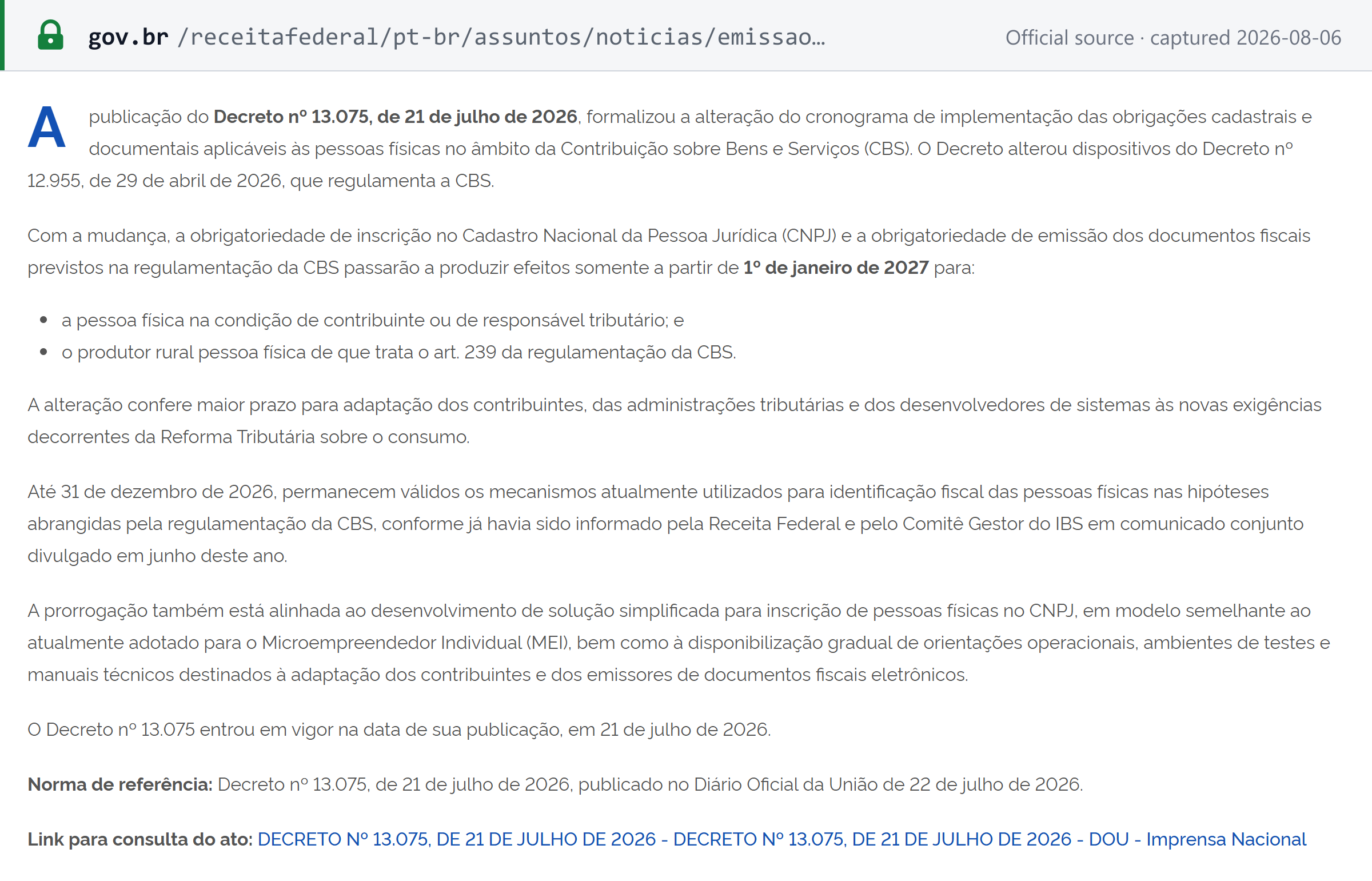 Source snapshot captured 2026-08-06 — original
Registration threshold
No turnover threshold applies to CNPJ registration — the obligation follows from being subject to IBS and CBS (art. 105 above). What Brazil has instead is a revenue line below which an individual is not a CBS/IBS taxpayer at all:
- Nanoempreendedor. Under LC 214/2025, art. 26, IV, the following are not IBS/CBS taxpayers: "nanoempreendedor, assim entendido a pessoa física que tenha auferido receita bruta inferior a 50% (cinquenta por cento) do limite estabelecido para adesão ao regime do MEI … e não tenha aderido a esse regime" — an individual whose gross revenue is below 50% of the MEI ceiling and who has not joined MEI. For ride-hailing and delivery drivers working through digital platforms, only 25% of the gross monthly amount received counts as revenue (art. 26, § 10). A nanoempreendedor may opt into the regular regime (art. 26, § 1, II). (LC 214/2025, Senado Federal)
- The figure. The general MEI ceiling is "R$ 81.000,00 (oitenta e um mil reais)" a calendar year (CGSN — Perguntas e Respostas MEI), so the nanoempreendedor line is gross revenue below R$40,500 a year — half the R$81,000 MEI ceiling. R$40,500 is our arithmetic on the two official figures, not a number Receita publishes.
- Waiver of CNPJ and documents. Ato Conjunto RFB/CGIBS nº 6, signed on 28 August 2026 and in force on publication, waives the nanoempreendedor's obligation to register in the CNPJ and to issue the electronic fiscal documents, unless the person opts into the regular regime, "produzindo efeitos até 31 de dezembro de 2028" (with effects until 31 December 2028). (Ato Conjunto RFB/CGIBS nº 6)
- Decreto nº 13.140, of 21 October 2026 (DOU extra edition nº 199-A of 21 October 2026) is a standalone federal decree, applying "no âmbito da União" — it does not amend the CBS regulation. For CBS it waives the nanoempreendedor's CNPJ registration (Decreto nº 12.955/2026, art. 105, § 3, VI, "b") and the issuance of the new electronic fiscal documents (art. 115, VI, "b"), with no end date; the waiver does not apply to a nanoempreendedor who opts into the regular regime. On the IBS side, the waivers "produzirão efeitos, no âmbito das competências relacionadas ao IBS, a partir de 1º de janeiro de 2029, e após manifestação favorável do CGIBS" (art. 1, sole paragraph, II) — that is, from the day after Ato Conjunto nº 6 stops having effect, and only if the CGIBS agrees. Art. 2 lets the MEI use the DASN-Simei annual declaration as the electronic fiscal document for sales and services "a consumidor final". (Decreto nº 13.140/2026, Senado Federal) Resolução CGSN nº 195/2026, also dated 21 October 2026, is the Simples Nacional counterpart; Receita Federal announced both acts on 23 October 2026. (Receita Federal, 23 October 2026)
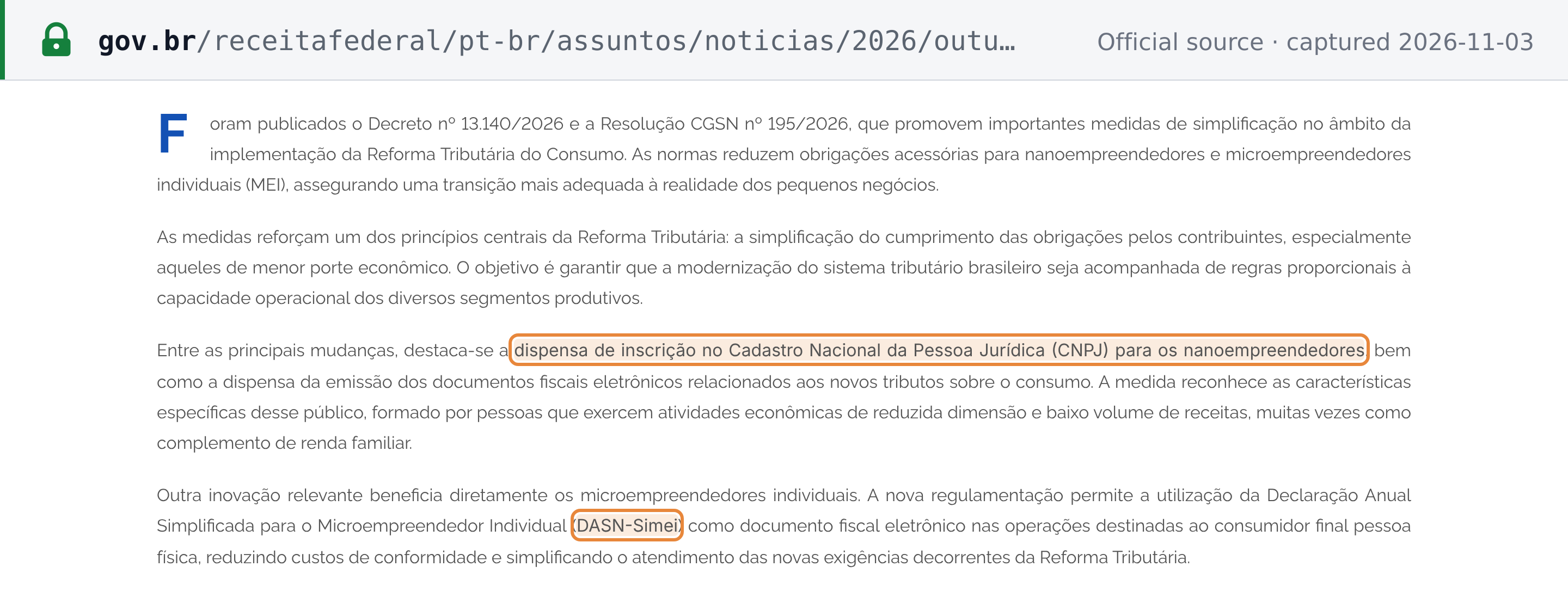 Source snapshot captured 2026-11-03 — original
Simples Nacional and MEI
- Own regime. "Os contribuintes optantes pelo Simples Nacional ou pelo MEI ficam sujeitos às regras desses regimes" — CBS and IBS are collected inside the Simples Nacional payment (DAS) — but "os optantes pelo Simples Nacional poderão exercer a opção de apurar e recolher o IBS e a CBS pelo regime regular" (LC 214/2025, art. 41, §§ 2–3). (LC 214/2025)
- Not in the 2026 test. The 2026 test rates "não serão aplicadas em relação às operações dos contribuintes optantes pelo Simples Nacional" (art. 348, III, "c"). Receita Federal, 9 October 2026: "As empresas optantes pelo Simples Nacional não estão obrigadas a destacar a CBS neste ano". (Receita Federal, 9 October 2026)
- Ceilings. A microenterprise (ME) has gross revenue up to R$360,000 a year; a small enterprise (EPP) above R$360,000 and "igual ou inferior a R$ 4.800.000,00" (LC 123/2006, art. 3, I and II). (CGSN — Perguntas e Respostas Simples Nacional, updated 9 October 2026)
- The R$3.6 million sublimit now also gates IBS — from 1 January 2027. Resolução CGSN nº 190/2026 (dated 4 August 2026; DOU of 10 August 2026): "O sublimite de R$ 3,6 milhões passa a ser considerado para fins de recolhimento do IBS, ICMS e ISS dentro do Simples Nacional", and the old R$1.8 million sublimit reference disappears; its changes take effect "em regra, a partir de 1º de janeiro de 2027". Above the sublimit, ICMS, ISS and IBS are paid under the regular regime rather than inside the DAS. (Portal do Simples Nacional, 12 August 2026)
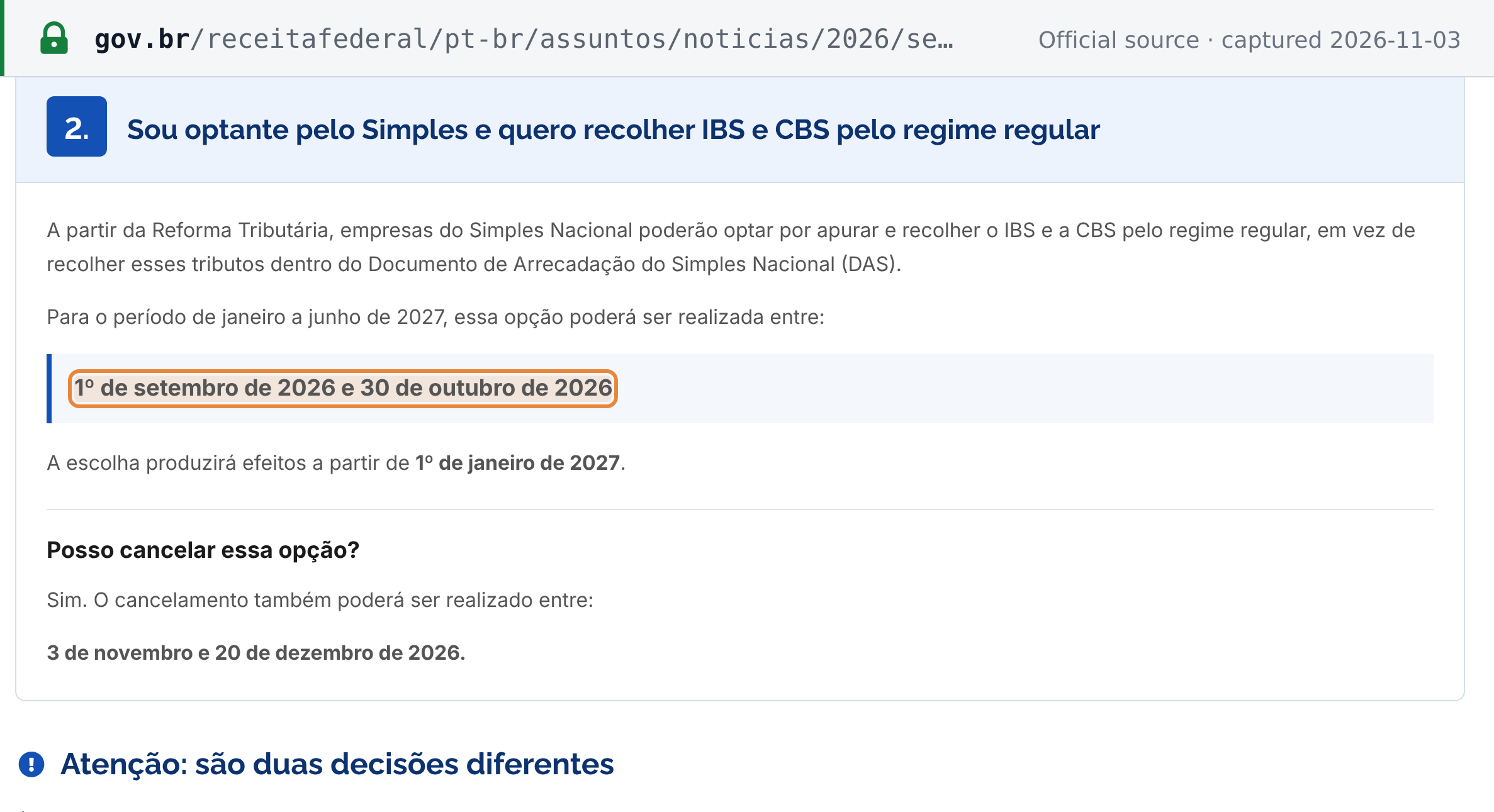
- 2027 option windows (Resolução CGSN nº 194/2026, DOU of 28 September 2026). Joining the Simples Nacional for 2027: 1 September – 15 October 2026 (impediments could be cleared until 30 October 2026). Electing regular-regime IBS/CBS for January–June 2027: 1 September – 30 October 2026, effective 1 January 2027. Either option can be cancelled between 3 November and 20 December 2026. (Receita Federal, 29 September 2026) On 29 October 2026 Receita said the regular-regime window would close on 30 October 2026 and would not be extended, with more than 1 million elections made. (Receita Federal, 29 October 2026)
- MEI (Simei). The Simei option stays in January: "o período para solicitar o enquadramento nesse regime permanece sendo o mês de janeiro". (Receita Federal, 25 September 2026)
 Source snapshot captured 2026-11-03 — original
Non-resident registration
There is no threshold for non-residents — LC 214/2025 sets none, and registration follows from making a supply in Brazil. A foreign supplier "fica obrigado a se cadastrar como contribuinte caso realize operações no País ou como responsável tributário no caso de importações" (art. 21, § 2), but is exempt from registering if it sells "exclusivamente por meio de plataforma digital inscrita no cadastro do IBS e da CBS no regime regular" (art. 22, § 3). Digital platforms, including foreign ones, must register in the regular regime (art. 23). If a foreign supplier or platform does not register, the IBS and CBS are segregated and collected at the reference rates by the institution handling the foreign-exchange remittance (art. 23, sole paragraph, I). (LC 214/2025)
Tax identification number
New CNPJs are alphanumeric from July 2026: "O CNPJ Alfanumérico será atribuído, a partir de Julho de 2026, exclusivamente a novas inscrições. Os números de CNPJ já existentes não sofrerão nenhuma alteração". (Receita Federal — CNPJ alfanumérico) For the format and check digits see the Brazil tax identification number guide; to check a number, see how to verify a CNPJ, how to verify a CPF or the Brazil CNPJ validator.
How to register
Businesses register through REDESIM, the national integrated registration system linking Receita Federal, the state commercial registries (Juntas Comerciais) and municipal licensing. (REDESIM) The step-by-step process, documents and timeline are on how to register for a CNPJ in Brazil.
Voluntary registration
Several persons who are outside the regular regime may opt into it: the nanoempreendedor, condomínios, consortia, sociedades em conta de participação, the rural producer and the TAC (LC 214/2025, art. 26, § 1), and Simples Nacional optants (art. 41, § 3). A Simples optant that received an IBS/CBS refund in the current or previous year may not leave the regular regime: "É vedado ao contribuinte do Simples Nacional … retirar-se do regime regular do IBS e da CBS caso tenha recebido ressarcimento de créditos desses tributos no ano-calendário corrente ou anterior" (art. 41, § 5). (LC 214/2025)
Cooperatives. Under art. 271 of LC 214/2025 cooperatives may elect a specific IBS/CBS regime. The Receita Federal–CGIBS joint guidance of 18 September 2026 opened the option for 2027 in the Receita Federal Services Portal from 1 September to 31 October 2026, effective 1 January 2027, requiring both the option and the list of members with admission dates. (Receita Federal, 18 September 2026) On 29 October 2026 Receita Federal and the CGIBS said an extension to 30 November 2026 is under discussion and still has to pass the CGIBS's internal governance — it had not been adopted when announced. (Receita Federal, 29 October 2026)
Deregistration
The sale or transfer of an establishment, closure, or a temporary halt of activity must be reported "até o último dia útil do mês subsequente à data do evento" — by the last business day of the month after the event (IBS regulation, art. 108, II). (Resolução CGIBS nº 6/2026) Failing to report is fined at 10 UPF per infringement (see Offences and penalties).
Group registration
Not available as such. The assessment consolidates one taxpayer's establishments, not separate legal entities: "A apuração relativa ao IBS e à CBS consolidará as operações realizadas por todos os estabelecimentos do contribuinte", and payment and refund claims are centralised in a single establishment (LC 214/2025, art. 42). Neither LC 214/2025 nor the IBS regulation contains a provision grouping separate legal entities. (LC 214/2025)
Rates
2026: test rates alongside the old taxes
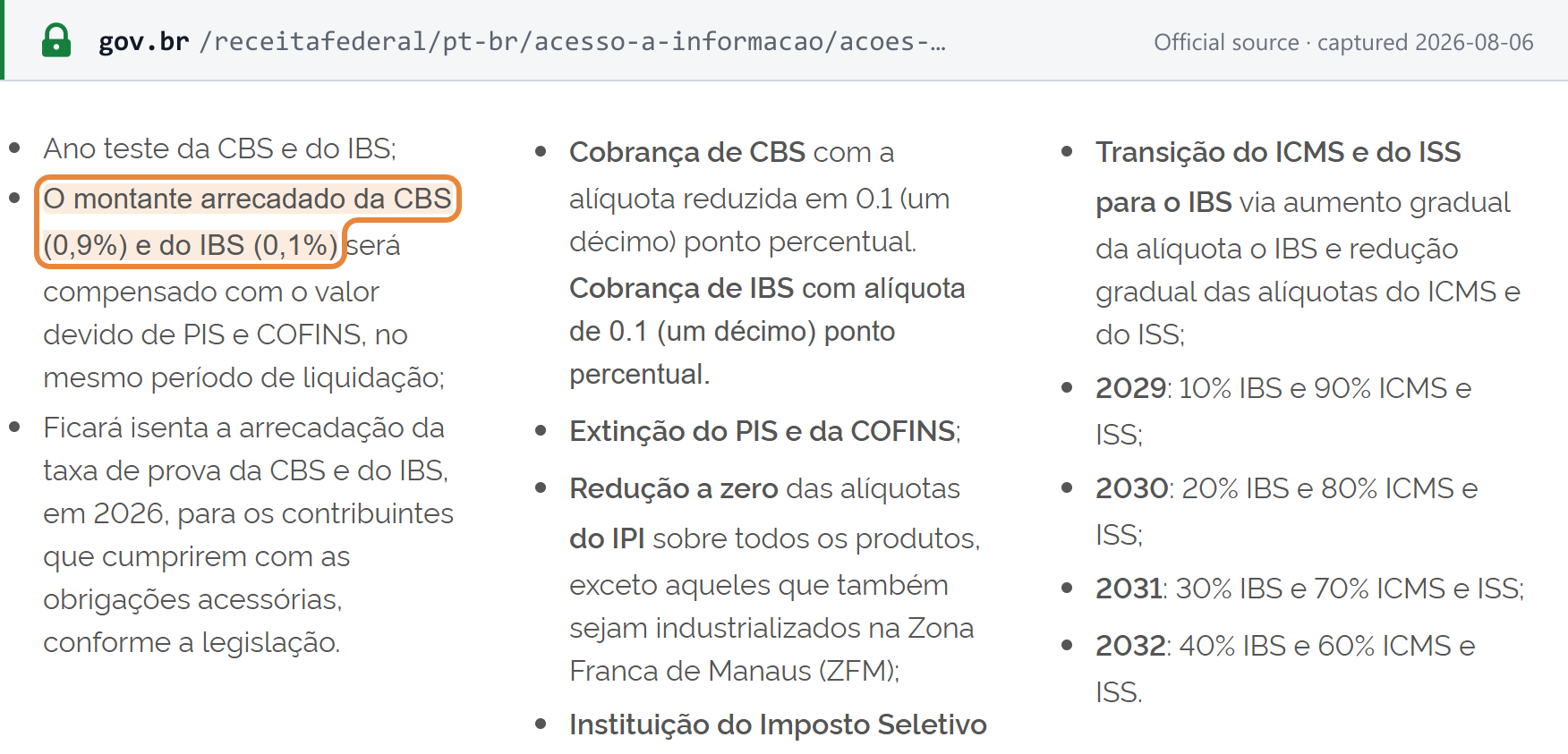
For taxable events from 1 January to 31 December 2026, LC 214/2025 charges IBS "mediante aplicação da alíquota estadual de 0,1% (um décimo por cento)" (art. 343) and CBS "mediante aplicação da alíquota de 0,9% (nove décimos por cento)" (art. 346) — CBS 0.9% + IBS 0.1%. Payment is waived for taxpayers who meet the ancillary obligations ("Fica dispensado o recolhimento do IBS e da CBS … em relação aos sujeitos passivos que cumprirem as obrigações acessórias", art. 348, § 1), and those taxpayers remain liable for PIS and Cofins in full (art. 348, § 2). Amounts actually paid are offset against PIS/Cofins of the same period. The test rates do not apply to Simples Nacional optants (art. 348, III, "c"). (LC 214/2025, Senado Federal; Receita Federal — Entenda a reforma)
Ato Conjunto RFB/CGIBS nº 1/2025 adds that "a apuração do IBS e da CBS no ano de 2026 será realizada em caráter meramente informativo, sem efeitos tributários, desde que cumpridas as obrigações acessórias" — the 2026 assessment is informative only, with no tax effect, provided the ancillary obligations are met. (Ato Conjunto RFB/CGIBS nº 1/2025)
 Source snapshot captured 2026-08-06 — original
The taxes actually paid in 2026
Until they are replaced, the legacy taxes carry the real burden:
| Tax | Level | Rate | Source |
|---|---|---|---|
| PIS/Pasep (non-cumulative regime) | Federal | 1.65% | Lei 10.637/2002, art. 2 |
| Cofins (non-cumulative regime) | Federal | 7.6% | Lei 10.833/2003, art. 2 |
| ISS | Municipal | Set by each municipality, minimum 2% ("A alíquota mínima … é de 2%"), maximum 5% | LC 157/2016, art. 8-A; LC 116/2003, art. 8 |
| ICMS — interstate | State | 12%; 7% from the South and Southeast to the North, Northeast, Centre-West and Espírito Santo; 4% on imported goods | Senate Resolution 22/1989; Senate Resolution 13/2012 |
| ICMS — internal | State | Set by each state's law (not listed here) | — |
| IPI | Federal | Product by product, under the TIPI table | — |
PIS and Cofins under the cumulative regime are not covered here.
The transition, 2027 to 2033
| Period | What applies | Law |
|---|---|---|
| 2026 | Test year: CBS 0.9% + IBS 0.1% (state), offset or waived; PIS/Cofins, ICMS, ISS and IPI fully due | LC 214/2025, arts. 343, 346, 348 |
| 2027–2028 | PIS and Cofins extinguished; CBS charged at the rate fixed under art. 14 reduced by 0.1 percentage point; IBS charged at 0.05% state + 0.05% municipal; IS begins; IPI reduced to zero except on products with incentivised manufacturing in the Manaus Free Trade Zone | EC 132/2023, ADCT arts. 126–127; LC 214/2025, arts. 344, 347 |
| 2029 | ICMS and ISS rates at 9/10 of their statutory rates — Receita: "10% IBS e 90% ICMS e ISS" | EC 132/2023, ADCT art. 128 |
| 2030 | 8/10 — "20% IBS e 80% ICMS e ISS" | same |
| 2031 | 7/10 — "30% IBS e 70% ICMS e ISS" | same |
| 2032 | 6/10 — "40% IBS e 60% ICMS e ISS" | same |
| 2033 | ICMS and ISS extinguished: "Ficam extintos, a partir de 2033, os impostos previstos nos arts. 155, II, e 156, III" | EC 132/2023, ADCT art. 129 |
LC 214/2025, art. 344: "o IBS será cobrado à alíquota estadual de 0,05% (cinco centésimos por cento) e à alíquota municipal de 0,05% (cinco centésimos por cento)" for 2027–2028. Art. 347: the CBS rate for the same years "será aquela fixada nos termos do inciso I do caput e dos §§ 2º e 3º, todos do art. 14, reduzida em 0,1 (um décimo) ponto percentual, exceto em relação aos combustíveis sujeitos ao regime específico". (LC 214/2025; EC 132/2023; Receita Federal — Entenda a reforma)
Announced rate: the 2027 CBS reference rate — calculated, not yet law
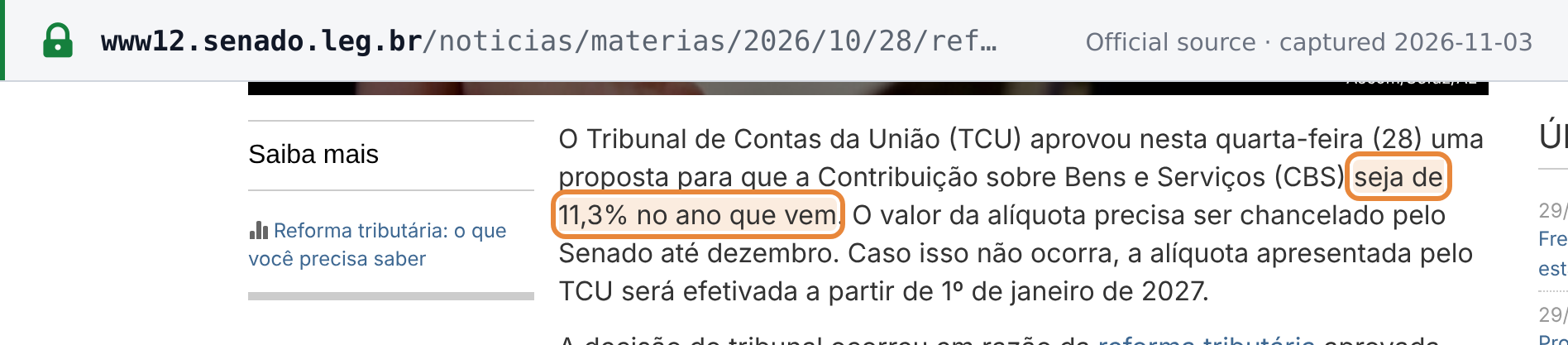
Under LC 214/2025, art. 349, "resolução do Senado Federal fixará … para os anos de 2027 a 2033, a alíquota de referência da CBS", based on calculations sent by the Federal Court of Accounts (TCU). On 28 October 2026 the TCU approved a proposal of 11.3% for 2027. Agência Senado: "O Tribunal de Contas da União (TCU) aprovou nesta quarta-feira (28) uma proposta para que a Contribuição sobre Bens e Serviços (CBS) seja de 11,3% no ano que vem. O valor da alíquota precisa ser chancelado pelo Senado até dezembro. Caso isso não ocorra, a alíquota apresentada pelo TCU será efetivada a partir de 1º de janeiro de 2027." (The TCU approved on Wednesday a proposal for CBS to be 11.3% next year. The rate must be endorsed by the Senate by December; otherwise the TCU rate takes effect from 1 January 2027.) The TCU also set a 44.16% reducer for purchases by the direct public administration, autarchies and public foundations. (Agência Senado, 28 October 2026)
Status as at 3 November 2026: a TCU calculation awaiting a Senate resolution — not law. Agência Senado reported on 3 November 2026 that the TCU study was due to reach the Senate on 10 November. (Agência Senado, 3 November 2026) If 11.3% is fixed, art. 347 would put the CBS charged in 2027 at 11.2% (11.3% less 0.1 point) — our arithmetic, not a published figure.
 Source snapshot captured 2026-11-03 — original
Standard rate mechanics
Each level of government sets its own rate by law — the Union for CBS, each state and municipality for its part of IBS — and "na ausência de lei específica que estabeleça a alíquota do ente federativo, será aplicada a alíquota de referência" (art. 14, § 3). The IBS on an operation is the destination state rate plus the destination municipal rate (art. 15), and each government's rate "será a mesma para todas as operações com bens ou com serviços", save the exceptions in the law (art. 16). (LC 214/2025)
Reduced and zero rates
As enacted in LC 214/2025 (LC 227/2026 amended several articles; check the consolidated text for annex contents):
- 60% reduction (art. 128): "ficam reduzidas em 60% (sessenta por cento) as alíquotas do IBS e da CBS" on, among others, education services, health services, medical devices, accessibility devices, medicines, food for human consumption (Annex VII), hygiene products for low-income households, fresh agricultural, fishing and forestry products, agricultural inputs, national cultural, artistic and audiovisual productions, and sport.
- 30% reduction (art. 127): services of regulated intellectual professions "submetidas à fiscalização por conselho profissional".
- Zero rate: the National Basic Food Basket in Annex I — "Ficam reduzidas a zero as alíquotas do IBS e da CBS incidentes sobre as vendas de produtos destinados à alimentação humana relacionados no Anexo I" (art. 125) — and the list in art. 143, including certain medical and accessibility devices and medicines, menstrual-care products, fresh fruit, vegetables and eggs, and cars for persons with disabilities and taxi drivers.
- Exports: "São imunes ao IBS e à CBS as exportações de bens e de serviços" (art. 8).
Imposto Seletivo. IS rates are set by ordinary law; this guide does not list them.
Cross-border rules
These rules govern CBS and IBS once they are charged in earnest from 2027; in 2026 only the test regime runs, and the import rules of ICMS, ISS and PIS/Cofins continue to apply.
Imports and exports
- Imports of services and intangibles — the Brazilian buyer pays. A service or intangible supplied by a non-resident "cujo consumo ocorra no País" is an import (LC 214/2025, art. 64). The same rates apply as for a domestic supply, "o adquirente é contribuinte do IBS e da CBS" on the acquisition, a regular-regime buyer may take the credit, and the foreign supplier is "responsável solidário" (jointly liable) (art. 64, § 5, III, V, VII and VIII). This works as a reverse charge.
- Imports of goods — taxed at import. From 1 January 2027 the Duimp import declaration carries the IBS/CBS fields, and the NF-e for imported tangible goods follows the Duimp date instead of the general NF-e date (Ato Conjunto RFB/CGIBS nº 4, art. 1, § 3; see E-invoicing status).
- Exports are immune (art. 8), and the exporter keeps its credits (art. 79). An export of services is a supply to a non-resident with consumption abroad (art. 80).
Place of supply
Brazil's IBS is a destination tax: the rate on each operation is the sum of the destination state's rate and the destination municipality's rate (art. 15). For imported services the test is where consumption occurs (art. 64).
Foreign companies selling into Brazil — B2B and B2C
- B2B. The Brazilian business buyer is the taxpayer on imported services and intangibles (art. 64, § 5, V), with the foreign supplier jointly liable. The foreign supplier is still obliged to register (art. 21, § 2) unless it sells only through a registered digital platform (art. 22, § 3).
- B2C. Where the supplier is abroad, the digital platform through which it sells is liable for the tax (art. 22, I). If neither the foreign supplier nor the platform registers, the institution executing the foreign-exchange operation segregates and pays the IBS and CBS at the reference rates on the remittance (art. 23, sole paragraph). There is no threshold.
Marketplace / platform deemed-supplier liability
A digital platform is one that "atua como intermediária entre fornecedores e adquirentes nas operações e importações realizadas de forma não presencial ou por meio eletrônico" and controls at least one of charging, payment, terms and conditions, or delivery (art. 22, § 1). Platforms, including foreign ones, must register (art. 23) and may issue fiscal documents in the supplier's name, including consolidated ones (art. 22, § 12, I). (LC 214/2025) See also marketplace deemed-supplier rules and VAT on digital services by non-resident suppliers.
Invoice requirements
Brazil has no free-form invoice. Every operation travels on a standardised electronic fiscal document whose layout is fixed by technical note and which the tax administration must authorise before it can be used. The practical question is not "does my invoice carry the right particulars" but "does my XML validate against the current layout version".
The obligation
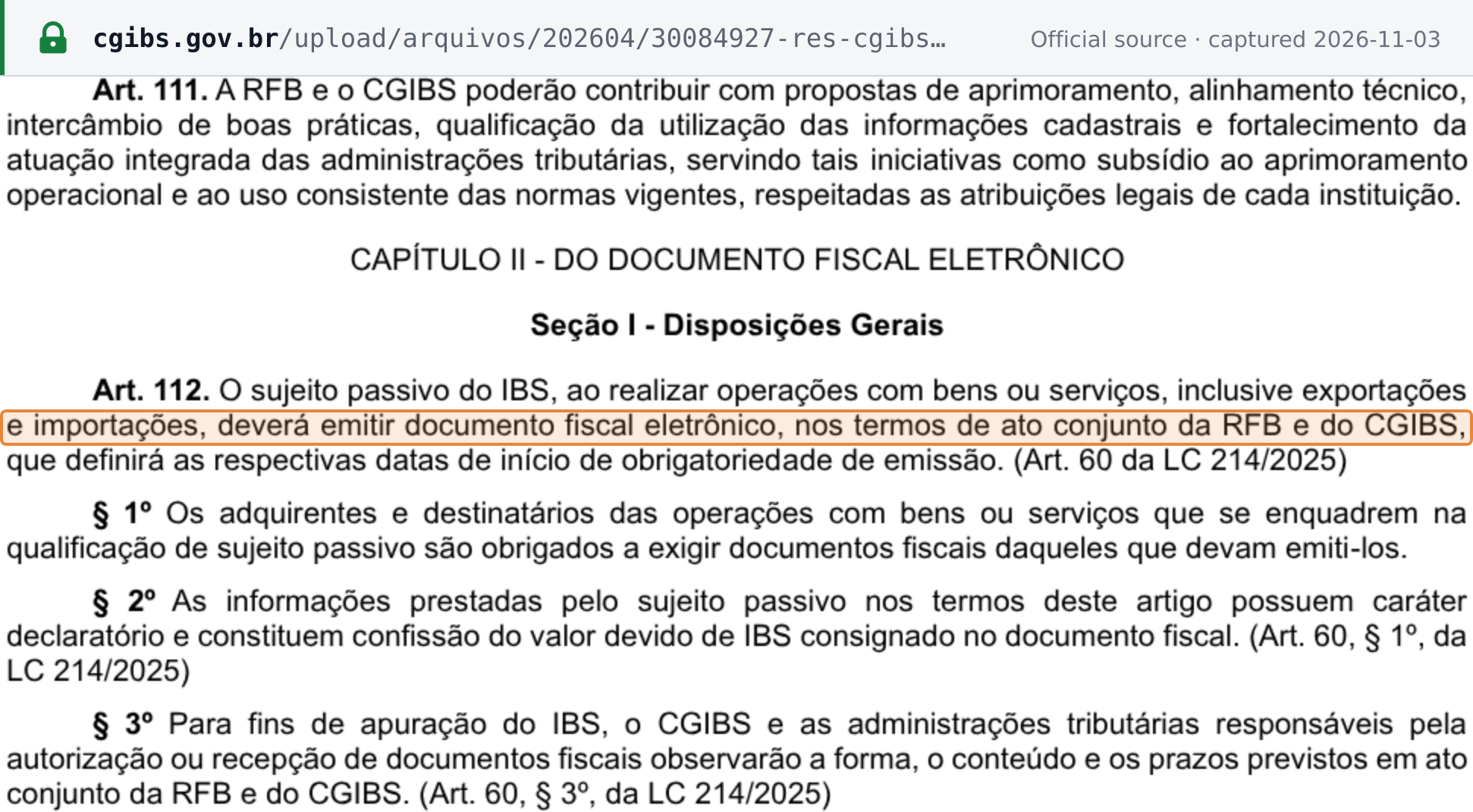
"O sujeito passivo do IBS, ao realizar operações com bens ou serviços, inclusive exportações e importações, deverá emitir documento fiscal eletrônico, nos termos de ato conjunto da RFB e do CGIBS, que definirá as respectivas datas de início de obrigatoriedade de emissão" — an IBS taxpayer must issue an electronic fiscal document for every operation with goods or services, including exports and imports, from start dates set by joint act (IBS regulation, art. 112; LC 214/2025, art. 60). Buyers who are taxpayers "são obrigados a exigir documentos fiscais" (§ 1), and the tax data on the document "constituem confissão do valor devido" — a confession of the tax owed (§ 2). The obligation covers immune, exempt, zero-rated and suspended operations and transfers between a taxpayer's own establishments (art. 115). (Resolução CGIBS nº 6/2026)
 Source snapshot captured 2026-11-03 — original
Document types
Articles 113 and 114 of the IBS regulation recognise the existing documents and create three new ones:
| Document | Model | Covers |
|---|---|---|
| NF-e — Nota Fiscal Eletrônica | 55 | Goods |
| NFC-e — Nota Fiscal de Consumidor Eletrônica | 65 | Retail sales to consumers |
| NFS-e — Nota Fiscal de Serviços Eletrônica | — | Services |
| CT-e / CT-e OS — Conhecimento de Transporte Eletrônico | 57 / 67 | Freight transport / other transport services |
| BP-e — Bilhete de Passagem Eletrônico | 63 | Passenger tickets |
| MDF-e — Manifesto Eletrônico de Documentos Fiscais | 58 | Manifest of fiscal documents (cargo) |
| GTV-e — Guia de Transporte de Valores Eletrônica | 64 | Cash-in-transit |
| NF3e — Nota Fiscal de Energia Elétrica Eletrônica | 66 | Electricity |
| NFCom — Nota Fiscal Fatura de Serviços de Comunicação Eletrônica | 62 | Communications |
| NFGas — Nota Fiscal Eletrônica do Gás | 76 | Gas |
| DC-e — Declaração de Conteúdo eletrônica | 99 | Content declaration |
| NFS-e Via | — | Road-use (toll) services |
| Duimp / DIR | — | Imports (single import declaration / remittance import declaration) |
| NFAg — Nota Fiscal de Água e Saneamento Eletrônica (new) | 75 | Water and sanitation |
| DeRE — Declaração de Regimes Específicos (new) | — | Specific-regime declaration |
| NF-e ABI — Nota Fiscal Eletrônica de Alienação de Bens Imóveis (new) | 77 | Sales of real estate |
(Resolução CGIBS nº 6/2026, arts. 113–114)
Validity and authorisation
A fiscal document is "o documento emitido e armazenado eletronicamente, de existência apenas digital" (art. 117). It is valid only with the issuer's electronic signature and the authorisation of use, and "somente poderá ser utilizado após a concessão de autorização de uso pela RFB, pelo CGNFS-e ou pelo CGIBS" (art. 118). A CNPJ that is "inapta, suspensa, nula e baixada" blocks issuance (art. 121). A document is not idôneo (not valid for tax purposes) if, among other things, it fails the legal requirements, is issued by a party whose registration is suspended, unfit, cancelled or void, or "não corresponder efetivamente à operação" (art. 122). (Resolução CGIBS nº 6/2026)
Mandatory content
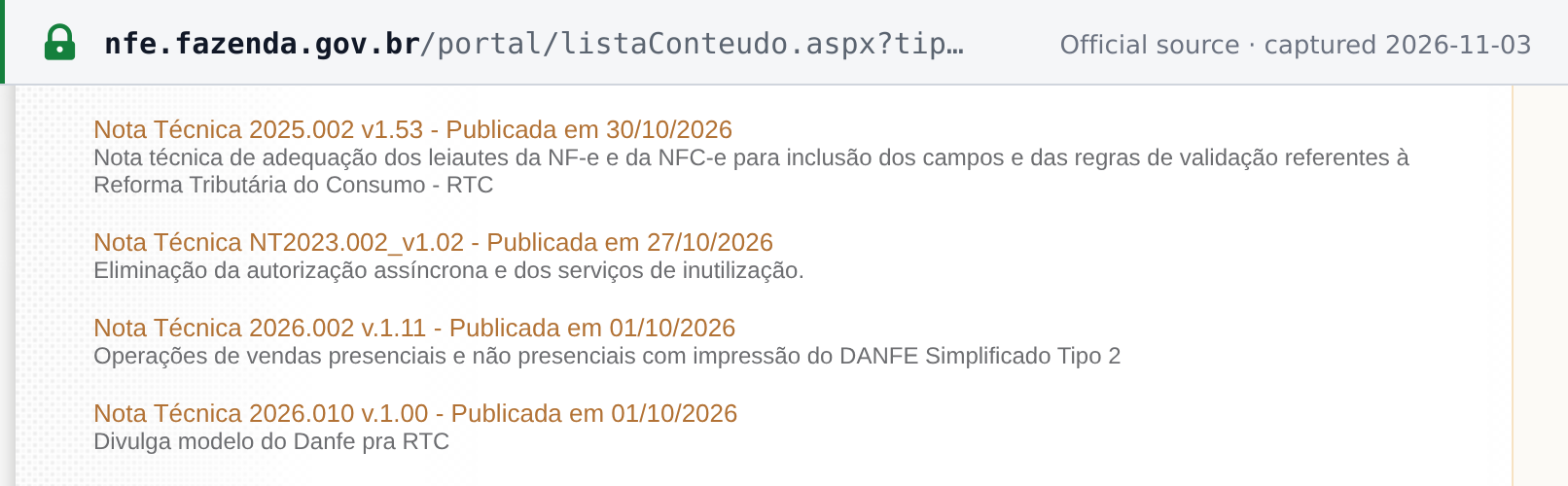
The mandatory content is the technical layout: issuers must observe "os leiautes, prazos, campos obrigatórios e padrões definidos na respectiva documentação técnica" (IBS regulation, art. 116, II). For NF-e and NFC-e that is the MOC 7.0 plus Nota Técnica 2025.002-RTC, now at version 1.53, published 30 October 2026. (Portal Nacional da NF-e — Notas Técnicas)
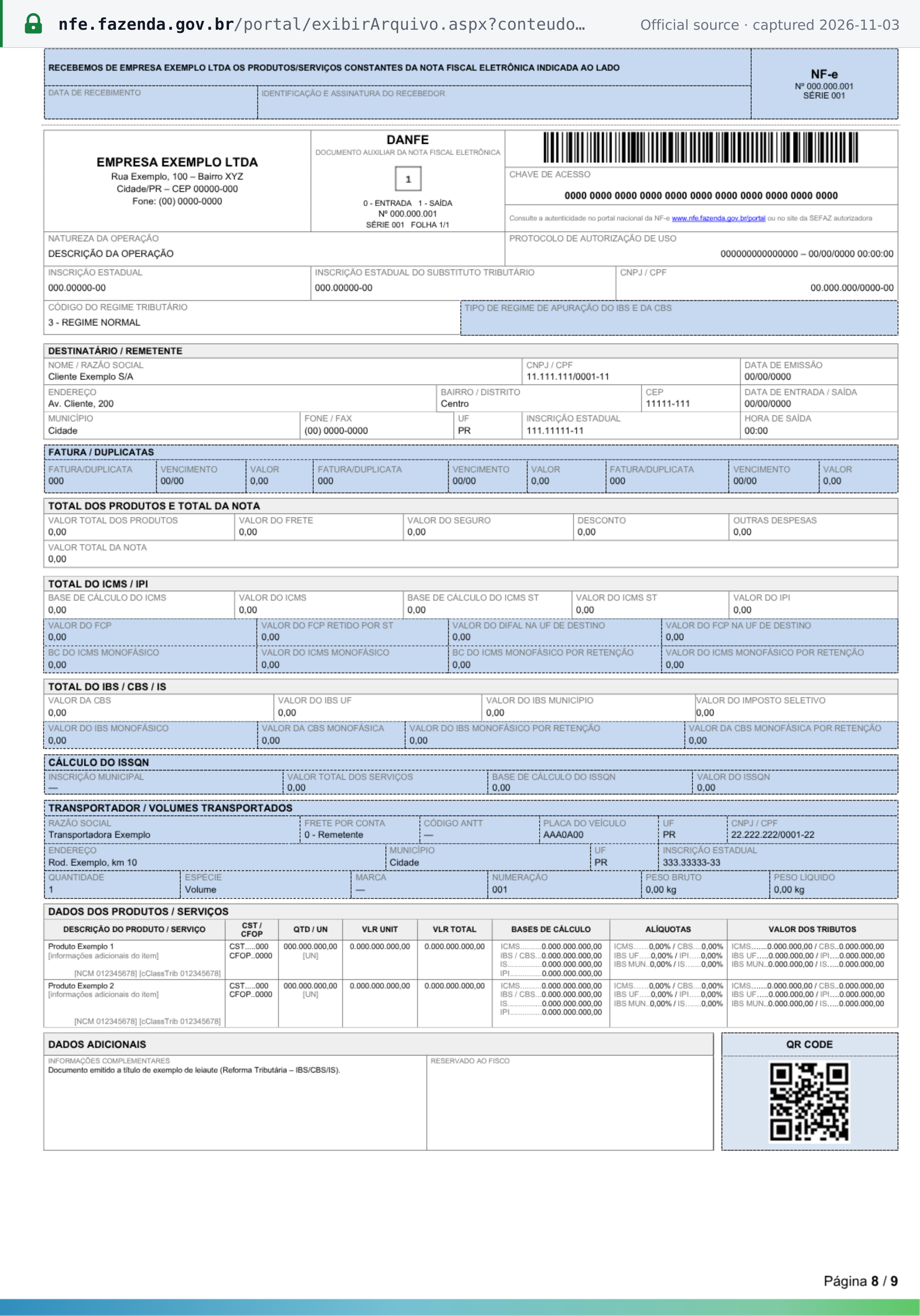
The CBS/IBS fields a developer has to map, as printed on the reformed DANFE (NT 2026.010, tables 4.1–4.3):
- Per item: tax classification code
cClassTrib(UB14); IBS/CBS basevBC(UB16); IBS state ratepIBSUF(UB18) and valuevIBSUF(UB35); IBS municipal ratepIBSMun(UB37) and valuevIBSMun(UB54); CBS ratepCBS(UB56) and valuevCBS(UB67); effective ratepAliqEfetwhere a rate reduction applies; Imposto Seletivo base, rate and value (UB05, UB06, UB11). - Totals ("Total do IBS/CBS/IS"):
vCBS(W56),vIBSUF(W41),vIBSMun(W46),vIS(W33), plus the single-phase (monofásico) IBS and CBS values (W58, W59, W59a, W59b). - Issuer: the tax-regime code
CRT(C21) and a reserved field for the IBS/CBS assessment regime.
NT 2026.010, p. 4: "Na área de totais da nota, imediatamente após o bloco "Total do ICMS/IPI", é inserido um novo bloco intitulado "Total do IBS/CBS/IS"." (NT 2026.010 v1.00)
 Source snapshot captured 2026-11-03 — original
Pin the version. NT 2025.002 went from v1.35 (31 March 2026) through v1.36, v1.40, v1.50, v1.51 and v1.52 to v1.53 on 30 October 2026 — roughly one revision a month. Track the portal list rather than a cached PDF.
Issuance deadline
A document must be authorised before the goods move or the service is used (art. 118, sole paragraph). The issuance and cancellation deadlines "deverão ser únicos para cada documento fiscal" (art. 112, § 4) and are set in each document's technical documentation, not in one IBS/CBS-wide rule. Cancelling after the taxable event, or after the cancellation deadline, is fined (see Offences and penalties). (Resolução CGIBS nº 6/2026)
Numbering and sequencing
"Os documentos fiscais serão identificados de maneira única pela sua chave de acesso" (art. 124). The access key must contain at least the issuer's CNPJ or CPF, the document model, the year and month of issue and the document number, and "é vedada a reutilização de numeração de documento fiscal, ainda que emitido em contingência" — a number may never be reused, even in contingency (§§ 1 and 3). Failing to report the voiding (inutilização) of a document number, or reporting it late, costs 1 UPF per number. (Resolução CGIBS nº 6/2026; LC 227/2026, art. 341-G, VIII)
Credit and debit notes
NT 2025.002-RTC adds two NF-e purposes: finNFe 5 = nota de crédito and finNFe 6 = nota de débito, alongside 1 (normal), 2 (complementary), 3 (adjustment) and 4 (return of goods). "O sentido das palavras "débito" e "crédito" sempre se referem ao ponto de vista do emissor" — a debit note records an increase in the tax the issuer owes, a credit note a reduction. Each carries a typed reason code (for example, debit note 02 annuls credits on immune or exempt outputs). (NT 2025.002-RTC v1.53)
Currency and language
Neither LC 214/2025 nor the IBS regulation sets a separate currency, language or exchange-rate rule for fiscal documents; the field formats are fixed by each document's technical layout. This guide does not cover the foreign-currency conversion rule.
Self-billing
A digital platform may issue fiscal documents "em nome do fornecedor, inclusive de forma consolidada" (LC 214/2025, art. 22, § 12, I). A buyer must issue a document for an acquisition or entry of goods or services where the law requires it (the entry NF-e); failing to do so is fined at 100% of the reference tax (art. 341-G, XVI). (LC 214/2025; LC 227/2026)
Retention and audit trail
"O emitente deverá manter em boa ordem e guarda os documentos que originaram as informações constantes dos documentos fiscais, na forma e no prazo estabelecido por ato conjunto da RFB e do CGIBS" — the retention period is delegated to a joint RFB/CGIBS act (IBS regulation, art. 149); no joint act setting the period had been published as at 3 November 2026, so no period is stated here. The audit trail is built into the system: the issuer's electronic signature, prior authorisation, the unique access key, and fines of 100 UPF per device for software that lets documents be issued with suppressed or reduced values (150 UPF for whoever supplies it) (art. 341-G, V–VI). (Resolução CGIBS nº 6/2026; LC 227/2026)
A specimen of a compliant invoice
The NF-e itself is XML. What a buyer, a driver or an auditor handles is the DANFE (Documento Auxiliar da Nota Fiscal Eletrônica), the printed representation — and Brazil prescribes it down to block positions, so the official models are the specimen.
The reformed DANFE (CBS/IBS). Nota Técnica 2026.010 v1.00, published on the Portal Nacional da NF-e on 1 October 2026, "especifica as alterações no leiaute de impressão do Documento Auxiliar da Nota Fiscal Eletrônica (DANFE), modelo 55, necessárias à representação dos tributos instituídos pela Reforma Tributária do Consumo: o Imposto sobre Bens e Serviços (IBS), a Contribuição sobre Bens e Serviços (CBS) e o Imposto Seletivo (IS)". It ships a portrait reference layout (main) and a landscape one (alternative); "Os valores exibidos nos modelos são fictícios e servem apenas para ilustrar a disposição dos campos" — the values are fictitious. Its schedule sets production for 1 December 2026. (NT 2026.010 v1.00)
Reading the portrait model below, top to bottom: the receipt stub ("RECEBEMOS DE … OS PRODUTOS/SERVIÇOS CONSTANTES DA NOTA FISCAL ELETRÔNICA INDICADA AO LADO") with date and signature; the issuer block, the DANFE title with the 0 - ENTRADA / 1 - SAÍDA box, and the barcoded CHAVE DE ACESSO that ties the paper to the authorised XML; the authorisation protocol; the issuer's CÓDIGO DO REGIME TRIBUTÁRIO next to the new TIPO DE REGIME DE APURAÇÃO DO IBS E DA CBS; the destinatário block; invoices and due dates; product and invoice totals; TOTAL DO ICMS / IPI; then the new TOTAL DO IBS / CBS / IS block (VALOR DA CBS, VALOR DO IBS UF, VALOR DO IBS MUNICÍPIO, VALOR DO IMPOSTO SELETIVO, and the single-phase values); ISSQN; the transporter block; and item lines that print the ICMS, IBS/CBS, IS and IPI bases, the ICMS, IBS UF, IBS MUN, CBS, IS and IPI rates and values, and each item's [cClassTrib]. During the transition the old and new taxes sit on the same document.
 Source snapshot captured 2026-11-03 — original, NT 2026.010 v1.00 p. 8
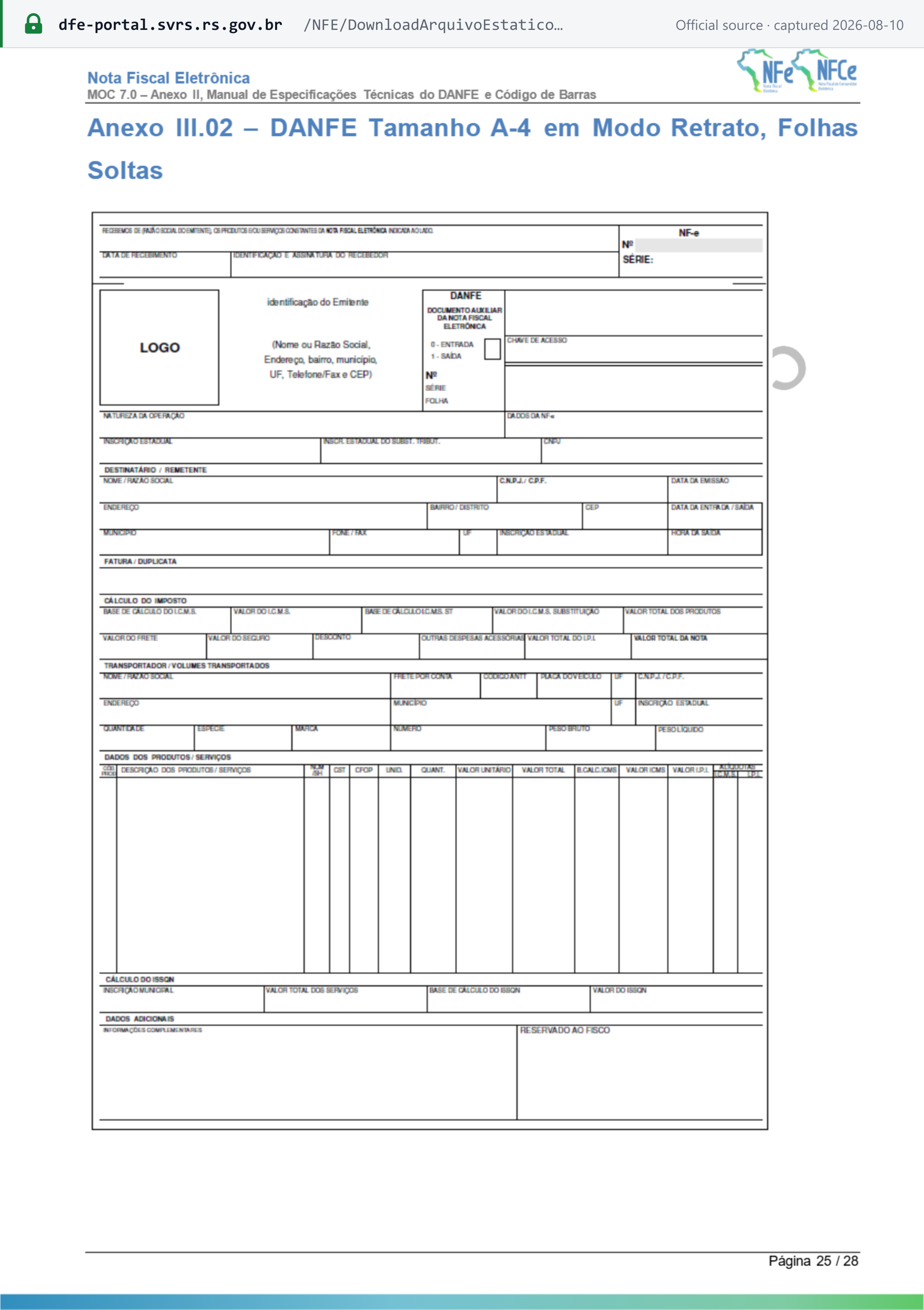
The classic DANFE, still the legal print layout until the reformed one goes into production, is specified in MOC 7.0 Anexo II, Manual de Especificações Técnicas do DANFE e Código de Barras, which tabulates each field's position and size in centimetres and carries the 44-digit access key as a CODE-128C barcode. Anexo III.02 is the A-4 portrait model:
 Source snapshot captured 2026-08-10 — original, MOC 7.0 Anexo II p. 25
NT 2025.002-RTC v1.53 still says, in its DANFE section, that changes to show the new taxes "estão em estudo"; NT 2026.010 is the note that delivers them.
Split payment: NF-e/NFC-e group YC
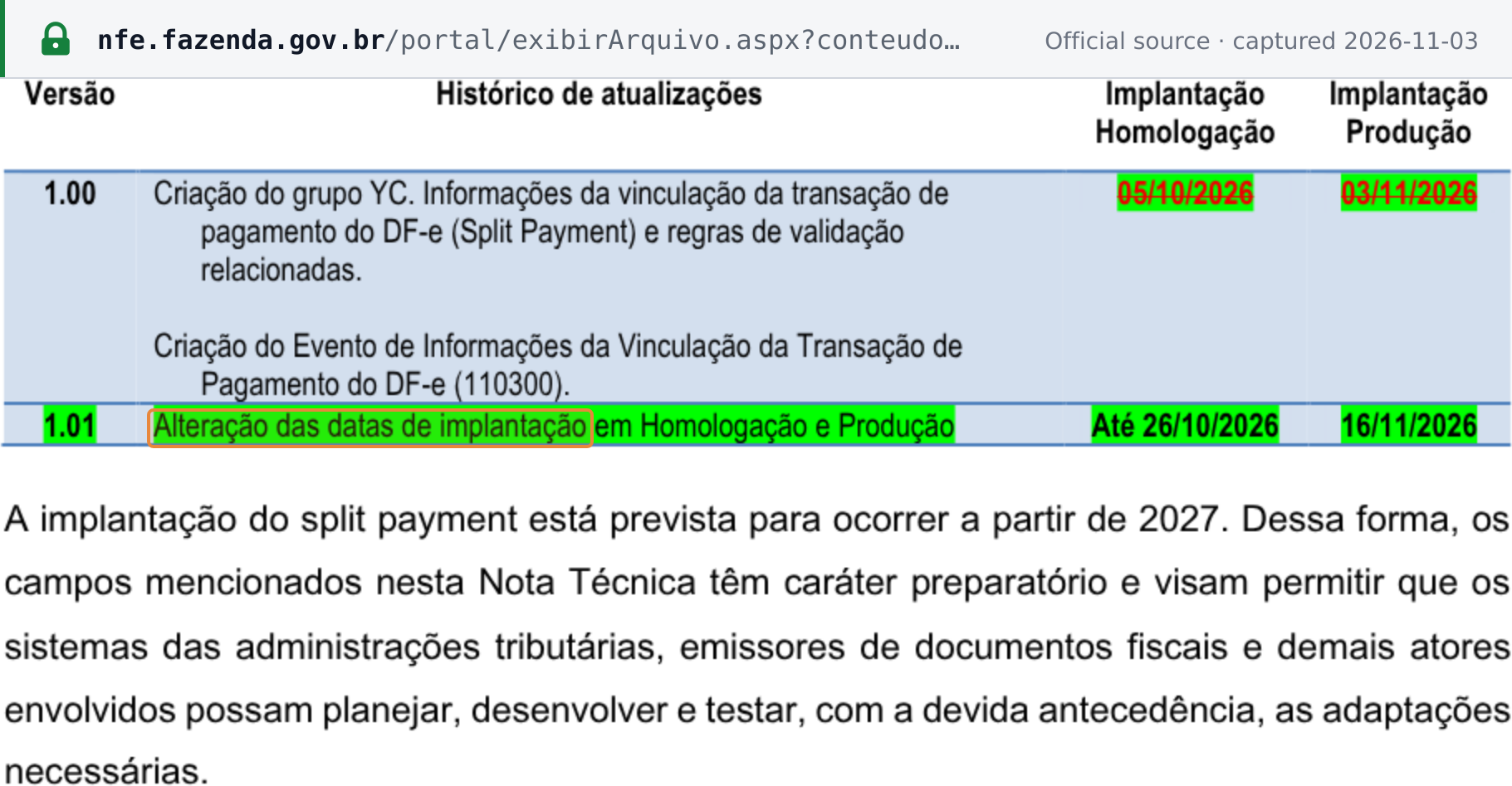
LC 214/2025, art. 31, requires payment-service providers to segregate and pay over the IBS and CBS "no momento da liquidação financeira da transação (split payment)". (LC 214/2025) To prepare, Nota Técnica 2026.006 creates NF-e/NFC-e group YC, linking the document to its payment transaction, and event 110300. Version 1.01 (October 2026) moved implementation to homologation "Até 26/10/2026" and production on 16 November 2026 (from 5 October and 3 November 2026 in v1.00). "Não há exigência de preenchimento ou uso dos campos de split payment em 2026 no ambiente de produção" — the fields need not be filled in production in 2026 — and they will be activated when split payment starts, "prevista para 2027". NT 2026.008 v1.01 (net-value fields) and NT 2026.005 v1.00 (Simples Nacional fields) carry the same homologation and 16 November 2026 production dates. (NT 2026.006 v1.01)
 Source snapshot captured 2026-11-03 — original
E-invoicing status
Status as at 3 November 2026: mandatory, clearance model. Every taxpayer must issue electronic fiscal documents that the tax administration authorises before use (IBS regulation, arts. 112 and 118), whether the buyer is a business, a consumer or a public body: authorisation is by the systems of the RFB, the CGNFS-e or the CGIBS (art. 118). The format is XML against each document's technical note. What is being phased in now is the CBS/IBS content of those documents. For the system-level detail see Brazil e-invoicing (NF-e and DF-e).
Mandatory start dates for the IBS/CBS fields, by document type
Ato Conjunto RFB/CGIBS nº 1/2025 required documents to be issued with the new fields from 1 January 2026, but suspended penalties for missing fields during an adaptation period. The binding dates, by document type, are in Ato Conjunto RFB/CGIBS nº 4, of 30 July 2026, and attach to taxable events on or after each date: (Ato Conjunto RFB/CGIBS nº 4; Receita Federal — Cronograma dos documentos fiscais eletrônicos)
| Start date | Document types |
|---|---|
| 3 August 2026 | NF-e (model 55), NFC-e (model 65), CT-e, CT-e OS, MDF-e, GTV-e, NF3e, DC-e, NFS-e Via, and BP-e not classified below |
| 1 October 2026 | NFCom, DIR, the DeRE "Eventos de Tabela do Contribuinte", and NFS-e for the other services on the LC 116/2003 ISS list not covered by alíneas "a" to "c" (art. 1, III, "d") |
| 15 November 2026 | DeRE "Eventos Periódicos Mensais" — due by the 15th of the month after the period, the first one covering October 2026 |
| 1 December 2026 | NFS-e for digital-platform services, ISS subitems 1.03, 1.05, 1.09 and 16.01, intangibles, condominium charges, leases, and other services outside the categories above (art. 1, III, "h"); semi-urban, metropolitan and air BP-e; NFGas; NFAg; NF-e ABI; and NF-e issued by an IBS/CBS taxpayer that is not an ICMS taxpayer (art. 1, § 4) |
| 1 January 2027 | Simples Nacional optants, for every document type (art. 1, § 1); Duimp, with NF-e on imports of tangible goods following that date (§ 3); NF-e for single-phase (monofásica) supplies (§ 2); remaining DeRE events |
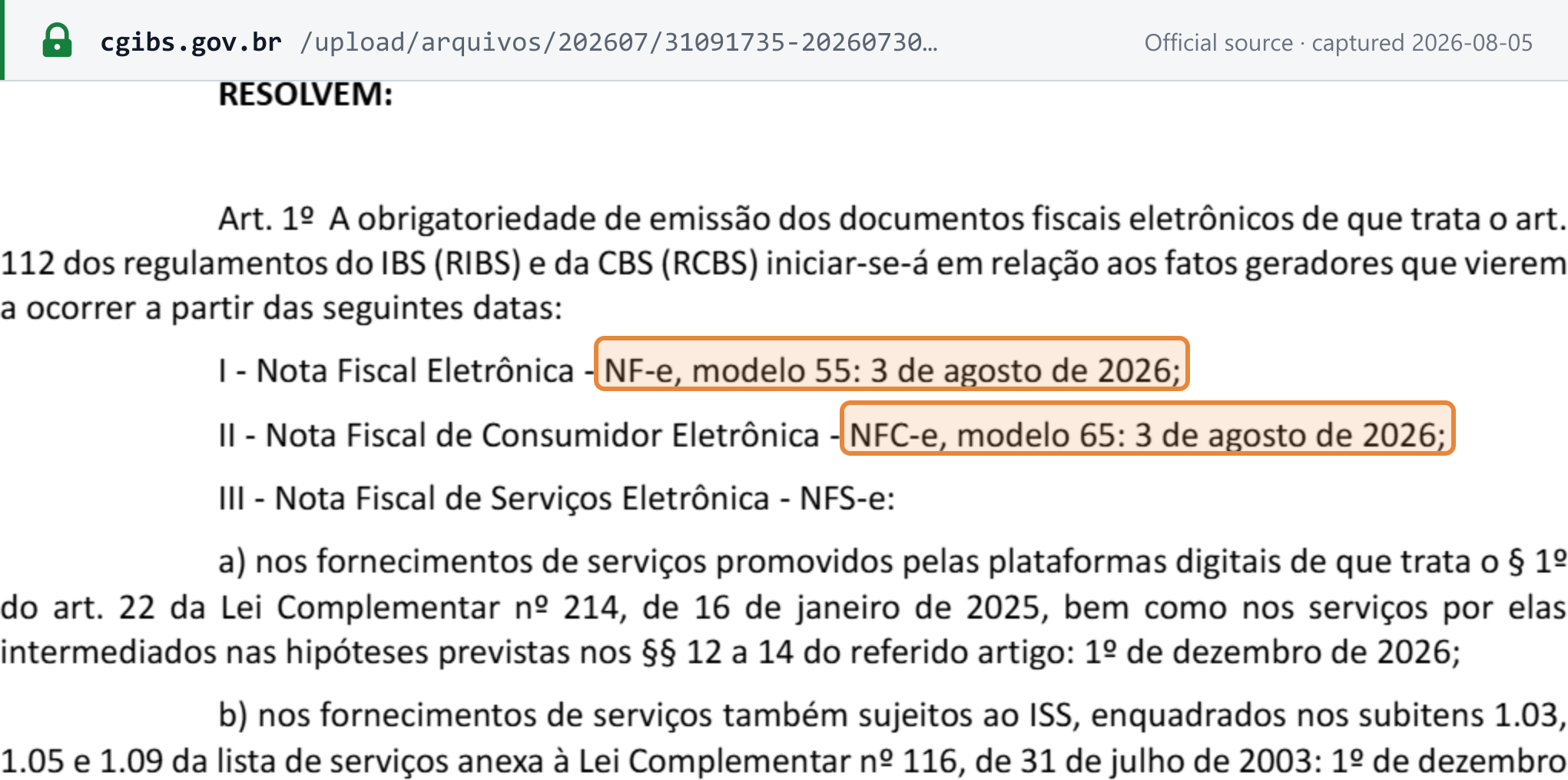 Source snapshot captured 2026-08-05 — original
Ato Técnico Conjunto nº 1/2026 deferred only the IBS/CBS validation rules due on 3 August 2026, so NF-e, NFC-e, CT-e, CT-e OS, GTV-e, BP-e, NF3e and NFCom are still authorised when some CBS/IBS fields are missing. On 6 August 2026 Receita Federal and the CGIBS stated "não houve suspensão da obrigatoriedade" — the obligation was not suspended — and the Ato Conjunto nº 4 schedule stands. (Comitê Gestor do IBS) In NT 2025.002-RTC v1.53 (30 October 2026), rule UB12-10 — rejection 1115, "Grupo IBSCBS não informado" — carries the notes "implementação em homologação para NFe com data de emissão maior ou igual a 01/07/2026 e emitente com CRT 3=Regime Normal" and "implementação futura para produção": it runs in the test environment but is not yet switched on in production. (NT 2025.002-RTC v1.53)
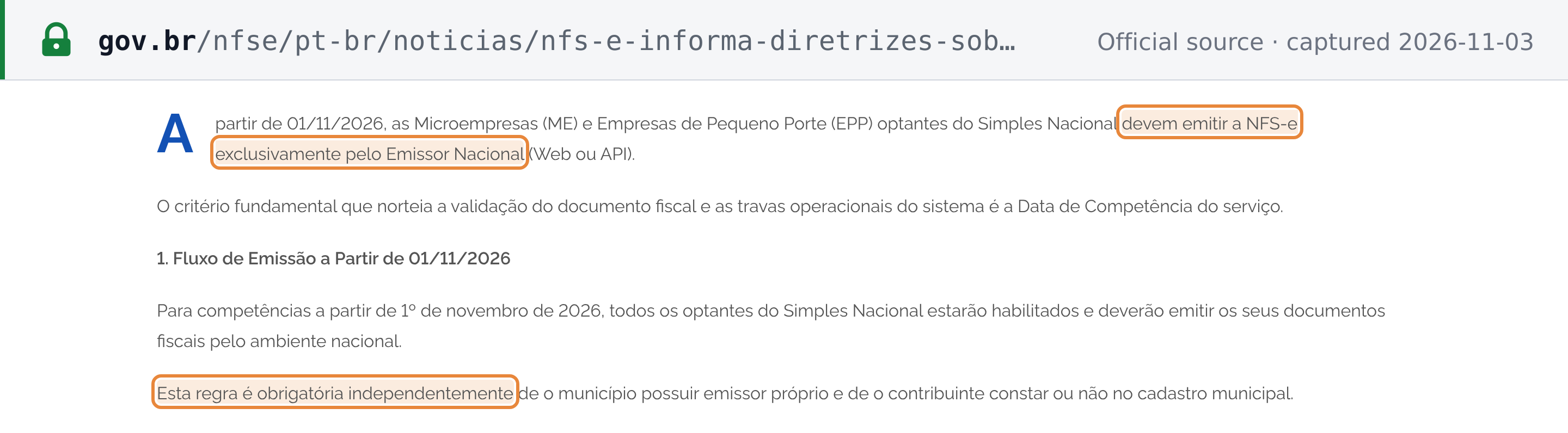
NFS-e Nacional for Simples Nacional ME/EPP — in force since 1 November 2026
Resolução CGSN nº 191/2026 (dated 4 August 2026; DOU of 10 August 2026) requires Simples Nacional micro and small enterprises to issue the NFS-e through the national Emissor Nacional from 1 November 2026; it revoked Resolução CGSN nº 189/2026, which had set 1 September 2026. (Receita Federal, August 2026) The national NFS-e portal, 29 October 2026: "A partir de 01/11/2026, as Microempresas (ME) e Empresas de Pequeno Porte (EPP) optantes do Simples Nacional devem emitir a NFS-e exclusivamente pelo Emissor Nacional (Web ou API). … Esta regra é obrigatória independentemente de o município possuir emissor próprio e de o contribuinte constar ou não no cadastro municipal." (Portal NFS-e Nacional, 29 October 2026) The CBS/IBS fields on those NFS-e follow the Simples Nacional date, 1 January 2027.
 Source snapshot captured 2026-11-03 — original
Filing and payment
Filing frequency
IBS and CBS are assessed monthly (LC 214/2025, art. 43). There is no turnover band that changes the frequency. (LC 214/2025)
2026
The 2026 assessment is informative only, without tax effect, for taxpayers who meet the ancillary obligations (Ato Conjunto RFB/CGIBS nº 1/2025; see Rates). Specific-regime taxpayers must already file the DeRE: its monthly events "deverão ser entregues até o dia 15 do mês seguinte ao do período de apuração", the first covering October 2026 — so due by 15 November 2026 (Ato Conjunto RFB/CGIBS nº 4, art. 1, § 5). (Ato Conjunto RFB/CGIBS nº 4)
The 2026 returns for PIS/Cofins, ICMS and ISS (federal, state and municipal filings) continue as before and are not covered here.
Return and payment due date — from 2027
Brazil replaces the self-assessed return with an assisted assessment (apuração assistida), built from the authorised fiscal documents:
- The CGIBS presents the assisted IBS assessment "até o dia 15 (quinze) do mês seguinte" for most taxpayers, and by the 20th for those who must file the DeRE (IBS regulation, art. 46, I–II).
- The taxpayer may adjust it "até o último dia útil do mês seguinte ao do período de apuração" (art. 46, § 3). With no response by then, "presume-se correto o saldo apurado e considera-se constituído o crédito tributário" — the balance is deemed correct and the tax debt is constituted (§ 7).
- "O saldo a recolher … deverá ser pago até o último dia útil do mês seguinte ao do período de apuração" — the balance is payable by the last business day of the following month (art. 45).
These are the IBS regulation's rules; the CBS regulation (Decreto nº 12.955/2026) shares its article numbering. (Resolução CGIBS nº 6/2026) Simples Nacional optants that did not elect the regular regime keep paying CBS and IBS inside the Simples Nacional DAS. Late-payment interest and surcharges for IBS/CBS are not covered here.
Input-tax recovery
A regular-regime taxpayer gets a full credit once the supplier's tax is extinguished, including by split payment, "excetuadas exclusivamente aquelas consideradas de uso ou consumo pessoal, nos termos do art. 57 desta Lei Complementar, e as demais hipóteses previstas nesta Lei Complementar" — except items of personal use or consumption listed in art. 57 and the other cases the law provides (LC 214/2025, art. 47). (LC 214/2025)
Refunds
A credit balance can be refunded. Receita/CGIBS must decide within 30 days for taxpayers in compliance programmes, 60 days in the cases of art. 40, and 180 days otherwise; "se não houver manifestação … o crédito será ressarcido ao contribuinte nos 15 (quinze) dias subsequentes" (LC 214/2025, art. 39, §§ 3–4). For 2026, test-rate amounts that cannot be offset against PIS/Cofins may be refunded within 60 days on request (art. 348, II, "b"). Exporters keep their credits (art. 79). (LC 214/2025)
Exemptions
Immune, zero-rated and reduced supplies
LC 214/2025 does not work from a broad list of exempt supplies. It uses immunity (exports of goods and services, art. 8), zero rates (the basic food basket, art. 125, and the art. 143 list) and rate reductions of 60% or 30% (arts. 127–128) — see Reduced and zero rates. (LC 214/2025)
Exempt is not zero-rated
The credit consequence differs. NT 2025.002-RTC gives the NF-e debit note a dedicated reason, "Anulação de Crédito por Saídas Imunes/Isentas" — input credits are annulled on immune or exempt outputs — while exports, although immune, keep their credits (art. 79). (NT 2025.002-RTC v1.53) See also zero-rated vs exempt supplies.
Special regimes
- Small business: Simples Nacional and MEI, with the nanoempreendedor outside the tax altogether (see Registration).
- Specific regimes: cooperatives (art. 271), fuels, financial services, health plans and real estate, among others — the specific-regime taxpayers file the DeRE.
- Manaus Free Trade Zone: IPI is kept on products with incentivised manufacturing there (EC 132/2023, ADCT art. 126), and LC 227/2026 sets fines for breaching the controls on goods entering the zone (art. 341-G, XXI).
Offences and penalties
The IBS/CBS penalty regime was inserted into LC 214/2025 by Lei Complementar 227/2026. Fines are expressed in UPF: "É instituída a Unidade Padrão Fiscal dos Tributos sobre Bens e Serviços (UPF), no valor de R$ 200,00 (duzentos reais), a ser atualizada anualmente pela variação do IPCA" — 1 UPF = R$200.00, indexed annually to IPCA inflation (art. 341-C). (LC 227/2026, Senado Federal)
Offences
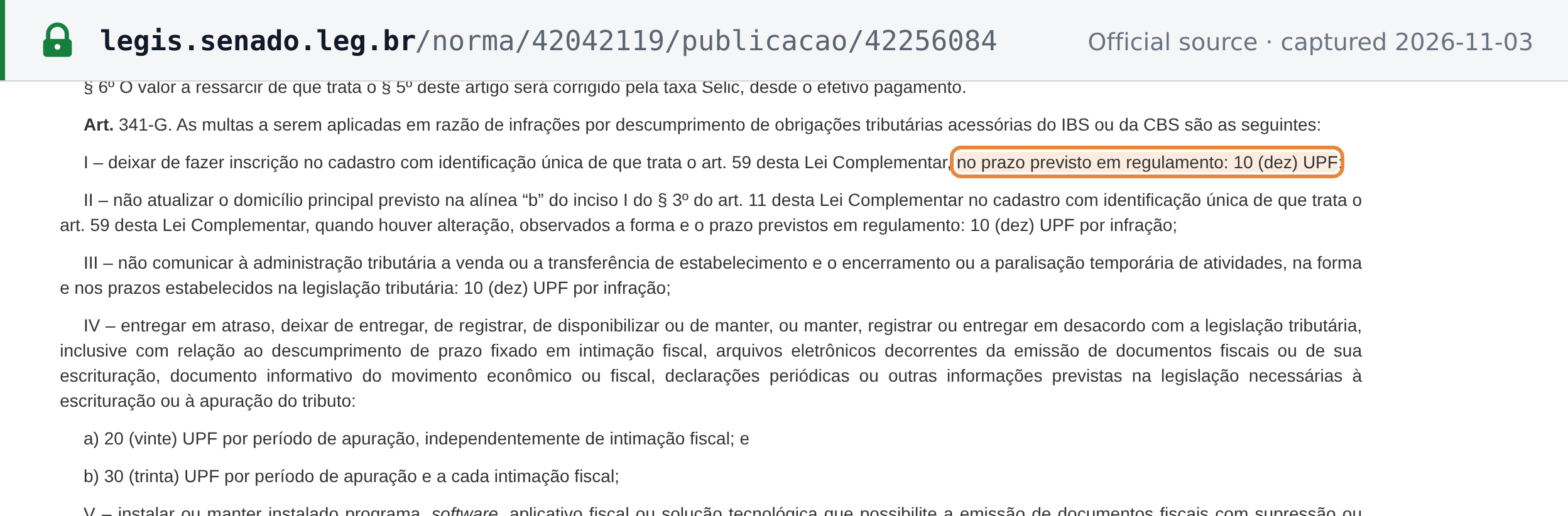
Art. 341-G lists the ancillary-obligation infringements, among them: failing to register in the CNPJ on time; failing to update the main domicile or to report a sale, transfer, closure or temporary halt; filing electronic files, declarations or document records late or not at all; installing, or supplying to others, software that lets documents be issued with suppressed or reduced values; supplying, buying, transporting or holding goods or services without a fiscal document; reusing a document for more than one movement; issuing or using a non-idoneous document; falsifying, altering or destroying a document; taking credits improperly; failing to issue an acquisition document; cancelling a document after the taxable event or after the cancellation deadline; and obstructing an inspection. Criminal tax offences are outside the scope of this guide.
Penalties
| Infringement (LC 214/2025, art. 341-G) | Fine |
|---|---|
| Failure to register in the CNPJ within the regulatory deadline (I) | 10 UPF |
| Failure to update the main domicile (II); failure to report sale, transfer, closure or temporary halt (III) | 10 UPF per infringement |
| Late or missing electronic files, declarations and document records (IV) | 20 UPF per assessment period; 30 UPF per period and per tax notice |
| Software allowing suppression or reduction of values — user (V) / developer or supplier (VI) | 100 UPF / 150 UPF per device |
| Late or missing report of a voided document number (VIII) | 1 UPF per number |
| Buyer failing to confirm, deny or report the return of an operation (IX) | 1 UPF per document |
| Obstructing an inspection (X) | 50 UPF per event |
| Goods or services not covered by a fiscal document (XI); document used twice (XII); falsified or destroyed document (XIV); failure to issue an acquisition document (XVI) | 100% of the reference tax |
| Issuing or using a non-idoneous document (XIII) | 66% of the reference tax |
| Improper credit or failure to reverse a credit (XV) | 66% of the credit |
| Cancelling a document after the taxable event / after the cancellation deadline (XVII) | 66% / 33% of the reference tax |
Fines are increased by 50% for repeat infringement of the same item within three years (§§ 1–2). The late-filing fine (IV) does not apply to "mera falha ou erro material" that does not obscure the nature and destination of the operation (§ 4). In 2026 the reference tax for the percentage fines is 6% of the operation value for CBS and 12% for IBS (§ 5, III). (LC 227/2026)
 Source snapshot captured 2026-11-03 — original
Assessments. On an ex officio assessment the fine is 75% of the tax not declared or not paid, or of the improper credit; it rises to 100% for evasion, fraud, simulation or collusion and 150% for repeat cases (art. 341-F). Fines are reduced by 50% if the assessment is paid in full within the objection deadline, with lower reductions (40%, 30%, 20%) for instalments and later payment; for participants in the national compliance programme (PNCT) or taxpayers with a good record the reductions are 60%, 50%, 40% and 30% (art. 341-H). (LC 227/2026)
The 2026 cure rule
During 2026, if an infringement notice is issued for IBS/CBS ancillary obligations, "o sujeito passivo será intimado para, no prazo de 60 (sessenta) dias contado da intimação, suprir a omissão apontada pela fiscalização", and "o atendimento à intimação … importa extinção da penalidade" — the taxpayer has 60 days to remedy the omission, and doing so extinguishes the penalty (LC 214/2025, art. 348, §§ 3–4, as amended by LC 227/2026). (LC 227/2026)
National Tax Compliance Programme (PNCT) for 2026
Ato Conjunto RFB/CGIBS nº 5, of 12 August 2026 (DOU of 13 August 2026, in force on publication) regulates the Programa Nacional de Conformidade Tributária for 2026 under arts. 471-A to 471-C of LC 214/2025, to help taxpayers adapt to the new document obligations. Taxpayers that comply with their IBS/CBS ancillary obligations are treated as enrolled. Those with inconsistencies stay enrolled if they show progressive correction, answer notices in time, correct the notified inconsistencies by 31 December 2026, and keep a designated accountant. (Ato Conjunto RFB/CGIBS nº 5)
Frequently asked questions
Is 11.3% the CBS rate for 2027?
Not yet. Under art. 349 of Lei Complementar 214/2025 a Senate resolution fixes the CBS reference rate for 2027 to 2033, on the basis of calculations by the Federal Court of Accounts (TCU). Agência Senado reported on 28 October 2026 that the TCU approved a proposal for a CBS rate of 11.3% in 2027, that the rate still has to be endorsed by the Senate, and that if it is not, the TCU rate takes effect from 1 January 2027. As at 3 November 2026 the Senate had not adopted the resolution. In 2027 and 2028 the CBS charged is the rate fixed under art. 14 reduced by 0.1 percentage point (art. 347), so plan systems for a rate that is calculated but not yet law.
We are a Simples Nacional company. Do we have to show CBS and IBS on our NF-e and NFS-e in 2026?
No. Art. 348 of Lei Complementar 214/2025 says the 2026 test rates are not applied to the operations of Simples Nacional optants, and Receita Federal said on 9 October 2026 that Simples Nacional companies are not obliged to show CBS this year. Under Ato Conjunto RFB/CGIBS nº 4, Simples Nacional optants must issue every electronic fiscal document type with the IBS/CBS fields from 1 January 2027. A separate rule already applies: since 1 November 2026, Simples Nacional micro and small enterprises (ME/EPP) must issue the NFS-e through the national Emissor Nacional (Resolução CGSN nº 191/2026).
Can a Simples Nacional company still elect, or cancel, regular-regime CBS/IBS for 2027?
The election for January to June 2027 ran from 1 September to 30 October 2026 under Resolução CGSN nº 194/2026 (DOU of 28 September 2026), and Receita Federal said on 29 October 2026 that it would not be extended. A company that elected can cancel between 3 November and 20 December 2026. The window to join the Simples Nacional itself for 2027 was 1 September to 15 October 2026, with 30 October 2026 as the deadline to clear impediments. The MEI (Simei) option stays in January.
Our municipality has its own NFS-e system. Do Simples Nacional ME/EPP still have to use the Emissor Nacional?
Yes. The national NFS-e portal stated on 29 October 2026 that from 1 November 2026 Simples Nacional ME and EPP must issue the NFS-e exclusively through the Emissor Nacional (web or API), whether or not the municipality has its own issuer and whether or not the business is in the municipal register. The CBS and IBS fields on those NFS-e only become mandatory for Simples Nacional optants from 1 January 2027.
Will an NF-e be rejected in 2026 if the CBS/IBS fields are blank, and what is the penalty?
Automatic rejection has not been switched on: Ato Técnico Conjunto nº 1/2026 deferred the IBS/CBS validation rules, and in NT 2025.002 v1.53 (30 October 2026) the rule that rejects an NF-e or NFC-e without the IBS/CBS group (UB12-10) runs in the test environment only, with production implementation still marked as future. The obligation itself was not suspended. Fines for IBS/CBS ancillary-obligation failures are set by art. 341-G of Lei Complementar 214/2025, inserted by Lei Complementar 227/2026. For 2026, if an infringement notice is issued, the taxpayer is summoned to remedy the omission within 60 days, and doing so extinguishes the penalty (art. 348, §§ 3 and 4).
Do individuals (pessoas físicas) need a CNPJ for CBS and IBS?
An individual who is a CBS or IBS taxpayer must register in the CNPJ and issue fiscal documents from 1 January 2027, the date to which Decreto nº 13.075/2026 postponed both obligations; until 31 December 2026 the current identification mechanisms remain valid. Under art. 105, § 4 of the IBS regulation, that registration produces effects only for IBS and CBS legislation. A nanoempreendedor, an individual with gross revenue below half the MEI ceiling who has not joined MEI, is not a CBS/IBS taxpayer and, unless they opt into the regular regime, is waived from the CNPJ and from issuing the new electronic fiscal documents: Ato Conjunto RFB/CGIBS nº 6 waives both until 31 December 2028, and Decreto nº 13.140/2026 makes the CBS waiver open-ended, with the IBS side to follow from 1 January 2029 if the CGIBS agrees.
Is there an official picture of the reformed DANFE showing CBS and IBS?
Yes. Nota Técnica 2026.010 v1.00, published on the Portal Nacional da NF-e on 1 October 2026, sets the DANFE print layout for IBS, CBS and the Imposto Seletivo and includes two reference models with fictitious values. It adds a TOTAL DO IBS / CBS / IS block after the ICMS/IPI totals and prints the IBS UF, IBS municipal, CBS and IS rates and values on each item line. Its scheduled production date is 1 December 2026.
Important websites
| Site | Purpose |
|---|---|
| REDESIM | Register a business and obtain a CNPJ (integrated federal, state and municipal registration) |
| Receita Federal — Consumption tax reform | CBS reform hub: news, legislation tabs and the service to choose the IBS/CBS assessment regime |
| Receita Federal — DF-e schedule | Start dates for the IBS/CBS fields on each electronic fiscal document |
| Comitê Gestor do IBS (CGIBS) | IBS regulation, joint acts and technical acts |
| Portal Nacional da NF-e | NF-e/NFC-e technical notes and document lookup |
| SVRS DF-e portal — documents | Mirror of NF-e manuals and technical notes |
| NFS-e Nacional | National NFS-e and the Emissor Nacional |
| Portal do Simples Nacional | Simples Nacional and MEI options, the DAS payment slip and news |
| Receita Federal — CNPJ | General information on the CNPJ |
| Brazil CNPJ validator | Check the structure and check digits of a CNPJ |
Recent changes
- 2026-11-01 — NFS-e Nacional mandatory for Simples Nacional ME/EPP: from 1 November 2026 they must issue the NFS-e only through the Emissor Nacional, even where the municipality has its own system; CBS/IBS fields follow from 1 January 2027. (Portal NFS-e Nacional) — see event
- 2026-10-30 — NT 2025.002-RTC reaches v1.53; NT 2026.006 v1.01 moves the group YC split-payment fields to production on 16 November 2026 (from 3 November), as do NT 2026.008 v1.01 and NT 2026.005 v1.00. (Portal Nacional da NF-e)
- 2026-10-29 — Receita Federal and the CGIBS say an extension of the cooperatives' specific-regime option deadline to 30 November 2026 is under discussion; it has not been adopted. (Receita Federal) — see event
- 2026-10-28 — The TCU calculates a 2027 CBS reference rate of 11.3%; the Senate resolution that fixes the rate is pending. (Agência Senado)
- 2026-10-21 — Decreto nº 13.140/2026 (DOU extra 21 October 2026) waives the nanoempreendedor's CNPJ registration and new electronic fiscal documents for CBS with no end date, and for IBS from 1 January 2029 subject to a favourable CGIBS decision; the MEI may use the DASN-Simei as the fiscal document for sales to final consumers. Resolução CGSN nº 195/2026 is dated the same day. (Senado Federal)
- 2026-10-01 — NT 2026.010 v1.00 publishes the reformed DANFE model with a TOTAL DO IBS / CBS / IS block; production from 1 December 2026. (Portal Nacional da NF-e) — see event
- 2026-09-28 — Resolução CGSN nº 194/2026 resets the 2027 Simples Nacional windows: joining by 15 October 2026, regular-regime IBS/CBS election by 30 October 2026, cancellation 3 November – 20 December 2026. (Receita Federal)
- 2026-08-28 — Ato Conjunto RFB/CGIBS nº 6 waives CNPJ registration and electronic fiscal documents for the nanoempreendedor until 31 December 2028, unless they opt into the regular regime. (Comitê Gestor do IBS) — see event
For the full chronology, see Brazil tax changes on Lookuptax.
Reference links
Legislation (Senado Federal legislation database, original published texts):
- Emenda Constitucional nº 132, de 20 de dezembro de 2023
- Lei Complementar nº 214, de 16 de janeiro de 2025
- Lei Complementar nº 227, de 13 de janeiro de 2026
- Decreto nº 13.075, de 21 de julho de 2026
- Lei nº 10.637/2002 (PIS/Pasep) · Lei nº 10.833/2003 (Cofins)
- LC 116/2003 (ISS) · LC 157/2016 (ISS minimum rate)
- Senate Resolution 22/1989 · Senate Resolution 13/2012 (ICMS interstate rates)
Regulations and joint acts:
- Resolução CGIBS nº 6, de 30 de abril de 2026 (IBS regulation)
- Ato Conjunto RFB/CGIBS nº 1, de 22 de dezembro de 2025
- Ato Conjunto RFB/CGIBS nº 4, de 30 de julho de 2026 (document start dates)
- Ato Conjunto RFB/CGIBS nº 5, de 12 de agosto de 2026 (PNCT)
- Ato Conjunto RFB/CGIBS nº 6, de 28 de agosto de 2026 (nanoempreendedor)
- Receita Federal — Atos técnicos conjuntos
Technical notes (Portal Nacional da NF-e):
- Nota Técnica 2025.002-RTC v1.53
- Nota Técnica 2026.010 v1.00 — DANFE for the reform
- Nota Técnica 2026.006 v1.01 — split payment, group YC
- Notas Técnicas — version list
Authority guidance:
- Receita Federal — Entenda a reforma tributária do consumo
- Receita Federal — Principais marcos regulatórios
- Receita Federal — Quem está obrigado a se inscrever no CNPJ
- Receita Federal — CNPJ alfanumérico
- CGSN — Perguntas e Respostas MEI · Perguntas e Respostas Simples Nacional
- Portal do Simples Nacional — Resolução CGSN nº 190/2026
- Receita Federal — Simples Nacional 2027 deadlines (Resolução CGSN nº 194/2026)
- Decreto nº 13.140, de 21 de outubro de 2026 · Receita Federal — Decreto nº 13.140/2026 and Resolução CGSN nº 195/2026
- Agência Senado — TCU calculates the 2027 CBS rate
Related on Lookuptax: