Colombia VAT (IVA) guidelines
| FACTSHEET | |
|---|---|
| Country code | CO |
| Tax name | Impuesto sobre las ventas (IVA) |
| Tax Authority | Dirección de Impuestos y Aduanas Nacionales (DIAN) |
Overview
Colombia levies the impuesto sobre las ventas (IVA) under Book III of the Estatuto Tributario (ET), Decreto 624 de 1989. Under ET art. 420 it applies to sales of movable and immovable tangible goods, sales or assignments of intangibles linked to industrial property, services rendered in Colombia "o desde el exterior", imports of tangible goods, and games of chance other than lotteries and online-only games. [1]
Authority. IVA, the tax register (RUT) and the e-invoicing system are run by the Dirección de Impuestos y Aduanas Nacionales (DIAN). [4]
Currency. Amounts are in Colombian pesos (COP). Most thresholds and penalties are set in UVT (Unidad de Valor Tributario), which DIAN resets every year. For 2026, 1 UVT = COP 52,374 (DIAN Resolución 000238 of 15 December 2025). [3] COP figures on this page are conversions at that 2026 value and are labelled as such.

Tax period. IVA periods are calendar-based: two months or four months, depending on the business (see Filing frequency).
Layering. None. IVA is a single national tax, with no departmental or municipal IVA. The municipal impuesto de industria y comercio (ICA) is a separate tax.
Legal instruments. In September 2025 DIAN compiled its tax resolutions into Resolución 000227 de 2025, the Resolución Única en Materia Tributaria, Aduanera y Cambiaria. Earlier resolutions on e-invoicing (Res. 000165/2023), the documento soporte (Res. 000167/2021), electronic payroll (Res. 000013/2021) and foreign digital providers (Res. 000051/2018) now live inside it and are cited below by their Res. 000227/2025 article, with the former article in brackets. [20]
For neighbouring systems, see the Mexico, Chile and Argentina guides.
Registration
Who should register
ET art. 437 par. 3: "Deberán registrarse como responsables del IVA quienes realicen actividades gravadas con el impuesto" — anyone carrying out IVA-taxable activities must register as a responsable de IVA. The only way out is a set of conditions for certain natural persons: retail traders and craft workers, small farmers and livestock keepers, and individual service providers. [2]
Consortia and temporary unions (uniones temporales) are themselves responsables when they carry out taxable activities directly. [2]
Registration threshold
- Companies and other legal entities: no threshold. The exception in ET art. 437 par. 3 names only natural-person categories.
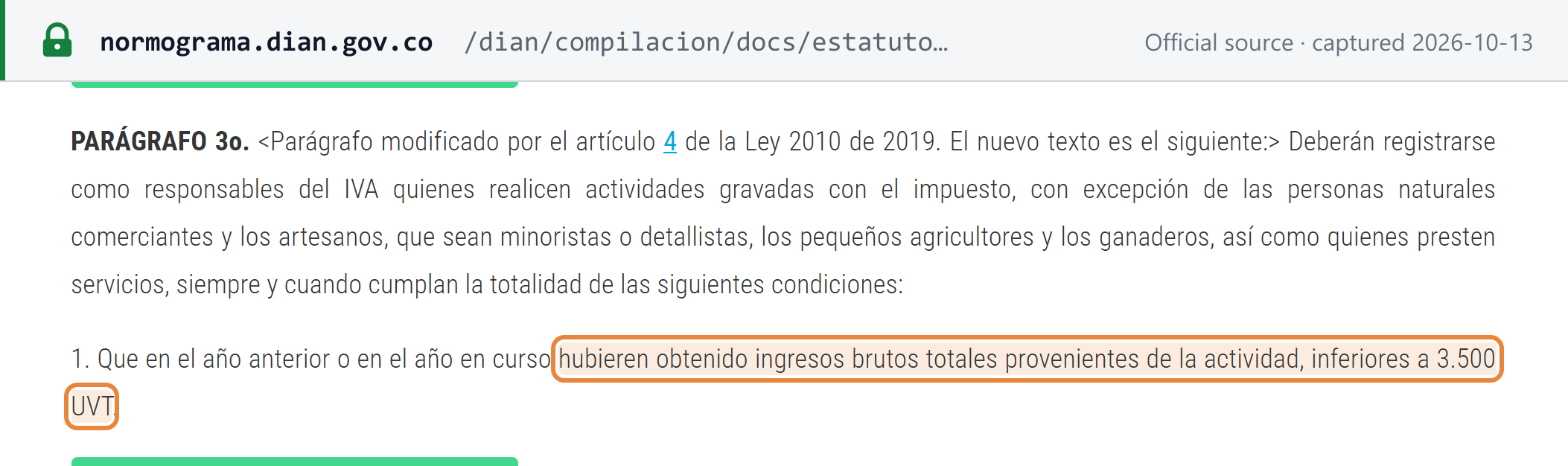
- Natural persons in the listed categories stay outside IVA only if they meet all six conditions: [2]
- gross income from the activity below 3,500 UVT (COP 183,309,000 at the 2026 UVT) in the prior year or the current year;
- no more than one establishment;
- no franchise or other intangible-exploitation arrangement;
- not a customs user;
- no single taxable contract of 3,500 UVT or more in the prior or current year;
- bank deposits and similar from taxable activities not above 3,500 UVT.
- State contractors. For natural-person service providers whose income comes from contracts with the State, the limits are 4,000 UVT (COP 209,496,000 at the 2026 UVT) (par. 5).
- Measurement. Gross income from the activity — not only taxable supplies — in the prior or current calendar year. A person about to sign a single contract above 3,500 UVT must register before signing it.
- Régimen Simple. Natural persons in the SIMPLE regime with gross income below 3,500 UVT are not IVA-responsable (par. 4).
Non-resident registration
Non-residents have no threshold. What a foreign seller must do depends on who the customer is:
- Selling to Colombian IVA-responsables (B2B): no registration — the customer withholds the IVA (see Foreign companies selling into Colombia).
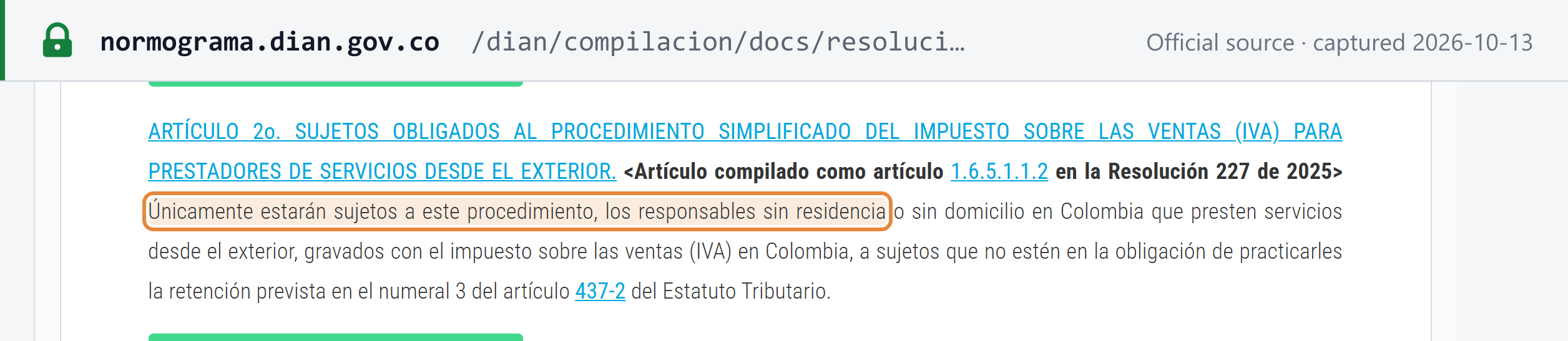
- Selling services to consumers and other customers not obliged to withhold (B2C): register in the RUT as an IVA responsable under the simplified procedure for providers of services from abroad. Res. 000051/2018 art. 2 (now Res. 000227/2025 art. 1.6.5.1.1.2): "Únicamente estarán sujetos a este procedimiento, los responsables sin residencia o sin domicilio en Colombia que presten servicios desde el exterior, gravados con el impuesto sobre las ventas (IVA) en Colombia, a sujetos que no estén en la obligación de practicarles la retención". The RUT responsibility code is 46 – "IVA prestadores de servicios desde el exterior". [5]
Registered foreign providers file bimonthly on a DIAN form available in Spanish and English; ET art. 437 par. 2 lets the return liquidate the tax in US dollars converted to pesos at the official exchange rate (TRM) of the day of filing and payment. [2] The registration request goes through DIAN's "PQSR y Denuncias" channel. [5]
Tax identification number
"El Número de Identificación Tributaria, NIT, constituye el código de identificación de los inscritos en el RUT" (ET art. 555-2). [4] A company NIT has up to 9 digits followed by a check digit (dígito de verificación, DV) — DIAN's own NIT, printed on its website, is 800.197.268-4. For filing deadlines the DV is ignored (see Return due date).
The format, the check-digit calculation and how to verify a NIT are on the Colombia tax ID guide. To check a number, use the Colombia NIT validator.
How to register
Registration in the RUT (Registro Único Tributario) "deberá cumplirse en forma previa al inicio de la actividad económica" — before the business starts — at DIAN, a chamber of commerce or another authorised entity, and it can be done electronically. [4] The documents depend on the type of registrant and are listed in Decreto Único Reglamentario 1625 de 2016 (DUR) art. 1.6.1.2.11 — for a legal entity, for example, its certificate of existence and legal representation and the legal representative's ID. [13]
DIAN's RUT pages do not publish a processing time. Start at DIAN's RUT registration and update page.
Voluntary registration
There is no stand-alone voluntary-registration article, but the effect exists: a person outside the regime who adds IVA to its prices must then comply in full with the obligations of a responsable (ET art. 437, first parágrafo). [2]
Deregistration
"Los responsables del impuesto solo podrán solicitar su retiro del régimen cuando demuestren que en el año fiscal anterior se cumplieron, las condiciones establecidas en la presente disposición" (ET art. 437 par. 3) — a natural person can leave only after showing it met all six conditions in the previous fiscal year. [2] Cancelling the RUT itself follows DUR art. 1.6.1.2.18; [13] foreign digital providers cancel under Res. 000051/2018 art. 7. [5]
Group registration
Not available. The ET has no IVA grouping provision; consortia and temporary unions being responsables in their own right is not grouping. For how grouping works elsewhere, see VAT grouping explained.
Rates
| Rate | Applies to |
|---|---|
| 19% | General rate, since 2017 (ET art. 468 as amended by Ley 1819 de 2016) |
| 5% | Listed goods (ET art. 468-1) and services (ET art. 468-3) |
| 0% — exento | Exempt goods and services with the right to credit and refund (ET arts. 477, 478, 481) |
| Excluido | Outside IVA: no IVA is charged and input IVA cannot be credited (ET arts. 424, 476) |
Standard rate. "La tarifa general del impuesto sobre las ventas es del diecinueve por ciento (19%) salvo las excepciones contempladas en este título" (ET art. 468). From tax year 2017, one point of the collection is earmarked for health and education. [6]

Reduced rate of 5%.
- Goods (art. 468-1), listed by tariff heading — for example coffee (09.01), wheat (10.01), industrial maize and rice, soy beans and crude vegetable oils. [7]
- Services (art. 468-3) — for example storage of agricultural products in bonded warehouses, agricultural insurance and prepaid medicine and complementary health plans. Surveillance, cleaning and temporary-staffing services are at 5% only when supplied by entities supervised by the Superintendencia de Economía Solidaria whose sole purpose is those services, and the services are performed by persons with disabilities. The 5% rate for air tickets in the same article applied only until 31 December 2022. [8]
Exento is not excluido. Colombia has no separately named "zero rate"; instead it splits two categories, and the vocabulary runs the opposite way to EU VAT:
- Exento (exempt) = taxed at 0% with input-IVA credit and refund. Art. 477: "Están exentos del impuesto sobre las ventas, con derecho a compensación y devolución, los siguientes bienes". This is what EU VAT calls zero-rated. [9]
- Excluido (excluded) = the supply "no causa el impuesto" and no input-IVA credit arises (art. 424, read with art. 488). This is what EU VAT calls exempt. [10]

Examples of each are under Exemptions.
Announced future rates. None enacted as of 13 October 2026.
Cross-border rules
Imports and exports
- Imports of tangible goods are taxed unless expressly excluded. The base is the customs-duty base plus the customs duties themselves (ET art. 459). [15] The import declaration supports the input-IVA claim (DUR art. 1.6.1.4.12 par. 2). [13]
- Low-value imports. Postal and express imports valued up to USD 200 are excluded from IVA only where a free-trade agreement expressly obliges Colombia not to charge it (ET art. 428 lit. j). It is not a general de minimis. [16]
- Exports of goods are exempt with the right to refund (ET art. 481 lit. a). Services rendered in Colombia and used exclusively abroad by parties with no business in Colombia are exempt, subject to the regulatory requirements (art. 481 lit. c). [17]
- Earthquake zone. Until 31 December 2027, imports of indispensable raw materials, inputs and capital goods for qualified investment projects in the affected municipalities are exempt (Decreto Legislativo 1413 de 2026, art. 9, see Recent changes). [46]
Place of supply
- Services and intangibles from abroad are taxed in Colombia when the direct user or recipient has its tax residence, domicile, permanent establishment or seat of economic activity in Colombia (ET art. 420 par. 3). [1]
- Services related to real estate are taxed where the property is located; cultural and artistic services, and loading and storage services, where they are physically performed (art. 420 par. 2). [1]
- Goods are taxed on sale in Colombia and on import (art. 420 lits. a and d).

Reverse charge on services from non-residents
Colombia applies the reverse charge as withholding. A Colombian IVA responsable that contracts taxable services from a person without residence or domicile in Colombia is a withholding agent (ET art. 437-2 num. 3), and "la retención será equivalente al ciento por ciento (100%) del valor del impuesto" (art. 437-1 par. 1). [11] [12] The customer can credit that IVA only if the withholding was actually made (DUR art. 1.6.1.4.12 par. 1), [13] and it supports the purchase with a documento soporte. See reverse charge explained.

Domestic IVA withholding also exists: State entities, grandes contribuyentes, card issuers and buyers from SIMPLE taxpayers withhold up to 50% of the IVA — 15% where no special rate has been set — and declare it monthly. [11] See VAT withholding regimes.
Digital products and services
Electronic and digital services supplied from abroad to Colombian recipients are taxable services under the place-of-supply rule above — for example audiovisual content, platform services, online advertising, distance learning and the supply of intangibles. Instead of registering, a provider that supplies only such services, and has not opted into bimonthly filing, may opt into a withholding scheme: card issuers, prepaid-card sellers and cash collectors withhold the IVA when they pay the provider, and DIAN lists the covered providers by resolution (ET art. 437-2 par. 3). [12] A foreign provider without tax residence in Colombia does not have to issue an invoice for electronic or digital services (ET art. 437 par. 2). [2] See VAT on digital services by non-resident suppliers.
Significant economic presence (PES) is an income-tax rule, not IVA. Since 1 January 2024 non-residents with PES — deliberate and systematic interaction with the Colombian market and gross income of 31,300 UVT or more (COP 1,639,306,200 at the 2026 UVT) from Colombian customers — are liable to income tax (ET art. 20-3). It does not change IVA registration. [14]
Foreign companies selling into Colombia — B2B and B2C
- Selling to businesses (B2B). When the Colombian customer is an IVA responsable, the foreign seller does not register: the customer withholds 100% of the IVA, pays it to DIAN and issues a documento soporte. [11]
- Selling to consumers (B2C) — and to any customer not obliged to withhold. The foreign seller of taxable services registers in the RUT (code 46), charges IVA and files bimonthly by the 10th business day of the following month, with no threshold. A digital-only provider can opt into card-issuer withholding instead. [5] [13]
- Goods. IVA on goods shipped to Colombia is collected at import (see Imports and exports).
Marketplace / platform deemed-supplier liability
Not applicable. Colombia has no deemed-supplier rule for marketplaces; it collects IVA on foreign digital services through the card-issuer withholding scheme above. The closest platform rule is ET art. 616-1: "Las plataformas de comercio electrónico deberán poner a disposición un servicio que permita la expedición y entrega de la factura electrónica de venta por parte de sus usuarios al consumidor final" — platforms must offer their users a way to issue e-invoices, not issue them as the seller. [18] See marketplace deemed-supplier rules for the comparison with other countries.
Invoice requirements
Every e-invoice is cleared by DIAN before it exists. "Todas las facturas electrónicas de venta para su reconocimiento tributario deben ser validadas previo a su expedición" by DIAN, and an invoice "solo se entenderá expedida cuando sea validada y entregada al adquirente" (ET art. 616-1). [18] Everything below follows from that clearance model (see also E-invoicing status).

Mandatory content
Res. 000227/2025 art. 1.5.1.2.2.1 (formerly Res. 000165/2023 art. 11) lists 18 requirements for the factura electrónica de venta: [19] [20]
| No. | Field |
|---|---|
| 1 | The title "factura electrónica de venta" |
| 2 | Seller's name and NIT |
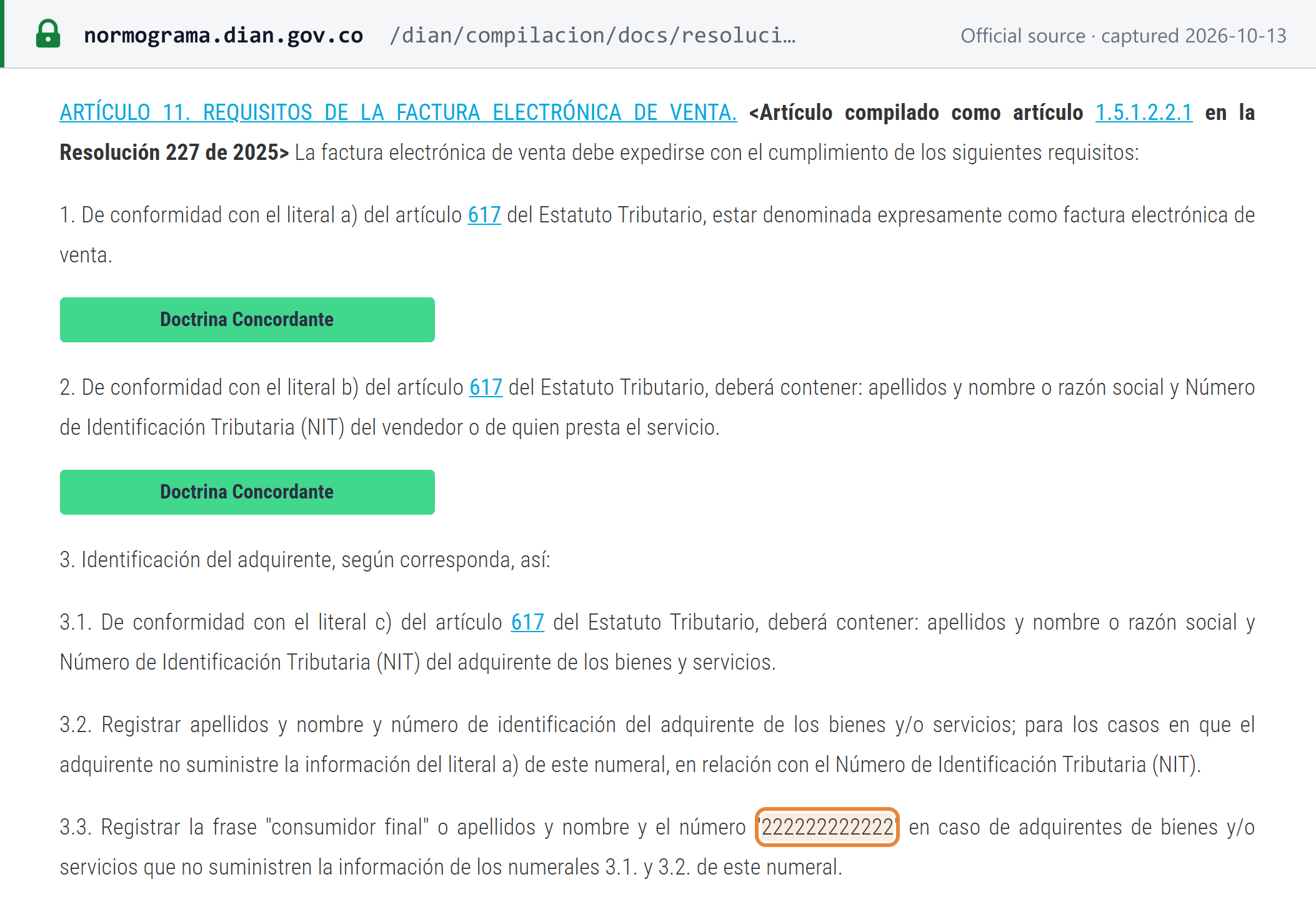
| 3 | Buyer's name and NIT; without a NIT, name and ID number; if the buyer gives no data, "consumidor final" with the number 222222222222; for off-premises sales to unidentified buyers, the delivery address |
| 4 | Consecutive number with a prefix of up to 4 alphanumeric characters, and the date and validity of DIAN's numbering authorisation |
| 5 | Date and time of generation |
| 6 | Date and time of issue (the validation time) |
| 7 | Delivery in the generation format, with DIAN's validation document ("Documento validado por la Dian") in the electronic container |
| 8 | Line items: quantity, unit, description and unambiguous codes |
| 9 | Total value |
| 10 | Payment form: cash or credit, and the term if on credit |
| 11 | Payment means (for cash sales) |
| 12 | Status where it applies: IVA withholding agent, income-tax self-withholder, gran contribuyente, SIMPLE taxpayer |
| 13 | Breakdown, with rates, of IVA, the national consumption tax (INC), the plastic-bag tax, the "impuestos saludables" and any other tax the law requires |
| 14 | Digital signature |
| 15 | The CUFE (Código Único de Factura Electrónica) |
| 16 | DIAN's URL, in the QR code |
| 17 | The content of the technical annex |
| 18 | Name and NIT of the software maker, the software name, and the technology provider |
The CUFE "corresponde a un valor alfanumérico obtenido a partir de la aplicación de un procedimiento que utiliza los datos de la factura electrónica de venta" — a code derived from the invoice data by the procedure in the technical annex (Res. 000227/2025 art. 1.5.1.5.2.2, formerly Res. 000165/2023 art. 30). [19] The statutory base is the shorter list in ET art. 617. [21]
Buyer data. When a buyer asks for an invoice in its own name, the seller may ask only for its name or business name, ID type and number, and email (Res. 000165/2023 art. 69 as modified by Res. 000202 of 31 March 2025). [22]
Issuance deadline
At the time of each sale. Issuance "comprende su generación, transmisión, validación y entrega ... por todas y cada una de las operaciones de venta y/o prestación de servicios al momento de efectuarse estas" (Res. 000227/2025 art. 1.5.1.1.3.1, formerly Res. 000165/2023 art. 5). [19] There is no after-the-fact transmission window for an ordinary e-invoice; the 48-hour windows apply only in contingencies (see E-invoicing status).
Numbering and sequencing
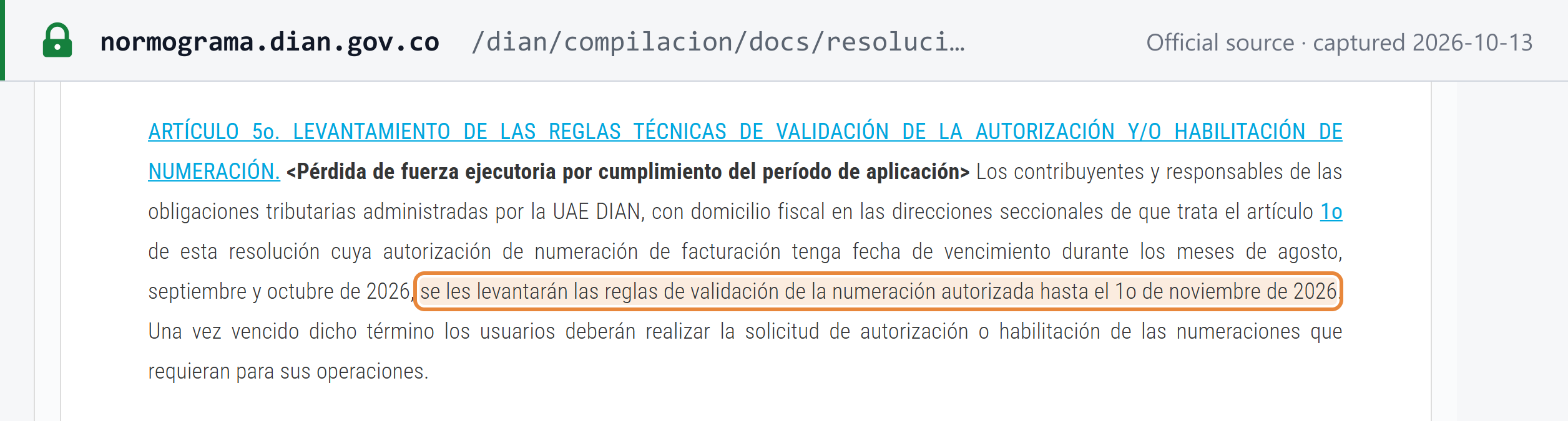
Invoices carry "un número que corresponda a un sistema de numeración consecutiva de facturas de venta" (ET art. 617 lit. d). [21] DIAN authorises each range, its prefix and its validity through its numbering service (Res. 000165/2023 arts. 42–50, now in Res. 000227/2025). A number that was consumed but failed validation is voided (inhabilitado) and its trace kept. [19] Until 1 November 2026, numbering-validation rules are lifted for taxpayers in nine disaster-affected cities whose authorisations expired in August to October 2026 (DIAN Res. 012017/2026 art. 5, see Recent changes). [48]
Credit and debit notes
A credit or debit note derived from an e-invoice must be titled as such, carry an internal consecutive number, quote "el prefijo, el número, el Código Único de Factura Electrónica (CUFE) de las facturas electrónicas de venta a la cual hace referencia" plus the CUFE generation date, and carry its own CUDE (Código Único de Documento Electrónico) and the QR URL (Res. 000227/2025 art. 1.5.1.5.6.1, formerly Res. 000165/2023 art. 36). [19]
Currency and language
"Se debe utilizar el idioma español y el peso colombiano en la generación de los documentos que hacen parte del sistema de facturación" — Spanish and Colombian pesos are mandatory, and a value in another currency or a second language may be added (Res. 000227/2025 art. 1.5.1.11.4, formerly Res. 000165/2023 art. 66). [19] The invoicing resolutions do not set an exchange rate or date for converting a foreign-currency amount to pesos.
Document types
- Factura electrónica de venta — the default document, for B2B, B2G and B2C.
- Documentos equivalentes electrónicos — electronic equivalent documents, such as the POS register ticket, public-utility bills, passenger transport and air tickets, gaming tickets, tolls, and show and cinema tickets. The electronic POS ticket rolled out on 1 May 2024 (grandes contribuyentes), 1 June 2024 (other income-tax filers) and 1 July 2024 (everyone else); the other equivalent documents followed between September and November 2024 (Res. 000165/2023 art. 23 as amended, now in Res. 000227/2025). [19]
- Traditional POS ticket limits. It can be issued only "siempre que la venta ... no supere cinco (5) UVT" (COP 261,870 at the 2026 UVT), excluding taxes; it does not support input IVA or income-tax deductions; and the buyer can always demand an invoice (ET art. 616-1 par. 2). [18] In the recitals of Res. 000165/2023, DIAN states that the electronic POS document can be issued for any amount and supports input IVA when the buyer is fully identified by name and ID number.
- Documento soporte — see Self-billing.
- Nómina electrónica — the electronic payroll support document (see E-invoicing status).
Self-billing
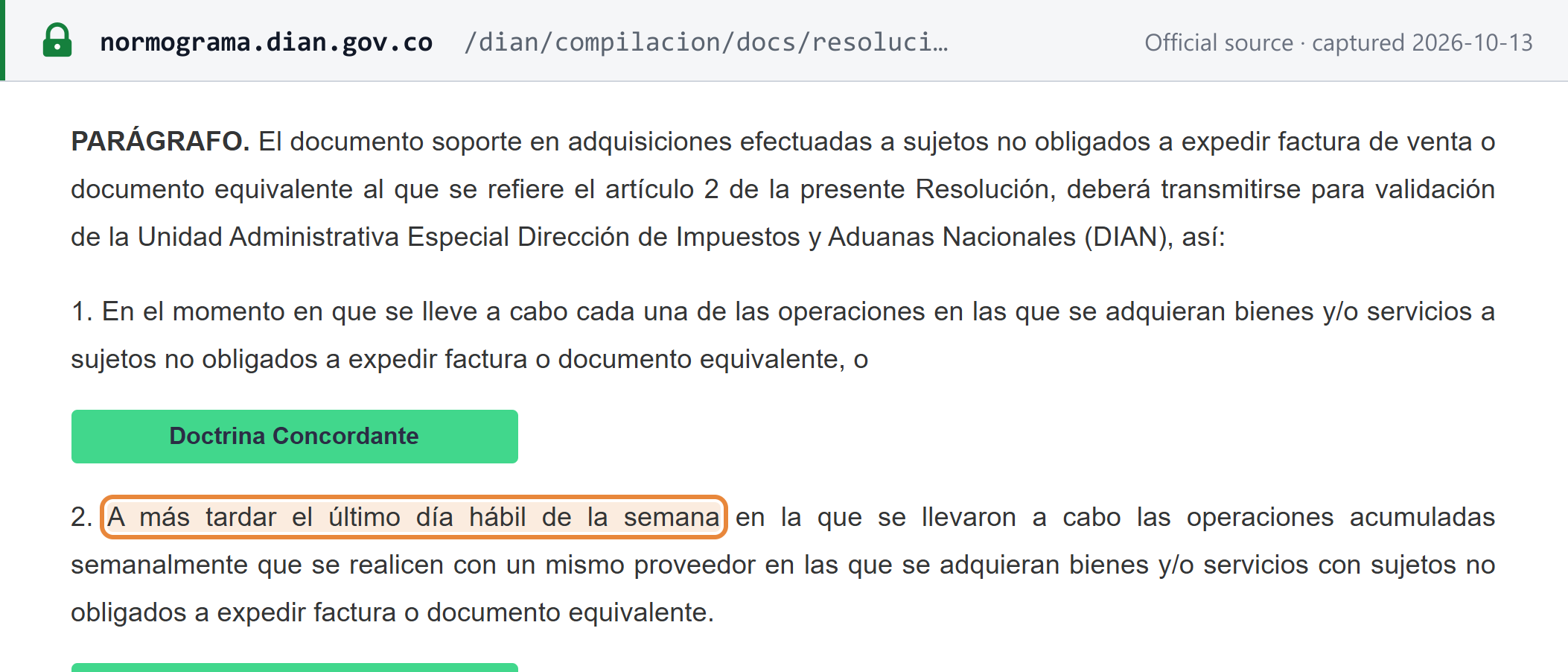
When a business buys from someone not obliged to invoice — including non-residents — and wants to claim the cost or the input IVA, it generates an electronic documento soporte en adquisiciones efectuadas a sujetos no obligados a facturar and transmits it to DIAN for validation. It must be transmitted at the time of each operation or, for purchases accumulated weekly with the same supplier, "a más tardar el último día hábil de la semana" (Res. 000227/2025 art. 1.5.2.3.4, formerly Res. 000167/2021 art. 10). [23] A non-resident without a RUT is identified by its home-country tax ID in place of a NIT (DUR art. 1.6.1.4.12 num. 3). [13] See DIAN's documento soporte guidance.
Retention and audit trail
- Retention: at least 5 years. Books, supporting documents, withholding evidence and returns must be kept "por un período mínimo de cinco (5) años, contados a partir del 1o. de enero del año siguiente al de su elaboración, expedición o recibo"; where accounts are computerised, the storage media and programs must also be kept (ET art. 632). [24]
- Electronic archiving. The XML validated by DIAN is the legal invoice, so electronic storage is the norm; electronic supporting documents must stay accessible and intact (Res. 000167/2021 art. 21, applying Ley 527 de 1999 arts. 12–13). [23]
- Audit trail. Prior validation, the CUFE and DIAN's authorised numbering ranges make each invoice traceable; numbers that fail validation are voided with their trace kept. ET art. 617 requires "los medios necesarios para su verificación y auditoría", [21] and sales-suppression software is punished with closure (ET art. 657 num. 2, see Penalties).
A specimen of a compliant invoice
DIAN does not publish an annotated specimen invoice. Below, Lookuptax lays out the 18 required fields for a domestic B2B sale with two IVA rates. Every name, number and amount is fictional:
Factura electrónica de venta
| Codenum. 8 | Descriptionnum. 8 | Qty / unitnum. 8 | Unit price (COP) | Amount (COP) | IVA ratenum. 13 |
|---|---|---|---|---|---|
| SPEC-001 | Office chair | 10 units | 200,000 | 2,000,000 | 19% |
| SPEC-002 | Roasted coffee, 500 g | 20 units | 25,000 | 500,000 | 5% |
- Subtotal
- COP 2,500,000
- IVA 19% on COP 2,000,000num. 13
- COP 380,000
- IVA 5% on COP 500,000num. 13
- COP 25,000
- Totalnum. 9
- COP 2,905,000
- CUFE: CUFE-SPECIMEN-PLACEHOLDER (num. 15). QR code carrying DIAN's validation URL (num. 16).
- Digital signature of the seller (num. 14), and the technical-annex content (num. 17), sit in the XML.
- Delivered to the buyer in the electronic container with DIAN's 'Documento validado por la Dian' (num. 7).
- Payment means is required for cash sales (num. 11); this specimen is a credit sale.
- Software: SPECIMEN-ERP by Ejemplo Software S.A.S. (NIT-SPECIMEN-C); technology provider NIT-SPECIMEN-D (num. 18).
- An address is required only as the delivery address for unidentified buyers in off-premises sales (num. 3); the addresses above are optional.
- Title "factura electrónica de venta" (num. 1). For an anonymous consumer, the buyer block reads "consumidor final", 222222222222 (num. 3).
E-invoicing status
Status (as at 2026-10-13): mandatory, clearance with prior validation. Colombia's system is DIAN's Sistema de Facturación Electrónica with validación previa: DIAN validates each invoice before it is issued (ET art. 616-1). [18] See CTC e-invoicing models.
- Format. XML, under the technical annex adopted by Res. 000165/2023 ("Versión 1.9 del Anexo Técnico de Factura Electrónica de Venta"). The annex issued with Res. 000042/2020 rejects a document whose version field does not equal "UBL 2.1". [19] [25]
- Who sends. The issuer, through DIAN-authorised technology providers or DIAN's free invoicing service.
- Phases. Issuance became mandatory in phases, first for subjects selected by DIAN, then for everyone under the calendar in Res. 000042/2020 art. 20, which ran from 15 June 2020 to 1 November 2020. [25] That calendar was repealed by Res. 000165/2023 art. 70. Taxpayers registering in the Régimen SIMPLE have two months to start issuing e-invoices (Res. 000227/2025 art. 1.5.1.2.1.1; DUR art. 1.6.1.4.28). [20] [13] The electronic equivalent documents followed in 2024 (see Document types).
- Scope. B2B, B2G and B2C are all covered — the buyer rules include "consumidor final".
- Contingency. If the issuer's own systems fail, it issues paper invoices and then transmits them as e-invoices "tipo 3" "dentro de las 48 horas siguientes al momento en que se supera el inconveniente" (Res. 000227/2025 art. 1.5.1.5.7.1, formerly Res. 000165/2023 art. 37). [19] If DIAN's systems fail, the invoice may be issued without prior validation and transmitted within 48 hours after the outage ends (ET art. 616-1). [18]
- RADIAN. E-invoices that are negotiable instruments (títulos valor) are registered in RADIAN; "Hasta tanto no se realice el registro de las operaciones en el RADIAN, no se hará efectiva la correspondiente cesión de derechos" (ET art. 616-1 par. 3). A buyer on credit must send electronic receipt confirmations before the invoice supports its costs and input IVA (Res. 000085/2022). [26]
- Electronic payroll. Payroll payments are supported by the documento soporte de pago de nómina electrónica, transmitted within the first 10 days of the month after the payment (Res. 000227/2025 art. 1.5.3.4.1.1, formerly Res. 000013/2021). [27]
For Colombia alongside other countries, see the e-invoicing status and networks table and the Peru and Chile e-invoicing guides.
Filing and payment
Filing frequency
| Frequency | Periods | Who |
|---|---|---|
| Bimonthly | Jan–Feb, Mar–Apr, May–Jun, Jul–Aug, Sep–Oct, Nov–Dec | Grandes contribuyentes; anyone whose gross income at 31 December of the prior year was 92,000 UVT or more; responsables under arts. 477 and 481 (producers of exempt goods, exporters) |
| Four-monthly (cuatrimestral) | Jan–Apr, May–Aug, Sep–Dec | Everyone with prior-year gross income below 92,000 UVT |
| Bimonthly | As above | Foreign providers of services from abroad (Res. 000051/2018 art. 14; DUR art. 1.6.1.13.2.30 par. 4) |
Sources: ET art. 600 for the first two rows; [28] Res. 000051/2018 and the DUR for foreign providers. [5] [13] The 92,000 UVT test uses prior-year income at the prior-year UVT, so the threshold is best read in UVT (at the 2026 UVT it would be COP 4,818,408,000). No return is due for a period with no taxable or creditable operations (ET art. 601). [49]

Return due date
Filing and payment are due on the same day, set by the last digit of the NIT, without the check digit: "sin tener en cuenta el dígito de verificación" (DUR arts. 1.6.1.13.2.30 and 1.6.1.13.2.31, as substituted by Decreto 2229 de 2023 for 2024 onwards). [13]
| Last NIT digit | 1 | 2 | 3 | 4 | 5 | 6 | 7 | 8 | 9 | 0 |
|---|---|---|---|---|---|---|---|---|---|---|
| Business day of the month after the period | 7th | 8th | 9th | 10th | 11th | 12th | 13th | 14th | 15th | 16th |
Foreign providers of services from abroad file and pay by the 10th business day of the month after each bimonthly period, whatever the NIT digit (DUR art. 1.6.1.13.2.30 par. 4). [13]
Upcoming 2026 dates (DIAN 2026 tax calendar): [29]
| Return | Due dates (NIT last digit 1 → 0) |
|---|---|
| Bimonthly, Sep–Oct 2026 | 11, 12, 13, 17, 18, 19, 20, 23, 24, 25 November 2026 |
| Bimonthly, Nov–Dec 2026, and four-monthly, Sep–Dec 2026 | 13, 14, 15, 18, 19, 20, 21, 22, 25, 26 January 2027 |
| Foreign service providers, Sep–Oct 2026 | 17 November 2026 (any digit) |
| Foreign service providers, Nov–Dec 2026 | 18 January 2027 (any digit) |
Payment due date and method
Same day as the return. Returns are filed and paid through DIAN's online services at dian.gov.co. Foreign providers' returns are liquidated in US dollars converted at the TRM of the day of filing and payment (ET art. 437 par. 2). [2]
Additional listings
- IVA withholding returns. Withholding agents declare and pay withheld IVA monthly (DUR art. 1.6.1.13.2.34). [13]
- Exogenous information (información exógena) — annual third-party information reporting, sanctioned under ET art. 651. [43]
- Régimen Simple taxpayers file an annual consolidated IVA return (DUR art. 1.6.1.13.2.51). [13]
Input-tax recovery and blocked items
- What is creditable. Only IVA on purchases and imports that count as a cost or expense for income tax and are used in IVA-taxable operations (ET art. 488). [30] IVA on inputs used for excluido supplies is therefore not creditable.
- Fixed assets — blocked. "El impuesto sobre las ventas por la adquisición o importación de activos fijos no otorgará descuento", except under the art. 485-2 regime for heavy-industry capital goods (ET art. 491). [31]
- Paperwork. The purchase needs a factura electrónica, an equivalent document that supports deductions, or a documento soporte; for credit purchases, the electronic receipt confirmations must also have been sent. IVA withheld on services from non-residents is creditable only once the withholding has been made.
Refunds
- Who can claim a refund. Exporters and other art. 481 responsables, producers of exempt goods under art. 477, responsables whose IVA has been withheld ("aquellos que hayan sido objeto de retención"), and suppliers taxed at 5% under arts. 468-1 and 468-3 (on the rate differential, after filing the income-tax return) (ET art. 850 par. 1). Other responsables carry a credit balance forward. [32]
- Timing. Processing times are set in ET art. 855.
- Non-residents. The Estatuto Tributario has no refund scheme for non-resident businesses.
Exemptions
Exempt (exento) and excluded (excluido) supplies
Exento — 0% with credit and refund (ET arts. 477, 478, 481): [9] [17]
- live cattle, and beef, pork, chicken and eggs (art. 477);
- exported goods and qualifying exported services; tourism services to non-residents; sales of inputs to industrial users of free trade zones; home internet for socio-economic strata 1 and 2 (art. 481);
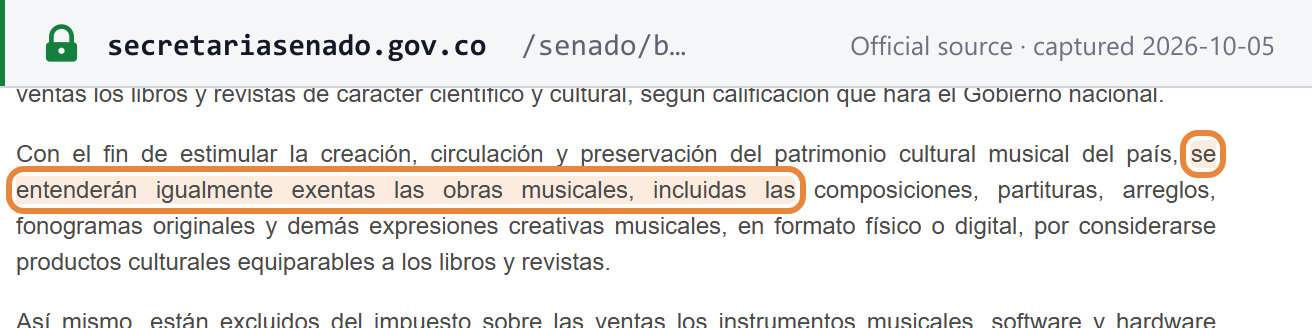
- scientific and cultural books and magazines and, since Ley 2615 de 2026, musical works — compositions, scores, arrangements and original phonograms, physical or digital (art. 478). [34]
Excluido — outside IVA, no credit (ET arts. 424, 476): [10] [33]
- "Los servicios médicos, odontológicos, hospitalarios, clínicos y de laboratorio, para la salud humana" (art. 476 num. 1);
- education by recognised institutions;
- public passenger transport;
- public utilities — energy, water, gas;
- home internet for stratum 3;
- the goods listed in art. 424.
Exento is not excluido. An exento supplier charges 0%, credits the IVA it paid on inputs and can claim a refund. An excluido supplier charges nothing and cannot credit input IVA, because art. 488 allows credits only for inputs used in taxable operations — the IVA it pays becomes a cost. [30] If you are used to EU VAT, exento behaves like zero-rating and excluido behaves like an exemption.
Special regimes
- Régimen Simple de Tributación (SIMPLE). SIMPLE taxpayers that only run shops and minimarkets (art. 908 num. 1), and SIMPLE natural persons below 3,500 UVT, are not IVA-responsable; buyers withhold IVA from SIMPLE suppliers (ET arts. 437 par. 4 and 437-2 num. 9). [2] [12]
- Free trade zones. Sales of inputs from the national customs territory to industrial users of a zona franca are exempt (ET art. 481 lit. e). [17]
- Earthquake zone. Import exemption until 31 December 2027 for qualified projects (Decreto Legislativo 1413 de 2026, see Recent changes).
- Music sector. Instruments, specialised software and hardware and phonogram-licensing intermediation owned by non-mass artists (subject to Government qualification), and luthier inputs for makers registered in Simus, are excluded (ET art. 478 as rewritten by Ley 2615 de 2026). [47]
Offences and penalties
Offences
- Not paying over collected IVA (Código Penal art. 402). "En la misma sanción incurrirá el responsable del impuesto sobre las ventas ... que, teniendo la obligación legal de hacerlo, no consigne las sumas recaudadas por dicho concepto, dentro de los dos (2) meses siguiente a la fecha fijada" for filing and payment. The penalty is "prisión de cuarenta (48) [sic] a ciento ocho (108) meses y multa equivalente al doble de lo no consignado sin que supere el equivalente a 1.020.000 UVT". Paying in full, with interest, ends the proceedings. [35]

- Tax fraud or evasion (Código Penal art. 434B). Omitting income, claiming fictitious costs or claiming improper credits for 100 to 2,500 monthly minimum wages (SMMLV) is punished with 36 to 60 months in prison, rising by a third above 2,500 SMMLV and by half above 5,000 SMMLV. [36]
- Administrative offences punished by closure: not invoicing, double invoicing or sales-suppression software, IVA returns or payments more than 3 months late, and not registering in the RUT before starting business (see below).
Penalties
COP figures are conversions at the 2026 UVT of COP 52,374.
| Penalty | Amount |
|---|---|
| Minimum penalty | 10 UVT (COP 523,740), including reduced penalties; interest and some RUT penalties are carved out (ET art. 639) [37] |
| Late filing | 5% of the tax due for each month or part month late, capped at 100% of the tax; with no tax due, 0.5% of gross income per month, capped at the lowest of 5% of income, twice the credit balance or 2,500 UVT (COP 130,935,000) (ET art. 641) [38] |
| Not filing | For IVA, 10% of the bank deposits or gross income for the period, or of the gross income on the last IVA return, whichever is higher (ET art. 643 num. 2) [39] |
| Late-payment interest | Charged daily at the consumer-credit usury rate certified by the Superintendencia Financiera, minus 2 points (ET arts. 634–635). DIAN publishes the rate for each period. [40] |

| Penalty | Amount |
|---|---|
| Invoice missing its title, the printer's NIT or the withholding-agent status (ET art. 617 lits. a, h, i) | 1% of the operations invoiced, capped at 950 UVT (COP 49,755,300); a repeat offence leads to closure (ET art. 652) [41] |
| Not invoicing, or an invoice missing ET art. 617 lits. b–g | Closure for 3 days — the premises are sealed "CERRADO POR LA DIAN" — or, instead, a fine of 5% of the previous month's operating income (ET arts. 652-1 and 657 num. 1 and par. 6) [42] |

| Penalty | Amount |
|---|---|
| Sales suppression or double invoicing; not adopting required technical controls | Closure for 3 days, or a fine of 10% of the previous month's operating income (ET art. 657 nums. 2 and 5) [42] |
| IVA returns or payments more than 3 months late | Closure for 3 days, or a fine of 15% of the previous month's operating income (ET art. 657 num. 4) [42] |
| Invoicing documents not transmitted properly | Up to 7,500 UVT (COP 392,805,000): 1% of amounts not reported, 0.7% of amounts reported wrongly, 0.5% of amounts reported late (ET art. 616-1, applying art. 651) [43] |
| Late RUT registration | Closure for 1 day per month of delay, or 1 UVT (COP 52,374) per day without premises; not updating the RUT, 1 UVT per day (2 UVT for address or activity changes); false RUT data, 100 UVT (COP 5,237,400) (ET art. 658-3) [44] |
Breaking the seals doubles the closure. Self-assessed penalties are reduced to 50% with no repeat offence in the previous 2 years, or to 75% with none in the previous year, if DIAN has not yet issued charges (ET art. 640). [45]
Frequently asked questions
I sell software as a service from abroad to Colombian companies and consumers. Do I need to register for IVA?
It depends on the customer. For sales to Colombian businesses that are IVA-responsable, no: the customer withholds 100% of the IVA and supports the purchase with a documento soporte. For sales to consumers and other customers who are not obliged to withhold, yes: you register in the RUT with responsibility code 46, file bimonthly by the 10th business day of the following month, and no threshold applies. A provider that supplies only electronic or digital services can instead opt into the card-issuer withholding scheme. You do not have to issue a Colombian e-invoice for digital services.
Is there an IVA registration threshold in Colombia?
Not for companies. Only certain natural persons, such as retailers, craft workers, small farmers and individual service providers, can stay outside IVA, and only if they meet all of six conditions, including gross income from the activity below 3,500 UVT in the prior or current year (COP 183,309,000 at the 2026 UVT of COP 52,374).
When is a Colombian IVA return due?
Returns are bimonthly if your gross income at 31 December of the prior year was at least 92,000 UVT, or if you are a gran contribuyente or an exporter or producer of exempt goods; otherwise they are four-monthly. Filing and payment are due on the same day, between the 7th and the 16th business day of the month after the period, depending on the last digit of your NIT without the check digit. For example, the September to October 2026 return is due between 11 and 25 November 2026.
Can I deduct the IVA shown on a POS ticket?
Not on a traditional POS register ticket, which can only be issued for sales up to 5 UVT and does not support input IVA. DIAN states that the electronic POS equivalent document does support input IVA when it identifies the buyer by name and ID number. If in doubt, ask for a factura electrónica de venta: a buyer can always demand one.
What happens if I do not issue an e-invoice in Colombia?
DIAN can close the premises for 3 days, or the business can instead pay a fine of 5% of the previous month's operating income. An invoice that lacks its title, the printer's NIT or the withholding-agent status costs 1% of the operations invoiced, capped at 950 UVT. Failing to transmit invoicing documents properly can cost up to 7,500 UVT.
What is the difference between exento and excluido in Colombian IVA?
An exento supply is taxed at 0%, and the supplier keeps its right to credit the IVA paid on inputs and can ask for a refund. An excluido supply is outside IVA altogether, and the IVA paid on inputs cannot be credited. This is the reverse of how many readers use the word exempt in EU VAT.
Important websites
| Site | Purpose |
|---|---|
| DIAN — RUT registration and update | Register in the RUT and obtain a NIT |
| DIAN — Consulta Estado RUT | Look up the RUT status of a NIT |
| Colombia NIT validator | Check the format and check digit of a NIT |
| DIAN | Online services for filing and paying returns |
| DIAN 2026 tax calendar (PDF) | Every 2026 due date by NIT digit |
| DIAN — Sistema de Facturación Electrónica | E-invoicing system, enablement and technical annexes |
| DIAN — Facturación gratuita | DIAN's free invoicing service |
| DIAN — Consulta de documentos electrónicos | Look up an e-invoice by its CUFE |
| DIAN — Documento soporte | Guidance on the documento soporte for purchases from non-invoicers |
| DIAN — E-invoicing rules | Current e-invoicing resolutions |
| DIAN Normograma | DIAN's compilation of tax law and resolutions |
| Estatuto Tributario (Senado) | Consolidated text of the ET |
Recent changes
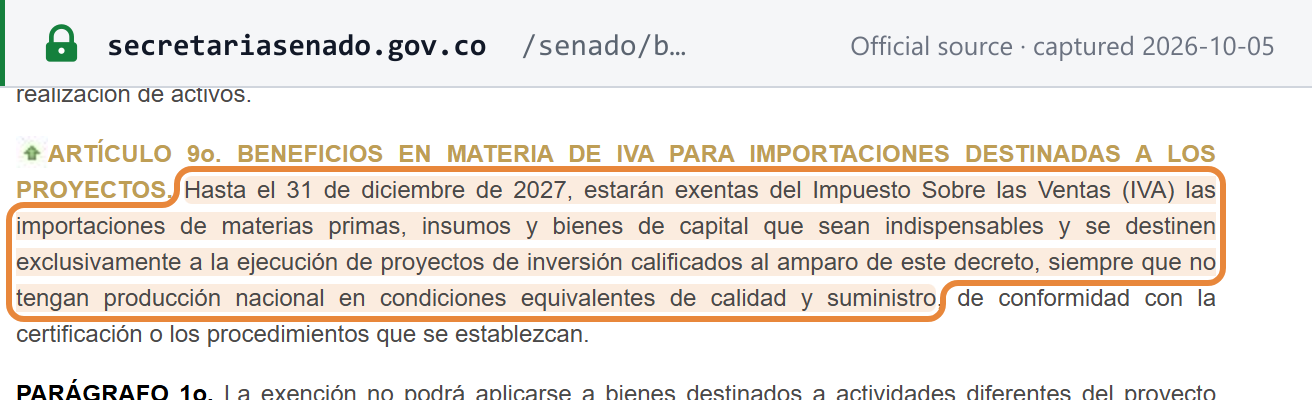
- 2026-09-17 — Decreto Legislativo 1413 de 2026, art. 9: until 31 December 2027, imports of indispensable raw materials, inputs and capital goods for qualified investment projects in the earthquake-affected municipalities, with no equivalent national production, are exempt from IVA. [46] — see the event record
- 2026-08-13 — DIAN Res. 012017 de 2026: for taxpayers in DIAN offices in nine cities (Pereira, Armenia, Manizales, Tuluá, Palmira, Popayán, Quibdó, Buenaventura and Cali) whose invoice-numbering authorisation expired in August, September or October 2026, "se les levantarán las reglas de validación de la numeración autorizada hasta el 1o de noviembre de 2026". The relief is automatic. [48]
- 2026-07-29 — Ley 2615 de 2026, art. 16, rewrote ET art. 478: musical works are exento, and certain music-sector instruments, software, hardware and luthier inputs are excluido. (Senado) — see the event record
- 2025-12-15 — DIAN Res. 000238 de 2025 sets the 2026 UVT at COP 52,374. (DIAN Normograma)
- 2025-09-23 — DIAN Res. 000227 de 2025, the Resolución Única, compiles and replaces DIAN's tax resolutions, including Res. 000165/2023 (e-invoicing), 000167/2021 (documento soporte), 000013/2021 (electronic payroll) and 000051/2018 (foreign providers). (DIAN Normograma)
- 2025-03-31 — DIAN Res. 000202 de 2025: a seller may ask a buyer who wants an invoice in its name only for its name, ID type and number, and email. (DIAN Normograma)
For the full chronology, see Colombia tax changes on Lookuptax.
Reference links
- Estatuto Tributario art. 420 — taxable events and place of supply (Senado)
- Estatuto Tributario art. 437 — responsables, registration conditions, foreign providers (Senado)
- DIAN Res. 000238 de 2025 — UVT for 2026 (Normograma)
- Estatuto Tributario art. 555-2 — RUT and NIT (Senado)
- DIAN Res. 000051 de 2018 — foreign providers of services from abroad (Normograma)
- Estatuto Tributario art. 468 — general rate (Senado)
- Estatuto Tributario art. 468-1 — goods at 5% (Senado)
- Estatuto Tributario art. 468-3 — services at 5% (Senado)
- Estatuto Tributario art. 477 — exempt goods (Senado)
- Estatuto Tributario art. 424 — excluded goods (Senado)
- Estatuto Tributario art. 437-1 — IVA withholding rates (Senado)
- Estatuto Tributario art. 437-2 — IVA withholding agents (Senado)
- Decreto Único Reglamentario 1625 de 2016 (DIAN Normograma)
- Estatuto Tributario art. 20-3 — significant economic presence (Senado)
- Estatuto Tributario art. 459 — taxable base for imports (Senado)
- Estatuto Tributario art. 428 — import exclusions (Senado)
- Estatuto Tributario art. 481 — exempt with refund (Senado)
- Estatuto Tributario art. 616-1 — invoicing system and prior validation (Senado)
- DIAN Res. 000165 de 2023 — electronic invoicing system (Normograma)
- DIAN Res. 000227 de 2025 — Resolución Única en Materia Tributaria, Aduanera y Cambiaria (Normograma)
- Estatuto Tributario art. 617 — invoice requirements (Senado)
- DIAN Res. 000202 de 2025 — buyer data (Normograma)
- DIAN Res. 000167 de 2021 — documento soporte (Normograma)
- Estatuto Tributario art. 632 — record retention (Senado)
- DIAN Res. 000042 de 2020 — e-invoicing calendar (DIAN, PDF)
- DIAN Res. 000085 de 2022 — RADIAN (Normograma)
- DIAN Res. 000013 de 2021 — electronic payroll (Normograma)
- Estatuto Tributario art. 600 — IVA periods (Senado)
- DIAN — Calendario Tributario 2026 (PDF)
- Estatuto Tributario art. 488 — creditable IVA (Senado)
- Estatuto Tributario art. 491 — fixed assets (Senado)
- Estatuto Tributario art. 850 — refunds (Senado)
- Estatuto Tributario art. 476 — excluded services (Senado)
- Estatuto Tributario art. 478 — books, magazines and musical works (Senado)
- Código Penal art. 402 (Senado)
- Código Penal art. 434B (Senado)
- Estatuto Tributario art. 639 — minimum penalty (Senado)
- Estatuto Tributario art. 641 — late filing (Senado)
- Estatuto Tributario art. 643 — not filing (Senado)
- Estatuto Tributario art. 635 — late-payment interest (Senado)
- Estatuto Tributario art. 652 — invoices without requirements (Senado)
- Estatuto Tributario art. 657 — closure (Senado)
- Estatuto Tributario art. 651 — information penalties (Senado)
- Estatuto Tributario art. 658-3 — RUT penalties (Senado)
- Estatuto Tributario art. 640 — penalty reductions (Senado)
- Decreto Legislativo 1413 de 2026 (Senado)
- Ley 2615 de 2026 (Senado)
- DIAN Res. 012017 de 2026 — numbering relief (Normograma)
- Estatuto Tributario art. 601 — no return without operations (Senado)
Related on Lookuptax:
- Colombia tax ID guide (NIT)
- Colombia NIT validator
- VAT registration thresholds worldwide
- Worldwide tax rates
- E-invoicing status and networks worldwide
- CTC e-invoicing models: clearance, reporting and interchange
- VAT withholding regimes
- Marketplace deemed-supplier rules
- VAT on digital services by non-resident suppliers
- Fiscal devices and certified cash registers