Republic of the Congo (Congo-Brazzaville) VAT guidelines
| FACTSHEET | |
|---|---|
| Country code | CG |
| Tax name | Value Added Tax — Taxe sur la Valeur Ajoutée (TVA) |
| Tax Authority | Direction Générale des Impôts et des Domaines (DGID) |
Overview
Not to be confused with the Democratic Republic of the Congo (Congo-Kinshasa, country code CD, 16% VAT). This guide covers the Republic of the Congo (Congo-Brazzaville, CG). For the DRC, see the DR Congo VAT guide.
The Republic of the Congo levies Value Added Tax — Taxe sur la Valeur Ajoutée (TVA) — under Loi n° 12-97 du 12 mai 1997 instituting VAT, "telle que modifiée par les lois de finances subséquentes" (Arrêté 1520, visas). The VAT law sits outside the codified Code général des impôts (CGI): the 2026 finance law amends it under "Modifications des textes non codifiés". [1] [6]
The law was rewritten and renumbered by Loi n° 39-2023 du 29 décembre 2023 (finance law for 2024, "LF 2024"), which transposed the CEMAC VAT directive. This guide uses the article numbers of that rewrite, as reproduced in the DGID's Instruction n° 0339/MEF/DGID/DRC of 18 March 2024, and the later amendments in Loi n° 47-2024 (LF 2025) and Loi n° 42-2025 (LF 2026). [2] [3]
A note on sources. The Ministry of Finance's website also hosts a "Code général des impôts — Tome 1". Its VAT annex is amended only to 2002, and its article numbers, rates and return date no longer match the law. Do not rely on it. No current consolidated CGI is published online: the DGID's own portal (impots.gouv.cg) could not be reached and impots.cg showed a "site en construction" page (checked 22 October 2026). Where this guide could not confirm a rule in current text, it says so.
Authority. VAT is administered by the Direction Générale des Impôts et des Domaines (DGID), part of the Ministère des Finances, du Budget et du Portefeuille Public. The Ministry describes the DGID as "l'organe technique qui assiste le Ministre dans l'exercice de ses attributions en matière fiscale". Import VAT is assessed by customs (Direction Générale des Douanes et des Droits Indirects). [17]
Currency. The franc CFA (FCFA, ISO code XAF), shared across the CEMAC zone. The SFEC e-invoicing API accepts invoices in XAF or USD. [12]
Tax period. The calendar month (art. 35).
Layering. VAT is national, but centimes additionnels (CA) of 5% of the VAT amount are charged on top of it. They are collected by the tax administration "au profit des collectivités locales" and "ne donnent pas lieu à déduction" (art. 38 A). At the standard rate, VAT plus CA comes to 18.9% of the price excluding tax: 18% + (5% × 18%) = 18.9%. [3]
For neighbouring systems, see the DR Congo VAT guide and the Angola VAT guide.
Registration
Who should register
Companies are liable to VAT whatever their turnover; individuals only from FCFA 100,000,000. Article 5(1), as rewritten by LF 2024: "Les personnes morales de droit privé sont, de plein droit, assujetties à la TVA, quel que soit leur chiffre d'affaires annuel. Les personnes physiques sont assujetties à la TVA lorsque leur chiffre d'affaires hors taxes est supérieur ou égal à 100 000 000 de francs." [3]
The scope is wide. Article 4 makes liable anyone who carries out taxable operations habitually or occasionally, independently, as part of an economic activity for consideration, "quel que soit le secteur d'activité". The State, local authorities and public bodies are not taxable for what they do as a public authority, but they are for economic activities run in the same way as the private sector.
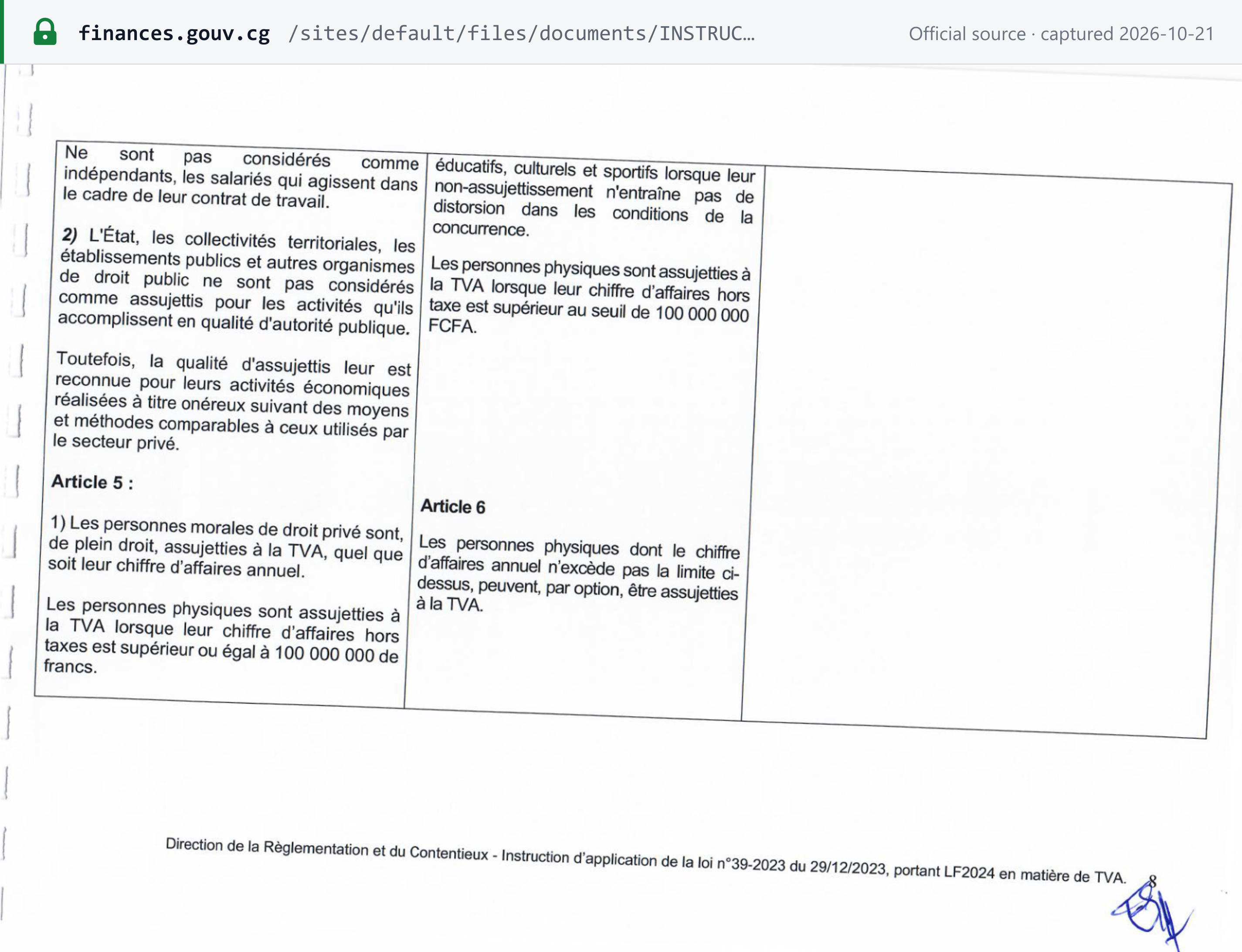 Source snapshot captured 2026-10-21 — original
Registration threshold
FCFA 100,000,000 of annual turnover excluding tax, for natural persons only (as at 22 October 2026). There is no threshold for companies.
- Test. Turnover "supérieur ou égal" to FCFA 100,000,000. LF 2024 changed the wording from "supérieur au seuil".
- Measurement period. The VAT law does not say. The CGI as printed in LF 2026 (art. 96) ties the forfait regime to the same "seuil d'assujettissement à la TVA" and ends it "dès le premier exercice qui suit celui au cours duquel les limites du chiffre d'affaires … sont dépassées": in practice, the financial year.
- Below the threshold. Individuals are taxed under the forfait regime (impôt global forfaitaire, IGF). LF 2026 defines the forfait seller as one whose "chiffre d'affaires maximum annuel … est inférieur à 100 millions de FCFA", and says its invoices carry no VAT or CA lines. [1]
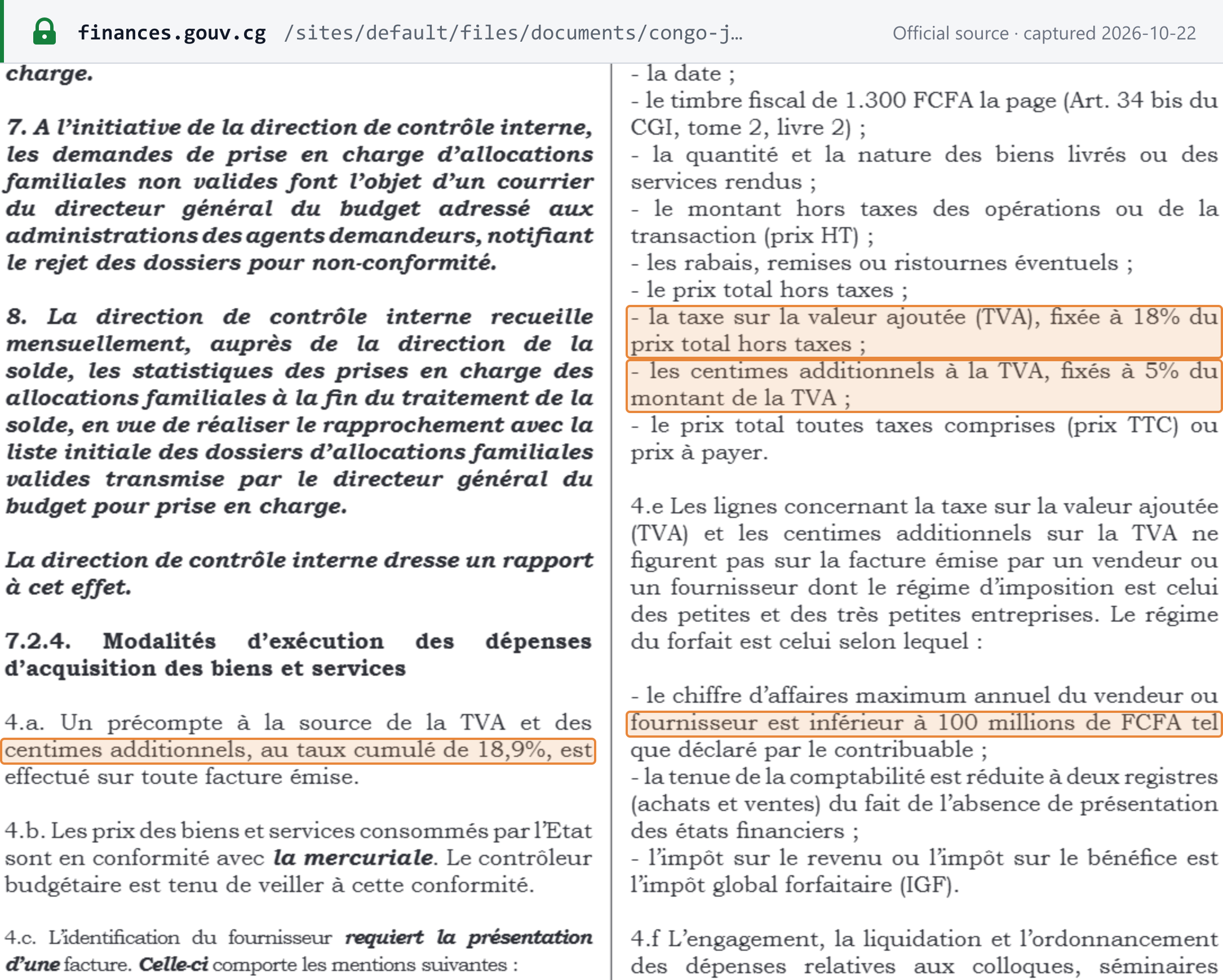 Source snapshot captured 2026-10-22 — original
Non-resident registration
The VAT law sets no separate threshold for non-residents. A non-resident liable to VAT must appoint "un représentant solvable accrédité, résident sur le territoire congolais", who must itself be VAT-registered and is jointly liable for the tax (art. 12(1)). If no representative is appointed, the VAT and any penalties "doivent être payées par la personne cliente" (art. 12(2)). Non-resident digital-service providers are the exception: they register and pay themselves through the ARPCE platform (art. 12(3)). See Foreign companies selling into the Republic of the Congo. [3]
Tax identification number
The identifier is the NIU — numéro d'identification unique, issued by the tax administration. "Un redevable ne peut se prévaloir de la qualité d'assujetti qu'après enregistrement et attribution d'un numéro d'identification unique (NIU)" (art. 30). Article 30 also requires the administration to publish NIUs online with each taxpayer's VAT status, name, address and tax office. We found no such public list (checked 22 October 2026). [3]
Format. No official format specification or check digit is published. The SFEC API documentation requires a buyer NIU of "16 ou 17 caractères" for business and government buyers. The NIUs printed in official documents we read are 16 or 17 characters long and begin with a letter. That is our observation, not an official rule. [12] Lookuptax has no Congo tax-ID page or validator yet; for official lookups elsewhere, see Check a VAT number.
How to register
- Form the business through the ACPCE. The Agence Congolaise pour la Création des Entreprises is the one-stop shop where founders make, "en un lieu unique et sur un même document", the declarations the law requires. [19] Its document lists for a company ask for the director's personal NIU, ID, proof of the registered office and the statutes. [16]
- Obtain the NIU. VAT status follows from registration and the NIU (art. 30).
- Activate E-TAX. Online filing is reached from www.impots.gouv.cg. Once the DGID activates the professional space, it emails a "numéro télé-déclarant" and a temporary password (E-TAX user guide v2.3, July 2026). [15]
- Enrol in the SFEC before invoicing. Enrolment asks for the NIU, RCCM number and date, legal form, tax residence, tax regime, sector, currency and capital, among other data. [10]
Registration deadline: not confirmed. LF 2024 dropped the VAT law's own déclaration d'existence article because the obligation now sits in CGI Tome 1 art. 399 quater. The current text of that article is not published online, so we cannot give the deadline or the penalty for registering late (checked 22 October 2026). Ask the DGID.
Voluntary registration
Available to individuals below FCFA 100,000,000. The CGI as printed in LF 2026 (art. 96(2)(a)) says a forfait taxpayer "qui optent pour assujettissement à la TVA" leaves the forfait regime at once and moves to the real regime for profits tax. Opting in lets a business deduct input VAT and issue VAT invoices its business customers can deduct. Companies have nothing to opt into: they are already liable. [1]
Deregistration
- Individuals. A real-regime taxpayer whose turnover falls below the threshold returns to the forfait "que lorsque leur chiffre d'affaires est resté inférieur à cette limite pendant deux exercices successifs" (CGI art. 96(3), LF 2026). [1]
- Companies cannot leave VAT by turnover, as they are liable of right.
- Ceasing business. Remaining VAT credits are refundable to businesses ceasing activity (art. 39(3)). SFEC users must also deactivate their invoicing system through their distributor (Arrêté 1519 art. 11). The CGI cessation-declaration deadlines are not published in current form.
Group registration
Not available, as far as the published texts show: the VAT law as rewritten by LF 2024 (all of Instruction 0339) and the LF 2025 and LF 2026 VAT amendments contain no grouping or consolidation provision (checked 22 October 2026).
Rates
| Rate | Applies to | Source |
|---|---|---|
| 18% (taux général) | Every taxable operation not at the reduced or zero rate | VAT law art. 22(2)(a) |
| + 5% of the VAT (centimes additionnels) | Charged on the VAT amount; 18.9% in total at the standard rate; not deductible | art. 38 A; LF 2026 |
| 5% (taux réduit) | Everyday goods in Annexe 5 (as replaced by LF 2026): milk and cream, tomatoes, rice, wheat flour, sugar, bread, pastry and biscuits, and salt under heading 25.01.00.11; gas-oil and lubricants imported from neighbouring countries by resident forestry companies; sales and acquisitions by developers and companies in special economic zones | art. 22(2)(c); LF 2025; LF 2026 |
| 0% (taux zéro) | Exports of taxable goods declared to and endorsed by customs; international transport and its accessories; local sales of sawn timber (bois débité) | art. 22(2)(b) |
Standard rate. 18%, the "taux général … applicable à toutes les opérations taxables à l'exclusion des opérations soumises aux taux réduit et zéro" (art. 22(2)(a)). It was already 18% in the 1997 law, and LF 2024 kept it. LF 2026, in its rules for State purchases, restates "la taxe sur la valeur ajoutée (TVA), fixée à 18% du prix total hors taxes" and "les centimes additionnels à la TVA, fixés à 5% du montant de la TVA". [1] [3]
18% or 18.9%? Both are official. 18% is the VAT rate. 18.9% is VAT plus the 5% centimes additionnels on that VAT, as a share of the price excluding tax. LF 2026 uses the combined figure for the withholding State buyers apply: "Un précompte à la source de la TVA et des centimes additionnels, au taux cumulé de 18,9%, est effectué sur toute facture émise". The centimes additionnels do not apply under the ARPCE regime for non-resident digital services, where the total is 18% (see below).
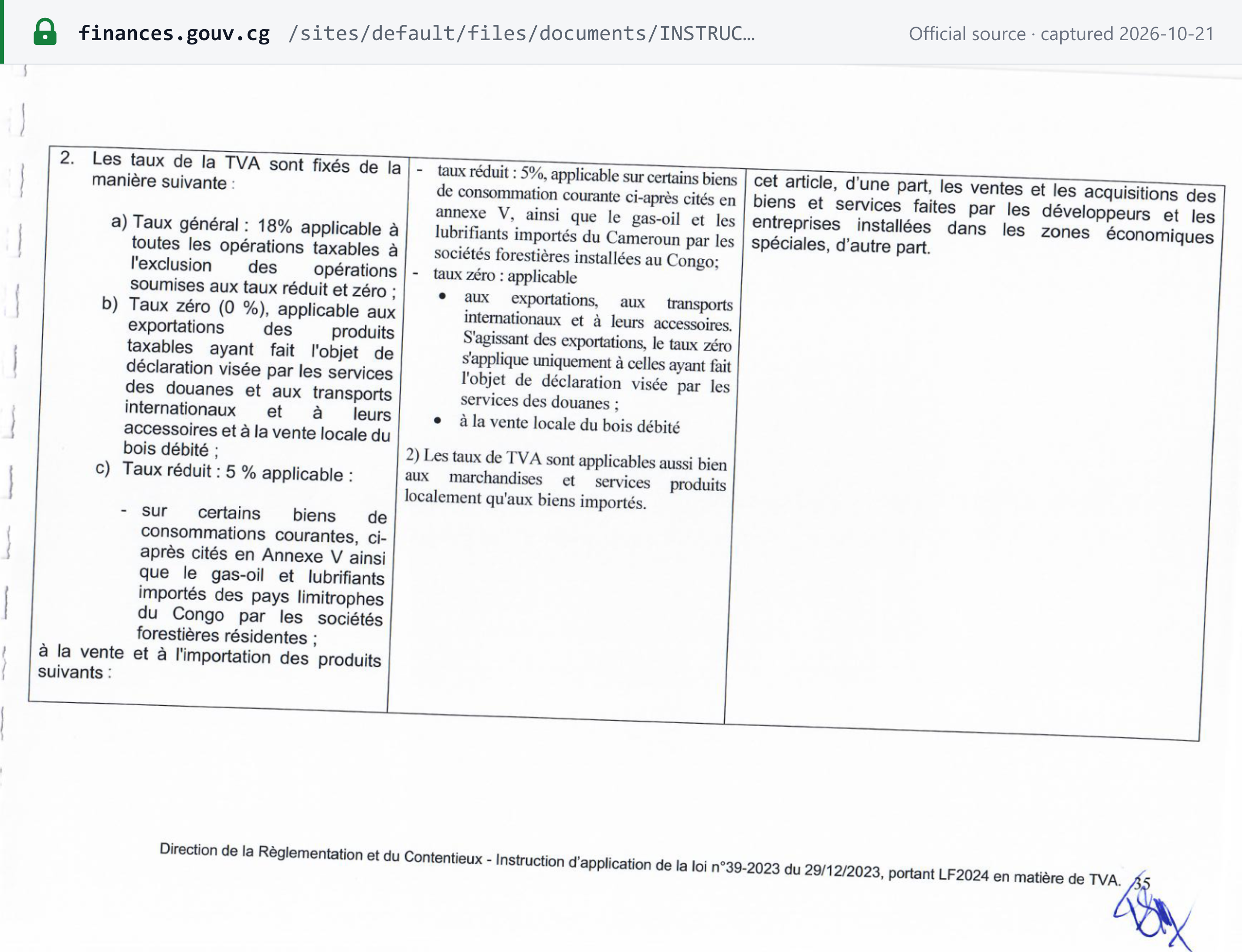 Source snapshot captured 2026-10-21 — original
The reduced-rate lists have moved twice since 2024. LF 2025 replaced the product table inside article 22 (milk and cream, bread and pastry, rice, wheat flour) and dropped the agricultural fertilisers and pesticides that LF 2024 had placed at 5%. LF 2026 replaced Annexe 5 and moved fertilisers, insecticides and pesticides to the exempt list in Annexe 3. So fertilisers and pesticides are exempt, not 5%; Instruction 0339 p. 36 still shows the superseded 2024 list. Salt is split by tariff heading: LF 2026 lists "Sel" under 25.01.00.11 at 5% in Annexe 5, and exempts "Sel" under 25.01.00.19 in Annexe 3 (JO spécial 3-2026 p. 78). Check the heading before you invoice salt. [1] [2]
Future rates. None announced: LF 2026 replaced the goods lists but not the rates (checked 22 October 2026). The SFEC invoice data model encodes the same two positive rates, "[T]" 18% and "[R]" 5%. [12]
For other countries' rates, see worldwide tax rates.
Cross-border rules
Imports and exports
- Imports. Import VAT "doit être obligatoirement déclarée et versée avant l'enlèvement de la marchandise" (art. 37), and is assessed by customs. It is not due on declarations under suspensive customs regimes or direct removal. To deduct it, the importer needs a customs declaration showing its NIU and the customs receipt for the VAT paid. Taxpayers making productive investments of more than FCFA 100,000,000 may defer import VAT on them to the filing date of the following month's return.
- De minimis. The VAT texts we read set none (checked 22 October 2026). We did not check the CEMAC customs code. We also could not confirm whether customs levies the 5% centimes additionnels on import VAT.
- Exports are zero-rated if declared to and endorsed by customs (art. 22(2)(b)). Exporters claiming a refund attach the customs references and proof that the funds were repatriated (art. 35(5)). Exporters making more than 80% of their sales abroad "sont autorisés à retenir la TVA qui leur est facturée" on their deductible purchases (art. 35(6)): they suspend VAT at source instead of building up a credit. [3]
Reverse charge on services from non-residents
The Republic of the Congo has no EU-style reverse charge. Article 12 combines a representative with a fallback on the customer: a non-resident liable to VAT appoints a VAT-registered representative resident in the Congo, jointly liable with it; failing that, the VAT and any penalties are paid "par la personne cliente pour le compte de la personne n'ayant pas dans l'Etat un établissement stable". Because intangible services "sont imposables dans le pays d'établissement du preneur" (art. 11(2)), most cross-border B2B services bought by a Congolese business land in the Congo, and in practice the customer accounts for the VAT. [3] See reverse charge explained for how this compares with other systems.
Digital products and services
Non-resident digital-service providers have their own regime, run with the telecoms regulator ARPCE. Services supplied in the Congo through foreign or local e-commerce platforms, and the platforms' commissions, are taxable in the Congo (art. 11(6)). Under art. 12(3), non-resident providers "sont responsables de la TVA y relative" and pay it on the basis of invoices built from data captured on the ARPCE platform. They must keep accurate records of the VAT they collect. [3]
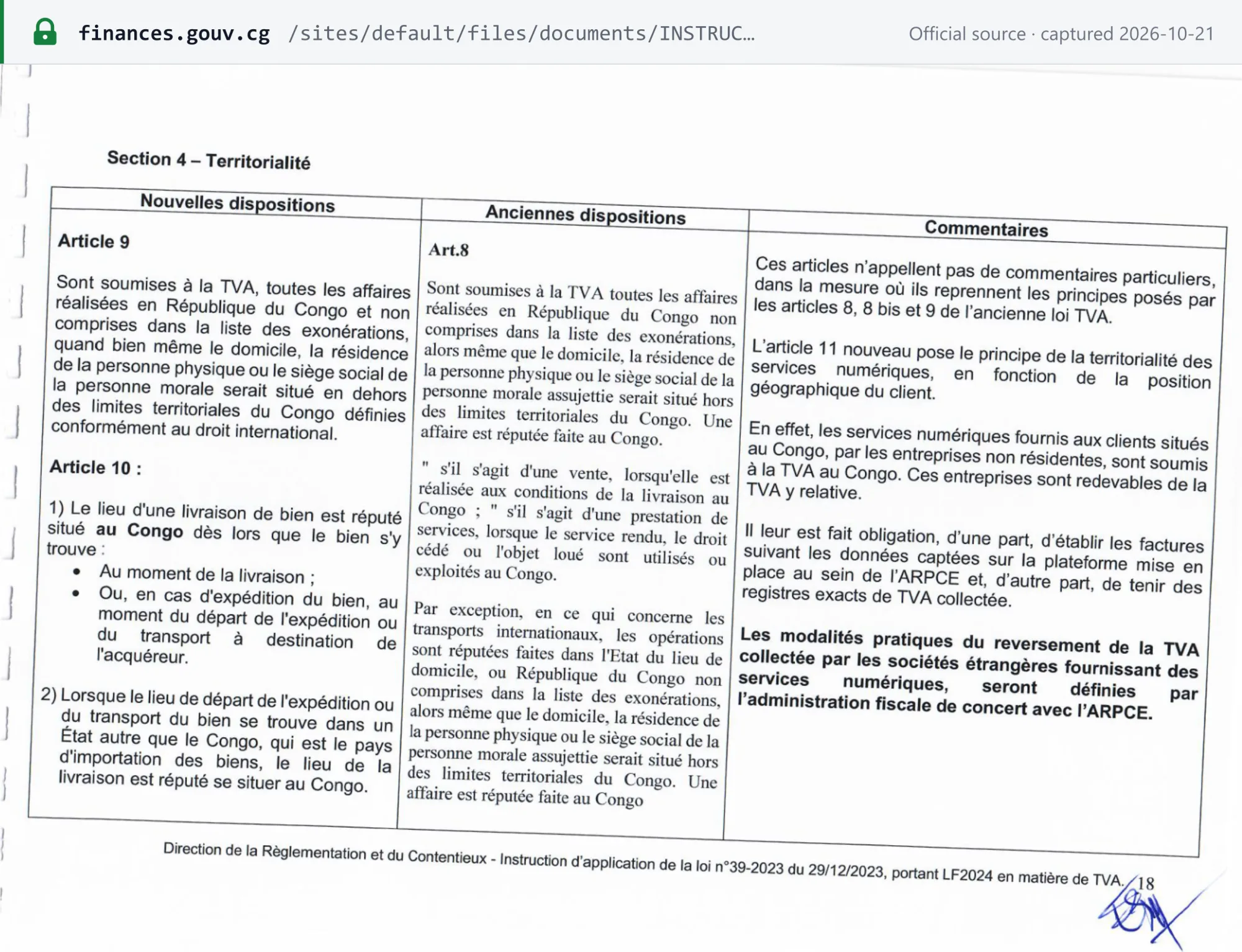 Source snapshot captured 2026-10-21 — original
ARPCE's FAQ for the portal (a PDF dated 29 September 2026, available from the portal's User Guides) sets out how it works:
- Scope. Digital services to customers in the Congo, both B2C and B2B, and transactions between platforms.
- Rate. "A single rate of 18% applies … No additional surtax applies under this regime": the 5% centimes additionnels are not added.
- Threshold. None. The obligation applies whatever the turnover.
- Representative. Not required. Registration on the portal gives a NIU for this regime and does not create a permanent establishment (ARPCE Explanatory Note N° 001/ARPCE-DG/26).
- Returns and payment. Quarterly, including nil quarters, by the 20th of the month after the quarter, paid by international bank transfer in EUR or USD.
- Start. Collection began on 1 July 2026, so the first return (Q3 2026) was due on 20 October 2026.
- Records. B2B invoices show the customer's identifier and Congolese tax number where it has one; records are kept for 10 years. [14]
 Source snapshot captured 2026-10-21 — original
See VAT on digital services by non-resident suppliers.
Foreign companies selling into the Republic of the Congo — B2B and B2C
The answer depends on what you sell more than on who your customer is.
- Digital services, B2B and B2C alike. The ARPCE regime: register on the portal, charge 18%, file quarterly. No threshold, no representative.
- Other services and goods, B2B. Appoint a VAT-registered representative in the Congo, or your Congolese business customer pays the VAT and any penalties for you (art. 12(2)).
- Other services and goods, B2C. Article 12 is the same, but the customer fallback only works where the customer can declare and pay, which a consumer generally cannot. Our reading is that a non-resident selling non-digital services to consumers needs a representative. We found no distance-selling regime for goods: goods enter through customs and bear import VAT at the border (art. 37).
- SFEC e-invoicing. "Toutes les transactions économiques réalisées sur le territoire congolais sont certifiées par le SFEC, à l'exception de celles impliquant un fournisseur étranger" (art. 34 bis, LF 2025). DGID communiqué 07-8, however, brings into the first phase all suppliers of UGE, UME and USTPG enterprises "sans distinction de taille ni de résidence fiscale"; no DGID text reconciles the two, so confirm your position with the SFEC team. [7] [2]
- Selling to the State. State buyers withhold VAT and centimes additionnels at the combined 18.9% on every supplier invoice (LF 2026, point 4.a). See VAT withholding regimes.
Marketplace / platform deemed-supplier liability
For digital platforms, the platform is liable for VAT on its own commissions. ARPCE: such gains are taxable when the platform operator, the seller or the buyer is in the Congo at the time of the transaction, and "the digital services platform is responsible for declaring and remitting the corresponding tax" (Explanatory Note §4.4, as reproduced in the ARPCE FAQ). [14] We found no rule making a marketplace the deemed supplier of physical goods sold by third-party sellers (checked the VAT law as rewritten by LF 2024, LF 2025, LF 2026 and the ARPCE texts, 22 October 2026). See marketplace deemed-supplier rules.
Place of supply
- Goods (art. 10). Supplied in the Congo if the goods are there at delivery; for shipped goods, if dispatch starts in the Congo. Imports from another State are deemed delivered in the Congo. Goods installed or assembled by the supplier are supplied where installed.
- Services performed physically (art. 11(1)): where performed. This covers hire of transport equipment, services linked to immovable property, cultural, sporting and educational services, work on movable goods, and intermediaries.
- Intangible services (art. 11(2)): where the customer is established. Among them: intellectual-property rights, advertising, consultancy, engineering, accounting and legal services, data processing, banking, financial and insurance services, staff provision, telecoms, broadcasting and electronically supplied services. Where the Congolese customer is not a taxable person, the place reverts to the supplier's State (art. 11(5)).
- Platform services (art. 11(6)): services supplied in the Congo through e-commerce platforms, and the platforms' commissions, are taxable in the Congo. [3]
Invoice requirements
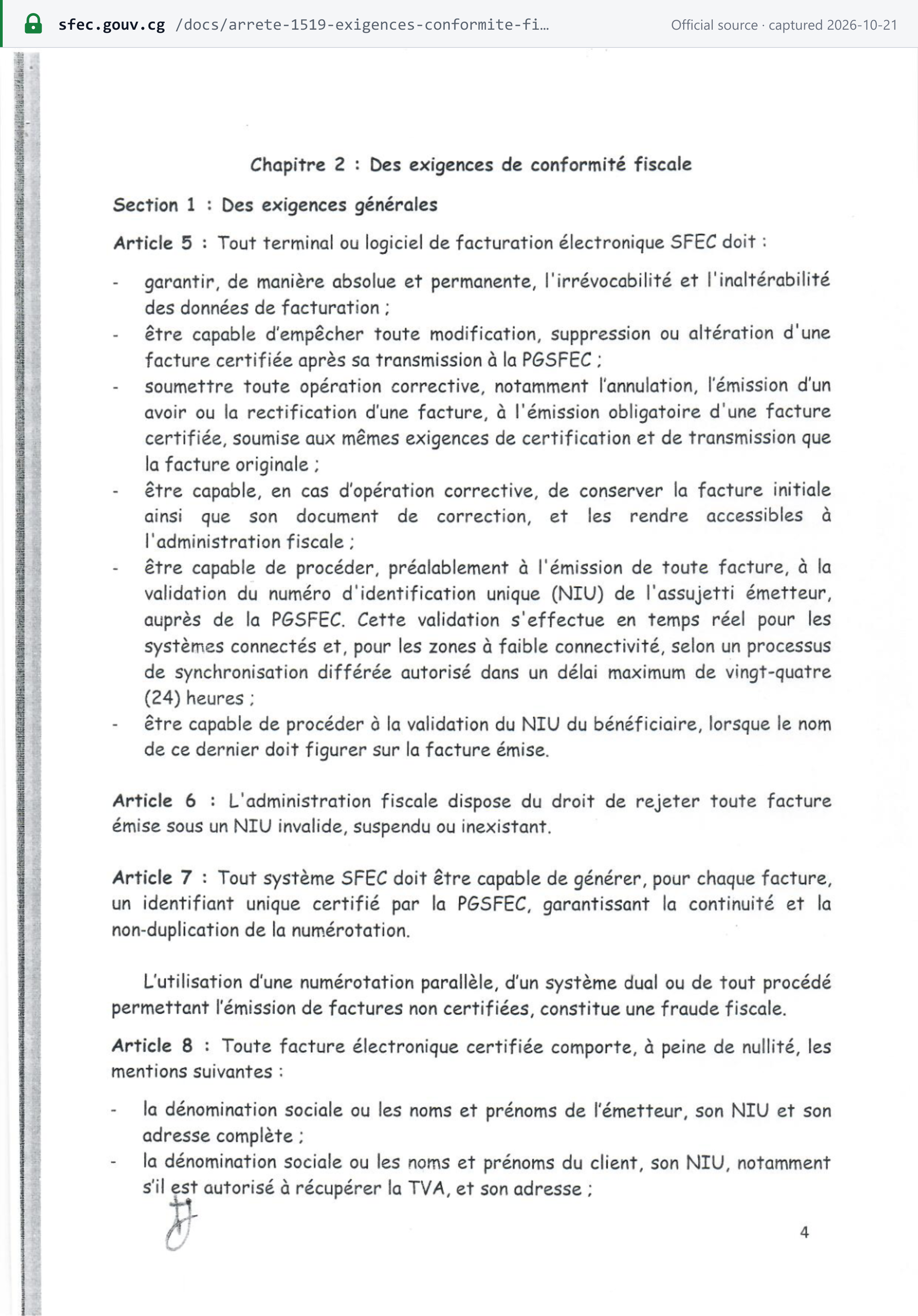
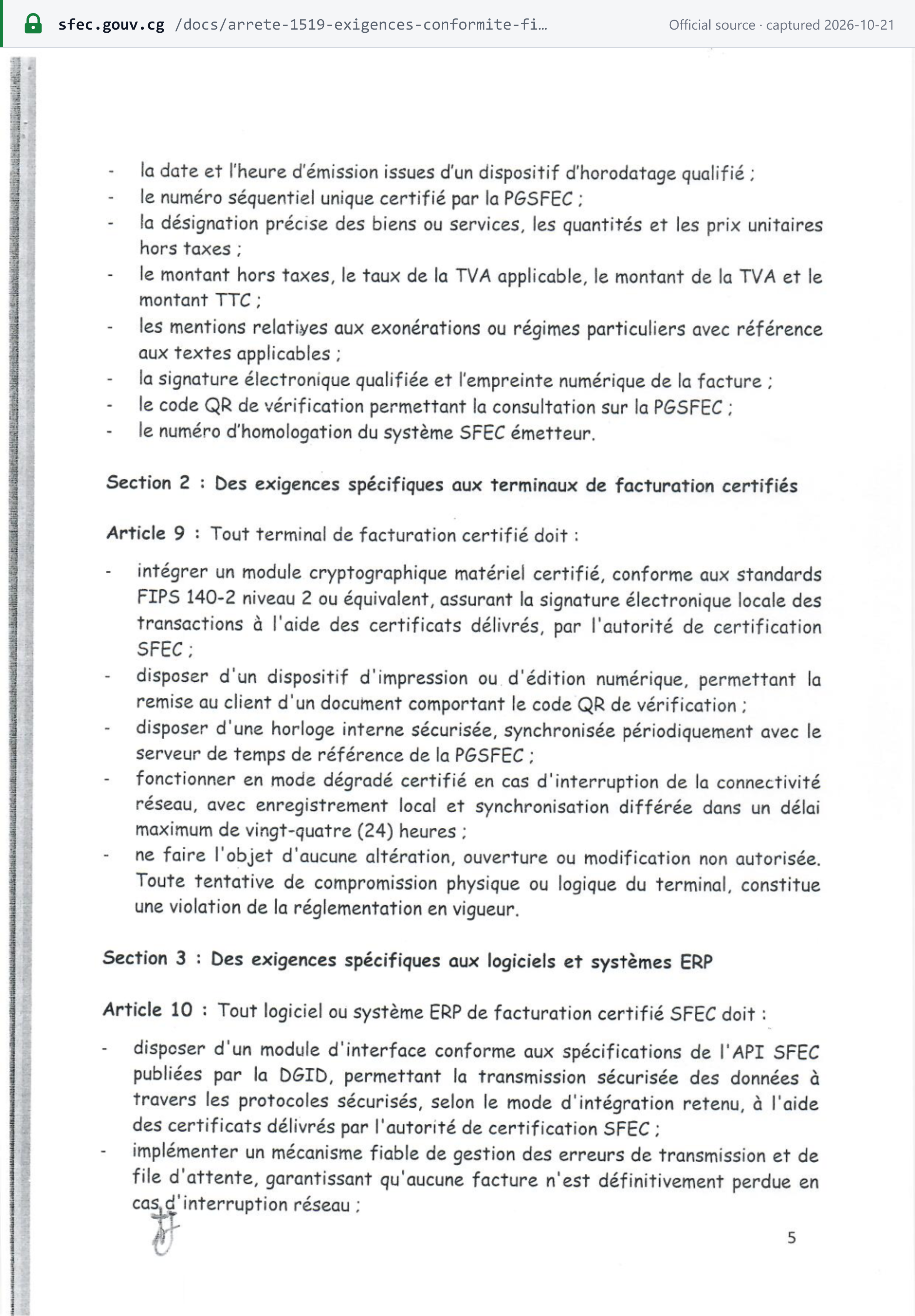
Two lists apply, and a compliant invoice carries both. The VAT law (art. 32, as rewritten by LF 2024) sets the base content. Since 1 August 2026, for businesses in the SFEC scope, every invoice must also be a certified electronic invoice issued through the SFEC. Arrêté n° 1519/MFBPP-CAB of 9 July 2026, art. 8, lists its particulars "à peine de nullité". Every taxable person must use the SFEC, and every customer, taxable or not, must demand a certified invoice for all its purchases (art. 34 bis, LF 2025). [2] [5]
Mandatory content
| # | Particular | VAT law art. 32(2) | Arrêté 1519 art. 8 |
|---|---|---|---|
| 1 | Invoice date and number, in a continuous series | ✓ | Date and time from a qualified time-stamping device; unique sequential number certified by the PGSFEC |
| 2 | Supplier: name, precise address, company name and NIU | ✓ | ✓ (full address) |
| 3 | Supplier's trade-register number (RCCM) or trades-register number | ✓ | — |
| 4 | Supplier's tax regime | ✓ | — |
| 5 | Customer: name, address and NIU | ✓ | ✓ — NIU "notamment s'il est autorisé à récupérer la TVA" |
| 6 | Description and quantity of goods or services | ✓ | ✓, with unit prices excluding tax |
| 7 | VAT rate, price excluding tax, VAT amount and total including tax | ✓ | ✓ |
| 8 | Exemption or special-regime wording, citing the applicable texts | — | ✓ |
| 9 | Bank details (références bancaires) | ✓ | — |
| 10 | The tax office the supplier reports to | ✓ | — |
| 11 | Qualified electronic signature and the invoice's digital fingerprint | — | ✓ |
| 12 | QR code for verification on the PGSFEC | — | ✓ |
| 13 | Homologation number of the issuing SFEC system | — | ✓ |
A partly exempt business shows, for each operation, the non-taxable amount and the taxable amount, rate and VAT (art. 32(3)). Forfait sellers issue invoices without VAT or centimes-additionnels lines (LF 2026, point 4.e); the SFEC FAQ says such an invoice "sera émise sans TVA et mentionnera le régime fiscal applicable". Invoices to State buyers. LF 2026 (point 4.d) lists what a real-regime supplier's invoice to the State must show. Along with the date, quantities, amounts, VAT and centimes additionnels, it must carry "le timbre fiscal de 1.300 FCFA la page" (CGI Tome 2 art. 34 bis). [1] [3] [10]
 Source snapshot captured 2026-10-21 — original
 Source snapshot captured 2026-10-21 — original
Issuance deadline
At each transaction. A certified invoice is generated for every transaction and handed to the customer even if not asked for (Décret n° 2026-101 art. 19; Arrêté 1519 art. 11). The VAT law requires an invoice for goods delivered, services rendered "ainsi que pour les acomptes perçus" (art. 32(1)), so advances are invoiced too. No day-count deadline for later issue is stated in the texts we read (checked 22 October 2026). [3] [4]
Numbering and sequencing
The VAT law asks for "une série continue" (art. 32(2)). Under the SFEC, every system must generate for each invoice "un identifiant unique certifié par la PGSFEC, garantissant la continuité et la non-duplication de la numérotation". "L'utilisation d'une numérotation parallèle, d'un système dual ou de tout procédé permettant l'émission de factures non certifiées, constitue une fraude fiscale" (Arrêté 1519 art. 7). [5]
Credit and debit notes
A certified invoice is never edited. Cancellation, a credit note (avoir) or a correction must itself be issued as a certified invoice "soumise aux mêmes exigences de certification et de transmission que la facture originale". The system keeps both the original and the correcting document for the tax administration (Arrêté 1519 art. 5). In the SFEC API, a credit note is an invoice of type "creditNote" that references the original sales invoice; the SFEC FAQ allows total and partial credit notes. [5] [12]
The VAT law's own correction rules (art. 29):
- Cancelled or rescinded sales. Send the customer a new invoice that cancels and replaces the original.
- Bad debts. Where the debt is "réellement et définitivement irrécouvrable", send a duplicate of the original invoice overprinted with the unpaid amount excluding VAT and the corresponding VAT, which the customer may not deduct. [3]
Currency and language
Statutory amounts are in FCFA; the SFEC accepts invoices in XAF or USD. The VAT law, Instruction 0339, Décret 2026-101, Arrêtés 1519 and 1520 and LF 2026 set no invoice language and no foreign-exchange conversion rule for foreign-currency invoices (checked 22 October 2026). All official texts and SFEC fields are in French.
Document types
- Certified invoice (facture électronique certifiée) — the only valid invoice for businesses in the SFEC scope. The SFEC certifies "factures et tickets de caisse", so a till receipt is a certified invoice with fewer customer details, not a separate document class. [13]
- Forfait-seller invoice — no VAT or centimes-additionnels lines; states the tax regime.
- Credit note (avoir) — itself certified (above).
- Pro forma — "n'est pas une facture définitive" and is not certified (SFEC FAQ).
We found no simplified invoice and no value threshold below which a lighter document is allowed.
Who is outside the SFEC (Décret 2026-101 art. 2, as summarised on the SFEC portal): the State and local authorities for their public-service missions; embassies, diplomatic missions and international organisations for transactions not taxable in the Congo. Transactions with a foreign supplier are also outside certification (art. 34 bis). [11]
Self-billing
Not provided for: the VAT texts we read contain no self-billing provision, and both art. 32 and art. 34 bis place the duty to issue on "le fournisseur des biens et services" (checked 22 October 2026).
Retention and audit trail
- Retention: 10 years. Accounting and supporting documents are kept "pendant un délai de dix ans après l'année au cours de laquelle les opérations ont été constatées", plus any years for which a VAT credit was carried forward and not used (art. 33(3)). Supporting documents for deductions must be originals. Arrêté 1519 art. 12 sets the same ten-year minimum for SFEC billing data, with integrity, confidentiality and availability guaranteed.
- Books. Kept under SYSCOHADA (journal, sales and purchase journals, inventory book, general ledger, trial balance), in the Congo, at the head office or main establishment (art. 33(1)–(2)).
- Electronic archiving. The PGSFEC stores the certified invoices. We found no rule against electronic-only archiving, and for an SFEC invoice the original is the certified electronic invoice.
- Audit trail (Arrêté 1519):
- billing data must be irrevocable and unalterable, with no change after transmission (art. 5);
- the issuer's NIU is validated with the PGSFEC before each invoice: in real time, or within 24 hours in low-connectivity areas (art. 5);
- terminals need a certified hardware cryptographic module (FIPS 140-2 level 2 or equivalent) and a degraded offline mode that syncs within 24 hours (art. 9);
- ERP software keeps an internal, time-stamped audit log of every operation on billing data, with the operator's identity (art. 10);
- the DGID may inspect on site without notice (art. 4). [3] [5]
A specimen of a compliant invoice
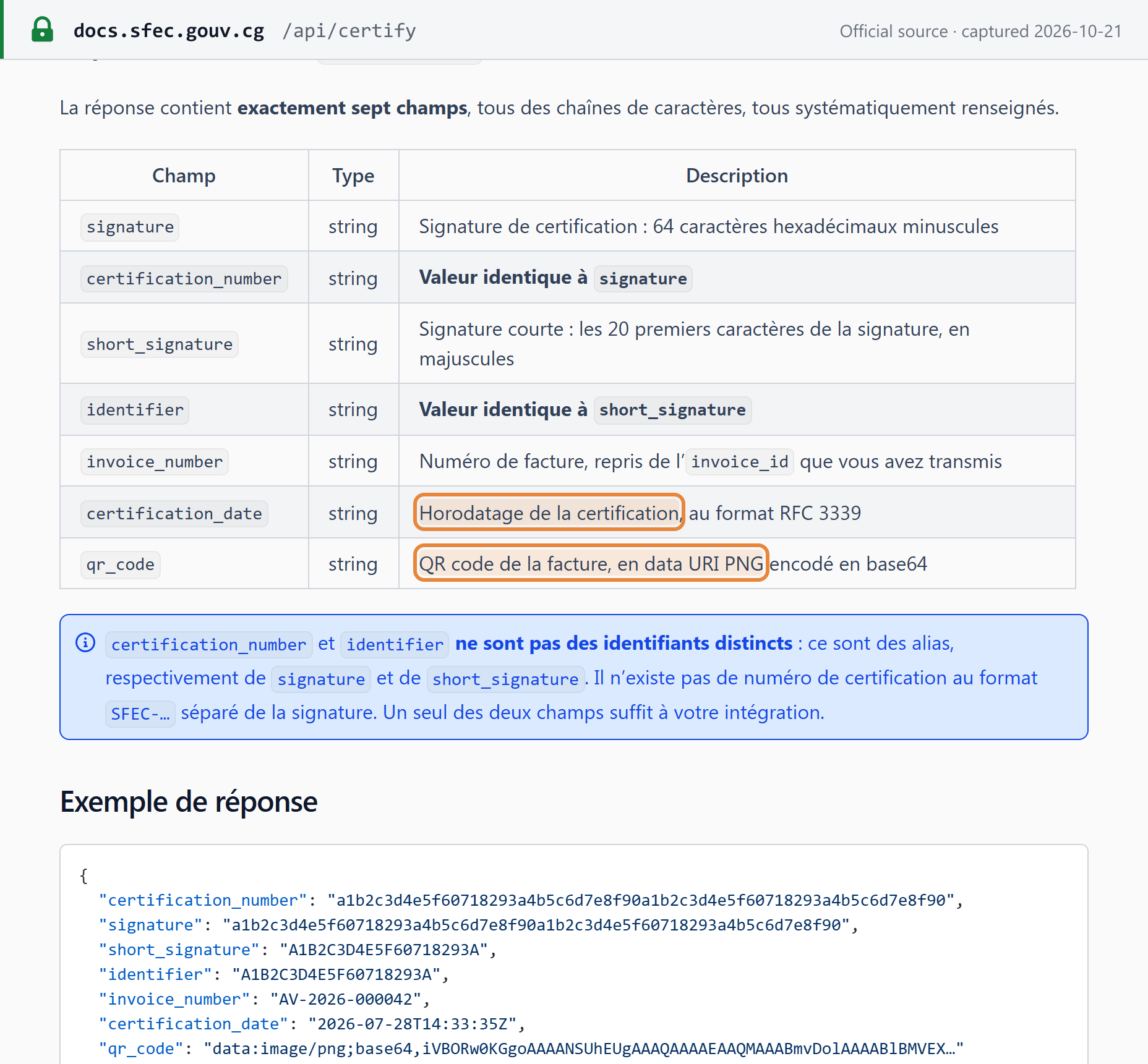
The DGID publishes no annotated specimen invoice. We looked on sfec.gouv.cg (home, compliance, FAQ, resources and news pages), the SFEC technical documentation, the Ministry's SFEC pages, Décret 2026-101, Arrêtés 1519 and 1520, Instruction 0339, LF 2025, LF 2026 and the E-TAX user guide (22 October 2026). What the DGID does publish is a sample of the certification response: the data the SFEC adds to every invoice it certifies.
 Source snapshot captured 2026-10-21 — original
Below, Lookuptax lays out the particulars of art. 32(2) and Arrêté 1519 art. 8 for an illustrative domestic B2B sale at 18%. Every name, number and code is fictional:
Facture électronique certifiée (SFEC) — illustrative
| Désignationart. 32(2) | Qtéart. 32(2) | Prix unitaire HTArr. 1519 art. 8 | Montant HTart. 32(2) |
|---|---|---|---|
| Ramettes de papier A4 | 100 | FCFA 3,500 | FCFA 350,000 |
| Livraison et installation | 1 | FCFA 150,000 | FCFA 150,000 |
- Total hors taxesart. 32(2)
- FCFA 500,000
- TVA 18%art. 22(2)(a); art. 32(2)
- FCFA 90,000
- Centimes additionnels 5% de la TVAart. 38 A
- FCFA 4,500
- Total TTCart. 32(2)
- FCFA 594,500
- Security elements generated by the SFEC (Arrêté 1519 art. 8): qualified electronic signature and digital fingerprint SPECIMEN-SIGNATURE · QR code for verification on the PGSFEC (not reproduced).
- Références bancaires: Banque Exemple, compte SPECIMEN-0000 — art. 32(2).
- VAT plus centimes additionnels is 18.9% of the amount excluding tax. A State buyer withholds that 18.9% at source (LF 2026). The centimes additionnels are not deductible by the customer (art. 38 A).
- An exempt or special-regime supply must carry the exemption wording with its legal reference (Arrêté 1519 art. 8). A forfait seller issues the invoice without the VAT and centimes-additionnels lines (LF 2026).
E-invoicing status
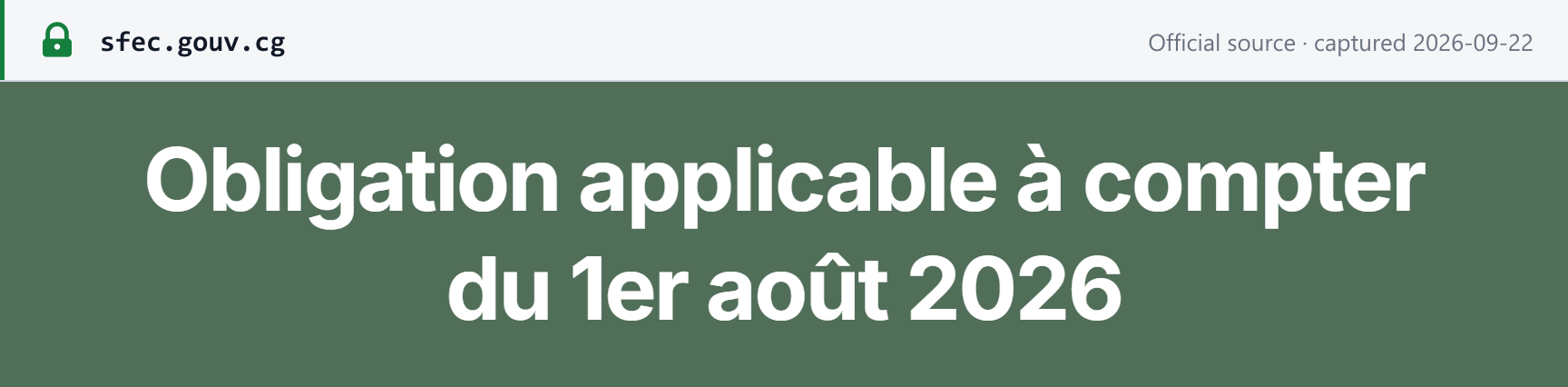
Status (as at 22 October 2026): mandatory and in force since 1 August 2026, phased by taxpayer segment. The system is the SFEC — Système de Facturation Électronique Certifiée, run by the DGID through a central platform, the PGSFEC. "En application du décret n°2026-101 du 31 mars 2026, les agents économiques sont tenus, à compter du 1er août 2026, d'émettre leurs factures sous forme électronique certifiée" (SFEC portal). [9]
 Source snapshot captured 2026-09-22 — original
- Model. Invoices issued through the API or e-Facture are certified online by the DGID platform before the buyer receives them, which works like clearance; the API returns a signature, a short signature, a certification time-stamp and a QR code. Certified terminals sign invoices locally and transmit them to the PGSFEC, within 24 hours when offline. There is no buyer acceptance step and no exchange network. See CTC e-invoicing models. [12]
- Phases by taxpayer segment.
- 1 August 2026 — the large-enterprise units (UGE), the medium-enterprise units (UME), the oil and gas subcontractors' unit (USTPG), "et tous leurs prestataires de services ou fournisseurs de biens, sans distinction de taille ni de résidence fiscale" (DGID communiqué N° 07-8/MFBPP/DGID/P.SFEC of 30 July 2026). A small supplier to a large company is therefore in scope from 1 August. The SFEC portal lists the oil segment as "FP — Fiscalité Pétrolière". [7]
- 1 December 2026 — the very small enterprises unit (UTTPE), per the deadline card on the DGID's SFEC portal. That date rests only on the portal. No decree, arrêté or communiqué fixing it has been published, and the SFEC FAQ says other categories follow "le calendrier officiel de la DGID". [9]
- 1 July or 1 August. The Ministry's SFEC page still says businesses have "jusqu'au 1er juillet 2026" to comply; a Ministry article of 30 June 2026 reported the launch moved to 1 August 2026, and DGID communiqué 07-8 is the first text that expressly sets deployment from 1 August 2026; Arrêté 1520 of 9 July 2026 (Journal officiel n° 29-2026, 16 July) already used that date as its compliance cut-off (art. 2 b), art. 4). No décret or arrêté moved the date. The same Ministry page says the decree gives businesses "un délai transitoire de trois (3) mois" to comply. [18] [7] [6] [13]
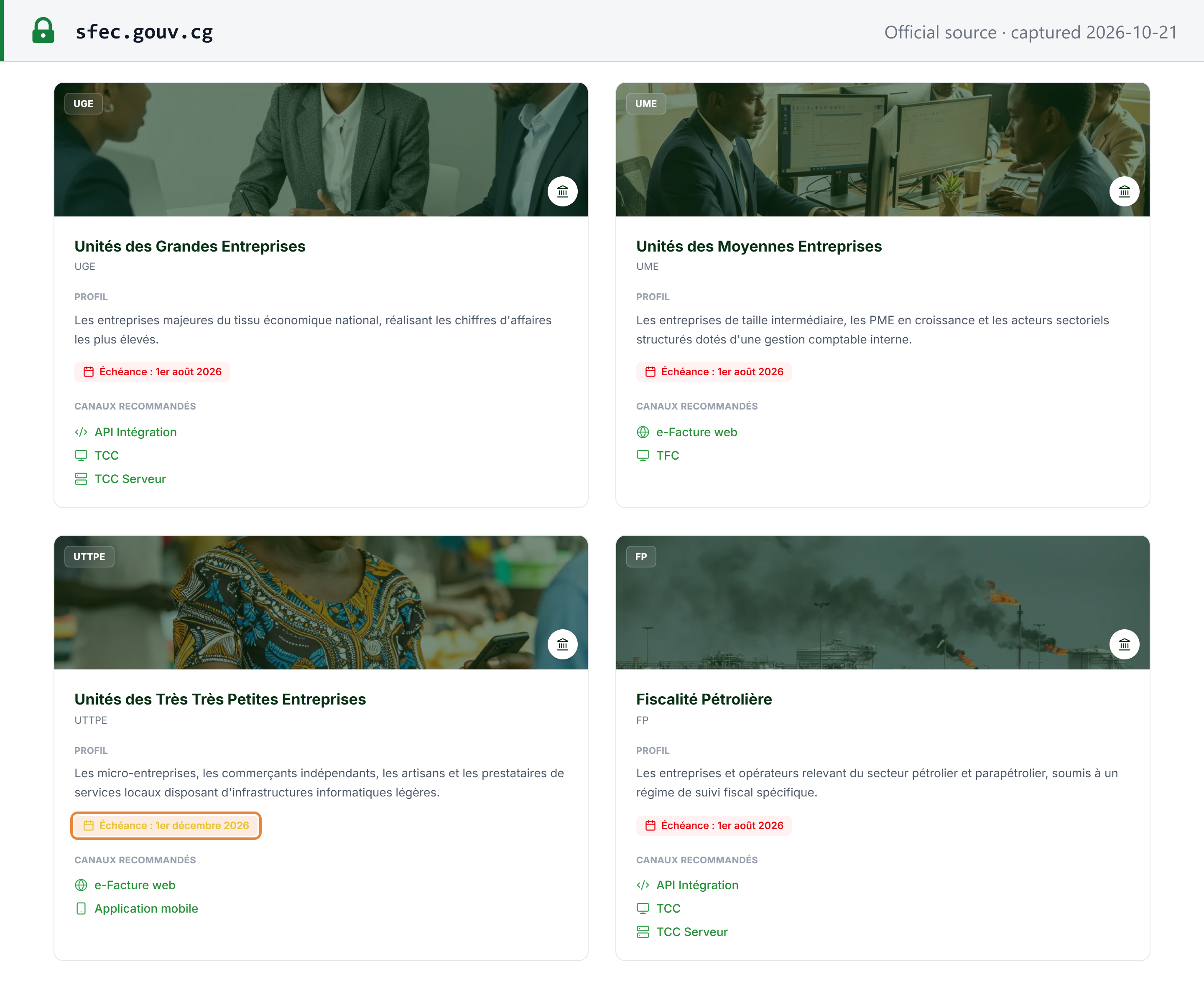 Source snapshot captured 2026-10-21 — original
-
Channels.
- e-Facture — the DGID's free web portal (efacture.gouv.cg), also available as a mobile app.
- API — REST, for ERP integration.
- TFC (terminal de facturation et de certification, as the SFEC FAQ expands it) — a certified invoicing terminal.
- TCC (terminal de contrôle et de certification) — attached to existing tills and software; also as TCC Serveur.
Terminals and software must be homologated by the DGID. A business with no invoicing system of its own uses e-Facture (Décret 2026-101 art. 30). See fiscal devices and certified cash registers. [4] [9]
-
Formats and standards. The API is JSON over HTTPS, per the SFEC technical documentation. The SFEC FAQ refers instead to invoices "au format XML conforme aux normes établies"; the two official pages disagree, and the technical specification is the one to build to. No official text names UBL, CII or Peppol. [10] [12]
-
Scope. B2B and B2C: every transaction, whether or not the customer asks. B2G: suppliers to the State issue SFEC invoices; the State and local authorities are only excused from using the SFEC for their own public-service missions (Décret art. 2). Foreign suppliers: VAT-law art. 34 bis excepts transactions involving a foreign supplier, while communiqué 07-8 covers suppliers of UGE, UME and USTPG enterprises "sans distinction de taille ni de résidence fiscale"; no DGID text reconciles the two. The finance law is a statute and outranks a DGID communiqué, which shows how the DGID is applying the rule; foreign suppliers should confirm their position with the SFEC team. [7] [2]
-
Early-compliance relief (Arrêté n° 1520/MFBPP-CAB art. 4, available until 31 December 2026):
- firms in the pilot phase that actually issued certified invoices: 60% remission of the penalties, fines and late-payment interest charged for 2025 and 2026 and assessed before 1 August 2026, and 100% for any 2026 control or spontaneous regularisation based on SFEC data;
- firms that brought their invoicing into line with the SFEC before 1 August 2026: the same 100% remission for 2026. [6]
Timeline.
| Date | Step |
|---|---|
| 27 December 2022 | LF 2023 (Loi n° 77-2022) institutes the SFEC, according to the Ministry's SFEC page |
| 30 December 2024 | LF 2025 (Loi n° 47-2024): every taxable person must use the SFEC; FCFA 50,000,000 fine (VAT law art. 34 bis) |
| 31 March 2026 | Décret n° 2026-101 regulates the SFEC |
| 30 June 2026 | The Ministry reports that the launch is postponed to 1 August 2026 |
| 9 July 2026 | Arrêtés n° 1518 to 1521/MFBPP-CAB: homologation, compliance requirements (including invoice particulars), incentives, fees |
| 30 July 2026 | DGID communiqué 07-8: gradual roll-out, UGE, UME, USTPG and all their suppliers first |
| 1 August 2026 | Certified e-invoicing in force for the first segment |
| 1 December 2026 | UTTPE, per the SFEC portal (no instrument found) |
| 31 December 2026 | End of the early-compliance remission (Arrêté 1520) |
For channels, homologation and fees, the API, offline rules and penalties in detail, see the Republic of the Congo SFEC e-invoicing guide. For other countries, see e-invoicing status and networks worldwide.
Filing and payment
Filing frequency
Monthly, for every VAT taxpayer (art. 35). The VAT law offers no quarterly or annual option by turnover band. Non-resident digital-service providers under the ARPCE regime file quarterly (see Digital products and services).
Return due date
By the 20th of the month after the month of the operations. Article 35, as rewritten by LF 2024: "La déclaration des opérations d'un mois donnée doit être déposée au plus tard le 20 du mois suivant, en double exemplaire, accompagné du paiement de la TVA". A return marked "NEANT" is due even when there was no business that month (art. 35(4)). The SFEC "ne modifie pas les obligations déclaratives prévues par la législation fiscale" (SFEC FAQ). [3] [10]
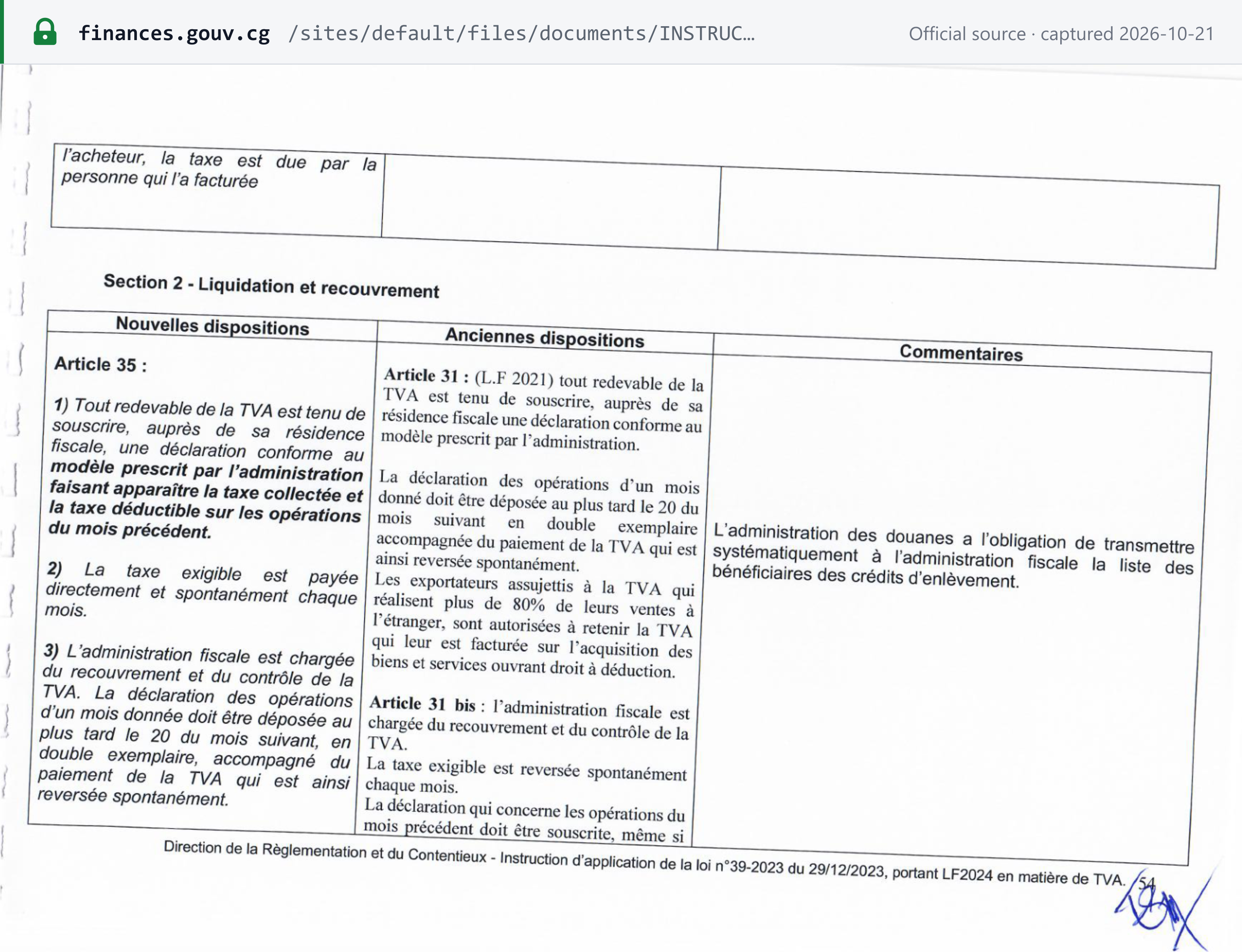 Source snapshot captured 2026-10-21 — original
Each return is accompanied by a detailed statement of deductions (art. 31) listing, for each supplier invoice:
- the supplier's name and NIU;
- the invoice number, date and amount excluding tax;
- the VAT and the nature of the purchase;
- for imports, the customs declaration and receipt;
- since LF 2025, also the billing address and "les éléments de sécurité liés au SFEC".
Without the statement, deductions are disallowed. Real-regime taxpayers also file a monthly receipts declaration (art. 36). The texts we read do not say whether the deadline moves when the 20th is a weekend or holiday. [2] [3]
Payment due date and method
With the return, by the 20th (art. 35). Returns are filed on E-TAX, the DGID's online filing system. Its user guide (v2.3, July 2026) covers the monthly or quarterly declaration of taxes and duties. [15]
From 1 October 2026, every enterprise in the UGE, UME and USTPG units "sont obligées de télédéclarer sur E-TAX et de télépayer sur la plateforme FOUTA" — the national e-payment platform. Only enterprises in the small and very small enterprises units (UPTPE) and similar structures may still pay through the Guichet unique des paiements (GUP), under Lettre circulaire n° 1091/MFBPP-CAB of 24 August 2026. [8]
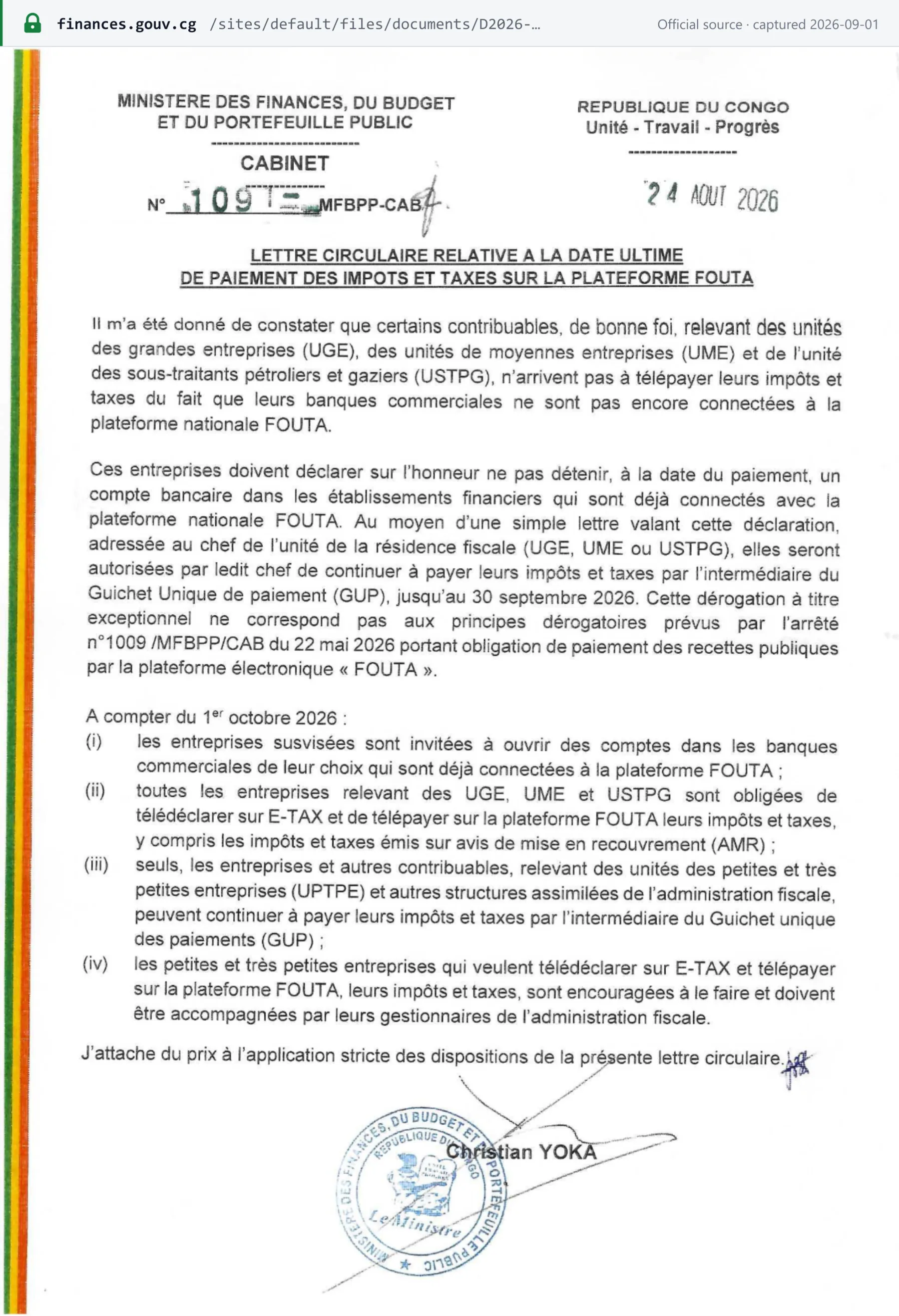 Source snapshot captured 2026-09-01 — original
Withholding by State buyers. State purchasers withhold VAT and centimes additionnels "au taux cumulé de 18,9%" on every invoice (LF 2026, budget-execution rules, point 4.a). Import VAT is paid to customs before the goods are removed (art. 37). [1]
Additional listings
- Detailed deduction statement with every monthly return (above), now carrying the SFEC security elements.
- Monthly receipts declaration for real-regime taxpayers (art. 36).
- There is no EC-sales-list equivalent, and the VAT texts we read set no annual VAT return (checked 22 October 2026).
Input-tax recovery and blocked items
Registered real-regime taxpayers deduct VAT on goods and services that are necessary for and allocated to the business (art. 23). The right arises when the tax becomes chargeable at the supplier (for imports, on release for consumption). "La TVA qui a grevé les éléments du prix d'une opération imposable au cours d'un mois donné est déductible au titre de ce mois" (art. 23(4)). LF 2024 replaced the old one-month lag. Time limit: "Le droit à déduction est exercé au plus tard jusqu'à la fin de l'année qui suit celle au cours de laquelle la TVA est devenue exigible"; after that, undeducted VAT "est acquise au trésor public" (art. 23(7), Instruction 0339 p. 38). The VAT must appear on an invoice from a registered supplier showing its NIU. From 1 August 2026 it must be a certified SFEC invoice where the supplier is in scope. Partly exempt businesses deduct by a turnover-based pro rata (arts. 25–27). [3]
Blocked input VAT (art. 24):
- lodging, accommodation, restaurant, reception and entertainment costs, except for tourism, restaurant and entertainment businesses;
- imports re-exported unused, and services linked to blocked goods;
- petroleum products;
- free distributions of goods for advertising or promotion;
- false invoices and false customs declarations;
- expenses paid in cash above FCFA 200,000 (LF 2026; it was FCFA 500,000 under LF 2024);
- passenger and mixed-use vehicles, their hire, parts, accessories and related services — except road vehicles with more than eight seats besides the driver used only to carry staff, and the fleets of vehicle-hire firms.
The centimes additionnels are never deductible (art. 38 A). [1] [3]
Refunds
Excess input VAT is a credit carried forward to later periods until used (art. 39(1)). Refunds of "crédits de TVA dûment justifiés" are paid only to legal persons, within three months of the claim (art. 39(2)). A two-month limit applies to (art. 39(3)):
- exporters making more than 80% of their turnover abroad;
- companies in a structural credit position because of withholding at source;
- diplomatic and consular missions, on reciprocity;
- businesses ceasing activity.
Claims are admissible only if the taxpayer is up to date with all its tax obligations (art. 39(4)). A credit claimed for refund cannot be carried forward, and it is cancelled if the refund is refused. Twenty percent of import-VAT receipts go to an escrow account at the BEAC to fund refunds (art. 40). [3]
New in LF 2026. Taxpayers showing a structural VAT credit on their October return must take a physical inventory of stock and fixed assets in the presence of the tax administration, notified at least 20 days ahead. If they do not, "annule tout crédit de TVA constaté au 31 décembre" of that year. [1]
We found no refund scheme for non-residents (checked 22 October 2026). Bad-debt relief exists through the "facture demeurée impayée" duplicate (art. 29; see Credit and debit notes).
Exemptions
Exempt supplies
Exemptions are a closed list in article 7 (as rewritten by LF 2024 and amended by LF 2025, with Annexe 3 replaced by LF 2026). Outside it, "aucune exonération ou exemption n'est accordée" by investment incentive, sector measure or special agreement (art. 6). Examples:
- Financial and property: banking and financial operations (including financial intermediation), insurance and reinsurance; transfers of immovable property by persons other than developers; interest on external loans and on non-professionals' deposits.
- Social: medical care, hospitalisation, analyses and prostheses; pharmaceuticals (not food supplements or cosmetics); school and training fees of authorised establishments; newspapers and periodicals (advertising excluded); the "social" tranches of water and electricity.
- Goods: sales of extractive products; raw produce of Congolese farmers, breeders, fishers and hunters; mineral water produced in the Congo and butane gas bottled in the Congo, with their inputs (LF 2025); imports of photovoltaic panels by start-ups and very small enterprises (LF 2025).
- Basic necessities in Annexe 3 (LF 2026): among them meat and poultry, sea fish (not luxury fish), salted fish, wheat and maize, vegetable oil, infant food, animal feed, quinine, insulin, antibiotics, fertilisers, insecticides and pesticides, exercise books and books, corrective glasses, wheelchairs and medical equipment.
- Other: games of chance; postage and fiscal stamps at face value; international shipping and aviation supplies and inter-State transit; second-hand goods sold by non-professionals; bare land or bare housing let by non-professionals. [1] [2] [3]
Exempt is not zero-rated. Exports, international transport and local sales of sawn timber are zero-rated (art. 22): input VAT stays deductible, and exporters can claim refunds (art. 39). Exempt supplies give no right to deduct the VAT on their costs. A business making both deducts by pro rata, with only taxable receipts and exports in the numerator (arts. 25–27).
Special regimes
- Forfait (IGF) for individuals below FCFA 100,000,000: no VAT charged, none deducted, unless they opt in.
- Special economic zones: sales and acquisitions of goods and services by developers and companies established there are taxed at 5% (art. 22(2)(c)).
- Exporters above 80% may suspend VAT on their purchases (art. 35(6)).
- Second-hand goods sold by professionals are taxable; those sold by non-professionals are exempt. We found no margin scheme and no cash-accounting scheme in the texts read (checked 22 October 2026).
Offences and penalties
Offences
- Not using the SFEC. "Toute action de nature à violer l'obligation d'utiliser le SFEC" is sanctioned (art. 34 bis, LF 2025); Décret 2026-101 art. 24 refers non-use back to that article.
- Parallel numbering, a dual system, or any process for issuing uncertified invoices "constitue une fraude fiscale" (Arrêté 1519 art. 7).
- Tampering: removing or trying to remove terminal seals, or altering or trying to alter SFEC billing data (Décret art. 19). Any physical or logical compromise of a terminal "constitue une violation de la réglementation en vigueur" (Arrêté 1519 art. 9).
- Selling unhomologated terminals or software, or selling without SFEC distributor approval (Décret arts. 4, 11 and 26).
- Charging VAT on an invoice: "Toute personne qui mentionne la TVA sur une facture … est redevable de la taxe du seul fait de sa facturation" (art. 34), even where no real supply took place.
- Criminal exposure. The CGI's general penal provisions are not published online in current form, so we cannot state whether imprisonment applies or for how long (checked 22 October 2026). [2] [4] [5]
Penalties
| Breach | Penalty | Source |
|---|---|---|
| Violating the obligation to use the SFEC | Fiscal fine of FCFA 50,000,000, and the VAT on the non-compliant transaction is not deductible | VAT law art. 34 bis, LF 2025 (Loi n° 47-2024) |
| Under-payment corrected spontaneously, before any action by the administration | Interest of 0.5% per day of delay, capped at 20% of the principal; no penalty | CGI art. 374 ter, LF 2026 |
| No detailed deduction statement with the return | Deductions disallowed | VAT law art. 31 |
| Structural VAT credit without the required inventory | VAT credit at 31 December cancelled | VAT law, LF 2026 |
| Late registration, late filing, late payment (general rates) | Not published online in current form — see below | CGI (current text unavailable) |
The FCFA 50,000,000 fine was enacted by the 2025 finance law (Loi n° 47-2024 du 30 décembre 2024), not the 2026 one. Décret 2026-101 sets no amount; it refers to "l'article 34 bis nouveau de la loi n° 47-2024". [2] [4]
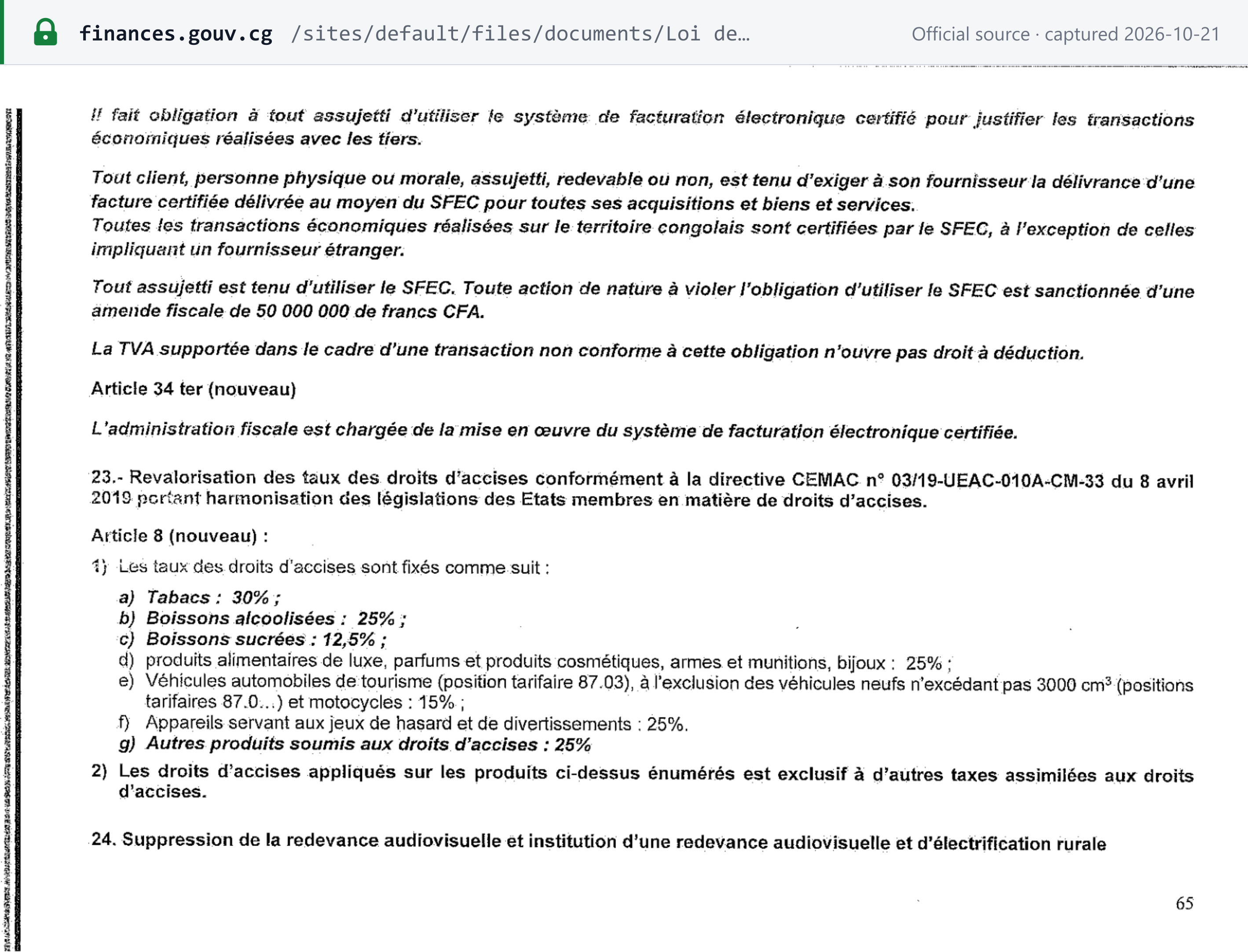 Source snapshot captured 2026-10-21 — original
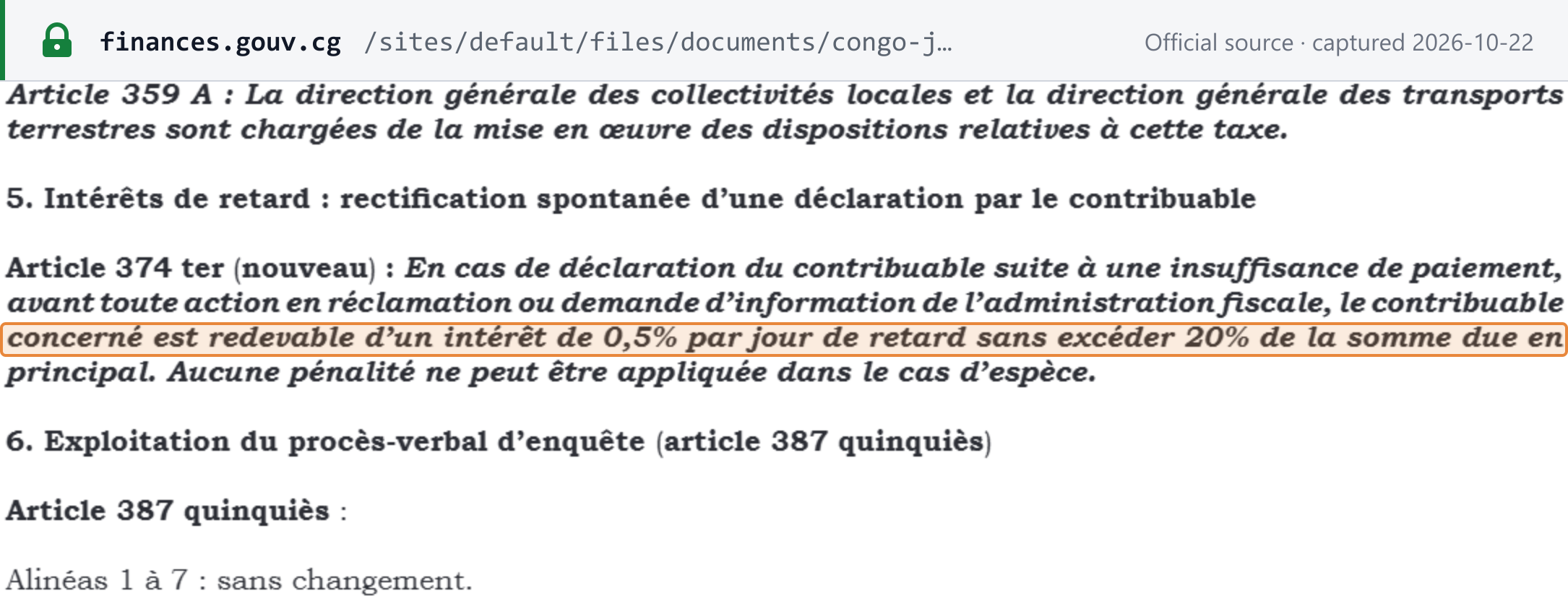 Source snapshot captured 2026-10-22 — original
What is not published. The general penalties for late registration, late filing and late payment, and for reassessments, sit in the CGI's penalty articles. Those articles have been amended by recent finance laws; LF 2026, for one, added art. 374 ter. No current consolidated text of the CGI is available on any official site we could reach (checked 22 October 2026), and the Ministry-hosted Tome 1 carries the 2000–2002 version. We do not reproduce those older figures as current. Ask the DGID for the rate that applies to your case.
Relief. Until 31 December 2026, businesses that joined the SFEC pilot or complied before 1 August 2026 may obtain 100% remission of penalties, fines and late-payment interest for 2026 controls and regularisations based on SFEC data. Pilot firms also get 60% remission of those charged for 2025 and 2026 and assessed before 1 August 2026 (Arrêté 1520 art. 4, under CGI art. 451). [6]
Frequently asked questions
A Congolese supplier sent us an ordinary invoice, not an SFEC-certified one, after 1 August 2026. Can we deduct the VAT?
Not if the supplier is in the SFEC scope. Under article 34 bis of the VAT law, added by the 2025 finance law, VAT borne on a transaction that does not comply with the obligation to use the SFEC gives no right to deduction. The DGID's SFEC FAQ says an uncertified invoice received from a medium-enterprise (UME) supplier after 1 August 2026 is not deductible, and that such invoices should be rejected. Uncertified invoices from small businesses not yet phased in remain deductible.
Our company's turnover is below FCFA 100 million. Do we still have to register for VAT in the Republic of the Congo?
Yes, if you are a company. Article 5 of the VAT law, as rewritten by the 2024 finance law, makes private-law legal persons liable to VAT of right, whatever their annual turnover. The FCFA 100,000,000 threshold applies only to natural persons (sole traders): below it they are taxed under the forfait regime and issue invoices without VAT lines, unless they opt into VAT.
We are a foreign company invoicing a client in Congo-Brazzaville. Do we need the SFEC, and who pays the VAT?
VAT law article 34 bis excludes transactions involving a foreign supplier from SFEC certification, but DGID communiqué 07-8 covers suppliers of UGE, UME and USTPG enterprises regardless of tax residence, and no DGID text reconciles the two. For the VAT itself, a non-resident liable to VAT must appoint a solvent, accredited representative resident in the Congo who is itself VAT-registered and jointly liable; if none is appointed, the customer pays the VAT and any penalties (article 12). Non-resident providers of digital services follow a separate regime: they register and pay 18% themselves through the ARPCE portal, with no threshold and no representative.
Is the VAT rate in the Republic of the Congo 18% or 18.9%?
Both figures are official, and they measure different things. The VAT rate is 18% of the price excluding tax. On top of the VAT, centimes additionnels of 5% of the VAT amount are charged for local authorities, which adds 0.9 points: 18% plus 5% of 18% gives 18.9% of the price excluding tax. The centimes additionnels are not deductible. They do not apply under the ARPCE regime for non-resident digital services, where the total is 18%.
Did the SFEC change the VAT return deadline?
No. The DGID's SFEC FAQ says the SFEC does not change the filing obligations in the tax legislation. The monthly VAT return and payment are still due no later than the 20th of the month following the month of the operations (VAT law article 35), filed on E-TAX. Since 1 October 2026, large and medium enterprises and oil and gas subcontractors must pay through the FOUTA e-payment platform.
Important websites
| Site | Purpose |
|---|---|
| DGID — Ministry of Finance page | The tax authority's description and contacts |
| impots.gouv.cg | DGID portal and the E-TAX professional space for online filing, named in the E-TAX guide. Could not be reached on 22 October 2026 |
| E-TAX user guide v2.3 (PDF, July 2026) | How to activate the account and file returns; includes an NIU search for logged-in professionals |
| FOUTA | National e-payment platform (programme page; mandatory for UGE, UME and USTPG from 1 October 2026) |
| ACPCE | Company-formation one-stop shop, with document lists by legal form |
| SFEC portal | E-invoicing rules, phases, FAQ and resources |
| e-Facture | The DGID's free web invoicing portal (sign-in required) |
| SFEC sandbox | Test environment; test invoices have no fiscal value |
| SFEC technical documentation | API, TCC and TFC integration |
| ARPCE digital-services VAT portal | Registration, quarterly returns and payment for non-resident digital-service providers |
| Ministry of Finance documentation | Finance laws, DGID instructions, decrees and arrêtés (searchable) |
| Journal officiel | Official gazette |
| Customs (DGDDI) | Import declarations and import VAT |
Tax-ID lookup. Article 30 of the VAT law requires the DGID to publish NIUs with their VAT status online, but we found no public lookup (checked 22 October 2026). There is no official rate-lookup tool; the finance laws are the source.
Recent changes
- 2026-10-01 — UGE, UME and USTPG enterprises must file on E-TAX and pay only through FOUTA (Lettre circulaire n° 1091/MFBPP-CAB of 24 August 2026). (Ministry of Finance) — see event
- 2026-08-01 — SFEC certified e-invoicing in force for the UGE, UME and USTPG units and all their suppliers; the SFEC portal shows 1 December 2026 for very small enterprises. (DGID) — see event
- 2026-07-09 — Arrêtés n° 1518 to 1521/MFBPP-CAB set SFEC homologation, compliance requirements (including the mandatory invoice particulars), incentives and fees. (SFEC portal)
- 2026-07-01 — VAT collection on digital services by non-residents begins through the ARPCE portal: 18%, no threshold, quarterly returns. (ARPCE)
- 2026-06-30 — The SFEC launch is postponed from 1 July to 1 August 2026. (Ministry of Finance) — see event
- 2026-03-31 — Décret n° 2026-101 regulates the SFEC. (SFEC portal) — see event
- 2026-01-01 — LF 2026 replaces the exempt and reduced-rate goods lists (Annexes 3 and 5), cuts the cash-expense deduction bar to FCFA 200,000 and adds art. 374 ter interest. (Journal officiel)
For the full chronology, see Republic of the Congo tax changes on Lookuptax.
Reference links
- Journal officiel, édition spéciale n° 3-2026 du 5 janvier 2026 — Loi n° 42-2025 du 31 décembre 2025, loi de finances pour 2026
- Loi n° 47-2024 du 30 décembre 2024, loi de finances pour 2025
- DGID — Instruction n° 0339/MEF/DGID/DRC du 18 mars 2024, application of LF 2024 (Loi n° 39-2023) on VAT
- Décret n° 2026-101 du 31 mars 2026 réglementant le SFEC
- Arrêté n° 1519/MFBPP-CAB du 9 juillet 2026 — fiscal-compliance requirements for SFEC terminals and software
- Arrêté n° 1520/MFBPP-CAB du 9 juillet 2026 — SFEC tax-support measures
- DGID — Communiqué N° 07-8/MFBPP/DGID/P.SFEC du 30 juillet 2026 (SFEC deployment)
- Lettre circulaire n° 1091/MFBPP-CAB du 24 août 2026 (FOUTA payment)
- DGID — SFEC portal
- DGID — SFEC FAQ
- DGID — SFEC compliance page
- DGID — SFEC technical documentation, "Certifier une facture"
- Ministry of Finance — Système de facturation électronique certifié (SFEC)
- ARPCE — FAQ, Digital VAT Portal (PDF "FAQ_ARPCE_Digital_VAT_Portal_EN_2026-09-29", 29 September 2026), available from the portal's User Guides
- DGID — E-TAX user guide, Guide Portail Espace Professionnel v2.3 (July 2026)
- ACPCE — Créer une société
- Ministry of Finance — Direction Générale des Impôts et des Domaines
- Ministry of Finance — SFEC information campaign, 30 June 2026 (launch postponed to 1 August 2026)
- ACPCE — Missions
Related on Lookuptax:
- DR Congo VAT guide — the other Congo (Kinshasa)
- VAT registration thresholds worldwide
- Worldwide tax rates
- E-invoicing status and networks worldwide
- CTC e-invoicing models explained
- Fiscal devices and certified cash registers explained
- VAT withholding regimes
- Reverse charge explained
- VAT on digital services by non-resident suppliers
- Marketplace deemed-supplier rules
- VAT names by country
- How to register for VAT, sales tax or GST
- Check a VAT number — official lookups by country