Cuba Sales and Services Tax guidelines
| FACTSHEET | |
|---|---|
| Country code | CU |
| Tax name | Impuesto sobre las Ventas (sales tax, goods) and Impuesto sobre los Servicios (services tax) — no VAT |
| Tax Authority | Oficina Nacional de Administración Tributaria (ONAT) |
Overview
Cuba has no VAT. It levies two separate taxes on turnover: the Impuesto sobre las Ventas (sales tax) on sales of goods, and the Impuesto sobre los Servicios (services tax) on services. Both are charged on the gross amount — the sales tax on "el importe total de las ventas de los bienes gravados" (Ley 113 art. 135), the services tax on "el total de los ingresos que generen los servicios prestados" (art. 148). Ley 113's chapters on these taxes (arts 132–153) contain no provision crediting, deducting or refunding tax paid on purchases, so the tax cascades: each seller in a chain pays it again on its full turnover. Terms such as "input VAT", "zero-rated" or "VAT number" do not apply. [1]
A move to a value added tax (impuesto al valor agregado, IVA) with gradual e-invoicing has been announced in the press, but as at 22 October 2026 no norm, rate or date for either is in the Gaceta Oficial. Until one is, the rules below are the law.
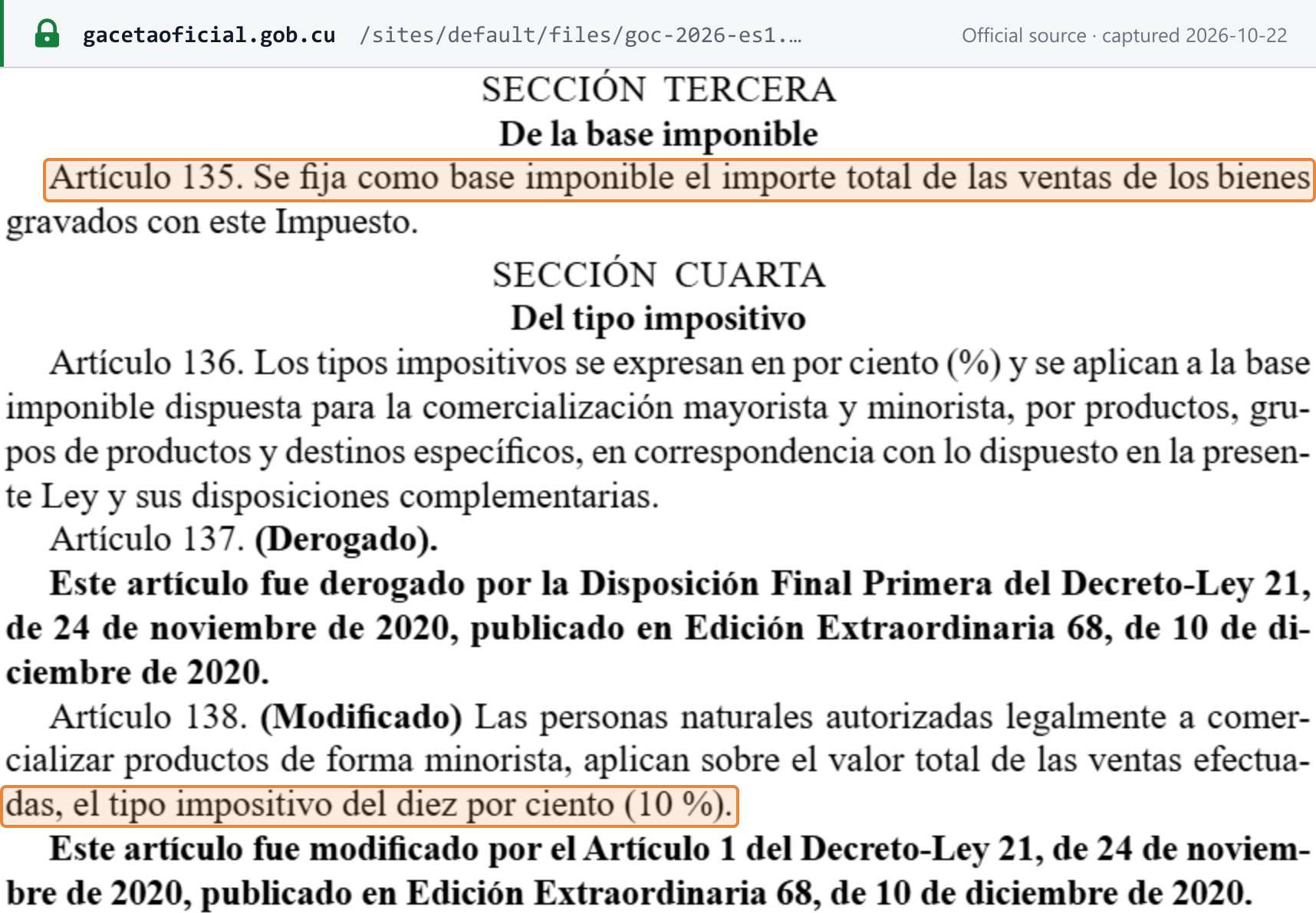 Source snapshot captured 2026-10-22 — original
The law. Ley 113/2012 "Del Sistema Tributario" creates both taxes and its regulation, Decreto 308/2012, sets the procedures. The Gaceta Oficial published the official concorded text of both, consolidated through Ley 181/2025, Decreto-Ley 107/2025 and Decreto 131/2025, in Edición Especial No. 1 of 12 January 2026 ("ES1"). The rates for each year are set by the annual State Budget law — for 2026, Ley 181/2025 "Del Presupuesto del Estado para el año 2026" (GOC Ordinaria 99 of 29 December 2025). [1] [2]
A third tax on top. The Impuesto Especial a Productos y Servicios (special tax on products and services, an excise) "se aplica en adición a los impuestos sobre las Ventas o los Servicios" (Ley 113 art. 141). The Ministry of Finance and Prices applies it to specific products during the year (Ley 181 art. 69) — see Rates.
Authority. The taxes are administered by the Oficina Nacional de Administración Tributaria (ONAT); customs (the Aduana General de la República) is the other operating tax administration. The Minister of Finance and Prices "es la máxima autoridad de la Administración Tributaria" (Ley 113 art. 387). [1]
Currency. Taxes are paid in Cuban pesos (CUP). Decreto-Ley 107/2025 (GOC Ordinaria 97 of 23 December 2025) provides that taxes previously payable in convertible pesos or freely convertible currency are paid in CUP, and empowers the Council of Ministers and the Minister of Finance and Prices to require payment of particular taxes in moneda libremente convertible (MLC). Retail sales and services authorised in MLC are taxed as the Minister disposes (Ley 181 art. 59). [5] [2]
Tax period. The fiscal year is the calendar year (Ley 113 art. 5 b); the sales and services taxes are computed and paid monthly (see Filing and payment).
Layering. Both are national taxes; there is no provincial or municipal sales tax. Ley 181 art. 63 cedes the revenue of two lines to municipal budgets — the sales tax on retail of cigarettes, cigars and matches, and the services tax on telecommunications — without changing who administers them. [2]
For a neighbouring system with a VAT, see the Dominican Republic guide.
Registration
Who should register
Every taxpayer. Ley 113 art. 393 a) obliges taxpayers to "inscribirse en el Registro de Contribuyentes, salvo las excepciones que para ello se disponga en las normas complementarias", and Decreto 308 art. 18 repeats it: "Los contribuyentes están obligados a inscribirse en el Registro de Contribuyentes". Liability to the sales or services tax follows from carrying on the taxed activity — selling goods or providing services under a licence or authorisation — not from reaching a turnover figure. [1]
Registration threshold
Not applicable — Cuba has no registration threshold. Ley 113, Decreto 308 and Ley 181/2025 contain no monetary threshold for registration or for the sales and services taxes. Registration is triggered by the authorisation to operate:
- Deadline: 15 calendar days (Decreto 308 art. 20) —
- natural persons, from the issue of the authorisations, licences, permits or affiliations "que originen su obligación de tributar";
- legal persons, from notification of their entry in the constitutive register (for companies, the Registro Mercantil).
- ONAT's turnaround: 5 calendar days once it holds the documents (art. 22).
- Where: at the ONAT office of the taxpayer's domicilio legal, in person or through a legally accredited representative (art. 24).
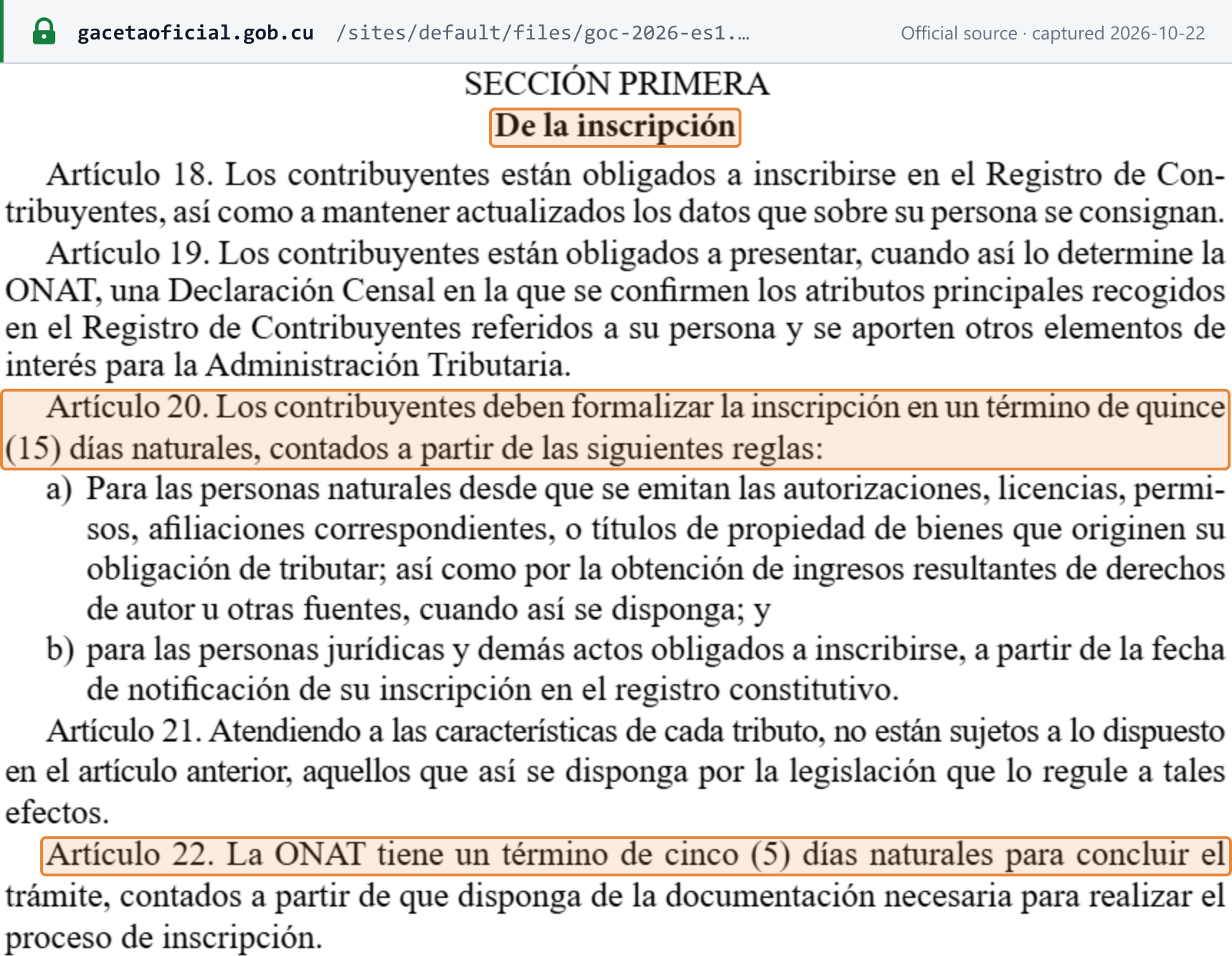 Source snapshot captured 2026-10-22 — original
Non-resident registration
Ley 113 and Decreto 308 have no non-resident registration regime and no threshold for foreign sellers. Foreign natural persons have the same tax rights and duties as Cubans, and a foreign legal person "cuando operen por mediación de un establecimiento permanente en el territorio nacional" must appoint a natural or legal person resident in Cuba to represent it before the tax administration (Ley 113 art. 9). Branches, agents and representative offices of foreign companies pay the higher registration stamp duty (below). See Cross-border rules. [1]
Tax identification number
On registration ONAT assigns a Número de Identificación Tributaria (NIT). ONAT Resolución 162/2025 makes it compulsory "en la declaración y pago de impuestos, en la emisión de facturas, en la apertura de cuentas bancarias y en la formalización de contratos". For legal persons it has 11 digits: two for the organisational form, then "00", then a six-digit consecutive number, then a control digit. For natural persons the NIT "coincide con el número de identidad permanente". The resolution publishes no check-digit algorithm, and gave taxpayers 180 days from its entry into force to build the NIT into their systems. [5]
For identifiers, portal login and the annual return, see the Cuba tax ID guide. Lookuptax has no Cuba validator, and neither ONAT nor the Ministry of Finance and Prices publishes a public NIT lookup.
How to register
Where each class of taxpayer registers, as published by ONAT (registration page, July 2024):
- Self-employed workers (trabajadores por cuenta propia, TCP) — at the ventanilla única (one-stop office) of the municipality of residence on their identity card.
- Micro, small and medium enterprises (MIPYMES) and non-agricultural cooperatives (CNA) — through the Ministry of Economy and Planning's Plataforma de Actores Económicos (PAE). For CNA the Gaceta fixes the deadline: 15 calendar days from entry in the Registro Mercantil (MFP Res 307/2023, Trigésimo Primero).
- Other natural persons — artists and creators in the cultural sector and their support staff, social communicators and designers, staff of foreign branches and others — at the municipal ONAT office.
- Other legal persons — state enterprises, joint ventures, agricultural cooperatives, foreign companies and other entities — also at the municipal ONAT office. [14] [6]
Documents (ONAT, July 2024): for natural persons, the identity document, the licence or (for TCP) the Planilla de Solicitud de Proyecto de Trabajo, a power of attorney where a representative files, a declaration of hired workers and co-owners, and the social-security affiliation; for legal persons, the certificate of entry in the constitutive register, the protocolised deed, the representative's power and a declaration of dependencies. Both also list their bank accounts.
Stamp duty. Registration in the Registro de Contribuyentes costs CUP 30.00 (Grupo 1) or CUP 750.00 (Grupo 2), and a certification CUP 20.00 or 500.00 (Ley 113 Anexo 4, numeral 23). ONAT's July 2024 page places resident natural persons, state entities, 100% Cuban-owned companies, foreign-investment vehicles under Ley 118, Mariel Special Development Zone users, cooperatives, MIPYMES and associations in the CUP 30 group, and non-resident natural persons and branches, agents and representative offices of foreign companies in the CUP 750 group. [1] [14]
New MIPYMES are exempt from the sales and services taxes (and profits tax, labour-force tax and the local-development contribution) for the month in which they register with ONAT (MFP Res 306/2023, Duodécimo). The former six- and twelve-month start-up exemptions were withdrawn from 2024. [6]
Voluntary registration
Not applicable. Registration is compulsory for every taxpayer and there is no threshold to fall below, so there is nothing to opt into; Ley 113 and Decreto 308 contain no voluntary-registration provision.
Updates and deregistration
- Changes to registered data must be formalised at ONAT within 30 calendar days (Decreto 308 art. 25). [1]
- Deregistration (baja) follows one of the causes in art. 45 — among them extinction, merger, death, permanent departure from the country, "conclusión de actividades gravadas", closure or licence withdrawal as a tax sanction, and non-renewal of the licence. [1]
- On a baja, ONAT checks the taxpayer's position and demands any outstanding debt (art. 54). [1]
Group registration
Not available. Decreto 308 has no grouping provision. A legal person operating from several establishments registers as the contribuyente principal and declares its dependencies, but each dependency still registers at its own domicile (art. 30), and the principal has 45 calendar days to prove they have done so (art. 31). That is branch registration, not a tax group. [1]
Rates
Rates for 2026 are fixed by Ley 181/2025, arts 58–69 (the budget law for 2026), plus Ministry of Finance and Prices (MFP) resolutions for named activities. There is no general "reduced rate" category: each 5% is a specific bonificación tied to an activity. [2]
| Rate | Applies to | Source |
|---|---|---|
| 10% (general) | Legal persons, on retail sales of goods and on services to the population | Ley 181 art. 58 |
| 10% | MIPYMES, non-agricultural cooperatives and local-development projects, on the total of their sales and services | Ley 181 art. 60 |
| 10% | Natural persons, including the self-employed | Ley 181 art. 61; MFP Res 271/2024 art. 19 |
| 10% | Associations, foundations and other associative forms, on sales and services to the population | Ley 181 art. 62 |
| 5% | Telecommunications services of the Empresa de Telecomunicaciones de Cuba (ETECSA) — services tax | Ley 181 art. 64 |
| 10% / 5% | Retail of agricultural products at markets: 10%; 5% where the provincial or municipal councils fix maximum or agreed prices, or for centrally priced products — from 1 January 2026 | MFP Res 348/2025, Primero–Segundo |
| 5% | Retail of the products in the resolution's Anexo Único through establishments of the "Mercado del Barrio" project — from 4 August 2026 | MFP Res 161/2026, Primero |
| 10% / 5% | Local-development projects: 10% on total sales and services; 5% on retail of food from their mini-industries — published 21 October 2026 | MFP Res 202/2026 art. 6.1 |
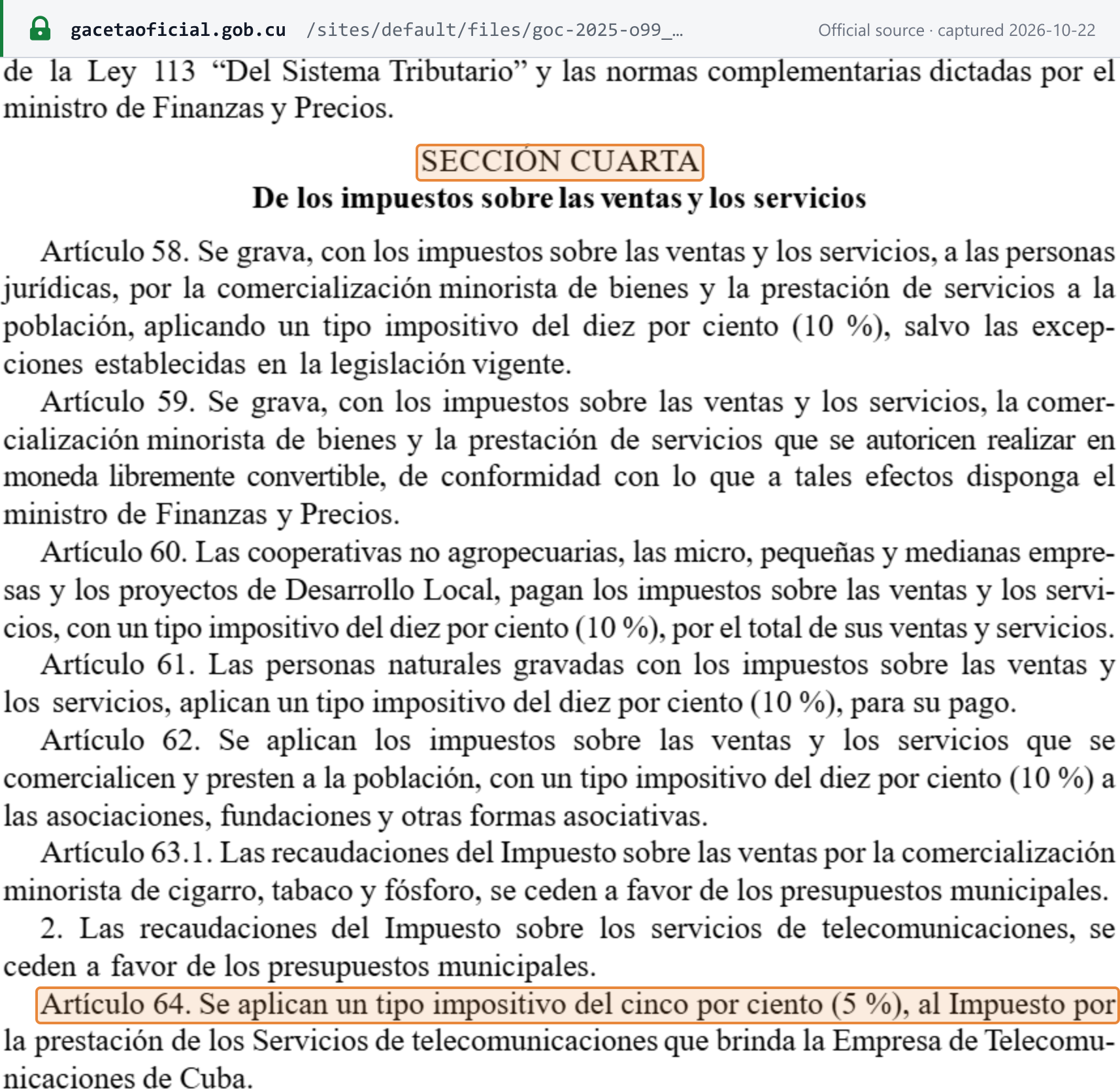 Source snapshot captured 2026-10-22 — original
The 10% in Ley 113 itself. Since Decreto-Ley 21/2020 (GOC Extraordinaria 68 of 10 December 2020), Ley 113 also fixes 10% directly for natural persons selling at retail (art. 138, shown in the Overview snapshot) and for entities providing services to the population (art. 150). The budget law restates and extends those rates each year. [1]
Self-employed workers (TCP) pay the sales and services taxes monthly at 10% of their monthly income. Commission income of telecommunications agents and insurance agents is not subject to them, and commercial fishers and contracted artists follow their own rules (Res 271/2024 art. 19). Tax paid through electronic payment channels earns a 3% bonificación (art. 7). [7] [7]
Mercado del Barrio. Res 161/2026 grants "una bonificación, consistente en la aplicación de un tipo impositivo del cinco por ciento (5 %)" on retail of the listed products through establishments linked to the project and certified by their parent entity, in force on publication on 4 August 2026. [8]
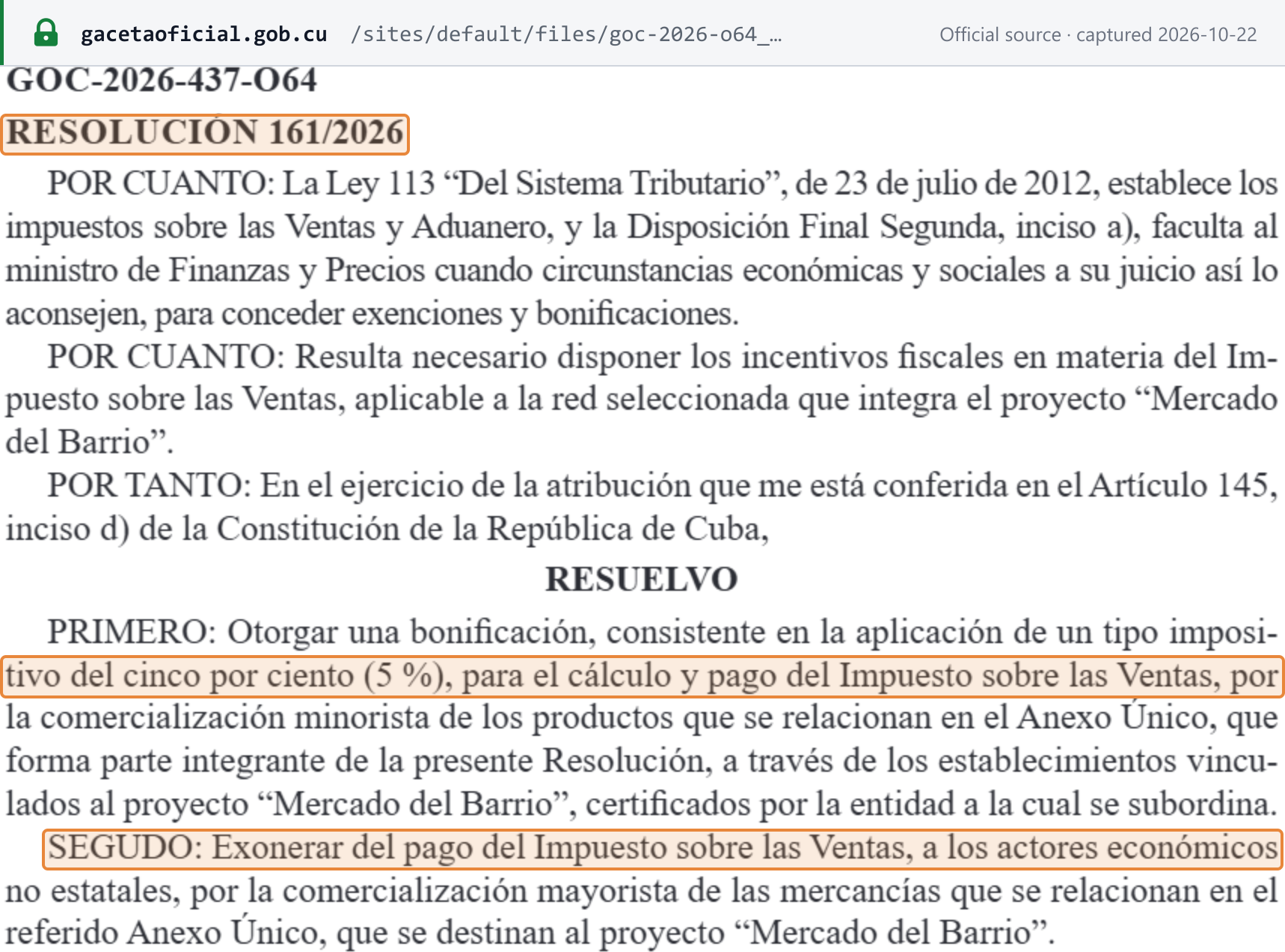 Source snapshot captured 2026-10-22 — original
Local-development projects. Res 202/2026, published in GOC Ordinaria 87 on 21 October 2026, sets their 10% and 5% rates and the budget line they pay to. The resolution states no entry-into-force date; it was signed on 9 September 2026. [10]
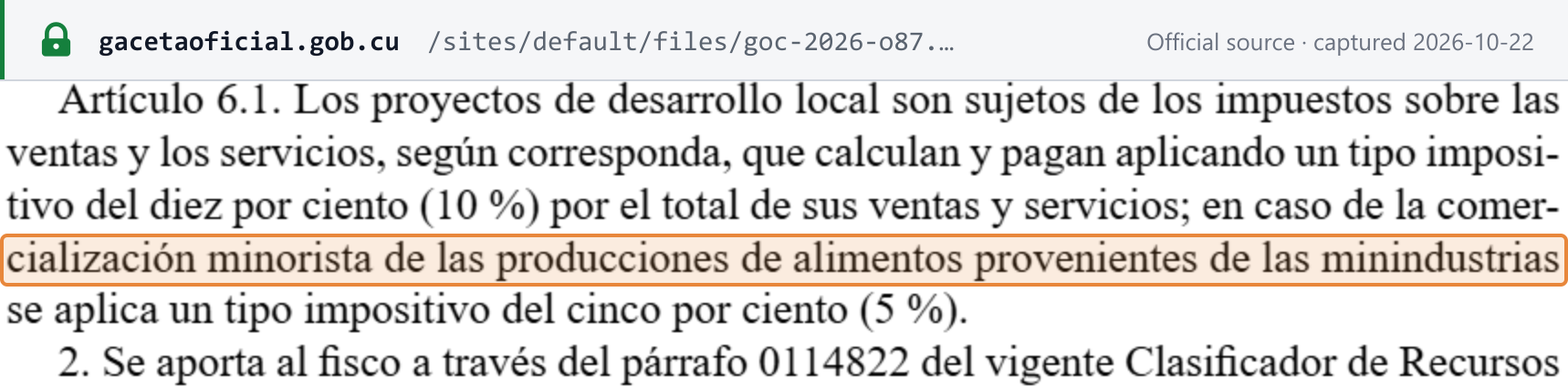 Source snapshot captured 2026-10-22 — original
Not taxed and exempt items are listed under Exemptions; there is no zero rate.
The excise on top. The Impuesto Especial a Productos y Servicios is applied product by product. In 2026, MFP Res 172/2026 (GOC Ordinaria 65 of 4 August 2026) applies it to authorised trading entities "por la venta en dólares estadounidenses (USD) o su equivalente en otras monedas convertibles, de vehículos de motor, remolques y semirremolques", at the amounts in its annex; and the Gaceta's summary of MFP Res 56/2026 describes an excise on imports of beer and alcoholic beverages. [13] [15]
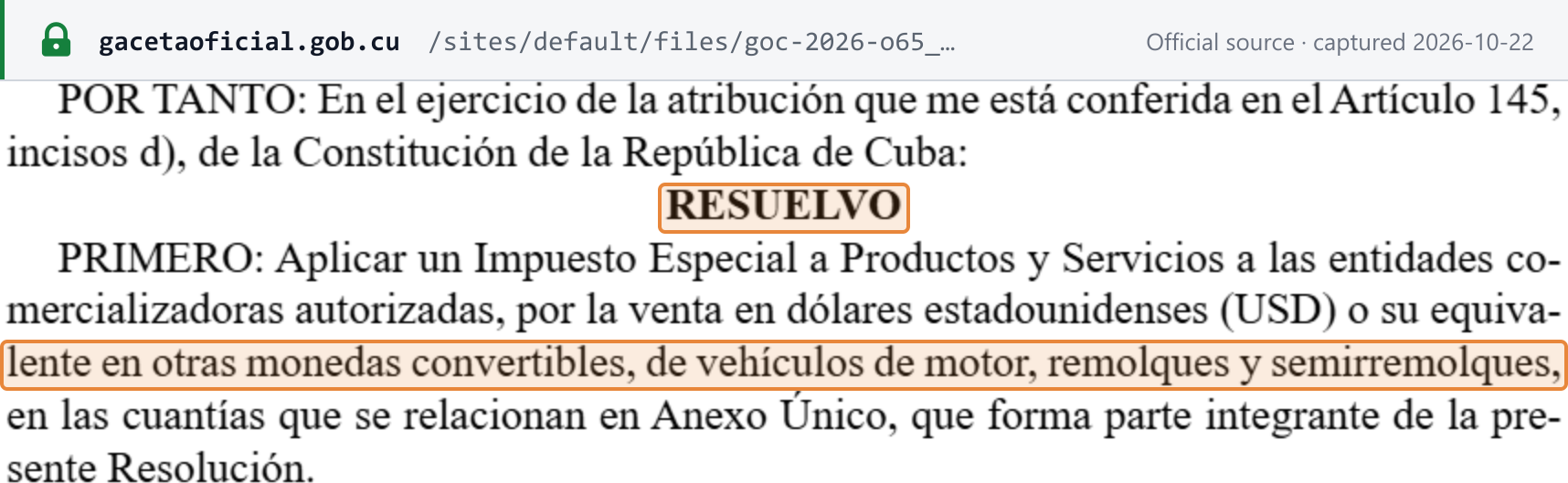 Source snapshot captured 2026-10-22 — original
Announced future rates. None. No rate, law or date for a value added tax is in the Gaceta Oficial.
For other countries' rates, see worldwide tax rates.
Cross-border rules
Imports and exports
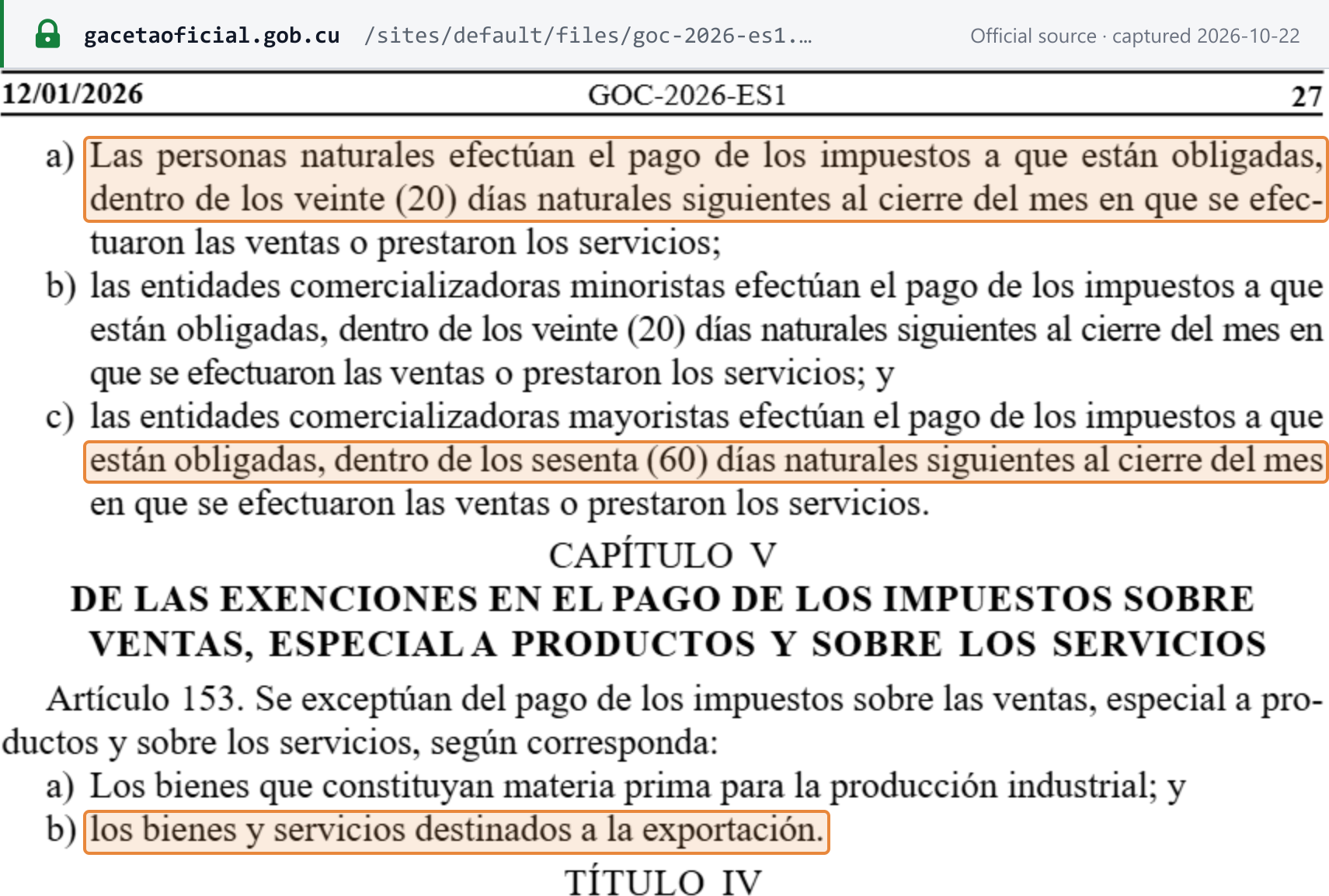
- Exports. Goods and services "destinados a la exportación" are excepted from the sales, special and services taxes (Ley 113 art. 153 b) — see the snapshot under Filing and payment.
- Imports. The entry of goods bears the Impuesto Aduanero (customs duty), collected by customs through the tariff (arts 282–284). The sales tax reaches imported goods when they are sold in Cuba: art. 132 covers goods "importados o producidos". Ley 113 has no sales tax collected by customs at importation. [1]
Reverse charge on imported services
Ley 113 has no reverse charge. The services tax reaches services "que se presten en el territorio nacional" (art. 146), and its taxpayers are those "que presten los servicios gravados" (art. 147). No article makes a Cuban customer liable for a foreign provider's services tax. Separately, a Cuban legal person paying income to a foreign company without a permanent establishment is jointly liable for the tax debt on that income (art. 128) — an income-tax rule, not a sales-tax one. See reverse charge explained for how other systems handle this. [1]
Digital products and services
Ley 113 and Decreto 308 have no digital-services provision, no registration channel for non-resident digital suppliers and no threshold. Compare VAT on digital services by non-resident suppliers.
Foreign companies selling into Cuba — B2B and B2C
- B2B. No specific rule. A foreign company operating through a permanent establishment registers through a resident representative (art. 9) and is taxed like any other legal person. For a supplier with no presence in Cuba, Ley 113 sets no registration duty and does not shift the tax to the Cuban customer.
- B2C. No registration regime for non-resident remote sellers, and no threshold. [1]
Marketplace / platform deemed-supplier liability
Ley 113 has no deemed-supplier provision. See marketplace deemed-supplier rules.
Place of supply
No dedicated rules. Goods are taxed when sold in Cuba (art. 132); services when rendered "en el territorio nacional" (art. 146).
Invoice requirements
The invoice is Modelo SC-2-12 "Factura", defined by MFP Resolución 11/2007 as replaced by Resolución 55/2021 (GOC Ordinaria 37 of 8 April 2021). It formalises sales of goods and services and consignment deliveries, and is also used for sales of fixed assets, returns of goods, collection of contractual penalties, and "el cobro de los impuestos, tasas y contribuciones previstos en la Ley del Sistema Tributario y que se autorizan a transferir a los clientes en la facturación". The Gaceta's norm page for Res 55/2021 lists no norm amending or repealing it ("Normas que la modifican: No existen referencias de normas"). [3] [17]
Scope. Res 55/2021 states: "Este modelo es de uso obligatorio para todas las empresas, unidades presupuestadas, cooperativas u otras entidades que utilicen la factura digital." It does not say outright whether MIPYMES and self-employed workers must use the SC-2-12 layout; they must in any case show their NIT on their invoices (ONAT Res 162/2025).
Mandatory content
The thirteen "datos de uso obligatorio" of the Factura (Res 55/2021):
| # | Data item | Res 55/2021 |
|---|---|---|
| 1 | Date of issue | dato 1 |
| 2 | Supplier: name, address, REEUP code (or ONEI registration), bank account and branch, NIT, Registro Comercial number, as applicable | dato 2 |
| 3 | Buyer: the same data; for natural persons, the permanent identity number | dato 3 |
| 4 | The concept of the operation | dato 4 |
| 5 | Carrier: name, identity number, vehicle plate, waybill (Carta de Porte) number and rail wagon, as applicable | dato 5 |
| 6 | Line items: code, description, unit of measure, quantity, unit price and amount | dato 6 |
| 7 | Tax rate ("Tipo impositivo y porciento, según corresponda") | dato 7 |
| 8 | Invoice total, subtotal where applicable, and currency of payment | dato 8 |
| 9 | Name and signature of the person delivering the goods or notifying the other concepts, and the date | dato 9 |
| 10 | Name and signature of the person receiving the goods, service or payment, and the date | dato 10 |
| 11 | Name and signature of the carrier and date of receipt, as applicable | dato 11 |
| 12 | Name and signature of the person who books the invoice and records it in inventory control | dato 12 |
| 13 | Consecutive number of the model | dato 13 |
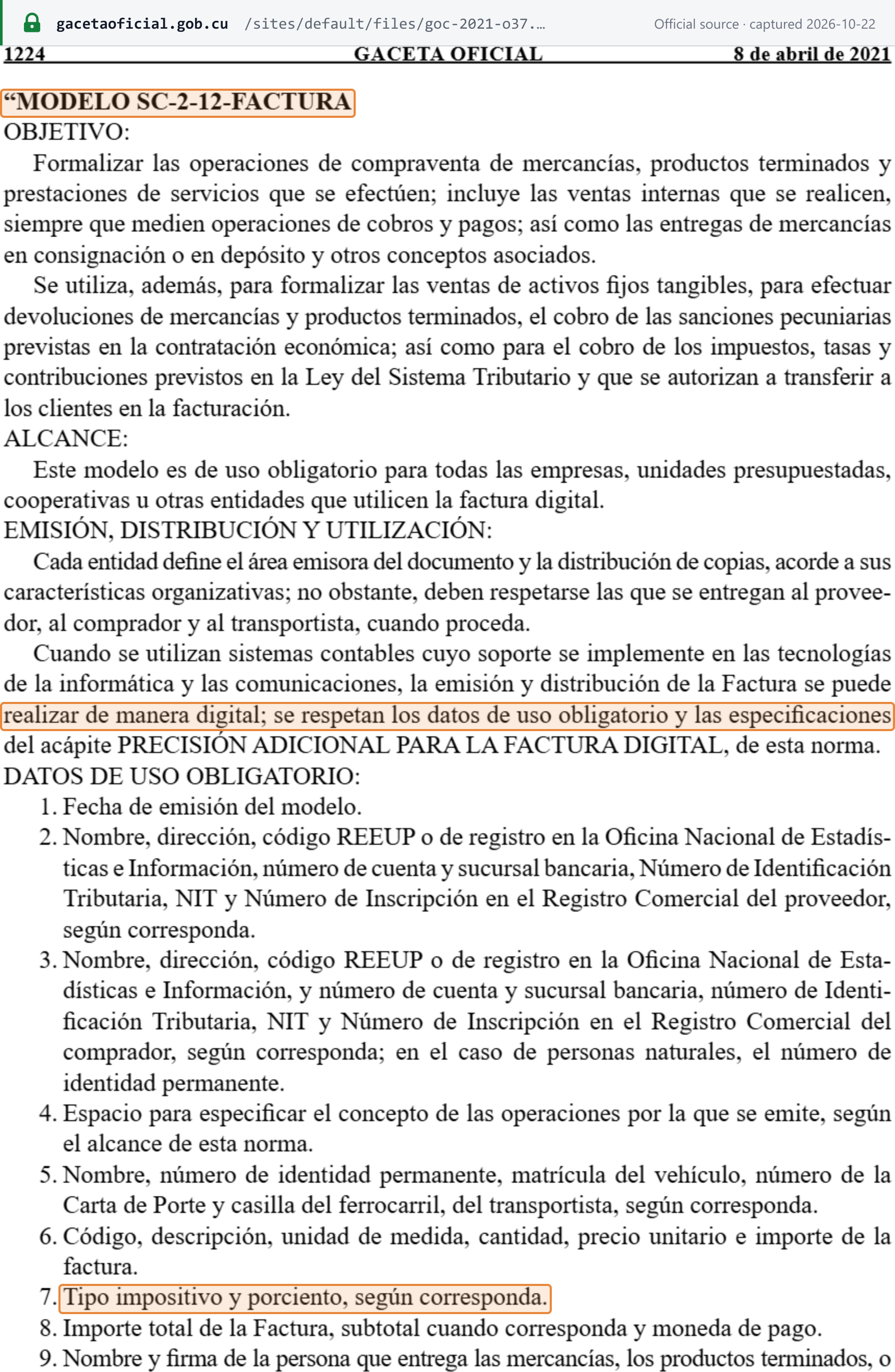 Source snapshot captured 2026-10-22 — original
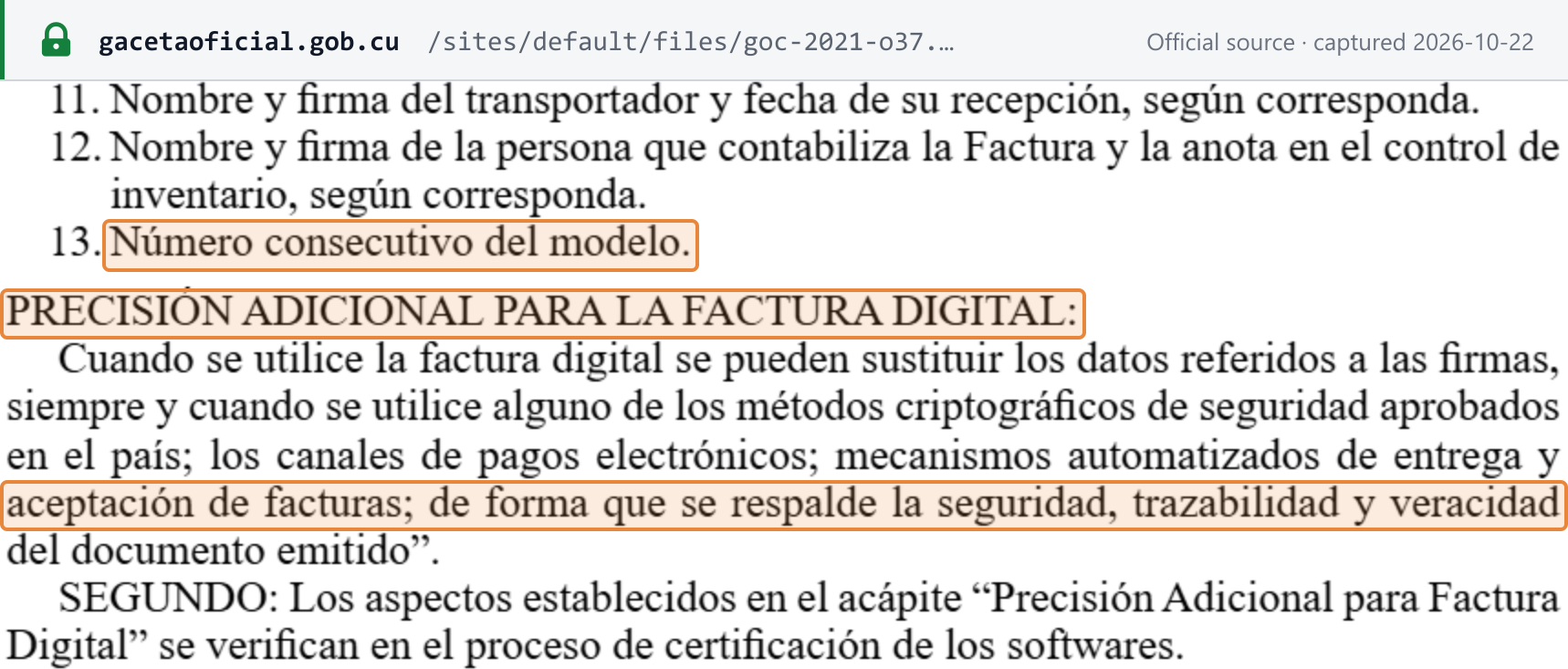 Source snapshot captured 2026-10-22 — original
Issuance deadline
Res 11/2007 and Res 55/2021 set no number of days. Where the invoice cannot be issued at delivery, Modelo SC-2-11 "Conduce" (delivery note) serves "como documento provisional en los casos en que no existan condiciones para efectuar la facturación en el momento de efectuar la entrega"; it also covers partial deliveries that a later Factura brings together (Res 11/2007). [4]
Numbering and sequencing
Each Factura carries the "Número consecutivo del modelo" (dato 13). No further sequencing rule is published.
Credit and debit notes
The MFP norms have no nota de crédito or nota de débito model. Res 55/2021 uses the Factura itself "para efectuar devoluciones de mercancías y productos terminados".
Currency and language
The Factura must state the currency of payment (dato 8). Res 11/2007 and Res 55/2021 set no language requirement and no exchange-rate rule for invoices in foreign currency. The tax itself is paid in CUP unless payment in MLC is authorised (see Overview).
Document types
- Factura (SC-2-12) — on paper or digital.
- Conduce (SC-2-11) — delivery note and provisional document.
- Buyer's certification — a non-agricultural cooperative buying from suppliers "que no emitan documentos justificantes" must certify the purchase itself, stating at least the seller's name, fiscal domicile, NIT, value, date, description, payment method and bank account (Res 307/2023, Vigesimoctavo). [6]
Res 55/2021 repealed MFP Instrucción 15 of 16 June 2006, to unify the invoice rules "con independencia de su forma de emisión". The MFP norms provide no simplified invoice, no value threshold for a lighter document and no rule on retail receipts for TCP or MIPYMES.
Self-billing
Not provided for as such. The cooperative buyer's certification above is the closest equivalent.
Retention and audit trail
- Retention: 5 years. Books, records, vouchers, copies of returns, payment receipts and the other required documents must be kept "en condiciones de auditabilidad o cualquier otra acción de fiscalización, por un término de cinco (5) años" (Ley 113 art. 393 d).
- Electronic records. Where accounts are kept electronically, the media and "los programas respectivos" must be kept operable for five years, and all automated records supplied (art. 393 e).
- Audit access. ONAT staff may use the taxpayer's own programs to extract information (art. 393 g).
- Penalty. Not keeping books, records and "facturas de venta" for five years costs 50–70 cuotas (natural persons) or 60–100 cuotas (legal persons) (Decreto 308 art. 119 c).
No tamper-evidence or hash requirement is published for paper invoices; a digital invoice needs an approved cryptographic method only where it replaces the signatures. [1]
A specimen of a compliant invoice
MFP publishes no official specimen of the Factura. Res 55/2021 and Res 11/2007 are text only — lists of data items with no form image — and ONAT's forms list carries return forms but no invoice model. Below, Lookuptax lays out the thirteen data items for an illustrative domestic sale. Every name, number and code is fictional:
Factura (Modelo SC-2-12) — illustrative
| Códigodato 6 | Descripcióndato 6 | U/Mdato 6 | Cantidaddato 6 | Precio unitariodato 6 | Importedato 6 |
|---|---|---|---|---|---|
| EJ-001 | Resmas de papel | U | 100 | CUP 400.00 | CUP 40,000.00 |
| EJ-002 | Cajas de cartón | U | 50 | CUP 200.00 | CUP 10,000.00 |
- Subtotaldato 8
- CUP 50,000.00
- Tipo impositivo y porcientodato 7
- Impuesto sobre las Ventas — 10 %
- Importe total de la Facturadato 8
- CUP 50,000.00
- Moneda de pagodato 8
- CUP
- Carrier (dato 5): name, identity number, vehicle plate and Carta de Porte number — left out here because the buyer collects the goods.
- Signature blocks, each with name, signature and date: delivered by (dato 9) · received by (dato 10) · carrier (dato 11) · booked by (dato 12). A digital Factura may replace the signatures with an approved cryptographic method, electronic payment channels or automated delivery and acceptance mechanisms.
- The specimen shows the rate only (dato 7): the sales tax is charged on the seller’s gross sales. Res 55/2021 also lets the Factura collect taxes “que se autorizan a transferir a los clientes”; where that authorisation exists, the tax would appear as a line of its own.
E-invoicing status
Status: no e-invoicing mandate and no clearance or real-time reporting system. Res 55/2021 permits a digital Factura: where accounting systems run on information technology, "la emisión y distribución de la Factura se puede realizar de manera digital", respecting the same mandatory data. A digital Factura may drop the signature fields only if it uses an approved cryptographic security method, electronic payment channels or automated delivery and acceptance mechanisms that guarantee "la seguridad, trazabilidad y veracidad del documento emitido", and those features are checked when the accounting software is certified (Res 55/2021, Segundo). Both points are shown in the invoice-rules snapshots above. [3]
- System and network. None published: no portal, network, format or schema.
- Phases by taxpayer size. None.
- Formats and standards. None prescribed beyond the thirteen data items.
- Scope. B2B, B2G and B2C alike: digital issue is optional for all.
No norm in the Gaceta Oficial makes the electronic invoice mandatory. See CTC e-invoicing models for what a mandate would look like, and e-invoicing status and networks worldwide for other countries.
Filing and payment
Filing frequency
Monthly, for every taxpayer class: the taxes are computed on each month's sales or service income and paid after the month closes. No quarterly or annual option is published.
Payment due date
The statutory rule is Ley 113 art. 152:
| Taxpayer | Due |
|---|---|
| Natural persons (including TCP) | Within 20 calendar days after the close of the month in which the sales were made or the services provided |
| Retail trading entities | Within 20 calendar days |
| Wholesale trading entities | Within 60 calendar days |
 Source snapshot captured 2026-10-22 — original
Regime-specific rules:
- Non-agricultural cooperatives (CNA): monthly, within 20 calendar days of month-end, to budget line 011452 (Res 307/2023, Decimonoveno).
- MIPYMES: 10% on the total of monthly income (Res 306/2023, Segundo); no separate day is stated, so art. 152 applies.
- Self-employed (TCP): monthly (Res 271/2024 art. 19), with the 3% bonificación for electronic payment.
- Agricultural retail at markets: daily, to the market operator under a daily sworn declaration; other points of sale on or before the 20th of the following month (Res 348/2025, Tercero–Séptimo).
- Weekends: a term ending on a Saturday moves to the next working day (Ley 113 art. 448). [1] [6] [2]
Return and payment method
Payment is made at bank branches or other authorised offices, to the line ("párrafo") of the State Budget's Clasificador de Recursos Financieros that each norm names — for example 011452 for CNA and 0114822 for local-development projects. ONAT's Portal Tributario at onat.gob.cu is entered with the taxpayer's NIT and password. [16] The name and number of the monthly form, and whether the monthly obligation is a separate sworn declaration or a payment alone, are not set out in Ley 113 or Decreto 308. The annual Declaración Jurada is an income-tax return (personal income tax or profits tax), not a sales-tax return.
Collection of firm debts. Since MFP Res 126/2026 (GOC Ordinaria 53 of 18 June 2026, in force 30 days after publication), ONAT can present an "orden de cobro sin aceptación" to the taxpayer's bank, and the debt "se debita de la cuenta bancaria fiscal o de la cuenta corriente" until paid in full. [11]
Additional listings
None. Ley 113 and Decreto 308 provide no annual sales-tax return and no sales or purchase listing.
Input-tax recovery and blocked items
Not applicable. The base is gross sales or income (arts 135 and 148) and Ley 113 has no credit mechanism, so there is no input tax to recover and no list of blocked items.
Refunds
Only of amounts paid in error or in excess (ingresos indebidos): taxpayers have the right to a refund of "las cantidades ingresadas indebidamente" (art. 426), the claim prescribes one year after payment (art. 429), and ONAT may set recognised credits off against tax debts (art. 427). There is no credit-position refund and no non-resident refund scheme. [1]
Exemptions
Not taxed and exempt supplies
Under Ley 181/2025 for 2026:
- Not subject to the sales tax: books, newspapers, magazines and educational and scientific materials, and other materials for the educational and cultural development of the population (art. 65).
- Not subject to the services tax: electricity transmission by the Unión Eléctrica enterprises (art. 66).
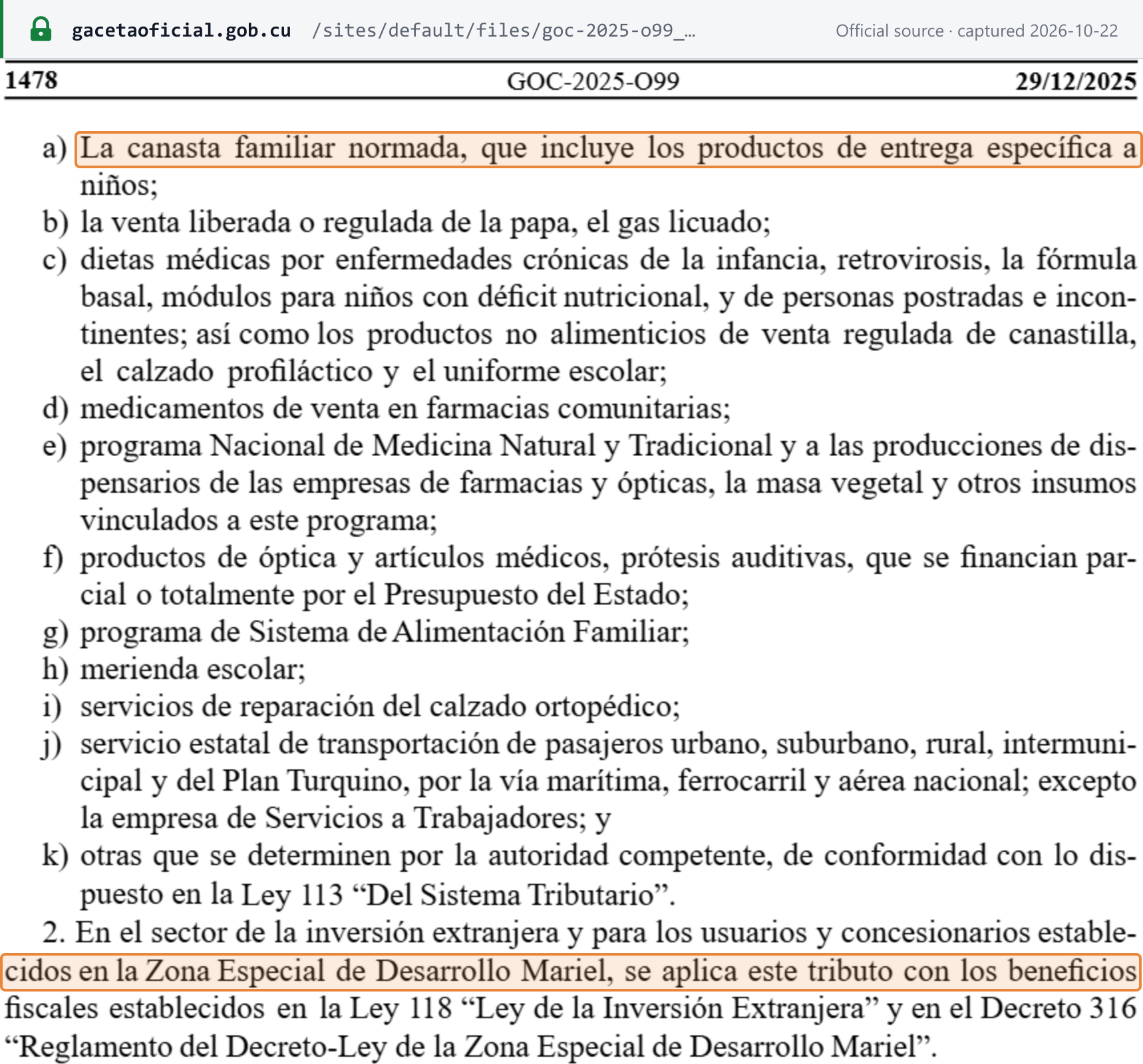
- Exonerated from the sales tax on retail and from the services tax (art. 67.1): the rationed family basket (canasta familiar normada); potatoes and liquefied gas; medical diets and listed children's and medical products; medicines sold in community pharmacies; natural and traditional medicine; optical and medical items financed by the State Budget; the family food programme; school meals; orthopaedic-shoe repair; state passenger transport; and others determined by the competent authority. [2]
 Source snapshot captured 2026-10-22 — original
Permanently, Ley 113 art. 153 excepts goods that are raw material for industrial production and goods and services for export (snapshot under Filing and payment).
Exempt is not zero-rated — and here neither has an input-tax consequence. Because no input tax is ever credited, an exempt or untaxed sale simply bears no tax; there is no credit to keep or lose.
Targeted 2026 wholesale exemptions
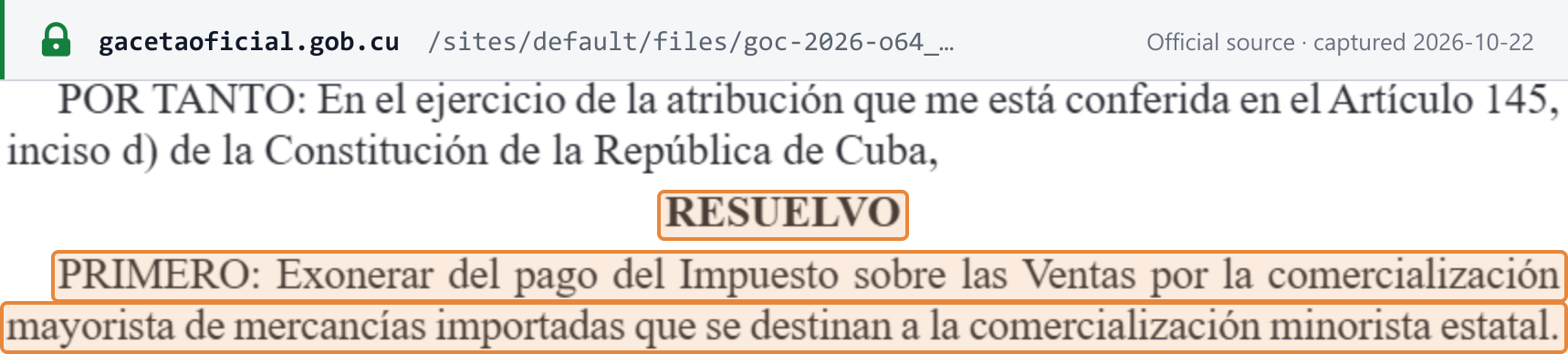
- Imported goods for state retail. Res 160/2026, Primero: "Exonerar del pago del Impuesto sobre las Ventas por la comercialización mayorista de mercancías importadas que se destinan a la comercialización minorista estatal." The wholesaler proves the benefit to ONAT with the supporting invoices (Segundo). In force on publication, 4 August 2026. [8]
- Mercado del Barrio goods. Res 161/2026, Segundo: non-state economic actors are exempt on wholesale of the annex goods destined for the project (snapshot under Rates).
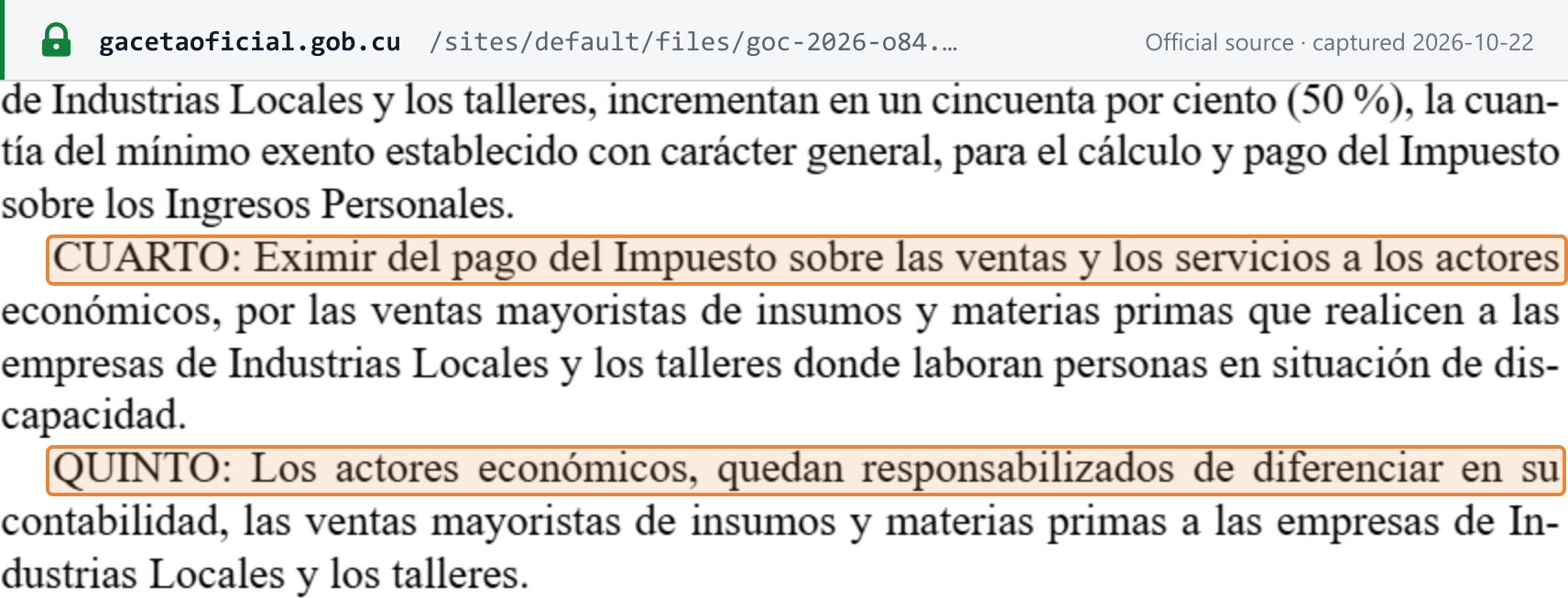
- Inputs to Industrias Locales and disability workshops. Res 201/2026, Cuarto (GOC Ordinaria 84 of 7 October 2026, in force on publication): economic actors are exempt from the sales and services taxes on wholesale of inputs and raw materials to Industrias Locales enterprises and to workshops employing persons with disabilities, and must separate those sales in their accounts (Quinto). [9]
 Source snapshot captured 2026-10-22 — original
 Source snapshot captured 2026-10-22 — original
Special regimes
- Foreign investment and the Mariel Special Development Zone (ZED Mariel): the taxes apply "con los beneficios fiscales" of Ley 118 and Decreto 316 (Ley 181 art. 67.2); those benefits are outside this guide.
- Agriculture: the sales-tax rates on agricultural products are set yearly through the budget law (Ley 113 art. 375) — for 2026, Res 348/2025 (see Rates).
- Local-development projects: 10% / 5% under Res 202/2026.
- Recent graduates not placed under the graduate distribution plan who become TCP: exempt from the sales, special (excise), services and personal income taxes for the first year of operations, counted from the date they completed their studies (Res 271/2024 art. 14.1).
- Remote areas: municipal councils may exceptionally cut the sales and services tax of TCP in hard-to-reach rural and mountain areas by up to 35% (art. 15.3).
- New MIPYMES: exempt for the month of registration (see How to register).
- Cash accounting, margin schemes, flat-rate schemes: none in Ley 113 for these taxes. [1] [7]
Offences and penalties
Offences
The Código Penal (Ley 151/2022) covers crimes against the public treasury:
- Tax evasion (art. 319.1): evading or refusing to pay a tax once the assessment is firm, payment has been demanded and the term has expired — 1 to 3 years' imprisonment, or a fine of 300 to 1,000 cuotas, or both; 2 to 5 years, or 500 to 1,000 cuotas, or both, where the State budget suffers serious harm (art. 319.2).
- Falsification or concealment (art. 320.1): falsifying, hiding or altering information of tax significance, or any other ruse to evade — 2 to 5 years, or 500 to 1,000 cuotas, or both; 3 to 8 years with serious harm.
- Withheld or collected taxes not paid over (art. 322): 2 to 5 years, or 500 to 1,000 cuotas, or both.
- Prosecution for arts 319 and 320 requires a complaint by ONAT's representative (art. 323.1), and the tax administration pursues the debt in parallel (Ley 113 art. 436). [12]
A criminal fine cuota is worth between CUP 10 and 200, set by the court according to the offender's income (Código Penal art. 40.2–3). It is a different unit from the tax-fine cuota below. [12]
Penalties
Tax fines for formal breaches are expressed in cuotas: between 10 and 100 cuotas, each worth CUP 100 to 1,000 "según se disponga en la Ley Anual del Presupuesto del Estado o mediante disposición del ministro de Finanzas y Precios" (Ley 113 art. 439). Ley 181/2025 fixes no value for the cuota, so a fine can be stated only as this range.
| Breach | Penalty | Source |
|---|---|---|
| Late payment (recargo por mora) | 2% if paid within 30 working days of the due date; 5% within 60 working days; then 0.1% per day, up to 40% of the principal | Ley 113 art. 425, as amended by DL 107/2025 |
| Enforced collection (recargo de apremio) | 5% of the debt | art. 424 |
| Not paying the tax, in full or in part, on time | Fine of up to 40% of the principal plus surcharge owed or paid late | art. 438 |
| Not registered, or registration data not updated in time | 10–50 cuotas (natural persons) / 20–60 cuotas (legal persons) | Decreto 308 art. 119 a) |
| Books, records and sales invoices not kept for 5 years | 50–70 / 60–100 cuotas | art. 119 c) |
| Returns and other declarations not filed, or filed late | 20–40 / 30–50 cuotas | art. 119 f) |
| Falsifying, hiding or altering tax documentation | 50–100 / 60–100 cuotas | art. 119 j) |
| Other formal duties | 10–20 cuotas | art. 119 l) |
Decreto 308 lists no specific penalty for failing to issue an invoice; that falls under the residual 10–20-cuota fine for "otros deberes formales" (art. 119 l). Beyond fines, sanctions include loss of tax benefits and temporary or permanent closure of establishments or withdrawal of the licence (Ley 113 art. 440). [1] [5]
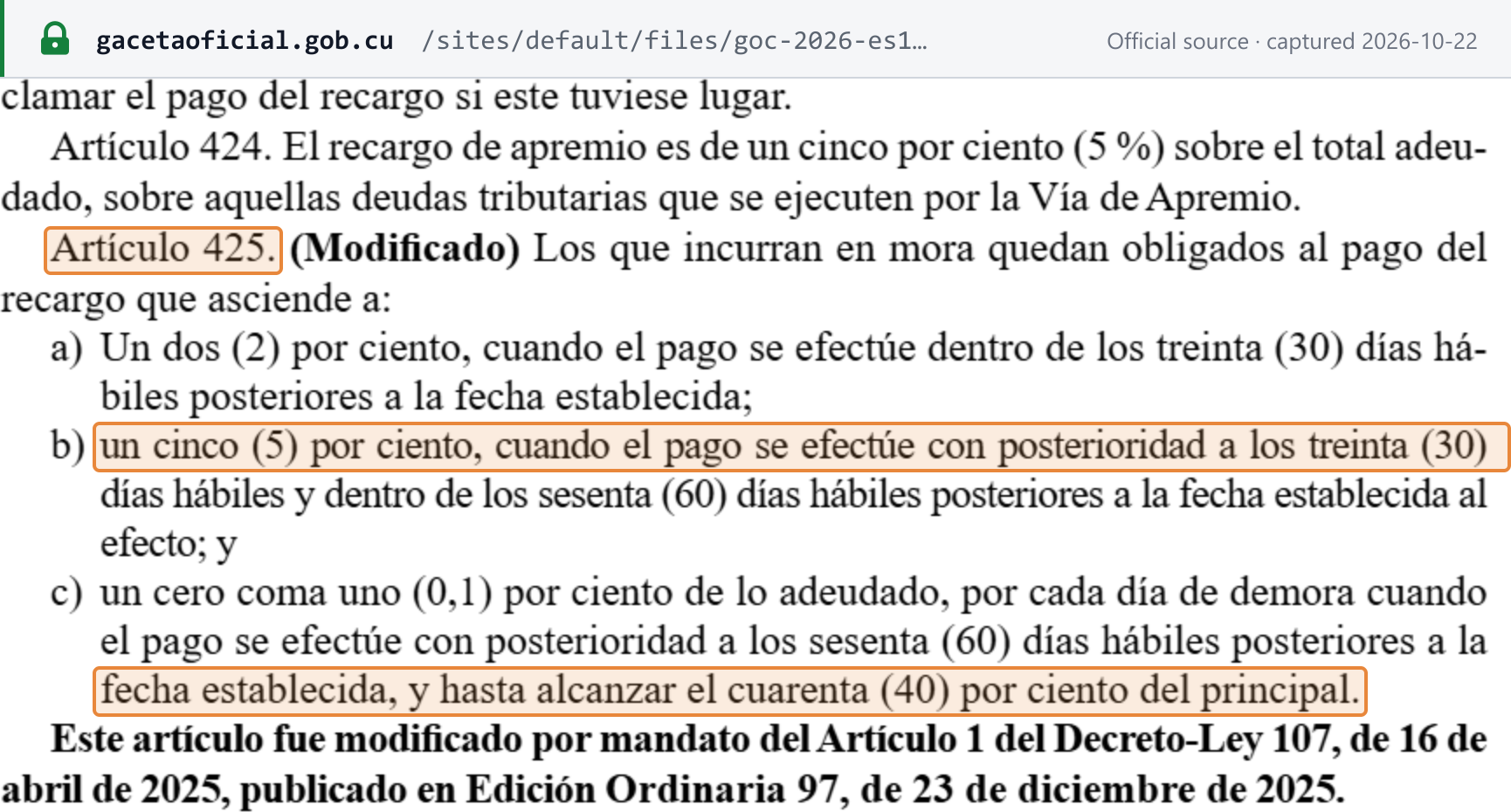 Source snapshot captured 2026-10-22 — original
Frequently asked questions
Does Cuba have VAT? Can we recover the tax we pay on purchases?
No. Cuba has no value added tax. It levies the Impuesto sobre las Ventas on sales of goods and the Impuesto sobre los Servicios on services, each charged on the full amount of sales or service income (Ley 113 articles 135 and 148). Ley 113 contains no mechanism for crediting tax paid on purchases, so the tax cascades through the supply chain. No law or resolution introducing a value added tax has been published in the Gaceta Oficial.
Is there a turnover threshold below which a Cuban business need not register?
No. Every taxpayer must register in ONAT's Registro de Contribuyentes within 15 calendar days: natural persons from the licence or authorisation that creates the tax obligation, legal persons from notification of their entry in the constitutive register (Decreto 308 articles 18 and 20). Ley 113, Decreto 308 and Ley 181 set no monetary registration threshold for the sales or services tax.
Our MIPYME sells wholesale to other businesses. Is that taxed?
Yes. For 2026, Ley 181 article 60 taxes MIPYMES, non-agricultural cooperatives and local-development projects at 10% on the total of their sales and services, wholesale included. Targeted exemptions exist for wholesale of imported goods destined for state retail (Resolution 160/2026), wholesale of the goods listed for the Mercado del Barrio project by non-state actors (Resolution 161/2026) and wholesale of inputs and raw materials to Industrias Locales enterprises and disability workshops (Resolution 201/2026).
When is the monthly sales or services tax due in Cuba?
Natural persons and retail entities pay within 20 calendar days after the close of the month in which they made the sales or provided the services; wholesale entities have 60 calendar days (Ley 113 article 152). A term that ends on a Saturday moves to the next working day (article 448).
Must Cuban invoices be electronic?
No. MFP Resolution 55/2021 permits a digital Factura, which must carry the same mandatory data. Its signature fields may be replaced by an approved cryptographic method, electronic payment channels or automated delivery and acceptance mechanisms, which are checked when the accounting software is certified. No norm in the Gaceta Oficial makes e-invoicing mandatory or creates a clearance system.
We are a foreign company selling software or services to Cuban customers. Do we have to register?
Ley 113 publishes no registration regime, threshold or reverse charge for non-resident suppliers, and no rule for digital services. The services tax falls on whoever provides taxed services in the national territory (articles 146 and 147), and a foreign legal person operating through a permanent establishment in Cuba must appoint a representative resident in Cuba (article 9).
What does paying Cuban sales or services tax late cost?
A surcharge of 2% if paid within 30 working days of the due date, 5% if paid within 60 working days, and after that 0.1% per day up to 40% of the principal (Ley 113 article 425, as amended by Decreto-Ley 107). Failing to pay can also bring a fine of up to 40% of the principal plus surcharge (article 438).
Important websites
| Site | Purpose |
|---|---|
| ONAT — Oficina Nacional de Administración Tributaria | Tax authority; the Portal Tributario for filing, payment and account access (login with NIT and password) |
| Plataforma de Actores Económicos (MEP) | Registration of MIPYMES and non-agricultural cooperatives |
| Municipal ONAT offices and ventanillas únicas | Registration of self-employed workers, other natural persons and other legal persons |
| Gaceta Oficial de la República de Cuba | The laws and resolutions, including each year's rates (search at /es/search/node/) |
| Ministerio de Finanzas y Precios | Ministry news and lists of tax norms |
| Aduana General de la República | Customs: import declarations and duty |
There is no official rate-lookup tool, no public NIT verification service and no e-invoicing portal.
Recent changes
- 2026-10-21 — MFP Res 202/2026: local-development projects pay the sales and services taxes at 10%, and 5% on retail of food from their mini-industries. (Gaceta Oficial)
- 2026-10-07 — MFP Res 201/2026: wholesale of inputs and raw materials to Industrias Locales enterprises and disability workshops exempted from the sales and services taxes. (Gaceta Oficial)
- 2026-08-11 — MFP Res 172/2026 in force: new Impuesto Especial a Productos y Servicios rates on sales of motor vehicles in convertible currency. (Gaceta Oficial) — see event
- 2026-08-04 — MFP Res 161/2026: 5% sales tax on retail of the listed products through Mercado del Barrio establishments, and a wholesale exemption for non-state actors supplying them. (Gaceta Oficial) — see event
- 2026-08-04 — MFP Res 160/2026: wholesale of imported goods destined for state retail exonerated from the sales tax. (Gaceta Oficial) — see event
- 2026-06-18 — MFP Res 126/2026 published: ONAT may collect firm tax debts by direct debit from the taxpayer's bank account, from 30 days after publication. (Gaceta Oficial)
- 2026-01-01 — Ley 181/2025 rates for 2026 (10% general, 5% for ETECSA telecommunications) and MFP Res 348/2025 agricultural rates (10% / 5%) take effect. (Gaceta Oficial)
- 2025-12-23 — Decreto-Ley 107/2025 published: new late-payment surcharge scale and payment of taxes in CUP. (Gaceta Oficial)
For the full chronology, see Cuba tax changes on Lookuptax.
Reference links
- Gaceta Oficial Edición Especial No. 1 of 12 January 2026 — concorded texts of Ley 113/2012 "Del Sistema Tributario" and Decreto 308/2012
- Gaceta Oficial Ordinaria No. 99 of 29 December 2025 — Ley 181/2025 "Del Presupuesto del Estado para el año 2026" and MFP Resolución 348/2025
- Gaceta Oficial Ordinaria No. 37 of 8 April 2021 — MFP Resolución 55/2021 (Modelo SC-2-12 Factura and the digital invoice)
- Gaceta Oficial Ordinaria No. 15 of 12 February 2007 — MFP Resolución 11/2007 (models including SC-2-11 Conduce)
- Gaceta Oficial Ordinaria No. 97 of 23 December 2025 — Decreto-Ley 107/2025, Decreto 131/2025 and ONAT Resolución 162/2025 (NIT)
- Gaceta Oficial Ordinaria No. 5 of 2024 — MFP Resoluciones 306/2023 (MIPYMES) and 307/2023 (non-agricultural cooperatives)
- Gaceta Oficial Ordinaria No. 78 of 19 August 2024 — MFP Resolución 271/2024 (self-employed workers)
- Gaceta Oficial Ordinaria No. 64 of 4 August 2026 — MFP Resoluciones 160/2026 and 161/2026
- Gaceta Oficial Ordinaria No. 84 of 7 October 2026 — MFP Resolución 201/2026
- Gaceta Oficial Ordinaria No. 87 of 21 October 2026 — MFP Resolución 202/2026 (local-development projects)
- Gaceta Oficial Ordinaria No. 53 of 18 June 2026 — MFP Resolución 126/2026 (collection of tax debts)
- Gaceta Oficial Ordinaria No. 93 of 1 September 2022 — Ley 151/2022, Código Penal
- Gaceta Oficial Ordinaria No. 65 of 4 August 2026 — MFP Resolución 172/2026 (excise on vehicles)
- ONAT — Inscripción en el Registro de Contribuyentes (registration page, July 2024)
- Gaceta Oficial — norm page for MFP Resolución 56/2026
- ONAT — home page and Portal Tributario login (archived 16 June 2026)
- Gaceta Oficial — norm page for MFP Resolución 55/2021
Related on Lookuptax: