Dominican Republic ITBIS guidelines
| FACTSHEET | |
|---|---|
| Country code | DO |
| Tax name | ITBIS — Impuesto sobre Transferencias de Bienes Industrializados y Servicios |
| Tax Authority | DGII (Dirección General de Impuestos Internos) |
Overview
The Dominican Republic's value-added tax is the ITBIS — Impuesto sobre Transferencias de Bienes Industrializados y Servicios (tax on transfers of industrialised goods and services). The DGII describes it as "un impuesto general al consumo tipo valor agregado" (a general consumption tax of the value-added type) that applies to the transfer and import of industrialised goods and to the supply of services. Each taxpayer charges ITBIS on its sales and deducts the ITBIS it paid on its purchases. This guide reflects the rules as at 14 October 2026. [1]
Authority. ITBIS is administered by the Dirección General de Impuestos Internos (DGII): "Este impuesto será administrado por la Dirección General de Impuestos Internos" (Tax Code, article 351). ITBIS on imports is assessed and paid together with customs duties. [2]
Statute. The Tax Code (Código Tributario, Law 11-92), Title III, articles 335 to 360, implemented by Regulation 293-11 and the DGII's general rules (Normas Generales). [2] [12]
What is taxed. Under article 335: the transfer of industrialised goods, the import of industrialised goods, and the supply and hire of services. [2] The DGII lists as not subject to ITBIS: real estate; money, securities and shares; transfers of copyrights, industrial property, licences and other rights that do not involve a tangible movable good; and leases of rights or intangibles. [3]
Currency. Dominican pesos (DOP, written RD$).
Tax period. "El período fiscal es el mes calendario" (the tax period is the calendar month; article 353). [2]
Layering. ITBIS is a single national tax. There is no provincial or municipal VAT.
For neighbouring systems, see the Mexico VAT guide and the Colombia VAT guide.
Registration
Who should register
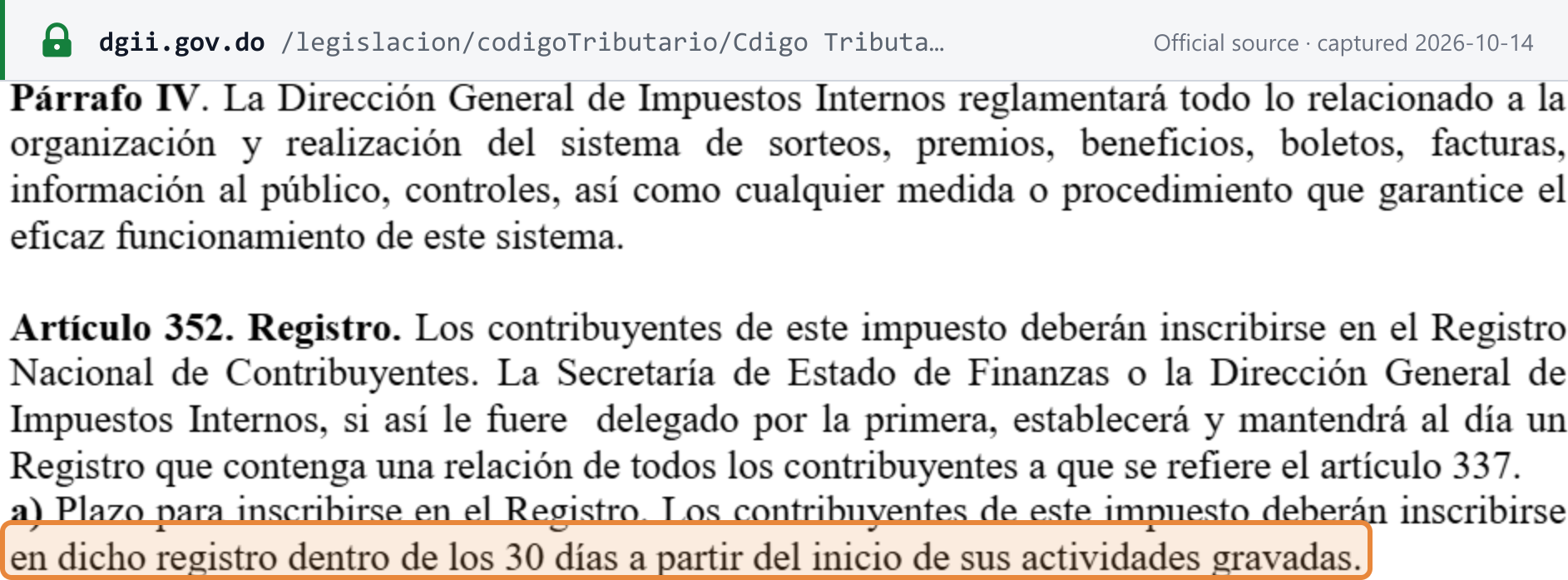
ITBIS taxpayers are individuals, companies and businesses, "nacionales o extranjeras" (Dominican or foreign), that transfer industrialised goods in the course of an industrial or commercial activity, that import taxed goods, or that supply taxed services (article 337). They must register in the Registro Nacional de Contribuyentes (RNC) "dentro de los 30 días a partir del inicio de sus actividades gravadas" (within 30 days of starting their taxed activities; article 352). [2]
A person that supplies only exempt goods or services is not an ITBIS taxpayer, and the ITBIS it pays on purchases is a cost (see Exemptions). [12]
Registration threshold
None. Title III of the Tax Code sets no turnover threshold for ITBIS: the obligation to register attaches to the start of taxed activities, whatever their value. [2]
Non-resident registration
The Code treats Dominican and foreign persons alike, with no threshold. A foreign company that transacts in the country registers a local entity or branch: its constitutive documents must be translated into Spanish, apostilled and registered at the Chamber of Commerce before the RNC application. [2] [4]
There is no ITBIS registration scheme for foreign suppliers of remote or digital services (see Digital products and services). Importers that are not registered bear an ITBIS perception at customs (see Imports and exports).
Tax identification number
The RNC is the DGII's taxpayer number. "Para las Personas Físicas este código será su número de cédula de identidad y para las Personas Jurídicas y extranjeros sin cédula es una numeración de 9 dígitos asignada por Impuestos Internos" — for individuals it is the 11-digit cédula; for legal persons, and foreigners without a cédula, it is a 9-digit number assigned by the DGII. The first digit of a 9-digit RNC shows the type: 1 for a for-profit legal person, 4 for a non-profit legal person, 5 for a foreign individual. [4]
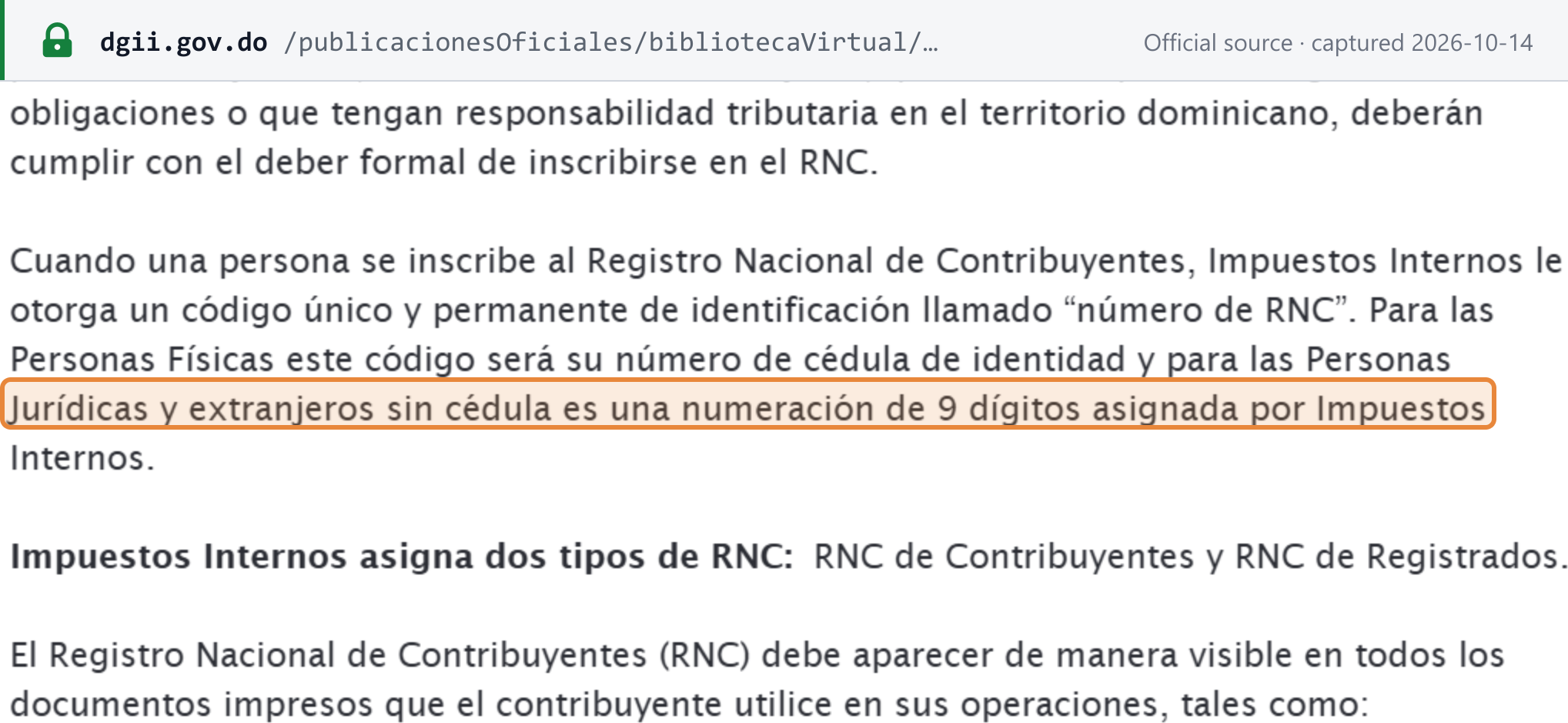
The DGII distinguishes contribuyentes (with recurring filing obligations) from registrados (holders who only carry out occasional procedures, such as a vehicle or property transaction, a refund or a one-off payment). The RNC must appear on every invoice. [5] [4]
Check an RNC with the Dominican Republic RNC validator, or see how to verify an RNC on the DGII portal.
How to register
You can apply for an RNC in three ways: online through the DGII Oficina Virtual (OFV), in person at a DGII local office, or through the single business-formation window Formalízate. [4]
Legal persons file Form RC-02 with: [4]
- the Registro Mercantil (commercial register) certificate;
- the statutes registered at the Chamber of Commerce, naming the person responsible for tax obligations;
- identity documents or passports of the shareholders;
- the receipt for the 1% company-formation tax. The DGII notes that Law 30-26 (article 58) repeals this tax from 2027.
The start-of-operations date you declare "nunca podrá exceder de 60 días contados desde la fecha de solicitud" (can never be more than 60 days after the application). The DGII may register, without notice, anyone holding a Registro Mercantil who has not completed RNC registration within 60 days. [4]
A new taxpayer that applies for authorisation to issue fiscal receipts gets the DGII's answer "en un plazo máximo de diez (10) días laborales" (within ten working days at most; Norma General 06-2018, article 3, paragraph II). [6] New registrants must also join the e-CF system within 120 days (see E-invoicing status).
Voluntary registration
Not applicable. With no threshold, every business that starts taxed activities must already register, so there is nothing to opt into.
Deregistration
- Permanent (dado de baja). Applies on dissolution or liquidation of a legal person, among other listed cases, including a legal person that has been suspended for three consecutive years with no operations, debts or assets. File Form RC-02 with a final income-tax return, the dissolution minutes registered at the Chamber of Commerce and a notarised guarantee letter. The closure must be notified "en un plazo de sesenta (60) días contados a partir del acta de la asamblea de liquidación" (within 60 days of the liquidation minutes). After the declared cessation date, the taxpayer "no podrá solicitar ni emitir NCF" (may not request or issue fiscal receipts). [4]
- Temporary cessation (cese temporal). An approved pause of operations "por un periodo máximo de tres (3) años" (for at most three years). [4]
Group registration
Not available. The Code has no voluntary VAT grouping. Article 337 works the other way: the tax administration may require commonly controlled persons making taxed supplies to be treated "como un solo contribuyente" (as a single taxpayer), and an individual who owns, controls or runs several taxed businesses is one taxpayer. [2]
Rates
| Rate | Applies to |
|---|---|
| 18% | General rate: taxed transfers, imports and services |
| 16% | Reduced rate: yogurt and butter, coffee, edible animal and vegetable fats, sugar, cocoa and chocolate |
| 0% | Exported goods, with deduction and refund of input ITBIS |
| Exempt | Goods listed in article 343 and services listed in article 344 (see Exemptions) |
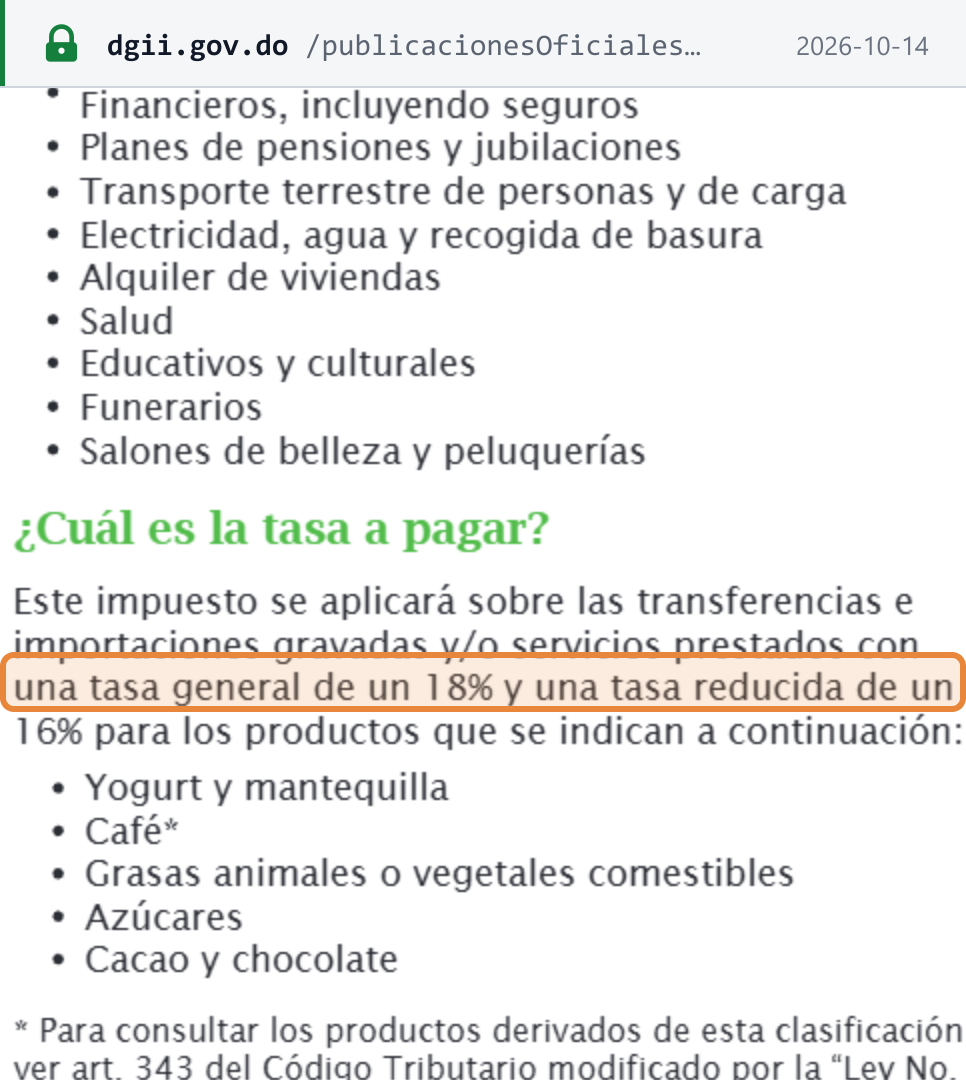
General rate: 18%. Reduced rate: 16%. The DGII's ITBIS guide (July 2026 edition): "Este impuesto se aplicará sobre las transferencias e importaciones gravadas y/o servicios prestados con una tasa general de un 18% y una tasa reducida de un 16%" for yogurt and butter, coffee, edible animal or vegetable fats, sugars, and cocoa and chocolate. [1] The DGII rate sheet gives the same rates, plus "tasa 0% para los exportadores". [7]
The 16% list is closed and defined by tariff heading in article 345 of the Code: yogurt (0403.10.00) and the other products of tariff 0403.90.00 ("Los demás"); butter; roasted or decaffeinated coffee and substitutes containing coffee; edible animal and vegetable fats and oils (soya, peanut, palm, sunflower, coconut and corn oils) and margarine; cane and beet sugar; cocoa powder and chocolate in bars or blocks. Article 345 sets these goods at 8% in 2013, 11% in 2014 and 13% in 2015, and 16% from 2016. [2]
Article 345 also still carries the general-rate text of Law 253-12, which scheduled a cut to 16% from 2015 subject to a tax-revenue target. The DGII's current guidance applies 18%. Article 341 of the consolidated Code is printed as "16%*" with an editor's note referring to article 345; read the two together. [2] [1]
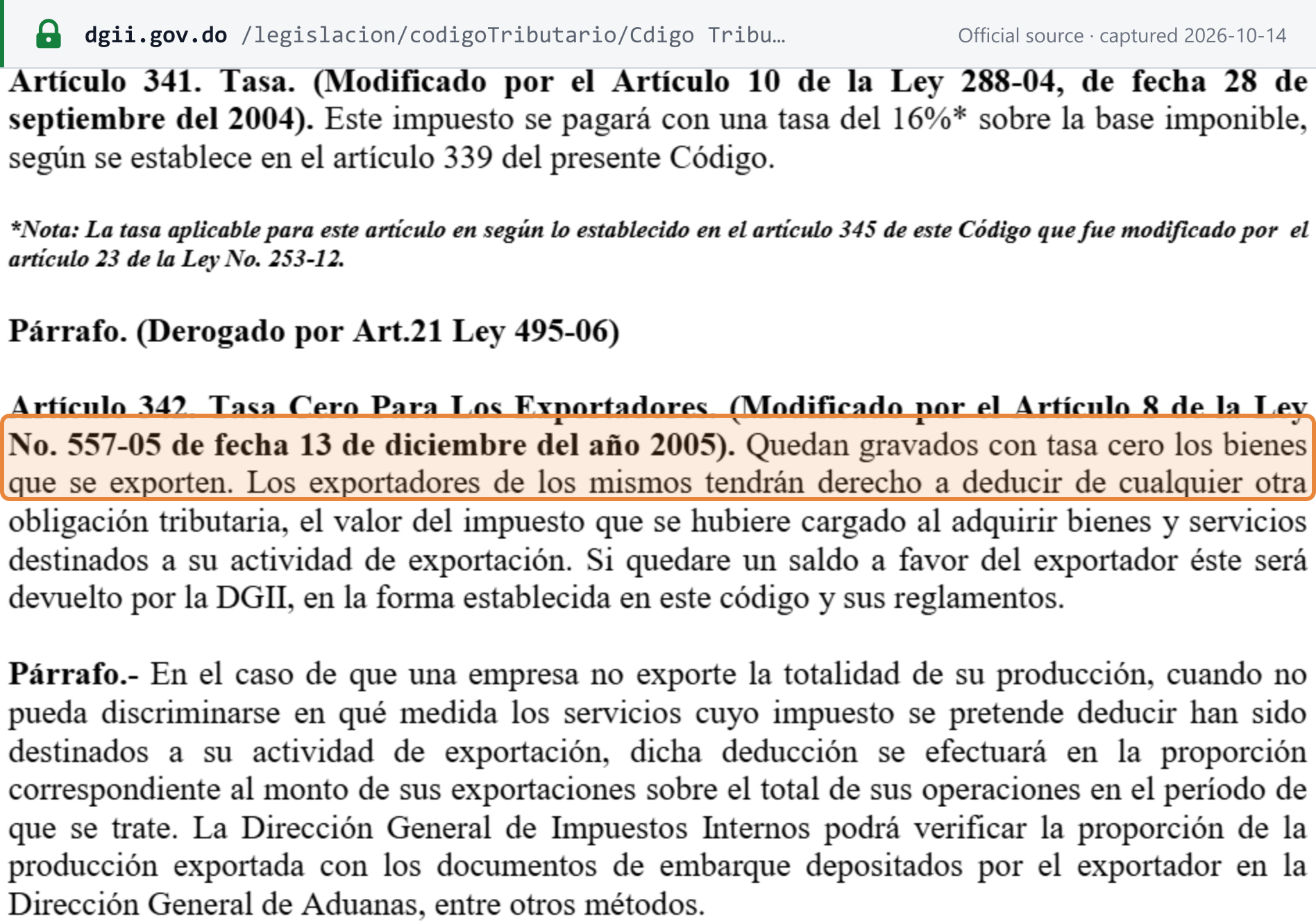
Zero rate. "Quedan gravados con tasa cero los bienes que se exporten" (exported goods are taxed at zero rate; article 342). [2]
Announced changes. No change to the ITBIS rates has been enacted. Law 30-26 (promulgated 18 June 2026) changes the exempt lists, not the rates, and the DGII's calendar of Law 30-26 measures (Aviso 10-26) lists no ITBIS rate item. [8] [9]
Cross-border rules
Imports and exports
Imports of goods. "En el caso de la importación de bienes el impuesto se liquidará y pagará conjuntamente con los impuestos aduaneros correspondientes" (article 354): ITBIS on imports is assessed and paid with customs duties. The base is the customs value plus all taxes on the import (article 339). A registered importer deducts the ITBIS paid at customs as input tax (article 346). [2]
ITBIS perception on informal importers (Law 30-26). Article 34 of Law 30-26 (promulgated 18 June 2026; in force on its promulgation and publication under article 62) adds article 354-1 to the Code: [9]
- An informal importer is a person not registered in the RNC with an economic activity that makes it liable for ITBIS.
- Customs applies an ITBIS perception on the customs declaration of an informal importer.
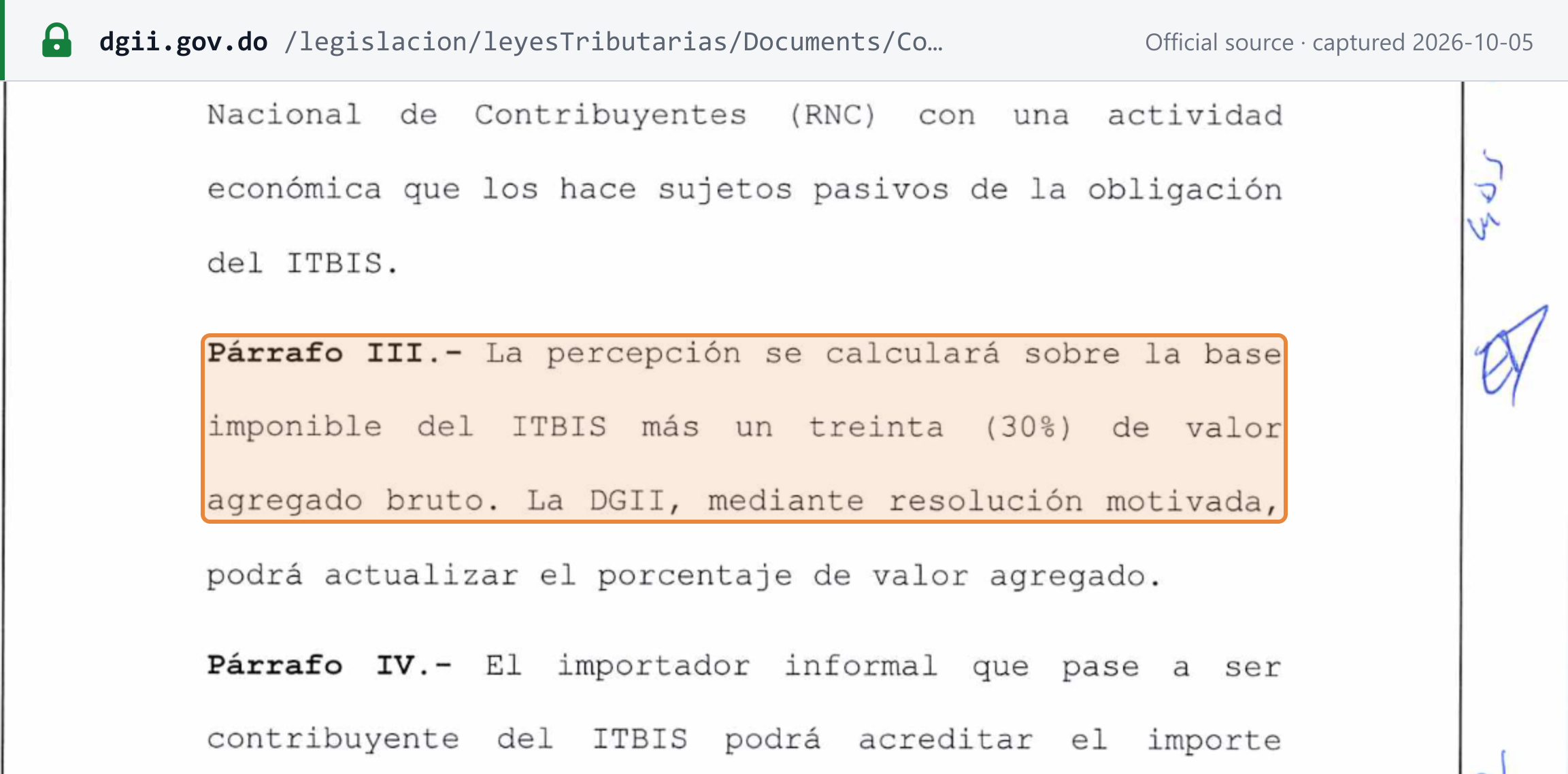
- "La percepción se calculará sobre la base imponible del ITBIS más un treinta (30%) de valor agregado bruto" — the base is the ITBIS base plus 30% gross added value. The DGII may update the percentage by reasoned resolution.
- An informal importer that later registers can credit the perception for periods that have not prescribed. The DGII and customs are to issue joint implementing rules.
Exports. Exported goods are zero-rated, and exporters may deduct the ITBIS paid on purchases for their export activity "de cualquier otra obligación tributaria" (from any other tax obligation), with any balance refunded (article 342; see Refunds). Exporters that also sell locally apportion their input tax. [2]
Exported services. The zero rate in article 342 covers goods. Exported services are exempt, not zero-rated: Regulation 293-11 lists them among exempt services (article 14, literal j) where the service is supplied from Dominican territory and used and consumed exclusively abroad by a person who is neither domiciled nor resident in the country and pays with foreign-source income. The DGII has held that a service performed and used in the Dominican Republic for a foreign client is taxed, not exported (Consulta 9-2022). [12] [37] Exports of goods are documented with an export receipt (e-CF type 46), while "los servicios exportados serán sustentados en facturas de consumo" (exported services are documented with consumer invoices; Norma General 05-19, article 10). [10]
Free zones. Goods transferred from the national territory to an industrial free zone are treated as exported, and goods leaving a free zone for the national territory as imported (article 357). Imports of inputs and equipment by free-zone companies are exempt (article 343). [2]
Digital products and services
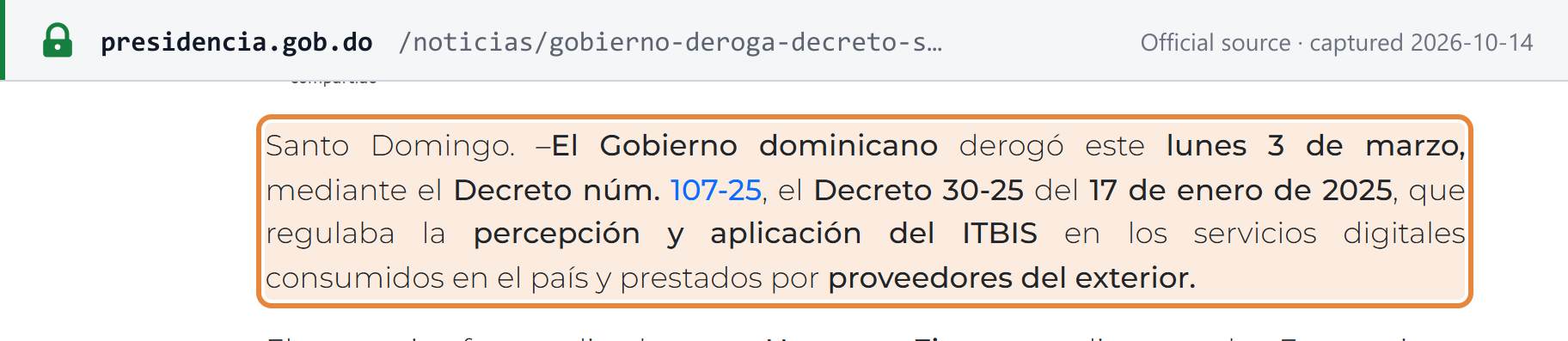
No ITBIS is collected on digital services supplied from abroad. Decree 30-25 of 17 January 2025 regulated an ITBIS perception on digital services consumed in the country and supplied by foreign providers. The government repealed it on 3 March 2025: "El Gobierno dominicano derogó este lunes 3 de marzo, mediante el Decreto núm. 107-25, el Decreto 30-25". [11] The ITBIS chapter of Law 30-26 (articles 34 to 39) contains no digital-services provision. [9]
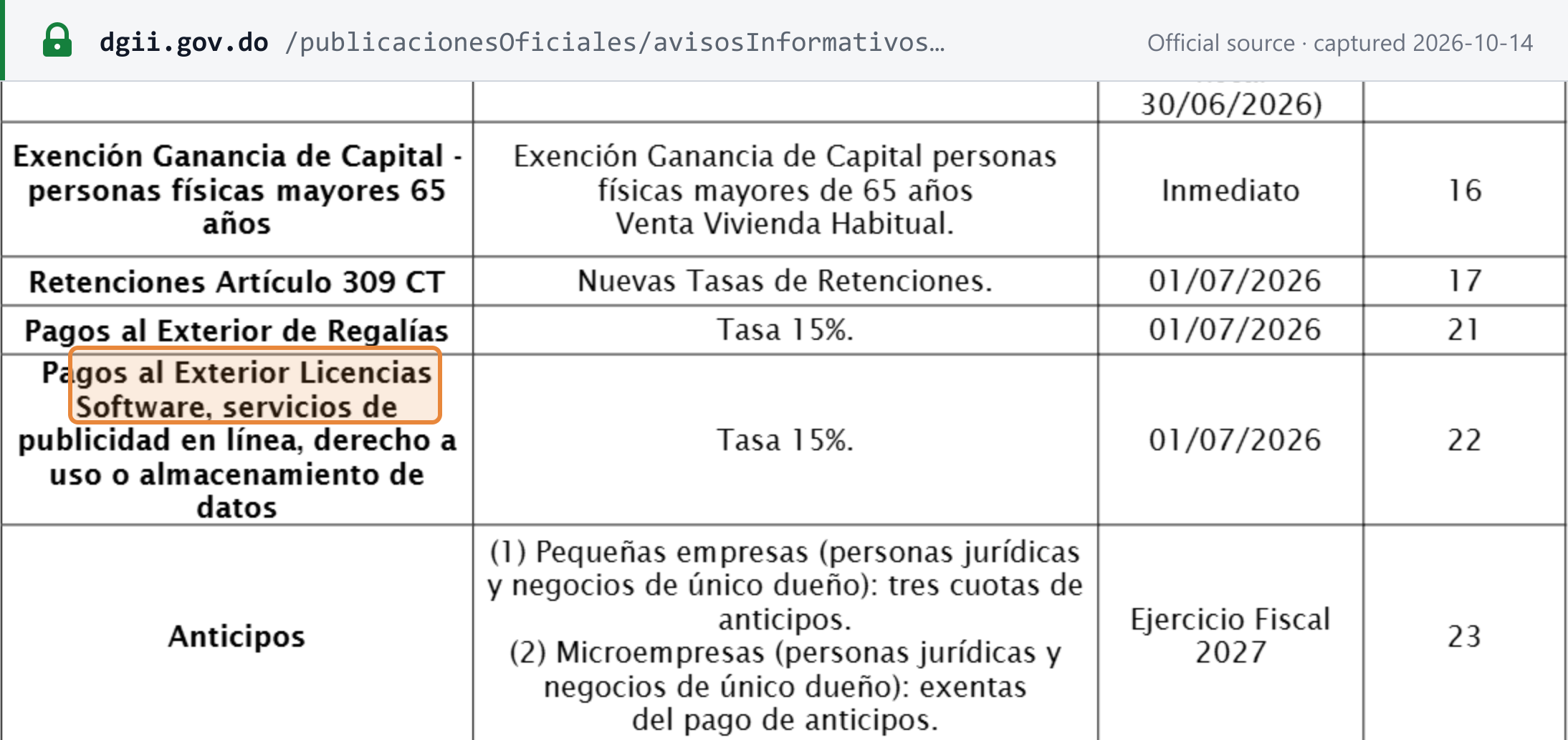
The 15% from 1 July 2026 is income tax, not ITBIS. Article 22 of Law 30-26 (new article 305-2 of the Code) requires anyone who pays non-residents for "licencias de software, servicios de publicidad en linea, derecho a uso o almacenamiento de datos" (software licences, online advertising, and data use or storage) to withhold 15% of the gross amount as a final payment of income tax. The DGII's calendar dates it from 1 July 2026. The withholding agent is whoever pays or credits the amount ("Quienes paguen o acrediten en cuenta"). It is a withholding of income tax, not an ITBIS charge. [9] [8]
See VAT on digital services by non-resident suppliers for how other countries tax them.
Foreign companies selling into the Dominican Republic — B2B and B2C
- Goods (B2B and B2C): the importer of record pays ITBIS at customs. An importer not registered in the RNC also bears the Law 30-26 perception on the base plus 30%. [2] [9]
- Remote services to consumers (B2C): there is no registration or collection mechanism for foreign suppliers; Decree 30-25 was repealed on 3 March 2025. [11]
- Remote services to businesses (B2B): the Dominican buyer's input-tax credit covers only ITBIS paid to local suppliers and at customs (article 346). On the payment abroad, the buyer's obligations are income-tax ones: it issues a Pagos al Exterior receipt (e-CF type 47) for Dominican-source income paid to a non-resident on which it must withhold income tax in full, and reports the payment on Formato 609. For software licences, online advertising and data, the withholding is 15% from 1 July 2026. [2] [10] [9]
Marketplace / platform deemed-supplier liability
Not applicable: neither Title III of the Tax Code nor Law 30-26 makes a marketplace or platform liable for ITBIS on sales made through it. The nearest mechanism is the withholding and perception that card acquirers and payment aggregators apply to domestic merchants under Norma General 06-23 (see ITBIS withholding). [2] [9] See marketplace deemed-supplier rules.
Place of supply
- Goods are taxed on transfer in the country and on import (article 335). [2]
- International passenger transport by air and sea is taxed "cuando el pasaje haya sido adquirido en la República Dominicana" (when the ticket was bought in the Dominican Republic), and a ticket bought abroad is taxed when the journey starts in the Dominican Republic (Regulation 293-11, article 3). [12]
- Other services: Title III of the Code contains no general place-of-supply article for services.
Invoice requirements
Every supply, taxed or exempt, must be documented with a comprobante fiscal (fiscal receipt) carrying a number authorised by the DGII, and the ITBIS must appear separately from the price (article 355). [2] Paper receipts carry an NCF in series "B"; electronic receipts (e-CF) carry an e-NCF in series "E". Electronic invoicing is mandatory and is replacing paper by taxpayer group (see E-invoicing status).
Document types
| e-CF type | Document | When it is used |
|---|---|---|
| 31 | Factura de Crédito Fiscal | Sales to businesses; supports the buyer's costs and input ITBIS |
| 32 | Factura de Consumo | Sales to final consumers; no credit value |
| 33 | Nota de Débito | Increases an earlier receipt |
| 34 | Nota de Crédito | Reduces or cancels an earlier receipt |
| 41 | Compras | Issued by the buyer when buying from a person not registered as a taxpayer |
| 43 | Gastos Menores | Minor staff expenses |
| 44 | Regímenes Especiales | Sales to special-regime and free-zone entities |
| 45 | Gubernamental | Sales to the government |
| 46 | Exportaciones | Export sales |
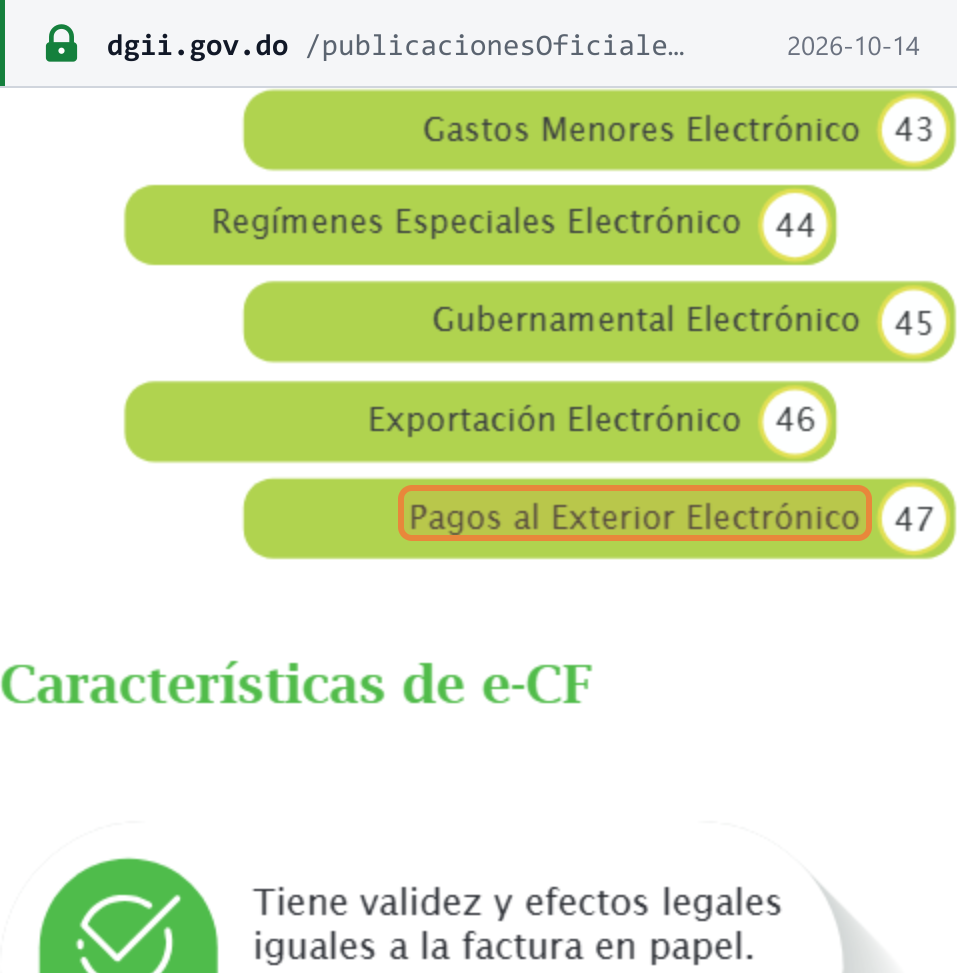
| 47 | Pagos al Exterior | Dominican-source income paid to non-residents |
The basic types are set by Decree 254-06 (article 4); the type codes and uses are in the DGII's e-invoicing guide and Norma General 05-19. The choice depends on who the buyer is, not on the amount: there is no value threshold that permits a simplified invoice. [14] [13] [10]
Mandatory content
Decree 254-06 (articles 7 to 9) sets the content of a fiscal receipt, and Norma General 06-2018 (article 7) its layout: [14] [6]
| Block | Field |
|---|---|
| Document | Type of document (crédito fiscal or consumo); NCF or e-NCF; sequence expiry date (crédito fiscal only); on a credit or debit note, the NCF it modifies |
| Issuer | RNC; legal name as registered; trade name; issuing point (branch); issue date |
| Buyer | RNC and legal name (crédito fiscal and notes) |
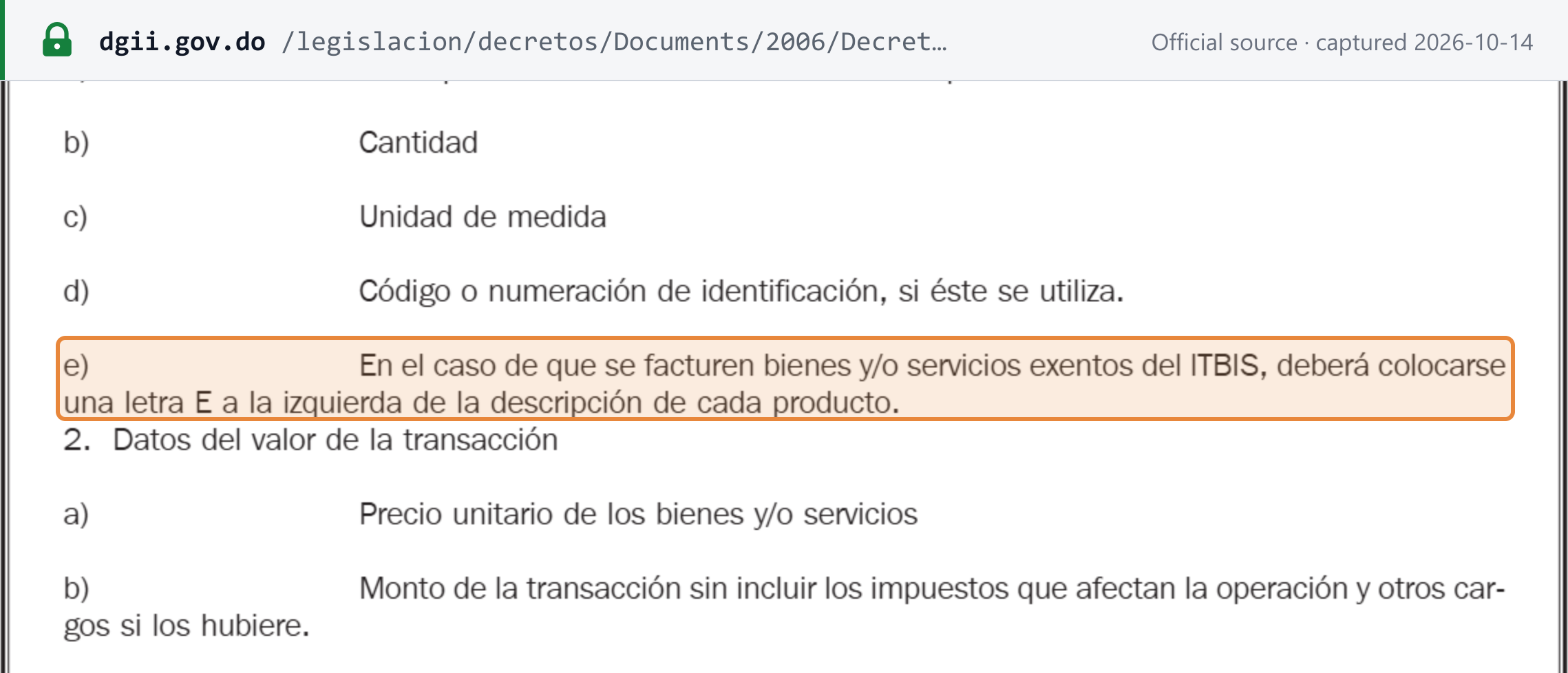
| Lines | Description, quantity and unit of measure; item code where used; unit price; an "E" to the left of each ITBIS-exempt item |
| Totals | Net amount before taxes; discounts and charges; ITBIS, selective excise (ISC) and any other charge, each shown separately; grand total |
| Copies | Each copy states who it is for (original for the buyer, copy for the issuer) |
Decree 254-06: "En el caso de que se facturen bienes y/o servicios exentos del ITBIS, deberá colocarse una letra E a la izquierda de la descripción de cada producto" (where ITBIS-exempt goods or services are invoiced, an E must be placed to the left of each item's description). [14]
An e-CF must also carry, under article 18 of Law 32-23, the document identification, issuer, buyer or receiver, goods or services, transaction value, taxes, "fecha y hora de la firma digital" (date and time of the digital signature) and the digital signature. [19] A buyer that does not receive e-CF electronically gets a printed representation (RI) with a QR code and a security code. [13]
Issuance deadline
The tax point (article 338) is: [2]
- Goods: when the invoice or equivalent document is issued, or on delivery if that comes first.
- Services: the earliest of the invoice, completion of the service, or payment.
Every supply, taxed or exempt, needs a fiscal receipt (article 355). If a sale is undone within 30 days and the goods are returned, the tax obligation is annulled (article 338). [2]
Numbering and sequencing
- An e-NCF is "E" followed by the two-digit e-CF type and a ten-digit sequence: 13 characters in all (for example
E310000000001). [13] [15] - The DGII authorises the sequences. An authorised sequence is valid for up to two calendar years, counting the year of authorisation (Norma General 06-2018, article 6). [6] Unused sequences authorised in 2024 lapsed on 1 January 2026 (Aviso 29-25). [16]
Credit and debit notes
Credit and debit notes may be issued only to the same buyer as the original receipt and must quote the NCF they modify (Decree 254-06, articles 4 and 9). [14] Once an e-CF has been sent to the DGII, it can be corrected only by an electronic credit or debit note, and cancelling it also requires an electronic credit note (Decree 587-24, article 11). [17]
Currency and language
Books "deben ser llenados en lengua castellana" (must be kept in Spanish; Tax Code article 50). [18]
Self-billing
There is no general self-billing between registered businesses. The buyer-issued Comprobante de Compras (B11 / e-CF type 41) is used when buying from a person not registered as a taxpayer. The buyer must first check on the DGII portal that the seller is not registered, and "la retención del cien por ciento (100%) del valor del ITBIS facturado aplicará en todos los casos en que se emita este tipo de comprobante" (100% of the ITBIS is withheld whenever this receipt is issued; Norma General 05-19, article 7). [10]
Retention and audit trail
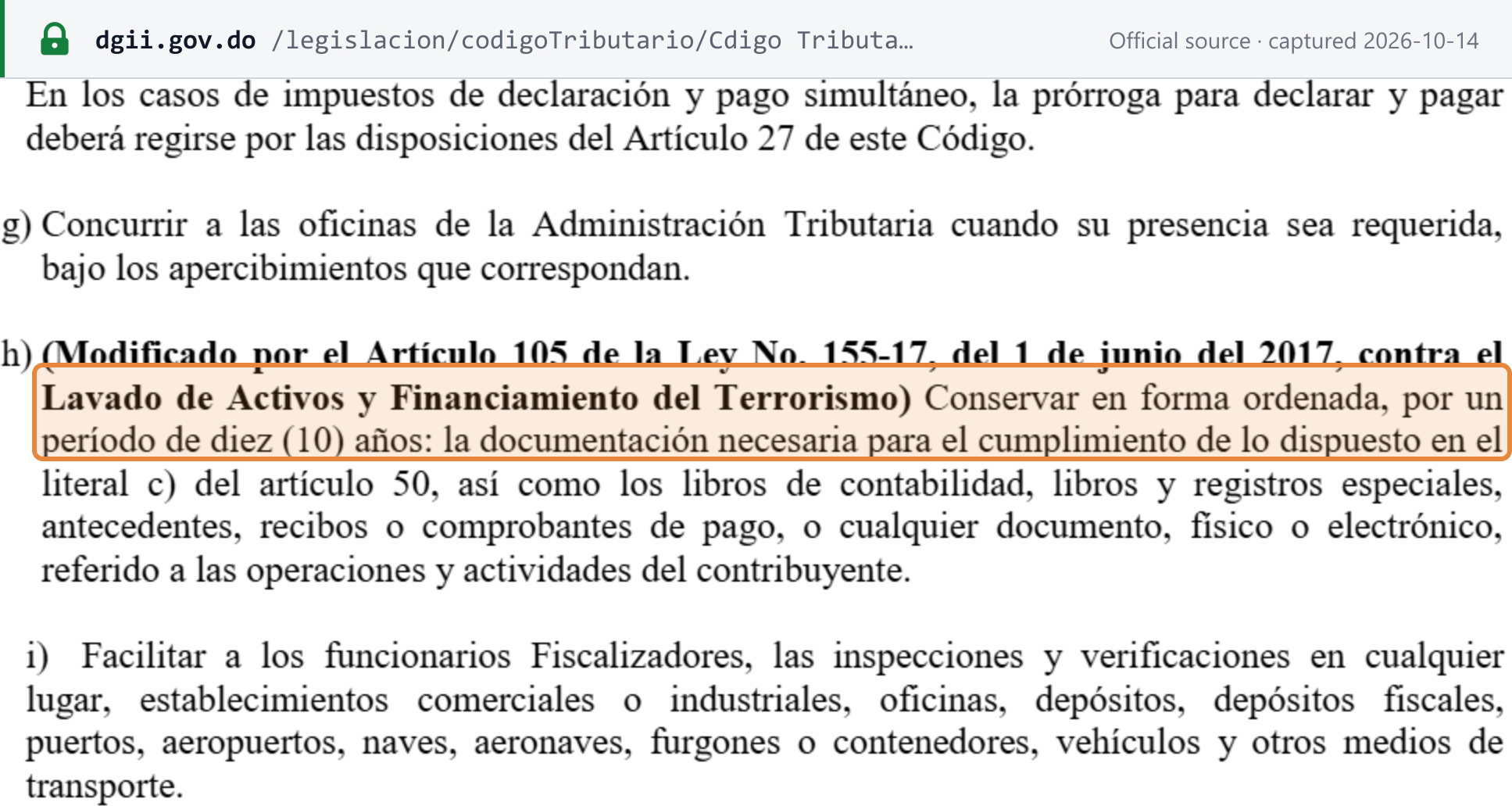
- Retention: 10 years. Taxpayers must keep their books, records, receipts "o cualquier documento, físico o electrónico" (or any document, physical or electronic) "por un período de diez (10) años" (Tax Code article 50). [18]
- Audit window: 3 years. The DGII's power to assess prescribes after three years (Tax Code article 21). The 10-year retention period is longer than the audit window. [18]
- Audit trail for e-CF. Every e-CF is digitally signed and validated by the DGII, which returns a TrackID and a status: accepted, conditionally accepted, rejected or in process (Law 32-23, articles 19 and 20). Modifying an e-CF after it has been signed and sent to the DGII is an infraction, and so is failing to keep the printed representation (article 26). [19]
A specimen of a compliant invoice
The DGII publishes an official specimen: page 6 of its electronic-invoicing guide (Guía 6) shows a model printed representation of an electronic Factura de Crédito Fiscal, marked "Este modelo de RI es exclusivo para fines ilustrativos" (this RI model is for illustrative purposes only). [13] It lays out, from top to bottom:
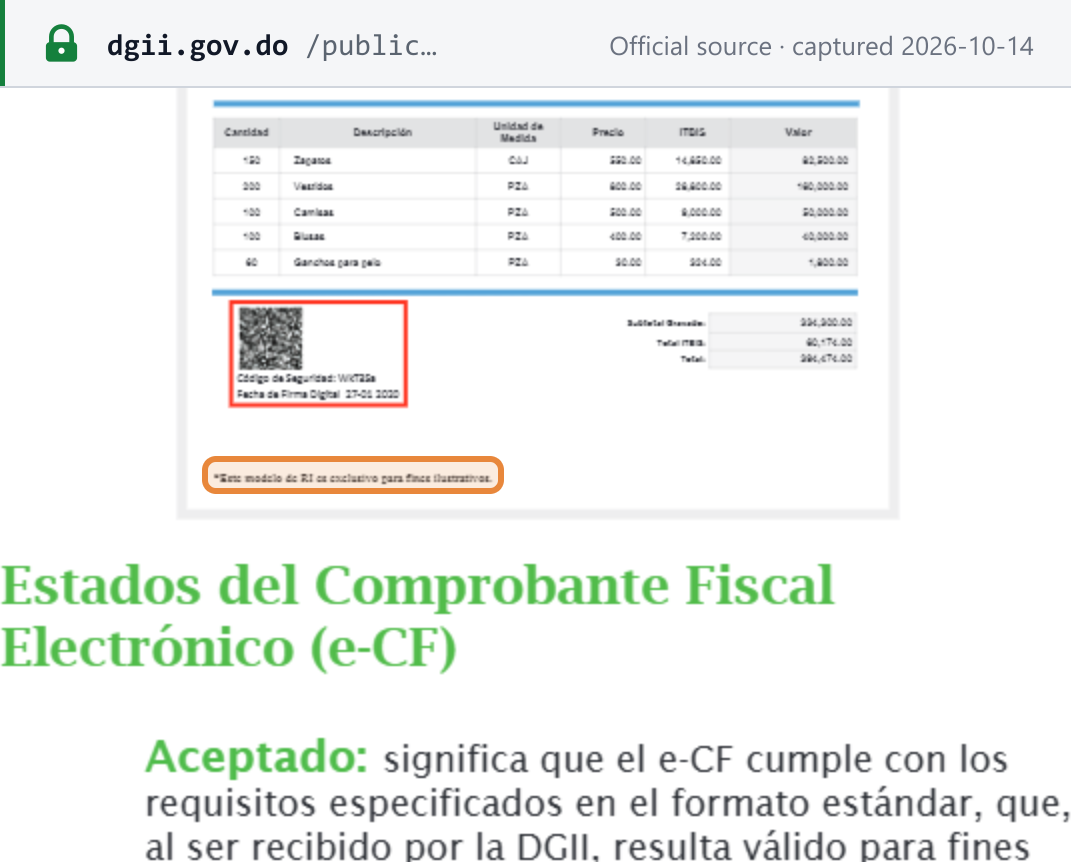
- the issuer's legal and trade name, branch, RNC and address;
- the document title, the e-NCF (
E310000000001), the sequence expiry date and the issue date; - the buyer's legal name and RNC;
- line columns for quantity, description, unit, price, ITBIS and value;
- totals for the taxed subtotal (Subtotal Gravado), total ITBIS and total;
- the QR code, the security code and the date of the digital signature.
The names and RNCs on it are the DGII's own illustrative values, not a real taxpayer's.
E-invoicing status
Status: mandatory, phased by taxpayer group. Large national, large local and medium taxpayers must already issue e-CF; small, micro and unclassified taxpayers must implement by 15 November 2026.
- Legal basis. Law 32-23 on electronic invoicing, promulgated on 16 May 2023, and its implementing regulation, Decree 587-24 of 10 October 2024. [20] [17] [28] [26]
- Scope. Everyone domiciled in the country who transfers goods or supplies services (Law 32-23, article 2). B2B, B2C (e-CF type 32) and B2G (type 45) are all covered. Paper B receipts remain usable only by groups still inside their transition window — large local and medium taxpayers until 31 October 2026, and small, micro and unclassified taxpayers, whose implementation deadline is 15 November 2026 — and otherwise only in a declared contingency (see the timeline below). [19]
- Model. Clearance through the DGII's own system, not Peppol. The issuer signs the e-CF as XML and sends it to the DGII by web service; the DGII validates it and returns a TrackID and status; the issuer then delivers the XML to an electronic receiver, or an RI with a QR code to anyone else; the receiver sends an acknowledgement and a commercial approval or rejection to the DGII and the issuer. Sending e-CF in any format other than XML is an infraction. [19]
- Signature. A digital certificate for tax procedures issued by a certification entity accredited by INDOTEL. [13]
- How to issue. Your own system certified by the DGII, a DGII-certified service provider, or the DGII's free Facturador Gratuito, available to taxpayers issuing up to 150 invoices a month. Every issuer passes DGII certification before issuing. [13]
Timeline by taxpayer group (Law 32-23, article 37, and DGII avisos):

| Group | Statutory deadline | Extension | Exclusive e-CF |
|---|---|---|---|
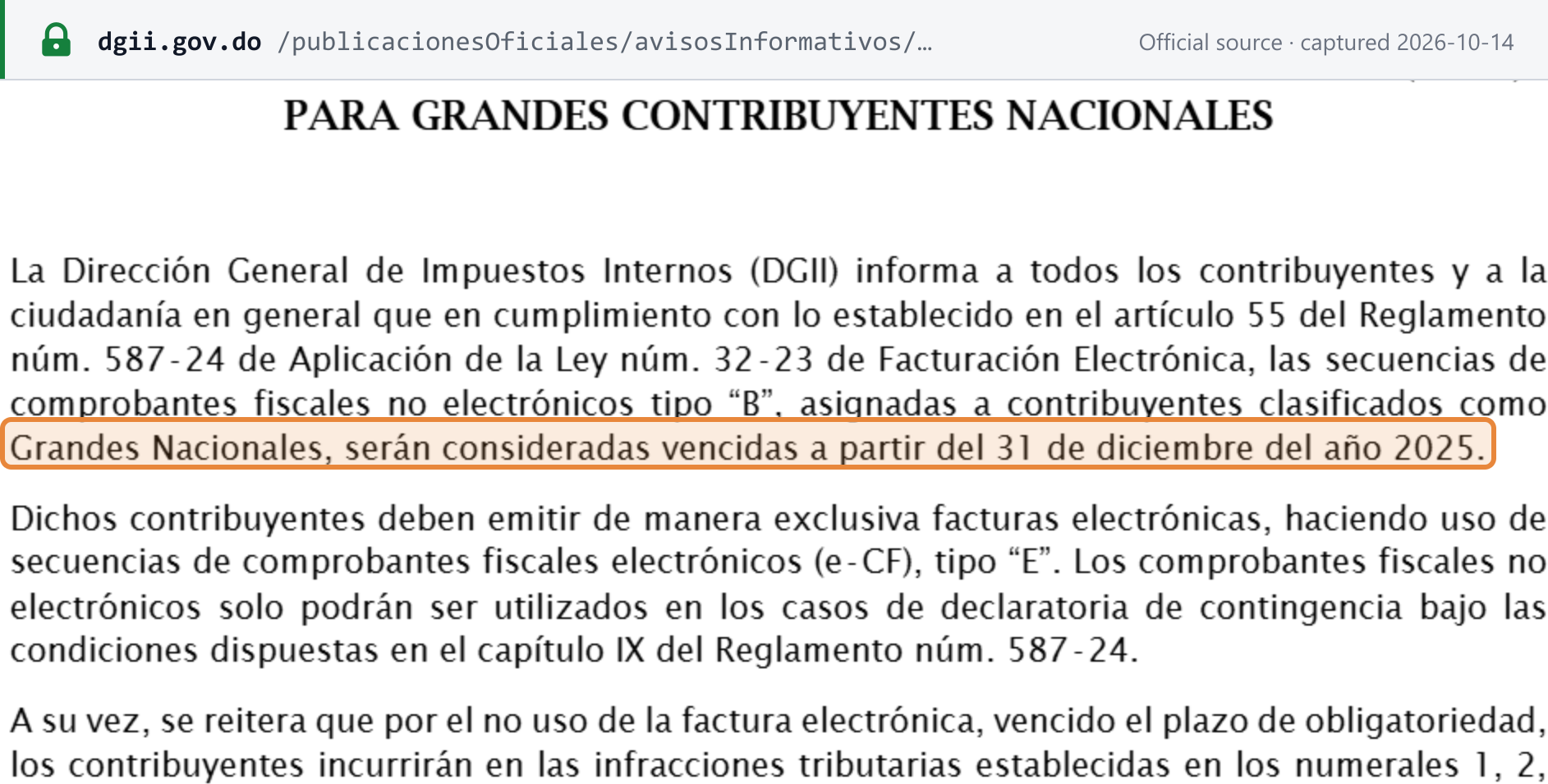
| Grandes Contribuyentes Nacionales | 12 months from the law: 15 May 2024 | Case by case, up to 120 days (Aviso 08-24) | Paper B sequences lapsed from 31 December 2025 (Aviso 25-25) |
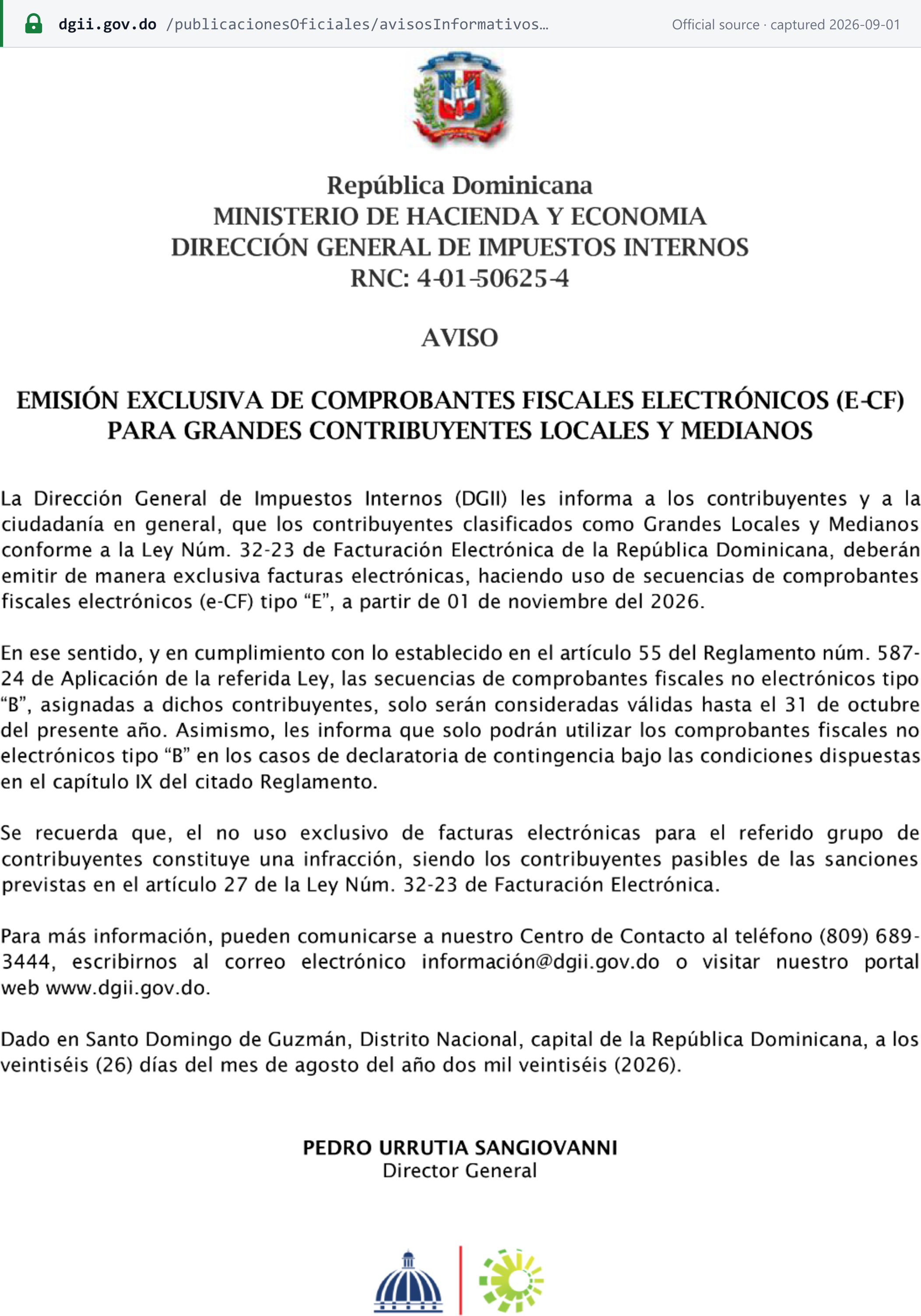
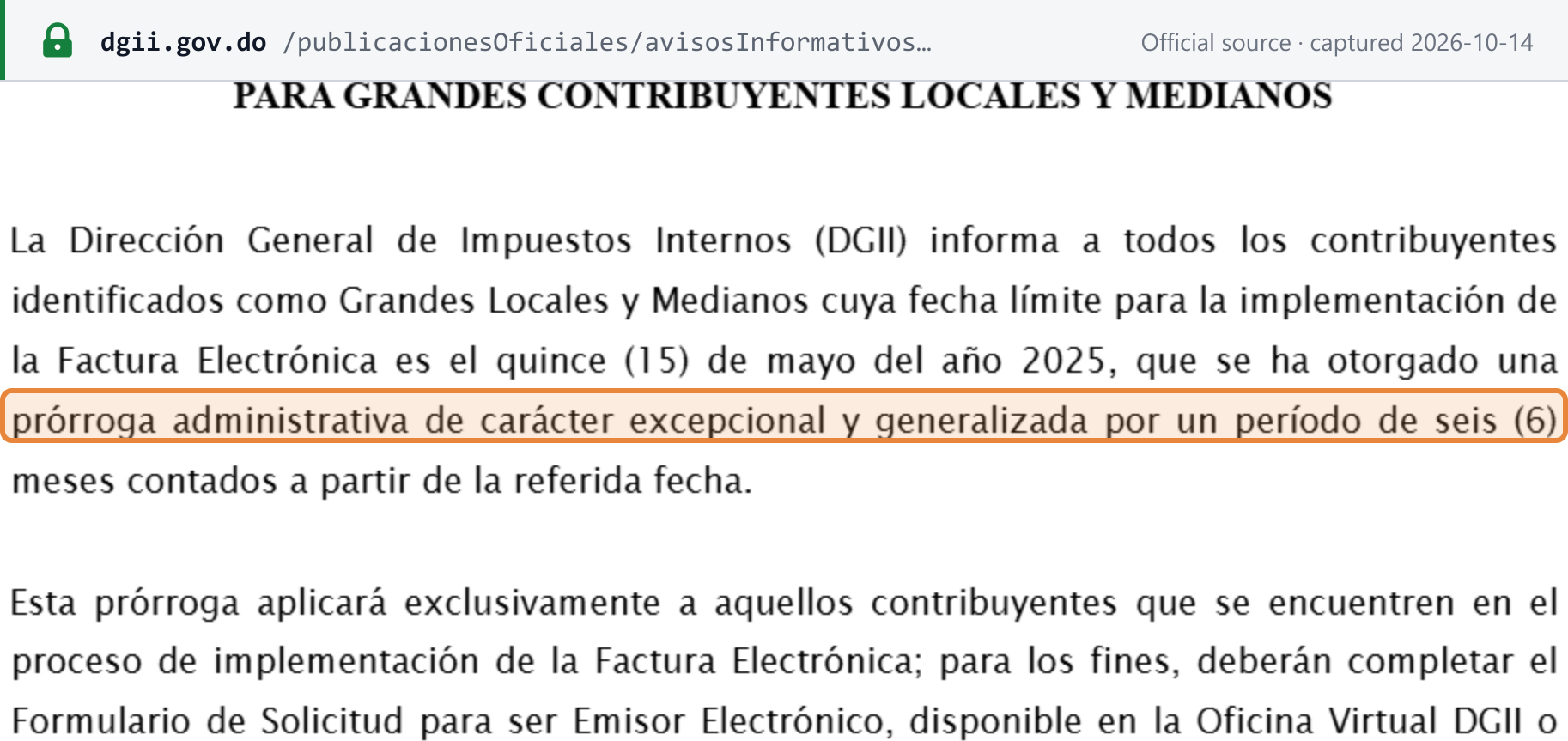
| Grandes Contribuyentes Locales y Medianos | 24 months: 15 May 2025 | Six months, to 15 November 2025 (Aviso 12-25) | B sequences valid only to 31 October 2026; e-CF only from 1 November 2026 (Aviso 14-26) |
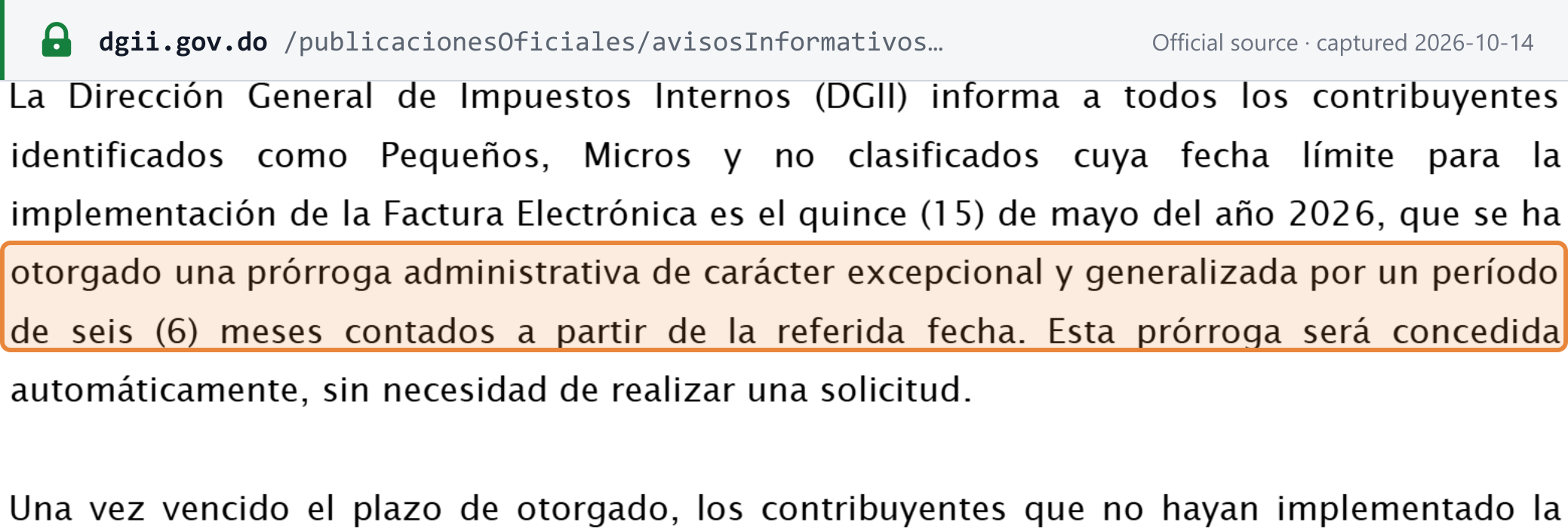
| Pequeños, Micro y no Clasificados | 36 months: 15 May 2026 (Aviso 14-25) | Six months, automatic, to 15 November 2026 (Aviso 06-26) | No date announced yet |
- Large local and medium taxpayers. The six-month extension of Aviso 12-25 applied only to taxpayers already implementing e-invoicing, who had to complete the application to become an electronic issuer. Aviso 14-26 (26 August 2026) then set the end of paper: these taxpayers "deberán emitir de manera exclusiva facturas electrónicas … a partir de 01 de noviembre del 2026", and their B sequences "solo serán consideradas válidas hasta el 31 de octubre" 2026. After that, B receipts may be used only in a declared contingency. [21] [25]
- Small, micro and unclassified taxpayers. Aviso 06-26 (6 May 2026) granted "una prórroga administrativa de carácter excepcional y generalizada por un período de seis (6) meses" from 15 May 2026, "concedida automáticamente, sin necesidad de realizar una solicitud" (granted automatically, with no application). The deadline is therefore 15 November 2026. [24]
- New registrants. A taxpayer that registers after its group's deadline has 120 days from registration to join; one that registers shortly before the deadline gets an extension to complete 120 days (Decree 587-24, article 7). [17]
- Extensions. Decree 587-24 (article 8) allows one extension only, of at most six months, and none for a taxpayer that has not started implementing; the Aviso 06-26 extension is different, an exceptional general administrative extension that the DGII granted automatically to the whole small, micro and unclassified group. [17] [24]
For the Dominican Republic alongside other countries, see the e-invoicing status and networks table.
Filing and payment
Filing frequency
Monthly for every ITBIS taxpayer. The tax period is the calendar month, and Title III sets no quarterly or turnover-banded option. Taxpayers in the simplified regime follow its own rules (see Special regimes). [2]
Return due date
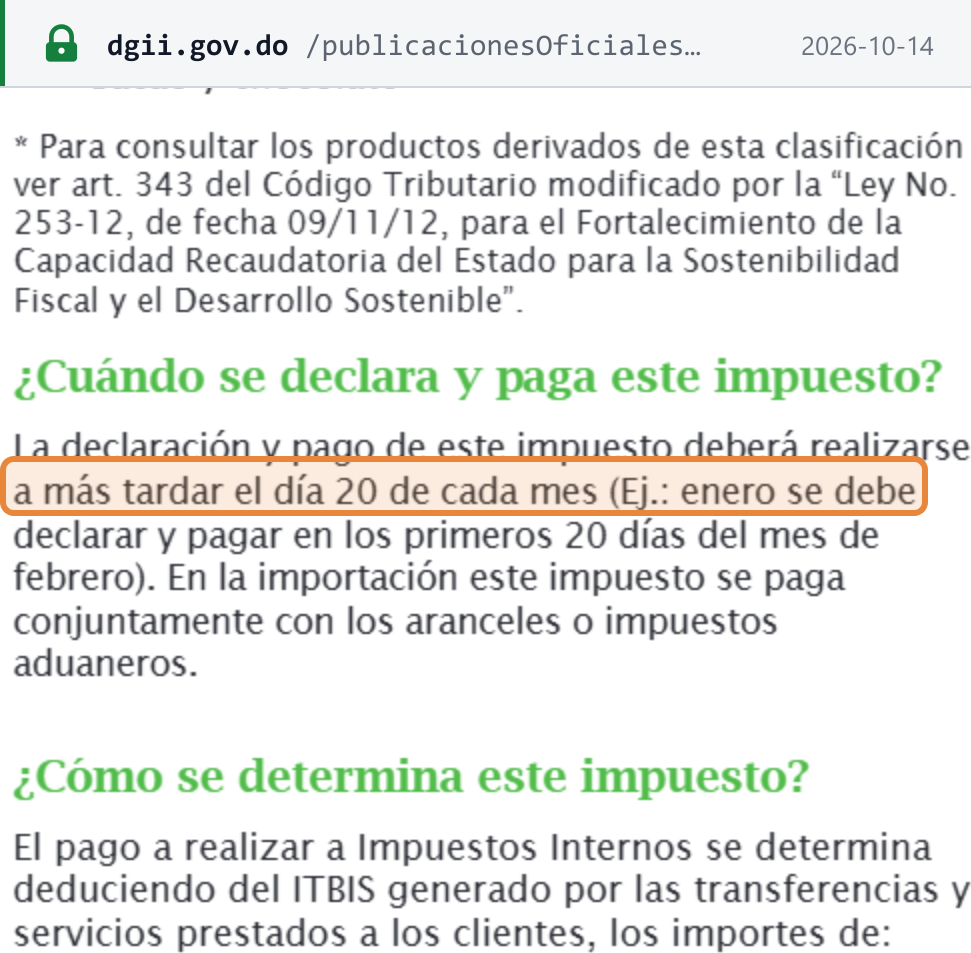
The ITBIS return, Form IT-1, "deberá ser presentada en el transcurso de los primeros veinte (20) días de cada mes, aun cuando no exista impuesto a pagar" — within the first 20 days of the following month, even when no tax is due (article 353). [2] The DGII: "La declaración y pago de este impuesto deberá realizarse a más tardar el día 20 de cada mes (Ej.: enero se debe declarar y pagar en los primeros 20 días del mes de febrero)." [1]
The DGII occasionally moves a deadline: Aviso 05-26 moved the payment deadline for March 2026 from Monday 20 April to Tuesday 21 April 2026 after a system outage. [31]
Payment due date and method
Payment is due with the return, by the 20th. You can pay at bank counters, through internet banking or at DGII local offices; at the local offices, payments over RD$15,000 must be made by certified or manager's cheque. ITBIS on imports is paid with the customs duties. [1]
Additional listings
- 606 (purchases), 607 (sales) and 608 (cancelled receipts) data formats are due by the 15th of each month. "Los Formatos 606, 607 y 608 deben ser remitidos antes de la declaración del ITBIS, aun cuando no haya operaciones" (they must be sent before the ITBIS return, even when there were no operations). [1] [30]
- 609 reports payments for services from abroad, monthly. The DGII publishes templates for all four formats. [29] [1]
- Annual return. There is no annual ITBIS return. Withholding agents file an annual withholding return (Tax Code article 50). [18]
ITBIS withholding
Many buyers withhold part or all of the ITBIS on their purchases and pay it to the DGII. For the supplier, amounts withheld are payments on account on its IT-1. [1]
| Payer → payee | Withheld | Basis |
|---|---|---|
| Company → company: professional services (engineering, architecture, accounting, audit, legal, computing, administration, design, consulting) and rental of movable goods | 30% of the invoiced ITBIS | Norma General 02-05, as amended by 07-09 [33] [34] |
| Company → company: security and guarding services | 100% | Norma General 07-09 [34] |
| Airlines and hotels → travel-agency commissions; insurers → brokers | 100% | Norma General 02-05, article 6 [33] |
| Companies and sole-owner businesses → individuals supplying taxed services | 100% | Regulation 293-11, article 25 [3] |
| Any buyer → a person not registered as a taxpayer (Comprobante de Compras) | 100% | Norma General 05-19, article 7 [10] |
| Buyers → suppliers in the simplified regime (RST) | 100% | DGII Guía 7 [1] |
| Construction companies buying taxed services | 100% from individuals; 30% from companies | DGII Revista ITBIS [3] |
| Legal persons → non-profit entities, for advertising or other taxed services | 100% | DGII Guía 7 [1] |
| Card acquirers, payment aggregators and e-payment entities → merchants | 2% of the invoiced amount; 18% perception if the merchant is unregistered, suspended, deregistered or only registrado and the single transaction exceeds RD$300,000 | Norma General 06-23, article 4 [35] |
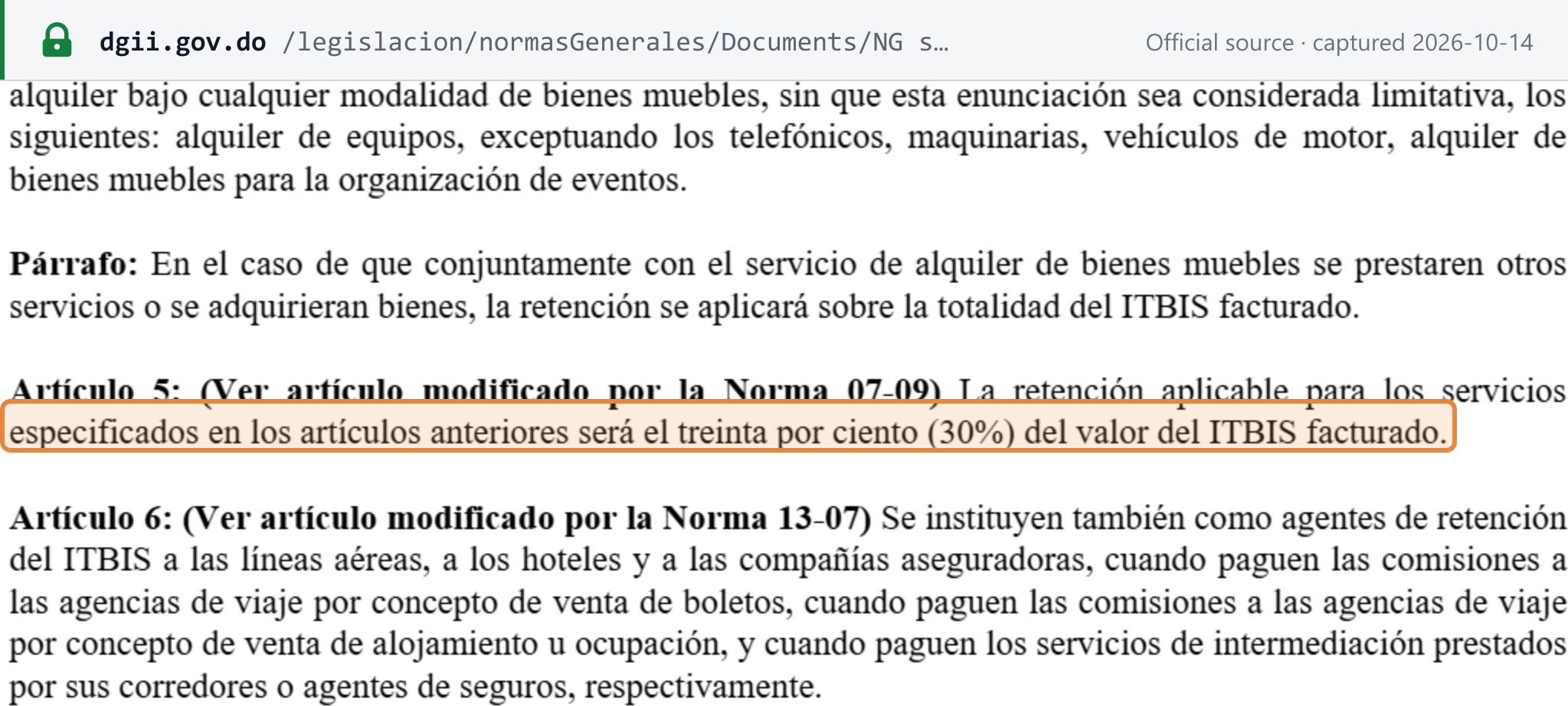
NG 02-05, article 5: "La retención aplicable para los servicios especificados en los artículos anteriores será el treinta por ciento (30%) del valor del ITBIS facturado." [33]
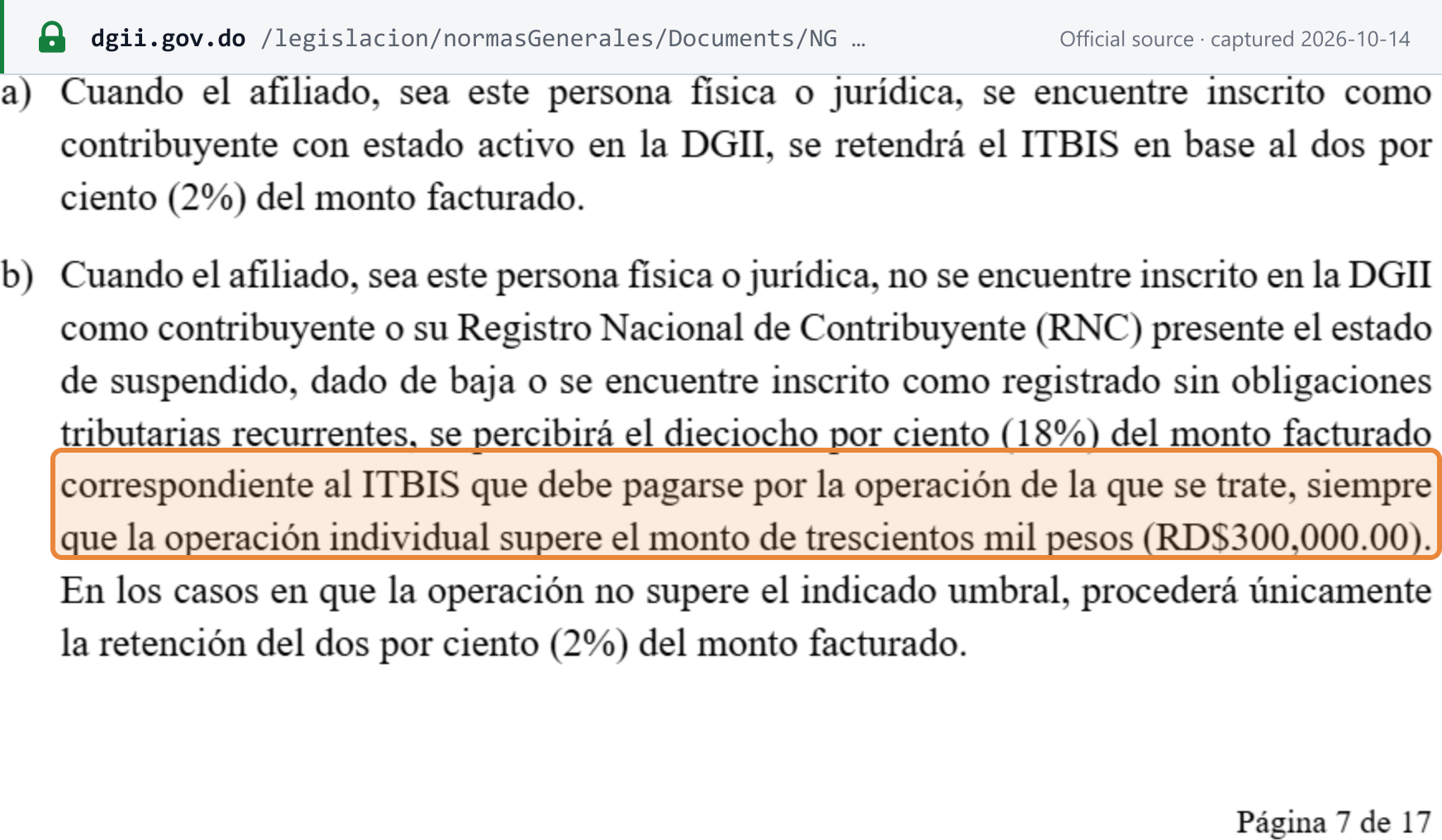
Card payments (Norma General 06-23, 3 October 2023). For merchants without an active RNC status, "se percibirá el dieciocho por ciento (18%) del monto facturado … siempre que la operación individual supere el monto de trescientos mil pesos (RD$300,000.00). En los casos en que la operación no supere el indicado umbral, procederá únicamente la retención del dos por ciento (2%)." Card acquirers report and pay weekly, each Friday, for the period from Friday to Thursday. [35]
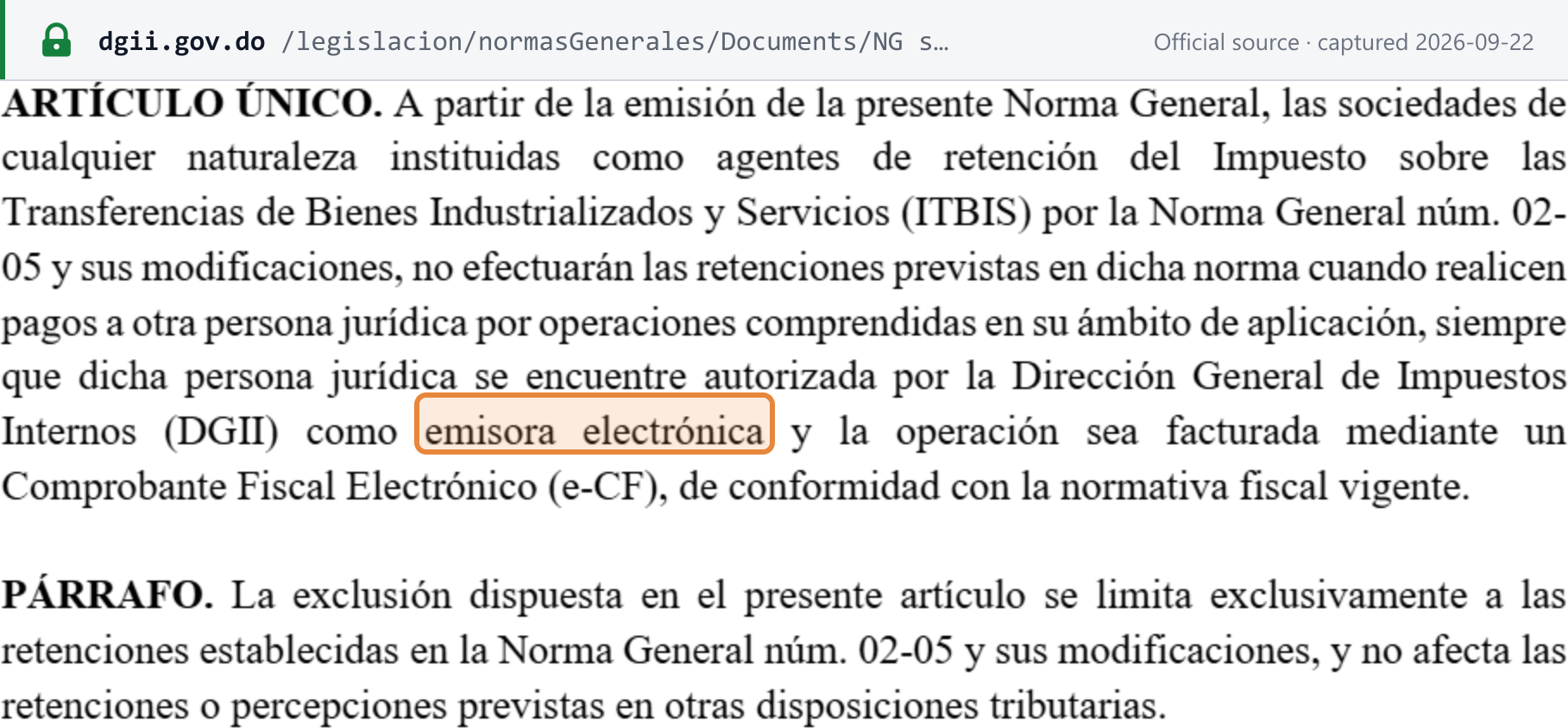
No 30% or 100% company withholding on payments to e-CF issuers (Norma General 02-2026). From its issue on 16 September 2026, companies acting as withholding agents under Norma General 02-05 "no efectuarán las retenciones previstas en dicha norma" when they pay another legal person that the DGII has authorised as an electronic issuer and the operation is invoiced with an e-CF. The exclusion "se limita exclusivamente a las retenciones establecidas en la Norma General núm. 02-05" and does not affect other withholdings or perceptions, such as the card regime, payments to individuals or Compras receipts. [32]
See VAT withholding regimes and the event record.
Input-tax recovery and blocked items
A taxpayer deducts the ITBIS paid in the same period to local suppliers and at customs (article 346), and treats ITBIS withheld from it as a payment on account. [2] The DGII sets these conditions: [1]
- the expense is deductible for income tax and is supported by an invoice with an NCF;
- the ITBIS is shown separately from the price;
- the purchase is reported on the 606.
Input tax used for both taxed and exempt supplies is apportioned (article 349). Blocked: ITBIS on goods that become part of a Category 1 asset (buildings) can never be deducted (article 336). There is no specific block on cars or entertainment in Title III; the income-tax-deductibility condition decides those. [2]
Refunds
- Residents. Excess input ITBIS carries forward to the following months (article 350). [2]
- Exporters may ask for a refund or set-off of their input-tax credits "dentro de un plazo de seis (6) meses" (within six months). The DGII has two months to decide; if it does not, "el silencio de la Administración surtirá los mismos efectos que la autorización" (silence counts as approval), and the exporter may set the credit off against any tax except taxes withheld from third parties. [2]
- Non-residents. Title III contains no ITBIS refund scheme for unregistered foreign businesses.
Exemptions
Exempt supplies
Exempt goods are a closed list of tariff headings in article 343. They include: live animals; fresh, chilled and frozen meat and fish; milk, eggs and honey, and dairy products other than yogurt and butter; unprocessed fruit and vegetables; cereals and flours; green coffee and cocoa beans; baby food, pasta and bread; natural and mineral water; fuels; medicines; fertilisers and agrochemicals; books and educational material; wheelchairs and joint prostheses. Imports under traveller and diplomatic franchises, temporary admission, and inputs and equipment imported by free-zone companies are also exempt. [2] [1]
Exempt services (article 344): financial services, including insurance; pensions; land transport of people and goods; electricity, water and refuse collection; residential rent; health; education and culture; funeral services; and beauty salons and hairdressers. [2]
Changes under Law 30-26 (promulgated 18 June 2026; in force on promulgation and publication, article 62): [9]
- Article 36 adds tariff subheadings to the article 343 exempt list, including asphalt products, fire engines, refuse trucks and ambulances.
- Article 38 adds fresh milk, natural water and pasta to article 343, paragraph III, which exempts the inputs bought by producers of those goods. It does not change the treatment of the goods themselves.
- Article 39 lets those producers deduct the ITBIS they pay on their inputs: "dicho ITBIS podrá ser deducido del impuesto cobrado en el periodo fiscal en que se trate".
Exempt is not zero-rated. A person that supplies only exempt goods or services is not an ITBIS taxpayer, and "el ITBIS pagado … deberá ser llevado a su costo" (the ITBIS it pays must be treated as a cost; Regulation 293-11, article 5). [12] An exporter, by contrast, charges 0% and deducts or recovers its input ITBIS (article 342). [2]
Special regimes
- Simplified regime (RST) — current. The Régimen Simplificado de Tributación under Decree 265-19, in force since fiscal year 2019, determines income tax and ITBIS on the basis of gross income or purchases. [36]
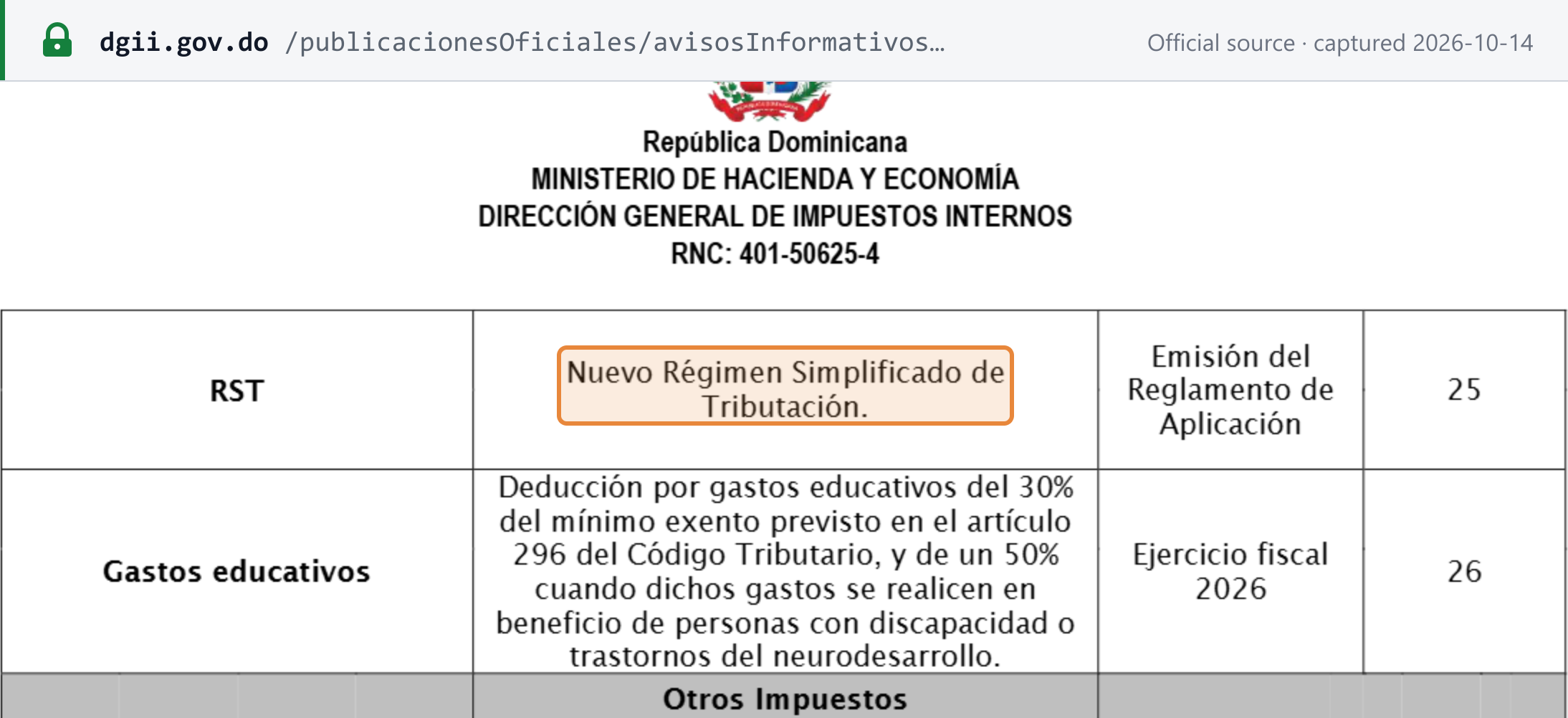
- Simplified regime — new, pending regulation. Law 30-26 (article 25, new Code article 290) creates a new voluntary RST, with prior DGII authorisation requested by 31 December. The income modality is open to legal persons and sole-owner businesses selling to final consumers with gross income up to RD$30,000,000, and to professionals, independent trades and agriculture up to RD$15,000,000; the purchases modality is open to commerce with purchases and imports up to RD$60,000,000. The amounts are indexed to inflation each year, and article 35 applies the regime to its members' ITBIS obligations. The DGII's calendar gives its start as "Emisión del Reglamento de Aplicación" — it takes effect only once its implementing regulation is issued. [9] [8]
- Free zones. Sales into industrial free zones are treated as exports, and free-zone imports of inputs and equipment are exempt (see Imports and exports).
Offences and penalties
Offences
- Breach of formal duties (Tax Code article 254): failing to register, failing to keep books, refusing access to the DGII, failing to file, and refusing to issue fiscal receipts or keep their copies. [18]
- Evasion (articles 248 and 249): filing a false or inaccurate return, or failing to pay all or part of the tax. [18]
- Tax fraud (defraudación) (articles 236 and 237): including false figures in the books and not paying over tax withheld or collected by the deadline. Intent is presumed when the tax evaded exceeds RD$100,000. Prison of six days to two years applies to repeat offences, to fraud above RD$100,000 in one period, and to withholding or collection agents who do not pay over the tax (article 239). [18]
- E-invoicing infractions (Law 32-23, article 26) include not using e-invoices, issuing without DGII authorisation, having no valid certificate, modifying a signed e-CF, sending a format other than XML, not keeping the RI, issuing e-CF that the DGII has not validated, and sending late to the DGII. [19]
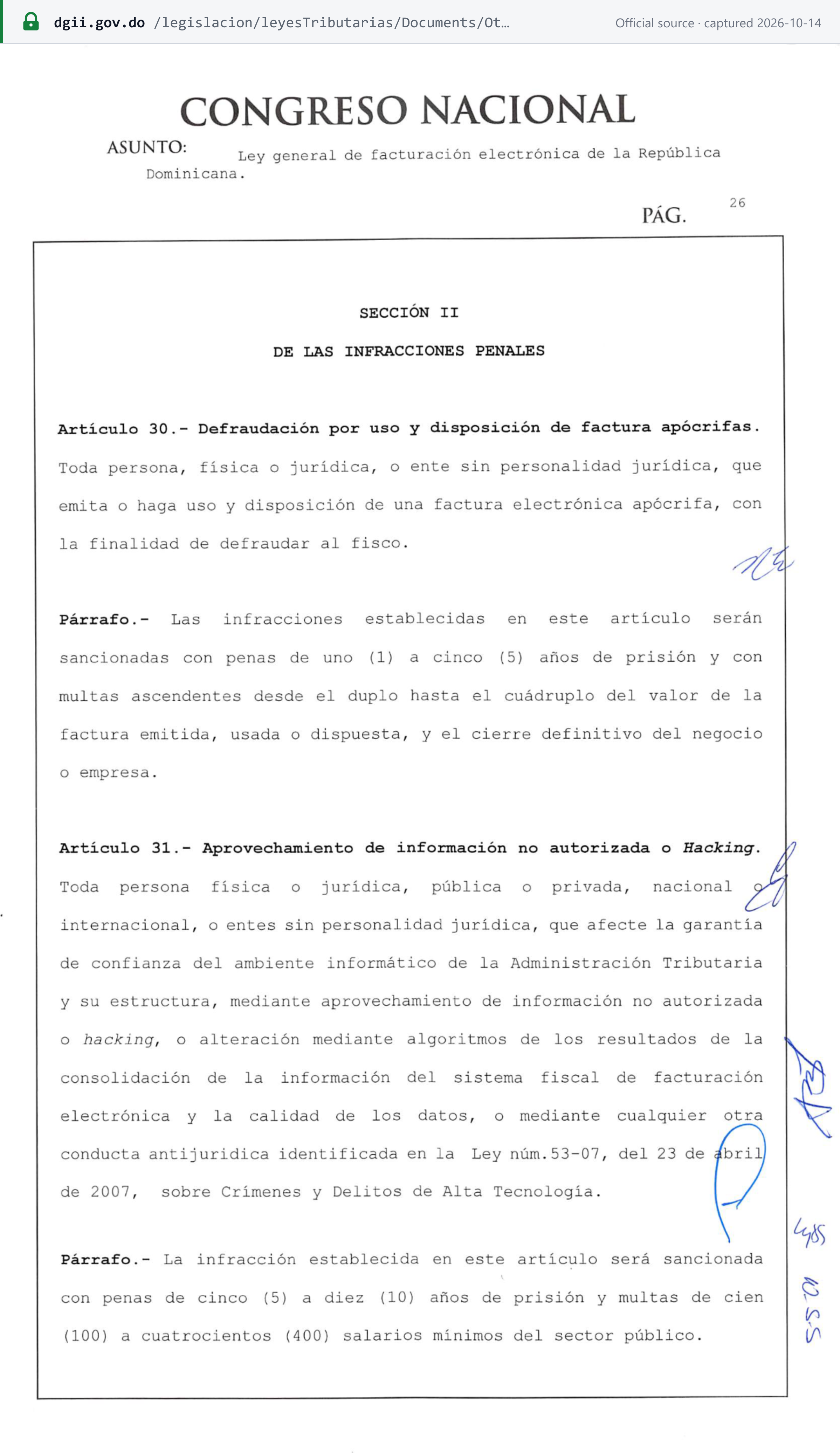
- False e-invoices. Issuing or using an apocryphal e-invoice to defraud is punished with one to five years in prison, a fine of two to four times the invoice value and the permanent closure of the business (Law 32-23, article 30). Attacks on the e-invoicing system carry five to ten years (article 31). [19]
Penalties
| Infringement | Penalty | Basis |
|---|---|---|
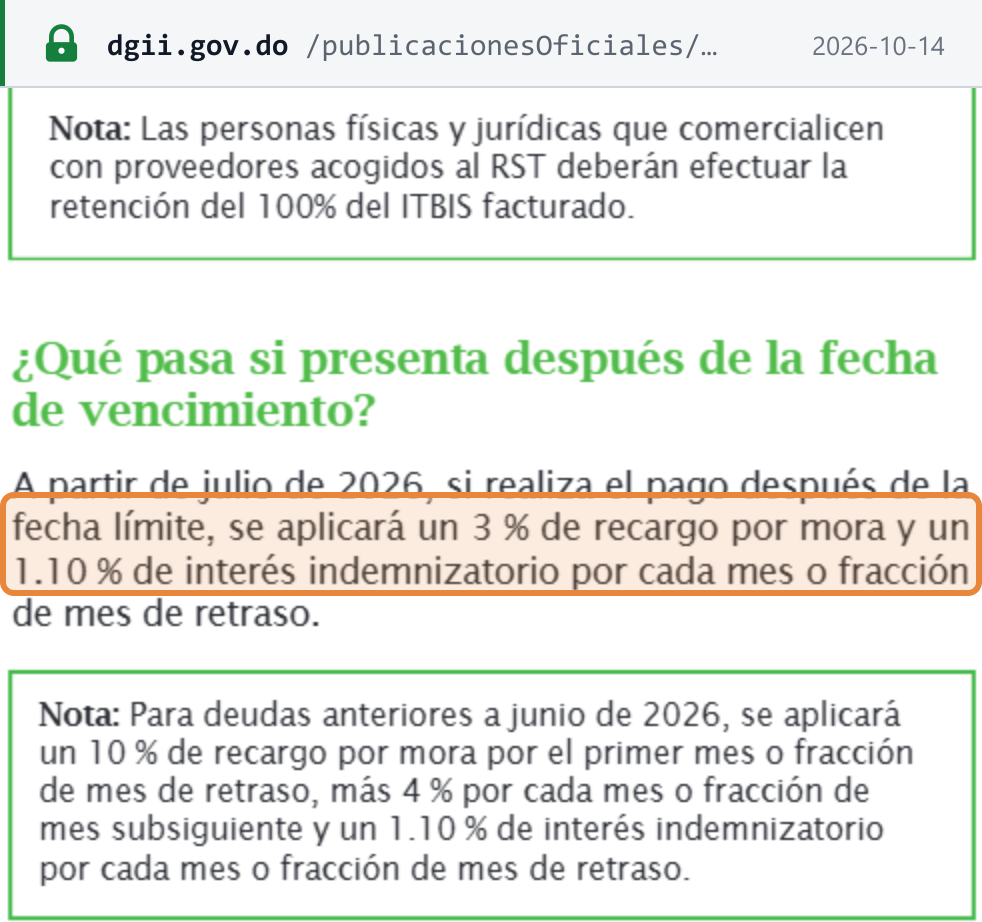
| Late payment (from July 2026) | Surcharge of 3% per month or part-month, capped at 100% of the tax; applies equally to withholding agents | Law 30-26, article 7 (Code article 252); for withholding agents, article 5 (Code article 26, paragraph VI) [9] |
| Compensatory interest | 1.10% per month or part-month | DGII Guía 7 [1] |
| Formal-duty breaches (late filing, failure to register, failure to issue a compliant receipt) | 5 to 30 minimum salaries; up to an extra 0.25% of the prior year's declared income for information-reporting failures; closure or suspension may be added | Code article 257 [18] |
| E-invoicing infractions | Infractions 1–15 sanctioned under Code article 257; late transmission (16) under article 205 | Law 32-23, articles 27–28 [19] |
| Evasion | Up to 2 times the tax omitted | Code article 250 [18] |
| Tax fraud, and withholding agents keeping tax withheld | 2 to 10 times the tax, plus confiscation, closure for up to two months and licence cancellation for up to six months | Code article 239 [18] |
The DGII's guide puts the late-payment rules this way: "A partir de julio de 2026, si realiza el pago después de la fecha límite, se aplicará un 3 % de recargo por mora y un 1.10 % de interés indemnizatorio por cada mes o fracción de mes de retraso." For older debts it notes: "Para deudas anteriores a junio de 2026, se aplicará un 10 % de recargo por mora por el primer mes o fracción de mes de retraso, más 4 % por cada mes o fracción de mes subsiguiente." [1] Law 30-26 also replaces the interest formula with the annual average lending rate of multiple-service banks plus 30 basis points, set at the start of each year; the DGII's calendar applies the new formula from January 2027. Prompt payment reduces the surcharge by 90%, 70%, 50% or 30% depending on the stage, except in cases of fraud. [9] [8]
Payment plans. Law 30-26 (new Code article 17-1) allows payment agreements with at least 15% paid up front, a guarantee and monthly instalments, over at most 12 months, or 24 months for debts covering more than 12 months. [9]
Frequently asked questions
Is the ITBIS rate 18% or 16%?
Both exist. The general rate is 18% and applies to most taxed goods, imports and services. A reduced rate of 16% applies only to a closed list of goods: yogurt and butter, coffee, edible animal and vegetable fats and oils, sugar, and cocoa and chocolate. Exported goods are taxed at 0%. Article 345 of the Tax Code still contains an older text announcing a cut of the general rate to 16%, but the DGII's current guidance applies 18%.
My supplier issues e-CF. Do I still withhold 30% of the ITBIS on its invoice?
Not if the supplier is a company that the DGII has authorised as an electronic issuer and the operation is invoiced with an e-CF. Since Norma General 02-2026 (16 September 2026), companies no longer apply the withholdings of Norma General 02-05, which include the 30% withholding on professional services and rental of movable goods, in that case. The change covers only Norma General 02-05. Other withholdings and perceptions continue, such as the 100% withholding on payments to individuals and the card withholding under Norma General 06-23.
We are a medium taxpayer and already issue e-CF. Can we keep using our paper B invoices?
Only until 31 October 2026. Under DGII Aviso 14-26, taxpayers classified as Grandes Locales y Medianos must issue e-CF exclusively from 1 November 2026, and their paper B sequences are valid only until 31 October 2026. After that, B receipts may be used only when a contingency has been declared under Decree 587-24.
Do foreign streaming or SaaS providers have to charge ITBIS to Dominican customers?
No ITBIS collection on digital services from abroad is in force. Decree 30-25 of 17 January 2025 would have introduced it, but Decree 107-25 repealed it on 3 March 2025. Separately, from 1 July 2026 Law 30-26 requires whoever pays or credits non-residents for software licences, online advertising and data use or storage to withhold 15%. That 15% is income tax that the payer must withhold, not ITBIS.
What is the 18% charged on card payments to some merchants?
Under Norma General 06-23, card acquirers, payment aggregators and other electronic-payment entities withhold 2% of the invoiced amount on payments to merchants with an active RNC. If the merchant is unregistered, suspended, deregistered or only registrado, they collect 18% of the invoiced amount as an ITBIS perception, but only when the single transaction exceeds RD$300,000. Below that amount, only the 2% withholding applies.
We registered our RNC after our group's e-CF deadline. When must we start issuing e-CF?
Within 120 days of your registration date. Decree 587-24 gives taxpayers who register after the deadline for their group 120 days from registration to join the electronic invoicing model. Taxpayers who register shortly before their group's deadline get an extension so that they also have 120 days.
When is the monthly ITBIS return due, and do I file if nothing is due?
The IT-1 return is filed and paid within the first 20 days of the following month, and it must be filed even when no tax is payable. Before it, the 606 (purchases), 607 (sales) and 608 (cancelled receipts) data formats are due by the 15th, also when there were no operations.
Important websites
| Site | Purpose |
|---|---|
| DGII Oficina Virtual (OFV) | Register an RNC, file the IT-1 and data formats, and pay |
| Formalízate | Single window for forming a business and registering it |
| DGII RNC lookup | Look up an RNC or cédula and its status |
| Dominican Republic RNC validator | Check an RNC's format with Lookuptax |
| DGII NCF / e-NCF lookup | Check that a fiscal receipt number is valid |
| DGII e-CF hub | Electronic invoicing requirements, certification and providers |
| Taxpayers obliged to implement e-CF | Implementation calendar and lists by group |
| Facturador Gratuito | DGII's free e-CF tool for small issuers |
| Data-format templates | Templates for the 606, 607, 608 and 609 |
| DGII ITBIS rate sheet | The general, reduced and zero rates |
| Dirección General de Aduanas | Customs, where ITBIS on imports is paid |
Recent changes
- 2026-09-16 — Norma General 02-2026 ended the Norma General 02-05 ITBIS withholdings on payments to legal persons authorised as electronic issuers that invoice with an e-CF. (DGII) — see event
- 2026-08-26 — Aviso 14-26: Grandes Locales y Medianos must issue e-CF exclusively from 1 November 2026; their paper B sequences are valid only to 31 October 2026. (DGII) — see event
- 2026-07-01 — Late-payment surcharge became 3% per month or part-month, capped at 100% (Law 30-26). (DGII)
- 2026-06-18 — Law 30-26 promulgated: ITBIS perception on informal importers (base plus 30%), the simplified regime extended to ITBIS pending regulation, and additions to the exempt lists. (DGII) — see event
- 2026-05-06 — Aviso 06-26: automatic six-month extension of the e-CF deadline for small, micro and unclassified taxpayers, to 15 November 2026. (DGII) — see event
- 2025-12-31 — Paper B sequences of Grandes Contribuyentes Nacionales lapsed; they issue e-CF only. (DGII)
For the full chronology, see Dominican Republic tax changes on Lookuptax.
Reference links
- DGII — Guía del Contribuyente No. 7: ITBIS (PDF)
- DGII — Tax Code, Title III: ITBIS (PDF)
- DGII — Revista ITBIS (PDF)
- DGII — Revista del Registro Nacional de Contribuyentes (PDF)
- DGII — RNC registration
- DGII — Norma General 06-2018 on fiscal receipts (PDF)
- DGII — ITBIS rates (PDF)
- DGII — Aviso 10-26: Law 30-26 implementation calendar (PDF)
- DGII — Law 30-26 (PDF)
- DGII — Norma General 05-2019 on fiscal receipts (PDF)
- Presidencia de la República — repeal of Decree 30-25 by Decree 107-25
- DGII — Regulation 293-11 (PDF)
- DGII — Guía del Contribuyente No. 6: electronic invoicing (PDF)
- DGII — Decree 254-06 (PDF)
- DGII — Aviso 24-19 (PDF)
- DGII — Aviso 29-25 (PDF)
- DGII — Decree 587-24 (PDF)
- DGII — Tax Code, Title I (PDF)
- DGII — Law 32-23 on electronic invoicing (PDF)
- DGII — Taxpayers obliged to implement electronic invoicing
- DGII — Aviso 12-25 (PDF)
- DGII — Aviso 14-25 (PDF)
- DGII — Aviso 25-25 (PDF)
- DGII — Aviso 06-26 (PDF)
- DGII — Aviso 14-26 (PDF)
- DGII — e-CF legal framework
- DGII — Aviso 08-24 (PDF)
- DGII — Aviso 20-24 (PDF)
- DGII — Data-format templates
- DGII — ITBIS infographic (PDF)
- DGII — Aviso 05-26 (PDF)
- DGII — Norma General 02-2026 (PDF)
- DGII — Norma General 02-05 (PDF)
- DGII — Norma General 07-09 (PDF)
- DGII — Norma General 06-23 (PDF)
- DGII — Régimen Simplificado de Tributación (RST)
- DGII — Consulta técnica 9-2022: ITBIS on database maintenance for a foreign client (PDF)
Related on Lookuptax: