DR Congo VAT guidelines
| FACTSHEET | |
|---|---|
| Country code | CD |
| Tax name | Value Added Tax — Taxe sur la Valeur Ajoutée (TVA) |
| Tax Authority | Direction Générale des Impôts (DGI) |
Overview
The Democratic Republic of the Congo levies Value Added Tax — Taxe sur la Valeur Ajoutée (TVA) — under Ordonnance-loi n° 10/001 du 20 août 2010 (the "VAT law"). Article 1 sets it up as "un impôt général sur la consommation dénommé « taxe sur la valeur ajoutée »". It replaced the former turnover tax (impôt sur le chiffre d'affaires) and has been amended by most finance laws since 2013. The DGI describes it as a tax on all goods and services "de toutes origines, consommés ou utilisés en RDC". [1] [3]
Three other texts matter as much as the VAT law:
- Décret n° 011/42 du 22 novembre 2011 — the VAT implementing decree: turnover measurement, representatives, online services, returns and refunds.
- Décret n° 23/10 du 03 mars 2023 — the facture normalisée (normalised invoice) and the fiscal devices that issue it.
- Loi n° 004/2003 du 13 mars 2003 on tax procedures (the "LPF") — the Numéro Impôt, reassessment periods, general penalties and offences.
The DGI publishes all four in its consolidated Code des Impôts, updated to 10 July 2023, which this guide cites by page. That edition is consolidated only to Finance Law n° 22/071 (2023). Later finance laws — including Loi de finances n° 25/060 du 29 décembre 2025 for 2026, which the DGI says amended both the VAT law and the LPF — are not published in consolidated form on any official site we could reach (checked 21 October 2026). Where a rule could have moved since July 2023, this guide says so. [1] [19]
Authority. VAT is administered by the Direction Générale des Impôts (DGI). On imports, VAT is collected by customs (DGDA): "A l’importation, la taxe sur la valeur ajoutée est perçue par l’Administration des Douanes" (VAT law art. 62). [1]
Currency. All statutory amounts are in Congolese francs (CDF, "FC"). VAT refunds are paid into an account "libellé en Franc congolais" (Arrêté ministériel n° 018 of 18 March 2016). [1]
Tax period. The calendar month (VAT law art. 60).
Layering. VAT is a single national tax. The VAT law provides for no provincial or local VAT.
For neighbouring systems, see the Burundi VAT guide, the Tanzania VAT guide, the Uganda VAT guide and the Angola VAT guide.
Registration
Who should register
Any natural or legal person — including the State, the provinces, decentralised territorial entities (ETDs) and public bodies — that makes taxable operations independently, habitually or occasionally, and whose annual turnover reaches the threshold below, is liable to VAT (VAT law arts. 13 and 14). Imports are taxable "quelle que soit leur valeur" (art. 12), so the threshold does not shelter an importer from import VAT. [1]
Registration threshold
CDF 80,000,000 of annual turnover. Article 14: "Les personnes morales et physiques sont assujetties à la taxe sur la valeur ajoutée lorsqu’elles réalisent un chiffre d’affaires annuel égal ou supérieur à 80.000.000 de Francs congolais." [1]
- Turnover basis. Turnover excluding VAT (Decree 011/42 art. 42).
- Measurement period. The previous year's turnover for an existing business; projected turnover for a new one (Decree art. 43).
- Crossing the threshold mid-year. File a VAT registration declaration (déclaration d'assujettissement) "avant le quinze du mois qui suit celui au cours duquel ce seuil a été dépassé" (VAT law art. 55).
- Changes. The Minister of Finance may change the threshold by arrêté (art. 14).
The DGI's VAT page and its August 2025 VAT leaflet both restate the CDF 80,000,000 figure (checked 21 October 2026). Businesses below it pay the flat business-profits tax (IBP) under the Centres d'Impôts Synthétiques regime: a DGI communiqué of 20 January 2026 places turnover above CDF 10 million and below CDF 80 million there. [2] [3] [16]
Liberal professions. The DGI's VAT page and leaflet say liberal professions are liable "sans considération de leur chiffre d’affaires". The DGI's own Code des Impôts marks the decree provision behind that rule (Decree art. 44) as obsolete since Finance Law n° 15/021 of 31 December 2015, and article 14 as amended contains no carve-out. Our reading is that, on the statute, the CDF 80,000,000 threshold applies to them too. If you are a liberal profession below the threshold, confirm your position with your DGI office. [1] [3]
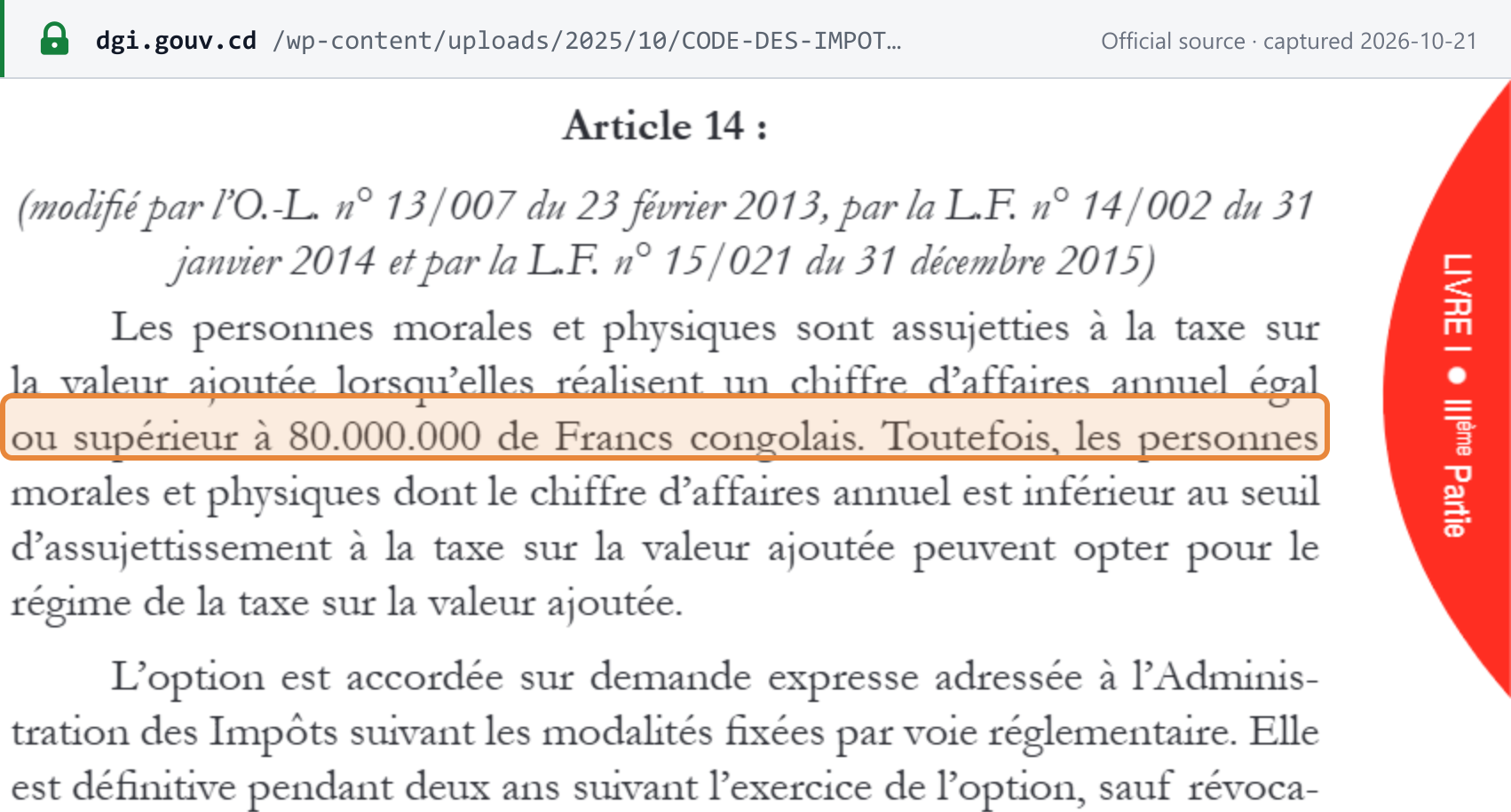 Source snapshot captured 2026-10-21 — original
Non-resident registration
The VAT law sets no separate threshold for non-residents. Imports, including imported services, are taxable "quelle que soit leur valeur", subject to article 14 (art. 12). A non-resident liable to VAT must appoint an approved representative resident in the DRC; failing that, its customer pays the VAT. See Foreign companies selling into the DR Congo below.
Tax identification number
Every taxpayer needs a Numéro Impôt (NIF), requested "dans les quinze jours qui suivent le début de ses activités" (LPF art. 1). The DGI issues it only after certifying the taxpayer's actual location, and changes must be reported within 15 days (LPF art. 2). Article 54 of the VAT law refers to a separate "numéro TVA" allotted by arrêté; we found no such arrêté, and in practice the Numéro Impôt is the identifier printed on invoices and returns. [1]
Format. The DGI publishes no format specification or check digit. Numbers printed in DGI documents — the DGI's own "A 0707219 F", and suppliers in its list of approved billing systems — follow a pattern of a letter, seven digits and a letter. That is our observation, not an official rule. [2] [14] Lookuptax has no DR Congo tax-ID page or validator yet; for official lookups elsewhere, see Check a VAT number.
How to register
- Numéro Impôt. Apply within 15 days of starting activity. Applications can be made online through the DGI's e-NIF portal, which also offers a NIF search.
- VAT registration. File the déclaration d'assujettissement "avant le début de ses activités" (VAT law art. 54). Decree art. 130 gives a new business until the 15th day after starting, and an existing business 15 days from receiving the DGI's notice of liability. The official form is linked from the DGI's VAT page; it gives a third deadline, the 15th of the month after the month activity starts. The law (before starting) is the safest date to work to. [1] [15]
- Fiscal device. Before invoicing, register for a fiscal device (physical, or online through e-DEF) — see E-invoicing status.
Late filing of the registration declaration costs CDF 500,000 (VAT law art. 69).
The DGI home page's "Commencer mon immatriculation" button leads to immatriculation.gouv.cd, which registers vehicle number plates. It is not business or VAT registration.
Voluntary registration
Available. A business below the threshold may opt into VAT by express request to the DGI. "Elle est définitive pendant deux ans suivant l’exercice de l’option, sauf révocation de l’Administration des Impôts" (art. 14). Opting in lets a business deduct input VAT and invoice VAT to business customers who can recover it. [1]
Deregistration
There is no immediate exit. A business whose turnover falls below the threshold "conserve sa qualité les deux années suivant celle de la constatation de la diminution de son chiffre d’affaires" (art. 14). A business that ceases activity files a cessation declaration within 15 days (Decree art. 143; LPF art. 2). A VAT credit still held on losing VAT status is set against other taxes, and any remainder is refunded (art. 65). [1]
Group registration
Not available in the DR Congo: neither the consolidated VAT law nor Decree 011/42 contains a VAT-grouping provision (checked 21 October 2026). Article 49's separate-sector deduction option applies within a single taxpayer and is not grouping.
Rates
| Rate | Applies to | Source |
|---|---|---|
| 16% (standard) | Every taxable operation not at the reduced rate or 0% | VAT law art. 35 |
| 8% (reduced, as consolidated to 2023) | 24 listed tariff lines of basic goods — among them beef, pork and poultry meat, frozen tilapia and horse mackerel, dried or salted fish, rice, sugar, infant milk preparations, condensed milk, bottled table water, iodised salt, household soap and matches — and domestic air tickets | VAT law art. 35 |
| 5% and 1% (invoicing groups from 2026) | Introduced under Finance Law n° 25/060 for 2026; the DGI has not published which goods fall in each band | DGI communiqué of 25 February 2026 |
| 0% | Exports and operations treated as exports (art. 7: aircraft and ships, transit, goods under suspensive regimes, transport of export goods) | VAT law art. 35 |
Standard rate. 16% since VAT replaced the turnover tax. Article 35: "taux normal : 16% applicable à toutes les opérations imposables à l’exclusion des opérations soumises au taux réduit ou au taux zéro". The DGI's VAT leaflet of August 2025 restates all three rates — 16%, 8% and 0% — as reproduced below. [1] [2]
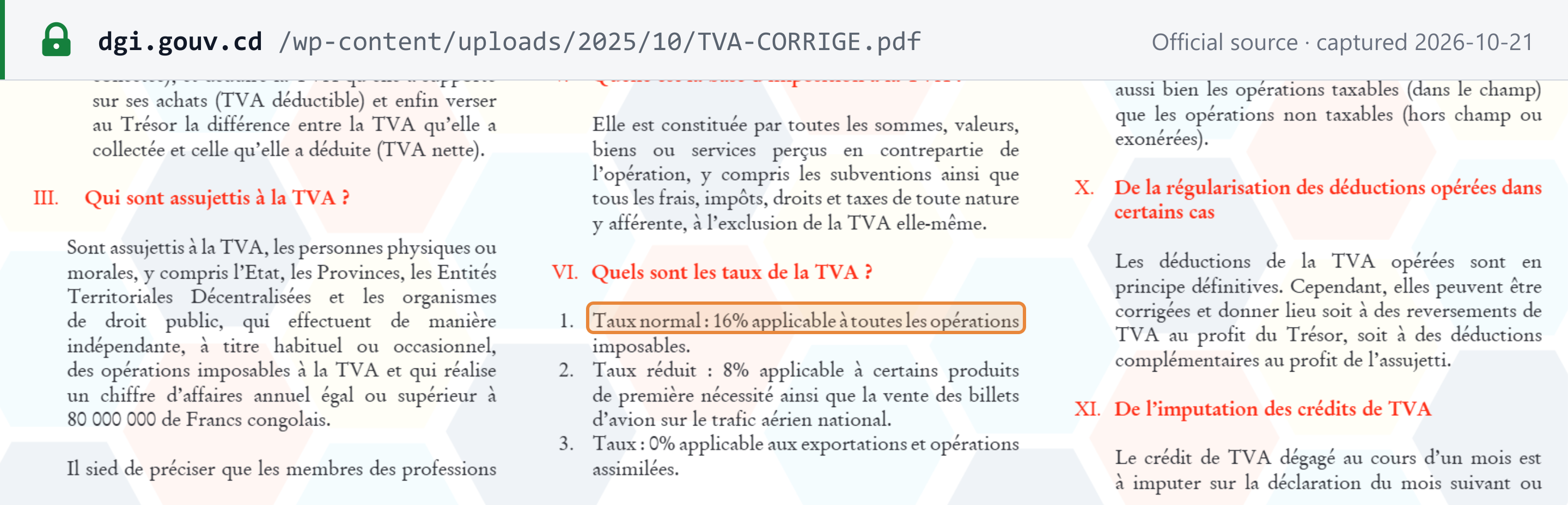 Source snapshot captured 2026-10-21 — original
The reduced rate in 2026. Implementing Finance Law n° 25/060 for 2026, the DGI's Communiqué officiel N° 01/010 of 25 February 2026 changed the taxation groups that certified billing systems use: group C "TAXABLE A 8 %" becomes "TAXABLE 5 %", the public-contract group at 8% becomes 5%, and two new groups at 1% are added. The communiqué does not say which goods sit in each group or from what date. The finance law itself is not on any official site we could reach (checked 21 October 2026). So treat 16% as settled, and confirm the reduced rate for a specific product with the DGI before you invoice it. [8]
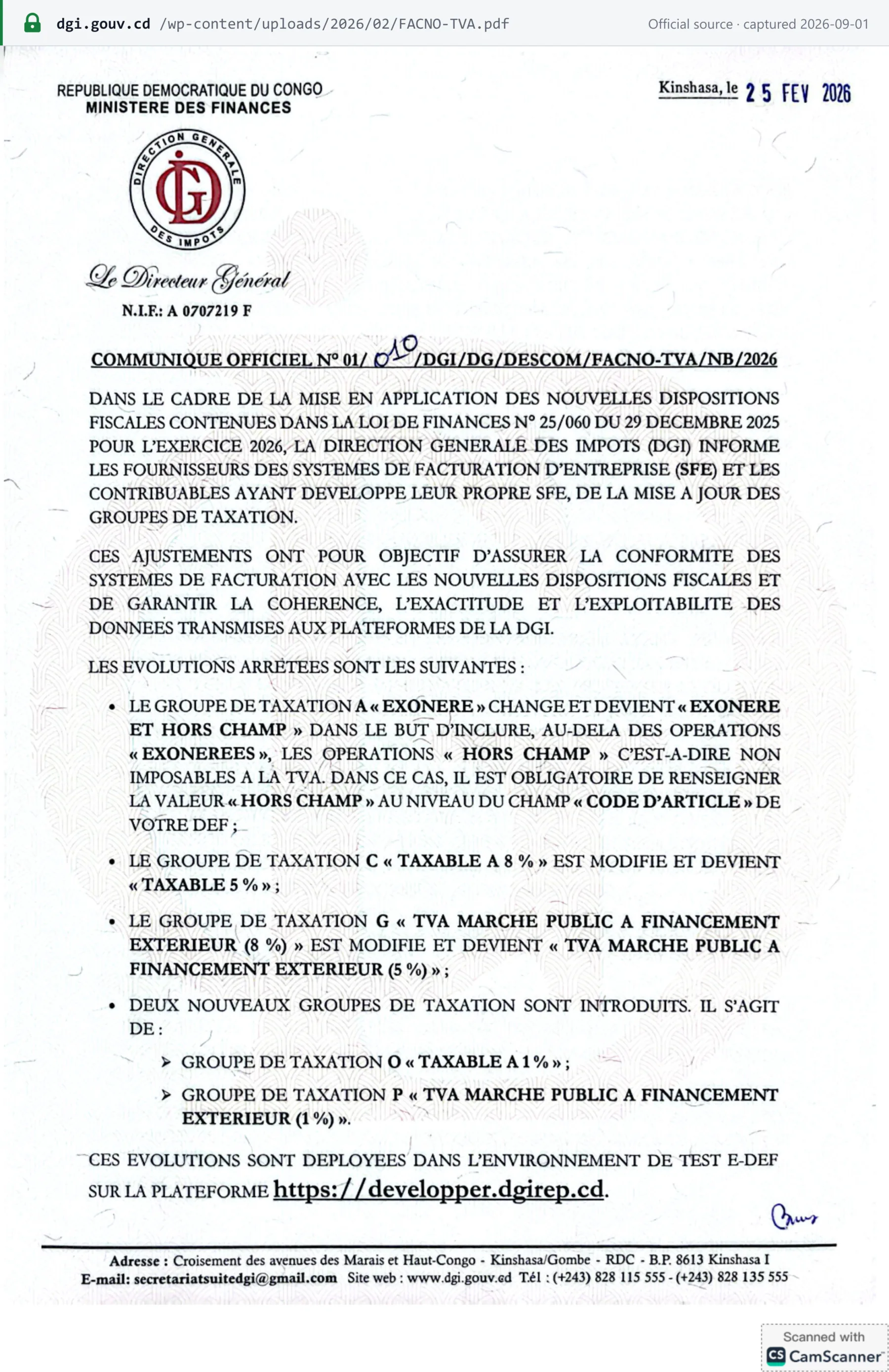 Source snapshot captured 2026-09-01 — original
Decree-based suspensions. The Code des Impôts lists several decrees that suspend VAT collection: on listed basic necessities (Décret n° 22/30 of 15 October 2022, amended in 2023), on certain cement and real-estate goods (Décret n° 22/31), on aviation-equipment imports and on electricity. The Ministry of the Budget's draft citizen budget for 2026 says the government "a supprimé la TVA sur certains produits alimentaires comme le lait et le sucre". The current lists were not published with these sources, so check them with the DGI. [1] [18]
For other countries' rates, see worldwide tax rates.
Cross-border rules
Imports and exports
- Imports are taxable "quelle que soit leur valeur" (art. 12): there is no de minimis. The base is the CIF value plus import duties and any excise (art. 27). VAT "doit être déclarée et versée avant l’enlèvement de la marchandise" (art. 61) and is collected by customs. It is deductible on the basis of the customs release declaration (art. 38). Mining companies in the exploitation phase account for VAT on qualifying imports (other than petroleum products) to the DGI at the next filing date instead of paying it at the border (art. 62; Arrêté ministériel n° 015 of 15 April 2022).
- Exports are zero-rated (art. 35). The input-tax deduction on exports is "définitivement acquises" only once customs documents prove the goods left and the export proceeds have been repatriated under the exchange-control rules (art. 39). [1]
Reverse charge on services from non-residents
The DR Congo has no general reverse charge of the EU kind. Instead, article 23 combines a representative with a fallback on the customer. A non-resident liable to VAT appoints an approved DRC-resident representative, who is jointly liable. If it does not, "la taxe sur la valeur ajoutée et, le cas échéant, les pénalités y afférentes sont payées par la personne cliente". For a DRC business buying services from abroad, the practical effect is close to a reverse charge, but the law frames it as the customer's default liability. An imported service is "le service reçu de l’étranger par des résidents" (Decree 011/42 art. 29). [1]
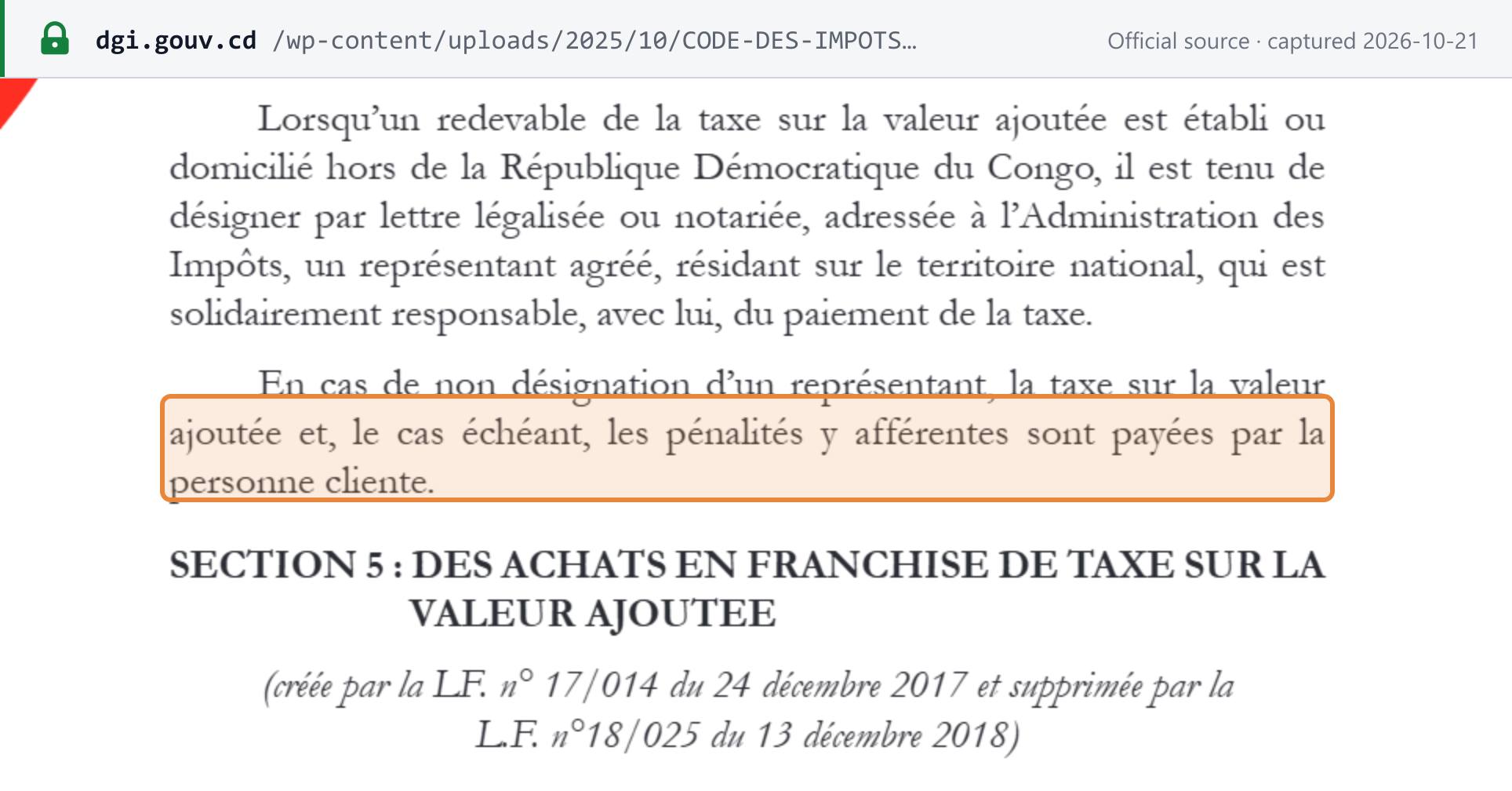 Source snapshot captured 2026-10-21 — original
See reverse charge explained for how this compares with other systems.
Digital products and services
Online services are within scope. Decree 011/42 art. 23 defines "les services électroniques fournis en ligne par des entreprises résidentes et non résidentes": website supply and hosting, online software and updates, images, text and information, databases, music, films and games, digitised books and publications, distance teaching, and remote maintenance of programs and equipment. A service is supplied in the DRC when it is used or exploited there (VAT law art. 22, 3°), so a non-resident's online service used in the DRC is taxable at 16%, through a representative, with the customer liable as the fallback. [1]
The DGI publishes no dedicated registration channel or simplified regime for non-resident digital suppliers (checked its VAT page, its 2025–2026 communiqués and its instruction indexes, 21 October 2026). See VAT on digital services by non-resident suppliers.
Foreign companies selling into the DR Congo — B2B and B2C
The statute does not distinguish B2B from B2C: article 23 applies to any non-resident "redevable" of VAT.
- B2B. Appoint a representative, or your DRC business customer pays the VAT and any penalties for you.
- B2C. The customer fallback only works where the customer can declare and pay, which a consumer generally cannot. The DGI has published no B2C guidance; our reading is that a non-resident selling to consumers needs a representative to account for the VAT.
- Threshold. The law sets none specific to non-residents. Imports, including imported services, are taxable "quelle que soit leur valeur", subject to article 14 (art. 12). [1]
The representative is appointed by legalised or notarised letter to the DGI within 15 days of starting activity. Only one is allowed per non-resident, and the DGI decides within 10 working days, with silence counting as approval (Arrêté ministériel n° 067 of 29 November 2011). Joint liability, the single-representative rule and the customer fallback are restated in Decree 011/42 arts. 39–41.
Marketplace / platform deemed-supplier liability
Not provided for. Neither the VAT law, Decree 011/42 nor the DGI's 2025–2026 communiqués contain a deemed-supplier rule for platforms (checked 21 October 2026). The only withholding mechanisms are domestic: the Treasury withholds VAT on supplies to the State, and mining companies withhold it on supplies by wholly State-owned enterprises (art. 53). See marketplace deemed-supplier rules.
Place of supply
- Territoriality. All operations carried out in the DRC are taxable, even where the taxpayer's domicile, residence or registered office is abroad (art. 21).
- Goods. Supplied in the DRC if located there at the time of sale (art. 22, 1°).
- Immovable works. Supplied in the DRC if performed there (art. 22, 2°).
- Services. Supplied in the DRC "lorsque le service rendu, le droit cédé ou l’objet loué, sont utilisés ou exploités au pays" (art. 22, 3°). This is a use-and-enjoyment test, not a supplier-location test. [1]
Invoice requirements
Every VAT taxpayer that supplies another taxpayer, or asks it for an advance, "doit lui délivrer une facture normalisée produite par les dispositifs électroniques fiscaux ou un document en tenant lieu" (VAT law art. 58, as amended by Finance Law n° 22/071). Since 1 December 2025 the obligation to issue and to demand a facture normalisée applies to all commercial transactions (see E-invoicing status). Private enterprises, NGOs, public spending bodies and public enterprises may accept only normalised invoices (Décret 23/10 art. 27). [1] [4]
Mandatory content
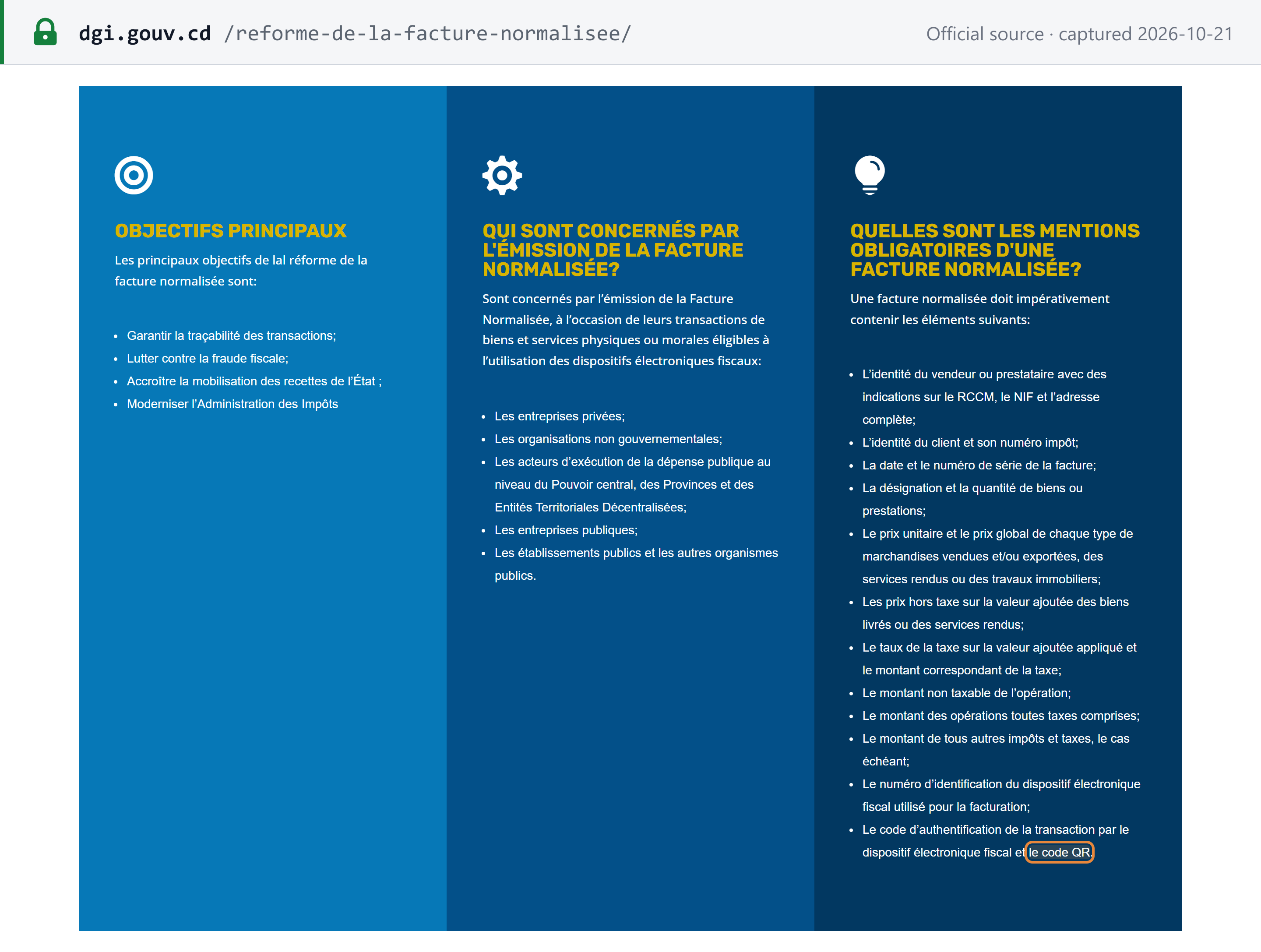
Décret n° 23/10 art. 26 lists twelve mandatory particulars, and the DGI's reform page restates them (adding the seller's trade-register number, RCCM):
| # | Particular | Décret 23/10 art. 26 |
|---|---|---|
| 1 | Seller or provider: name or company name, exact address and Numéro Impôt | a) |
| 2 | Customer: name or company name, exact address and the customer's Numéro Impôt | b) |
| 3 | Invoice date and serial number | c) |
| 4 | Description and quantity of goods or services | d) |
| 5 | Unit price and total price per type of goods, services or works (taxable amounts shown apart from justified non-taxable amounts) | e) |
| 6 | Prices excluding VAT | f) |
| 7 | VAT rate applied and the corresponding VAT amount | g) |
| 8 | Non-taxable amount of the operation | h) |
| 9 | Total including all taxes | i) |
| 10 | Amount of any other taxes | j) |
| 11 | Identification number of the fiscal device (DEF) used | k) |
| 12 | Authentication code of the transaction issued by the DEF, and a QR code | l) |
A "document tenant lieu" (substitute document) must carry every particular except 11 and 12. Arrêté ministériel n° 044 of 30 December 2024 lists which documents qualify; it is named in a DGI communiqué of 4 December 2025 but not published on the DGI's site (checked 21 October 2026). [1] [7]
 Source snapshot captured 2026-10-21 — original
Each omitted particular costs CDF 750,000 for a company and CDF 250,000 for an individual (LPF art. 97 bis).
Issuance deadline
At the time of the transaction: the invoice is issued "lors de chaque transaction" (art. 59 quater; Arrêté ministériel n° 033 of 23 October 2023 art. 3). There is no deferred-issuance window. Sales that could not be invoiced during a connectivity outage must be regularised by normalised invoices within 48 hours, and unbilled sales found by a DGI inspection within 7 days of notification (AM 033 art. 7). Every till must display the notice "EXIGEZ LA FACTURE NORMALISEE". [12]
Numbering and sequencing
Each invoice carries a serial number (art. 26 c), generated with its security elements by the fiscal device. Cancelled invoices are kept in the invoice book or file "selon l’ordre chronologique de numérotation" (Decree 011/42 art. 127). [1]
Credit and debit notes
A facture normalisée "ne peut être annulée ou corrigée autrement que par l’émission d’une facture d’avoir normalisée" (Circulaire n° 004 of 30 December 2024). The credit note carries the same security elements as the invoice — QR code, DEF/DGI code and the device's unique serial number (NID) — and must:
- refer to a real original invoice (except rebates spanning several invoices and notes for costs pre-financed by third parties);
- not exceed, cumulatively, the original invoice amount;
- state and evidence its reason;
- use the same customer, items and taxation groups as the original.
For a credit note to a private individual, record their contact details and keep a copy of their identity document. Keep a special register of credit notes. Credit notes that break these rules are treated as fictitious invoices. [10]
For a bad debt, the seller sends the customer a duplicate invoice overprinted "FACTURE DEMEUREE IMPAYEE POUR LA SOMME DE …", and the customer must repay the VAT it deducted (VAT law art. 52; Decree art. 127). [1]
Currency and language
Not specified in the VAT texts. Neither the VAT law, Decree 011/42, Décret 23/10 nor AM 033 sets an invoice currency, a language or a foreign-exchange conversion rule (checked 21 October 2026). Statutory amounts, returns and refunds are all expressed in Congolese francs.
Document types
- Facture normalisée — issued through a fiscal device, with the security elements.
- Document tenant lieu — a substitute document without the device elements, for the cases listed in AM 044/2024.
- Facture d'avoir normalisée — the normalised credit note.
- Self-supply invoice — a facture normalisée à soi-même is the evidence for deducting VAT on a self-supply (art. 38).
We found no simplified invoice and no value threshold below which a lighter document is allowed.
Who is exempt from using a fiscal device (Circulaire n° 005 of 30 December 2024): the State, provinces, ETDs and public bodies; diplomatic missions and international organisations; small businesses outside VAT under the IBP regime; farmers, breeders and gardeners selling their own unprocessed produce (not intermediaries); individuals letting unfurnished property to individuals; public water and electricity utilities; banks and microfinance institutions approved by the central bank; and foreign airlines selling only their own products. Others may ask the DGI for a temporary dispensation, which "ne peut excéder une période de deux (02) mois". [11]
Self-billing
Not provided for: the VAT texts read contain no self-billing provision (checked 21 October 2026).
Retention and audit trail
- Retention. The VAT texts set no explicit period in years. The DGI may reassess "au titre de l’exercice en cours et de quatre années précédentes" (LPF art. 43), so keep invoices and records for at least the current year plus four. Books must be kept in the DRC at the head office or main establishment, or with the fiscal representative, and supporting documents for deductions must be originals (VAT law art. 57). Users of standalone billing devices (UF) must use thermal paper that stays legible for at least four years (AM 033 art. 8).
- Audit trail. Billing systems "doivent en outre respecter les critères d’inaltérabilité, de sécurisation, de conservation et d’archivage des données" (art. 59 quater). Arrêté ministériel n° 016 of 27 February 2025 spells these out for homologated enterprise billing systems: corrections are themselves recorded, daily, monthly and annual closures are kept, and archives are made at least annually with their integrity guaranteed. [1] [13]
A specimen of a compliant invoice
The DGI publishes no official specimen of a facture normalisée. We looked in the Code des Impôts, the ministerial orders and circulars on the reform, the 2025–2026 e-invoicing communiqués, the list of approved billing systems, the DGI's media library and the e-DEF portal (21 October 2026); the invoice images on the DGI site are decorative illustrations, not models. Below, Lookuptax lays out the twelve particulars of Décret 23/10 art. 26 for an illustrative domestic B2B sale at 16%. Every name, number and code is fictional:
Facture normalisée — illustrative
| Désignationart. 26 d | Qtéart. 26 d | Prix unitaire HTart. 26 e | Prix total HTart. 26 e, f |
|---|---|---|---|
| Ramettes de papier A4 | 200 | CDF 3,000 | CDF 600,000 |
| Livraison | 1 | CDF 200,000 | CDF 200,000 |
- Total hors TVAart. 26 f
- CDF 800,000
- TVA 16%art. 26 g
- CDF 128,000
- Montant non taxableart. 26 h
- CDF 0
- Autres impôts et taxesart. 26 j
- CDF 0
- Total toutes taxes comprisesart. 26 i
- CDF 928,000
- Security elements printed by the fiscal device (art. 26 k and l): DEF number DEF-SPECIMEN-0001 · DEF/DGI authentication code SPECIMEN-CODE · QR code (not reproduced).
- A substitute document (document tenant lieu) carries the same particulars except the DEF number, authentication code and QR code — art. 26, last paragraph.
- The total is below CDF 1,000,000. A transaction of CDF 1,000,000 or more between VAT taxpayers must be paid by cheque, transfer or bank card, or the customer loses the VAT deduction — VAT law arts. 59 bis and 74 bis.
E-invoicing status
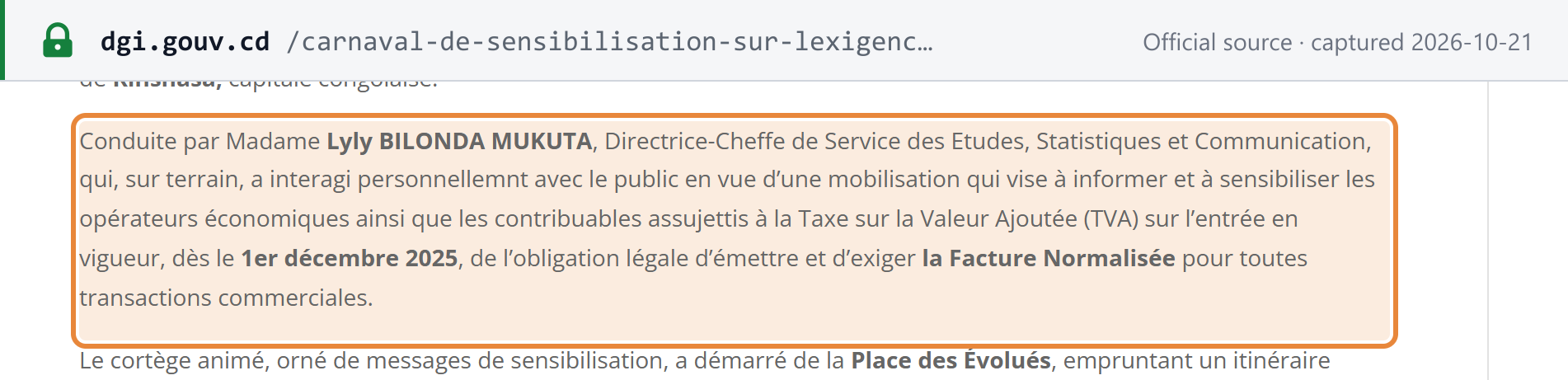
Status (as at 21 October 2026): mandatory for all VAT taxpayers since 1 December 2025. Every invoice is a facture normalisée issued through a dispositif électronique fiscal (DEF) connected to the DGI. The DGI calls the facture normalisée "un document commercial électronique, doté des éléments de sécurité", issued "à l’aide d’un Dispositif Électronique Fiscal qui est directement relié à l’Administration des Impôts". On 5 October 2026 it said the obligation "est pleinement effective" now that the moratoria have ended, and that its services are carrying out compliance checks nationwide. [4] [9]
 Source snapshot captured 2026-10-21 — original
-
Model. Real-time reporting through a certified device: devices are "connectés au système informatique de l’Administration des Impôts" (art. 59 quater) and physical devices transmit over the mobile network (AM 033 art. 8). We found no DGI description of pre-issue approval, so this is not a clearance model. See CTC e-invoicing models and fiscal devices.
-
Devices (Décret 23/10 arts. 4–10):
- UF (unité de facturation) — a standalone physical billing device;
- MCF (module de contrôle de facturation) — attached to an enterprise billing system (SFE) homologated by the DGI;
- e-UF — the DGI's free online invoicing for businesses without billing software;
- e-MCF — the online control module for businesses with a homologated SFE.
The online versions run on the DGI's e-DEF platform. Homologated systems receive an ISF identifier and devices a NID (AM 016/2025). The DGI publishes the list of homologated SFE and approved DEF suppliers; the latest is dated 4 September 2026. [13] [14]
-
Phases by taxpayer size. None: one date, 1 December 2025, for all VAT taxpayers (DGI Communiqué officiel N° 01/050 of 2 October 2025: "la date de l’effectivité de l’obligation d’émission et d’exigence d’une facture normalisée … est fixée au 1er décembre 2025"). [6]
-
Formats and standards. Each invoice carries the device number, the DEF/DGI authentication code and a QR code. The DGI publishes no XML, UBL or Peppol format; its technical specification sits on a developer environment that was unreachable on 21 October 2026.
-
Scope. B2B and B2C: every transaction. B2G: public spending bodies and public enterprises may accept only normalised invoices, while public bodies selling are themselves exempt from using a device (Circulaire 005/2024).
Timeline.
| Date | Step |
|---|---|
| 23 June 2017 | Finance Law n° 17/005 creates the fiscal-device obligation, start date to be set by arrêté |
| 28 December 2022 | Finance Law n° 22/071 introduces the facture normalisée, SFE homologation and its penalties |
| 3 March 2023 | Décret n° 23/10 regulates the facture normalisée |
| 23 October 2023 | Arrêtés ministériels n° 033 (conditions of use of fiscal devices) and 034 (approval and marketing of devices and systems) |
| 30 December 2024 | Circulaires n° 004 (credit notes) and 005 (scope and dispensations); AM 044 (substitute documents) |
| 27 February 2025 | AM 016 amends the approval and homologation rules |
| 2 October 2025 | DGI fixes the start date at 1 December 2025 |
| 1 December 2025 | Obligation to issue and demand the facture normalisée in force for all VAT taxpayers |
| 4 December 2025 | DGI: December 2025 deductions not backed by normalised invoices will be reassessed, after a 20-day regularisation window |
| 25 February 2026 | Taxation groups updated for Finance Law n° 25/060 (5% and 1%) |
| 5 October 2026 | DGI: the Minister has announced the end of the moratoria and the obligation is "pleinement effective"; nationwide compliance checks |
For other countries, see e-invoicing status and networks worldwide.
Filing and payment
Filing frequency
Monthly, for every VAT taxpayer. The VAT texts offer no quarterly or annual option by turnover band.
Return due date
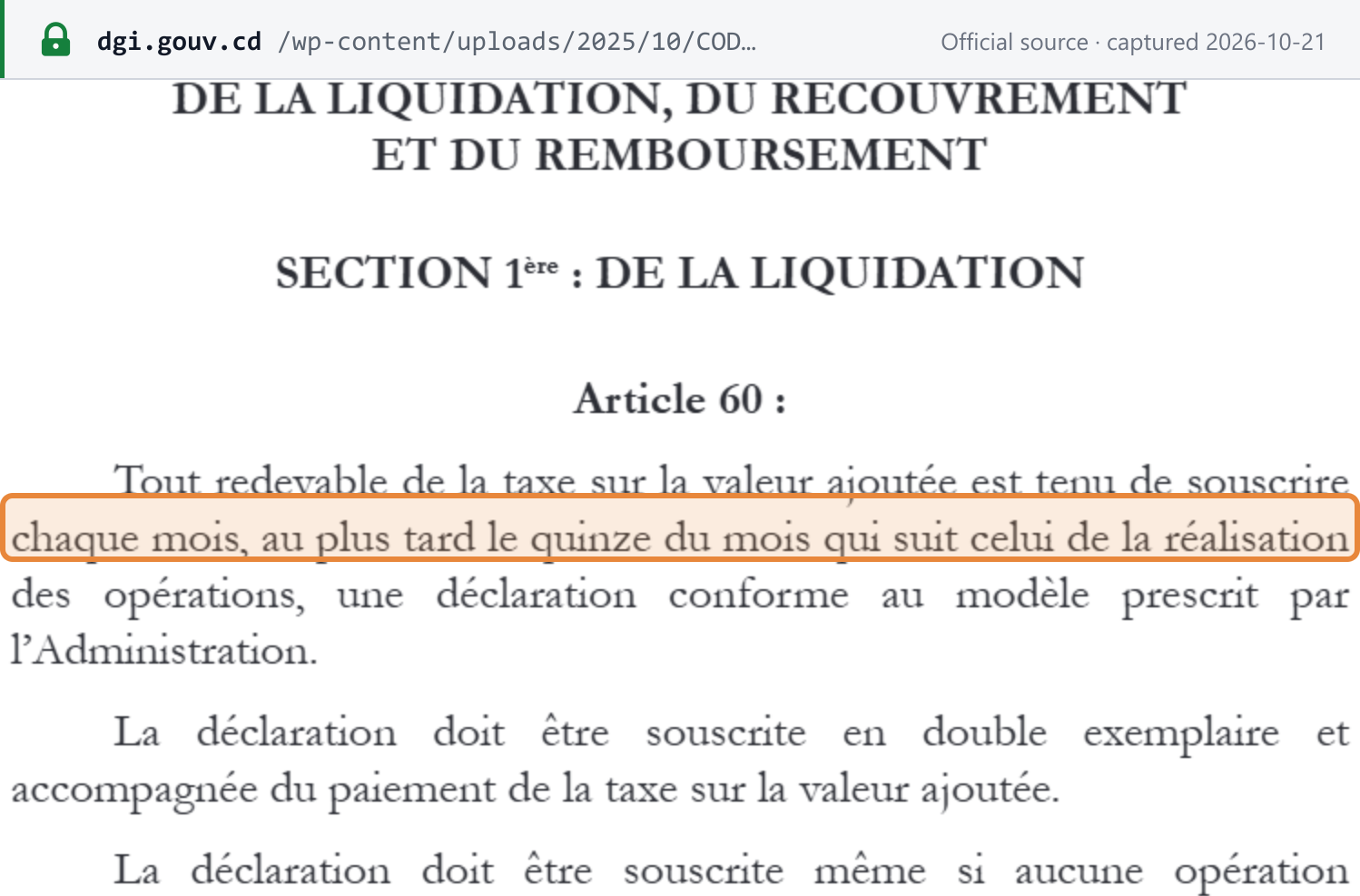
By the 15th of the month after the month of the operations: "Tout redevable de la taxe sur la valeur ajoutée est tenu de souscrire chaque mois, au plus tard le quinze du mois qui suit celui de la réalisation des opérations, une déclaration conforme au modèle prescrit par l’Administration" (VAT law art. 60). A return is due even with nothing to declare, marked "Néant". Every return must be accompanied by a detailed statement of deductions listing each supplier invoice (supplier name and Numéro Impôt, invoice number, date and amount, VAT, and the nature and quantity of the purchase); without it, the deductions are reinstated after a five-day formal notice (art. 56). [1]
The law does not move the deadline when the 15th is a weekend or holiday. The DGI publishes the exact date in a communiqué each month — for example, Thursday 15 October 2026 for September 2026 returns. [17]
 Source snapshot captured 2026-10-21 — original
Payment due date and method
With the return: the return "doit être souscrite en double exemplaire et accompagnée du paiement de la taxe sur la valeur ajoutée" (art. 60), so payment is also due by the 15th. Online filing (télédéclaration) on the DGI's i-impôts portal is in use for taxpayers managed by the large-enterprise directorate (DGE), the tax centres (CDI) and some Centres d'Impôts Synthétiques. Other taxpayers download the official forms from the DGI site and file with their tax office, by email or on paper, as the DGI's monthly communiqués set out. [17]
Import VAT is paid to customs before the goods are removed (art. 61).
Additional listings
- Annual customer and supplier lists. Every natural or legal person subject to tax on 2025 profits and liable to VAT, exempt or not, files a list of its customers and a list of its suppliers each year (LPF arts. 47 bis and 47 ter). The customer list was introduced by Finance Law n° 24/011 of 20 December 2024, with a first deadline of 31 March 2025, for manufacturers, importers and wholesalers. The DGI's communiqué for 2026 addresses both lists to every VAT taxpayer subject to profits tax and sets 31 March 2026 as the deadline. Teledeclarants file online; others use the forms on the DGI site. [20]
- VAT withheld. VAT withheld by the Treasury or by mining companies is reported on separate annexes (art. 53).
- There is no equivalent of an EC sales list.
Input-tax recovery and blocked items
The right to deduct arises when the tax becomes chargeable and must be exercised "jusqu’au 31 décembre de l’année qui suit celle au cours de laquelle la taxe est devenue exigible" (art. 37). It needs a facture normalisée, or a substitute document showing the supplier's Numéro Impôt, or for imports the customs release declaration (art. 38). [1]
Blocked input VAT (arts. 41–42):
- lodging, accommodation, restaurant, reception and entertainment costs, and hire of tourist vehicles and passenger transport — except for tourism, restaurant and entertainment businesses acting in their taxable trade;
- goods used by third parties, managers or staff;
- petroleum products, except for wholesale resale, power generation, fixed industrial plant and airlines; other uses are capped at 50%;
- passenger vehicles, and their hire, parts and services — except staff buses of ten or more seats, public-transport fleets and car-rental companies;
- VAT shown on an invoice issued outside the fiscal devices by someone required to use them;
- transactions of CDF 1,000,000 or more between VAT taxpayers not paid by cheque, transfer or bank card (arts. 59 bis and 74 bis).
Businesses making both taxable and exempt supplies deduct by pro-rata, rounded up, based provisionally on the prior year and finalised by 31 March (arts. 43–45). Deductions on capital goods are adjusted over five years for movables and twenty for immovables (art. 50).
Refunds
The general rule is carry-forward: "Le crédit d’impôt ne peut pas faire l’objet d’un remboursement au profit de l’assujetti et ne peut être cédé" (art. 63). Refunds are available only to (art. 64):
- exporters, capped at 16% of the month's exports;
- businesses making new fixed-asset investments, for projects of CDF 1,000,000,000 or more;
- mining and oil companies in the research or development and construction phase;
- businesses ceasing activity;
- wholly State-owned public bodies whose VAT was withheld.
The claim is filed with the monthly return on the official form; an incomplete file is returned within 7 days and the taxpayer has 3 months to complete it (Decree arts. 144–145). Refunds are paid by bank transfer to a CDF account within 30, 60 or 90 days depending on the taxpayer's risk category (Arrêté ministériel n° 018 of 18 March 2016). There is no refund scheme for non-residents. [1] [2]
Exemptions
Exempt supplies
Exemptions are a closed list in articles 15 to 19: "En dehors des opérations reprises aux articles 15 à 19 ci-dessus, aucune exonération ou exemption en matière de la taxe sur la valeur ajoutée ne peut être accordée par des textes particuliers" (art. 20). Examples:
- Goods and imports (art. 15): used goods sold by a user who could not deduct VAT on them; fiscal stamps; listed agricultural inputs; transfers of immovable property by non-developers; human organs and blood, and prostheses; fishing boats and nets; listed pharmaceutical products and medical equipment; mosquito nets; coffins; mining and oil equipment before the exploitation phase; imports of wheat, maize and their flours, and local sales of wheat, bread, maize and those flours; local sales of live animals; start-up equipment imported by new businesses; original works of art sold by the artist.
- Services (art. 17): newspapers and books (advertising excluded); school fees of authorised institutions; medical care and analyses; patient transport; funeral services; international air transport; interest on investment loans, leasing, agricultural credit and overdrafts; microfinance credit; letting of unfurnished homes by non-developers; life and health insurance and reinsurance premiums.
- Also exempt: activities subject to a specific exclusive tax, such as entry tickets, transfers bearing registration duty and gambling winnings (art. 18); and diplomatic missions and international organisations, subject to reciprocity (art. 19). [1]
Exempt is not zero-rated. Exports at 0% keep full input-tax recovery. Exempt supplies give no right to deduct: "aucun droit à déduction n’est ouvert pour les assujettis qui effectuent des opérations exonérées" (Decree 011/42 art. 98). A business making both uses the pro-rata.
Special regimes
- Second-hand dealers pay VAT on their margin for goods bought from non-taxpayers (art. 31).
- Travel agents use a margin scheme and cannot deduct the bought-in costs (arts. 32–33).
- Freight forwarders and customs brokers are taxed on their remuneration less justified disbursements (art. 34).
- Services and works are taxed on a cash basis — VAT is due on receipt of payment (art. 25). The DGI may authorise accounting on invoicing instead (art. 26), and the invoices must then say "Autorisation d’acquitter la TVA d’après les débits".
- Free zones are outside the customs territory; goods leaving them for consumption are taxed on their value at exit (arts. 24 and 27).
- Small businesses have no VAT flat-rate scheme: below CDF 80,000,000 they are outside VAT and pay IBP, unless they opt in.
- Mining companies in the exploitation phase account for import VAT through their return (art. 62).
Offences and penalties
Offences
Tax offences committed with evident fraudulent intent are punishable "sans préjudice des peines portées aux articles 124 et 127 du Code Pénal" (LPF art. 101). They include wilfully failing to declare, concealing taxable sums, fictitious or inaccurate book entries, obstructing the tax administration, organised insolvency, and failing to pay over a tax collected as legal debtor — which covers VAT charged to customers. The fine equals the tax evaded, doubled on a repeat; prosecution is by the public prosecutor on the request of a DGI officer. The LPF itself states no prison term; it refers to the Penal Code. [1]
VAT-specific conduct is penalised "sans préjudice des poursuites pénales": wrongly charging VAT, false or falsified invoices, and tampering with a billing system. Repeated failure to issue normalised invoices can lead to a three-month administrative closure and a residence ban for foreign managers (art. 74 sexies). Trading without a Numéro Impôt leads to provisional closure (LPF art. 98).
Penalties
All amounts as consolidated in the Code des Impôts of 10 July 2023. Finance Law n° 25/060 amended the VAT law and the LPF for 2026, and its text was not available on any official site we could reach (checked 21 October 2026).
| Breach | Penalty | Source |
|---|---|---|
| Late VAT registration declaration | CDF 500,000 | VAT law art. 69 |
| Late return showing a credit / a nil return | CDF 1,500,000 and loss of 10% of the credit / CDF 500,000 | art. 69 bis |
| Late payment of tax declared | 2% per month, each month started counted in full | LPF art. 91 |
| Late filing regularised before formal notice | 25% of the tax declared | LPF art. 89 |
| Reassessment | 20% of the tax evaded (40% on a repeat); 50% for assessment by default (100% on a repeat); interest of 2% per month, capped at 50% | LPF art. 89 |
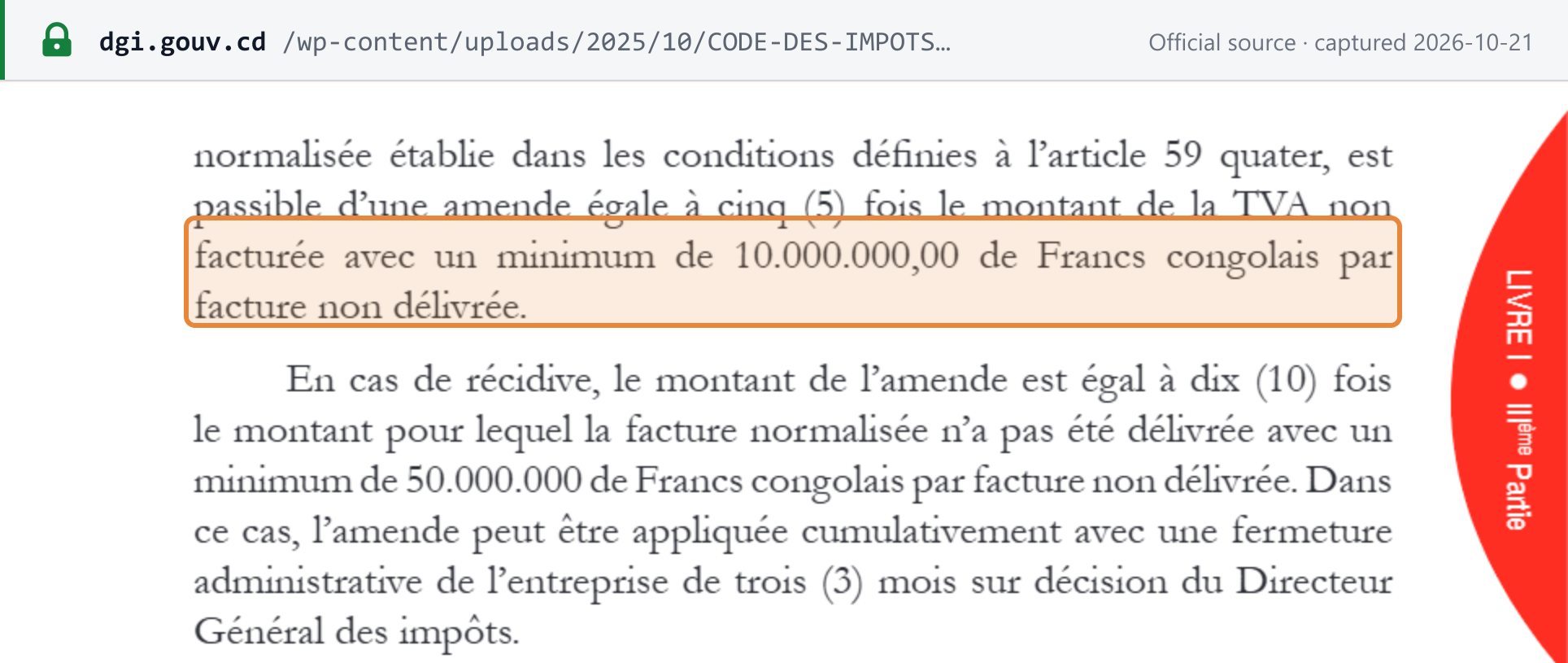
| Transaction without a facture normalisée | 5× the VAT not invoiced, minimum CDF 10,000,000 per invoice; on a repeat, 10× the amount not invoiced, minimum CDF 50,000,000 per invoice, with possible three-month closure | VAT law art. 74 sexies |
| Not using a fiscal device | CDF 10,000,000 | art. 74 quater |
| Deliberately corrupting a fiscal device | CDF 5,000,000; tripled on a repeat | art. 74 quinquies |
| Any other breach of the fiscal-device rules | CDF 10,000,000 | art. 74 decies |
| Altering a billing system, or identity theft to issue invoices | CDF 10,000,000 per invoice | art. 74 octies |
| Unhomologated billing software (supplier, publisher or in-house developer) | CDF 50,000,000; CDF 100,000,000 on a repeat | art. 74 nonies |
| Each missing mandatory invoice particular | CDF 750,000 (companies) / CDF 250,000 (individuals) per omission | LPF art. 97 bis |
| No invoice issued | 2× the tax at stake; tripled on a repeat | VAT law art. 72 |
| Issuing a false invoice, or using a falsified one to deduct VAT | 3× the VAT | art. 71 |
| Wrongly charging VAT on an invoice | 3× the VAT wrongly invoiced | art. 70 |
| Failure to withhold VAT | A fine equal to the VAT not withheld | art. 74 ter |
 Source snapshot captured 2026-10-21 — original
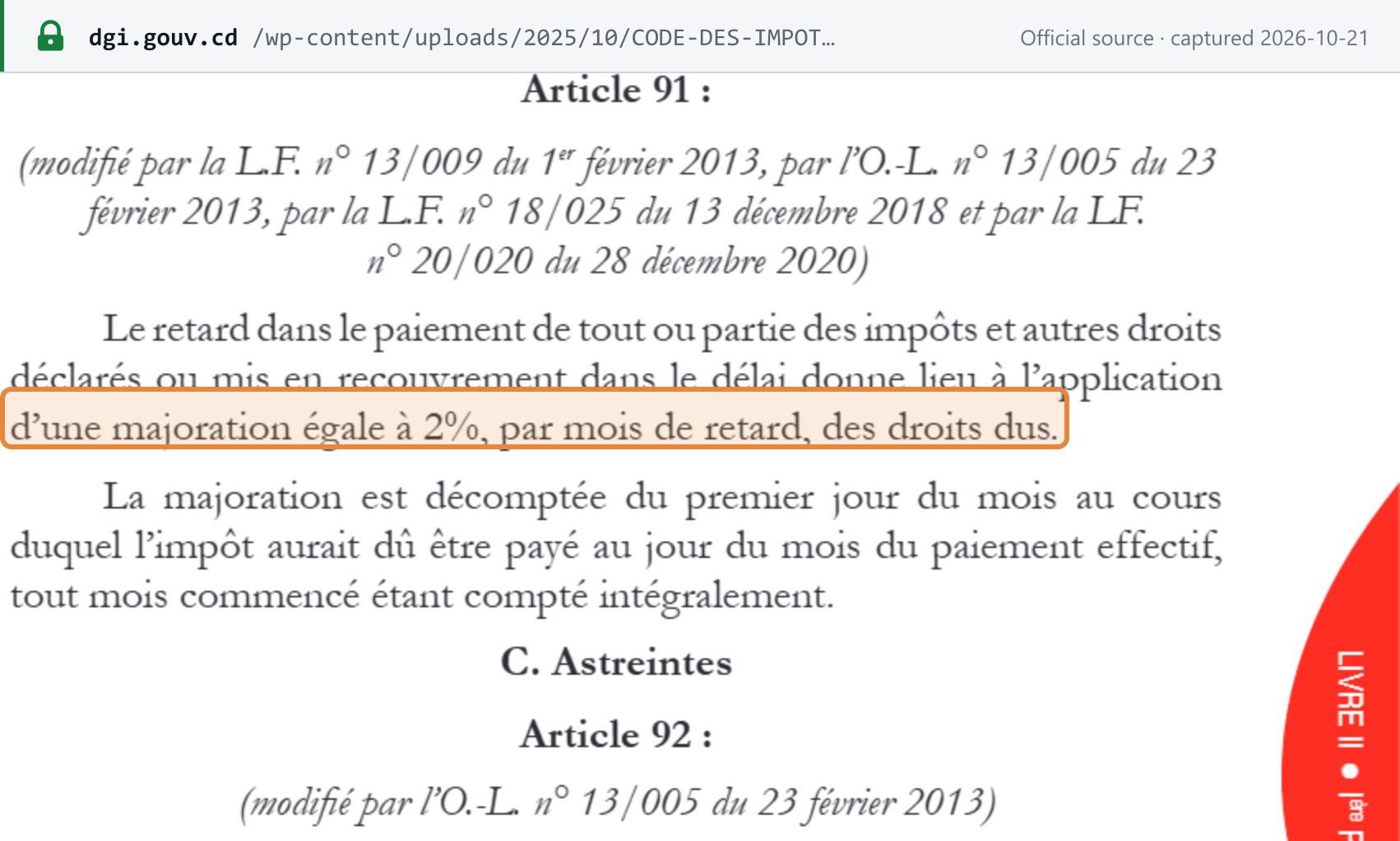 Source snapshot captured 2026-10-21 — original
Frequently asked questions
Our supplier in the DR Congo gave us an ordinary invoice, not a facture normalisée. Can we deduct the VAT?
No. Article 42 of the VAT law blocks the deduction of VAT shown on an invoice issued outside the fiscal devices (DEF) by a person who is required to use them. The DGI's communiqué of 4 December 2025 announced that deductions for December 2025 not backed by a normalised invoice would be reassessed after a 20-day regularisation window, and on 5 October 2026 the DGI confirmed that, with the moratoria ended, the obligation is fully effective.
We already run an ERP. Do we still need a fiscal device in the DR Congo?
Yes. Every VAT taxpayer must issue its invoices through a dispositif électronique fiscal connected to the DGI. A business with its own billing software needs that software homologated by the DGI as an enterprise billing system (SFE) and linked to a control module (MCF) or its online version (e-MCF). A business without billing software can use the DGI's free online e-UF on the e-DEF platform.
We are a foreign company selling software or services to DR Congo customers. Who pays the VAT?
A non-resident liable to DRC VAT must appoint an approved representative resident in the DRC, by legalised or notarised letter to the DGI, and the representative is jointly liable for the tax (VAT law article 23). If no representative is appointed, the VAT and any penalties are paid by the customer. Online services supplied by non-resident businesses are expressly within scope (Decree 011/42 article 23), and the law sets no separate threshold for non-residents.
When is the DR Congo VAT return due if the 15th falls on a weekend?
The VAT law only says the return and payment are due no later than the 15th of the month following the month of the operations. It does not say what happens when the 15th is a weekend or holiday. The DGI publishes a communiqué each month giving the exact deadline, so check its official communiqués page.
Can we get our DR Congo VAT credit refunded?
Only if you fall into one of the categories in article 64 of the VAT law: exporters (capped at 16% of the month's exports), businesses making new investments of CDF 1,000,000,000 or more, mining and oil companies in the research or development phase, businesses ceasing activity, and wholly State-owned public bodies whose VAT was withheld. Everyone else carries the credit forward; article 63 says it can be neither refunded nor transferred.
Important websites
| Site | Purpose |
|---|---|
| DGI — Direction Générale des Impôts | Tax authority home page |
| DGI — VAT page | VAT rules, the registration and return forms, the VAT leaflet and the published register of VAT taxpayers |
| e-NIF | Online Numéro Impôt application, with a NIF search |
| i-impôts | Online filing and payment (large enterprises, tax centres and some CIS taxpayers); also checks tax-clearance certificates |
| e-DEF | DGI platform for the online fiscal devices (e-UF, e-MCF) |
| DGI — Facture normalisée reform | Rules, ministerial orders and circulars on the normalised invoice |
| Approved billing systems and devices (PDF, 4 September 2026) | Homologated SFE and approved DEF suppliers |
| DGI — Official communiqués | Monthly filing deadlines and e-invoicing announcements |
| SYGDEF | DGI fiscal-device system (account login), named in Circulaire 005/2024 and the DGI's 5 October 2026 communiqué alongside its "FACNO RDC" mobile app for checking normalised invoices |
| DGI — Document authentication | Checks DGI-issued documents by QR code or number |
| DGDA — Customs | Import declarations and import VAT |
| Journal officiel | Official gazette (unreachable on 21 October 2026) |
There is no official rate-lookup tool; the DGI's VAT leaflet is its own summary of the rates.
Recent changes
- 2026-10-05 — The DGI states that, with the moratoria ended by the Minister, the obligation to issue and deliver a facture normalisée is fully effective, with nationwide compliance checks. (DGI) — see event
- 2026-03-23 — Annual customer and supplier lists now due from every VAT taxpayer subject to profits tax, by 31 March 2026 (LPF arts. 47 bis and 47 ter). (DGI)
- 2026-02-25 — Taxation groups updated for Finance Law n° 25/060: the 8% group becomes 5% and a new 1% group is added. (DGI) — see event
- 2025-12-01 — The facture normalisée, issued through a fiscal device, becomes mandatory for all VAT taxpayers. (DGI)
For the full chronology, see DR Congo tax changes on Lookuptax.
Reference links
- DGI — Code des Impôts, updated to 10 July 2023 (VAT law, Decree 011/42, Décret 23/10 and the tax-procedure law)
- DGI — La TVA : notions essentielles à retenir (VAT leaflet, August 2025)
- DGI — Taxe sur la valeur ajoutée (VAT page)
- DGI — Réforme de la facture normalisée
- DGI — Awareness campaign on the facture normalisée obligation from 1 December 2025 (news, November 2025)
- DGI — Communiqué officiel N° 01/050 of 2 October 2025 (start date)
- DGI — Communiqué officiel N° 01/059 of 4 December 2025 (practical arrangements)
- DGI — Communiqué officiel N° 01/010 of 25 February 2026 (taxation groups)
- DGI — Communiqué of 5 October 2026 (obligation fully effective)
- Circulaire ministérielle n° 004 of 30 December 2024 (normalised credit notes)
- Circulaire ministérielle n° 005 of 30 December 2024 (scope and dispensations)
- Arrêté ministériel n° 033 of 23 October 2023 (conditions of use of fiscal devices)
- Arrêté ministériel n° 016 of 27 February 2025 (approval and homologation)
- DGI — Homologated SFE and approved DEF, as at 4 September 2026
- DGI — VAT registration declaration form
- DGI — Communiqué officiel N° 01/005 of 20 January 2026 (Centres d'Impôts Synthétiques)
- DGI — Communiqué on the 15 October 2026 deadline
- Ministère du Budget — Budget citoyen 2026
- DGI — Session on the innovations of Finance Law n° 25/060 for 2026 (January 2026)
- DGI — Communiqué officiel N° 01/015 of 23 March 2026 (customer and supplier lists)
Related on Lookuptax:
- VAT registration thresholds worldwide
- Worldwide tax rates
- E-invoicing status and networks worldwide
- Fiscal devices and certified cash registers explained
- Reverse charge explained
- VAT on digital services by non-resident suppliers
- How to register for VAT, sales tax or GST
- Check a VAT number — official lookups by country