Guatemala IVA guidelines
| FACTSHEET | |
|---|---|
| Country code | GT |
| Tax name | Value added tax (IVA) — Impuesto al Valor Agregado |
| Tax Authority | SAT (Superintendencia de Administración Tributaria) |
Overview
Guatemala's value-added tax is the Impuesto al Valor Agregado (IVA). Article 1 of the Ley del IVA establishes it "sobre los actos y contratos gravados por las normas de la presente ley" (on the acts and contracts taxed by this law). This guide reflects the rules as at 15 October 2026. [1]
Authority. IVA is administered by the Superintendencia de Administración Tributaria (SAT). The law's text still refers to the "Dirección General de Rentas Internas", SAT's predecessor.
Statute. The Ley del Impuesto al Valor Agregado, Decreto 27-92 of the Congress, as amended, most recently by Decreto 31-2024 and Decreto 17-2025. Its regulation is Acuerdo Gubernativo 5-2013 (Reglamento de la Ley del IVA). [1] [2]
What is taxed. Under article 3: the sale or exchange of movable goods; services rendered in the national territory; imports; the leasing of movable and immovable property; adjudications in payment; self-supply and withdrawals of goods; inventory shortfalls; the first sale of real estate; gifts between living persons; and the contribution of real estate to companies. Later transfers of housing pay stamp tax instead of IVA (article 7.12). [1]
Currency. Amounts are in quetzales (GTQ, Q).
Tax period. "Un mes calendario" (one calendar month), under article 2.7. [1]
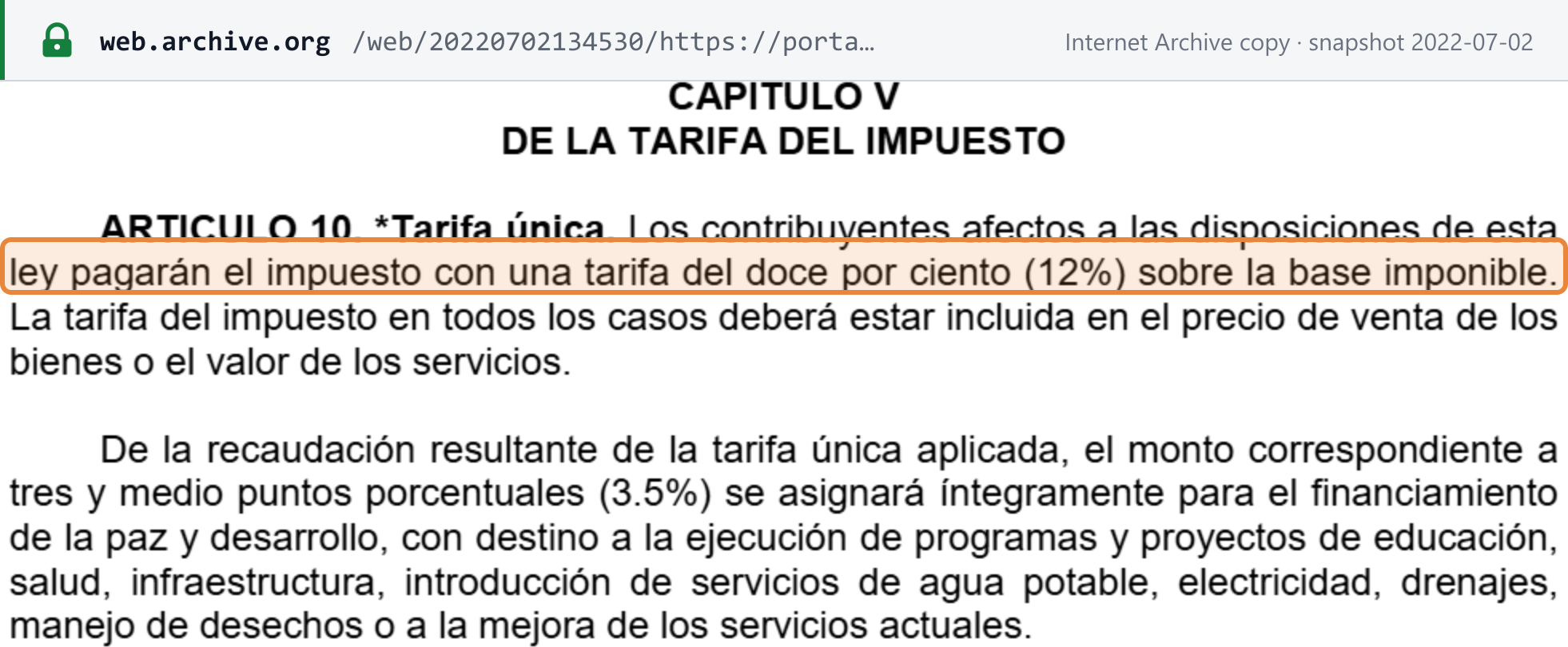
Layering. None. IVA is a single national tax with one rate; there is no departmental or municipal IVA. Article 10 earmarks 3.5 of the 12 percentage points for peace and development programmes, including a share for municipalities, but that is revenue sharing, not a separate tax. Other indirect taxes, such as the fuel tax (IDP) and the hotel tax (ITH), are separate and appear as separate lines on an FEL invoice (see Invoice requirements). [1] [3]
For neighbouring systems, see the Mexico VAT guide and the Colombia VAT guide.
Registration
Who should register
Every person carrying on an activity in Guatemala enrols in SAT's Registro Tributario Unificado (RTU) before starting. Article 120 of the Tax Code, as rewritten by Decreto 31-2024 (in force 9 April 2025), says that individuals and legal persons, "públicas y privadas, lucrativas o no lucrativas", must register "antes de iniciar actividades" (before starting activities), and that SAT assigns each of them a Número de Identificación Tributaria (NIT). Registered data must be ratified once a year. [4]
For IVA, anyone who habitually or periodically carries out taxable acts in Guatemala is a taxpayer (article 2.6 of the Ley del IVA). [1]
Registration threshold
None. There is no turnover threshold for IVA registration: the duty to register arises before activity starts, whatever the expected turnover. Turnover decides only which IVA regime applies (see Voluntary registration).
Non-resident registration
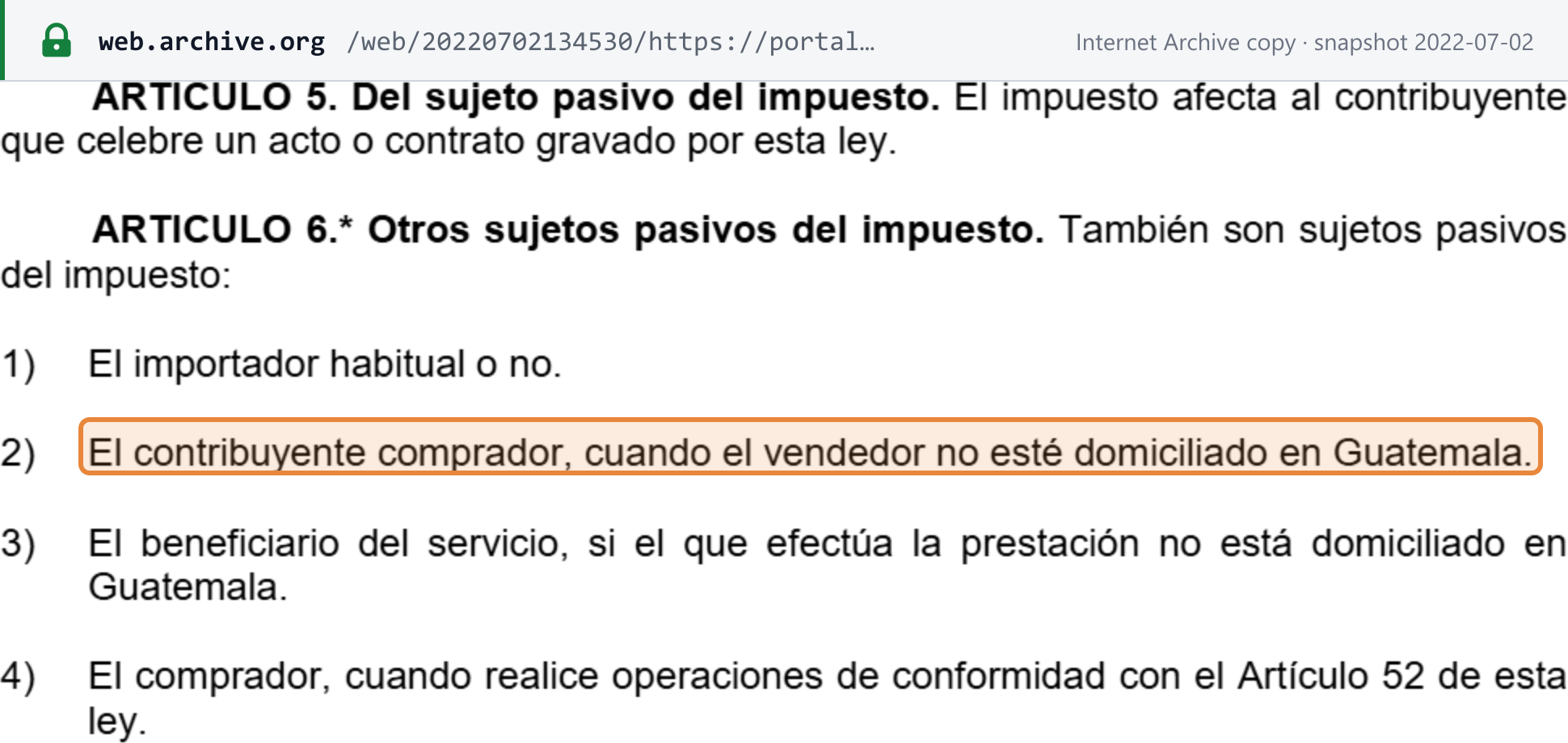
Guatemala has no non-resident IVA registration scheme. Neither the Ley del IVA nor SAT's registration pages provide a registration route or threshold for foreign suppliers without a presence in Guatemala. Instead, article 6 of the law makes the Guatemalan buyer, or the Guatemalan beneficiary of a service, liable for the IVA when the seller or provider is not domiciled in Guatemala (see Cross-border rules). [1]
Tax identification number
The tax number is the NIT, which SAT alone assigns. Its format (2 to 12 digits, ending in a check digit of 0 to 9 or K), the NITs formed from the first nine digits of the CUI identity number for Guatemalans and domiciled foreigners registered from 4 October 2023, and the check digit are covered in the Guatemala NIT and CUI guide. You can check a NIT's format with the Guatemala NIT validator.
How to register
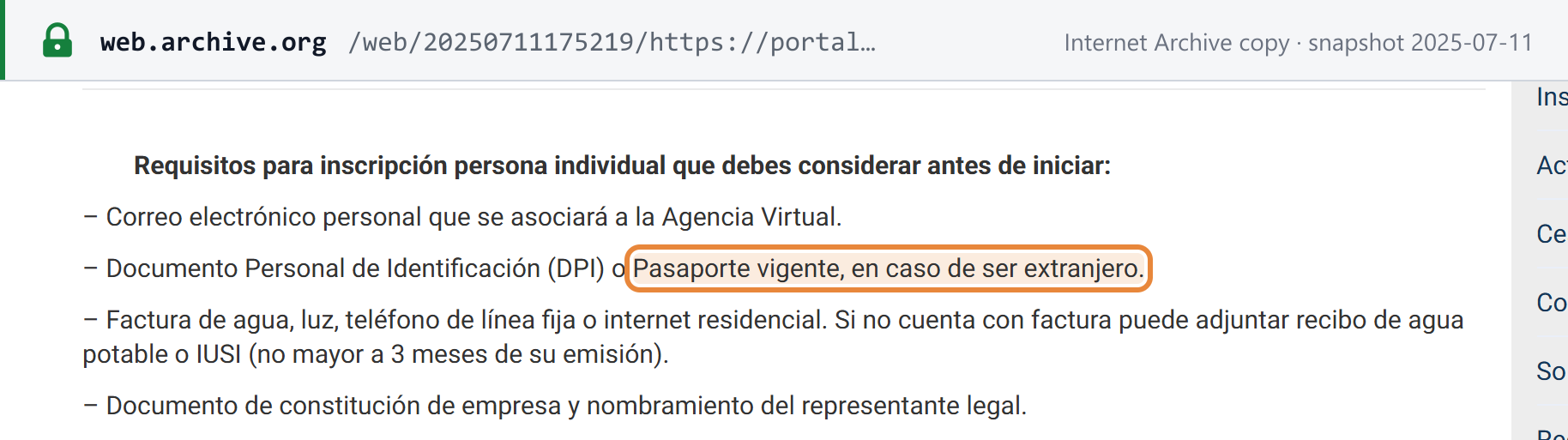
Apply online through SAT's RTU Digital service, "Inscripción (solicitud de NIT)". SAT lists these requirements: [5]
- Individuals: a personal email address, which is linked to the Agencia Virtual; the Documento Personal de Identificación (DPI), or "Pasaporte vigente, en caso de ser extranjero" (a valid passport, if a foreigner); and a utility bill no more than three months old.
- Legal entities: a company email address; the legal representative's DPI or passport; the constitution document and the representative's appointment; and a utility bill. The representative must already hold a NIT with updated data, including fingerprint and photograph.
Voluntary registration
Not applicable as such, because everyone registers. The choice is between two IVA regimes:
- Régimen General: 12% on sales, less IVA paid on purchases.
- Pequeño Contribuyente: 5% of gross income, with no input credit, for persons whose annual sales do not exceed 125 monthly non-agricultural minimum wages (see Special regimes).
A business that wants to charge creditable IVA to business customers, or to recover its own input IVA, registers in the General regime. A small taxpayer whose income exceeds the ceiling must change regime "a más tardar, en el transcurso del mes calendario inmediato siguiente" (at the latest, during the following calendar month); otherwise SAT moves it to the General regime (article 50, as reworded by Decreto 31-2024). [4]
Deregistration
- Returns continue until SAT is told. The duty to file subsists even in months with no taxable operations, unless the taxpayer has notified SAT in writing that its activities are suspended or have ended (article 43 of the Ley del IVA). [1]
- Temporary or definitive cessation. Under article 120 of the Tax Code as rewritten by Decreto 31-2024, a taxpayer can request temporary cessation, which SAT says lasts as long as requested but not beyond the prescription period of 48 months, or definitive cessation, which SAT can also apply ex officio. Changes to registered data must be notified within 30 days. [4] [6]
- Suspension by SAT. SAT can suspend the IVA affiliation of taxpayers who do not file and pay, or who file 12 or more consecutive nil returns while their FEL invoices show income. A suspended taxpayer "quedará inhabilitado" (is barred) from issuing FEL invoices. [4]
Group registration
Not available. The Ley del IVA contains no provision for grouping separate persons. What it does provide is a single return for one taxpayer's several establishments: a taxpayer with more than one business establishment declares and pays for all of them "en forma conjunta, en un solo formulario" (jointly, on one form), under article 44 as reworded by Decreto 31-2024. [4]
Rates
Standard rate
12%, a single rate ("tarifa única") on the taxable base. Article 10 requires the tax to be included in the price: "La tarifa del impuesto en todos los casos deberá estar incluida en el precio de venta de los bienes o el valor de los servicios" (in all cases the tax must be included in the sale price of goods or the value of services). Prices and invoice totals are therefore IVA-inclusive; the IVA within a total is total × 12/112. [1]
SAT's guidance on short-term rentals confirms that taxpayers pay IVA "con una tarifa del 12%" under article 10. [7]
Reduced and zero rates
None. The Ley del IVA has one rate. Exports are exempt with a right to refund of input IVA, which works like a zero rate (see Imports and exports). [1]
The 5% often quoted for Guatemala is not a reduced IVA rate. It is the tax paid by taxpayers in the Pequeño Contribuyente regime on their total gross monthly income, with no input credit for them or their buyers (article 47). SAT's short-term-rental guidance confirms that "la tarifa aplicada en este régimen será de 5%" (the rate in this regime is 5%). [7] [1] The 4% "Régimen Electrónico de Pequeño Contribuyente", created by Decreto 7-2019, has been repealed: article 25 of Decreto 31-2024 repealed articles 54 "A" to 54 "F" of the law three months after Decreto 31-2024 entered into force on 9 April 2025. [8] [4]
Temporary fuel exemption (October to December 2026)
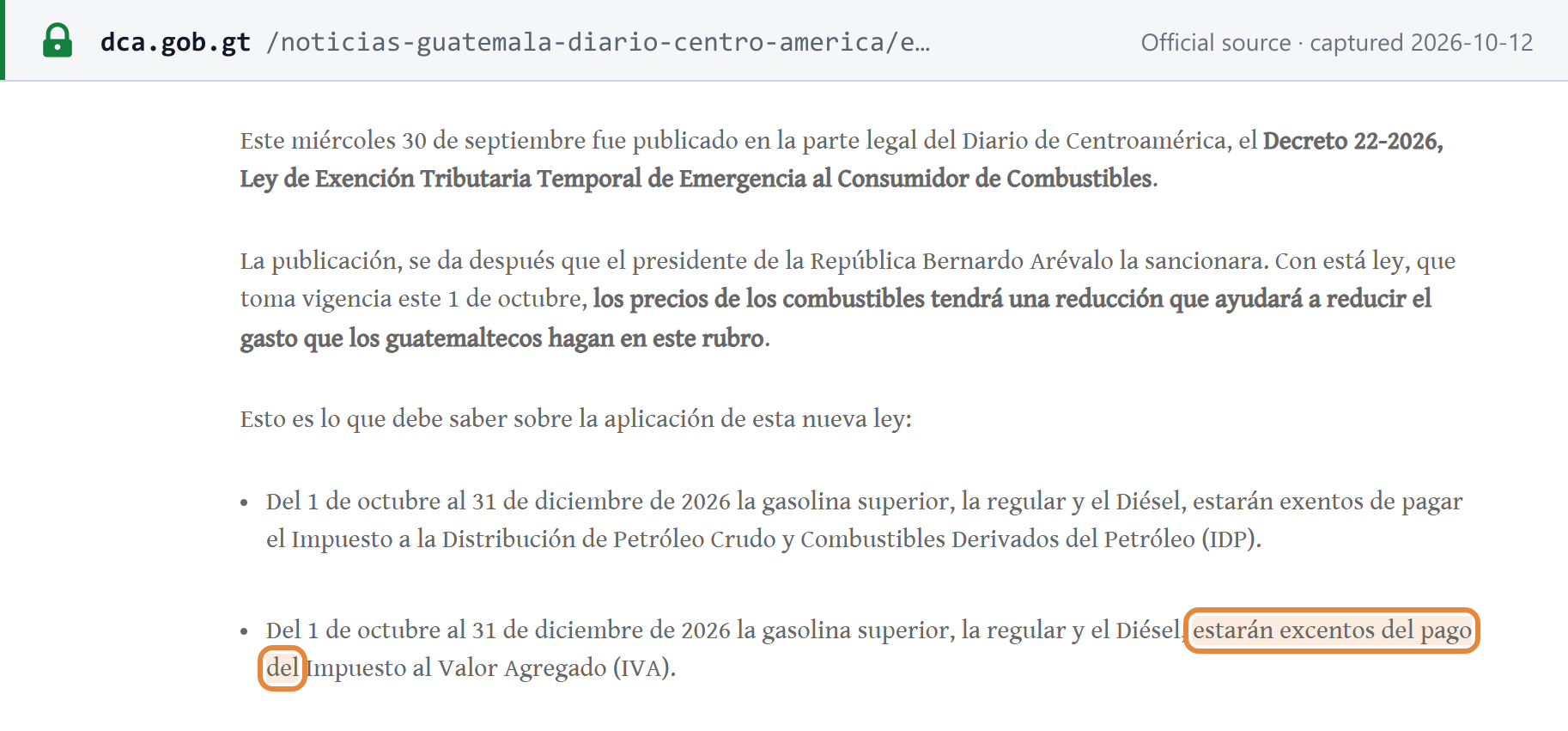
Decreto 22-2026, the Ley de Exención Tributaria Temporal de Emergencia al Consumidor de Combustibles, was published in the Diario de Centro América on 30 September 2026 and took effect on 1 October 2026. From 1 October to 31 December 2026, premium gasoline, regular gasoline and diesel are exempt from both IVA and the fuel distribution tax (IDP). [9]
Announced future rates
None. No change to the 12% rate has been enacted. Decreto 17-2025 changed the refund procedure, not the rate (see Refunds).
Cross-border rules
Imports and exports
Imports. IVA is charged on imports, whether or not the importer is habitual (articles 3 and 6). The taxable base is the CIF value plus the tariff duties and other charges levied on the import (article 13.1), and customs will not release goods until the taxes have been paid: "Las aduanas no autorizarán el retiro de los bienes del recinto aduanero sin que previamente estén debidamente cancelados los correspondientes impuestos" (article 4.2). Article 7.1 exempts certain imports, among them goods under temporary-import regimes, diplomatic imports and travellers' duty-free baggage. IVA paid on imports is creditable input tax for a General-regime taxpayer (article 16). [1]
Exports. Exports of goods and of services are exempt (article 7.2), but exporters keep the right to credit and to a refund of the input IVA on their purchases (articles 16 and 23), so exports work like a zero rate. An export of services is a service rendered in Guatemala "a usuarios que no tienen domicilio ni residencia en el mismo y que estén destinados exclusivamente a ser utilizados en el exterior" (to users with no domicile or residence in the country, intended exclusively for use abroad), provided the foreign currency was negotiated under exchange law (article 2.4). Exporters issue a normal FEL factura with the exports complement. [1] [3]
Buyer liability on services and goods from non-domiciled suppliers
Article 6 lists five further groups of persons liable for IVA: the importer, habitual or not; the buying taxpayer when the seller is not domiciled in Guatemala; the beneficiary of a service when the provider is not domiciled in Guatemala; the buyer that issues a factura especial under article 52; and civil and commercial companies and co-ownerships in the cases of article 3.5. The two cross-border groups read "El contribuyente comprador, cuando el vendedor no esté domiciliado en Guatemala" (the buying taxpayer, when the seller is not domiciled in Guatemala) and "El beneficiario del servicio, si el que efectúa la prestación no está domiciliado en Guatemala" (the beneficiary of the service, if the provider is not domiciled in Guatemala). The foreign supplier therefore does not charge Guatemalan IVA. Article 6.3 is not limited to business customers: the beneficiary of a service from a non-domiciled provider is the person liable, whoever it is. [1]
Digital products and services
Guatemala has not enacted an IVA registration or collection regime for foreign suppliers of digital services or low-value goods to consumers. The Ley del IVA, including its amendments by Decretos 7-2019, 31-2024 and 17-2025, contains no such regime. SAT's guidance on short-term rentals booked through a digital platform deals with hosts whose property is in Guatemala, on the territoriality principle, and not with the platform itself. [1] [7]
Foreign companies selling into Guatemala — B2B and B2C
- B2B (selling to a Guatemalan business). The foreign supplier does not register. The Guatemalan buying taxpayer (article 6.2), or the Guatemalan business that receives the service (article 6.3), is liable for the IVA. [1]
- B2C (selling to consumers in Guatemala). No regime requires a foreign supplier of digital services to register or to collect IVA from consumers, so the foreign provider has no Guatemalan IVA registration to make. Article 6.3 still names the beneficiary of the service, whoever it is, as the person liable. Goods shipped to consumers pay IVA at import (see Imports and exports).
Marketplace / platform deemed-supplier liability
Not applicable. The Ley del IVA has no rule that makes a marketplace or platform the deemed supplier of sales made through it.
Place of supply
The law has no detailed place-of-supply rules. Services are taxed when rendered "en el territorio nacional" (in the national territory, article 3.2), and sales are taxed when the goods are in Guatemala. SAT applies the territoriality principle: for example, it treats the short-term rental of a property located in Guatemala as subject to IVA, whoever books it. [1] [7]
Invoice requirements
Every invoice in Guatemala is an electronic document (DTE) issued under the Factura Electrónica en Línea (FEL) regime (see E-invoicing status).
Document types
SAT's FEL guide lists the document types. The main ones are: [3]
- Factura — the ordinary invoice of a General-regime taxpayer, also used for exports.
- Factura cambiaria — an invoice that also works as a credit instrument, with payment instalments (abonos).
- Factura especial — issued by the buyer when it buys from an individual who does not issue invoices; the buyer withholds the IVA (see Self-billing).
- Factura de Pequeño Contribuyente (and its cambiaria version) — issued by small taxpayers; gives no input credit.
- Nota de crédito, nota de débito and nota de abono.
- Recibo, recibo por donación and recibo de anticipos.
- Constancia de Exención de IVA (CIVA) — the certificate an exempt buyer gives the seller.
- Constancia de Adquisición de Insumos y Servicios (CAIS) and nota de envío.
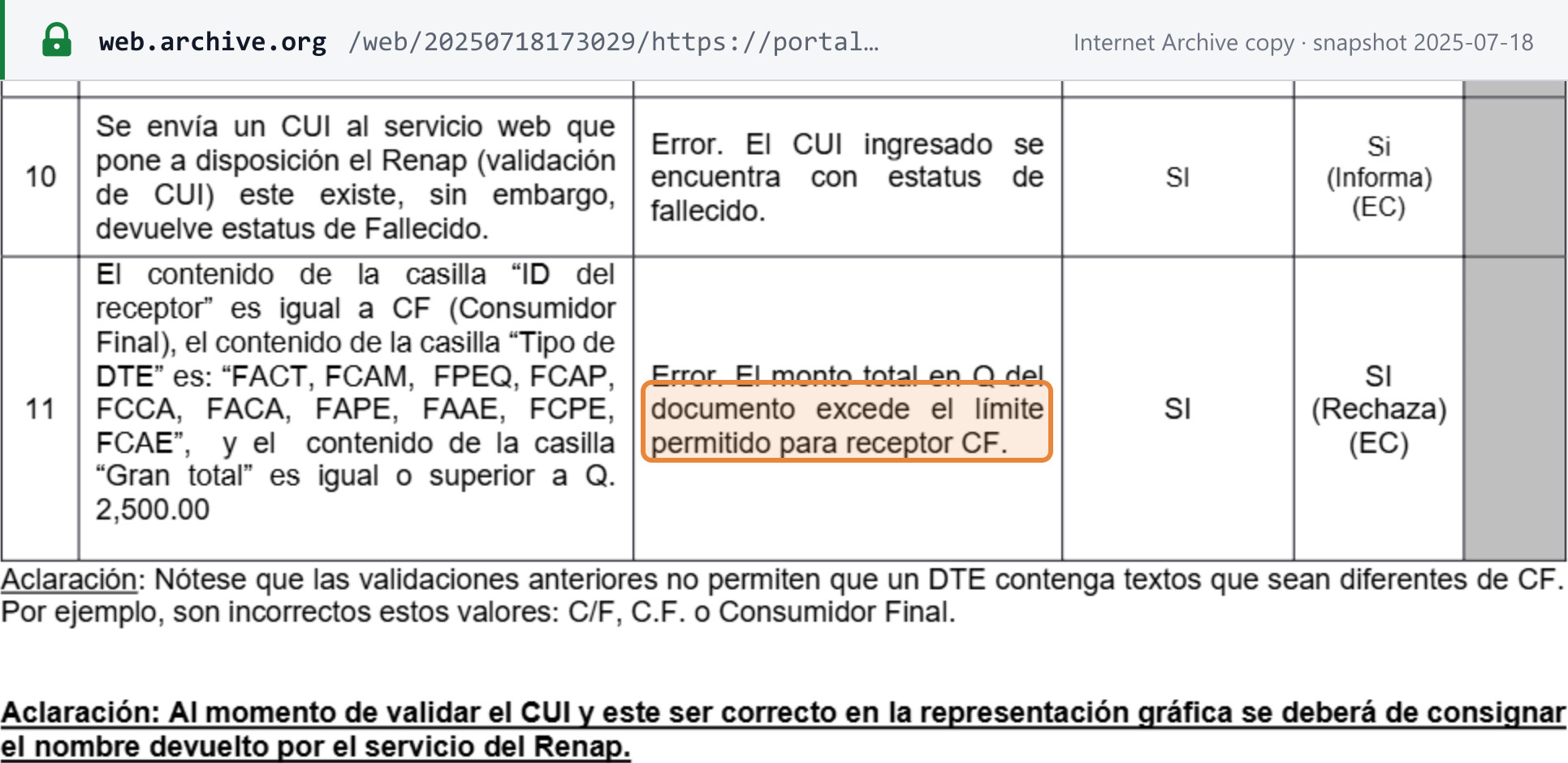
There is no simplified invoice. A buyer who gives no NIT is identified as consumidor final ("CF"), but only below Q2,500. SAT's FEL validation rules (version 1.7.4, January 2023) reject a document to receiver CF when its total is "igual o superior a Q. 2,500.00" (equal to or above Q2,500.00), with the error "El monto total en Q del documento excede el límite permitido para receptor CF". At or above that amount the buyer's NIT or CUI is required. The field must say exactly CF: "son incorrectos estos valores: C/F, C.F. o Consumidor Final". [10]
A small taxpayer may group sales under Q50 into one invoice at the end of the day (article 49). [1]
Mandatory content
Article 30 of the IVA regulation sets the minimum content of invoices: [2]
- Document type.
- Series and sequential number; each establishment uses a different series.
- Legends where they apply, such as "No genera derecho a crédito fiscal", "Sujeto a pagos trimestrales", "Sujeto a retención definitiva" or "Pago directo".
- Issuer's name and trade name.
- Issuer's NIT.
- Address of the establishment.
- Issue date.
- Buyer's name.
- Buyer's NIT; if the buyer has none or does not give it, "consumidor final" or "CF", or else the number of a personal identity document.
- Description of the goods or services and their values.
- Discounts.
- Other charges.
- Total price, including the tax.
SAT's FEL guide adds what the printed or PDF representation of a DTE must show: [3]
- Issuer: name, NIT, establishment name and address.
- Receiver: NIT (or DPI on a factura especial) or "CF"; name; address optional.
- Authorisation data: authorisation number, series and number, issue date and time, and currency; an access number only for documents issued in contingency.
- Lines: quantity, description, unit price including IVA (except for small-taxpayer, exempt or non-taxable sales), discounts, line total, and each tax on the line — IVA and, where relevant, others such as IDP (fuel) or ITH (hotels).
- Frases: legends that depend on the issuer's tax affiliation or the operation.
- Complements: for example instalments on a factura cambiaria, withholdings on a factura especial, exports, and the reference to the original document on credit and debit notes.
- Certifier: name and NIT.
- QR code: optional when the certifier is not SAT.
Issuance deadline
Under article 34 of the Ley del IVA, for sales of goods, invoices and debit and credit notes are issued and given to the buyer "en el momento de la entrega real de los bienes" (at actual delivery of the goods). For services, they are issued "en el mismo momento en que se reciba la remuneración" (when payment is received). [1]
In FEL, an issue date more than five days before certification triggers a warning, and the issue date may not fall after the end of the month of certification. [10]
Numbering and sequencing
Invoices carry a series and a sequential number for each establishment (article 30.2 of the regulation). [2] In FEL, the certifier also assigns each DTE a unique authorisation number (article 5 of Acuerdo de Directorio 13-2018). [11]
Credit and debit notes
Credit notes are used "para devoluciones, anulaciones o descuentos sobre operaciones ya facturadas" (for returns, annulments or discounts on operations already invoiced), and debit notes for increases in price. Both must cite the number and date of the original invoice and be recorded in the seller's books "dentro del plazo de dos meses" (within two months) of it (articles 17 and 29). [1] In FEL, a note must be in the same currency as the original document. [10]
Cancellation
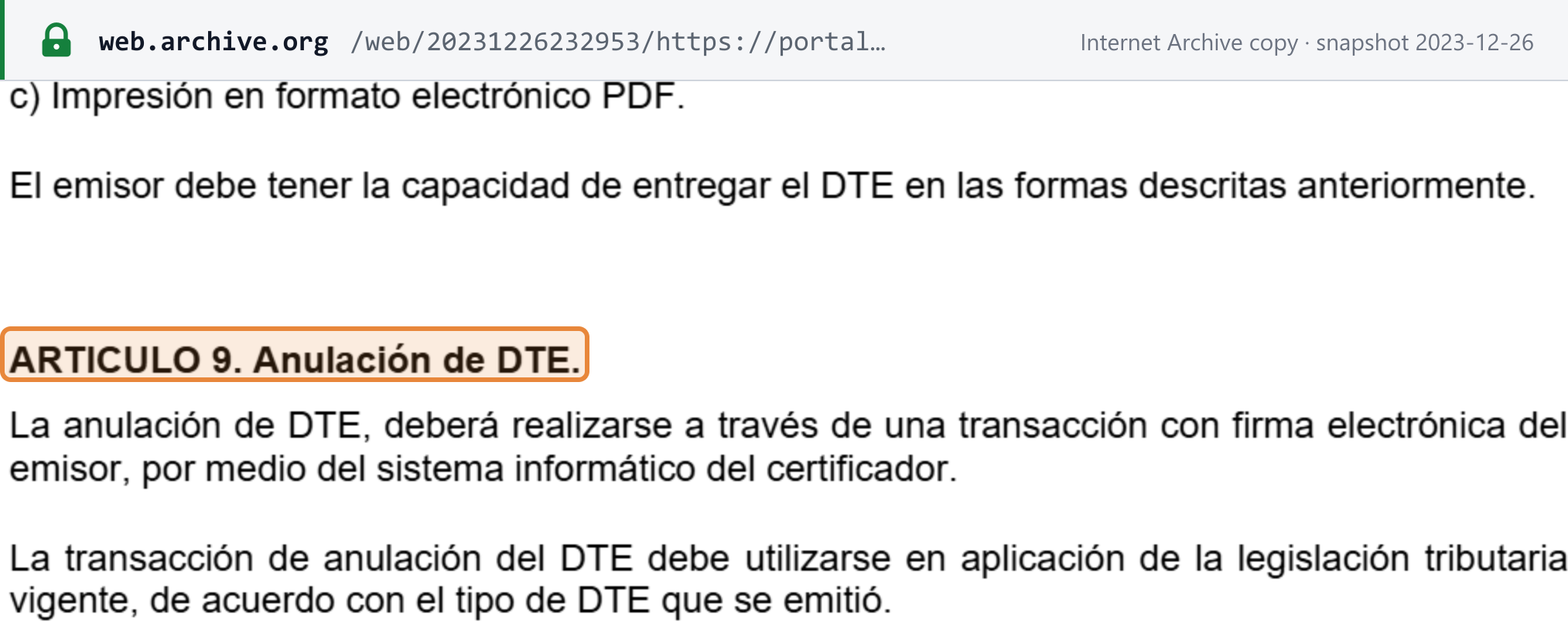
A certified DTE can be annulled. Under article 9 of Acuerdo de Directorio 13-2018, "La anulación de DTE, deberá realizarse a través de una transacción con firma electrónica del emisor, por medio del sistema informático del certificador" (annulment of a DTE is made through a transaction signed electronically by the issuer, through the certifier's system). [11] SAT's FEL rules reject an annulment dated more than four years (the Tax Code's prescription period) after the due date of the return for the invoice's period, and the annulment of a DTE that has a registered IVA withholding. [10]
Currency and language
DTEs may be issued in a foreign currency. The amounts are converted at "tipo de cambio oficial publicado por el Banco de Guatemala para esa moneda en la fecha de emisión del documento" (the official exchange rate published by the Banco de Guatemala for that currency on the issue date). If no rate was published for that currency on that day, the last registered rate is used. For US dollars, the rules require "la tasa de referencia publicada por el Banco de Guatemala" (the reference rate published by the Banco de Guatemala); for other currencies, the selling rate. [10] The legends required by the regulation, such as "No genera derecho a crédito fiscal", are in Spanish. [2]
Self-billing
Permitted in one case. A buyer that acquires goods or services from an individual who does not issue invoices issues a factura especial itself, and withholds the IVA. The factura especial may not be used between taxpayers who are registered to invoice (article 52). [1]
Retention and audit trail
- Retention. The issuer, and the receiver where applicable, keep the XML files of certified DTEs until the Tax Code's prescription period has run (article 21 of Acuerdo de Directorio 13-2018). SAT's FEL rules put that period at four years. [11] [10]
- Audit trail. The certifier applies its advanced electronic signature and a unique number, and immediately sends a copy of each DTE to SAT (article 5). "Para que un DTE sea válido, deberá estar aceptado por parte de la SAT" (a DTE is valid only once SAT has accepted it, article 7). It can be delivered to the buyer as XML, on paper or as a PDF (article 8). [11]
- Books. Taxpayers keep a purchases book and a sales book, with entries made within two months (articles 37 and 39 of the Ley del IVA). [1]
A specimen of a compliant invoice
SAT publishes an official annotated specimen. Its guide to the requirements for the graphic representation of DTEs shows a factura issued from the FEL application in SAT's Agencia Virtual, with numbered callouts for each required block: (1) document type, (2) issuer data, (3) receiver data, (4) authorisation data, (5) description of the goods and services, (6) frases, (7) complements, (8) certifier data and (9) QR code. [3]
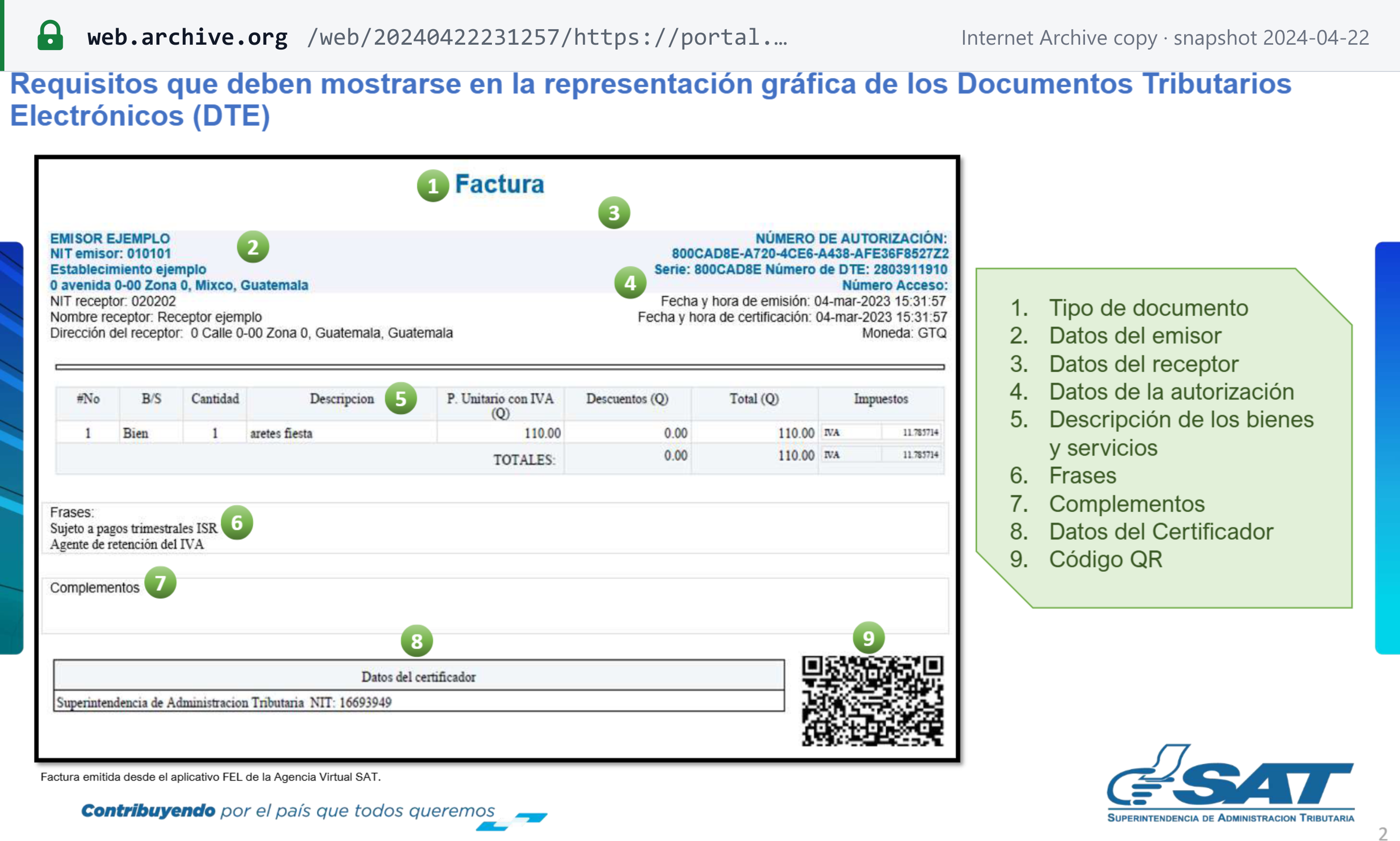
Read it with the mandatory content list above. The specimen's unit price of Q110.00 includes IVA, and the IVA it shows, Q11.785714, is the amount contained in that price (110 × 12/112).
E-invoicing status
Status: mandatory, with real-time clearance through certifiers.
- Legal basis. The Régimen de Factura Electrónica en Línea (FEL) was "Creado a través del Acuerdo de Directorio Número 13-2018, vigente desde el 23 de mayo del año 2018" (created by Board Agreement 13-2018, in force since 23 May 2018). [12]
- How it works. The issuer signs an XML document (DTE). A SAT-authorised certifier certifies it, assigns its authorisation number and sends it to SAT at once. SAT also offers a free certifier through the Agencia Virtual and its FEL app. An issuer may use more than one certifier. [11] [12]
- Phase-in. SAT brought taxpayers in by resolution:
- General-regime IVA taxpayers: by 1 July 2022 at the latest (SAT-DSI-1240-2021). [13]
- Pequeño Contribuyente: by 1 July 2023 at the latest (SAT-DSI-400-2023, which extended the earlier deadline of 31 March 2023). [14]
- New registrants: since 1 July 2021, FEL is the only means SAT authorises for issuing tax documents to persons registering for the first time (article 28 bis of the IVA regulation). [2]
- Scope. One regime for B2B, B2C and B2G documents.
- Format. XML, signed with an advanced electronic signature, validated against SAT's published rules. [10]
- Certifiers. Need annual SAT authorisation, an information-security certificate, paid-up capital of Q1,000,000 (legal persons) and a surety bond in SAT's favour "por un millón de quetzales (Q1,000,000.00)", plus contracts with SAT and with each issuer. SAT publishes the list of authorised certifiers. [11]

Filing and payment
Filing frequency
Monthly for every IVA taxpayer, in both regimes; the tax period is the calendar month (article 2.7). [1]
Return due date
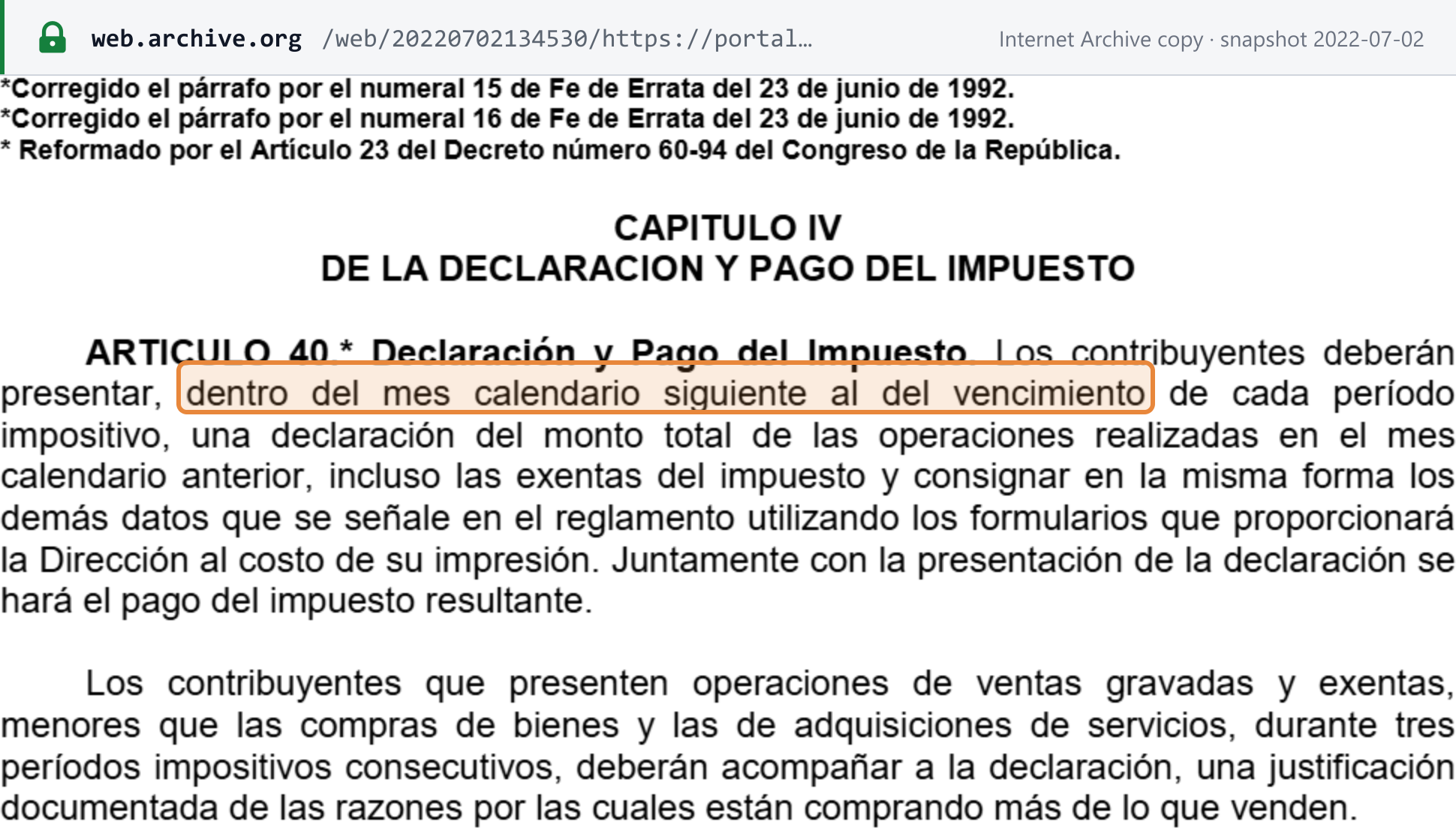
- General regime. Article 40: taxpayers file "dentro del mes calendario siguiente al del vencimiento de cada período impositivo" (within the calendar month following the end of each tax period) a return of all operations of the previous month, including exempt ones. The form is SAT-2237 IVA General. A taxpayer whose purchases exceed its sales for three consecutive periods must attach a documented justification. [1]
- Pequeño Contribuyente. A simplified monthly return in the following month, filed even when it is nil or the whole tax has been withheld (article 48). [1]
- Several establishments. One consolidated return for all of them (article 44). [4]
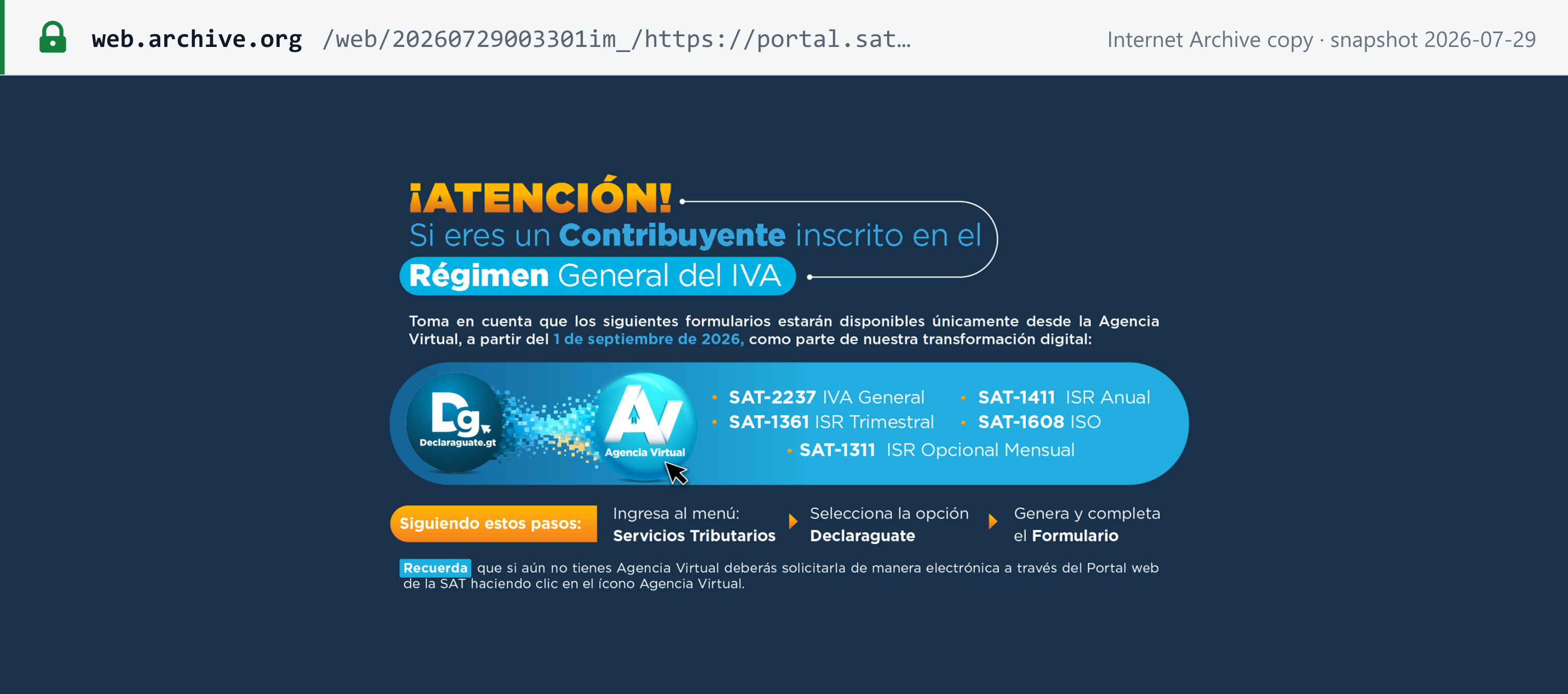
Where to file. From 1 September 2026, General-regime IVA taxpayers can file SAT-2237 only in SAT's Agencia Virtual (Servicios Tributarios → Declaraguate). SAT's notice lists the forms that are "disponibles únicamente desde la Agencia Virtual, a partir del 1 de septiembre de 2026": SAT-2237 IVA General, SAT-1361 ISR trimestral, SAT-1311 ISR opcional mensual, SAT-1411 ISR anual and SAT-1608 ISO. [15]
Payment due date and method
Payment is made with the return: "Juntamente con la presentación de la declaración se hará el pago del impuesto resultante" (article 40). [1]
IVA withholding (retención)
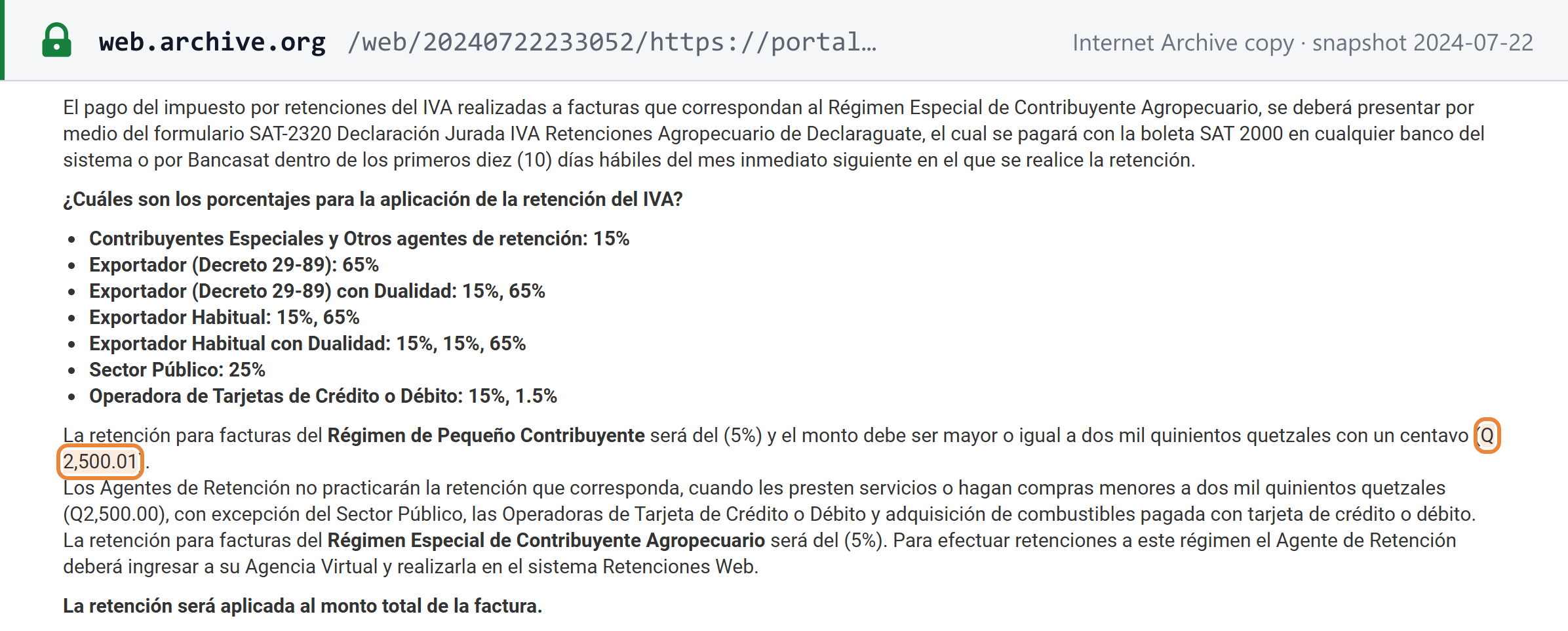
SAT designates withholding agents that keep back part of the IVA on the invoices they pay and pay it to SAT. SAT's Retenciones Web IVA page lists these percentages. The page still refers to the repealed agricultural regime, so confirm the current rates with SAT before relying on them: [16]
| Withholding agent | Percentage withheld |
|---|---|
| Special taxpayers and other withholding agents | 15% |
| Exporters under Decreto 29-89 | 65% (15% or 65% for exporters with dual status) |
| Habitual exporters | 15% or 65% |
| Public sector | 25% |
| Credit and debit card operators | 15% or 1.5% |
| Invoices from a Pequeño Contribuyente | 5% |
- Threshold. Withholding does not apply to purchases under Q2,500.00; for small-taxpayer invoices the threshold is Q2,500.01. The threshold does not apply to public-sector agents, card operators and fuel paid by card. [16]
- Agent's deadline. The agent files form SAT-2340 and pays "dentro de los primeros quince (15) días hábiles del mes inmediato siguiente" (within the first 15 business days of the following month). [16]
- Supplier's side. A General-regime supplier credits the IVA withheld against its monthly IVA. For a small taxpayer, the 5% withheld is its whole tax on the sale and a final payment (article 48). [1]
Additional listings
- Special taxpayers file an electronic detail of their purchases and sales "cada seis meses, como máximo" (at least every six months), under article 57 "D". [1]
- Exporters in the special refund regime file a sworn declaration of the exports they made with SAT every six months, in January and July, to keep the register of exporters up to date (article 25 of the Ley del IVA as rewritten by Decreto 17-2025). [17]
- Annual IVA return or EC-style sales list: none. The Ley del IVA requires only the monthly return.
Input-tax recovery and blocked items
What is creditable. IVA paid on imports and on goods and services linked to the taxable activity. Fixed assets give credit only if directly linked to production or commercialisation (article 16). The purchase needs an invoice in the buyer's name with its NIT and a detailed description, recorded in the purchases book (article 18). [1]
Timing. Credit is claimed in the month of the invoice or, at most, "en los dos meses inmediatos siguientes" (in the two following months), under article 20. [1]
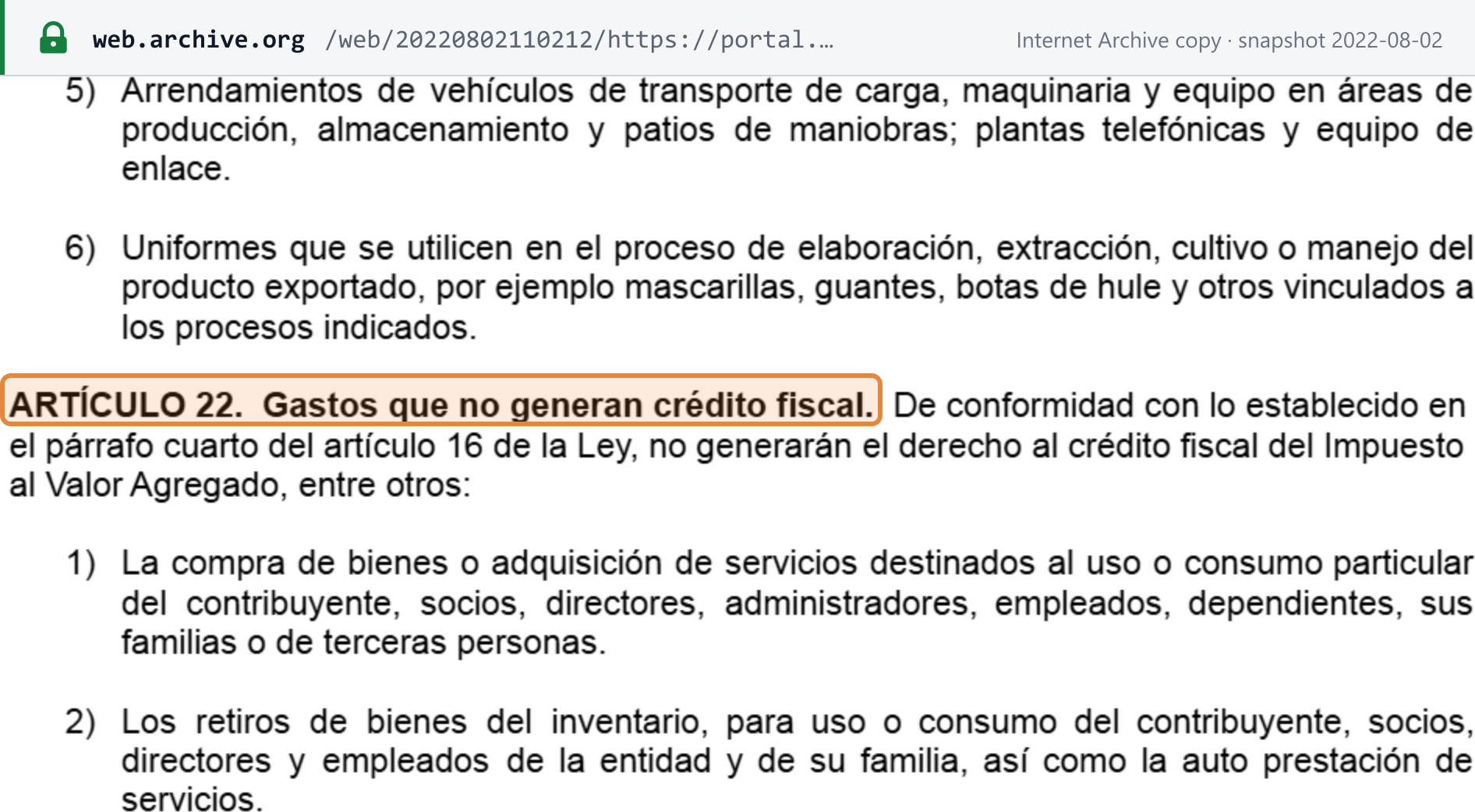
Blocked. Article 22 of the IVA regulation lists purchases that give no credit, among them: [2]
- goods or services for the private use or consumption of the taxpayer, partners, directors, managers, employees, dependants, their families or third parties;
- withdrawals for own use;
- capital assets not used in the activity, and fuel, lubricants and insurance for vehicles that are not;
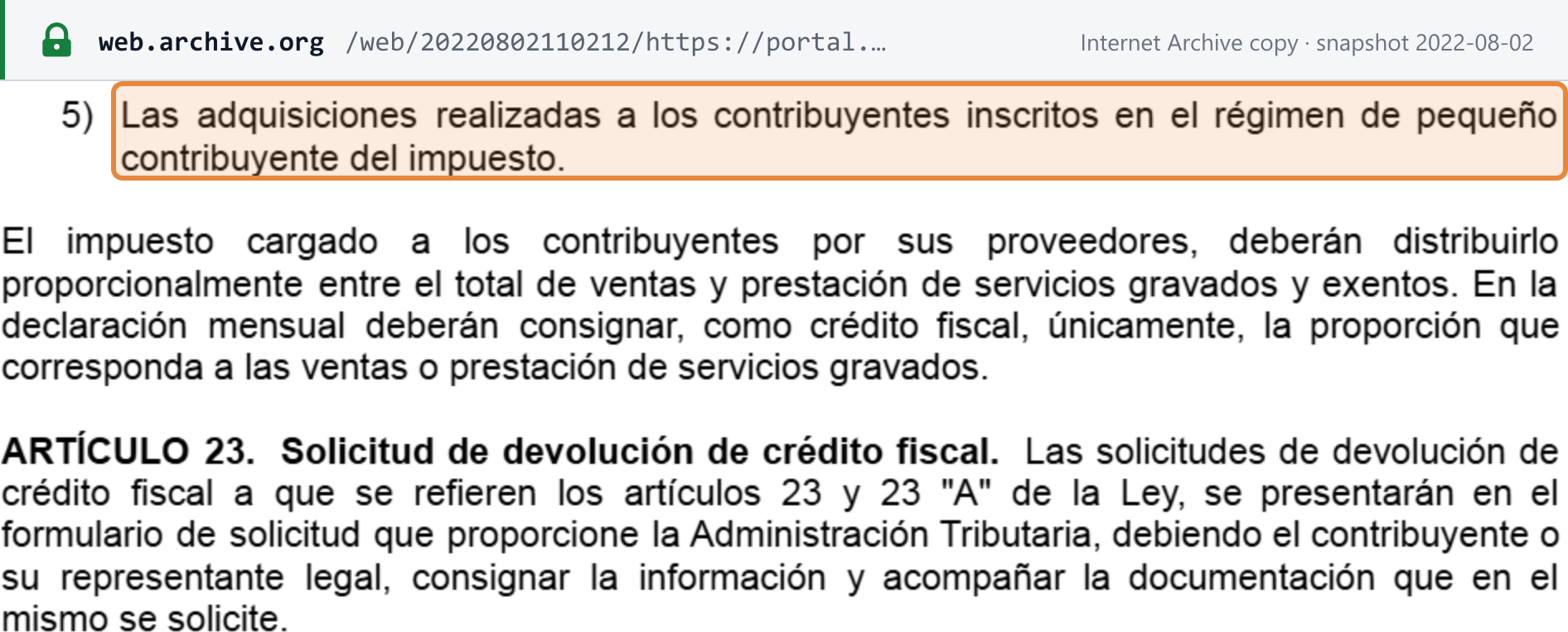
- purchases from taxpayers in the Pequeño Contribuyente regime.
Where a taxpayer makes both taxed and exempt sales, input IVA is apportioned (article 22, final paragraph).
Refunds
Excess credit. A General-regime taxpayer carries excess credit forward to later months with no time limit. Cash refunds are available only to exporters and to taxpayers that sell to exempt persons in the domestic market (articles 16 and 21 to 23, with articles 23 and 25 as rewritten by Decreto 17-2025). [17] [1]
Decreto 17-2025. The Ley para la Facilitación del Cumplimiento en la Devolución de Impuestos was published in the Diario de Centro América on 28 November 2025 and entered into force the following day, 29 November 2025. It rewrote articles 23, 23 "A" and 25 of the Ley del IVA, added article 23 "B", and amended the Tax Code and Decreto 20-2006: [17]
- General procedure. Claims accumulate by quarter or by semester. SAT decides within 30 business days for quarterly claims and 60 business days for semester claims. Banco de Guatemala pays from a dedicated account funded with at least 8% of daily IVA receipts.
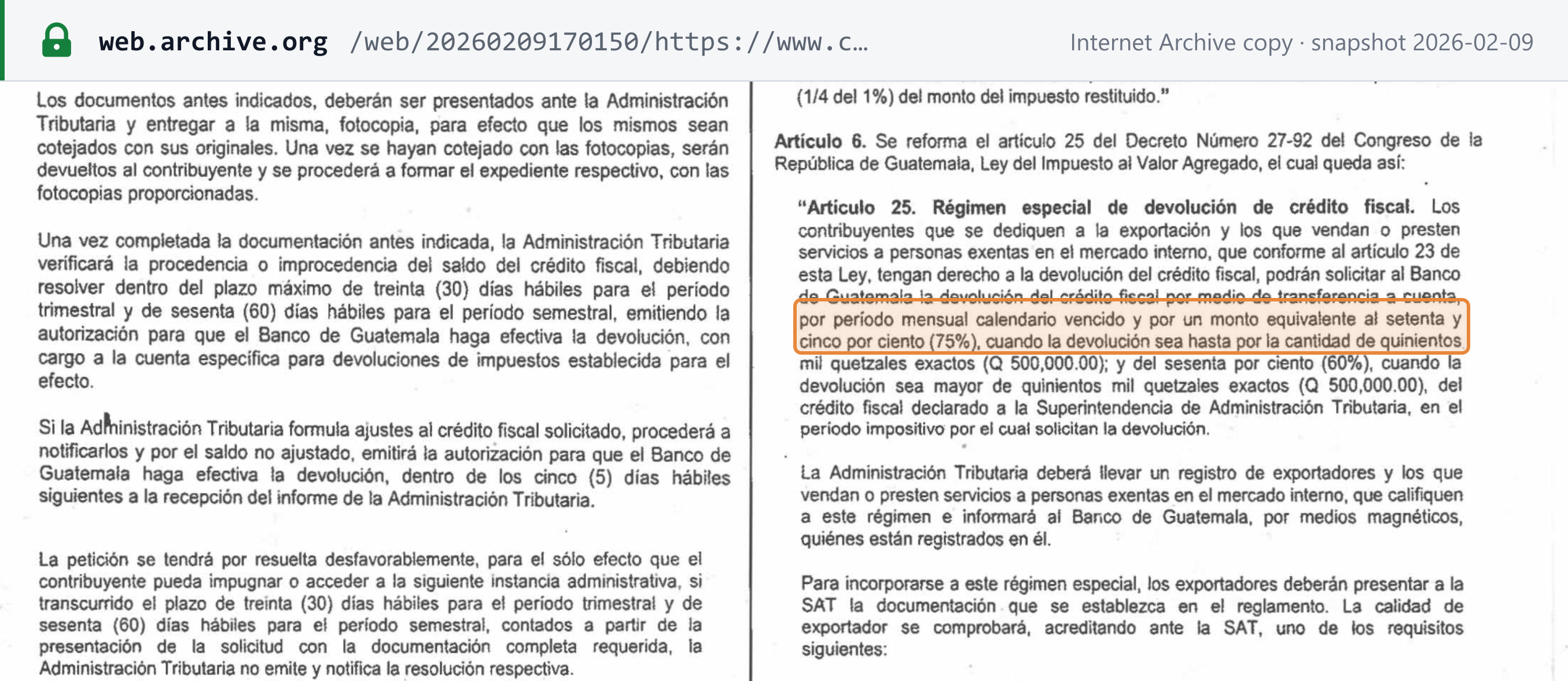
- Special regime (article 25). A monthly refund of 75% of the declared credit when the refund is up to Q500,000, and 60% when it exceeds Q500,000. It is now also open to taxpayers that sell to exempt persons. The request is due within 30 business days after the return deadline. An exporter, for this purpose, exports 50% or more of its sales, or less than 50% but cannot absorb its credit.
- No interest. "Los importes a favor de los contribuyentes en concepto de créditos del Impuesto al Valor Agregado, no generarán intereses" (IVA credit balances earn no interest), under Tax Code article 99 as rewritten.
- Suppliers subject to withholding whose credit stays unabsorbed for two consecutive years can claim its restitution (Decreto 20-2006, article 11).
The IVA regulation does not admit refund claims below Q10,000 (article 27). [2]
Exemptions
Exempt supplies
Objective exemptions (article 7) include: [1]
- exports of goods and services (7.2);
- mergers, inheritances and contributions of goods to companies (7.3);
- services of institutions supervised by the Superintendencia de Bancos and of stock exchanges; in insurance, only reinsurance (7.4);
- cooperatives' transactions with their members, and all services of savings-and-credit cooperatives (7.5);
- issuance and transfer of securities (7.6);
- qualifying non-profit educational, social and religious services, and donations (7.9, 7.13);
- membership dues (7.10);
- retail sales of fresh meat, fish, fruit, vegetables, cereals and basic grains to final consumers in municipal markets, up to Q100 per transaction (7.11);
- social housing up to 80 m² and Q250,000, and lots up to 120 m² and Q120,000 (7.12);
- generic and natural medicines, and HIV antiretrovirals (7.15).
Decreto 31-2024 added article 7.16, for primary and livestock products from export lots that are sold to market sellers instead of exported, and article 8 "A", for school-meal purchases by parents' organisations. [4]
Subjective exemptions (article 8) cover certain buyers and operations: tuition at authorised schools, universities, the national sports bodies (CDAG and COG), the social security institute (IGSS), diplomatic missions and international organisations. These buyers receive the invoice but do not pay the IVA on it; instead they hand the seller a Constancia de Exención (CIVA) authorised by SAT (article 9). [1]
Temporary: premium gasoline, regular gasoline and diesel, from 1 October to 31 December 2026 (see Rates).
Exempt is not zero-rated. An exempt sale carries no output IVA, and the input IVA attributable to it is not creditable; it must be apportioned away (article 22 of the regulation). Only exports and sales to subjectively exempt buyers keep the right to credit and to a refund (articles 16 and 23 of the law, article 23 as rewritten by Decreto 17-2025). [17] [2] [1]
Special regimes
Pequeño Contribuyente (small taxpayer).
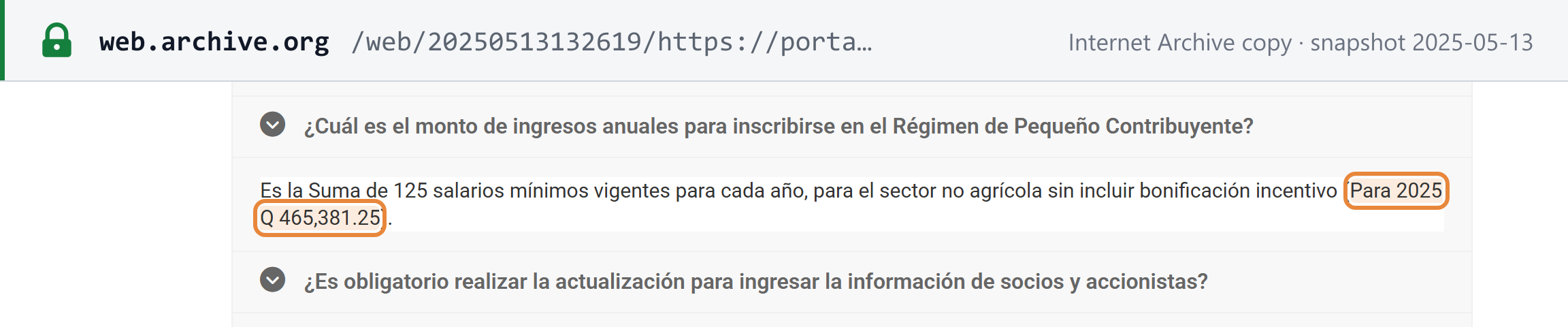
- Who. Individuals or legal persons whose sales of goods or services do not exceed "ciento veinticinco (125) salarios mínimo mensual vigente para el sector no agrícola, sin incluir la bonificación incentivo, en un año calendario" (125 current monthly non-agricultural minimum wages, excluding the incentive bonus, in a calendar year), under article 45 as rewritten by Decreto 31-2024. The rule applies from 9 April 2025; the previous ceiling was Q150,000. [4] [6]
- The figure. SAT put the ceiling for 2025 at Q465,381.25. Because it is 125 times the minimum wage in force each year, it changes when the minimum wage does. [6]
- Tax. 5% of total gross monthly income from sales or services (article 47), paid monthly or withheld at 5% by withholding agents. No input credit for the taxpayer, and none for its buyers. [1]
- Obligations. Issue FEL "Factura de Pequeño Contribuyente" invoices carrying "No genera derecho a crédito fiscal"; invoice every sale over Q50, with a daily consolidated invoice for smaller sales; keep a purchases-and-sales book authorised by SAT, which "podrá llevarlo en forma física o electrónica" (may be kept on paper or electronically, article 49); file the monthly return. [1]
- The 4% electronic regime created by Decreto 7-2019 has been repealed (see Reduced and zero rates). Its members had three months to choose another regime, after which SAT placed them in the General regime. [4]
Primary and livestock regimes (Decreto 31-2024). Decreto 31-2024 created regimes outside IVA for authorised agricultural and artisanal producers, and for livestock, fish and bee producers, that sell to supermarkets, municipal markets, collection centres and restaurants. They pay the Impuesto a la Confianza Tributaria (ICT) of 1.5% of gross sales (2% for some exporters) monthly, as a final payment. The primary regime's ceiling is 3,500 monthly non-agricultural minimum wages. "Las facturas que emitan y reciban los contribuyentes bajo el Régimen Primario o Régimen Pecuario no generarán derecho a crédito fiscal" (their invoices give no tax credit). Registration in these regimes has been open since 9 April 2025, with no closing date. Separately, taxpayers in the repealed agricultural and electronic regimes had three months, until 8 July 2025, to register in the regime that applied to them; SAT moved those that did not to the General regime (article 20 of Decreto 31-2024). [4] [6]
Offences and penalties
The figures below are from SAT's guidance on the sanctions in the Tax Code and their reductions. [18]
Offences
- Operating without registering in the RTU, failing to issue invoices, and issuing false invoices are separate tax infringements under the Tax Code. [18]
- Criminal exposure. Article 11 of Decreto 31-2024 provides that "Las acciones u omisiones tipificadas como delito contra el Régimen Tributario y Aduanero serán sancionadas conforme lo establece el Decreto Número 17-73, Código Penal" (acts or omissions defined as crimes against the tax and customs regime are punished under the Penal Code) and under the law against customs fraud and smuggling (Decreto 58-90). [4]
- Refund fraud. SAT must file a criminal complaint where it detects fraud in a refund claim (article 23 "A" of the Ley del IVA, as rewritten by Decreto 17-2025). [17]
Penalties
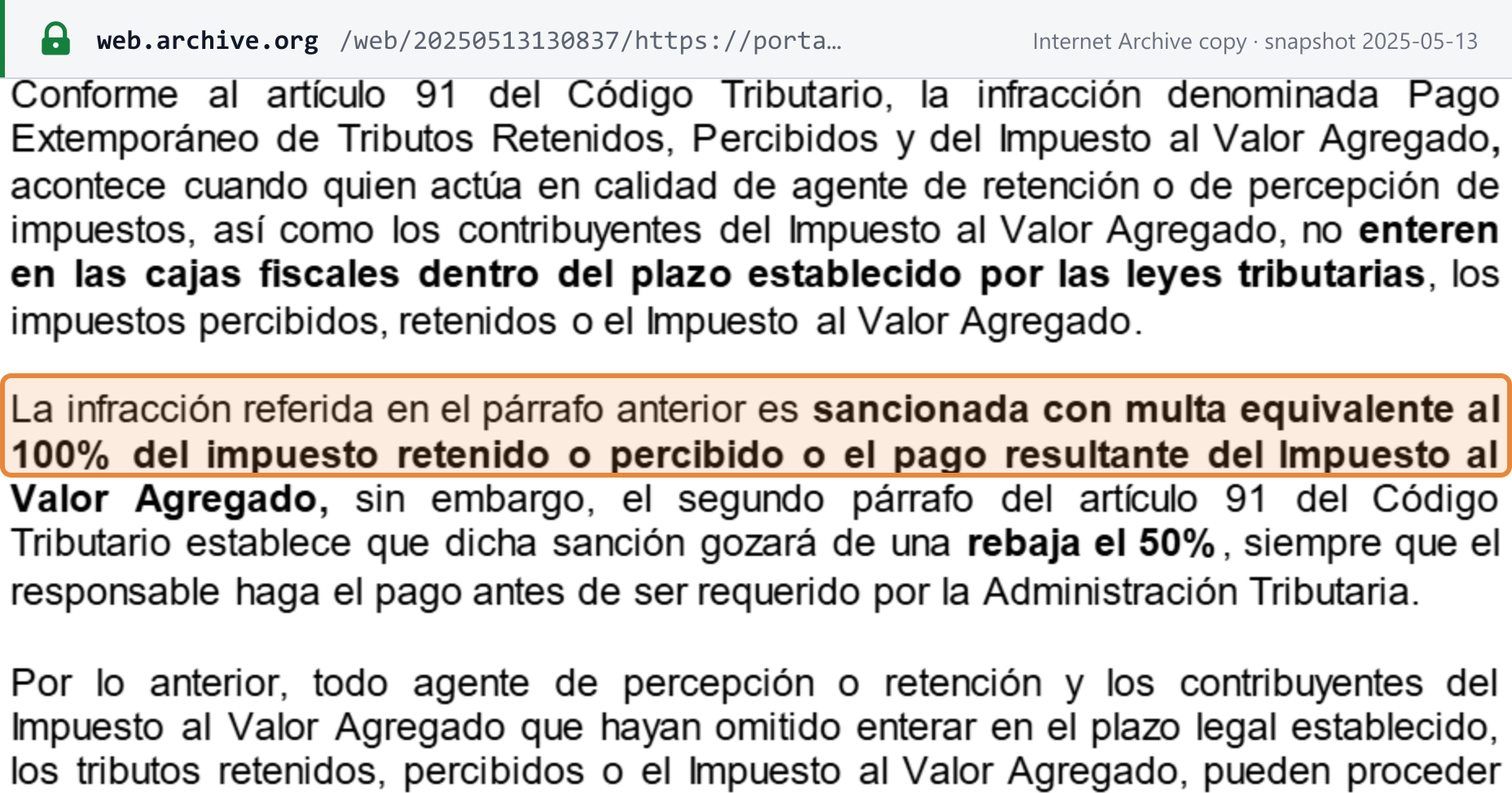
- Late payment of IVA, or of IVA withheld: a fine of 100% of the tax, halved if paid before SAT requires it (Tax Code article 91). [18]
- Late-payment surcharge (mora): the tax due × 0.0005 × the number of days late (article 92). A late return filed and paid voluntarily cuts the surcharge by 85% and interest by 50% (article 106).
- Interest: a simple annual rate set by the Junta Monetaria each January and July, based on the weighted bank lending rate (article 58).
- Omission detected by SAT: a fine of 100% of the tax omitted (articles 88 and 89). Accepting and paying in SAT's pre-assessment procedure cuts interest by 40% and the fine by 80% (article 145 "A"); accepting adjustments without appeal cuts the fine by 50% (article 146).
- Late return: Q50 per day late, up to Q1,000 (article 94.9).
- Invoices without the formal requirements: Q100 per document, capped at Q5,000 a month and at 2% of the previous month's gross income (article 94.8). Illegible or incomplete invoices: Q5,000 a month (article 94.17).
- Buying without demanding an invoice, or failing to withhold: a fine equal to the tax (articles 94.3 and 94.7).
- Operating without registering: Q10,000 (article 94.15). Quoting prices without IVA: Q5,000 (article 94.6). Books not kept up to date: Q5,000 per audit (article 94.4).
- Self-correction: the formal-duty fines in article 94 are cut by 85% if the taxpayer corrects the failure before SAT acts (article 94 "A").
Frequently asked questions
Do I add 12% IVA on top of my prices in Guatemala?
No. Article 10 of the Ley del IVA requires the 12% to be included in the sale price of goods or the value of services, so prices and invoice totals include IVA. To find the IVA inside a price, multiply the total by 12/112: a Q1,120 total contains Q120 of IVA. Small taxpayers in the Pequeño Contribuyente regime do not charge 12%; they pay 5% of their gross income, and their invoices give the buyer no input credit.
Why does FEL reject my consumidor final (CF) invoice for a Q3,000 sale?
SAT's FEL validation rules (version 1.7.4, January 2023) reject a document addressed to the receiver CF when its total is Q2,500.00 or more. At that value you must enter the buyer's NIT or CUI. Below Q2,500 you may use CF, but the field must contain exactly CF; variants such as C/F, C.F. or Consumidor Final are rejected.
Why did my Guatemalan client pay me only part of the IVA on my invoice?
Your client is probably an IVA withholding agent. SAT's Retenciones Web IVA page lists the percentages by type of agent: 15% for special taxpayers and other agents, 65% (or 15% and 65%) for exporters, 25% for the public sector, and 15% or 1.5% for card operators. Agents generally do not withhold on purchases under Q2,500.00; for small-taxpayer invoices the threshold is Q2,500.01. That page still refers to the repealed agricultural regime, so confirm the current rates with SAT. The agent pays the withheld amount to SAT, and you credit it against the IVA on your monthly SAT-2237 return. If you are a Pequeño Contribuyente, agents withhold 5% of invoices of Q2,500.01 or more, and that is your final tax on the sale.
Why can't my client claim input IVA on my Pequeño Contribuyente invoice?
Because the Small Taxpayer regime is not a reduced IVA rate. A Pequeño Contribuyente pays 5% of its gross income instead of charging 12%, and its FEL invoices carry the legend No genera derecho a crédito fiscal (does not give the right to tax credit). Article 22 of the IVA regulation lists purchases from small taxpayers among the purchases that give no input credit. A supplier whose business customers need input credit can move to the General regime.
We are a foreign SaaS company. Do we have to register for IVA in Guatemala?
No. The Ley del IVA has no registration scheme for non-resident suppliers. Article 6 makes the Guatemalan side liable instead: the buying taxpayer when the seller is not domiciled in Guatemala, and the beneficiary of a service when the provider is not domiciled there. For sales to businesses, your Guatemalan customer accounts for the IVA. For sales to consumers, Guatemala has not enacted any regime that requires a foreign supplier of digital services to register or collect IVA.
Can I cancel an FEL invoice after it has been certified?
Yes. Under article 9 of SAT's Acuerdo de Directorio 13-2018, a DTE is annulled through a transaction signed electronically by the issuer in the certifier's system. The annulment must fall within the 4-year prescription period, and SAT rejects the annulment of a DTE that has an IVA withholding registered against it. Credit notes are a separate document, used for returns, discounts and annulments of operations already invoiced, and must be recorded within two months of the original invoice.
What is the income limit for the Pequeño Contribuyente regime?
Annual sales or services of no more than 125 monthly non-agricultural minimum wages, excluding the incentive bonus, in a calendar year. The rule comes from Decreto 31-2024, in force since 9 April 2025; the earlier limit was Q150,000. SAT put the limit for 2025 at Q465,381.25. Because the minimum wage is set each year, the limit changes with it. A small taxpayer that exceeds it must move to the General regime by the end of the following calendar month at the latest, or SAT moves it.
Important websites
| Site | Purpose |
|---|---|
| SAT portal and Agencia Virtual | Log in to the Agencia Virtual to file SAT-2237 (Servicios Tributarios → Declaraguate), pay, and use SAT's free FEL certifier |
| RTU Digital — NIT request | Register and obtain a NIT online |
| SAT NIT and CUI lookup | Look up a NIT or CUI |
| Guatemala NIT validator | Check a NIT's format with Lookuptax |
| SAT — Factura Electrónica en Línea | FEL regime, authorised certifiers and guides |
| SAT — FEL technical documentation | XML schemas and the FEL rules and validations |
| SAT — Retenciones Web IVA | IVA withholding rules and the agents' application |
| SAT tax calendar | Filing and payment dates |
| Ministerio de Trabajo — minimum wage | The minimum wage on which the small-taxpayer ceiling is based |
Recent changes
- 2026-10-01 — Decreto 22-2026 in force: premium gasoline, regular gasoline and diesel are exempt from IVA and IDP until 31 December 2026. (Diario de Centro América) — see event
- 2026-09-01 — General-regime taxpayers can file SAT-2237 IVA General only in the Agencia Virtual. (SAT) — see event
- 2025-11-29 — Decreto 17-2025 in force: IVA refunds reformed, with a monthly special regime of 75% of the credit up to Q500,000 and 60% above, and no interest on credit balances. (Congreso)
- 2025-04-09 — Decreto 31-2024 in force: the small-taxpayer ceiling became 125 monthly minimum wages, new primary and livestock regimes were created, and the 4% electronic small-taxpayer regime was repealed with effect three months later. (Congreso)
For the full chronology, see Guatemala tax changes on Lookuptax.
Reference links
- SAT — Ley del Impuesto al Valor Agregado, Decreto 27-92, consolidated text as amended to 2012 (Internet Archive copy of the SAT PDF)
- SAT — Reglamento de la Ley del IVA, Acuerdo Gubernativo 5-2013 (PDF)
- SAT — Guía de requisitos mínimos de los DTE (PDF)
- Congreso de la República — Decreto 31-2024 (Diario de Centro America, 9 December 2024) (PDF)
- SAT — RTU Digital: Inscripción (solicitud de NIT)
- SAT — Frequently asked questions on Decreto 31-2024
- SAT — Tax obligations for services offered through a digital rental platform (PDF)
- Congreso de la República — Decreto 7-2019 (PDF)
- Diario de Centro America — Decreto 22-2026, temporary fuel tax exemption (30 September 2026)
- SAT — FEL Reglas y Validaciones, version 1.7.4, January 2023 (PDF)
- SAT — Acuerdo de Directorio 13-2018, Régimen FEL (PDF)
- SAT — Factura Electrónica en Línea (FEL)
- SAT — Resolution SAT-DSI-1240-2021, FEL for General-regime taxpayers (PDF)
- SAT — Resolution SAT-DSI-400-2023, FEL for small taxpayers (PDF)
- SAT — Notice: General-regime forms only in the Agencia Virtual from 1 September 2026
- SAT — Retenciones Web IVA
- Congreso de la República — Decreto 17-2025 (Diario de Centro America, 28 November 2025) (PDF)
- SAT — Reduction of the sanctions in the Tax Code (PDF)
Related on Lookuptax: