Israel VAT guidelines
| FACTSHEET | |
|---|---|
| Country code | IL |
| Tax name | Value added tax (VAT) — מס ערך מוסף (Ma'am, מע"מ) |
| Tax Authority | Israel Tax Authority (רשות המסים בישראל) |
Overview
Israel levies value added tax (VAT) — mas erech mussaf (מס ערך מוסף), usually shortened to Ma'am (מע"מ) — under the Value Added Tax Law, 5736-1975. The rate is set by a Minister of Finance order, the VAT (Rate of Tax on a Transaction and on the Import of Goods) Order, which applies one rate to transactions in Israel and to imports of goods. [1]
Authority. VAT is administered by the Israel Tax Authority (ITA) through its regional VAT offices; its registration, filing and allocation-number services are listed under Important websites.
Currency. Amounts are in new Israeli shekels (NIS, ₪).
Tax period. Periodic reports are filed by the 15th of the month, or the 19th when filed online (see Filing and payment).
Layering. None. There is one national VAT; there is no regional or local VAT.
Registration
Who should register
Businesses open a VAT file with the ITA in one of two classes: [2] [3] [4]
| Class | Hebrew | How it works |
|---|---|---|
| Authorised dealer | עוסק מורשה (osek murshe) | Opens a file on Form 821 and receives a username and password for VAT reporting and payment |
| Exempt dealer | עוסק פטור (osek patur) | Small business within the turnover ceiling; opens a file online and files an annual turnover declaration |
Registration threshold
The turnover figure that appears in many tables is the ceiling for exempt-dealer status, not a level below which a business stays unregistered: exempt dealers open a VAT file too.
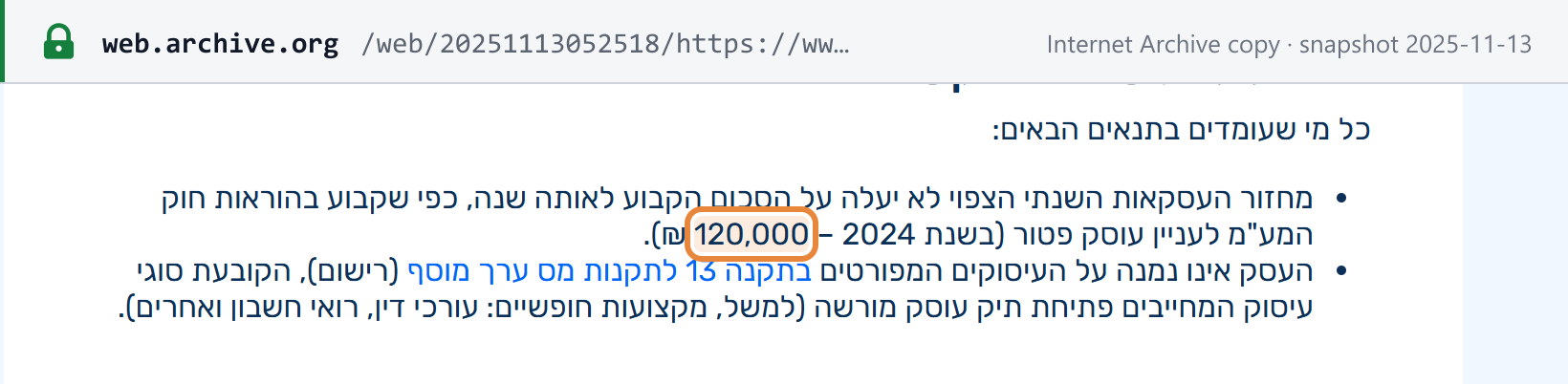
- Ceiling: a business can open an exempt-dealer file only if its expected annual turnover does not exceed the amount set for that year, which the ITA gives as NIS 120,000 for 2024 (page updated 31 March 2025). [3]
- Who can never be exempt: companies (reg 13(7)) and the other groups in regulation 13 of the VAT (Registration) Regulations, such as lawyers and accountants, must register as authorised dealers. [3] [5]
Non-resident registration
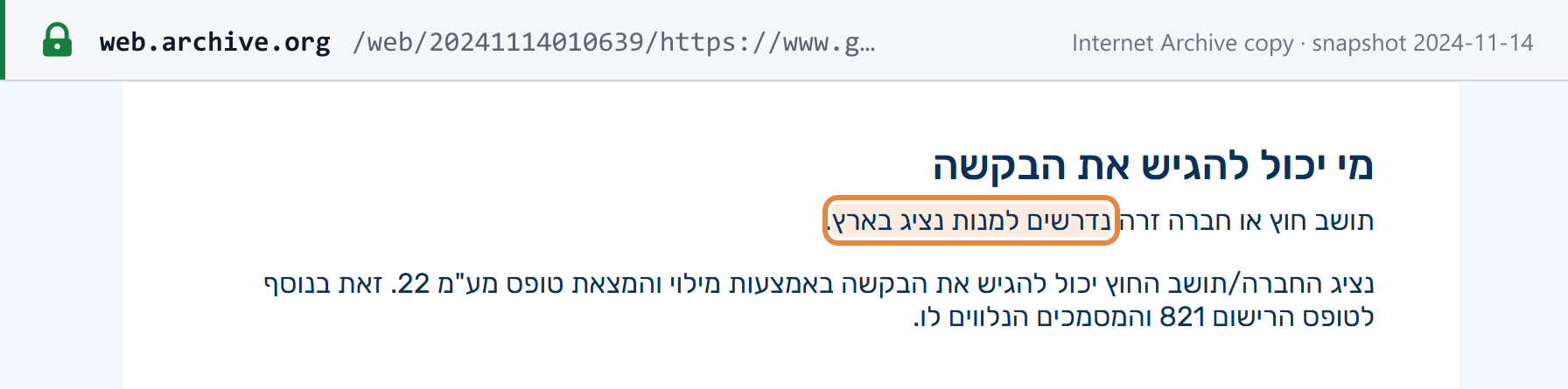
- Forms. A foreign resident, or a company registered as a foreign company with the Registrar of Companies, that wants to operate in Israel files Form 22 together with Form 821. [6]
- Representative. "A foreign resident or foreign company is required to appoint a representative in Israel" (ITA, Form 22 page). Under reg 6(a) of the VAT (Registration) Regulations, a foreign dealer — one whose main business is outside Israel but which also has business or activity in Israel — notifies the Director of its representative's name within 30 days of starting activity in Israel. The representative must be an individual whose permanent residence is in Israel, or a company registered in Israel. [6] [5] [7]
- Power of attorney. The notice is made on the Director's form with a power of attorney from the foreign dealer to the representative, including authority to file every report, pay the tax and deal with every matter under the Law (reg 6(b)). [5] [7]
- Documents. The ITA's Form 22 page asks for a certificate of incorporation (for a company) or a passport with an entry visa (for an individual), and a notarised power of attorney where documents are signed abroad. [6]
Tax identification number
An allocation-number request must include the customer's authorised-dealer number. [8] For the format of Israeli identity, company and dealer numbers, see the Israel tax ID guide, or check a number with the Israel TIN validator.
The ITA's dealer lookup "allows customers to obtain the contact details of an authorized or exempt trader online, based on the trader's number." [9]
How to register
- Authorised dealer. Print, complete and sign Form 821, and file it in person at the regional VAT office (by appointment) or through a representative such as a CPA or tax adviser. Bring identification, a cancelled cheque or bank confirmation, the lease or purchase agreement for the premises, and a licence or other evidence of the business. After registration you receive confirmation that you are registered and a username and password for VAT reporting and payment. [2]
- Exempt dealer. Apply online. The application opens the VAT and income-tax files together and notifies National Insurance automatically. An exempt dealer then files an annual turnover declaration. [3] [4]
- Foreign business. Form 22 with Form 821, through the Israeli representative (see Non-resident registration).
- Changes. A change of activity, business address or phone number must be reported within 15 days of the change, on Form 822. [10]


For the registration process across countries, see how to register for VAT, GST and sales tax.
Voluntary registration
Not covered in this guide — see the ITA.
Deregistration
Apply on Form 18, stating the exact date activity stopped and listing the assets and inventory still held. [11]
Group registration
Available. Under reg 10(b) of the VAT (Registration) Regulations, dealers that ask to register as one may do so even if each keeps its own books, where they are: [12]
- a company and its subsidiary, or two or more subsidiaries of the same company ("subsidiary" as defined in the Securities Law, 5728-1968);
- a partnership and a partner holding 50% or more of it; or
- a cooperative society and shareholders holding together at least 50% of its shares.
For how grouping works elsewhere, see VAT grouping explained.
Rates
| Rate | Applies to |
|---|---|
| 18% | Transactions in Israel and imports of goods, since 1 January 2025 (17% before) |
| 0% (zero-rated) | Supplies listed in the VAT Law; the list is not covered in this guide — see the ITA |
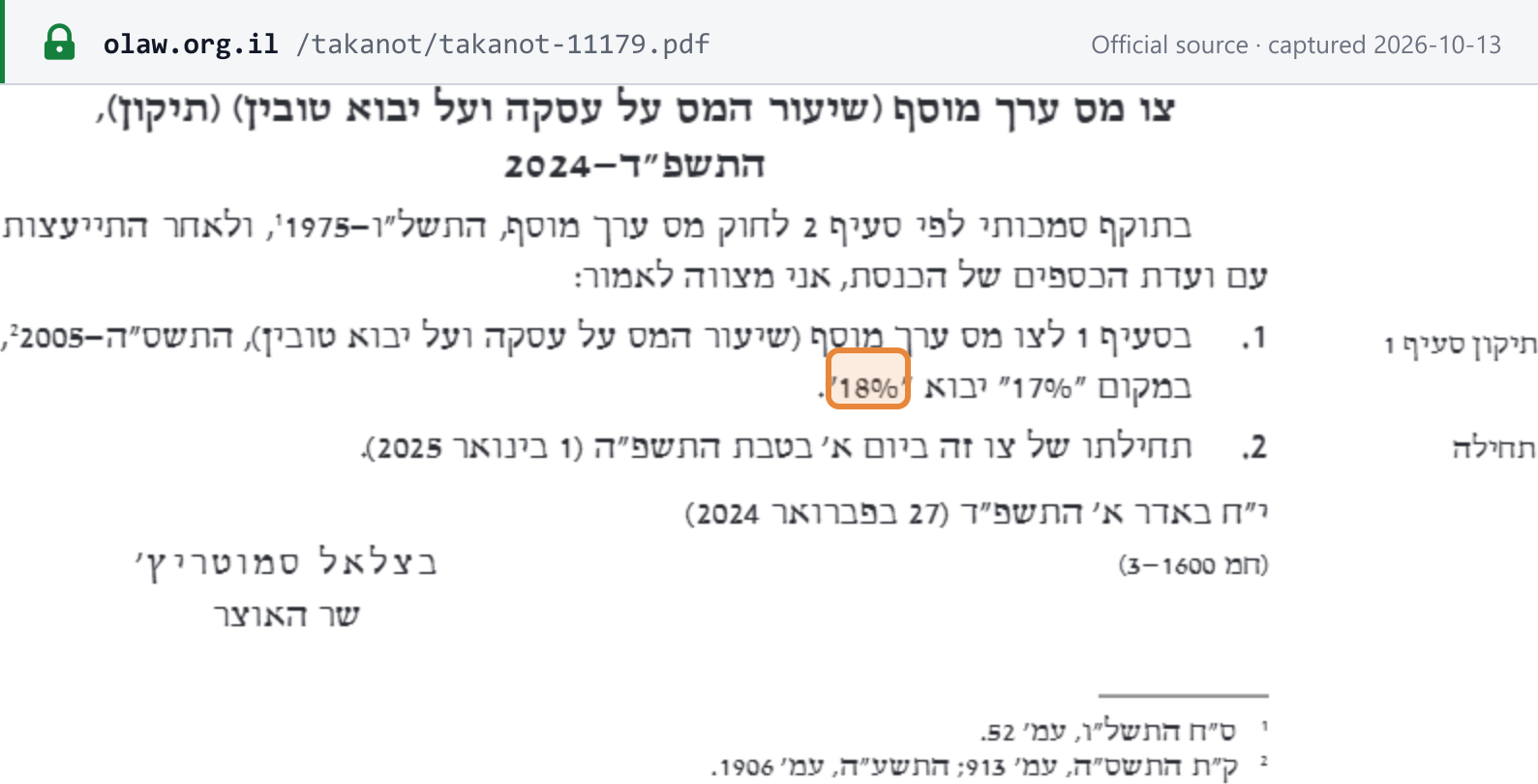
Standard rate. The VAT (Rate of Tax on a Transaction and on the Import of Goods) (Amendment) Order, 5784-2024, signed by the Minister of Finance on 27 February 2024 and published in Kovetz HaTakanot 11179 on 28 February 2024, replaced "17%" with "18%" in section 1 of the 2005 rate order, with effect from 1 January 2025. [1]
No reduced rate. The rate order sets one rate. The ITA's allocation instruction treats zero-rated tax invoices as a separate class (see E-invoicing status). [13]
Cross-border rules
Imports and exports
- Imported goods bear VAT at 18%: the rate order applies to "the import of goods". [1]
- Exports, customs procedure and low-value imports: not covered in this guide — see the ITA.
Reverse charge on services from non-residents
Regulation 6D of the VAT Regulations puts the liability to pay the VAT on the buyer when a transaction is made in Israel and the seller or service provider is a foreign resident, unless the buyer holds an invoice for the transaction. It applies to any buyer, not only businesses: a buyer that is a dealer issues an invoice in its own name and reports and pays the tax in its periodic report, and a buyer that is not a dealer reports the purchase as an occasional transaction and pays the tax with that report (reg 6D, applying reg 6C(d)). [14] See reverse charge explained.
Digital products and services
No regime makes a foreign seller register or collect VAT on remote sales to consumers: there is no simplified registration or digital-services regime. Instead, reg 6D makes the buyer liable unless it holds an invoice (see Reverse charge on services from non-residents). For how other countries tax these supplies, see VAT on digital services by non-resident suppliers.
Foreign companies selling into Israel — B2B and B2C
- Selling to businesses (B2B): the Israeli buyer, as a dealer, issues an invoice in its own name and reports and pays the VAT under reg 6D, unless it holds an invoice for the transaction. [14]
- Selling to consumers (B2C): reg 6D also makes a consumer buyer liable; a buyer that is not a dealer reports the purchase as an occasional transaction. No regime makes a foreign seller register or collect VAT on remote sales to consumers. A foreign resident or foreign company that wants to operate in Israel registers on Form 22 with Form 821 and appoints a representative (see Non-resident registration). [14] [6]
Marketplace / platform deemed-supplier liability
Not covered in this guide — see the ITA.
Place of supply
Not covered in this guide — see the ITA.
Invoice requirements
Data reported for an allocation number
For the allocation model, the ITA's instruction and service page list the invoice data a supplier reports when requesting an allocation number: [13] [8]
- the document (invoice) number;
- the customer's VAT or company number;
- the amount before VAT;
- the VAT amount;
- the date.
The allocation number the ITA returns is then shown on the tax invoice (see E-invoicing status). The full list of particulars a tax invoice must carry is not covered in this guide — see the ITA.
Issuance deadline, numbering, credit notes, currency and language
Not covered in this guide — see the ITA.
Self-billing
When the ITA refuses an allocation number and the supplier chooses the buyer reverse charge, the buyer issues a self-invoice carrying the same special allocation number (see E-invoicing status). [13]
Retention and audit trail
- Retention: not covered in this guide — see the ITA.
- Audit trail. For invoices above the threshold, the allocation number links each tax invoice to the data the supplier reported to the ITA, and buyers can check that match online (see E-invoicing status).
A specimen of a compliant invoice
The ITA publishes no annotated specimen tax invoice. Below, Lookuptax lays out the fields the allocation model uses, for a domestic B2B tax invoice above the NIS 5,000 allocation threshold issued to an authorised-dealer customer that asked for an allocation number. Every name, number and amount is fictional:
Tax invoice (חשבונית מס) with allocation number
| Description | Amount excl. VAT |
|---|---|
| Kitchen cabinets, supply and install | NIS 5,000.00 |
| Worktop, engineered stone | NIS 1,000.00 |
- Amount before VATexceeds NIS 5,000: allocation number
- NIS 6,000.00
- VAT 18%VAT amount, reported for the allocation request
- NIS 1,080.00
- Total including VAT
- NIS 7,080.00
- An invoice with only zero-rated or only exempt lines gets no allocation number.
- Without the allocation number, the customer cannot deduct the input VAT on this invoice.
E-invoicing status
Status (as at 2026-10-13): phased in and in force for B2B tax invoices — the "Israel Invoices" allocation model (מודל חשבוניות ישראל). The ITA issues a 9-digit allocation number for a tax invoice; the invoice itself can be produced by software or from a paper invoice book. The ITA's English page says the model is based on the Economic Efficiency Law 2023 and aims to address fictitious invoices. [15] [13]
When a number is needed. All four conditions must hold (ITA VAT Implementation Instruction 01/2025): [13]
- the tax invoice amount before VAT exceeds the threshold;
- the tax invoice includes VAT;
- the customer is an authorised dealer;
- the customer asks for an allocation number.
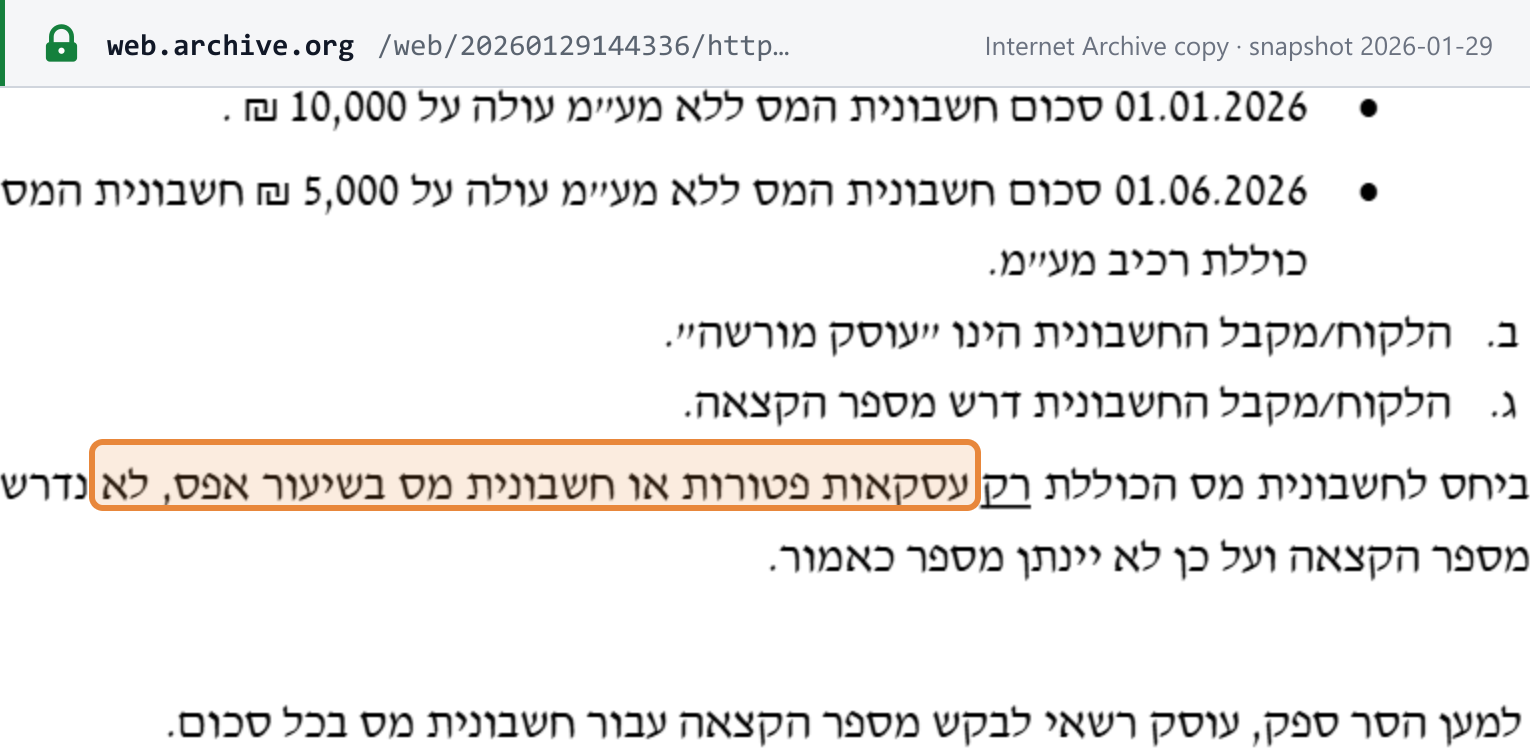
Without a number, the customer cannot deduct the input VAT on an invoice above the threshold. No number is required — or given — for a tax invoice that carries only exempt transactions or is only zero-rated. A dealer may request a number for a tax invoice of any amount. [13] [15]
Threshold timeline (invoice amount before VAT; an invoice must exceed the figure to be caught):
| From | Threshold | Set by |
|---|---|---|
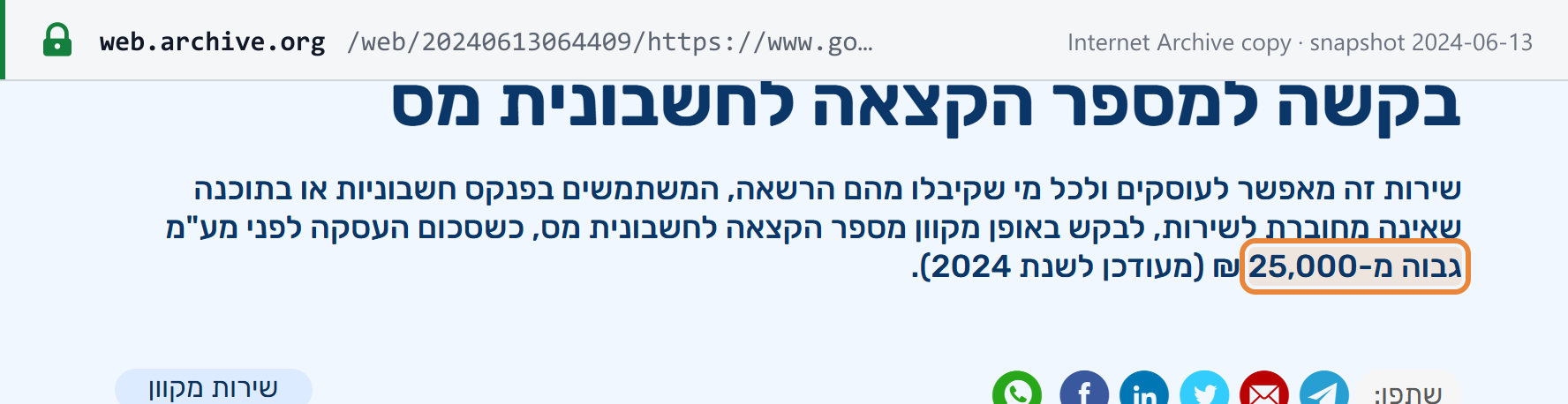
| 5 May 2024 (start) | exceeds NIS 25,000 | ITA allocation service page, 2024 [16]; start date: Instruction 01/2024 [17] |
| 1 January 2025 | exceeds NIS 20,000 | Instruction 01/2024 (15 Aug 2024) [17] |
| 1 January 2026 | exceeds NIS 10,000 | Instruction 01/2025 (7 Dec 2025) [13] |
| 1 June 2026 (current) | exceeds NIS 5,000 | Instruction 01/2025 [13] |
An invoice of exactly NIS 5,000 before VAT is therefore not caught.
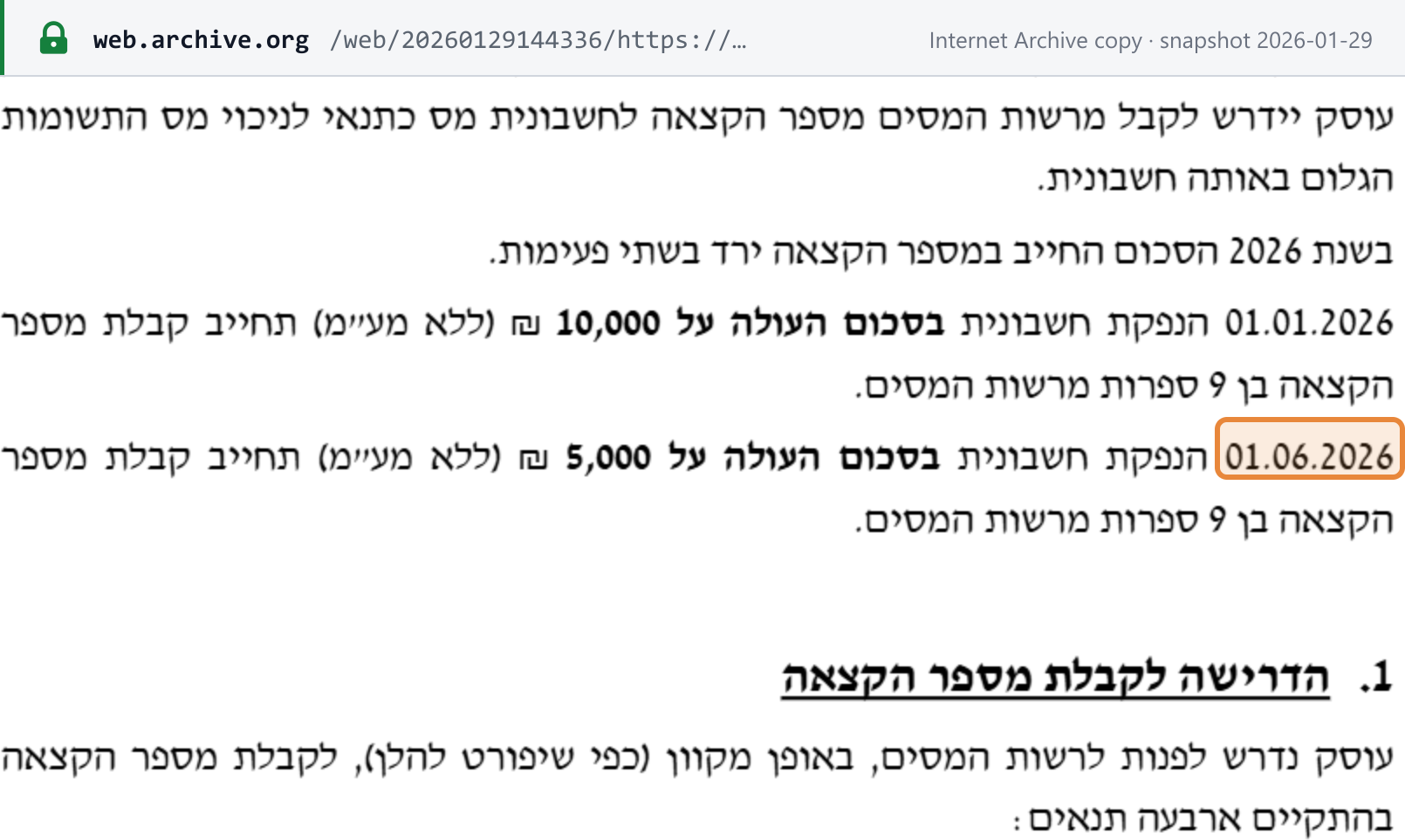
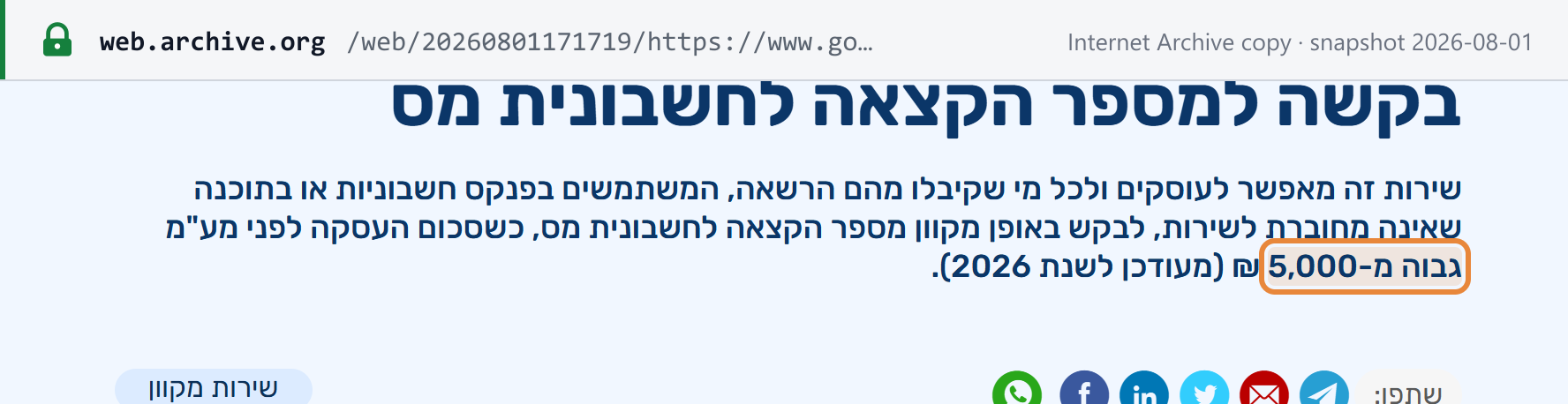
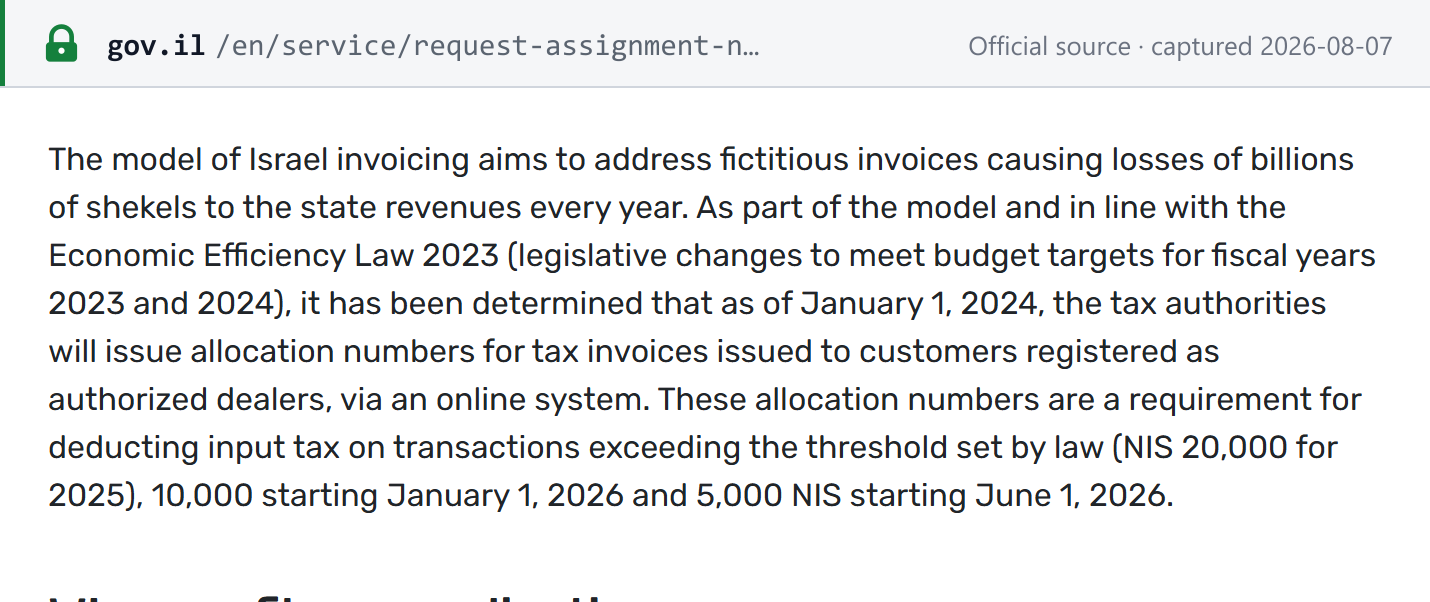
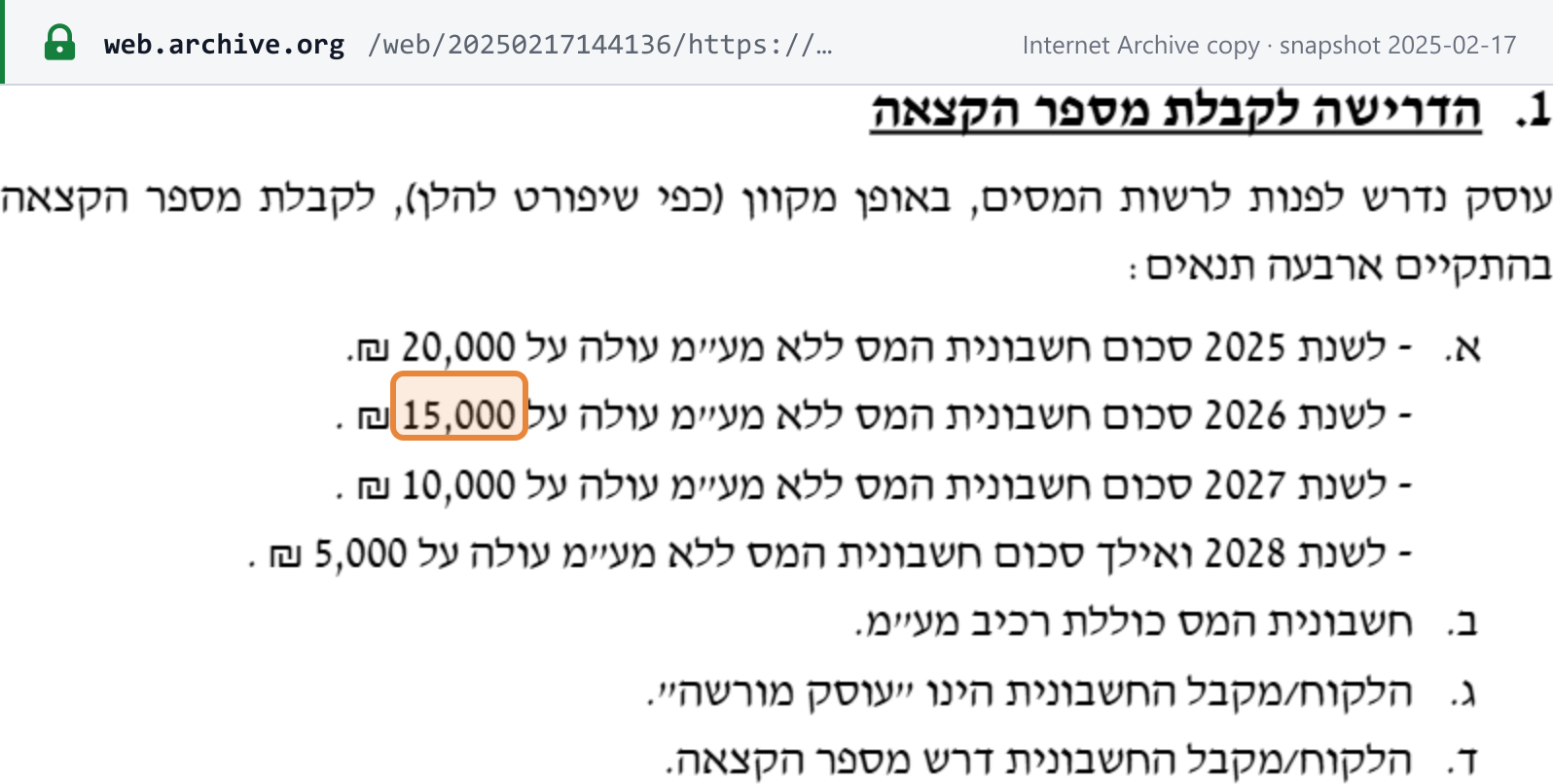
The earlier schedule was replaced. Instruction 01/2024 had set NIS 15,000 for 2026, NIS 10,000 for 2027 and NIS 5,000 from 2028. Instruction 01/2025 of 7 December 2025 brought the steps forward to NIS 10,000 in January 2026 and NIS 5,000 in June 2026. Articles still quoting the 2027 and 2028 dates are describing the replaced schedule. Neither Instruction 01/2025 nor the ITA service page (updated 1 June 2026) shows a step below NIS 5,000. [13] [17] [8]
How it works in practice. [13] [8]
- Channels. Accounting software connected to the ITA requests numbers automatically. Dealers using an invoice book, or software that is not connected, use the ITA web application (live since November 2023), entering the document number, the customer's number, the amount before VAT, the VAT and the date. First register for the ITA's digital services and grant any delegation needed (see Important websites).
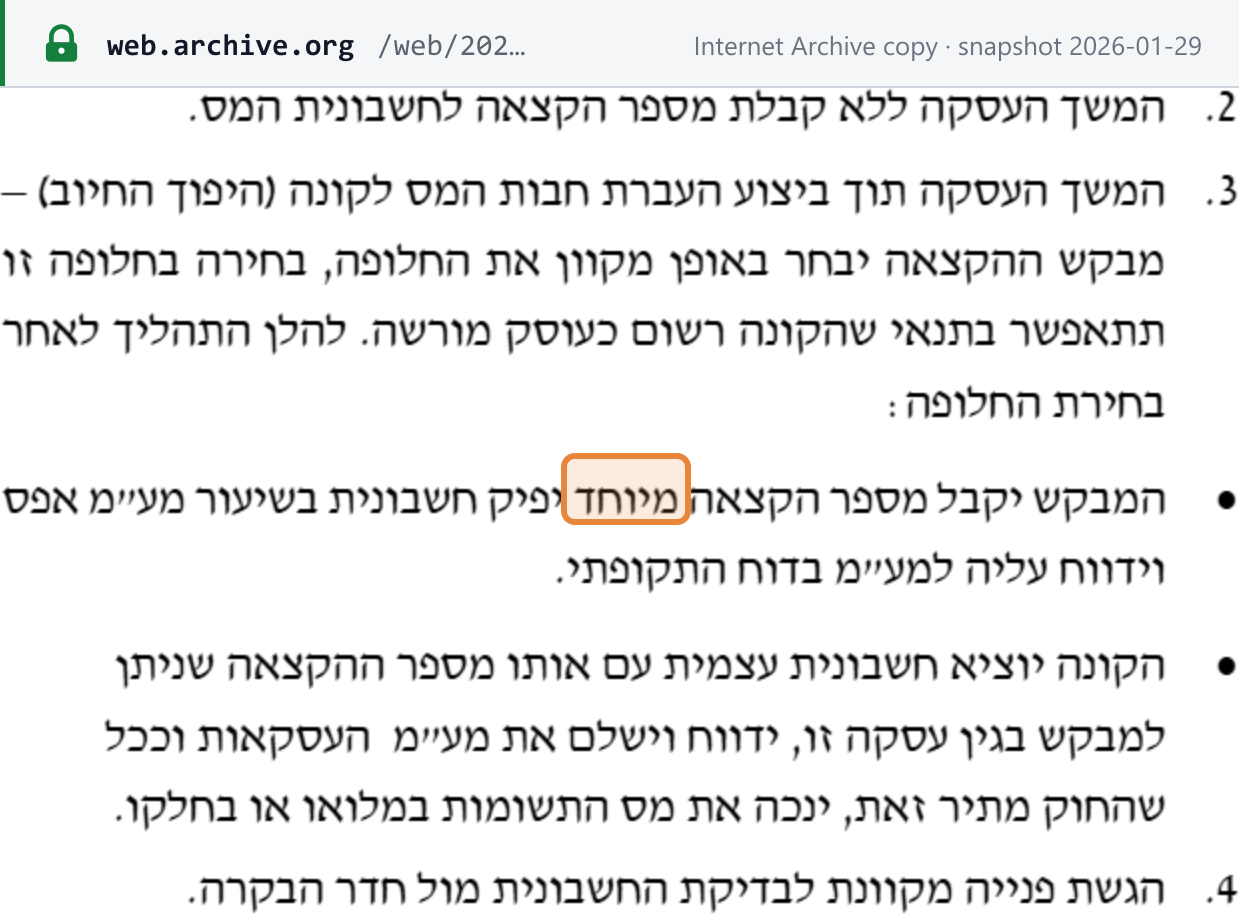
- Refusal. If the ITA refuses a number, the supplier can cancel the request, go ahead without a number, use the buyer reverse charge, or ask the ITA's control room to review the invoice. Under the reverse charge, the requester receives a special allocation number, issues a 0% VAT invoice and reports it; the buyer issues a self-invoice with the same number, reports and pays the VAT, and deducts input VAT as the law allows. This option is available only where the buyer is an authorised dealer.
- Hearing and objection. A hearing is set within two business days of the online notice, with a decision within one business day — if none is given, the number is treated as granted. An objection can be filed within 30 days and is decided within 21 business days, or treated as accepted; an appeal lies to the District Court.
- Buyers can check. The ITA's verification service lets a dealer confirm, by allocation number, that a supplier's invoice data matches what the supplier reported to the ITA. [18]

- System. The ITA's online allocation-number service; no Peppol or other exchange network is involved.
- Format. The model works with paper invoice books as well as software: dealers using an invoice book request numbers through the ITA web application.
- Scope. B2B only — the customer must be an authorised dealer. B2C and B2G: not covered in this guide — see the ITA.
For how this model compares with other systems, see CTC e-invoicing models explained and the e-invoicing status and networks table. The event record for the June 2026 step is Israel lowers the allocation-number threshold to NIS 5,000.
Filing and payment
Filing frequency
Not covered in this guide — see the ITA. Exempt dealers file an annual turnover declaration. [4]
Return due date
- Periodic report: by the 15th of the month. [19]
- Filed online: "periodic reports submitted online can be reported and paid by the 19th of each month (instead of the 15th of each month)." [19]

Payment due date and method
Payment is due with the report. The ITA's reporting page lists these methods: [19]
- online bank debit;
- a Postal Bank voucher, through a representative;
- credit card, only where the payments to the VAT file that month, including this one, total no more than NIS 35,000.

Additional listings
Exempt dealers file an annual turnover declaration. [4] Other listings are not covered in this guide — see the ITA.
Input-tax recovery and blocked items
- Allocation number. Above the threshold, the tax invoice must carry an allocation number for the input VAT to be deductible (Instruction 01/2025). [13]
- Deduction periods and blocked items: not covered in this guide — see the ITA.
Refunds
Not covered in this guide — see the ITA.
Exemptions
Exempt supplies
Not covered in this guide — see the ITA.
Exempt is not zero-rated. The ITA's allocation instruction treats a tax invoice with only exempt transactions and a zero-rated tax invoice as separate categories; neither receives an allocation number. [13]
Special regimes
- Exempt dealer (osek patur) — the small-business status described under Registration threshold.
- Other regimes: not covered in this guide — see the ITA.
Offences and penalties
Offences
Not covered in this guide — see the ITA. The ITA describes the allocation model as aimed at fictitious invoices. [15]
Penalties
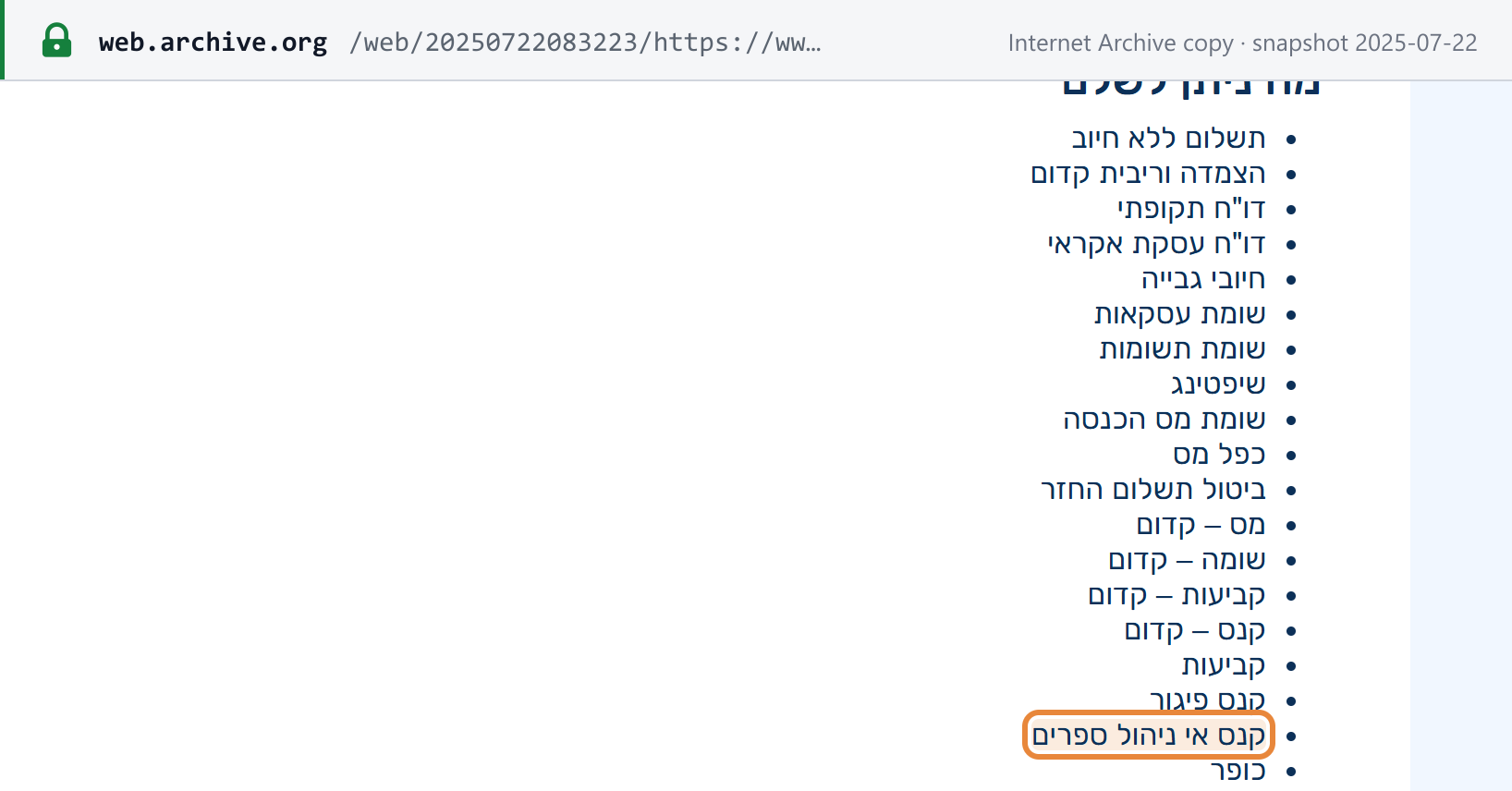
The ITA's VAT debt-payment service lists, among the items a dealer can pay, these charges: [20]
| Charge | Hebrew |
|---|---|
| Late fine | קנס פיגור |
| Fine for not keeping books | קנס אי ניהול ספרים |
| Composition payment (in place of prosecution) | כופר |
| Linkage differentials and interest | הצמדה וריבית |
Amounts and rates: not covered in this guide — see the ITA.
Frequently asked questions
What is the VAT rate in Israel, and is there a reduced rate?
The standard rate is 18% from 1 January 2025, up from 17%, under an amendment order published in Kovetz HaTakanot 11179 on 28 February 2024. The order sets one rate for transactions in Israel and imports of goods; there is no reduced rate. Zero-rated invoices exist, and the Israel Tax Authority's allocation rules treat them separately.
Do I need an allocation number on a NIS 6,000 invoice to an Israeli business?
Yes, from 1 June 2026, if the customer asks for one. A number is needed when all four conditions hold: the amount before VAT exceeds NIS 5,000, the tax invoice includes VAT, the customer is an authorised dealer (osek murshe), and the customer asks for a number. Without it the customer cannot deduct the input VAT on that invoice. An invoice of exactly NIS 5,000 before VAT is not caught, and an invoice carrying only zero-rated or only exempt transactions never receives a number. You may also request a number for an invoice of any amount.
Is the allocation-number threshold dropping to NIS 3,000 or NIS 2,000?
Not in any Israel Tax Authority source as at 13 October 2026. The current threshold is more than NIS 5,000 before VAT from 1 June 2026, set by VAT Implementation Instruction 01/2025 of 7 December 2025. That instruction replaced the schedule in Instruction 01/2024, which had planned NIS 15,000 for 2026, NIS 10,000 for 2027 and NIS 5,000 from 2028; figures from that older schedule still appear in some articles.
We are a foreign SaaS company with Israeli customers. Do we have to register for VAT in Israel?
Regulation 6D of the VAT Regulations puts the liability to pay the VAT on the buyer when the seller is a foreign resident, unless the buyer holds an invoice; this applies to any buyer, and a buyer that is not a dealer reports the purchase as an occasional transaction. No regime makes a foreign seller register or collect VAT on remote sales to consumers. A foreign resident or foreign company that wants to operate in Israel opens a VAT file on Form 22 together with Form 821 and appoints a representative in Israel, notifying the representative's name within 30 days of starting activity in Israel (VAT (Registration) Regulations, regulation 6(a)).
Can a company be an exempt dealer (osek patur) in Israel?
No. Companies (reg 13(7)) and the other groups in regulation 13 of the VAT (Registration) Regulations, such as lawyers and accountants, must register as authorised dealers. Other small businesses can open an exempt-dealer file online where their expected annual turnover does not exceed the exempt-dealer ceiling, which the Israel Tax Authority gives as NIS 120,000 for 2024.
When is the Israeli VAT return due?
Periodic VAT reports are due by the 15th of the month. Reports submitted online can be filed and paid by the 19th of the month instead.
Can I pay Israeli VAT by credit card?
Yes, if the payments to your VAT file in that month, including this one, total no more than NIS 35,000. Otherwise pay by online bank debit, or through a representative with a Postal Bank voucher.
Important websites
| Site | Purpose |
|---|---|
| Register as an authorised dealer (Form 821) | Open an osek murshe VAT file |
| Open an exempt-dealer file online | Open an osek patur file (VAT and income tax together) |
| Register a foreign dealer (Form 22) | VAT file for a foreign resident or foreign company, with an Israeli representative |
| Report or pay VAT reports | File periodic returns and pay online |
| Pay a VAT debt | Pay arrears, fines, linkage and interest |
| Request an allocation number (English) | Allocation numbers for tax invoices, including the web application |
| Register for digital services and grant delegation | Needed before requesting allocation numbers online |
| Verify a supplier's invoice data | Check a supplier's invoice against its allocation number |
| Dealer lookup | Contact details of an authorised or exempt dealer, by dealer number |
| Israel TIN validator | Check the format of an Israeli identity, company or dealer number |
Recent changes
- 2026-06-01 — The allocation-number threshold falls to tax invoices exceeding NIS 5,000 before VAT. (Israel Tax Authority) — see event
- 2026-01-01 — The allocation-number threshold falls to tax invoices exceeding NIS 10,000 before VAT. (Israel Tax Authority)
- 2025-12-07 — VAT Implementation Instruction 01/2025 replaces the 2024 schedule (NIS 15,000 for 2026, 10,000 for 2027, 5,000 from 2028) with the two 2026 steps. (Israel Tax Authority)
- 2025-01-01 — Standard VAT rate rises from 17% to 18% (Kovetz HaTakanot 11179). (Reshumot)
- 2025-01-01 — The allocation-number threshold falls to tax invoices exceeding NIS 20,000 before VAT. (Israel Tax Authority)
- 2024-05-05 — Allocation numbers begin for tax invoices exceeding NIS 25,000 before VAT. (Israel Tax Authority)
For the full chronology, see Israel tax changes on Lookuptax.
Reference links
ITA pages were read from Internet Archive copies; the links below are the official addresses. Gazette (Reshumot) issues are linked to the olaw.org.il copies of the typeset gazette.
- Kovetz HaTakanot 11179, p.1840 — VAT rate amendment order 5784-2024 (28 February 2024)
- Israel Tax Authority — Open an authorised-dealer file (Form 821)
- Israel Tax Authority — Open an exempt-dealer file online (updated 31 March 2025)
- Israel Tax Authority — Exempt dealer's annual turnover declaration
- Kovetz HaTakanot 3474, pp.946–949 — VAT (Registration) Regulations, 5736-1976, regs 6 and 13 (9 February 1976)
- Israel Tax Authority — Open a VAT file for a foreign dealer (Form 22)
- Kovetz HaTakanot 3513, p.1415 — VAT (Registration) (Amendment) Regulations, 5736-1976, amending reg 6 (23 April 1976)
- Israel Tax Authority — Request an allocation number for a tax invoice (Hebrew, updated 1 June 2026)
- Israel Tax Authority — Dealer lookup (English)
- Israel Tax Authority — Report a change in a VAT file (Form 822)
- Israel Tax Authority — Close a VAT file (Form 18)
- Kovetz HaTakanot 3576, p.2390 — VAT (Registration) (Amendment No. 2) Regulations, 5736-1976, reg 10(b) (18 August 1976)
- Israel Tax Authority — VAT Implementation Instruction 01/2025 (7 December 2025, PDF, Hebrew)
- Kovetz HaTakanot 4169, p.38 — VAT (Amendment) Regulations, 5741-1980, adding reg 6D (1 October 1980)
- Israel Tax Authority — Request an allocation number for a tax invoice (English)
- Israel Tax Authority — Request an allocation number for a tax invoice (Hebrew, as at 13 June 2024; Internet Archive copy)
- Israel Tax Authority — VAT Implementation Instruction 01/2024 (15 August 2024, PDF, Hebrew; schedule since replaced)
- Israel Tax Authority — Verify supplier invoice data (updated 12 May 2025)
- Israel Tax Authority — Report or pay VAT reports
- Israel Tax Authority — Pay a VAT debt
Related on Lookuptax: