Mauritius VAT guidelines
| FACTSHEET | |
|---|---|
| Country code | MU |
| Tax name | Value Added Tax (VAT) — Taxe sur la Valeur Ajoutée (TVA) |
| Tax Authority | Mauritius Revenue Authority (MRA) |
Overview
Mauritius levies Value Added Tax (VAT) — TVA in French, the island's other official administrative language — under the Value Added Tax Act (originally Act No. 2 of 1998), administered by the Mauritius Revenue Authority (MRA). VAT is charged on any supply of goods or services made in Mauritius by a taxable person in the course or furtherance of business, and on the importation of goods, irrespective of the importer's VAT status. [1] [2]
The standard rate is 15%, unchanged since 1 July 2002. [1] This is confirmed both by the Fourth Schedule to the Act and, in plain language, by MRA's own published guide: "The standard rate of VAT is 15%." [2]
Currency. All values in this guide are in Mauritian Rupees (MUR), written "Rs." on MRA's own forms and guides; this guide uses "MUR" for clarity. [2]
Tax period basis. Mauritius VAT has no single fixed "tax year" the way income tax does — the operative unit is the taxable period (a calendar month or calendar quarter, depending on turnover; see Filing and payment). A separate small-enterprise VAT annual accounting system does run on an accounting year (a company's own financial year, or 30 June for anyone else). [1]
Layering. Mauritius VAT is a single national tax with no state, provincial or municipal layer. It applies uniformly to the autonomous island of Rodrigues, where registered persons pay their VAT at a dedicated MRA outpost rather than through a separate Rodrigues tax. [2] Two other charges sit alongside VAT under related legislation but are not VAT and are out of scope of this guide: a Solidarity Levy of 0.85% on hotels, hotel management and tour operators (Eleventh Schedule to the VAT Act), and a new Insurance Premium Tax on general insurance business, enacted by the Finance Act 2026 (Act No. 14 of 2026) as a new Part XD of the Act, applying to policies entered into or renewed on or after 1 January 2027 — see Recent changes. [1] [3]
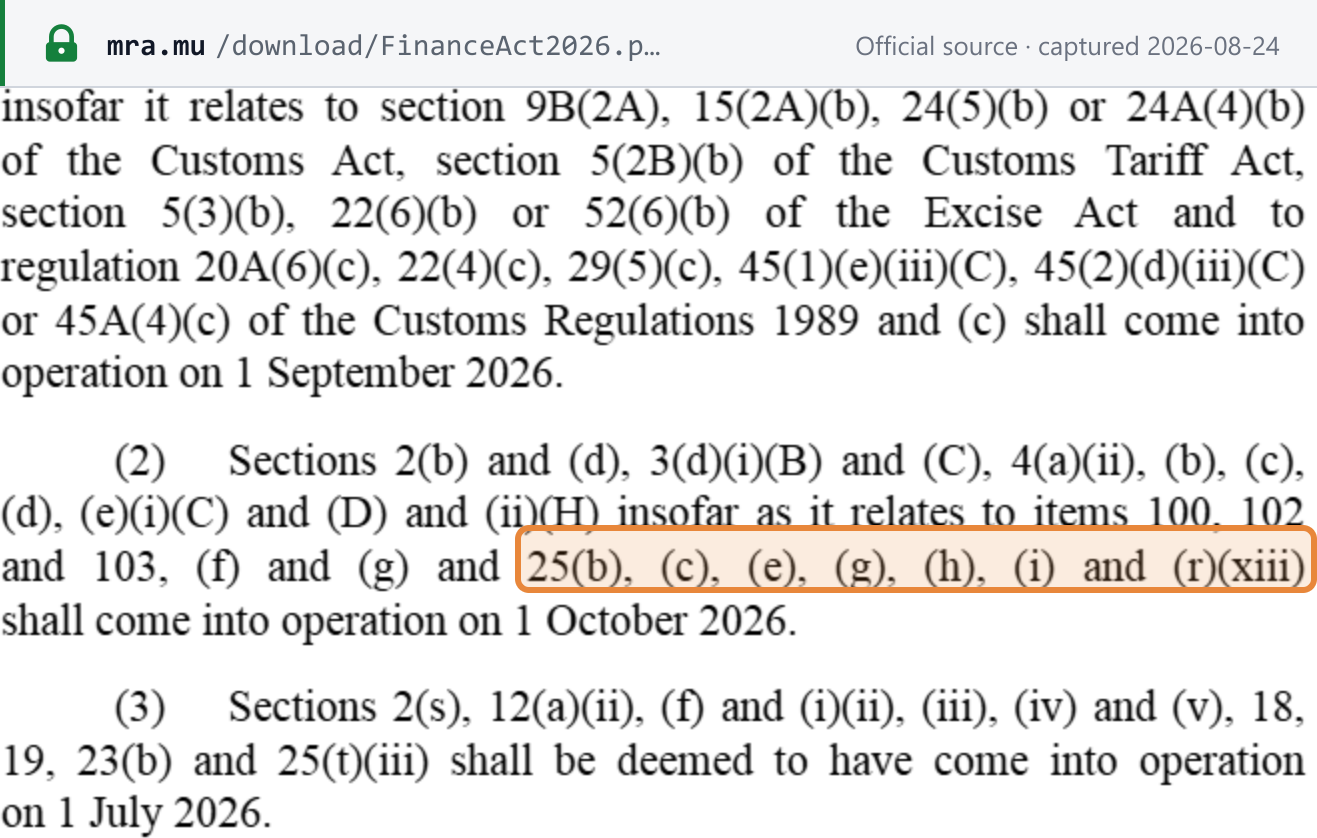
A word on status before you read further: the Bill described in earlier versions of this guide — Finance Bill No. XII of 2026 — was passed by the National Assembly on 31 July 2026, received Presidential assent on 12 August 2026, and was gazetted as the Finance Act 2026 (Act No. 14 of 2026) on 13 August 2026. It is enacted law, but the enacted text does not track every early report about it: common salt was not zero-rated (the word "salt" does not appear in the Act), while electronic books were zero-rated, not exempted as some pre-enactment coverage suggested. Commencement also varies by provision — most VAT amendments took effect immediately on gazettal (13 August 2026), but a specific list of provisions was deferred under section 28 of the Act — to 1 October 2026 (now in force) or to 1 January 2027. Each VAT change below states its own commencement date; see Recent changes for the full list. [3] [5]
 Source snapshot captured 2026-08-24 — original
Registration
Who should register
A person must apply for compulsory registration where, in the course or furtherance of business, taxable supplies exceed or are likely to exceed the Sixth Schedule amount — currently MUR 3 million — in any 12-month period (not a fixed calendar year). Separately, and irrespective of turnover, compulsory registration also catches: [1]
- Tenth Schedule Part I professions and businesses once turnover is below MUR 3 million but the person is still engaged in one of them: accountant/auditor, advertising agent, adviser (investment or tax), architect, attorney/solicitor, barrister of more than 2 years' standing, freight forwarding agent, consultant (legal, tax, management), customs house broker, wholesale liquor dealer, engineer, estate agent, land/marine/motor surveyor, notary, optician, project manager, property valuer, quantity surveyor, sworn auctioneer, airline general sales agent, second-hand motor vehicle importation agent, and holders of a pleasure-craft licence for a commercial vessel over 12 metres.
- Tenth Schedule Part II businesses, irrespective of turnover: banking transactions (other than with non-residents and Global Business Licence holders), management-licence services outside Category 1/2 Global Business Licence clients, and merchant credit-card services from non-bank issuers.
- Tenth Schedule Part III digital or electronic services supplied by a foreign supplier — see Cross-border rules.
A person whose turnover is made up exclusively of zero-rated supplies, or of zero-rated and exempt supplies together, is not bound to register. A person who makes only exempt supplies cannot register at all. [1] [2]
Registration threshold
| Trigger | Threshold | Measurement period | Notes |
|---|---|---|---|
| Compulsory registration (resident) | MUR 3,000,000 (Sixth Schedule, s.15) | Any 12-month period of taxable supplies | Cut from MUR 6 million, effective 1 October 2025 (Finance Act 2025). [1] |
| Compulsory — specified professions (Tenth Schedule Part I) | None | — | Irrespective of turnover. [1] |
| Compulsory — specified businesses (Tenth Schedule Part II) | None | — | Irrespective of turnover. [1] |
| Foreign digital-service supplier (Tenth Schedule Part III) | MUR 3,000,000 from 1 October 2026 (none from 1 January to 30 September 2026) | — | Compulsory regardless of revenue from 1 January 2026 to 30 September 2026. The Mauritius tax-representative requirement was repealed effective 13 August 2026 (Finance Act 2026, s.25(f)) — the foreign supplier is now directly responsible. The zero-threshold rule itself was replaced by the ordinary MUR 3 million Sixth Schedule threshold, with a B2B carve-out, from 1 October 2026 (s.25(g)). See Cross-border rules. [1] [3] [6] |
| Voluntary registration | Below MUR 3,000,000 | — | Available on application, subject to the Director-General being satisfied the applicant keeps proper records and has been discharging its revenue-law obligations. [1] |
The Act's own Sixth Schedule reads, in full: "Annual turnover of taxable supplies — 3 million rupees," with an endnote recording that Finance Act 2025 substituted "3" for "6" with effect from 1 October 2025. [1]
Tax registration number
Mauritius uses a single identifier — the Tax Account Number (TAN) — across VAT and every other tax head. An individual's TAN is 8 digits starting with 1, 5, 7 or 8; an entity's TAN is 8 digits starting with 2 or 3. On registration for VAT, the VAT Registration Number allocated is the same as the TAN — MRA does not issue a separate VAT-only number format. For the full format walkthrough, the related Business Registration Number (BRN), and the National Identification Number, see Lookuptax's Mauritius TIN/TAN guide. [7] [2]
How to register
- Online — the simplified VAT registration facility on MRA's website (login with NID/NCID, TAN or BRN).
- Manually — a downloadable VAT registration form, submitted by email to
[email protected], by registered post, or in person at MRA's Head Office (Ehram Court, Port Louis). - At incorporation — an application can be filed at the same time as business registration through the Corporate and Business Registration Integrated System (CBRIS).
- Foreign digital-service suppliers email the required particulars (entity name, confirmation of foreign-supplier status, home-country registration certificate, correspondence details, and any Mauritius agent's details) to
[email protected]; MRA then issues a TAN/username and the supplier completes registration on MRA's VAT e-filing portal, either directly or through an approved e-Filing Service Centre acting as tax representative.
MRA issues a Certificate of Registration and a distinctive mark once satisfied the applicant should register; there is no published fixed processing timeline. [2] [6]
Voluntary registration
Available below the MUR 3 million threshold on application, where the Director-General is satisfied the applicant keeps proper business records and has been discharging its other revenue-law obligations. A voluntarily registered person may claim input tax from the date of registration onward. [1]
Deregistration
Two distinct routes exist:
- Where the threshold itself rises (e.g. the October 2025 cut from MUR 6 million to MUR 3 million works in the other direction — this route applies when a threshold increases): a registered person no longer required to remain registered may give irrevocable written notice within 30 days of the increase taking effect, electing to cease registration from the start of the following taxable period, after clearing overdue returns and paying tax due plus any penalties and interest. [1]
- Ordinary cancellation — the Director-General may, on his own initiative or on request, require a registered person to show cause within 14 days why registration should not cease, and may then cancel it from a date he determines. On cancellation the person must stop holding out as registered, file a final return and pay tax on capital goods exceeding MUR 100,000 still held as business assets, and return the certificate of registration. Any final-period excess of input over output tax is not refundable on deregistration. [1]
Group registration
Not available. The Value Added Tax Act has no VAT-grouping provision — registration and returns are made on a strictly per-taxable-person basis, with no mechanism to register two or more related entities as a single unit. (Checked against the full text of the Act, 2026-08-10.) [1]
Rates
| Rate | Applies to | Effective |
|---|---|---|
| 15% (standard) | Most taxable goods and services not specifically zero-rated or exempt | Since 1 July 2002 (Fourth Schedule) [1] |
| 0% (zero-rated) | Goods exported from Mauritius under Customs control; certain basic foodstuffs (rice, wheat flour, bread, edible oils, margarine and butter, milk and dairy, sugar, unprocessed primary agricultural produce, poultry and eggs, meat, tea, honey, and more listed in the Fifth Schedule); printed and, since 13 August 2026, electronic books (item 2(i) of the Fifth Schedule — zero-rated, not exempt, so input VAT stays recoverable); international transport of passengers and goods by sea or air to/from Mauritius, Rodrigues or the Outer Islands; supplies wholly for freeport-zone activities; and exports of services — services supplied to a person who belongs outside Mauritius, is outside Mauritius when the services are performed, and does not consume them in Mauritius | Fifth Schedule [1] [3] |
| Exempt (no VAT charged, no input-tax recovery) | See Exemptions | First Schedule [1] |
Mauritius has no reduced or super-reduced rate distinct from the standard rate — the rate structure is simply standard (15%), zero (0%), or exempt.
Payment service providers join banks in the zero-rated Fifth Schedule, from 13 August 2026. Item 6(2) of the Fifth Schedule already zero-rated a bank's banking transactions with non-residents and corporations holding a Global Business Licence. Section 25(s)(ii) of the Finance Act 2026 (Act No. 14 of 2026) repeals and replaces item 6(2) to add a second limb on the same footing: the supply of services by a payment service provider ("PSP"), licensed and regulated by the Bank of Mauritius under the National Payment Systems Act, to non-residents and corporations holding a Global Business Licence issued by the Financial Services Commission, is now zero-rated as well. Section 28 of the Act does not list section 25(s) among the provisions deferred to 1 October 2026, so — consistent with other un-scheduled VAT Act amendments in the same Act — it took effect on the Act's gazettal date, 13 August 2026. A licensed PSP should review whether services it supplies to non-residents or Global Business Licence corporations now qualify. [3]
Announced future rates. None. The Finance Act 2026 (Act No. 14 of 2026) does not touch section 10 (the rate-charging provision) or the Fourth Schedule rate figure itself — its VAT amendments are confined to scope, thresholds, penalties and administration, plus the item 2(i) and item 6(2) zero-rating changes noted above; see Recent changes. No change to the 15% standard rate is in force or announced. [3]
Cross-border rules
Imports and exports
- Imports — VAT is charged on the importation of goods (other than First Schedule exempt items), valued at customs value plus customs duty, excise duty, the MID levy, the CO2 levy and the levy on energy consumption, and collected alongside customs duty at the border. A deferred-payment scheme lets a VAT-registered person defer import VAT on capital goods (plant and machinery): the deferred amount is instead self-declared as output tax in that period's VAT return. [1]
- Exports — goods exported under Customs control are zero-rated, as are exports of services (see the Rates table above) and international transport. [1]
- De-minimis — not documented in the Act or MRA's published guidance reviewed for this guide; treated as unconfirmed rather than guessed.
- Reverse charge on imported (non-digital) services — under section 14, where a supplier who does not belong in Mauritius and is not VAT-registered supplies services performed or utilised in Mauritius to a registered Mauritius recipient, the recipient self-accounts for VAT as if it had made the supply itself, and may claim the same amount back as input tax on the same return. The foreign supplier's own invoice or documentation stands in as the VAT invoice. This mechanism does not apply where the supply is instead covered by the digital-services regime in section 14A. [1]
Digital products and services
Since 1 January 2026, section 14A of the VAT Act charges VAT at 15% on digital or electronic services — the Tenth Schedule Part III list — supplied by a foreign supplier to a person in Mauritius. As originally enacted the item 1 list read: images or text (photographs, screensavers, e-books, digitised documents), music/film/television/games/programmes on demand, applications/software and software maintenance, website supply or web hosting, advertising space on a website, online magazines, and distance maintenance of programmes and equipment. Since 13 August 2026, the Finance Act 2026 (Act No. 14 of 2026) has changed this list two ways: it deletes "electronic books" from item 1 (e-books leave the foreign-supplier digital-services regime as they enter the Fifth Schedule zero-rating list instead — see Rates), and it adds a new item 8 — "commission, fee or other consideration receivable by operators of online marketplace" — bringing marketplace-commission income into the same digital-services charge. [1] [3] [6]
A foreign supplier is any person with no permanent establishment in Mauritius or whose place of abode is outside Mauritius. The Act tests whether a recipient counts as "a person in Mauritius" using a five-factor, two-of-five rule: billing address, the location of the bank from which payment originates, the IP address or other geolocation of the device used, the international country code in the recipient's contact details, or any other commercially relevant information — any two non-contradictory factors pointing to Mauritius are enough. [1]
Foreign companies selling into Mauritius — B2B and B2C
The two tracks answer differently, and it matters which one your supply falls into:
-
Ordinary (non-digital) services — B2B: the reverse charge under section 14 puts the obligation on the Mauritius-registered recipient; the non-resident supplier is not required to register for that transaction. B2C: the Act contains no reverse-charge or non-resident-registration mechanism for ordinary services supplied to a Mauritius consumer outside the Tenth Schedule Part III digital-services list — this guide found no provision bringing such supplies into scope, and does not guess one.
-
Digital or electronic services (Tenth Schedule Part III) — both B2B and B2C until 30 September 2026: MRA's published guidance for foreign suppliers, which still describes the original rule, has registration "irrespective of the amount of turnover" and charging on supplies "to persons located in Mauritius" generally, with no business-customer carve-out. [6]
This changed, in two stages, under the Finance Act 2026 (Act No. 14 of 2026) — assented to 12 August 2026, gazetted 13 August 2026, no longer a proposal. Effective immediately on gazettal (13 August 2026), section 25(f) repeals the mandatory tax-representative requirement in section 14A(2) and (5) entirely: the foreign supplier itself is now directly responsible for returns and payment, replacing the old rule that only required a Mauritius tax representative once turnover exceeded MUR 3 million. From 1 October 2026, section 25(g) went further and amended section 15(2)(a)(iii) to replace the zero-threshold registration trigger itself with the ordinary MUR 3 million Sixth Schedule threshold, adding a new carve-out: the compulsory-registration trigger "shall not apply where such services are supplied exclusively to VAT registered persons" (a genuine B2B exclusion). Section 28(2) of the Act names section 25(g) — but pointedly not 25(f) — among the provisions commencing 1 October 2026; there is no general commencement clause, so anything the Act's commencement section does not list took effect on gazettal. [3]
Marketplace / platform deemed-supplier liability
No deemed-supplier regime exists. Mauritius has not adopted an EU/UK-style rule making a marketplace liable for VAT on sales it merely facilitates, and the Finance Act 2026 does not introduce one. What it introduces instead, effective 13 August 2026, is narrower: section 25(u) of the Finance Act 2026 (Act No. 14 of 2026) adds a new Tenth Schedule Part III item 8, taxing "commission, fee or other consideration receivable by operators of online marketplace" as a digital/electronic service in its own right — a marketplace operator charges VAT on its own commission, not on the underlying seller's sale, and does not take on liability for the seller's VAT. Section 25(a) inserts a matching definition of "online marketplace" into section 2: a digital platform connecting or facilitating electronic transactions between buyers and sellers of goods and services (including websites, web-based portals, app stores and similar platforms), excluding a platform that solely processes payments electronically. Both changes are enacted and already in force, not proposals. [3]
Place of supply
The Act does not contain a dedicated "place of supply" Part with separate destination/origin rules the way EU-style VAT law does. Instead:
- Goods — VAT is charged on any supply made in Mauritius, and separately on the importation of goods into Mauritius. [1]
- Services — a "taxable supply" is statutorily defined as a supply of goods in Mauritius, or a supply of services performed or utilised in Mauritius — that phrase is the Act's place-of-supply test for services. [1]
- Cross-border services to a registered recipient are pulled into scope via the section 14 reverse charge regardless of where the (non-belonging) supplier is based.
- Digital/electronic services use the separate five-factor, two-of-five "person in Mauritius" test under section 14A(4) described above.
Invoice requirements
Mandatory content
Under section 20(2) of the VAT Act, every registered person making a taxable supply must issue a VAT invoice showing: [1]
| Required field | Notes |
|---|---|
| The words "VAT INVOICE" | Must appear in a prominent place |
| Supplier's name, business address, VAT Registration Number and Business Registration Number | — |
| Serial number and date of issue | — |
| Quantity and description of goods, or description of services | — |
| Value of the supply, stating whether it is subject to VAT | — |
| Where subject to VAT: the value, and the VAT amount and rate applied | — |
| Where the invoice is in a foreign currency: the exchange rate applied | — |
| Where the purchaser is a registered person: purchaser's name, business address, BRN and VAT Registration Number | — |
| Where the purchaser is in business but not registered: purchaser's name, business address and BRN | — |
| Where a purchaser not in business requests it: purchaser's name, address and National Identity Card number | On request only |
This particulars list does not apply to foreign suppliers of digital or electronic services, who instead follow the digital-services regime described in Cross-border rules. [1]
Issuance deadline
The Act requires a VAT invoice to be issued "in respect of" the supply, without a stated day-count grace period (unlike some peer jurisdictions' fixed 14/21-day windows) — in practice this is anchored by the time of supply rule (section 5): a supply is deemed to occur at the earlier of the invoice being issued or payment being received, so the invoice effectively fixes or follows the tax point rather than trailing it by a set number of days. [1]
Section 25(b) of the Finance Act 2026 added a new paragraph (c) to subsections (1) and (2) of section 5, and a new sub-paragraph (iii) within the lease limb of subsection (3): the time of supply is also "3 months from the date the supply is delivered or performed". [3]
That is a materially different kind of trigger from the existing two. Invoice date and payment date are both within the supplier's control; this one is not. From 1 October 2026, VAT falls due three months after delivery or performance whether or not anything has been invoiced or paid — which puts a hard outer limit on construction retentions, milestone billing, and intercompany recharges settled late. The change belongs in the tax engine rather than the invoicing workflow. See the event record for the Mauritius three-month time-of-supply backstop.
Numbering and sequencing
Every VAT invoice needs a serial number and date of issue (section 20(2)(c)). For taxpayers on the e-invoicing system, the Invoice Fiscalisation Platform (IFP) additionally assigns a unique Invoice Registration Number (IRN) and generates a QR code for every fiscalised transaction — see E-invoicing status. [1] [8]
Credit and debit notes
Under section 21(4), input tax and output tax are adjusted to take account of debit notes, credit notes, and bad debts actually written off. For fiscalised (e-invoiced) transactions, a debit note and a credit note are themselves categories of "transaction data" that must be transmitted to the IFP and referenced back to the original invoice via a chained document hash — see E-invoicing status. [1] [8]
Currency and language
The value of a taxable supply is expressed in Mauritius currency by default; a foreign-currency invoice must state the exchange rate used. Foreign suppliers receiving payment in specified foreign currencies (matching Income Tax Act section 6(5)) may file their VAT return and pay in that currency instead. MRA additionally allows foreign digital-service suppliers to remit VAT in USD, EUR, GBP, SGD, ZAR or CHF. Business records must be kept, in writing (paper or electronic), in English or French. [1] [6]
Document types
The Act distinguishes a full VAT invoice (section 20, required whenever a registered person makes a taxable supply) from the plainer receipt or invoice obligation under section 19(2)(c) for keeping a chronological record of supplies. Beyond that, this guide could not confirm a published, value-based "simplified invoice" threshold in the Act or MRA's guidance (compare, for instance, South Africa's abridged-invoice cut-off) — it is not stated, so it is left unconfirmed rather than guessed. The closest built-in simplification: a consumer (non-business) purchaser's identity need only be captured — name, address and National Identity Card number — if the purchaser asks for it (section 20(2A)). [1]
Self-billing
Not documented. No self-billing provision was found in the Value Added Tax Act; this guide does not assume one exists.
Retention and audit trail
Every business record and every VAT invoice copy must be kept for at least 5 years after the transaction, in English or French, electronically or otherwise. [1]
For taxpayers on the mandatory e-invoicing system, the Value Added Tax (e-Invoicing) Regulations 2023 build in real audit-trail integrity: each Electronic Billing System (EBS) transmits transaction data to the Invoice Fiscalisation Platform (IFP) in real time; the IFP authenticates every EBS before accepting data; and every invoice carries a chained hash — "Previous Invoice Hash = (Date & Time + Invoice Amount + BRN + invoice number) of the previous invoice", with 0 for the very first invoice — creating a tamper-evident, sequentially-linked record the MRA can verify transaction-by-transaction. [8]
A specimen of a compliant invoice
MRA publishes an official annotated field-by-field template for a fiscalised e-invoice — the closest thing to a labelled specimen this guide could source directly from the regulator, and the definitive answer to "what does a compliant Mauritius e-invoice actually contain." Selected mandatory fields from that template: [9]
| Field | Requirement | What it captures |
|---|---|---|
| Supplier Type | Mandatory | The VAT registration status of the seller |
| Transaction Type | Mandatory | B2B, B2G or B2C |
| Document Type | Mandatory | Standard invoice (STD), proforma (PRF), training (TRN), credit note (CRN) or debit note (DRN) |
| Invoice Number | Mandatory | Sequential number across invoices, debit notes and credit notes |
| Previous Invoice/Note Hash | Mandatory | The chained tamper-evidence hash described above |
| DateTime | Mandatory | Date and time of issue (yyyyMMdd HH:mm:ss) |
| Total VAT Amount / Total Amount without VAT / Invoice Total | Mandatory | The value breakdown |
| Currency | Mandatory | ISO currency code |
| Name of seller (legal name) / VAT Registration Number / BRN | Mandatory | Seller identification |
| Legal name of buyer / VAT Number / BRN of buyer | Conditional | Required where the buyer is in business |
| Types of Supplies | Mandatory | TC01 (15% taxable) / TC02 (0% taxable) / TC03 (exempt) / TC04 (non-fiscal, no turnover effect) / TC05 (standard-rated to exempt bodies) / TC06 (outside VAT scope) |
| Description of Goods/Services | Mandatory | Per line item |
The QR code MRA generates during fiscalisation must appear on the customer-facing invoice (2cm × 2cm); the Invoice Registration Number (IRN) generated at the same time must not appear on it. [9]
For registered persons not yet on the e-invoicing system, the sheet below shows where the ordinary section 20(2) fields sit on the page. All names, numbers and figures are fictional, for illustration only:
VAT invoice
| Description | Quantity | Value (excl. VAT) |
|---|---|---|
| Printer toner cartridges | 50 units | MUR 25,000.00 |
- Value of the supply (excl. VAT)
- MUR 25,000.00
- VAT at 15%
- MUR 3,750.00
- Total
- MUR 28,750.00
- The words "VAT INVOICE" must appear in a prominent place — which is why they head the sheet rather than sitting in a footer.
- The purchaser block changes with who is buying: a registered person gets the full name, address, BRN and VAT number shown here; a business that is not registered gets name, address and BRN; a non-business purchaser is identified only on request, by name, address and National Identity Card number (s.20(2A)).
- A foreign-currency invoice must additionally state the exchange rate applied.
E-invoicing status
Status: phased and mandatory, rolling out by taxpayer turnover band since 2023, running alongside the ordinary VAT invoice obligation until a taxpayer is brought into scope. [10]
-
System and network — MRA's own e-Invoicing System, built from two parts: each business's Electronic Billing System (EBS) — an accounting package, ERP, POS or cash register certified compliant by a registered EBS Solution Provider — connected in real time to MRA's central Invoice Fiscalisation Platform (IFP), which fiscalises each transaction and returns an Invoice Registration Number (IRN) and QR code. This is a real-time clearance model, not periodic reporting. [10] [8]
-
Legal basis — Part VA (sections 20A–20F) of the VAT Act, and the Value Added Tax (e-Invoicing) Regulations 2023 (Government Notice No. 132 of 2023), in force from 2 October 2023. [1] [8]
-
Phase timeline — Phase 1 (26 June 2023): EBS software developers and solution providers register, customise, test and self-certify their EBS. Phase 2: economic operators onboard a certified EBS onto the platform. Phase 3, the mandatory-issuance rollout, by taxpayer category and annual turnover: [10]
Taxpayer category Annual turnover exceeding (MUR) Deadline to issue fiscal invoices LTD (Large Taxpayer Department) 100 million 15 May 2024 MSTD (Medium and Small Taxpayer Department) 100 million 1 August 2025 MSTD 80 million 30 June 2026 MSTD 40 million 1 September 2026 MRA's own page states the statutory basis directly: "Under Section 20A(2) of the Value Added Tax Act, the Director General is empowered to require, by written notification, a taxpayer to comply with e-invoicing requirements as from a date specified in the notice, irrespective of its turnover level and whether it is registered for VAT or not." (Verified against the live page and against section 20A(2) of the Act itself, checked 2026-08-10.) [10] [1]
-
Format and standard — a structured JSON format, per MRA's Standard e-Invoice Template and Technical Specifications. [9]
-
Scope — the standard e-invoice template itself carries a mandatory Transaction Type field distinguishing B2B, B2G and B2C, so once a taxpayer is in scope by turnover, all three transaction categories are captured under the same mandate — there is no separate phase-in by counterparty type. [9]
-
Penalties — failing to issue fiscal invoices once obligated: MUR 10,000 per month or part-month, capped at MUR 200,000 (section 20B). Misusing or tampering with the e-invoicing system: a penalty up to MUR 50,000 (section 20C). See also Offences and penalties. [1]
Filing and payment
Filing frequency
Determined by annual turnover of taxable supplies, against the Second Schedule threshold of MUR 10 million: [1]
- Quarterly (default) — turnover not exceeding MUR 10 million. A registered person below this line may irrevocably elect monthly filing instead.
- Monthly (mandatory) — turnover exceeding MUR 10 million. Monthly filers must also submit, with the return, a list of taxable supplies made to any person (other than retail sales), showing invoice number and value — foreign digital-service suppliers are exempt from this specific list but must submit their own equivalent list of Mauritius supplies. [1]
Quarters run to 31 March, 30 June, 30 September and 31 December.
Return due date
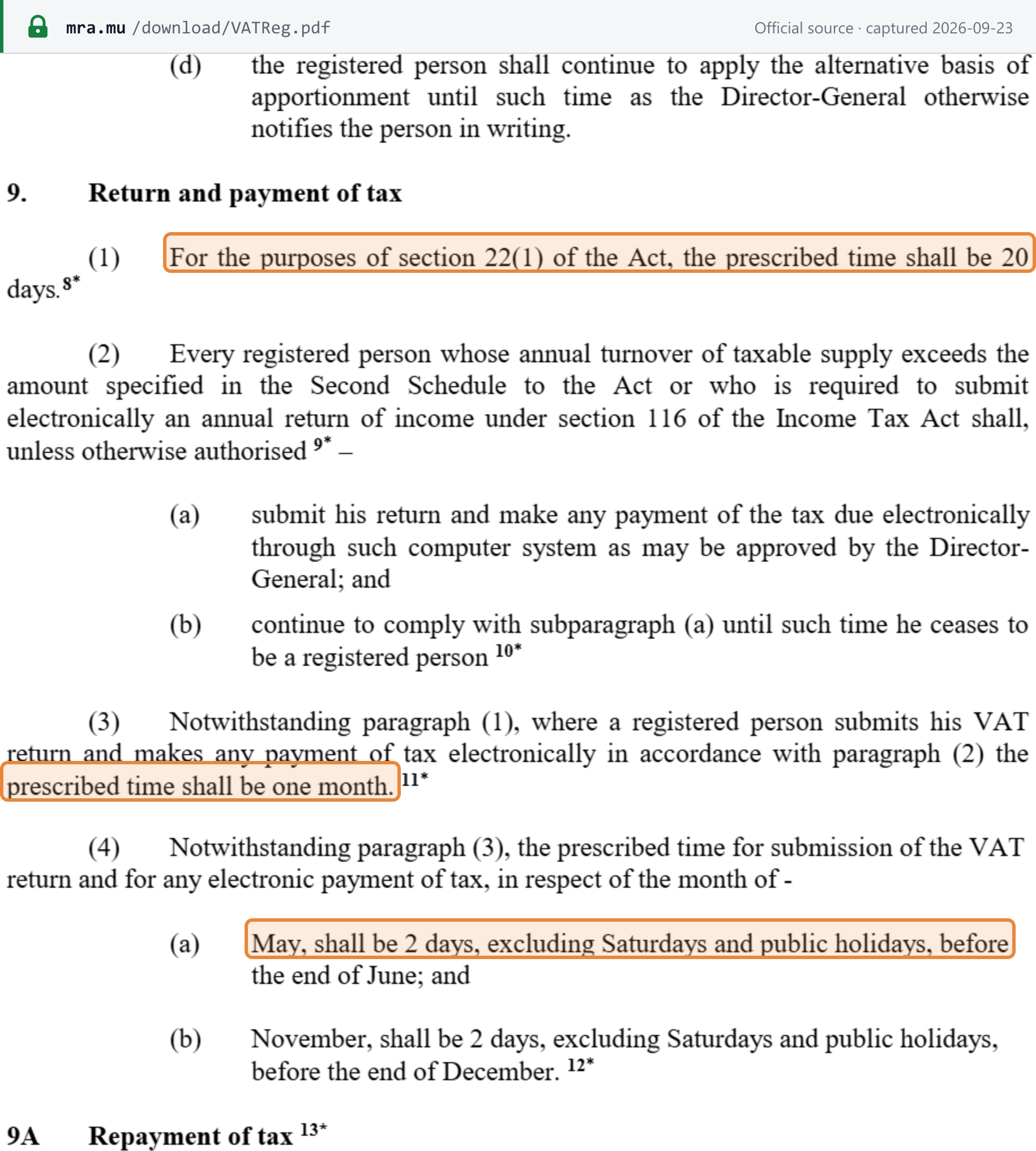
Every return is filed electronically. Section 22(1) of the Act has required it since 25 July 2019: every registered person shall, within the prescribed time, "submit electronically to the Director-General in respect of that period a return". The Act leaves the time to regulations, and regulation 9 of the Value Added Tax Regulations 1998 sets it (checked 2026-09-23):
- 20 days after the end of the taxable period — reg. 9(1): "For the purposes of section 22(1) of the Act, the prescribed time shall be 20 days."
- One month where the registered person both submits the return and pays electronically — reg. 9(3): "Notwithstanding paragraph (1), where a registered person submits his VAT return and makes any payment of tax electronically in accordance with paragraph (2) the prescribed time shall be one month." MRA applies this as the last day of the following month. Reg. 9(2) singles out persons whose turnover exceeds MUR 10 million, or who must submit their annual return of income electronically; MRA’s calendar still lists both the 20th and the month-end date each month, so if you are unsure which applies to you, file and pay by the 20th.
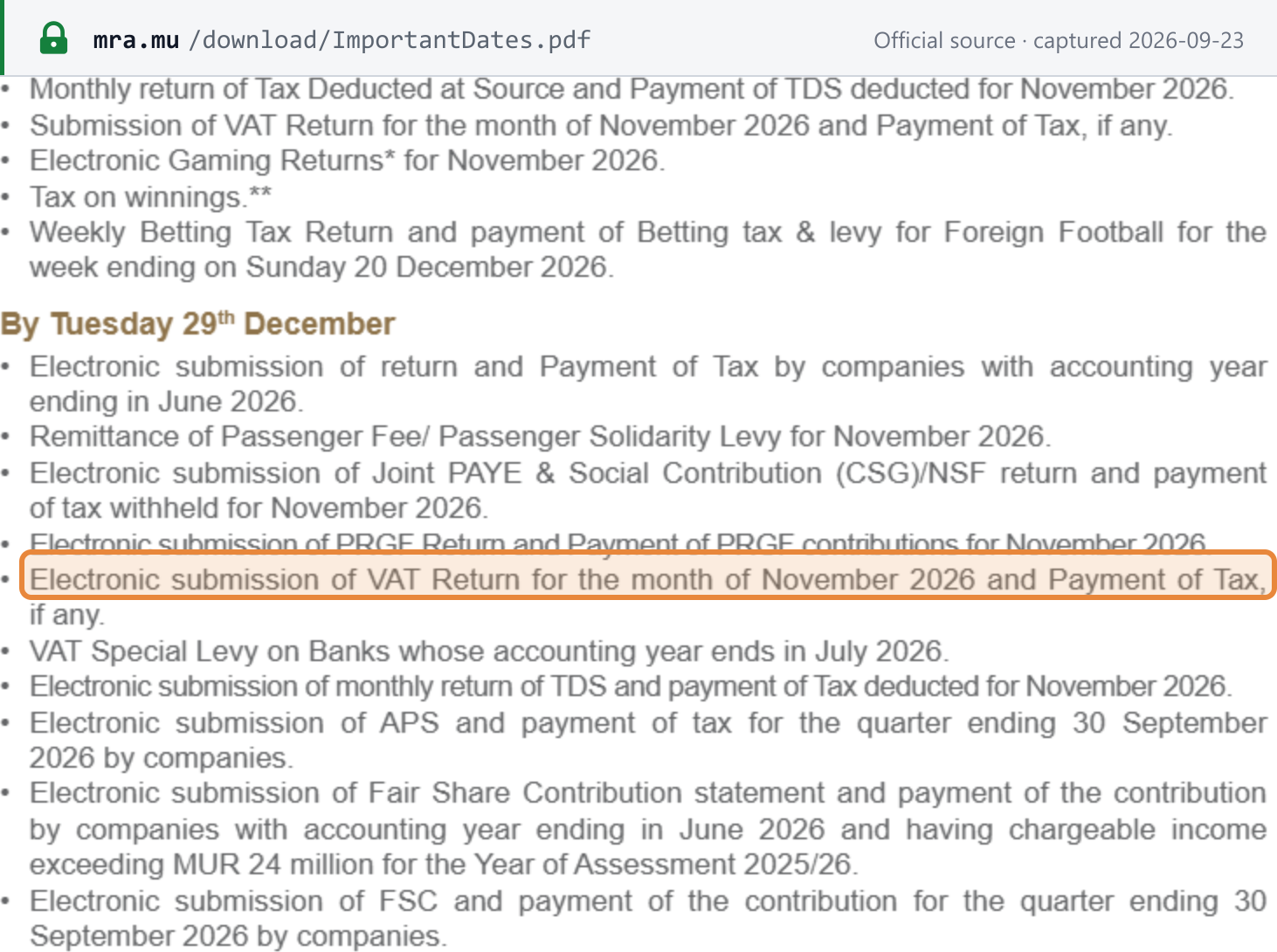
- May and November come earlier for electronic filers — reg. 9(4) makes the May return due "2 days, excluding Saturdays and public holidays, before the end of June", and the November return the same number of days before the end of December. MRA’s tax calendars gave 26 June 2026 for the May 2026 period (January–June 2026 edition, archived) and give 29 December 2026 for November 2026.
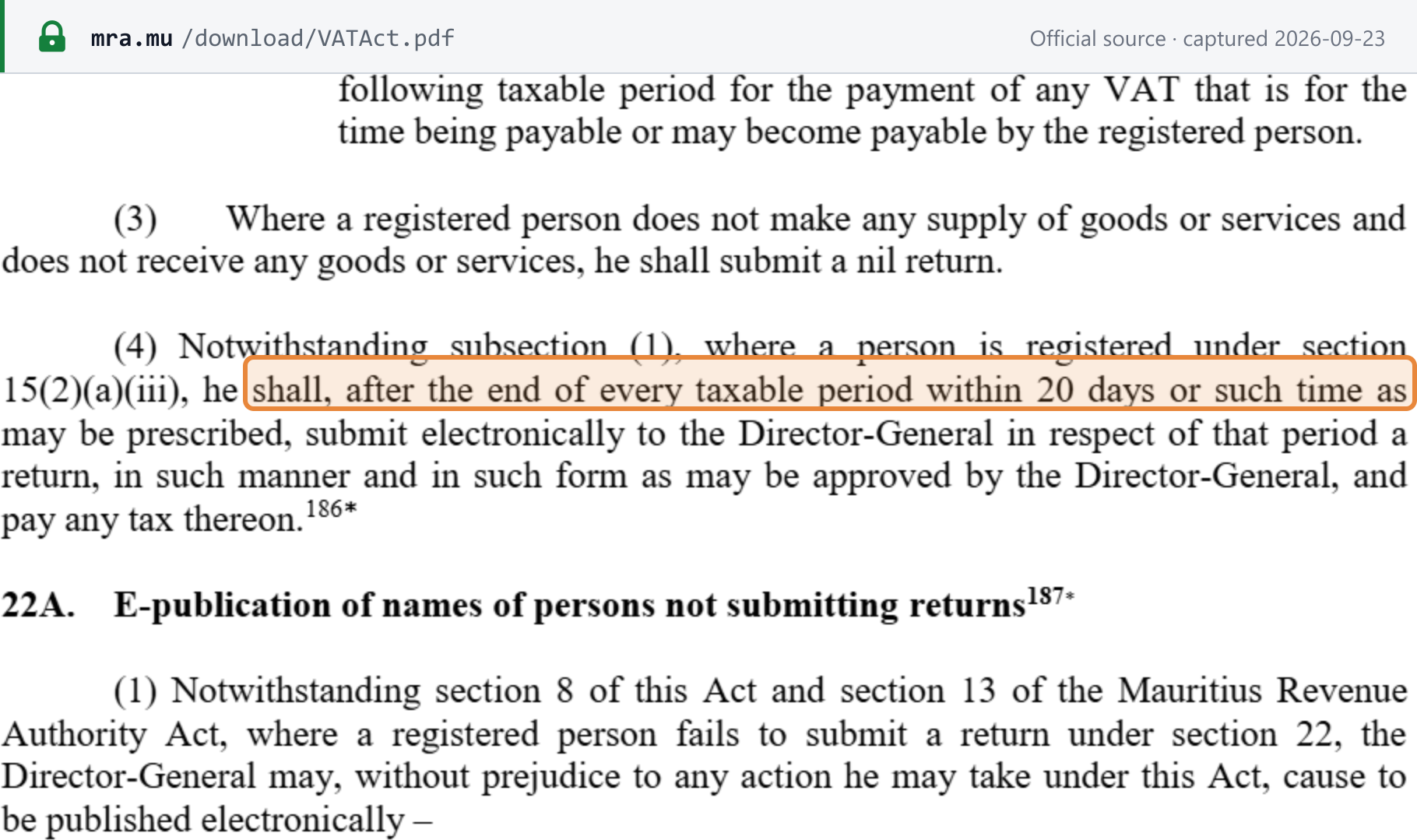
A deadline that falls on a weekend or public holiday moves to the next working day. Foreign digital-service suppliers registered under section 15(2)(a)(iii) file under section 22(4), which says "within 20 days or such time as may be prescribed"; MRA's guide for foreign suppliers also mentions the end of the following month, so the 20th is the safe date to work to. [11] [12] [1]
 Source snapshot captured 2026-09-23 — original
 Source snapshot captured 2026-09-23 — original
 Source snapshot captured 2026-09-23 — original
Payment due date and method
Payment is due with the return, made electronically to the MRA. Foreign digital-service suppliers may instead pay in USD, EUR, GBP, SGD, ZAR or CHF. [1] [6]
Additional listings
Registered persons filing monthly must submit a list of taxable supplies (invoice number and value) alongside the return; nil returns are required even where no supplies were made or received. Where a return goes unfiled, MRA may publish the defaulting registered person's name, trading name and address (and, for a company, its directors) no earlier than 3 months after the due date, following a prior notice giving 7 days to comply. [1]
Input-tax recovery and blocked items
Input tax is generally creditable against output tax, but section 21(2) blocks recovery on: [1]
- Goods or services used to make an exempt supply;
- Motor cars and other vehicles for carrying 9 or fewer persons, motorcycles and mopeds (own-use), plus their spare parts, maintenance, repairs, related fuel and parking (quad bikes, golf carts and similar are carved back out of this block);
- Accommodation, lodging, catering, entertainment, and rental/lease of the vehicles above, for own use;
- Goods and services used by banks to provide banking services other than to non-residents and Global Business Licence holders;
- Goods and services used to provide merchant credit-card services (Tenth Schedule Part II item 4); and
- The supply of digital or electronic services — input tax on inbound digital/electronic services is blocked outright.
Refunds
A registered person may claim repayment (not just carry-forward) where, in respect of a taxable period: [1]
- Input tax on capital goods or qualifying intangible assets (goodwill, software, patents, franchise agreements) exceeds MUR 100,000;
- The registered person is mainly engaged in zero-rated supplies — a repayment proportionate to the zero-rated share of turnover; or
- Excess input tax is unlikely to be set off against future output tax, to the Director-General's satisfaction.
Repayment claims must generally be paid within 45 days of MRA receiving the return and claim (the clock restarts once any requested supporting documents are supplied); late repayment carries interest at the Bank of Mauritius's prevailing Key Rate. An overclaimed repayment carries a penalty of 20% of the amount overclaimed, capped at MUR 200,000 (waived below MUR 250). Unused input tax not claimed in the correct period may still be claimed within 24 months of when it ought to have been taken — shortened from 36 months by section 25(j) of the Finance Act 2026 (Act No. 14 of 2026), in force since 13 August 2026. [1] [3]
Exemptions
Exempt supplies
The First Schedule lists exempt goods and services, including: educational services and MQA-approved training; veterinary services; land (any interest, right or licence over land); wheat and cereal flours; invalid carriages and orthopaedic appliances; journals and periodicals; various baggage, re-import and postal-value import concessions; and financial/insurance-adjacent items referenced elsewhere in the Schedule (banking services to residents outside the non-resident/Global Business Licence carve-out, and related management/insurance items). [1]
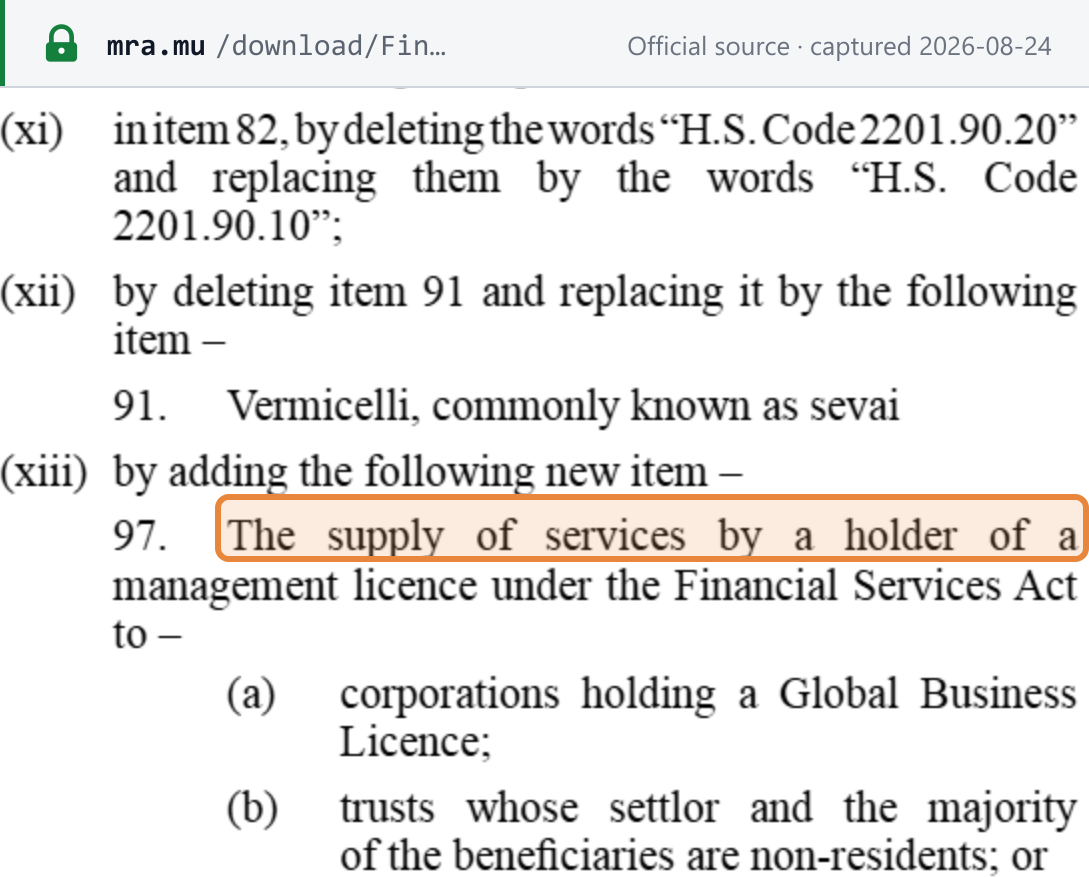
Since 1 October 2026, new item 97 exempts the supply of services by a holder of a management licence under the Financial Services Act to (a) corporations holding a Global Business Licence, (b) trusts whose settlor and the majority of the beneficiaries are non-residents, and (c) foundations whose founder and the majority of the beneficiaries are non-residents (Finance Act 2026, s.25(r)(xiii)). [3]
 Source snapshot captured 2026-08-24 — original
Note that this is an exemption, not a zero rating: input tax attributable to these supplies stops being recoverable. Management companies with substantial Mauritian input costs may find the net effect raises their cost rather than lowering it, and the apportionment calculation — not the rate change — is the work. See the event record.
Exempt is not the same as zero-rated. A zero-rated supply is still a taxable supply — VAT is charged at 0%, and the supplier keeps full input-tax recovery. An exempt supply is outside VAT altogether: no VAT is charged, but the input tax used to make it is also not recoverable (section 21(2)(a)). A person who makes only exempt supplies cannot register for VAT at all. [1] [2]
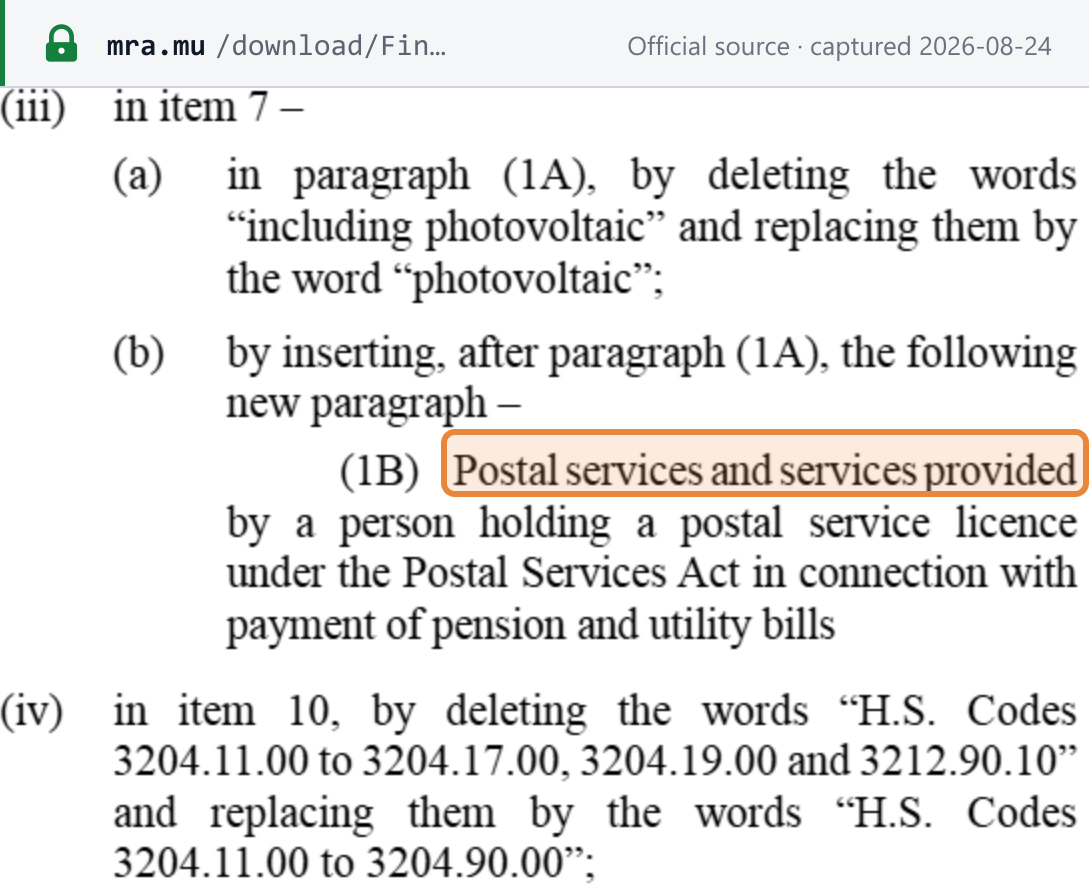
Postal services moved the other way on 13 August 2026. Section 25(s)(iii) of the Finance Act 2026 inserts a new paragraph 1B into item 7 of the Fifth Schedule, zero-rating postal services and services provided by a holder of a postal service licence under the Postal Services Act in connection with the payment of pension and utility bills. Section 25(r)(iv) simultaneously repeals First Schedule item 30(b), which had exempted the identical wording, and neither limb is named in section 28 — so both took effect on gazettal with no gap between them. The customer-facing rate does not move (nil either way); what changes is that attributable input tax becomes recoverable. [3]
 Source snapshot captured 2026-08-24 — original
Special regimes
- Freeport zone — no VAT on goods imported into a freeport zone (unless a specific authorisation brings the underlying activity into charge); goods leaving the zone to elsewhere in Mauritius are treated as newly imported and taxed accordingly. [1]
- Bonded and excise warehouses — no VAT while goods remain in the warehouse; VAT applies on removal into the domestic market. [1]
- Duty-free shops — no VAT on qualifying goods imported for sale in a duty-free shop, or supplied to one, under the Deferred Duty and Tax Scheme. [1]
- Small-enterprise VAT annual accounting system — a person with turnover not exceeding MUR 10 million (a "small enterprise") may apply to account for VAT annually, on a cash or accrual basis: three simplified quarterly statements (each paying roughly 25% of the prior year's VAT liability) followed by a single annual return, rather than the ordinary period-by-period return cycle. [1]
Offences and penalties
Mauritius keeps criminal offences and civil penalties/interest genuinely distinct, and both carry real figures.
Offences (sections 54–59)
| Offence | Conduct |
|---|---|
| s.54 Failure to register or pay tax | Being liable to register and not doing so; failing to pay tax due; omitting charged VAT from a return |
| s.55 Failure to submit return and pay tax | Not filing a return (including nil returns) or statement, or not paying in accordance with it |
| s.56 Failure to keep records or issue a VAT invoice | Not issuing a required VAT invoice; not keeping records/receipts; not furnishing information or producing books on request |
| s.57 Incorrect return or information | Omitting/understating output tax, overstating input tax, an incorrect repayment claim, or incorrect information affecting any tax liability |
| s.58 False returns, books, records or invoices | Wilful, intent-to-evade falsification, false statements, or misleading the Director-General |
| s.59 Other offences | Failing to comply with sections 25(1)/29/31; holding oneself out as registered when not; obstructing an officer; any other contravention |
Penalties on conviction (section 60):
| Offences | Fine | Imprisonment | Extra |
|---|---|---|---|
| s.56, s.59(a)/(d) | Up to MUR 100,000 | Up to 3 years | — |
| s.57, s.59(b)/(c) | Up to MUR 500,000 | Up to 5 years | Court may additionally order payment of up to double the tax involved |
| s.54, s.55, s.58 | Up to MUR 1,000,000 | Up to 8 years | Court may additionally order payment of up to double the tax involved, and (for s.55) order the return be filed |
MRA may compound an offence, with the Director of Public Prosecutions' consent, for the unpaid tax plus an amount up to the statutory maximum penalty — final and conclusive once agreed. Payment of tax is owed regardless of any conviction or compounding. [1]
Civil penalties and interest
| Default | Penalty |
|---|---|
| Failure to apply for compulsory registration (s.15B) | MUR 5,000 per month or part-month of default, capped at MUR 50,000 |
| Late/non-submission of return (s.26) | MUR 2,000 per month or part-month, capped at MUR 20,000 (capped at MUR 5,000 for a "small enterprise", turnover ≤ MUR 10 million) |
| Failure to join the mandatory electronic filing/payment system, after notice (s.26A) | MUR 5,000 per month or part-month, capped at MUR 100,000 |
| Late payment of tax (s.27) | 10% of the tax due (2% for a small enterprise) |
| Interest on unpaid tax (s.27A) | 1% per month or part-month from the due date to payment |
| Overclaimed repayment (s.24(9)) | 20% of the amount overclaimed, capped at MUR 200,000 (waived below MUR 250) |
| Failure to issue fiscal e-invoices, once obligated (s.20B) | MUR 10,000 per month or part-month, capped at MUR 200,000 |
| Misuse of or tampering with the e-invoicing system (s.20C) | Up to MUR 50,000 |
The total penalty and interest on any single default is capped at 100% of the tax due (section 27AB) — except for the s.15B, s.20B, s.20C and s.26/26A penalties, which sit outside that cap. [1]
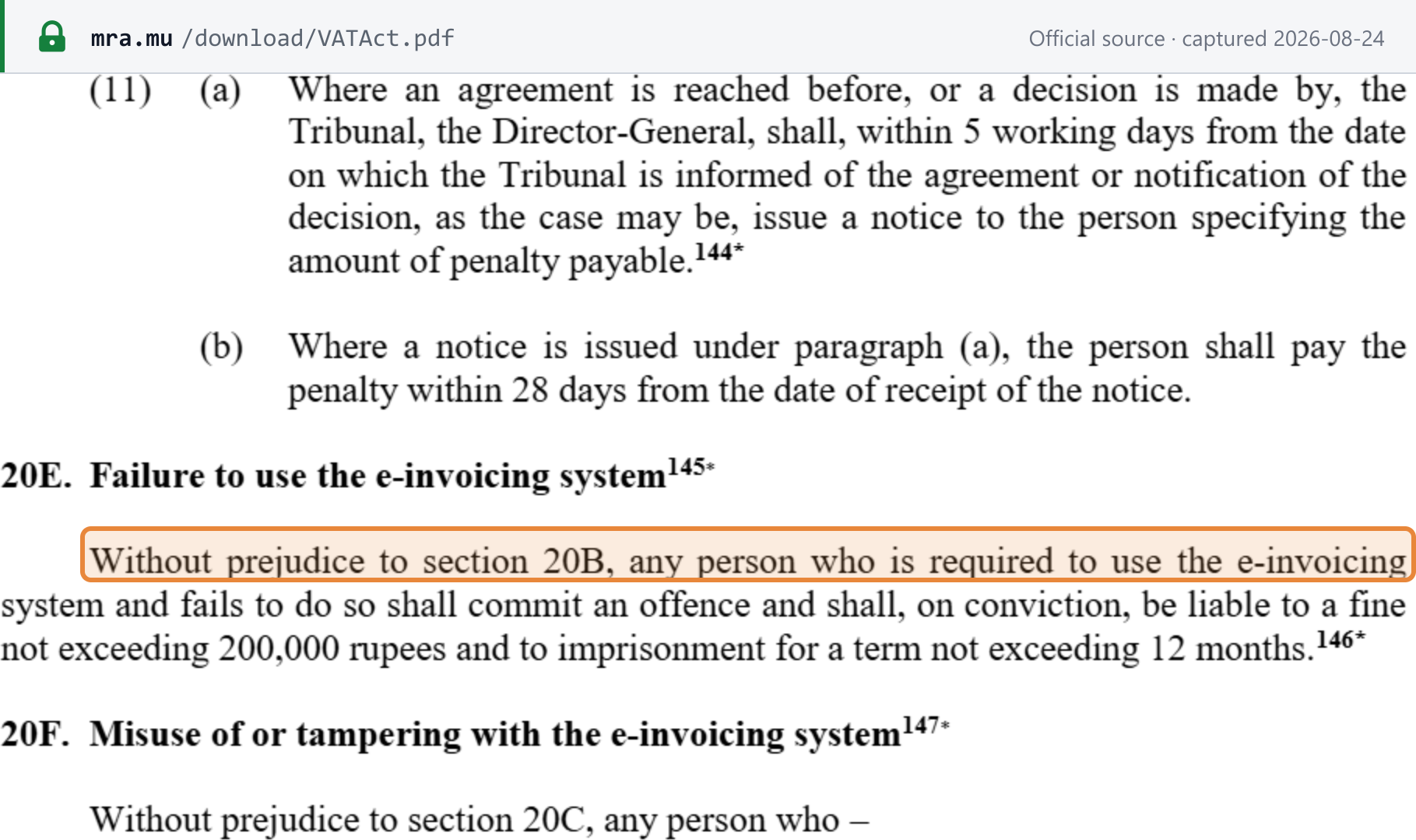
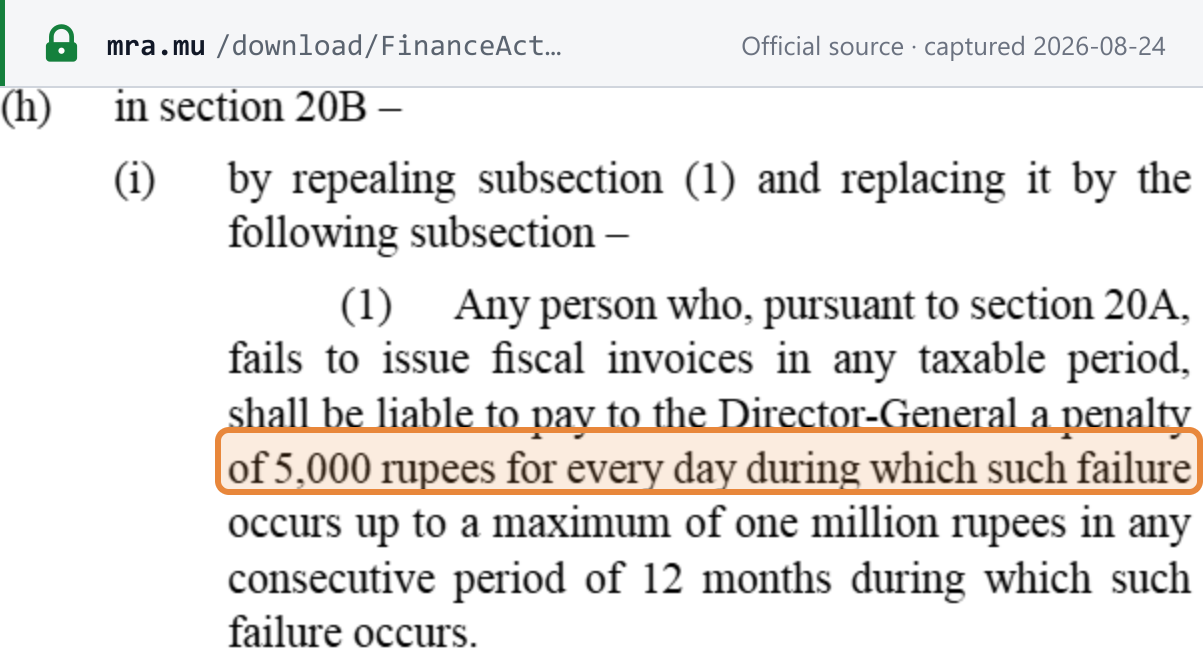
The Finance Act 2026 (Act No. 14 of 2026) raised several of these ceilings from 1 October 2026 (section 28(2) of the Act names sections 25(h) and (i) among the provisions with that commencement date): the failure-to-issue-fiscal-invoices penalty (s.20B) becomes MUR 5,000 per day capped at MUR 1 million per 12 months, and the section 20E OFFENCE of failing to use the e-invoicing system carries a higher maximum fine on conviction — MUR 500,000, up from MUR 200,000 — and a maximum term of imprisonment doubled from 12 months to 24. Both have applied since 1 October 2026. [3]
 Source snapshot captured 2026-08-24 — original
 Source snapshot captured 2026-08-24 — original
Two further Finance Act 2026 penalty changes (13 August 2026)
Section 25(k) of the Finance Act 2026 (Act No. 14 of 2026) adds a new subsection (3) to section 28 of the VAT Act: any person who fails to comply with section 28(2) now commits an offence, carrying on conviction a fine not exceeding MUR 100,000 and imprisonment for a term not exceeding 2 years. [3]
Sections 25(l) and 25(m) of the same Act raise the penalty ceiling under sections 32(4) and 32A(3) of the VAT Act — both provisions are amended by deleting the words "200,000 rupees" and replacing them with "500,000 rupees", raising the maximum penalty under each from MUR 200,000 to MUR 500,000. [3]
Both changes were gazetted, and took effect, on 13 August 2026.
Frequently asked questions
I am a foreign company selling digital services into Mauritius with no local presence — do I really have to register for VAT with no turnover threshold?
No, not since 1 October 2026 — and the local tax-representative requirement went earlier, on 13 August 2026. Section 14A of the Value Added Tax Act, in force since 1 January 2026, extends VAT to digital or electronic services (the Tenth Schedule Part III list) supplied by a foreign supplier to a person in Mauritius. As originally enacted, section 15(2)(a)(iii) required a foreign supplier of these services to register and charge 15% irrespective of turnover — MRA's guidance for foreign suppliers still describes that rule. The Finance Act 2026 (Act No. 14 of 2026) — assented to 12 August 2026, gazetted 13 August 2026 — changed this in two steps. Effective immediately on gazettal, section 25(f) repealed the tax-representative requirement entirely: the foreign supplier itself is now directly responsible for returns and payment. From 1 October 2026, section 25(g) replaced the zero-threshold registration rule with the ordinary MUR 3 million Sixth Schedule threshold, with a carve-out for supplies made exclusively to VAT-registered recipients. Since 1 October 2026, a foreign digital supplier must register once its taxable supplies exceed, or are likely to exceed, MUR 3 million, unless it supplies only VAT-registered persons. [6] [1] [3]
My Mauritius customer is itself VAT-registered — do I still have to charge VAT on cross-border services, or does reverse charge apply?
It depends on whether the service is on the Tenth Schedule Part III digital/electronic services list, and on the date. For ordinary (non-digital) services, section 14 puts the reverse charge on the Mauritius-registered recipient: where a supplier who does not belong in Mauritius and is not VAT-registered supplies services performed or utilised in Mauritius to a registered person, the recipient self-accounts as if it made the supply, and claims the same amount back as input tax — the non-resident supplier does not need to register for that transaction. For digital or electronic services, until 30 September 2026 there was no business-customer carve-out: registration and 15% charging applied regardless of whether the Mauritius recipient was VAT-registered, and MRA's published guidance for foreign suppliers still describes that rule. Since 1 October 2026, section 25(g) of the Finance Act 2026 (Act No. 14 of 2026), gazetted 13 August 2026, excludes supplies made exclusively to VAT-registered persons from the compulsory-registration trigger. [1] [3] [6]
My turnover is well under the MUR 3 million VAT registration threshold — can I safely stay unregistered?
Not necessarily. The MUR 3 million compulsory-registration threshold (Sixth Schedule, reduced from MUR 6 million on 1 October 2025) is measured over any 12-month period, but two other triggers apply regardless of turnover: the Tenth Schedule Part I list of professions (accountants, advisers, architects, attorneys, engineers, estate agents, notaries, opticians, sworn auctioneers, second-hand vehicle importation agents, commercial pleasure-craft licence holders over 12 metres, and more), and the Tenth Schedule Part II/III lists (certain banking/management/credit-card services, and digital services from foreign suppliers) — though the Part III trigger for digital services narrows to the ordinary MUR 3 million threshold, with a B2B carve-out, from 1 October 2026 under the Finance Act 2026 (Act No. 14 of 2026). Failing to register when liable is an offence under section 54 — on conviction, a fine of up to MUR 1 million and imprisonment of up to 8 years, plus a civil penalty of MUR 5,000 per month of default (capped at MUR 50,000) under section 15B. [1]
Is the Finance Act 2026 already in force — and did it really zero-rate e-books and exempt common salt?
Partly in force, and no on salt. The Finance Bill No. XII of 2026 was passed by the National Assembly on 31 July 2026, received Presidential assent on 12 August 2026, and was gazetted as the Finance Act 2026 (Act No. 14 of 2026) on 13 August 2026 — it is enacted law, not a Bill any more. But the Act does not match some pre-enactment reporting on two points. First, the word "salt" does not appear anywhere in the Act: common salt was not zero-rated. Second, electronic books are zero-rated, not exempt — section 25(s) inserts "electronic books," into item 2, paragraph (i) of the Fifth Schedule (the zero-rating schedule) alongside printed books; a zero-rated supply keeps full input-VAT recovery, an exempt one does not. On timing: most of the Act's VAT changes — the e-books zero-rating, the new online-marketplace-commission charge, the "online marketplace" definition, and the repeal of the mandatory tax representative for foreign digital suppliers — commenced immediately on gazettal (13 August 2026), because the Act's commencement section (section 28) does not list them and there is no general commencement clause. A specific list of provisions is expressly deferred: the Sixth Schedule threshold and B2B carve-out for foreign digital suppliers (section 25(g)), plus two e-invoicing/inspection penalty increases (section 25(h) and (i)), commenced 1 October 2026; the new Insurance Premium Tax on general insurance business (section 25(p)) applies only to policies entered into or renewed on or after 1 January 2027. [3] [5]
What happens if I don't register my billing system for e-invoicing once the mandate reaches my turnover band?
MRA's e-Invoicing Phase 3 rolls out mandatory fiscal invoicing by turnover band: LTD businesses over MUR 100 million from 15 May 2024; MSTD businesses over MUR 100 million from 1 August 2025, over MUR 80 million from 30 June 2026, and over MUR 40 million from 1 September 2026. Separately, under section 20A(2), the Director-General may notify any specific taxpayer to comply from a stated date, irrespective of turnover and irrespective of VAT registration status. Once obligated, failing to issue fiscal invoices carries a penalty under section 20B of MUR 10,000 per month or part-month, capped at MUR 200,000 — on top of the ordinary offence provisions for failing to issue a VAT invoice at all. [10] [1]
I hold a Bank of Mauritius payment service provider licence — do my services to non-residents now qualify for VAT zero-rating the way a bank's do?
Yes, since 13 August 2026. Item 6(2) of the Fifth Schedule already zero-rated a bank's banking transactions with non-residents and corporations holding a Global Business Licence under the Financial Services Act. Section 25(s)(ii) of the Finance Act 2026 (Act No. 14 of 2026) repeals and replaces item 6(2), adding a second limb on the same footing: services supplied by a payment service provider ("PSP"), licensed and regulated by the Bank of Mauritius under the National Payment Systems Act, to non-residents and to Global Business Licence corporations, are now zero-rated as well. This provision is not among the sections given a specific commencement date in section 28 of the Act, so — unlike the digital-services registration threshold in section 25(g), which is deferred to 1 October 2026 — it took effect on the Act's gazettal date, 13 August 2026. A licensed PSP should review which of its services to non-resident and Global Business Licence customers now fall within item 6(2). [3]
Important websites
| Site | Purpose |
|---|---|
| MRA VAT registration (domestic) | Online VAT/TAN registration |
| MRA foreign-supplier VAT portal (vt3f) | Registration and return filing for foreign digital-service suppliers |
| MRA TAN request portal | Requesting/retrieving a Tax Account Number |
| MRA e-Invoicing Portal | EBS registration, onboarding and fiscalisation for the e-invoicing mandate |
| MRA VAT page | VAT FAQs, guides, forms and the list of VAT-registered persons |
| MRA list of VAT-registered persons (PDF) | MRA's quarterly-updated published list of registered VAT numbers, names and BRNs — the closest Mauritius equivalent to an online VAT-number checker |
| MRA VAT on digital/electronic services from foreign suppliers | Registration and compliance guidance for foreign digital suppliers |
Also see Lookuptax's own Mauritius VAT/TAN validator.
Recent changes
- 2026-10-01 — Foreign digital-service suppliers' compulsory VAT registration switched from irrespective-of-turnover to the ordinary MUR 3 million Sixth Schedule threshold, with a carve-out for supplies made exclusively to VAT-registered persons (Value Added Tax Act, s.15(2)(a)(iii), as amended by s.25(g) of the Finance Act 2026, Act No. 14 of 2026). (Mauritius National Assembly) — see issue
- 2026-10-01 — Six further Finance Act 2026 VAT limbs commenced, all named in section 28(2) of the Act. Time of supply (s.25(b)): a third trigger was added to section 5 — three months from the date the supply is delivered or performed, independent of invoicing or payment (record). Hotels and tourist residences (s.25(e)): where more than 50% of payment is received in a foreign currency specified in section 6(5) of the Income Tax Act, the VAT return must be filed and 50% of the VAT paid in that currency (record). Deferred import VAT (s.25(c)): failing to declare it as output tax in the period of deferral costs MUR 10,000 and must be corrected in the next period, failing which it becomes recoverable under section 24A of the Customs Act (record). Management-licence services (s.25(r)(xiii)): new First Schedule item 97 exempts services supplied by a management-licence holder to Global Business Licence corporations and to trusts and foundations whose principals and majority beneficiaries are non-resident (record). Penalties (s.25(h) and (i)): the fiscal-invoice penalty becomes MUR 5,000 per day capped at MUR 1 million per 12 months (record), and the section 20E maximum fine rises from MUR 200,000 to MUR 500,000, with maximum imprisonment extended from 12 to 24 months (record). (Mauritius Revenue Authority) — see issue
- 2026-09-01 — MRA e-Invoicing Phase 3 reached Medium and Small Taxpayer Department (MSTD) economic operators with annual turnover exceeding MUR 40 million, who must issue fiscal invoices from this date, following the MUR 80 million tier that took effect 30 June 2026. (Mauritius Revenue Authority) — see issue
- 2026-08-13 — Two further Finance Act 2026 penalty changes took effect on gazettal. Section 25(k) adds a new subsection (3) to section 28 of the VAT Act, making failure to comply with section 28(2) a specific offence, carrying on conviction a fine of up to MUR 100,000 and imprisonment of up to 2 years — non-compliance with a section 28(2) notice was already an offence under the general section 59(d)/60(1) catch-all (fine up to MUR 100,000, up to 3 years). Sections 25(l) and 25(m) raise the maximum penalty under sections 32(4) and 32A(3) of the VAT Act from MUR 200,000 to MUR 500,000. (Mauritius Revenue Authority) — see the s.28(3) offence record, the penalty-ceiling record and the issue
- 2026-08-13 — Postal services move from exempt to zero-rated. Section 25(s)(iii) of the Finance Act 2026 inserts a new paragraph 1B into item 7 of the Fifth Schedule, zero-rating postal services and services provided by a holder of a postal service licence under the Postal Services Act in connection with the payment of pension and utility bills — while section 25(r)(iv) repeals First Schedule item 30(b), which had exempted the identical wording. Neither limb is named in section 28, so both took effect on publication and there is no gap. The customer-facing rate does not move (nil either way); what changes is that attributable input tax becomes recoverable. (Mauritius Revenue Authority) — see the event record and the issue
- 2026-08-13 — The Finance Act 2026 (Act No. 14 of 2026) was gazetted, enacting VAT changes with immediate effect, including: electronic books are zero-rated (not exempt) under item 2(i) of the Fifth Schedule, alongside printed books (s.25(s)(i)); item 6(2) of the Fifth Schedule is repealed and replaced to extend the existing bank zero-rating to licensed payment service providers (PSPs regulated by the Bank of Mauritius under the National Payment Systems Act) on services to non-residents and Global Business Licence corporations (s.25(s)(ii)); a new Tenth Schedule Part III item 8 charges VAT on commission, fee or other consideration receivable by operators of an online marketplace, while e-books are simultaneously removed from that same digital-services item (s.25(u)); the mandatory Mauritius tax representative for foreign digital-service suppliers is repealed (s.25(f)) — the foreign supplier is now directly responsible for returns and payment; and the unclaimed-input-tax recovery window is shortened from 36 months to 24 months (s.25(j), amending s.21(6) — see Refunds). (Mauritius National Assembly) — see the input-tax-window record and the issue
- 2026-07-28 (superseded — corrected 2026-08-18) — Finance Bill No. XII of 2026 was introduced in the National Assembly, proposing — among other VAT changes — repeal of the mandatory Mauritius tax representative for foreign digital-service suppliers, a Sixth Schedule turnover threshold with a B2B carve-out for those suppliers (proposed from 1 October 2026), zero-rating of electronic books and common salt, and a new charge on online-marketplace commission. It was passed by the Assembly on 31 July 2026, assented to on 12 August 2026, and gazetted as the Finance Act 2026 (Act No. 14 of 2026) on 13 August 2026 — but not in the form originally proposed: common salt does not appear anywhere in the enacted Act and was not zero-rated, while electronic books were zero-rated rather than exempted. See the 2026-08-13 and 2026-10-01 entries above for what the Act actually enacted. (Mauritius National Assembly)
- 2026-06-30 — MRA e-Invoicing Phase 3 reached MSTD economic operators with annual turnover exceeding MUR 80 million. (Mauritius Revenue Authority)
- 2026-01-01 — VAT extended to digital or electronic services supplied by foreign suppliers to persons in Mauritius (new section 14A of the VAT Act), at the standard 15% rate, with compulsory registration irrespective of turnover and a MUR 3 million tax-representative trigger. (Mauritius Revenue Authority)
- 2025-10-01 — Compulsory VAT registration threshold cut from MUR 6 million to MUR 3 million (Sixth Schedule, Finance Act 2025). (Mauritius Revenue Authority)
- 2025-08-01 — MRA e-Invoicing Phase 3 reached MSTD economic operators with annual turnover exceeding MUR 100 million. (Mauritius Revenue Authority)
- 2024-05-15 — MRA e-Invoicing Phase 3 began with Large Taxpayer Department (LTD) economic operators with annual turnover exceeding MUR 100 million required to issue fiscal invoices. (Mauritius Revenue Authority)
- 2023-10-02 — Value Added Tax (e-Invoicing) Regulations 2023 (Government Notice No. 132 of 2023) came into operation, setting the legal and technical framework for the e-invoicing system. (Mauritius Revenue Authority)
Ahead — scheduled changes that have not yet taken effect:
- 2027-01-01 (scheduled) — The new Insurance Premium Tax on general insurance business (Finance Act 2026, s.25(p)) applies to policies entered into or renewed on or after this date. (Mauritius National Assembly)
Reference links
- Mauritius Revenue Authority — Value Added Tax Act (Consolidated Version up to May 2026, PDF)
- Mauritius Revenue Authority — VAT Frequently Asked Questions (September 2025, PDF)
- Mauritius Revenue Authority — Guide on Simplified VAT Registration (September 2025, PDF)
- Mauritius Revenue Authority — Value Added Tax Regulations 1998 (consolidated, PDF)
- Mauritius Revenue Authority — Tax calendar, important dates (PDF)
- Mauritius Revenue Authority — VAT on digital or electronic services from foreign suppliers
- Mauritius Revenue Authority — e-Invoicing
- Mauritius Revenue Authority — Value Added Tax (e-Invoicing) Regulations 2023, GN No. 132 of 2023 (PDF)
- Mauritius Revenue Authority — Standard e-Invoice Template (PDF)
- Mauritius National Assembly — The Finance Act 2026 (Act No. 14 of 2026) (PDF, assented 12 August 2026, gazetted 13 August 2026)
- Mauritius National Assembly — Acts 2026 list
- Mauritius Revenue Authority — List of VAT Registered Persons (PDF)
- Lookuptax — Mauritius TIN/TAN: Complete Tax ID Guide
- Lookuptax — Official links to check VAT numbers worldwide
- Lookuptax — E-invoicing status and the networks worldwide