Morocco VAT guidelines
| FACTSHEET | |
|---|---|
| Country code | MA |
| Tax name | Taxe sur la valeur ajoutée (TVA) |
| Tax Authority | Direction Générale des Impôts (DGI) |
Overview
Morocco levies value added tax — taxe sur la valeur ajoutée (TVA) — under Book I, Part III of the Code Général des Impôts (CGI), articles 87 to 125 quinquies. Article 87 describes it as a turnover tax that applies to "opérations de nature industrielle, commerciale, artisanale ou relevant de l'exercice d'une profession libérale, accomplies au Maroc" (industrial, commercial, craft and liberal-profession operations carried out in Morocco) and to imports. The implementing rules are in Décret n° 2-06-574 of 31 December 2006, as supplemented by Décret n° 2-25-862 of 27 November 2025. [1] [3]
This guide follows the DGI's consolidated CGI, 2026 edition, which incorporates the 2026 Finance Law (loi de finances n° 50-25). Article and page references below are to that edition.
Authority. VAT on domestic operations is administered by the Direction Générale des Impôts (DGI). VAT on imports is the responsibility of the Administration des Douanes et Impôts Indirects (ADII): "L'application de la taxe sur la valeur ajoutée à l'importation incombe à l'administration des douanes et impôts indirects" (art. 120). [1]
Currency. Amounts are in Moroccan dirhams (MAD).
Tax period. A calendar month or a calendar quarter, depending on turnover and taxpayer type (see Filing frequency).
Layering. None. VAT is a single national tax. Local taxes, such as the taxe professionnelle whose number appears on invoices, are separate levies and are not VAT.
Registration
Who should register
Morocco has no general registration threshold. Whether you are liable depends on the kind of operation you carry out (CGI art. 89-I): [1]
- Taxable whatever their turnover: manufacturers, wholesalers, importers, building works, service providers generally, banks, and the listed liberal professions.
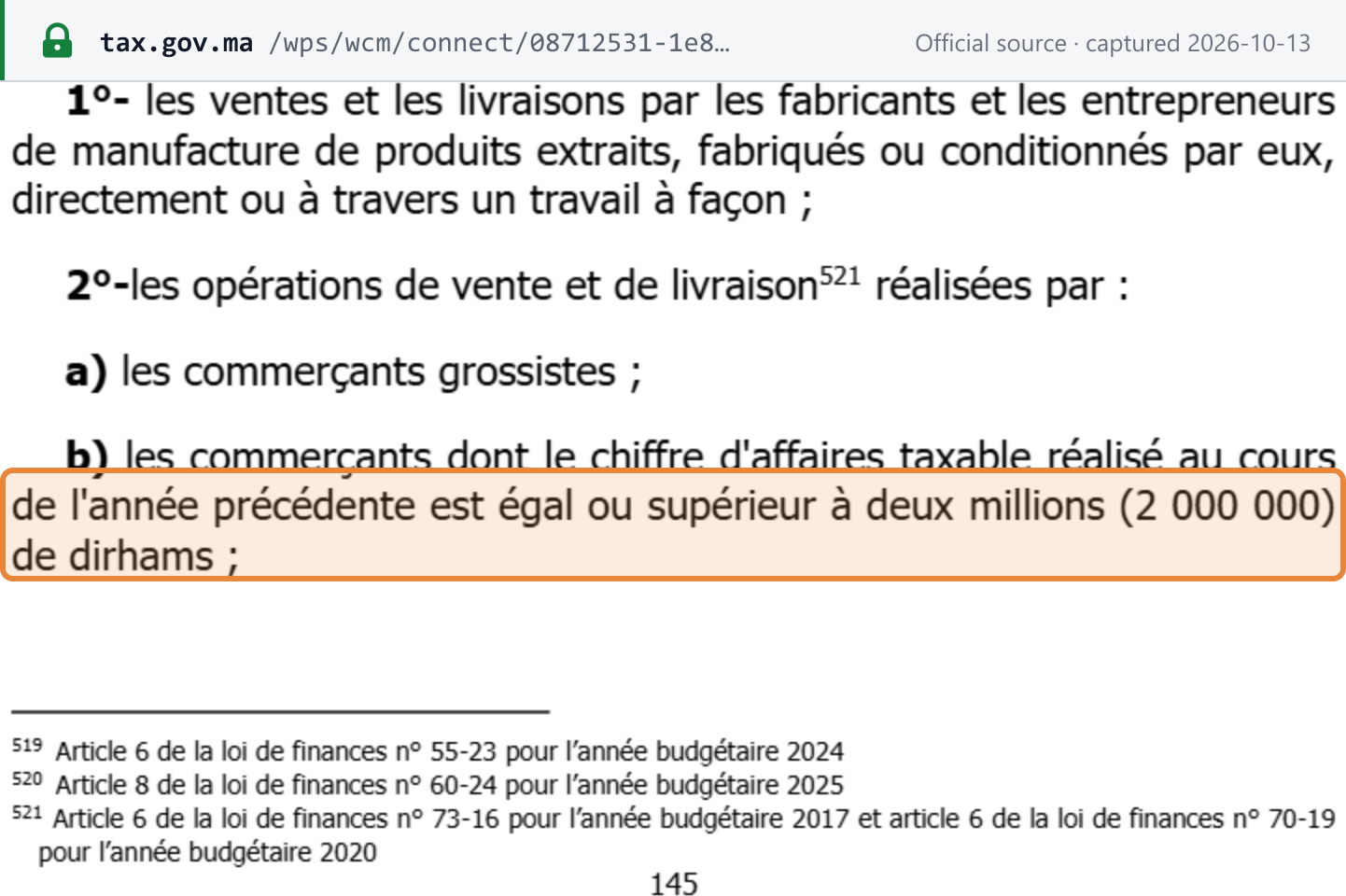
- Retailers: taxable once their taxable turnover for the previous year "est égal ou supérieur à deux millions (2 000 000) de dirhams" (is MAD 2,000,000 or more). A retailer that becomes taxable leaves only after three consecutive years below that amount.
- Small natural-person businesses: sales and services by natural-person manufacturers and service providers with annual turnover of MAD 500,000 or less are exempt without the right to deduct (art. 91-II-3°). Once such a business becomes taxable, it can leave only after three consecutive years at or below that amount.
Registration threshold
Not applicable as a general rule — see above. The only turnover tests are the MAD 2,000,000 retailer test and the MAD 500,000 small-business exemption.
Non-resident registration
Non-residents have no threshold. The rule depends on who the customer is:
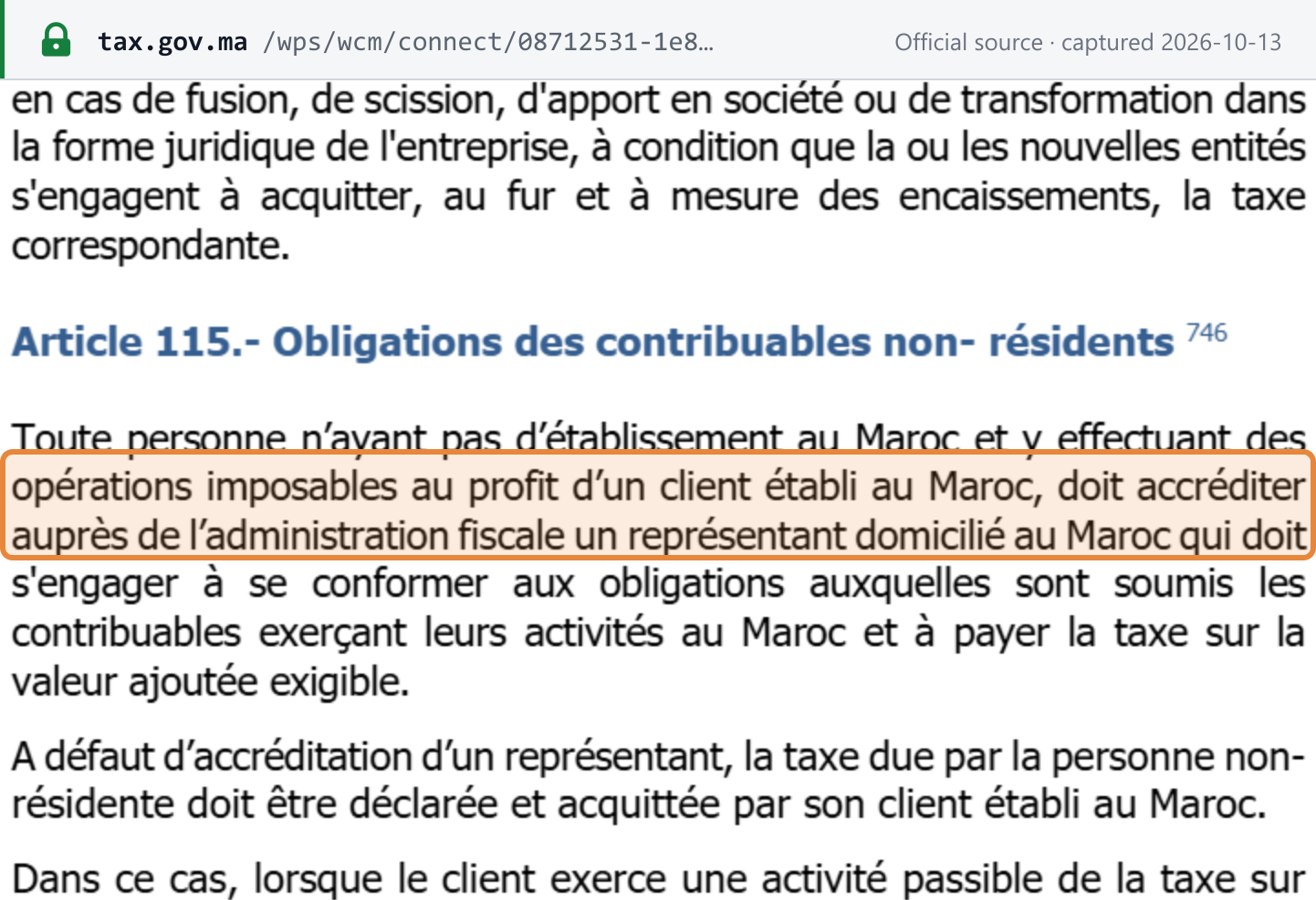
- Supplies to a client established in Morocco (art. 115). "Toute personne n'ayant pas d'établissement au Maroc et y effectuant des opérations imposables au profit d'un client établi au Maroc, doit accréditer auprès de l'administration fiscale un représentant domicilié au Maroc" — a non-resident without an establishment must accredit a representative domiciled in Morocco. If it does not, the Moroccan client declares and pays the VAT instead (see Foreign companies selling into Morocco). [1]
- Remote, dematerialised services to customers not registered for VAT (art. 115 bis). The non-resident registers itself on the DGI's online platform, with no representative and no threshold (see Digital services).
Tax identification number
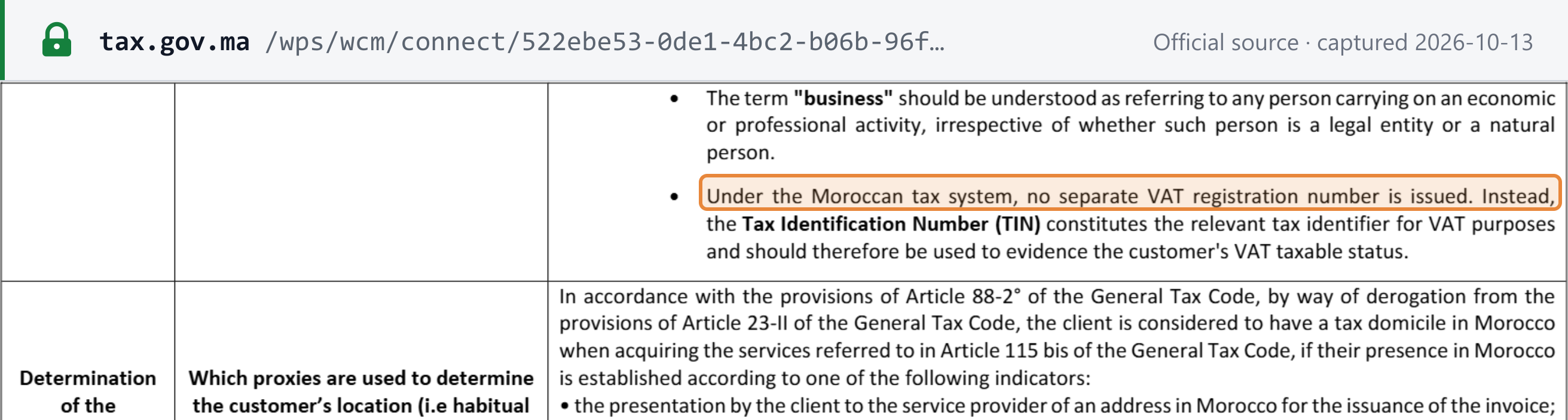
There is no separate VAT number. The DGI states: "Under the Moroccan tax system, no separate VAT registration number is issued. Instead, the Tax Identification Number (TIN) constitutes the relevant tax identifier for VAT purposes." The TIN is the identifiant fiscal (IF) issued by the local tax office. [2]
Businesses also hold an identifiant commun de l'entreprise (ICE). Taxpayers must show it on their invoices and on every tax return (art. 145-VIII). Each omission or error costs MAD 100 (art. 198 ter). Holding an ICE is also a condition for any CGI exemption (art. 164-I). [1]
For the formats of the IF and ICE, see the Morocco tax ID guide, or check a number with the Morocco TIN validator.
How to register
File a déclaration d'existence with the local tax office (art. 109, referring to art. 148). It must be filed "dans un délai maximum de trente (30) jours" — within 30 days of incorporation for a Moroccan company, of setting up for a non-resident business, or of starting activity. The declaration states the business's VAT position and any option under article 90. For a non-resident company it also names its accredited Moroccan representative (art. 148-III-5°). [1]
Filing late or inaccurately costs a fine of MAD 1,000 (art. 188). The DGI publishes no processing time.
Non-resident suppliers of digital services to customers not registered for VAT register online on the DGI's Taxation on Digital Services platform instead (see Digital services). [3]
Voluntary registration
Available to four groups (art. 90): exporters, for their export turnover; small manufacturers and service providers exempt under article 91-II-3°; resellers of goods other than bread, flour, milk, raw sugar and dates; and lessors of unequipped professional premises. The usual reason to opt in is to recover input VAT.
The option "prend effet à l'expiration d'un délai de trente (30) jours" (takes effect 30 days after it is filed) and must be kept for at least three consecutive years. For lessors it is irrevocable. [1]
Deregistration
A business that is sold or stops trading must file a declaration within 30 days of the sale or cessation. The declaration settles the tax due to that date and regularises deductions, and the tax is payable within the same 30 days (art. 114). In a merger, demerger, contribution to a company or change of legal form, payment is deferred if the new entity undertakes to pay the tax as cash is collected. Retailers taxable under the MAD 2,000,000 test leave only after three consecutive years below it. [1]
Group registration
Not available. The VAT title of the CGI 2026 (arts 87–125 quinquies) contains no VAT grouping or fiscal-unity provision (checked 2026-10-13). Each legal entity registers and files separately.
Rates
| Rate | Applies to |
|---|---|
| 20% | Standard rate on all taxable supplies not listed at 10% (art. 99-A); also the general rate on imports (art. 121), with 10% for the imports listed under Imports and exports |
| 10% with right to deduct | Hotels, restaurants and cafés; rental of tourist property; works of art; museum, cinema and theatre tickets; edible oils (not palm oil), salt, milled rice and pasta (other than exempt short pasta); solar panels and solar water heaters; animal feed; petroleum gas and oils; banking, credit and foreign-exchange commissions; Islamic finance; securities transactions; listed agricultural and fishing equipment; water for public networks, sanitation and water-meter rental; sales of renewable electricity; the "voiture économique"; refined sugar; urban and road transport |
| 10% without right to deduct | Services of insurance agents and brokers |
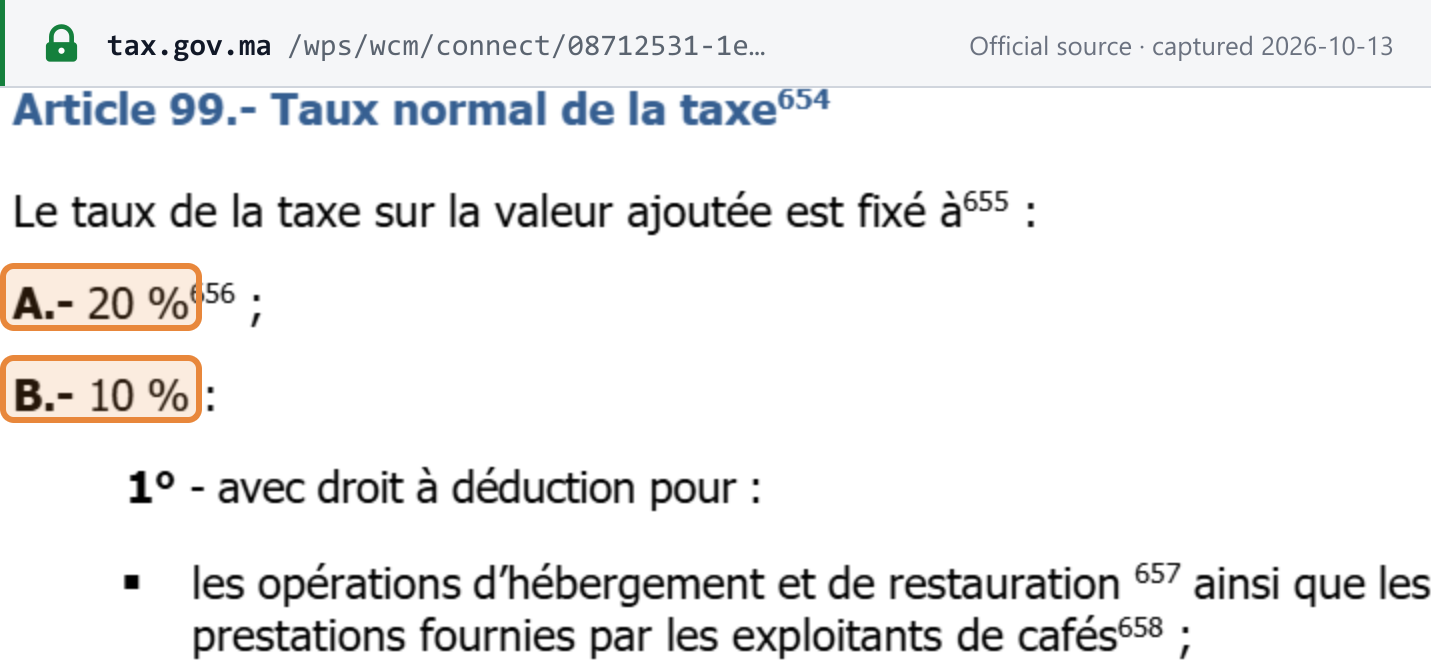
Article 99 now lists only these two rates: "Le taux de la taxe sur la valeur ajoutée est fixé à : A.- 20 % ; B.- 10 %". [1]
Exports and certain other supplies are exempt with the right to deduct, which works like a zero rate (see Exemptions).
The 2024–2026 rate convergence
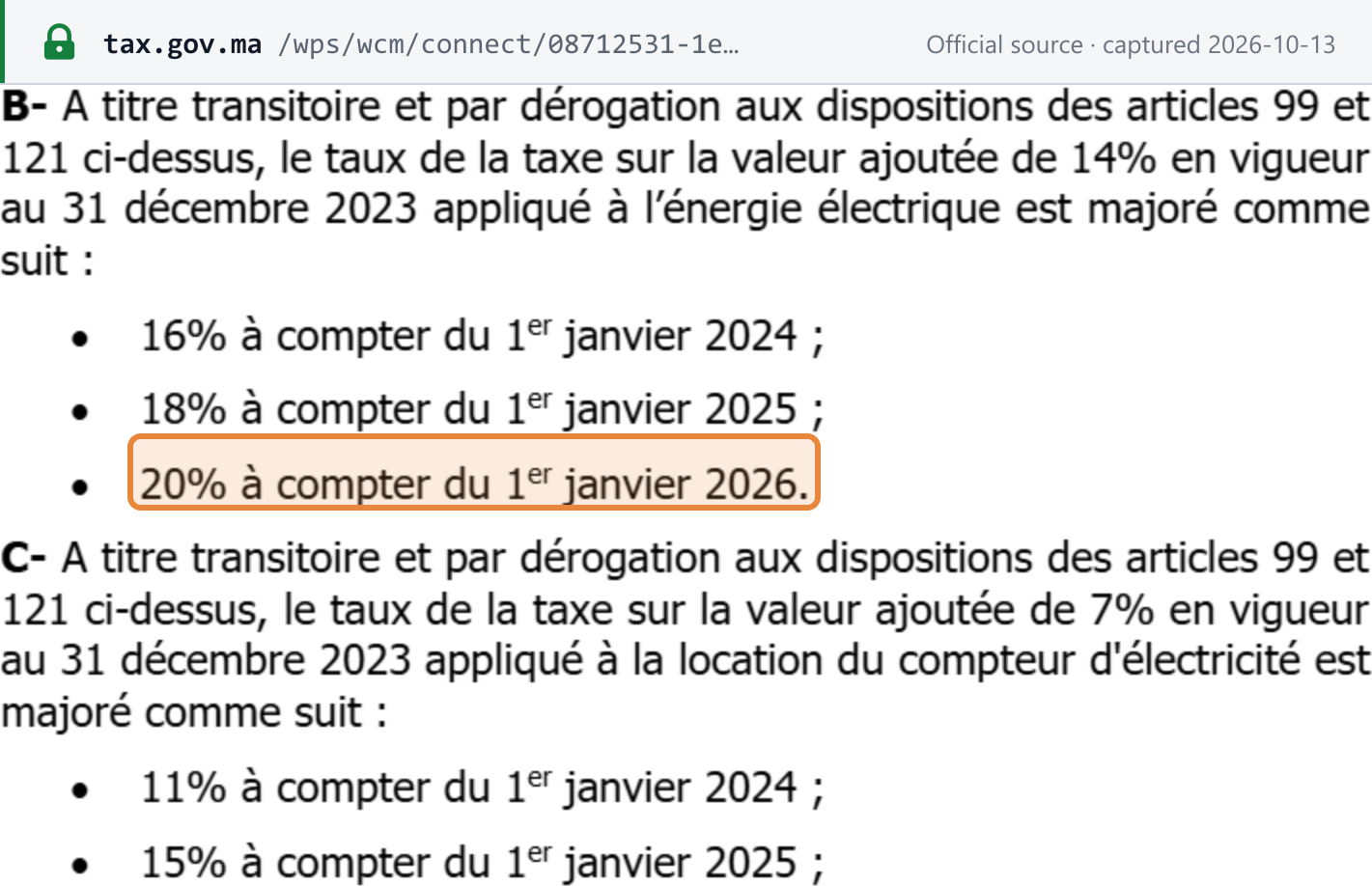
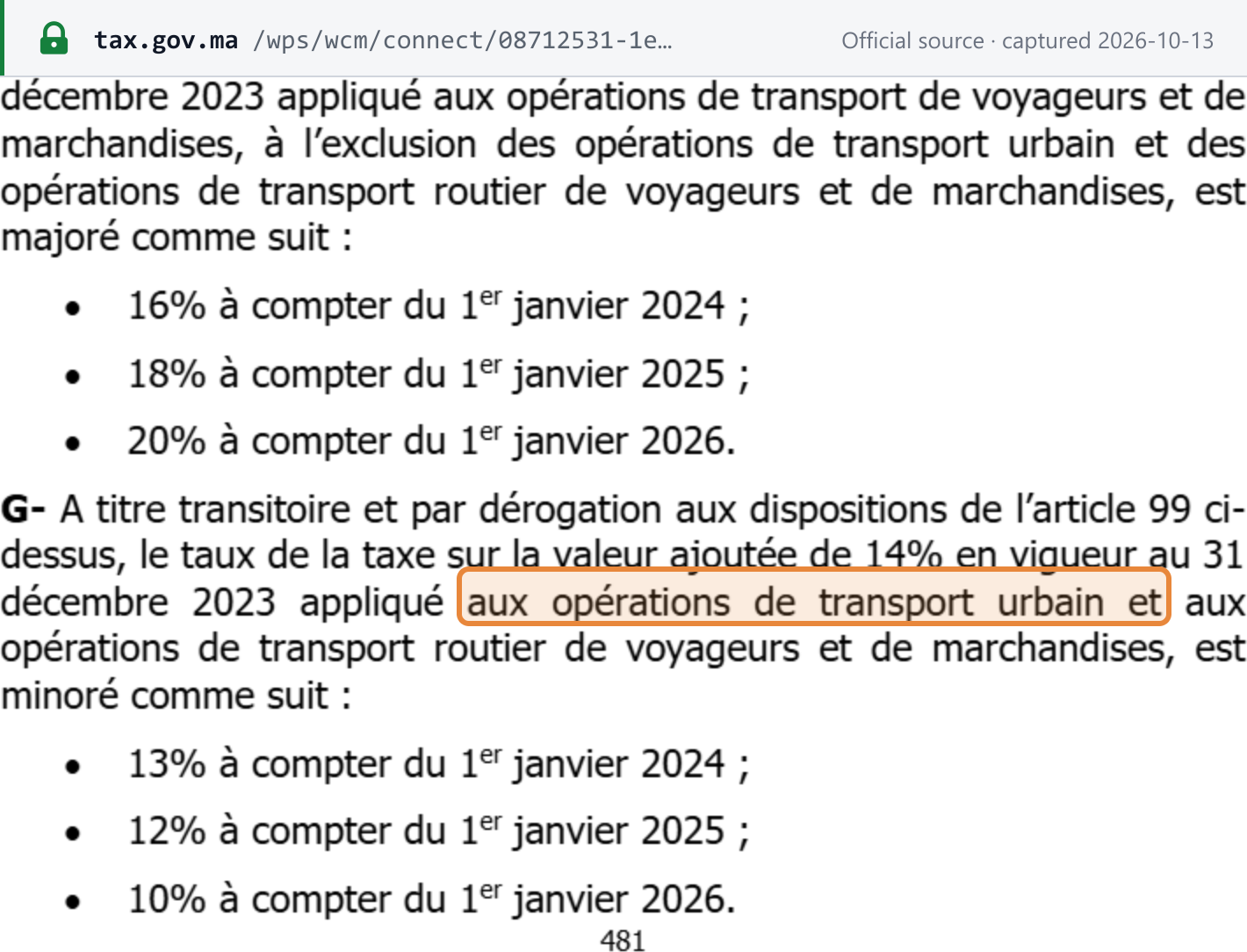
The 2024 Finance Law (loi n° 55-23) removed the former 7% and 14% rates in steps (art. 247-XXXXI). The last step took effect on 1 January 2026, leaving 20% and 10% as the only rates: [1] [5]
| Item | 2023 | 1 Jan 2024 | 1 Jan 2025 | 1 Jan 2026 |
|---|---|---|---|---|
| Electricity | 14% | 16% | 18% | 20% |
| Electricity-meter rental | 7% | 11% | 15% | 20% |
| Sales of renewable electricity by producers | 14% | 12% | 10% | 10% |
| Refined sugar | 7% | 8% | 9% | 10% |
| Transport other than urban and road transport (for example, rail) | 14% | 16% | 18% | 20% |
| Urban transport, and road transport of passengers and goods | 14% | 13% | 12% | 10% |
| Insurance brokers' commissions | 14% | 12% | 10% | 10% |
Other changes from 1 January 2024: water, sanitation and water-meter rental moved to 10%; pharmaceutical products became exempt with the right to deduct; and sardine conserves, milk powder and household soap moved from 7% to exempt without the right to deduct (see Exemptions). International transport is exempt with the right to deduct (art. 92). [5]
Announced changes. None enacted as at 13 October 2026. The 2027 Finance Bill had not been tabled, and the DGI's press page carried no item on it when checked on that date. [9]
Cross-border rules
Imports and exports
- Imports. VAT on imported goods becomes due on customs clearance: "Le fait générateur de la taxe sur la valeur ajoutée est constitué, à l'importation, par le dédouanement des marchandises." It is charged at 20% ad valorem, or 10% for the products listed in article 99-B and the other goods listed in article 121: edible fluid oils other than palm oil, and the seeds, oil fruits and vegetable oils used to make them; maize and barley; oilcakes and simple animal feed; cassava and grain sorghum; and engines for fishing boats (art. 121). It is collected by the ADII, subject to the exemptions in article 123. [1] This guide does not cover customs low-value (de minimis) rules; check them with the ADII.
- Exports. Goods and services supplied for export by VAT-registered persons are exempt with the right to deduct (art. 92-I-1°), with customs proof of export. A VAT credit that arises from exports can be refunded (art. 103). [1]
- Imported services. Services from a non-resident to a Moroccan client are taxed in Morocco and are handled through the representative, reverse-charge or withholding rules below.
Place of supply
Under article 88, an operation is made in Morocco: [1]
- Goods: "lorsque celle-ci est réalisée aux conditions de livraison de la marchandise au Maroc" — when the sale is made on terms of delivery in Morocco.
- Services and other operations: when the service, right or rented item is used or exploited in Morocco.
- Remote services (since 2025): also when a non-resident with no establishment in Morocco supplies a service remotely, in dematerialised form, to a client whose seat, establishment or tax domicile is in Morocco (added by the 2025 Finance Law).
Foreign companies selling into Morocco — B2B and B2C
Selling to businesses (B2B). A non-resident without an establishment either accredits a Moroccan representative, who handles its VAT, or leaves the VAT to the client (art. 115): [1]
- Client registered for VAT — reverse charge. The client "doit déclarer le montant hors taxe de l'opération sur sa propre déclaration de la taxe sur la valeur ajoutée, calculer la taxe exigible et procéder en même temps à la déduction" — it declares the net amount in its own return, calculates the VAT and deducts it at the same time. From 2026 the client also attaches a statement of its non-resident suppliers to its return (art. 112-II).
- Client outside the scope of VAT — withholding. The client withholds the VAT from each payment and pays it over in the month after payment (art. 117-III).
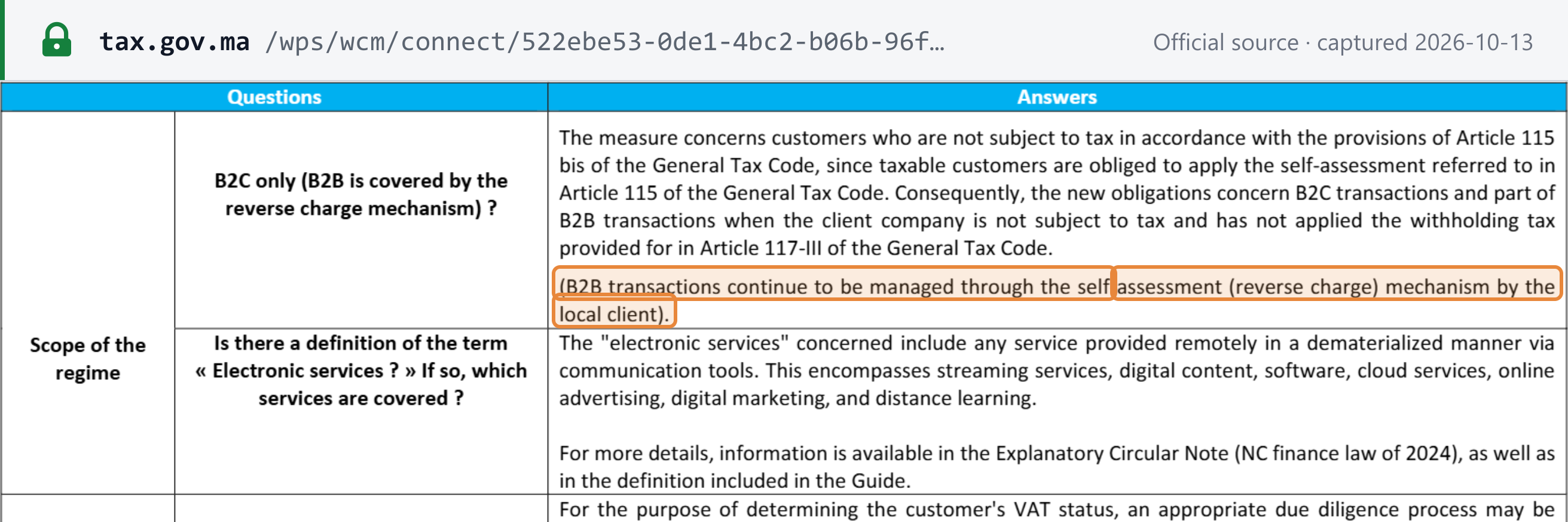
The DGI confirms that "B2B transactions continue to be managed through the self-assessment (reverse charge) mechanism by the local client", and that the customer's IF is the evidence of its VAT status. [2] See reverse charge explained.
Selling to consumers and other customers not registered for VAT (B2C). Non-residents supplying remote, dematerialised services to customers who are not registered for VAT register themselves under article 115 bis, described next. For goods, sales are taxed when delivered in Morocco, and VAT on imports is collected by customs (see Imports and exports).
Digital services to non-registered customers (article 115 bis)
A non-resident with no establishment in Morocco that supplies remote, dematerialised services to customers who are not subject to VAT, and has not accredited a representative, must "s'enregistrer sur la plateforme électronique dédiée à cet effet et obtenir un identifiant fiscal" — register on the dedicated online platform and obtain a tax identifier (art. 115 bis). [1]
- Who counts as a customer not registered for VAT. Article 115 bis covers clients non assujettis. That includes Moroccan businesses outside the VAT scope: such a business should withhold the VAT under article 117-III, and the DGI says the 115 bis obligations reach a B2B sale only where an unregistered client company has not applied that withholding. [2]
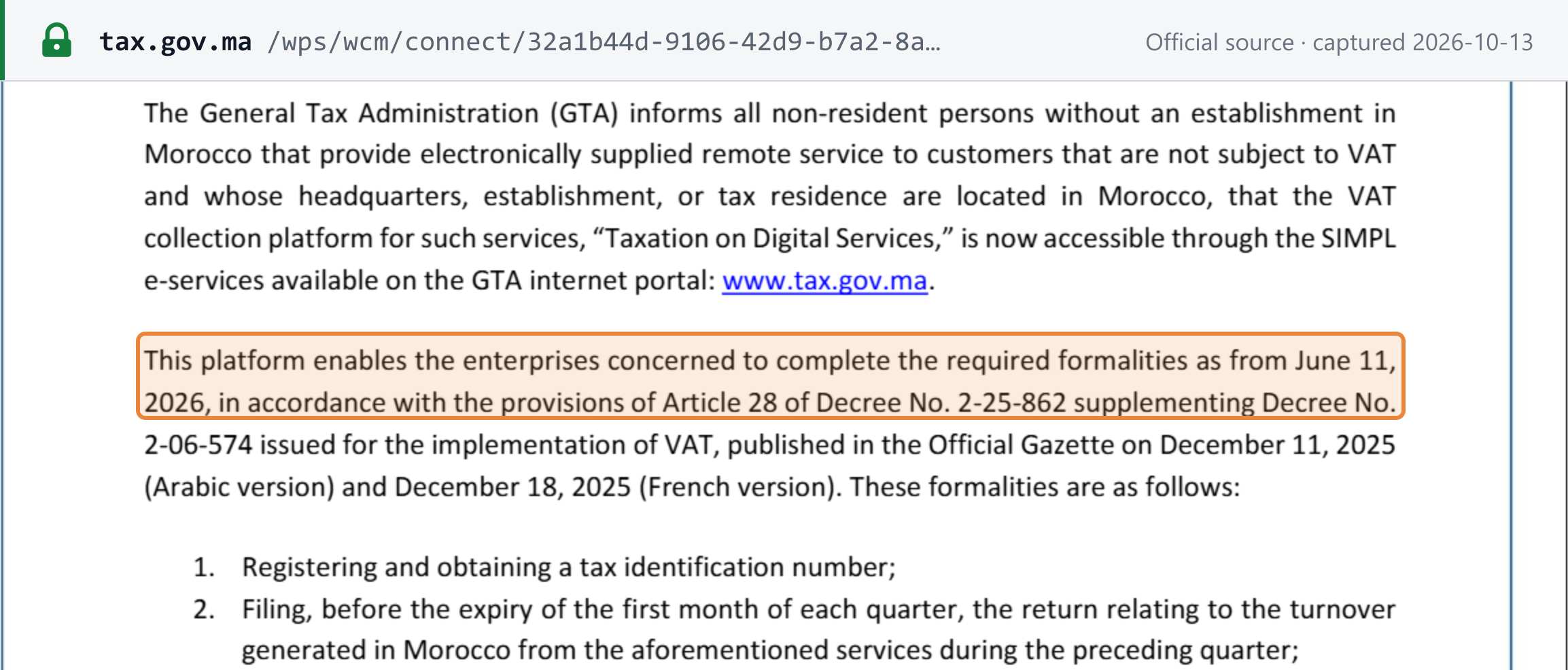
- Start date: 11 June 2026. The DGI's "Taxation on Digital Services" platform "enables the enterprises concerned to complete the required formalities as from June 11, 2026", under article 28 of Décret n° 2-25-862. [3] Article 115 bis itself was created by the 2024 Finance Law.
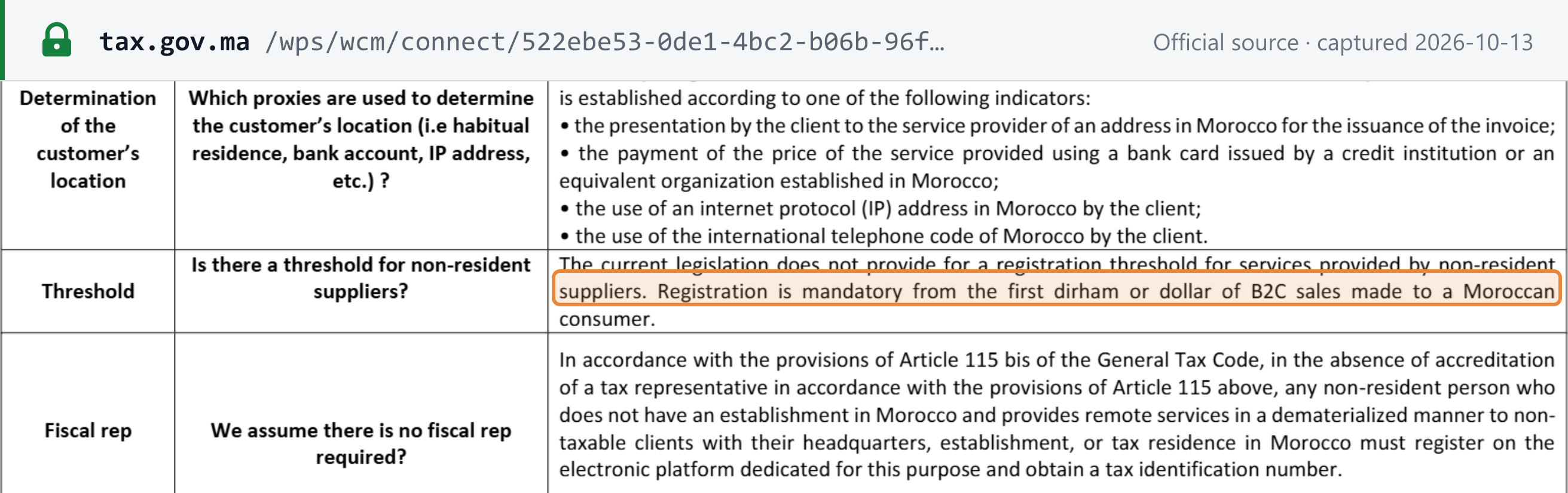
- No threshold. "Registration is mandatory from the first dirham or dollar of B2C sales made to a Moroccan consumer." [2]
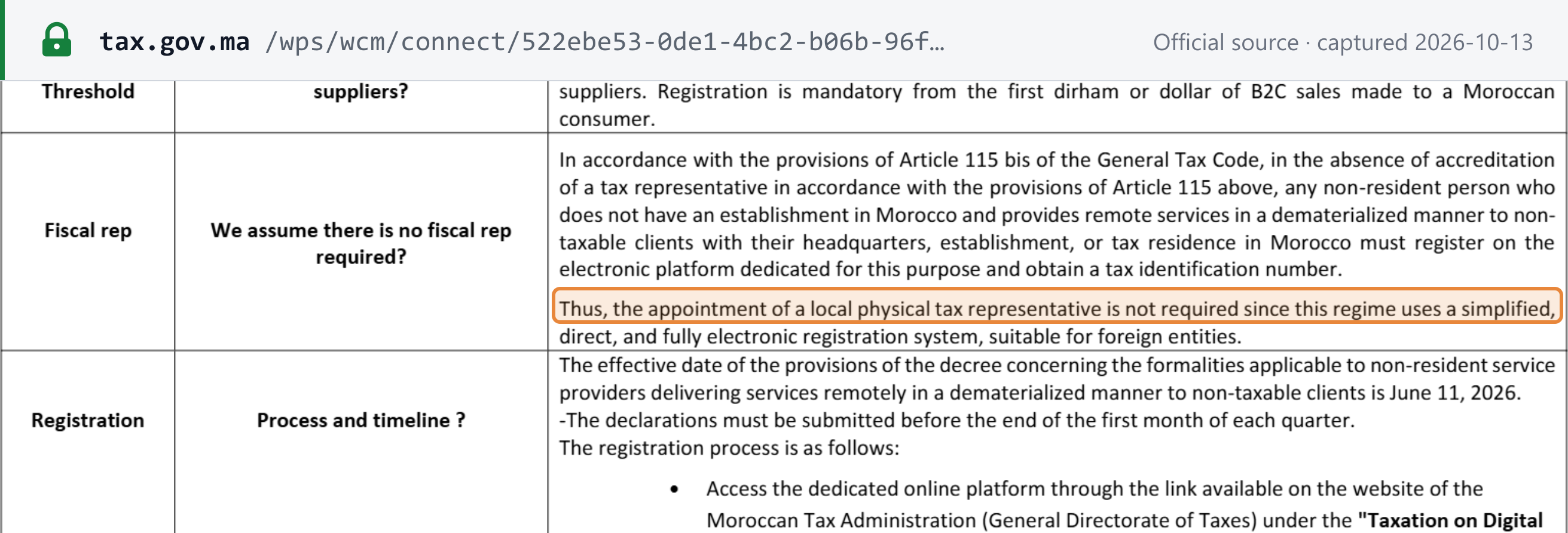
- No representative. "The appointment of a local physical tax representative is not required." [2]
- Quarterly returns. File the turnover return "avant l'expiration du premier mois de chaque trimestre" — before the end of the first month of each quarter, for the previous quarter — and pay at the same time, without deducting input VAT. Returns were monthly until the 2025 Finance Law made them quarterly. [1] [6]
- Rate. The DGI states no special rate for this regime, so the standard 20% applies (art. 99-A).
- Payment currency. "At present, the platform supports only the United States Dollar (USD) as its transaction currency." [2]
- Records. Keep a register of the services supplied for 10 years.
- Customer in Morocco. Any one of these indicators is enough: a Moroccan address given for the invoice, payment with a bank card issued in Morocco, a Moroccan IP address, or use of Morocco's international telephone code.
- Services covered. The DGI lists streaming, digital content, software, cloud services, online advertising, digital marketing and distance learning.
See the event record and VAT on digital services by non-resident suppliers.
Marketplace / platform deemed-supplier liability
Not applicable. The VAT title of the CGI 2026 has no rule making a marketplace or platform liable for VAT on sales made through it, and the DGI's digital-services Q&A is silent on it (checked 2026-10-13). The only "platform" in the VAT title is the DGI's own registration platform for article 115 bis. See marketplace deemed-supplier rules for how other countries handle this.
VAT withholding at source on services (article 117-V)
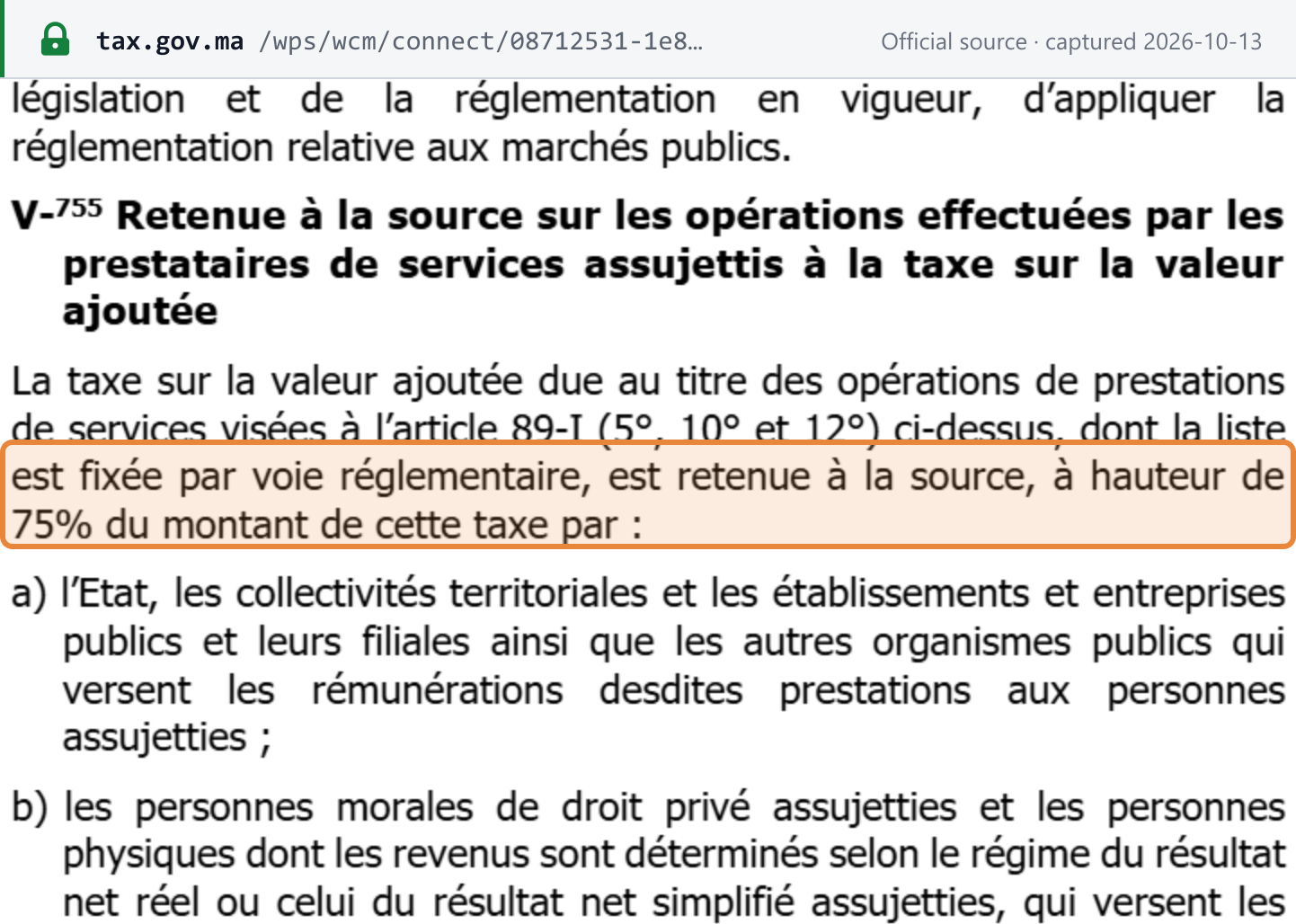
Some Moroccan payers must withhold part of the VAT on certain services they buy and pay it to the DGI themselves. The VAT on the services in article 89-I (5°, 10° and 12°), whose list is fixed by regulation, "est retenue à la source, à hauteur de 75% du montant de cette taxe" — is withheld at source at 75% of the tax. Payers in groups (b) and (c) below withhold 100% instead if the supplier has not provided an attestation de régularité fiscale (tax-compliance certificate) less than six months old. Group (a), the State and public bodies, withholds 75% with no certificate condition. [1] [8]
| Who withholds | On payments to | Since |
|---|---|---|
| (a) The State, local authorities, public bodies and their subsidiaries | VAT-registered service providers | 2024 Finance Law |
| (b) VAT-registered private-law legal persons, and VAT-registered individuals taxed on actual or simplified net profit | VAT-registered natural persons | 2024 Finance Law |
| (c) Credit institutions, insurers and reinsurers, and companies with turnover excluding VAT of MAD 200 million or more | VAT-registered legal persons | 2026 Finance Law, phased in |
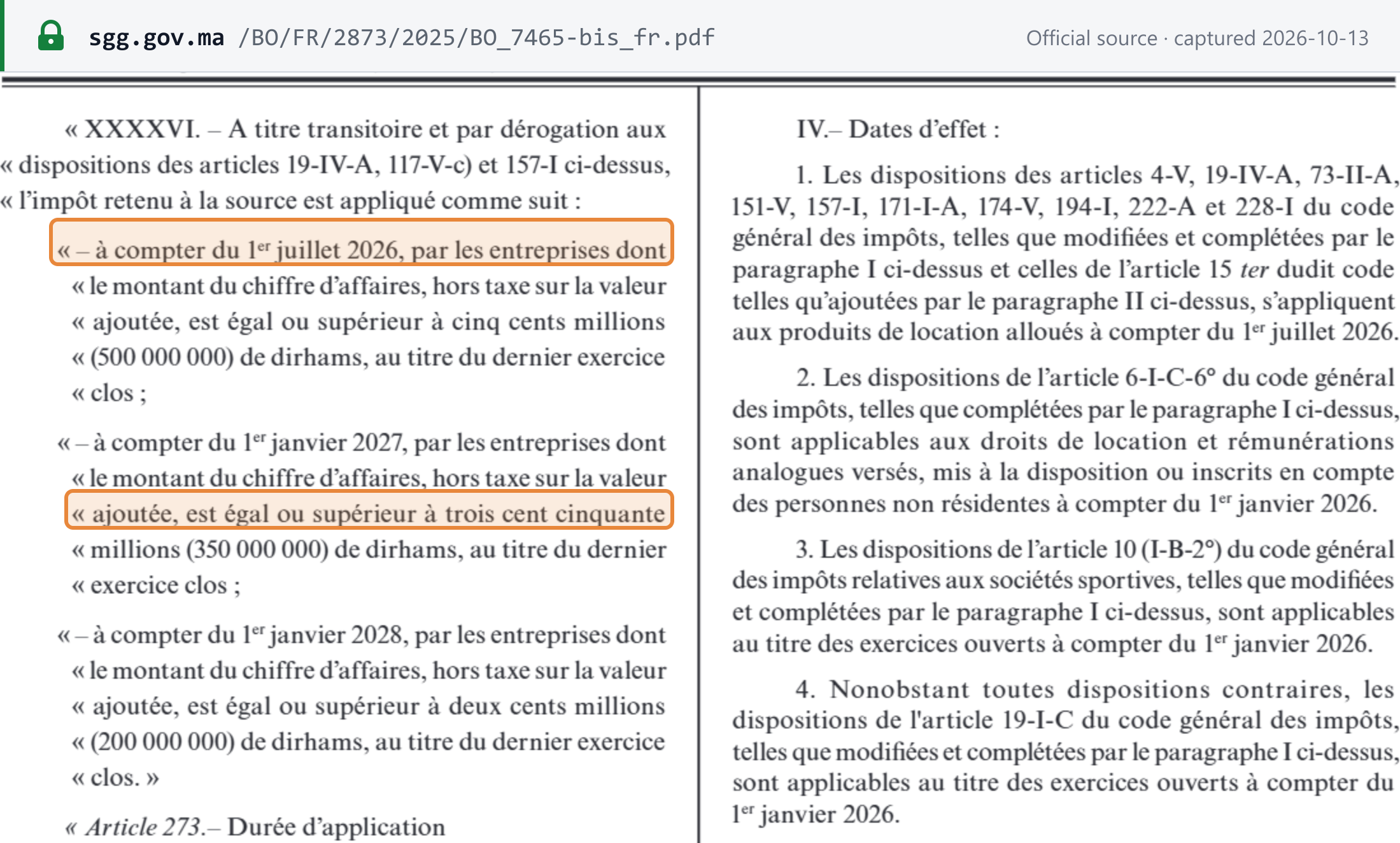
The third group is phased in (art. 247-XXXXVI; loi de finances n° 50-25): [4]
- 1 July 2026: credit institutions, insurers and reinsurers, and companies with turnover of MAD 500 million or more in their last closed financial year;
- 1 January 2027: companies with turnover of MAD 350 million or more;
- 1 January 2028: companies with turnover of MAD 200 million or more.
Excluded from withholding: sales of electricity and water through networks; sanitation and meter rental; telecom operators; insurance brokers; and services of MAD 5,000 or less, within MAD 50,000 per month per supplier. The withheld VAT is paid over in the month after payment through SIMPL-TVA; the DGI's communiqué gives 31 July 2026 as the deadline for VAT withheld in June 2026. A supplier whose VAT credit arises from this withholding can claim a refund (art. 103). [1] [8]
See the event record and VAT withholding regimes.
Invoice requirements
Mandatory content
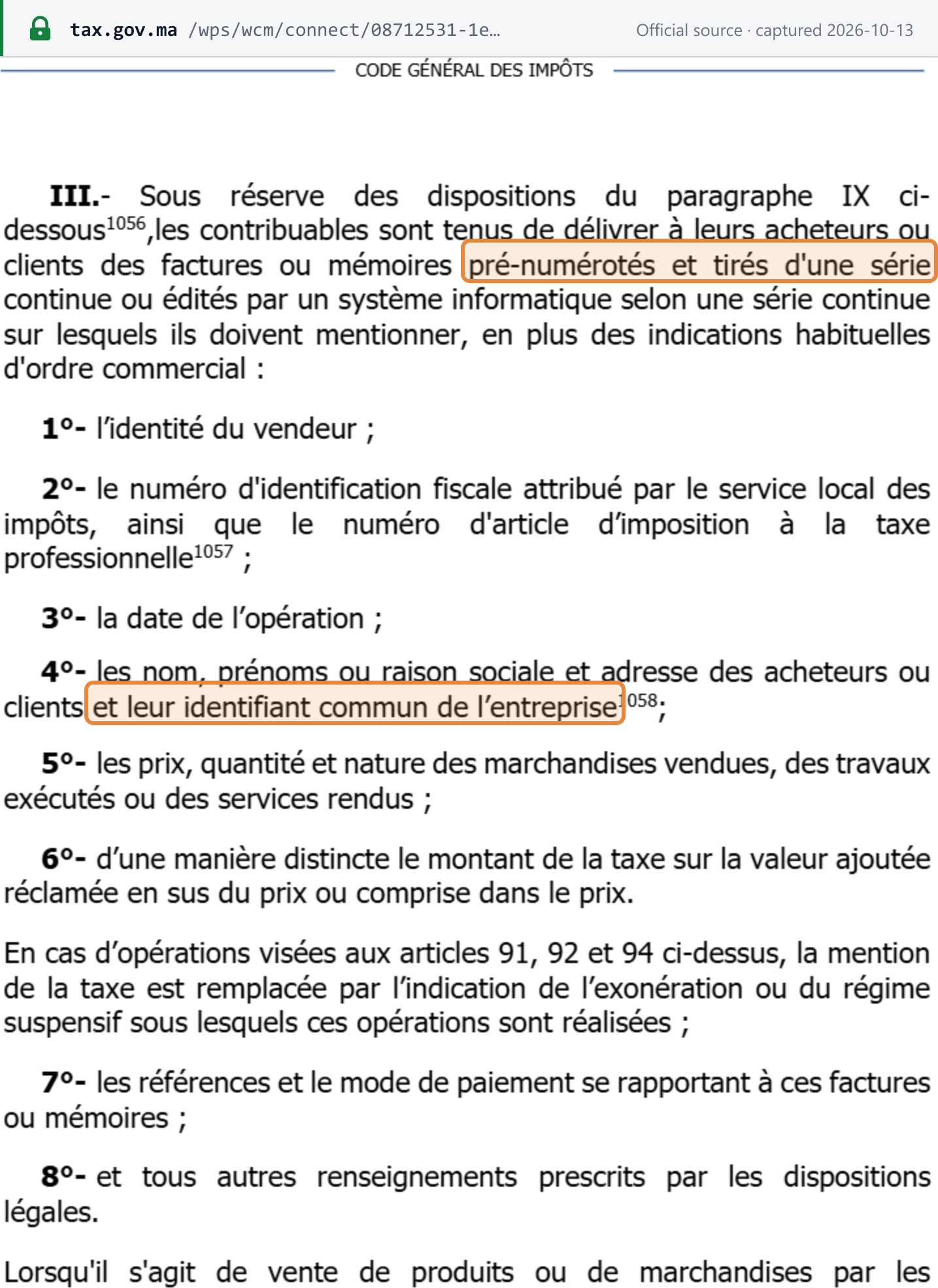
Taxpayers must issue "des factures ou mémoires pré-numérotés et tirés d'une série continue ou édités par un système informatique selon une série continue" — invoices pre-numbered in a continuous series, or produced by a computer system in a continuous series (art. 145-III). In addition to the usual commercial details, each invoice must show: [1]
| # | Field | Rule |
|---|---|---|
| 1 | Seller's identity | art. 145-III-1° |
| 2 | Seller's tax identification number (IF) and taxe professionnelle number | art. 145-III-2° |
| 3 | Date of the operation | art. 145-III-3° |
| 4 | Buyer's name or company name, address and ICE | art. 145-III-4° |
| 5 | Price, quantity and nature of the goods, works or services | art. 145-III-5° |
| 6 | VAT shown separately, whether charged on top of or included in the price | art. 145-III-6° |
| 7 | Payment references and method of payment | art. 145-III-7° |
| 8 | Seller's ICE | art. 145-VIII |
| 9 | Any other information required by law | art. 145-III |
The buyer's ICE applies to financial years opened from 1 January 2019. Whoever shows VAT on an invoice owes it: "Toute personne qui mentionne la taxe sur les factures qu'elle établit en est personnellement redevable du seul fait de sa facturation" (art. 119-II). A buyer cannot deduct VAT without a compliant invoice (arts 106 and 146). [1]
Issuance deadline
The CGI sets no deadline for issuing an invoice. VAT normally becomes due when payment is received (art. 95; see Special regimes).
Numbering and sequencing
Invoices must be pre-numbered in a continuous series, or produced by a computer system in a continuous series (art. 145-III).
Credit and debit notes
The CGI sets no specific rule for credit notes (avoirs) or debit notes.
Currency and language
The CGI sets no rule on the language or currency of an invoice. Non-residents registered under article 115 bis currently pay their VAT in US dollars.
Document types
- Full invoice — the standard document, with the content above.
- Cash receipt. "Lorsqu'il s'agit de vente de produits ou de marchandises par les entreprises à des particuliers, le ticket de caisse peut tenir lieu de facture" — for sales of goods to individuals, a cash receipt can replace the invoice. It must show at least the date, the seller, a description, the quantity and the price including VAT. No value limit applies. [1]
- Non-resident digital suppliers (art. 115 bis) give the customer "an equivalent document" showing the date, the supplier, the customer's name, a description and the price including VAT. [2]
Self-billing
The CGI has no self-billing provision.
Retention and audit trail
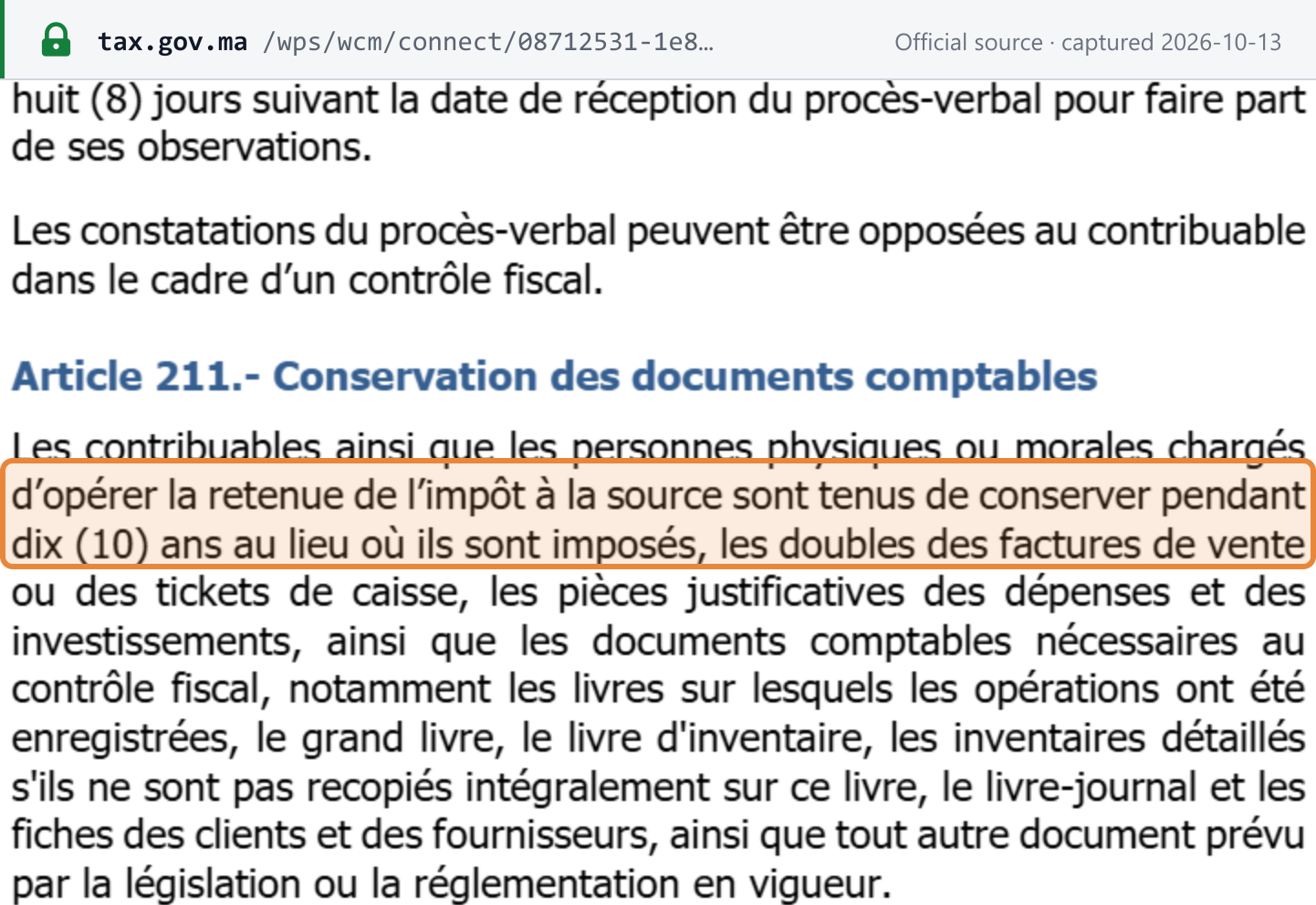
- Retention: 10 years. Taxpayers "sont tenus de conserver pendant dix (10) ans au lieu où ils sont imposés, les doubles des factures de vente ou des tickets de caisse" — they must keep copies of sales invoices and cash receipts, expense and investment documents, and the accounting records needed for a tax audit for 10 years, at the place where they are taxed (art. 211). [1]
- Electronic accounts. Since the 2026 Finance Law, accounts must also be kept in electronic format (art. 145-I). [4]
- Integrity. The DGI publishes no tamper-evidence or hash rule for invoices. The integrity rule is the continuous numbering in article 145-III.
A specimen of a compliant invoice
The DGI publishes no annotated specimen invoice. Below, Lookuptax lays out the article 145 particulars for a domestic B2B sale with lines at 20% and 10% and one export line. Every name, number and amount is fictional:
Facture (invoice) — domestic B2B sale
| Nature of goods or servicesart. 145-III-5° | Qtyart. 145-III-5° | Price excl. VATart. 145-III-5° | VAT rateart. 145-III-6° |
|---|---|---|---|
| Management consulting, September 2026 | 1 | MAD 10,000.00 | 20% |
| Hotel accommodation for client seminar (2 nights) | 4 | MAD 4,000.00 | 10% |
| Market study delivered for export | 1 | MAD 6,000.00 | Exempt (art. 92-I-1°) |
- Total excluding VAT
- MAD 20,000.00
- VAT at 20%art. 145-III-6°: shown separately
- MAD 2,000.00
- VAT at 10%art. 145-III-6°: shown separately
- MAD 400.00
- Total including VAT
- MAD 22,400.00
- Payment by bank transfer, reference SPEC-TRF-0042 (art. 145-III-7°: payment references and method).
- The export line is exempt with the right to deduct under art. 92-I-1° of the CGI; the exemption relied on is stated on the invoice.
- The seller owes any VAT shown on the invoice (art. 119-II).
- Keep a copy for 10 years (art. 211).
E-invoicing status
Status (as at 2026-10-13): no e-invoicing mandate is in force. There is a legal basis but no implementing rules.
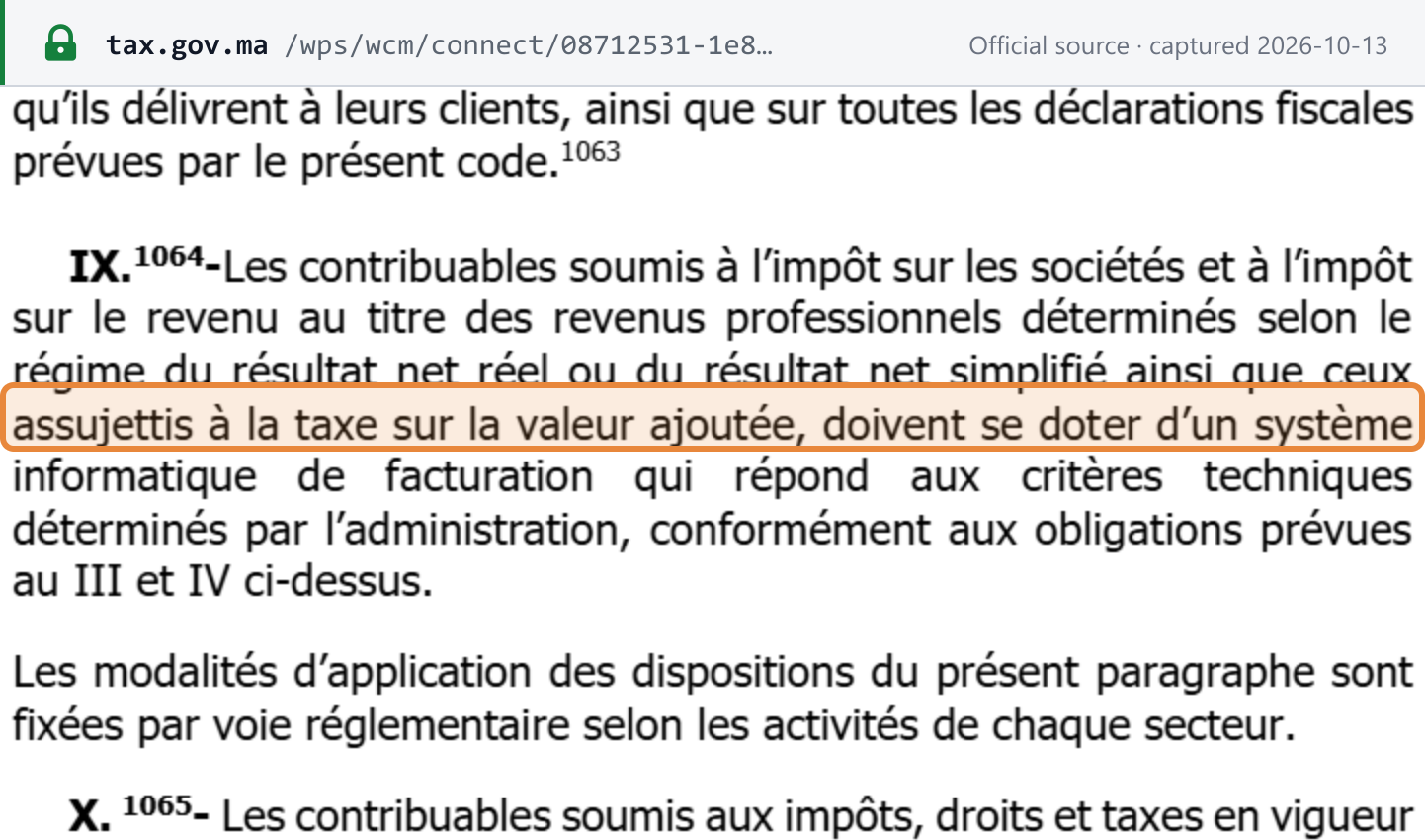
- Legal basis. Article 145-IX of the CGI, added by the 2018 Finance Law, provides that businesses subject to corporate tax, income tax on professional income (actual or simplified net-profit regime) or VAT "doivent se doter d'un système informatique de facturation qui répond aux critères techniques déterminés par l'administration" — must adopt a computerised invoicing system meeting technical criteria set by the tax administration. It adds: "Les modalités d'application des dispositions du présent paragraphe sont fixées par voie réglementaire selon les activités de chaque secteur" — the details are to be fixed by regulation, sector by sector. [1]
- No implementing decree. No decree or order implementing article 145-IX appears on the DGI's decrees or orders pages or in its press releases through 22 September 2026. The 2026 Finance Law and the DGI's circular on it (note circulaire n° 737) do not mention e-invoicing (checked 2026-10-13). [10] [11] [12]
- System, format, phases and scope. None published. There is no official system name, invoice format, phase timeline or taxpayer-size threshold, and no B2B, B2G or B2C scope.
- E-filing is mandatory. All companies have had to file their tax returns electronically since 1 January 2017 (art. 155) — this covers returns, not invoices.
For how clearance and reporting models work elsewhere, see CTC e-invoicing models and the e-invoicing status and networks table.
Filing and payment
Filing frequency
| Frequency | Who (art. 108) |
|---|---|
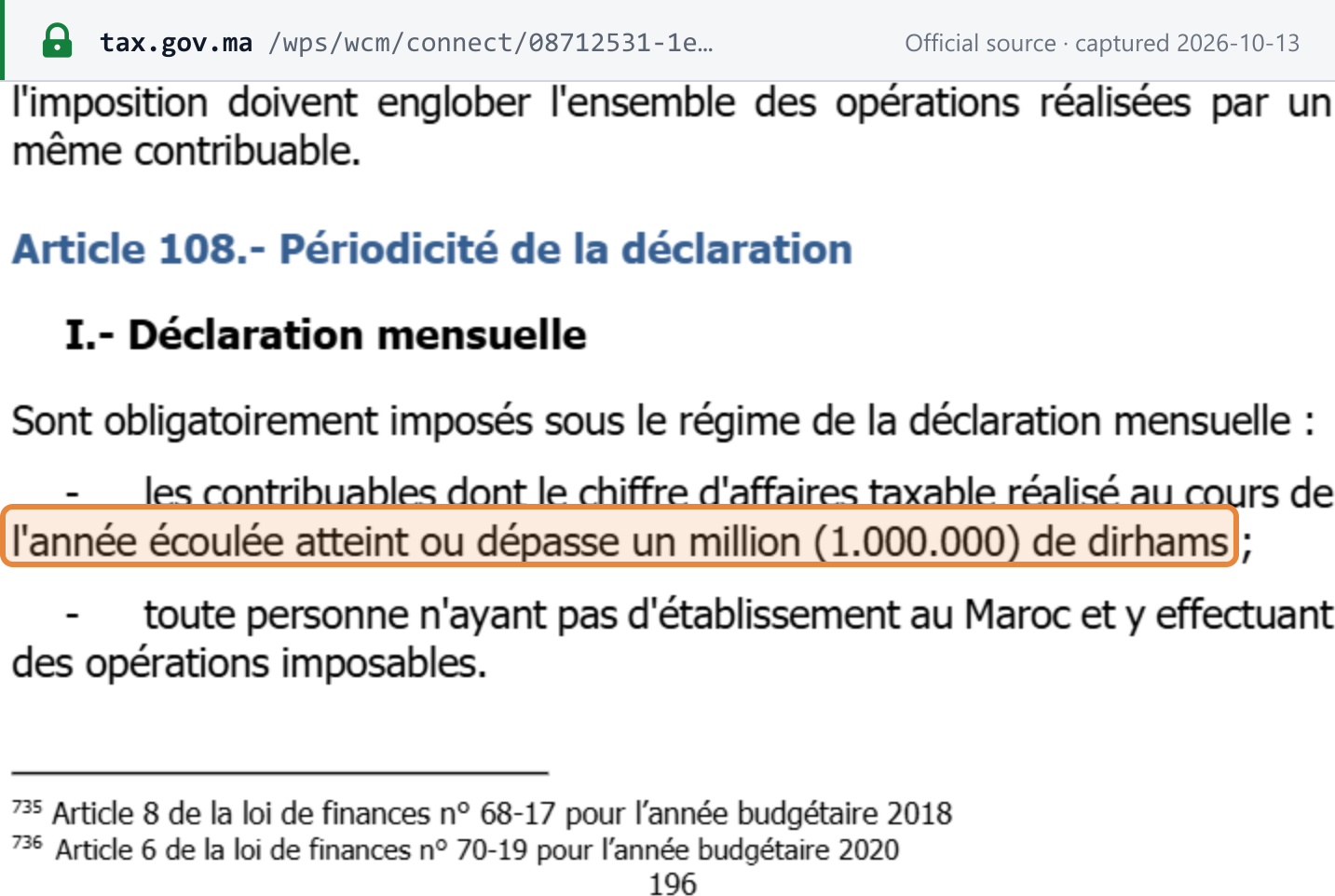
| Monthly (compulsory) | Taxpayers whose taxable turnover for the previous year reached MAD 1,000,000 or more; and any person without an establishment in Morocco making taxable operations there |
| Quarterly | Taxpayers below MAD 1,000,000; seasonal, periodic or occasional activities; and new taxpayers for their first calendar year |
| Quarterly | Non-resident suppliers of digital services to customers not registered for VAT, registered under article 115 bis |
Quarterly filers can choose monthly filing by applying "avant le 31 janvier" (before 31 January). [1]
Return due date
Returns are filed electronically, and the electronic deadline applies:
- Monthly filers: before the end of the month following the month of the operations (art. 110).
- Quarterly filers: before the end of the first month of the following quarter (art. 111).
Article 110 still sets an earlier paper deadline, "avant le vingt (20) de chaque mois" (before the 20th). Electronic filing has been compulsory for all companies since 1 January 2017 (art. 155), so the end-of-month deadline is the one that applies in practice. [1]
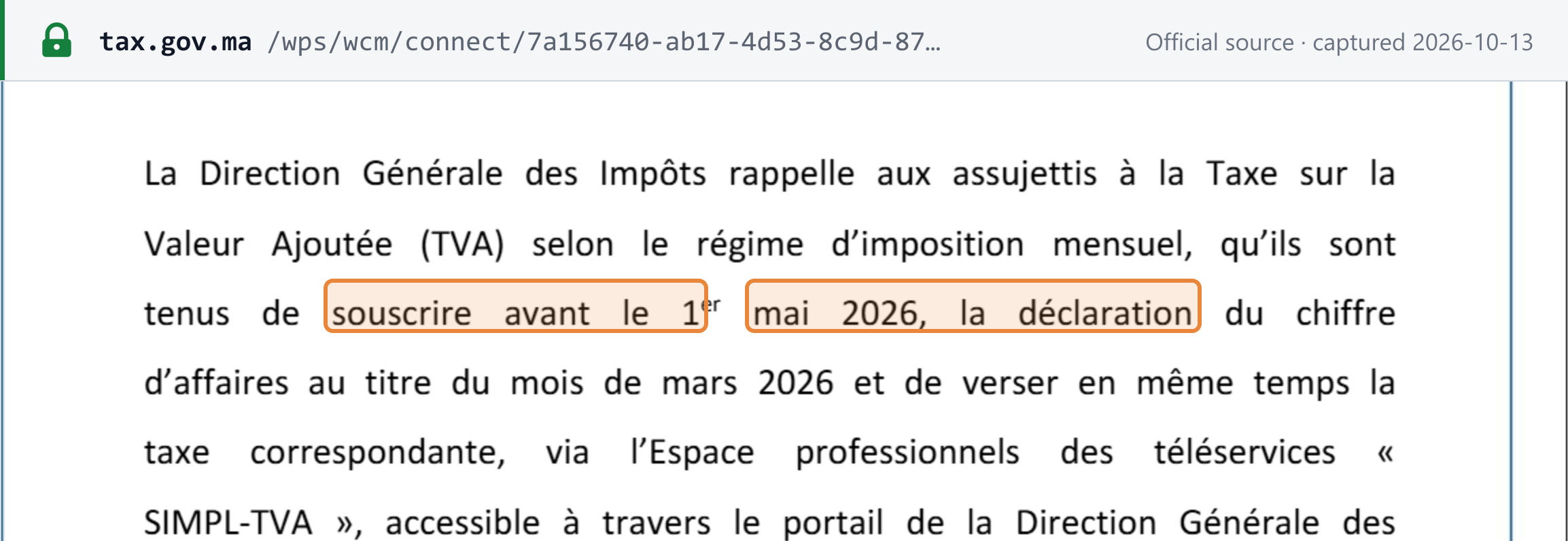
The DGI's own example: monthly filers had to file the March 2026 return and pay the tax "avant le 1er mai 2026" (before 1 May 2026), through SIMPL-TVA. [7]
Payment due date and method
The tax is paid at the same time as the return is filed — "verser, en même temps, la taxe correspondante". Payment is made electronically through SIMPL-TVA, in the professional area of the DGI's e-services at www.tax.gov.ma. Not filing or paying electronically when required costs 1%, with a minimum of MAD 1,000 (arts 187 bis and 208 bis). [1] [7]
Additional listings
- Statement of deductions — attached to every return. For each purchase it lists the invoice reference, the supplier's name, IF and ICE, the description, the amount excluding VAT, the VAT, and the payment method and references (art. 112-II).
- Withholding statement — where turnover was taxed by withholding.
- Non-resident supplier statement — since 2026, clients that self-assess VAT on supplies by non-residents attach a list of those suppliers (art. 112-II).
- Prorata declaration — businesses with both taxable and exempt activity file it before 1 March (art. 113).
- Annual VAT return — none.
Input-tax recovery and blocked items
- When. The right to deduct "prend naissance dans le mois de l'établissement des quittances de douane ou du paiement partiel ou intégral des factures" — it arises in the month the purchase invoice is paid (or the customs receipt is issued). It must be used within one year. A deduction made outside that year costs 15% of the deductible VAT, with a minimum of MAD 500 (art. 204 bis). [1]
- Excess credit carries forward to later periods (art. 101).
- Capital goods on which VAT was deducted must be kept for 60 months (movable goods) or 10 years from acquisition (immovable goods), or the deduction is regularised (art. 102).
- Blocked (art. 106):
- goods and services not used for the business;
- passenger vehicles, except those used for public transport or staff transport;
- most non-fuel petroleum products;
- gifts;
- travel, reception and representation costs;
- services taxed at 10% without the right to deduct (insurance brokers);
- purchases without a compliant invoice;
- purchases above MAD 5,000 per day per supplier, within MAD 50,000 per month per supplier, not paid by traceable means — crossed non-endorsable cheque, bank transfer, electronic payment and the other means listed (art. 106-II).
Refunds
A VAT credit is not refundable except in six cases listed in article 103: [1]
- exports and other operations exempt with deduction under article 92, and suspensions under article 94;
- ending a taxable activity;
- investment goods;
- leasing companies;
- seawater desalination;
- credits caused by VAT withholding under article 117 (IV and V).
Claims are made quarterly, within one year of the end of the quarter, and "sont liquidés dans un délai maximum de trois (3) mois" — are settled within three months of filing. A separate quarterly refund applies to VAT on investment goods (art. 103 bis), excluding office equipment and passenger vehicles.
The VAT title of the CGI (arts 87–125 quinquies) contains no bad-debt relief provision.
Exemptions
Morocco has two kinds of exemption, and the difference decides whether you can recover input VAT.
Exempt without the right to deduct (art. 91). No VAT is charged, and VAT on related costs cannot be recovered. Examples: [1]
- bread, couscous, flour, semolina and short pasta; milk; raw sugar;
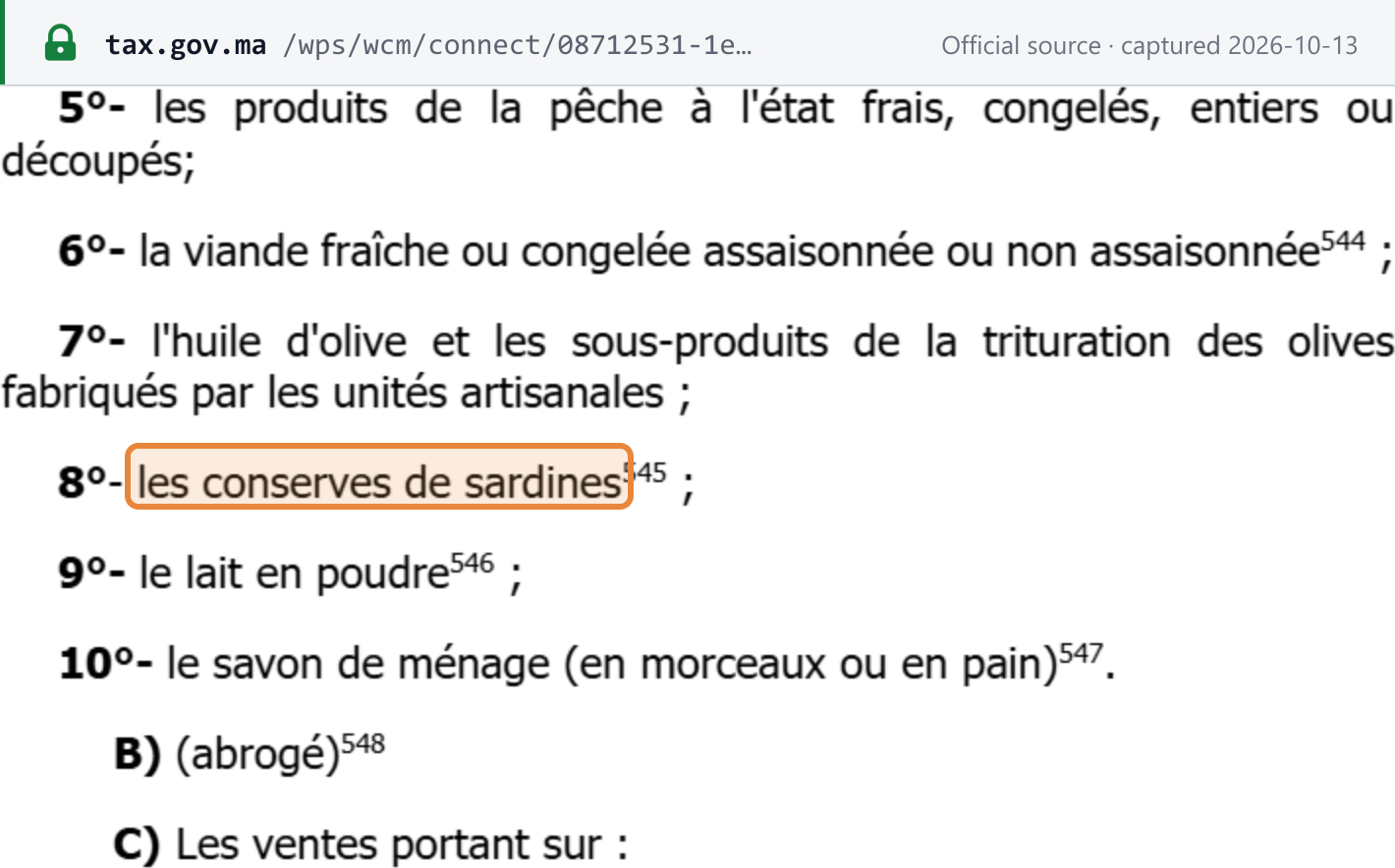
- sardine conserves, milk powder and household soap (taxed at 7% until the end of 2023);
- newspapers and books; school supplies;
- natural-person manufacturers and service providers with turnover of MAD 500,000 or less;
- medical services;
- microcredit;
- cooperatives and their unions (art. 91-IV-1°). For cooperatives that process raw materials collected from members, or inputs, with industrial-type equipment, the exemption applies only while annual turnover is under MAD 10 million excluding VAT (art. 93-II).
Sports companies formed under loi n° 30-09 are also exempt without the right to deduct, from 1 January 2026 to 31 December 2030 (art. 247-XXXXIV, added by the 2026 Finance Law). [1]
Moving sardines, milk powder and soap from 7% to this exemption in 2024 removed their producers' right to deduct; the DGI's circular on the 2024 Finance Law gives a prorata example. [5]
Exempt with the right to deduct (art. 92). No VAT is charged, but VAT on related costs can be recovered, and a resulting credit can be refunded (art. 103) — in effect a zero rate. Examples:
- exports of goods and services;
- all pharmaceutical products (since 1 January 2024);
- fertilisers and listed agricultural inputs;
- investment goods bought in the first 36 months of activity (art. 92-I-6°). Businesses that build their investment projects, and those carrying out projects under an investment agreement with the State that is still valid, can extend the 36 months by 24 months by filing an electronic extension request before the 36 months end (sentence amended by the 2026 Finance Law);
- ships, and supplies to diplomatic missions (art. 92-II).
Special regimes
- Cash basis by default. VAT becomes due when payment is received, with an option for the invoice (debit) basis (art. 95).
- Second-hand goods — margin scheme (art. 125 bis).
- Travel agents — margin scheme (art. 125 quater).
- Non-apparent VAT recovery (art. 125 ter).
- Self-assessment on purchases from non-taxable suppliers (art. 125 quinquies). Under paragraph I, a VAT-registered customer may choose to declare and pay the VAT on goods and services bought from suppliers that are outside the scope of VAT or exempt without the right to deduct, except purchases of land and agricultural products; it declares the net amount in its return for the month or quarter of payment and deducts the same VAT. Under paragraph II (2026 Finance Law), industrial processing companies liable to VAT must self-assess the VAT on purchases of new industrial waste, and of recovered metals and other recovered materials.
- Suspensive customs regimes (art. 94).
- Free zones (zones d'accélération industrielle) — not covered in this guide.
Offences and penalties
Offences
Article 192-I makes it a criminal offence to use any of these means to evade tax, or to obtain an undue deduction or refund: [1]
- issuing, delivering or producing fictitious invoices;
- false or fictitious accounting entries;
- repeated sales without invoices;
- destroying accounting documents that must be kept;
- organising one's own insolvency.
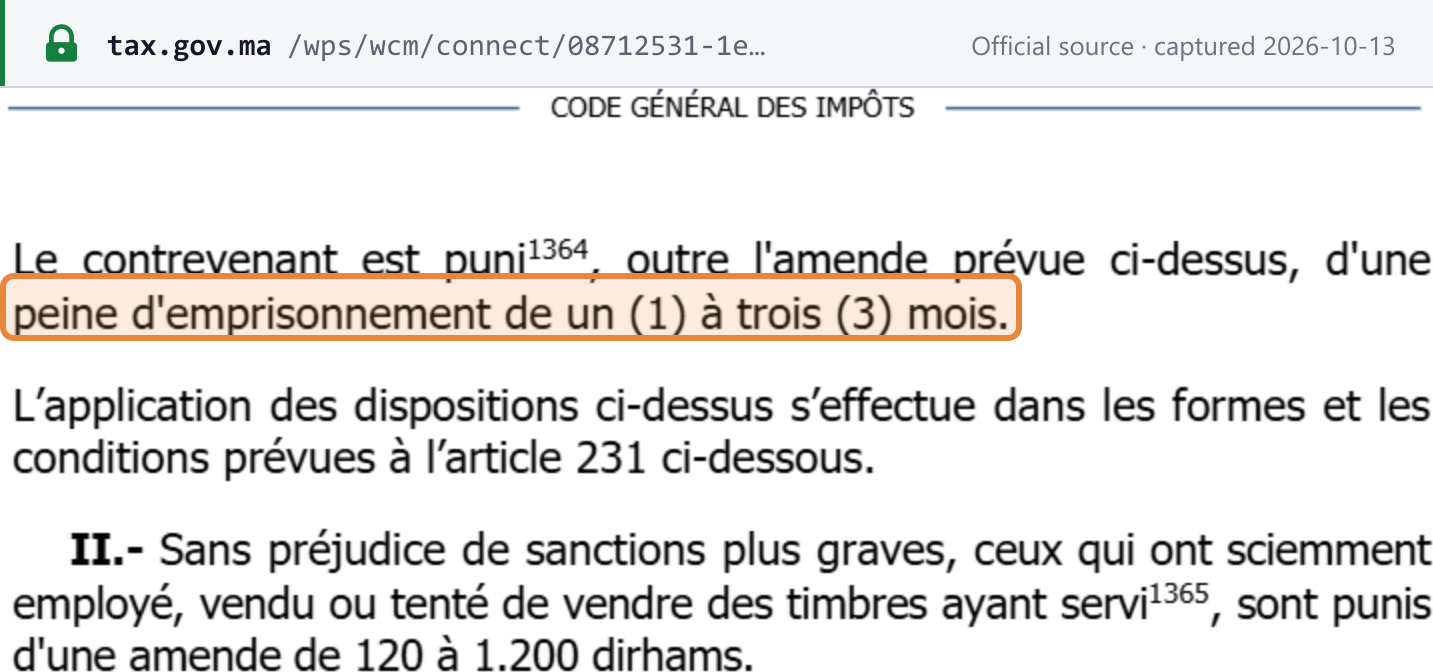
The fine is MAD 5,000 to 50,000, and "le contrevenant est puni, outre l'amende prévue ci-dessus, d'une peine d'emprisonnement de un (1) à trois (3) mois" — one to three months' imprisonment as well. Prosecution follows the procedure in article 231. Anyone who took part in the scheme faces a fine equal to 100% of the tax evaded (art. 187).
Penalties
| Penalty | Amount |
|---|---|
| Late payment of VAT (art. 208) | A 20% penalty on VAT or withheld VAT paid late or not paid (the general rate is 10%), plus 5% for the first month and 0.5% for each further month or part month |
| Late filing (art. 184) | Surcharges of 5% if no more than 30 days late, 15% after 30 days, and 20% on an ex-officio assessment; minimum MAD 500. An incomplete return with no tax effect: MAD 500 |
| Reassessment (art. 186) | 30% for VAT and withholding taxpayers (the general rate is 20%); 100% for bad faith |
| Late existence declaration (art. 188) | MAD 1,000 |
| Missing or wrong own ICE on invoices or returns (art. 145-VIII; art. 198 ter) | MAD 100 per omission or error |
| Not filing or paying electronically (arts 187 bis, 208 bis) | 1%, minimum MAD 1,000 |
| Deduction outside the one-year window (art. 204 bis) | 15% of the deductible VAT, minimum MAD 500 |
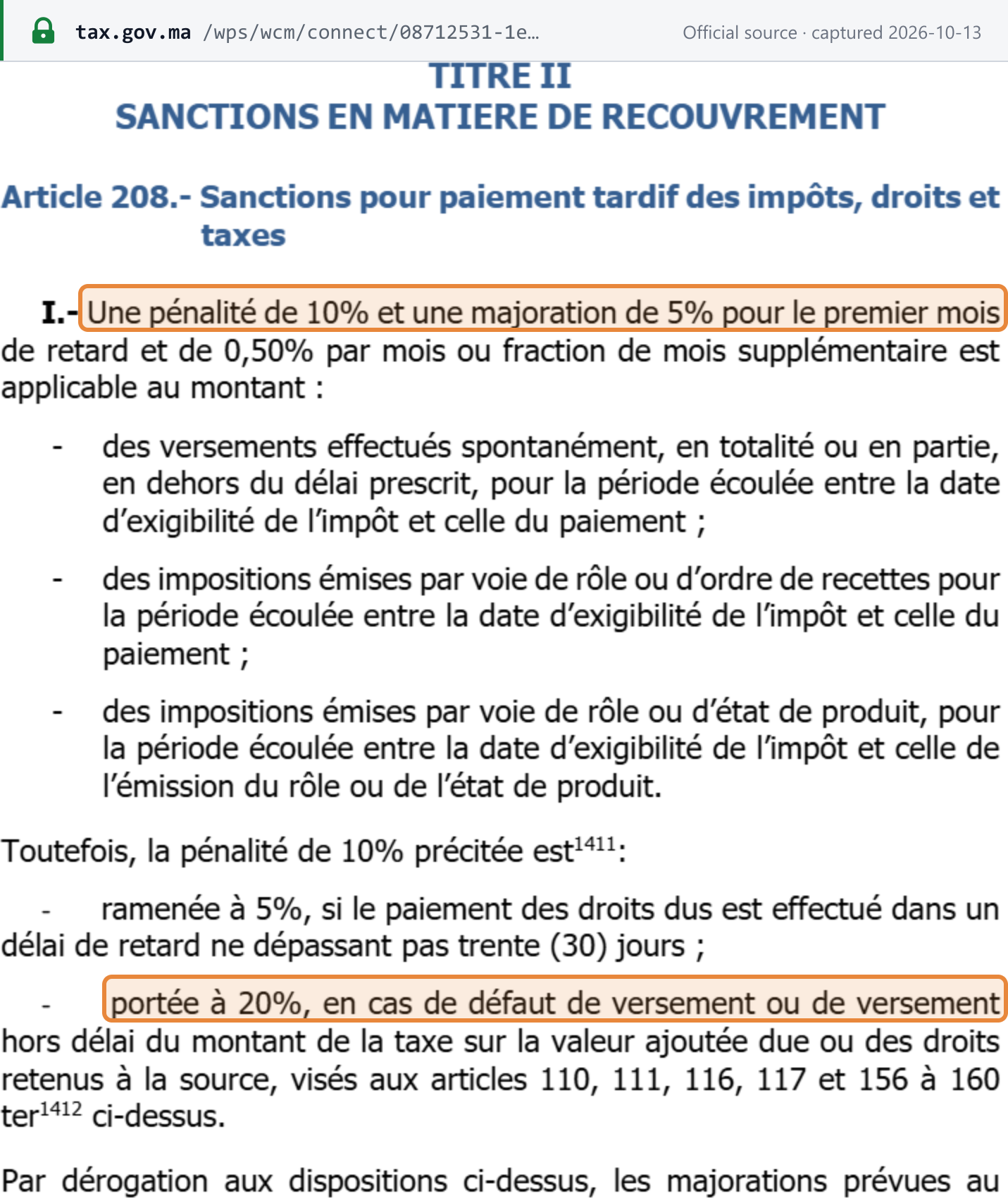
Article 208 reads: "Une pénalité de 10% et une majoration de 5% pour le premier mois de retard et de 0,50% par mois ou fraction de mois supplémentaire", and the 10% is "portée à 20%, en cas de défaut de versement ou de versement hors délai du montant de la taxe sur la valeur ajoutée due ou des droits retenus à la source". [1]
Frequently asked questions
Do we need a tax representative in Morocco to sell software or streaming to Moroccan customers who are not registered for VAT?
No. Since 11 June 2026, a non-resident with no establishment in Morocco that supplies remote, dematerialised services to customers who are not subject to VAT registers on the DGI's Taxation on Digital Services platform and obtains a tax identifier there. The DGI says a local physical tax representative is not required. There is no threshold: registration applies from the first dirham of B2C sales. Returns are quarterly, filed and paid before the end of the first month of each quarter for the previous quarter, with no deduction of input VAT. The platform currently accepts payment in US dollars only.
Our Moroccan business client self-assessed the VAT on our invoice, or withheld it. Why?
If you have no establishment in Morocco and have not accredited a Moroccan representative, the VAT on your supply is declared and paid by your Moroccan client (CGI article 115). A VAT-registered client self-assesses it under the reverse charge, declaring the tax and deducting it in the same return. A client outside the scope of VAT withholds the VAT from each payment and pays it over the following month (article 117-III).
Why does a Moroccan buyer insist on our ICE and on paying by bank transfer?
A Moroccan invoice must show the buyer's identifiant commun de l'entreprise (ICE), and the seller must show its own ICE on invoices and tax returns (CGI article 145-III and 145-VIII). A taxpayer that leaves its own ICE off an invoice or return, or gets it wrong, is fined MAD 100 per omission or error (article 198 ter, which applies to article 145-VIII). The buyer also cannot deduct VAT on purchases above MAD 5,000 per day per supplier, within a limit of MAD 50,000 per month per supplier, unless they are paid by a traceable means such as a crossed cheque, bank transfer or electronic payment (article 106-II).
Is there a VAT registration threshold in Morocco?
There is no general threshold: liability depends on the activity. Manufacturers, wholesalers, importers, service providers and the listed liberal professions are taxable whatever their turnover. Retailers become taxable once their taxable turnover for the previous year reaches MAD 2,000,000. Natural-person manufacturers and service providers with annual turnover of MAD 500,000 or less are exempt. Non-resident suppliers of digital services to customers who are not registered for VAT have no threshold.
Is e-invoicing mandatory in Morocco?
Not as at 13 October 2026. Article 145-IX of the CGI, added by the 2018 Finance Law, requires businesses subject to corporate tax, income tax on professional income or VAT to adopt a computerised invoicing system that meets technical criteria set by the tax administration, with the details to be fixed by regulation. No implementing decree or order has been published on the DGI's website, so no e-invoicing system, format, timeline or scope is in force.
What happened to Morocco's 7% and 14% VAT rates?
The 2024 Finance Law phased them out, and since 1 January 2026 Morocco has two rates, 20% and 10%. Electricity, electricity-meter rental and transport other than urban and road transport rose step by step to 20%. Refined sugar, urban and road transport, sales of renewable electricity and insurance brokers' commissions moved to 10%. Pharmaceutical products became exempt with the right to deduct from 1 January 2024.
Important websites
| Site | Purpose |
|---|---|
| DGI portal — tax.gov.ma | Entry point for all DGI e-services, including SIMPL-TVA |
| SIMPL-TVA (DGI portal → Téléservices SIMPL → Espace professionnels) | File VAT returns, pay VAT and pay over withheld VAT (login required) |
| Taxation on Digital Services | Registration, quarterly returns and payment for non-resident B2C digital-services suppliers (art. 115 bis); support: [email protected] |
| DGI e-services page | Links to the DGI's online services, including the digital-services platform |
| Verify a tax-compliance certificate | Check an attestation de régularité fiscale, which decides whether 75% or 100% of the VAT is withheld under article 117-V |
| DGI tax calendar | Filing and payment deadlines |
| CGI 2026 (PDF) | The consolidated tax code, including all VAT rules |
| Customs (ADII) | VAT on imports |
| Morocco TIN validator | Check the format of a Moroccan tax identifier |
| E-invoicing portal | None published (see E-invoicing status) |
Recent changes
- 2026-07-01 — VAT withholding at source on services extended to banks, insurers and companies with turnover of MAD 500 million or more (75%; 100% without a tax-compliance certificate); the turnover band drops to MAD 350 million in 2027 and MAD 200 million in 2028. (Bulletin officiel n° 7465 bis) — see event
- 2026-06-11 — The DGI's "Taxation on Digital Services" platform opened for non-resident suppliers of remote services to customers not registered for VAT (Décret n° 2-25-862, art. 28). (DGI) — see event
- 2026-01-01 — Rate convergence completed: electricity, electricity-meter rental and other transport at 20%; refined sugar and urban and road transport at 10%. (CGI 2026, art. 247-XXXXI)
- 2026-01-01 — 2026 Finance Law: accounts must also be kept in electronic format (art. 145-I); clients attach a statement of their non-resident suppliers to their VAT return (art. 112-II). (Bulletin officiel n° 7465 bis)
- 2025-01-01 — 2025 Finance Law: returns by non-resident remote-service suppliers become quarterly, and customer-location indicators are introduced (arts 88 and 115 bis). (DGI note circulaire n° 736)
- 2024-01-01 — 2024 Finance Law: pharmaceuticals exempt with the right to deduct; sardine conserves, milk powder and household soap exempt without it; phase-out of the 7% and 14% rates begins. (DGI note circulaire n° 735)
For the full chronology, see Morocco tax changes on Lookuptax.
Reference links
- DGI — Code Général des Impôts, 2026 edition (PDF, French)
- DGI — VAT: digital services supplied by non-residents, Q&A (PDF, English)
- DGI — Press release on the Taxation on Digital Services platform (14 May 2026, PDF, English)
- Bulletin officiel n° 7465 bis (16 December 2025) — Loi de finances n° 50-25 for 2026 (PDF)
- DGI — Note circulaire n° 735 on the 2024 Finance Law (PDF)
- DGI — Note circulaire n° 736 on the 2025 Finance Law (PDF)
- DGI — Communiqué: monthly VAT return for March 2026 (PDF)
- DGI — Communiqué: payment of VAT withheld at source under article 117-V (PDF)
- DGI — Press releases
- DGI — Decrees
- DGI — Orders (arrêtés) and CGI archive
- DGI — Note circulaire n° 737 on the 2026 Finance Law (PDF)
Related on Lookuptax: