New Zealand GST guidelines
| FACTSHEET | |
|---|---|
| Country code | NZ |
| Tax name | Goods and services tax (GST) — Tāke hokohoko |
| Tax Authority | Inland Revenue |
Overview
New Zealand levies goods and services tax (GST) — Tāke hokohoko in te reo Māori — under the Goods and Services Tax Act 1985. Inland Revenue's GST guide describes it as "a tax, usually 15%, charged by GST registered businesses on the supply (sale) of most goods and services in New Zealand, most goods imported into New Zealand and some specified imported services." [1]
Authority. GST is administered by Inland Revenue. GST on imported goods above NZD 1,000 is collected at the border by the New Zealand Customs Service (see Imports and exports).
Currency. Amounts are in New Zealand dollars (NZD).
Tax period. One, two or six months, chosen by the business within the limits set out under Filing frequency. Inland Revenue says GST filing periods "should align with your income tax balance date. For most businesses, the balance date is 31 March." Overseas businesses registered under the simplified rules for remote services, low-value goods or listed services file quarterly. [8]
Layering. None. GST is a single national tax at a single rate; there is no regional or local GST. Inland Revenue's tax policy unit describes it as "imposed at a single rate of 15% across a wide range of goods and services with few exceptions." [34]
For the neighbouring system, see the Australia GST guide.
Registration
Who should register
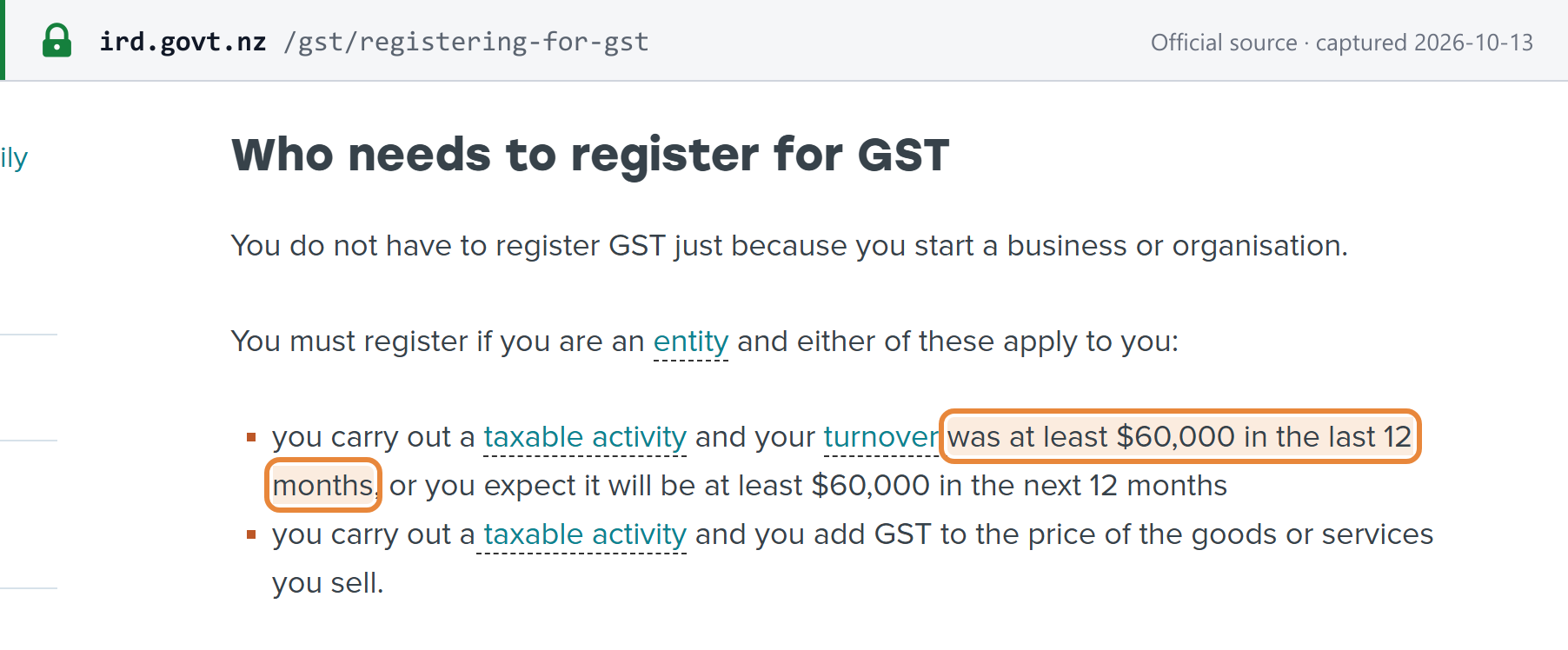
You must register for GST if you carry on a taxable activity and your turnover was NZD 60,000 in the last 12 months, or is expected to be NZD 60,000 in the next 12 months. You must also register if you add GST to the price of what you sell. [2]
A taxable activity is "an activity that is carried on continuously or regularly, and involves or is intended to involve the supply of goods or services to another person for consideration." [1]
Registration threshold
- Amount: NZD 60,000 of turnover — sales from taxable activities, including certain imported services you receive. [1]
- Measurement: a rolling 12 months, tested both ways — the past 12 months and the next 12 months.
- Wording. Inland Revenue's pages describe the test as turnover of "at least $60,000" on its registration page and as "over $60,000" in its GST guide (IR375, p.4), so its guidance does not settle whether turnover of exactly NZD 60,000 triggers registration.
If you need to register, Inland Revenue says it will process the request "within 10 working days". In exceptional circumstances — for example, if you have been adding GST to your prices before registering — it can backdate the registration. [33] [2]
Non-resident registration
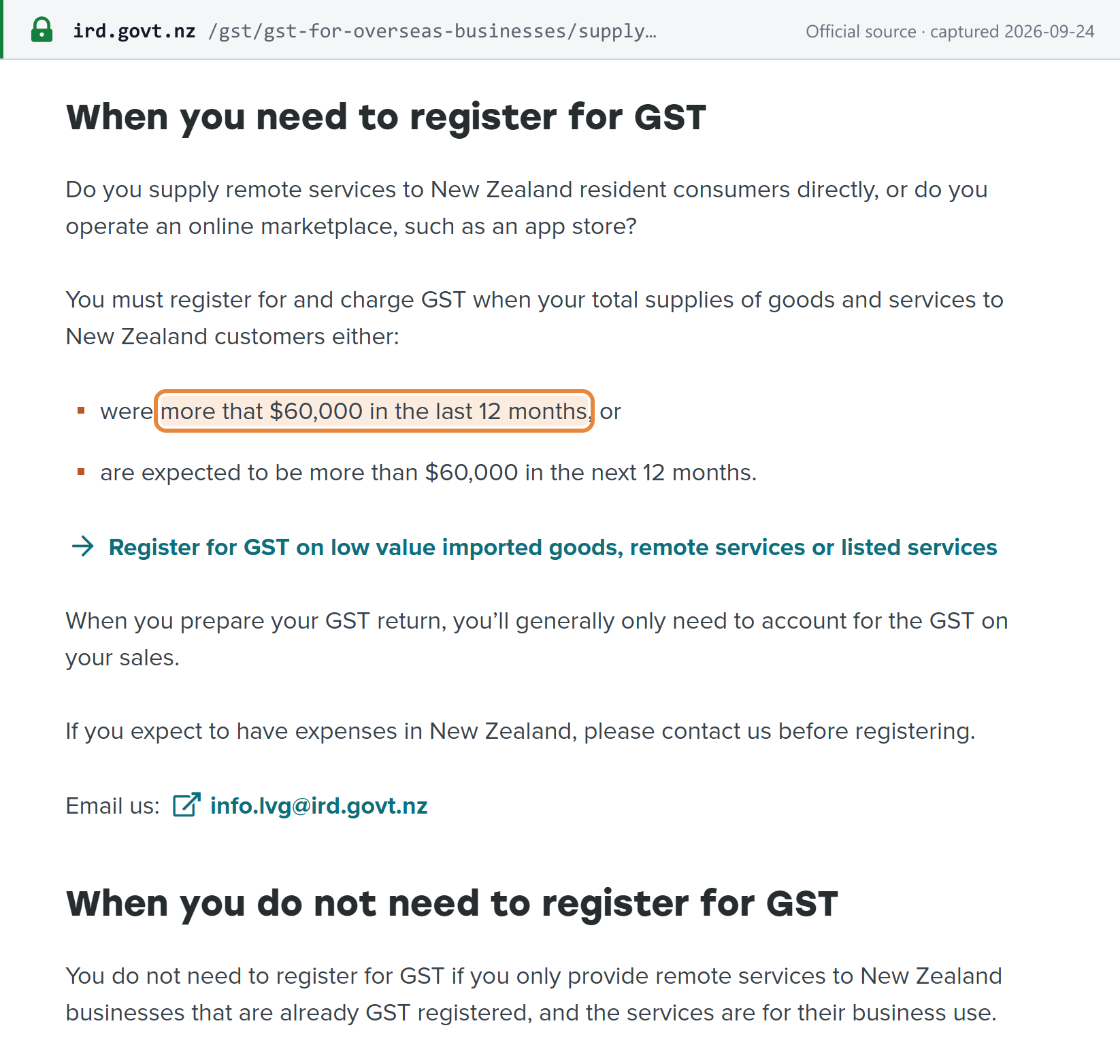
The threshold for non-residents is the same NZD 60,000, but what counts toward it depends on which of the five types of registration applies. "There are 5 types of GST registration for non-resident businesses depending on the circumstances and extent of the activity undertaken in New Zealand." [3]
| Type | Who it is for | Threshold |
|---|---|---|
| Supplying goods or services in New Zealand | Non-residents with a New Zealand taxable activity | NZD 60,000 (domestic rules) |
| Remote services | Services supplied from offshore to New Zealand-resident consumers | NZD 60,000 of supplies to New Zealand customers |
| Low-value imported goods | Goods of NZD 1,000 or less each sold to New Zealand consumers (since 1 December 2019) | NZD 60,000 of such supplies |
| Listed services | Online marketplaces facilitating ride-sharing, food delivery and accommodation (since 1 April 2024) | NZD 60,000 |
| Non-resident business claimant | Businesses with no New Zealand taxable supplies, claiming back New Zealand GST | First-period refund must be more than NZD 500 |
Sources: Inland Revenue, GST for overseas businesses and its sub-pages. [3] [4] [5]
Supplies to GST-registered New Zealand businesses do not count toward the low-value-goods threshold, and an overseas supplier of remote services that only supplies GST-registered businesses for their business use does not need to register. [5] A business registered under these simplified rules generally accounts only for GST on its sales and files quarterly. [4]
Non-resident visitors. From 1 April 2026, a non-resident visitor arriving on or after that date who only makes certain zero-rated supplies of services to non-residents can choose not to register (Taxation (Annual Rates for 2025–26, Compliance Simplification, and Remedial Measures) Act 2026, Royal assent 30 March 2026). [24] A Bill introduced on 10 September 2026 would extend the choice to all such non-residents from the day after Royal assent; it is not law yet (see Recent changes). [23]
Tax identification number
"Your GST number will be the same as your IRD number." [33] For the IRD number's format and validation, see the New Zealand tax ID guide. Many businesses also hold a New Zealand Business Number (NZBN), which is a valid buyer identifier on taxable supply information over NZD 1,000; see how to verify an NZBN or check one with the NZBN validator.
Inland Revenue offers no public GST-number lookup; its marketplace guidance tells operators that want to confirm a seller's registration to contact Inland Revenue. [13]
How to register
- New Zealand businesses register in myIR ("I want to…" → "Register for Goods and services tax (GST)"). Have ready your IRD number, your turnover for the last 12 months and the next 12 months, your business industry (BIC) code, and your chosen filing frequency and accounting basis. [33]
- Overseas businesses under the remote-services, low-value-goods or listed-services rules register in myIR under "Register for GST as an overseas business" (you will need your home-country tax number), or on paper form IR994. Non-resident business claimants use form IR564. [3]

Voluntary registration
Available: "You can still register for GST if your turnover from a taxable activity is less than $60,000." Registering lets you claim GST on business expenses, but you must then add GST to your prices, file returns regularly and face penalties if you file late. [35]
Deregistration
You must cancel your registration within 21 days if you stop your taxable activity and do not intend to start a new one within the next 12 months. You may cancel if your turnover for the next 12 months will be under NZD 60,000, or after more than 12 months of nil returns. "You cannot cancel your GST registration if GST is included in your prices, even if your annual turnover is under $60,000." [28]
The final return runs from the start of the taxable period to the cancellation date and is due on the normal date. Business assets you keep are treated as sold: return GST of 3/23 of their market value, "regardless of the accounting basis you use." [36]
Group registration
Available. A group of companies must be at least 66% commonly owned by voting or market-value interests, and either every company must be GST-registered or the group's taxable supplies to outsiders must be at least 75% of its total supplies. One representative member files a single return; members are jointly and severally liable; supplies between members are ignored. Non-residents registered under section 54B can only be grouped with other section 54B registrants. [27]
Branches and divisions can register separately, each with its own GST number. From 1 April 2026, members of an unincorporated joint venture can choose to account for GST individually. [37] For how grouping works generally, see VAT grouping explained.

Rates
| Rate | Applies to |
|---|---|
| 15% | Standard rate on most goods and services, since 1 October 2010 (up from 12.5%) |
| 0% (zero-rated) | Exported goods, services to non-residents outside New Zealand, sale of a going concern, land between registered persons, and others listed below |
| 15% on 60% of value | Commercial dwelling accommodation (such as long-stay hotel or rest-home accommodation) after the first 4 weeks |

There is no reduced rate in the sense used by EU systems. To find the GST in a GST-inclusive price, "multiply it by 3 then divide by 23". [1] [26]
Commercial accommodation. "After 4 weeks, charge GST only on 60% of the value of the domestic goods or services, usually the right to occupy the premises." (IR375, p.38) This rule does not apply to accommodation supplied through an online marketplace. [1] [13]
Zero-rated supplies include: [15]
- exported goods — goods entered for export "must be exported within 28 days of the time of supply, unless we have agreed to an extension";
- services supplied to non-residents outside New Zealand at the time the service is performed;
- services relating to land or goods outside New Zealand, and services performed outside New Zealand;
- remote services supplied to non-residents;
- a sale of a going concern between two registered persons;
- land sold between registered persons (compulsory zero-rating);
- certain financial services supplied to GST-registered businesses, where the supplier elects;
- duty-free goods, and newly refined fine metal sold by a refiner to a dealer.
Announced change. A Bill introduced on 10 September 2026 proposes to zero-rate electricity generated at residential premises and sold to electricity retailers from 1 April 2027. As at 12 October 2026 it was at select committee and is not law. [22] See the event record.
Cross-border rules
Imports and exports
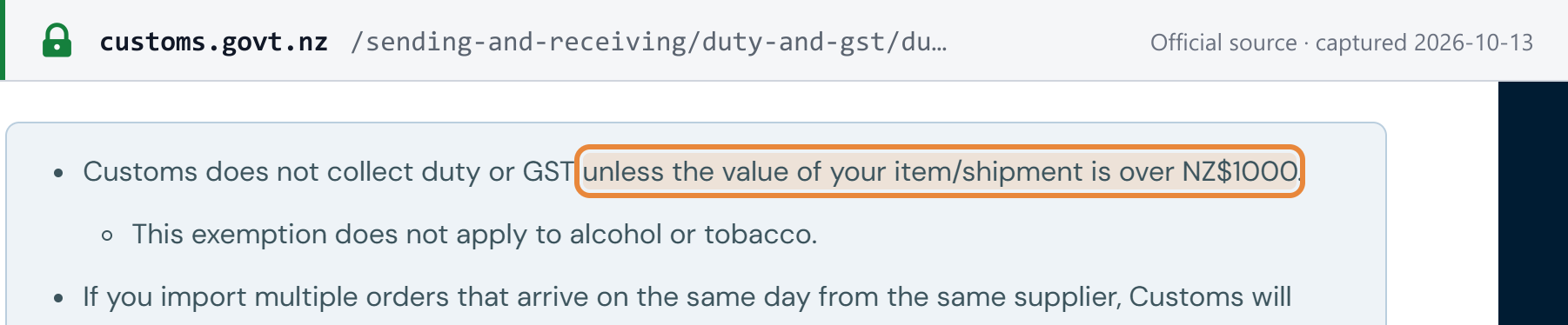
Imported goods over NZD 1,000. Customs collects GST at 15% on the price plus international freight, postage and insurance, plus any duty. "Customs does not collect duty or GST unless the value of your item/shipment is over NZ$1000." The exemption "does not apply to alcohol or tobacco." [12] A GST-registered importer claims the Customs GST using the Customs document — import entry, deferred-payment statement or broker statement — rather than as an ordinary purchase. [1]
Low-value imported goods (NZD 1,000 or less). "A low value good is a physical good valued at NZ$1,000 or less, excluding GST." Since 1 December 2019, GST on these goods sold to New Zealand consumers is collected at checkout by the registered overseas seller, marketplace or redeliverer rather than at the border. [5]

Exports are zero-rated (see Rates). Items under NZD 1,000 that need no export entry still qualify if you can prove they were exported. [15]
Reverse charge on services from non-residents
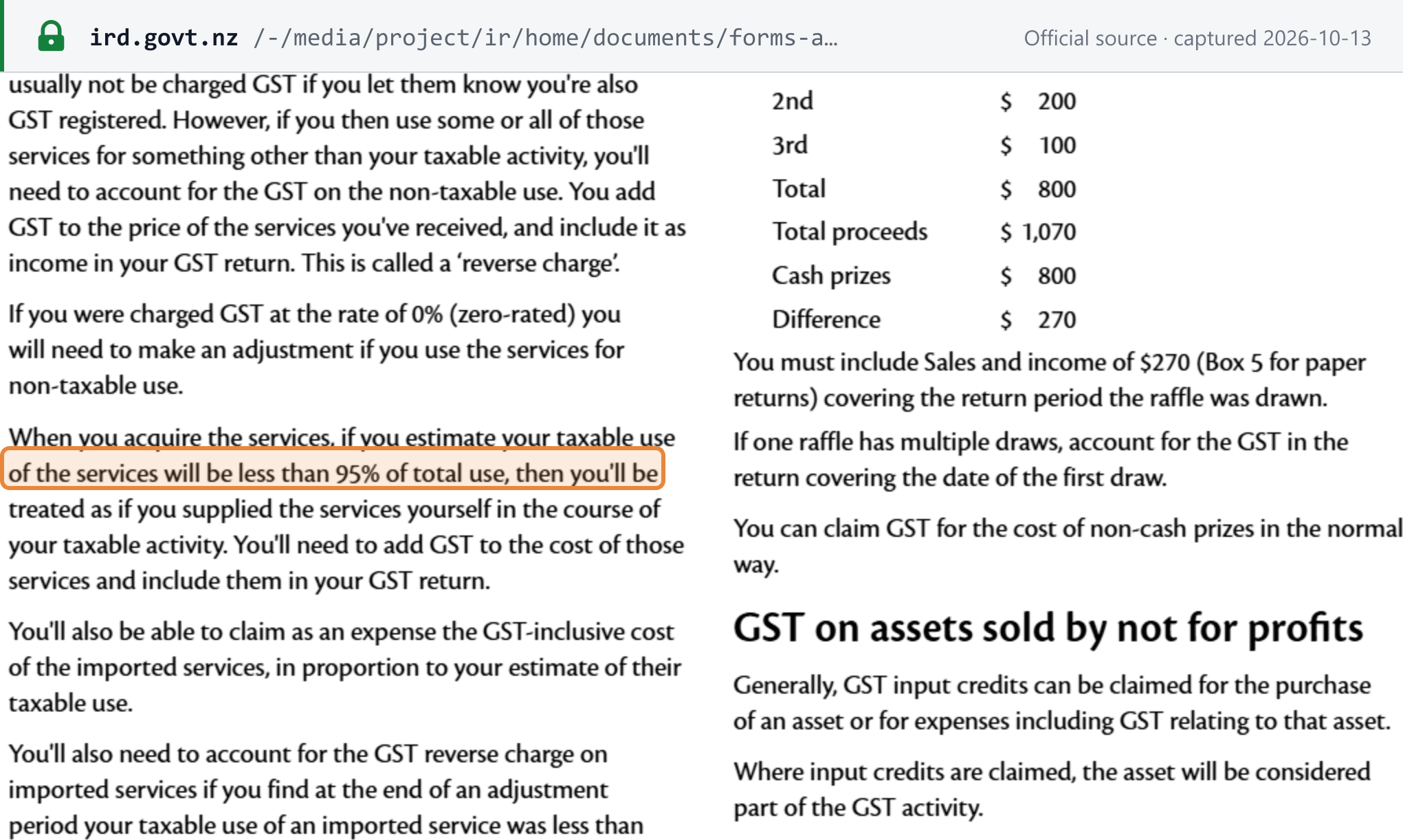
A GST-registered New Zealand business buying services from a non-resident is usually not charged GST. It self-assesses GST under the reverse charge only if it estimates its taxable use of the services will be less than 95% of total use, and it then claims back the share it uses for taxable supplies. A fully taxable business therefore usually accounts for nothing. [16] See reverse charge explained.
Digital products and services
Remote services caught by the offshore-supplier rules include e-books, films, TV and music, online newspapers, games and apps, software and software maintenance, online gambling, web design, and legal, accounting, insurance and consultancy services. To treat a customer as New Zealand-resident, a supplier needs "2 non-conflicting pieces of evidence" — for example billing address, IP address, bank details or the mobile country code of a SIM card. [4] See VAT on digital services by non-resident suppliers.
Foreign companies selling into New Zealand — B2B and B2C
- Selling to consumers (B2C): an overseas seller of remote services must register once its supplies to New Zealand customers were more than NZD 60,000 in the last 12 months or are expected to be in the next 12 months (low-value goods use the same NZD 60,000 figure), then charges 15% and files quarterly. Where a marketplace is responsible for the GST on a sale, the marketplace returns it instead of the underlying seller. [4]
- Selling to businesses (B2B): "You do not need to register for GST if you only provide remote services to New Zealand businesses that are already GST registered, and the services are for their business use." The customer handles any GST under the 95% reverse-charge rule above. Treat a customer as not registered unless they state they are GST-registered or give you their GST number or NZBN. [4]
Marketplace / platform deemed-supplier liability
New Zealand has three marketplace regimes: [4] [38] [13]
- Remote services. A marketplace such as an app store "may be required to register and return GST on supplies made through the marketplace, instead of the underlying supplier."
- Low-value goods. Only one party charges GST: the marketplace before the seller, and either of them before a redeliverer. "If an online marketplace operator is responsible for GST on a sale, then the seller will not be responsible for GST."
- Listed services (since 1 April 2024). Online marketplaces, resident or not, that facilitate ride-sharing and ride-hailing, food and beverage delivery, and short-stay and visitor accommodation must collect and pay GST of 15%, "whether the seller is GST-registered or not." [41] For sellers who are not registered, "You pass on 8.5% to sellers who are not GST-registered and pay the remaining 6.5% to us." The marketplace provides taxable supply information within 28 days of the supply.

See marketplace deemed-supplier rules for how these compare with other countries.
Place of supply
Services supplied to a non-resident are still charged at 15% where the service is received in New Zealand — Inland Revenue's examples include school tuition and tour packages. [1] "Goods located outside New Zealand, which are not going to be imported into New Zealand, are zero-rated." [15] The general place-of-supply rules are in section 8 of the Goods and Services Tax Act 1985.
Invoice requirements
New Zealand no longer requires "tax invoices". "New laws, which took effect on 1 April 2023, replaced the requirement to use tax invoices with a more general requirement to provide and keep certain records known as taxable supply information." [6]
| Old term | New term (from 1 April 2023) |
|---|---|
| Tax invoice | Taxable supply information (TSI) |
| Debit note / credit note | Supply correction information (SCI) |
| Buyer-created tax invoice | Buyer-created taxable supply information |
Existing invoice formats still comply — "You do not need to change the wording of the GST documents your business uses to reflect the new terms" — and the words "tax invoice" are no longer required. Taxable supply information can be spread across several records (invoices, contracts, bank statements) and exchanged electronically, for example by Peppol e-invoice. [6] [11]

Mandatory content
What taxable supply information must contain depends on the value of the supply, including GST: [6]
| Field | NZD 200 or less | Over NZD 200, up to NZD 1,000 | Over NZD 1,000 |
|---|---|---|---|
| Seller's name or trade name | Yes | Yes | Yes |
| Seller's GST number | — | Yes | Yes |
| Date of the invoice (or time of supply) | Yes | Yes | Yes |
| Description of the goods or services | Yes | Yes | Yes |
| Amount | Consideration | GST-exclusive amount, GST and GST-inclusive amount; or GST-inclusive amount with a statement that GST is included | Same as previous column |
| Buyer's name and one identifier (address, phone, email, trading name, NZBN or website) | — | — | Yes, if the buyer is GST-registered |
For secondhand goods bought from an unregistered seller, the buyer keeps the seller's name and address, the date, a description, the quantity and the price.
Issuance deadline
"Taxable supply information must be provided to GST registered buyers within 28 days of a request (or by an alternative date agreed to by the parties) for supplies over $200." For a sale of NZD 200 or less, you do not have to provide it to the buyer, but both parties keep records. [6] [1] Failing to do so is an offence (see Offences).

Numbering and sequencing
Inland Revenue's taxable supply information requirements do not include an invoice number or a sequential numbering rule. A correction (SCI) must, however, identify the original record — "for example, an invoice number" — so most businesses keep numbering in practice. [29]
Credit and debit notes
"A seller must provide supply correction information to correct an error in the original taxable supply information, or filed return" — for example after a return, a cancellation or a wrong price, rate or description. It shows the seller's name and GST number, the date, details identifying the original record, and the correction including the tax amount. It is not needed for a discount or rebate agreed in writing or already set out in the original record. "You must include the supply correction information in the GST return for the period it was provided in." [29]
Currency and language
- Currency. "If you are paid for goods or services in a foreign currency, convert the amount to New Zealand dollars using the exchange rate for the date of the GST time of supply." (IR546, p.13) [16]
- Language. "Records must be in English or Māori unless Inland Revenue has approved keeping your records in another language." (IR375, p.8) [1]
Document types
There is one record type — taxable supply information — whose required content steps up at NZD 200 and NZD 1,000 (see Mandatory content). There is no separate "simplified invoice": the NZD 200-or-less band plays that role.
Self-billing
Permitted without approval: "Where both parties agree, any GST registered buyer purchasing from a GST registered seller can provide buyer-created taxable supply information. You do not need our approval." The record must carry the usual content plus both parties' GST numbers, and both keep a copy. Arrangements approved before 1 April 2023 continue. [30]
Retention and audit trail
- Retention: 7 years. "You must keep records of all cash and electronic sales and purchases for 7 years." [40] For computer records, "it's the same rule for paper or electronic media". [31]
- Electronic records must be "retrievable and readable at all times". For computer-assisted audits, keep transaction-level records (general ledger and journals), the chart of accounts and system documentation; Inland Revenue accepts delimited text, Access, DBF, print and XML files. [31]
- Input-tax link. "You are only entitled to claim GST for purchases and expenses for which you hold taxable supply information." (IR375, p.7) [1]
- Integrity. There is no tamper-evidence or hash-chain rule for invoices; the closest rule is the offence of making, supplying or possessing electronic sales-suppression tools (see Offences).

A specimen of a compliant invoice
Inland Revenue publishes no annotated specimen. Below, Lookuptax lays out the fields for a domestic B2B sale over NZD 1,000 to a GST-registered buyer, the band with the most required fields. Every name, number and amount is fictional:
Invoice — taxable supply information (over NZD 1,000)
| Descriptionrequired | Amount (excl. GST) |
|---|---|
| Kitchen cabinetry, supply and install | NZD 4,000.00 |
| Benchtop, engineered stone | NZD 1,000.00 |
- Total excluding GSTrequired over NZD 200
- NZD 5,000.00
- GST at 15%required over NZD 200
- NZD 750.00
- Total including GST
- NZD 5,750.00
- The words "tax invoice" are not required since 1 April 2023.
- Alternatively, show only the GST-inclusive total with a statement that GST is included, where every item is standard-rated.
- For a supply of NZD 200 or less, the GST number, GST amounts and buyer details may be left out.
- Addresses, quantities and unit prices are not required fields; add them if your business needs them.
- Provide to a GST-registered buyer within 28 days of a request. Keep for 7 years.
E-invoicing status
Status (as at 2026-10-13): voluntary for businesses; required for government agencies. New Zealand has no B2B or B2C e-invoicing mandate and no clearance or real-time reporting system. Inland Revenue receives no invoice data: "Information is exchanged through the Peppol network using the software business specifications for eInvoicing. Inland Revenue does not receive this information." [11]
- Network. Peppol. New Zealand and Australia take a joint approach to e-invoicing using Peppol; see the Australia Peppol guide.
- B2G — Government Procurement Rule 44. Agencies that receive (or send) more than 2,000 domestic trade invoices a year must be able to receive (or send) e-invoices by 1 January 2026. Agencies must also require large suppliers to submit e-invoices from 1 January 2027. A supplier is large if "in each of the two preceding accounting periods the total revenue of the entity and its subsidiaries (if any) exceeds $33 million." [9]
- Payment times — Rule 36. "Agencies must pay 95% of: domestic trade eInvoices within 5 business days other domestic trade invoices within 10 business days." [10]
- Scope. These are procurement rules that bind government agencies; they reach suppliers through agency contracts, not through tax law.
- Format. The technical specifications are published on the government e-invoicing site, einvoicing.govt.nz.

For New Zealand alongside other countries, see the e-invoicing status and networks table.
Filing and payment
Filing frequency
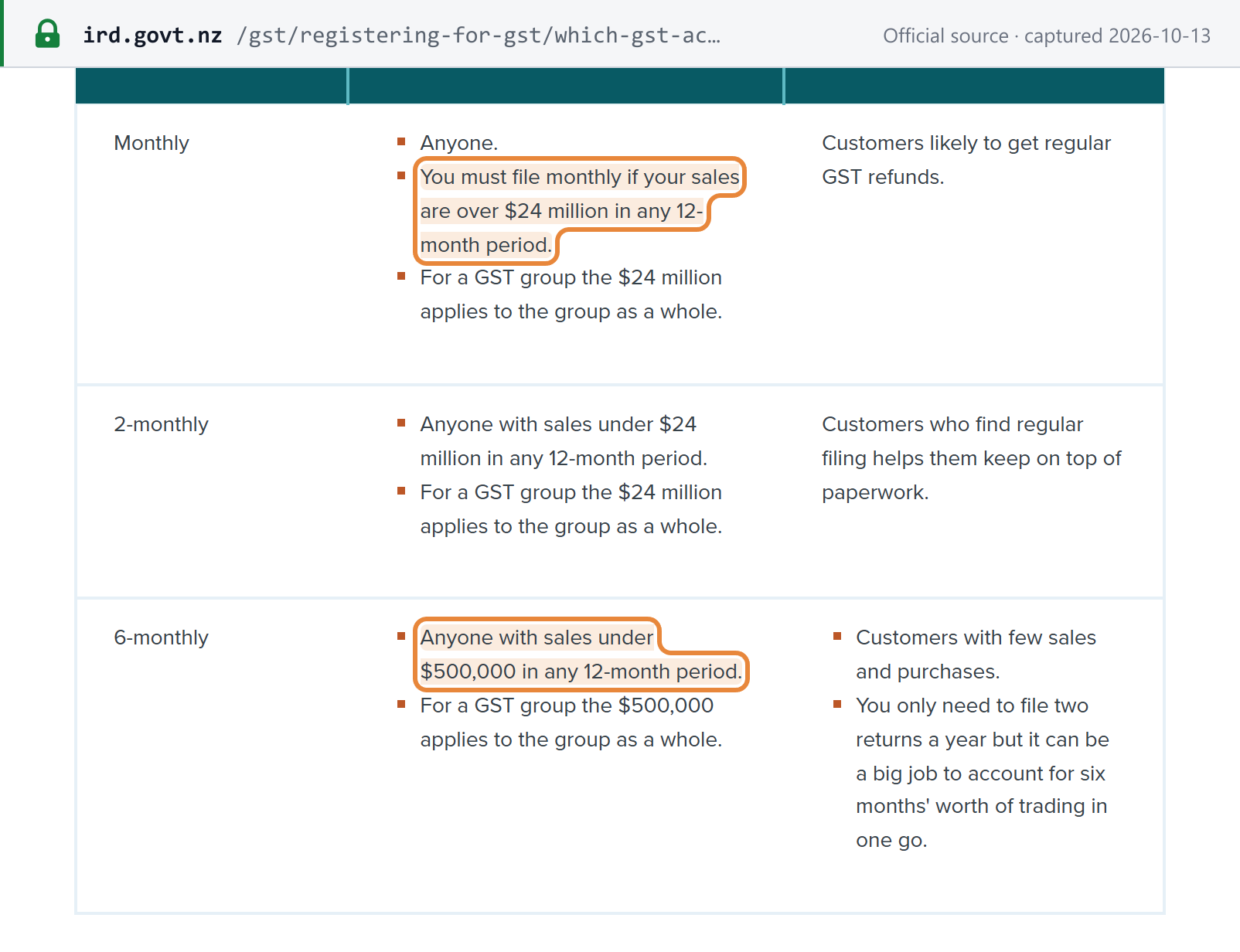
| Frequency | Who can use it |
|---|---|
| Monthly | Anyone; mandatory if sales are over NZD 24 million in any 12 months |
| Two-monthly | Sales under NZD 24 million; the default if you do not choose |
| Six-monthly | Sales under NZD 500,000 in any 12 months |
| Quarterly | Overseas businesses registered under the remote-services, low-value-goods or listed-services rules |
"You must file monthly if your sales are over $24 million in any 12-month period." GST groups measure sales at group level. [8] [1]
Accounting basis. The payments basis (cash) is available if total sales are NZD 2 million or less in the last 12 months. The invoice basis is open to anyone and is the default; the hybrid basis (invoice for sales, payments for expenses) is also open to anyone. [8]
Return due date
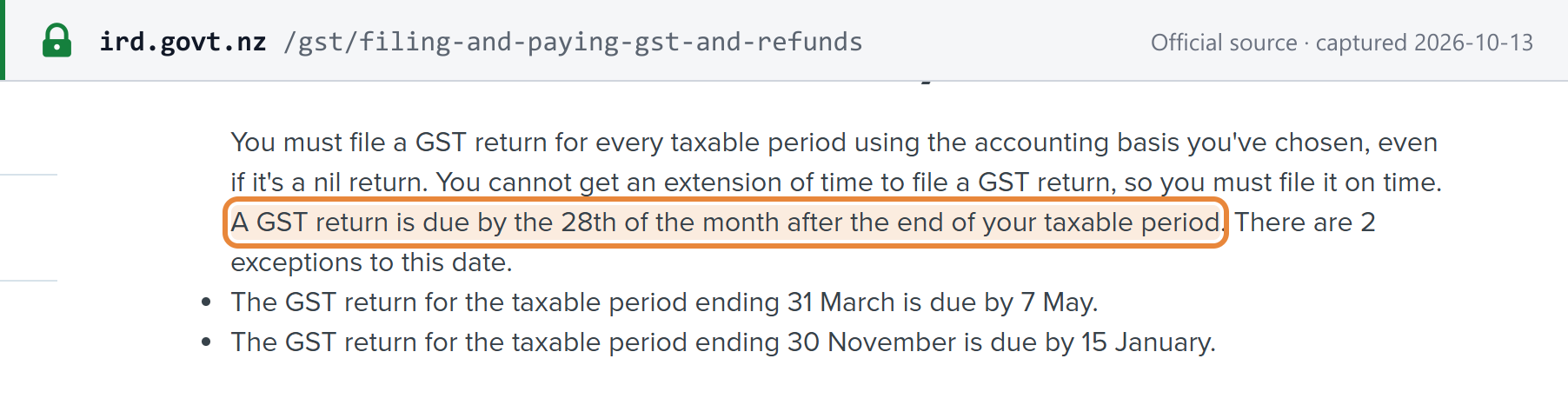
"A GST return is due by the 28th of the month after the end of your taxable period", with two exceptions: [7]
- a period ending 30 November is due by 15 January;
- a period ending 31 March is due by 7 May.
A due date on a weekend or public holiday moves to the next working day. Nil returns must still be filed, and "You cannot get an extension of time to file a GST return." [7] [1]
Payment due date and method
"Your GST payment is due on the same day as your GST return." Pay through myIR or the other methods Inland Revenue lists; overseas businesses can pay from overseas. [39]
Additional listings
None. Inland Revenue's GST guidance describes no annual GST return, sales or purchase listing, or EC-sales-list equivalent.
Input-tax recovery and blocked items
- Holding records. You can claim only where you hold taxable supply information (see Retention and audit trail).
- Mixed use. For purchases of NZD 10,000 or less (excluding GST) you can use the principal-purpose method (a full claim or none) or apportion; above NZD 10,000 you must apportion. [1]
- Entertainment. "You'll need to make a GST adjustment of 15% of the GST-exclusive non-deductible amount once a year" — the share that is not deductible for income tax, usually 50%. (IR375, p.34)
- Exempt use. GST on costs used to make exempt supplies cannot be claimed (see Exemptions).
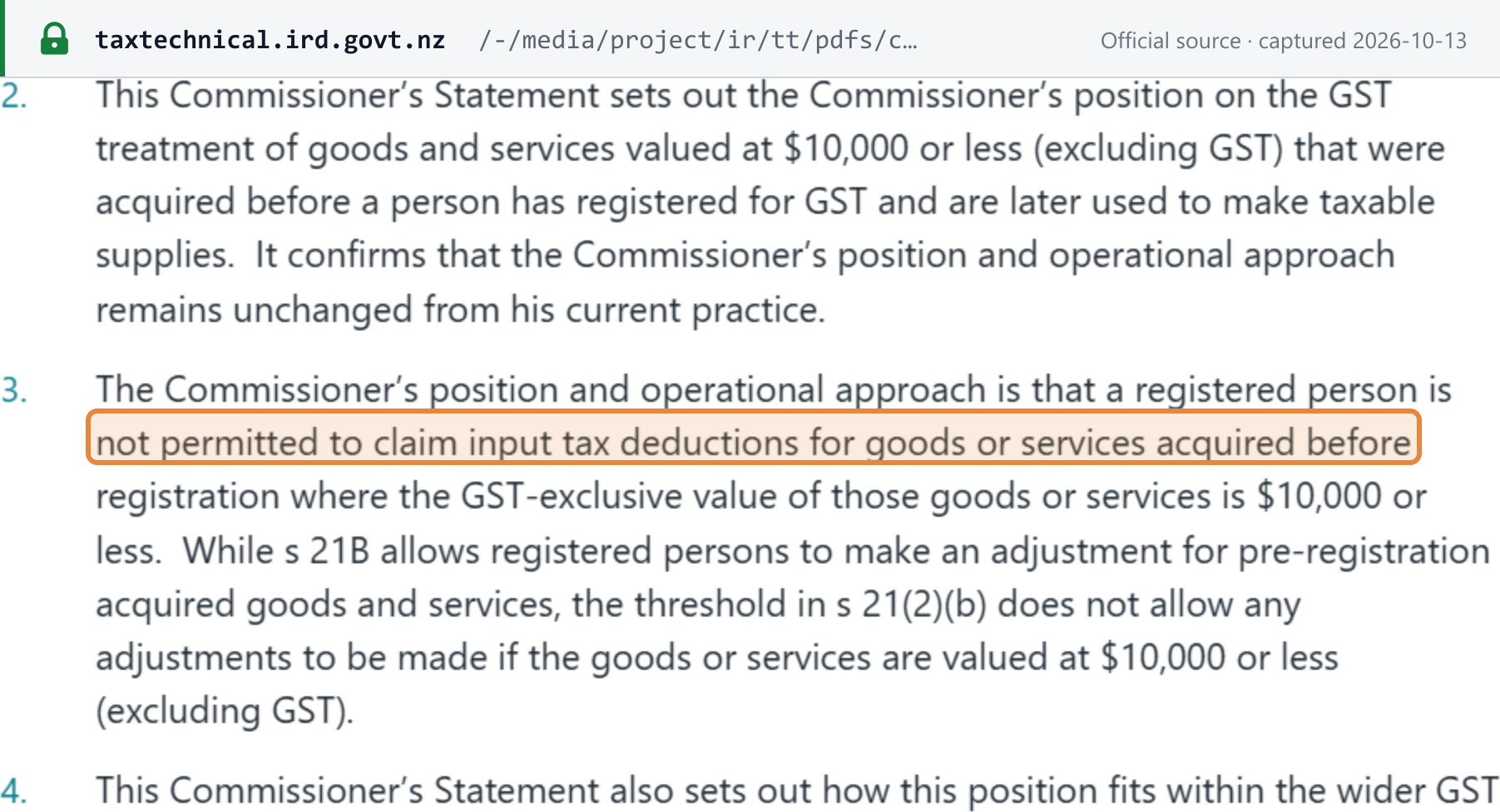
- Before registration. Inland Revenue's position in CS 26/02 (22 May 2026) is that "a registered person is not permitted to claim input tax deductions for goods or services acquired before registration where the GST-exclusive value of those goods or services is $10,000 or less." [25] The Bill introduced on 10 September 2026 would introduce new pre-registration rules from 1 April 2027; it is not law yet (see the event record).
Refunds
- Residents. Refunds are paid "within 15 working days from when we get your return". A refund under NZD 5 is carried forward. Inland Revenue pays interest on overpayments of more than NZD 100 (see Penalties). [32]
- Non-residents. A business with no New Zealand taxable supplies can register as a non-resident business claimant if its first-period refund will be more than NZD 500. Non-resident registered businesses do not need a New Zealand bank account. [3] [32]
- Bad debts. Claim a credit adjustment in the period the debt is written off: "You must write off the debt(s). You cannot claim for provision for bad debts." (IR375, p.36)
Exemptions
Exempt supplies
"Exempt supplies are goods and services which are not subject to GST. You do not include these supplies in your GST return." [14] They include:
- financial services — interest, loans, bank fees, securities, credit, currency exchange, and arranging these;
- renting a residential dwelling, and selling a dwelling that has been rented out for five years or more as part of a taxable activity;
- residential accommodation under a head lease;
- donated goods and services sold by non-profit bodies;
- penalty interest on overdue accounts;
- fine metal sold by a dealer, or imported by anyone.
Exempt is not zero-rated. A zero-rated supply goes in your return at 0% and you can claim GST on the costs of making it. An exempt supply stays out of the return and you cannot claim GST on its costs: "GST cannot be charged on the rent for a residential dwelling. A landlord cannot claim any GST on dwelling expenses, such as maintenance, rates and insurance." [14]

Special regimes
- Payments basis for businesses with sales of NZD 2 million or less (see Filing frequency).
- Commercial accommodation taxed on 60% of value after 4 weeks (see Rates).
- Listed-services flat-rate credit of 8.5% for unregistered sellers on marketplaces (see Marketplace / platform deemed-supplier liability).
- Secondhand goods bought from unregistered sellers can carry an input-tax claim.
- Free zones and flat-rate small-business schemes: Inland Revenue's GST guidance describes none.
Offences and penalties
Offences
Inland Revenue groups tax crimes into levels; "A conviction for tax crime can mean a fine, and in serious cases you can go to prison." [21]
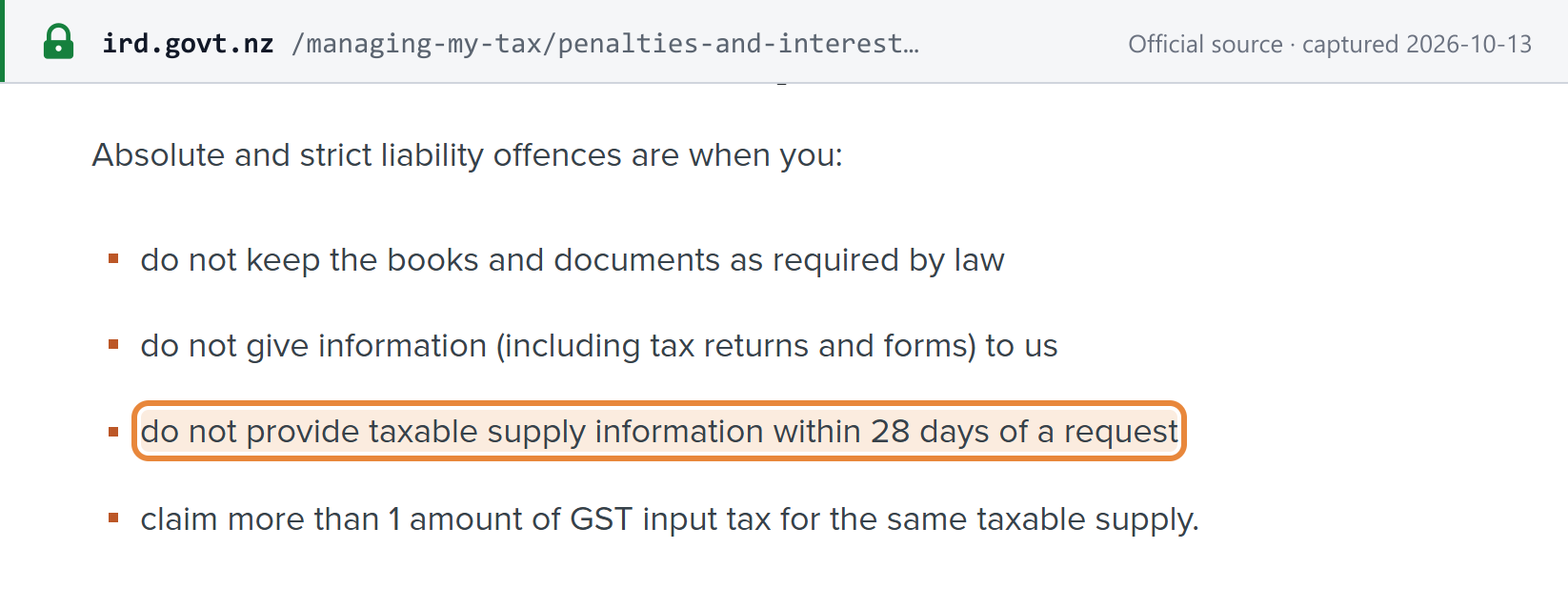
- Absolute and strict liability offences — not keeping the required records; not filing returns or giving information; not providing taxable supply information within 28 days of a request; claiming GST input tax more than once for the same supply.
- Knowledge offences — knowingly failing to keep records or give information; giving altered, false, incomplete or misleading information.
- Evasion offences — acting to evade assessment or payment, or to obtain a refund you are not entitled to. Inland Revenue may prosecute instead of charging the evasion penalty, which "could mean imprisonment for up to five years and a fine of up to $50,000." [19]
- Electronic sales-suppression tools — making or supplying them carries a criminal penalty of up to NZD 250,000; acquiring or possessing one, a civil penalty of up to NZD 5,000 or a criminal penalty of up to NZD 50,000.
- Obstructing Inland Revenue, and aiding or abetting an offence.
Fine amounts for the absolute-liability and knowledge offences are set in the Tax Administration Act 1994; Inland Revenue's penalty pages do not state them.
Penalties
| Penalty | Amount |
|---|---|
| Late filing | NZD 50 per return on the payments basis; NZD 250 on the invoice or hybrid basis [17] |
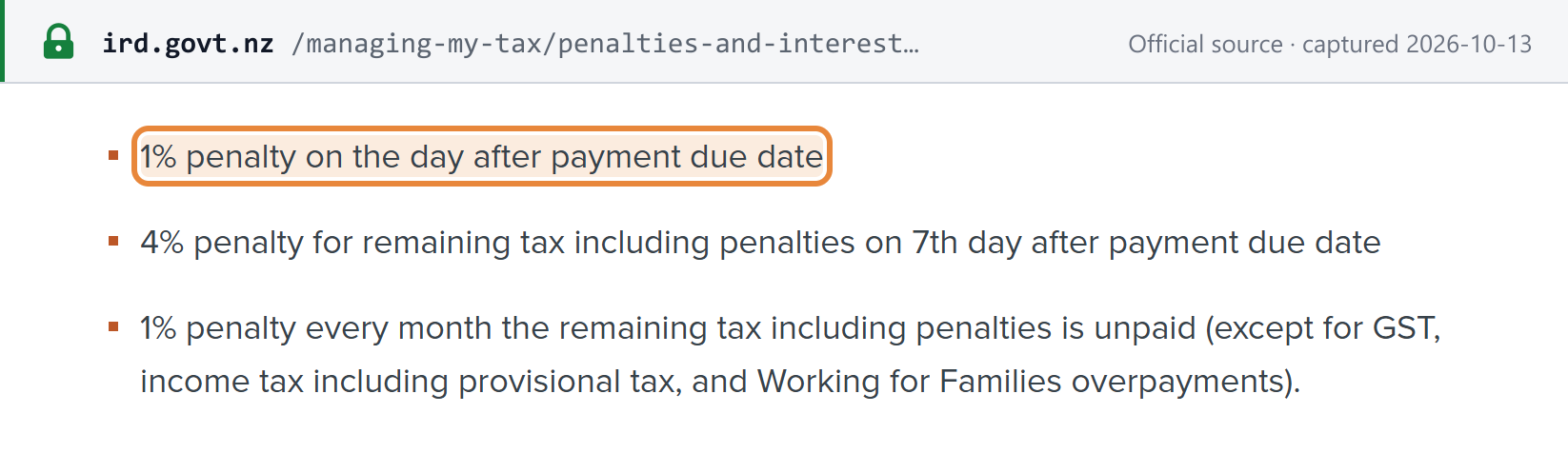
| Late payment | 1% the day after the due date, then a further 4% on the 7th day on the amount still unpaid, including penalties. The monthly 1% incremental penalty that applies to other taxes does not apply to GST. [18] |
| Shortfall (an incorrect return) | Not taking reasonable care 20%; gross carelessness 40%; abusive tax position 100%; evasion 150% of the shortfall. Can increase by 25% for obstruction. [19] |
| Use-of-money interest | From 16 January 2026: 8.97% charged on underpaid tax and 2.25% paid on overpaid tax, calculated daily and not compounded; no interest on amounts under NZD 100. [20] |
| Late registration | Inland Revenue publishes no separate penalty for registering late. |


Frequently asked questions
We are an overseas software company with New Zealand customers. Do we need to register for GST?
Only if your supplies to New Zealand customers were more than NZD 60,000 in the last 12 months or are expected to be in the next 12 months. Once registered you charge 15% GST and file returns quarterly. You do not need to register if you only supply GST-registered New Zealand businesses for their business use. Treat a New Zealand customer as not registered unless they tell you they are, or give you their GST number or New Zealand Business Number.
We bought equipment before registering for GST. Can we claim the GST back in our first return?
Not if the item cost NZD 10,000 or less excluding GST. Inland Revenue's Commissioner's statement CS 26/02 of 22 May 2026 says input tax cannot be claimed on goods or services bought before registration at that value or below. A Bill introduced on 10 September 2026 would bring in new rules for pre-registration purchases from 1 April 2027, but as at 12 October 2026 it was at select committee and is not law.
Do New Zealand invoices still have to say 'Tax invoice'?
No. Since 1 April 2023 the requirement is to provide and keep taxable supply information, and the words 'tax invoice' are no longer required. For a sale of NZD 200 or less you do not have to provide it to the buyer. Above NZD 200 it must show your GST number and either the GST amounts or a GST-inclusive total with a statement that GST is included. Above NZD 1,000 it must also show the buyer's name and one identifier, such as an address, email or NZBN, if the buyer is GST-registered. Provide it within 28 days of a registered buyer's request.
When is a New Zealand GST return due?
By the 28th of the month after the end of the taxable period, with payment due the same day. There are two exceptions: a period ending 30 November is due by 15 January, and a period ending 31 March is due by 7 May. A due date on a weekend or public holiday moves to the next working day. Inland Revenue does not grant extensions of time for GST returns.
Do I charge GST on residential rent or on short-stay accommodation booked through a platform?
Rent for a residential dwelling is exempt: no GST is charged, and the landlord cannot claim GST on dwelling expenses. Short-stay accommodation booked through an online marketplace is a listed service: since 1 April 2024 the marketplace collects 15% GST, and for hosts who are not GST-registered it passes 8.5% back as a flat-rate credit and pays the remaining 6.5% to Inland Revenue.
Is e-invoicing mandatory in New Zealand?
Not between businesses or for consumers, as at 13 October 2026, and Inland Revenue receives no invoice data. The rule is for government buyers: agencies receiving more than 2,000 domestic trade invoices a year had to be able to receive e-invoices by 1 January 2026, and must require large suppliers, with revenue over NZD 33 million in each of the two preceding accounting periods, to submit e-invoices from 1 January 2027 (Government Procurement Rule 44).
Important websites
| Site | Purpose |
|---|---|
| myIR | Register for GST, file returns and pay (New Zealand businesses) |
| Register for GST as an overseas business | Registration for remote-services, low-value-goods and listed-services suppliers |
| Inland Revenue — GST | Rate, registration, returns and refunds guidance |
| Inland Revenue — Key dates | GST due-date calendar |
| Paying from overseas | Payment methods for non-resident registrants |
| NZBN verification | Check a New Zealand Business Number (Inland Revenue offers no public GST-number lookup) |
| Customs — What's my duty estimator | Estimate duty and GST on imported goods |
| einvoicing.govt.nz | Government e-invoicing information and Peppol set-up |
| Government Procurement Rules | Rules 36 and 44 on e-invoicing and payment times for agencies |
Recent changes
- 2026-10-12 — The Taxation (Annual Rates for 2026–27, FBT Simplification, Foreign Investment Funds, and Remedial Measures) Bill, introduced 10 September 2026, is at select committee. Its GST items include zero-rating residential solar exports from 1 April 2027, new pre-registration input-tax rules from 1 April 2027, optional registration for non-residents making only zero-rated services to non-residents, Inland Revenue power to move ineligible six-monthly filers to two-monthly, and consolidated rules for correcting GST errors. Not law. (Inland Revenue) — see events: solar exports, registration and filing
- 2026-05-22 — Commissioner's statement CS 26/02: no input tax on pre-registration purchases of NZD 10,000 or less. (Inland Revenue)
- 2026-05-22 — Officials' issues paper Current GST issues published for consultation (closed 29 June 2026); ministers have not yet made decisions. (Inland Revenue)
- 2026-04-01 — Non-resident visitors making only certain zero-rated services can choose not to register; unincorporated joint-venture members can account for GST individually (Act of 30 March 2026). (Inland Revenue)
- 2026-01-01 — Government agencies receiving more than 2,000 invoices a year must be able to receive e-invoices (Procurement Rule 44); large suppliers to agencies must send e-invoices from 1 January 2027. Rule 36 requires agencies to pay 95% of e-invoices within 5 business days. (NZ Government Procurement)
- 2024-04-01 — Marketplaces collect GST on ride-sharing, food delivery and short-stay accommodation (listed services). (Inland Revenue)
- 2023-04-01 — Taxable supply information replaces tax invoices. (Inland Revenue)
For the full chronology, see New Zealand tax changes on Lookuptax.
Reference links
- Inland Revenue — IR375 GST guide (March 2026, PDF)
- Inland Revenue — Registering for GST
- Inland Revenue — GST for overseas businesses
- Inland Revenue — Supplying remote services into New Zealand
- Inland Revenue — GST on low-value imported goods
- Inland Revenue — Taxable supply information · How taxable supply information works
- Inland Revenue — Filing and paying GST and refunds
- Inland Revenue — Which GST accounting basis and filing frequency should I use
- NZ Government Procurement — Rule 44, eInvoicing capability
- NZ Government Procurement — Rule 36, prompt payment times
- Inland Revenue — eInvoicing
- New Zealand Customs Service — Duty and allowances
- Inland Revenue — GST obligations for marketplaces (listed services) · Marketplace rules for listed services
- Inland Revenue — Exempt supplies
- Inland Revenue — Zero-rated supplies
- Inland Revenue — IR546 GST Plus (March 2026, PDF)
- Inland Revenue — Late filing penalties
- Inland Revenue — Late payment penalties
- Inland Revenue — Shortfall penalties
- Inland Revenue — Interest on overpayments and underpayments
- Inland Revenue — Criminal penalties
- Inland Revenue Tax Policy — 2026–27 annual rates, FBT simplification and remedial measures Bill
- Inland Revenue Tax Policy — Commentary on the Bill (September 2026, PDF)
- Inland Revenue Tax Policy — Commentary on the Taxation (Annual Rates for 2025–26, Compliance Simplification, and Remedial Measures) Act 2026 (PDF)
- Inland Revenue Tax Technical — CS 26/02 (22 May 2026)
- Inland Revenue Tax Technical — GST rate increase to 15% (Taxation (Budget Measures) Act 2010)
- Inland Revenue — Registering for GST as a group
- Inland Revenue — When to cancel your GST registration
- Inland Revenue — Supply correction information (credit and debit notes)
- Inland Revenue — Buyer-created taxable supply information
- Inland Revenue — Computer record keeping for audit
- Inland Revenue — GST refunds
- Inland Revenue — Register for GST
- Inland Revenue Tax Policy — Current GST issues (issues paper, May 2026)
- Inland Revenue — Registering for GST voluntarily
- Inland Revenue — Your final GST return
- Inland Revenue — Special types of GST registration
- Inland Revenue — Who needs to charge GST on low-value imported goods
- Inland Revenue — Paying GST
- Inland Revenue — Records of income and expenses
- Inland Revenue — GST on listed services
Related on Lookuptax: