Nigeria VAT guidelines
| FACTSHEET | |
|---|---|
| Country code | NG |
| Tax name | Value Added Tax (VAT) |
| Tax Authority | Nigeria Revenue Service (NRS) |
Overview
Nigeria levies Value Added Tax (VAT). Since 1 January 2026 it has been imposed by Chapter Six of the Nigeria Tax Act, 2025 (Act No. 7 of 2025): "Value Added Tax (VAT) is imposed in accordance with the provisions of Chapter Six of this Act" (s.144). Section 203 provides that the Act "shall come into effect on the first day of January, 2026", and section 196(k) repeals the old Value Added Tax Act, Cap. V1, Laws of the Federation of Nigeria 2004. [1] English is the official language; the tax has no separate local-language name.
Authority. VAT is administered by the Nigeria Revenue Service (NRS), established under the Nigeria Revenue Service (Establishment) Act, 2025. NRS states that this Act "replaces the Federal Inland Revenue Service (Establishment) Act, 2007" — the NRS is the former Federal Inland Revenue Service (FIRS). [20] Registration, returns and penalties are governed by the Nigeria Tax Administration Act, 2025.
Currency. Amounts are in Nigerian naira (NGN, ₦). NRS's withholding guidelines state that "VAT should be remitted in the currency in which it was assessed." [7]
Tax period. The calendar month — returns are monthly (see Filing and payment). The Act defines the year of assessment as "1 January to 31 December of any year". [1]
Layering. None for the taxpayer: VAT is a single national tax at a single standard rate, collected by the NRS.

Registration
Who should register
Section 145 of the Nigeria Tax Act charges VAT "on all taxable supplies in Nigeria", subject to the exemptions in the Act. [1] NRS summarises who must register:
"All businesses above the exemption threshold that supply taxable goods and services in Nigeria are required to register for VAT, charge VAT and render a return on or before the 21st day of the month following transaction with the NRS. This includes companies, partnerships, sole proprietors, and non-resident suppliers providing digital or physical goods/services to Nigerian customers." [2]
Registration threshold
The VAT chapter of the Nigeria Tax Act sets no registration threshold (checked 2026-10-13). Instead, small businesses are exempt: NRS states that "Small companies are exempted from filing and paying VAT". The NRS VAT page refers to "the exemption threshold" but does not state its amount (checked 2026-10-13). [2]
Non-resident registration
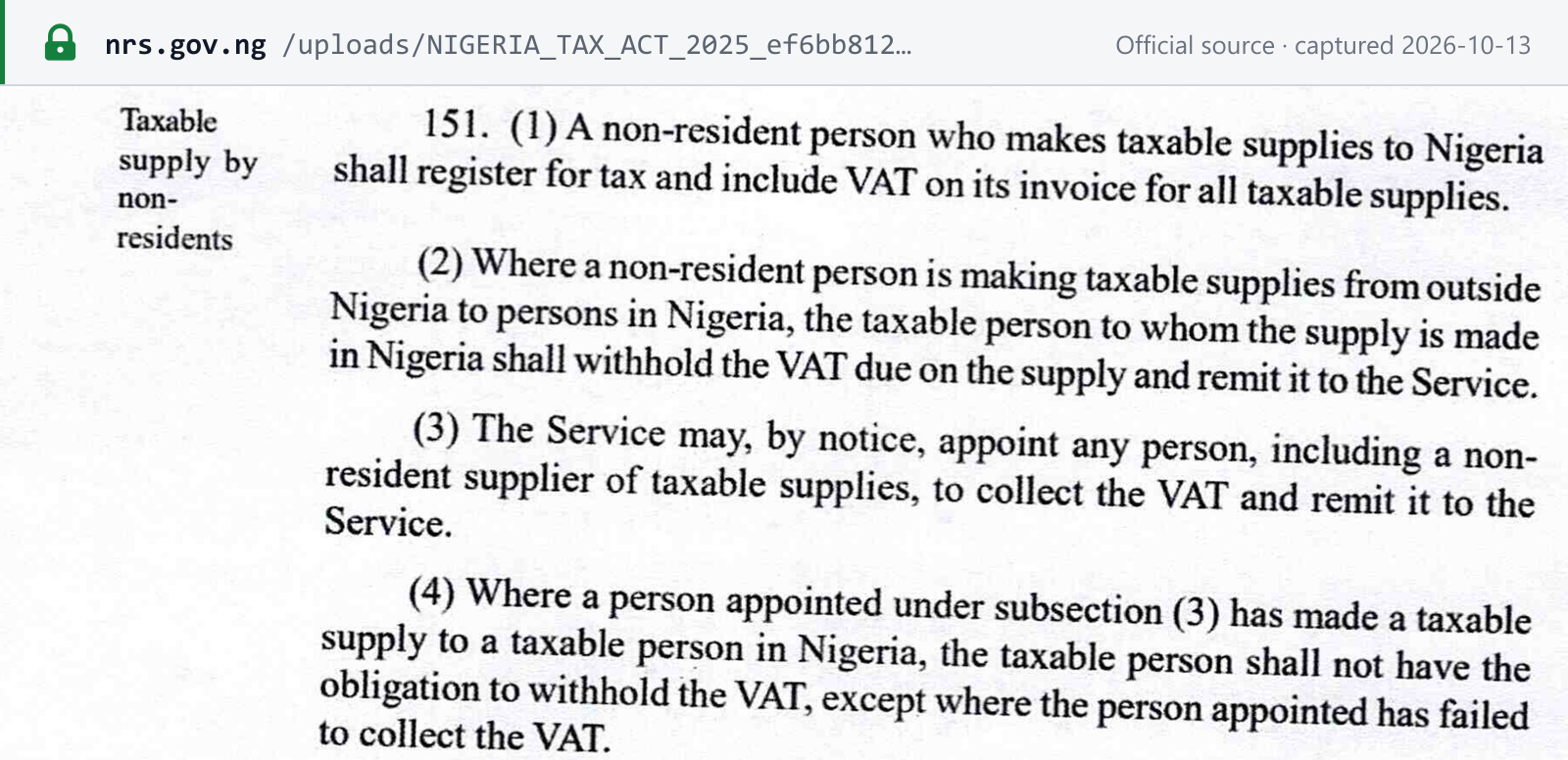
There is no threshold for non-residents. Section 151(1) of the Nigeria Tax Act: "A non-resident person who makes taxable supplies to Nigeria shall register for tax and include VAT on its invoice for all taxable supplies." [1] NRS repeats this wording on its VAT page. [2]
- A non-resident "may appoint a representative for the purpose of compliance with its VAT obligations" (s.151(6)).
- The NRS may, by notice, appoint any person, including a non-resident supplier, to collect the VAT and remit it (s.151(3)).
- How collection works in practice depends on who the customer is — see Foreign companies selling into Nigeria.
NRS has not published a separate non-resident registration route or form on the sources we reached (checked 2026-10-13).
Tax identification number
Nigeria uses a single Tax ID for all taxes. NRS describes it as "a unique, system-generated number assigned to all taxable persons in Nigeria for the purpose of tax administration". From 1 January 2026 the Tax ID is 13 digits, and "The use of the new Tax ID becomes effective from January 1, 2026, replacing previously issued TINs." [3]
- An individual's Tax ID is linked to their 11-digit National Identification Number (NIN); a company's is linked to its Corporate Affairs Commission (CAC) registration number. The NIN or CAC number is the key for retrieving the Tax ID, not a substitute for it. [3]
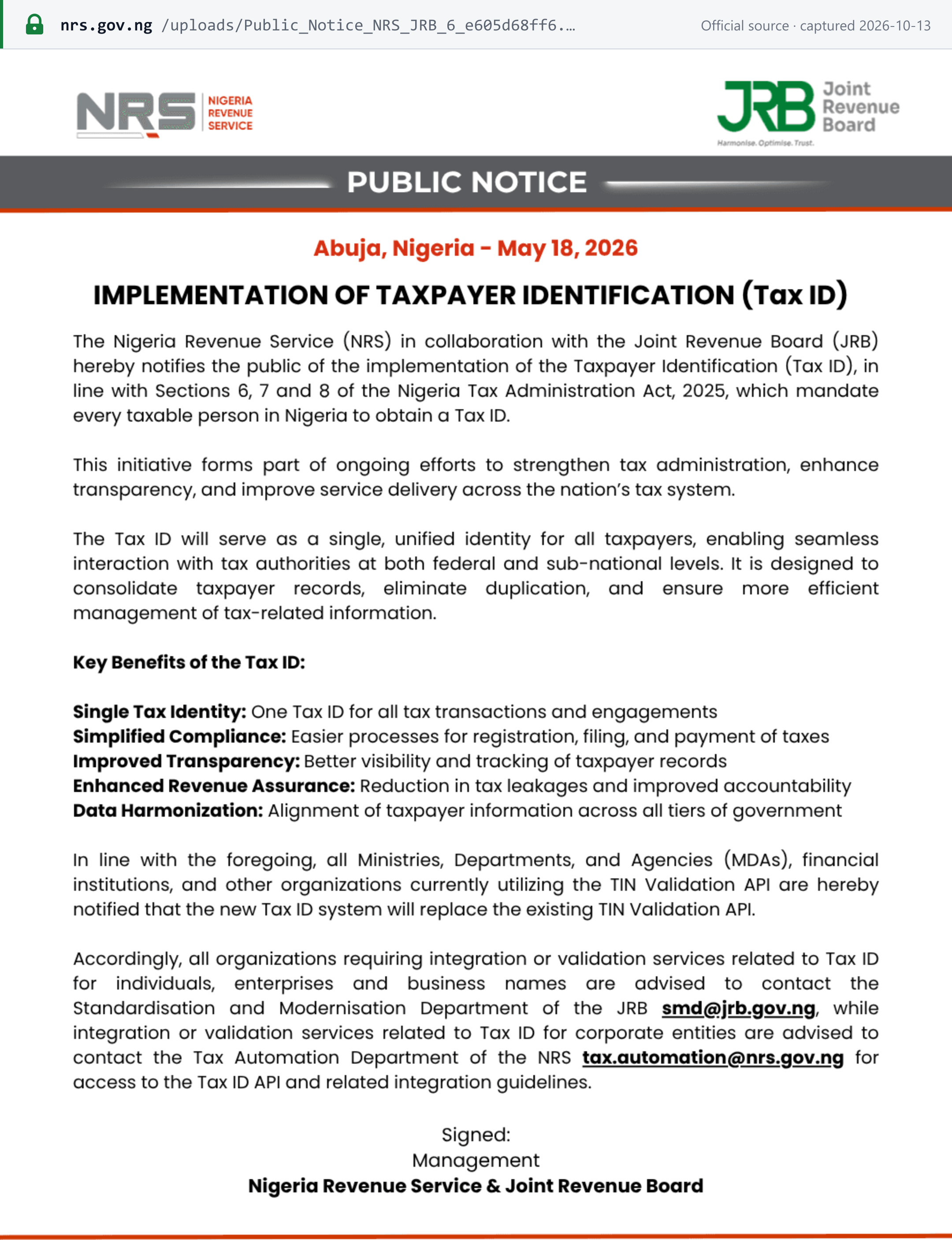
- Retrieve a Tax ID on the Nigerian Tax ID Portal. A joint NRS/Joint Revenue Board notice of 18 May 2026 states that "the new Tax ID system will replace the existing TIN Validation API". [4]
- The supplier's Tax ID is the first mandatory particular on a VAT invoice (see Invoice requirements).
For format details and validation, see the Nigeria tax ID guide or check a number with the Nigeria Tax ID validator.
How to register
Register, file and pay on the NRS Taxpayer Self-Service Portal (Rev360) at selfservice.nrs.gov.ng. NRS scheduled Rev360 to go live on 30 April 2026, and published its user manual on 21 April 2026. [21] [22] NRS's portal page invites taxpayers to "Register to start fulfilling your tax obligations" and "File and pay your taxes online". [5]
The documents NRS lists for VAT are: VAT invoices for all sales and purchases; the "Monthly VAT return form (VAT 002)"; proof of payment (if paid at a bank); and the Tax ID. [2] NRS does not publish a processing time for registration (checked 2026-10-13).
Voluntary registration
NRS's VAT guidance does not describe a voluntary-registration route for small companies that are exempt (checked 2026-10-13).
Deregistration
NRS's VAT guidance publishes no VAT deregistration procedure or final-return rule (checked 2026-10-13).
Group registration
Not available. No VAT group registration provision appears in the Nigeria Tax Act 2025 (checked 2026-10-13). Each taxable person registers and files on its own Tax ID.
Rates
| Rate | Applies to |
|---|---|
| 7.5% | Standard rate on the value of all taxable supplies (Nigeria Tax Act s.148, from 1 January 2026) |
| 0% (zero-rated) | Basic food items, medical and pharmaceutical products, educational books, exports (other than oil and gas) and the other supplies listed below (s.187) |
| Exempt | Oil and gas exports, land and buildings, money and securities, baby products and the other supplies listed under Exemptions (s.186) |
| Not collected until a ministerial order | Petroleum products, renewable energy equipment, compressed natural gas, liquefied petroleum gas and other gaseous hydrocarbons (s.186(2), Eleventh Schedule) |
Standard rate. Section 148: "VAT shall be charged on the value of all taxable supplies at the rate of 7.5%." [1] NRS: "The standard VAT rate is 7.5%". [2] There is no reduced rate.

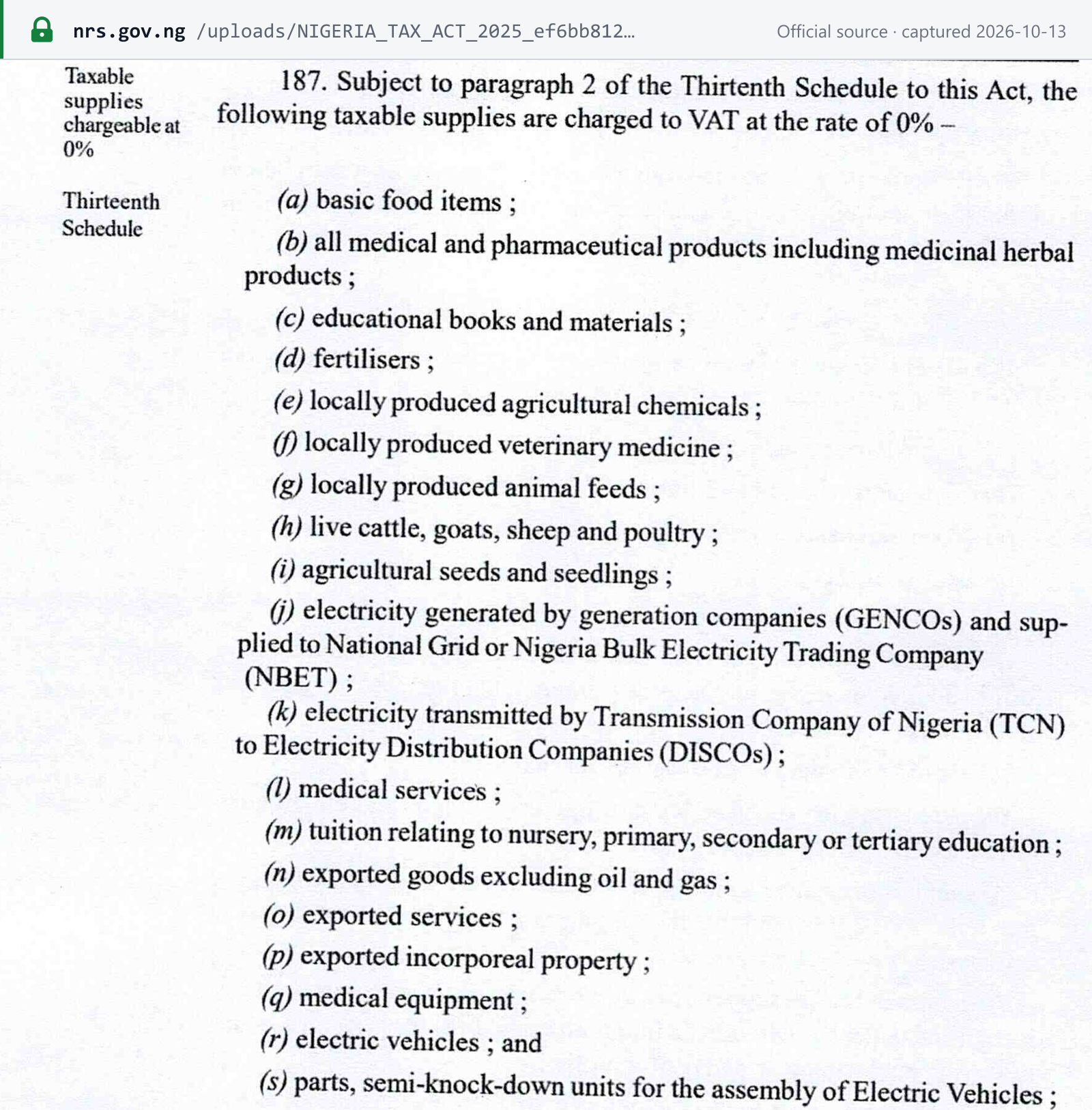
Zero-rated supplies (0%). Section 187 opens "Subject to paragraph 2 of the Thirteenth Schedule to this Act" and lists: [1]
- basic food items; all medical and pharmaceutical products, including medicinal herbal products; educational books and materials;
- fertilisers; locally produced agricultural chemicals, veterinary medicine and animal feeds; live cattle, goats, sheep and poultry; agricultural seeds and seedlings;
- electricity generated by generation companies and supplied to the National Grid or the Nigeria Bulk Electricity Trading Company; electricity transmitted by the Transmission Company of Nigeria to distribution companies;
- medical services; tuition for nursery, primary, secondary and tertiary education;
- exported goods (excluding oil and gas), exported services and exported incorporeal property;
- medical equipment; electric vehicles; and parts and semi-knock-down units for assembling electric vehicles.
"Basic food items" are defined in section 189 and cover, among others, bread and cereals, cooking oils, fish, fruit, meat and eggs, milk, nuts, pulses, tubers, culinary salt, vegetables and water. The water item excludes sparkling or flavoured water; water sold in restaurants, hotels, eateries, lounges, cafes, canteens and similar settings; and water sold by contractors, caterers or similar persons (gazette p. A496).
Items on which VAT is not yet collected. Under section 186(2) and paragraph 1 of the Eleventh Schedule, VAT is not collected on petroleum products (automotive gas oil, aviation turbine kerosene, premium motor spirit, household kerosene and locally produced liquefied petroleum gas), renewable energy equipment, compressed natural gas, liquefied petroleum gas and other gaseous hydrocarbons until the Minister specifies a collection date by order in the Official Gazette. [1]
Announced changes. None. No rate change had been announced as at 2026-10-13.
Cross-border rules
Imports and exports
- Imports. The value of an imported taxable supply is its price plus taxes, duties and other charges levied outside Nigeria or because of importation (other than Nigerian VAT), plus commission, parking, transport and insurance up to the port or point of entry (s.150). "An importer of taxable goods shall, before clearing those goods, pay to the Service the VAT on the goods." (s.156(3)) [1]
- Exports. Exported goods, services and incorporeal property are zero-rated (s.187), so the exporter can recover input VAT by refund (see Refunds). Oil and gas exports are exempt (s.186(1)(a)), not zero-rated. [1]
Customer withholding on supplies from abroad
Nigeria does not use a classic reverse charge. Instead, under section 151(2), "Where a non-resident person is making taxable supplies from outside Nigeria to persons in Nigeria, the taxable person to whom the supply is made in Nigeria shall withhold the VAT due on the supply and remit it to the Service." [1]
- The customer files a return for, and remits, the withheld VAT within 14 days of the month following the month of the transaction (Circular 2026/05 §8.0(e); Circular 2026/18 §4.1; see Filing and payment). [6] [7]
- The NRS may also direct a taxable person that receives an invoice without VAT to self-account for the VAT and remit it (s.155(2)).
- NRS's withholding guidelines (Information Circular 2026/18) confirm: "In the case of supply by a non-resident person not appointed, the taxable person to whom the supply is made in Nigeria, including an appointed agent in Nigeria, shall have the obligation to withhold the tax in line with these Guidelines." [7]
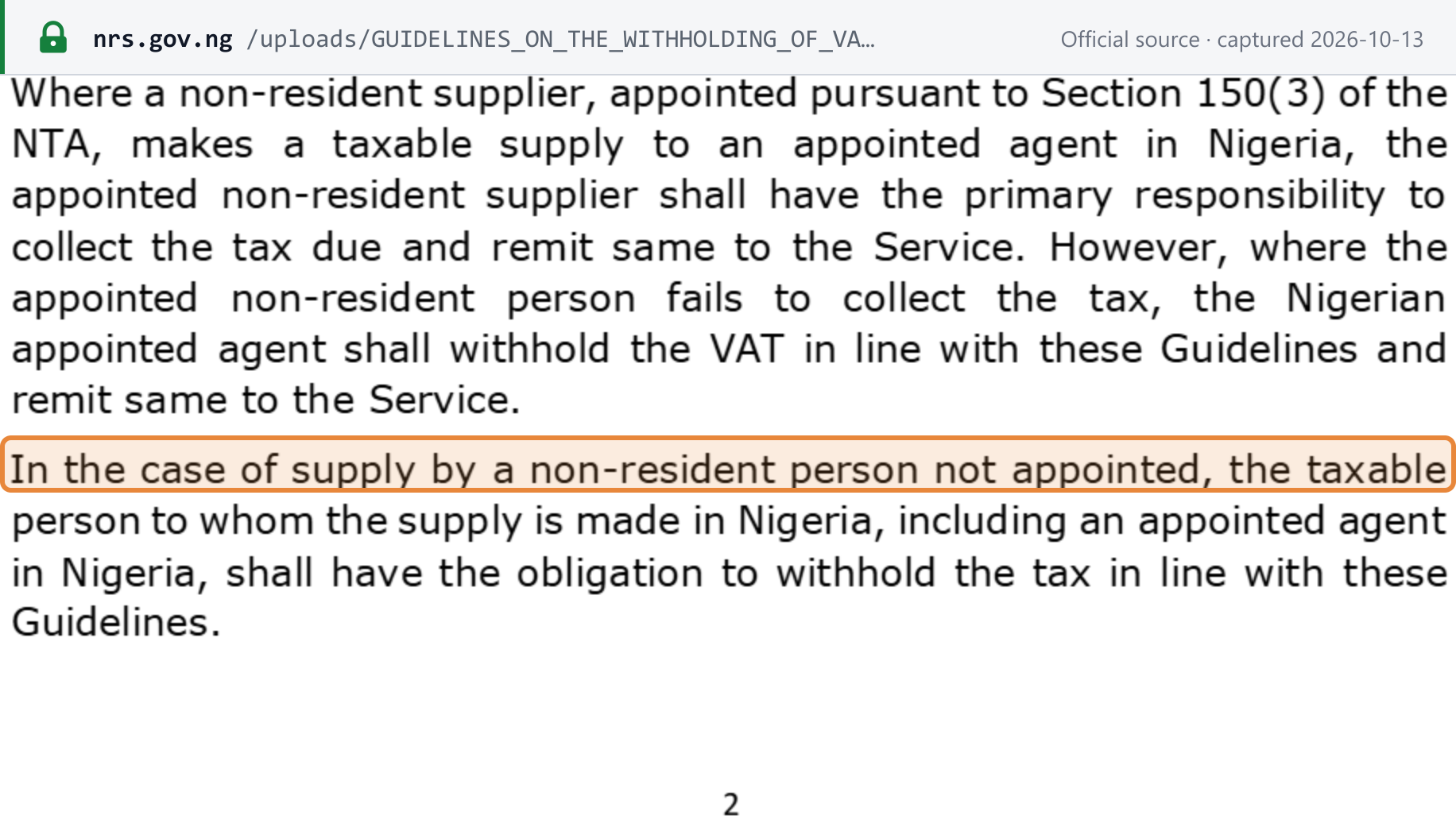
The circular refers to the appointment power as "Section 150(3) of the NTA", one number lower than section 151(3) in the gazetted Act; this guide uses the gazette's numbering.
See reverse charge explained and VAT withholding regimes.
Digital products and services
There is no separate digital-services regime and no threshold. Services are taxable in Nigeria when they are consumed there (see Place of supply), so streaming, software, SaaS and other remote services sold to Nigerian customers are caught by the general non-resident rules in section 151. The Act lets the NRS issue guidelines for appointed non-resident suppliers (s.151(7)); none appeared in NRS's list of circulars (checked 2026-10-13). [1] [17] See VAT on digital services by non-resident suppliers.
Foreign companies selling into Nigeria — B2B and B2C
- Selling to Nigerian businesses (B2B): the Nigerian customer withholds the 7.5% VAT from its payment and remits it to the NRS by the 14th of the following month (s.151(2); Circular 2026/05 §8.0(e); Circular 2026/18 §4.1). If the NRS has appointed you as a VAT collector, you collect the VAT yourself and the customer does not withhold, unless you failed to collect it (s.151(4)). Section 151(1) still requires you to register and show VAT on your invoice. [1] [7]
- Selling to consumers (B2C): there is no Nigerian business to withhold, so you register, charge 7.5% and account for the VAT yourself from the first sale (s.151(1)). NRS has not published which return form or due date applies to a non-resident accounting for VAT on consumer sales. You may appoint a Nigerian representative to handle compliance (s.151(6)). NRS names "non-resident suppliers providing digital or physical goods/services to Nigerian customers" among those that must register. [1] [2]
Marketplace / platform deemed-supplier liability
The Act has no deemed-supplier rule as such, but it lets the NRS appoint platforms and other persons as VAT collectors: [1]
- the NRS may appoint any person, including a non-resident supplier, to collect and remit VAT (s.151(3));
- an appointed person that does not handle the payments but earns a commission on the supplies collects the VAT through the mechanism it uses to collect its commission (s.151(5));
- goods imported through an online or digital platform operated by a non-resident supplier are not charged VAT again at clearance if the VAT was already collected and proof of payment is provided (s.151(8)).
See marketplace deemed-supplier rules.
Place of supply
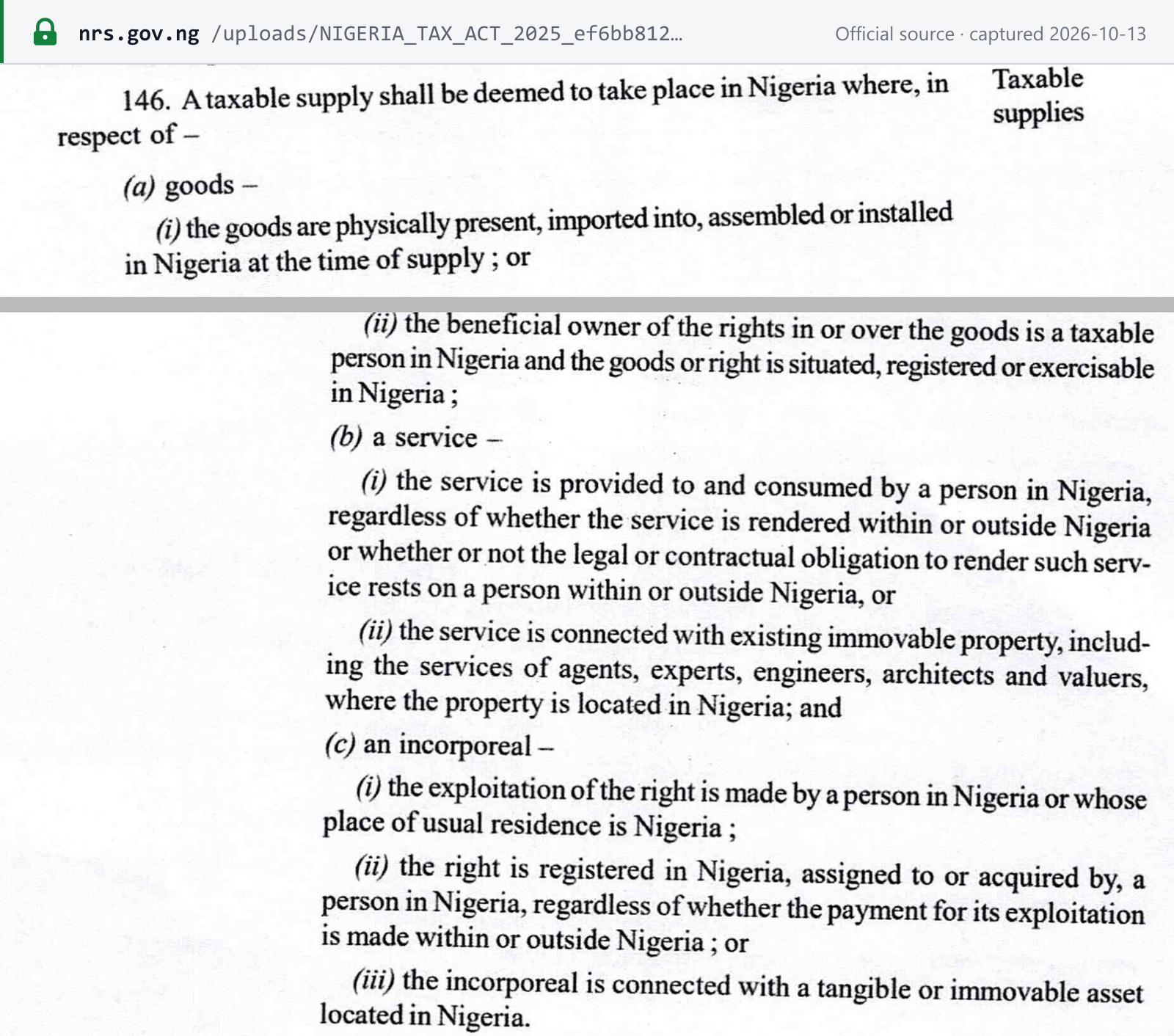
Under section 146 of the Nigeria Tax Act, a supply is made in Nigeria: [1]
- Goods: if the goods are physically present in, imported into, assembled in or installed in Nigeria at the time of supply; or if the beneficial owner of the rights is a Nigerian taxable person and the goods or right are situated, registered or exercisable in Nigeria.
- Services: if "the service is provided to and consumed by a person in Nigeria, regardless of whether the service is rendered within or outside Nigeria or whether or not the legal or contractual obligation to render such service rests on a person within or outside Nigeria"; or if the service is connected with immovable property in Nigeria.
- Incorporeal property: if it is exploited by a person in Nigeria or whose usual residence is Nigeria; registered in, assigned to or acquired by a person in Nigeria; or connected with a tangible or immovable asset in Nigeria.
Invoice requirements
Mandatory content
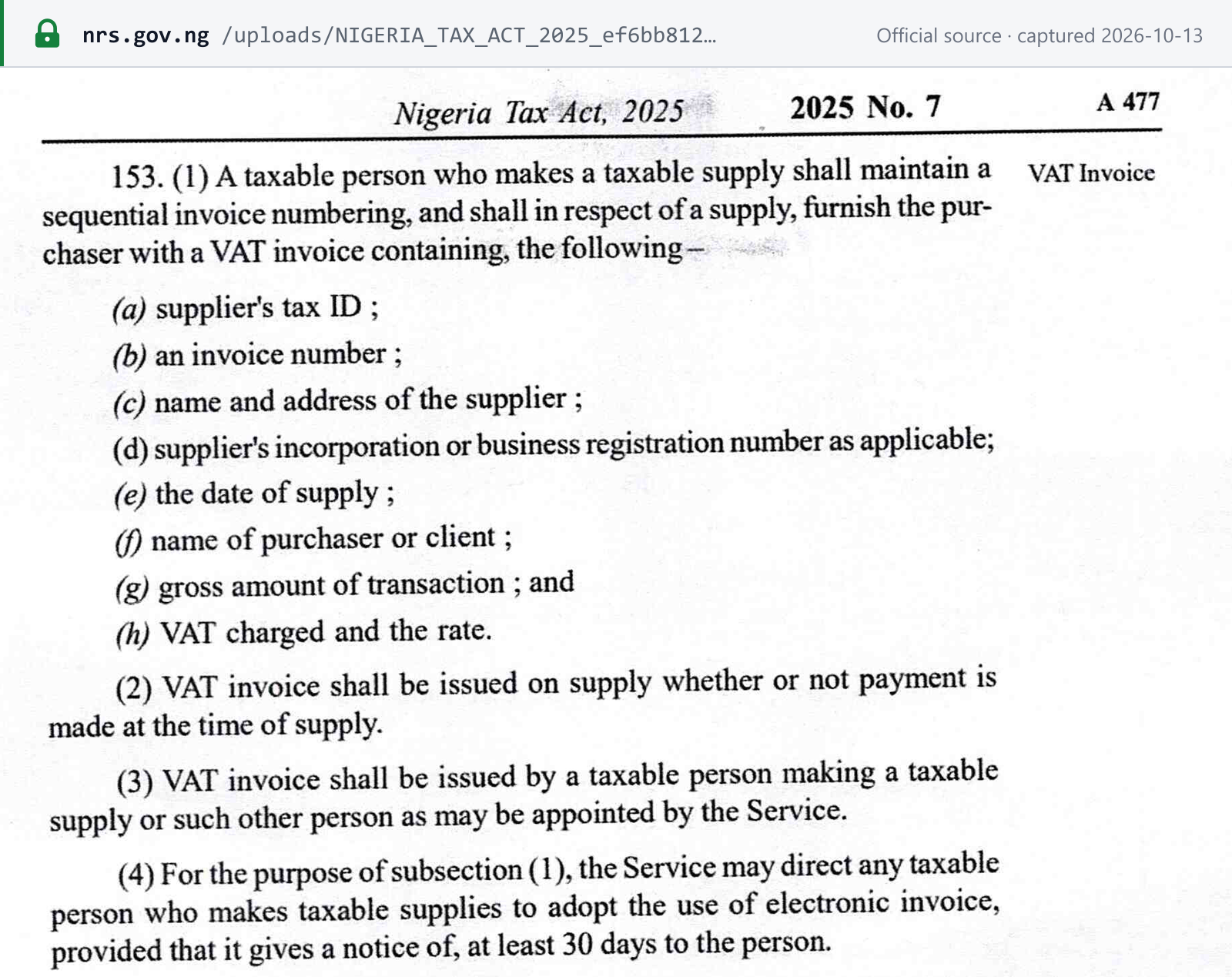
Section 153(1) of the Nigeria Tax Act: "A taxable person who makes a taxable supply shall maintain a sequential invoice numbering, and shall in respect of a supply, furnish the purchaser with a VAT invoice containing" the following. [1] NRS reproduces the same list on its VAT page. [2]
| # | Field | Section |
|---|---|---|
| 1 | Supplier's Tax ID | s.153(1)(a) |
| 2 | Invoice number | s.153(1)(b) |
| 3 | Name and address of the supplier | s.153(1)(c) |
| 4 | Supplier's incorporation or business registration number, as applicable | s.153(1)(d) |
| 5 | Date of supply | s.153(1)(e) |
| 6 | Name of the purchaser or client | s.153(1)(f) |
| 7 | Gross amount of the transaction | s.153(1)(g) |
| 8 | VAT charged and the rate | s.153(1)(h) |
The invoice is issued by the supplier or by any other person the NRS appoints (s.153(3)). When you supply a business that must withhold VAT, NRS's withholding guidelines ask you to show the gross amount, the VAT rate and the VAT amount separately on the invoice. [7]
Issuance deadline
On supply. "VAT invoice shall be issued on supply whether or not payment is made at the time of supply." (s.153(2)) There is no separate "within N days" rule. [1]
The time of supply is the earliest of: the invoice or receipt being issued; the goods being delivered or made available for use; or payment being due or received (s.147(1)). Special rules cover supplies between connected persons without an invoice, periodic and rental supplies, progressive construction-type work and instalment-credit agreements (s.147(2)–(3)).
Numbering and sequencing
Invoice numbering must be sequential (s.153(1)). Invoices processed through the NRS e-invoicing platform also carry an Invoice Reference Number (IRN) issued by the platform (see E-invoicing status).
Credit and debit notes
The Nigeria Tax Act sets one VAT-invoice content list (s.153) and contains no credit-note, debit-note, simplified-invoice or self-billing rules (checked 2026-10-13). The NRS e-invoicing platform's live code list does offer "Credit Note", "Debit Note", "Self Billed Invoice" and "Self-billed Credit Note" as document types (checked 2026-10-13). [16]
Currency and language
- Currency. Neither the Act nor NRS's VAT guidance sets a foreign-exchange conversion rule for invoices (checked 2026-10-13). For withheld VAT, NRS states that "VAT should be remitted in the currency in which it was assessed." [7]
- Language. NRS's VAT guidance states no invoice-language rule (checked 2026-10-13). English is the official language.
Document types
The Act has a single document: the VAT invoice under section 153. The technical overview of the e-invoicing system (a FIRS-branded slide deck from April 2025, hosted on the NRS e-invoicing portal) distinguishes a B2B "Tax Invoice" from a B2C "Simplified Tax Invoice": "A B2C invoice is issued by a business to a consumer, including simplified tax elements such as seller details, invoice number, date, goods or services description, total amount, and applicable taxes." The overview says it is "not intended to be legally binding", and no value threshold for a simplified invoice is published. [12]
Self-billing
The Act has no self-billing provision (checked 2026-10-13). The NRS e-invoicing platform supports self-billed invoices and self-billed credit notes as document types. [16]
Retention and audit trail
- Retention. NRS tells VAT payers to "Retain all supporting invoices and records for audit purposes." Its VAT page does not state a retention period (checked 2026-10-13). [2]
- E-invoicing records. Every taxable supply must go through the fiscalisation system (NTA s.158), and NRS's VAT circular requires taxpayers to "maintain accurate records of all transactions processed through the EFS". [6]
- Tamper evidence. Invoices cleared through the Merchant Buyer Solution carry an IRN and a cryptographic stamp with a QR code, which NRS describes as "a secure, verifiable, and tamper-proof mechanism for e-invoice validation". [12]
- Withholding agents keep a separate "VAT Withheld Account" available for audit. [7]
A specimen of a compliant invoice
NRS publishes no legible annotated specimen. Below, Lookuptax lays out the eight particulars of section 153(1) on a domestic B2B sale. Every name, number and amount is fictional:
VAT invoice (Nigeria Tax Act 2025, s.153)
| Description | Amount (excl. VAT) |
|---|---|
| Steel window frames, supply and install | NGN 2,000,000.00 |
| Site survey | NGN 400,000.00 |
- Total excluding VAT
- NGN 2,400,000.00
- VAT at 7.5%NTA 2025 s.153(1)(h): VAT charged and the rate
- NGN 180,000.00
- Gross amount of transactionNTA 2025 s.153(1)(g)
- NGN 2,580,000.00
- Issue the invoice on supply, whether or not payment has been made (s.153(2)).
- Where the buyer withholds VAT, show the gross amount, VAT rate and VAT amount separately.
- Taxpayers already in the Merchant Buyer Solution rollout transmit the invoice through the platform, which returns the IRN and a QR code.
E-invoicing status
Status (as at 2026-10-13): mandatory and phased by taxpayer size, under a continuous-transaction-control model. The system is the National E-Invoicing / Electronic Fiscal System (EFS), operated as the Merchant Buyer Solution (MBS) at einvoice.nrs.gov.ng. Its legal basis is section 158 of the Nigeria Tax Act (fiscalisation of supplies) and section 153(4), which lets the NRS direct any taxable person to use electronic invoices on at least 30 days' notice. [1] NRS: "A taxable person making a taxable supply shall implement the fiscalisation system deployed by the Service". [2]
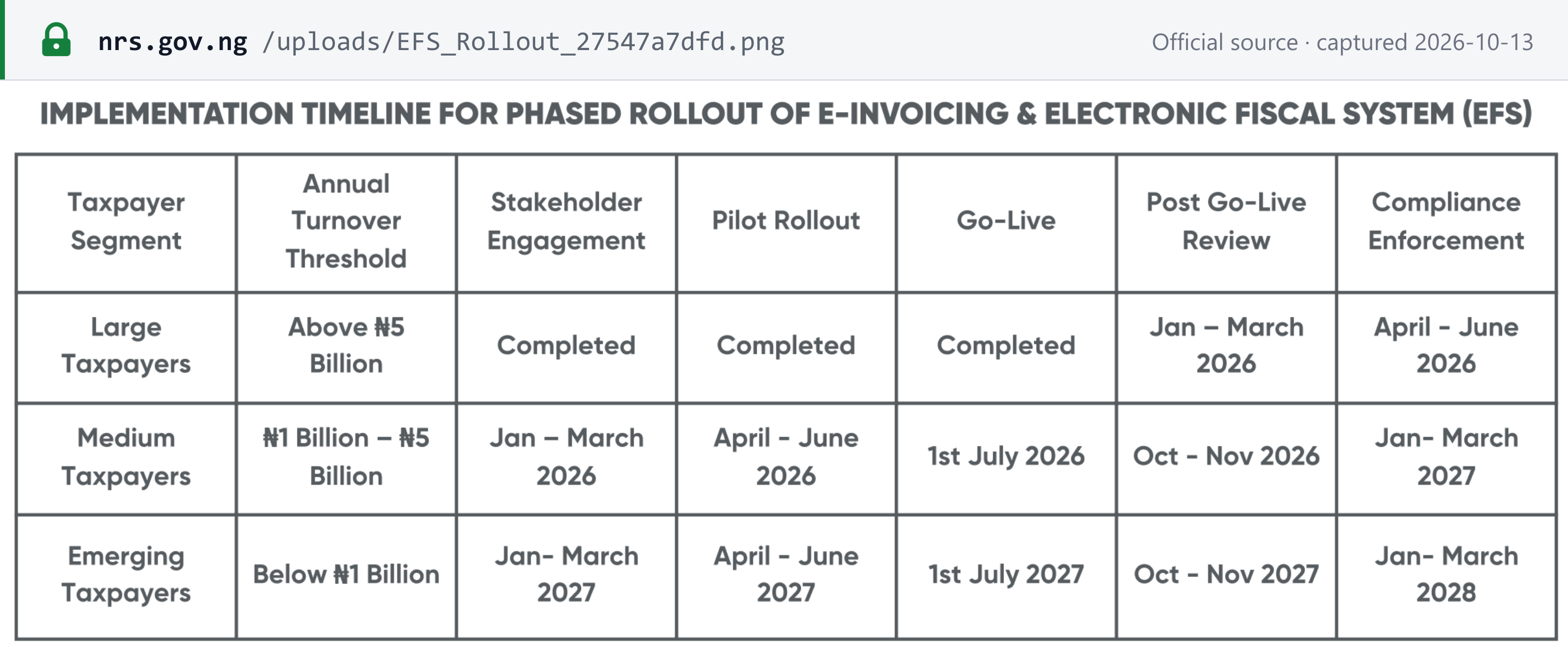
| Segment (annual turnover) | Engagement | Pilot | Go-live | Post go-live review | Compliance enforcement |
|---|---|---|---|---|---|
| Large — above NGN 5 billion | Done | Done | 1 August 2025 (implementation extended to November 2025) | January–March 2026 | April–June 2026 |
| Medium — NGN 1 billion to NGN 5 billion | January–March 2026 | April–June 2026 | 1 July 2026 (scheduled) | October–November 2026 | January–March 2027 |
| Emerging — below NGN 1 billion | January–March 2027 | April–June 2027 | 1 July 2027 | October–November 2027 | January–March 2028 |
These dates are indicative. NRS: "Timelines are indicative and subject to adjustment by the NRS based on operational readiness and stakeholder feedback", and "Compliance enforcement shall commence only after the completion of engagement, pilot, and post-go-live review phases for each taxpayer segment." [9] [10] As at 2026-10-13 NRS had not published a notice confirming that medium taxpayers went live on 1 July 2026. See the event record.
- Large taxpayers. A public notice of 20 July 2026 began compliance monitoring and stated that "all large taxpayers that are yet to commence or complete implementation processes are required to ensure full compliance on or before 31 July 2026." Compliance means being onboarded on the MBS, integrated through an approved Access Point Provider or System Integrator, validated and tested, and transmitting invoices. Buyers are told to "Ensure you receive only compliant e-invoices with a valid Invoice Reference Number (IRN) from suppliers." [11]
- Formats and network. Structured e-invoices in UBL on a "Peppol-Based Structured e-Invoicing Network", according to the April 2025 FIRS-branded technical overview. Each cleared invoice receives an IRN and a cryptographic stamp with a QR code. [12] See Peppol.
- Scope. B2B: the supplier sends the invoice through its access point to the buyer, with the tax data reported to NRS. B2C: the merchant reports the e-invoice to the tax authority in near-real time. [12]
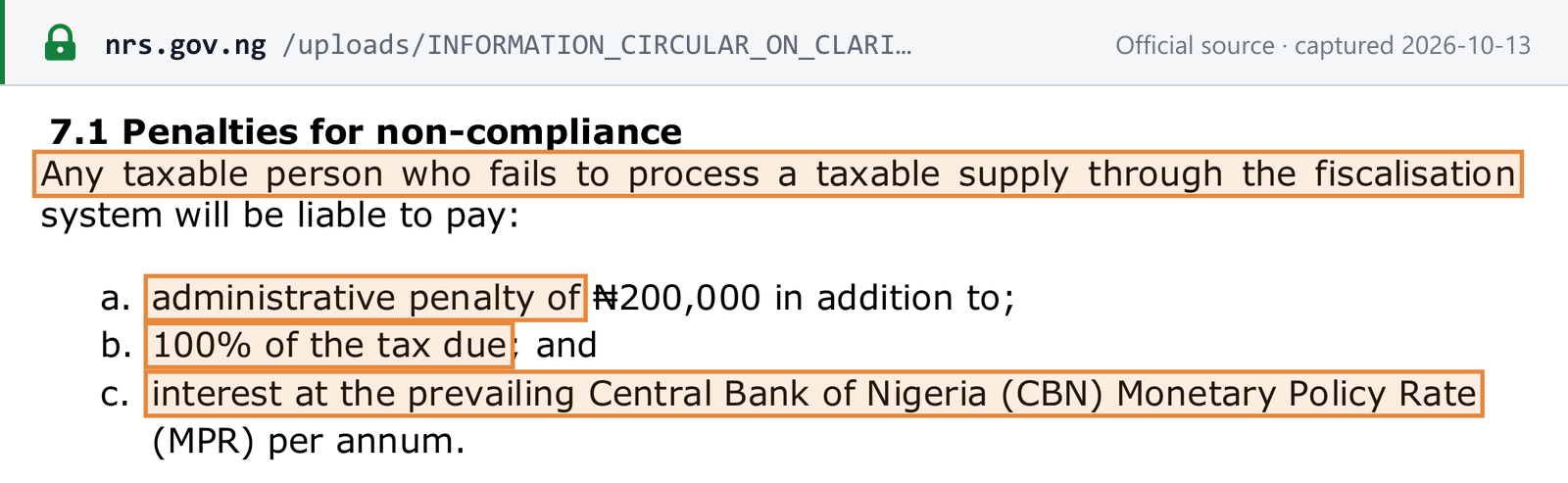
- Penalty. NRS's VAT circular: "Any taxable person who fails to process a taxable supply through the fiscalisation system will be liable to pay: a. administrative penalty of ₦200,000 in addition to; b. 100% of the tax due; and c. interest at the prevailing Central Bank of Nigeria (CBN) Monetary Policy Rate (MPR) per annum." [6]
For how clearance models work, see CTC e-invoicing models and fiscal devices; for Nigeria alongside other countries, see the e-invoicing status and networks table.
Filing and payment
Filing frequency
Monthly for every VAT-registered business; there is no quarterly or annual option. NRS: "VAT returns must be filed monthly, not later than the 21st day of the month following the month of transaction." [2]
Return due date
| Return | Due |
|---|---|
| VAT collected on your own supplies (form VAT 002) | Return and payment by the 21st of the month after the month of the transaction |
| VAT withheld or self-accounted (government bodies, appointed agents, customers of non-resident suppliers) | Separate return and payment by the 14th of the month after the month of the transaction (NTA s.155(4) for government bodies and appointed persons; Circular 2026/05 §8.0(e) and Circular 2026/18 §4.1 for customers of non-resident suppliers) |
NRS's VAT circular (Information Circular 2026/05, §8.0(d)) requires taxpayers to "file returns and remit the VAT collected within 21 days of the month following the month of transaction". [6] NRS's tax calendar: "Returns and payment due by the 21st day of the month following the transaction month". [13]
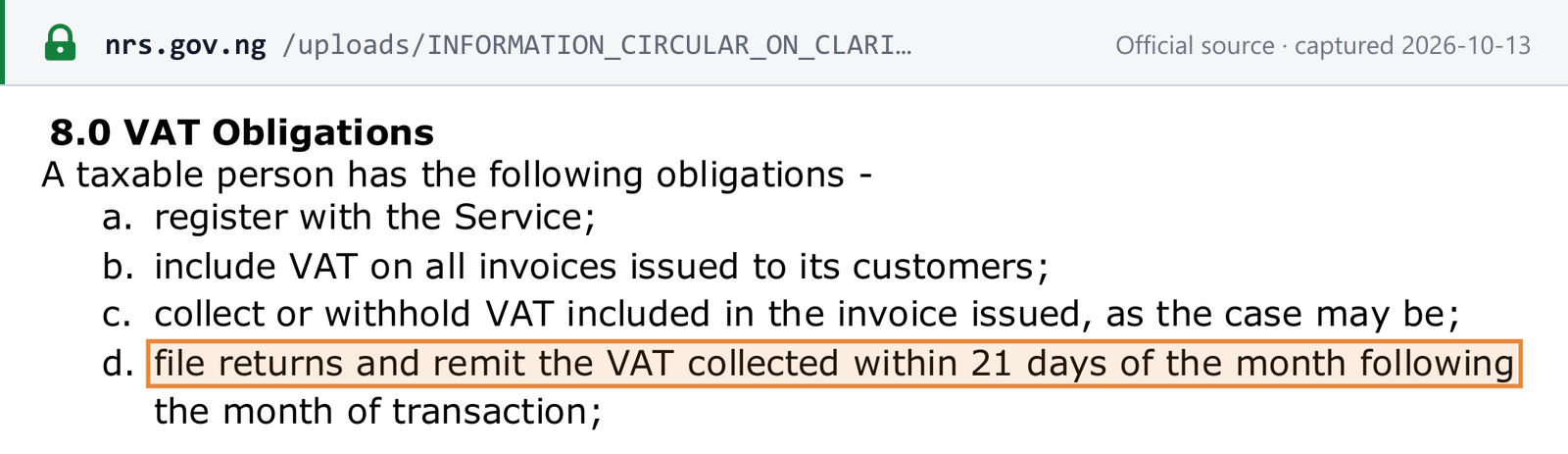
For withheld VAT, the same circular (§8.0(e)) requires taxpayers to "file returns and remit the VAT withheld within 14 days of the month following the month of transaction". [6] For government bodies and persons the NRS appoints to collect or withhold VAT, section 155(4) of the Nigeria Tax Act sets the same 14th-day deadline; for customers of non-resident suppliers, the withholding guidelines apply it (Circular 2026/18 §4.1). [1] [7]

NRS publishes no rule for a due date that falls on a weekend or public holiday (checked 2026-10-13).
Payment due date and method
Payment is due on the same date as the return. NRS: "File VAT returns and make payment online via the NRS portal or at designated banks." [2] Return templates for VAT and withheld VAT are on NRS's tax returns forms page. [18]
Additional listings
- Withholding schedule. Each withheld-VAT remittance is accompanied by a schedule showing each supplier's name, Tax ID and address, the invoice number, the gross invoice amount, the VAT and the month (s.155(3); Circular 2026/18). [1] [7]
- Annual return. NRS's VAT guidance describes no annual VAT return or sales and purchase listing (checked 2026-10-13).
Input-tax recovery and blocked items
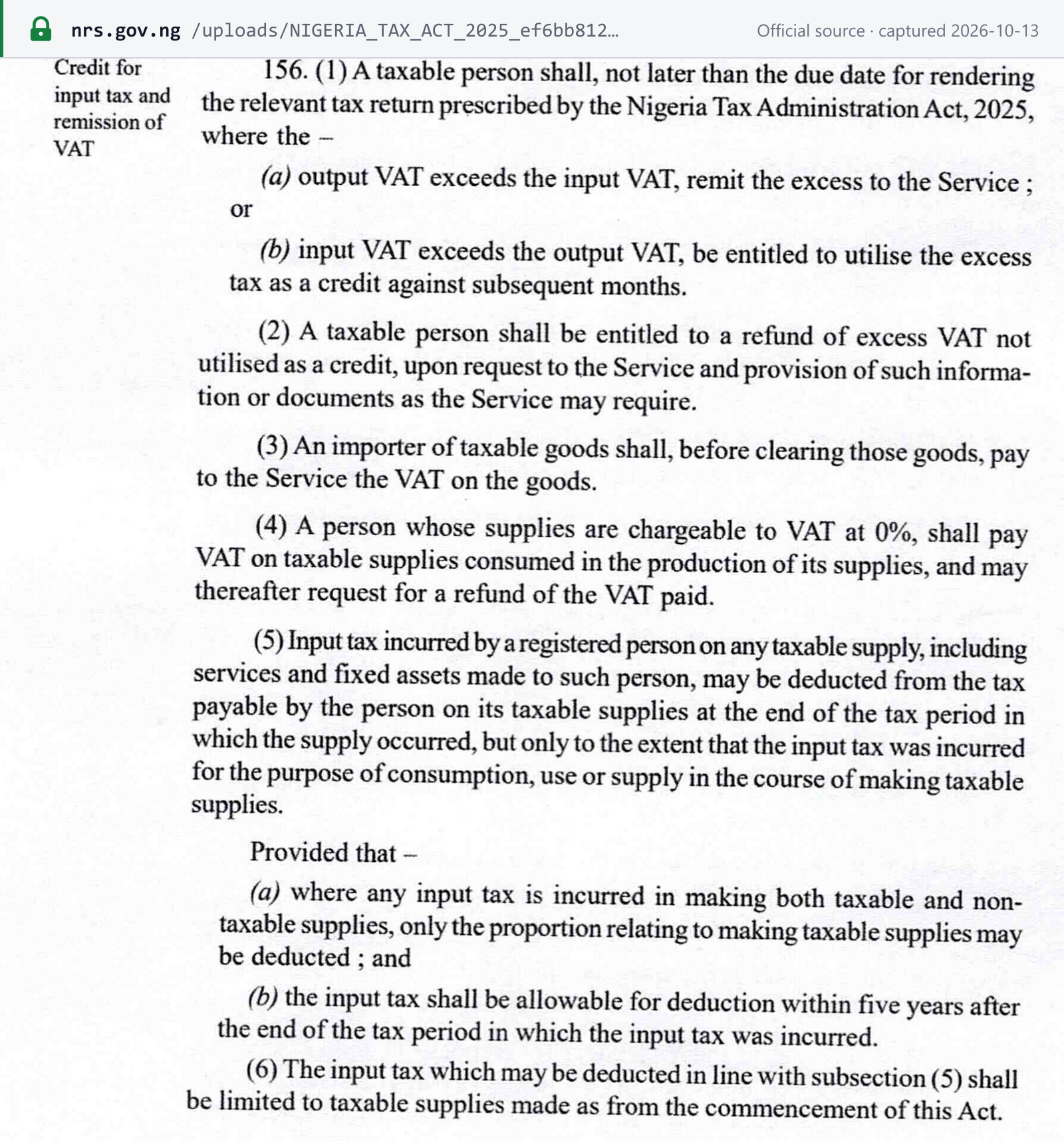
This is the reform's biggest VAT change. From 1 January 2026, input VAT on services and fixed assets is deductible. Section 156(5): "Input tax incurred by a registered person on any taxable supply, including services and fixed assets made to such person, may be deducted from the tax payable by the person on its taxable supplies at the end of the tax period in which the supply occurred, but only to the extent that the input tax was incurred for the purpose of consumption, use or supply in the course of making taxable supplies." [1]
- Mixed use. Where input VAT relates to both taxable and non-taxable supplies, only the proportion relating to taxable supplies is deductible.
- Time limit. The deduction must be taken "within five years after the end of the tax period in which the input tax was incurred".
- Start date. Only input VAT on supplies made from the commencement of the Act (1 January 2026) qualifies (s.156(6)).
- Exempt supplies. NRS: "Input VAT on exempt supplies cannot be claimed." [2]
- Blocked items. The Nigeria Tax Act contains no list of blocked inputs such as entertainment or passenger cars; recovery is limited by purpose under section 156(5) (checked 2026-10-13).
NRS: "Input VAT on capital expenditure and services is now fully recoverable under the new regime." Claims must be supported by valid VAT invoices. [2]
Refunds
- Excess credit. Where input VAT exceeds output VAT, the excess is carried forward as a credit against later months, or the taxpayer can request a refund of the unused excess (s.156(1)–(2)). [1]
- Zero-rated suppliers pay VAT on their inputs and then request a refund (s.156(4)).
- Time limit to claim. NRS's refund guidelines (Information Circular 2026/17): "The request for refund must be submitted within 12 months from the date of the transaction that generated the claim, otherwise, the right to such refund will be forfeited." [8]
- Deduction versus cash refund. The two time limits govern different claims. Section 156(5)(b) of the Act lets input tax be deducted against output VAT in a return within five years after the end of the tax period in which it was incurred. The 12-month limit in the refund guidelines applies to a request for a cash refund of excess VAT, counted from the date of the transaction that generated the claim; after that, the guidelines say the right to the refund is forfeited. [1] [8]
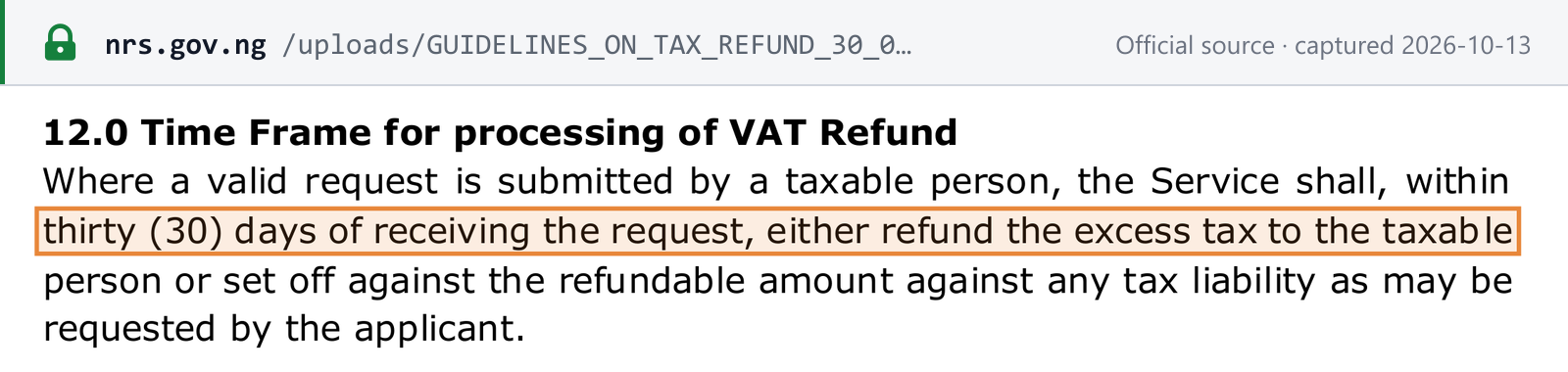
- Time to pay. "Where a valid request is submitted by a taxable person, the Service shall, within thirty (30) days of receiving the request, either refund the excess tax to the taxable person or set off against the refundable amount against any tax liability as may be requested by the applicant." [8]
- Non-residents. NRS publishes no general VAT refund scheme for non-residents; diplomatic missions have their own scheme under the refund guidelines.
- Bad debts. The VAT chapter of the Nigeria Tax Act contains no bad-debt relief provision (checked 2026-10-13).
Exemptions
Exempt supplies
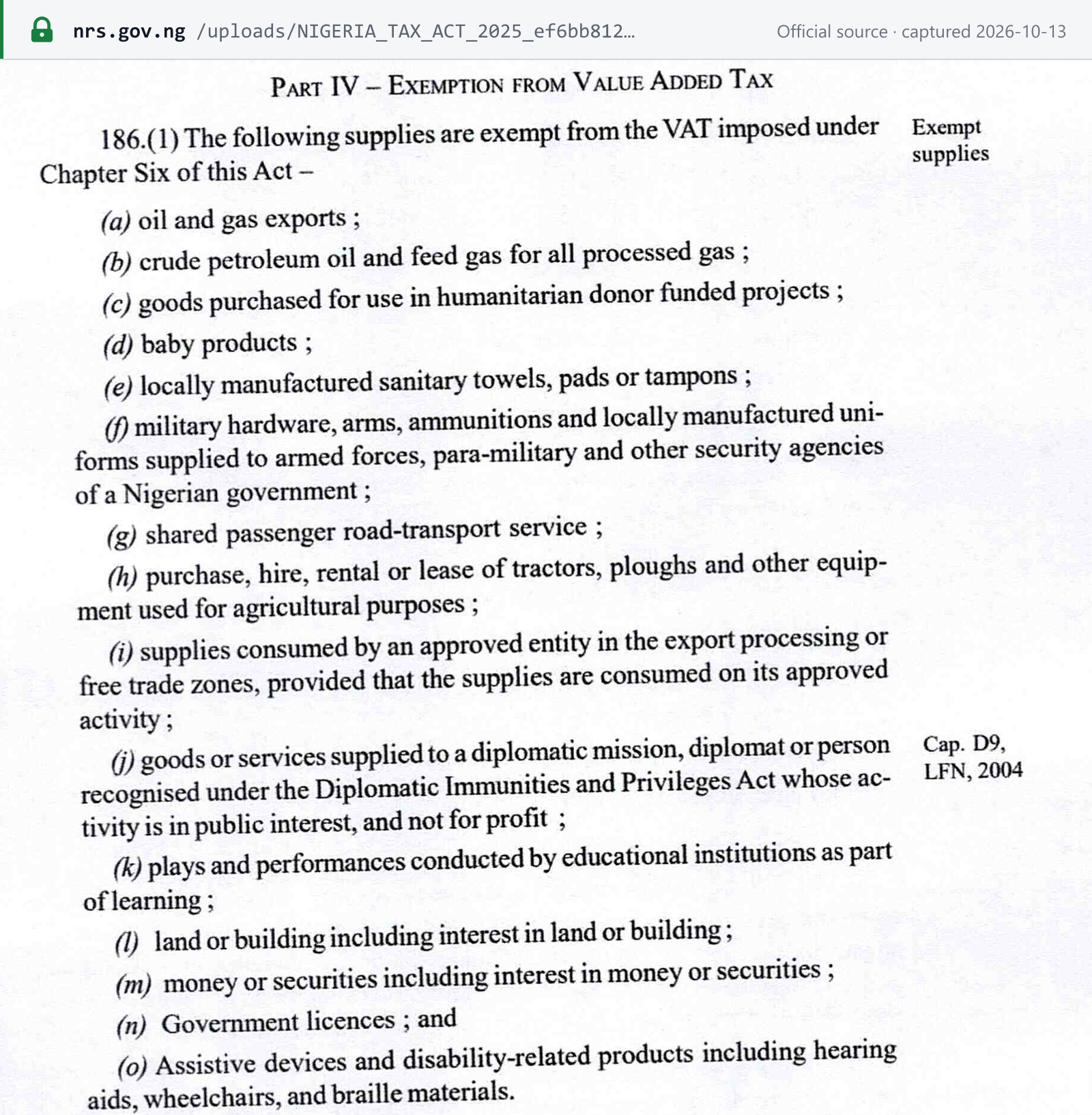
Section 186(1) of the Nigeria Tax Act exempts: [1]
- oil and gas exports; crude petroleum oil and feed gas for processed gas;
- goods bought for humanitarian donor-funded projects;
- baby products; locally manufactured sanitary towels, pads and tampons;
- military hardware, arms, ammunition and locally manufactured uniforms supplied to government security agencies;
- shared passenger road-transport services;
- purchase, hire, rental or lease of tractors, ploughs and other agricultural equipment;
- supplies consumed by an approved entity in an export processing or free trade zone on its approved activity;
- goods and services supplied to diplomatic missions and diplomats;
- plays and performances by educational institutions as part of learning;
- land or buildings, including interests in them; money or securities, including interests in them; Government licences;
- assistive devices and disability-related products.
The President may also exempt supplies under donor-financed projects by order (s.188).
Bank charges are taxable. NRS press release of 15 January 2026: "VAT has always applied to fees, commissions, and charges for services rendered by banks and other financial institutions under Nigeria's long-established VAT regime. The Nigeria Tax Act did not introduce VAT on banking charges". [15]
Exempt is not zero-rated
The difference decides whether you get your input VAT back:
- A zero-rated supply (s.187), such as basic food or exported services, is taxable at 0%. The supplier can recover the VAT on its inputs, by refund if necessary (s.156(4)).
- An exempt supply (s.186), such as land or financial securities, carries no VAT, and the supplier cannot recover the VAT on its inputs. NRS's refund guidelines say such input VAT "cannot be claimed against output VAT, hence it should be expensed in the income statement". [8]
- Exports of oil and gas are exempt, while other exports are zero-rated.
Special regimes
- Small companies: exempt from filing and paying VAT (see Registration threshold). [2]
- Free trade and export processing zones: supplies consumed by approved zone entities on their approved activity are exempt (s.186(1)(i)).
- VAT withholding: government ministries, departments and agencies and persons appointed by the NRS withhold VAT from their suppliers and remit it by the 14th (s.155; Circular 2026/18). See VAT withholding regimes.
- Margin, cash-accounting and flat-rate schemes: none appears in the Nigeria Tax Act or NRS's VAT guidance (checked 2026-10-13).
Offences and penalties
Offences
NRS's penalties page lists the conduct that attracts sanctions: [14]
- Failure to register — "Businesses and individuals must register with the NRS; failure to do so may result in sanctions."
- Late filing and late payment.
- False declarations — "Providing inaccurate or misleading information can lead to severe penalties, including prosecution."
- Not processing supplies through the fiscalisation system (see E-invoicing status).
- Non-remittance of VAT collected or withheld. NRS's VAT page lists "Additional penalties for false declarations or non-remittance". [2]
NRS states that enforcement "can range from reminders and audits to legal proceedings and asset recovery". [14] The criminal fines and prison terms are set in the Nigeria Tax Administration Act, 2025; NRS's VAT and penalties pages do not state them.
Penalties
| Penalty | Amount |
|---|---|
| Late registration or late filing | NRS: "₦100,000 for the first month of default, ₦50,000 for each subsequent month (for late registration or filing)." [2] |
| Late payment | NRS: "Interest on unpaid VAT at the prevailing rate." [2] |
| Not using the e-invoicing / fiscalisation system | NGN 200,000 administrative penalty, plus 100% of the tax due, plus interest at the prevailing CBN Monetary Policy Rate per annum (Circular 2026/05). [6] |
| Failure to withhold or remit withheld VAT | "The penalties stipulated under the relevant provisions of the Nigeria Tax Administration Act" (Circular 2026/18); NRS's guidelines do not state the amounts. [7] |
Disputes. "If you disagree with a VAT assessment or penalty, you may file an objection with the NRS within 30 days of receiving the notice. Further appeals can be made to the Tax Appeal Tribunal." [2]
Frequently asked questions
We are a foreign software company selling to Nigerian customers. Do we have to register for VAT, and is there a threshold?
Yes, and the Nigeria Tax Act 2025 sets no threshold for non-residents. Section 151(1) requires a non-resident that makes taxable supplies to Nigeria to register and include 7.5% VAT on its invoices. When you sell to a Nigerian business, that customer withholds the VAT from what it pays you and remits it to the Nigeria Revenue Service by the 14th of the following month, unless the Service has appointed you to collect the VAT yourself. When you sell to consumers, nobody withholds: you register, charge 7.5% VAT and account for it to the Service yourself. The Service has not published which return form or due date applies to a non-resident accounting for VAT on consumer sales.
Can a Nigerian business now claim input VAT on services and equipment?
Yes. From 1 January 2026, section 156(5) of the Nigeria Tax Act lets a registered person deduct input VAT on any taxable supply, including services and fixed assets, to the extent it is used to make taxable supplies. The claim must be made within five years after the end of the tax period in which the input VAT was incurred, and only supplies made from 1 January 2026 qualify. Input VAT on exempt supplies cannot be claimed.
When do we have to issue e-invoices through the Merchant Buyer Solution?
It depends on annual turnover. Large taxpayers (above NGN 5 billion) went live on 1 August 2025, and the Nigeria Revenue Service required full compliance by 31 July 2026. Medium taxpayers (NGN 1 billion to NGN 5 billion) were scheduled to go live on 1 July 2026, with enforcement from January to March 2027. Emerging taxpayers (below NGN 1 billion) are scheduled to go live on 1 July 2027. The Service describes these dates as indicative. Failing to process a taxable supply through the fiscalisation system carries a NGN 200,000 administrative penalty plus 100% of the tax due plus interest at the Central Bank of Nigeria Monetary Policy Rate.
Is our old FIRS TIN still valid?
No. The Nigeria Revenue Service says the new 13-digit Tax ID became effective on 1 January 2026, replacing previously issued TINs. Individuals' Tax IDs are linked to their National Identification Number (NIN) and businesses' to their Corporate Affairs Commission registration number. You can retrieve yours on the Tax ID portal at taxid.nrs.gov.ng.
Do small businesses have to charge VAT in Nigeria?
No. The Nigeria Revenue Service states that small companies are exempted from filing and paying VAT, and that the obligation to register, charge VAT and file applies to businesses above the exemption threshold. The Service's VAT page does not state the threshold figure itself.
When are Nigerian VAT returns due?
Monthly. The return and payment for VAT you collected are due by the 21st day of the month after the month of the transaction. VAT you withheld from a supplier, or self-accounted for, is due by the 14th day of the following month on a separate return.
Important websites
| Site | Purpose |
|---|---|
| NRS Taxpayer Self-Service Portal (Rev360) | Register, file VAT returns and pay |
| Nigerian Tax ID Portal | Retrieve a 13-digit Tax ID with a NIN or CAC registration number |
| NRS — Tax ID validation | Validate a Tax ID |
| Merchant Buyer Solution (MBS) | E-invoicing platform: onboarding, invoice clearance and IRNs |
| NRS — Value Added Tax | VAT rate, registration, invoice and penalty guidance |
| NRS — Filing and payment deadlines | Tax calendar for VAT, withholding tax, PAYE and other taxes |
| NRS — Tax returns forms | VAT and withheld-VAT return templates |
| NRS — Tax guides and manuals | Information circulars, including the VAT, withholding and refund guidelines |
Recent changes
- 2026-07-20 — NRS began compliance monitoring of large taxpayers under the e-invoicing system, with full compliance due by 31 July 2026. (NRS)
- 2026-06-29 — NRS published Information Circulars 2026/05 (VAT administration), 2026/17 (tax refunds) and 2026/18 (VAT withholding). (NRS)
- 2026-05-18 — NRS and the Joint Revenue Board announced that the Tax ID system replaces the TIN Validation API. (NRS)
- 2026-04-21 — NRS published the user manual for Rev360, its new Taxpayer Self-Service Portal for registration, filing and payment. Its 15 April 2026 press release had scheduled Rev360 to go live on 30 April 2026, starting with medium and emerging taxpayers. (NRS, 15 April; NRS, 21 April)
- 2026-02-17 — NRS published the phased e-invoicing (EFS/MBS) timeline: medium taxpayers to go live 1 July 2026, emerging taxpayers 1 July 2027. (NRS) — see event
- 2026-01-15 — NRS confirmed that the Nigeria Tax Act did not introduce VAT on bank charges, which were already taxable. (NRS)
- 2026-01-01 — The Nigeria Tax Act 2025 took effect: VAT at 7.5% under Chapter Six, input VAT on services and fixed assets recoverable, the 13-digit Tax ID replacing TINs, and the VAT Act Cap. V1 repealed. (NRS)
For the full chronology, see Nigeria tax changes on Lookuptax.
Reference links
- Nigeria Tax Act, 2025 (gazetted, NRS upload, PDF)
- NRS — Value Added Tax
- NRS — Nigerian Tax ID Portal goes live effective January 1, 2026
- NRS and Joint Revenue Board — Public notice on the Tax ID (18 May 2026)
- NRS — Self-service portal
- NRS — Information Circular 2026/05, clarification on the changes in the administration of VAT (PDF)
- NRS — Information Circular 2026/18, guidelines on the withholding of VAT (PDF)
- NRS — Information Circular 2026/17, guidelines on tax refund (PDF)
- NRS — Implementation timeline on the EFS regime
- NRS — EFS rollout timeline table (image)
- NRS — Public notice on compliance monitoring of large taxpayers (20 July 2026)
- Technical overview on the National e-Invoicing System (FIRS-branded slide deck, April 2025; NRS e-invoicing portal, PDF)
- NRS — Filing and payment deadlines (tax calendar)
- NRS — Penalties and sanctions
- NRS — Press release on VAT and bank charges (15 January 2026, image)
- NRS e-invoicing platform — invoice resources (code lists)
- NRS — Tax guides and manuals
- NRS — Tax returns forms
- NRS — Tax ID validation
- NRS — NRS (Establishment) Act, 2025 (page content)
- NRS — Press release: upcoming launch of Rev360 (15 April 2026)
- NRS — Rev360 user manual, Taxpayer Self-Service Portal (21 April 2026)
Related on Lookuptax:
- Nigeria tax ID guide
- Nigeria Tax ID validator
- VAT withholding regimes
- VAT on digital services by non-resident suppliers
- Reverse charge explained
- Marketplace deemed-supplier rules
- CTC e-invoicing models
- Peppol e-invoicing
- VAT registration thresholds worldwide
- Worldwide tax rates
- E-invoicing status and networks worldwide