Taiwan business tax (VAT) guidelines
| FACTSHEET | |
|---|---|
| Country code | TW |
| Tax name | Business tax (營業稅) — value-added business tax (加值型營業稅) and non-value-added business tax (非加值型營業稅) |
| Tax Authority | Ministry of Finance and the National Taxation Bureaus |
Overview
Taiwan levies business tax (營業稅) under the Value-added and Non-value-added Business Tax Act (加值型及非加值型營業稅法), last amended on 28 May 2025. Article 1 provides that value-added or non-value-added business tax "shall be levied, in accordance with this Act, on the sale of goods or services within the territory of the Republic of China (R.O.C.) and on the import of goods." [1]
The Act has two computation tracks (Art 1-1): [1]
- Value-added business tax (加值型營業稅) — the general computation: output tax minus input tax, at 5% (Chapter 4, Section 1). This is Taiwan's VAT.
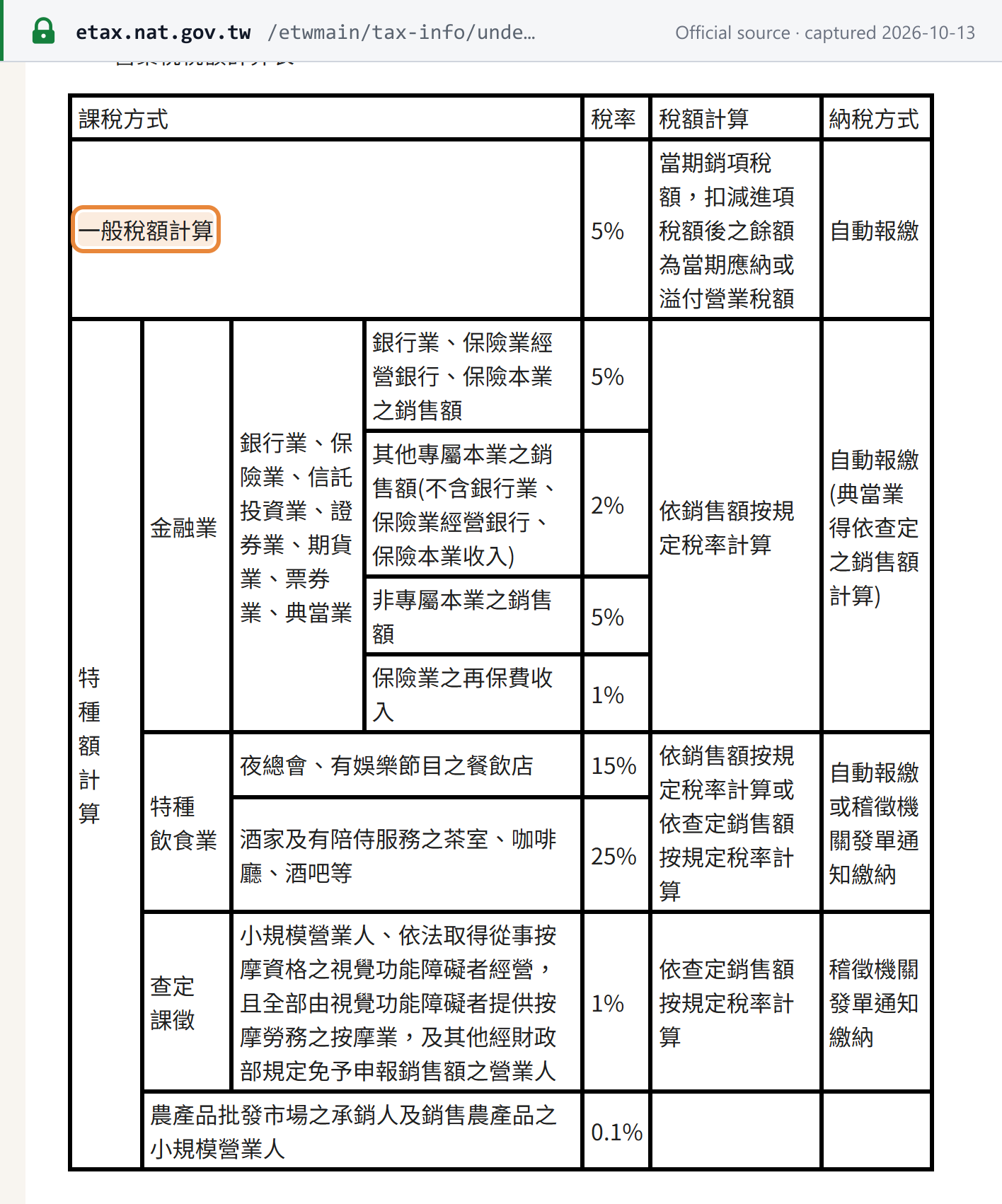
- Non-value-added business tax (非加值型營業稅) — a tax on gross sales for financial institutions, special food and beverage businesses and small businesses assessed by the tax office (Chapter 4, Section 2).
Taxpayers are businesses selling goods or services, consignees or holders of imported goods, and purchasers of services from foreign enterprises with no fixed place of business in Taiwan (Art 2). Foreign sellers of electronic services to individuals in Taiwan are themselves the taxpayer (Art 2-1). [1]
Authority. The Ministry of Finance (財政部) administers the tax. Its Taxation Administration (賦稅署) sets policy, and five National Taxation Bureaus — Taipei, Kaohsiung, Northern Area, Central Area and Southern Area — register, assess and collect. Business tax on imports is levied by the Customs Administration (Art 41). The e-invoice platform is run by the Ministry's Fiscal Information Agency. [3] [1]
Currency. New Taiwan dollars (TWD, written NT$). Tax is rounded to the nearest New Taiwan dollar (Art 14). [1]
Tax period. Two months. Returns cover January–February, March–April and so on; businesses with zero-rated sales may apply to file monthly (Art 35; see Filing and payment). [2]
Layering. None. Business tax is a single national tax under one Act, administered nationally; there is no city or county business tax.
Official dates on Taiwanese sources use the Republic of China (民國) calendar: add 1911 to the year (民國 115 = 2026).
Registration
Who should register
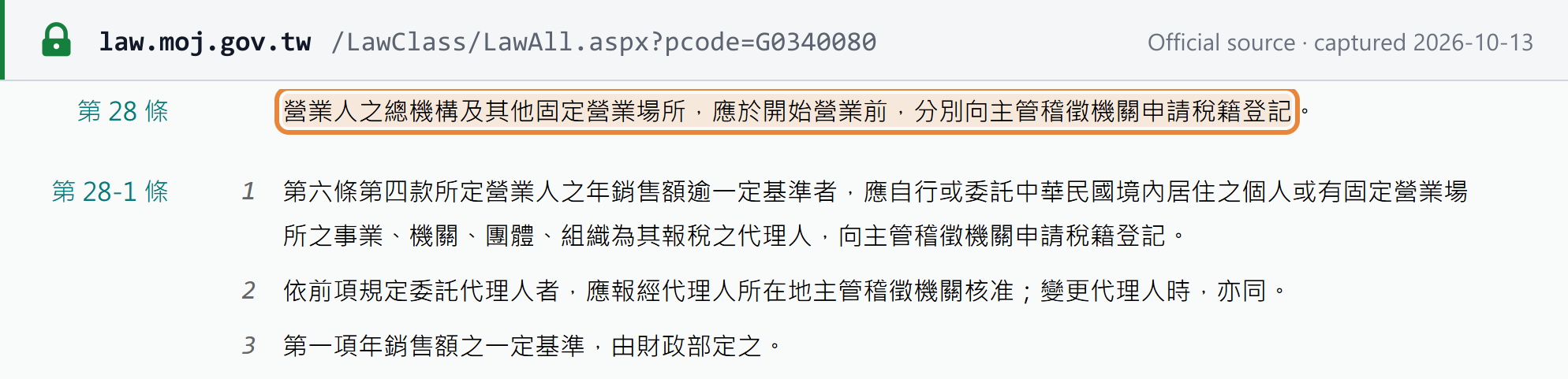
There is no turnover threshold for ordinary businesses. The head office and every other fixed place of business must apply for tax registration before commencing business (Art 28). Companies and sole proprietorships are tax-registered automatically from their commercial registration. [1]
Registration threshold
Two figures work like thresholds for particular groups:
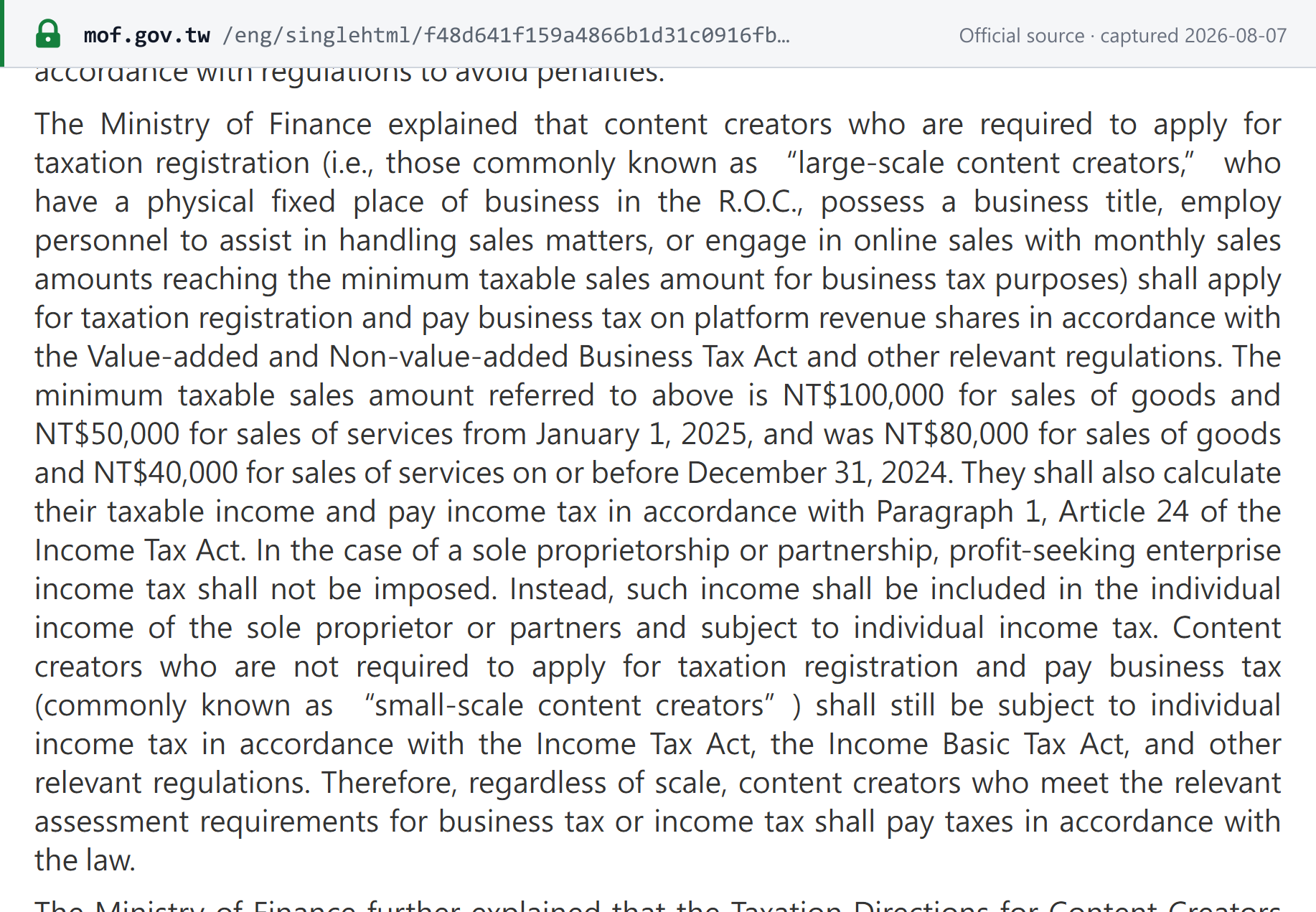
- Minimum taxable sales amount (起徵點). From 1 January 2025, a small business is not taxed below NT$100,000 a month for trading, manufacturing, publishing, utilities, transport, general food and beverage and similar trades, or NT$50,000 a month for decoration, advertising, repair, processing, lodging, labour contracting, warehousing, leasing, agency and technical or design trades (MOF Order 台財稅字第11304677940號, 12 December 2024). Mixed businesses add the two fractions together. [6] The same figures apply to individuals who regularly sell creative or informational content online. [29]
- Small-scale businesses (小規模營業人). A business whose monthly sales are below NT$200,000 may be assessed by the tax office instead of filing: it pays 1% on the assessed sales and need not issue uniform invoices. The Ministry of Finance restated this on 19 March 2026. The Ministry of Finance may, having regard to a small business's nature and capability, require it to use the general computation, with uniform invoices (Art 24). [7] [1]

Non-resident registration
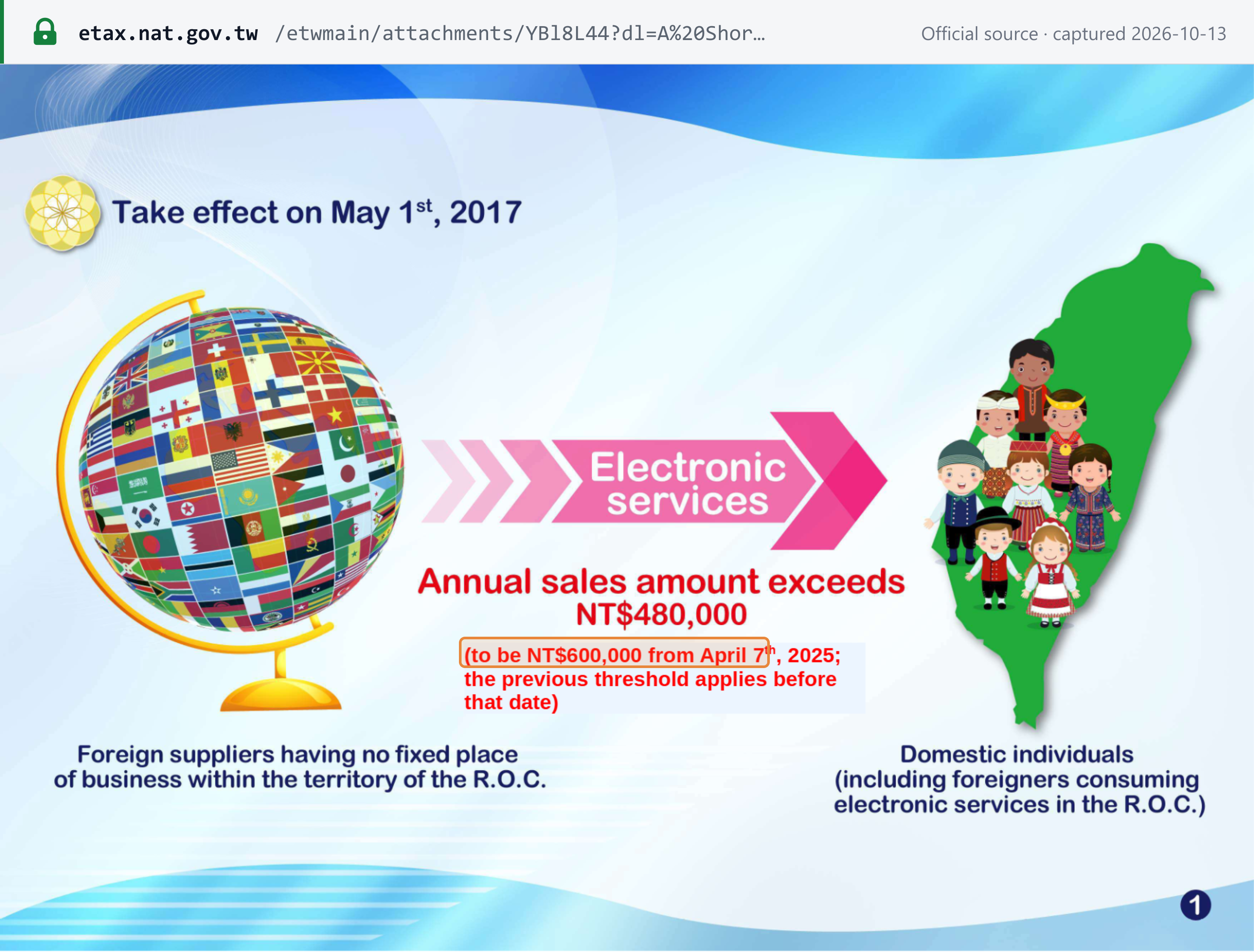
- Foreign sellers of electronic services to individuals (B2C) must register once their annual sales to individuals in Taiwan exceed NT$600,000. The threshold was NT$480,000 until it was raised from 7 April 2025. [9] [13]
- Foreign sellers to Taiwanese businesses (B2B) do not register: the Taiwanese buyer accounts for the tax (Art 36; see Foreign companies selling into Taiwan).
- A foreign business with a fixed place of business in Taiwan registers like any domestic business (Art 28).
Tax identification number
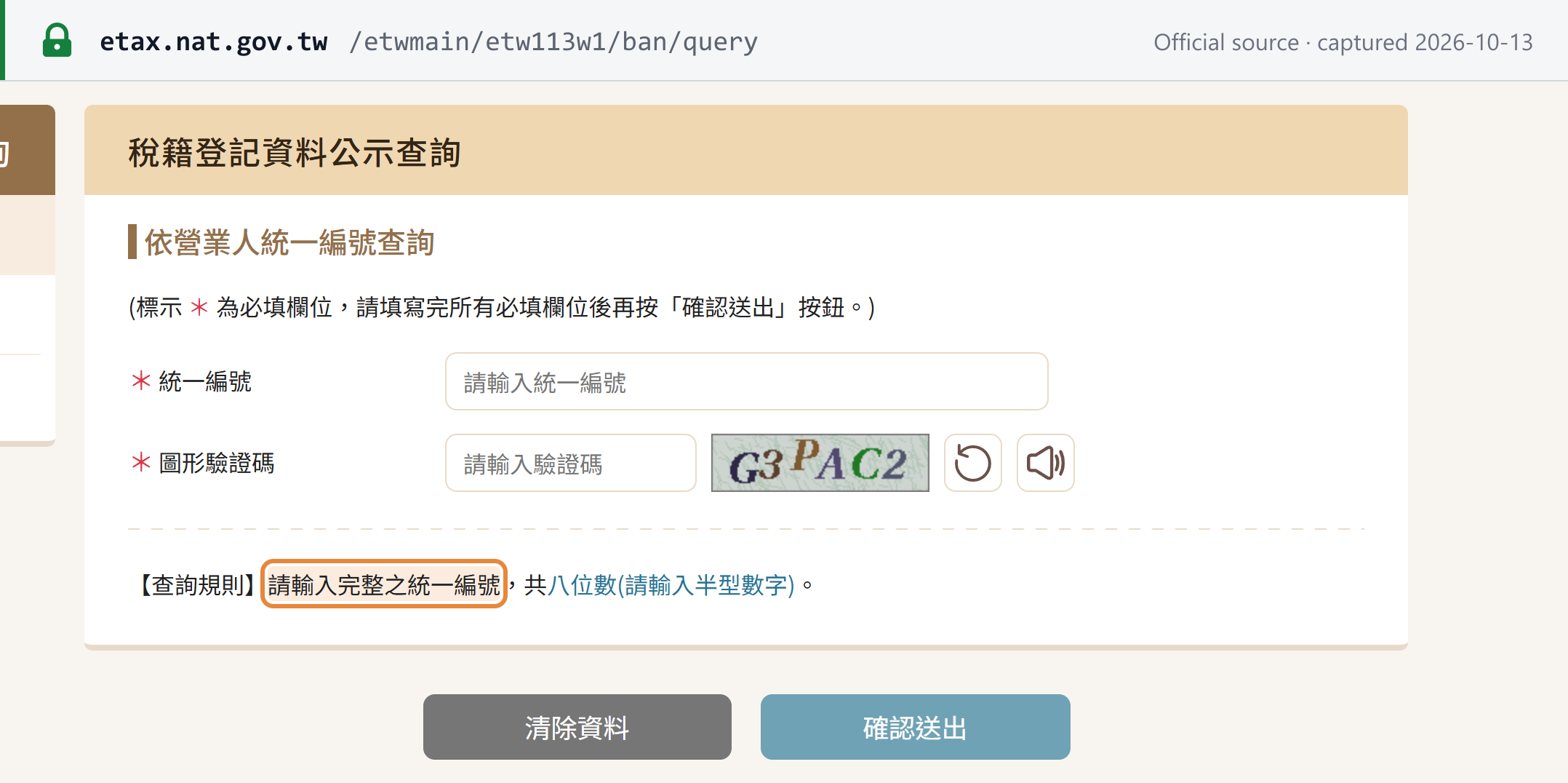
The business tax number is the Business Administration Number (BAN, 統一編號), often called the Unified Business Number (UBN): 8 digits, with a weighted check digit. Foreign e-service suppliers receive a BAN when their registration is approved. Format rules and worked examples are on the Taiwan tax ID guide, and you can check a number with the Taiwan UBN validator. The Ministry of Finance eTax Portal offers a public lookup of a business's tax registration by BAN.
How to register
- Domestic companies and sole proprietorships are registered for tax automatically from Ministry of Economic Affairs or local commercial registration data. Other entities file a registration application with their National Taxation Bureau before starting business.
- Foreign e-service suppliers apply online in the cross-border zone of the eTax Portal. They provide their home-country registration certificate, authenticated or notarised (by a local government authority, a court, a Taiwanese mission abroad, or their country's mission in Taiwan); a Chinese translation of any foreign-language document; and, where an agent files for them, a letter of appointment. Suppliers who file for themselves are registered with the National Taxation Bureau of Taipei. [8]
Voluntary registration
Not applicable in the usual sense, because every business must register before trading. Two opt-ins exist instead, each locked for three years once approved:
- a small business may elect the general (value-added) computation, which lets it recover input tax and issue invoices its business customers can deduct (Arts 23–24);
- a seller of exempt goods or services may apply to the Ministry of Finance to waive the exemption and charge tax (Art 8, final paragraph). [1]
Deregistration
A business must apply to change or cancel its registration within 15 days of a merger, transfer, dissolution or cessation. Cancellation takes effect only once tax is paid in full or security is provided (Art 30). The final return, with the list of uniform invoices issued, is due within 15 days of the event (Enforcement Rules Art 33). [1] [4]
Foreign e-service suppliers cancel online within 15 days of being dissolved in their home country, giving up their domain name and network address, or registering in Taiwan under Art 28. [8]
Group registration
Not available — the Business Tax Act has no grouping provision for separate legal entities. Each fixed place of business files separately, but a business using the general computation may apply to the Ministry of Finance to have its head office file a consolidated return for all its branches (Art 38). Each branch still reports its own sales and input documents to its local tax office (Enforcement Rules Art 39). [1] [4] For how grouping works elsewhere, see VAT grouping explained.
Rates
| Rate | Applies to | Provision |
|---|---|---|
| 5% | General (value-added) computation: most goods and services. The Act sets a band of 5% to 10% and the Executive Yuan sets the applied rate. | Art 10 |
| 0% | Exports, export-related services, services provided in Taiwan but used abroad, international transport, sales to bonded zones and other Art 7 supplies | Art 7 |
| 5% | Banks and insurers on their core banking and insurance business; also non-core sales of financial businesses | Art 11 |
| 2% | Other financial businesses on their core business (securities, futures, bills, trust investment, pawnshops) | Art 11 |
| 1% | Reinsurance premiums; small-scale businesses and other businesses assessed by the tax office | Arts 11, 13 |
| 15% | Nightclubs and restaurants with entertainment shows | Art 12 |
| 25% | Saloons, and tea rooms, coffee shops and bars offering companionship services | Art 12 |
| 0.1% | Consignees at agricultural wholesale markets and small businesses selling agricultural products | Art 13 |
Every rate below the 0% row belongs to the non-value-added (gross receipts) track: no input tax is deducted. [10] [1] The Ministry of Finance's 2026 guidance describes the Article 10 rate as "currently 5%". [13]
Reduced rates. Taiwan has no reduced rate under the general computation — supplies are taxed at 5%, zero-rated (Art 7) or exempt (Art 8).
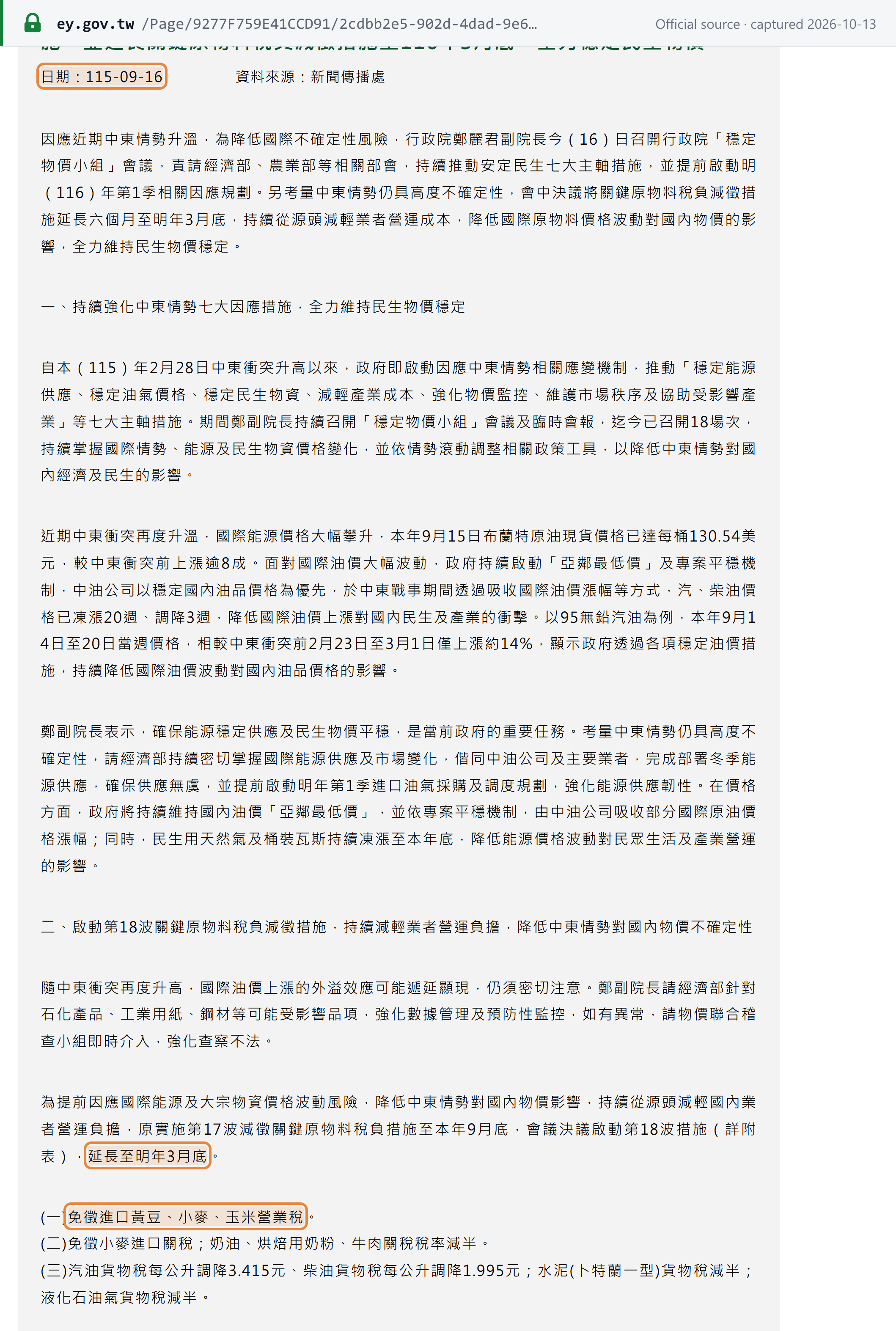
Temporary relief on imported grain. Article 9-1 lets the Executive Yuan adjust business tax on imported wheat, barley, corn and soybeans. On 16 September 2026 it extended its relief on key raw materials for an 18th round, to the end of March 2027, keeping imported soybeans, wheat and corn exempt from business tax. [11] [1]
Cross-border rules
Imports and exports
Imports. Business tax on imported goods is collected by Customs (Art 41) on the customs value plus import duty, and any commodity tax or tobacco and alcohol tax (Art 20). Imports exempt under Art 9 include gold, fertiliser, the goods in Art 49 of the Customs Act, and national antiques. [1]
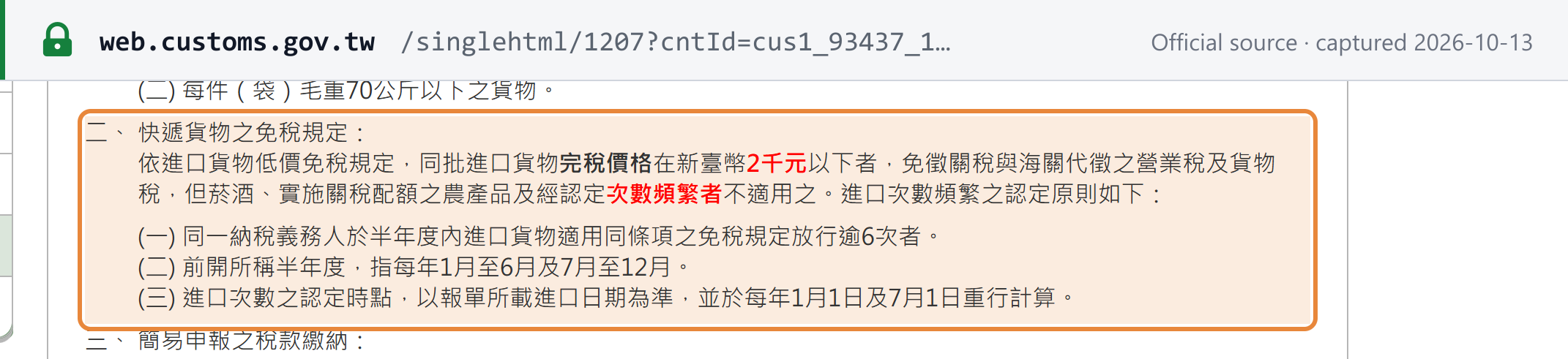
Low-value consignments. A consignment with a customs value of NT$2,000 or less is exempt from import duty and from the business tax and commodity tax collected by Customs. The relief does not cover tobacco and alcohol or tariff-quota farm products, and it is lost by a taxpayer who uses it for more than 6 releases in a half-year. [12]
Exports. Exported goods, export-related services and services provided in Taiwan but used abroad are zero-rated (Art 7). [2]
Imported services. A Taiwanese buyer of services from a foreign supplier with no fixed place of business in Taiwan accounts for the tax under Art 36 — see B2B and B2C below and reverse charge explained.
Digital products and services
"Electronic services" are services downloaded and saved to a computer or mobile device, services used online without download, and other services provided over the internet or other digital means (Enforcement Rules Art 4-1). [4] The Ministry's Q&A treats a buyer as an individual in Taiwan where, for example, the buyer's mobile number carries the 886 country code, or the billing address, bank account, IP address or SIM card points to Taiwan; for services used at a physical location, that location decides. [8] See VAT on digital services by non-resident suppliers.
Foreign companies selling into Taiwan — B2B and B2C
- Selling to businesses (B2B): the foreign supplier does not register. The Taiwanese buyer is the taxpayer (Art 36):
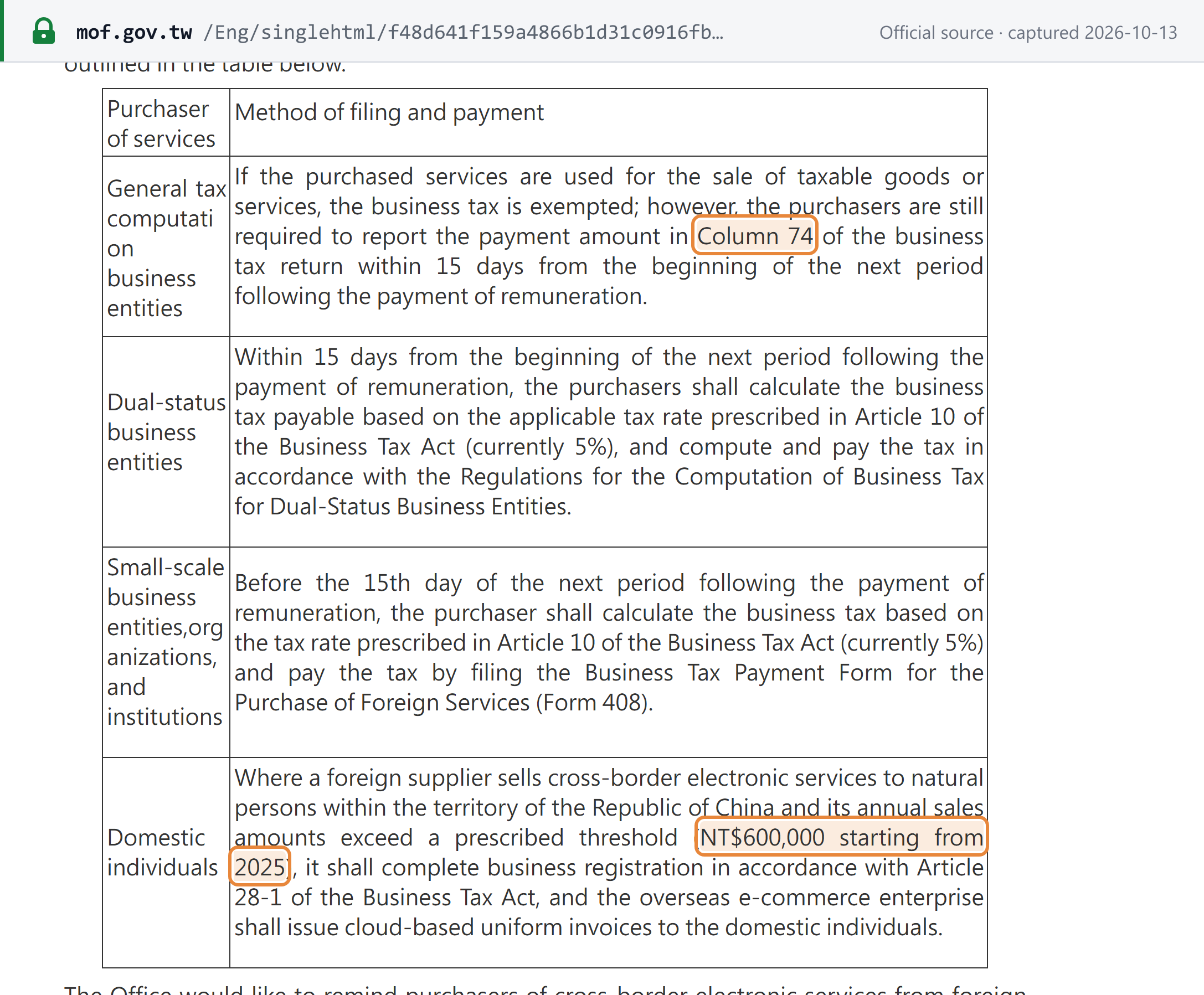
- a buyer using the general computation that uses the service solely for taxable sales pays nothing, but reports the payment in Column 74 of its business tax return within 15 days from the start of the next period;
- a dual-status buyer (with both taxable and exempt sales) computes and pays the tax under the Ministry of Finance regulations for dual-status business entities;
- a general-computation buyer that does not use the service for taxable sales pays 5% on the payment (Art 36);
- small-scale business entities, organisations and institutions compute 5% on the payment and pay it on Form 408 before the 15th day of the next period;
- schools and research institutions buying for education or research are relieved (Art 36-1). [13] [1]
- Selling electronic services to individuals (B2C): above NT$600,000 a year the foreign supplier registers (Art 28-1), charges 5%, files and pays every two months, and issues cloud uniform invoices to the buyers. The buyer-pays route does not apply to these sales (Art 2-1). [13]
Practical rules for registered foreign e-service suppliers: [8] [4]
- Agent. Optional: file yourself, or appoint an individual or business in Taiwan as tax-filing agent.
- Exchange rate. Convert foreign-currency sales at the Bank of Taiwan closing spot buying rate on the last day of the period (Enforcement Rules Art 32-2).
- Payment. In New Taiwan dollars, by remittance to the National Taxation Bureau of Taipei account at the Bank of Taiwan, Chengzhong Branch (account 045036070263), with the supplier bearing the fees; or in cash with a barcode payment slip.
- Input tax. Tax on purchases from Taiwanese businesses is creditable only where the purchase is used solely for electronic services sold to individuals in Taiwan.
Marketplace / platform deemed-supplier liability
There is no general deemed-supplier rule for goods marketplaces in the Act. For electronic services sold to individuals through a foreign platform, liability follows whoever collects the price: if the platform collects from the buyer, the platform reports the full price and the underlying foreign vendor's receipts from the platform are outside Taiwanese business tax; if the vendor collects, the vendor reports. [8] Domestic platforms must pass buyers' carrier and donation-code details for cloud invoices to the sellers using them (E-Invoice Implementation Directions, point 21). [14] See marketplace deemed-supplier rules.
Place of supply
Under Art 4: [1]
- Goods are sold in Taiwan where they are shipped from Taiwan, or, if no transport is needed, where they are located in Taiwan.
- Services are sold in Taiwan where they are provided or used in Taiwan. International transport boarding or loading in Taiwan, and reinsurance accepted from Taiwanese insurers, are also caught.
Invoice requirements
Registered businesses must issue a uniform invoice (統一發票) to the buyer at the time set by the Act's time-limit table (Art 32). Small-scale businesses and businesses of a special nature may issue ordinary receipts instead. [1] The detailed rules are in the Uniform Invoice Regulations (統一發票使用辦法), last amended 12 December 2024 with effect from 1 January 2025. [5]
Mandatory content
Every uniform invoice states, in the prescribed format (Uniform Invoice Regulations Art 9): [5]
| Field | Chinese term | Notes |
|---|---|---|
| Track letters and number | 字軌號碼 | Assigned by the government (see Numbering) |
| Transaction date | 交易日期 | |
| Item name | 品名 | |
| Quantity | 數量 | |
| Unit price | 單價 | |
| Amount | 金額 | |
| Sales amount | 銷售額 | |
| Tax category | 課稅別 | Taxable, zero-rated or exempt |
| Tax amount | 稅額 | Shown separately where the buyer is a business (Act Art 32) |
| Total | 總計 | |
| Seller's name, BAN and address | — | Shown by the uniform-invoice seal; an e-invoice may print them as text (Art 5, Art 8) |
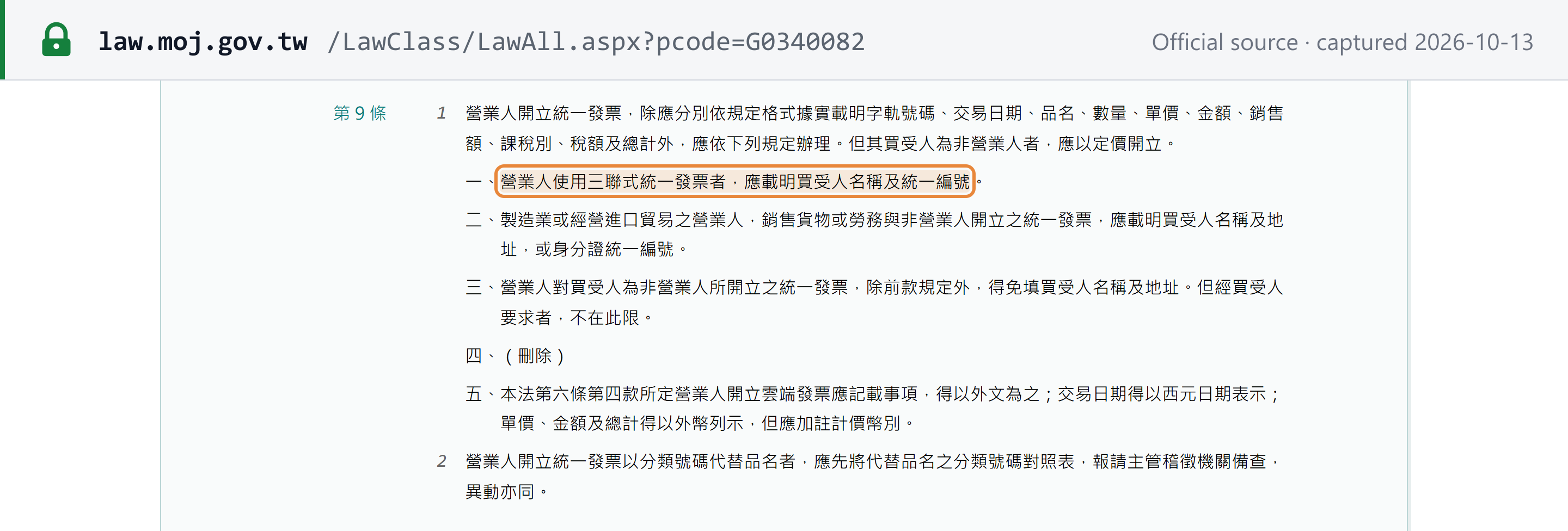
| Buyer's name and BAN | 買受人名稱及統一編號 | Required on triplicate (B2B) invoices (Art 9 subpara 1) |
- To a non-business buyer, the invoice is issued at the tax-inclusive list price, and the buyer's name and address may be left out unless the buyer asks for them. Manufacturers and importers selling to non-business buyers must show the buyer's name and address or ID number. [5]
- To deduct input tax, the buyer needs a document showing its name, address and BAN (Act Art 33). [2]
Issuance deadline
The time depends on the trade, under the table of time limits for issuing sales documents attached to the Act (營業人開立銷售憑證時限表): [16] [17]
| Business | When the invoice is issued |
|---|---|
| Sale of goods (trading, manufacturing and similar) | At shipment; any payment received before shipment is invoiced when received |
| Goods sold under a written agreement that takes effect only on the buyer's confirmation | At the buyer's confirmation |
| Most services (labour contracting, leasing, warehousing, transport, advertising, banking and others) | When payment is collected |
A business may issue invoices for its sales to other businesses monthly, at month-end, only with approval from its tax office and if it meets the conditions in Uniform Invoice Regulations Art 15-1. [5]
Numbering and sequencing
- Invoices carry track letters and numbers (字軌號碼) assigned by the government and must be issued in time order (Art 8). [5]
- An invoice for another period cannot be used without approval, and assigned numbers cannot be passed to anyone else (Art 21).
- E-invoice numbers are applied for from the tax office after the business's e-invoice system passes a self-test, then drawn from the platform as needed. Foreign e-service suppliers apply on the eTax Portal and receive an allocation (E-Invoice Implementation Directions, point 7). [14]
- Unused e-invoice numbers are reported to the platform within 10 days of the start of the next period. [19]
Credit and debit notes
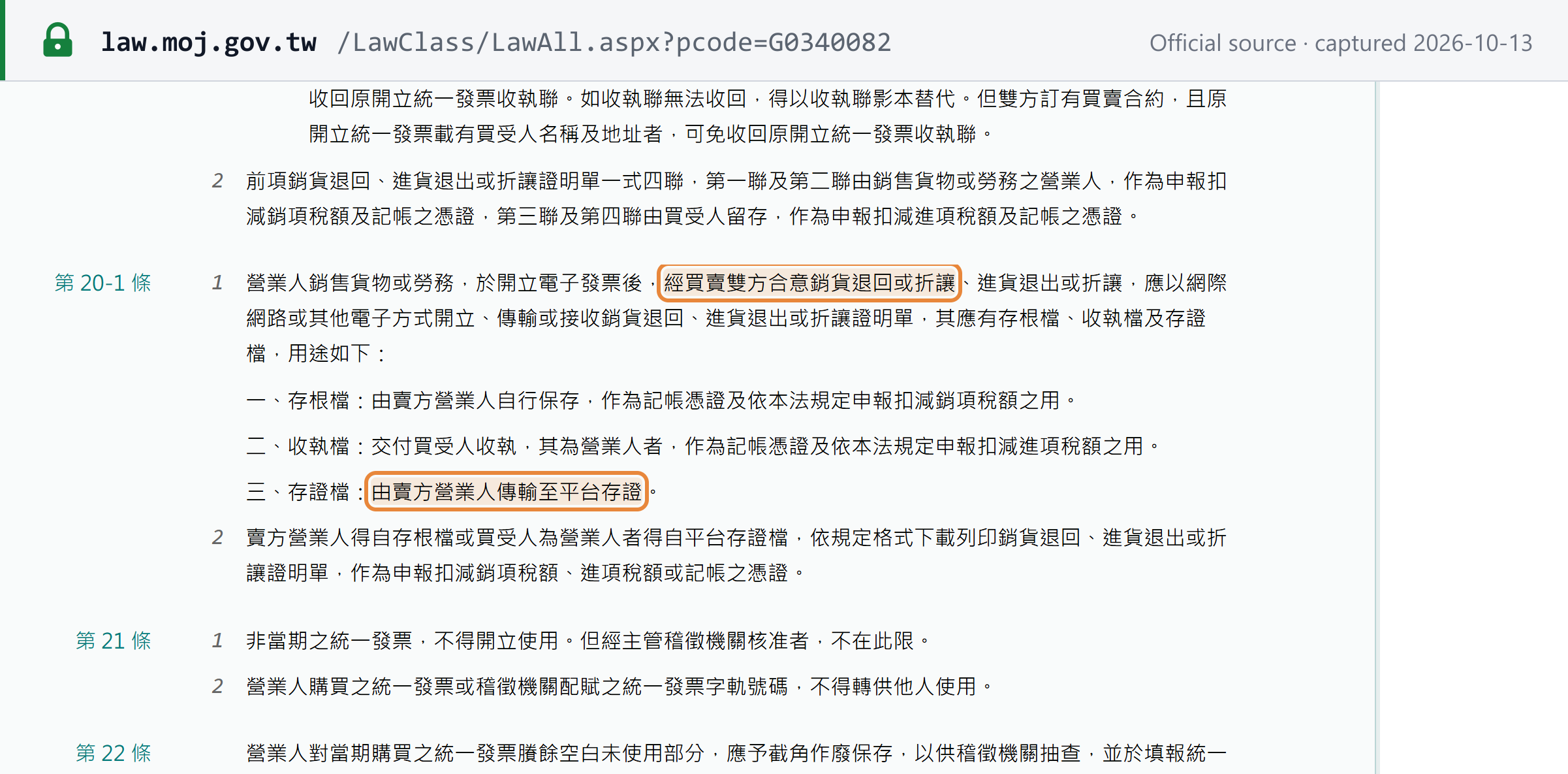
Taiwan uses a certificate of sales return, purchase return or allowance (銷貨退回、進貨退出或折讓證明單) instead of a credit note. Where the original was an e-invoice, the certificate must be issued electronically by the seller, which uploads its evidence file to the platform (Uniform Invoice Regulations Art 20-1, in force 1 January 2025). For paper invoices, the certificate is issued on paper (Art 20). An invoice with an error in its required particulars is not amended by a note; a new invoice is issued (Art 24). [5] [20]
Currency and language
- Foreign e-service suppliers. Cloud invoices may be written in a foreign language, use Western dates, and show the unit price, amount and total in a foreign currency, provided the currency is stated (Art 9 subpara 5). Sales are converted to New Taiwan dollars for the return at the Bank of Taiwan rate (see B2B and B2C). [5]
- Domestic sellers. The regulations give the foreign-language and foreign-currency permission only to foreign e-service suppliers.
Document types
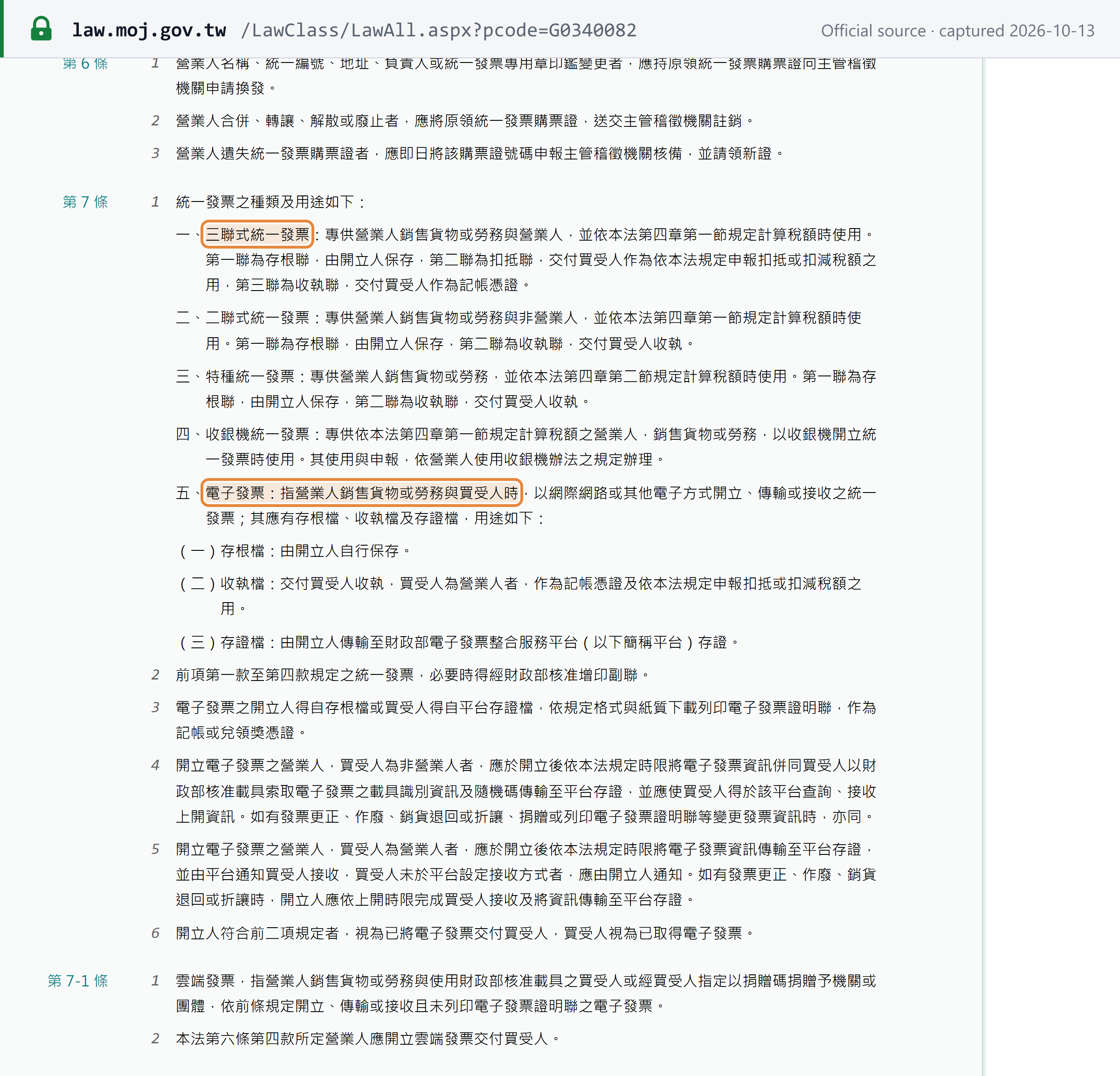
The Uniform Invoice Regulations define five types of uniform invoice (Art 7): [5]
| Type | Used for |
|---|---|
| Triplicate (三聯式) | Sales to businesses, under the general computation |
| Duplicate (二聯式) | Sales to non-business buyers, under the general computation |
| Special (特種) | Sellers on the non-value-added track |
| Cash-register (收銀機) | General-computation sellers issuing by cash register |
| Electronic invoice (電子發票) | Issued, transmitted or received over the internet or other electronic means; it has stub, receipt and evidence files |
Other documents:
- Ordinary receipts replace uniform invoices for small-scale and special-nature businesses (Act Art 32). Art 4 of the Regulations lists 34 cases in force where uniform invoices need not be used or issued, including small-scale businesses, hospitals, schools and export sales. [5]
- Sales under NT$50. Where a sale's amount plus output tax is under NT$50, an invoice need not be issued for each sale unless the buyer asks; one aggregated invoice is issued at the close of each day. This does not apply to e-invoices, cash-register invoices or vending machines (Art 15).
- Cash-register receipts may replace item-by-item invoices with tax office approval (Act Art 32).
Self-billing
The Uniform Invoice Regulations contain no self-billing provision. For e-invoices, return and allowance certificates must be issued by the seller (Art 20-1).
Retention and audit trail
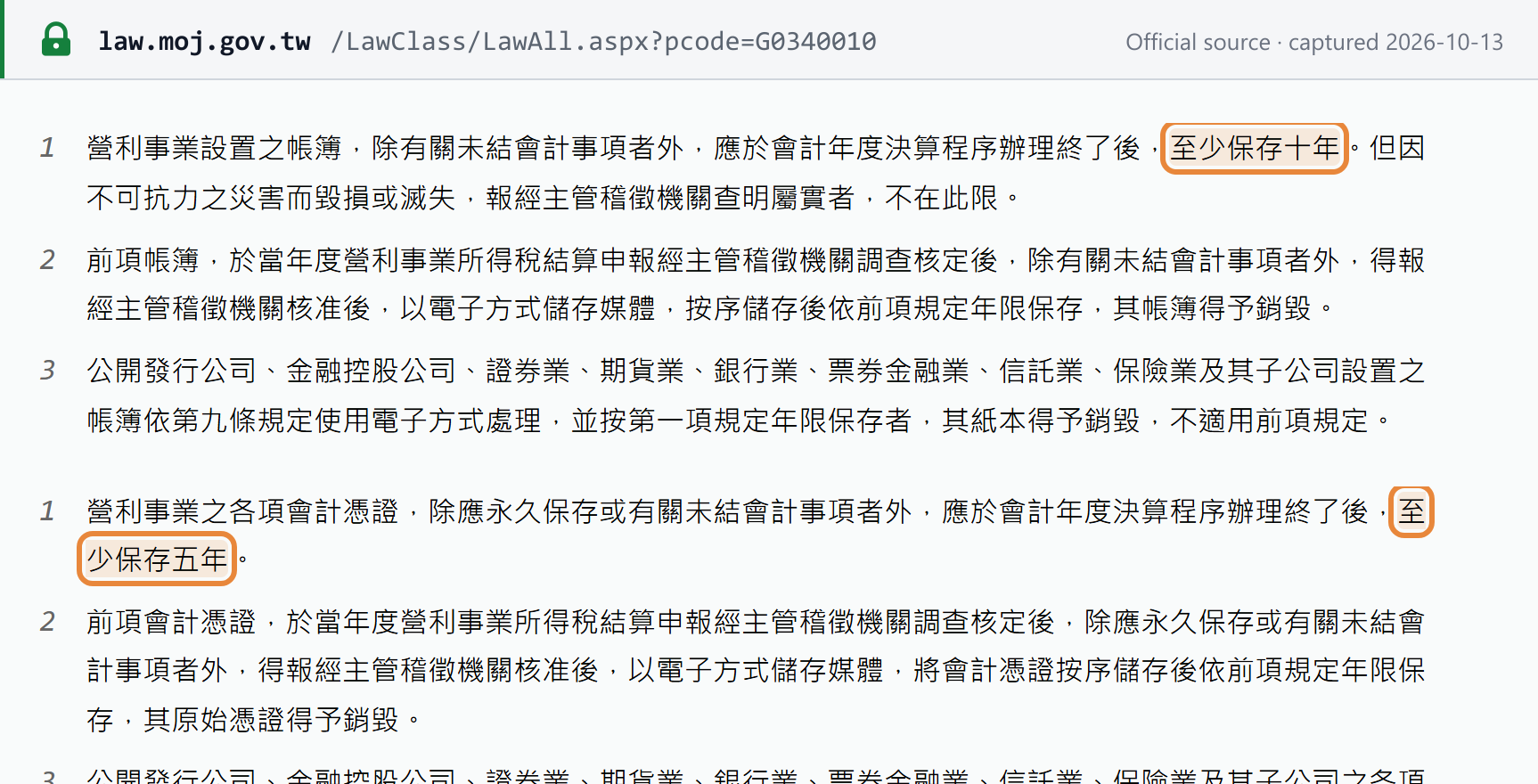
- Retention. Vouchers — invoices received and the stubs or copies of invoices issued — are kept for 5 years (Tax Collection Act Art 11). Books are kept for at least 10 years and accounting vouchers for at least 5 years after the year-end closing (Books and Vouchers Regulations Arts 26–27). [24] [26]
- Electronic-only archiving. After the year's income tax return has been assessed, a business may, with tax office approval, store its vouchers electronically in sequence and destroy the paper originals (Art 27). [26]
- E-invoice audit trail. An e-invoice exists as stub, receipt and evidence files; the evidence file is held on the Ministry of Finance platform (Uniform Invoice Regulations Art 7). E-invoice systems must protect confidentiality, integrity, source authentication, non-repudiation and accountability, and must block wrong, duplicate or un-uploaded invoice numbers (Directions point 4). The buyer's consent to issuing, correcting, voiding or making an allowance on an e-invoice is kept for at least 5 years (point 9). [5] [14]
A specimen of a compliant invoice
The Ministry of Finance publishes official specimens of the e-invoice proof copy (電子發票證明聯) — the printed form of an e-invoice — in Annex 1 to the E-Invoice Implementation Directions. Every number in them is the Ministry's own sample data. [15]
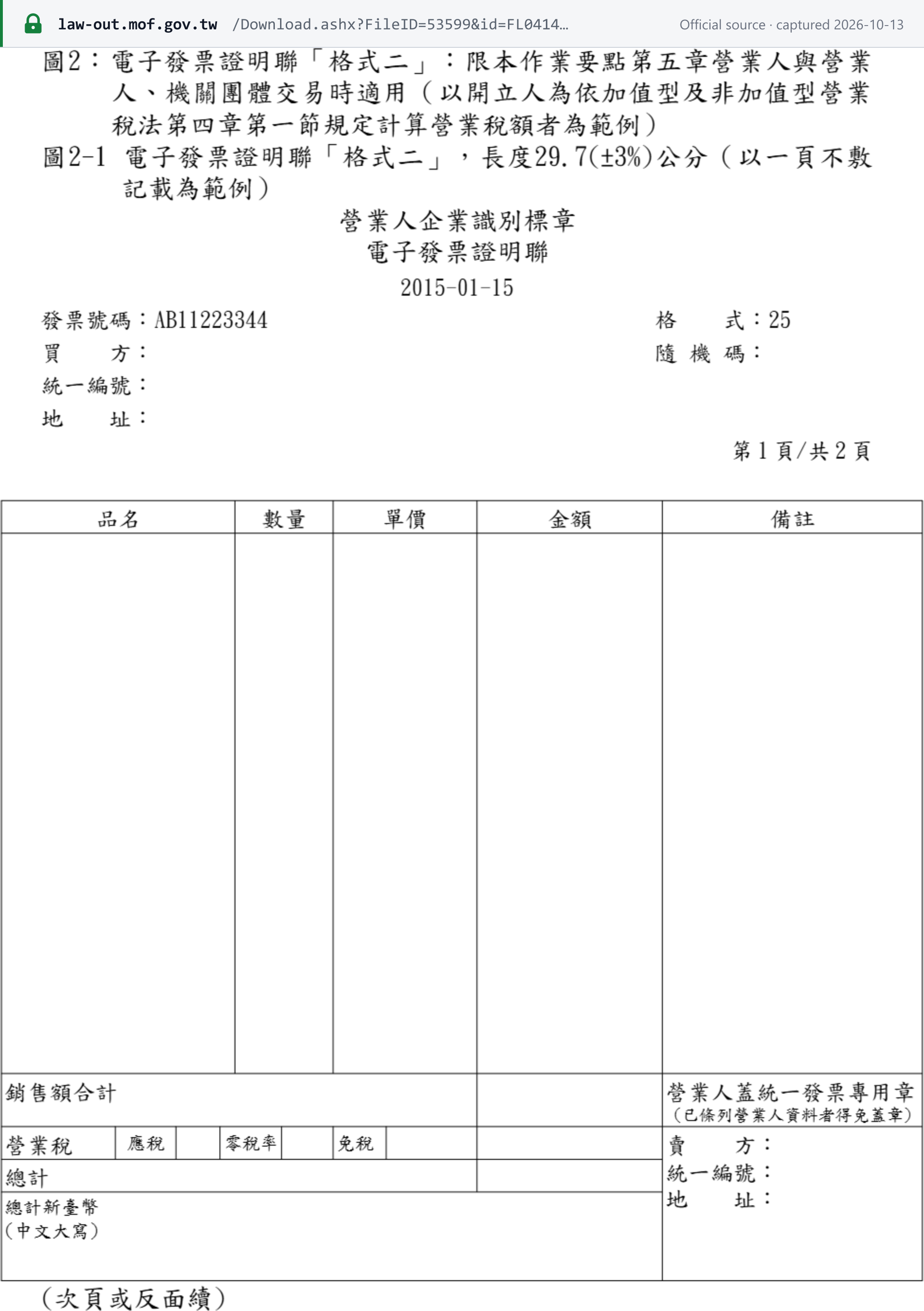
Format 2 (A4), for sales to businesses, government agencies and other organisations (Figure 2-1). The top block carries a place for the seller's logo (optional), the title 電子發票證明聯, the date (2015-01-15), the invoice number AB11223344, the filing format code (格式: 25), the random code, and the buyer's name, BAN and address. The body has columns for item name (品名), quantity (數量), unit price (單價), amount (金額) and remarks (備註). The foot shows the sales total (銷售額合計); the business tax with boxes for taxable (應稅), zero-rated (零稅率) and exempt (免稅); the total (總計) and the total in New Taiwan dollars in Chinese numerals. The bottom-right box is for the uniform-invoice seal; a seller that prints its name, BAN and address there may omit the stamp.
Format 1 (5.7 cm wide), shown here in its version for non-business buyers (Figure 1-1); a business-buyer version is Figure 1-2. The front shows, in a fixed order, a place for the seller's logo, 電子發票證明聯, the bimonthly period in the ROC calendar (108年01-02月, i.e. January–February 2019), the invoice number AB11223344, the date and time (2019-01-23 11:22:33), a random code (9999), the total (340), the seller's BAN, a barcode and two QR codes. Item details print on a second sheet, and the back is the prize-claim receipt for the uniform invoice lottery.
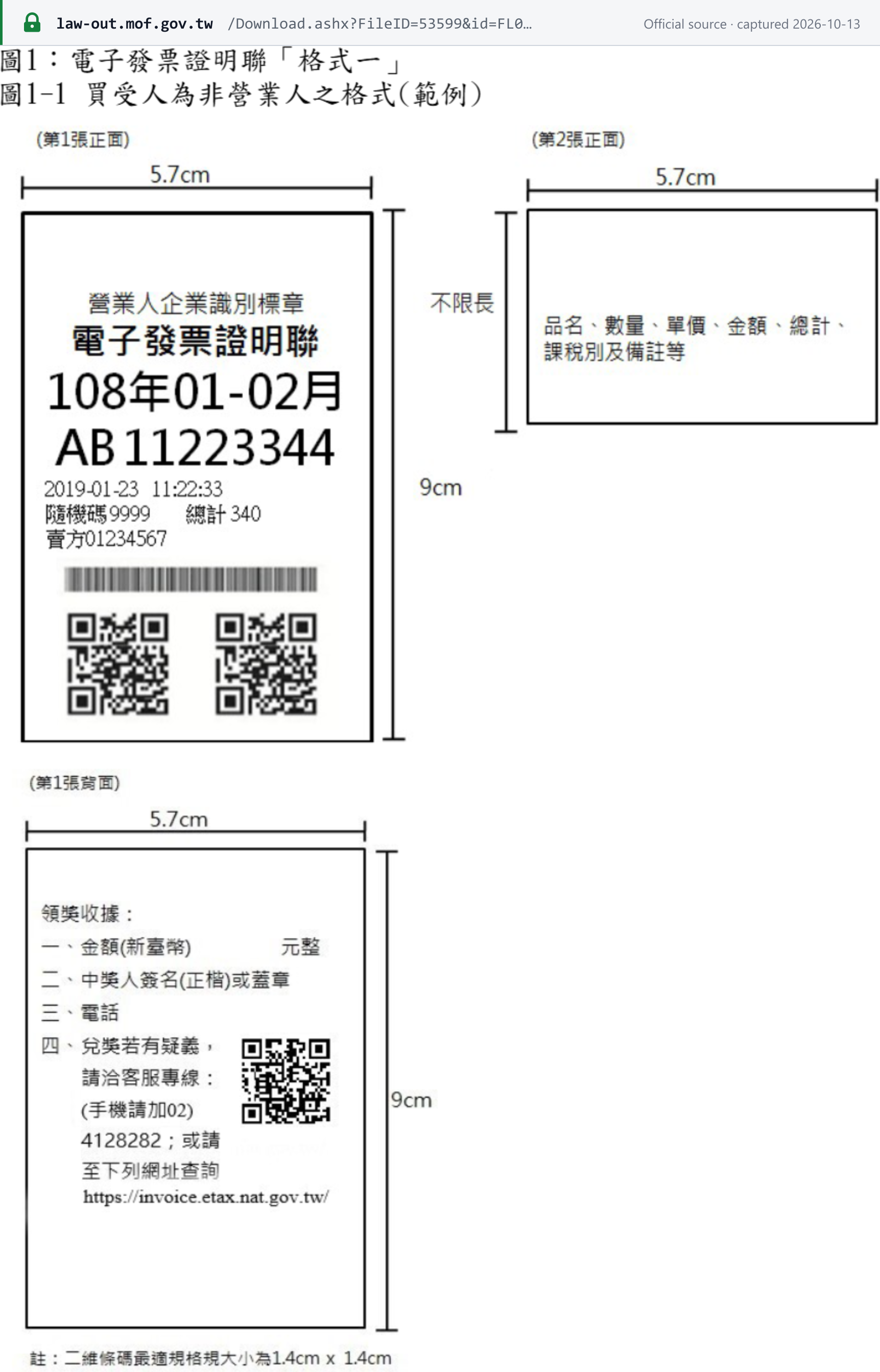
The Ministry's numbers in these figures are illustrative; do not treat them as valid BANs or invoice numbers. On Format 1, item lines mark the tax category as TX (taxable), TZ (zero-rated) or TF (exempt). [15]
E-invoicing status
Status (as at 2026-10-13): e-invoices are one of the uniform-invoice forms for domestic sellers; cloud invoices are mandatory for registered foreign e-service suppliers.
- Domestic sellers. An e-invoice is one of the five permitted types of uniform invoice — the Act says a uniform invoice may be issued, transmitted or obtained electronically (Art 32). [1] [5]
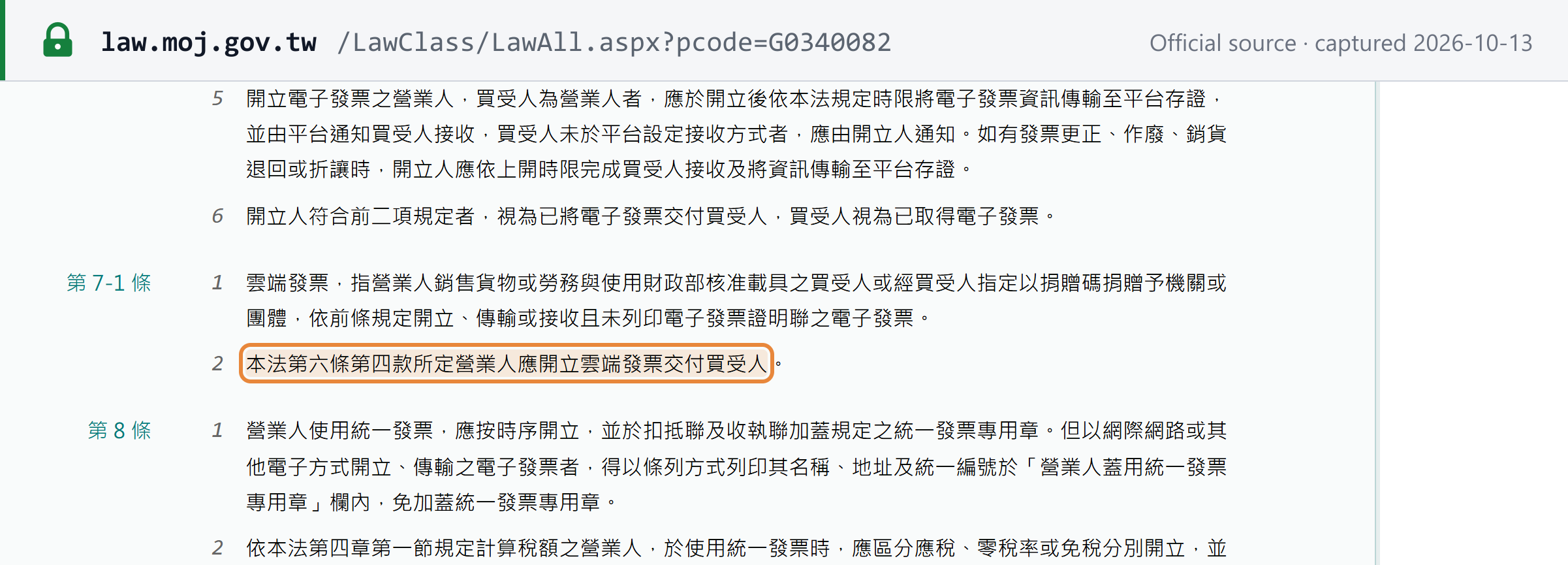
- Foreign e-service suppliers registered under Art 6 subpara 4 of the Act must issue cloud invoices (雲端發票) to buyers (Uniform Invoice Regulations Art 7-1), a duty in force since 1 January 2019. From 1 May 2017 to 31 December 2018 they were exempt from issuing invoices. They need not offer paper proof copies. [5] [8] [14]
Model. The seller issues the e-invoice and then uploads it, with the required data, to the Ministry of Finance E-Invoice Platform (財政部電子發票整合服務平台) for evidence filing (存證). This is a post-issuance reporting model, not prior clearance. See CTC e-invoicing models.
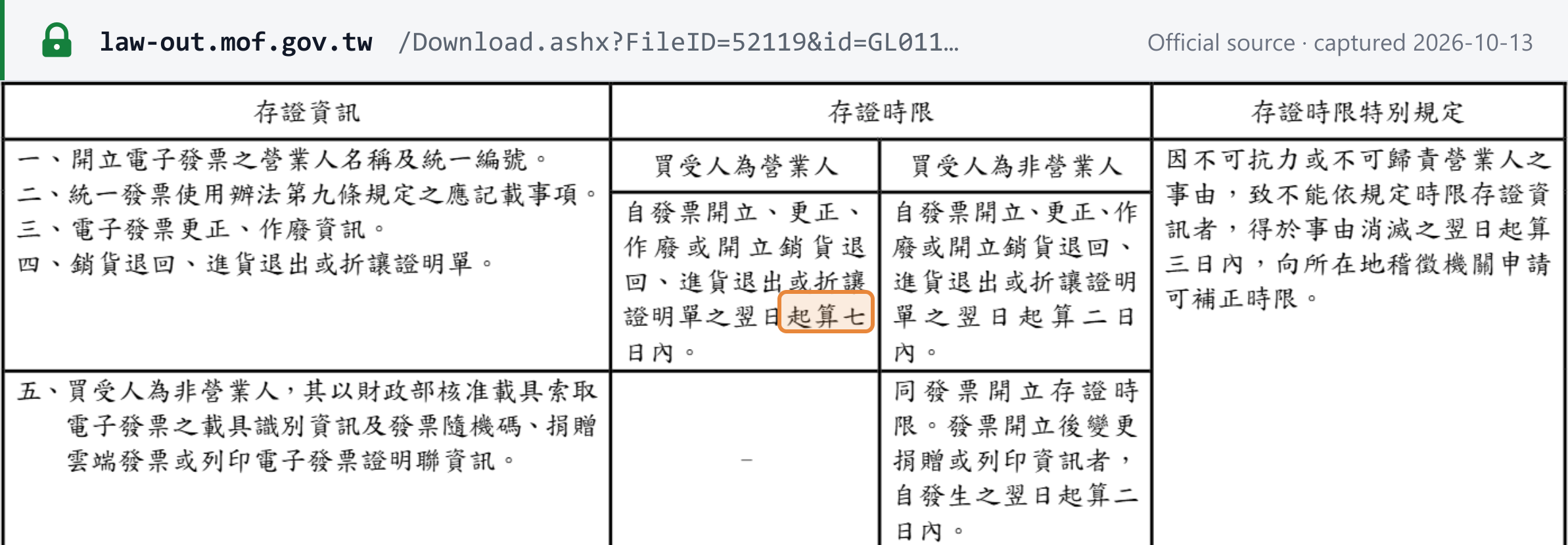
Upload time limits (MOF announcement 台財稅字第11304654280號, in force 1 January 2025): [18] [19]
| Upload | Buyer is a business | Buyer is not a business |
|---|---|---|
| Issue, correction or voiding of an e-invoice, or a return or allowance certificate | 7 days from the day after | 2 days from the day after |
| Buyer's carrier ID, random code, donation or proof-copy printing data | — | With the invoice; a later change to donation or printing, 2 days from the day after |
The last day is not extended for weekends or public holidays. A business prevented by force majeure may apply to its tax office within 3 days after the cause ends. Since 1 January 2025, late or inaccurate upload can be fined NT$1,500 to NT$15,000 (Act Art 48-2). [19] [2]
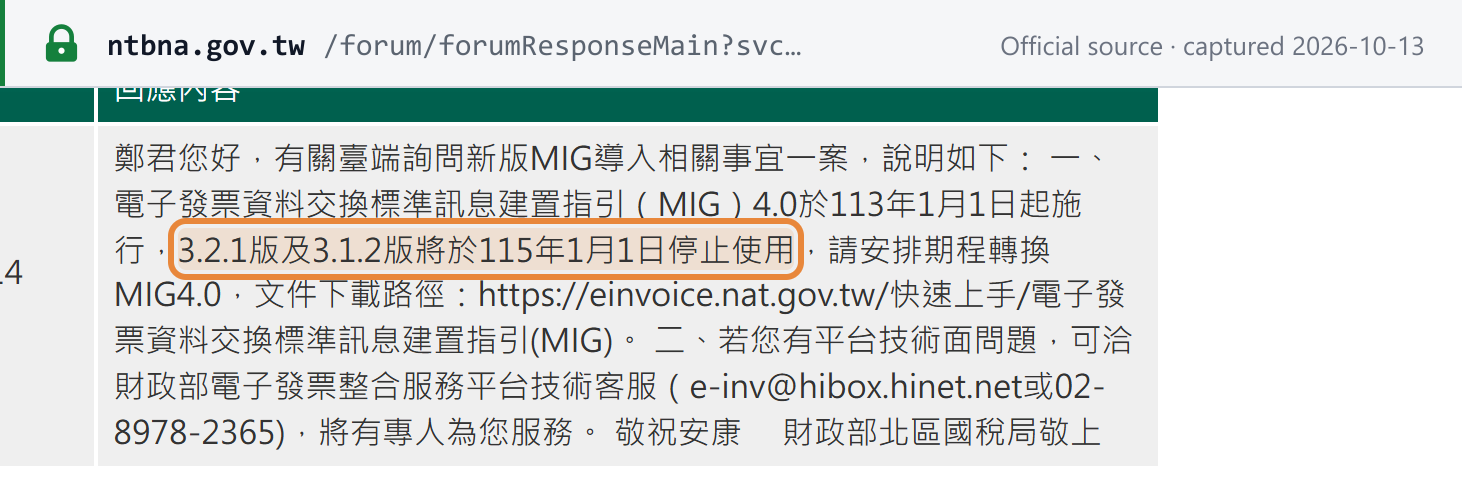
Format. The XML message standard is the E-Invoice Message Implementation Guideline (MIG, 電子發票資料交換標準訊息建置指引). MIG 4.0 has applied since 1 January 2024, and versions 3.2.1 and 3.1.2 stopped being accepted on 1 January 2026. A MIG 4.1 document dated 29 October 2025 has also been published. Businesses connect through the platform's Turnkey software or a value-added service centre, after a system self-test. [21] [22] [14]
Scope.
- B2B: businesses issue on the platform, through a value-added service centre, or from their own system with upload; the buyer receives through the platform or is notified by the seller. [14]
- B2G: sales to government agencies follow the same uniform-invoice rules; the A4 proof-copy format (Format 2) covers government buyers.
- B2C: cloud invoices are attached to a carrier (載具) — the Ministry's mobile barcode, a citizen digital certificate, or a phone, membership or payment-card number — or donated by code. Paper proof copies are the exception, and domestic merchants may not refuse the Ministry's common carrier. [14]
Uniform invoice lottery. Uniform invoices double as lottery tickets; prizes are funded from 3% of annual business tax revenue (Act Art 58). [2]
For Taiwan's e-invoicing system in more depth, see the Taiwan e-invoicing guide, and for other countries the e-invoicing status and networks table.
Filing and payment
Filing frequency
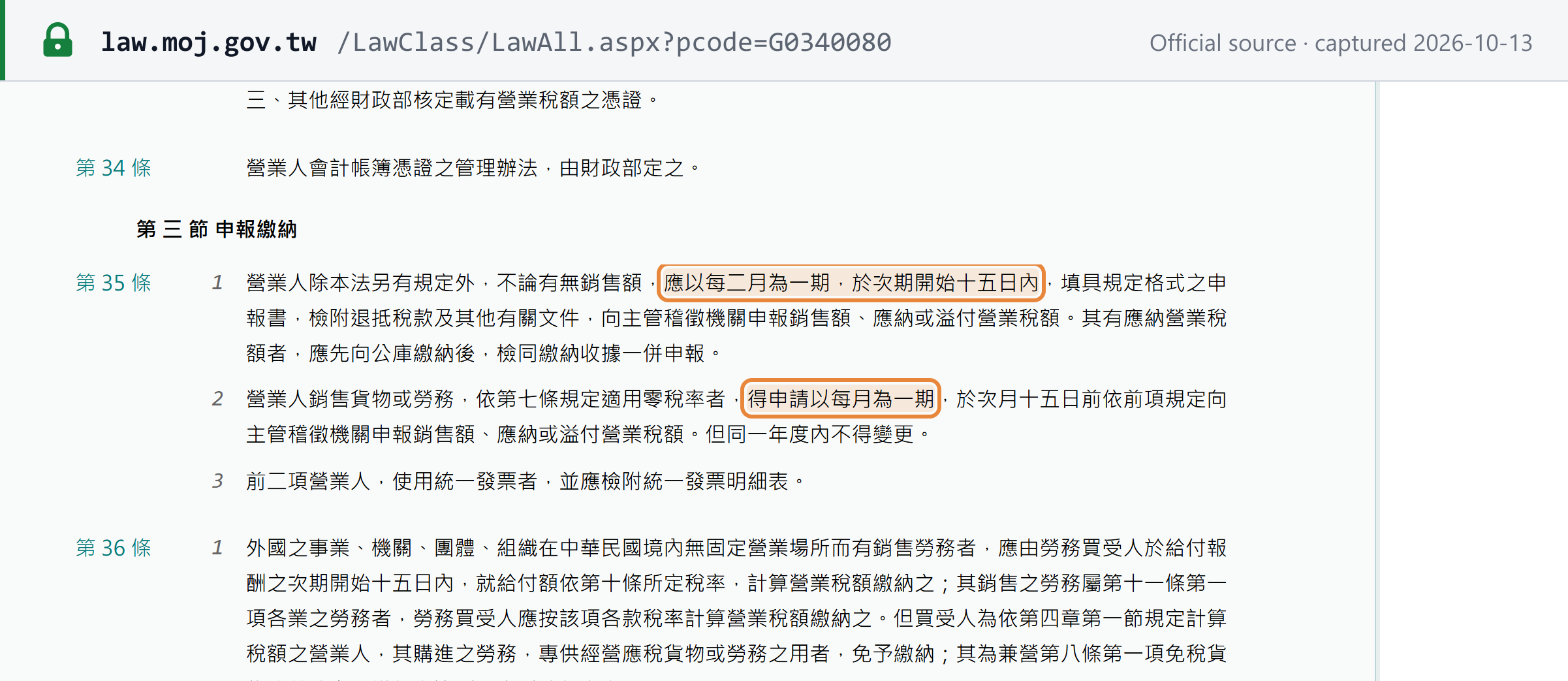
- Every two months, whether or not there were sales (Art 35). Periods are January–February, March–April, May–June, July–August, September–October and November–December.
- Monthly, on application, for businesses with zero-rated (Art 7) sales; once approved, the choice cannot be changed within the same year.
- Small-scale businesses assessed at 1% do not file; the tax office sends quarterly assessment notices, before the end of January, April, July and October (Art 40; Enforcement Rules Art 45). [2] [4]
Return due date
Within the first 15 days of the following period: by 15 March, 15 May, 15 July, 15 September, 15 November and 15 January. Monthly filers file by the 15th of the next month. [2]
The return form depends on the computation used: [23] [13]
| Form | Used by |
|---|---|
| 401 | General computation, wholly taxable sales |
| 403 | General computation with exempt sales, or special (non-value-added) computation alongside it |
| 404 | Special (non-value-added) computation only |
| 408 | Payment of tax on services bought from foreign suppliers (small-scale entities, organisations and institutions) |
Payment due date and method
Any tax due is paid before the return is filed, and the payment receipt is filed with the return (Art 35). [2] For how foreign e-service suppliers pay, see Foreign companies selling into Taiwan.
Additional listings
The return is filed with the input and output invoice data, the list of zero-rated sales and, when a refund is claimed for fixed assets, the fixed-asset list. Businesses that use uniform invoices also attach the detailed list of uniform invoices used (統一發票明細表) (Art 35). There is no annual business tax return. [23] [4] [2]
Input-tax recovery and blocked items
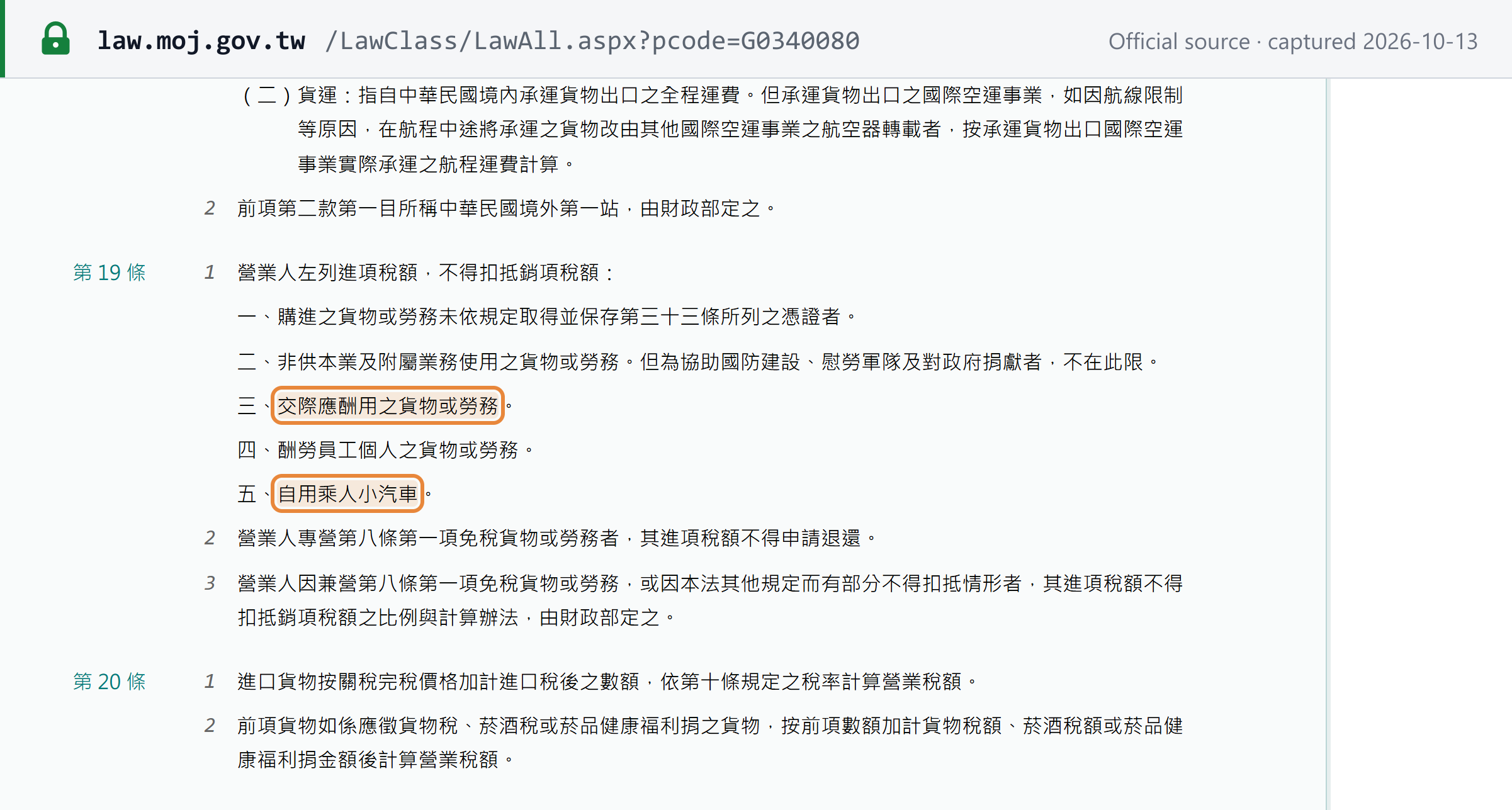
Input tax is credited against output tax for the period (Art 15), supported by a uniform invoice or other approved document showing the buyer's name, address and BAN (Art 33). Input tax on the following cannot be credited (Art 19): [1]
- purchases without the required documents;
- goods or services not used for the business, except to support national defence, comfort troops or donate to government;
- entertainment (交際應酬);
- rewards to individual employees;
- passenger cars for own use (自用乘人小汽車).
Businesses with both taxable and exempt sales apportion input tax under Ministry of Finance regulations. Small-scale businesses assessed at 1% have 10% of their input tax credited against the assessed tax (Art 25).
Refunds
- Residents. Excess input tax is carried forward, except in three cases where the tax office refunds it after review (Art 39): excess arising from zero-rated sales (capped at zero-rated sales × 5%), from acquiring fixed assets (capped at the tax on them), and on cancellation of registration. Other refunds need Ministry of Finance approval. [2] [4]
- Non-residents. A foreign business with no fixed place of business in Taiwan that buys goods or services for exhibitions or temporary business activities in Taiwan may claim a refund, subject to reciprocity (Art 7-1). [1]
- Bad debts. The Act and its Enforcement Rules contain no bad-debt relief provision.
Exemptions
Exempt supplies
Art 8 exempts a long list of goods and services, including: [1]
- sales of land;
- medical services, medicine, ward lodging and meals provided by hospitals and clinics;
- education services from schools, kindergartens and other educational and cultural institutions;
- social welfare services;
- newspapers and broadcasting, excluding newspaper and television advertising;
- unprocessed agricultural, forestry, fishery and livestock products, and feed;
- gold bars, bricks, foil, coins and ornaments, excluding the processing fee;
- government bonds and securities subject to securities transaction tax;
- financial derivatives, corporate and financial bonds, and interbank call loans, excluding commissions and service charges.
Exempt is not zero-rated. A zero-rated seller charges 0% and can recover input tax, with a cash refund under Art 39. A business dealing solely in exempt supplies cannot have input tax refunded (Art 19), and a business with mixed sales apportions. An exempt seller may waive the exemption, with a three-year lock (see Voluntary registration). [1]
Special regimes
- Bonded zones. Sales to science parks, free trade zones, bonded factories and warehouses and logistics centres for their operations are zero-rated (Art 7); goods moved from a bonded zone into the taxable area are treated as imports (Art 5). [1]
- Small-scale businesses. 1% on assessed sales, no uniform invoices, 10% input credit (see Registration threshold). From 1 January 2026 to 31 December 2028, chain and franchise eateries that would otherwise be moved onto uniform invoices can stay on the 1% assessment if they adopt mobile payment or kiosk checkout. [7]
- Used cars and motorcycles. A business buying from a non-registered seller may compute deemed input tax as purchase cost ÷ (1 + rate) × rate, limited to the output tax on resale (Art 15-1). [1]
- Virtual assets. Sales of virtual assets and stablecoins as defined in the Virtual Asset Services Act are outside the scope of business tax (MOF Order 台財稅字第11504611390號, 3 September 2026). [28]
- Imported grain. Imported soybeans, wheat and corn are exempt until the end of March 2027 (see Rates).
- Cash accounting and flat-rate schemes: none apart from the small-scale assessment regime. Invoices for most services are already issued when payment is collected.

Offences and penalties
Offences
The following conduct is unlawful under the Business Tax Act and the Tax Collection Act: [1] [24]
- trading without tax registration, or after registration is cancelled or suspended (Act Art 51);
- under-reporting or not reporting sales, and falsely reporting input tax (Art 51);
- failing to issue uniform invoices, or understating the sales amount on them (Art 52);
- letting others use your uniform invoices (Art 47);
- failing to give, obtain or keep vouchers (Tax Collection Act Art 44).
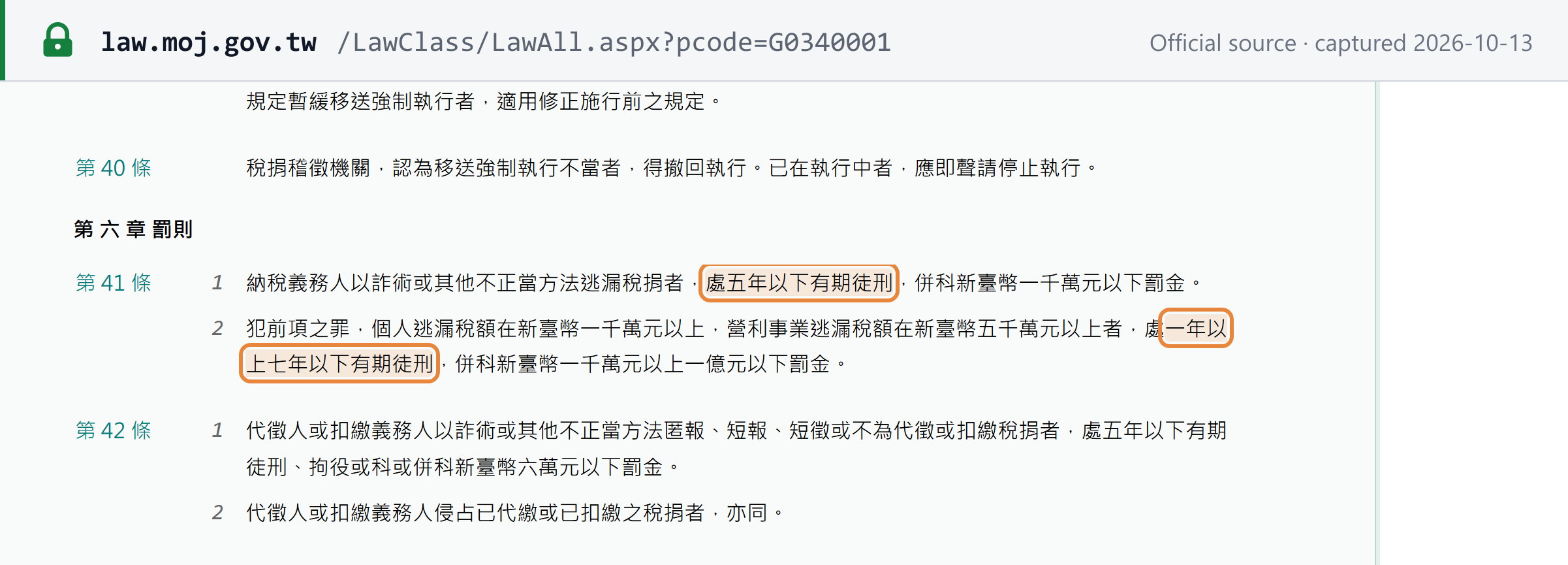
Criminal exposure. Evading tax by fraud or other improper means is punishable by up to 5 years' imprisonment and a fine of up to NT$10 million. Where a business evades NT$50 million or more (NT$10 million or more for an individual), the range is 1 to 7 years' imprisonment and a fine of NT$10 million to NT$100 million (Tax Collection Act Art 41). Instigating or assisting is punishable by up to 3 years' imprisonment and a fine of up to NT$1 million (Art 43). [24] [25]
Penalties
| Failure | Penalty | Provision |
|---|---|---|
| Not registering | NT$3,000–30,000, repeatable until registered; trading unregistered also up to 5× the tax evaded | Act Arts 45, 51 |
| Not reporting changes, cancellation or suspension; false registration details | NT$1,500–15,000, repeatable | Act Art 46 |
| Not using uniform invoices when required, or letting others use them | NT$3,000–30,000, repeatable; possible suspension | Act Art 47 |
| Missing or wrong invoice particulars | 1% of the sales amount (NT$1,500–15,000); wrong buyer name, address or BAN from the second time, 2% (NT$3,000–30,000) | Act Art 48 |
| Late or inaccurate e-invoice upload (from 1 January 2025) | NT$1,500–15,000, repeatable | Act Art 48-2 |
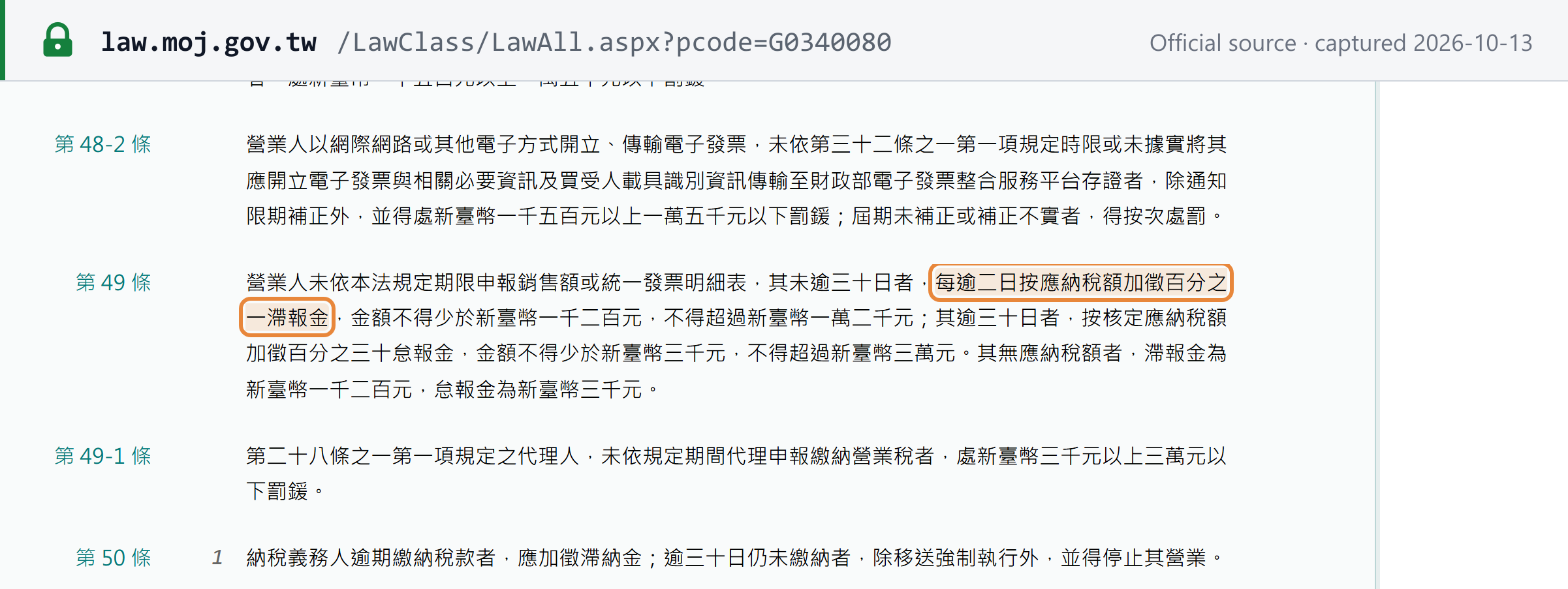
| Late filing, up to 30 days | 1% of tax payable for every 2 days (NT$1,200–12,000); NT$1,200 if no tax is payable | Act Art 49 |
| Late filing, over 30 days | 30% of the assessed tax (NT$3,000–30,000); NT$3,000 if no tax is payable | Act Art 49 |
| Late payment | 1% for every 3 days late; after 30 days, compulsory enforcement and possible suspension. Interest also runs daily at the postal savings one-year fixed deposit rate on 1 January of each year. | Tax Collection Act Art 20; Act Art 50 |
| Evasion (under-reported sales, false input tax and similar) | Up to 5× the tax evaded; possible suspension | Act Art 51 |
| Failure to issue or understating invoices, found before the filing deadline | Tax due plus up to 5× the tax, capped at NT$1,000,000; suspension after three findings in a year | Act Art 52 |
| Failure to give, obtain or keep vouchers | Up to 5% of the voucher total, capped at NT$1,000,000 | Tax Collection Act Art 44 |
| A foreign e-service supplier's tax-filing agent not filing or paying | NT$3,000–30,000 | Act Art 49-1 |
| Voluntary disclosure before any report or investigation | Evasion penalties (Tax Collection Act Arts 41–45 and the evasion penalties in the tax laws) waived. Fines for conduct, such as failing to register (Act Art 45), late-filing surcharges (Art 49) and late e-invoice upload (Art 48-2), are not. Interest still due. | Tax Collection Act Art 48-1 |
Sources: Business Tax Act Arts 45–52; Tax Collection Act Arts 20, 44 and 48-1. [1] [2] [24] [25]
Frequently asked questions
We sell software, apps or streaming to consumers in Taiwan from abroad. Do we have to register for business tax?
Yes, once your annual sales of electronic services to individuals in Taiwan exceed NT$600,000 (the threshold was NT$480,000 before 7 April 2025). You register online in the cross-border zone of the Ministry of Finance eTax Portal, either yourself or through a tax-filing agent in Taiwan, and then charge 5% business tax, file every two months and issue cloud invoices.
Do we charge Taiwanese business tax to business customers in Taiwan?
No. A foreign supplier with no fixed place of business in Taiwan does not register for its sales to Taiwanese businesses; the buyer accounts for the tax. A buyer using the general computation method that uses the service solely for taxable sales pays nothing but reports the payment in Column 74 of its return. Other buyers pay the tax themselves: a buyer with both taxable and exempt sales pays a proportion, a general-computation buyer that does not use the service for taxable sales pays 5%, and small-scale business entities, organisations and institutions pay 5% on Form 408 by the 15th day of the next period.
Do registered foreign sellers have to issue Taiwanese invoices, and can they be in English and US dollars?
Yes. Registered foreign e-service suppliers must issue cloud uniform invoices to their customers, a duty in force since 1 January 2019. The invoice may be in a foreign language, may use Western dates, and may show the unit price, amount and total in a foreign currency, provided the currency is stated.
How and when does a registered foreign e-service supplier file and pay?
Every two months, within the first 15 days of the next period, whether or not there were sales, on the eTax Portal. Foreign-currency sales are converted at the Bank of Taiwan closing spot buying rate on the last day of the period. Tax is paid in New Taiwan dollars by remittance to the National Taxation Bureau of Taipei account at the Bank of Taiwan, or in cash with a barcode payment slip.
What happens if a foreign seller exceeds the threshold and never registers?
Failing to register carries a fine of NT$3,000 to NT$30,000, which can be imposed repeatedly until you register, and trading without registration can be fined up to five times the tax evaded on top of the tax itself. Late payment adds 1% for every 3 days late. Voluntary disclosure before any report or investigation waives the penalties for tax evasion, but not the fine for failing to register or late-filing surcharges, and interest is still due.
How quickly must a Taiwanese e-invoice be uploaded to the Ministry of Finance platform?
Within 7 days where the buyer is a business and within 2 days where the buyer is not a business, counted from the day after the invoice is issued, corrected or voided. The deadline is not extended for weekends or holidays. Since 1 January 2025, late or inaccurate upload can be fined NT$1,500 to NT$15,000, repeatedly if not corrected.
Important websites
| Site | Purpose |
|---|---|
| eTax Portal — cross-border e-commerce zone (English) | Registration, filing and payment for foreign e-service suppliers |
| eTax Portal | Domestic e-filing, payment and payment slips |
| BAN registration lookup | Look up a business's tax registration by BAN |
| Taiwan UBN validator | Check the format and check digit of a BAN |
| E-Invoice Platform | Issue and receive e-invoices, carriers, MIG and Turnkey downloads |
| Business tax computation table | Rates by computation method and business type |
| Customs — express goods | Import tax and the NT$2,000 low-value relief |
| Laws & Regulations Database | Business Tax Act, Enforcement Rules, Uniform Invoice Regulations and Tax Collection Act, in Chinese and English |
| MOF regulations system | Ministry of Finance orders, announcements and directions |
Recent changes
- 2026-09-16 — Imported soybeans, wheat and corn remain exempt from business tax until the end of March 2027 (18th round of raw-material relief). (Executive Yuan)
- 2026-09-03 — Sales of virtual assets and stablecoins placed outside business tax (MOF Order 台財稅字第11504611390號). (Executive Yuan Gazette) — see the event record
- 2026-07-01 — The penalty-free period for individuals who regularly sell creative or informational content online ended on 30 June 2026; those at or above NT$100,000 (goods) or NT$50,000 (services) a month must register; the tax is 5%, or 1% if they are assessed as a small-scale business (Act Arts 13, 23). (Ministry of Finance) — see the event record
- 2026-04-22 — E-Invoice Implementation Directions amended (台財資字第1150000163號). (MOF regulations system)
- 2026-03-19 — The Ministry of Finance confirms that businesses with monthly sales under NT$200,000 may stay off uniform invoices at 1%, with a 2026–2028 relief for eateries adopting mobile payment or kiosk checkout. (Ministry of Finance)
- 2026-01-01 — MIG 3.2.1 and 3.1.2 retired; e-invoices use MIG 4.0 or later. The 28 May 2025 amendment of Act Art 58 (uniform-invoice prize funding) took effect. (NTB Northern Area) (Laws & Regulations Database)
- 2025-04-07 — Registration threshold for foreign e-service suppliers raised from NT$480,000 to NT$600,000 a year. (MOF eTax)
- 2025-01-01 — Late or inaccurate e-invoice upload becomes finable (Act Art 48-2), with the 7-day and 2-day limits reissued by MOF announcement; return and allowance certificates for e-invoices must be issued electronically by the seller; minimum taxable sales amount raised to NT$100,000 (goods) and NT$50,000 (services) a month. (Taxation Administration) (MOF regulations system)
For the full chronology, see Taiwan tax changes on Lookuptax.
Reference links
- Value-added and Non-value-added Business Tax Act (English)
- 加值型及非加值型營業稅法 — Business Tax Act (Chinese, authoritative)
- Ministry of Finance — Organization and functions
- Enforcement Rules of the Value-added and Non-value-added Business Tax Act (English)
- 統一發票使用辦法 — Uniform Invoice Regulations (Chinese)
- 小規模營業人營業稅起徵點 — Minimum taxable sales amount for small businesses (MOF Order, 12 December 2024)
- Ministry of Finance — press release on businesses under NT$200,000 a month (19 March 2026, Chinese)
- MOF eTax — Q&A on business tax for cross-border e-commerce (Chinese, PDF)
- MOF eTax — A Short Version for the New Provisions of Business Tax (VAT) on Cross-Border Electronic Services (PDF)
- MOF eTax — Business tax computation methods and rates (Chinese)
- Executive Yuan — extension of key raw-material tax relief to March 2027 (16 September 2026, Chinese)
- Customs Administration — Express goods (Chinese)
- Ministry of Finance — Domestic business entities and individuals purchasing cross-border electronic services from foreign suppliers (14 August 2026)
- 電子發票實施作業要點 — E-Invoice Implementation Directions (amended 22 April 2026, Chinese)
- E-Invoice Implementation Directions, Annex 1 — e-invoice proof copy formats (PDF, Chinese)
- 營業人開立銷售憑證時限表 — Time limits for issuing sales documents (PDF, Chinese)
- The Table of the Time Limits for Issuing Documentary Evidence of Sales (PDF, English)
- MOF announcement on e-invoice upload scope and time limits (12 December 2024, Chinese)
- E-invoice upload time-limit table (PDF, Chinese)
- Taxation Administration — e-invoice upload limits and penalties from 1 January 2025 (18 December 2024, Chinese)
- National Taxation Bureau of the Northern Area — MIG 4.0 cutover reply (Chinese)
- Fiscal Information Agency — E-Invoice Message Implementation Guideline v4.1 (PDF, Chinese)
- 營業稅電子資料申報繳稅作業要點 — Business tax e-filing directions (Chinese)
- Tax Collection Act (English)
- 稅捐稽徵法 — Tax Collection Act (Chinese, authoritative)
- 稅捐稽徵機關管理營利事業會計帳簿憑證辦法 — Books and Vouchers Regulations (Chinese)
- Business Tax Act — amendment history (Chinese)
- Executive Yuan Gazette — MOF Order 台財稅字第11504611390號 (3 September 2026)
- Ministry of Finance — business tax on individuals who regularly publish creative or informational content online
Related on Lookuptax:
- Taiwan tax ID guide (BAN / UBN)
- Taiwan UBN validator
- Taiwan e-invoicing guide
- VAT registration thresholds worldwide
- E-invoicing status and networks worldwide
- CTC e-invoicing models: clearance, reporting and interchange
- VAT on digital services by non-resident suppliers
- Marketplace deemed-supplier rules
- Reverse charge explained