Trinidad and Tobago VAT guidelines
| FACTSHEET | |
|---|---|
| Country code | TT |
| Tax name | Value Added Tax (VAT) |
| Tax Authority | Board of Inland Revenue, through the Inland Revenue Division (IRD) of the Ministry of Finance |
Overview
Trinidad and Tobago levies Value Added Tax (VAT) under the Value Added Tax Act, Chap. 75:06 (Act 37 of 1989; "the Act"). Section 6 charges it on "the entry of goods imported into Trinidad and Tobago" and on "the commercial supply within Trinidad and Tobago of goods or prescribed services by a registered person". The appointed day was 1 January 1990. English is the only official language, so there is no separate local-language name. [1]
The Act is cited from the Attorney General's unofficial consolidation to Act No. 18 of 2024, hosted by the IRD; Schedule 2 (zero rating) has since been amended by Legal Notices, cited below. [1] [14]
Authority. "The Board is responsible for the administration of this Act" (s.49): the Board of Inland Revenue, acting through the Inland Revenue Division (IRD) of the Ministry of Finance. VAT on imports is collected by the Comptroller of Customs and Excise (s.10). [1] [2]
Currency. The Trinidad and Tobago dollar (TTD); the Act writes amounts as "dollars". Consideration in a foreign currency is converted "at the rate at which the Central Bank would, at the time of supply or importation, as the case may be, have purchased that currency in the form of notes" (s.5).
Tax period. Two months as standard (s.30), in one of two calendar categories assigned by the IRD — see Filing and payment.
Layering. A single national VAT. We found no Tobago or municipal VAT in the Act; Tobago House of Assembly bodies appear in it only as relieved importers (s.44(f)).
For other Caribbean and Central American systems, see the Dominican Republic ITBIS guide and the Guatemala VAT guide.
Registration
Who should register
A person who makes a commercial supply "is required to be registered" (s.20(1)), unless the low-level-supplies test in section 21 keeps them out. A commercial supply is a supply of goods or prescribed services in the course of business (s.14). That includes zero-rated supplies, but not exempt services: "prescribed services" means any services not listed as exempt in Schedule 1 (s.3). Import VAT is the importer's liability whether or not the importer is registered (s.11), so the threshold does not shelter imports. [1]
Registration threshold
TTD 600,000 of commercial supplies in 12 months, in force since 1 January 2023 (Act No. 21 of 2022 amended sections 21 and 22 from that date). A person may stay unregistered only while both of these hold (s.21(1)(a)):
- in the 12 months ending with the month before the supply, the value of their commercial supplies "was not more than six hundred thousand dollars"; and
- there are reasonable grounds to believe that supplies in the 12 months starting with the month of the supply will not exceed TTD 600,000.
So liability starts once supplies go above TTD 600,000, on a rolling 12-month look-back or a 12-month forecast. The IRD's VAT page puts it the same way — commercial supplies "with a gross value in excess of $600,000.00 (as of 1/1/2023) in any twelve (12) month period". Its registration page says "$600,000 … or more"; the statute's "not more than" test governs. [1] [2] [3]
 Source snapshot captured 2026-10-21 — original
Businesses trading for less than 12 months. Section 21(2) tests them on an average monthly value of commercial supplies "not more than sixteen thousand and six hundred dollars". That figure was not raised when the annual threshold moved to TTD 600,000 (TTD 16,600 × 12 is about TTD 200,000). We report it as the statute reads; confirm with the IRD how it is applied to a new business.
The Ministry of Finance's older "Registering for VAT" page still gives a TTD 500,000 threshold; it is out of date.
Non-resident registration
The Act sets no separate threshold for non-residents. A non-resident is liable only when the place-of-supply rule puts its supply in Trinidad and Tobago (s.16 — see Place of supply), and then the same TTD 600,000 test applies. A person carrying on business in Trinidad and Tobago on behalf of an absentee principal — including a company not incorporated there with no fixed place of business there — may perform the principal's VAT functions, and if no one is appointed the Board may deem such a person the agent (s.43). [1]
Tax identification number
The registration number is "the identifying number borne by the certificate of registration" (s.3), and the certificate shows the date registration takes effect (s.27(2)). It must be displayed in public view at every place of business (s.27(3)). The IRD's e-Tax guidance uses two identifiers: the BIR file number, the general taxpayer number, and a separate VAT account number. The e-Tax Non-Logged-In Returns Service asks for both, with the BIR letter ID, to verify the taxpayer before a return is prepared. [1] [7]
Format. The IRD's VAT and e-Tax pages publish no format, length or check digit for either number, so we do not give one. Lookup. e-Tax lists "Search VAT Status" among its non-logged-in services, and the IRD also answers paper requests on form VAT-604. For official lookups in other countries, see Check a VAT number. [7] [13]
How to register
- Apply to the Board "in the manner and form approved by the Board" (s.24), using the forms on the IRD's VAT registration page:
- sole proprietors: form IA-001;
- companies, partnerships and other organisations: forms AOI-002 and DP-003.
- Attach valid identification (for every director of a company), BIR file numbers, the certificate of registration of the trade name or company, and evidence of trading above the threshold — for example three months of bank statements, payment cheques received, sales and purchase invoices, or a contract or letter of award. Anyone acting for the applicant needs a letter of authorisation.
- Timeline. The Board must register an applicant above the threshold "within one working day after the date of receipt of the application supported by such other documents" (s.25).
The IRD's general VAT page still refers to "Form A / Form B / Form C"; the registration page's IA-001, AOI-002 and DP-003 are the current form numbers. [1] [3]
Voluntary registration
Available at the Board's discretion. Anyone who "intends to make a commercial supply" may apply (s.24); the Board "shall" register an applicant above the threshold and "may" register one who will only make supplies below it (s.25). Registering lets a business deduct input tax, which only registered persons can do (ss.32–34) — the usual reason is an exporter, whose sales are zero-rated. If a voluntary registrant never starts trading, the Board can cancel the registration and claw back refunded input tax (s.29(3A)–(3D)). [1]
Deregistration
- Who may apply. A registered person who is not, or will not be, required to be registered applies in writing (s.29(1)); the Board may also cancel on its own motion (s.29(2)). It may refuse where registrable supplies were made in the last two years (s.29(3)). There is no separate exit threshold: the test is no longer meeting sections 20–21.
- Procedure. Apply by letter. The IRD says you remain registered, and must account for VAT, until you receive its approval notice (VAT 13).
- Certificate. Return it within 15 days after cancellation takes effect (s.29(5)); failing to do so is an offence (TTD 15,000 and one year).
- Final return. Due within 25 days after ceasing to be registered (s.31(2)(b)).
- Stock on hand at cessation is a deemed commercial supply (s.14(5)), valued at the lower of open market value and cost (s.18(5)). [1] [6]
Group registration
Not available in Trinidad and Tobago: the Act contains no VAT-grouping provision for related companies. It allows the reverse — a business with separately identifiable branches or divisions that keep separate accounts may register each one separately, with liability staying on the applicant (s.41). Partnerships, joint ventures and trusts register as one body, with members jointly and severally liable (s.42). See VAT grouping explained.
Rates
| Rate | Applies to | Source |
|---|---|---|
| 12.5% (standard) | Every entry of goods and every commercial supply that is not zero-rated | VAT Act s.7(1) |
| 0% (zero rate) | Goods and services listed in Schedule 2 — basic foods, agricultural inputs, medicines, exports, international transport and others (examples below) | VAT Act s.8; Schedule 2 |
| Exempt (no VAT, no recovery) | Services listed in Schedule 1 — see Exemptions | VAT Act s.3; Schedule 1 |
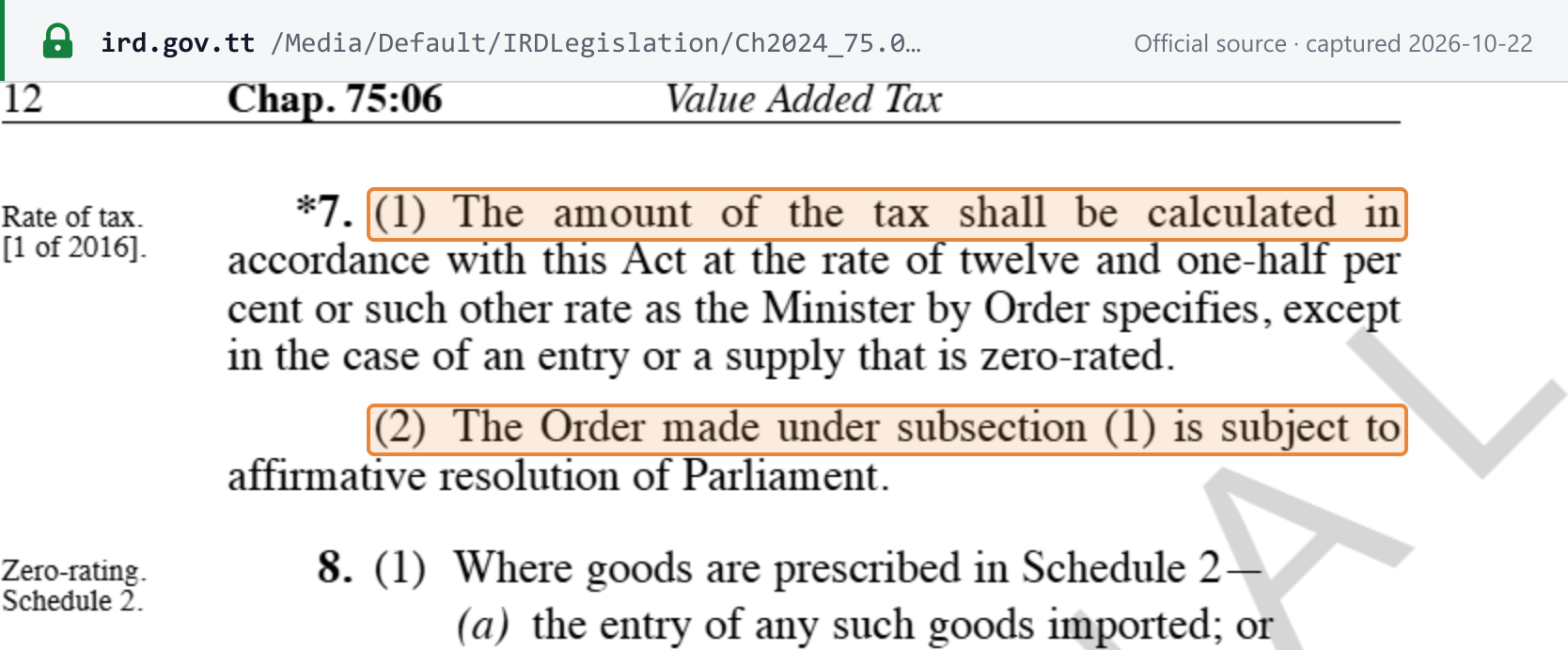
Standard rate: 12.5% since 1 February 2016. Section 7(1): tax is calculated "at the rate of twelve and one-half per cent or such other rate as the Minister by Order specifies, except in the case of an entry or a supply that is zero-rated". The footnote dates the current wording: "Amendment made to this section by Act No. 1 of 2016 took effect from 1st February 2016" — the change that cut the rate from 15%. A rate Order needs the affirmative resolution of Parliament (s.7(2)). The IRD's VAT page states "VAT is charged at a rate of 12.5%". There is no reduced or super-reduced rate: the Act has one positive rate, with zero rating and exemption as the only alternatives. [1] [2]
 Source snapshot captured 2026-10-21 — original
 Source snapshot captured 2026-10-22 — original
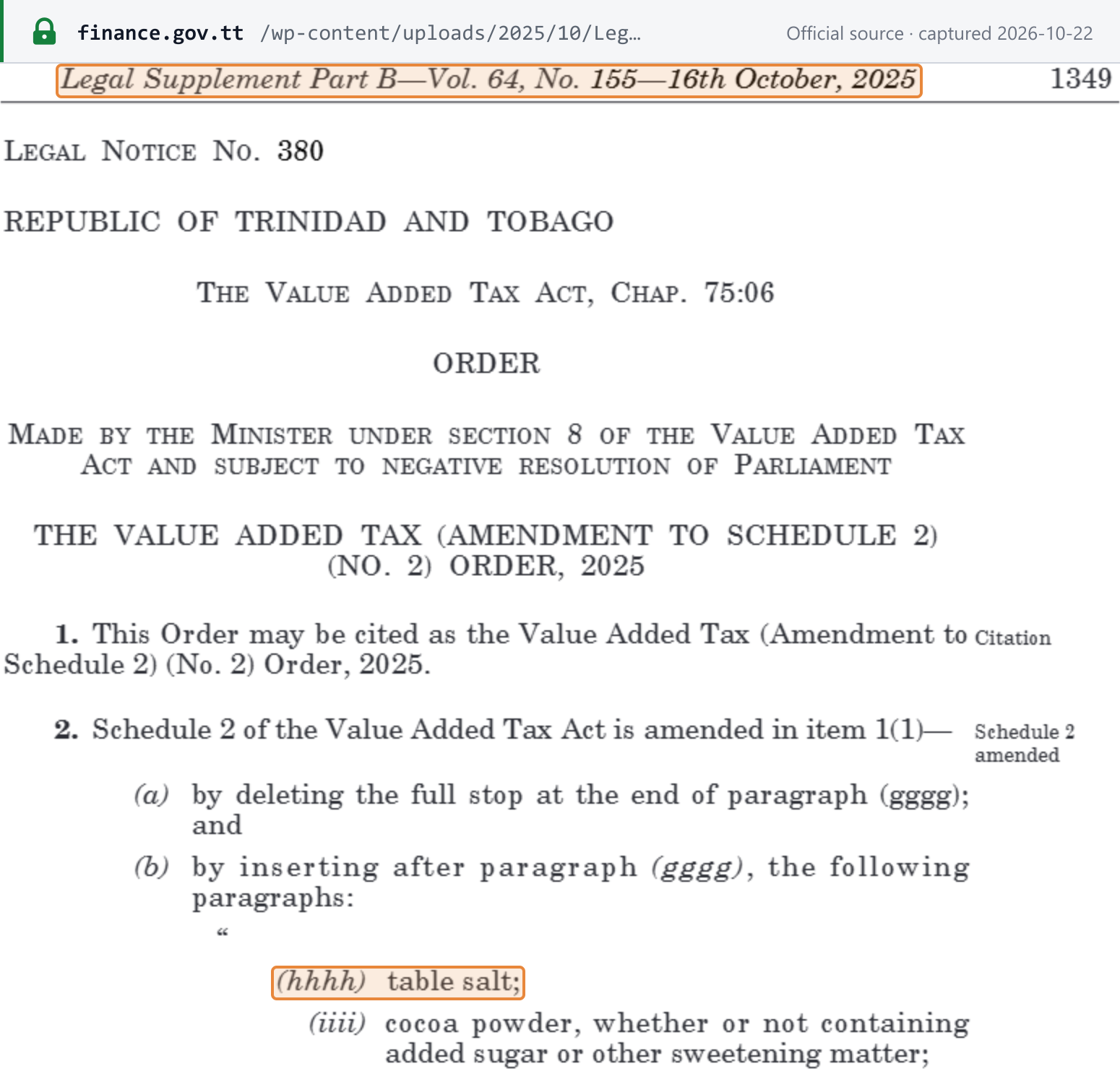
Zero rate (Schedule 2). A zero-rated entry or supply is taxed at nil, "and consequently no tax shall be charged" (s.8(3)), while the supplier keeps full input-tax recovery. The Minister amends Schedule 2 by Order, subject to negative resolution (s.8(4)). Examples, as consolidated plus the later Orders:
- Food — unprocessed food (other than the imported "luxury" items in Appendix A), rice, flour, milk, bread, baby formula, sardines and a long list in item 1(1). LN 380/2025 added table salt, cocoa powder, mauby, icing sugar, grapefruit juice, vanilla essence, soy sauce, coconut water, pepper sauce, cakes and muffins and others from 17 October 2025. LN 556/2026 (gazetted 21 July 2026) deleted the word "canned" from the beans, corn, mixed-vegetable and peas items, so they qualify whether or not canned.
- Agriculture — live food animals, animal feed, seeds, fertilisers and agricultural machinery; LN 488/2025 added a tariff-coded list of agricultural inputs and equipment (new item 53) from 1 January 2026.
- Health — prescription drugs, listed over-the-counter medicines, diabetic supplies, orthopaedic appliances and spectacle lenses.
- Exports and international — goods supplied to a destination outside Trinidad and Tobago (item 15); services paid for in foreign currency to a recipient outside Trinidad and Tobago when performed (item 17); international freight and port services; international aircraft and ship supplies.
- Other — natural gas, crude oil and iron ore; public water and sewerage; travel between Trinidad and Tobago; hotel accommodation; laptops, cell phones and listed computer equipment.
- Vehicles — electric vehicles, but since 1 January 2026 only those with a CIF value not exceeding TTD 400,000 (LN 488/2025; dearer ones are now standard-rated); listed hybrid and CNG vehicles; motorcycles up to 300 cc. [1] [8] [9] [10]
 Source snapshot captured 2026-10-22 — original
The Ministry of Finance's explainer on zero-rated items describes the 2016 list and is out of date (black pepper and nutmeg, for example, have since been zero-rated), so use Schedule 2 and the Orders above for any item check. There is no official rate-lookup tool.
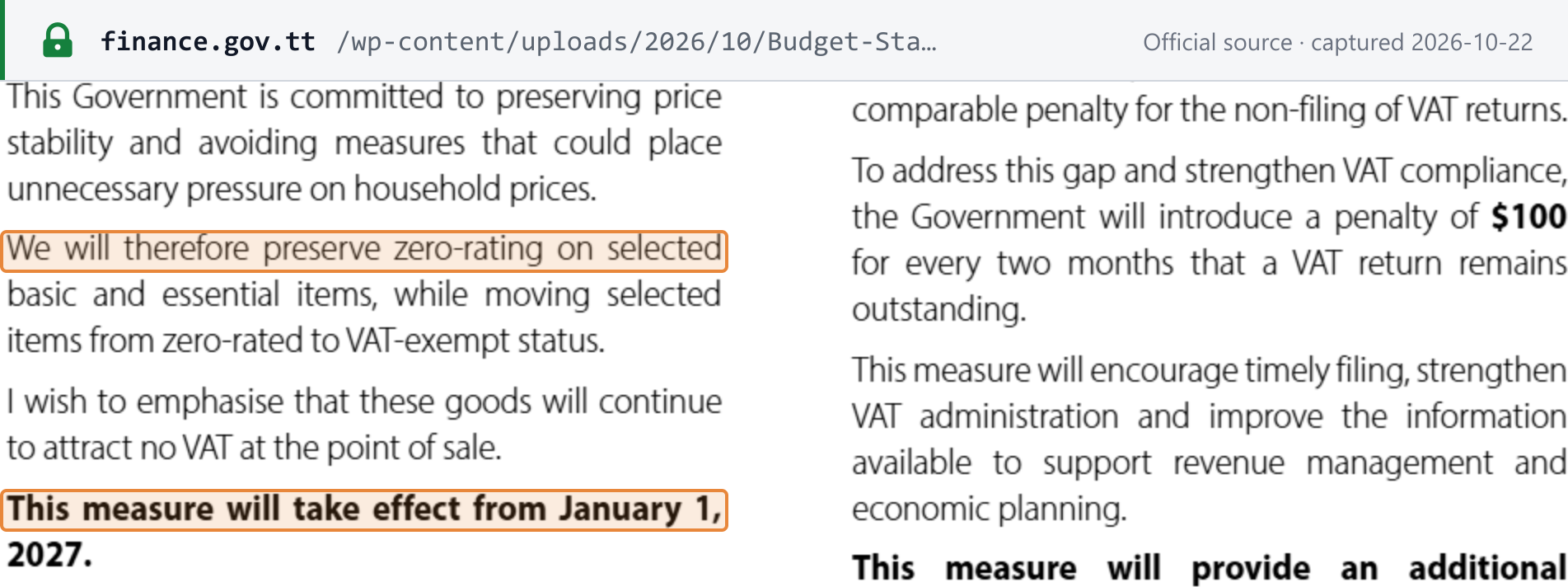
Announced changes — proposals, not law. The Budget Statement 2027 (12 October 2026) proposes, from 1 January 2027, "moving selected items from zero-rated to VAT-exempt status" while keeping zero rating on "selected basic and essential items". Those goods would still carry no VAT at the point of sale, but their sellers would lose input-tax recovery (see Exemptions). No item list has been published, and no Order had been gazetted as at 22 October 2026. The Budget proposes no change to the 12.5% standard rate. It also records that the Government accepted a review's recommendation to keep a reformed VAT rather than replace it with the Sales Tax floated in the FY2026 Budget. See the event record. [11] [12]
 Source snapshot captured 2026-10-22 — original
For other countries' rates, see worldwide tax rates.
Cross-border rules
Imports and exports
- Imports. VAT on imported goods "becomes due and payable at the time when the goods are entered, and is the liability of the importer" (s.11). Customs collects it under the Customs Act "as if it were a duty of Customs" (s.10(2)). The taxable value is the customs value plus duties, taxes and other charges on entry, excluding VAT (s.12). Schedule 2 goods are zero-rated on import too (s.8(1)(a)), and section 44 lists specific import exemptions. Import VAT paid by a registered person is input tax (s.34(1)(b)).
- De minimis. The VAT Act sets no low-value import threshold. Customs practice on low-value and courier shipments could not be confirmed: customs.gov.tt was unreachable on 22 October 2026.
- Exports. Goods supplied to a destination outside Trinidad and Tobago are zero-rated (Schedule 2 item 15), as are supplies into a free zone or special economic zone (item 16). Keep the export documentation: the Books and Records Regulations require "import and export documentation" (reg. 3(1)(c)). [1]
Reverse charge on services from non-residents
None. We found no reverse-charge or self-assessment provision in the Act. Input tax arises only from VAT charged by a registered supplier or paid on import entry (s.34(1)). Instead, the place-of-supply rule below keeps most services from non-residents out of scope. See reverse charge explained.
Place of supply
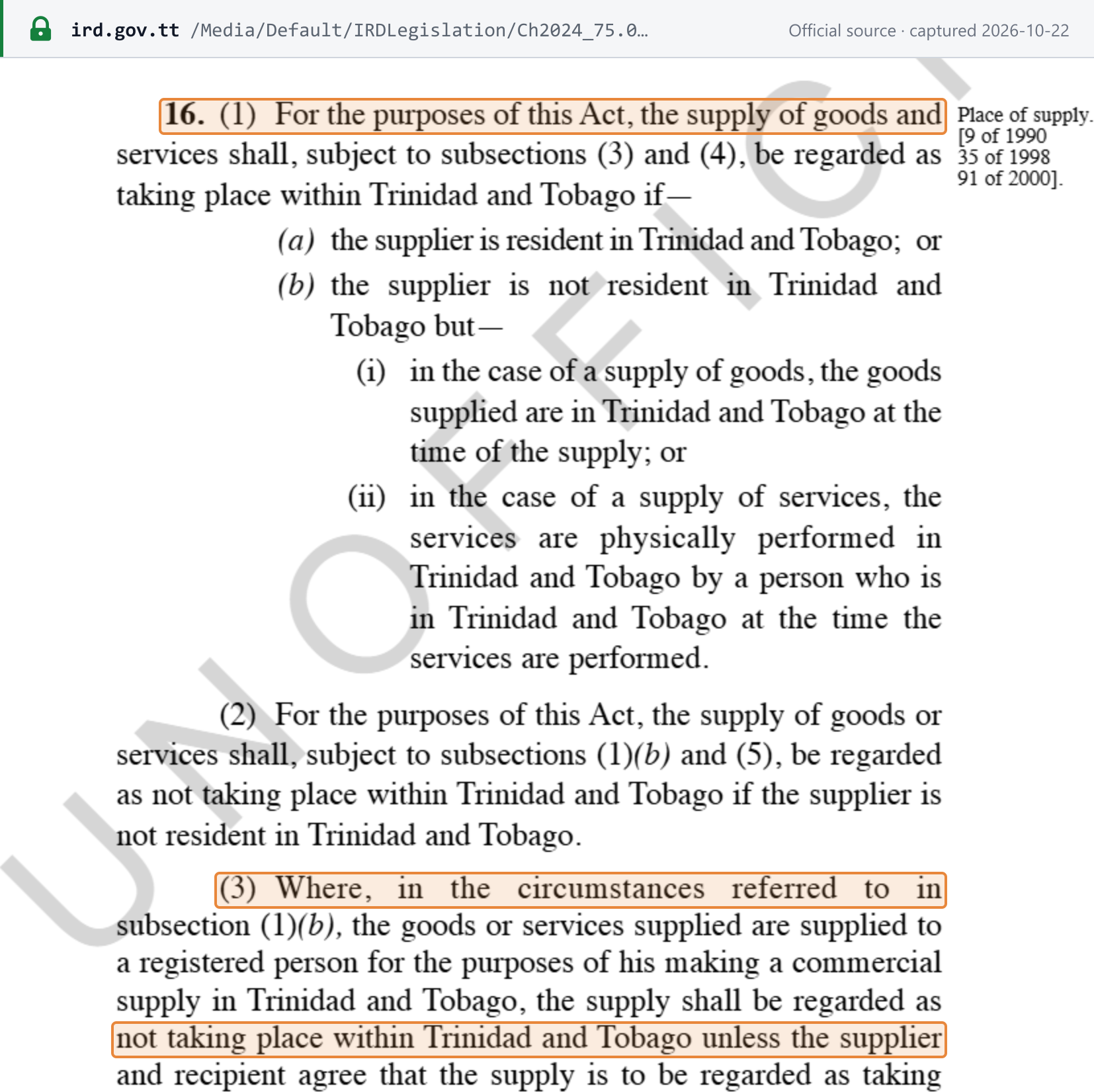
The rule turns on where the supplier is resident, not where the customer is (s.16):
- Resident supplier. Every supply takes place in Trinidad and Tobago (s.16(1)(a)).
- Non-resident supplier, goods. In Trinidad and Tobago only if the goods are there at the time of supply (s.16(1)(b)(i)).
- Non-resident supplier, services. In Trinidad and Tobago only if "the services are physically performed in Trinidad and Tobago by a person who is in Trinidad and Tobago at the time the services are performed" (s.16(1)(b)(ii)). Otherwise the supply is outside Trinidad and Tobago (s.16(2)).
- B2B carve-out. A non-resident's in-scope supply to a registered person for its own commercial supplies is treated as outside Trinidad and Tobago, unless both parties agree otherwise or the supplier is already registered or liable to be (s.16(3)).
- Goods not yet entered. Imported goods supplied before entry, or to someone liable for the import VAT, are outside Trinidad and Tobago (s.16(4)); import VAT catches them at entry.
- International travel and package tours are in Trinidad and Tobago if paid for there, if the journey originates there, or if the ticket is issued there (s.16(5)). [1]
 Source snapshot captured 2026-10-22 — original
Foreign companies selling into Trinidad and Tobago — B2B and B2C
Under the current Act (as at 22 October 2026):
- B2B, services performed abroad (remote consulting, software, cloud). Outside the scope (s.16(2)): no Trinidad and Tobago VAT, no registration and no reverse charge.
- B2B, goods or services physically in Trinidad and Tobago. In scope, but treated as outside the scope when supplied to a registered business for its own commercial supplies, unless both parties agree otherwise (s.16(3)).
- B2C, digital or remote services. Currently outside the scope, because the services are not physically performed in Trinidad and Tobago (s.16(1)(b)(ii)).
- B2C, goods. The consumer pays import VAT at customs entry (s.11). The foreign seller registers only if it supplies goods already located in Trinidad and Tobago and passes the threshold.
- Threshold. No separate non-resident threshold; where a supply is in scope, the TTD 600,000 test applies.
Digital products and services
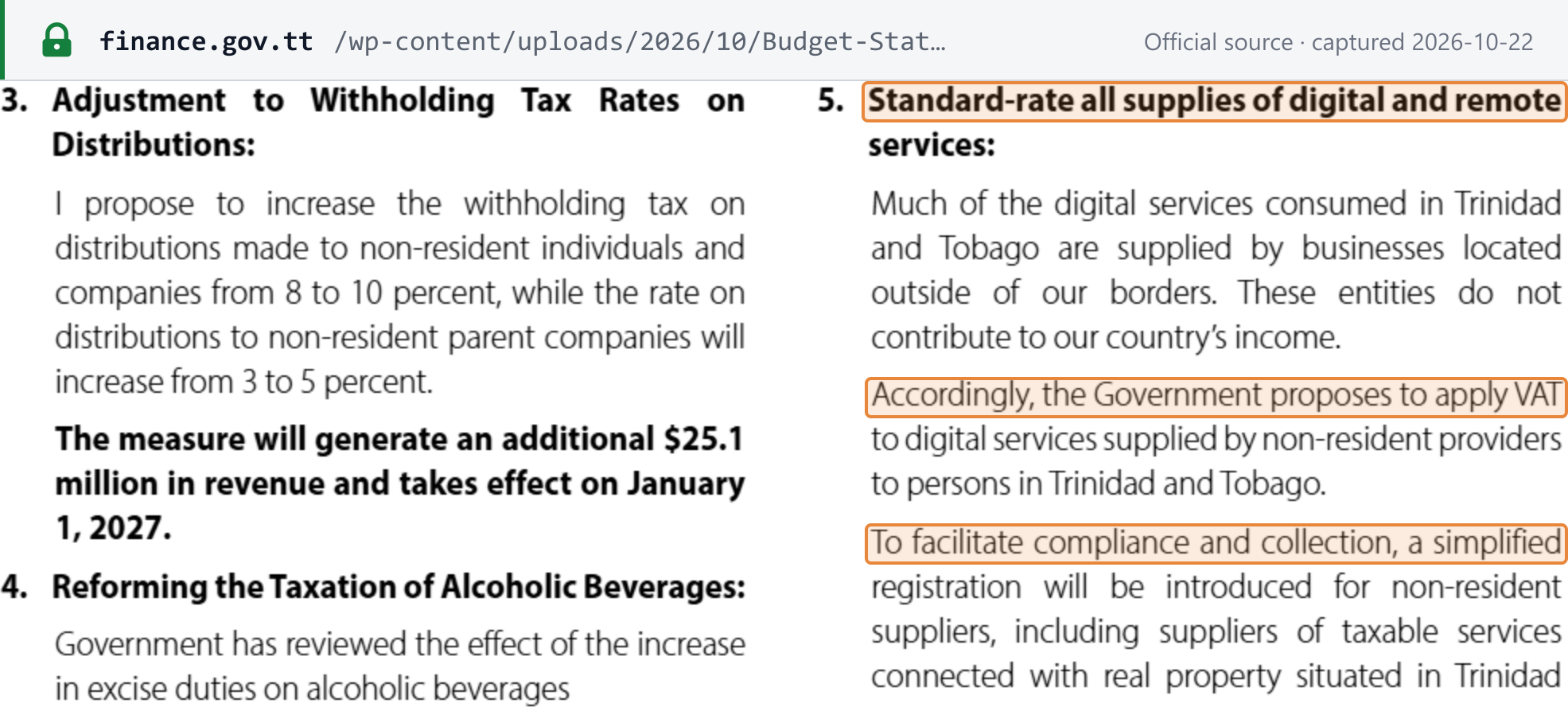
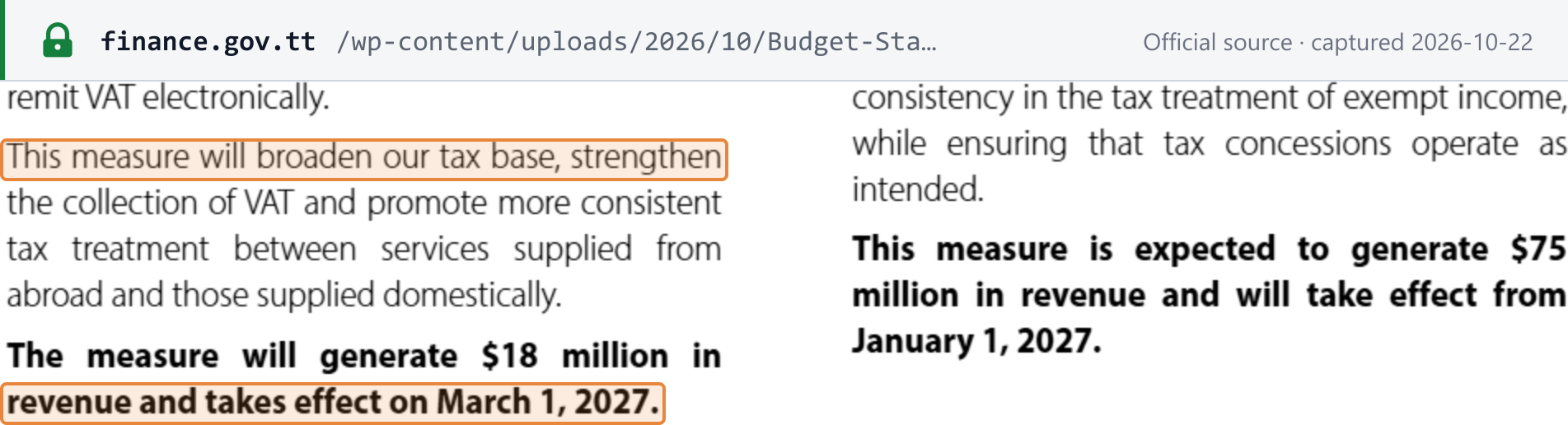
Today, a non-resident's digital services are outside the scope under section 16. The Budget Statement 2027 proposes to "apply VAT to digital services supplied by non-resident providers to persons in Trinidad and Tobago", with a simplified registration that would let non-resident suppliers — including suppliers of taxable services connected with real property in Trinidad and Tobago — "register, collect and remit VAT electronically". The Budget gives 1 March 2027 as the start date and projects TTD 18 million of revenue. [11]
This is a proposal, not law. As at 22 October 2026 no bill or order implementing it had been published. The Budget heading says "Standard-rate all supplies of digital and remote services", but the text gives no rate figure, no registration threshold and no B2B/B2C split, so we state none of them. See the event record and VAT on digital services by non-resident suppliers.
 Source snapshot captured 2026-10-22 — original
 Source snapshot captured 2026-10-22 — original
Marketplace / platform deemed-supplier liability
Not provided for: we found no deemed-supplier provision for platforms or marketplaces in the Act. See marketplace deemed-supplier rules.
Invoice requirements
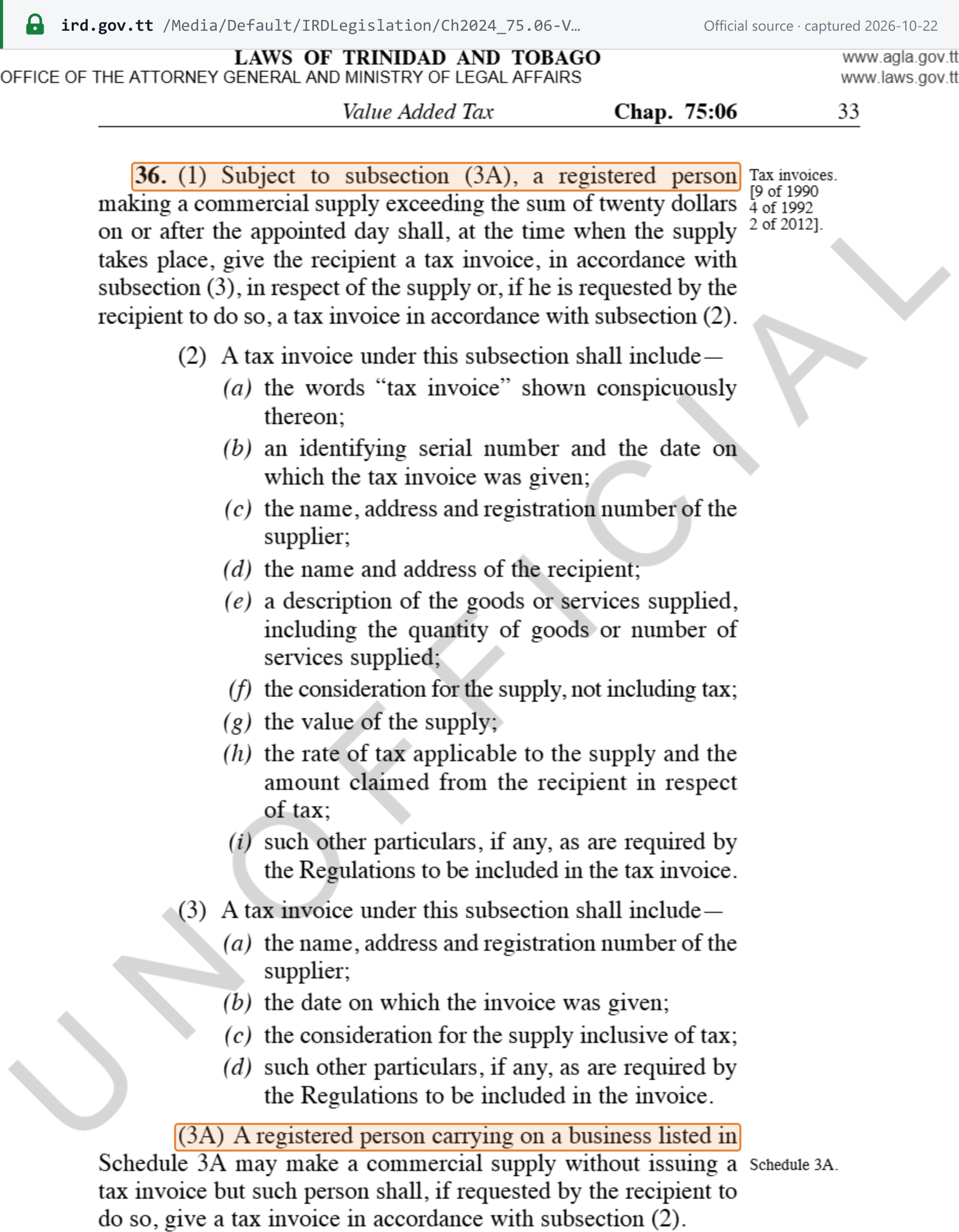
A registered person "making a commercial supply exceeding the sum of twenty dollars" must, "at the time when the supply takes place", give the recipient a tax invoice under section 36(3) — "or, if he is requested by the recipient to do so, a tax invoice in accordance with subsection (2)" (s.36(1)). So there are two statutory forms:
- the simplified form (s.36(3)) is the default for every supply over TTD 20;
- the full form (s.36(2)) is given on request — and a VAT-registered buyer needs it, because input tax is deductible only where "there has been given a tax invoice in accordance with section 36(2)" (s.34(1)(a)). [1]
 Source snapshot captured 2026-10-22 — original
Mandatory content
Full tax invoice — s.36(2):
| # | Field | VAT Act |
|---|---|---|
| 1 | The words "tax invoice", shown conspicuously | s.36(2)(a) |
| 2 | Identifying serial number | s.36(2)(b) |
| 3 | Date the tax invoice was given | s.36(2)(b) |
| 4 | Supplier's name, address and VAT registration number | s.36(2)(c) |
| 5 | Recipient's name and address | s.36(2)(d) |
| 6 | Description of the goods or services, including the quantity of goods or number of services | s.36(2)(e) |
| 7 | Consideration for the supply, not including tax | s.36(2)(f) |
| 8 | Value of the supply | s.36(2)(g) |
| 9 | Rate of tax applicable to the supply | s.36(2)(h) |
| 10 | Amount claimed from the recipient in respect of tax | s.36(2)(h) |
| 11 | Any other particulars required by Regulations | s.36(2)(i) |
Simplified tax invoice — s.36(3): the supplier's name, address and registration number; the date the invoice was given; the consideration inclusive of tax; and any particulars required by Regulations. The Books and Records Regulations (LN 170/1992) add no invoice particulars to either list.
The IRD's own checklist lists eight items; it omits the rate of tax and the quantity, which section 36(2)(e) and (h) require — follow the statute. [1] [2]
Failing to issue a tax invoice is an offence (TTD 6,000, s.36(4)), with a TTD 3,000 modified penalty — see Offences and penalties.
Issuance deadline
At the time of supply (s.36(1)); there is no grace period. The time of supply is the earliest of the invoice, the payment, or the goods being made available or the services rendered (s.17(1)). Special rules cover hire purchase and sale or return, continuous services, periodic payments, progressive supplies of goods and stage-payment construction (s.17(2)–(6)).
Numbering and sequencing
Each full invoice carries "an identifying serial number" (s.36(2)(b)). The Act requires a unique identifier but states no gapless or sequential-series rule, and the IRD's VAT pages add none. Credit and debit notes must quote the identifying number of the invoice they adjust (s.37(3)(e)).
Credit and debit notes
Where a supply is cancelled, its price changes (by discount or otherwise) or goods are returned, the supplier issues a credit or debit note (s.37(1)–(2)) showing:
- the words "credit note" or "debit note", shown conspicuously;
- the supplier's name, address and registration number, and the recipient's name and address;
- the date of the note;
- the identifying number and date of the original tax invoice;
- the tax shown on the invoice, the adjusted amount and the credit or debit needed to make the adjustment;
- a brief explanation of the circumstances (s.37(3)).
Both supplier and registered recipient adjust in the period the note is given (s.37(4)–(5)). Only one note may be issued per adjustment; a copy marked as such may replace a lost original (s.37(6)). Breaches carry a fine of TTD 3,000 (s.37(7)). [1]
Currency and language
The Act sets no language or currency rule for the invoice itself. Books and records, which include tax invoices, must be kept "in the English language and the currency of Trinidad and Tobago" (s.38(1), (3)), and foreign-currency consideration is converted at the Central Bank notes-buying rate at the time of supply (s.5). Our reading: a foreign-currency invoice is fine if the TTD tax value can be derived at the section 5 rate.
Document types
- Full tax invoice (s.36(2)) — issued on request; the document a registered buyer needs to claim input tax.
- Simplified tax invoice (s.36(3)) — the default for every supply over TTD 20, showing the tax-inclusive price. The choice between the two is driven by the customer's request, not by a value threshold.
- No invoice — supplies of TTD 20 or less carry no invoice duty (s.36(1)). Schedule 3A businesses — fast food outlets, gas stations and cinemas — may supply without issuing any tax invoice, but must give a full s.36(2) invoice on request (s.36(3A)).
- Proforma invoice — used for the fishermen's waiver; it must meet the tax-invoice requirements but be "clearly identified as being a proforma invoice and is not a tax invoice" (s.46(3)).
- Credit and debit notes (s.37) — above.
Self-billing
Not provided for in the VAT Act: section 36 places the duty to issue the invoice on the supplier, and the IRD's VAT pages are silent.
Retention and audit trail
- Retention. Keep books and records in Trinidad and Tobago "for not less than six years after the end of the last tax period to which they relate", whether or not you remain registered (s.38(4)). The IRD's VAT page words it as "six (6) years or three (3) years from the date of filing returns, whichever is later", mirroring the assessment time limit in section 39(8); the statute's six years after the last period is the rule to work to.
- What to keep (Books and Records Regulations, reg. 3): copies of tax invoices, proforma invoices and waivers; purchase invoices; import and export documents; credit and debit notes; cash, purchase, sales and wage books; stock sheets, fixed-asset register and financial statements; bank statements; ledgers; records of daily takings and till rolls; business correspondence; and records of own-use and free supplies. A VAT account summarising output and input tax per period is also required (reg. 4(1)).
- Audit trail. Records must be "in sufficient detail … to enable the Board to verify the figures used in the Value Added Tax return", together with "all documentation which described the accounting system used in each tax period" (reg. 4(2)).
- Electronic-only archiving. Neither the Act nor the Regulations address electronic-only archiving or tamper-evidence.
- Breaching section 38 is an offence: TTD 30,000 and two years' imprisonment (s.38(5)). [1] [2]
A specimen of a compliant invoice
The IRD publishes no official specimen of a tax invoice, so Lookuptax lays out the section 36(2) particulars below for an illustrative domestic B2B sale at 12.5%. Every name, number and amount is fictional:
Tax invoice (full form, s.36(2)) — illustrative
| Descriptions.36(2)(e) | Qtys.36(2)(e) | Unit price excl. VATs.36(2)(f) | Amount excl. VATs.36(2)(f) |
|---|---|---|---|
| Office chairs | 20 | TTD 350.00 | TTD 7,000.00 |
| Delivery and assembly | 1 | TTD 1,000.00 | TTD 1,000.00 |
- Consideration, not including taxs.36(2)(f)
- TTD 8,000.00
- Value of the supplys.36(2)(g)
- TTD 8,000.00
- VAT at 12.5%s.36(2)(h)
- TTD 1,000.00
- Total payable
- TTD 9,000.00
- Full form under s.36(2), given because the recipient asked for it: a VAT-registered recipient needs this form to deduct the TTD 1,000.00 as input tax (s.34(1)(a)).
- The default simplified form under s.36(3) would show only the supplier name, address and registration number, the date, and the consideration inclusive of tax (TTD 9,000.00).
- Any later price change or return is corrected by a credit or debit note quoting SPEC-2026-0042 and its date (s.37(3)).
E-invoicing status
Status (as at 22 October 2026): none. Trinidad and Tobago has no e-invoicing, clearance or real-time invoice-reporting system. The VAT Act has no electronic-invoice provision, and the IRD and the Budget 2027 announce none. Whatever medium a business uses, its invoices have to meet section 36. [1] [11]
- System and network. None for invoices. Returns can be filed online through e-Tax (the IRD's GENTAX system), but it is optional: "e-Tax is an option provided and it is not compulsory to register". [7]
- Phase timeline, formats, scope. Not applicable: no B2B, B2G or B2C mandate exists.
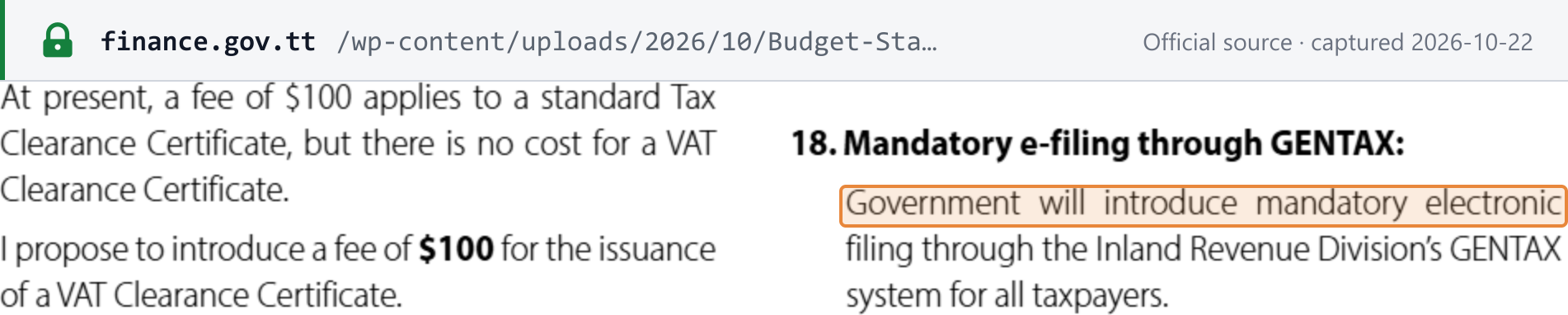
- Proposed — e-filing, not e-invoicing. The Budget Statement 2027 says "Government will introduce mandatory electronic filing through the Inland Revenue Division's GENTAX system for all taxpayers", without a date. That would make online returns compulsory; it is not an invoicing mandate, and it is a proposal, not law.
 Source snapshot captured 2026-10-22 — original
See CTC e-invoicing models for how other countries do it, and e-invoicing status and networks worldwide.
Filing and payment
Filing frequency
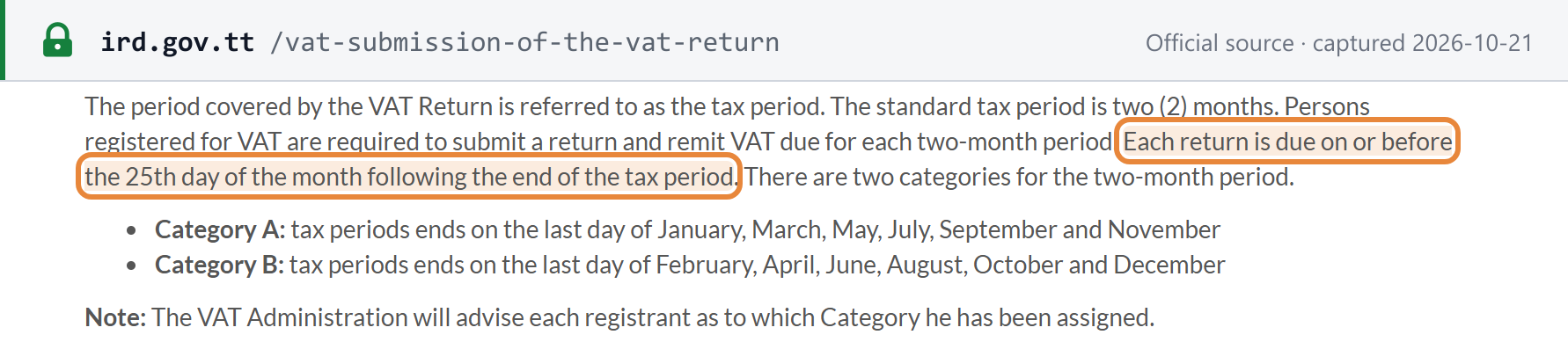
Every two months. "The standard tax period is two (2) months." The IRD assigns each registrant to:
- Category A — tax periods end on the last day of January, March, May, July, September and November; or
- Category B — tax periods end on the last day of February, April, June, August, October and December.
"The VAT Administration will advise each registrant as to which Category he has been assigned." A Category C exists for periods set by the Board case by case (s.30(3)). The IRD publishes no turnover band that decides the category. [1] [4]
Return due date
Within 25 days after the end of the tax period (s.31(2)(a)) — in the IRD's words, "on or before the 25th day of the month following the end of the tax period". After deregistration, the final return is due within 25 days of ceasing to be registered (s.31(2)(b)). Returns must be signed (s.31(1)); the IRD warns "Don't submit an unsigned VAT Return". Online filing is through e-Tax, using a ttconnect ID or the non-logged-in return service. [4]
 Source snapshot captured 2026-10-21 — original
Payment due date and method
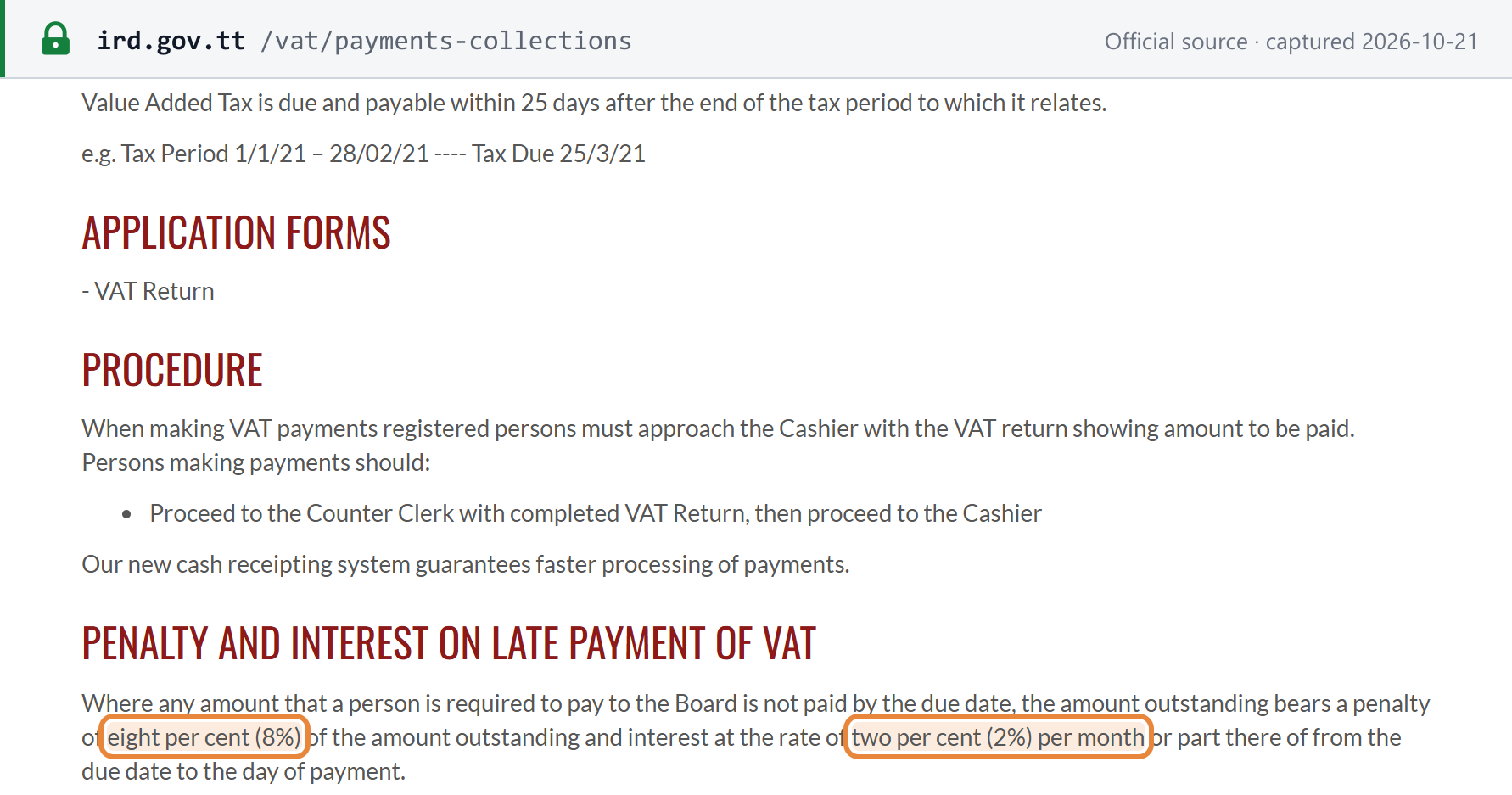
The same day as the return: section 35(1) requires payment within the time allowed for furnishing the return, which the IRD's payments page puts as "due and payable within 25 days after the end of the tax period to which it relates"; its example is the period 1 January – 28 February, tax due 25 March. Net tax payable of TTD 100 or less is deemed nil (s.35(5)). Pay at an IRD cashier with the completed return; the IRD's e-Tax pages also cover payment description slips and have a separate page for payments of TTD 100,000 and over. [1] [5]
Import VAT is paid to Customs at entry (s.11).
Additional listings
None. The Act and the IRD's pages impose no annual VAT return, no sales or purchase listing and no equivalent of an EC sales list. Invoices are not attached to the return, but "proper invoicing requirements must be met for all claims and must be submitted upon request". [2]
Input-tax recovery and blocked items
- What counts. Tax charged by a registered supplier and evidenced by a full s.36(2) invoice, plus import VAT paid on entry (s.34(1)). Tax on goods or services "required other than for the purposes of his carrying on a business in Trinidad and Tobago" is excluded.
- Fully taxable businesses recover everything (s.34(3)(a)). Partly exempt businesses recover in full on inputs used only for taxable supplies, nothing on inputs used only for exempt supplies, and a turnover-based share of the rest (s.34(3)(b)).
- Pre-registration stock is recoverable in the first period if an inventory audited by a chartered accountant is produced (s.34(2)).
- Blocked items. The Act has no specific list (entertainment, passenger cars and the like); the only bar is the business-purpose test.
- Retail schemes. The Board may approve output-tax options A, B or C for retailers (s.33(2)–(6)). [1]
Refunds
- Resident credits. Where input tax exceeds output tax, a refund is due (s.32(2)). The Board pays it or sets it off against other tax owed under any Act it administers (s.35(2)).
- Interest. A refund still outstanding more than six months after the later of the return due date and the filing date bears interest at 1% per month or part of a month (s.35(3)), provided the return is "accurate in all particulars" (s.35(3A)).
- Refund bonds. The Minister may settle refund liabilities with VAT refund bonds (Part 5A; Bond-Payment Refund Regulations, LN 68/2020).
- Imports. Overpaid import VAT is refunded by Customs (s.13A).
- Non-residents. No refund scheme; the only refunds to unregistered persons are to diplomats and international organisations (s.46A).
- Bad-debt relief. Output tax on a consideration written off as bad after reasonable recovery efforts can be deducted, but not before 12 months after the debt became due; recoveries are paid back (s.47). [1]
Exemptions
Exempt supplies
Exempt services (Schedule 1):
- medical, dental, hospital, optical and paramedical services (not veterinary);
- bus and taxi services (other than those of the Public Transport Service Corporation, which are zero-rated);
- approved education and training;
- real estate brokerage;
- rental of residential property;
- accommodation in hotels, inns and guest houses for more than 30 days;
- public postal services;
- betting, gambling and lotteries;
- financial services — exchange, lending, deposits, financial instruments, credit, guarantees and superannuation, including arranging them but not advising on them;
- services by a non-resident to a free-zone approved enterprise;
- services of licensed financial institutions that are subject to financial services tax.
Land. The sale of an interest in land or of a building "shall be regarded as neither a supply of goods nor a supply of services" (Schedule 3 item 7), so it is outside the scope; leases of land and buildings are supplies of services (item 6), and only residential rental is exempt. [1]
Exempt is not zero-rated. An exempt service is not a "prescribed service", so it is not a commercial supply at all (s.3, s.14): it carries no VAT, does not count towards the registration threshold, and input tax attributable to it cannot be recovered (s.34(3)(b)). A zero-rated supply is a commercial supply taxed at nil, with full input-tax recovery (s.8(3), s.34(3)(a)). That difference is why the Budget 2027 proposal to move "selected items from zero-rated to VAT-exempt status" matters to sellers: if it is legislated, the price to consumers stays VAT-free, but the seller stops recovering the VAT on its own costs for those items.
Special regimes
- Free zones and special economic zones — Schedule 1 item 11; Schedule 2 items 16 and 18.
- Highly capital-intensive approved enterprises — import relief (s.44(g); Schedule 2 item 31).
- Fishermen — waivers on approved inputs, documented by proforma invoice (ss.45–46).
- Diplomatic refunds (s.46A) and presidential remission on motor vehicles (s.46B).
- Retailers — output-tax options A, B and C approved by the Board (s.33).
- Not available: we found no margin scheme, cash-accounting scheme or flat-rate small-business scheme in the Act. Small businesses below TTD 600,000 are simply outside VAT unless they register voluntarily.
Offences and penalties
Offences
Offences under the Act are tried summarily, with fines and in several cases imprisonment:
| Conduct | Section | Fine (TTD) | Imprisonment |
|---|---|---|---|
| Making commercial supplies while unregistered when required to register | s.20(3) | 15,000 | 1 year |
| Recovering, or seeking to recover, an amount represented to be tax other than as the Act allows (e.g. charging VAT when not registered) | s.23(2) | 50,000 | 3 years |
| Failing to display the certificate of registration | s.27(4) | 6,000 + 100 a day | — |
| An unregistered person displaying a certificate | s.27(5) | 15,000 | 1 year |
| Failing to notify changes within 21 days | s.28(4) | 6,000 | — |
| Failing to return the certificate within 15 days of cancellation | s.29(6) | 15,000 | 1 year |
| Failing to furnish a return | s.31(5) | 1,000 | — |
| Failing to issue a tax invoice | s.36(4) | 6,000 | — |
| Credit or debit note breaches | s.37(7) | 3,000 | — |
| Books and records breaches | s.38(5) | 30,000 | 2 years |
| Failing without lawful excuse to comply with a requirement of the Act, or knowingly giving false or misleading information | s.56 | 50,000 | 3 years |
Directors are liable for an offence by a company unless they prove it was committed without their consent and that they exercised due diligence (s.57). Prosecutions must start within three years of the offence or 12 months from when the Board has sufficient evidence, whichever is later (s.58). [1]
Penalties
- Late payment. "The amount outstanding bears a penalty of eight per cent of the amount outstanding and interest at the rate of two per cent per month or part of a month" (s.54(1)), counted from the return due date (s.54(3)). The Board may reduce or waive either (s.54(2)).
- Penal tax. Where an assessment results from an offence, the Board may add penal tax of up to three times the tax involved (s.39(4)). Assessments are payable within 30 days (s.39(7)) and may be raised within six years of the end of the period or three years from filing, whichever is later — without limit for fraud, wilful default or gross neglect (s.39(8)–(10)).
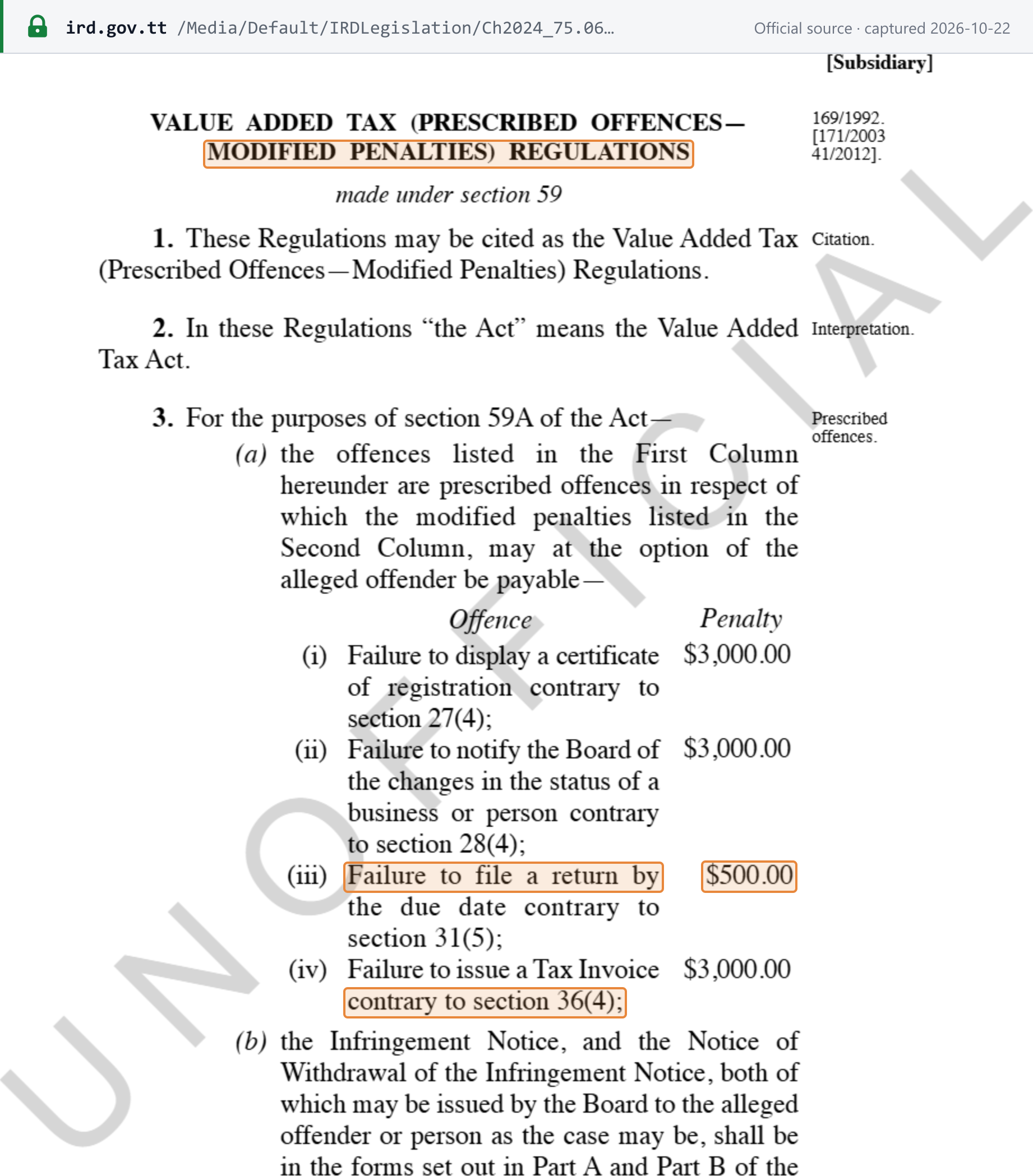
- Modified (on-the-spot) penalties. For four offences the Board may issue an infringement notice, and paying the modified penalty within 28 days avoids prosecution (s.59A; Value Added Tax (Prescribed Offences—Modified Penalties) Regulations, LN 169/1992): TTD 500 for failing to file a return by the due date; TTD 3,000 each for failing to display the certificate, failing to notify changes and failing to issue a tax invoice.
- Late filing is not penalty-free today. It is the section 31(5) offence above, with the TTD 500 modified penalty, and any tax paid late attracts the 8% penalty and 2% monthly interest. [1] [5]
 Source snapshot captured 2026-10-21 — original
 Source snapshot captured 2026-10-22 — original
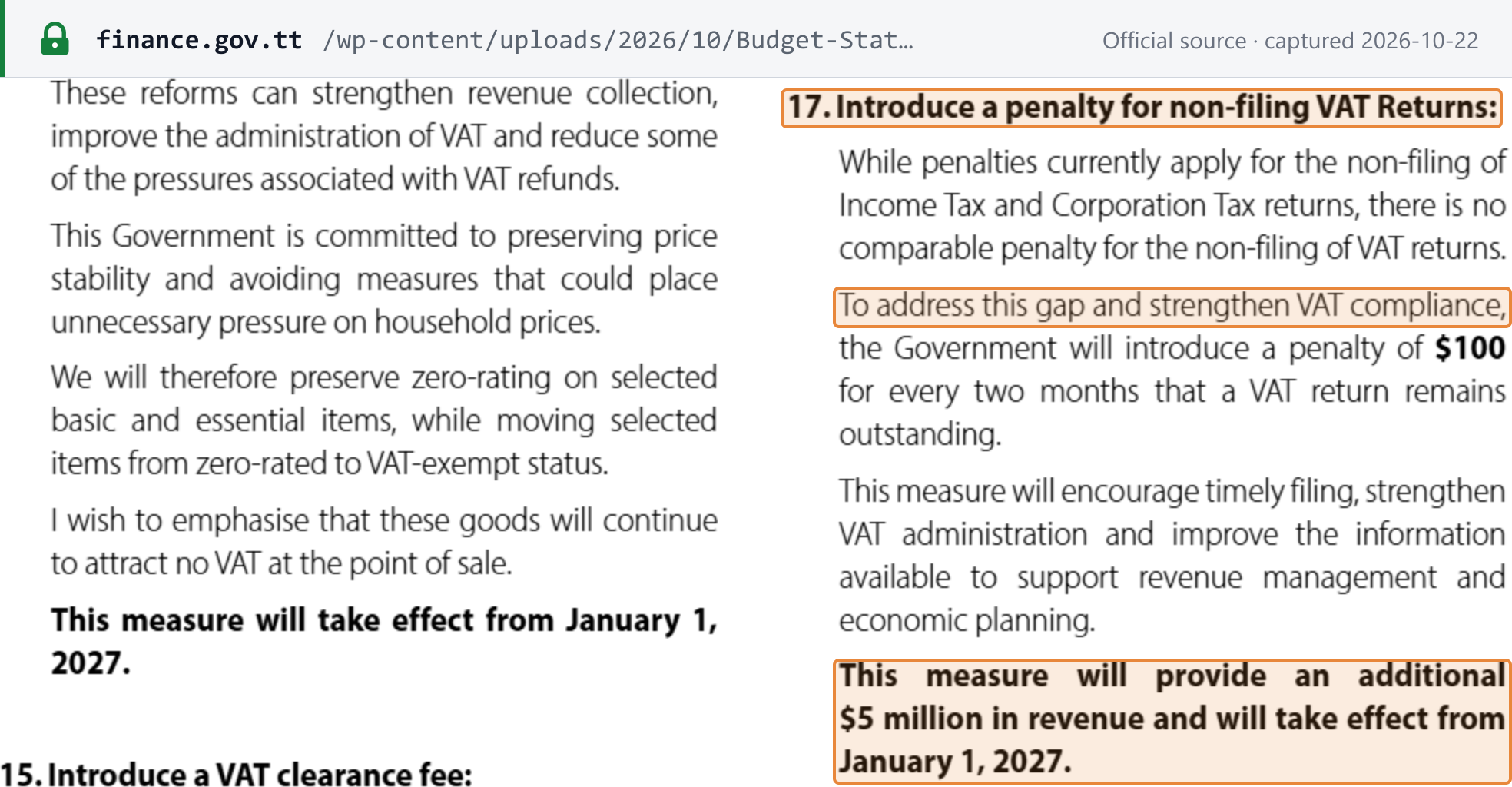
Proposed — not law. The Budget Statement 2027 proposes "a penalty of $100 for every two months that a VAT return remains outstanding", from 1 January 2027. The Budget's own premise is that "there is no comparable penalty for the non-filing of VAT returns" to those for income and corporation tax returns; read with the existing section 31(5) offence and the TTD 500 modified penalty, the proposal adds an automatic, recurring civil penalty rather than creating the first one. It also proposes a TTD 100 fee for VAT clearance certificates from the same date. See the event record. [11]
 Source snapshot captured 2026-10-22 — original
Frequently asked questions
Our Trinidad and Tobago supplier gave us a receipt showing only the VAT-inclusive total. Can we claim the input tax?
Not on that document. Section 34(1)(a) of the Value Added Tax Act only counts output tax as your input tax where a tax invoice in accordance with section 36(2) was given. The default invoice under section 36(3) shows only the supplier's details, the date and the tax-inclusive price; the supplier must give you the full section 36(2) invoice, with your name and address, the rate and the tax amount, if you ask for it. So ask for the full tax invoice at the time of supply.
Does a foreign SaaS or streaming provider have to charge Trinidad and Tobago VAT today?
Not under the current Act. Section 16 treats a non-resident's supply of services as taking place in Trinidad and Tobago only if the services are physically performed there by a person who is there at the time, so remotely supplied digital services fall outside the scope, and the Act has no reverse charge. The Budget Statement 2027 of 12 October 2026 proposes to apply VAT to digital services supplied by non-resident providers from 1 March 2027, with a simplified electronic registration. That is a proposal: as at 22 October 2026 no bill or order implementing it had been published.
Our sales passed TTD 600,000. When do we have to register for VAT?
Once your commercial supplies in the 12 months ending with the previous month exceed TTD 600,000, or you have reasonable grounds to expect the next 12 months to exceed it, you are required to be registered (sections 20 and 21). Apply to the Board of Inland Revenue with forms IA-001 (sole proprietors) or AOI-002 and DP-003 (companies and partnerships) and evidence of trading; the Act says the Board shall register you within one working day of a complete application. Making commercial supplies while unregistered when you are required to register is an offence carrying a fine of TTD 15,000 and one year's imprisonment.
Which months do we file Trinidad and Tobago VAT returns for?
The standard tax period is two months. The Inland Revenue Division assigns each registrant to Category A (periods ending January, March, May, July, September and November) or Category B (periods ending February, April, June, August, October and December). The return and the VAT due are both due on or before the 25th day of the month after the period ends, so a January to February period is due by 25 March.
Is there a penalty for filing a Trinidad and Tobago VAT return late?
Yes. Failing to furnish a return is an offence under section 31(5) of the Act (a fine of TTD 1,000 on summary conviction), and the Modified Penalties Regulations let the Board settle it with a TTD 500 infringement penalty. Tax paid late also bears an 8% penalty plus interest of 2% per month or part of a month (section 54). The Budget Statement 2027 proposes an additional TTD 100 penalty for every two months a return remains outstanding from 1 January 2027; that is a proposal, not yet law as at 22 October 2026.
Our Trinidad and Tobago VAT refund is late. Do we get interest?
Yes, once it is more than six months overdue. Under section 35(3) a refund still outstanding six months after the later of the return due date and the date you filed bears interest at 1% per month or part of a month, provided the return was accurate in all particulars. The Board may set a refund off against other tax you owe, and under Part 5A the Minister may settle refund liabilities with VAT refund bonds.
Important websites
| Site | Purpose |
|---|---|
| IRD — Value Added Tax (VAT) | VAT overview: rate, threshold, invoicing and record-keeping guidance |
| IRD — VAT registration | Registration forms (IA-001, AOI-002, DP-003) and required documents |
| e-Tax | Online VAT returns, account and refund status, and the non-logged-in "Search VAT Status" service |
| IRD — e-Tax FAQs | How e-Tax works, the ttconnect ID and the non-logged-in services |
| IRD — Submission of the VAT return | Tax periods, Category A and B, the 25th-day rule |
| IRD — VAT payments / collections | Payment deadline, how to pay, late-payment penalty and interest |
| IRD — Cancellation of VAT registration | Deregistration procedure |
| IRD — VAT information request | Form VAT-604 requests for a person's VAT status |
| IRD — Legislation and tax laws | The VAT Act consolidation and other tax laws |
| Government Printer e-gazette | Legal Notices, including the Schedule 2 zero-rating Orders |
| Customs and Excise Division | Import entries and import VAT (unreachable from our network on 22 October 2026) |
There is no official rate-lookup tool (Schedule 2 and its amending Orders are the reference) and no e-invoicing portal.
Recent changes
- 2026-10-12 — Budget Statement 2027 proposes VAT on digital services supplied by non-resident providers, with simplified electronic registration, from 1 March 2027 (proposal, not law). (Ministry of Finance) — see event
- 2026-10-12 — Budget Statement 2027 proposes moving selected zero-rated items to VAT-exempt status from 1 January 2027; no item list published (proposal, not law). (Ministry of Finance) — see event
- 2026-10-12 — Budget Statement 2027 proposes a TTD 100 penalty for every two months a VAT return is outstanding and a TTD 100 VAT clearance certificate fee from 1 January 2027, and mandatory GENTAX e-filing (proposals, not law). (Ministry of Finance) — see event
- 2026-07-21 — LN 556/2026 deletes "canned" from the zero-rated beans, corn, mixed-vegetable and peas items. (Government Printer)
- 2026-01-01 — LN 488/2025 zero-rates listed agricultural inputs and equipment and limits electric-vehicle zero rating to a CIF value of TTD 400,000. (Parliament)
- 2025-10-17 — LN 380/2025 adds table salt, mauby, soy sauce, coconut water and other food items to the zero rate. (Ministry of Finance)
For the full chronology, see Trinidad and Tobago tax changes on Lookuptax.
Reference links
- Value Added Tax Act, Chap. 75:06 — consolidated to Act No. 18 of 2024 (Office of the Attorney General and Ministry of Legal Affairs; unofficial consolidation hosted by the IRD), including the Books and Records and Modified Penalties Regulations
- IRD — Value Added Tax (VAT)
- IRD — VAT – Application for Registration
- IRD — VAT – Submission of the VAT Return
- IRD — VAT Payments / Collections
- IRD — VAT – Cancellation of Registration
- IRD — e-Tax FAQs
- Legal Notice No. 380 of 2025 — Value Added Tax (Amendment to Schedule 2) (No. 2) Order, 2025
- Legal Notice No. 488 of 2025 — Value Added Tax (Amendment to Schedule 2) (No. 3) Order, 2025
- Legal Notice No. 556 of 2026 — Value Added Tax (Amendment to Schedule 2) Order, 2026
- Ministry of Finance — Budget Statement 2027 (12 October 2026)
- Ministry of Finance — Budget Statement FY2026 (13 October 2025)
- IRD — VAT – Request for Information (form VAT-604)
- IRD — Legislation and Tax Laws
Related on Lookuptax: