Uzbekistan VAT (QQS / NDS) guidelines
| FACTSHEET | |
|---|---|
| Country code | UZ |
| Tax name | Value added tax (VAT) — qoʻshilgan qiymat soligʻi (QQS / ҚҚС); налог на добавленную стоимость (NDS / НДС) |
| Tax Authority | Tax Committee under the Cabinet of Ministers (Soliq qoʻmitasi) |
| Standard rate | 12% (since 1 January 2023) |
Overview
Uzbekistan's value added tax is the qoʻshilgan qiymat soligʻi (қўшилган қиймат солиғи, QQS) in Uzbek and the налог на добавленную стоимость (NDS) in Russian. It is charged on supplies of goods and services in Uzbekistan and on imports.
Authority. VAT is administered by the Tax Committee under the Cabinet of Ministers (Soliq qoʻmitasi; older legislation calls it the State Tax Committee). Import VAT is paid under customs legislation (Tax Code Arts. 272–273). [14] [1]
Statute. The Tax Code of the Republic of Uzbekistan of 30 December 2019, Section X (Articles 237–282). The Uzbek text is authoritative; lex.uz also publishes a Russian version, marked as an unofficial translation for recent amendments. Several current rules, including the VAT threshold and the 6% simplified procedure, are set by presidential decree. [1] [2]
Layering. VAT is a single national tax, with no regional layer. Small businesses below the threshold pay the turnover tax (налог с оборота) instead of VAT and profit tax (Tax Code Art. 462). [1]
Currency. Uzbek soʻm (UZS). Invoice amounts are stated in soʻm.
Tax period. "Налоговым периодом является месяц" — the tax period is a calendar month (Art. 259). Foreign suppliers of electronic services to individuals use a quarter (Art. 280). [1]
This guide states the law as at 14 October 2026.
For a neighbouring system, see the Kazakhstan VAT guide.
Registration
Who should register
Under Tax Code Art. 237, VAT payers are: [1]
- Uzbek legal entities, unless they pay the turnover tax;
- individual entrepreneurs whose income exceeds the threshold, or who opt in;
- foreign legal entities and entrepreneurs supplying goods or services whose place of supply is Uzbekistan;
- foreign legal entities with a permanent establishment in Uzbekistan;
- the managing partner of a simple partnership.
"Не являются налогоплательщиками … лица, уплачивающие налог с оборота" — persons paying turnover tax are not VAT payers, and neither are state bodies. VAT payers take a "special registration" as VAT payers (Art. 237). Under Decree UP-100, the VAT-payer certificate is issued for record-keeping only and is not a ground for sanctions, and its temporary suspension has been abolished (para 9). [3]
Registration threshold
A legal entity whose total income does not exceed the threshold may pay the turnover tax instead of VAT and profit tax (Arts. 461–462). [1]
- Threshold: since 1 June 2026, 12,000 times the base calculation value (базавий ҳисоблаш миқдори, BRV). Decree UP-100 of 26 May 2026, para 2: "чегаравий миқдор базавий ҳисоблаш миқдорининг ўн икки минг баравари этиб белгилансин" (the threshold is set at twelve thousand times the base calculation value). [3]
- In soʻm: the base calculation value is UZS 440,000 from 1 September 2026 (Decree PF-115 of 23 June 2026), so the threshold is 12,000 × UZS 440,000 = UZS 5,280,000,000. The soʻm figure changes whenever the base calculation value does. [4]
- Tax Code text: the Tax Code itself still states UZS 1 billion (Arts. 237, 461 and 462); Decree UP-100 sets the higher threshold from 1 June 2026. [1]
- Measurement: total income (совокупный доход) in the tax period.
- When VAT starts: a business whose income exceeds the threshold moves to VAT and profit tax "со дня достижения указанного размера совокупного дохода" — from the day that income is reached (Art. 462). [1]
- Sectors that cannot use turnover tax. Art. 461 excludes some businesses whatever their income, including excise-goods producers, mining companies, fuel sellers, lotteries, alcohol retail outlets, markets and trade complexes, tax consultancies and audit firms, pharmaceutical and medical businesses (from 2025) and jewellers (from 2026). [1]
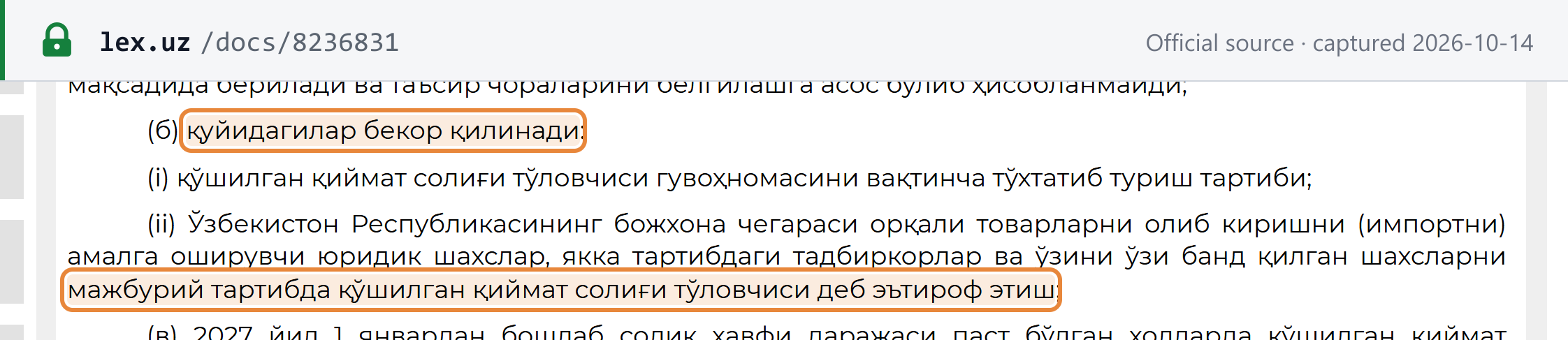
- Importers. Decree UP-100 para 9(b)(ii) abolished the rule that made importers mandatory VAT payers, with effect from 28 May 2026: "мажбурий тартибда қўшилган қиймат солиғи тўловчиси деб эътироф этиш" (mandatory recognition as VAT payers) of legal entities, individual entrepreneurs and self-employed persons importing goods is cancelled. The Tax Code text still moves importers to VAT (Art. 461 part 2; Art. 462); the decree applies from 28 May 2026. [3] [1]


Non-resident registration
There is no registration threshold for foreign businesses: Art. 237 makes a foreign legal entity a VAT payer whenever the place of supply is Uzbekistan, and neither it nor Chapter 39 sets an amount. In practice, who accounts for the VAT depends on the customer: [1]
- Electronic services to individuals (B2C): the foreign supplier registers, within 30 calendar days of starting (Art. 279). See Foreign companies selling into Uzbekistan.
- Supplies to Uzbek businesses (B2B): the Uzbek buyer withholds the VAT as tax agent (Art. 255), so the foreign supplier does not register. For electronic services, only Uzbek legal entities and permanent establishments of foreign entities act as tax agents (Arts. 255, 278); Art. 255 does not make Uzbek individual entrepreneurs tax agents for electronic services, and the Code does not say expressly who accounts for the VAT on those sales. The tax-agent rule does not apply to exempt supplies.
- A permanent establishment registers as a VAT payer in the ordinary way.
Tax identification number
Every taxpayer other than an individual has one unchangeable taxpayer identification number — STIR in Uzbek, INN in Russian. It has 9 digits: "дастлабки 8 та рақам солиқ тўловчининг ўз рақамини, охирги рақам эса назорат сонини ташкил этади" (the first 8 digits are the taxpayer's own number and the last is a check number), issued in the range 20000000X to 39999999X (Cabinet of Ministers Resolution No. 480 of 5 August 2024). For individuals, the personal identification number (PINFL) serves as the TIN (Tax Code Art. 127). The TIN must appear on contracts, invoices, transport documents and payment documents. [5] [1]

For the STIR and PINFL in more detail, see the Uzbekistan tax ID guide.
How to register
Residents take special registration as VAT payers with the tax authority; the VAT-payer certificate, its cancellation and deregistration follow a procedure set by the Cabinet of Ministers (Art. 237). All exchanges between the tax authority and legal entities or individual entrepreneurs go "исключительно через персональный кабинет налогоплательщика" — exclusively through the taxpayer's personal cabinet, signed with an electronic digital signature (Art. 56). Foreign suppliers of electronic services file their returns through the personal cabinet as well (Art. 281). [1]
Voluntary registration
- Legal entities on turnover tax may opt into VAT "начиная с 1 числа месяца, следующего за месяцем, в котором было подано заявление" — from the 1st of the month after they apply (Art. 462).
- Individual entrepreneurs may register voluntarily (Art. 237).
- Lock-in: a business that opts in can return to turnover tax only after 12 months, and only if its income stayed below the threshold (Art. 462).
The usual reason to opt in is to credit input VAT and to give business customers invoices with VAT they can credit. [1]
Group registration
Not available. The only grouping in the Tax Code is the consolidated group of taxpayers, which is formed "в целях исчисления и уплаты налога на прибыль" — for profit tax only (Art. 61); Section X (VAT) has no grouping provision. See VAT grouping for how grouping works where it exists. [1]
Rates
| Rate | Applies to |
|---|---|
| 12% (standard) | All taxable supplies and imports not zero-rated or exempt |
| 0% | Exports of goods, international transport services, listed agricultural produce and the other supplies in Chapter 36 |
| 6% (optional simplified procedure, 1 June 2026 – 1 January 2030) | All sales of a catering, trade or services business that chooses it (Decree UP-100) |
| Exempt | Education, financial services, insurance, childcare and the other supplies in Arts. 243–245 |
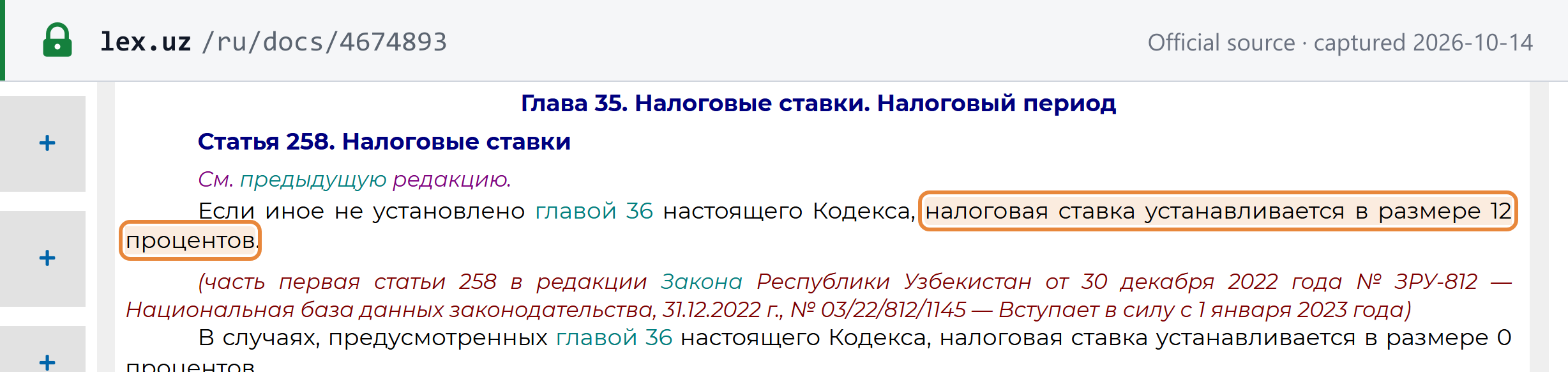
Standard rate 12%. "Если иное не установлено главой 36 настоящего Кодекса, налоговая ставка устанавливается в размере 12 процентов" (Art. 258). The rate was cut from 15% to 12% from 1 January 2023 by Law ZRU-812 of 30 December 2022. No change to the standard rate has been announced. [1]
Zero rate (Chapter 36). 0% applies to: [1]
- goods exported under the customs export procedure, and goods re-exported after inward processing;
- fuel and lubricants supplied to aircraft;
- transit transport services and services directly connected with international carriage (Art. 260);
- supplies to diplomatic missions and production-sharing participants, by refund (Art. 264);
- precious metals sold by producers to the authorised buyer;
- from 1 January 2026, listed agricultural produce grown by agricultural producers, except cotton and grain (Art. 264).
The zero rate needs confirming documents filed with the return and, for exports of goods, a bank statement showing payment (Arts. 260, 266). Services supplied abroad are generally outside the scope of Uzbek VAT under the place-of-supply rules, but the supplier keeps its input VAT credit on them (Art. 266). [1]

Simplified 6% procedure. Decree UP-100 (26 May 2026), section IV, lets businesses whose main activity is public catering, trade or services choose, voluntarily, a simplified way of calculating VAT from 1 June 2026 to 1 January 2030. It is set by presidential decree, not by the Tax Code. Under it: [3]
- VAT is 6% on all sales turnover ("барча айланмаларга нисбатан 6 фоиз этиб белгиланади");
- profit tax is 0%, with no profit-tax return;
- the business cannot credit VAT on its purchases;
- existing VAT exemptions, preferences and partial refunds stop applying, and any negative VAT balance is written off;
- buyers from the business can still credit the VAT shown on its invoices.
Who cannot use it: enterprises with a state share of 50% or more, and large taxpayers. Switching in or out takes effect from the 1st of the month after the business notifies the tax authority. A business returning to the general regime can credit VAT on the inventory and long-term assets on its balance sheet.

Cross-border rules
Imports and exports
Imports of goods. Import VAT is paid under customs legislation. The taxable base is the customs value plus excise tax and customs duty (Art. 254). A VAT payer credits the import VAT it has paid (Art. 266). The exemptions for imports are listed in Art. 246. [1]
Exports of goods. Zero-rated (Art. 260, see Rates).
Services bought from abroad. An Uzbek business buying services from a foreign supplier that is not registered accounts for the VAT as tax agent (below).
Digital products and services
Chapter 39 of the Tax Code taxes electronic services supplied by foreign legal entities to individuals in Uzbekistan. [1]
- Covered (Art. 282): software, games and databases; e-books, media and streaming; online advertising; listing services; online marketplaces; website support; hosting and domain names; cloud storage and computing; automated data, search and translation services; access to search engines; web statistics.
- Not covered: goods or services ordered online but delivered offline, software on physical media, consulting by e-mail, and internet access.
- Threshold: none.
- Where the customer is (Art. 241): an electronic service to an individual is supplied in Uzbekistan if any one of these points there: the buyer's residence; the bank or payment operator used to pay; the buyer's network (IP) address; or the country code of the phone number used to buy or pay.

Goods sold through e-trading platforms (from 12 December 2026). Law ZRU-1173 of 10 September 2026 extends the Chapter 39 regime to foreign legal entities selling goods to individuals through e-trading platforms, with the taxable base being the value of the goods including tax, at actual sale prices. [9]

See VAT on digital services by non-resident suppliers.
Foreign companies selling into Uzbekistan — B2B and B2C
- Selling to Uzbek businesses (B2B). When a foreign person that is not registered as a VAT payer supplies goods or services whose place of supply is Uzbekistan, the Uzbek buyer is the tax agent: Uzbek legal entities, individual entrepreneurs and permanent establishments of foreign entities must "исчислить, удержать у налогоплательщика и перечислить в бюджет" (calculate, withhold and pay to the budget) the VAT, "вне зависимости от того, являются ли они налогоплательщиками или нет" — whether or not they are VAT payers themselves (Art. 255). For electronic services, only an Uzbek legal entity or a permanent establishment that buys them is the tax agent (Art. 255 part 4; Art. 278); individual entrepreneurs are not, so sales of electronic services to them follow the B2C rules below. The tax-agent rule does not apply to exempt supplies (Arts. 243–245). The base is the income from the supply including VAT; if the contract price excludes VAT, the agent adds VAT on top. The agent's payment document entitles it to credit the VAT. A tax agent that is not a VAT payer files a return by the 20th of the following month (Art. 273). [1]
- Selling electronic services to individuals (B2C). The foreign legal entity is the taxpayer (Art. 278): [1]
- register within 30 calendar days of starting to supply (Art. 279);
- charge 12% — Chapter 39 has no separate rate — on a base that is the price including the tax, at actual sale prices (Art. 280);
- convert foreign-currency prices at the Central Bank of Uzbekistan rate on the last day of the month in which payment was received (Art. 280);
- file and pay quarterly, by the 20th of the month after the quarter, electronically through the taxpayer personal cabinet (Art. 281);
- no invoices are required (Art. 47).
- Selling goods from abroad. Import VAT is collected at the border; from 12 December 2026, foreign sellers of goods to individuals through e-trading platforms join the Chapter 39 regime (above).



See reverse charge explained for how tax-agent and reverse-charge mechanisms compare.
Marketplace / platform liability
- Electronic services: where several intermediaries take part in the settlements, "налоговым агентом признается иностранное юридическое лицо — посредник, участвующее в расчетах непосредственно с физическими лицами" — the foreign intermediary that settles directly with the individuals is the tax agent (Art. 278).
- Uzbek intermediaries taking part in settlements with an unregistered foreign supplier are tax agents (Art. 255).
- Goods (from 12 December 2026, Law ZRU-1173): goods sold to individuals through e-trading platforms are supplied in Uzbekistan "если местом жительства покупателя и местом доставки товаров являются Республика Узбекистан" — if the buyer lives in Uzbekistan and the goods are delivered there. Foreign or Uzbek intermediaries settling directly with the individuals, and operators of Uzbek e-trading platforms that settle payments in favour of foreign sellers, "признаются налоговыми агентами" — are tax agents for those sales. [9]
[1] See marketplace deemed-supplier rules.
Place of supply
- Goods (Art. 240): Uzbekistan, if the goods are in Uzbekistan and are not shipped or transported, or are in Uzbekistan when shipment or transport begins.
- Services, general rule (Art. 241): Uzbekistan "при условии, что покупатели таких услуг осуществляют деятельность или находятся на территории Республики Узбекистан" — if the buyer operates or is located in Uzbekistan.
- Exceptions follow the property or the place of performance: services connected with real estate and movable property, catering, culture, education and events, transport, airport services, short-term vehicle hire and broadcast advertising. Ancillary services follow the main service.
- Electronic services to individuals: the four indicators above.
Invoice requirements
Legal entities, individual entrepreneurs and self-employed persons must issue a VAT invoice (счёт-фактура; ҳисобварақ-фактура) to their buyers. "Счет-фактура, как правило, оформляется в электронной форме в информационной системе электронных счетов-фактур" — as a rule, the invoice is electronic, issued in the e-invoice information system (Tax Code Art. 47). The detailed rules are in the Regulation on invoice forms, Annex 2 to Cabinet of Ministers Resolution No. 489 of 14 August 2020. [1] [6]
Document types
| Document | When it is used |
|---|---|
| E-invoice | The rule for every supply between businesses |
| Paper invoice, in at least two copies | Only for transactions involving state secrets, or during a technical outage confirmed by the operator — then reissued electronically (paras 11–13) |
| Fiscal cash-register or virtual cash-register receipt | Replaces the invoice where payment is in cash, by personal bank card or by corporate card in soʻm and a receipt is issued (para 3; Art. 47) |
| Monthly summary e-invoice | Generated unilaterally by the supplier, once per calendar month, for sales made without invoices under para 3, unless a fiscal or virtual receipt or an export customs declaration covers them (para 59) |
| Combined e-invoice and e-waybill | Required whenever goods are shipped at the moment of sale, except goods moved by hand or without a vehicle and goods not sold at the time of shipment (paras 3 and 14¹, added by Res. 168 of 18 March 2025) |
No invoice is needed either for strict-reporting receipts, export customs declarations, bank statements, transport tickets and utility or telecom payments through banks (para 3). For exports without a customs declaration, the supplier generates the e-invoice itself, showing only the buyer's name and the word "non-resident" (para 60). [6]
Mandatory content
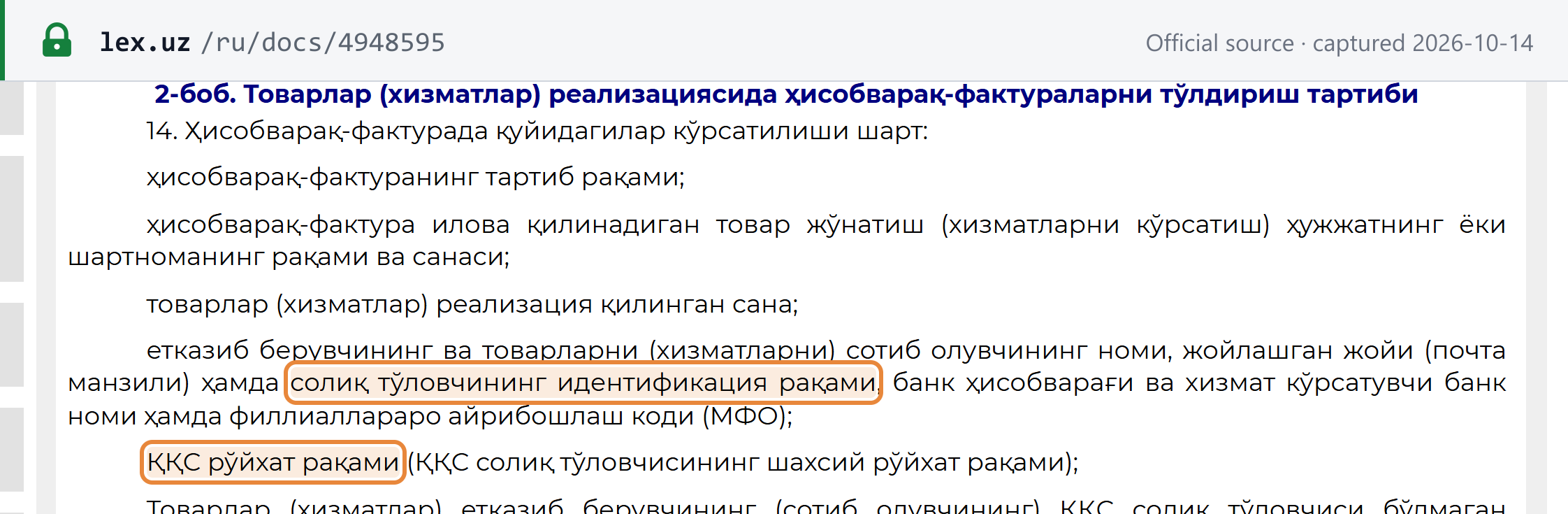
"Ҳисобварақ-фактурада қуйидагилар кўрсатилиши шарт" — an invoice must show (Res. 489 Annex 2, para 14): [6]
- the invoice's serial number;
- the number and date of the shipping document or contract;
- the date of supply;
- the supplier's and the buyer's name, address, TIN, bank account, bank name and inter-branch bank code (MFO);
- the VAT registration number.
Each line carries (para 15):
| Column | Field |
|---|---|
| 1 | Name of the goods or service |
| 2 | Digital-marking flag |
| 3 | Identification code from the Single Electronic National Catalogue of goods and services |
| 4 | Barcode |
| 5 | Unit of measure |
| 6 | Quantity |
| 7 | Unit price excluding VAT |
| 8 | Value excluding VAT (including excise) |
| 9 | VAT rate |
| 10 | VAT amount |
| 11 | Total including VAT |
- Without VAT: non-payers and exempt supplies write «Қўшилган қиймат солиғисиз» or «ҚҚСсиз» ("without VAT") in column 9.
- Marked goods: marking codes are mandatory; since 23 January 2026 an e-invoice for goods subject to mandatory marking cannot be issued without them.
- Excise payers show the excise rate and amount; sales by budget organisations show the exchange lot number.
- Licences and permits are checked in real time from 21 July 2026 (Res. 393 of 20 July 2026).
Issuance deadline
"Товарлар жўнатилган (топширилган) ёки хизматлар кўрсатилган календарь санада" — an invoice is issued on the calendar date the goods are shipped or the services supplied (para 4). Utilities, telecoms, rail, forwarding and pipeline transport issue one invoice dated the last day of the month, by the 10th of the following month (para 6); long-term construction contracts work the same way (para 7). [6]
Numbering and sequencing
Each invoice carries a serial number (para 14). A corrected invoice keeps the number and date of the invoice it replaces (para 44). [6]
Buyer acceptance
The buyer must accept an e-invoice with its electronic digital signature, or reject it with a reason, "ўн календарь кун" — within 10 calendar days, or 1 calendar day for goods subject to digital marking. An e-invoice not accepted or rejected in time is deemed accepted (para 63). A deadline that falls on a non-working day moves to the next working day (para 64). [6]

Credit and debit notes
- Additional invoice: used, with the buyer's confirmation, for returns, refused services, changes in price or quantity and discounts. It is issued on the date of the event, within one year of the original invoice or within the warranty period (paras 40–41).
- Corrected invoice: cancels and replaces the original for errors that change the tax base or for other amendments. It keeps the original number and date, is marked as corrected, may be issued within the three-year limitation period (Tax Code Art. 88), and leads to amended returns where needed (paras 44–46).
- Both are issued electronically (para 66), and the Tax Code requires the seller to issue one whenever the value of a supply changes (Art. 47).
Currency and language
"Ҳисобварақ-фактурада товарларнинг (хизматларнинг) қиймати миллий валютада, сўмда кўрсатилади" — values are shown in national currency, soʻm (para 8). The regulation's forms are in Uzbek. [6]
Retention and audit trail
- Retention: taxpayers keep returns and supporting documents "в течение трех лет, следующих за календарным годом, установленным для уплаты соответствующих налогов" — for three years after the calendar year in which the tax was due (Tax Code Art. 22). Tax agents keep them for the limitation period (Arts. 23, 88). [1]
- Audit trail: e-invoices are stored and accounted for in the e-invoice information system (para 10), and a state roaming operator stores them centrally (Res. 522). Each e-invoice, with its attachments, is signed with an electronic digital signature (para 62). VAT payers keep purchase and sales invoice registers in the form approved by the Tax Committee (para 9). [6] [7]
A specimen of a compliant invoice
The official invoice form is Appendix 1 to the Regulation (Res. 489 Annex 2), a blank table template; no annotated specimen is published. Below, Lookuptax lays out the para 14 particulars and the para 15 columns for a domestic B2B sale of goods in October 2026. Every name, number and amount is fictional:
INVOICE (ҲИСОБВАРАҚ-ФАКТУРА)
| Goods / servicepara 15 col. 1 | Catalogue codepara 15 col. 3 | Unitpara 15 col. 5 | Qtypara 15 col. 6 | Unit price excl. VATpara 15 col. 7 | Value excl. VATpara 15 col. 8 | VAT ratepara 15 col. 9 | VATpara 15 col. 10 | Total incl. VATpara 15 col. 11 |
|---|---|---|---|---|---|---|---|---|
| Office chairs | CATALOGUE-SPECIMEN | pcs | 10 | 500,000.00 | 5,000,000.00 | 12% | 600,000.00 | 5,600,000.00 |
- Value excluding VATpara 15 col. 8
- UZS 5,000,000.00
- VAT 12%para 15 col. 10
- UZS 600,000.00
- Total including VATpara 15 col. 11
- UZS 5,600,000.00
- Columns 2 (digital-marking flag) and 4 (barcode) are left out here for width; they are part of the line in the official form.
- A supplier that is not a VAT payer, or an exempt supply, writes «ҚҚСсиз» ("without VAT") in the VAT-rate column instead of a rate.
- The buyer accepts or rejects the e-invoice with its electronic digital signature within 10 calendar days (1 day for marked goods); otherwise it is deemed accepted (para 63).
- The buyer can credit the VAT only once the invoice is accepted in electronic form (para 10).
E-invoicing status
Status: mandatory for all businesses since 1 January 2020. Cabinet of Ministers Resolution No. 522 of 25 June 2019 introduced electronic invoices voluntarily from 1 July 2019 and "начиная с 1 января 2020 года в обязательном порядке для всех хозяйствующих субъектов" — mandatorily for all business entities from 1 January 2020. [7]

- System: the Tax Committee's e-invoice information system. Businesses issue and receive e-invoices through e-invoice operators; the state enterprise "Scientific-Information Centre New Technologies" under the Tax Committee is the roaming operator that stores invoices centrally and exchanges them between operators (Res. 522). [7]
- Scope: B2B and B2G. B2C is covered by online fiscal cash-register or virtual cash-register receipts instead of invoices, plus the monthly summary e-invoice (Res. 489 Annex 2, paras 3, 59). [6]
- Format: Resolution 489 prescribes the fields and columns (paras 14–15) and the electronic digital signature (para 62); it does not refer to an international syntax such as Peppol or UBL.
- Input VAT depends on acceptance. "Товарларни (хизматларни) сотиб олувчи фақат электрон шаклда қабул қилинган ҳисобварақ-фактураларда акс эттирилган ҚҚС суммасини ҳисобга олишга ҳақли" — the buyer may credit only VAT shown on invoices accepted in electronic form (Res. 489 Annex 2, para 10). [6]
- Risk rating. From 1 January 2026, VAT shown on an invoice "отнесенном к категории с высокой степенью риска" — classed as high risk — is not credited by the buyer, unless the VAT was paid under Art. 266¹ (Tax Code Art. 267, as amended by Law ZRU-1108). [1]
- Automatic refunds from risk scoring. Decree UP-100 (para 10) instructed the Tax Committee and the Ministry of Economy and Finance to introduce, by 1 October 2026, automatic refunds of negative VAT balances based on real-time risk assessment of e-invoices and tax returns. [3]

For Uzbekistan alongside other countries, see the e-invoicing status and networks table.
Filing and payment
Filing frequency and due date
- Resident VAT payers: monthly. The return is filed "не позднее двадцатого числа месяца, следующего за истекшим налоговым периодом" — by the 20th of the month after the tax period — at the place of tax registration (Art. 273). [1]
- Payment: by the same date as the return (Art. 273).
- How: electronically, through the taxpayer personal cabinet (Art. 56). The return includes data from the purchase and sales registers; tax agents and intermediaries also file invoice-journal data.
- Foreign suppliers of electronic services: quarterly, by the 20th of the month after the quarter (Art. 281).
- Tax agents that are not VAT payers: by the 20th of the following month (Art. 273).
- Imports: import VAT is paid under customs rules.

Additional listings
Section X of the Tax Code provides for no annual VAT return; purchase and sales register data are filed with the monthly return (Art. 273). [1]
Input-tax recovery and blocked items
Input VAT is creditable on goods and services used for taxable supplies, including zero-rated ones, on the basis of an invoice accepted electronically from a VAT payer or of paid import VAT (Art. 266). On registering as a VAT payer, a business can credit VAT on inventory bought in the previous 12 months and on long-term assets. [1]
Blocked (Art. 267): [1]
- purchases for exempt supplies, and purchases by non-payers;
- representation (entertainment) expenses ("представительских расходов");
- goods and services received free of charge;
- items for own needs that are not deductible for profit tax;
- "легковые автомобили, мотоциклы, вертолеты, моторные лодки, самолеты" — passenger cars, motorcycles, helicopters, motor boats and aircraft, and their fuel, and alcohol and tobacco, unless related to the business activity;
- VAT on high-risk e-invoices (from 1 January 2026).
Refunds
- Standard: a negative balance (excess input VAT) is carried forward against future VAT, unless the taxpayer asks for a refund in the return; the refund is then paid "не позднее тридцати дней с даты уведомления налоговых органов о возврате суммы налога при представлении налоговой отчетности" — within 30 days of the date the taxpayer notified the tax authority of the refund in its return (Art. 274). [1]
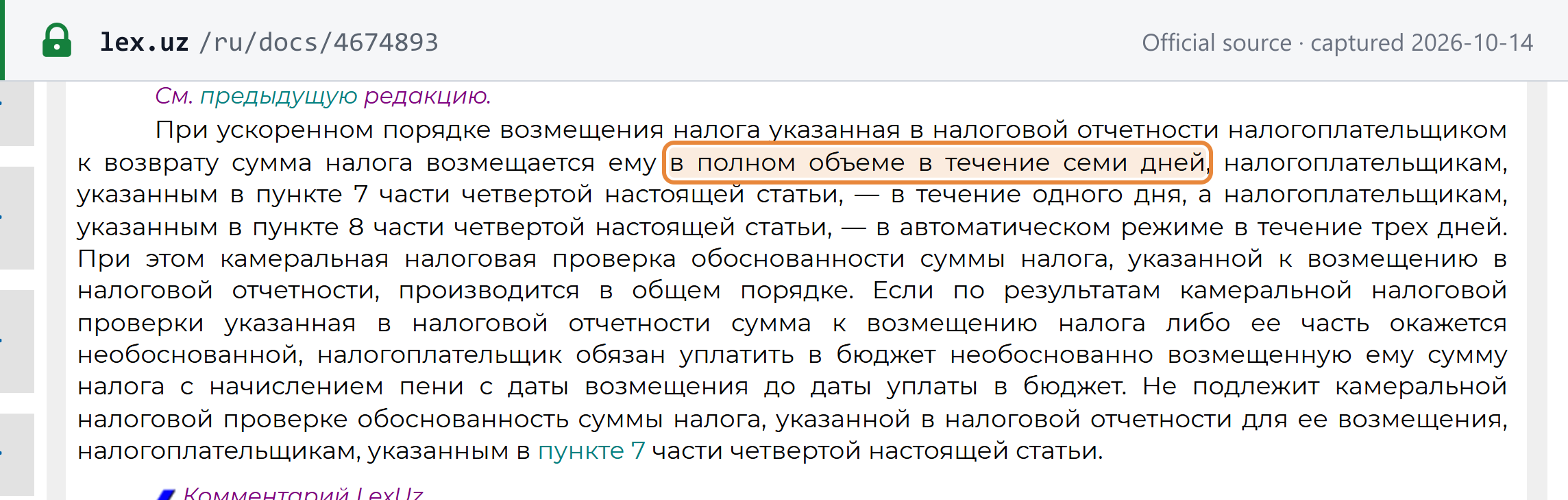
- Accelerated, within 7 days, in full: large taxpayers; taxpayers with a bank guarantee or pledge; exporters, for amounts from the zero rate where an earlier refund was clean; diplomatic missions; production-sharing participants; taxpayers under tax monitoring; and, once and for one year from 1 January 2026, businesses that have grown from small into medium or large (Art. 274).
- Within 1 day, without a desk audit: businesses rated "AAA".
- Automatically within 3 days: agricultural producers (except cotton and grain), from 1 January 2026.
- Small balances: since 28 May 2026, negative VAT balances "10 миллион сўмгача" — up to UZS 10 million — are refunded automatically, without an application or a tax audit (Decree UP-100 para 9(g)). [3]
- From 1 January 2027: taxpayers rated low tax risk have negative balances from zero-rated supplies and real-estate purchases covered "в трехдневный срок в автоматизированном порядке" — automatically within 3 days (Decree UP-95 of 19 May 2026). [8]
- Tourists: a TAX FREE refund scheme exists for foreign tourists, under a Cabinet procedure (Art. 274).


Exemptions
Exempt supplies
Exempt under Art. 243, where any required licence is held: [1]
- pre-school childcare, and care of the sick and elderly;
- funeral and religious services;
- prosthetic and disability goods; pension and benefit payment services;
- education services (general, vocational, higher, postgraduate and licensed supplementary education);
- sanatorium, health and sport services of budget organisations;
- housing maintenance for the population and condominium management;
- free supplies by decision of the President or the Cabinet of Ministers;
- bank and measured precious-metal bars, and investment coins;
- goods under the duty-free customs procedure; goods and services funded by loans from international financial institutions; patronage supplies; sales of state property;
- financial services (Art. 244) and insurance, including life insurance (Art. 245).
Exempt is not zero-rated. VAT on purchases used for exempt supplies cannot be credited and becomes part of their cost (Art. 267). A business making both taxable and exempt supplies "обязаны вести раздельный учет оборотов" — must keep separate accounts and apportion its input VAT (Arts. 243, 268). Zero-rated supplies, by contrast, keep full credit and refund rights (Art. 266). [1]

Special regimes
- Turnover tax for small businesses below the 12,000-BRV threshold, instead of VAT and profit tax (Arts. 461–470). Turnover-tax payers still act as tax agents and must issue invoices and keep purchase and sales books (Art. 462). [1]
- 6% simplified VAT for catering, trade and services businesses, 1 June 2026 – 1 January 2030 (Decree UP-100; see Rates).
- Catering partial refund: from 1 June 2026, catering businesses get back 40% of the VAT they paid, whatever share of their revenue was received cashless (Decree UP-100 para 3). [3]
- Special economic zones have their own regimes (Tax Code Art. 473 onwards).
Offences and penalties
Offences
- Tax evasion (Criminal Code Art. 184, as amended by Law ZRU-1131, in force 19 July 2026). Evasion is measured in base calculation values (BRV): "значительным размером … признается размер от ста до шестисот базовых расчетных величин, крупным размером — от шестисот до тысячи … особо крупным размером — тысяча и более" — significant is 100–600 BRV, large 600–1,000 BRV, especially large 1,000 BRV or more. [11]
- significant evasion after an administrative penalty for the same act: a fine of 100–150 BRV, correctional labour of up to 2 years, restriction of liberty of 1–3 years, or imprisonment of 1–3 years;
- repeated or large-scale evasion: a fine of 200–300 BRV, correctional labour, restriction of liberty, or imprisonment of 3–5 years;
- especially large evasion: a fine of 300–600 BRV or imprisonment of 5–7 years.
- Paying the tax in full removes liberty-restricting penalties, and a first offender who compensates in full before judgment is exempt from liability.
- Tax offences (Tax Code chapter 28): failing to register for VAT; trading without a cash register or receipt; concealing the tax base; non-payment; and showing VAT on an invoice when not entitled to. The fines are below.

Penalties
| Breach | Penalty | Source |
|---|---|---|
| Late VAT registration | 5% of income received between the date registration was due and the actual registration date, at least UZS 5,000,000. From 1 January 2026 not applied to a business moving from turnover tax to VAT for the first time that registers within one year | Tax Code Art. 219 |
| Trading without a cash register, payment terminal, electronic payment system or QR code, or without issuing a receipt | UZS 5,000,000; unregistered cash register or receipts UZS 7,000,000; using another person's terminal or QR code, or a non-compliant cash register, UZS 20,000,000 | Tax Code Art. 221 |
| Concealing or understating the tax base | 20% of the concealed base, plus 1% of the value for wrong product identification codes on invoices or receipts | Tax Code Art. 223 |
| Non-payment or underpayment | 20% of the unpaid tax | Tax Code Art. 224 |
| Showing VAT on an invoice for an exempt supply, or by a non-payer | 20% of the VAT shown, and the VAT must be paid | Tax Code Art. 225 |
| Late return (other than micro-firms and small enterprises) | 1 BRV for citizens, 10 BRV for officials | Administrative Code Art. 175 |
| Late return by micro-firms and small enterprises | 3 BRV | Administrative Code Art. 175 |
Only one late-filing fine is imposed per calendar month, however many returns are late (Administrative Code Art. 175). At the base calculation value of UZS 440,000 from 1 September 2026, 1 BRV is UZS 440,000, 3 BRV UZS 1,320,000 and 10 BRV UZS 4,400,000. [4]



Late-payment interest (пеня). Interest accrues for each day of delay from the day after the due date. "Процентная ставка пени принимается равной одной трехсотой действующей в это время ставки рефинансирования Центрального банка" — the daily rate is 1/300 of the Central Bank of Uzbekistan refinancing rate in force at the time (Tax Code Art. 110). [1] The refinancing rate equals the Central Bank's main rate, which the Central Bank kept at 14% a year on 16 September 2026 — a daily rate of 14% / 300 ≈ 0.0467% for as long as that rate applies. [12] [13]


Frequently asked questions
We sell SaaS to consumers in Uzbekistan from abroad. Is there a registration threshold?
No. A foreign company supplying electronic services to individuals in Uzbekistan is a VAT payer for those services from its first sale. It applies for registration within 30 calendar days of starting, charges 12% VAT included in the price, and files and pays quarterly, by the 20th of the month after the quarter, through its taxpayer personal cabinet (Tax Code Arts. 278–282).
And if our customers are Uzbek companies?
Then you do not register. When a foreign company supplies electronic services to an Uzbek legal entity, or to a foreign company's permanent establishment in Uzbekistan, the customer is the tax agent: it calculates, withholds and pays the VAT to the budget, whether or not it is a VAT payer itself (Tax Code Art. 255). Art. 255 does not make Uzbek individual entrepreneurs tax agents for electronic services, and the Code does not say expressly who accounts for the VAT on those sales.
Is the VAT threshold UZS 1 billion or 5 billion?
Since 1 June 2026 the threshold for moving from turnover tax to VAT is 12,000 times the base calculation value (Decree UP-100), replacing the earlier UZS 1 billion. With the base calculation value at UZS 440,000 from 1 September 2026 (Decree PF-115), that is UZS 5,280,000,000. The figure in soʻm moves whenever the base calculation value changes.
Can I issue a paper invoice?
As a rule, no. Invoices are issued electronically in the e-invoice information system, and a buyer may credit only the VAT shown on invoices accepted in electronic form. Paper is allowed only for transactions involving state secrets, or during a technical outage confirmed by the operator, after which the invoice is reissued electronically (Cabinet Resolution No. 489, Annex 2).
My customer never signed my e-invoice. Is it valid?
Yes. The buyer must accept an e-invoice with its electronic digital signature, or reject it with a reason, within 10 calendar days (1 calendar day for goods subject to digital marking). An e-invoice the buyer neither accepts nor rejects in time is deemed accepted (Cabinet Resolution No. 489, Annex 2, para 63).
Should my café switch to the 6% simplified VAT?
It is optional, for businesses whose main activity is catering, trade or services, from 1 June 2026 to 1 January 2030 (Decree UP-100). You pay 6% on all sales and 0% profit tax, but you cannot credit VAT on your purchases and you lose existing VAT exemptions and partial refunds; your business customers can still credit the VAT you charge. It suits a business with few VAT-bearing costs. Enterprises with a state share of 50% or more, and large taxpayers, cannot use it.
What happens if I file or pay my VAT late?
A late return brings an administrative fine of 1 base calculation value for a citizen and 10 for an official, or 3 for micro-firms and small enterprises, with only one such fine per calendar month (Administrative Code Art. 175). Late payment accrues daily penalty interest at 1/300 of the Central Bank's refinancing rate (Tax Code Art. 110), and unpaid tax found by the authority carries a fine of 20% of the amount (Art. 224).
Important websites
| Site | Purpose |
|---|---|
| Tax Committee — taxpayer personal cabinet (my.soliq.uz) | VAT registration, returns, payments and e-invoices for resident businesses |
| Tax Committee on gov.uz | Official page of the Tax Committee |
| tax.uz | Registration and returns for foreign suppliers of electronic services |
| lex.uz — Tax Code (Russian) · (Uzbek, official) | Official text of the Tax Code and the decrees cited here |
| my.gov.uz | Government services portal, including business registration |
| Customs Committee | Import VAT and customs procedures |
| Central Bank of Uzbekistan — refinancing rate | The rate behind late-payment interest, and official exchange rates |
| Uzbekistan tax ID guide | STIR (INN) and PINFL formats |
Recent changes
- 2026-09-10 — Law ZRU-1173 signed (adopted by the Legislative Chamber on 10 February 2026, approved by the Senate on 18 May 2026): from 12 December 2026, foreign sellers of goods to individuals through e-trading platforms join the Chapter 39 regime. (lex.uz) — see event
- 2026-09-01 — Base calculation value raised to UZS 440,000 (Decree PF-115), so the turnover-tax threshold is UZS 5,280,000,000 and fines set in BRV rise. (lex.uz)
- 2026-06-01 — Decree UP-100: threshold for moving to VAT set at 12,000 × BRV, replacing UZS 1 billion; optional 6% simplified VAT for catering, trade and services until 1 January 2030; 40% partial refund for catering. (lex.uz) — see events: threshold, 6% simplified VAT
- 2026-05-28 — Decree UP-100 in force: importers are no longer automatically VAT payers, and negative VAT balances up to UZS 10 million are refunded automatically. (lex.uz)
- 2026-05-19 — Decree UP-95 adopted: from 1 January 2027, taxpayers rated low tax risk get negative VAT balances from the zero rate and real-estate purchases covered automatically within 3 days. (lex.uz) — see event
- 2026-01-01 — Law ZRU-1108: no input credit on high-risk e-invoices; zero rate for listed agricultural produce with 3-day automatic refunds; one-year grace on the late-registration fine for first-time switchers; revised cash-register and late-filing fines. (lex.uz)
- 2023-01-01 — Standard rate cut from 15% to 12% (Law ZRU-812). (lex.uz)
For the full chronology, see Uzbekistan tax changes on Lookuptax.
Reference links
- Tax Code of the Republic of Uzbekistan (lex.uz, Russian text)
- Tax Code of the Republic of Uzbekistan (lex.uz, official Uzbek text)
- Presidential Decree UP-100 of 26 May 2026 (lex.uz)
- Presidential Decree PF-115 of 23 June 2026 — base calculation value (lex.uz)
- Cabinet of Ministers Resolution No. 480 of 5 August 2024 — taxpayer identification numbers (lex.uz)
- Cabinet of Ministers Resolution No. 489 of 14 August 2020, with Annex 2, Regulation on invoice forms (lex.uz)
- Cabinet of Ministers Resolution No. 522 of 25 June 2019 — electronic invoices (lex.uz)
- Presidential Decree UP-95 of 19 May 2026 (lex.uz)
- Law ZRU-1173 of 10 September 2026 (lex.uz)
- Code of Administrative Responsibility, Art. 175 (lex.uz)
- Criminal Code, Art. 184 (lex.uz)
- Central Bank of Uzbekistan — refinancing rate
- Central Bank of Uzbekistan — press releases
- Tax Committee under the Cabinet of Ministers (gov.uz)
Related on Lookuptax: