E-invoicing in Mexico: CFDI 4.0 and PAC clearance
Overview
Mexico's e-invoice is the CFDI (Comprobante Fiscal Digital por Internet), which the SAT's own pages also call the factura electrónica. Under article 29 of the Código Fiscal de la Federación (CFF), wherever the tax laws require a receipt for an act or activity, for income received or for taxes withheld, taxpayers must issue it as a digital document "a través de la página de Internet del Servicio de Administración Tributaria". [1]
The system is run by the Servicio de Administración Tributaria (SAT). Before a CFDI is issued, it must be sent to the SAT, which validates it against CFF article 29-A and the applicable complements, assigns the folio and adds the SAT's digital seal (CFF art. 29, fr. IV). In practice this is done by a PAC (proveedor de certificación de CFDI), a private company the SAT authorises to perform those three steps (CFF art. 29 Bis). [1]
Legal basis in one line. CFF articles 29, 29 Bis and 29-A; Reglamento del CFF article 39; Chapter 2.7 of the annual Resolución Miscelánea Fiscal (RMF); the technical standard in Anexo 20 and the PAC validations in Anexo 29.
| Mexico | |
|---|---|
| System | CFDI (factura electrónica), version 4.0 |
| Authority | Servicio de Administración Tributaria (SAT) |
| Model | Clearance: validated, assigned a folio and sealed before issue, by a SAT-authorised PAC |
| B2B | Mandatory |
| B2C | Mandatory; a global CFDI covers sales to the general public |
| B2G | Mandatory, through the same CFDI regime (no separate B2G platform) |
| Non-established businesses | The obligation attaches to issuers registered in the RFC with an e.firma and a digital-seal certificate (see Scope) |
| Format | XML, CFDI 4.0 under Anexo 20 (namespace http://www.sat.gob.mx/cfd/4), plus SAT complements |
| Network | PACs authorised by the SAT; not Peppol |
| Key dates | CFDI reform in force 1 Jan 2011; CFDI the receipt in all tax laws from 1 Jan 2014; CFDI 4.0 the only valid version from 1 Apr 2023; hydrocarbons complement from 24 Apr 2026 |
| Legislation | CFF arts. 29, 29 Bis, 29-A, 29-A Bis; RCFF art. 39; RMF 2026 Chapter 2.7; Anexos 20 and 29 |
For Mexican IVA rates, registration and the full list of what a CFDI must contain, see the Mexico VAT guide.
Mandate status & timeline
Status (as at 22 October 2026): mandatory clearance for every issuer, in force. There is no phasing by turnover or taxpayer size. What changes over time is the version of the standard and the complements that ride on it, so the table below is a version and complement chronology.
| Date | What became mandatory or changed | Scope | Instrument | Status |
|---|---|---|---|---|
| 1 Jan 2011 | The reform of CFF article 29 that introduced the CFDI takes effect; printed receipts already held could be used until they expired | Taxpayers obliged to issue receipts | Decree DOF 7 Dec 2009, Artículo Décimo transitorio | Passed |
| 1 Jan 2014 | CFF arts. 29 and 29-A rewritten; every reference to receipts in the tax laws is read as a reference to the CFDI | All issuers | Decree DOF 9 Dec 2013, transitorios Primero and Segundo fr. IV | Passed |
| 1 Jul 2017 → 1 Jan 2018 | CFDI 3.3 in force; mandatory from 1 January 2018 | All issuers | SAT Anexo 20 page | Passed |
| 1 Nov 2018 | New cancellation process: the recipient must accept the cancellation | All issuers | SAT comunicado, 28 Oct 2018 | Passed |
| 1 Jan 2022 | CFDI 4.0 and CFDI de Retenciones 2.0 introduced, alongside 3.3; Carta Porte complement mandatory | All issuers; freight transport | SAT Anexo 20 page; SAT Carta Porte releases | Passed |
| 1 Jan 2023 → postponed | CFDI 4.0 to be mandatory from 1 January 2023 (announced 8 June 2022) | All issuers | SAT comunicado, 8 Jun 2022 | Superseded |
| 1 Apr 2023 | CFDI 4.0 the only valid version (3.3 allowed until 31 March 2023; payroll CFDI 3.3 until 30 June 2023) | All issuers | SAT comunicados, 28 Nov 2022 and 5 Apr 2023 | Passed |
| 31 Dec 2023 | End of the period in which fines for Carta Porte filling errors were not applied | Freight transport | SAT comunicado 001-2024 | Passed |
| 1 Jan 2024 | Carta Porte CFDI enforceable in foreign-trade operations | Freight transport | SAT Carta Porte page | Passed |
| 18 Jan 2024 | Comercio Exterior complement 2.0 in force | Definitive exports | SAT Comercio Exterior page | Passed |
| 17 Jul 2024 | Carta Porte 3.1 mandatory (published 17 June 2024) | Freight transport | SAT Carta Porte page | Passed |
| 1 Jan 2026 | CFF reform in force: CFDIs must cover real operations (29-A fr. IX), fuel CFDIs carry the CNE permit number (29-A fr. V f), new cancellation deadline, new CSD-restriction grounds | All issuers; fuel sellers | Decree DOF 7 Nov 2025, Primero transitorio | Passed |
| 24 Apr 2026 | Complemento Concepto para la facturación de Hidrocarburos y Petrolíferos mandatory | Sellers of gasoline and diesel | SAT comunicado (22) conjunto, 27 Mar 2026; RMF 2026 | Passed |
| 9 Jul 2026 | First amendment of the RMF 2026: fuel-complement rule and CFDI-restriction rules amended; Anexo 29 modified | Fuel sellers; issuers using simplified issuing facilities | Primera Resolución de Modificaciones, DOF 9 Jul 2026 | Published |
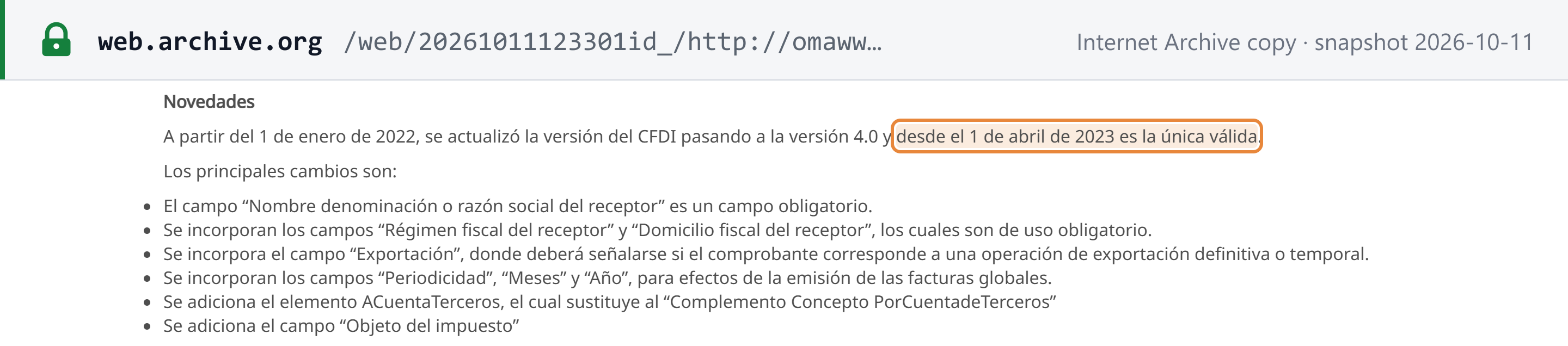
Version 4.0 and the end of 3.3. The SAT's Anexo 20 page states that from 1 January 2022 the CFDI moved to version 4.0 "y desde el 1 de abril de 2023 es la única válida" (and since 1 April 2023 it is the only valid one). Version 3.3 had entered into force on 1 July 2017 and was mandatory from 1 January 2018. The main 4.0 changes: the recipient's name, tax regime and tax-domicile postal code became mandatory; a new Exportación field; fields for global invoices; the ACuentaTerceros element; and the Objeto del impuesto field. [2]
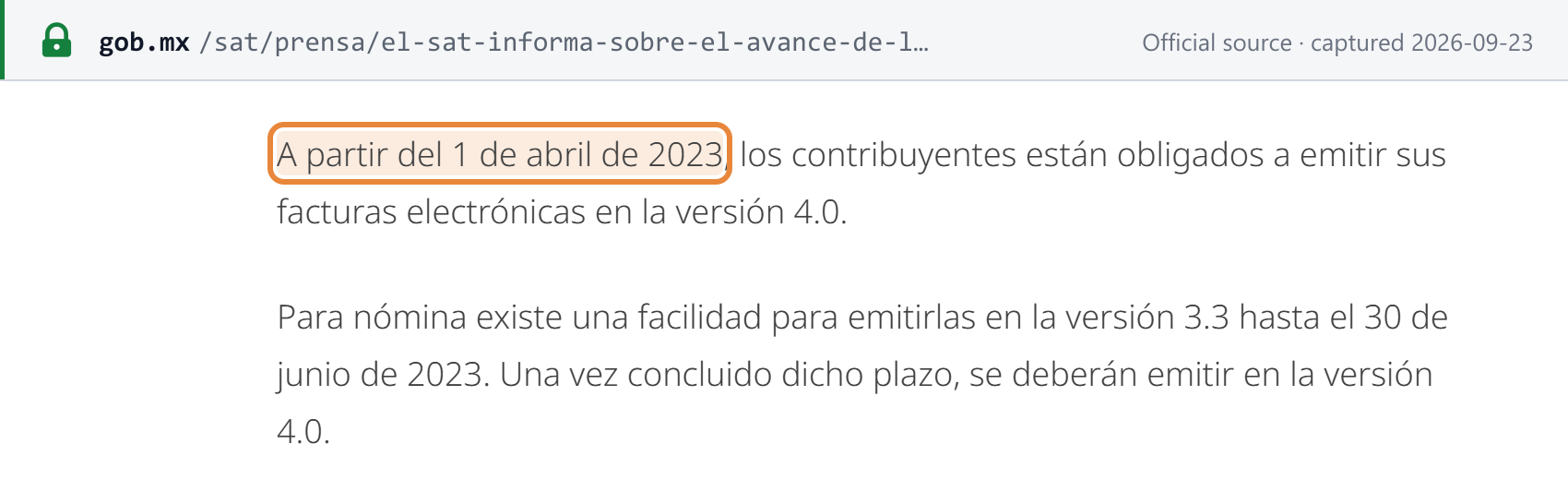
The postponements. On 8 June 2022 the SAT announced that CFDI 4.0 would be mandatory from 1 January 2023. [10] On 28 November 2022 it extended the option to keep issuing version 3.3 to 31 March 2023. [11] Its release of 5 April 2023 confirmed that from 1 April 2023 taxpayers must issue their e-invoices in version 4.0, with payroll CFDIs allowed in version 3.3 until 30 June 2023. Today a PAC certifies a document only if the version of the standard it uses is current (see Format & network). [3]
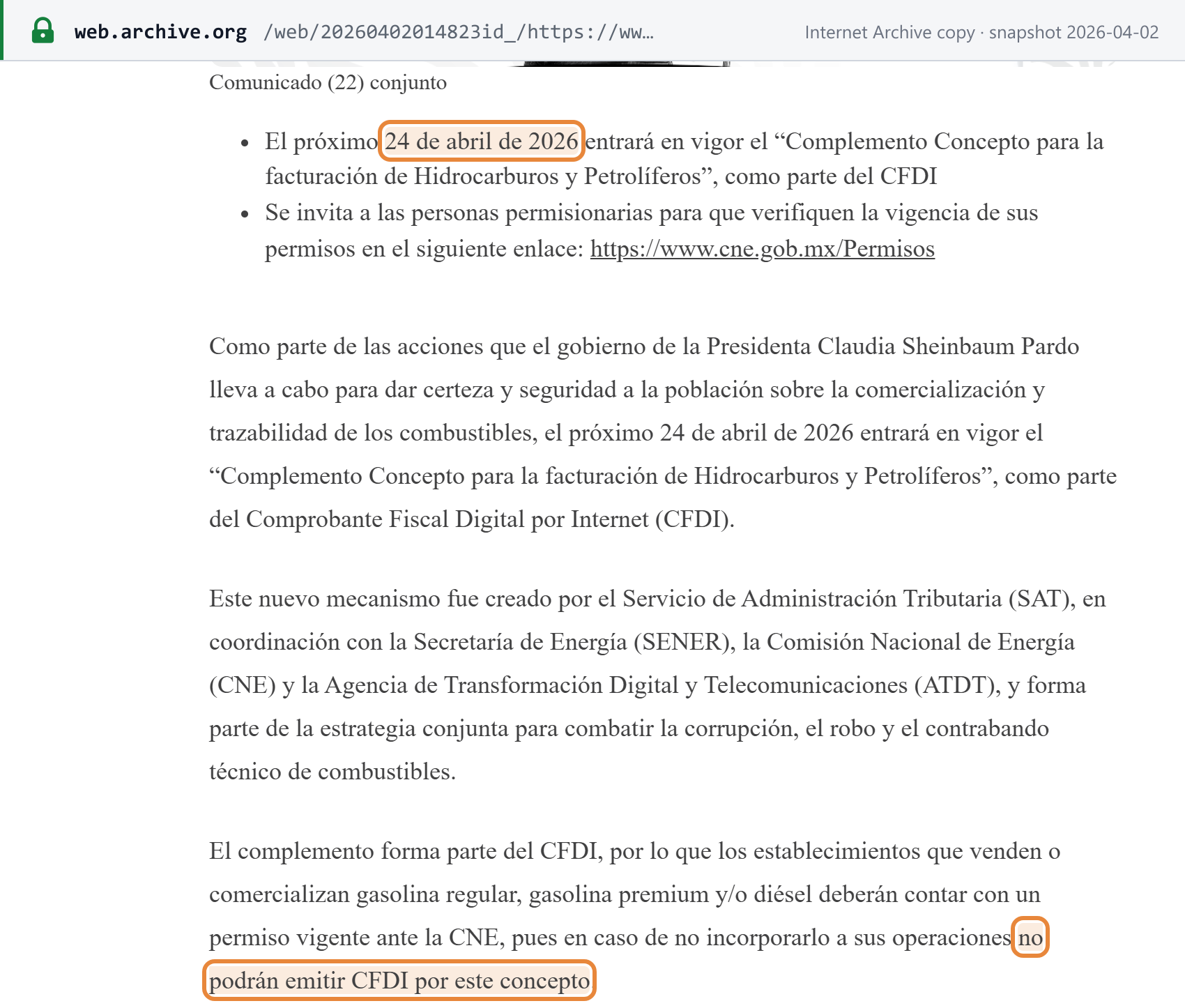
The latest phase: the hydrocarbons complement (24 April 2026). In a joint comunicado of 27 March 2026, the SAT announced that the "Complemento Concepto para la facturación de Hidrocarburos y Petrolíferos" would enter into force on 24 April 2026 as part of the CFDI. It was built with the Secretaría de Energía (SENER), the Comisión Nacional de Energía (CNE) and the Agencia de Transformación Digital y Telecomunicaciones. Establishments that sell regular gasoline, premium gasoline or diesel must hold a valid CNE permit; without the complement in their operations they "no podrán emitir CFDI por este concepto", that is, they cannot issue the CFDI for those sales. [4]
The legal mechanism sits in the RMF 2026. The rule on receipts for sales of hydrocarbons and petroleum products (rule 2.7.1.48) requires sellers of gasoline and diesel to add the complement to their CFDIs and to record product code 15101505 (diesel), 15101514 (regular gasoline under 91 octane) or 15101515 (premium gasoline, 91 octane or more). Under rule 2.7.1.8, any complement the SAT publishes on its Portal becomes mandatory 30 calendar days after publication, and an RMF transitory provision makes the fuel rules apply once that period has run. Anexo 29 then tells PACs to reject an income or expense CFDI carrying those product codes unless every Concepto node has the complement. [5] [6] Separately, since 1 January 2026, CFF article 29-A fr. V f) requires CFDIs issued by distributors and sellers of hydrocarbons or petroleum products to carry the seller's valid CNE permit number. [1]
What came after. The first amendment of the RMF 2026, published in the DOF on 9 July 2026, reworded the first paragraph of the fuel-complement rule and amended rules 2.7.3.1 to 2.7.3.9, so that taxpayers falling under CFF article 17-H fr. XI, XII or XIII have CFDI issuance restricted and cannot use the simplified issuing facilities until they correct the irregularity. It also published the first modification of Anexo 29. [7]
What is announced next. As at 22 October 2026 no new CFDI version or newly mandatory complement has been announced.
Carta Porte. The transport complement has been mandatory since 1 January 2022. The SAT first gave taxpayers until 31 March 2022 to issue it correctly without fines or penalties; on 28 November 2022 it said penalties for filling errors would not be applied until 31 July 2023; and its release of 2 January 2024 states that the extension of the non-application of fines ended on 31 December 2023. [20] [11] [9] Version 3.1 was published on 17 June 2024 and must be used from 17 July 2024; in foreign-trade operations the Carta Porte invoice has been enforceable since 1 January 2024. [8]
Legal basis
| Instrument | What it does for the CFDI | Published | In force |
|---|---|---|---|
| Código Fiscal de la Federación, arts. 29, 29 Bis, 29-A, 29-A Bis | Duty to issue CFDIs; pre-issue validation, folio and SAT seal; PAC authorisation; mandatory content; cancellation | Code DOF 31 Dec 1981; consolidated text last reformed DOF 9 Apr 2026 | Current text |
| Decree reforming the CFF, DOF 7 Dec 2009 | Reform of art. 29 that introduced the CFDI | 7 Dec 2009 | 1 Jan 2011 |
| Decree reforming the CFF, DOF 9 Dec 2013 | Rewrote arts. 29 and 29-A; receipts in all laws read as CFDIs | 9 Dec 2013 | 1 Jan 2014 |
| Decree reforming the CFF, DOF 12 Nov 2021 | Added art. 29 Bis (PACs), the cancellation infraction (81 fr. XLVI) and the missing-complement fine (84 fr. IV d) | 12 Nov 2021 | In force |
| Decree reforming the CFF, DOF 7 Nov 2025 | 29-A fr. V f) and fr. IX, new cancellation deadline, art. 29-A Bis, new CSD-restriction grounds, amended fines | 7 Nov 2025 | 1 Jan 2026 |
| Reglamento del CFF, art. 39 | CFDI to be sent to the SAT or PAC within 24 hours of the operation | DOF 2 Apr 2014 | Current |
| Resolución Miscelánea Fiscal 2026, Chapter 2.7 | Operating rules: CFDI (2.7.1), PACs (2.7.2), simplified facilities (2.7.3–2.7.4), payroll (2.7.5), Carta Porte (2.7.7) | DOF 28 Dec 2025 | 2026 (re-issued yearly) |
| First amendment of the RMF 2026 | Amended the fuel-complement rule and rules 2.7.3.x; first modification of Anexo 29 | DOF 9 Jul 2026 | Published 9 Jul 2026 |
| Anexo 20 | Binding technical standard: CFDI 4.0, Retenciones 2.0, cancellation service, QR code | DOF 13 Jan 2022, as an annex of the RMF 2022 | 1 Jan 2022 |
| Anexo 29, RMF 2026 | Binding on PACs: extra validations, lists, free application | DOF 9 Jan 2026 | 2026 |
| SAT complement standards on the SAT Portal (Pagos, Carta Porte, Comercio Exterior, Hidrocarburos y Petrolíferos, Nómina) | Binding 30 calendar days after publication (RMF rule 2.7.1.8) | SAT Portal | Per complement |
Do the technical standards bind? Yes. CFF article 29 fr. III requires CFDIs to meet article 29-A and the SAT's general rules, "inclusive los complementos", which are published on the SAT's Portal. Anexo 20 is itself an annex of the RMF, published in the DOF. The SAT's Anexo 20 page still lists the standard as published in the DOF on 13 January 2022, with later schema and catalogue updates on the Portal (the latest catalogue update is dated 1 October 2026). [1] [2] [13]
Scope
B2B: mandatory. CFF article 29 covers every receipt the tax laws require, whoever the customer is. Buyers of goods and services must ask for the CFDI, and amounts shown on a CFDI that does not meet the requirements "no podrán deducirse o acreditarse fiscalmente": they cannot be deducted or credited (CFF art. 29-A). [1]
B2C: mandatory, with a global CFDI. Where the customer gives no RFC, the seller uses the generic RFC set by the SAT and the sale counts as one with the general public (CFF art. 29-A fr. IV). The RMF 2026 lets the seller send a global CFDI within 24 hours after a daily, weekly, monthly or bimonthly close, with IVA and IEPS shown separately. A seller need not issue receipts for public sales under MXN 100 where the customer does not ask for one. The global-CFDI facility does not apply to fuel sellers covered by RMF rule 2.6.1.2; a transitory provision lets those under rule 2.6.1.2 fr. VII and VIII keep issuing a daily, weekly or monthly global CFDI until 31 December 2026, filled in under Apéndice 3 of the SAT's global-CFDI filling guide. The generic RFCs are XAXX010101000 for the general public and XEXX010101000 for foreign residents. [1] [5]
B2G: the same CFDI regime. Suppliers to government bodies issue ordinary CFDIs; there is no separate B2G platform. Public bodies are also issuers: the SAT publishes a guide to filling in CFDIs issued by the Federation, states and municipalities for contributions, duties, products and aprovechamientos. [2]
Payroll and withholdings are inside the system. Payroll is issued as a CFDI of type N (nómina) with the payroll complement. Withholdings and payment information go on the separate CFDI de Retenciones e información de pagos, version 2.0, the only valid version since 1 April 2023. [18]
Non-established businesses. The statute does not exclude non-residents in so many words. What it requires of an issuer is a valid e.firma (advanced electronic signature), registered tax obligations in the RFC, and a digital-seal certificate (CSD) obtained from the SAT (CFF art. 29 fr. I–II). [1] Foreign suppliers of digital services registered under the IVA law have a different duty: under LIVA article 18-D fr. V they must send Mexican recipients receipts showing the IVA separately when the recipient asks, with content that identifies both parties. The statute does not call these receipts CFDIs. [15] A Mexican seller invoicing a customer abroad issues a CFDI with the generic RFC XEXX010101000; exports of goods carry the Comercio Exterior complement, version 2.0 since 18 January 2024. [17]
Exempt or excluded transactions. None is carved out of the CFDI as such: the duty follows the receipt the tax laws require, not the tax rate. The only value-based relief is the B2C MXN 100 rule above.
Format & network
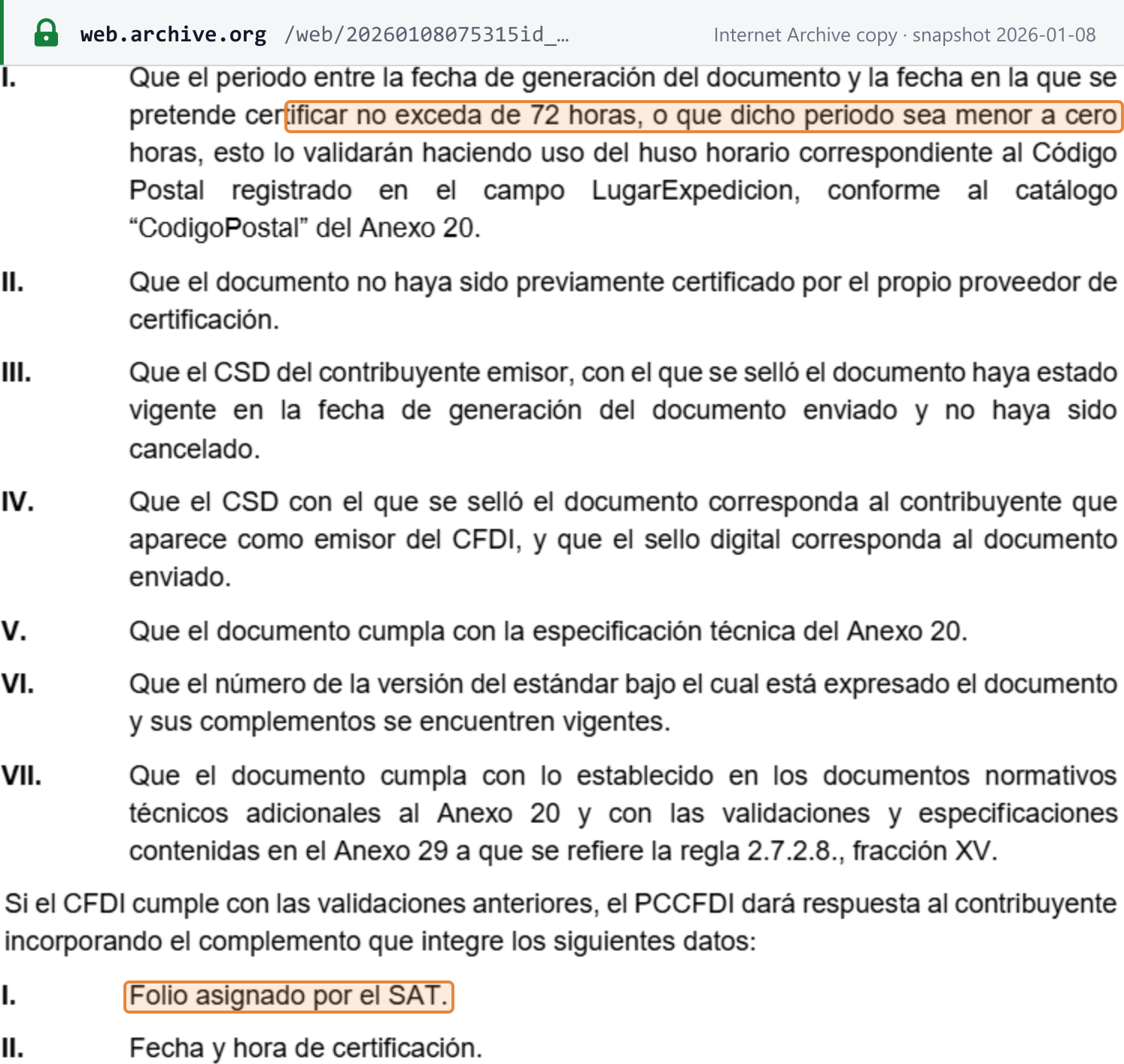
The CTC model: clearance through PACs. The issuer builds the XML, seals it with its CSD and sends it to a PAC. Under the RMF 2026, the PAC checks that:
- no more than 72 hours have passed since the document was generated, and it is not dated in the future, using the time zone of the postal code in
LugarExpedicion; - it has not certified the same document before;
- the issuer's CSD was valid on the generation date and has not been cancelled;
- the CSD belongs to the issuer and the seal matches the document;
- the document meets Anexo 20;
- the versions of the standard and its complements are current;
- the document meets the additional technical documents and the Anexo 29 validations.
If the CFDI passes, the PAC returns it with a complement (the Timbre Fiscal Digital) carrying the folio assigned by the SAT (the UUID), the certification date and time, the CFDI's seal, the serial number of the SAT certificate used, and the SAT's digital seal. The PAC must send the CFDI to the SAT at the moment it certifies it. [5] Separately, the Reglamento requires the issuer to send the CFDI to the SAT or PAC within 24 hours of the operation (RCFF art. 39). [14]
For how this compares with reporting and interchange models, see e-invoicing models: clearance, reporting and interchange.
The XML standard. CFDI 4.0, schema cfdv40.xsd, namespace http://www.sat.gob.mx/cfd/4, defined in Anexo 20. It is a national schema, not UBL, CII or Peppol BIS. The issuer's seal uses SHA-2 256 with RSA: the CSD's private key encrypts the digest. [13]
The network: PACs, not Peppol. The SAT publishes on its Portal the logo, name, RFC and SAT certificate number of every authorised PAC, and separately those whose authorisation was revoked, not renewed or withdrawn. A taxpayer may use one or more PACs at the same time. [5] Mexico does not use Peppol: CFDIs are cleared through PACs, and delivery to the buyer is outside the clearance rules.
Complements. Complements are XML extensions the SAT publishes on its Portal for particular operations; they bind 30 calendar days after publication (RMF rule 2.7.1.8). The ones most businesses meet:
- Pagos 2.0 (payment complement, REP), for invoices paid later or in instalments (see below).
- Carta Porte 3.1, for the transport of goods.
- Comercio Exterior 2.0, for definitive exports of goods.
- Hidrocarburos y Petrolíferos, for sales of gasoline and diesel since 24 April 2026.
- Nómina, for payroll.
Deferred payment: PPD invoice plus payment CFDI. When the price is not paid in full when the invoice is issued, the seller issues the income CFDI for the full value and then a payment CFDI for the payments received, with Total = 0 and the Pagos complement. One payment CFDI may cover all of a month's payments from the same customer, and it is due by the 5th calendar day of the following month. An invoice issued as paid in a single payment (PUE) that is not paid by the end of the month must be cancelled and reissued as PPD with payment form "99", related to the original as a substitution. [5]
Carta Porte: who issues it. Carriers and transport intermediaries moving freight by road, rail, air or sea, and parcel and courier services, issue an income CFDI with the Carta Porte complement; with its printed or digital representation it proves the transport and lawful possession of the goods. Owners moving their own goods issue a traslado CFDI with value zero and their own RFC as issuer and recipient. [5]
Cancellation (amended 1 January 2026). Since the 2025 CFF reform took effect, a CFDI may be cancelled no later than the month in which the annual income-tax return for the year of issue is due, and only if the recipient accepts. Before 2026 the statute allowed cancellation only within the fiscal year of issue. Cancelling an income CFDI also requires documentary justification of the reason. [1]

Under the RMF 2026 the recipient has 3 days from the request to accept or reject on the SAT Portal, and silence counts as acceptance. The exception is fuel CFDIs (income and expense CFDIs with the hydrocarbons complement, and Carta Porte income CFDIs listing the three fuel codes), which need express acceptance. No acceptance is needed, among other cases, for:
- CFDIs of up to MXN 1,000 (except fuel CFDIs and payment CFDIs);
- payroll, withholding and public-in-general CFDIs, and CFDIs issued to foreign residents;
- cancellations within the business day after issue. [5]
To replace a CFDI issued with errors, issue the correct one first with relation type "04" (Sustitución de los CFDI previos), then request cancellation of the old one with motive "01" (Comprobante emitido con errores con relación), quoting the new folio. [13] [19]
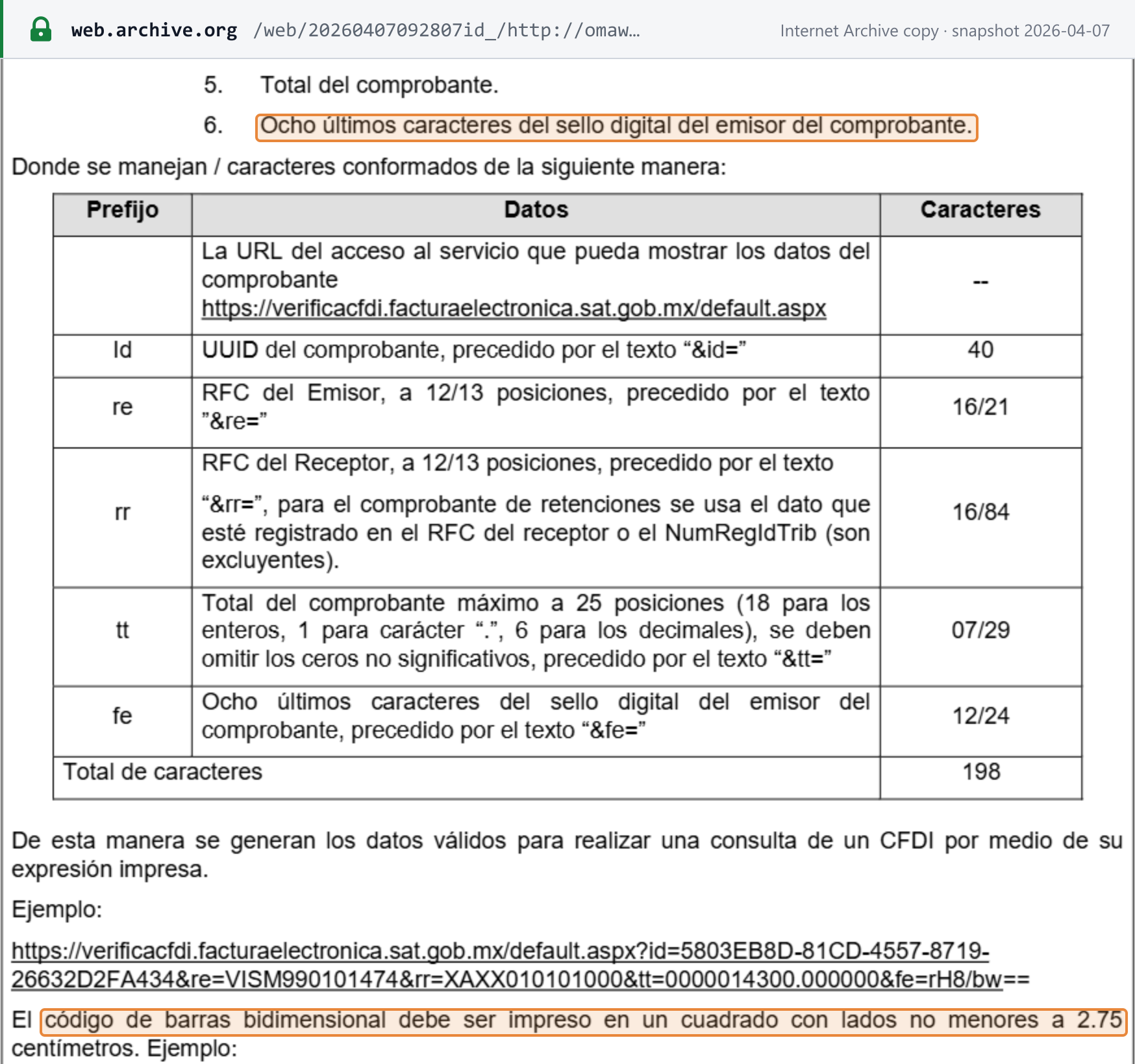
QR code and verification. The printed or PDF representation must carry a QR code (ISO/IEC 18004). It encodes the SAT verification URL https://verificacfdi.facturaelectronica.sat.gob.mx/default.aspx with the UUID (&id=), issuer RFC (&re=), recipient RFC (&rr=), total (&tt=) and the last eight characters of the issuer's seal (&fe=), and is printed in a square of at least 2.75 cm a side. [13] The RMF accepts either this QR code or the folio fiscal on the printed version. [5]
The SAT Portal's Factura electrónica section offers a one-by-one CFDI validation service, a free bulk-validation application and bulk download of CFDIs issued and received; the Factura SAT Móvil app shows CFDIs issued and received. [5]
E-reporting alongside. The monthly electronic-accounting upload and the DIOT are separate filings, not part of CFDI clearance; see filing and payment in the Mexico VAT guide.
Onboarding: how to comply
What an issuer needs. Under CFF article 29 fr. I–II:
- a valid e.firma, tax obligations registered in the RFC, and compliance with the SAT's general rules;
- a CSD (certificado de sello digital) from the SAT, requested only through an electronic form signed with the e.firma. You can hold one for all establishments or one per establishment, and it is used only to seal receipts. [1]
Connection modes.
- The SAT's free invoicing service on its Portal, and the Factura SAT Móvil app. [9]
- A PAC's free application: every PAC must validate and certify, free of charge, the CFDIs (including payment CFDIs) that taxpayers generate with it.
- A PAC's paid API or ERP integration, for volume issuers.
Primary-sector producers and some other small sellers can have CFDIs issued for them through the simplified facilities in RMF sections 2.7.3 and 2.7.4. [5]
PAC accreditation. The SAT authorises PACs under CFF article 29 Bis, and each must post a guarantee. [1] Under the RMF 2026:
- an authorisation lasts for the two fiscal years after the year in which it is notified;
- a PAC must keep subscribed and paid-in capital of at least MXN 10,000,000, with stated exceptions;
- a PAC whose authorisation is revoked enters a 90-calendar-day transition so its clients can move to an authorised PAC on the SAT's list. [5]
Choose a PAC from the SAT's published list (see Important websites).
Testing environments. The SAT does not publish a taxpayer test environment.
Penalties
Amounts as compiled in the RMF 2026 (DOF 28 December 2025). [1]
| Breach | Infraction | Fine |
|---|---|---|
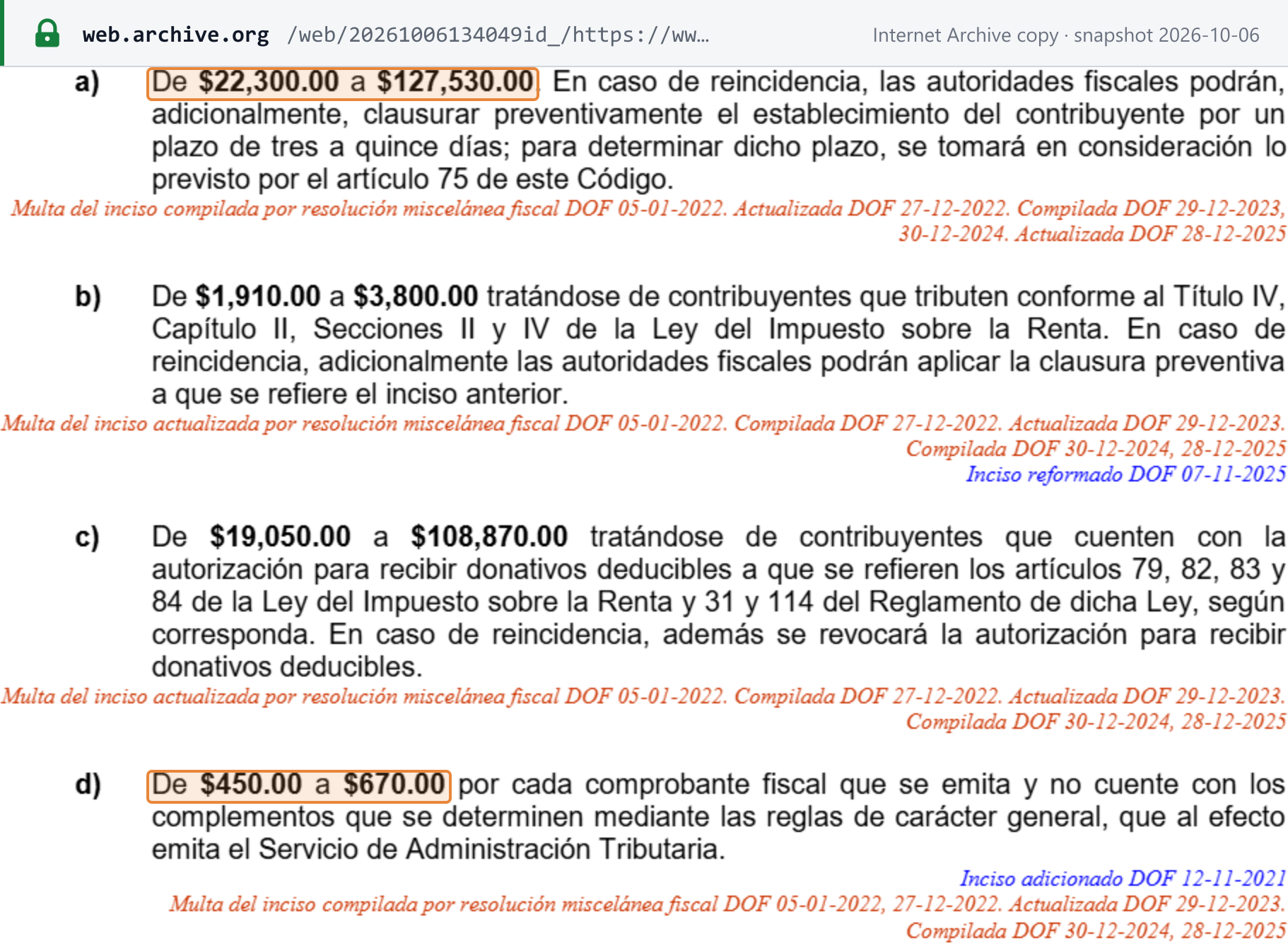
| Not issuing, delivering or making available a CFDI, or issuing one that fails the CFF, Reglamento or RMF requirements | Art. 83 fr. VII | MXN 22,300 to 127,530; on a repeat offence, possible preventive closure of the establishment for 3 to 15 days (art. 84 fr. IV a). MXN 1,910 to 3,800 for individuals taxed under LISR Title IV, Chapter II, Sections II and IV (art. 84 fr. IV b) |
| Issuing a CFDI without the complements the SAT's rules require | Art. 83 fr. VII | MXN 450 to 670 per CFDI (art. 84 fr. IV d) |
| Not cancelling income CFDIs issued in error or without cause, or cancelling them out of time | Art. 81 fr. XLVI | 5% to 10% of the amount of each CFDI (art. 82 fr. XLII) |
| PAC failures: wrong structure or stamp, out-of-date standard or complement, late certification or delivery | Art. 82-G | MXN 10 to 20 or MXN 20 to 60 per CFDI, by type (art. 82-H) |
The sanction that stops invoicing: CSD restriction. Before leaving a CSD without effect, the SAT may restrict it temporarily, which stops the taxpayer issuing CFDIs (CFF art. 17-H Bis). The 2025 reform, in force since 1 January 2026, added grounds that include:
- CFDIs that do not declare the "ingreso" key in the document-type field;
- fuel CFDIs without a valid CNE permit number, or for fuel not lawfully imported or acquired;
- recipients of false CFDIs who did not correct their tax position.
The taxpayer has up to 40 working days to file a clarification; use of the certificate is restored the day after the request, and the SAT must decide within 10 days. [1]
False CFDIs. Since 1 January 2026 a CFDI must cover existing, real operations; one that does not is "false" for the CFF (art. 29-A fr. IX), and new article 29-A Bis lets the authorities act on it directly. [1] The criminal offence for issuing or using false invoices is covered under offences and penalties in the Mexico VAT guide.
Frequently asked questions
Our PAC rejected the CFDI as too old. What is the limit?
A PAC will not certify a document if more than 72 hours have passed between its generation and the attempt to certify it, measured in the time zone of the postal code in LugarExpedicion (RMF 2026). Separately, the Reglamento del CFF requires the CFDI to be sent to the SAT or the PAC within 24 hours of the operation. [5] [14]
What do errors CFDI40145 and CFDI40147 mean?
They are validations in the SAT's CFDI 4.0 error matrix. CFDI40145: the recipient's name must be the name associated with the RFC recorded for the recipient. CFDI40147: the recipient's tax-domicile postal code (DomicilioFiscalReceptor) is checked against the SAT's list of registered, non-cancelled RFCs. In practice, copy the name and postal code exactly as they appear on the customer's Constancia de Situación Fiscal, and check the RFC with an RFC validator. [16]
Can we still cancel an invoice issued last year?
Yes, since 1 January 2026: a CFDI can be cancelled up to the month in which the annual income-tax return for the year of issue is due, provided the recipient accepts, unless an exception applies (for example, CFDIs of up to MXN 1,000 or cancellation within the business day after issue). The recipient has 3 days to answer, and silence counts as acceptance except for fuel CFDIs. Before 2026 the statute allowed cancellation only within the year of issue. [1] [5]
The customer has not paid yet. Which invoice do we issue?
Issue the income CFDI as PPD (deferred or instalment payment) for the full value, then a payment CFDI with the Pagos complement for the payments received, by the 5th calendar day of the following month. An invoice issued as PUE that is still unpaid at the end of the month must be cancelled and reissued as PPD. [5]
We sell gasoline or diesel. What changed in 2026?
Since 24 April 2026 your CFDIs for those sales must carry the hydrocarbons and petroleum products complement, and without it you cannot issue the CFDI. Use product code 15101505 (diesel), 15101514 (regular gasoline) or 15101515 (premium gasoline), and show your valid CNE permit number on the CFDI. A missing or wrong permit number is a ground for restricting your digital-seal certificate, and cancelling a fuel CFDI needs the recipient's express acceptance. [4] [5] [1]
What is the fine for issuing a CFDI without a required complement?
MXN 450 to 670 for each CFDI issued without the complements the SAT's rules require (CFF art. 84 fr. IV d). Failing to issue a CFDI, or issuing one that does not meet the requirements, is fined MXN 22,300 to 127,530, with possible closure for 3 to 15 days on a repeat offence. [1]
Is there a SAT test environment?
The SAT does not publish a taxpayer test environment.
We are a foreign company. Do we have to issue CFDIs?
The CFDI duty falls on issuers that hold an e.firma, are registered in the RFC with tax obligations and have a digital-seal certificate (CFF art. 29 fr. I–II). Foreign suppliers of digital services registered for IVA must send receipts to Mexican recipients when asked (LIVA art. 18-D fr. V); the statute does not call these CFDIs. [1] [15]
Recent changes
- 2026-07-09 — The first amendment of the RMF 2026 rewords the fuel-complement rule, amends rules 2.7.3.1 to 2.7.3.9 so that CFF article 17-H fr. XI to XIII cases have CFDI issuance restricted, and modifies Anexo 29. (SAT) — see event
- 2026-04-24 — The Complemento Concepto para la facturación de Hidrocarburos y Petrolíferos becomes mandatory for CFDIs on sales of gasoline and diesel, as announced by the SAT on 27 March 2026. (SAT) — see event
- 2026-01-01 — The CFF reform of 7 November 2025 takes effect: CFDIs covering non-existent operations are false, fuel CFDIs carry the CNE permit number, cancellation is allowed until the month the annual income-tax return is due, and new CSD-restriction grounds apply. (Cámara de Diputados)
- 2026-01-01 — The RMF 2026 (DOF 28 December 2025) applies, including the 72-hour PAC certification window and the 30-day rule for new complements. (SAT)
- 2024-07-17 — Carta Porte complement version 3.1 becomes mandatory. (SAT)
- 2023-04-01 — CFDI 4.0 becomes the only valid version (payroll CFDI 3.3 allowed until 30 June 2023). (SAT)
Related resources
- Mexico VAT guide — IVA rates, registration, the mandatory content of a CFDI and a specimen invoice
- Mexico tax identification numbers (RFC), or validate an RFC on Lookuptax
- E-invoicing status and networks by country
- E-invoicing models: clearance, reporting and interchange
- Other Latin American clearance systems: Brazil, Chile and Peru
- Mexico tax changes on Lookuptax
Important websites
- SAT: Factura electrónica
- SAT: Formato de factura (Anexo 20) — standard, guides, catalogues and schemas
- CFDI 4.0 schema (cfdv40.xsd)
- SAT: Complementos de factura
- SAT: Complemento Carta Porte
- SAT: Factura de Comercio Exterior
- SAT: Factura de retenciones e información de pagos
- SAT: list of authorised PACs
- SAT: CFDI verification service
- RMF 2026 and its annexes
- CNE: permit lookup