E-invoicing in Armenia: electronic settlement documents
Overview
Armenia has no separate "e-invoice" instrument. Its Tax Code defines a family of settlement documents (հաշվարկային փաստաթղթեր, hashvarkayin pastatghter), and Article 56(3) requires them to be issued electronically, with narrow exceptions. That rule has been in the Code since it entered into force on 1 January 2018. [2] [3]
The documents are issued in the settlement-document system of the State Revenue Committee (SRC) (Պետական եկամուտների կոմիտե), Armenia's tax authority. The SRC calls the current platform «Էլեկտրոնային հաշվարկային փաստաթղթեր», "Electronic Accounting Documents" or the "E-Invoicing system" in its English text. Taxpayers reach it through File Online (file-online.taxservice.am), and the SRC states it "has been in operation since June 1, 2023". [1]
As a general rule each electronic document is created in real time inside the SRC system, validated with an electronic signature, given a series-number by the system, and registered there. Decision 1257-Ն also allows two other methods: special billing programs that use series-numbers allocated in advance by the SRC (open to issuers of more than 1,000 documents on any day of a calendar month), and issuance through a cash register. Accounting software can feed the system through the SRC's own XML schema and API. [4]
Legal basis in one line. RA Tax Code (Law ՀՕ-165-Ն) Articles 55–57 and 67, with the issuance procedure in Government Decision N 1257-Ն of 5 October 2017, both in force since 1 January 2018. [2] [4]
| Armenia | |
|---|---|
| System | SRC "Electronic settlement documents" (e-invoicing) system, reached through File Online |
| Model | Government platform: the general rule is real-time issuance inside the SRC system, which assigns the series-number and registers each document; high-volume issuers may use SRC-allocated series-numbers in their own billing programs |
| Documents | Tax invoice (հարկային հաշիվ), invoice-document (հաշիվ վավերագիր), their adjusting versions, the leasing hand-over act, the VAT-refund tax invoice and the consignment note (բեռնագիր) |
| B2B | Mandatory since 1 January 2018 for every organisation, individual entrepreneur and notary (Tax Code Arts. 56(1), 56(3)) |
| B2G | Same documents and system; no separate B2G channel |
| B2C | Tax invoice or invoice-document optional for retail and consumer services when the buyer does not ask for one; a cash-register (CRM) receipt is issued instead (Art. 56(2)). Electronic cash registers (e-CRM) expand to Government-designated sectors from 1 January 2027 |
| Non-residents | Not on the system themselves: under reverse charge the Armenian counterparty issues the tax invoice (Art. 56(7)) |
| Format | SRC national XML schema (XSD) with an API package; PDF and Excel export. No UBL or CII |
| Network | SRC system via File Online, web portal, file import or API. Not Peppol; no accredited service providers |
| Integrity | Electronic signature plus a unique SRC series-number; public validity check by series-number |
| Authority | State Revenue Committee of the Republic of Armenia |
| Legislation | Tax Code Arts. 55, 56, 57, 67, 380–381; Government Decision N 1257-Ն (5 October 2017) |
For the VAT rate, registration and the full list of mandatory invoice particulars, see the Armenia VAT guide, which calls the invoice-document a "tax bill".
Mandate status & timeline
Status: mandatory for all organisations, individual entrepreneurs and notaries since 1 January 2018. The Tax Code that entered into force on that date already contained the electronic default in Article 56(3), and Decision 1257-Ն, which sets the issuance procedure, entered into force the same day. [3] [4]


| Date | What applies | Who | Instrument | Status |
|---|---|---|---|---|
| 1 January 2018 | Settlement documents issued electronically by default | All organisations, individual entrepreneurs and notaries | Tax Code Art. 56(3); Decision 1257-Ն | In force |
| 1 June 2023 | Current SRC "Electronic settlement documents" platform live on File Online; Decision 1257-Ն re-cast for it by Decision N 1478-Ն of 31 August 2023 | All issuers | SRC; Decision 1478-Ն | In force |
| 1 March 2025 | Mandatory "Transaction type" (Գործարքի տեսակ) field in the goods/services lines | Tax invoices not at 20%; all invoice-documents | SRC notice | In force |
| 1 April 2026 | e-CRM mandatory for medical providers connected to the electronic health system that accept payment by payment instruments; tax invoices for medical services carry the e-health service ID code | Medical-service providers | Law ՀՕ-60-Ն (Arts. 380.1(1.2), 55(4)(12)) | In force |
| 1 July 2026 | Foreign-currency amounts converted at the Central Bank of Armenia (CBA) average rate published on the previous business day | All | Law ՀՕ-234-Ն (Art. 16(2)) | In force |
| 1 September 2026 | Documents for goods due before the supply (previously at the moment of supply); consignment-note rule moved into Art. 56(4.1); CRM receipt for cash and card settlements | All issuers; CRM users | Law ՀՕ-309-Ն (Arts. 56(4), 56(4.1), 381(3)) | In force |
| 1 January 2027 | e-CRM mandatory for sales, works and services in sectors the Government sets; AMD 500,000 fine for operating without an e-CRM; CRM receipt showing the goods' destination address as accompanying document | Organisations, individual entrepreneurs and notaries in designated sectors | Law ՀՕ-309-Ն (Arts. 380.1(1.1), 416(1.1), 57(2.1)) | Enacted; sectors not yet set |
The current platform, 1 June 2023. The SRC: "The E-Invoiving [sic] system has been in operation since June 1, 2023. This system allows for the electronic issuance of invoices as outlined in the Tax Code of the Republic of Armenia and Government Resolution No. 1257-N (October 5, 2017)." Decision 1257-Ն was amended for the new platform by Decision N 1478-Ն of 31 August 2023, which carries a transitional provision. [1] [4]
Transaction type field, 1 March 2025. The SRC's notice says the new mandatory «Գործարքի տեսակ» field in the goods-list section "will operate from 1 March 2025". On tax invoices it is required whenever the VAT rate is not 20% (options: 0%-rated, VAT-exempt, other); on invoice-documents it is always required (options include special tax regime, 0%-rated, exempt, not a VAT object, export, and EAEU export by air). The SRC's integration documents are labelled as updated "starting March 1, 2025". [9] [1]
Medical services, 1 April 2026. Law ՀՕ-60-Ն (adopted 4 March 2026, published 27 March 2026, in force 1 April 2026) added Article 380.1(1.2): an e-CRM is mandatory where organisations and individual entrepreneurs providing medical care and services, connected to the electronic health system, accept payment by payment instruments. It also added Article 55(4)(12): a tax invoice for medical services carries, for each service, the personalised identification code generated by the electronic health system. [7]

Foreign-currency conversion, 1 July 2026. For the purposes of Article 16, which governs the accounting of transactions in foreign currency, the CBA average rate "published on the given day" means the rate the CBA published on the previous business day (Article 16(2)(1), restated by Law ՀՕ-234-Ն). Foreign-currency exchange transactions themselves keep the same-day rate (Article 16(2)(2)). [2] [8]
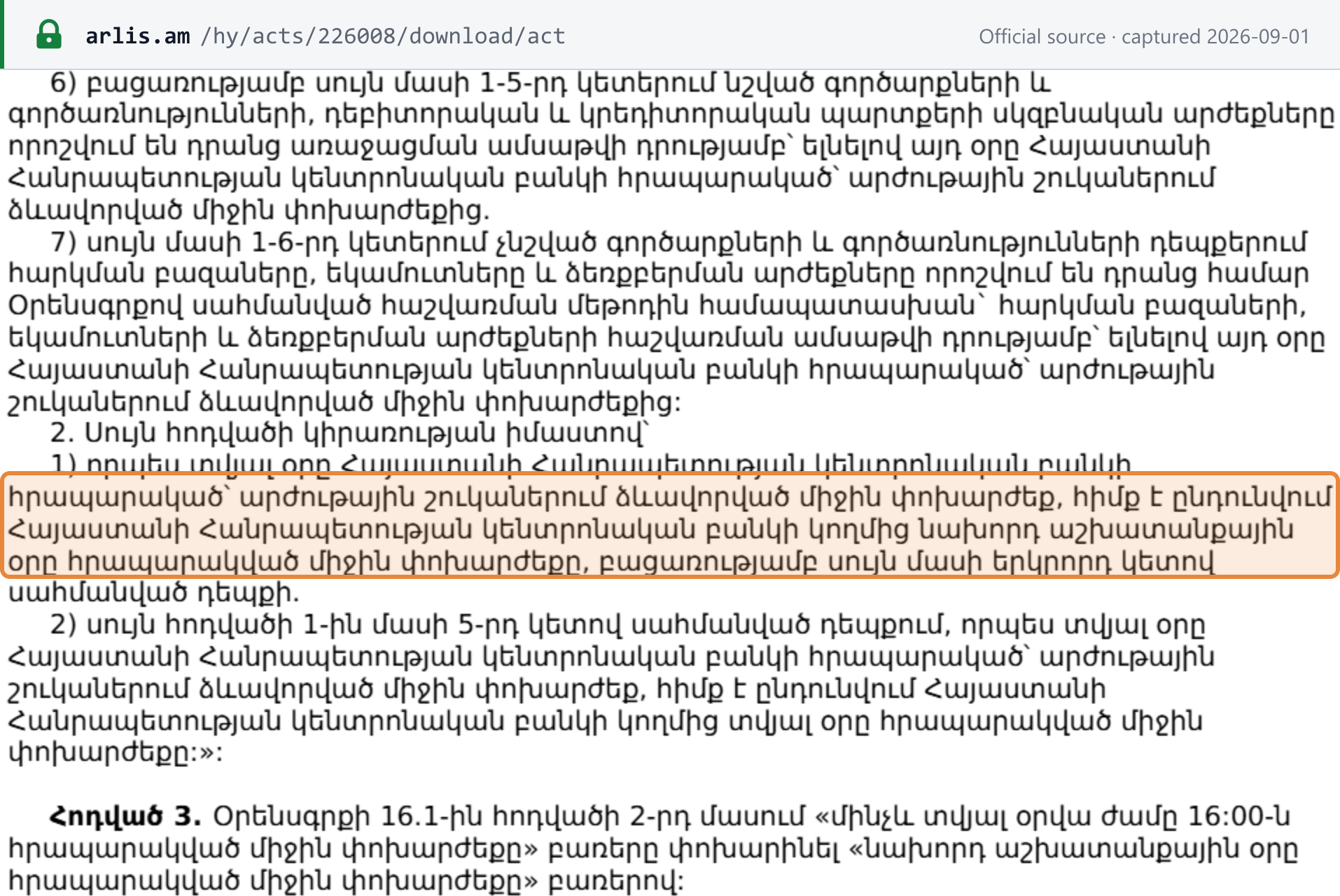
Issuance timing, 1 September 2026. Since 2018 Article 56(4) has set when settlement documents are issued. Law ՀՕ-309-Ն (adopted 3 July 2026, published 16 July 2026) rewrote it from 1 September 2026. Settlement documents, other than in the Article 56(8) and (8.1) cases, are now issued:
- before the supply of goods (previously at the moment of supply);
- at the moment work or a service is completed, including by the stages the contract provides for (unchanged).
The consignment note is issued before the goods are moved. That rule has applied since 2018; the law only moved it into its own part, Article 56(4.1). From the same date, Article 381(3) requires CRM users to give a CRM receipt for both cash and card or other payment-instrument settlements. [5]

The exceptions in Article 56(8) and (8.1): [2]
- tax invoices, invoice-documents and their adjusting versions (Article 55(2)(1)–(4)) may be issued in advance, provided the supply or completion takes place on the date the document states (56(8)(1));
- public and utility services may be invoiced after the billing period (56(8)(2));
- under reverse charge, where on-time issuance is impossible, the tax invoice is issued on the day the supplier's settlement or payment document is actually received (56(8)(3));
- CRM receipts for order-based retail may be generated in advance, but before the goods leave the dispatch point (56(8.1)).
The next phase: e-CRM expansion, 1 January 2027. Law ՀՕ-309-Ն rewrites Article 380.1(1.1) from 1 January 2027. e-CRM use stays mandatory for ride-hailing platforms and taxis, and becomes mandatory also for organisations, individual entrepreneurs and notaries making sales, performing works or providing services. The Government sets the areas of activity, the cases and the deadlines; until its implementing acts are in force, the existing ride-hailing and taxi rules keep applying. The law requires the implementing acts to be adopted before 1 January 2027. [5]

The Government has not yet adopted the sector decision. Prime Minister's Decision N 901-Ա of 9 September 2026, which lists the measures implementing Law ՀՕ-309-Ն, schedules the Government decision on the sectors, cases and deadlines of mandatory e-CRM use for submission in the first ten days of December 2026 and adoption in the last ten days of December 2026, with the SRC responsible. Until it is adopted, no sector outside ride-hailing, taxis and the medical-services case has an e-CRM start date. The same timetable schedules a Government decision supplementing Decision 1257-Ն itself, also for adoption in the last ten days of December 2026; it has not yet been adopted either. [6]
Accompanying documents, 1 January 2027. Article 57(2.1) already treats an e-CRM electronic receipt issued (generated) in the manner the Government sets as an accompanying document for the movement of goods; that limb has applied since 2020 (Law ՀՕ-280-Ն). Rewritten Article 57(2.1) adds a new limb from 1 January 2027: a CRM receipt (including an e-CRM electronic receipt) that, besides its mandatory data, shows the destination address of the goods and, where the buyer is an organisation, individual entrepreneur or notary, the buyer's taxpayer identification number (ՀՎՀՀ), also counts as an accompanying document. [5] [2]
Postponements
None. No date in the table above has been moved by a later instrument.
Legal basis
| Instrument | Date | In force | What it does for e-invoicing |
|---|---|---|---|
| RA Tax Code, Law ՀՕ-165-Ն | Adopted 4 October 2016 | 1 January 2018 | Art. 55 (settlement documents and their content), Art. 56 (issuance, electronic default, deadlines, cancellation), Art. 57 (accompanying documents), Art. 67 (when a tax invoice is barred), Arts. 380–381 (CRM and e-CRM), Arts. 410, 415, 416, 425, 426 (penalties) |
| Government Decision N 1257-Ն | 5 October 2017 | 1 January 2018; re-cast by N 1478-Ն of 31 August 2023; Annex 3 restated by N 601-Ն of 25 April 2024 | Annex 1: issuance in the SRC system. Annex 2: invalidation and cancellation. Annex 3: cases of non-electronic issuance |
| Law ՀՕ-60-Ն | Adopted 4 March 2026; published 27 March 2026 | 1 April 2026 | Art. 380.1(1.2) e-CRM for e-health-connected medical services; Art. 55(4)(12) medical-service ID code on tax invoices |
| Law ՀՕ-234-Ն | Adopted 6 May 2026; published 3 June 2026 | FX rule 1 July 2026 | Art. 16 restated: previous-business-day CBA rate |
| Law ՀՕ-309-Ն | Adopted 3 July 2026; published 16 July 2026 | Art. 1(2)–(3) and Art. 9: 1 September 2026; the rest 1 January 2027 | Goods documents before the supply (56(4)); consignment-note rule moved to 56(4.1); CRM receipt for cash and card (381(3)); e-CRM expansion (380.1(1.1)); CRM receipt with destination address as accompanying document (57(2.1)); AMD 500,000 fine (416(1.1)) |
| Prime Minister's Decision N 901-Ա | 9 September 2026 | — | Timetable for the Law ՀՕ-309-Ն implementing acts, including the Government e-CRM sector decision (last ten days of December 2026) |
| SRC integration package ("API, XSD and XML data") | Files dated up to 11 December 2025 | Linked from the SRC e-invoicing page | The import/export format "set by the tax authority" under Decision 1257-Ն pt 19 |
Decision 1257-Ն was adopted under Tax Code Article 56(3)(2) and 56(12). Its preamble sets three things: the procedure for issuing settlement documents (Annex 1), the procedure for invalidating and cancelling them (Annex 2), and the cases of non-electronic issuance (Annex 3). [4]
Technical standards. None of these instruments names UBL, CII or EN 16931. The schema is the SRC's own, published as XSD files in the SRC package. [2] [4] [10]
Scope
Who. Article 56(1): organisations, individual entrepreneurs and notaries "are obliged to issue" the Code's settlement documents for supplies of goods, works and services. The duty is not limited to VAT payers. Article 67 bars a tax invoice for periods in which the supplier is not a VAT payer and for exempt, 0%-rated, special-regime and non-VAT-object transactions; in those cases an invoice-document (հաշիվ վավերագիր) is issued instead, in the same system. [2]
B2B. In scope since 1 January 2018. The buyer's TIN is a mandatory field, as is its VAT number where the buyer is a VAT payer (Article 55(4)(10)(a)). All electronic settlement documents are validated by the electronic signature of at least one authorised person (Decision 1257-Ն Annex 1 pt 6). A recipient may validate received documents in the system whether or not it is a VAT payer (pt 7); VAT payers must validate the tax invoices they receive (Tax Code Article 68(1)). A recipient that was not a party to the transaction uses the system's "not a party" function (pt 28). [2] [4]
B2G. Public bodies receive the same SRC settlement documents. Neither the Tax Code, Decision 1257-Ն nor the SRC e-invoicing page sets a separate government-buyer channel or format. [2] [4] [1]
B2C. A supplier in retail trade, or performing works or services for the population, that uses a billing system or operates a CRM may skip the tax invoice or invoice-document unless the buyer asks for one (Article 56(2)). The consumer document is the CRM receipt; since 1 September 2026 it is required for cash and card settlements alike (Article 381(3)). An e-CRM receipt is formed by sending the receipt data to the SRC's electronic management system and receiving a fiscal number back (Article 380.1(3)). From 1 January 2027 e-CRMs become mandatory in the sectors the Government sets (see timeline). [2] [5]
Non-established businesses. A non-resident without a permanent establishment is not put on the system by these rules. Where the Armenian resident party (organisation, individual entrepreneur, notary or permanent establishment) bears the VAT under the reverse charge, that resident issues the tax invoice, and any adjusting one (Article 56(7)), entering its own TIN and VAT number in the supplier fields (Article 55(9)). Documents for purchases from such a non-resident remain valid with missing data where a written contract or power of attorney holds it (Article 55(10)). VAT registration of non-resident e-service suppliers is covered in the Armenia VAT guide. [2]
Paper (non-electronic) cases. Decision 1257-Ն Annex 3 pt 1.1 lists three: [4]
- exports of goods from Armenia, except exports to the EAEU of goods subject to traceability and EAEU exports by air, which stay electronic;
- supplies whose place of supply is outside Armenia (Tax Code Art. 37(2)), unless both issuer and recipient are registered with the tax authority;
- outages of communications or of the SRC system that make electronic issuance impossible.
In cases 1 and 2 the transaction is documented on paper with the invoice-document data, without a series-number (pt 1.2). After an outage, the electronic document must be issued within two business days of the outage ending (pt 6), and where outage facts exist the Article 410 fine is not applied (pt 9). Article 56(3)(1) also keeps the cash-register receipt, and documents containing secret or restricted-use information, outside the electronic rule. [4] [2]
Simplified invoice. There is no value-threshold simplified invoice. The reduced document is the invoice-document, which carries the Article 55(4) particulars except the VAT rate and amount (Article 55(5)). It is defined by the type of transaction (Article 67), not by value. [2]
Time limit. No settlement document, including an adjusting one, may be issued, and none cancelled, for a transaction once three tax years have passed since the tax year that includes the transaction date (Article 56(11.1)). [2]
Format & network
The model: issuance inside the government platform. Decision 1257-Ն Annex 1 (as re-cast in 2023) sets how it works: [4]
- Electronic settlement documents are issued through the SRC's settlement-document system, which sits inside its electronic reporting system, File Online (pt 2).
- Three issuance methods exist (pt 3): in real time over the internet; through taxpayers' special billing programs using series-numbers obtained from the SRC (pts 36–47; pt 37 limits this to issuers of more than 1,000 documents on any day of a calendar month); and through a CRM. The general rule is real-time issuance through the SRC system (pt 15). Accompanying documents such as consignment notes may be issued only in real time (pt 16).
- Each document carries a unique series-number (pt 5) and is validated by electronic signature (pt 6). On validation it receives its series-number (pt 29) and is registered in the SRC system (pt 30).
- Once e-signed, a document cannot be changed (pt 12). The issuer's name, TIN and address are filled in from the SRC database (pt 25).
The SRC itself does not label the model; functionally, the authority's system issues the number and holds the document of record. The platform is not Peppol-based, and none of the instruments or the SRC page provides for accredited service providers.


Data format: the SRC's own XML schema. The SRC system can "issue, adjust, receive, invalidate, cancel, delete, and sign accounting documents, without needing additional software", export them in XML, and export PDF and Excel copies. The SRC's e-invoicing page links an integration package ("API Data, XSD, and XML (.zip)"), updated for the 1 March 2025 changes. Its contents: [1] [10]
invoice.xsdandaccdoc.xsd, target namespacehttp://www.taxservice.am/tp3/invoice/definitions;- XML templates for goods, services, excise goods, the leasing act, VAT refund, invoice-documents for goods and services, EAEU export, and transport and traceable-goods consignment notes;
- OpenAPI specifications for a REST/JSON API, with example calls that log in through an SRC web service to obtain a token and then call
e-invoicing.taxservice.am/api; - document sources
IMPORT,WEB,BATCHandAPI, and signing methodsID_CARD,CO_SIGN,MTS_MOBILEandNIKITA_MOBILE(Armenian ID-card and mobile-ID signatures).
Decision 1257-Ն pt 19 ties this together: data entered in a taxpayer's accounting or invoicing software is imported into the SRC system, and exported from it, "in the format set by the tax authority". [4]
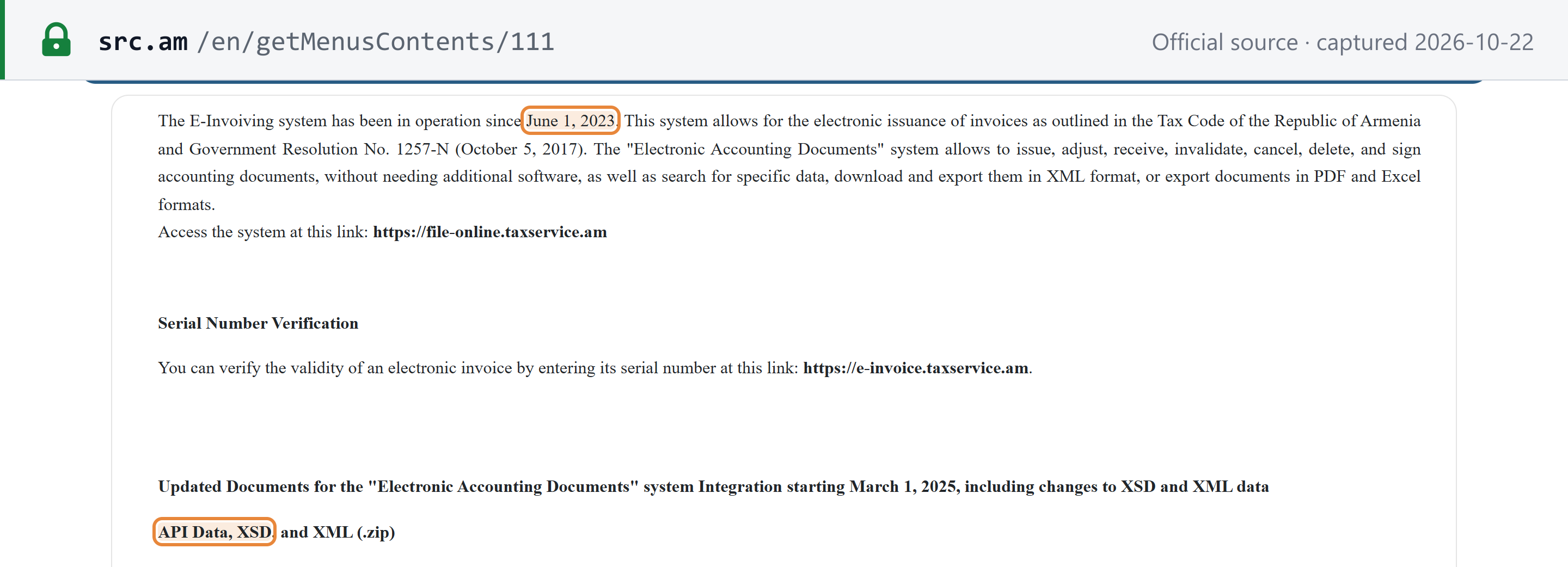
Integrity. Integrity rests on the electronic signature of an authorised person and the SRC-issued series-number. The SRC provides an online validity check by series-number (Decision 1257-Ն pt 13): "You can verify the validity of an electronic invoice by entering its serial number at this link: https://e-invoice.taxservice.am." Neither the Tax Code, Decision 1257-Ն nor the SRC e-invoicing page requires a QR code, hash chain or cryptographic stamp on settlement documents. [4] [1]
e-CRM receipts alongside. The e-CRM channel is separate. Each electronic receipt is formed by sending its data to the SRC's electronic management system and receiving a fiscal number back (Article 380.1(3)). The exchange uses "a special format approved by the tax authority (web-service description)" (Article 380.1(4)). The Government sets the technical requirements, registration and mandatory receipt particulars, and from 1 January 2027 also the rules for applying an e-CRM on behalf of another taxpayer. [2] [5]
Amounts in foreign currency. Since 1 July 2026, conversion uses the CBA rate published on the previous business day (see timeline).
Onboarding: how to comply
1. Get e-filing access. Only persons that have concluded an agreement with the SRC on electronic submission of tax returns (ԷՆՊ) under Tax Code Article 310, and received an electronic code and password from the SRC, may issue settlement documents electronically or validate received ones (Decision 1257-Ն Annex 1 pt 6). [4]
2. Log in through File Online. The settlement-document system is entered through File Online; every action is taken in the name of the taxpayer that logged in (pt 24). Documents are signed with an Armenian electronic signature (ID card or mobile ID, per the SRC package). [4] [1] [10]
3. Choose a connection mode. [4] [10]
- Web portal: issue, receive and validate documents directly in the SRC system. Suits low volumes.
- File import: upload XML built by accounting software to the SRC schema (pt 19).
- API: connect an ERP to the SRC's REST API using the published OpenAPI specifications.
- CRM: a cash register can also issue settlement documents (pt 3).
Providers and testing. There is no accreditation of service providers: a business connects to the SRC system itself, or its software vendor builds to the SRC package. The SRC e-invoicing page publishes no separate test environment. [1]
Penalties
Breaking the issuance procedure. Article 426(1): a tax invoice or adjusting tax invoice issued in breach of the procedure the Government sets (Decision 1257-Ն) costs the issuer twice the full consideration including VAT, but not less than AMD 5,000,000. [2]

| Article | Obligation breached | Exposure |
|---|---|---|
| 426(1) | Tax invoice or adjusting tax invoice issued in breach of the Government-set procedure | 2× the full consideration including VAT, minimum AMD 5,000,000 |
| 425(1) | Tax invoice issued although Article 67(1) bars it | The VAT shown on it is payable to the budget unless the invoice was duly cancelled |
| 410(1) | Goods supplied or moved without an accompanying document, or with a non-compliant one | 50% of the goods' price, minimum AMD 500,000; a second case within a year 100%, minimum AMD 2,000,000; a third or later 200%, minimum AMD 10,000,000. Micro-enterprises get a warning first (410(3)) |
| 415 | Issuing or receiving fictitious ("goods-less") settlement documents | Fine set by reference to the deviation, or to the document amount where no real transaction occurred |
| 416(1) | No registered, compliant CRM at the place and time of a cash or card settlement where a CRM is mandatory | AMD 500,000 |
| 416(2) | Each breach of the CRM application rules | AMD 200,000 plus 0.5% of the previous quarter's turnover on all the taxpayer's CRMs, capped at AMD 10,000,000 |
| 416(4) | CRM software integrated with commercial software sends the SRC data that differs from the printed receipt | AMD 5,000,000 plus 1% of the previous quarter's CRM turnover |
| 416(1.1), from 1 January 2027 | Supplies or passenger transport carried out without an e-CRM where Article 380.1(1.1) or (1.2) makes one mandatory | AMD 500,000 |
The 2027 e-CRM fine. New Article 416(1.1), inserted by Law ՀՕ-309-Ն, fines the organisation, individual entrepreneur or notary (including one applying an e-CRM on another taxpayer's behalf), or the individual carrying passengers by taxi, AMD 500,000 for carrying out the transaction without an electronic cash-register machine where its use is mandatory. The same law deletes former Article 408(7), which fined passenger transport carried out without an e-CRM AMD 200,000 per case. [5]

Outage relief. Where facts of a communications or SRC-system outage exist, the Article 410 fine is not applied (Decision 1257-Ն Annex 3 pt 9). [4]
Frequently asked questions
Is e-invoicing mandatory in Armenia, and since when?
Yes. Under Tax Code Article 56(3), settlement documents (tax invoices, invoice-documents, their adjusting versions and consignment notes) are issued electronically. The rule has applied since the Tax Code entered into force on 1 January 2018, to every organisation, individual entrepreneur and notary. The current SRC platform, reached through File Online, has been in operation since 1 June 2023. [2] [1]
We are not registered for VAT. Do we still have to issue electronic documents?
Yes. Article 56(1) obliges every organisation, individual entrepreneur and notary to issue settlement documents. Where a tax invoice is barred, for example for a non-VAT payer or an exempt or 0%-rated supply, an invoice-document is issued instead (Article 67), in the same SRC system. [2]
When must the invoice be issued?
From 1 September 2026, documents for goods are due before the supply (previously at the moment of supply); documents for work or services are issued at the moment the work or service is completed, including by contractual stage (Article 56(4)). The consignment-note rule, unchanged since 2018, now sits in Article 56(4.1): the note is issued before the goods are moved. A tax invoice or invoice-document may be issued in advance if the supply takes place on the date it states (Article 56(8)(1)). [5] [2]
Do we need Peppol or an accredited service provider?
No. Documents are issued in the SRC system through File Online, by web portal, file import or API, using the SRC's own XML schema. Neither the Tax Code, Decision 1257-Ն nor the SRC e-invoicing page provides for Peppol or for accredited providers. [4] [1]
What if the SRC system is down?
Decision 1257-Ն Annex 3 allows a paper document when a communications or SRC-system outage makes electronic issuance impossible. Within two business days after the outage ends, the electronic document is issued in its place. Where facts of the outage exist, the Article 410 fine is not applied. [4]
What changes on 1 January 2027?
Use of an electronic cash-register machine (e-CRM) becomes mandatory for sales, works and services in the sectors, cases and deadlines the Government sets. That Government decision has not yet been adopted; it is scheduled for the last ten days of December 2026. Carrying out a transaction without an e-CRM where one is mandatory is fined AMD 500,000 (new Article 416(1.1)). A CRM receipt showing the destination address of the goods, and the business buyer's TIN, also becomes an accompanying document for goods movement; an e-CRM receipt generated under the Government procedure has counted as one since 2020. [5] [6]
Which exchange rate converts a foreign-currency invoice?
Since 1 July 2026, the Central Bank of Armenia average rate published on the previous business day (Tax Code Article 16(2)(1)). Foreign-currency exchange transactions themselves use the rate published that day. [2] [8]
Can an issued document be changed or cancelled?
A document validated by electronic signature cannot be changed (Decision 1257-Ն Annex 1 pt 12); corrections go through an adjusting document or a cancellation under Article 56 and Annex 2 of the decision. No settlement document, including an adjusting one, can be issued or cancelled for a transaction once three tax years have passed since the tax year of the transaction (Article 56(11.1)). [4] [2]
Recent changes
- 2026-09-09 — Prime Minister's Decision N 901-Ա scheduled the Government decision on e-CRM sectors, cases and deadlines for adoption in the last ten days of December 2026. (ARLIS)
- 2026-09-01 — Settlement documents for goods became due before the supply, instead of at the moment of supply; the consignment-note rule (before the goods move) moved into Article 56(4.1). (ARLIS — Law ՀՕ-309-Ն) — see event
- 2026-07-16 — Law ՀՕ-309-Ն published: from 1 January 2027, e-CRM use becomes mandatory in Government-designated sectors, with an AMD 500,000 fine for operating without an e-CRM. (ARLIS — Law ՀՕ-309-Ն) — see event
- 2026-07-01 — Foreign-currency amounts converted at the CBA rate published on the previous business day. (ARLIS — Law ՀՕ-234-Ն) — see event
- 2026-04-01 — e-CRM mandatory for e-health-connected medical providers accepting payment by payment instruments; tax invoices for medical services carry the e-health service ID code. (ARLIS — Law ՀՕ-60-Ն)
- 2025-03-01 — Mandatory "Transaction type" field on tax invoices not at 20% and on all invoice-documents. (SRC)
- 2023-06-01 — The current SRC "Electronic settlement documents" platform went live on File Online. (SRC)
Related resources
- Armenia VAT guide — rate, registration, the full list of mandatory invoice particulars
- Armenia tax ID guide — the TIN (ՀՎՀՀ) carried on every settlement document; validate an Armenian TIN
- E-invoicing status and networks by country
- CTC e-invoicing models explained
- Fiscal devices and certified cash registers
- Armenia tax changes on Lookuptax
Important websites
- File Online — entry to the SRC settlement-document system
- E-invoice validity check by serial number
- SRC e-invoicing page and integration package (Armenian version, which links the latest package)
- Government Decision N 1257-Ն on issuing settlement documents
- RA Tax Code, consolidated
- State Revenue Committee