E-invoicing in South Korea: the electronic tax invoice
Overview
South Korea has required electronic tax invoices (전자세금계산서, jeonja segeum gyesanseo) from corporations since January 2011. An e-tax invoice is a VAT tax invoice issued through a certified electronic system — the National Tax Service's free Hometax service, a registered issuing agent (ASP), a company's own ERP, or an e-tax-capable cash-receipt device — and its details are transmitted to the National Tax Service (NTS, 국세청) by the day after issue. [4] [1] [2]
Legal basis in one line. VAT Act Article 32(2)–(3) requires corporations and designated individual businesses to issue tax invoices electronically and transmit the details to the NTS; Enforcement Decree Article 68 sets the KRW 80 million threshold, the deadline and the permitted systems. [3] [2]
| South Korea | |
|---|---|
| System | Electronic tax invoice (전자세금계산서): issued by the supplier, then reported to the NTS by the next day; no pre-clearance |
| B2B / B2G | Mandatory for all corporations since Jan 2011; for individual businesses with prior-year supplies of KRW 80m or more per place of business since 1 Jul 2024 |
| B2C | Consumer-facing businesses issue receipts (card slips, cash receipts) instead of tax invoices |
| Exempt supplies | A parallel electronic invoice (전자계산서) duty applies |
| Non-residents | Foreign e-service suppliers on simplified registration issue no tax invoices |
| Reporting | Issuance details to the NTS by the day after issue; Hometax transmits automatically |
| Format | Digitally signed XML to the national e-tax invoice standard; not Peppol |
| Authority | National Tax Service; policy by the Ministry of Finance and Economy |
| Legislation | VAT Act Arts 32, 34, 60; Enforcement Decree Art 68; Enforcement Rule Art 50 |
For VAT rates, registration and the mandatory particulars of a tax invoice, see the South Korea VAT guide.
Mandate status & timeline
The mandate is in force and has widened in steps for individual businesses. The threshold is the prior-year supply value per place of business, counting taxable and exempt supplies together.
| From | Who must issue electronically | Status (at 13 Oct 2026) |
|---|---|---|
| Jan 2011 | All corporations | In force |
| Jan 2012 | Individuals with supplies of KRW 1bn or more | Superseded by lower thresholds |
| Jul 2014 | Individuals at KRW 300m or more | Superseded |
| Jul 2019 | Individuals at KRW 300m or more, taxable plus exempt | Superseded |
| Jul 2022 | Individuals at KRW 200m or more | Superseded |
| Jul 2023 | Individuals at KRW 100m or more | Superseded |
| 1 Jul 2024 | Individuals at KRW 80m or more | Current threshold |
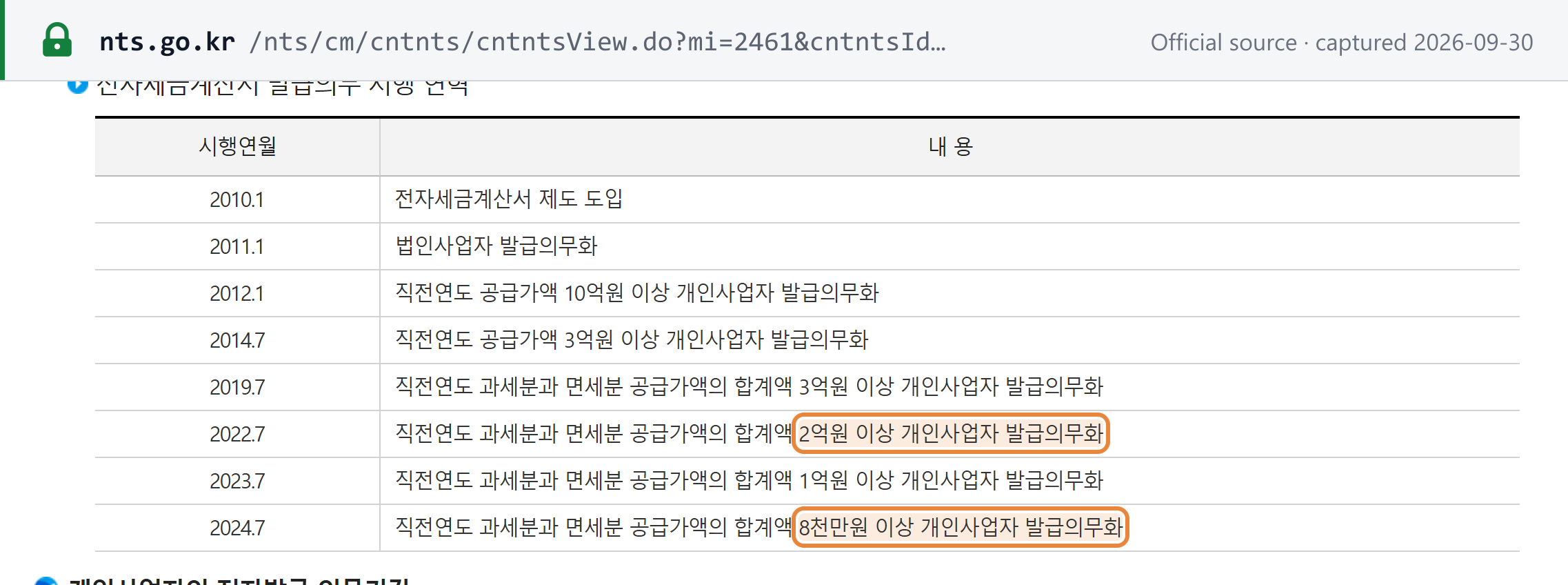
Once in, always in. An individual business that reaches KRW 80 million keeps the obligation even if its supplies later fall below it. This rule applies to businesses that became obliged from 1 July 2023; before that, an individual's obligation ran for one year at a time. [2] [5]
When a new individual business starts. The obligation begins on 1 July of the year after the year in which supplies reached KRW 80 million. The tax office must notify the business one month before; a business not notified in time starts on the first day of the second month after it receives the notice. [2]

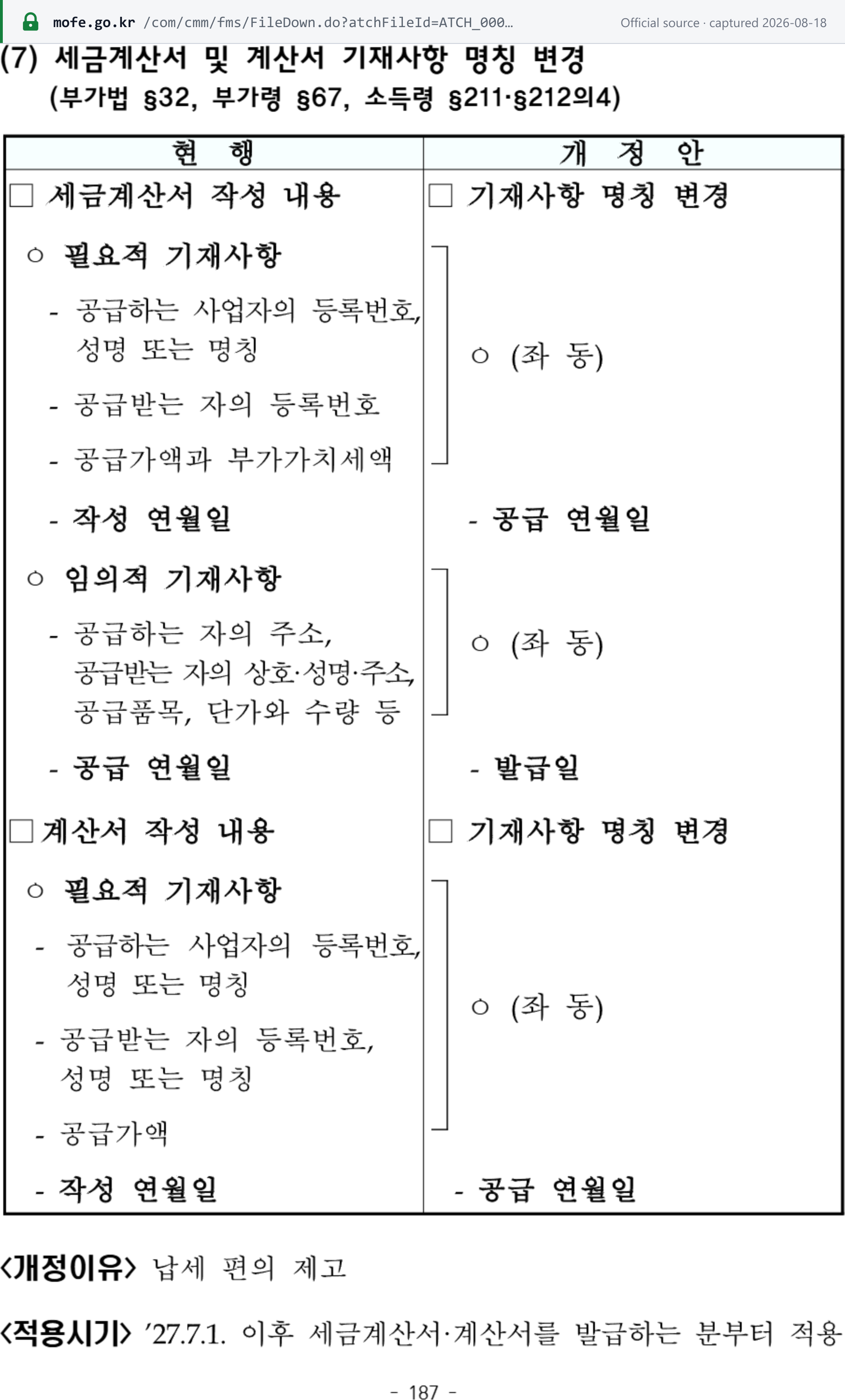
No further threshold cut has been announced. The 2026 Tax Reform proposals published by the Ministry of Finance and Economy on 3 August 2026 contain no change to the threshold or to who must issue. The only change they propose to the e-tax invoice itself renames two date fields, for invoices issued from 1 July 2027; the Act change is in Bill 2221049, which was still pending in the National Assembly on 13 October 2026. Separately, a supply for which a foreign company's Korean place of business issues the tax invoice would be treated as connected with that place of business. [6]
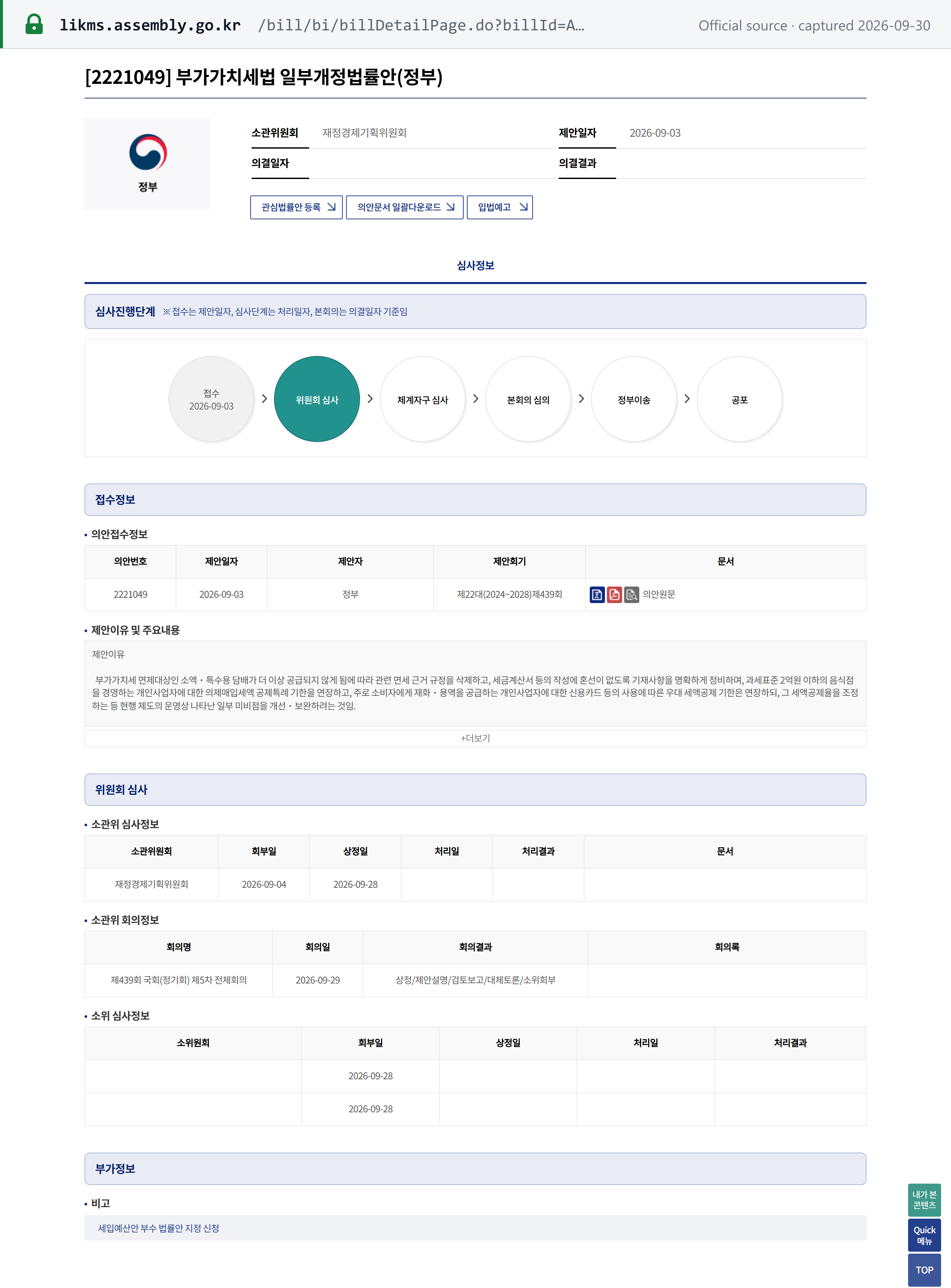
There is no pilot or postponement in progress.
Legal basis
| Instrument | Version in force | What it does |
|---|---|---|
| VAT Act (부가가치세법) | Act No. 21065, in force 2 Jan 2026 | Art 32: e-issuance and transmission duty; Art 34: issue timing; Art 47: issuance credit; Art 60: penalties |
| VAT Enforcement Decree (시행령) | Presidential Decree No. 36133, in force 1 Apr 2026 | Art 68: KRW 80m threshold, permitted systems, next-day transmission, industry carve-outs |
| VAT Enforcement Rule (시행규칙) | Ministry Ordinance No. 9, in force 1 Apr 2026 | Art 50: the binding e-tax invoice standard; certification and registration of ASP and ERP systems |
What the law requires. VAT Act Article 32(2) obliges corporations and the individual businesses the Decree designates to issue tax invoices "by the electronic method", and Article 32(3) obliges them to transmit the issuance details to the NTS by the Decree deadline. Businesses not obliged may issue and transmit voluntarily (Art 32(5)). [3]
The electronic method. Decree Article 68(5) defines it as issuing over a network through a certification system that can confirm who drew up the invoice and whether it was altered, using an ERP system, an issuing agent's system, the NTS's own system (Hometax), or an e-tax-capable cash-receipt device or other NTS-designated system. [2]
Industry carve-out. Seven types of supply — including industrial electricity, telecoms backbone services, industrial city gas, broadcasting and IPTV services to businesses — may instead use an invoice declared to the tax office as an e-tax invoice, submitting the file to the NTS by the 11th of the month after supply (Decree Art 68(9)). [2]
Scope
B2B and B2G. The duty attaches to every tax invoice an obliged business issues for a taxable supply, whether the buyer is a business or a public body. No separate B2G platform is described in the Act, the Decree or the NTS guidance (checked 13 October 2026). [3]
B2C. Businesses that mainly supply consumers, and small simplified taxpayers, issue receipts instead of tax invoices (VAT Act Art 36); credit-card slips and cash receipts count as receipts. In industries the Income Tax Act designates, a cash receipt must be issued for cash transactions of KRW 100,000 or more even if the customer does not ask, with a penalty of 20% of the unissued amount (10% if corrected within 10 days). A cash receipt is not an e-tax invoice. [3] [7]
Exempt supplies. VAT-exempt supplies are invoiced with a 계산서 (invoice), not a tax invoice. Its electronic version (전자계산서) is mandatory for corporations and, from 1 July 2024, for individuals with prior-period revenue of KRW 80 million or more. [4]
Foreign businesses.
- A foreign supplier of electronic services registered under the simplified registration regime issues no tax invoices for those services (Decree Art 71(1)8). See VAT on digital services by non-resident suppliers.
- A Korean supplier does not issue a tax invoice to a non-resident or foreign company without a place of business in Korea, unless the buyer proves it is a business in its own country and asks for one, or the buyer is a foreign company's liaison office (Decree Art 71(1)9).
- When a foreign supplier with no Korean place of business supplies services, it issues no Korean tax invoice. A buyer that uses the services in its taxable business has nothing to account for; a buyer that is exempt, not in business, or cannot deduct the input tax pays the VAT itself under proxy payment (VAT Act Art 52).

Format & network
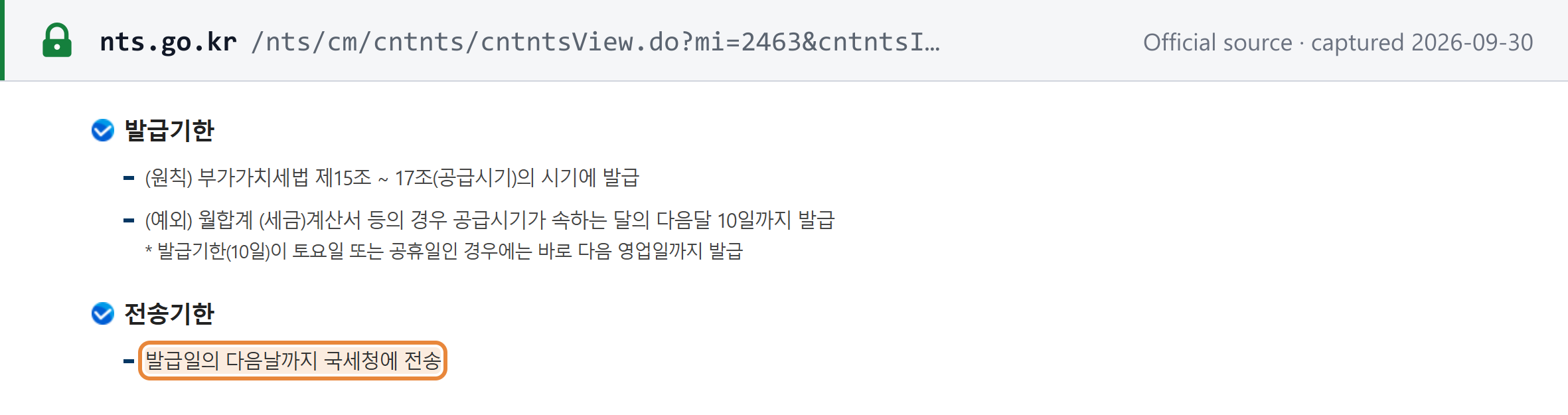
The model: issue, then report next day. The supplier issues the invoice and delivers it to the buyer; the details then go to the NTS by the day after the issue date (Decree Art 68(7)). The NTS does not approve invoices before they reach the buyer, so this is post-issuance reporting rather than clearance. On the models generally, see CTC e-invoicing models. [2]
When an invoice counts as issued. The NTS says issuance is complete when the digitally signed XML original reaches the buyer's inbox, whether or not the buyer opens it. An SMS or a link announcing the invoice, without the file, is not issuance. Where the buyer has not designated an inbox, the NTS system counts as the inbox. [1] [8]

XML standard. Enforcement Rule Article 50(1) requires e-tax invoices to be generated, issued and transmitted to the national e-tax invoice standard made under the Framework Act on Electronic Documents and Transactions. The NTS does not publish the schema name or version on its guidance pages (checked 13 October 2026). [9]
Peppol. Not used. Neither the law nor the NTS guidance mentions Peppol or any interchange network (checked 13 October 2026).
Correcting an invoice. Errors and later changes are handled with an amended e-tax invoice (수정전자세금계산서) under VAT Act Article 32(7) and the grounds in Decree Article 70. [3]
Onboarding: how to comply
Choose a route. The NTS lists four ways to issue:
- Hometax (hometax.go.kr) or mobile Hometax — free, run by the NTS. Hometax emails the buyer and transmits to the NTS automatically at issuance, so there is no separate transmission step.
- An ASP or your own ERP — a site run for a fee by an NTS-registered issuing agent, or a self-built system. The system emails the buyer and must transmit to the NTS by the day after issue.
- Phone ARS (126-1-2-1) after collecting a security card from a tax office.
- Proxy issuance at a tax office — any tax office, with the application form and evidence of the transaction.
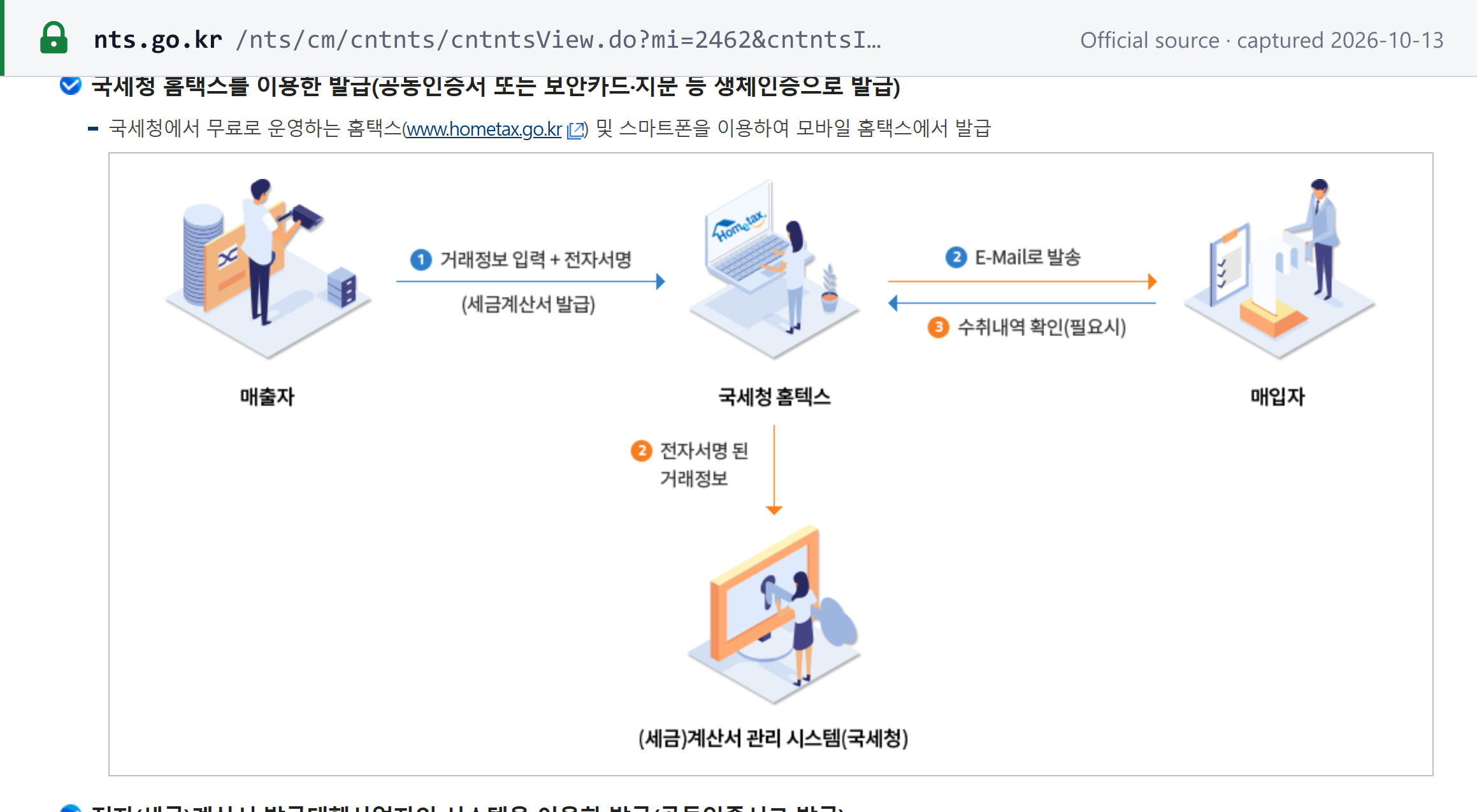
Get a certificate. Signing needs a business general-purpose, e-tax-invoice or ASP joint certificate (공동인증서). If that is hard to obtain, a security card from the tax office allows issuance on Hometax, and since February 2021 mobile Hometax accepts fingerprint and other biometric sign-in. [10]

Issue on time.
- Issue at the time of supply (VAT Act Art 34).
- A monthly consolidated invoice per customer, or one for a period within the month, may be issued by the 10th of the following month (the next business day if the 10th is a Saturday or public holiday).
- Transmit by the day after issue.
Providers: certification and registration. Anyone operating an ERP, ASP or device system for e-tax invoices must register it in advance with the NTS or the tax office (Decree Art 68(6)), and before that must obtain standard certification from the NTS (Rule Art 50(2), since 18 March 2022). An issuing agent needs capital of at least KRW 200 million; the NTS decides on registration within 14 days; and certification can be cancelled if a system cannot read invoices issued by other systems. [9]

What you get back.
- Invoices transmitted by the 11th of the month after the period need only totals in the VAT return, not a per-customer list (VAT Act Art 54(2)).
- Transmitted e-tax invoices are exempt from the 5-year retention duty (Art 71(3)).
- Individual businesses with prior-year supplies under KRW 300 million, including those starting business in the year, and simplified taxpayers get a credit of KRW 200 per invoice, up to KRW 1 million a year, for invoices issued and transmitted on time until 31 December 2027 (Art 47).
Penalties
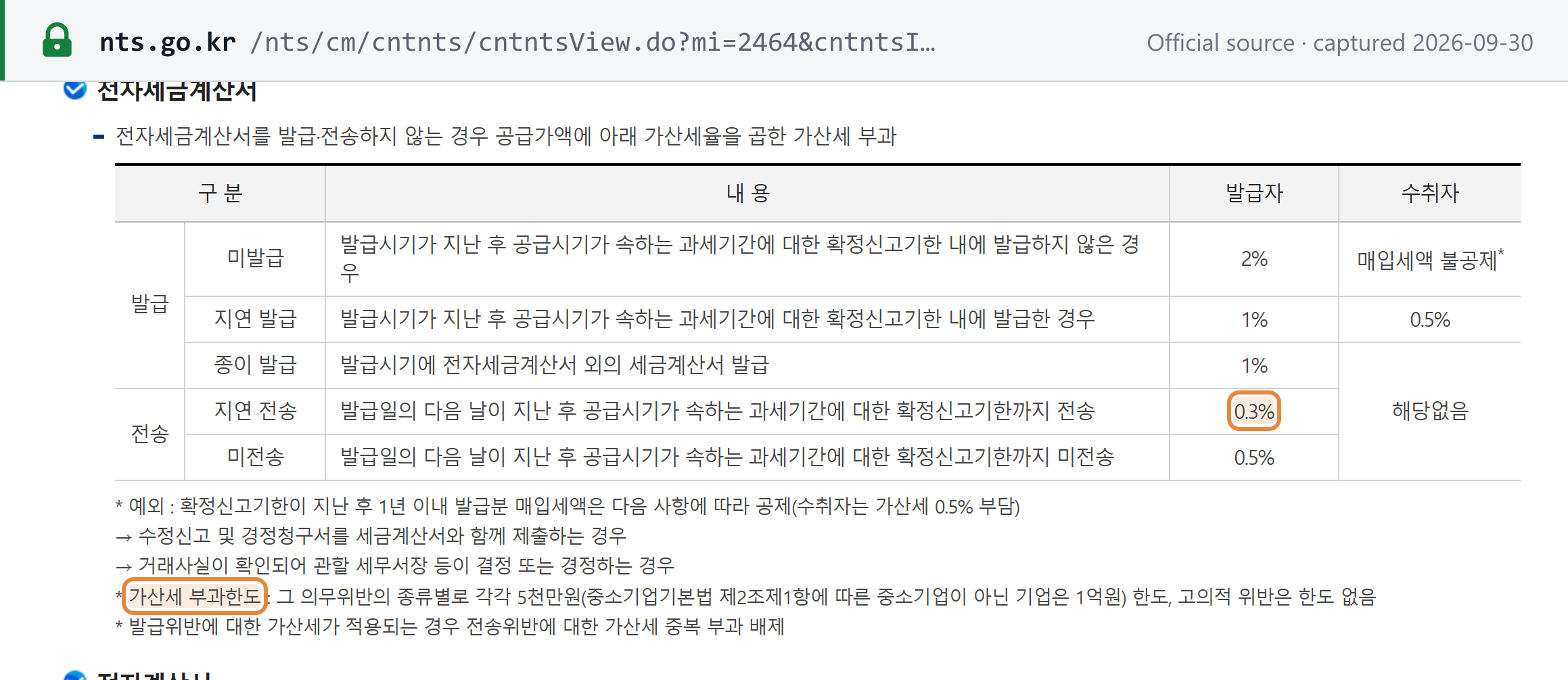
Penalties under VAT Act Article 60 are a percentage of the supply value:
| Breach | Penalty |
|---|---|
| Invoice not issued by the final-return deadline | 2% |
| Invoice issued late, but by the final-return deadline | 1% |
| Obliged e-issuer issues a paper tax invoice instead | 1% |
| Details transmitted late, but by the final-return deadline | 0.3% |
| Details not transmitted by the final-return deadline | 0.5% |
| Mandatory particulars missing or wrong by error | 1% |
| Fake tax invoices | 4% |
- Where an issuance penalty applies, no transmission penalty is added on top.
- Each type of breach is capped at KRW 50 million (KRW 100 million for businesses that are not SMEs); intentional breaches have no cap.
- A buyer that receives a late invoice pays 0.5% and can claim input tax only within limits; a buyer that never receives one cannot claim the input tax.
Frequently asked questions
We issue through an ASP. Do we still have to transmit to the NTS?
Yes. An ASP or ERP system must transmit the issuance details to the NTS by the day after the issue date. Only Hometax transmits automatically at the moment of issue. Late transmission costs 0.3% of the supply value, and no transmission by the final-return deadline costs 0.5%.
We emailed the customer a PDF and a link. Is the invoice issued?
No. The NTS treats an e-tax invoice as issued only when the digitally signed XML original reaches the buyer's inbox. An SMS or a link without the file does not count.
Our sole proprietorship has dropped below KRW 80 million. Can we go back to paper?
No. Once an individual business is obliged, the obligation continues even if its supplies later fall below KRW 80 million. A paper tax invoice from an obliged issuer attracts a 1% penalty.
We passed KRW 80 million in 2025. When do we start?
From 1 July 2026, the start of the second taxable period of the following year. The tax office must notify you one month before; if you were not notified in time, you start on the first day of the second month after you receive the notice.
Is the "date of preparation" field changing?
It is proposed. The 2026 Tax Reform would rename the mandatory 작성 연월일 (date of preparation) to 공급 연월일 (date of supply), and the optional 공급 연월일 to 발급일 (date of issue), for invoices issued from 1 July 2027. The Act change is in Bill 2221049, which was still pending in the National Assembly on 13 October 2026.
Recent changes
- 2024-07-01 — Individual businesses with prior-year supplies of KRW 80 million or more must issue e-tax invoices (previously KRW 100 million). (NTS)
- 2023-07-01 — The individual obligation becomes continuing: a business that falls back below the threshold stays obliged. (NTS)
- 2027-07-01 (proposed) — Tax invoice date fields renamed: 작성 연월일 becomes 공급 연월일, and the optional 공급 연월일 becomes 발급일, for invoices issued from this date. The Act change is in Bill 2221049, filed 3 September 2026 and pending on 13 October 2026. (MOFE) — see event
Related resources
- South Korea VAT guide — rates, registration, tax invoice particulars
- South Korea tax ID guide and the Korean business registration number validator
- E-invoicing status and networks by country
- CTC e-invoicing models
- Taiwan e-invoicing
- South Korea tax changes on Lookuptax
Important websites
- Hometax — free issuance and look-up
- NTS e-tax invoice guidance
- NTS: issuing amended tax invoices