E-invoicing in Pakistan: FBR Digital Invoicing
Overview
Pakistan's federal e-invoicing system is FBR Digital Invoicing (DI), which PRAL (Pakistan Revenue Automation (Pvt.) Ltd) built for the Federal Board of Revenue (FBR). Taxpayers reach it through IRIS, FBR's taxpayer portal, under Digital Invoicing. The seller's ERP or point-of-sale software posts each invoice to FBR's web API in real time, and FBR returns a unique FBR invoice number, which is printed on the invoice with a QR code and the Digital Invoicing System logo. [1] [2]
Who runs it. The FBR (Inland Revenue) owns the mandate and the rules. PRAL operates the API on its Enterprise Service Platform, issues the security tokens and is a licensed integrator by rule, obliged to integrate registered persons free of charge on demand (Sales Tax Rules r.150XF). Private integrators are licensed by the FBR. [2] [3]
Legal basis in one line. Sales Tax Act 1990 s.23(3)–(6); Sales Tax Rules 2006 Chapter XIV ("Procedure for Licensing, Issuance of Electronic Sales Tax Invoices and Integration of Registered Persons"), as substituted by S.R.O. 69(I)/2025 and amended by S.R.O. 1666(I)/2026; the category schedule in S.R.O. 1852(I)/2025 under r.150Q(2); and the Finance Act, 2026 (Act No. XLIII of 2026).
| Pakistan | |
|---|---|
| System | FBR Digital Invoicing (DI), reached through IRIS; Tier-1 retail outlets on the FBR POS integration |
| Authority | Federal Board of Revenue (Inland Revenue); system operator PRAL |
| Model | Real-time reporting: each invoice is posted to FBR, validated, and given an FBR invoice number that must be printed with a QR code |
| B2B | Mandatory for every sales-tax registered person; issue-by dates 1 Nov to 31 Dec 2025 under S.R.O. 1852(I)/2025, all passed |
| B2C | In scope: the API takes sales to unregistered buyers; Tier-1 retailers integrate through the POS system, required since 1 Dec 2019 |
| B2G | No separate regime; no rule addresses government buyers specifically |
| Non-established businesses | No rule addresses them specifically; the duty attaches to sales-tax registered persons (see Scope) |
| Format | JSON over a REST web API (PRAL "Technical Specification for DI API", v1.12); not UBL |
| Network | FBR/PRAL Digital Invoicing gateway, through PRAL (free) or an FBR-licensed integrator; not Peppol |
| Legislation | STA 1990 s.23; STR Chapter XIV (S.R.O. 69(I)/2025, S.R.O. 1666(I)/2026); S.R.O. 1852(I)/2025; Finance Act, 2026 |
The FBR taxes goods under the Sales Tax Act and services in the Islamabad Capital Territory under the ICT (Tax on Services) Ordinance; other services are taxed by the provinces, which run their own systems (see Scope). For rates, registration and invoice content, see the Pakistan sales tax guide.
Mandate status & timeline
Status (as at 22 October 2026): mandatory for every sales-tax registered person; every issue-by date under S.R.O. 1852(I)/2025 has passed, the last on 31 December 2025. Two later instruments matter. The Finance Act, 2026 requires every tax invoice to bear a verifiable FBR invoice number from the time the Board notifies. S.R.O. 1666(I)/2026 amended Chapter XIV when issued on 29 September 2026; its extension to federal excise duty and ICT services operates as far as those laws require e-invoicing or integration.
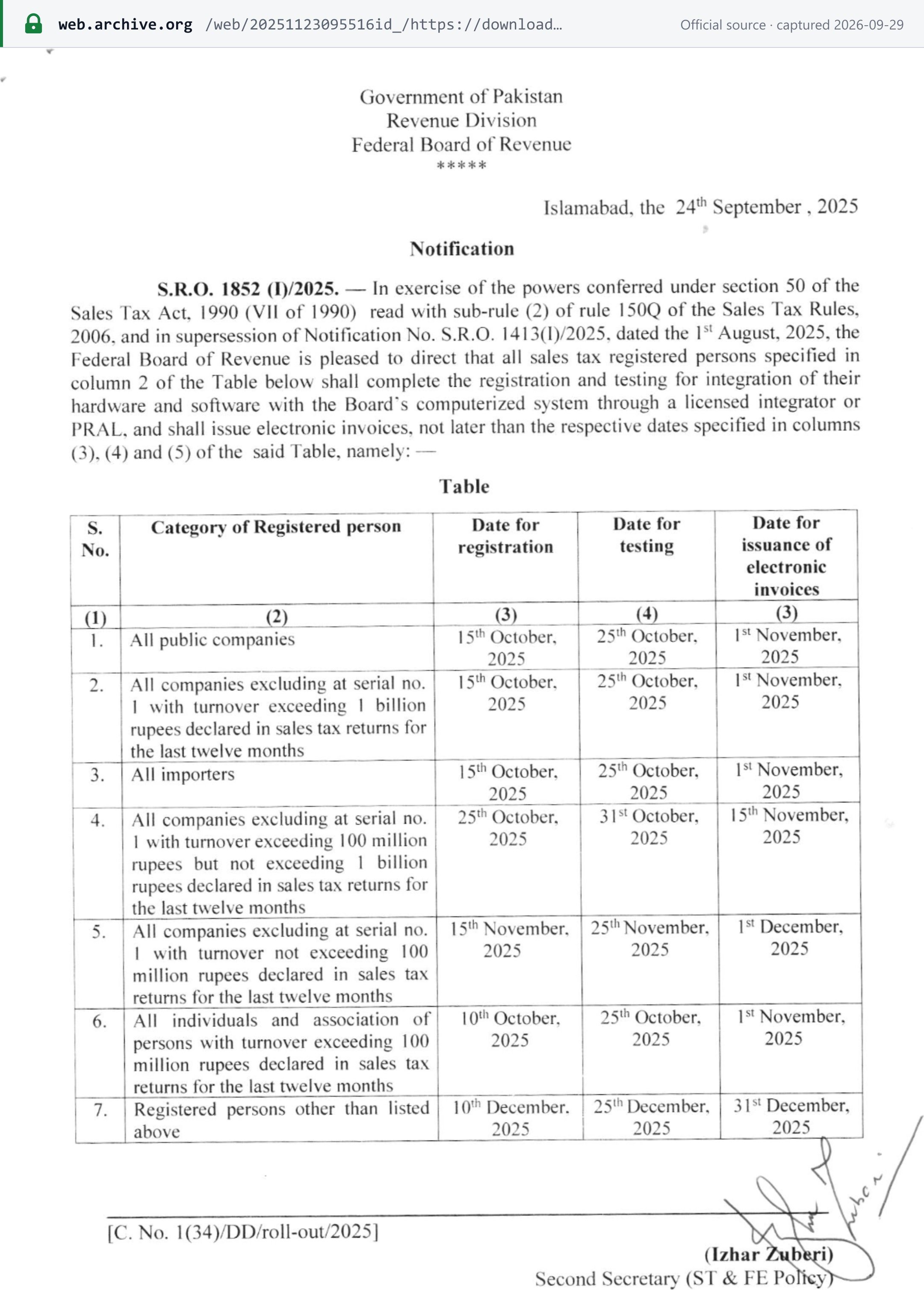
The operative schedule: S.R.O. 1852(I)/2025, 24 September 2025. Issued under s.50 of the Act read with r.150Q(2), and "in supersession of Notification No. S.R.O. 1413(I)/2025", it directs that the registered persons in each category "shall complete the registration and testing for integration of their hardware and software with the Board's computerized system through a licensed integrator or PRAL, and shall issue electronic invoices, not later than" the dates below. They are deadlines, not start dates. Turnover is as "declared in sales tax returns for the last twelve months". [4]
| # | Category of registered person | Registration by | Testing by | Issue e-invoices by | Status |
|---|---|---|---|---|---|
| 1 | All public companies | 15 Oct 2025 | 25 Oct 2025 | 1 Nov 2025 | Passed |
| 2 | Other companies, turnover above PKR 1 billion | 15 Oct 2025 | 25 Oct 2025 | 1 Nov 2025 | Passed |
| 3 | All importers | 15 Oct 2025 | 25 Oct 2025 | 1 Nov 2025 | Passed |
| 4 | Other companies, turnover above PKR 100 million up to PKR 1 billion | 25 Oct 2025 | 31 Oct 2025 | 15 Nov 2025 | Passed |
| 5 | Other companies, turnover up to PKR 100 million | 15 Nov 2025 | 25 Nov 2025 | 1 Dec 2025 | Passed |
| 6 | Individuals and associations of persons, turnover above PKR 100 million | 10 Oct 2025 | 25 Oct 2025 | 1 Nov 2025 | Passed |
| 7 | Registered persons other than listed above | 10 Dec 2025 | 25 Dec 2025 | 31 Dec 2025 | Passed |
The postponements. Readers who planned against an earlier calendar should note that the seven-category structure and the PKR 100 million and PKR 1 billion bands carried over from S.R.O. 1413 to S.R.O. 1852 unchanged; only the dates moved. The corporate / non-corporate split of S.R.O. 709 did not survive.
| Step | Instrument | What it set | Status |
|---|---|---|---|
| 1 | S.R.O. 709(I)/2025, 22 Apr 2025 | Corporate registered persons from 1 May 2025; non-corporate from 1 Jun 2025 | Superseded |
| 2 | FBR letter F.No.1(141)ST-L&P/2025/55105-R, 30 Apr 2025 (under s.74) | Corporate → 1 Jun 2025; non-corporate → 1 Jul 2025 | Superseded |
| 3 | FBR letter F.No.1(141)ST-L&P/2025/77394-R, 20 Jun 2025 (under s.74) | Corporate → 1 Jul 2025; non-corporate → 1 Aug 2025 | Superseded |
| 4 | S.R.O. 1413(I)/2025, 1 Aug 2025, superseding S.R.O. 709 | Seven categories; issue-by dates 1 Sep 2025 (categories 1–3), 1 Oct 2025 (4 and 6), 1 Nov 2025 (5), 1 Dec 2025 (7) | Superseded |
| 5 | S.R.O. 1852(I)/2025, 24 Sep 2025, superseding S.R.O. 1413 | The table above: 1 Nov to 31 Dec 2025 | Operative; all dates passed |
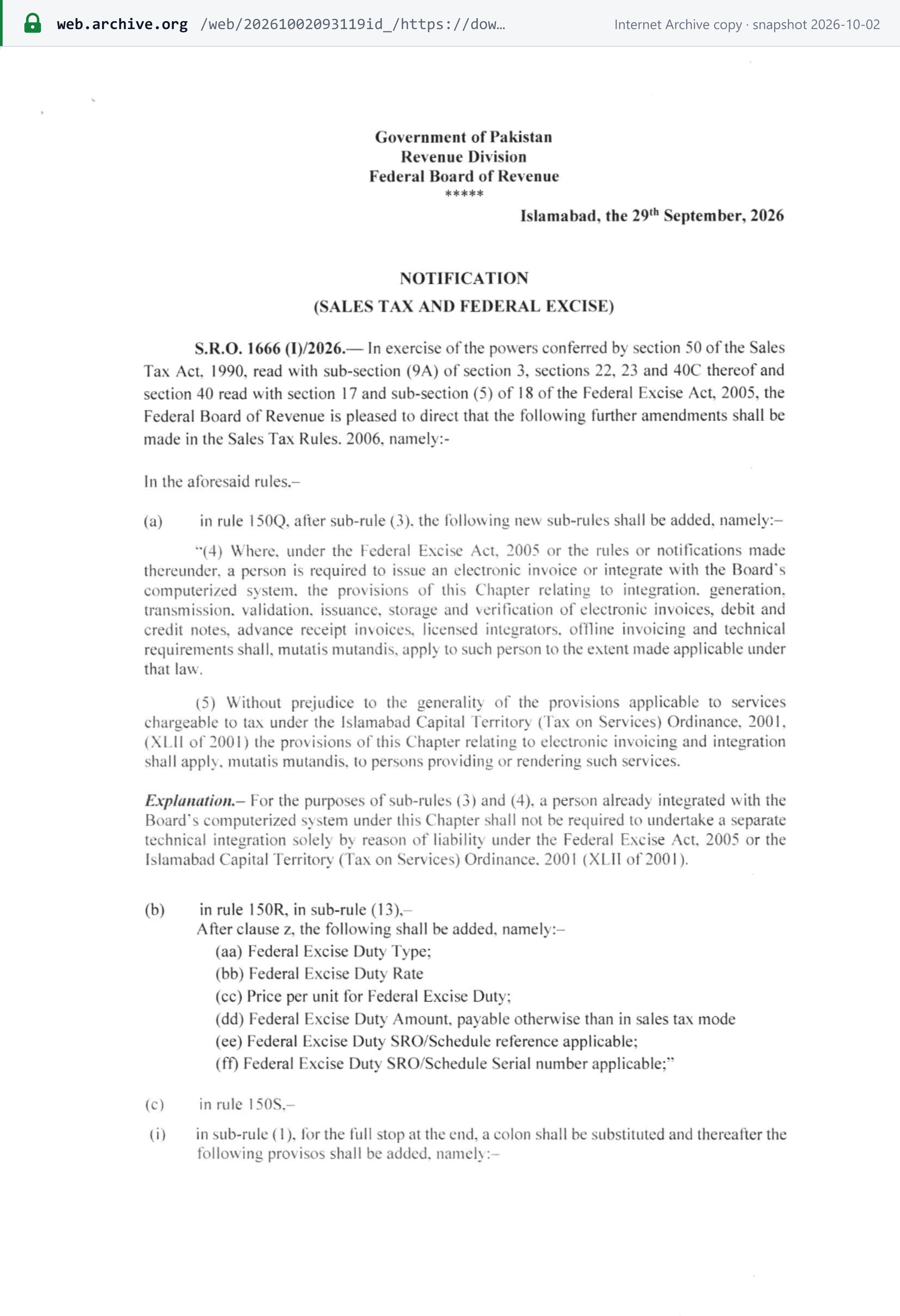
The latest phase: S.R.O. 1666(I)/2026, 29 September 2026. This S.R.O. amends Chapter XIV so that:
- where the Federal Excise Act 2005 requires a person to issue an electronic invoice or integrate, the Chapter's provisions on "integration, generation, transmission, validation, issuance, storage and verification of electronic invoices, debit and credit notes, advance receipt invoices, licensed integrators, offline invoicing and technical requirements" apply mutatis mutandis (new r.150Q(4));
- the Chapter's e-invoicing and integration provisions apply mutatis mutandis to persons providing services taxable under the Islamabad Capital Territory (Tax on Services) Ordinance 2001 (new r.150Q(5));
- a person already integrated "shall not be required to undertake a separate technical integration" because of liability under either law (Explanation);
- six federal excise fields, (aa) to (ff), join the mandatory invoice particulars in r.150R(13);
- where sales tax, federal excise duty and ICT services tax fall on one transaction, "a single electronic invoice containing separately identifiable particulars of each tax or duty shall be sufficient" (r.150S(1) proviso);
- debit notes, credit notes and advance receipt invoices are issued electronically (r.150S(2));
- an integrator's licence also covers federal excise and ICT services e-invoicing (r.150XE(4)). [9]
S.R.O. 1666 states no deferred commencement and no category schedule, so its amendments took effect when it was issued on 29 September 2026; the changes to r.150S(2) and r.150XD(2), for example, apply now. The federal excise extension applies "to the extent made applicable under" the Federal Excise Act. For ICT services, the proviso to s.3(1) of the ICT Ordinance, added by the Finance Act 2025, makes the duty to integrate "for real-time reporting of provision of services" run from a date the Board sets by general order. [9] [10]
Enacted, date to be notified: the FBR invoice number on every tax invoice. From 1 July 2026, s.23(1) of the Act, as amended by the Finance Act, 2026, requires a registered person making a taxable "as well as exempt supply" to "issue a tax invoice including an advance receipt invoice, bearing a verifiable and unique FBR invoice number". A proviso adds that "the condition of a verifiable and unique FBR invoice number shall be applicable from the time as notified by the Board", so the requirement applies from the time the Board notifies. FBR's Circular No. 01 of 2026 describes the duty without that proviso; the Act's wording, quoted here, is the operative text. The Finance Act makes the same change to s.18(1) of the Federal Excise Act. Persons integrated under Chapter XIV already print the FBR invoice number under r.150R(13)(a). [11] [12]
Pilot or voluntary phase. None. FBR announced no voluntary phase; the sandbox described under Onboarding is the only pre-production stage.
Legal basis
| Instrument | What it does for e-invoicing | Date |
|---|---|---|
| Sales Tax Act 1990, s.23(3) | The Board may by notification require registered persons to issue electronic invoices | In force |
| Sales Tax Act 1990, s.23(5)–(6), added by the Finance Act 2025 | The Board may require any person or class "to integrate their electronic invoicing system with the Board's Computerized System for real time reporting of sales"; licensed integrators carry out the integration | 1 Jul 2025 |
| Sales Tax Rules 2006, Chapter XIV (r.150Q–150XQ), substituted by S.R.O. 69(I)/2025 | Integration duty, invoice particulars, storage, offline mode, licensing of integrators, PRAL as free integrator | S.R.O. dated 29 Jan 2025 |
| S.R.O. 1852(I)/2025 (superseding S.R.O. 1413(I)/2025, which superseded S.R.O. 709(I)/2025) | Category schedule under r.150Q(2) | 24 Sep 2025 |
| Sales Tax General Order 01 of 2026 | One or more licensed integrators allowed; 72-hour cancel-or-edit window | 30 Mar 2026 |
| Finance Act, 2026 (Act No. XLIII of 2026), s.4 | Defines "electronic invoicing system" (s.2(9AB)); FBR invoice number on tax invoices (s.23(1), date to be notified); suspension for non-compliance with s.23(5)–(6) (s.21(2)); input-tax limit tied to digital-invoicing compliance (s.8B); s.33 entry 25 substituted | Gazetted 26 Jun 2026; in force 1 Jul 2026 |
| S.R.O. 1666(I)/2026 | Chapter XIV extended to federal excise duty and ICT services; six FED fields; single combined e-invoice | 29 Sep 2026; no commencement date stated |
| S.R.O. 1662(I)/2026 | Chapter XIV-AD: procedure for sealing and de-sealing the premises of non-integrated persons other than Tier-1 retailers | 29 Sep 2026 |
| Sales Tax Rules 2006, Chapter XIV-AA (r.150ZEA onwards) | Tier-1 retailer POS integration, "Commencing from the 1stDecember, 2019" | 1 Dec 2019 |
| PRAL Technical Specification for DI API, v1.12 | JSON schema, endpoints, sandbox scenarios, QR and logo printing | Changelog to 24 Jul 2025 |
Does the technical specification bind? Rule 150R(1) requires integration in the manner the Board specifies by Sales Tax General Order. The specification is published by FBR and PRAL, and an invoice that fails its validation receives no FBR invoice number. [3] [2]
Which S.R.O. is operative. Sales Tax General Order 01 of 2026 recites that "FBR through SRO. 1413(I)/2025 dated 01.08.2025 obligate all sales tax registered persons to integrate". S.R.O. 1413 had been superseded by S.R.O. 1852 on 24 September 2025, and S.R.O. 1852's dates are the operative ones. [13] [4]
Where the universal duty comes from. The duty on every registered person comes from category 7 of S.R.O. 1852, "Registered persons other than listed above". The Finance Act, 2026 did not itself impose integration on all registrants: it added a suspension ground (s.21(2)), the substituted penalty in s.33 entry 25, and the FBR invoice-number condition.
Scope
B2B: mandatory. All seven S.R.O. 1852 categories are sales-tax registered persons, and category 7 covers every registered person not listed above it, so the duty reaches every federal sales-tax registrant. Exempt supplies are included: "In case of supply of exempt items, the electronic invoices shall also be issued through system integrated with the Board's Computerized System" (r.150R(9)). Online sales, including through a marketplace, are covered: the integrated person must register the website, software or app with FBR's system "to record the auto-electronic invoices" (r.150R(12)). [4] [3]
B2C: in scope, two ways. S.R.O. 1852 does not limit the duty by type of buyer, and PRAL's API takes buyerRegistrationType "Unregistered", with a sandbox scenario for "Goods at standard rate to unregistered buyers" (SN002) and scenarios SN026–SN028 for "Sale to End Consumer by retailers", which "are applicable only if registered as retailer in sales tax profile". A retailer selling to the general public, other than a manufacturer-cum-retailer or importer-cum-retailer, may omit the extra-tax, further-tax, FED and SRO particulars (r.150R(13) proviso). Separately, Tier-1 retailers must integrate their retail outlets with FBR's system "for real-time reporting of sales", commencing from 1 December 2019 (the POS integration, r.150ZEA(2)), and a POS integration already registered counts as integrated under Chapter XIV (r.150Q proviso). For who is a Tier-1 retailer after the Finance Act, 2026, see the Pakistan sales tax guide. [2] [3] [14]
Retail POS invoice. The POS "standardized format" requires the buyer's name only "when the customer is liable for the tax or credit or invoice value is above Rs.100,000/-". The POS invoice carries the FBR fiscal invoice number, FBR's POS logo and a QR code; see the FBR specimen in the Pakistan sales tax guide. [14]
B2G. No rule addresses government buyers specifically. The Act, Chapter XIV, S.R.O. 1852 and PRAL's API set up no separate B2G channel or portal, so a government buyer is a recipient like any other.
Non-established businesses. No e-invoicing rule addresses non-residents specifically. Chapter XIV binds "registered persons" (r.150Q(1)), and S.R.O. 1852 category 7 does not exclude non-residents. A non-resident registered for sales tax, for example a seller of digitally ordered goods from within Pakistan through an online marketplace under s.14(1A), is therefore a registered person like any other. Sales tax on imports is collected at customs, and no Digital Invoicing scenario covers imports. [3]
Edges.
- Zero-rated sales are reported in Digital Invoicing under scenario SN007, "Zero rated sale". [2]
- Retailers other than Tier-1 pay sales tax through their electricity bills (s.3(9)); no Digital Invoicing rule addresses them.
- Credit notes. Rule 150S(2) requires debit notes, credit notes and advance receipt invoices to be issued electronically. PRAL's v1.12 specification documents two document types, "Sale Invoice" and "Debit Note". [9] [2]
Provincial services. Services other than ICT services are taxed by the provinces, which run their own real-time systems outside FBR's Digital Invoicing. The Sindh Revenue Board requires providers of scheduled services, and online marketplaces facilitating them, to integrate their points of sale "within 45 days from the date when the requirement of PoS integration is notified", charges "a fee of one rupee on every invoice generated by an integrated PoS", and offers online invoice verification. [15]
Format & network
The CTC model: real-time reporting with an FBR-issued invoice number. FBR's own words are "real time reporting of sales" (s.23(5)). The invoicing software must "transmit the invoice data to the Board's Computerized System through secure means and receive the unique FBR invoice number", then "generate the QR Code on the base of unique FBR invoice number and print the QR Code on receipt" (r.150R(4)(c) and (e)). FBR validates each posted invoice, returns status code "00" (Valid) or "01" (Invalid) with error codes, and on success returns the invoiceNumber. Because an invoice without that number does not meet the rules, the model works like clearance, although FBR does not use that word. A separate validateinvoicedata method checks a payload without posting it. [3] [2]
For how this compares with other models, see e-invoicing models: clearance, reporting and interchange.
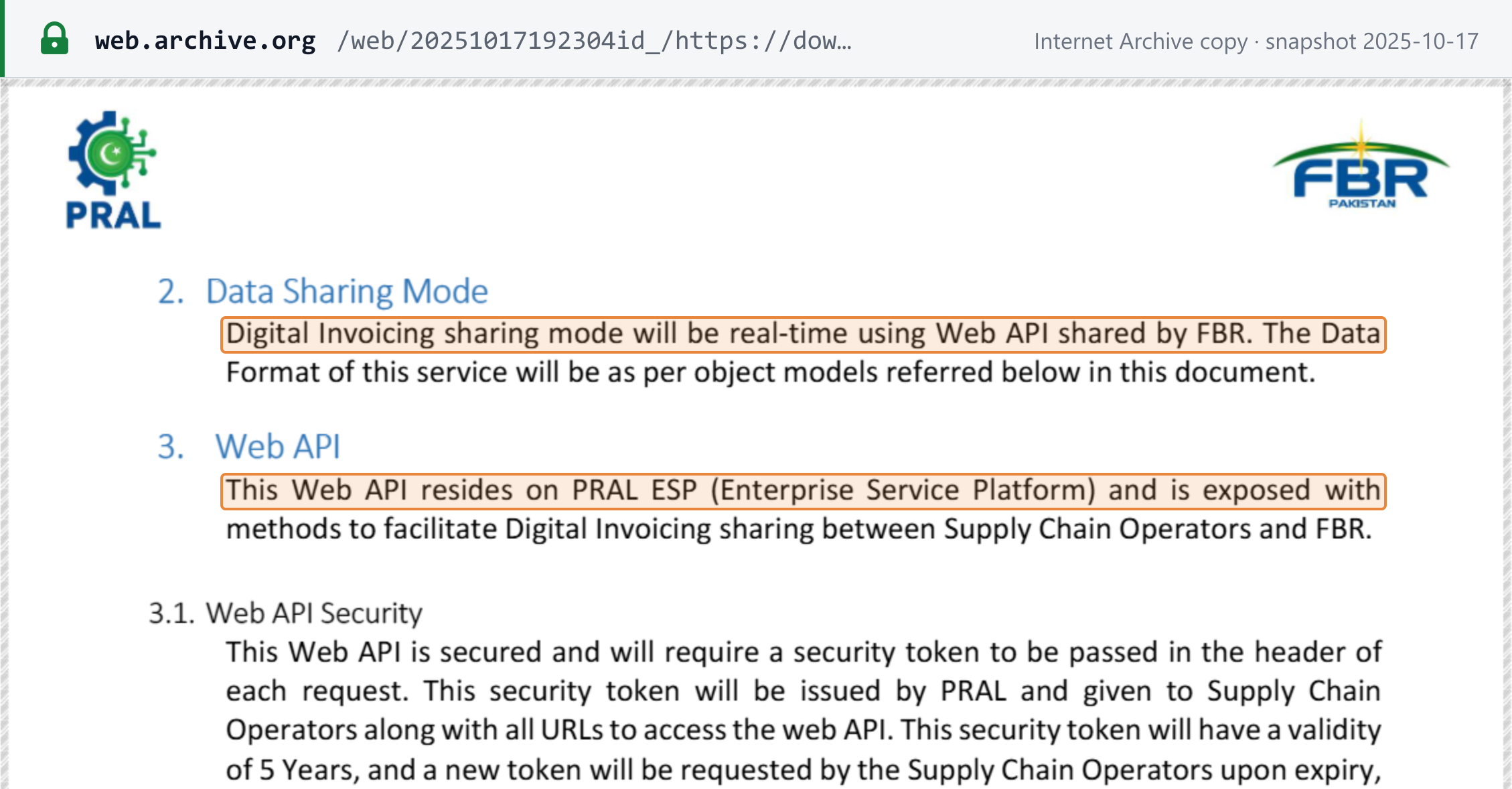
The message format: PRAL's JSON schema. PRAL's specification states that "Digital Invoicing sharing mode will be real-time using Web API shared by FBR" and that the API "resides on PRAL ESP (Enterprise Service Platform)". Each call is a REST POST of one JSON object: an invoice header, added once, and an items array. [2]
- Header fields:
invoiceType("Sale Invoice" or "Debit Note"),invoiceDate(YYYY-MM-DD),sellerNTNCNIC(7 or 13 digits),sellerBusinessName,sellerProvince,sellerAddress,buyerNTNCNIC(optional for unregistered buyers),buyerBusinessName,buyerProvince,buyerAddress,buyerRegistrationType,invoiceRefNo(debit notes only) andscenarioId(sandbox only). - Item fields:
hsCode,productDescription,rate,uoM,quantity,totalValues,valueSalesExcludingST,fixedNotifiedValueOrRetailPrice,salesTaxApplicable,salesTaxWithheldAtSource,extraTax,furtherTax,sroScheduleNo,fedPayable,discount,saleTypeandsroItemSerialNo. - Reference APIs return province codes, document types, item codes, SRO items, transaction types, units of measure, rates and HS codes.
- Endpoints: production
https://gw.fbr.gov.pk/di_data/v1/di/postinvoicedata; sandbox…/postinvoicedata_sb.
Seller and buyer are identified by NTN or CNIC. The field description says 7 or 13 digits, while the specification's error 0002 asks for a buyer "registration number in 13 digits or NTN in 7 or 9 digits". See the Pakistan TIN guide for both formats. [2]
Not UBL, not Peppol. The specification, the user manual and Chapter XIV reference no UBL, CII or Peppol profile. The network is FBR's Digital Invoicing gateway, reached directly through PRAL or through an FBR-licensed integrator.
Federal excise fields. S.R.O. 1666(I)/2026 adds six federal excise particulars to r.150R(13): (aa) Federal Excise Duty Type, (bb) rate, (cc) price per unit, (dd) amount payable otherwise than in sales tax mode, (ee) SRO/Schedule reference and (ff) SRO/Schedule serial number. PRAL's v1.12 schema carries one federal excise field, fedPayable. [9] [2]
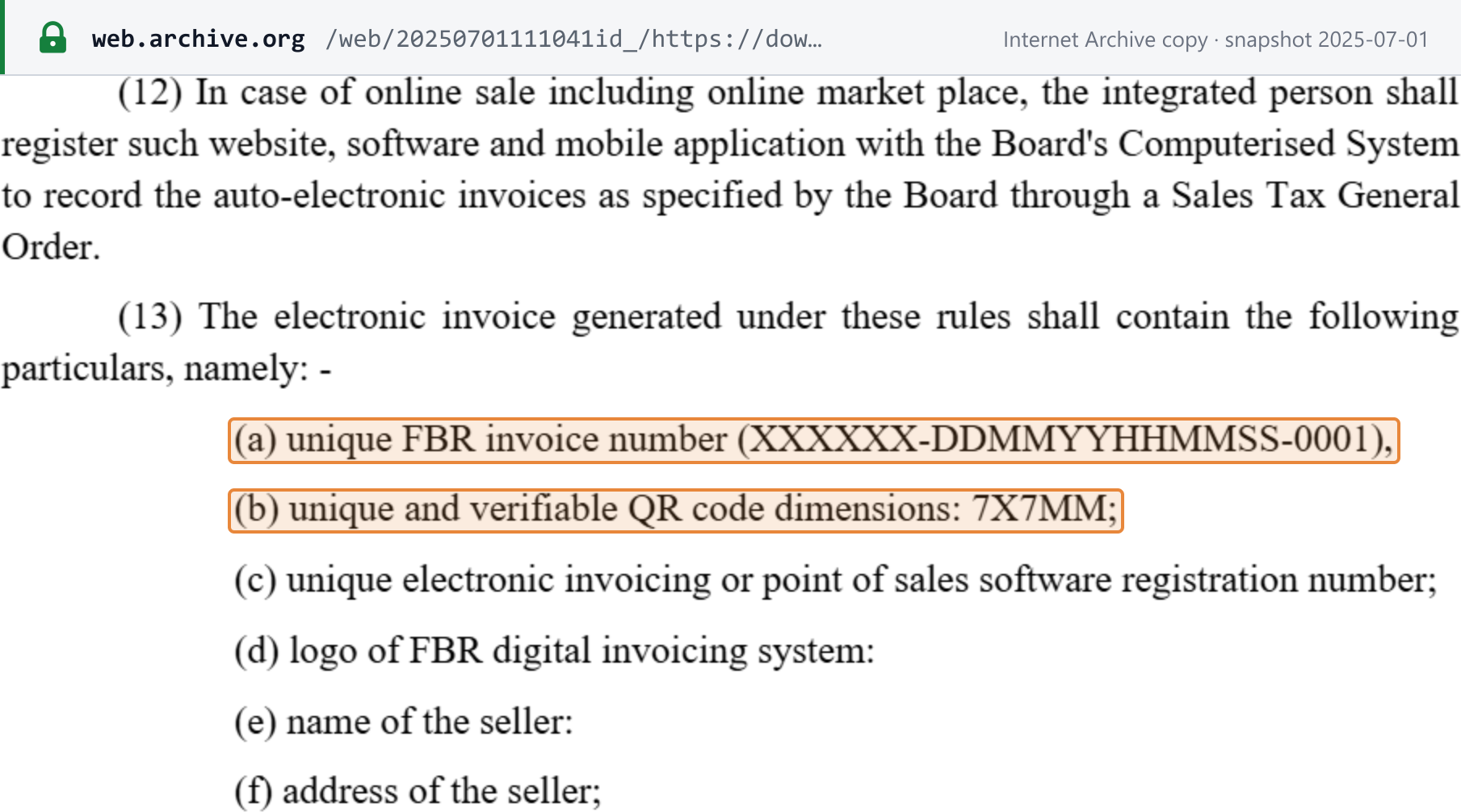
Mandatory particulars (r.150R(13)). The e-invoice must contain:
- (a) the unique FBR invoice number;
- (b) a "unique and verifiable QR code";
- (c) the e-invoicing or POS software registration number;
- (d) the logo of the FBR digital invoicing system;
- (e)–(j) seller and recipient name, address and registration number;
- (k)–(z) date, tax period, description, quantity, value excluding tax, rate, sales tax, tax withheld at source, extra tax, further tax, FED payable in sales tax mode, total discount, invoice reference number, HS code, unit of measurement, and SRO and serial number;
- (aa)–(ff) the federal excise fields added by S.R.O. 1666. [3] [9]
Where the official sources differ. Two details are stated differently in the rule and in PRAL's specification:
| Detail | Sales Tax Rules r.150R(13) | PRAL DI API v1.12 |
|---|---|---|
| FBR invoice number | Format "XXXXXX-DDMMYYHHMMSS-0001" | Sample response 7000007DI1747119701593; a debit note's reference to the original invoice is "22 digits in case of NTN 28 digits in case of CNIC" |
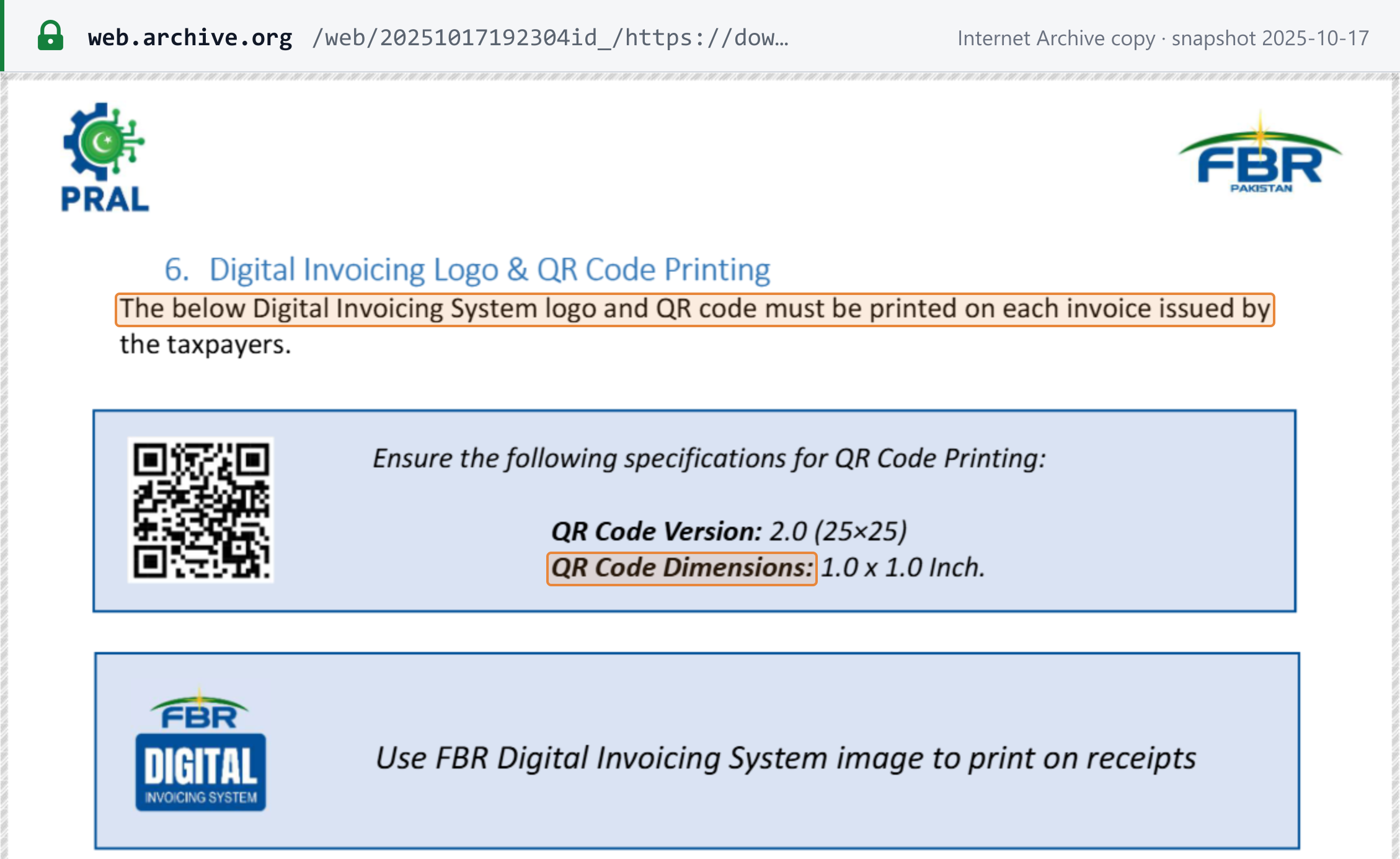
| QR code | "dimensions: 7X7MM" | "QR Code Version: 2.0 (25×25)", "QR Code Dimensions: 1.0 x 1.0 Inch" |
Neither FBR nor PRAL reconciles the two. [3] [2]
Integrity mechanics. PRAL's specification says "The below Digital Invoicing System logo and QR code must be printed on each invoice issued by the taxpayers". Under r.150R(4) the software must also create and record a digital signature on the invoice, "encrypt and preserve the reported sales tax invoice data in an irrevocable and secure manner", and log every adjustment, modification or cancellation. The Electronic Transactions Ordinance 2002 applies (r.150W). No hash chain is specified. [2] [3]
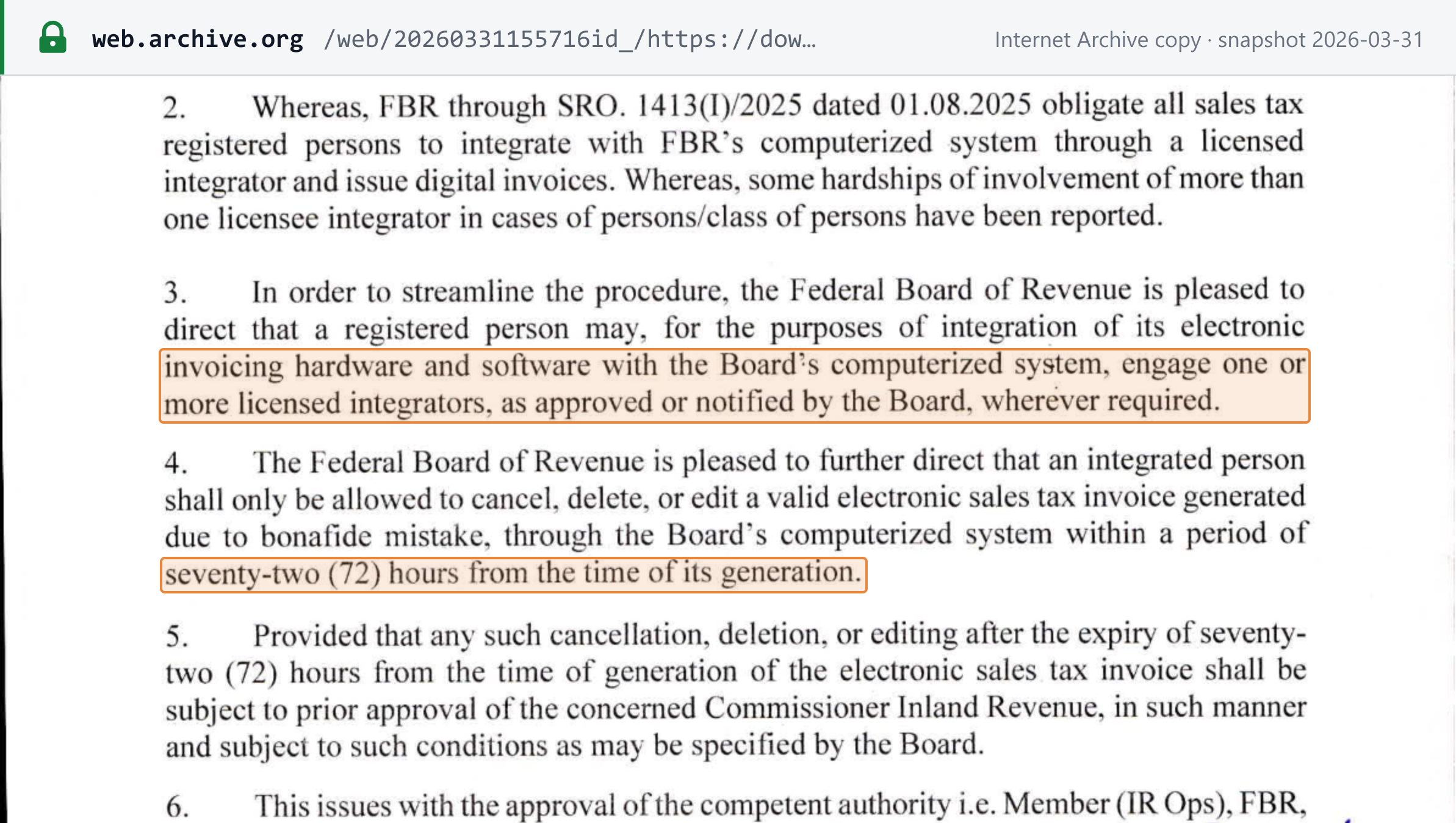
Cancellation and editing: 72 hours. Under Sales Tax General Order 01 of 2026 (30 March 2026), an integrated person may "cancel, delete, or edit a valid electronic sales tax invoice generated due to bonafide mistake, through the Board's computerized system within a period of seventy-two (72) hours from the time of its generation". After 72 hours, any cancellation, deletion or edit needs the "prior approval of the concerned Commissioner Inland Revenue". [13]
Offline mode. Invoices generated while the invoicing software is down, "including disruption caused by internet or power failure", must be "clearly identified as invoices issued in the offline mode and shall be uploaded within 24 hours of restoration" (r.150XC). The DI user manual adds that "The system does not support automatic retries for failed uploads", so a failed invoice must be submitted again. [3] [1]
Buyer verification. The Board must provide a facility on its website for a buyer to check that an invoice "has been communicated to the Board's Computerized System" (r.150XB). [3]
E-reporting alongside. "The Annexure-C of the sales tax return shall be auto-filled from the electronic invoices issued by the integrated person" (r.150R(5)). For return deadlines, see filing and payment in the Pakistan sales tax guide. [3]
Onboarding: how to comply
Registration with the platform. The steps in PRAL's DI User Manual v1.5:
- Log in to IRIS with your registration number and password and open Digital Invoicing.
- Choose the integration mode: API Integration, or Manual Invoice Generation ("limited functionality").
- Choose the integrator: "Proceed with PRAL as Licensed Integrator" or "Proceed with Other Licensed Integrator" (picked from a drop-down list). The manual says "PRAL will Provide Free of Cost Licensed Integrator Services along with Sandbox Testing, whereas Other Licensed Integrators may charge certain fee."
- Submit the technical details: contact person, ERP or system provider, cloud or on-premises hosting, software version, and the business nature and sector, which decide the sandbox scenarios.
- With PRAL as integrator, submit the IP addresses to whitelist. "The PRAL Data Centre will accept or reject the IPs submitted by the taxpayer within 2 working hours", which starts sandbox testing. With another integrator, PRAL does not whitelist.
- In the sandbox, post at least one successful invoice for each assigned scenario: "Minimum 1 invoice of each scenario must be successful to mark it complete."
- A production token is generated, and you switch to the production endpoint. [1]
Credentials. Every request carries a security token issued by PRAL as Authorization: Bearer <token>. "This security token will have a validity of 5 Years", after which a new one is requested, and "Sandbox and Production routing will be based on the security token being used". [2]
Licensed integrators. Only a licensee or PRAL may integrate notified persons (r.150XE(1)). "PRAL shall provide free of cost integration services to the registered persons on demand" (r.150XF(2)). For private integrators, Chapter XIV provides:
- applications go to the Board, and a licensing committee examines eligibility within 7 days and recommends or rejects within 15 days (r.150XI); FBR reconstituted that committee by notification of 6 October 2025;
- a licence "shall be valid for five years from date of issuance", is non-transferable and may not be used by a sub-contractor (r.150XJ); renewal is applied for three months before expiry (r.150XK);
- a licence can be suspended or cancelled after a show-cause notice, with representation to the Board, whose decision is final (r.150XN); the rules do not say what happens to the persons the integrator served;
- integrator fees may not exceed a threshold the Board specifies by Sales Tax General Order (r.150XO); the rule itself does not state an amount;
- the cost of equipment and software falls on the integrated person (r.150R(10)).
Since Sales Tax General Order 01 of 2026, a registered person may "engage one or more licensed integrators, as approved or notified by the Board, wherever required". [3] [16] [13]
Testing environment. The sandbox endpoints share the production host with an _sb suffix (…/postinvoicedata_sb, …/validateinvoicedata_sb). Scenarios SN001 to SN028 are assigned by business activity and sector; a manufacturer in "All Other Sectors", for example, gets SN001, SN002, SN005, SN006, SN007, SN015, SN016, SN017, SN021, SN022 and SN024. [2]
Connection modes.
| Mode | Suits | Notes |
|---|---|---|
| API integration with PRAL as integrator | Businesses with their own ERP or POS and in-house IT | Free; PRAL whitelists IPs and runs the sandbox |
| API integration through another FBR-licensed integrator | Businesses that want a vendor-managed connection | The integrator may charge a fee |
| Manual Invoice Generation in IRIS | Not stated by FBR or PRAL (generally, very low volumes) | The manual describes it only as "limited functionality"; no rule says who may rely on it, and r.150R(3) says no supply shall be made "except through the integrated outlets, point of sale or electronic invoice issuing machines" |
| FBR POS integration | Tier-1 retail outlets | Sales Tax Rules Chapter XIV-AA |
Other duties of an integrated person (Chapter XIV): display an "Integrated with FBR" signboard with FBR's logo at each outlet (r.150R(11)); report a failure of the system within 24 hours (r.150XA); keep e-invoices for six years on electronic media (r.150S(1)) so the original transmission can be re-created at audit (r.150T). The Commissioner may extend the time to integrate "for up to sixty days in aggregate with fifteen days intervals", with paper invoices meanwhile (r.150V). [3]
Penalties
The Sales Tax Act's s.33 table carries four entries aimed at e-invoicing and integration, plus the general invoice entry. [17] [11]
| s.33 entry | Breach | Penalty |
|---|---|---|
| 25 (substituted by the Finance Act, 2026) | A person required to integrate "for monitoring, tracking, reporting or recording of sales, production and similar business transactions" who fails to register or, if registered, "fails to integrate in the manner as required under law within the stipulated time as notified by the Board" | Up to PKR 1 million; if the offence continues one month after the first penalty, a second penalty of up to PKR 5 million; premises may be sealed "with or without imposition of penalty" |
| 25A (as amended by the Finance Act 2025) | A person required to integrate under section 23 (or s.40C(4)) who fails to register or integrate, "or fail to issue electronic invoices after integration" | PKR 500,000 for the first default; PKR 1 million for the second, PKR 2 million for the third and PKR 3 million for the fourth, each fifteen days after the order for the previous default; premises may be sealed. The first-default penalty is waived "if the retailer integrates his business with the Board's Computerized System before imposition of penalty for second default" |
| 25AA | A licensed integrator that fails to integrate registered persons as required | PKR 1 million or 1% of the total value of the sales suppressed, whichever is higher |
| 24 | An integrated person who avoids monitoring, or issues an invoice that "does not carry the prescribed invoice number or barcode or QR code or bears duplicate invoice number" | PKR 500,000 or 200% of the tax involved, whichever is higher; on conviction, up to 2 years' imprisonment, a fine of up to PKR 2 million, or both; premises may be sealed |
| 2 (amended by the Finance Act, 2026) | Failure to issue an invoice when required | PKR 25,000 or 5% of the tax involved, whichever is higher |
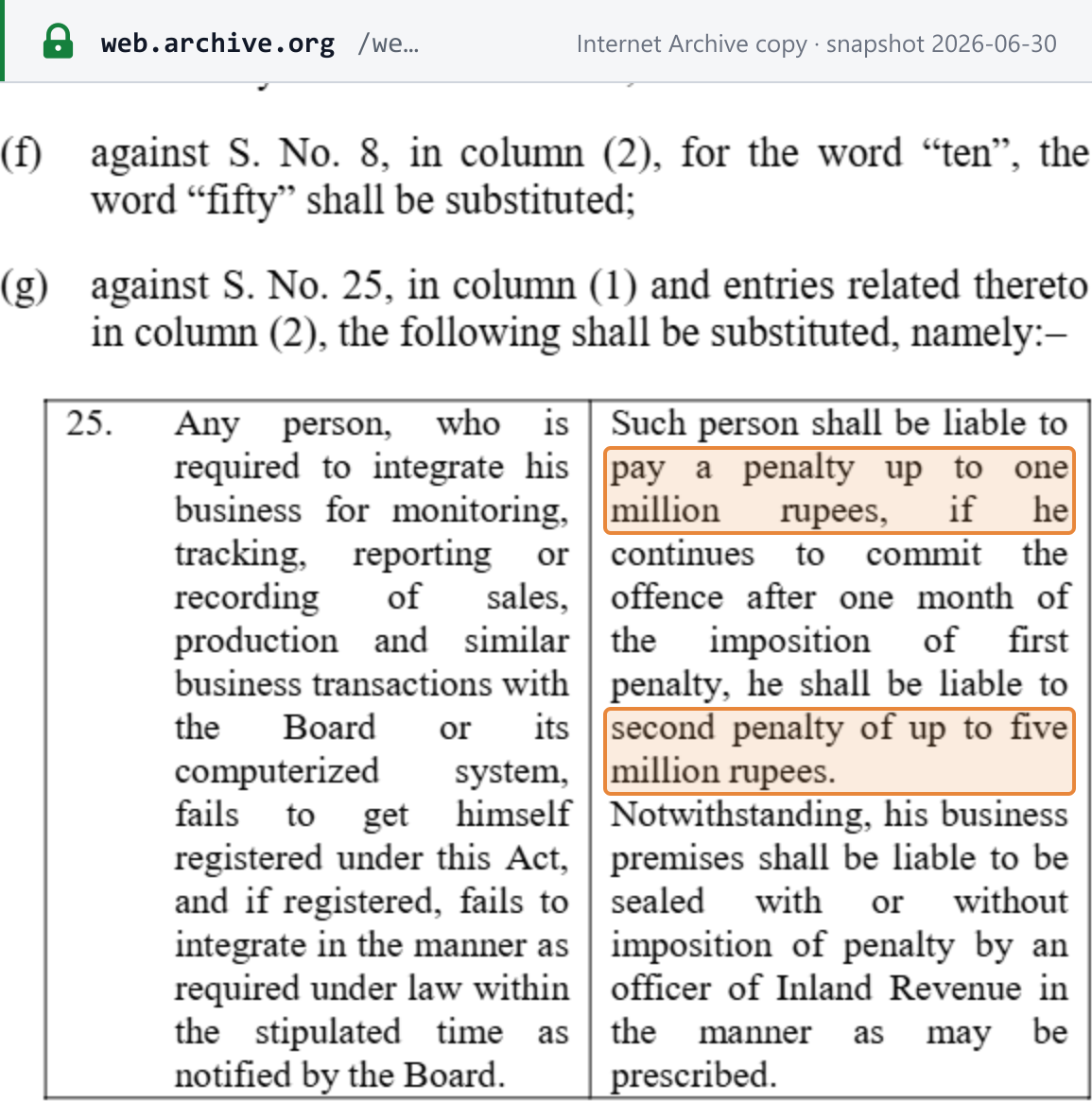
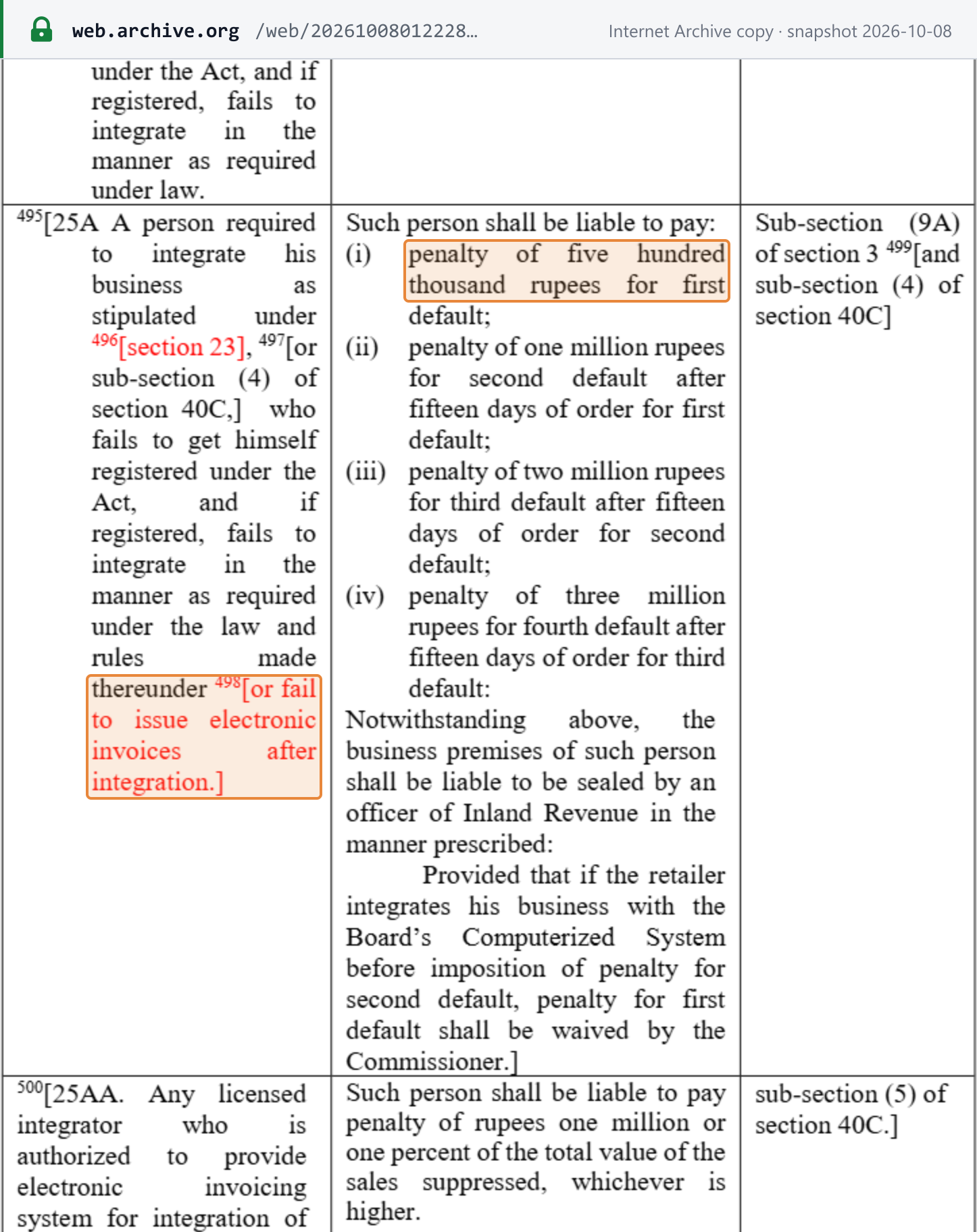
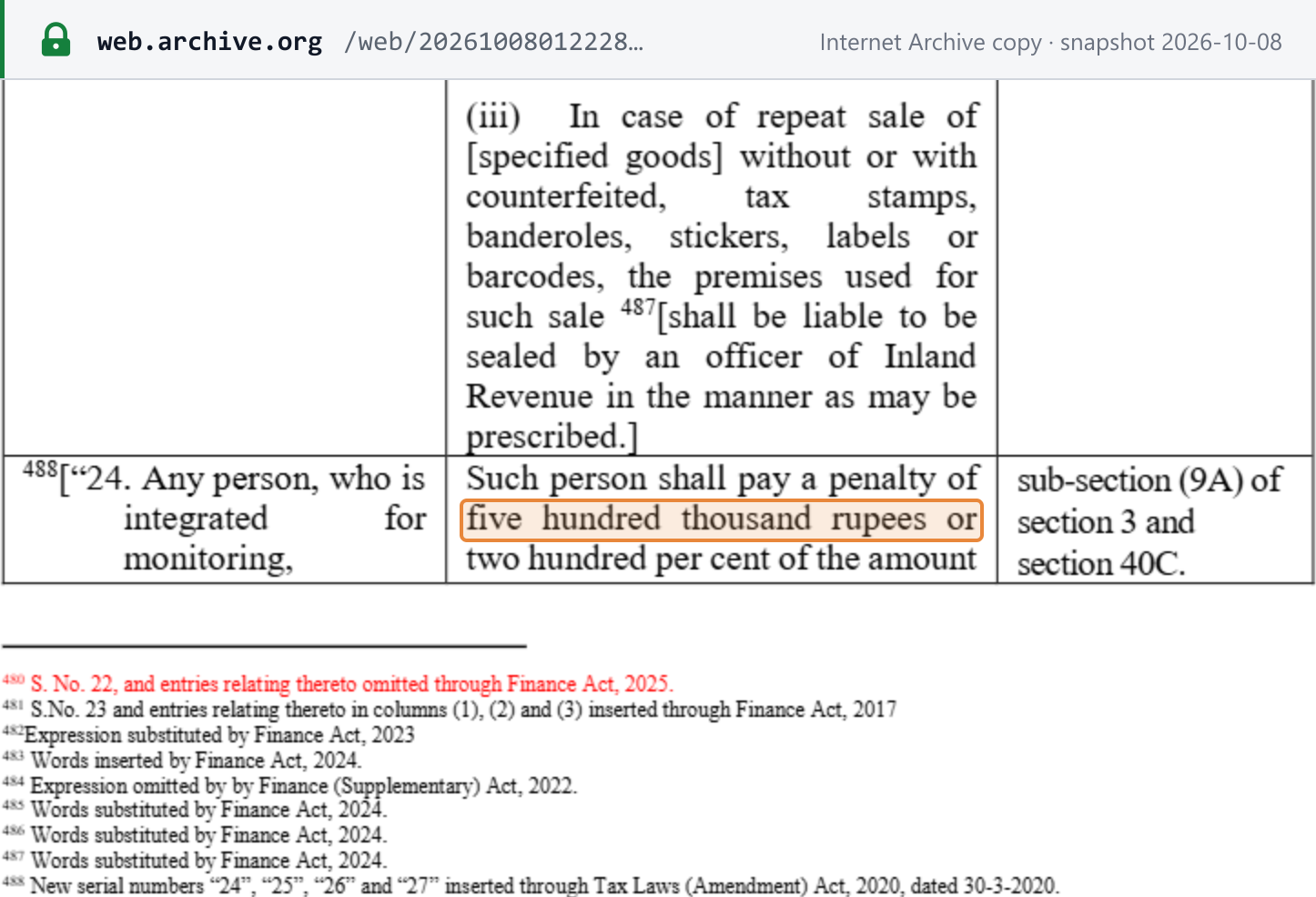
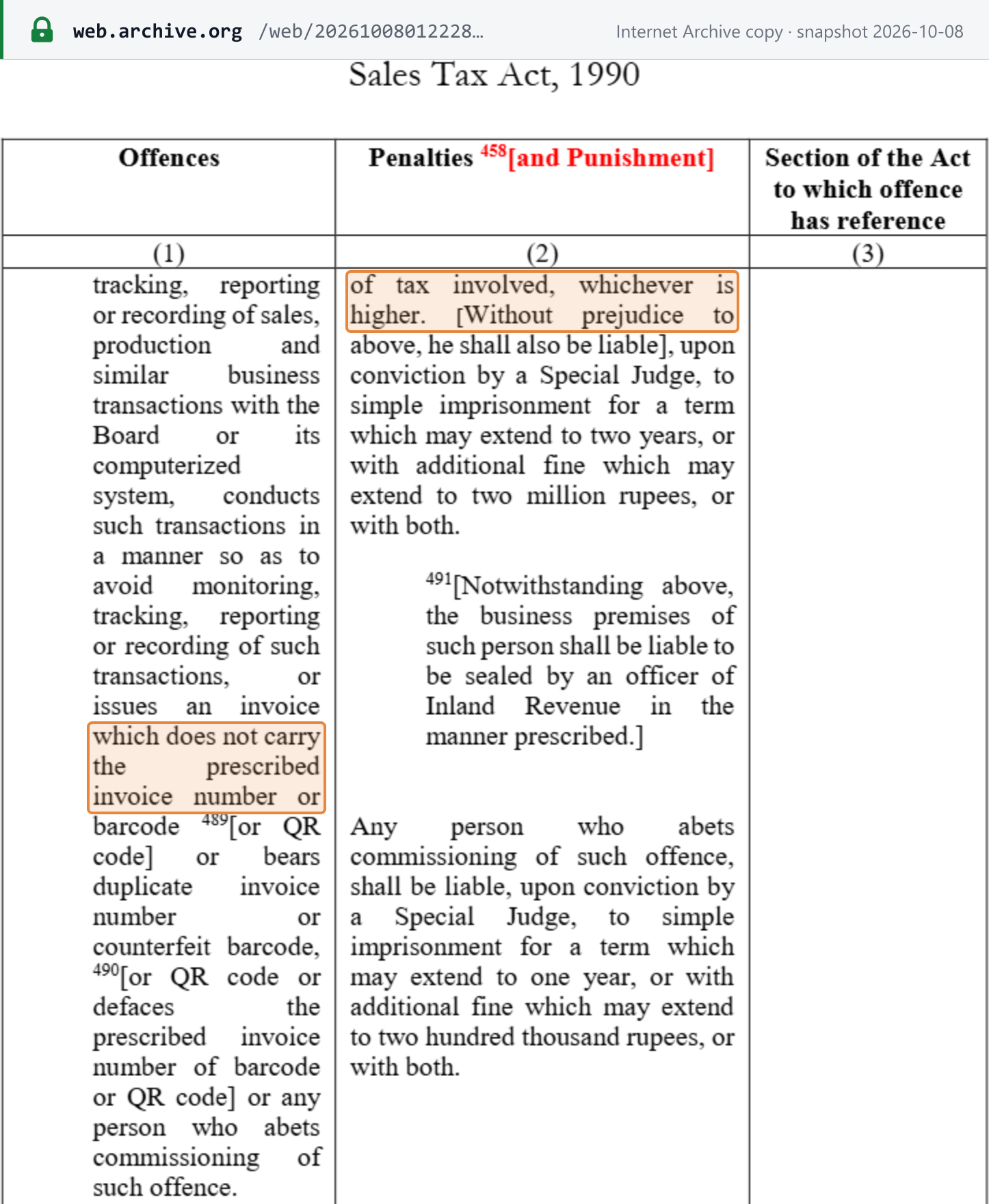
Entries 25 and 25A can both apply. Entry 25A has referred to persons required to integrate under section 23 since the Finance Act 2025, and covers both failing to integrate and failing to issue e-invoices after integration; entry 25, as substituted by the Finance Act, 2026, covers failing to integrate within the time the Board notifies. A person who has not integrated under S.R.O. 1852 falls within the words of both. The Act does not say which prevails, and FBR's Circular No. 01 of 2026 explains only entry 25, which it describes as "a penalty of rupees one million"; the Act's substituted text, quoted above, is the operative wording. [17] [12]
Other sanctions.
- Suspension of registration. Since 1 July 2026 the Commissioner may suspend a registration where the person "has committed non-compliance of sub-sections (5) and (6) of section 23 or section 40C" (s.21(2), amended by the Finance Act, 2026). [11]
- Input-tax limit. The Board may "reduce or enhance the limit provided in this sub-section for any registered person on the basis of compliance or non-compliance with the production monitoring, digital invoicing, e-bility, POS, or any other electronic system" (s.8B, Finance Act, 2026). [11]
- Tax on unaccounted sales. Where an integrated person sells without generating an invoice with the QR code or FBR invoice number, or leaves a generated invoice out of Annex-C or the return (other than a legally approved cancellation), the officer computes and recovers the tax on those sales, with penal action (r.150XD(2), substituted by S.R.O. 1666(I)/2026). [9]
- Sealing procedure. S.R.O. 1662(I)/2026 adds a procedure for sealing and de-sealing the premises of non-integrated persons other than Tier-1 retailers (new r.150ZES–150ZEU). Its text refers to a "production monitoring system, video surveillance, digital eye or any other prescribed monitoring mechanism". [18]
- Tier-1 retailers. Adjustable input tax is reduced by 60% for a period of non-integration (s.8B(6)), and gas and electricity connections of notified, unintegrated Tier-1 retailers may be disconnected (s.14AB). [17]
The 72-hour window in Sales Tax General Order 01 of 2026 is a correction facility, not a grace period. For the rest of the s.33 table, see offences and penalties in the Pakistan sales tax guide.
Frequently asked questions
All the S.R.O. 1852 dates have passed. What if we are not integrated yet?
You are late. Category 7, registered persons other than those listed, had to issue e-invoices by 31 December 2025, and every other category had an earlier date. Failing to integrate within the notified time carries a penalty of up to PKR 1 million, and up to PKR 5 million if it continues one month after the first penalty (s.33 entry 25, Finance Act, 2026). Entry 25A sets PKR 500,000 for a first default, rising to PKR 3 million, and the Act does not say which entry prevails. The Commissioner may also suspend your registration (s.21(2)) and may extend the time to integrate by up to sixty days in aggregate (r.150V). [4] [11] [17] [3]
Do we have to pay a private integrator?
No. PRAL is a licensed integrator by rule and must provide integration services free of cost on demand (r.150XF(2)); other FBR-licensed integrators may charge a fee. Since Sales Tax General Order 01 of 2026 you may engage more than one licensed integrator. [3] [1] [13]
Is Pakistan's e-invoice UBL or Peppol?
Neither. It is PRAL's own JSON schema, posted in real time to FBR's Digital Invoicing API at gw.fbr.gov.pk, which returns an FBR invoice number. [2]
We issued an e-invoice by mistake. Can we cancel it?
Yes, through FBR's system within 72 hours of its generation, if it was generated due to a bona fide mistake. After 72 hours, cancelling, deleting or editing it needs the prior approval of the concerned Commissioner Inland Revenue (Sales Tax General Order 01 of 2026). [13]
Our internet went down. What happens to the invoices?
Issue them in offline mode, clearly identified as such, and upload them within 24 hours of restoration (r.150XC). Failed uploads are not retried automatically, so resubmit each failed invoice. [3] [1]
Do exempt supplies need an e-invoice?
Yes. Rule 150R(9) requires electronic invoices for exempt supplies through the integrated system, and from 1 July 2026 s.23(1), as amended by the Finance Act, 2026, requires a tax invoice for exempt supplies and advance receipts too. [3] [11]
When must the FBR invoice number appear on every invoice?
For persons integrated under Chapter XIV it already must: the unique FBR invoice number is the first mandatory particular in r.150R(13). The wider statutory condition in s.23(1), added by the Finance Act, 2026, applies from the time the Board notifies. [3] [11]
We also charge federal excise duty, or provide services in Islamabad. Do we need a second integration?
No. S.R.O. 1666(I)/2026 says a person already integrated need not undertake a separate technical integration, and one e-invoice showing each tax or duty separately is sufficient. It also adds six federal excise fields to the mandatory particulars, while PRAL's v1.12 schema carries one federal excise field, fedPayable. S.R.O. 1666 took effect when issued on 29 September 2026; the extension operates as far as the Federal Excise Act and the ICT Ordinance require e-invoicing or integration. [9] [2]
What size must the QR code be?
The official sources differ. PRAL's DI API specification v1.12 requires QR code version 2.0 (25×25), printed at 1.0 × 1.0 inch, together with the Digital Invoicing System logo. Sales Tax Rules r.150R(13)(b) gives QR code dimensions of 7×7 mm. Neither FBR nor PRAL reconciles the two. [2] [3]
Recent changes
- 2026-09-29 — S.R.O. 1666(I)/2026 extends Sales Tax Rules Chapter XIV e-invoicing to persons liable under the Federal Excise Act and to ICT services providers, adds six federal excise invoice fields and allows one combined e-invoice; already-integrated persons need no separate integration; it took effect on issue, with the federal excise and ICT extension applying as far as those laws require e-invoicing. (Federal Board of Revenue) — see event
- 2026-09-29 — S.R.O. 1662(I)/2026 adds a procedure for sealing and de-sealing the premises of non-integrated persons other than Tier-1 retailers (Sales Tax Rules Chapter XIV-AD); its text refers to production monitoring, video surveillance, digital eye or other prescribed monitoring mechanisms. (Federal Board of Revenue)
- 2026-06-26 — Finance Act, 2026 (Act No. XLIII of 2026) gazetted, in force 1 July 2026: tax invoices must bear a verifiable and unique FBR invoice number from a date the Board will notify, invoices are required for exempt supplies and advance receipts, registration may be suspended for non-integration, and the s.33 entry 25 penalty rises to up to PKR 1 million, then up to PKR 5 million. (Federal Board of Revenue) — see event
- 2026-03-30 — Sales Tax General Order 01 of 2026: registered persons may engage one or more licensed integrators; e-invoices may be cancelled or edited within 72 hours, later only with the Commissioner's approval. (Federal Board of Revenue)
- 2025-12-31 — Last issue-by date under S.R.O. 1852(I)/2025: all remaining registered persons. (Federal Board of Revenue)
- 2025-09-24 — S.R.O. 1852(I)/2025 re-sets the schedule to 1 November–31 December 2025, superseding S.R.O. 1413(I)/2025. (Federal Board of Revenue)
Related resources
- Pakistan sales tax guide — rates, registration, invoice requirements, the FBR POS specimen invoice and the full s.33 penalty table
- Pakistan tax identification numbers (NTN and CNIC), or validate an NTN on Lookuptax
- E-invoicing status and networks by country
- E-invoicing models: clearance, reporting and interchange
- A comparable national invoice-registration model: India's IRP e-invoicing
- Pakistan tax changes on Lookuptax
Important websites
- FBR IRIS — Digital Invoicing registration, integration mode, sandbox and production tokens
- PRAL Technical Specification for DI API, v1.12 (PDF)
- PRAL Digital Invoicing User Manual, v1.5 (PDF)
https://gw.fbr.gov.pk/di_data/v1/di/postinvoicedata— production API endpoint (for integrators; not a browser page)- PRAL Digital Invoicing support (CRM)
- FBR sales tax SROs — S.R.O. 1852(I)/2025, S.R.O. 1666(I)/2026 and later notifications
- Sindh Revenue Board POS invoice verification
Sources
- PRAL — Digital Invoicing User Manual, v1.5 (PDF)
- PRAL — Technical Specification for DI API, v1.12 (PDF)
- FBR — POS Booklet, May 2025, with Sales Tax Rules Chapter XIV as substituted by S.R.O. 69(I)/2025 (PDF)
- FBR — S.R.O. 1852(I)/2025, 24 September 2025 (PDF)
- FBR — S.R.O. 709(I)/2025, 22 April 2025 (PDF)
- FBR — Electronic integration of taxpayers, extension, 30 April 2025 (PDF)
- FBR — Electronic integration of taxpayers, further extension, 20 June 2025 (PDF)
- FBR — S.R.O. 1413(I)/2025, 1 August 2025 (PDF)
- FBR — S.R.O. 1666(I)/2026, 29 September 2026 (PDF)
- FBR — Finance Act, 2025 (PDF)
- FBR — Finance Act, 2026 (Act No. XLIII of 2026), Gazette of Pakistan Extraordinary, 26 June 2026 (PDF)
- FBR — Circular No. 01 of 2026 (Sales Tax and Federal Excise), 11 September 2026 (PDF)
- FBR — Sales Tax General Order 01 of 2026, 30 March 2026 (PDF)
- FBR — Sales Tax Rules, 2006, updated up to 01-01-2025 (PDF)
- Sindh Revenue Board — Sindh Sales Tax Special Procedure (Online Integration of Business) Rules, 2022 (PDF)
- FBR — Notification reconstituting the licensed-integrator evaluation committee, 6 October 2025 (PDF)
- FBR — Sales Tax Act, 1990, as amended up to 30 June 2025 (PDF)
- FBR — S.R.O. 1662(I)/2026, 29 September 2026 (PDF)