E-invoicing in Burkina Faso: the facture électronique certifiée (FEC)
Overview
Burkina Faso's e-invoice is the facture électronique certifiée (FEC), a certified electronic invoice issued through a système électronique certifié de facturation (SECeF). A SECeF is a physical device that produces the invoice, stores all invoice data in its internal memory and transfers the data to the tax administration's remote server. It comes in two forms that do the same job: [6]
- a module de contrôle de facturation (MCF), a control module connected to the business's invoicing software, the système de facturation d'entreprise (SFE), which must itself be homologated; or
- a standalone unité de facturation (UF), an invoicing unit that combines the MCF and the SFE in one machine.
The system is run by the Direction générale des impôts (DGI) of the Ministry of Economy and Finance. The devices are distributed by the Chambre de commerce et d'industrie du Burkina Faso (CCI-BF) through its network of approved distributors. [4] The FEC replaces, for the taxpayers it covers, the paper facture normalisée that Burkina Faso standardised in 2017. [11]
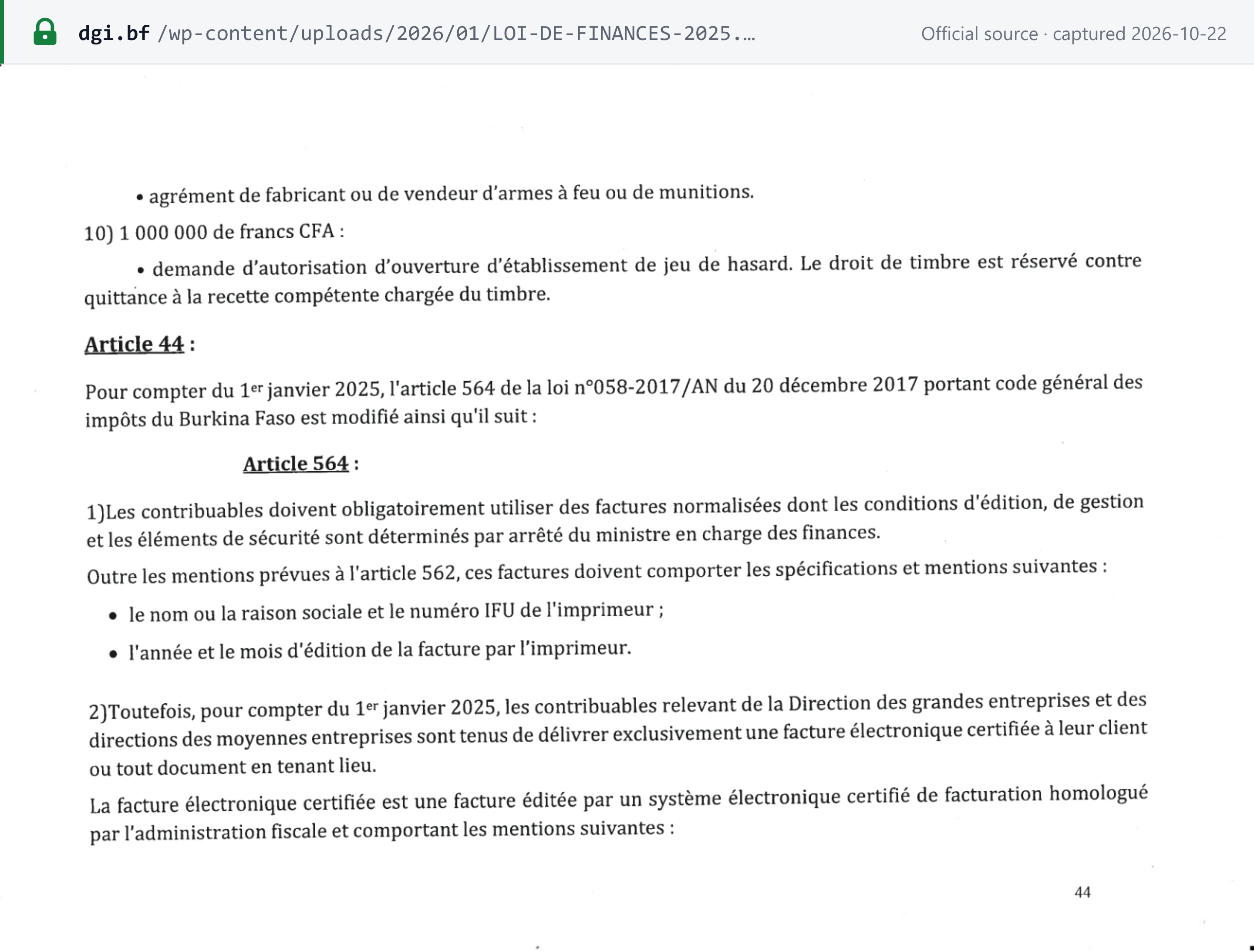
Legal basis in one line. Article 564 §2 of the Code général des impôts (CGI), as rewritten by article 44 of the 2025 Finance Law (Loi n°042-2024/ALT), requires taxpayers under the Direction des grandes entreprises (DGE) and the directions des moyennes entreprises (DME) to issue exclusively an FEC from 1 January 2025. [1]
| Burkina Faso | |
|---|---|
| System | Facture électronique certifiée (FEC), issued through a SECeF: an MCF behind homologated SFE software, or a standalone UF |
| Model | Certified fiscal device with store-and-forward reporting: the device certifies each invoice locally and transmits the data to the DGI. Not clearance, not Peppol |
| Who must issue | Taxpayers under the DGE and the DMEs (large and medium enterprises), except the categories exempted by CGI art. 566 §2. Other taxpayers stay on the paper facture normalisée |
| B2B / B2C | Both: the obligation is to issue an FEC to "leur client", for every transaction |
| B2G | Same obligation for suppliers; public-spending bodies must accept only FECs from local suppliers |
| Non-residents | Out of scope: enterprises without a permanent establishment in Burkina Faso are exempt |
| Go-live | Legal obligation in force since 1 January 2025. Devices on sale from 7 September 2026 (DGE and software publishers), 2 November 2026 (DME, régime du réel normal) and 1 December 2026 (DME, régime non déterminé), each followed by a 30-day conformity window |
| Format | Printed (thermal or A4) or electronic invoice carrying the device's security elements: SECeF code, machine identifier, counters, date and time, QR code. No XML or UBL schema is published |
| Transmission | GSM mobile network (at least 3G), data encrypted with AES-256, to the DGI server and the SYGMEF platform |
| Authority | Direction générale des impôts (DGI); devices distributed by the CCI-BF |
| Legislation | CGI arts 564, 566, 798-1 and 798-2 as amended by Loi n°042-2024/ALT; arrêtés 2025-0047, 2025-0048 and 2025-0049 of 5 February 2025; DGI notes de service 2025-0884, 0885, 0887 and 0889 of 29 December 2025 |
For how certified fiscal devices work in other countries, see Fiscal devices and certified cash registers. The DR Congo guide covers a system built on the same UF, MCF and SFE vocabulary.
Mandate status & timeline
Status as at 22 October 2026: in force by law since 1 January 2025 for DGE and DME taxpayers; device sales open for the DGE, scheduled for the DMEs.
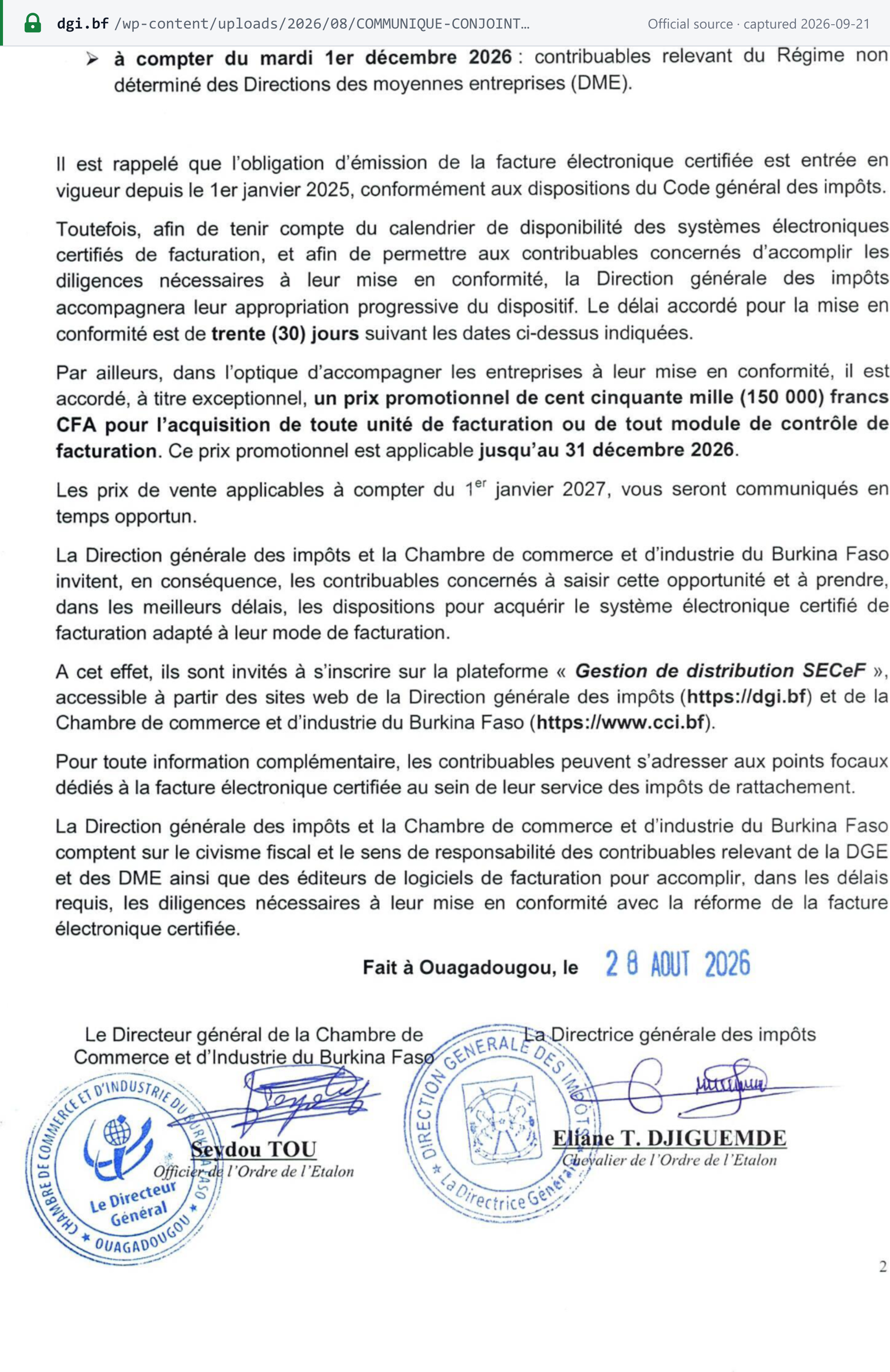
The legal obligation and the practical rollout run on two different clocks. The 2025 Finance Law made the FEC compulsory from 1 January 2025. The certified devices, however, only went on sale in September 2026. A joint communiqué of the DGI and the CCI-BF dated 28 August 2026 sets the sale calendar by taxpayer class and gives each class 30 days after its date to come into conformity. The communiqué recalls that "l'obligation d'émission de la facture électronique certifiée est entrée en vigueur depuis le 1er janvier 2025", and states that the DGI will support taxpayers' progressive take-up of the system. [1] [2]
| Phase | Who | Date | What happens | Instrument | Status |
|---|---|---|---|---|---|
| Legal obligation | DGE and DME taxpayers | 1 January 2025 | Must issue exclusively an FEC to their clients | LF 2025 art. 44 (CGI art. 564 §2) | In force |
| Wave 1 | DGE taxpayers and invoicing-software publishers | 7 September 2026 | Certified devices (UF and MCF) on sale; 30-day conformity window from this date | Communiqué of 28 August 2026 | Passed |
| Wave 2 | DME taxpayers under the régime du réel normal d'imposition | 2 November 2026 | Devices on sale; 30-day conformity window from this date | Communiqué of 28 August 2026 | Scheduled |
| Wave 3 | DME taxpayers under the régime non déterminé | 1 December 2026 | Devices on sale; 30-day conformity window from this date | Communiqué of 28 August 2026 | Scheduled |
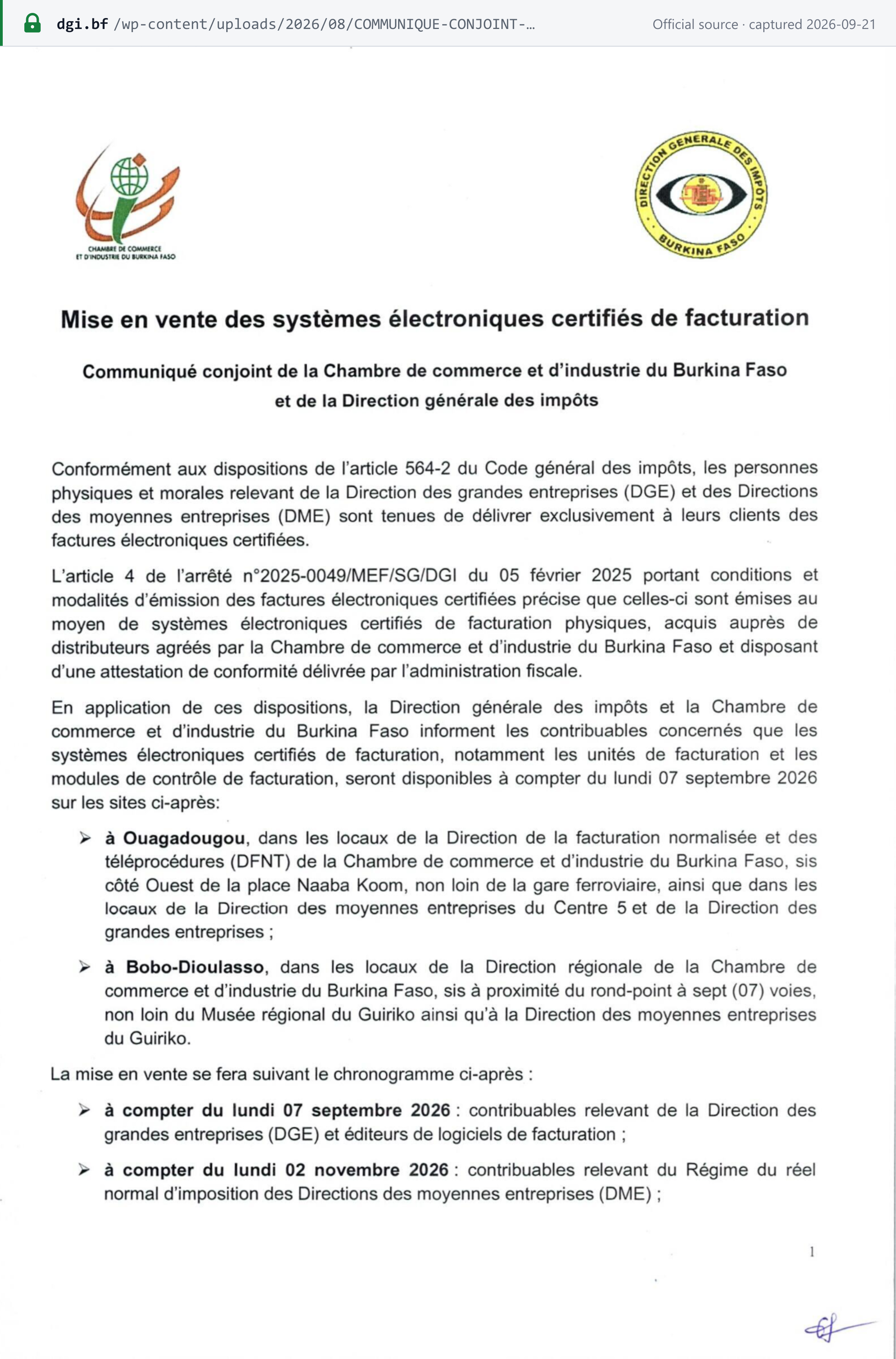
The latest announced step is the communiqué of 28 August 2026 above. Devices are sold in Ouagadougou at the CCI-BF's Direction de la facturation normalisée et des téléprocédures (DFNT), the DME Centre 5 and the DGE, and in Bobo-Dioulasso at the CCI-BF regional office and the DME Guiriko. [2]
Taxpayers outside the DGE and the DMEs. The amended CGI art. 564 §1 keeps them on the paper facture normalisée, and no official text sets an FEC date for them. The DGI and CCI-BF practical guide describes the move from the paper invoice to the FEC as progressive, without dates. [1] [11]
The 1 July 2026 date announced at the launch. At the official launch on 6 January 2026, the DGI announced that compulsory use of the e-invoicing system by large enterprises would follow "à compter du 1er juillet 2026", after an information campaign, software homologation and training. No legal text sets that date, and certified devices were not on sale by then. The DGI and CCI-BF communiqué of 28 August 2026 now sets the operative calendar shown in the table, while the legal obligation has applied since 1 January 2025. No official source gives FEC dates in 2027 or 2028. [16] [2]

Pilot and implementing texts
- 5 February 2025. The Minister of Economy and Finance signed three implementing arrêtés: 2025-0047 (homologation and marketing of devices and software), 2025-0048 (documents that stand in for an FEC) and 2025-0049 (conditions for issuing FECs). Each took effect on signature. Arrêté 2025-0049 art. 10 gave existing SFE users three months from signature to update their software, extendable by the DGI by up to two months at the user's request. [3] [4]
- 1–5 September 2025. The DGI held a workshop in Ouagadougou to evaluate the pilot phase of the FEC reform. [15]
- 29 December 2025. The DGI issued four notes de service: the technical specifications of the SECeF devices, the technical specifications of SFE software (version 2.0), the homologation procedures, and the creation of the homologation committee. [14]
- 6 January 2026. The Minister of Economy and Finance officially launched the FEC in Ouagadougou. The DGI's account of the launch announced compulsory use by large enterprises from 1 July 2026 (see above). [16]
- 3 June 2026. The DGI homologated the first business invoicing software (SFE) on its public register. [13]
Postponements
No instrument has moved the 1 January 2025 legal date. For readers who planned against the 1 July 2026 date announced at the launch: device sales instead began on 7 September 2026 for the DGE, under the 28 August 2026 communiqué. The 30-day conformity windows in the 28 August 2026 communiqué are an administrative tolerance tied to device availability; they do not amend the CGI. [2]
Legal basis
| Instrument | Date | What it does for the FEC |
|---|---|---|
| Loi n°042-2024/ALT, Finance Law for 2025 | Adopted 23 December 2024; in effect from 1 January 2025 (art. 89) | Art. 44 rewrites CGI art. 564 (FEC obligation and mandatory mentions); art. 45 rewrites art. 566 (exemptions); arts 53 and 54 insert CGI arts 798-1 and 798-2 (penalties); art. 57 exempts physical certified invoicing systems from VAT and customs duties for 2025 |
| Arrêté n°2025-0049/MEF/SG/DGI | 5 February 2025; in effect on signature | Conditions and procedures for issuing FECs: who issues, device activation, issuers' obligations, the acceptance rule for public buyers, the SFE update period |
| Arrêté n°2025-0047/MEF/SG/DGI | 5 February 2025; in effect on signature | Homologation of SECeF devices and SFE software, attestations of conformity, distribution through the CCI-BF, marketing of software, withdrawal |
| Arrêté n°2025-0048/MEF/SG/DGI | 5 February 2025 | Documents that stand in for an FEC |
| Note de service n°2025-0887/MEF/SG/DGI/DLC/sl | 29 December 2025 | Technical specifications of the SECeF devices (UF and MCF) |
| Note de service n°2025-0889/MEF/SG/DGI/DLC/sl | 29 December 2025 | Technical specifications of SFE software, version 2.0 |
| Note de service n°2025-0885/MEF/SG/DGI/DLC/sl | 29 December 2025 | Homologation procedures for UF, MCF and SFE |
| Note de service n°2025-0884/MEF/SG/DGI/DLC/sl | 29 December 2025 | Creates the homologation committee |
| Loi n°021-2025/ALT, Finance Law for 2026 | Adopted 27 December 2025; promulgated by Décret n°2025-1660/PF of 30 December 2025; Journal officiel spécial n°01 of 2 January 2026 | Art. 40 renews the VAT and customs exemption on physical certified invoicing systems for 2026. It does not amend CGI arts 564, 566, 798-1 or 798-2 |
| Joint DGI and CCI-BF communiqué | 28 August 2026 | Device sale calendar, 30-day conformity windows, promotional device price |
The 2025 Finance Law's explanatory memorandum lists the "Institution de la facture électronique certifiée (Art.564, 566, 798-1 et 798-2 du CGI)" among its measures. [18] The 2026 Finance Law is not the source of the FEC obligation: its only FEC provision is the device tax exemption in art. 40. [10]
Technical standards. The binding technical texts are the DGI's notes de service on SECeF devices and SFE software. They name no ISO, UBL, CII or Peppol standard. The data-exchange protocol between the SFE and the MCF, and the format of the invoice QR code, are "défini par l'Administration" and are not published by the DGI. [6] [14]
Scope
Who must issue. Every enterprise attached to the DGE or to a DME that supplies goods or services must issue an FEC "lors de chaque transaction" (arrêté 2025-0049 art. 3). The DMEs include both the régime du réel normal and the régime non déterminé, which have separate device-sale dates. Taxpayers outside the DGE and the DMEs continue to use the paper facture normalisée under CGI art. 564 §1. [3] [1] [2]
B2B and B2C. The same rule covers both. CGI art. 564 §2 requires the FEC to be issued "à leur client", without distinguishing business from consumer customers. Issuers must display "EXIGEZ LA FACTURE ELECTRONIQUE CERTIFIEE" visibly at every till or payment point (arrêté 2025-0049 art. 6 c). The SFE specification provides a "client comptant" customer type with no mandatory customer details, for walk-in sales, and requires the customer's name and IFU (identifiant financier unique) for companies and for individual traders. [1] [3] [7]
B2G. In-scope suppliers issue FECs to public buyers like any other client. On the receiving side, arrêté 2025-0049 art. 8 says the actors in the public-spending chain (central government, local authorities, public establishments and other public bodies) and persons under the régime non déterminé "ne devront accepter que les factures électroniques certifiées des fournisseurs locaux de biens et services", unless the supplier is exempt under CGI art. 566 §2. [3]
Exemptions (CGI art. 566 §2). As rewritten by the 2025 Finance Law, these taxpayers are exempt from using the FEC: [1]
- the State, local authorities and their public establishments without industrial or commercial activity;
- enterprises without a permanent establishment in Burkina Faso;
- air-navigation companies;
- urban public-transport companies, for passenger transport sold with tickets.
The paragraph introduces this list as taxpayers "relevant de la Direction des grandes entreprises"; it does not say whether DME taxpayers in the same categories are also exempt. The longer list in art. 566 §1 (supermarket tickets, pharmacies, fuel stations, banks and others) exempts only from the paper facture normalisée, not from the FEC.
Non-established businesses. Out of scope. Enterprises without a permanent establishment in Burkina Faso are exempt under CGI art. 566 §2, and invoices from foreign suppliers without a permanent establishment count as documents standing in for an FEC (arrêté 2025-0048 art. 3). [1] [5]
Documents standing in for an FEC. Arrêté 2025-0048 lists the documents that count in place of an FEC: invoices issued before the obligation took effect; invoices from foreign suppliers without a permanent establishment; customs documents; tax assessments and collection titles; receipt slips for purchases of farm produce from farmers, building aggregates, restaurant kitchen supplies, and scrap or plastics bought from individuals for recycling; and invoices from exempt persons. [5]
Exports and imports. Exports are in scope. The SFE specification defines export invoice types (export sale, export advance and export credit note) and a tax group for exports of taxable products, and lets the customer's IFU field be filled in free format for exports. On the purchase side, customs documents stand in for an FEC for imports. [7] [5]
Simplified invoices. The FEC texts set no simplified-invoice regime and no low-value threshold. Arrêté 2025-0049 requires a device-certified FEC at each transaction; for walk-in customers the "client comptant" type leaves the customer fields optional. [3] [7]
Format & network
The model: certified fiscal device, store-and-forward. The invoice is finalised locally. The MCF (or the UF) generates the security elements for each invoice and writes the invoice data to its internal memory as a transaction. It then sends the stored data to the DGI's server over the mobile network, which the specification calls a remote audit. The DGI does not validate or stamp each invoice before it is issued; the control sits in the device. The MCF refuses to certify an invoice whose total or any line is zero or negative, or whose number repeats the last certified invoice. The SFE "ne devrait pas être en mesure d'émettre une facture sans éléments de sécurité fournis par le MCF". [6] [7] For how this model compares with clearance and reporting systems, see CTC e-invoicing models.
Offline operation. The device keeps issuing invoices while offline, within limits. The MCF blocks itself when the days since its last successful remote audit exceed a blocking parameter, or when the number of unsent transactions exceeds a second one. The SFE must warn the user every day once the MCF has not connected to the administration for more than 7 days. [6] [7]
Transmission. The MCF's communication module sends its data "en utilisant le réseau d'opérateur mobile", using at least a 3G GSM connection; all data must be encrypted and compressed. Internal and audit data are encrypted with AES-256 in CBC mode, and the MCF keeps its internal data for at least 10 years. Taxpayers must place the device where it can pick up the GSM network (arrêté 2025-0049 art. 7 d). The DGI's technical note requires regular transmission of the data to the SYGMEF platform. [6] [3]
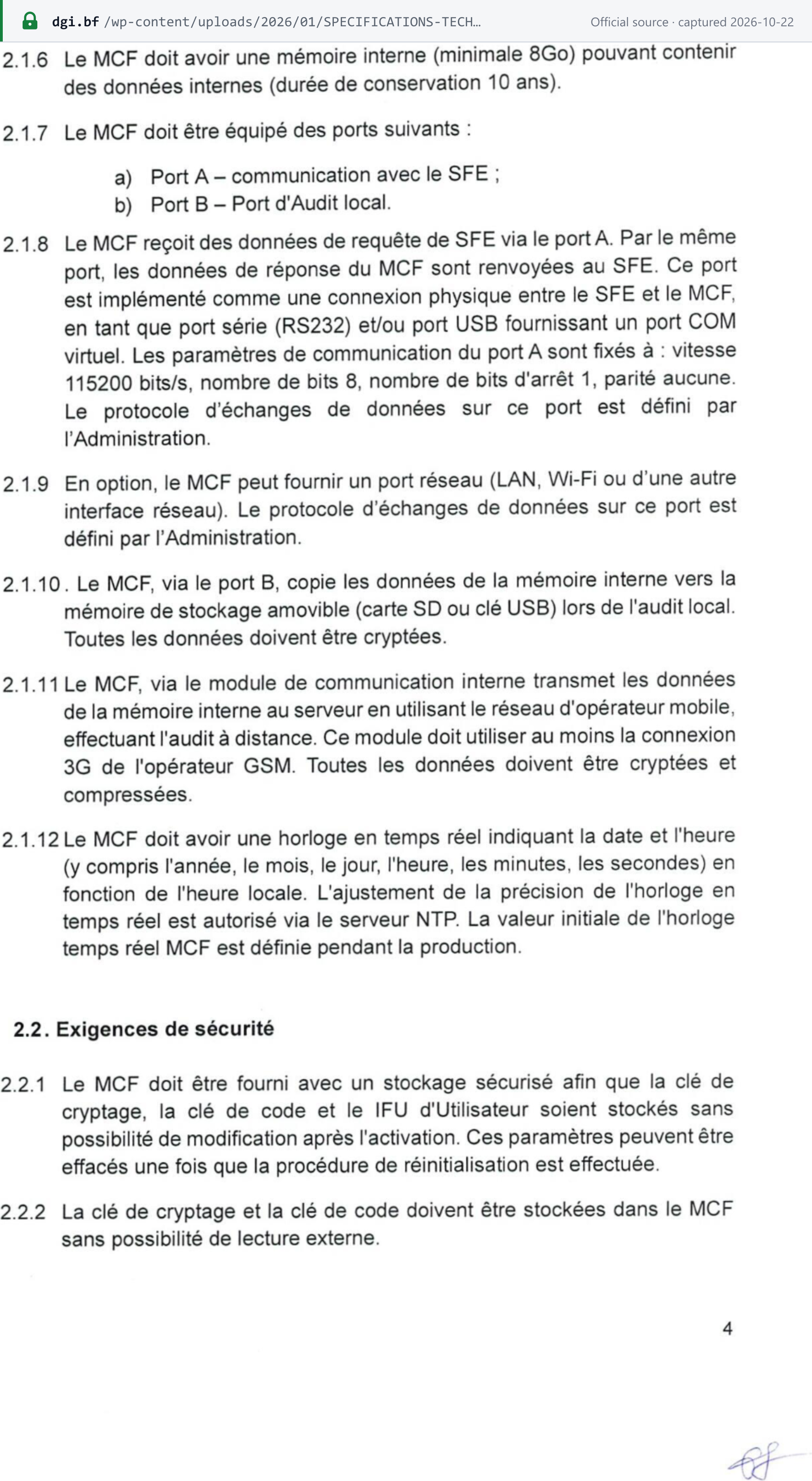
Format: no XML schema; not Peppol-based. The DGI publishes no XML, UBL, CII or JSON invoice schema, and the system does not use Peppol. Arrêté 2025-0049 defines the FEC as "une facture émise sous différents formats" through certified systems, carrying the mandatory mentions and the security elements. UFs print on thermal paper that must stay legible for at least 10 years. The SFE connects to the MCF by serial (RS232) or USB link, and the SFE specification requires the data printed on the invoice and the data exchanged with the MCF to be identical. [3] [6] [7]
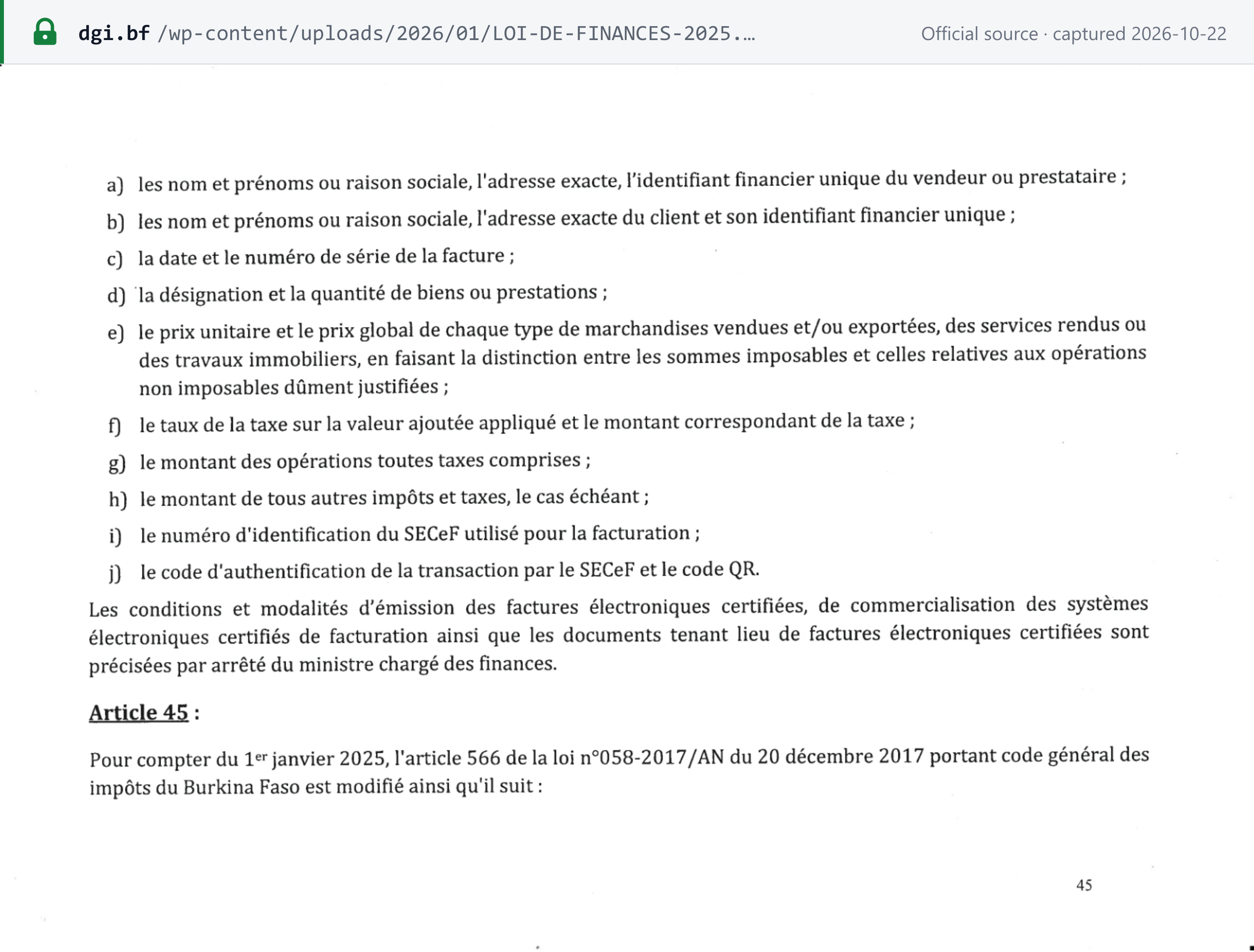
Mandatory mentions and integrity elements (CGI art. 564 §2). Every FEC must show: [1]
- a) the seller's name or business name, exact address and IFU;
- b) the client's name or business name, exact address and IFU;
- c) the date and serial number of the invoice;
- d) the description and quantity of goods or services;
- e) unit and total prices, separating taxable from duly justified non-taxable amounts;
- f) the VAT rate applied and the VAT amount;
- g) the total including taxes;
- h) other taxes due;
- i) the identification number of the SECeF used;
- j) the SECeF's transaction authentication code and the QR code.
The SECeF specification lists the security elements the MCF generates: the SECeF code of the invoice, the machine identifier in the form NIM-ACNT (the device's unique number plus its activation counter), counters, the MCF date and time, and a QR code "au format défini par l'Administration". The device number (NIM) has the format MMCCNNNNNN: manufacturer code, certificate code and serial number. [6]
The SFE specification adds further content, including the invoice time, an invoice number from an unbroken ascending sequence per financial year, the ISF identifier of the software, the operator's name, totals by tax group, and stamp duty on cash payments. It defines six invoice types (sale, advance and credit note, each in a domestic and an export version) and tax groups that include VAT at 18% (group B) and 10% (group C). [7]
E-reporting. The FEC texts (the CGI articles, the three arrêtés and the DGI's technical notes) set no e-reporting obligation separate from the device's transmission of invoice data to the DGI.
Onboarding: how to comply
1. Choose the right device. The DGI and CCI-BF practical guide sets out two routes: [11]
- Businesses that invoice with software keep it, provided it is homologated or being homologated (or they apply to homologate their own software), and buy from the CCI-BF distribution network "un module de contrôle pour chaque ordinateur ou serveur qui héberge un logiciel de facturation". The MCF is set up and tested with the help of DGI and CCI-BF technicians.
- Businesses without invoicing software buy invoicing units: "Chaque site d'émission de facture (site de vente) devra être doté en unité de facturation".
Every device must be activated by the approved distributor before it is used (arrêté 2025-0049 art. 5). [3]
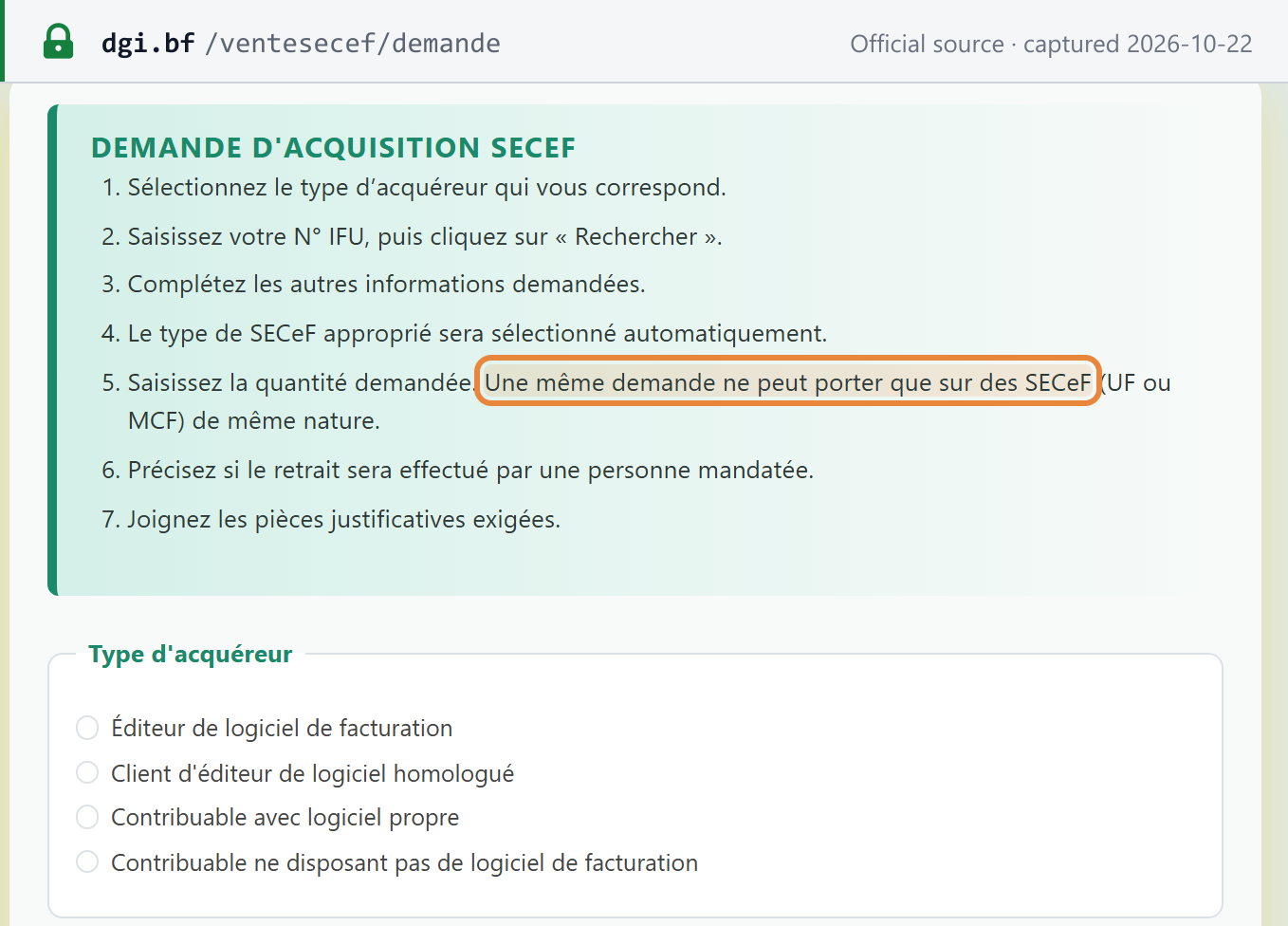
2. Order through the GDSECeF platform. Taxpayers register on the "Gestion de distribution SECeF" (GDSECeF) platform, reachable from the DGI and CCI-BF websites, at dgi.bf/ventesecef/demande. The request form asks for the acquirer type (invoicing-software publisher, client of a homologated software publisher, taxpayer with its own software, or taxpayer without invoicing software), the IFU, identity and contact details, the quantity, whether a proxy will collect the devices, and supporting documents. The platform selects the device type from the acquirer type, and one request can cover devices of one kind only, UF or MCF. Each tax office has focal points for the FEC. [12] [2]
3. Price and tax treatment of the devices. The 28 August 2026 communiqué sets a promotional price of FCFA 150,000 for any invoicing unit or control module, applicable until 31 December 2026; the prices that apply from 1 January 2027 are to be announced. Imports and domestic sales of physical certified invoicing systems are exempt from VAT and customs duties for 2025 (LF 2025 art. 57) and 2026 (LF 2026 art. 40). [2] [1] [10]
4. Ongoing obligations. Under arrêté 2025-0049 arts 6 and 7, issuers must, among other things: [3]
- install a certified system at every place of sale and notify the DGI in writing of any change of location;
- display "EXIGEZ LA FACTURE ELECTRONIQUE CERTIFIEE" at every till or payment point;
- keep a replacement device in case the installed one fails;
- issue regularisation FECs within 48 hours for sales not invoiced because of a device malfunction;
- pay for the compulsory annual maintenance by the designated distributor;
- keep the device where it can reach the GSM network, and report connectivity faults;
- for UF users, use thermal paper that keeps the print legible for at least 10 years.
Accreditation of devices and software (homologation)
Every SECeF model and every SFE must be homologated before it is marketed or used. A comité d'homologation, appointed by the Director General of Taxes, checks conformity and reliability; the procedure takes at most 20 working days from filing (arrêté 2025-0047 art. 4). A successful model receives an individual attestation of conformity with a device identifier, or an ISF (identifiant de système de facturation) for software. A taxpayer that has developed its own SFE and does not market it must go through the same procedure (art. 12). [4]
The homologation procedure note requires, for devices, prototype samples and a 48-hour continuous mass-invoicing test on the prototype at the DGI. An SFE need not support every invoice type and tax group, but may be used only for those validated during homologation. [8]
The DGI keeps a public register of homologated SFE software. The first entry was homologated on 3 June 2026, and the register listed nine programs after the homologation of 15 October 2026. An attestation of conformity can be checked with the DGI's attestation checker. [13] [17]
Testing and connection modes
The DGI publishes no public sandbox. The SECeF specification provides a device test mode, set at activation, which deactivates itself after a number of days set by the administration and cannot be reactivated, only reset. [6]
Issuing is device-based only: an MCF connected to homologated software, or a standalone UF. The FEC texts describe no portal or API route for issuing invoices.
Penalties
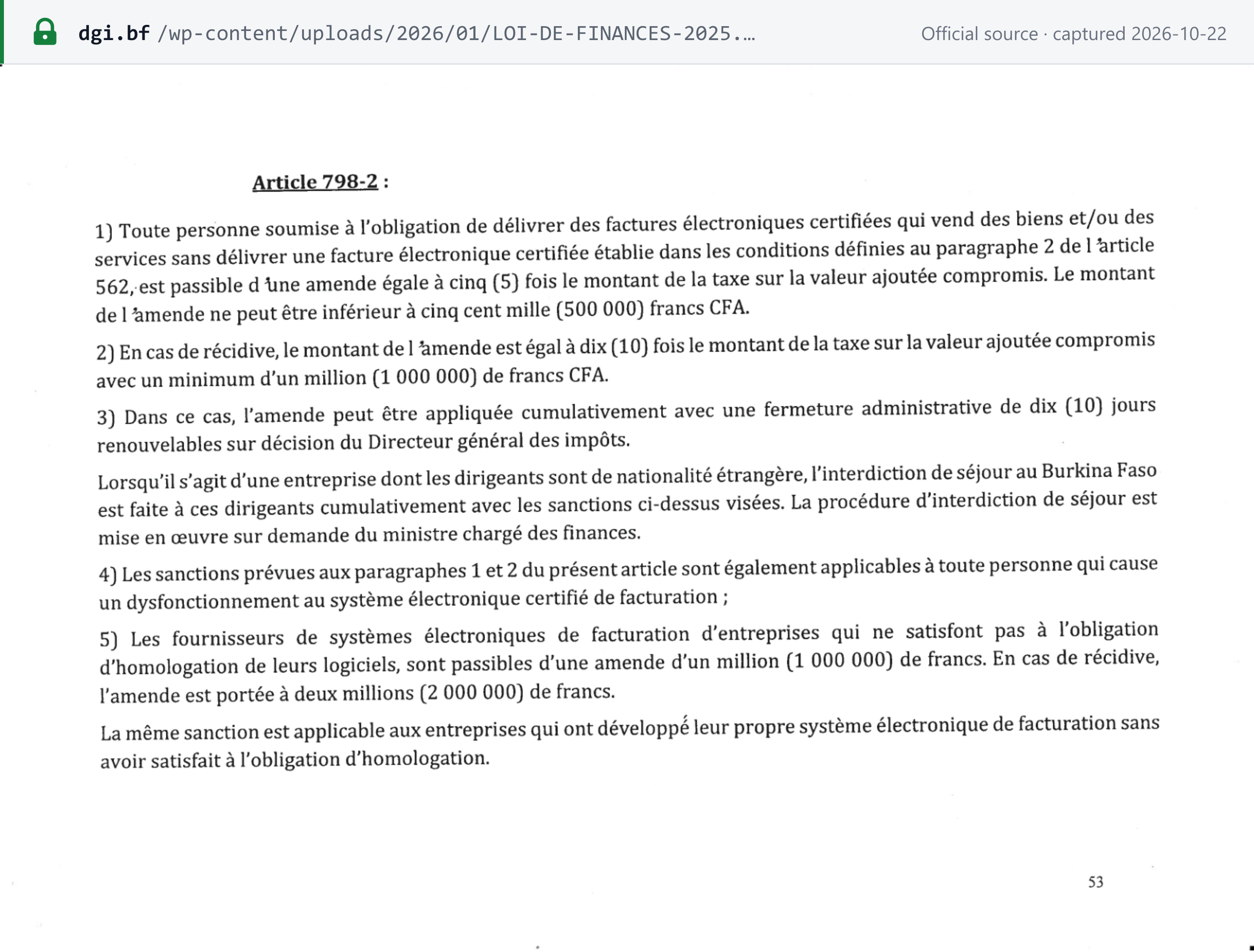
Failing to issue an FEC (CGI art. 798-2, inserted by LF 2025 art. 54). [1]
| Breach | Penalty |
|---|---|
| Selling goods or services without issuing an FEC (§1) | 5 times the VAT compromised, minimum FCFA 500,000 |
| Repeat offence (§2) | 10 times the VAT compromised, minimum FCFA 1,000,000 |
| Repeat offence, additional sanction (§3, which follows the repeat-offence paragraph: "Dans ce cas…") | The fine may be combined with an administrative closure of 10 days, renewable by decision of the Director General of Taxes. For an enterprise whose managers are foreign nationals, a ban on those managers staying in Burkina Faso is added, on the request of the finance minister |
| Causing a malfunction of the certified invoicing system (§4) | The penalties of §§1 and 2 |
| Supplier of business invoicing software that fails to have it homologated (§5) | FCFA 1,000,000; FCFA 2,000,000 on repeat. The same applies to enterprises that developed their own system without homologation |
| Modifying an SFE, or using another person's identity, to issue fraudulent or falsified FECs (§6) | FCFA 2,000,000 per invoice, without prejudice to criminal sanctions |
Taxpayers still on the paper invoice (CGI art. 798-1). A facture normalisée that does not comply with art. 564 §1, or that carries inaccurate mentions, is fined FCFA 100,000 per invoice. [1]
Enforcement posture, dated. The DGI and CCI-BF communiqué of 28 August 2026 grants 30 days after each device-sale date (7 September, 2 November and 1 December 2026) for conformity, and states that the DGI will support taxpayers' progressive take-up. The communiqué does not amend art. 798-2. [2]
Frequently asked questions
Does the 1 July 2026 date announced at the launch still apply?
At the 6 January 2026 launch, the DGI announced compulsory use for large enterprises from 1 July 2026, but no legal text sets that date and devices were not on sale by then. The legal obligation has applied to DGE and DME taxpayers since 1 January 2025 under CGI art. 564 §2, and the DGI and CCI-BF communiqué of 28 August 2026 sets the operative calendar: certified devices went on sale on 7 September 2026 for DGE taxpayers and software publishers, and are scheduled for 2 November 2026 (DME, régime du réel normal) and 1 December 2026 (DME, régime non déterminé), each followed by a 30-day conformity window. [16] [1] [2]
We already invoice from an ERP. Do we still need a device?
Yes. The software must be homologated by the DGI and must pass each invoice to a control module (MCF) that adds the security elements; you need one MCF for each computer or server that hosts the invoicing software. Software developed in-house must go through the same homologation. [11] [4]
Is there an API or XML format we can integrate with?
No. The DGI publishes no XML, UBL or JSON invoice schema, and the system is not Peppol-based. Integration runs through a homologated SFE connected to a physical MCF; the data-exchange protocol and the QR-code format are defined by the administration and not published. [6]
What does a device cost?
FCFA 150,000 per invoicing unit (UF) or control module (MCF), a promotional price that applies until 31 December 2026; prices from 1 January 2027 have not been announced. Imports and domestic sales of the devices are exempt from VAT and customs duties for 2025 and 2026. Annual maintenance by the designated distributor is compulsory and at the taxpayer's cost. [2] [10] [3]
We are a foreign company without a permanent establishment in Burkina Faso. Must we issue FECs?
No. CGI art. 566 §2 exempts enterprises without a permanent establishment in Burkina Faso, and their invoices count as documents standing in for an FEC under arrêté 2025-0048. [1] [5]
What happens if the device is offline or breaks down?
The MCF stores invoices and keeps working offline until the days since its last transmission or the number of unsent transactions exceed limits set by the DGI, at which point it blocks. You must keep a backup device and issue regularisation FECs within 48 hours for sales not invoiced because of a malfunction. [6] [3]
What are the penalties?
Selling without issuing an FEC is fined 5 times the VAT compromised, with a minimum of FCFA 500,000; a repeat offence is fined 10 times the VAT compromised, with a minimum of FCFA 1,000,000, and for a repeat offence the fine may be combined with a 10-day administrative closure. Suppliers of unhomologated invoicing software face FCFA 1,000,000 (FCFA 2,000,000 on repeat), and fraudulent FECs FCFA 2,000,000 per invoice (CGI art. 798-2). [1]
How do we check that a software vendor is approved?
The DGI publishes a public register of homologated SFE software and an online checker for attestations of conformity on dgi.bf. Only homologated software connected to an MCF can produce an FEC. [13] [17]
Recent changes
- 2026-08-28 — The DGI and the CCI-BF set the device sale calendar: from 7 September 2026 for DGE taxpayers and software publishers, 2 November 2026 for DME taxpayers under the régime du réel normal and 1 December 2026 for the régime non déterminé, each with a 30-day conformity window, at FCFA 150,000 per device until 31 December 2026. (DGI / CCI-BF) — see event
- 2026-06-03 — The DGI homologated the first business invoicing software (SFE) on its public register. (DGI)
- 2026-01-06 — The Minister of Economy and Finance officially launched the FEC in Ouagadougou. (DGI)
- 2025-12-29 — The DGI issued the technical specifications for SECeF devices and SFE software, the homologation procedures and the homologation committee (notes de service 2025-0884, 0885, 0887 and 0889). (DGI)
- 2025-02-05 — Arrêtés 2025-0047, 2025-0048 and 2025-0049 set the homologation and distribution of devices, the documents standing in for an FEC, and the conditions for issuing FECs. (DGI)
- 2025-01-01 — The 2025 Finance Law (Loi n°042-2024/ALT) made the FEC compulsory for DGE and DME taxpayers (CGI art. 564 §2) and introduced penalties (CGI arts 798-1 and 798-2). (DGI)
Related resources
- E-invoicing status and networks by country
- Fiscal devices and certified cash registers
- CTC e-invoicing models explained
- DR Congo VAT guide — a fiscal-device system with the same UF, MCF and SFE vocabulary
- Validate a Burkina Faso IFU — the identifier every FEC carries for seller and business buyer
- Burkina Faso tax changes on Lookuptax