E-invoicing in Nigeria: the Merchant Buyer Solution (MBS)
Overview
Nigeria's system is the National E-Invoicing & Electronic Fiscal System (EFS), which the Nigeria Revenue Service (NRS), formerly FIRS, says is "also known as the Merchant Buyer Solution (MBS)". Taxpayers meet it as the MBS portal at einvoice.nrs.gov.ng, which calls itself "NRS-MBS". Older FIRS-era material says "FIRSMBS" and points to einvoice.firs.gov.ng, which now redirects to einvoice.nrs.gov.ng. [1] [3]
Before an invoice reaches the buyer, the supplier's system sends it through an NRS-accredited provider to the MBS. NRS validates it, and the invoice carries an Invoice Reference Number (IRN) and a QR code that anyone can check. NRS describes MBS as "Nigeria's national electronic invoicing framework", built on the OpenPeppol interoperability framework. [8] [15]
Legal basis in one line. Nigeria Tax Act 2025 (NTA) s.158, which requires every taxable person making a taxable supply to implement the fiscalisation system NRS deploys, and s.23 of the Nigeria Tax Administration Act 2025 (NTAA), as cited by NRS. NRS Information Circular 2026/05 restates the duties and the penalty. [4] [1] [5]
| Nigeria | |
|---|---|
| System | National E-Invoicing & Electronic Fiscal System (EFS), operated as the Merchant Buyer Solution (MBS) |
| Model | Clearance: NRS validates each invoice before exchange; B2C receipts are reported |
| B2B | In force for large taxpayers (annual turnover above ₦5 billion) since 1 August 2025; full compliance due by 31 July 2026. Medium taxpayers (₦1–5 billion): go-live date 1 July 2026, no NRS go-live confirmation published; emerging taxpayers (below ₦1 billion) scheduled for 1 July 2027 |
| B2G | Same platform; no separate B2G system or B2G date |
| B2C | In scope: simplified tax invoice (receipt) with a QR code, reported to NRS |
| Non-residents | In scope per the MBS portal FAQ: foreign companies must comply "if they transact with Nigerian businesses". NRS publishes no connection mechanics for them |
| Format | UBL-based schema. The MBS validator and API documentation take UBL in JSON format (or CSV); other NRS documents also list XML |
| Network | NRS MBS platform through accredited Access Point Providers (APPs) and System Integrators (SIs). Peppol (PINT NG) is used for cross-border exchange and is not mandatory domestically |
| Integrity | IRN, cryptographic stamp (CSID) and QR code |
| Authority | Nigeria Revenue Service, through the MBS portal |
| Legislation | NTA 2025 s.158 and s.153(4); NTAA 2025 s.23 (as cited by NRS); NRS Circular 2026/05 §7 |
For the VAT rate, registration and the general invoice rules, see the Nigeria VAT guide.
Mandate status & timeline
Status: mandatory for large taxpayers; medium and emerging taxpayers phased in by turnover. NRS announced the phased rollout in a public notice of 17 February 2026, as its 20 July 2026 notice records ("the Public Notice issued on 17 February 2026"). [3] [1] [2]
| Segment | Annual turnover | Stakeholder engagement | Pilot | Go-live | Post go-live review | Compliance enforcement | Status |
|---|---|---|---|---|---|---|---|
| Large | Above ₦5 billion | Completed | Completed | 1 August 2025 (implementation extended to November 2025) | January–March 2026 | April–June 2026; full compliance due 31 July 2026 | In force |
| Medium | ₦1 billion – ₦5 billion | January–March 2026 | April–June 2026 | 1 July 2026 | October–November 2026 | January–March 2027 | Go-live date passed; NRS has not published a go-live confirmation |
| Emerging | Below ₦1 billion | January–March 2027 | April–June 2027 | 1 July 2027 | October–November 2027 | January–March 2028 | Scheduled |
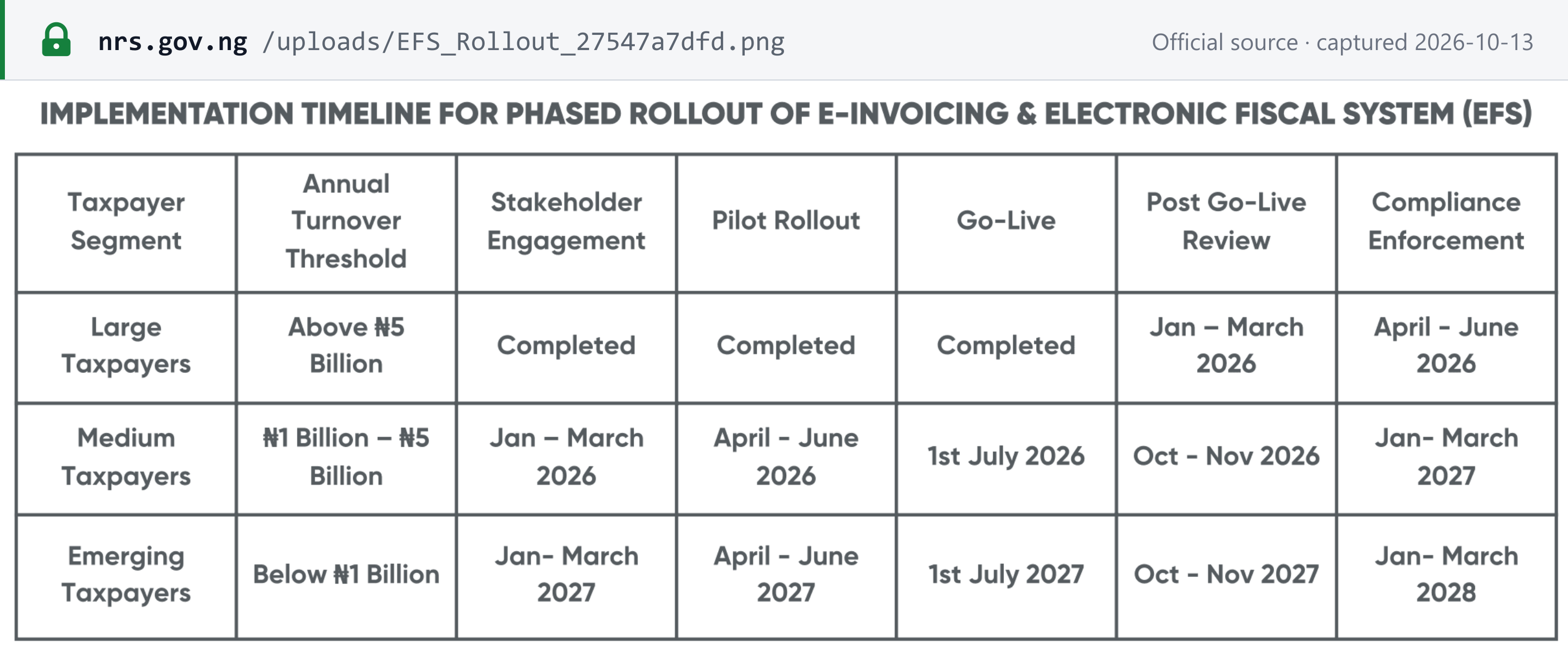
The dates are indicative. NRS: "Timelines are indicative and subject to adjustment by the NRS based on operational readiness and stakeholder feedback." It adds that "Compliance enforcement shall commence only after the completion of engagement, pilot, and post-go-live review phases for each taxpayer segment", and that "Detailed guidelines and technical specifications will be issued ahead of each phase." [1]
Large taxpayers. NRS says the MBS "officially went live on 1st August 2025 for Large Taxpayers", after a pilot deployed in January 2025, and that "the effective implementation for this category was subsequently extended to November 2025". [1]
The latest announced step: 31 July 2026. A public notice of 20 July 2026 began compliance monitoring of large taxpayers and stated that "all large taxpayers that are yet to commence or complete implementation processes are required to ensure full compliance on or before 31 July 2026". Compliance, per the notice, means:
- onboarding completed on the NRS Merchant Buyer Solution;
- taxpayer systems integrated "through approved Access Point Providers (APPs) and/or Systems Integrators (SIs)";
- all validation and testing activities completed;
- active transmission of invoices to the NRS e-invoicing platform;
- as a buyer, receiving "only compliant e-invoices with a valid Invoice Reference Number (IRN) from suppliers".
Taxpayers that miss the deadline face "regulatory and enforcement actions … in accordance with the provisions of the relevant tax laws and regulations". [3] [29]
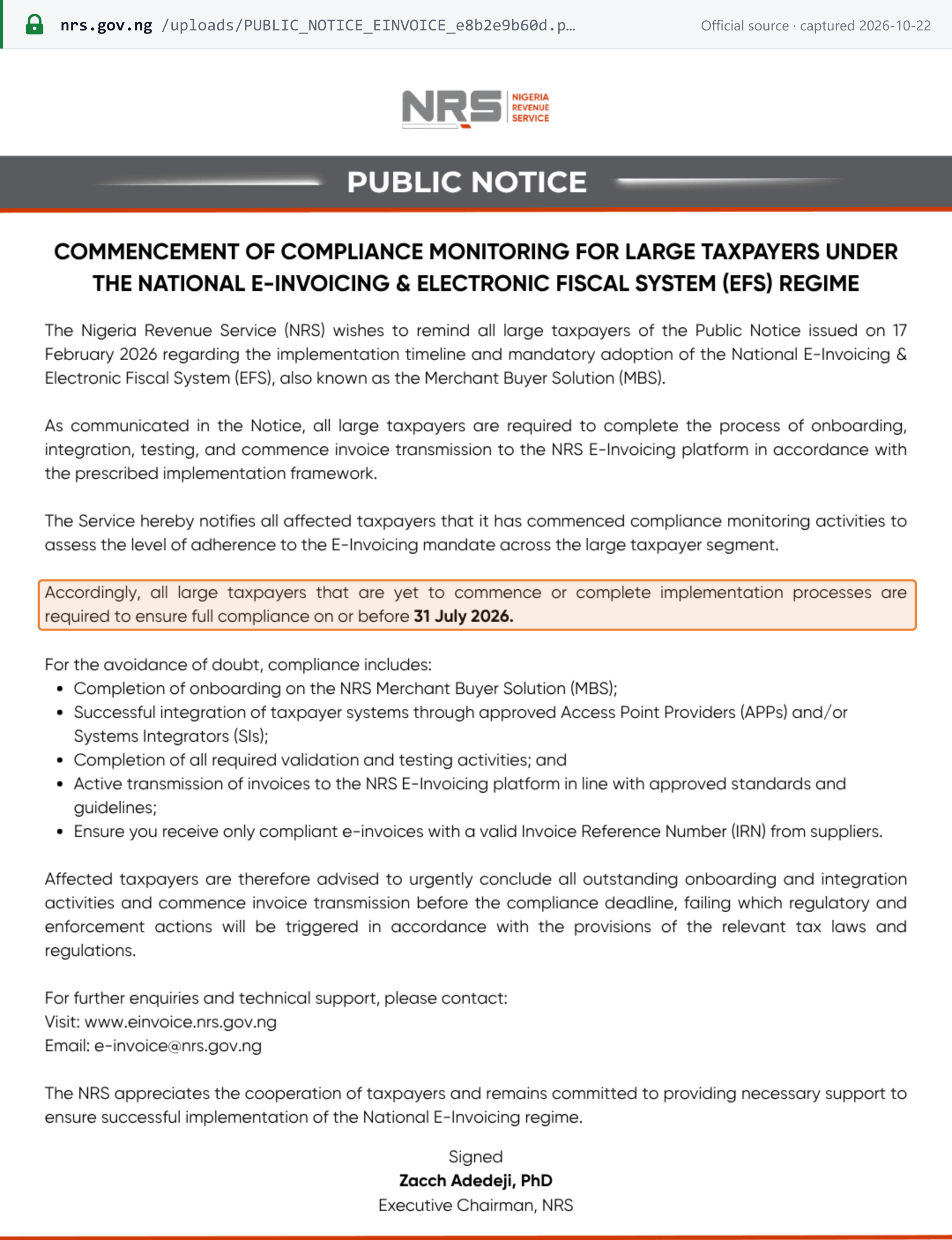
Medium taxpayers. Their go-live date was 1 July 2026. NRS has published no notice confirming that the phase went live and none moving the date. On the published table, medium taxpayers are now in the post go-live review window (October–November 2026), with enforcement due January–March 2027. [2]
Further phases. Emerging taxpayers (below ₦1 billion) are the last segment on the published table. NRS publishes no exemption by size (see Scope).
Pilot and early milestones
The pilot was deployed in January 2025. NRS's MBS site gives the milestones as system integration and validation in Q1 2025, performance optimisation and sensitisation in Q2 2025, operational go-live for large taxpayers in Q3 2025, and the Peppol-based cross-border invoicing framework being finalised in Q4 2025. [1] [15]
Postponements
There has been one. For large taxpayers, the 1 August 2025 go-live stood, but "effective implementation" was extended to November 2025 (17 February 2026 notice). For large taxpayers the table had put compliance enforcement in April–June 2026; the 20 July 2026 notice then set 31 July 2026 as the compliance deadline. No other date in the table has moved. [1] [3]
Legal basis
| Instrument | Date | What it does |
|---|---|---|
| Nigeria Tax Act 2025 (Act No. 7 of 2025), s.158 "Fiscalisation of supplies for VAT" | Official Gazette No. 117, Vol. 112, 26 June 2025; in force 1 January 2026 (s.203) | A taxable person making a taxable supply "shall implement the fiscalisation system deployed by the Service". The system may include fiscal equipment, software or a secured communication system "for electronic invoicing and data transfer" |
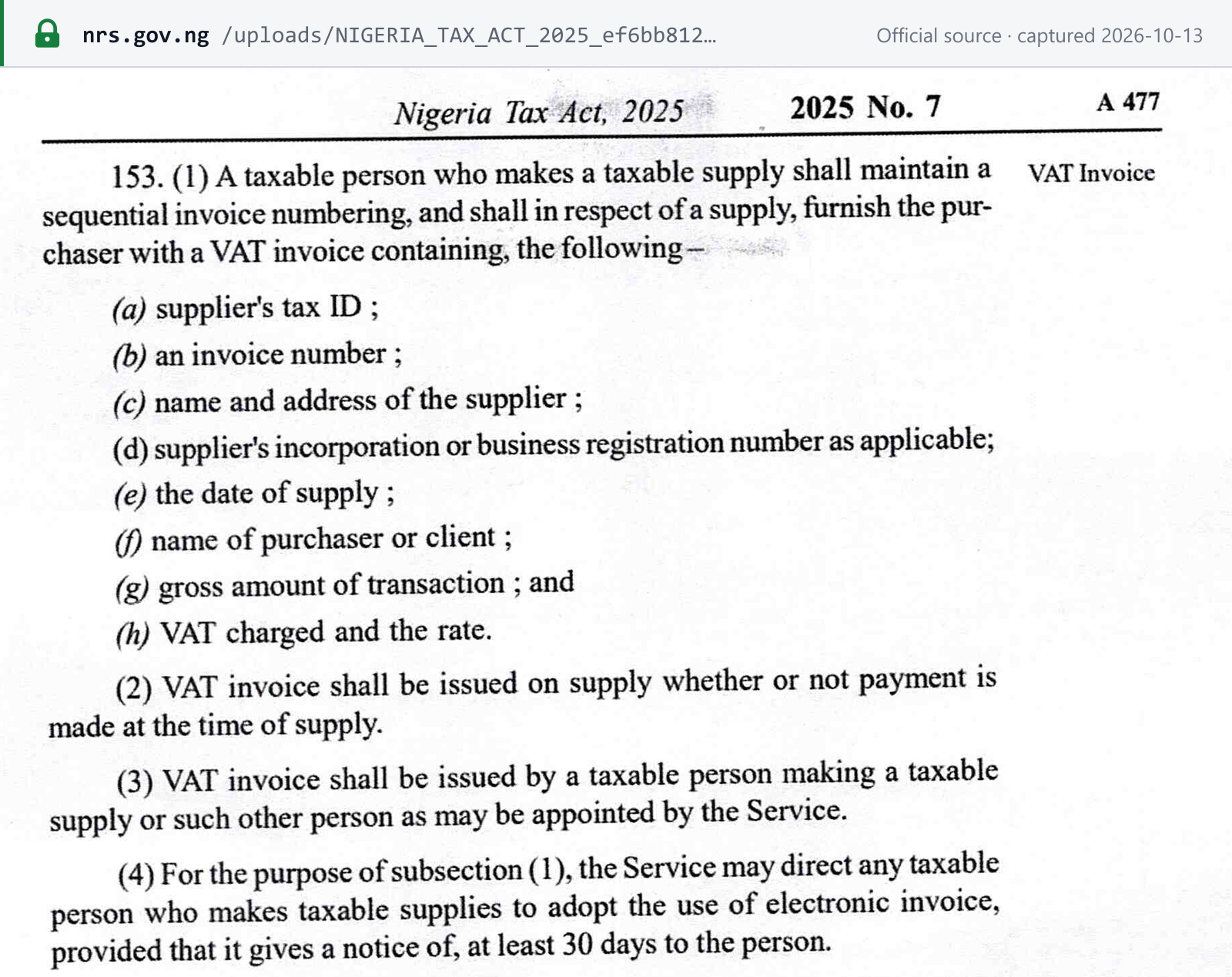
| Same Act, s.153(4) | As above | NRS "may direct any taxable person who makes taxable supplies to adopt the use of electronic invoice", on at least 30 days' notice |
| Nigeria Tax Administration Act 2025 (Act No. 5 of 2025), s.23 | 2025 | Cited by NRS as the section "which empowers the Service to deploy technology for the administration and collection of taxes" |
| NRS Information Circular No. 2026/05 (VAT administration), §§7.0–7.1 | Published 29 June 2026 | Restates the EFS obligations and sets out the penalty; replaces FIRS Circular 2022/14 |
| NRS public notice — implementation timeline | 17 February 2026 | Phased rollout by turnover |
| NRS public notice — compliance monitoring for large taxpayers | 20 July 2026 | Full compliance for large taxpayers by 31 July 2026 |
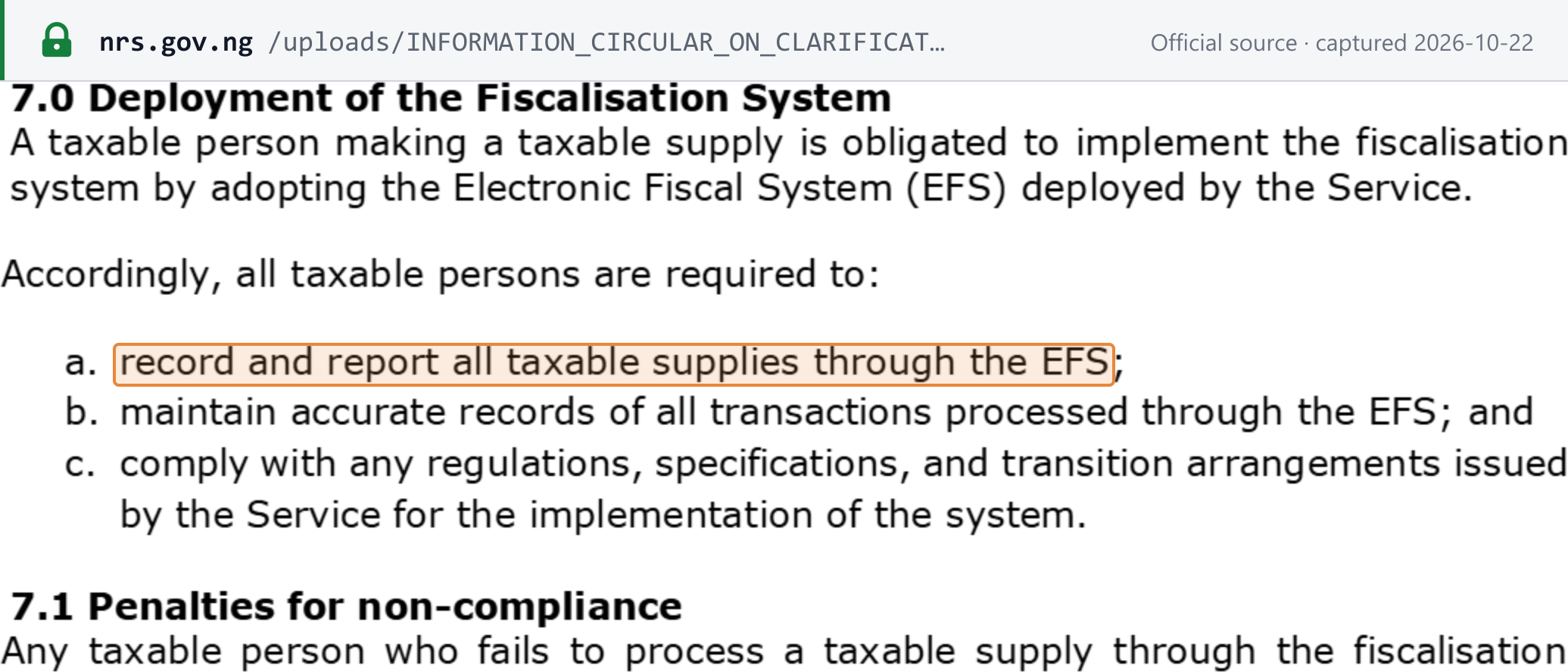
The circular puts the statutory duty in NRS's own words: "A taxable person making a taxable supply is obligated to implement the fiscalisation system by adopting the Electronic Fiscal System (EFS) deployed by the Service." Every taxable person must record and report all taxable supplies through the EFS, keep accurate records of the transactions processed through it, and comply with the regulations, specifications and transition arrangements NRS issues. [5]
Technical standards. No separate e-invoicing regulation or gazetted technical standard has been published. The MBS portal lists the standards the platform adopts, including UBL, ISO 20022, ISO 27001, PKI, NTP timestamping, LEI, Peppol and HSN codes. These are platform design standards, not legal instruments, and NRS's technical documents state that they are "not intended to be legally binding". [19] [7]
Scope
Who. The statutory duty in NTA s.158(1) falls on "a taxable person making a taxable supply", with no size limit. The turnover bands come from NRS's rollout timetable, not from the Act. The MBS portal says "Certain entities may be exempt from implementing e-Invoice based on specific criteria defined by NRS", but NRS has published no criteria. [4] [8]
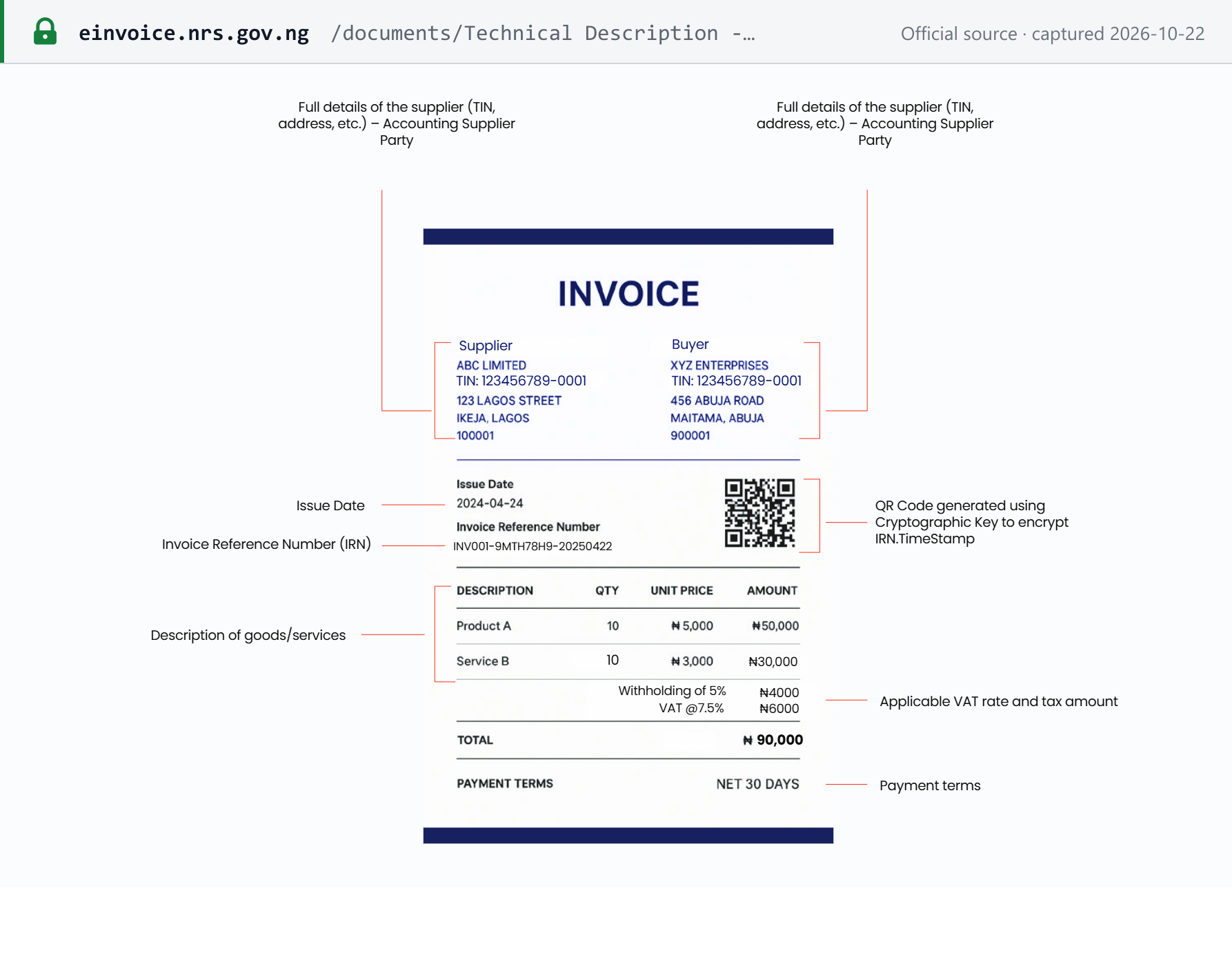
B2B. In scope. The supplier's system sends the e-invoice through its access point; NRS validates and signs it; and it is delivered to the buyer's access point and system. NRS's Technical Description says the e-invoice "is automatically sent from the supplier's system to the buyer's system without any human interaction". The FAQ in the same document says the system applies to "All eligible taxpayers transacting B2B, B2G, and qualifying B2C invoices, as notified by the FIRS". [7]
B2G. In scope on the same platform. There is no separate B2G system, and NRS publishes no separate B2G date: government entities are not a separate row in the rollout table. Since December 2025 the API carries an invoice_kind field with the values B2C, B2B, B2G and G2B. [10] [7]
B2C. In scope. The merchant issues a Simplified Tax Invoice (a receipt) with a QR code and reports it to NRS. NRS documents describe the reporting window differently:
- the Technical Description says the supplier reports the e-invoice "within 24 hours", and the portal's use-case page gives a retail example where the company "must report all issued invoices(receipt) within 24 hours";
- NRS's technical overview for financial institutions says the merchant reports "near-real time";
- the enablement form lets a taxpayer choose "Real-time or Near real-time reporting".
None of these is set in the Act or in a public notice. NRS publishes no value threshold for the simplified invoice. [7] [16] [14] [20]
What each invoice type carries. Per the Technical Description: [7]
| Tax Invoice (B2B and B2G) | Simplified Tax Invoice (B2C) |
|---|---|
| Full supplier and buyer details (TIN, address) | Seller name and address only; buyer identity (TIN, phone number, NIN) optional |
| Issue date, IRN, QR code | Issue date, IRN, QR code |
| Description, quantity and unit price | Basic description |
| VAT rate and tax amount; payment terms | Total excluding tax, tax rates charged, total due |
"Both invoice types must comply with the FIRS e-Invoicing schema and be submitted electronically to FIRS." [7]
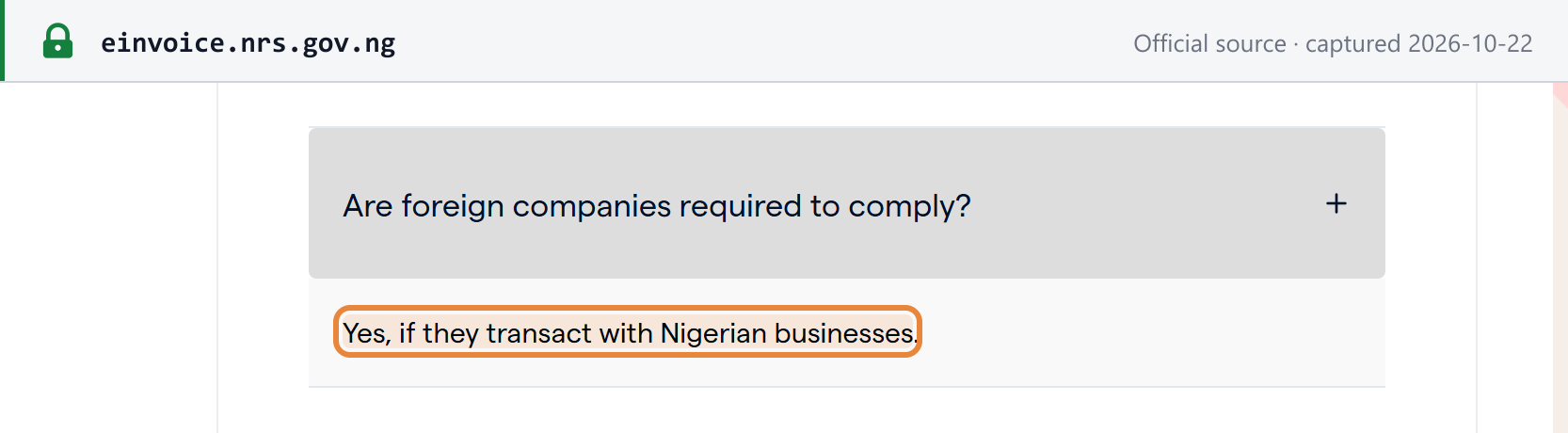
Non-established businesses. In scope. The MBS portal FAQ asks "Are foreign companies required to comply?" and answers "Yes, if they transact with Nigerian businesses." NRS publishes no onboarding or connection mechanics specific to foreign companies. [27]
NRS also addresses is export customers: a Nigerian supplier may enter the customer's foreign tax identifier, provided the customer neither supplies taxable goods or services in Nigeria nor derives income from Nigeria; otherwise the customer must register for a Nigerian Tax ID. NRS says "A new cross-border schema is being prepared". [10]
Buyer without a Tax ID. For a B2B customer that has no TIN or Tax ID yet, NRS lets the supplier put the incorporation number in the TIN field, prefixed "RN-" according to NRS's text, although NRS's own example is "RC-847789". [10]
Exempt and zero-rated supplies. They still go through the system, with their tax category. Since February 2026 the platform also carries the tax categories Withholding_Tax, Stamp_Duty and Exempted, and NRS's use cases include an invoice mixing standard-rated items with items zero-rated as medical goods, and a zero-rated tuition receipt. NRS publishes no exclusion for imports or reverse-charge self-accounting. [10] [16]
Document types and corrections. The portal lists invoices, credit notes, debit notes and refund notes; the Technical Description code list adds self-billed and other document types. On correcting a cleared invoice NRS's own documents differ:
- the Technical Description FAQ: "Can I cancel an invoice after it has been signed? No. However, you can issue a Credit Note or Debit Note to adjust it", and every adjustment document "must reference an original invoice with a valid IRN";
- the portal's resources page: "e-Invoices can be rejected or cancelled within 72 hours, with corrections resubmitted as needed".
Format & network
The model: clearance, with reporting for B2C. NRS's Technical Description says "all invoices undergo validation and clearance by FIRS before submission", and its technical overview names the model "Continuous Transaction Controls (CTC)". The flow:
- The supplier's system (or its System Integrator) builds the invoice and its IRN.
- The supplier's Access Point Provider sends it to the MBS.
- NRS validates it in near real time; a valid invoice is assigned its IRN and validation details. Statuses are Submitted, Valid, Invalid and Canceled.
- The validated invoice goes to the buyer, through the buyer's access point for B2B, with a QR code the buyer can check.
"What happens if an invoice is not signed? It is considered invalid and not fiscally recognized by the FIRS." [7] [14] [8]
Data format: UBL-based; NRS documents differ on JSON and XML. The invoice data model follows the Universal Business Language (UBL). NRS's resources page and its Technical Description list JSON or XML, and its technical FAQ says e-invoices "should be submitted in the approved XML format as specified in our documentation". The portal's invoice validator and API documentation (version 1.1), however, offer only "UBL (JSON Format)" or CSV. The access-point rules refer to "JAdES for JSON invoices" for digital signatures. Confirm the submission format with your access point provider or NRS. [8] [7] [24] [21] [22]
The network: MBS through accredited providers; Peppol for cross-border. Domestic invoices travel through NRS-accredited Access Point Providers to the MBS platform. NRS is also Nigeria's Peppol Authority: "The National Revenue Service (NRS) serves as the official PEPPOL Authority for Nigeria", and Peppol service providers must pass PINT NG compliance testing. But Peppol is not mandatory for domestic invoicing. NRS's MBS FAQ: "Is PEPPOL mandatory in Nigeria? — No. PEPPOL is mainly used for cross-border e-invoicing." The Technical Description says "Peppol is only required for users involved in cross-border invoice exchanges", and the enablement form's PEPPOL field is for organisations in cross-border trade. Participants carry their Tax ID under the ISO/IEC 6523 identifier scheme ICD 0244. [6] [11] [7] [12] [15]

For how the Peppol network and PINT profiles work, see the Peppol guide.
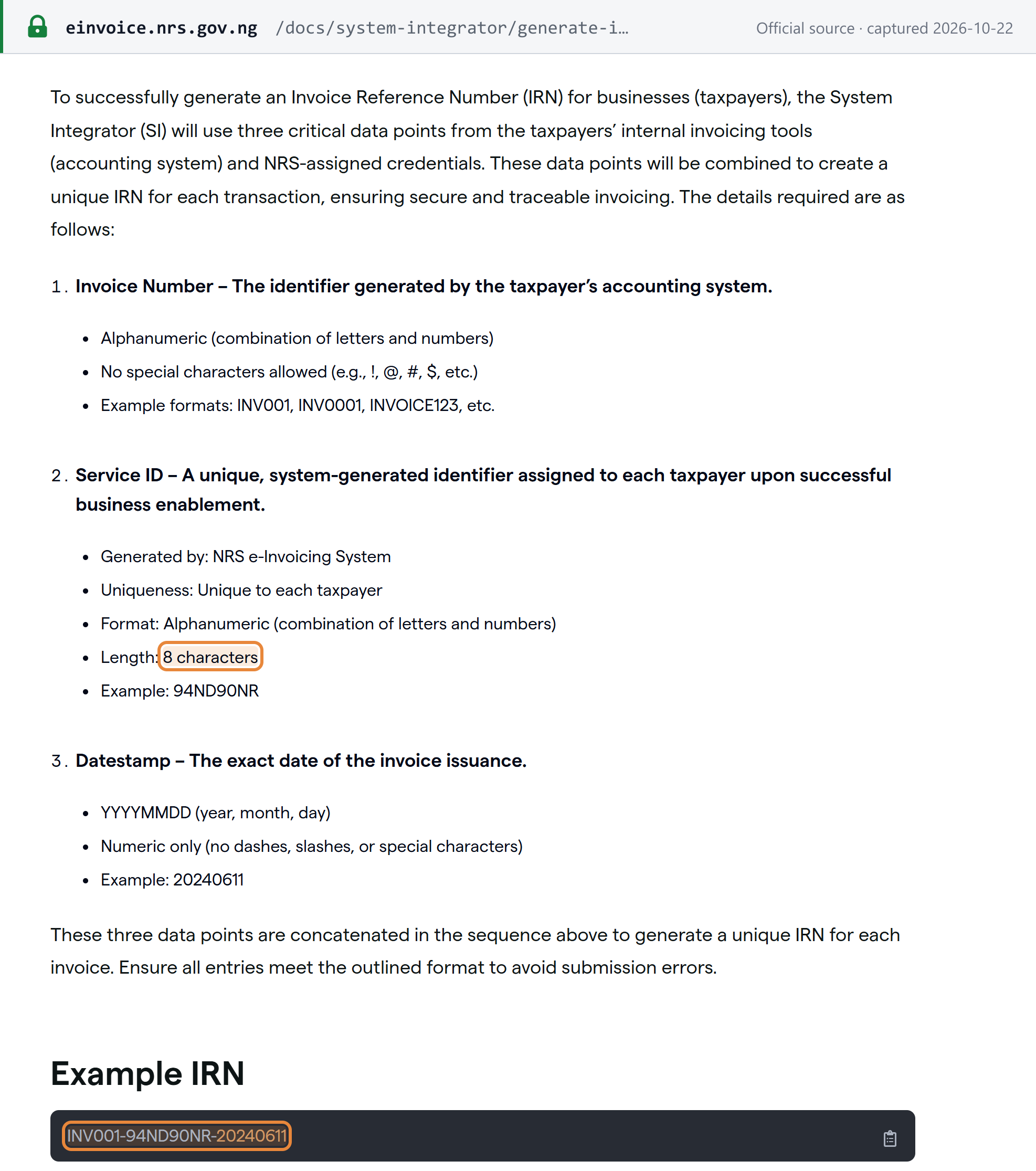
The IRN. The System Integrator or the taxpayer's own system builds the IRN from three parts, joined in this order: [9]
- Invoice number from the taxpayer's accounting system: alphanumeric, no special characters (e.g. INV001).
- Service ID: an 8-character alphanumeric code NRS assigns on business enablement (e.g. 94ND90NR).
- Datestamp: the invoice issue date as YYYYMMDD (e.g. 20240611).
NRS's example is INV001-94ND90NR-20240611. The system rejects an invoice whose IRN and business ID combination already exists. [9] [7]
QR code and cryptographic stamp. Each taxpayer downloads crypto keys (a public key and a certificate) from the MBS dashboard. The system appends a UNIX timestamp to the IRN ("IRN.timestamp"), encrypts it with the NRS-issued key, and renders the result as a QR code. NRS's Cryptographic Stamp Identifier (CSID) "serves as a unique digital signature applied to e-invoices". Buyers and the public can validate an invoice with the MBS360 app or the portal's Validate IRN tool. A printed invoice is valid only if its IRN and CSID can be validated electronically. Access Point Providers must encrypt data using SHA-256 hashing and ECDSA. [18] [23] [22] [7]
- Payment status. Invoices are updated through the API as PENDING, PAID or REJECTED, and since April 2026 PARTIAL for instalment payments. The Technical Description FAQ: "Only PAID invoices that are signed, transmitted, and confirmed are considered fiscally reportable."
- VAT exemptions and withholding. Reported through specific schema fields and a post-payment endpoint.
- API change policy. NRS's changelog: "All updates announced below will remain optional for a period of three (3) months from their respective release dates, after which compliance will be enforced."
Onboarding: how to comply
1. Enable the business on the MBS portal. Per NRS's taxpayer manual: [12] [20]
- At einvoice.nrs.gov.ng, choose Businesses, then Register, as a taxpayer. "Enrolment takes about five minutes. You will need your TIN or Tax ID and access to the email address registered against it." The TIN cannot be changed afterwards.
- On the enablement form, answer the PEPPOL field (yes only for cross-border invoice exchange), pick a preferred Access Point Provider and choose real-time or near real-time reporting.
- After NRS approves the request, a password link goes to the registered email address; it expires 60 minutes after it is sent.
- Log in, set up two-factor authentication and IP whitelisting, and collect the credentials: the Business ID, the API key and secret key, and the crypto keys used for the QR code.
- Link one or more Access Point Providers and set a default. A taxpayer "can integrate with more than one Access Point Provider", and an APP needs the Submit Invoice permission to transmit.
A public enablement-status checker and the Validate IRN tool sit under the portal's MBS360 tools.
2. Choose an integration route. The portal lists two ways to create invoices: [8]
- MBS portal: one online form per invoice, or a batch upload from an Excel template. Suits low volumes.
- API: "Direct integration with taxpayer's ERP system", "Through Peppol service providers", or "Through non-Peppol technology providers".
Since November 2025 a taxpayer that integrates directly can report for fiscalisation with its own API keys, setting integrator_service_id to 00000. The 20 July 2026 notice, however, describes compliance for large taxpayers as integration "through approved Access Point Providers (APPs) and/or Systems Integrators (SIs)". Taxpayers planning a direct integration should confirm the route with NRS ([email protected]). NRS's FAQ puts an average implementation at "between 4 to 8 weeks". [10] [3] [24]
3. Test, then go live. The API has separate staging and production environments, each with its own API and secret keys. [17] A separate Simulation Portal accepts test invoices that "are not sent to tax authorities and have no legal validity". [28] For System Integrators and Access Point Providers, NRS's getting-started guide sets the go-live steps: contact NRS support to confirm onboarding; an NRS engineer carries out an integration review; then execute the necessary agreements and set up a settlement account, and switch the API keys, callback and webhook URLs and base URL to production. [25]
Accredited providers. NRS accredits two kinds of provider: [26] [15] [13]
- System Integrators (SIs) configure ERPs and point-of-sale systems, register devices and certificates, map data to the schema and generate IRNs.
- Access Point Providers (APPs) validate, encrypt and sign invoices, and transmit them between trading partners and NRS.
Applicants complete a pre-accreditation questionnaire; NRS's MBS site says they "must be registered Nigerian entities with valid tax identification, demonstrate strong technical capacity, meet data security standards, and comply with MBS governance requirements". The public Approved Service Providers Directory lists each provider as a System Integrator, Access Point Provider or both, with the status "Accredited" or "Provisional".
Peppol service providers. A provider that wants to exchange cross-border invoices over Peppol follows NRS's 12-step procedure, which includes an OpenPeppol membership application, a Service Provider Agreement with NRS as Peppol Authority, access to the Nigeria SMP, sandbox interoperability testing, PINT NG compliance testing and accreditation certification. A provider established in Nigeria contracts with NRS; a foreign provider registers with the Peppol Authority of its own country and "must also comply with the local requirements set by NRS" when serving Nigerian customers. [11]
Penalties
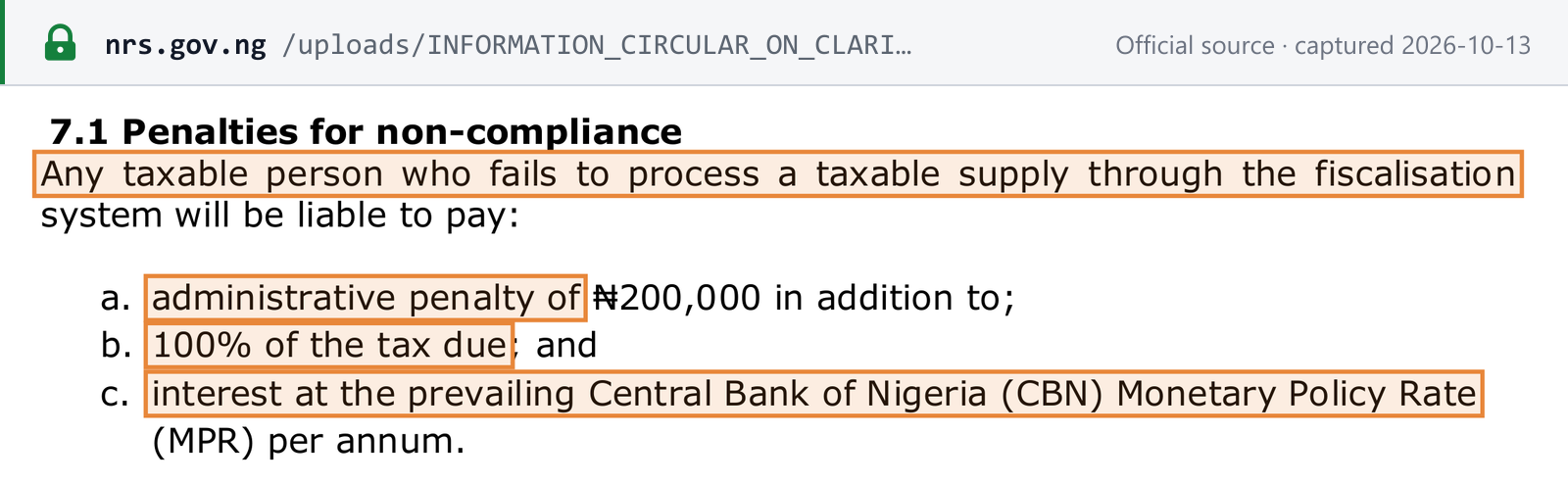
Failing to use the system. NRS Circular 2026/05 §7.1: "Any taxable person who fails to process a taxable supply through the fiscalisation system will be liable to pay: a. administrative penalty of ₦200,000 in addition to; b. 100% of the tax due; and c. interest at the prevailing Central Bank of Nigeria (CBN) Monetary Policy Rate (MPR) per annum." The penalty is not split by obligation: it applies to any taxable supply not processed through the system. [5]
Enforcement posture, dated.
- 17 February 2026. "Compliance enforcement shall commence only after the completion of engagement, pilot, and post-go-live review phases for each taxpayer segment." The table puts enforcement for large taxpayers in April–June 2026, for medium taxpayers in January–March 2027 and for emerging taxpayers in January–March 2028. [1] [2]
- 20 July 2026. Large taxpayers not fully compliant by 31 July 2026 face "regulatory and enforcement actions". [3]
NRS has published no report of enforcement actions taken.
Frequently asked questions
Our annual turnover is ₦3 billion. When do we have to be live, and when can NRS penalise us?
You are in the medium band (₦1 billion to ₦5 billion). NRS scheduled go-live for 1 July 2026, a post go-live review for October–November 2026 and compliance enforcement for January–March 2027. NRS calls these dates indicative, and it has published no notice confirming or moving the medium-taxpayer go-live. [2] [1]
Do we need Peppol to comply?
No. NRS says Peppol is mainly used for cross-border e-invoicing and is only required for users involved in cross-border invoice exchanges. Domestic invoices go to the Merchant Buyer Solution through an NRS-accredited Access Point Provider. [6] [7]
Can our ERP connect to NRS directly, or must we use an access point provider?
NRS lists direct integration with the taxpayer's ERP as an API route, and since November 2025 directly integrated taxpayers can report with their own API keys. But NRS's 20 July 2026 notice describes compliance for large taxpayers as integration through approved Access Point Providers and/or System Integrators. Confirm the route with NRS before relying on a direct connection. [8] [10] [3]
How is the IRN built, and who generates it?
The System Integrator or the taxpayer's system builds it from the invoice number, the 8-character Service ID NRS assigns on enablement, and the issue date as YYYYMMDD, joined in that order. NRS's example is INV001-94ND90NR-20240611. [9]
Can we cancel an invoice once NRS has validated it?
NRS's documents differ. The Technical Description says a signed invoice cannot be cancelled and must be adjusted by a credit or debit note that references the original IRN. The portal's resources page says e-invoices can be rejected or cancelled within 72 hours. [7] [8]
Our B2B customer has no Tax ID. What goes in the TIN field?
NRS allows the customer's incorporation number in the TIN field, prefixed RN- according to NRS's text, although NRS's own example is RC-847789. For an export customer you may use the tax identifier issued by its country, provided it neither supplies taxable goods or services in Nigeria nor derives income from Nigeria. [10]
What is the penalty for not using the system?
An administrative penalty of ₦200,000, plus 100% of the tax due, plus interest at the CBN Monetary Policy Rate per annum, for a taxable supply not processed through the fiscalisation system (NRS Circular 2026/05 §7.1). [5]
We are a small business with turnover below ₦1 billion. Are we exempt?
No size exemption is published. Emerging taxpayers (below ₦1 billion) are scheduled to go live on 1 July 2027, with enforcement in January–March 2028. The MBS portal says some entities may be exempt on criteria NRS defines, but NRS has published none. [2] [8]
Recent changes
- 2026-07-20 — NRS began compliance monitoring of large taxpayers and set 31 July 2026 for full compliance. (NRS)
- 2026-06-29 — NRS Information Circular 2026/05 restated the EFS obligations and the ₦200,000 plus 100% of tax plus MPR interest penalty. (NRS)
- 2026-02-17 — NRS published the phased rollout timeline: medium taxpayers go live 1 July 2026, emerging taxpayers 1 July 2027. (NRS) — see event
- 2026-01-01 — Nigeria Tax Act 2025, including s.158 on fiscalisation of supplies, took effect. (NRS)
- 2025-08-01 — The MBS went live for large taxpayers; effective implementation was later extended to November 2025. (NRS)
Related resources
- Nigeria VAT guide — rate, registration, invoice requirements
- Nigeria tax ID guide — the Tax ID used to enable a business on the MBS and to identify buyers; validate a Nigerian Tax ID
- E-invoicing status and networks by country
- Peppol e-invoicing
- CTC e-invoicing models explained
- Fiscal devices and certified cash registers
- Nigeria tax changes on Lookuptax
Important websites
- MBS e-invoicing portal (support: [email protected])
- MBS API documentation and API changelog
- Approved Service Providers Directory
- Nigeria Peppol Authority and service-provider accreditation
- Taxpayer's manual: Navigating the NRSMBS e-Invoice Portal (PDF)
- Technical Description of the MBS e-Invoicing System (PDF, large file)
- Nigeria Tax Act 2025 (PDF)
- NRS Information Circular 2026/05 on VAT administration (PDF)