E-invoicing in Serbia: SEF
Overview
Serbia's e-invoicing system is the Sistem elektronskih faktura (SEF), branded eFaktura. It is a central government platform run by the central information intermediary, a unit of the Ministry of Finance, which also supervises the law. Every e-invoice between businesses, and between businesses and the public sector, is sent and received through SEF. [1]
Legal basis in one line. The Law on Electronic Invoicing (Zakon o elektronskom fakturisanju, Official Gazette 44/2021, last amended by 80/2026) makes e-invoicing through SEF mandatory between VAT payers and with the public sector, and requires VAT to be recorded electronically in SEF. [1] [2]
| Serbia | |
|---|---|
| System | SEF — a central Ministry of Finance platform; an e-invoice is an authentic document only if sent through SEF |
| B2G | Mandatory since 1 May 2022 |
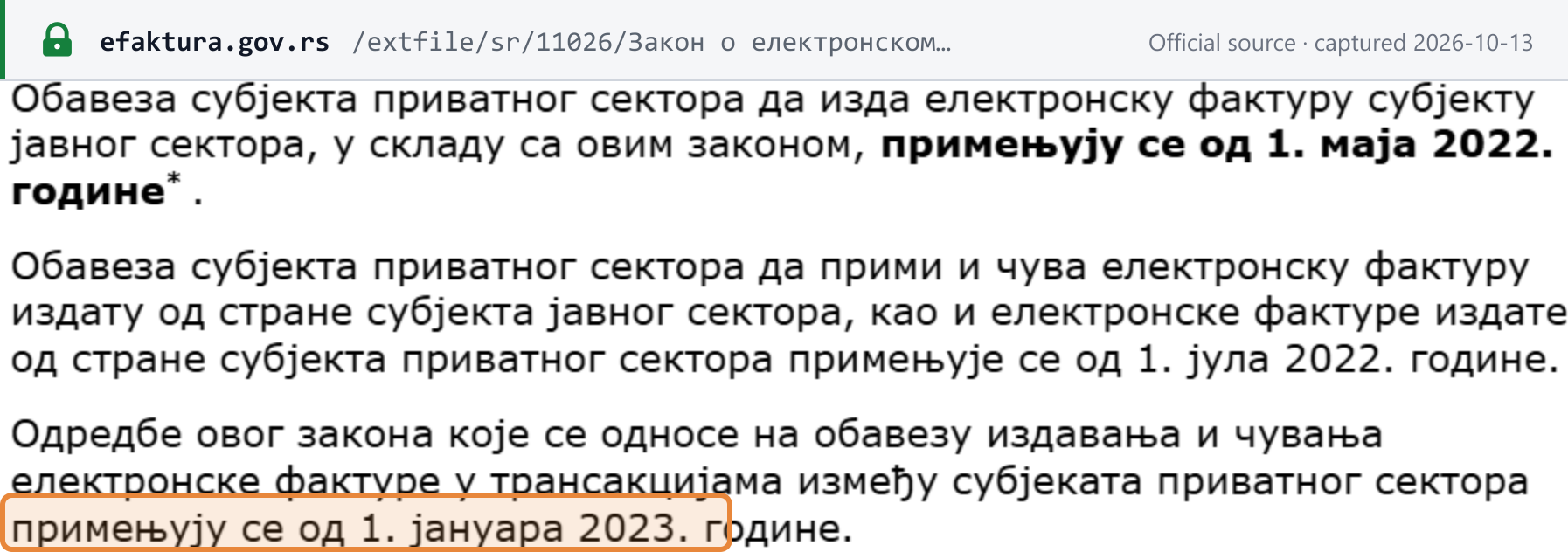
| B2B | Receiving since 1 Jul 2022; issuing since 1 Jan 2023 |
| B2C | Outside the e-invoicing law; retail is covered by e-fiscalisation |
| Non-residents | A foreign person's VAT tax representative issues through SEF |
| VAT recording | Electronic VAT recording in SEF by the 12th of the following month |
| Format | UBL 2.1 to the Serbian EN 16931 specification (SRBDT); not Peppol |
| Authority | Ministry of Finance (central information intermediary) |
| Legislation | Law on Electronic Invoicing (Off. Gazette 44/2021 … 80/2026); Rulebook on Electronic Invoicing (47/2023 … 71/2026) |
For Serbian tax identification numbers (PIB), see the Serbia tax ID guide.
Mandate status & timeline
| Phase | What became mandatory | Date | Status (at 13 Oct 2026) |
|---|---|---|---|
| B2G | Public sector receives and stores e-invoices; public-to-public and private-to-public invoices issued through SEF | 1 May 2022 | In force |
| G2B | Public sector issues e-invoices to private businesses; private businesses receive and store e-invoices | 1 Jul 2022 | In force |
| B2B | Private businesses issue and store e-invoices between themselves | 1 Jan 2023 | In force |
| VAT recording | Current electronic VAT-recording regime in SEF; input VAT recorded for VAT periods beginning after 31 Aug 2024 | 1 Jan 2024 | In force |
| Preliminary VAT return | SEF compiles a preliminary VAT return (PPP PDV) | VAT periods beginning after 31 Dec 2026 | Upcoming |
| Farmer purchases and exports | Purchases from non-VAT farmers recorded in SEF; customs-declaration list extended to exports | 1 Jul 2027 | Upcoming |
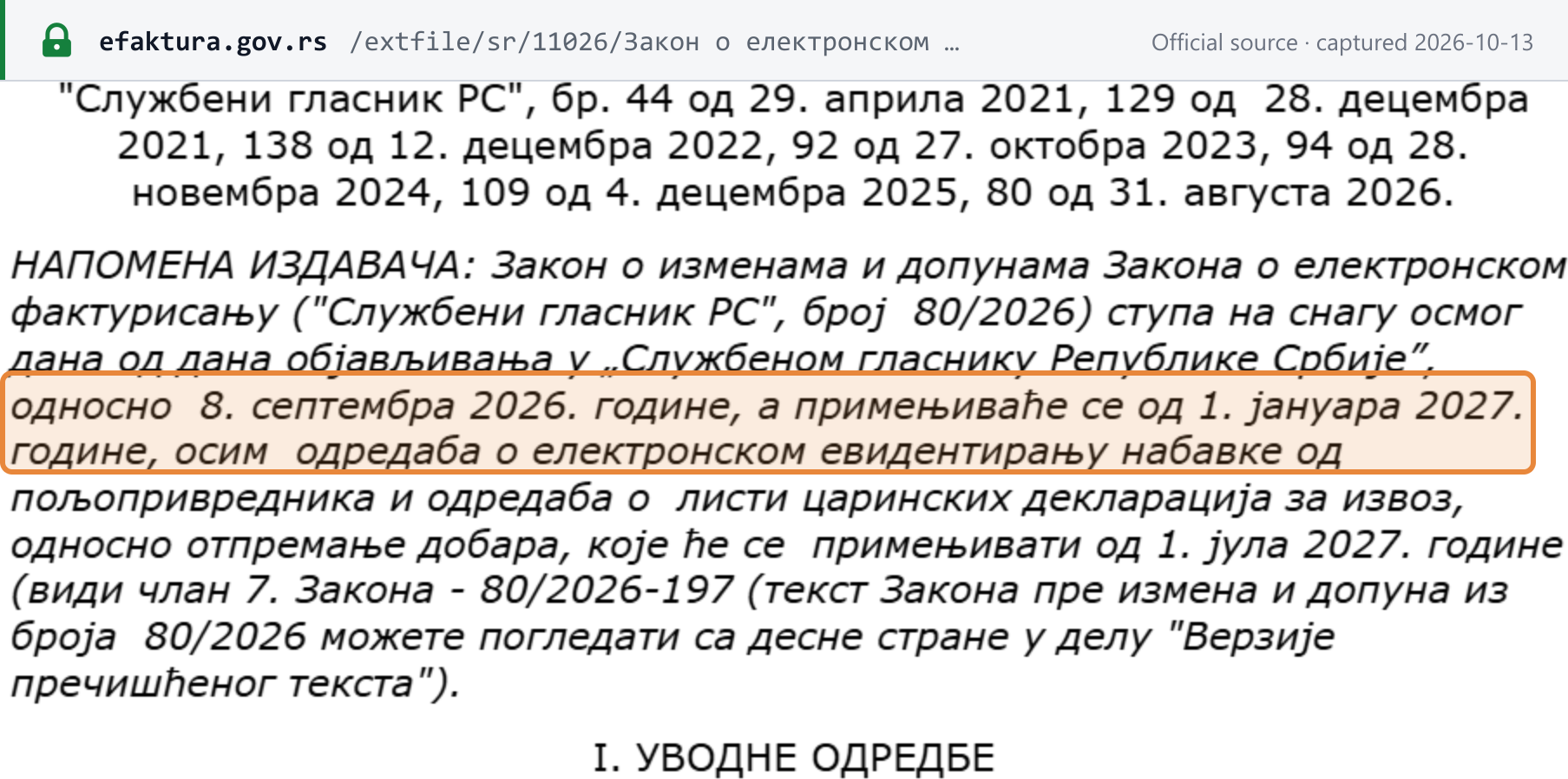
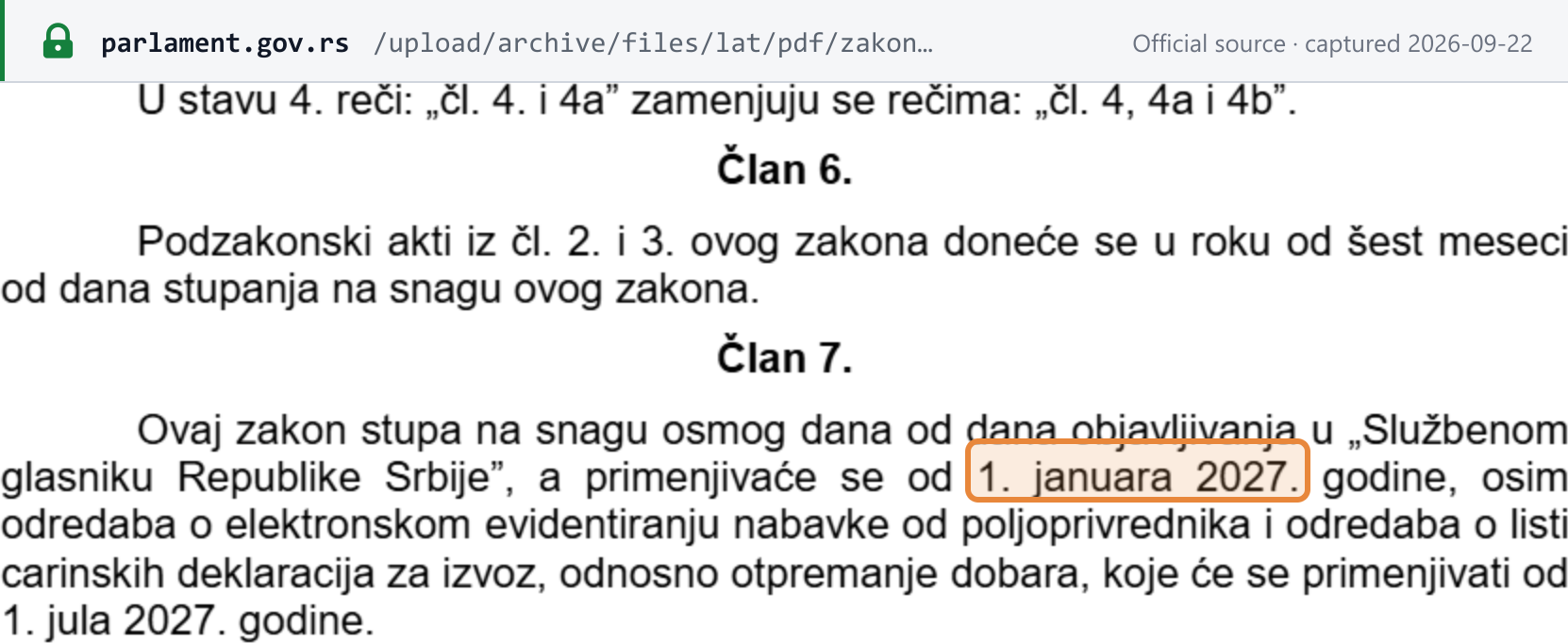
The 2026 amendment. The amending law published in Official Gazette 80/2026 on 31 August 2026 entered into force on 8 September 2026 and applies from 1 January 2027, except the rules on recording purchases from farmers and on the export customs-declaration list, which apply from 1 July 2027. Implementing rulebooks are due within six months of entry into force. [2]
Farmer purchases (from 1 July 2027). A VAT payer that buys agricultural or forestry products or agricultural services in Serbia from a farmer who is not registered for VAT must record those purchases in SEF, in aggregate per tax period, by the 12th of the following month. [1]
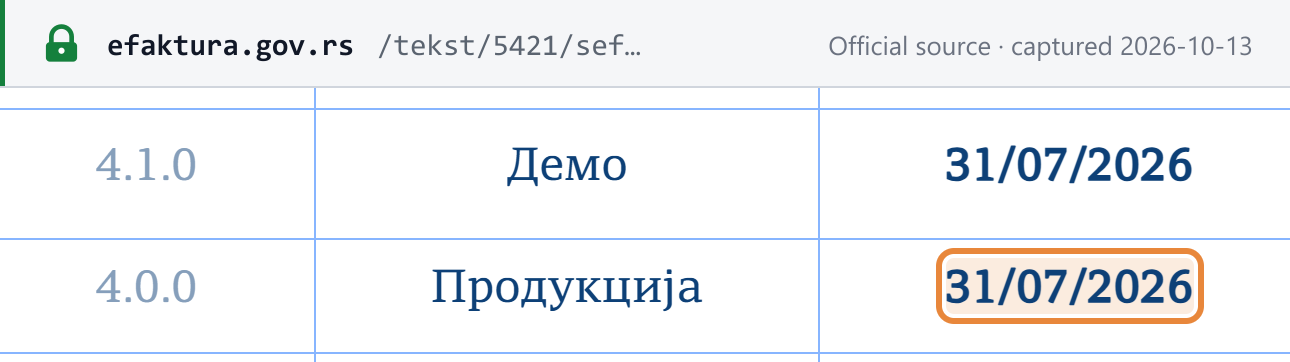
SEF releases. SEF version 4.0.0, whose July 2026 release had been postponed, went to production on 31 July 2026; versions 4.1.0 (2 August), 4.1.1 (21 August) and 4.2.0 (2 October 2026) followed. [4] [5]
Legal basis
| Instrument | Official Gazette | What it does |
|---|---|---|
| Law on Electronic Invoicing (Zakon o elektronskom fakturisanju) | 44/2021, amended 129/2021, 138/2022, 92/2023, 94/2024, 109/2025, 80/2026 | Who issues, SEF, VAT recording, retention, fines |
| Rulebook on Electronic Invoicing (Pravilnik o elektronskom fakturisanju) | 47/2023, last amended 71/2026 (31 Jul 2026) | Registration, access, VAT-recording mechanics, the preliminary VAT return |
| Decrees on information intermediaries, e-invoice storage, and the invoice management system | 69/2021 and later amendments | Intermediary consent, storage and inspection |
| SRBDT specification | Version of 18 Dec 2025 | Serbian application of EN 16931 |
| Law on Fiscalisation (Zakon o fiskalizaciji) | 153/2020, amended 96/2021, 138/2022, 80/2026 | Retail (B2C) receipts |
Legal effect. An e-invoice is an authentic document (verodostojna isprava) only if it was sent to the recipient through SEF (Art 8). [1]
Scope
Who must issue e-invoices (Art 3(1)):
- private-sector entities, for transactions between themselves;
- private-sector entities, for transactions with the public sector;
- public-sector entities, for transactions with the private sector;
- public-sector entities, for transactions between themselves;
- a foreign person's VAT tax representative in Serbia, for transactions with the private and public sectors.
A "private-sector entity" is a VAT payer that is not in the public sector. [1]
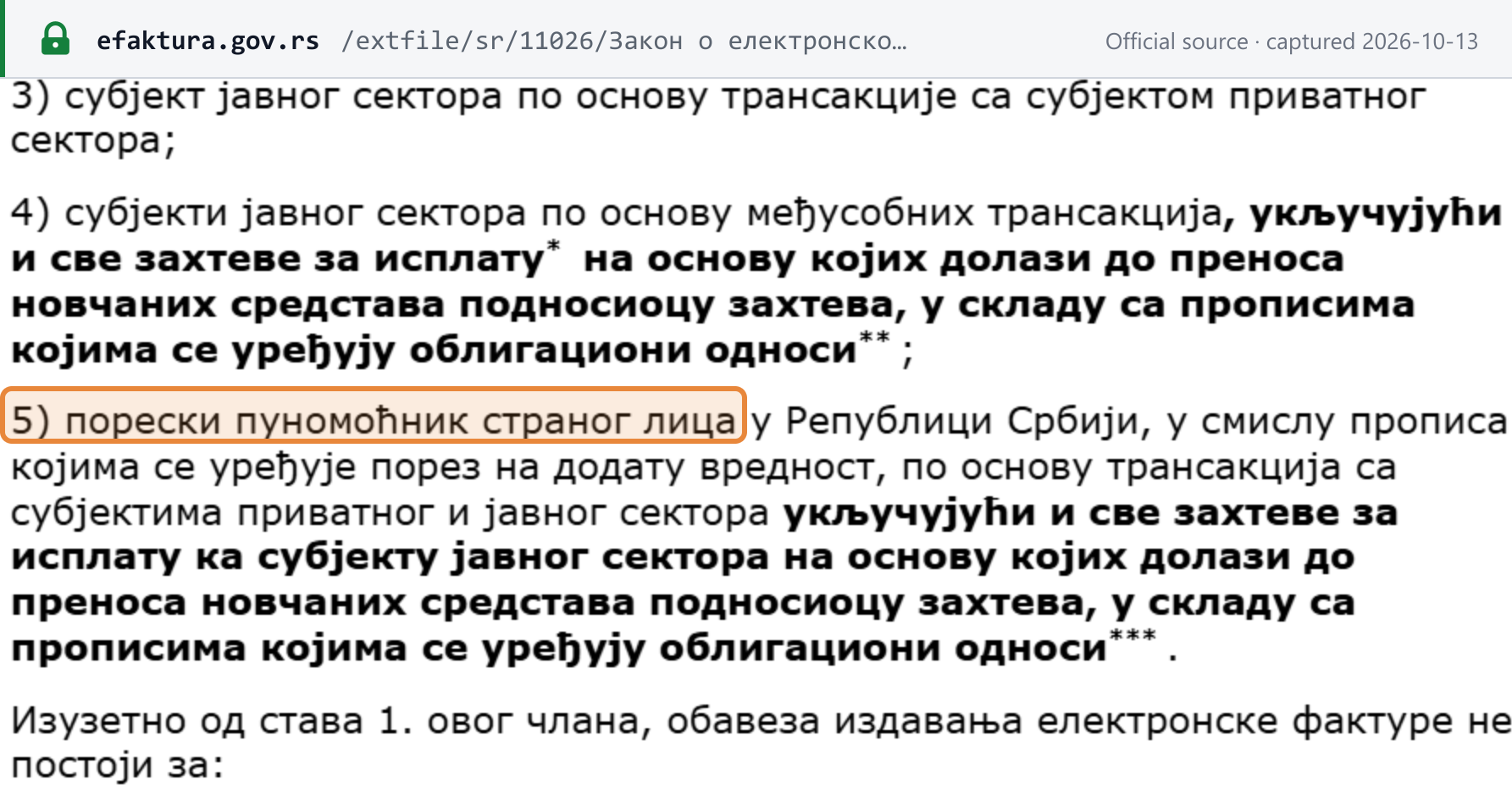
B2C. Out of scope. The law does not apply to individuals who are not self-employed, and retail sales are exempt from e-invoicing because they are covered by e-fiscalisation (see below). Since 109/2025, retail to a corporate-card holder, and retail to a public-sector body that asks for an e-invoice within 7 days, must still be e-invoiced; the e-invoice may not be issued before the fiscal receipt. [1]
Other exemptions (Art 3(2)) include defence and security procurement, electricity supply and offtake other than for final consumption, supplies without consideration, and certain public-revenue fees. [1]
Non-residents. The law names only a foreign person's VAT tax representative as an issuer; it places no issuing duty on a foreign supplier without one. Any recipient can receive invoices from foreign issuers through an information intermediary. Once SEF supports it technically, public-sector recipients must also receive EN 16931 invoices from foreign issuers directly, and private recipients may; we found no Ministry announcement that direct receipt is live. A foreign company's legal representative needs a Serbian electronic identity to log in to SEF. [1] [7]
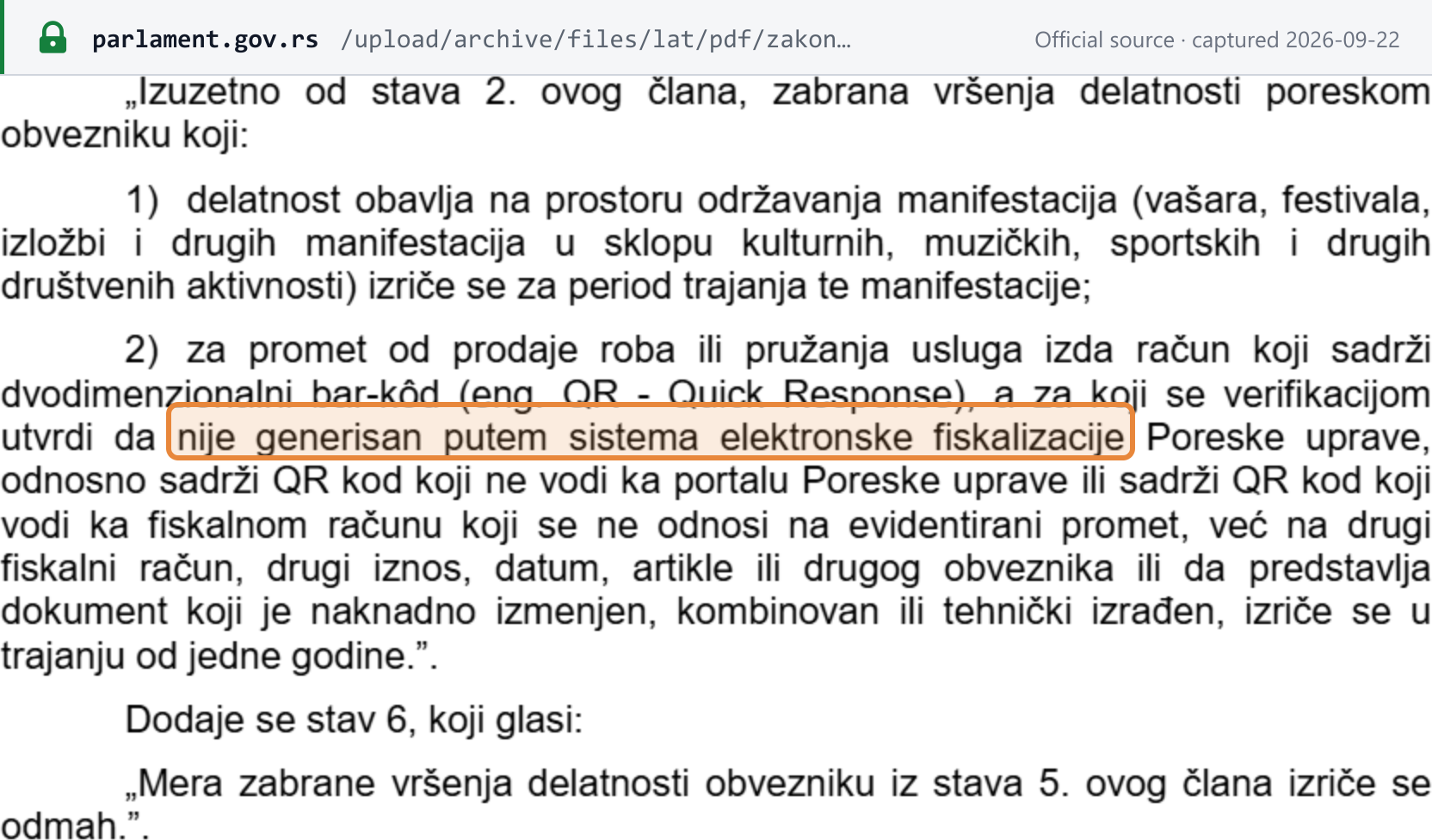
E-fiscalisation for retail. The Law on Fiscalisation has applied since 1 November 2021: retail sales and retail advances are recorded through an electronic fiscal device that issues a receipt with a QR code. Since 8 September 2026, issuing a receipt whose QR code fails verification — one not generated through the Tax Administration's e-fiscalisation system — leads to an immediate one-year ban on doing business. See fiscal devices and certified cash registers. [8]
Format & network
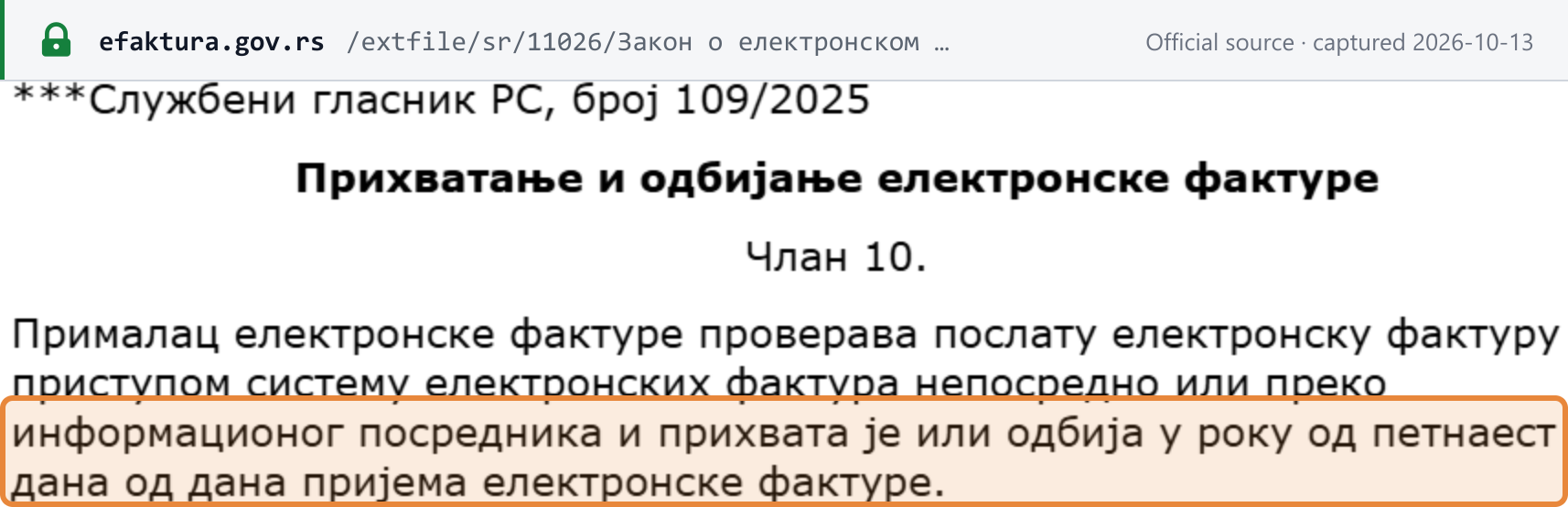
The model. SEF is a central platform: the issuer sends the invoice to SEF, and SEF makes it available to the recipient. An e-invoice counts as delivered when issued. The recipient must accept or reject it within 15 days. A public-sector recipient that stays silent is deemed to accept; a private recipient is notified again and, after a further 5 days of silence, is deemed to reject. See CTC e-invoicing models. [1]
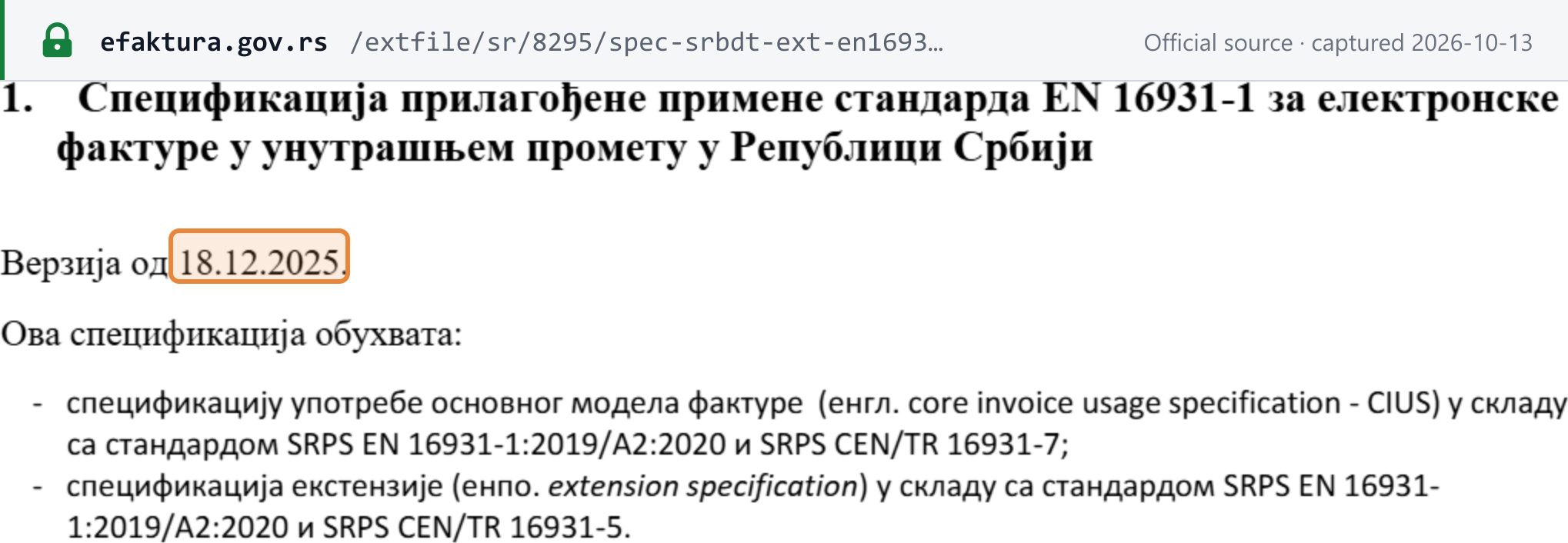
XML format. E-invoices follow the "Serbian standard of electronic invoicing", which is SRPS EN 16931-1, identical to EN 16931-1, in UBL 2.1 syntax. The Ministry's SRBDT specification (version of 18 December 2025) sets the CustomizationID urn:cen.eu:en16931:2017#compliant#urn:mfin.gov.rs:srbdt:2022. The Ministry also publishes a UBL 2.1 validation service. [6]
Peppol. SEF is a national platform: the Rulebook sets the Serbian UBL standard, and the Ministry publishes no Peppol access point, profile or participant scheme for it.
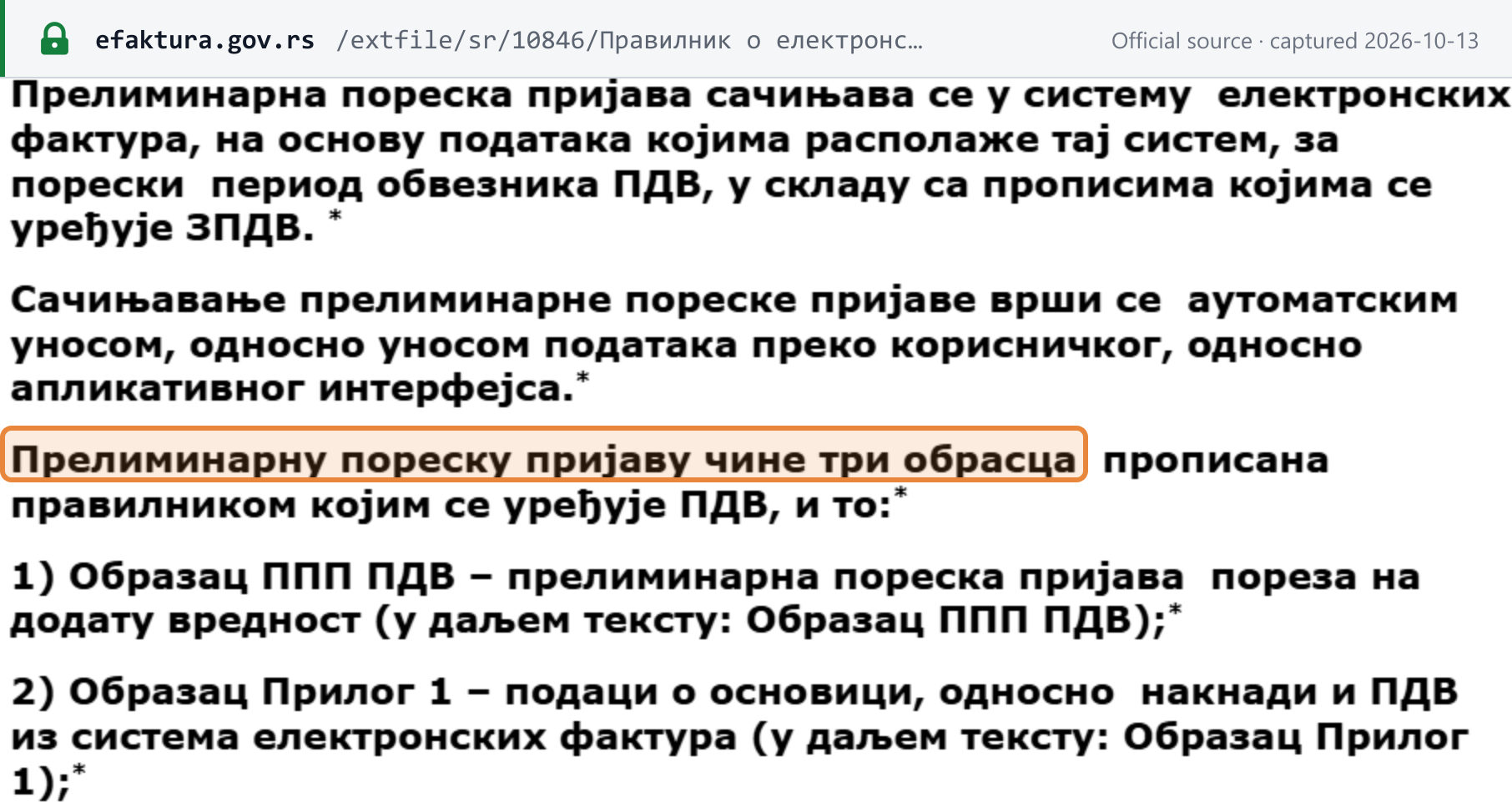
Electronic VAT recording. VAT payers record in SEF the VAT they calculate on supplies not covered by an e-invoice showing VAT, by the 12th of the month after the tax period (Art 4), and record input VAT by the same day (Art 4a). From VAT periods beginning after 31 December 2026, SEF compiles a preliminary VAT return (PPP PDV) from e-invoice and VAT-recording data, with an annex filled automatically. [1] [3]
Onboarding: how to comply
- Register in SEF. Registration is done in SEF's web interface by the legal representative, the foreign person's tax representative, or the entrepreneur. Identity is checked through the eID portal at a high level of assurance: an eUprava account with the ConsentID app, or a qualified electronic certificate. An entity that becomes subject to the law without registering is registered automatically. [3] [9]
- Choose how to connect. Use SEF's web interface, connect your own software through the API with a key generated in SEF, or use one information intermediary. You cannot have more than one intermediary at a time. [3]
- Test. A demo environment runs at demoefaktura.mfin.gov.rs; an API key works only in the environment where it was generated. [10]
- Declare your VAT status within 5 days of being entered on the SEF user list (Art 3a). [1]
Information intermediaries. Acting as an intermediary needs the Ministry of Finance's consent, and the central information intermediary keeps the register. The register version of 6 October 2025 lists two intermediaries. [11]
Availability. SEF is available every day except for maintenance from 01:00 to 06:00. [3]
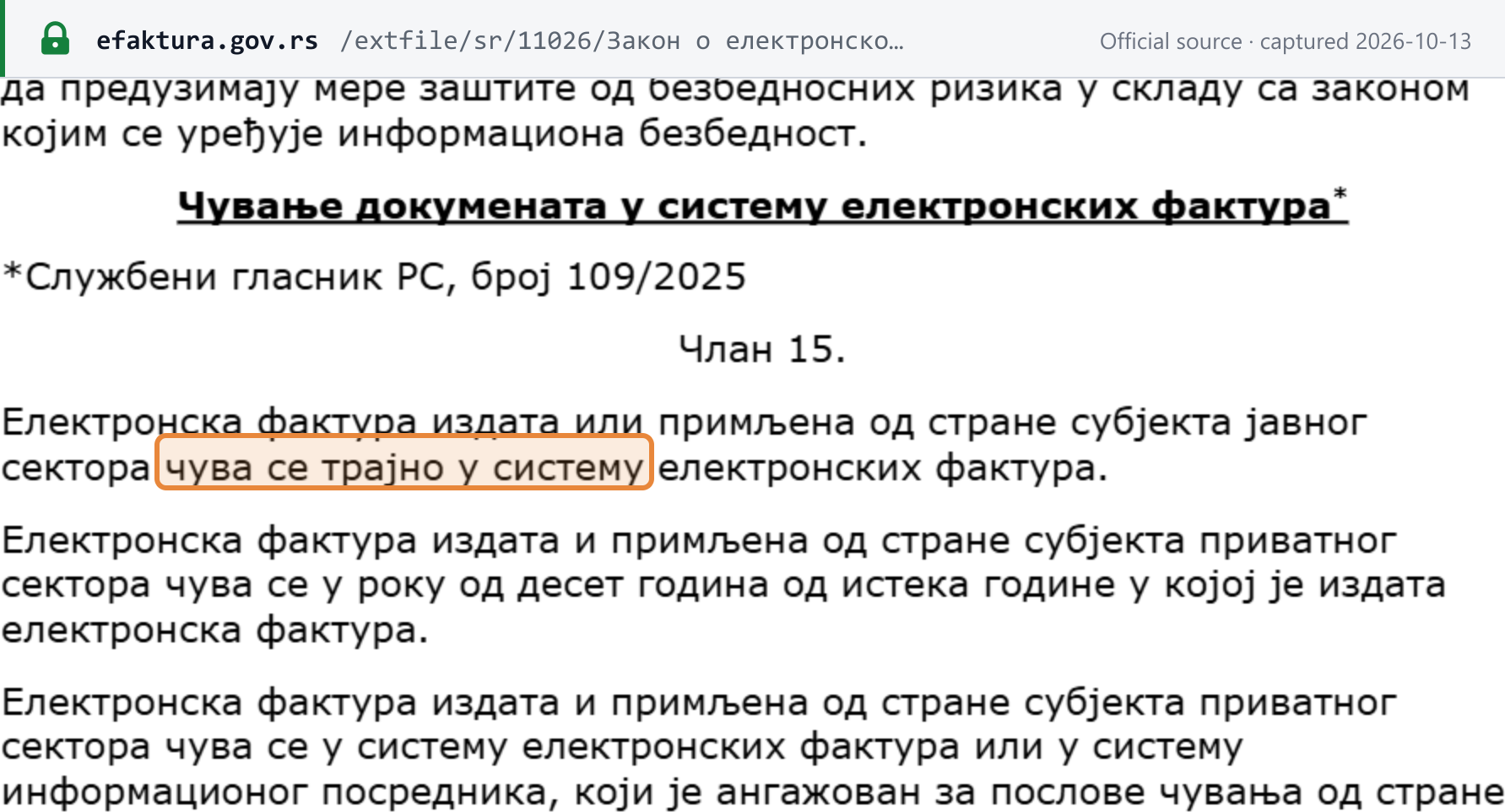
Retention. Public-sector e-invoices are kept permanently in SEF. Private-sector e-invoices are kept for 10 years from the end of the year of issue, in SEF or with the contracted intermediary (Art 15). [1]
Penalties
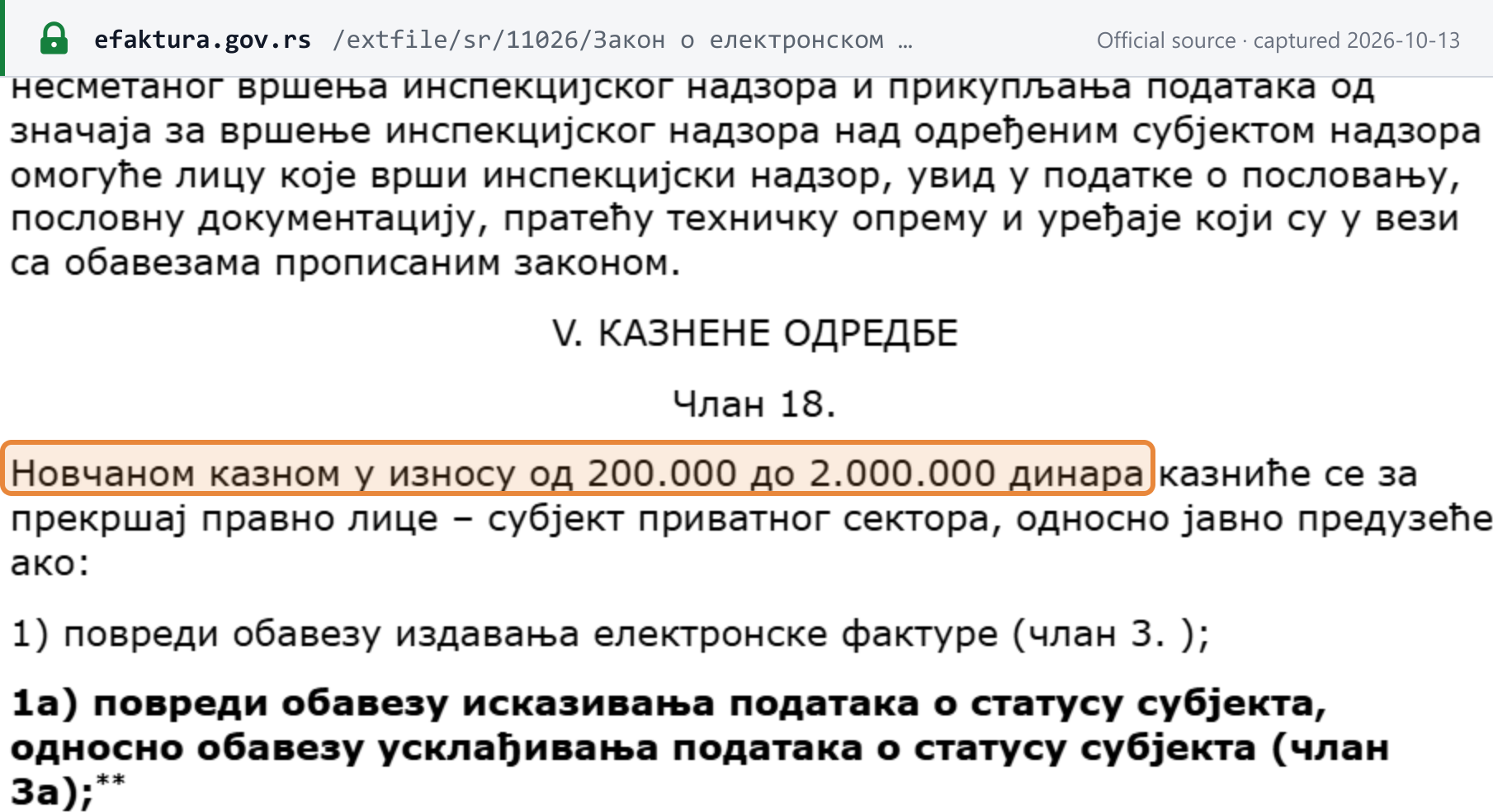
Article 18 sets fines for breaching the duty to issue e-invoices, the VAT-status duty, the electronic VAT-recording duties and the duty to use SEF:
| Who | Fine |
|---|---|
| Legal entity (private sector) or public enterprise | RSD 200,000 to 2,000,000 |
| Entrepreneur | RSD 50,000 to 500,000 |
| Responsible person, including in the public sector | RSD 50,000 to 150,000 |
A VAT-recording error corrected before supervision starts is not an offence. The Rulebook's grace periods for VAT-recording errors ended on 31 December 2025. [1]
Frequently asked questions
Is Serbia's B2B e-invoicing mandate starting in 2027?
No. B2B e-invoicing through SEF has been mandatory since 1 January 2023, and B2G since 1 May 2022. What starts in 2027 is the 2026 amendment: SEF compiles a preliminary VAT return for VAT periods beginning after 31 December 2026, and purchases from non-VAT farmers must be recorded in SEF from 1 July 2027.
Do we need an e-invoice for a sale to a consumer?
No. Retail sales are covered by e-fiscalisation, not by SEF. The exceptions are retail sales to a corporate-card holder, and to a public-sector body that asks for an e-invoice within 7 days; those must also be e-invoiced, after the fiscal receipt.
Does a foreign company without a Serbian tax representative have to use SEF?
The law places the issuing duty on a foreign person's VAT tax representative, not on a foreign supplier without one. A foreign company's legal representative who wants to use SEF needs a Serbian electronic identity.
What happens if our customer does not respond to an e-invoice?
The recipient has 15 days to accept or reject it. A public-sector recipient that does not respond is deemed to accept. A private recipient is notified again and, if it still does not respond within 5 days, is deemed to reject.
Recent changes
- 2026-10-02 — SEF version 4.2.0 released to production, after 4.0.0 (31 July 2026). (Ministry of Finance)
- 2026-08-31 — Law amending the Law on Electronic Invoicing (Official Gazette 80/2026), in force 8 September 2026: applies from 1 January 2027; recording of purchases from farmers and the export customs-declaration list from 1 July 2027. (Legal information system) — see event
- 2026-07-31 — Rulebook amendment (Official Gazette 71/2026): SEF compiles the preliminary VAT return for VAT periods beginning after 31 December 2026. (Ministry of Finance)
Related resources
- Serbia tax ID guide
- E-invoicing status and networks by country
- Fiscal devices and certified cash registers
- CTC e-invoicing models
- Croatia e-invoicing and Slovenia e-invoicing
- Serbia tax changes on Lookuptax