Burundi Tax ID Guide — NIF (Numéro d'Identification Fiscale)
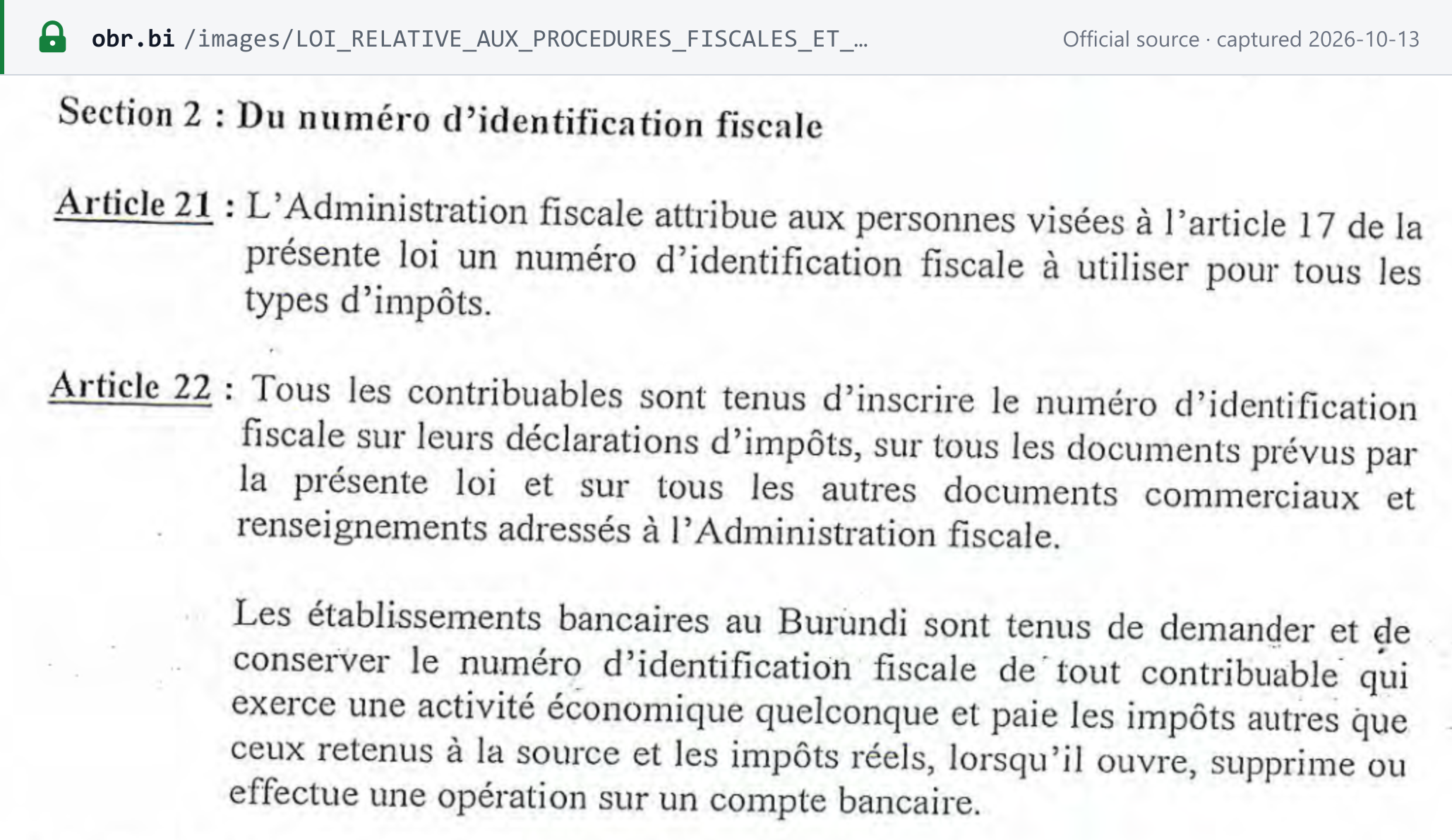
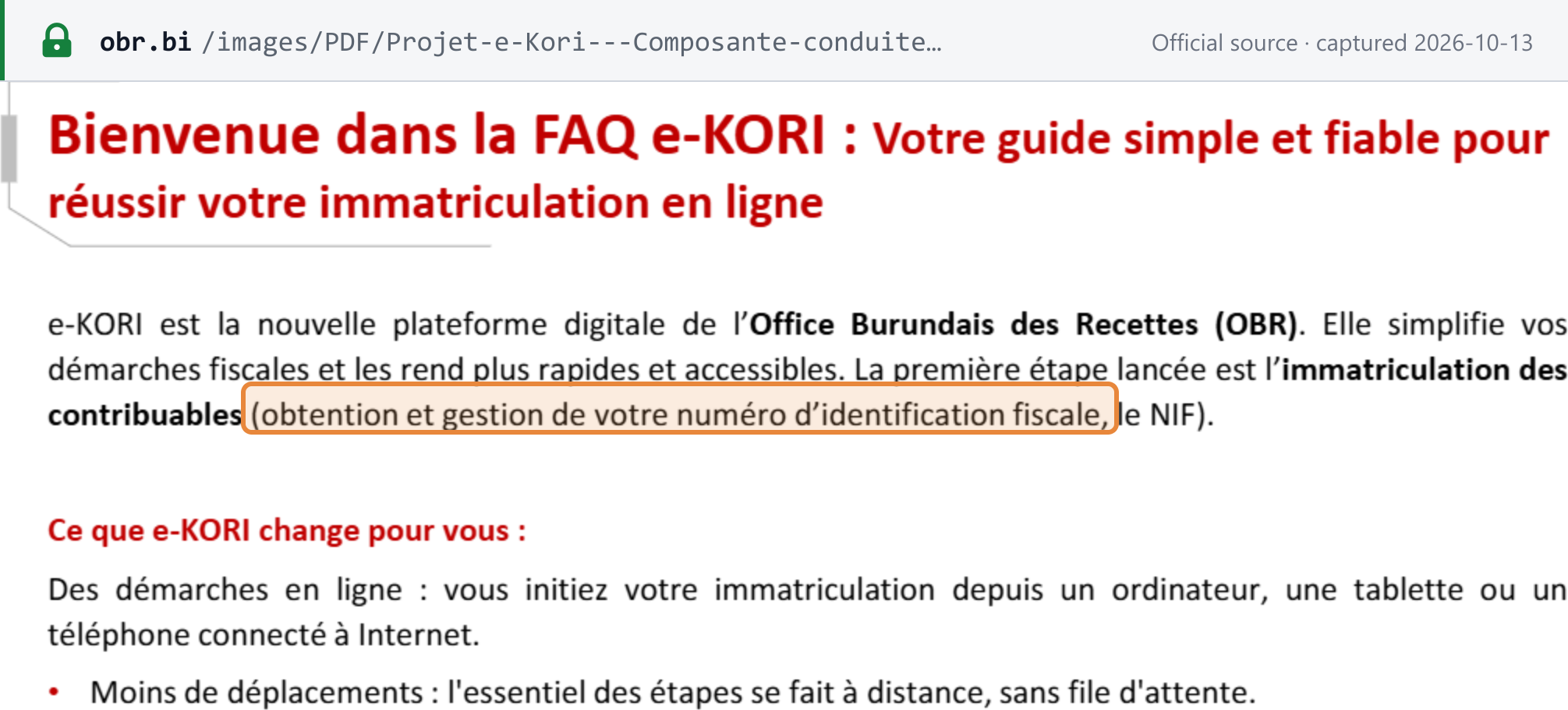
Burundi has a single tax identifier: the NIF (Numéro d'Identification Fiscale), issued by the Office Burundais des Recettes (OBR). The tax procedures law says OBR assigns every registered person "un numéro d'identification fiscale à utiliser pour tous les types d'impôts" — one number for all taxes. [1] There is no separate VAT number: a VAT-registered business keeps its NIF and receives a VAT registration certificate. NIFs are now applied for online through OBR's new e-KORI portal. [2]
Burundi's Tax IDs at a Glance
| Number | Issuer | Format | Who has one |
|---|---|---|---|
| NIF (Numéro d'Identification Fiscale) | OBR | Not published; OBR's examples are mostly 10 digits beginning with 4, e.g. 4005864068 | Individuals, companies, cooperatives, associations, NGOs and projects with tax obligations — including for one-off acts such as an import or a property sale |
| VAT registration | OBR | No separate number — the NIF plus a VAT registration certificate | Businesses over the VAT threshold, or registered by choice |
| Commercial register (Registre de Commerce) number | Issued at company registration (now through the ADB one-stop shop) | Not published | Traders and companies; not a tax ID |
NIF (Numéro d'Identification Fiscale)
| Field | Detail |
|---|---|
| Issuer | Office Burundais des Recettes (OBR) |
| Scope | One number for all taxes |
| Format | Not published by OBR |
| OBR examples | 4005864068 (verification form), 4000202020 (EBMS specification) |
| Check digit | None published |
| Cost | Free |
| Where it must appear | Tax returns, documents required by the tax procedures law, and commercial documents sent to OBR |
The NIF must be written on tax returns, on every document the tax procedures law requires and on all other commercial documents sent to the tax administration. Banks must ask for and keep the NIF of any taxpayer with an economic activity that pays taxes other than withheld taxes and impôts réels, when it opens, closes or operates a bank account. [1]
Format
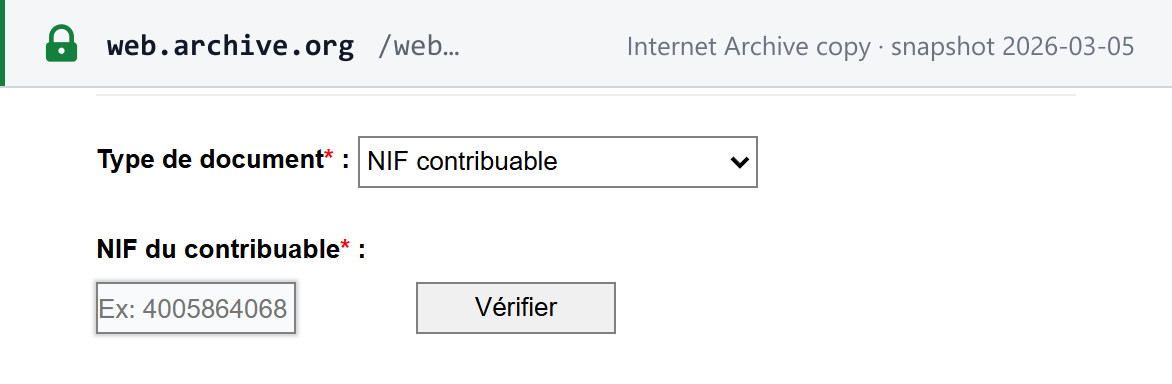
OBR does not publish a NIF format or check-digit rule. The examples OBR itself uses are 10-digit numbers beginning with 4: its document-verification form showed the placeholder "Ex: 4005864068" and accepted digits only, [3] and its EBMS e-invoicing specification uses 4000202020 as a customer NIF — though the same specification's invoice-signature examples use a 9-digit 400020202. [9] Treat a 10-digit pattern as what most of OBR's examples show, not as an official rule.
OBR re-issued NIFs when it introduced its SIGTAS tax system; its 2011 registration form has an "Ancien NIF" (old NIF) field for businesses registered before then. [4] NIFs issued before e-KORI remain valid. [2]
The NIF on invoices
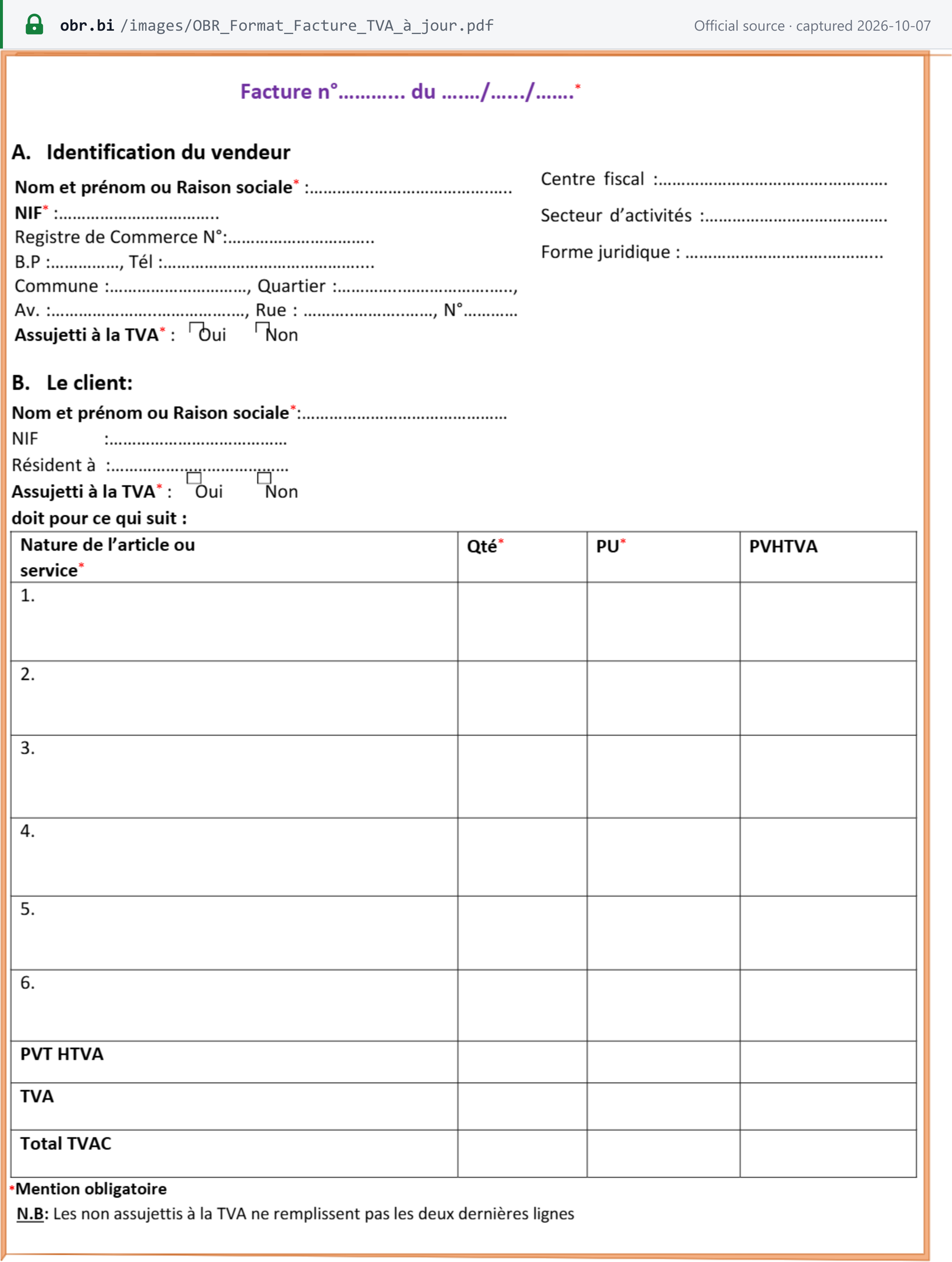
OBR's official invoice model identifies both seller and buyer by NIF, together with a "Assujetti à la TVA : Oui / Non" (VAT-registered yes/no) box. The seller's NIF is a mandatory field; the buyer's NIF field is not marked mandatory. [5]
Who Must Register
| Who | Rule |
|---|---|
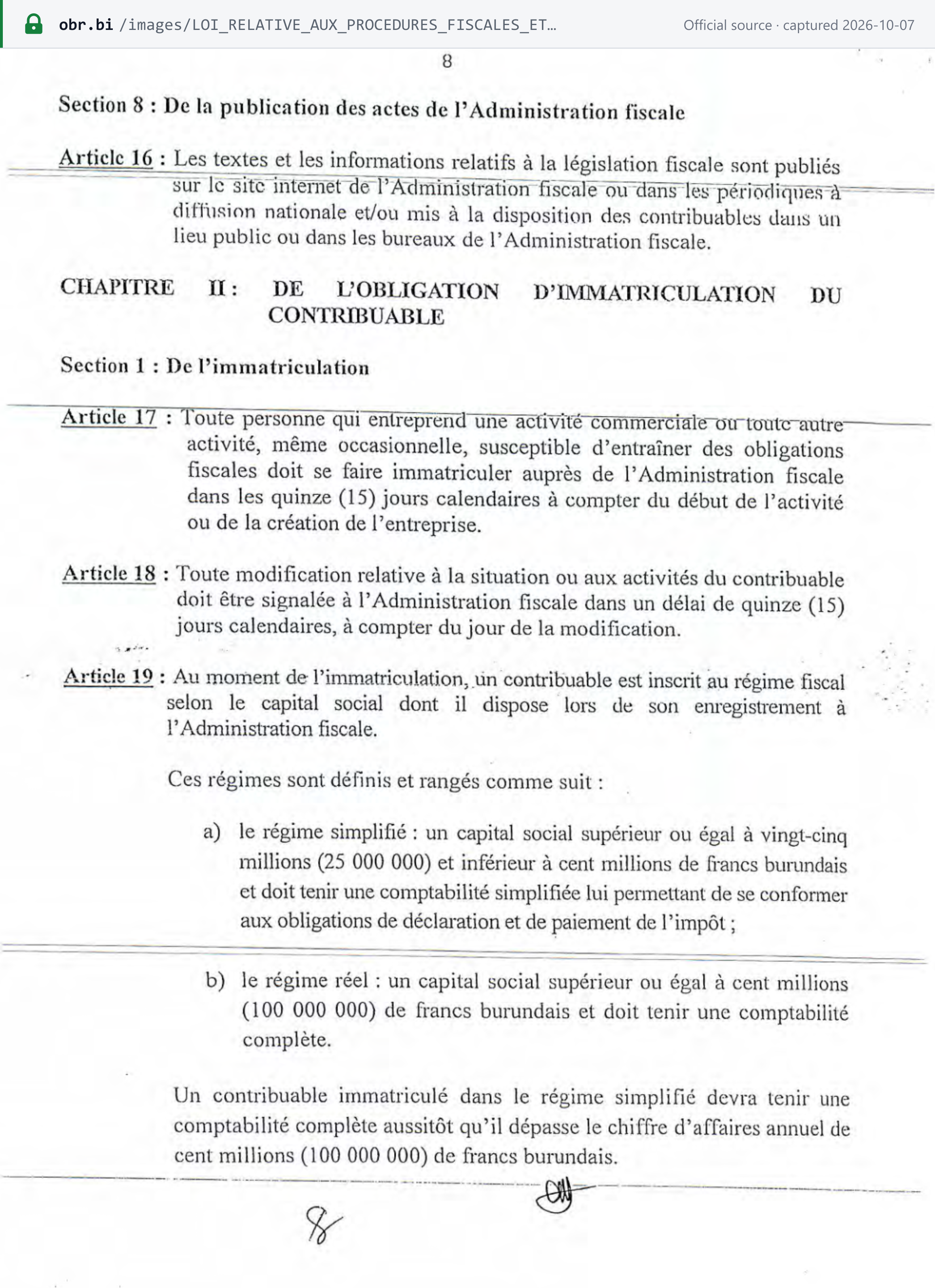
| Anyone starting a commercial or other activity, even an occasional one, that may create tax obligations | Register with OBR for a NIF within 15 calendar days of starting |
| Changes to a taxpayer's situation or activities | Report to OBR within 15 calendar days |
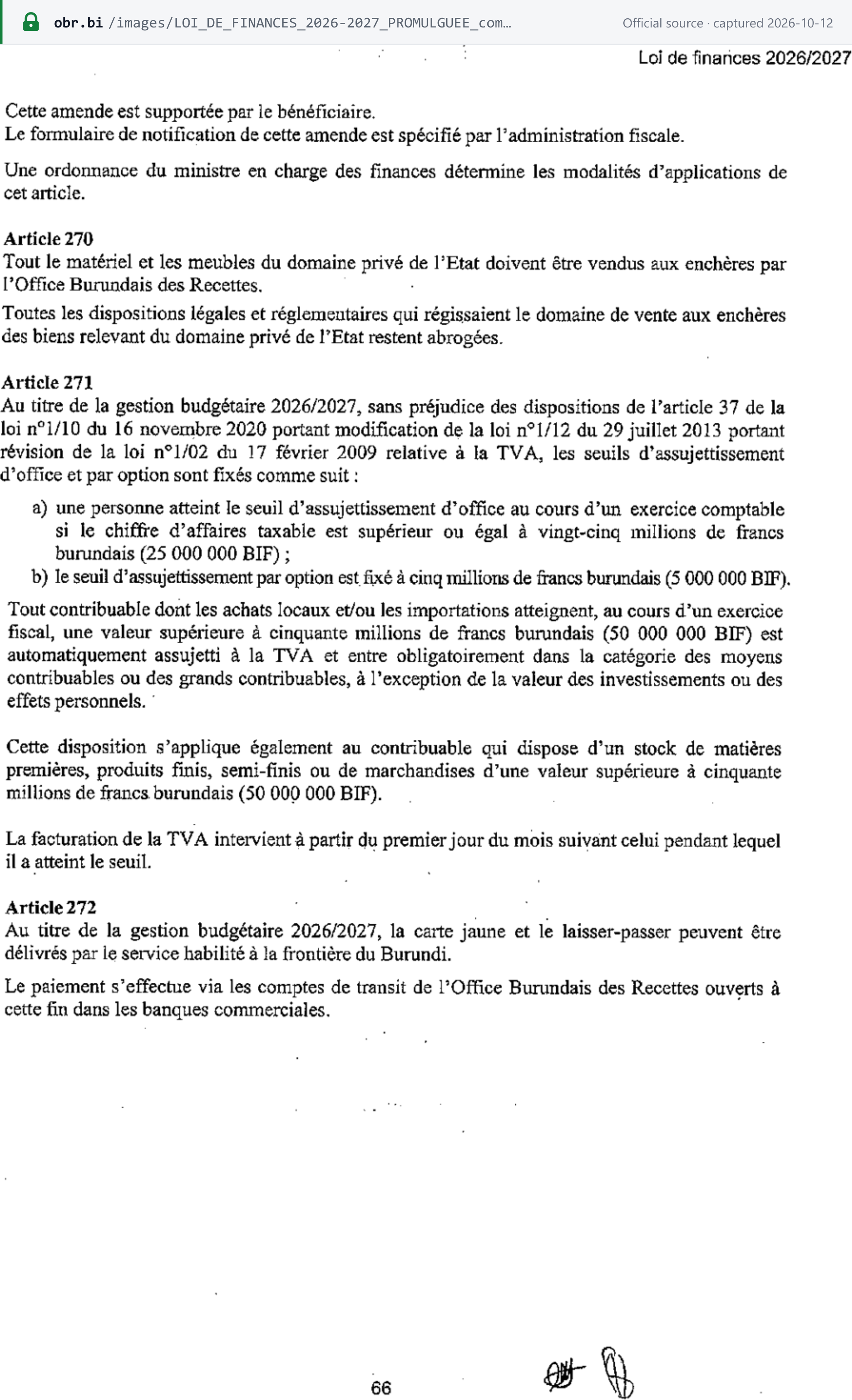
| VAT — compulsory | Taxable turnover of BIF 25,000,000 or more in a financial year (2026/27) |
| VAT — optional | From BIF 5,000,000 of turnover |
| VAT — automatic | Local purchases and/or imports worth more than BIF 50,000,000 in a fiscal year (excluding investments and personal effects), or stock worth more than BIF 50,000,000 |
| Non-residents making taxable supplies | Appoint an OBR-approved fiscal representative |
The 15-day rule is in article 17 of the tax procedures law, which covers anyone undertaking "une activité commerciale ou toute autre activité, même occasionnelle". [1] OBR also registers people for one-off acts such as clearing goods through customs or transferring property. [6]
VAT thresholds (2026/27)
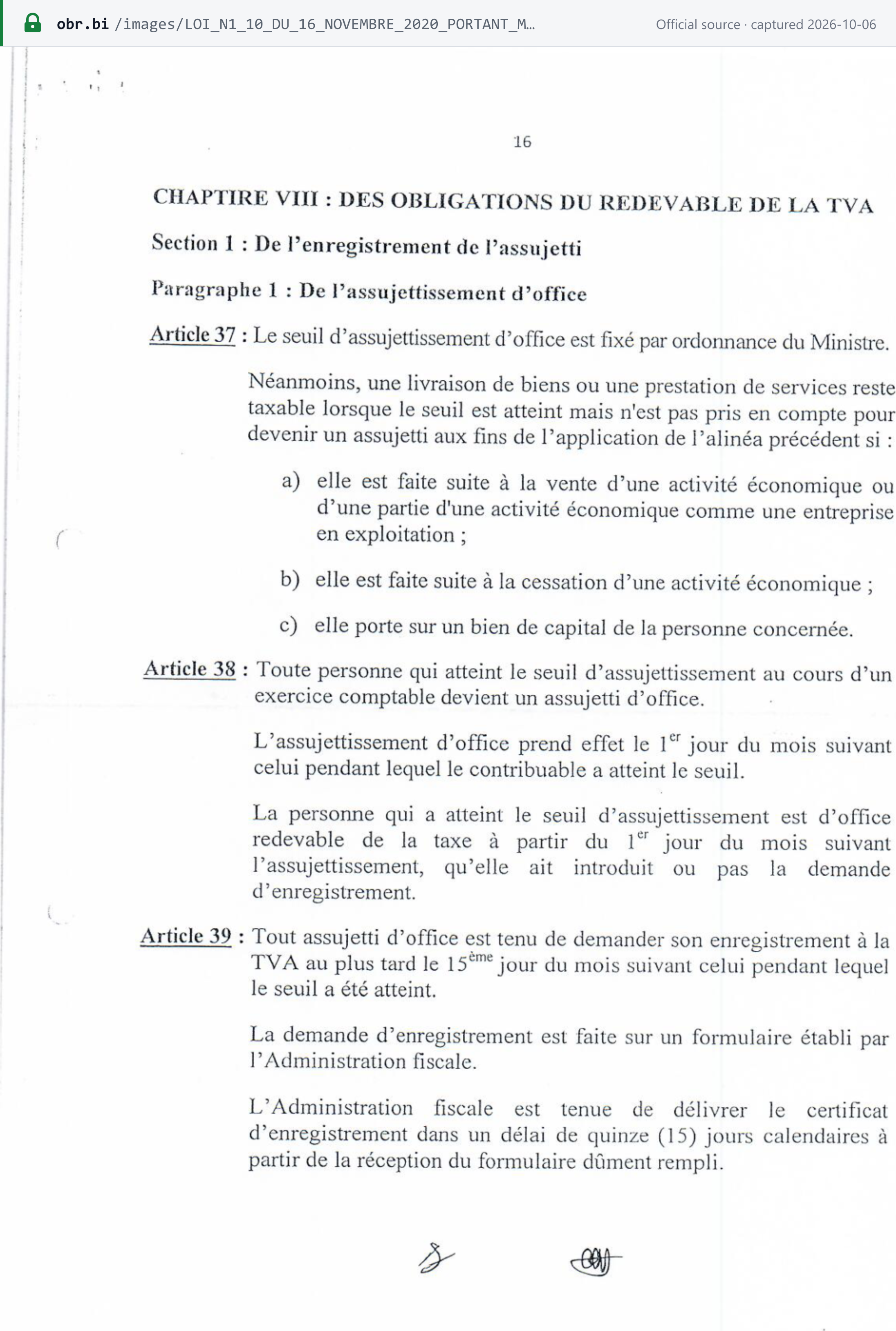
The Finance Law for 2026/27 (Law n°1/10 of 30 June 2026, in force 1 July 2026) sets the compulsory VAT threshold at taxable turnover of BIF 25,000,000 (FBU) or more during a financial year, and the optional threshold at BIF 5,000,000. A taxpayer whose local purchases and/or imports exceed BIF 50,000,000 in a fiscal year, not counting investments and personal effects — or whose stock of raw materials, finished or semi-finished goods or merchandise is worth more than BIF 50,000,000 — becomes liable to VAT automatically and moves into the medium or large taxpayer category. VAT is charged from the first day of the month after the threshold is reached. [7] A business that becomes liable must apply for VAT registration by the 15th of the following month, and OBR issues the certificate within 15 calendar days. [8]
How to Register
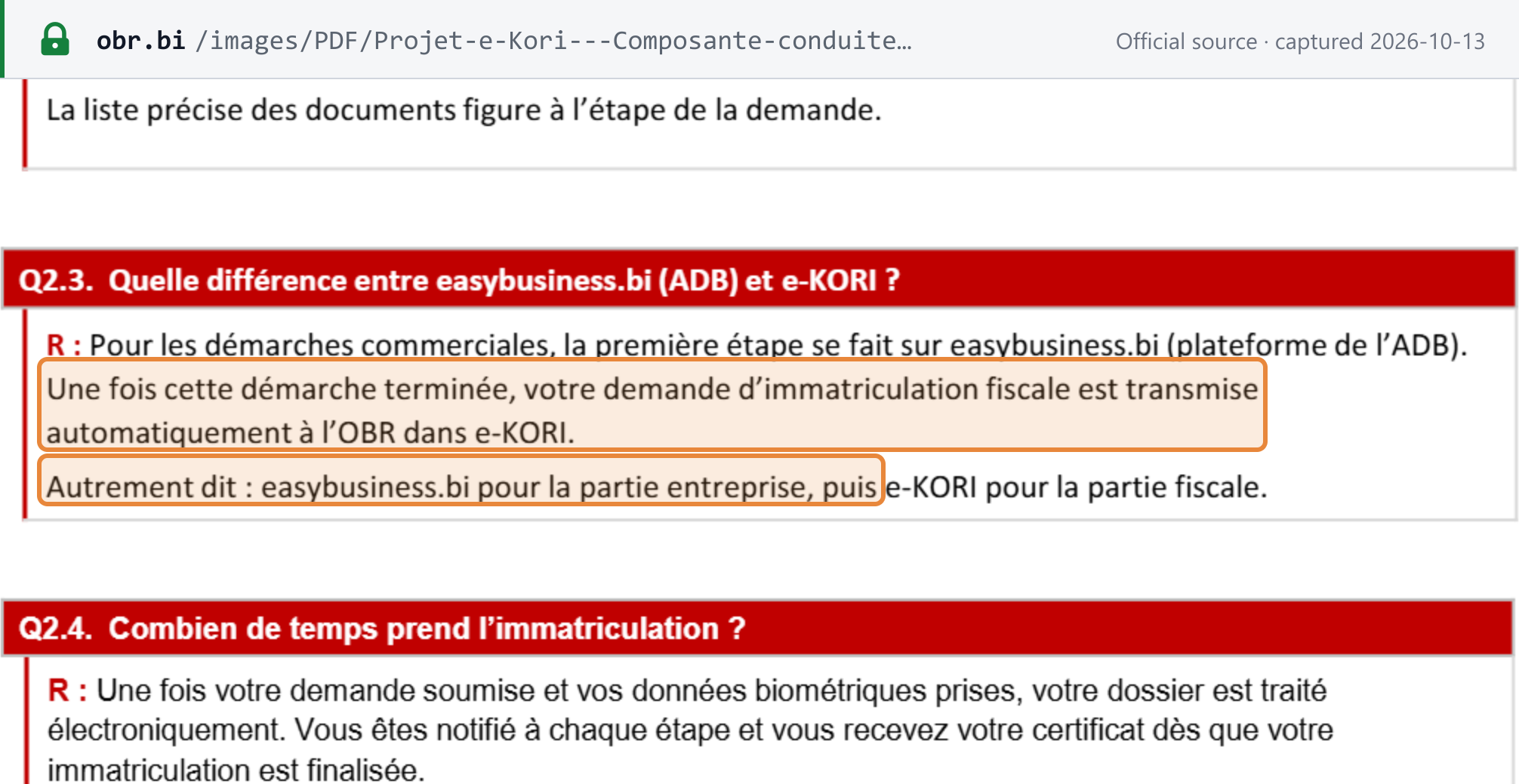
Registration is now online through OBR's e-KORI portal. Businesses carrying on a commercial activity start on the Burundi Development Agency's one-stop shop, easybusiness.bi; once that step is done, the tax registration is passed automatically to OBR in e-KORI. Individuals then receive an email inviting them to give their fingerprints and photo at OBR, and the registration certificate is sent by email. [2]
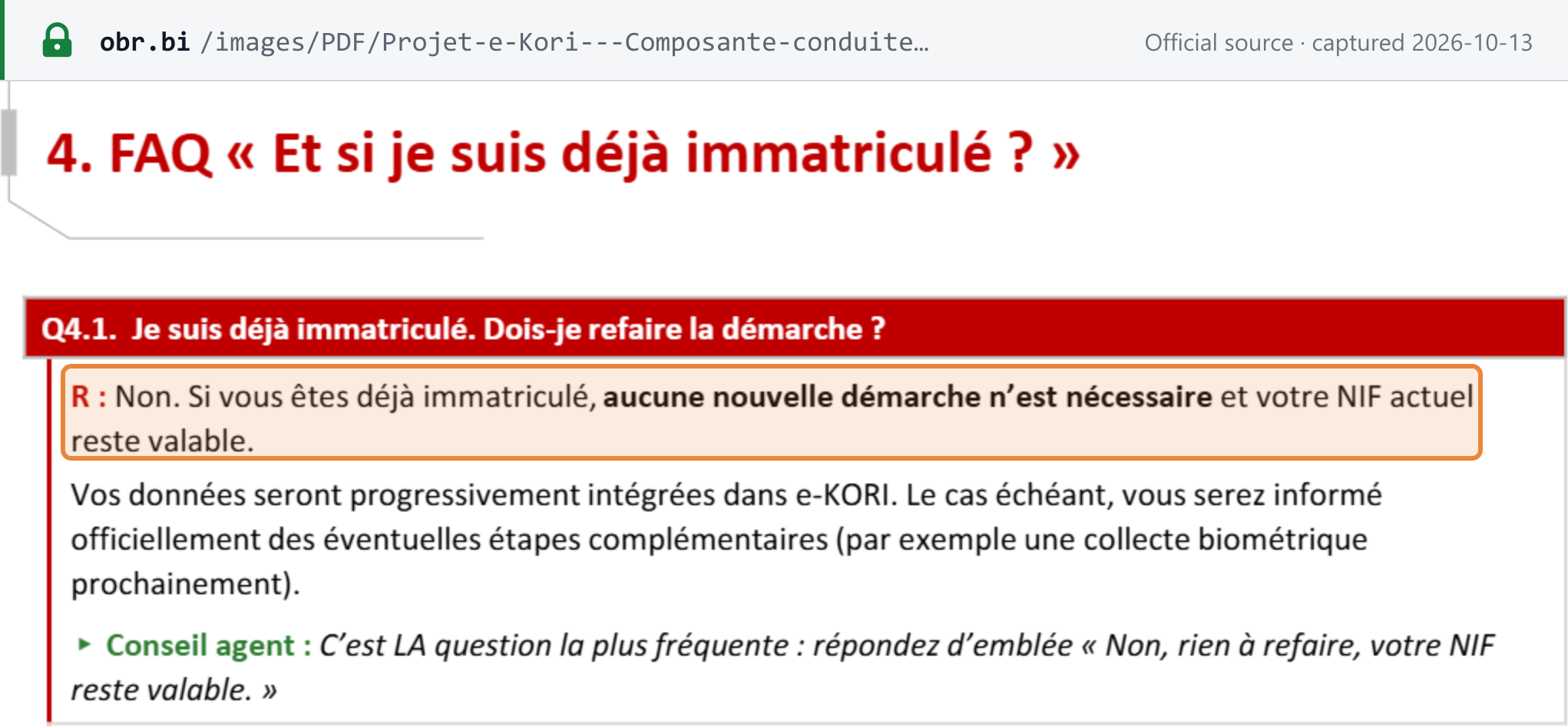
OBR says registration in e-KORI is free and that it will never ask for payment to issue a NIF. Taxpayers registered before e-KORI do not need to do anything: their current NIF stays valid. [2]
Cross-Border Notes
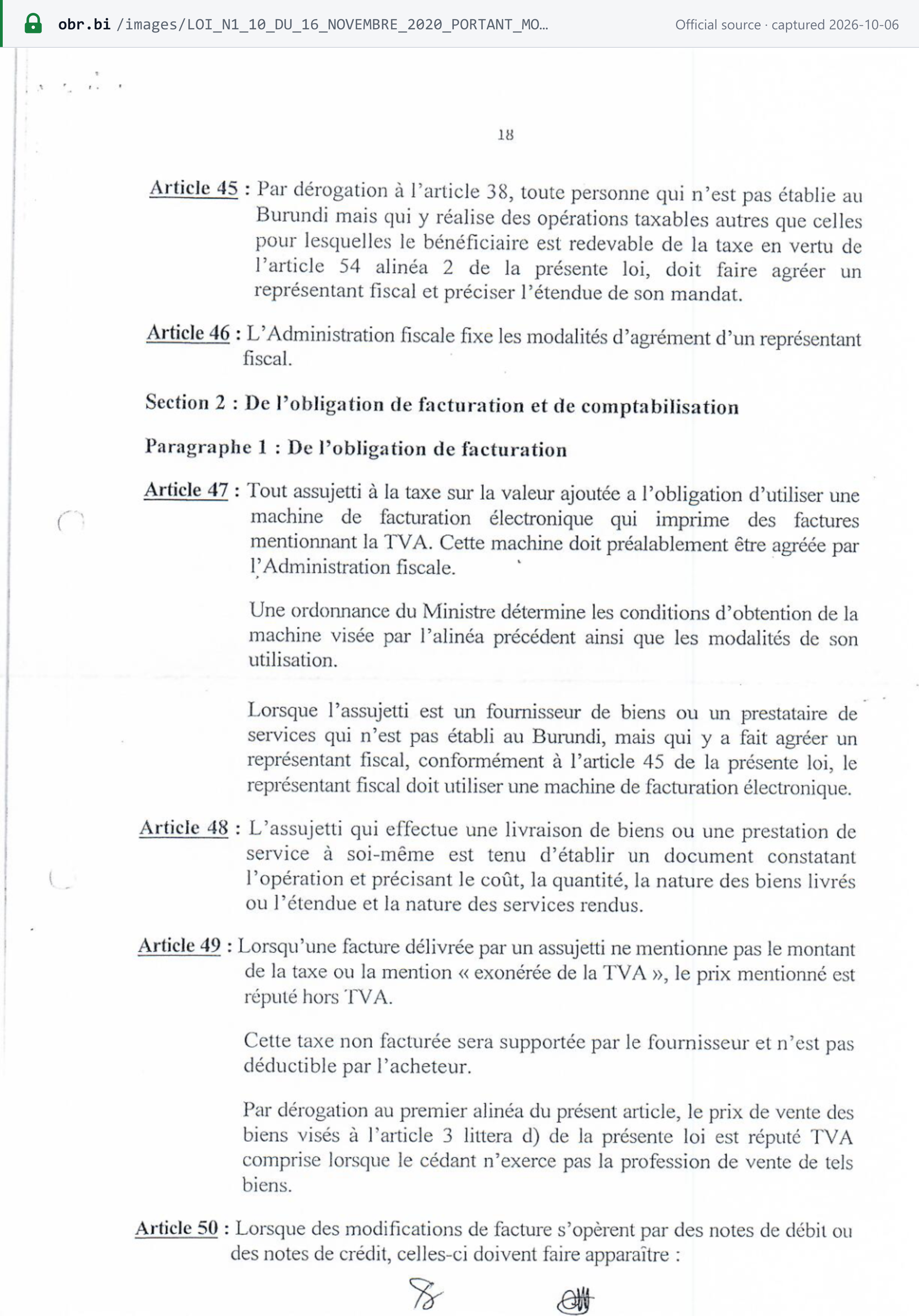
- Non-residents. A person not established in Burundi who makes taxable supplies there must have an OBR-approved fiscal representative, except for supplies on which the customer accounts for the VAT. [8] Article 45 is written as an exception to the threshold rule in article 38. OBR's registration form requires the representative's NIF for a foreign company and passport details for non-Burundian individuals. [4]
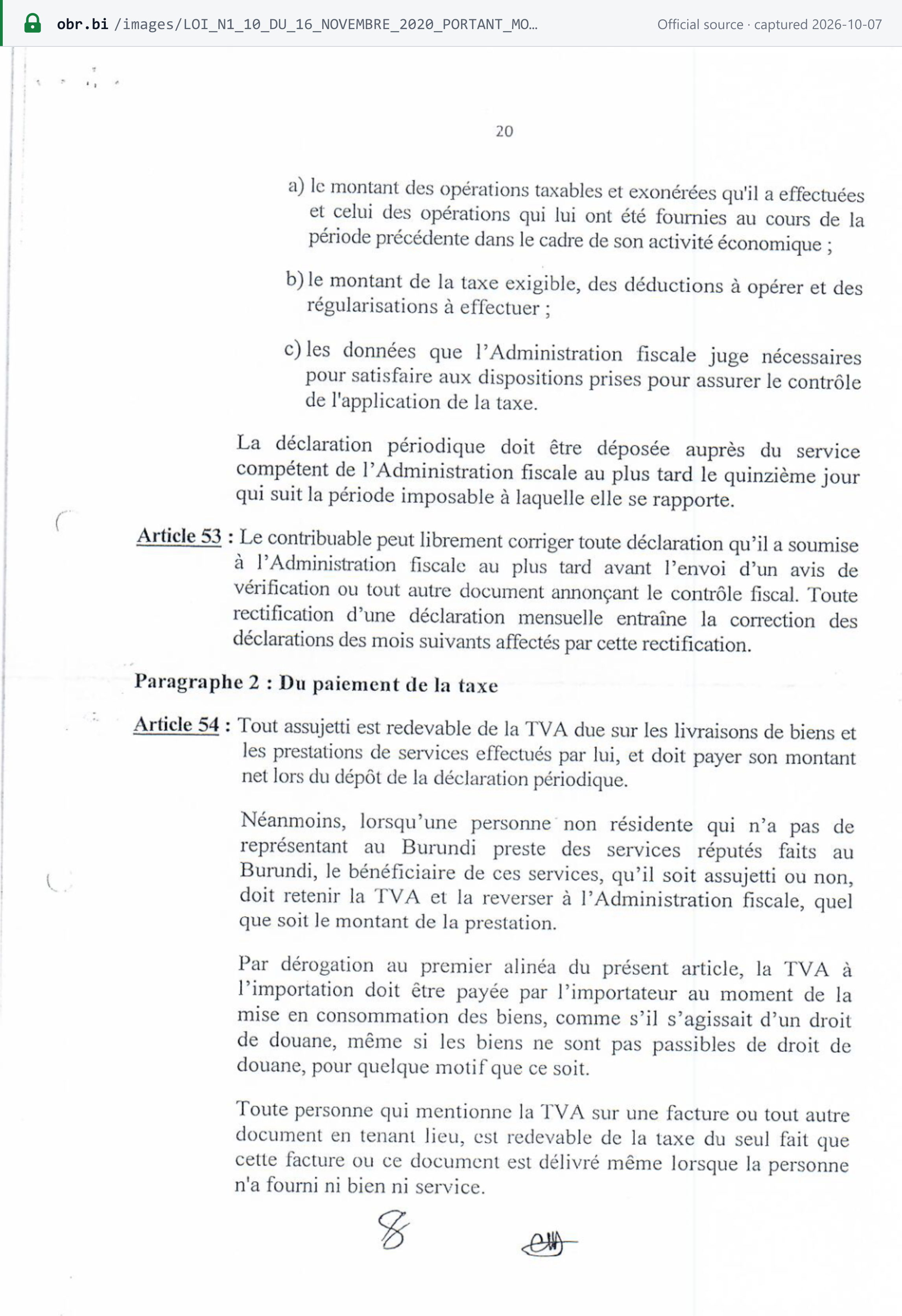
- Services from abroad. When a non-resident with no representative in Burundi supplies services treated as made in Burundi, the customer — VAT-registered or not — must withhold the VAT and pay it to OBR, whatever the amount. [8] See the reverse charge explainer.
E-invoicing (EBMS)
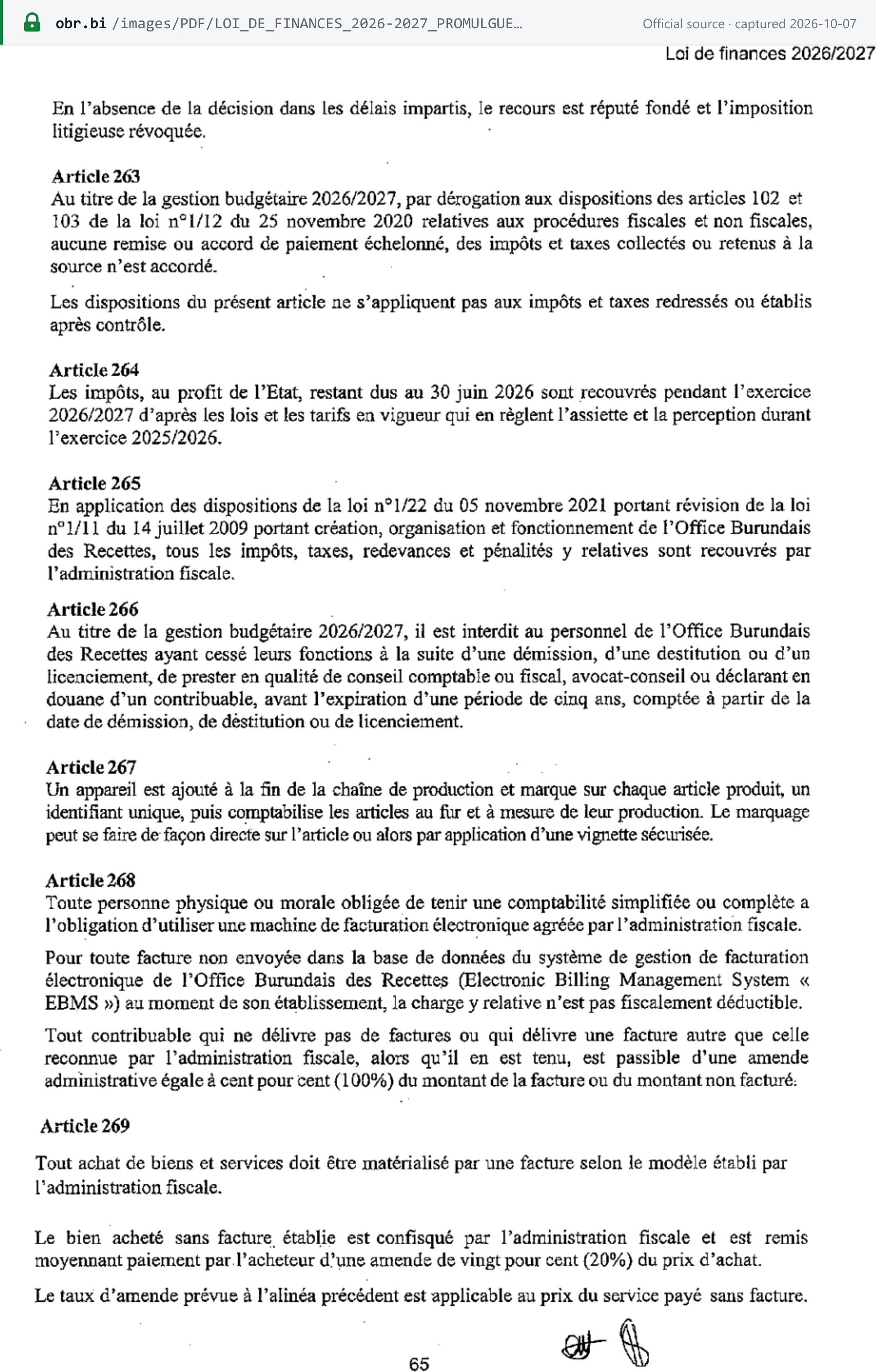
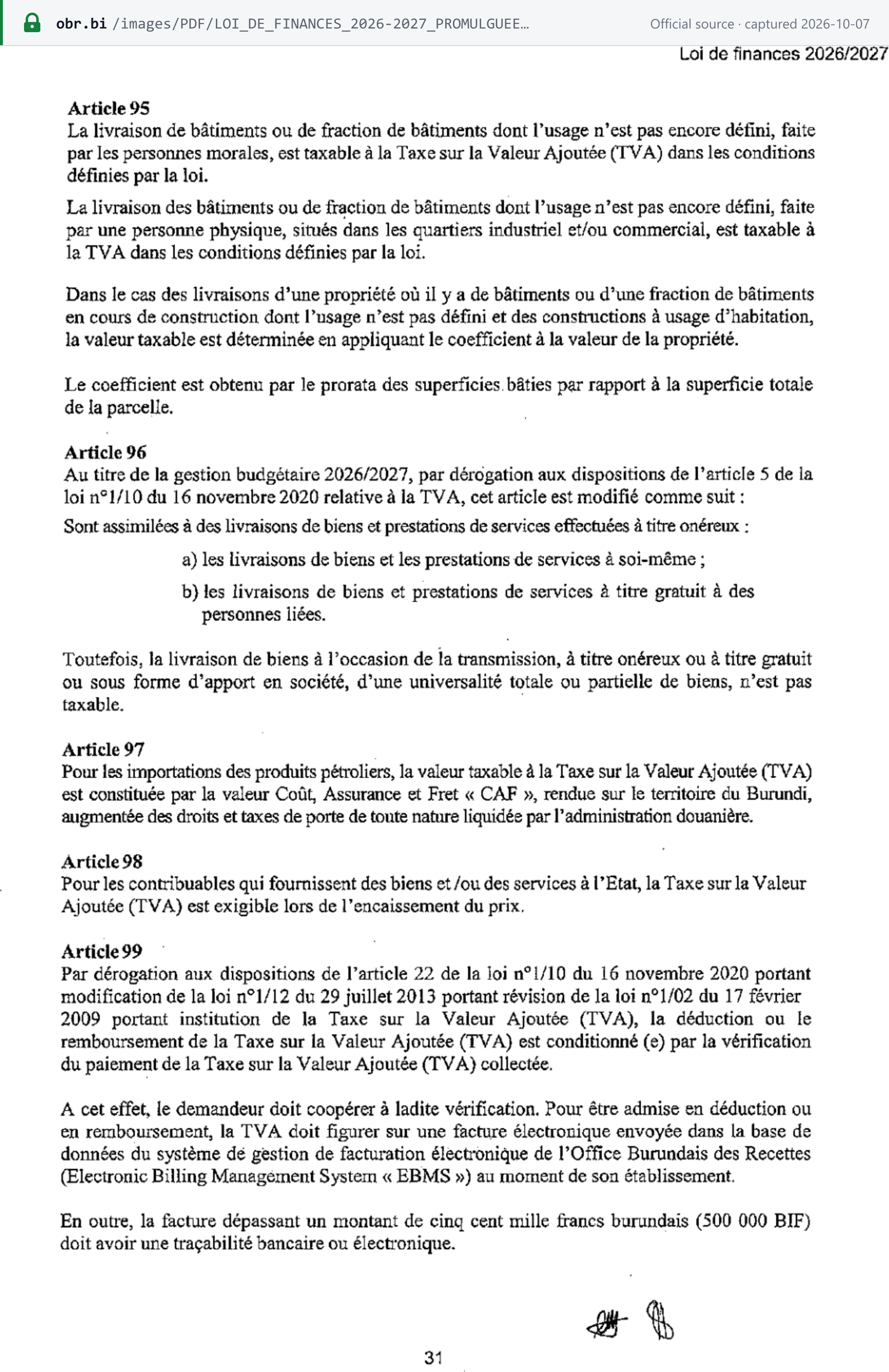
Every VAT taxpayer must issue invoices from an electronic invoicing machine approved by OBR. [8] From 1 July 2026 the duty covers anyone required to keep simplified or full accounts, and an expense is not tax-deductible if its invoice was not sent to OBR's Electronic Billing Management System (EBMS) when it was issued. Input VAT is deductible only on invoices sent to EBMS, and invoices over BIF 500,000 also need a bank or electronic payment trail. [7] See the Burundi VAT guide for invoice content and e-invoicing detail.
How to Verify a Burundi NIF
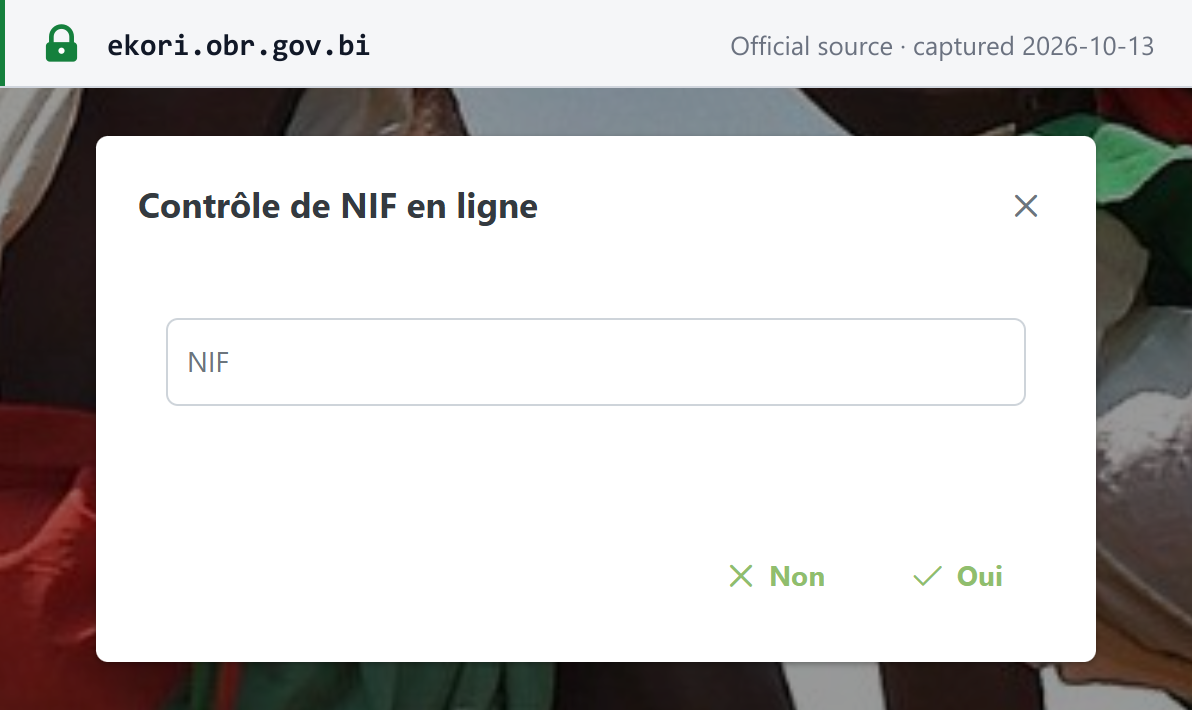
- e-KORI "Contrôle de NIF en ligne". OBR's e-KORI portal has a public NIF check that is designed to return the taxpayer's name, principal officer, tax office and activity. As of 13 October 2026 the check returns an empty record even for OBR's own example number, so a blank result does not mean a NIF is invalid.
- Check the certificate. e-KORI's "Contrôle des documents émis par l'OBR" verifies a NIF registration certificate from its reference. Asking a supplier for its certificate is the most reliable check today.
- Ask OBR. OBR's free helpline number is 500. [2]
There is no checksum to test, because OBR publishes none.
Recent Changes
- 2026-07-01 — VAT thresholds of BIF 25,000,000 (compulsory) and BIF 5,000,000 (optional) under the Finance Law 2026/27. (OBR) — see event
- 2026-07-01 — Automatic VAT liability for taxpayers with purchases, imports or stock above BIF 50,000,000. (OBR) — see event
- 2026-07-01 — Input VAT deductible only on invoices sent to EBMS; e-invoicing machines required for everyone keeping simplified or full accounts. (OBR) — see event
Frequently Asked Questions
How many digits does a Burundi NIF have?
OBR does not publish a format. Most of the examples OBR uses itself are 10-digit numbers beginning with 4, such as 4005864068, and its old verification form accepted digits only.
Is there a separate VAT number in Burundi?
No. The NIF is used for all taxes. A business that registers for VAT keeps its NIF and receives a VAT registration certificate, and invoices show whether each party is VAT-registered.
Does it cost anything to get a NIF?
No. OBR says registration in e-KORI is entirely free and that it will never ask for payment to issue a NIF. Company registration on easybusiness.bi is a separate step run by the Burundi Development Agency.
I registered before e-KORI. Do I need a new NIF?
No. OBR says existing taxpayers do not need to register again and their current NIF stays valid.
How long do I have to register for a NIF?
15 calendar days from starting the activity or creating the business. This applies even to occasional activities that may create tax obligations.
My turnover is below BIF 25 million — can I still be liable for VAT?
Yes. Under the Finance Law 2026/27, a taxpayer whose local purchases and/or imports in a fiscal year (not counting investments and personal effects), or whose stock, are worth more than BIF 50,000,000 becomes liable to VAT automatically.
Do foreign businesses need a NIF in Burundi?
A non-resident making taxable supplies in Burundi must appoint a fiscal representative approved by OBR, and OBR's registration form for a foreign company's representation requires the representative's NIF. Where a non-resident with no representative supplies services, the Burundian customer withholds and pays the VAT instead.
How do I check a supplier's NIF?
Use the "Contrôle de NIF en ligne" check on OBR's e-KORI portal, but note that as of 13 October 2026 it returns an empty record even for OBR's own example number. The more reliable route is to ask for the supplier's NIF registration certificate and verify it with e-KORI's document control, or call OBR's free helpline on 500.
Related Resources
- Burundi VAT guide
- VAT registration thresholds by country
- Worldwide VAT, GST and sales tax rates
- East African TIN guides: Kenya, Uganda
- Reverse charge explained
- Burundi tax changes
How Lookuptax can help you in VAT validation?
Lookuptax VAT validation revolutionizes VAT number validation with its robust platform, empowering businesses to seamlessly verify VAT numbers across over 100 countries. Our cutting-edge technology ensures accurate and efficient validation, reducing errors and enhancing compliance.