Taiwan Tax ID Guide — Business Administration Number (BAN/UBN), National ID & UI Number
A Taiwanese business is identified for tax by its 營利事業統一編號 — usually shortened to 統一編號 or 統編. The Ministry of Finance's official English name for it is the Business Administration Number (BAN); it is also widely called the Unified Business Number (UBN). It is an 8-digit number used by profit-seeking enterprises and withholding agencies. [1] Individuals are identified by their national ID number (國民身分證統一編號), issued by the Ministry of the Interior, or — for foreigners and others without household registration — by a UI number (統一證號) issued by the National Immigration Agency. Taiwan's VAT is called business tax (營業稅) and is charged at 5%; there is no separate VAT number.
Taiwan's Tax IDs at a Glance
| Number | Local name | Format | Issuer | Who has one | Check |
|---|---|---|---|---|---|
| Business Administration Number (BAN / UBN) | 營利事業統一編號 | 8 digits | Ministry of Finance, on tax registration | Businesses and each branch, withholding agencies, registered foreign e-service suppliers | Weighted sum divisible by 5 |
| National ID number | 國民身分證統一編號 | 1 letter + 9 digits; 2nd digit 1 (male) or 2 (female) | Ministry of the Interior | Nationals with household registration | Check character — algorithm not published |
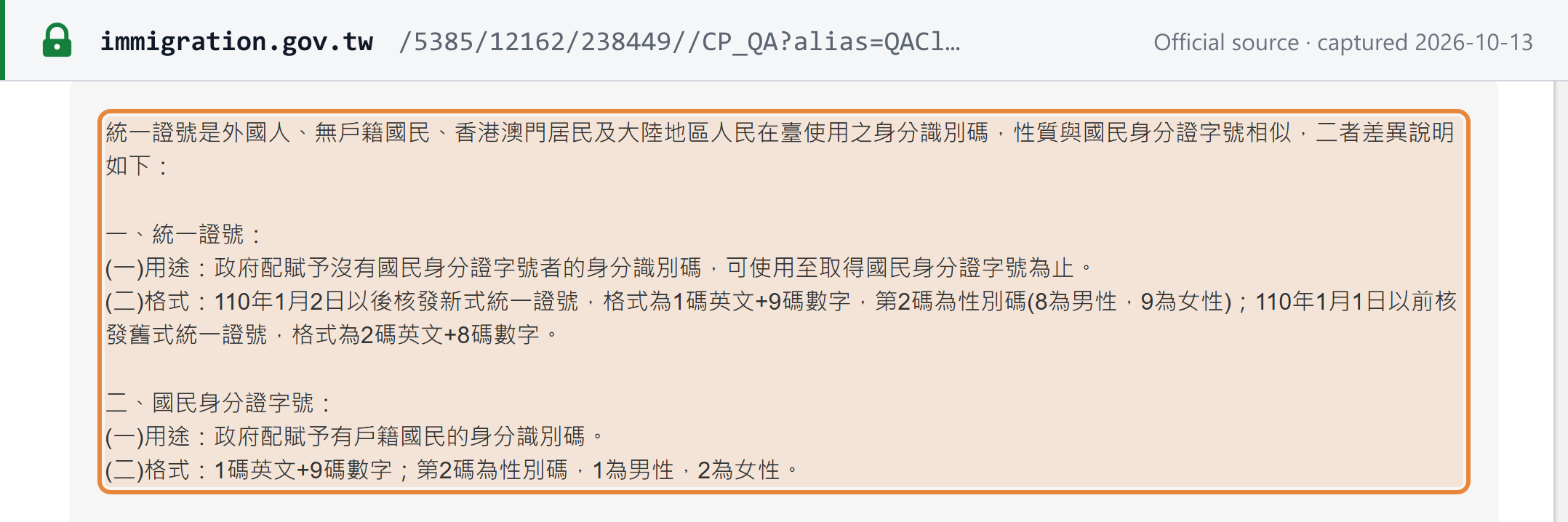
| UI number (new format, from 2 Jan 2021) | 統一證號 | 1 letter + 9 digits; 2nd digit 8 (male) or 9 (female) | National Immigration Agency | Foreigners, Hong Kong, Macao and mainland residents, nationals without household registration | Check character — algorithm not published |
| UI number (old format) | 統一證號 (舊式) | 2 letters + 8 digits; valid until 31 Dec 2030 | National Immigration Agency | Same holders, numbers issued up to 1 Jan 2021 | Not published |
Business Administration Number (統一編號)
| Field | Detail |
|---|---|
| Length | 8 digits, no letters or prefix |
| Check | Whole number checked by a weighted sum — divisible by 5 since 2023 (previously 10) |
| Issued | On taxation registration with the competent tax authority |
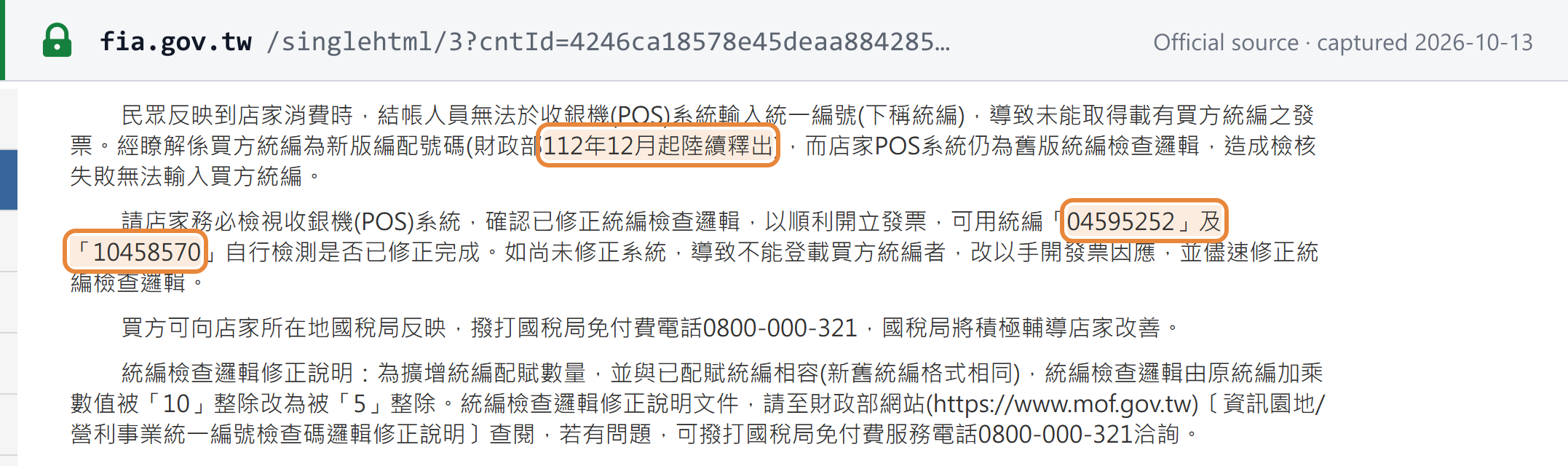
| Test numbers | 04595252 and 10458570 — published by the Fiscal Information Agency for testing |
| Also called | Unified Business Number (UBN), 統編 |
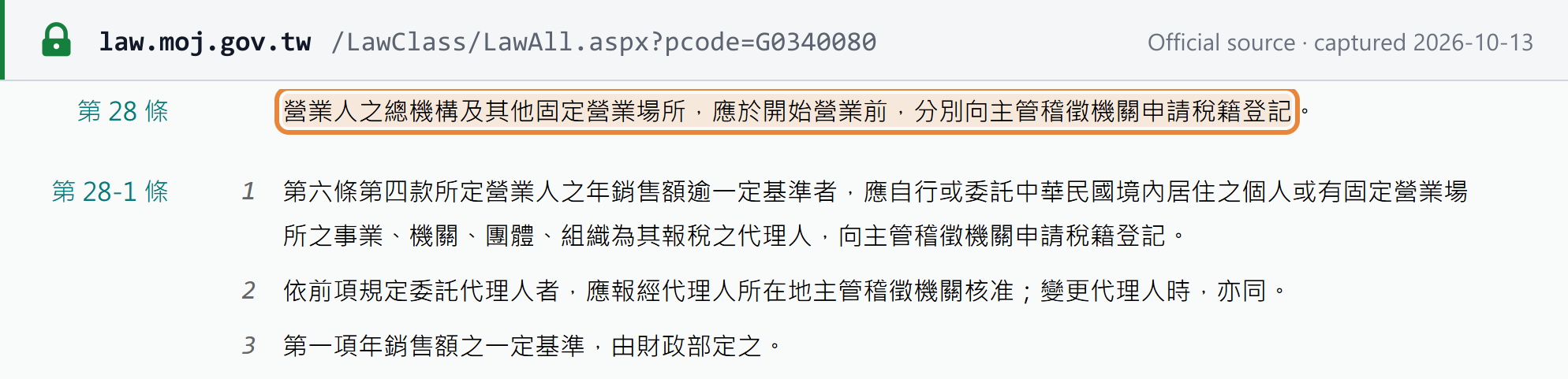
Every business entity must apply for taxation registration before it starts business, and the head office and each fixed place of business register separately. [2] For companies, sole proprietorships and partnerships there is no separate tax application: the tax authority registers them from the data provided by the company or commercial registry, and that registration is "deemed" to be the taxation registration. [3] In practice, the number on a company's registration is the same number it uses for tax.
The check rule — and the 2023 change
The Fiscal Information Agency (FIA), the Ministry of Finance's IT agency, publishes the check logic: [4]
- Multiply the eight digits by the weights 1, 2, 1, 2, 1, 2, 4, 1.
- For each product, add its digits together (for example, 12 becomes 1 + 2 = 3), then add up the eight results.
- The number is valid if the total is divisible by 5.
- If the seventh digit is 7, its product is 28 and its digit sum is 10; that position may then be counted as either 1 or 0, and the number is valid if either total is divisible by 5.
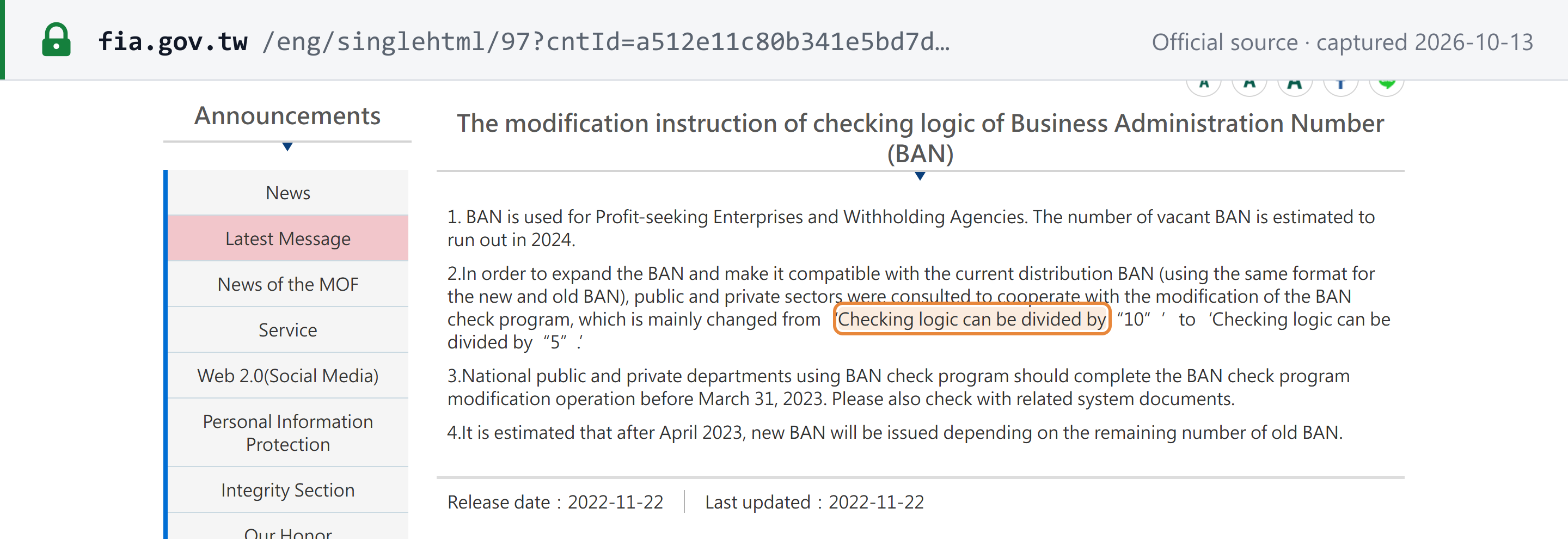
The rule used to be "divisible by 10". Because Taiwan was running out of BANs, the Ministry of Finance changed it to "divisible by 5", which keeps the same 8-digit format and keeps every existing number valid. Public and private systems had to update their checks before 31 March 2023, [1] and new-series numbers have been released since December 2023 (the FIA had first expected to start issuing them after April 2023). A system still applying the old rule rejects genuine new numbers — the FIA's own guidance for shops whose tills refuse a buyer's BAN is to test them with 04595252 and 10458570, which are valid only under the new rule. [5]
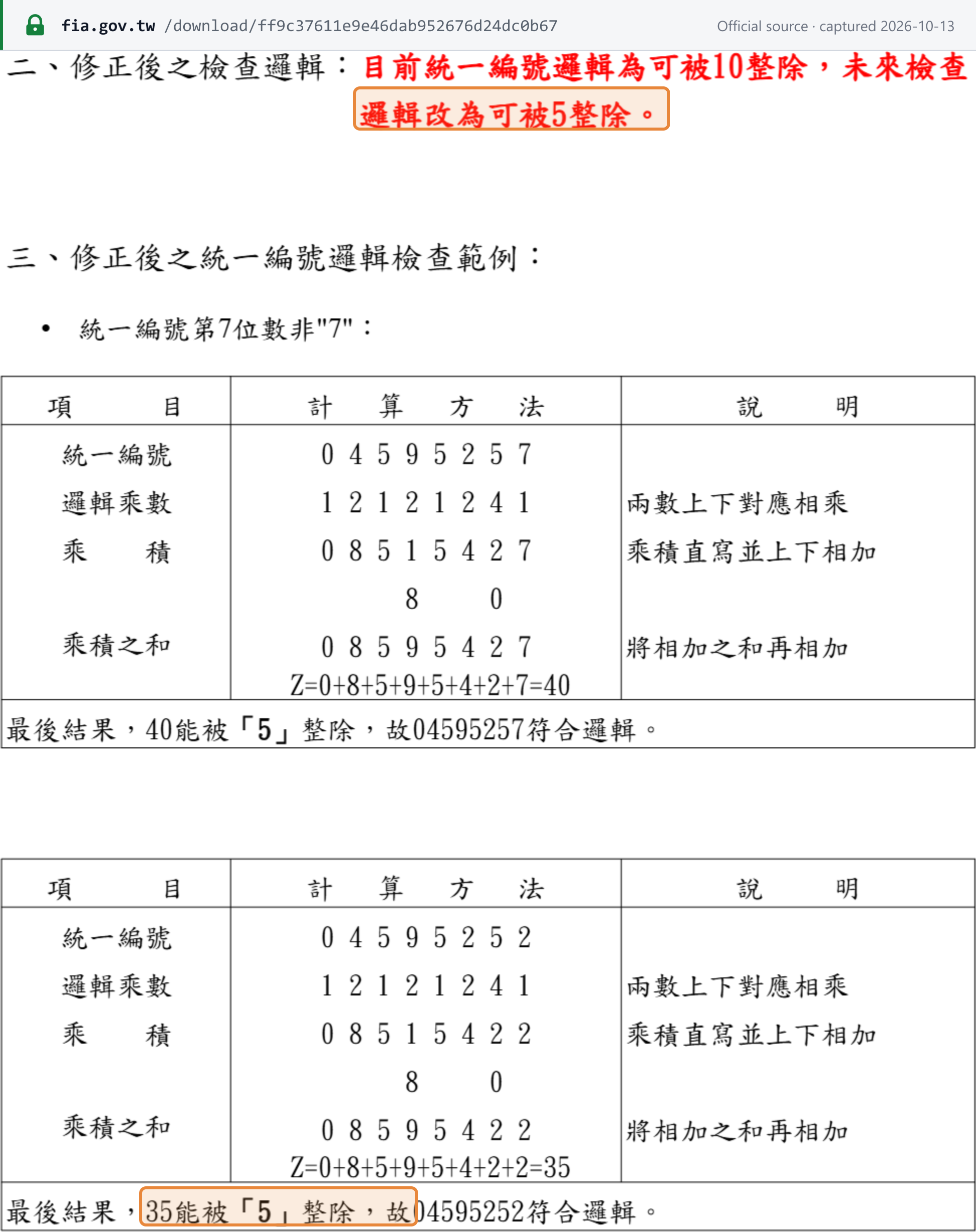
Worked example (04595252): the products are 0, 8, 5, 18, 5, 4, 20, 2; their digit sums are 0, 8, 5, 9, 5, 4, 2, 2; the total is 35, which is divisible by 5 — so the number is valid (it would have failed the old divisible-by-10 rule).
National ID Number and UI Number
The national ID number is one letter followed by nine digits; the second character is a sex code, 1 for men and 2 for women. The UI number (統一證號) is the identifier the government assigns to people without a national ID number — foreigners, Hong Kong, Macao and mainland residents, and nationals without household registration — and is used until the holder obtains a national ID number. [6]
Since 2 January 2021, new UI numbers follow the citizens' layout: a region letter, a sex code of 8 for men or 9 for women, seven further digits and a check character in the tenth position. UI numbers issued up to 1 January 2021 have two letters and eight digits; they can be used until 31 December 2030 and are replaced with a new-format number when a permit is extended or reissued. [6] [7] Systems that store foreigners' tax IDs should accept both formats until then.
Both numbers end in a check character, but neither the Ministry of the Interior nor the National Immigration Agency explains how it is calculated on its website. A national ID number cannot be looked up from the number alone: the Ministry of the Interior's ID-card record check also needs details printed on the physical card, such as the issue date and place.
Who Must Register for Business Tax
| Who | Rule |
|---|---|
| Businesses with a fixed place of business, a business title or staff | Register before commencing business — no turnover threshold |
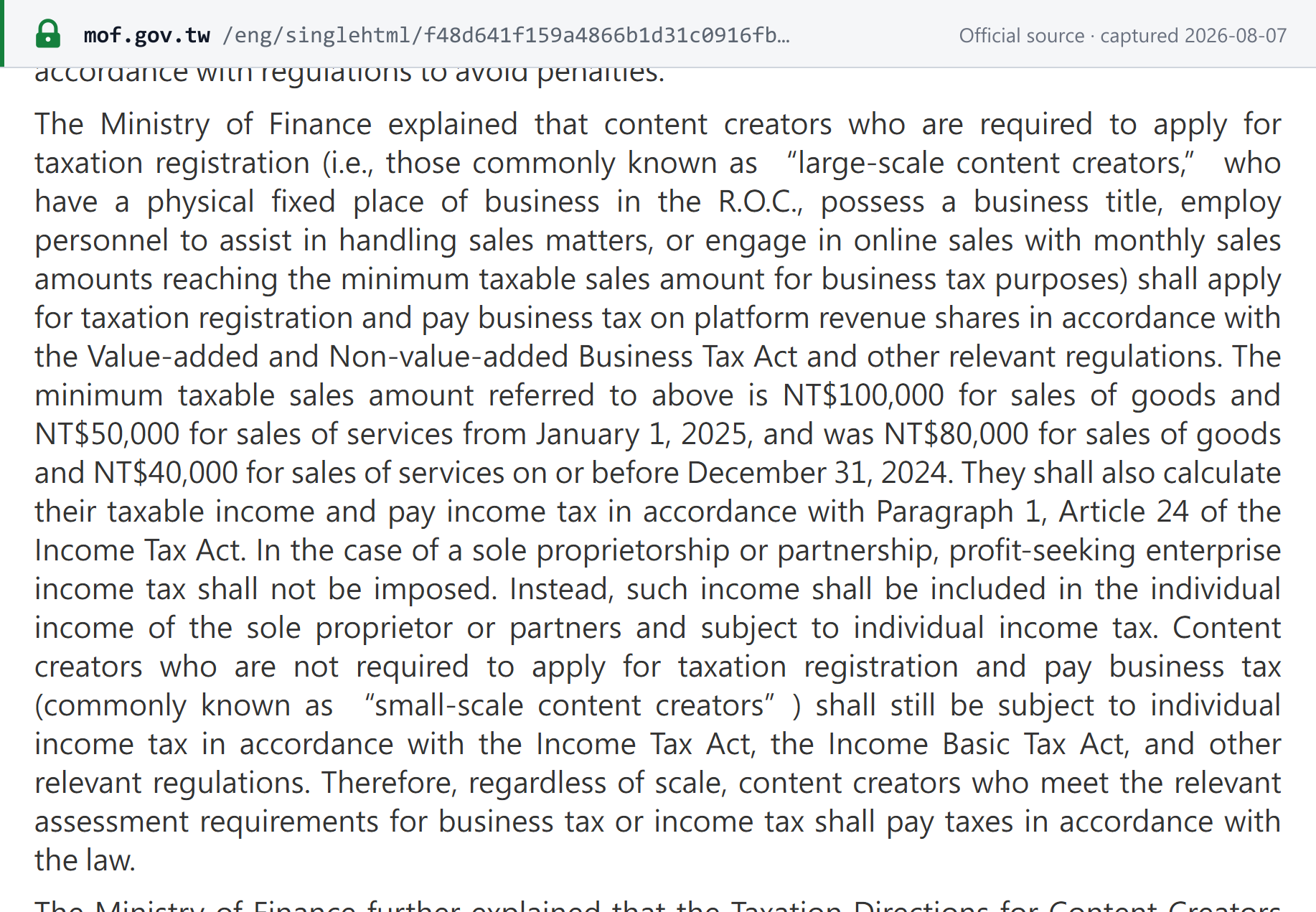
| Online sellers and content creators without those | Register once monthly sales reach the minimum taxable sales amount: NT$100,000 for goods or NT$50,000 for services (from 1 Jan 2025) |
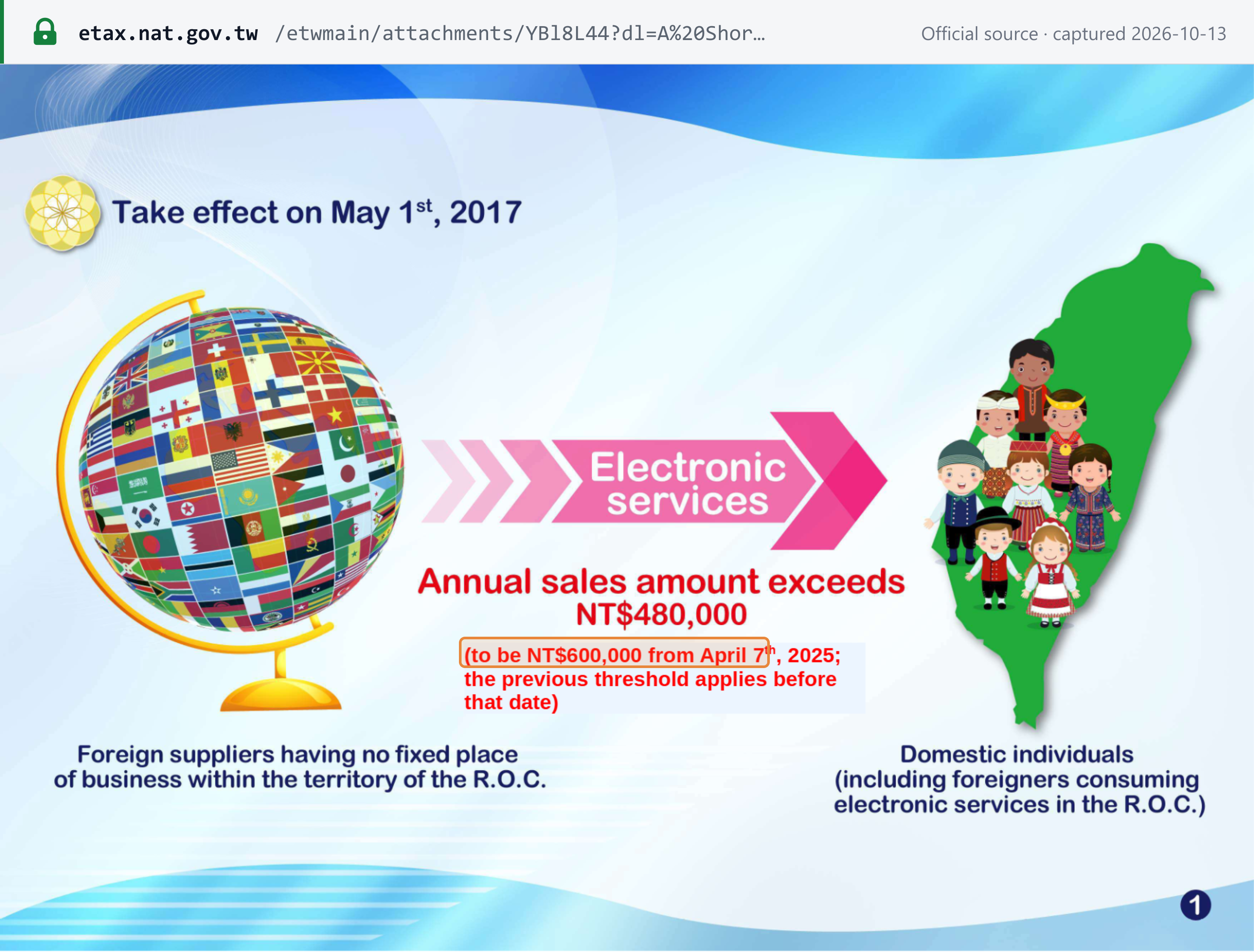
| Foreign suppliers of electronic services to individuals in Taiwan | Register once annual sales exceed NT$600,000 (from 7 Apr 2025) |
The standard business tax rate is 5%. Small business entities whose average monthly sales are below a level set by the Ministry of Finance are assessed by the tax authority and pay 1%. [2]
The monthly minimum taxable sales amount rose from NT$80,000 (goods) and NT$40,000 (services) to NT$100,000 and NT$50,000 on 1 January 2025. It decides when an individual selling online — including a content creator — must register; anyone who has a physical fixed place of business, a business title or staff handling sales must register regardless. The Ministry of Finance issued directions for content creators in 2025, and creators who complied by 30 June 2026 could be exempted from penalties. [8]
Since 2023, any business selling through an online platform, app or other electronic means must show its BAN and registered name clearly on its online sales pages. [3]
How to Register
Companies, sole proprietorships and partnerships register with the Ministry of Economic Affairs or the local government; their tax registration follows automatically. Other businesses file a registration application with the competent National Taxation Bureau before starting business. A foreign enterprise setting up a fixed place of business in Taiwan files its home-country registration certificate, authenticated or notarised. [3]
Cross-Border Notes
- Foreign e-service suppliers with no fixed place of business in Taiwan must register when their annual sales of electronic services to individuals in Taiwan exceed NT$600,000, measured on the previous or current year. The threshold was NT$480,000 until 6 April 2025. [9] They register online through the eTax portal, either directly — handled by the National Taxation Bureau of Taipei — or through a tax-filing agent resident in Taiwan, and are assigned a BAN on approval. [10] Failing to register can be fined NT$3,000 to NT$30,000.
- B2B purchases of services from foreign suppliers without a fixed place of business in Taiwan are reverse-charged by the Taiwanese buyer — although a VAT-registered buyer that uses the services only for its taxable business does not have to pay the tax. [2]
The BAN on uniform invoices
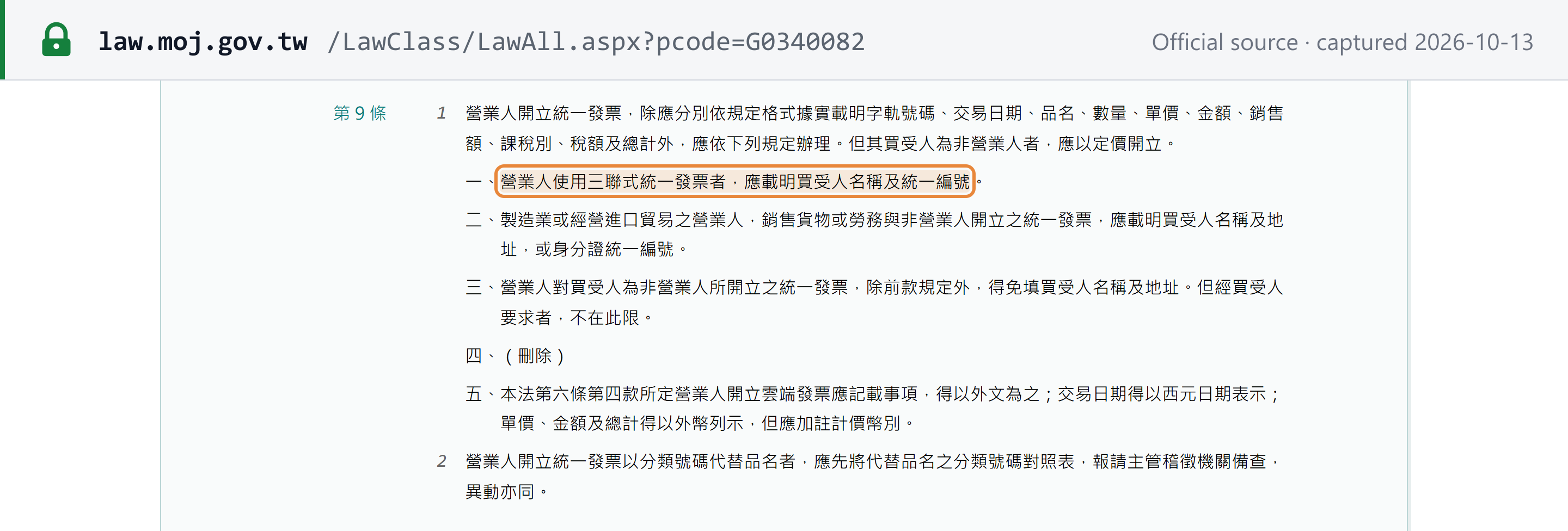
Taiwanese businesses issue uniform invoices (統一發票), which may be issued electronically and transmitted to the Ministry of Finance's e-invoice platform. On a triplicate (B2B) invoice, the seller must state the buyer's name and BAN. [11] Leaving out the buyer's BAN or recording it wrongly is penalised: 1% of the invoice's sales amount (NT$1,500 to NT$15,000) for a first offence, and 2% (NT$3,000 to NT$30,000) for each later one. [2] For e-invoice formats and transmission, see the Taiwan e-invoicing guide.
How to Verify a Taiwanese Tax ID
| What you want to confirm | Official tool | What it covers |
|---|---|---|
| A BAN is registered for business tax | MOF eTax taxation registration lookup — search by BAN, name or address | All tax-registered business entities |
| Whether a business issues uniform invoices | eTax uniform-invoice business lookup | Invoice-issuing status |
| A company's or business name's registration | Ministry of Economic Affairs Findbiz | Company, commercial and limited-partnership registers |
| A foreign resident's old and new UI numbers | National Immigration Agency UI number result lookup | Old-to-new UI number mapping |
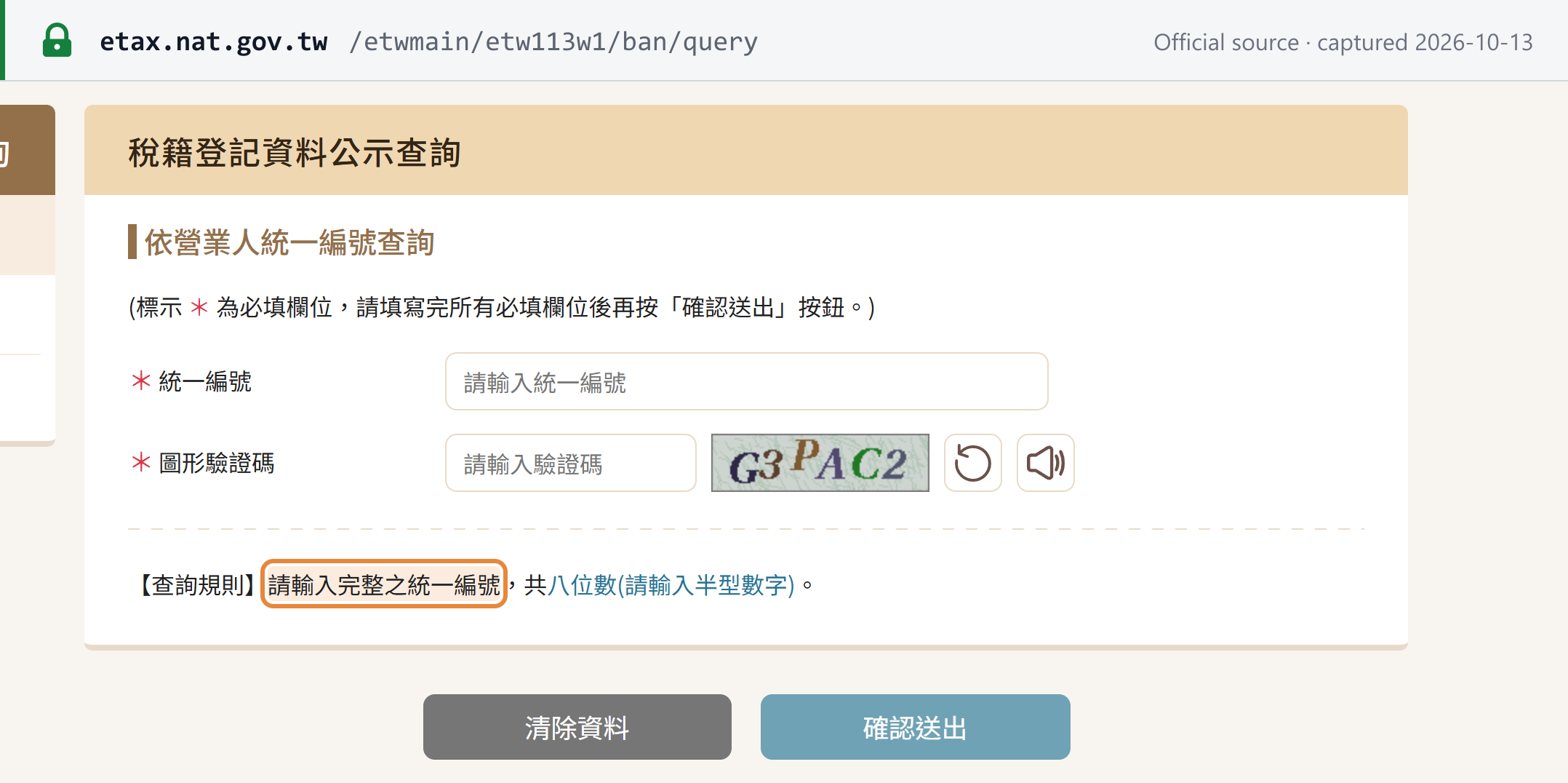
National ID numbers cannot be looked up from the number alone. To check a BAN's format and check digit instantly, use the Lookuptax Taiwan BAN (UBN) validator; test it with 04595252 to confirm the divisible-by-5 rule.
Recent Changes
- 2026-06-30 — End of the penalty-relief window for content creators who registered for business tax under the 2025 directions. (Ministry of Finance) — see event
- 2025-04-07 — Registration threshold for foreign e-service suppliers raised from NT$480,000 to NT$600,000 a year.
- 2025-01-01 — Minimum taxable sales amount raised to NT$100,000 (goods) and NT$50,000 (services) a month.
- 2023-12 — New-series BANs, valid only under the divisible-by-5 check, released.
Frequently Asked Questions
What is the difference between a BAN, a UBN and 統一編號?
They are the same 8-digit number. 營利事業統一編號, usually shortened to 統一編號 or 統編, is the Chinese name. The Ministry of Finance's English name is Business Administration Number (BAN), and many systems call it the Unified Business Number (UBN).
Why is a valid Taiwanese business number rejected by my system?
Your system probably still checks that the weighted sum is divisible by 10. Since 2023 the rule has been divisible by 5, and new-series numbers issued from December 2023 pass only the new rule. The Fiscal Information Agency publishes 04595252 and 10458570 as test numbers that should be accepted.
How is the BAN check digit calculated?
Multiply the eight digits by 1, 2, 1, 2, 1, 2, 4, 1, add the digits of each product, and sum the results. The number is valid if the total is divisible by 5. If the seventh digit is 7, that position can count as 1 or 0, and the number is valid if either total is divisible by 5.
Does Taiwan have a separate VAT number?
No. Taiwan's VAT is business tax, and a business is identified for it by its 8-digit BAN. A business receives the BAN when it registers for tax, and companies get it through their company registration.
Must the buyer's BAN appear on a Taiwanese invoice?
On triplicate (B2B) uniform invoices, yes: the seller must state the buyer's name and BAN. Omitting the buyer's BAN or recording it wrongly is fined 1% of the sales amount (NT$1,500 to NT$15,000) for a first offence and 2% (NT$3,000 to NT$30,000) for each later one.
When does a foreign company need to register for business tax in Taiwan?
A foreign company with no fixed place of business in Taiwan must register when its annual sales of electronic services to individuals in Taiwan exceed NT$600,000, a threshold that applies from 7 April 2025. It is assigned a BAN on approval. Sales to Taiwanese businesses are reverse-charged by the buyer.
What is a UI number, and what changed in 2021?
The UI number is the identifier issued by the National Immigration Agency to foreigners and others without a national ID number. Since 2 January 2021 new UI numbers have one letter and nine digits, with 8 or 9 as the second digit. Older numbers with two letters and eight digits remain usable until 31 December 2030.
Can I check a Taiwanese national ID number online?
Not from the number alone. The Ministry of the Interior's ID-card record check also needs details printed on the card, such as its issue date and place, and the ministry's website does not explain how the check character is calculated. From the number itself you can check only the layout: one letter followed by nine digits, with 1 or 2 as the second digit.
Related Resources
- Taiwan e-invoicing guide (e-GUI)
- Official national VAT number lookups by country
- Worldwide VAT, GST and sales tax registration thresholds
- VAT on digital services from non-resident suppliers
- Taiwan tax changes — chronology
- Reverse charge explained
How Lookuptax can help you in VAT validation?
Lookuptax VAT validation revolutionizes VAT number validation with its robust platform, empowering businesses to seamlessly verify VAT numbers across over 100 countries. Our cutting-edge technology ensures accurate and efficient validation, reducing errors and enhancing compliance.