Australia compliance calendar

9 recurring Goods and services tax (GST) obligations — returns, payments and listings — each with its due rule and official source, plus the dates new Australia rules take effect.

Mon
Tue
Wed
Thu
Fri
Sat
Sun
26
27
28
29
30
31
1
2
3
4
5
6
Return filing Payment

Dates already include the weekend and public-holiday shift where Australia applies one — 7 of 9 obligations here do. The rest stand as computed, and each obligation's notes say which applies to it and why. Confirm against the linked official source before relying on a date.

Recurring obligations, with sources

Each deadline cites the official text that states it and the date we last verified it.

Business activity statement (BAS) — quarterly GST reporting

Goods and services tax (GST) · Quarterly · return filing

28th of the month after the quarter ends — but the occurrence that would fall in January is due 28 February Verified 2026-10-15
Who files
GST-registered businesses with GST turnover under A$20 million that the ATO has not told to report monthly — the default reporting cycle for most registered businesses
Notes
Lodge and pay by 28 October for July–September, 28 February for October–December, 28 April for January–March and 28 July for April–June. The ATO's financial year starts on 1 July, so 28 October is the September quarter, Q1 of 2026–27, and 28 February 2027 is the December quarter, Q2. The December quarter is due in February by law. Sunday 28 February 2027 moves to Tuesday 2 March, because Monday 1 March is Labour Day in Western Australia and the ATO extends any whole-state holiday to every taxpayer. PAYG withholding and instalments share the form and the date. Lodging online or through a registered agent can bring a later date for some quarters, never the December one.
Source
A New Tax System (Goods and Services Tax) Act 1999 — s 31-8 (returns) and s 33-3 (payment), Compilation No. 96 Federal Register of Legislation (legislation.gov.au)
See the source text
“If a tax period applying to you is a *quarterly tax period, you must give your *GST return for the tax period to the Commissioner:”
Screenshot of Federal Register of Legislation (legislation.gov.au) showing the Business activity statement (BAS) — quarterly GST reporting deadline Open full size Captured from Federal Register of Legislation (legislation.gov.au) on 2026-10-14

Business activity statement (BAS) — monthly GST reporting

Goods and services tax (GST) · Monthly · return filing

21st of the month after the month ends Verified 2026-10-15
Who files
Businesses with GST turnover of A$20 million or more, businesses the ATO has directed to report monthly, smaller businesses that choose monthly reporting, and importers in the deferred GST scheme
Notes
Lodge and pay by the 21st of the following month, and lodge a nil BAS for a month with nothing to report. When the 21st is a weekend or a public holiday anywhere in Australia, the deadline moves to the next business day: the October 2026 statement is due Monday 23 November. There is no extra month for December: the December statement is due 21 January, although clients with turnover up to A$10 million who lodge electronically through a registered agent get until 21 February — unless they are registered for deferred GST, which rules the later date out. Importers using the deferred GST scheme must report monthly and pay their import GST on this statement instead of at the border.
Source
Due dates for lodging and paying your BAS — Monthly reporting Australian Taxation Office
See the source text
“The due date to lodge and pay your monthly BAS is the 21st day of the month following the end of the reporting period.”
Screenshot of Australian Taxation Office showing the Business activity statement (BAS) — monthly GST reporting deadline Open full size Captured from Australian Taxation Office on 2026-10-14

Simplified GST return — non-resident limited registration entities

Goods and services tax (GST) — simplified registration · Quarterly · return filing

28th of the month after the quarter ends — but the occurrence that would fall in January is due 28 February Verified 2026-10-15
Who files
Non-resident businesses registered under simplified GST: sellers of imported services and digital products or low-value imported goods (A$1,000 or less) to Australian consumers, electronic distribution platform operators and redeliverers
Notes
A simplified GST registrant cannot choose monthly periods, so it files and pays every quarter through Online services for non-residents, on the ordinary quarterly dates: 28 October, 28 February, 28 April and 28 July. Sellers used to European deadlines are often caught by the October–December quarter, which is not due until 28 February. Registrants get an ATO reference number rather than an ABN, cannot issue tax invoices and cannot claim GST credits. Platform operators that are treated as the supplier for sales made through them file on the same cycle.
Source
Simplified GST registration Australian Taxation Office
See the source text
“must lodge your GST returns and pay your GST by the quarterly payment date”
Screenshot of Australian Taxation Office showing the Simplified GST return — non-resident limited registration entities deadline Open full size Captured from Australian Taxation Office on 2026-10-15

GST instalment — quarterly

Goods and services tax (GST) — instalments · Quarterly · payment

28th of the month after the quarter ends — but the occurrence that would fall in January is due 28 February Verified 2026-10-15
Who files
Businesses with aggregated turnover under A$10 million (or non-business entities with GST turnover of A$2 million or less) that do not report monthly and have elected to pay GST by instalments
Notes
Instalment payers pay an amount the ATO works out for them each quarter, on the same days as the quarterly BAS — 28 October, 28 February, 28 April and 28 July — and report their actual GST only once a year on the annual GST return. The instalment can be varied if the notified amount is too high or too low, and any refund arrives only with the annual return. PAYG items on the same activity statement keep their own rules. The election must be made by 28 October of the financial year it is to cover.
Source
A New Tax System (Goods and Services Tax) Act 1999 — s 162-70, Compilation No. 96 Federal Register of Legislation (legislation.gov.au)
See the source text
“You must pay your *GST instalment to the Commissioner as follows:”
Screenshot of Federal Register of Legislation (legislation.gov.au) showing the GST instalment — quarterly deadline Open full size Captured from Federal Register of Legislation (legislation.gov.au) on 2026-10-14

GST instalment — primary producers and special professionals (two per year)

Goods and services tax (GST) — instalments · Quarterly · payment

28th of the month after the quarter ends Verified 2026-10-15
Who files
GST instalment payers carrying on a primary production business, or special professionals (authors, artists, sportspeople and similar), whose income from that activity exceeded the related deductions in the base year
Notes
Farmers and special professionals who pay by instalments make only the last two payments of the financial year, on 28 April (for January–March) and 28 July (for April–June), rather than four. Nothing is due in October or February. The year's GST is still squared up on the annual GST return.
Source
Quarterly GST reporting — Lodgment and payment dates Australian Taxation Office
See the source text
“If you are a primary producer or a special professional who pays only 2 GST instalments for the year, your instalments are due on 28 April and 28 July.”
Screenshot of Australian Taxation Office showing the GST instalment — primary producers and special professionals (two per year) deadline Open full size Captured from Australian Taxation Office on 2026-10-14

Annual GST return — with the income tax return (31 October)

Goods and services tax (GST) · Annually · return filing

last day of the 4th month after the year ends Verified 2026-10-15
Who files
GST instalment payers, and voluntarily registered entities (GST turnover under A$75,000, or A$150,000 for not-for-profits) that report annually, who lodge their own income tax return
Notes
The annual GST return for the financial year ending 30 June is due, with any balance, on the day your income tax return is due — 31 October for a business that lodges its own. The 2025–26 return falls on Saturday 31 October 2026 and so is due Monday 2 November; the 2026–27 return is expected to be due Monday 1 November 2027, assuming next year's lodgment rules keep 31 October. Clients of a registered tax agent usually have a later income tax date under the agent's lodgment program, and the annual GST return follows it. The calendar shows the year the financial year ends in, so 2026 here means 2025–26.
Source
Due dates for lodging and paying your BAS — Annual reporting Australian Taxation Office
See the source text
“The due date to lodge and pay your annual GST return is 31 October.”
Screenshot of Australian Taxation Office showing the Annual GST return — with the income tax return (31 October) deadline Open full size Captured from Australian Taxation Office on 2026-10-15

Annual GST return — no income tax return required (28 February)

Goods and services tax (GST) · Annually · return filing

28th of the 8th month after the year ends Verified 2026-10-15
Who files
GST instalment payers and annual reporters (voluntarily registered, GST turnover under A$75,000 or A$150,000 for not-for-profits) that are not required to lodge an income tax return
Notes
Entities that do not have to lodge an income tax return file the annual GST return and pay the balance by 28 February after the financial year ends. For 2025–26 that is Sunday 28 February 2027, which moves to Tuesday 2 March because Monday 1 March is a public holiday in Western Australia. The 2026–27 return is due Monday 28 February 2028 (still the 28th, though 2028 is a leap year).
Source
Quarterly GST reporting — Lodgment and payment dates Australian Taxation Office
See the source text
“If you are not required to lodge an income tax return, your annual GST return will be due by 28 February following the financial year the return covers.”
Screenshot of Australian Taxation Office showing the Annual GST return — no income tax return required (28 February) deadline Open full size Captured from Australian Taxation Office on 2026-10-14

GST registration — apply within 21 days

Goods and services tax (GST) · One-off · registration

within 21 days of becoming required to be registered (current or projected GST turnover reaching A$75,000, or A$150,000 for a non-profit body) Verified 2026-10-15
Who files
Any entity carrying on an enterprise whose GST turnover reaches A$75,000 (A$150,000 for non-profit bodies), plus taxi and ride-sourcing drivers and fuel tax credit claimants regardless of turnover; non-residents selling to Australian consumers count towards the same threshold
Notes
You are required to register once your GST turnover reaches A$75,000 (A$150,000 for a non-profit body), or once your projected turnover for the coming year is likely to reach it, and you then have 21 days to apply. Non-resident sellers usually trigger registration on the projected test, before their first year's sales are in. Below the threshold registration is voluntary. Non-resident sellers of digital products and low-value goods to Australian consumers can use the simplified registration through Online services for non-residents.
Source
A New Tax System (Goods and Services Tax) Act 1999 — s 25-1, Compilation No. 96 Federal Register of Legislation (legislation.gov.au)
See the source text
“You must make your application within 21 days after becoming required to be registered.”
Screenshot of Federal Register of Legislation (legislation.gov.au) showing the GST registration — apply within 21 days deadline Open full size Captured from Federal Register of Legislation (legislation.gov.au) on 2026-10-14

GST registration — apply to cancel within 21 days of ceasing business

Goods and services tax (GST) · One-off · registration

within 21 days of ceasing to carry on any enterprise Verified 2026-10-15
Who files
Every GST-registered entity that stops carrying on any enterprise
Notes
A business that closes must apply to cancel its GST registration within 21 days of stopping.
Source
A New Tax System (Goods and Services Tax) Act 1999 — s 25-50, Compilation No. 96 Federal Register of Legislation (legislation.gov.au)
See the source text
“You must lodge your application within 21 days after the day on which you ceased to be carrying on any *enterprise.”
Screenshot of Federal Register of Legislation (legislation.gov.au) showing the GST registration — apply to cancel within 21 days of ceasing business deadline Open full size Captured from Federal Register of Legislation (legislation.gov.au) on 2026-10-14

GST only. Most businesses report and pay quarterly on the business activity statement (BAS) by the 28th of the month after the quarter, except the October–December quarter, which is due 28 February; businesses with GST turnover of A$20 million or more report monthly by the 21st. A due date on a weekend or public holiday moves to the next business day — and the ATO counts a holiday observed throughout any one state or territory as a holiday for everyone. Australia's financial year runs from 1 July to 30 June, so the September quarter is the first quarter of the ATO's year. Excise, wine equalisation tax, luxury car tax and the taxable payments annual report are not covered here; WET, LCT and fuel tax credits are reported on the same BAS.

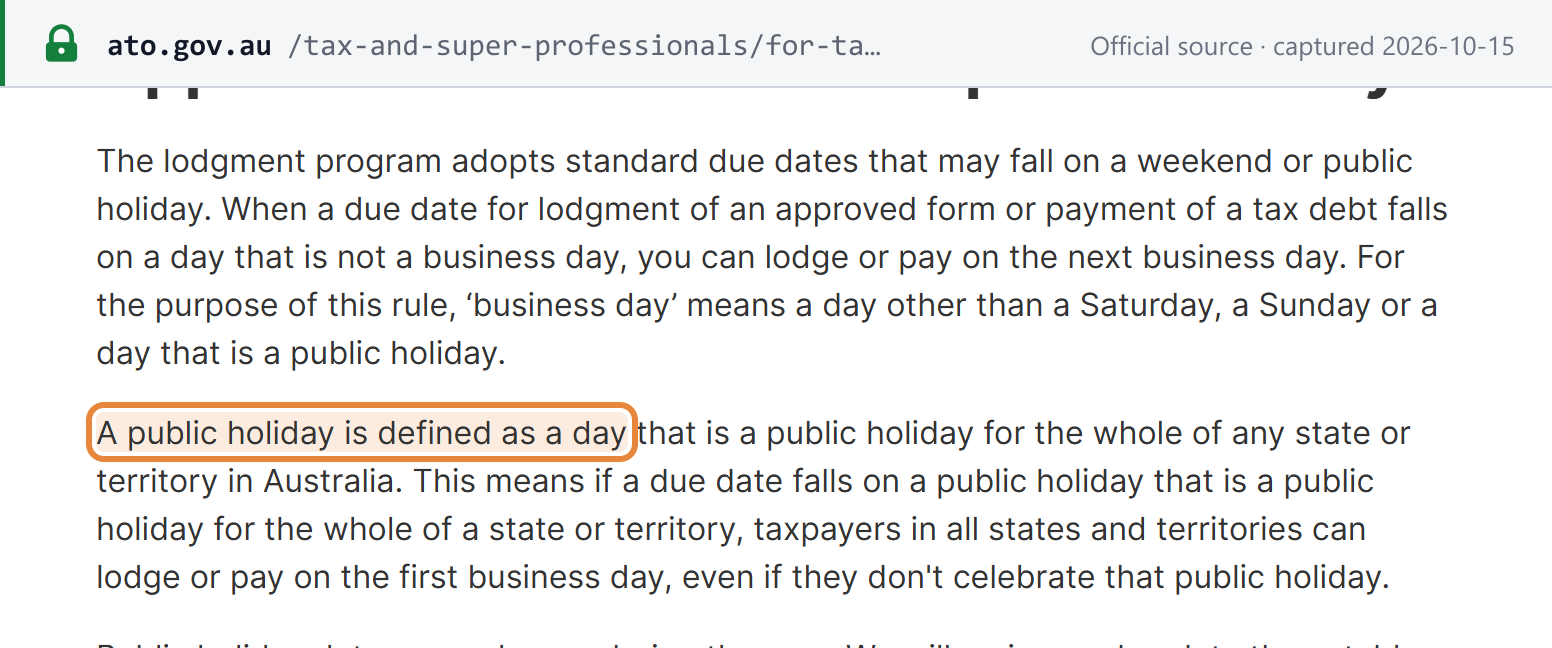
“A public holiday is defined as a day that is a public holiday for the whole of any state or territory in Australia. This means if a due date falls on a public holiday that is a public holiday for the whole of a state or territory, taxpayers in all states and territories can lodge or pay on the first business day, even if they don't celebrate that public holiday.”
Screenshot of the official source stating the rule that governs Australia's deadlines
Lodgment and payment dates on weekends or public holidays — Australian Taxation Office, captured 2026-10-15

What this calendar does not list

  • Not applicable Recapitulative listing — Australia's GST law has no recapitulative or sales listing. The taxable payments annual report (due 28 August) reports payments to contractors for income-tax compliance, not supplies, and is outside this calendar.
  • Not applicable E-invoicing / e-reporting cycle — Peppol e-invoicing is voluntary. The ATO states that eInvoicing is not a compliance or revenue measure and that it receives no copy of invoices, so it creates no filing deadline.

About this calendar

Which Australia tax deadlines does this calendar cover?

9 recurring indirect-tax obligations — Goods and services tax (GST) returns, payments and related filings — each with the due-date rule, who must file, and the official source that states the deadline. Direct-tax, payroll and company-registry deadlines are out of scope.

How current are these due dates?

Every obligation carries the date it was last verified against its official source (newest: 2026-10-15). Law-change dates come from the weekly Last Week in Taxes scan and link to their full change records.

Do the dates account for weekends and public holidays?

No — the calendar shows the statutory due date. Where the authority shifts deadlines falling on non-working days, the obligation notes say so. Confirm against the linked official source before relying on a date.

Validate tax IDs in 100+ countries

Put these rules into practice — verify VAT, GST, and EIN numbers in real time with the Lookuptax API.