
Oman compliance calendar

12 recurring VAT and Excise tax obligations — returns, payments and listings — each with its due rule and official source, plus the dates new Oman rules take effect.

Mon
Tue
Wed
Thu
Fri
Sat
Sun
26
27
28
29
30
31
1
2
3
4
5
6
Return filing Report / listing Law change takes effect

No obligation here shifts for a weekend or public holiday. Where that is Oman's own rule the date stands as shown; where a shift exists but is not modelled, the obligation's notes say so. Confirm against the linked official source before relying on a date.

Recurring obligations, with sources

Each deadline cites the official text that states it and the date we last verified it.

VAT return (quarterly tax period)

VAT · Quarterly · return filing

30th day after the quarter ends Verified 2026-11-12
Who files
Every VAT-registered person: the tax period is a calendar quarter (January–March, April–June, July–September, October–December) for all taxable persons, with no monthly or annual option. Filing and payment share this date.
Notes
Every VAT-registered business files one return per calendar quarter, within 30 days after the quarter ends: by 30 April, 30 July, 30 October and 30 January. Any VAT the return shows as payable must reach the Tax Authority electronically by the same day. A return is owed for every quarter, including one with nothing to declare, and a business registered part-way through a quarter files for the part from its registration date. The VAT law contains no rule moving the deadline when the 30th falls on a Friday, Saturday or public holiday, which happens often, so in those quarters file and pay by the last working day before.
Source
VAT Law (Royal Decree 121/2020), Tax Authority English translation, Article 72 (PDF p.30) Tax Authority (جهاز الضرائب), Sultanate of Oman
See the source text
“The Taxable Person shall file a Tax Return to the Authority within (30) thirty days following the end of the Tax Period”
Screenshot of Tax Authority (جهاز الضرائب), Sultanate of Oman showing the VAT return (quarterly tax period) deadline Open full size Captured from Tax Authority (جهاز الضرائب), Sultanate of Oman on 2026-11-12

Excise tax return (quarterly)

Excise tax · Quarterly · return filing

30th day after the quarter ends Verified 2026-11-12
Who files
Excise registrants (three-month tax periods, shown here as calendar quarters) — producers of excise goods, importers, tax-warehouse keepers and holders of untaxed excise goods. An importer is exempt if its activity is importing only, it holds no tax-warehouse licence and its imports in the quarter do not exceed OMR 5,000.
Notes
The excise law sets three-month tax periods, the first starting on the date of registration; the Tax Authority's portal runs them as calendar quarters, so the return is normally due within 30 days after each quarter closes, the same days as the VAT return. The excise shown on the return is payable on that same day. Small importers can be exempt from the return altogether: the importer must do nothing but import, hold no tax-warehouse licence and bring in no more than OMR 5,000 of excise goods in the quarter. As with VAT, the excise law does not push a deadline that lands on a Friday or Saturday into the following week.
Source
Excise Tax Law (Royal Decree 23/2019) and Executive Regulations, Tax Authority consolidated Arabic edition, Law Article 29 (PDF p.15) Tax Authority (جهاز الضرائب), Sultanate of Oman
See the source text
“يجب على المسجل أن يقدم إلى الجهاز إقرارا ضريبيا خلال (٣٠) الثلاثين يوما التالية لانتهاء الفترة الضريبية”
Screenshot of Tax Authority (جهاز الضرائب), Sultanate of Oman showing the Excise tax return (quarterly) deadline Open full size Captured from Tax Authority (جهاز الضرائب), Sultanate of Oman on 2026-11-12

Excise importer's annual statement of imported excise goods

Excise tax · Annually · report / listing

30th January each year Verified 2026-11-12
Who files
Every importer of excise goods, whether or not it files quarterly excise returns.
Notes
Once a year, anyone who imported excise goods sends the Tax Authority a statement of everything imported in the calendar year just ended, within 30 days of the year end, so by 30 January. The statement gives the tax identification number, the type, quantity and HS code of each good, its retail selling price, the excise category and the tax already paid to Customs at the border. The duty falls on importers generally, not only on small importers excused from quarterly returns. In years when 30 January is a Friday or Saturday, the statement is still due that day, so send it during the working week before.
Source
Excise Tax Executive Regulations (Tax Authority Decision 51/2020), Tax Authority consolidated Arabic edition, Article 47 (PDF p.44) Tax Authority (جهاز الضرائب), Sultanate of Oman
See the source text
“يجب على المستورد لسلعة انتقائية أن يقدم إلى الجهاز بيانا بالسلع الانتقائية التي قام باستيرادها خلال السنة الضريبية، وذلك خلال (٣٠) الثلاثين يوما التالية لانقضاء هذه السنة”
Screenshot of Tax Authority (جهاز الضرائب), Sultanate of Oman showing the Excise importer's annual statement of imported excise goods deadline Open full size Captured from Tax Authority (جهاز الضرائب), Sultanate of Oman on 2026-11-12

VAT registration — resident business above OMR 38,500

VAT · One-off · registration

within 30 days of the end of the month at which supplies over that month and the preceding 11 months exceed — or over that month and the following 11 months are expected to exceed — OMR 38,500 Verified 2026-11-12
Who files
Persons resident in Oman whose supplies over the month just ended and the 11 months before it exceeded OMR 38,500, or are expected to exceed OMR 38,500 over that month and the next 11 months.
Notes
The threshold test is run at the end of each month, looking back over the last 12 months of supplies and forward over the next 12. Once either total passes OMR 38,500, the application must be made within 30 days, and registration normally takes effect on the first day of the following month unless the Tax Authority sets another date in the certificate. Businesses between OMR 19,250 and OMR 38,500 may register voluntarily.
Source
VAT Executive Regulations (Tax Authority Decision 53/2021, Official Gazette 1383), Article 110 (Arabic, PDF p.51) Tax Authority (جهاز الضرائب), Sultanate of Oman
See the source text
“يجب على كل شخص له محل إقامة في السلطنة وملزم بالتسجيل، أن يتقدم بطلب التسجيل وفقا للمادة (١٢٠) من هذه اللائحة وذلك خلال (٣٠) ثلاثين يوما من تاريخ تحقق أي من الحالتين المنصوص عليهما في المادة (٥٥) من القانون”
Screenshot of Tax Authority (جهاز الضرائب), Sultanate of Oman showing the VAT registration — resident business above OMR 38,500 deadline Open full size Captured from Tax Authority (جهاز الضرائب), Sultanate of Oman on 2026-11-12

VAT registration — non-resident established in another GCC implementing state

VAT · One-off · registration

within 30 days of meeting either registration test of VAT Law Article 55 (supplies above OMR 38,500 over the trailing or the expected next 12 months) Verified 2026-11-12
Who files
Persons with no place of residence in Oman but a place of residence in another GCC state that applies VAT, once they meet the same OMR 38,500 tests as residents.
Notes
A business based in another GCC state that applies VAT is treated like an Omani one for timing: it has 30 days to apply once its supplies pass the OMR 38,500 test, and its registration takes effect on the same basis as a resident's. It must also appoint a responsible person resident in Oman.
Source
VAT registration procedures for non-resident applicants (Tax Authority), quoting Executive Regulations Article 111(1) (PDF p.3) Tax Authority (جهاز الضرائب), Sultanate of Oman
See the source text
“within thirty (30) days from the date of meeting the conditions stipulated in Article (55) of the Law”
Screenshot of Tax Authority (جهاز الضرائب), Sultanate of Oman showing the VAT registration — non-resident established in another GCC implementing state deadline Open full size Captured from Tax Authority (جهاز الضرائب), Sultanate of Oman on 2026-11-12

VAT registration — non-resident outside the GCC

VAT · One-off · registration

at least 20 days before the beginning of the month in which the first supply on which the non-resident must pay Omani VAT takes place Verified 2026-11-12
Who files
Persons with no place of residence in Oman or any GCC implementing state that make supplies on which they must pay Omani VAT. There is no registration threshold.
Notes
A foreign business outside the GCC has no threshold to wait for. Its application must be in at least 20 days before the start of the month in which it makes its first supply taxable in Oman — for a first sale in March, that means applying by early February. Registration then takes effect from the date of that first supply.
Source
VAT registration procedures for non-resident applicants (Tax Authority), quoting Executive Regulations Article 111(2) (PDF p.4) Tax Authority (جهاز الضرائب), Sultanate of Oman
See the source text
“twenty (20) days prior to the beginning of the month in which the first supply takes place”
Screenshot of Tax Authority (جهاز الضرائب), Sultanate of Oman showing the VAT registration — non-resident outside the GCC deadline Open full size Captured from Tax Authority (جهاز الضرائب), Sultanate of Oman on 2026-11-12

VAT deregistration — activity ceased permanently

VAT · One-off · registration

within 30 days of permanently ceasing the activity Verified 2026-11-12
Who files
VAT-registered persons that stop carrying on their activity for good.
Notes
A business that closes down for good must apply to the Tax Authority to cancel its VAT registration within 30 days of the day it stopped trading. The 30 days run from the actual cessation, not from the end of the quarter or the year.
Source
VAT Executive Regulations (Tax Authority Decision 53/2021, Official Gazette 1383), Article 136(1) (Arabic, PDF p.61) Tax Authority (جهاز الضرائب), Sultanate of Oman
See the source text
“(٣٠) ثلاثين يوما من تاريخ التوقف عن مزاولة النشاط بشكل نهائي”
Screenshot of Tax Authority (جهاز الضرائب), Sultanate of Oman showing the VAT deregistration — activity ceased permanently deadline Open full size Captured from Tax Authority (جهاز الضرائب), Sultanate of Oman on 2026-11-12

VAT deregistration — registration conditions no longer met

VAT · One-off · registration

within 2 months of the end of the tax year (31 December) in which the conditions for being subject to VAT stopped being met Verified 2026-11-12
Who files
VAT-registered persons that keep trading but stop making taxable supplies; whose supplies over the past 12 months fell below the voluntary registration threshold (OMR 19,250) with no prospect of passing OMR 38,500 in the next 12; whose supplies over the next 12 months are not expected to exceed OMR 19,250; or that transfer all or part of their activity to someone else in those circumstances.
Notes
Where a business carries on but no longer meets the conditions for registration, the cancellation request is due within two months after the end of the calendar year in which that happened — in practice by the end of February. Separately, a business may choose to deregister at any time if its supplies over the past 12 months were between OMR 19,250 and OMR 38,500, it does not expect them to exceed OMR 38,500 over the next 12 months, and it has been registered for more than 12 months.
Source
VAT Executive Regulations (Tax Authority Decision 53/2021, Official Gazette 1383), Article 136(2) (Arabic, PDF p.61) Tax Authority (جهاز الضرائب), Sultanate of Oman
See the source text
“(٢) شهرين من نهاية السنة الضريبية التي انتفت فيها شروط الخضوع للضريبة”
Screenshot of Tax Authority (جهاز الضرائب), Sultanate of Oman showing the VAT deregistration — registration conditions no longer met deadline Open full size Captured from Tax Authority (جهاز الضرائب), Sultanate of Oman on 2026-11-12

Excise — notice of ceasing excise activity

Excise tax · One-off · registration

within 15 days of ceasing, wholly or partly, the activity relating to excise goods Verified 2026-11-12
Who files
Excise registrants that stop, wholly or partly, the activity relating to excise goods.
Notes
An excise registrant that stops dealing in excise goods, even partly, must tell the Tax Authority immediately, and no later than 15 days after stopping, giving its tax identification number and the reason. Excise registration itself has no fixed deadline, but a business that should register and does not is treated as registered by law. Changes to registration details must be reported within 30 days.
Source
Excise Tax Executive Regulations (Tax Authority Decision 51/2020), Tax Authority consolidated Arabic edition, Article 14 (PDF p.34) Tax Authority (جهاز الضرائب), Sultanate of Oman
See the source text
“يلتزم المسجل بإخطار الجهاز إذا توقف – كليا أو جزئيا – عن مزاولة النشاط المتعلق بالسلعة الانتقائية خلال (١٥) خمسة عشر يوما من تاريخ التوقف”
Screenshot of Tax Authority (جهاز الضرائب), Sultanate of Oman showing the Excise — notice of ceasing excise activity deadline Open full size Captured from Tax Authority (جهاز الضرائب), Sultanate of Oman on 2026-11-12

Excise — declaration of stock held when goods become excisable or the rate rises

Excise tax · One-off · report / listing

within 15 days of the date goods become subject to excise tax or their excise rate is increased Verified 2026-11-12
Who files
Anyone importing, producing, trading in or distributing goods that newly become subject to excise or whose excise rate is increased — registered or not.
Notes
When a product is brought into the excise net, or its excise rate goes up, every business importing, producing, trading in or distributing it must declare the stock it held beforehand, on the Tax Authority's form, within 15 days of the change. The declaration lists the kinds and quantities of goods, the retail selling price of each and the excise due on them. It applies whether or not the business is registered for excise.
Source
Excise Tax Executive Regulations (Tax Authority Decision 51/2020), Tax Authority consolidated Arabic edition, Article 9 (PDF p.32) Tax Authority (جهاز الضرائب), Sultanate of Oman
See the source text
“يلتزم كل من يزاول نشاطا يتعلق بهذه السلعة كالاستيراد أو الإنتاج أو الاتجار أو التوزيع بإخطار الجهاز بالرصيد الموجود لديه منها قبل خضوعها للضريبة أو الزيادة في فئتها على النموذج المعد لهذا الغرض، وذلك خلال (١٥) خمسة عشر يوما من تاريخ الخضوع أو الزيادة”
Screenshot of Tax Authority (جهاز الضرائب), Sultanate of Oman showing the Excise — declaration of stock held when goods become excisable or the rate rises deadline Open full size Captured from Tax Authority (جهاز الضرائب), Sultanate of Oman on 2026-11-12

VAT — revised return after discovering an error

VAT · One-off · return filing

within 29 days of the day the error or omission is discovered (the Tax Authority counts that day as day 1 of 30, so an error found on 20 June is due by 19 July) Verified 2026-11-12
Who files
Any taxable person that becomes aware of an error or omission in a VAT return it has already filed.
Notes
If you find a mistake in a VAT return you have already submitted, the law gives 30 days to file a revised return, which then replaces the original. The Tax Authority counts the day of discovery as the first of those days: in its own example an error found on 20 June must be corrected by 19 July. A return can no longer be revised three years after it was submitted, and not once the Authority has started an inspection.
Source
VAT Law (Royal Decree 121/2020), Tax Authority English translation, Article 73 (PDF p.30) Tax Authority (جهاز الضرائب), Sultanate of Oman
See the source text
“The revised Tax Return shall be filed within (30) thirty days following the error or omission being discovered.”
Screenshot of Tax Authority (جهاز الضرائب), Sultanate of Oman showing the VAT — revised return after discovering an error deadline Open full size Captured from Tax Authority (جهاز الضرائب), Sultanate of Oman on 2026-11-12

VAT — notice of changes to registration details

VAT · One-off · registration

within 30 days of the change to data previously submitted in the registration application Verified 2026-11-12
Who files
Every VAT-registered person whose registration details change.
Notes
Changes to anything given in the VAT registration application, such as the business name, address, activity or bank details, must be notified to the Tax Authority in writing within 30 days of the change. The Authority then issues a certificate showing the new details. A non-resident must report changes to its responsible person's details within 10 days.
Source
VAT Law (Royal Decree 121/2020), Tax Authority English translation, Article 65 (PDF p.27) Tax Authority (جهاز الضرائب), Sultanate of Oman
See the source text
“The Taxable Person shall notify the Authority in writing for any changes that occurred on data previously submitted in the registration application within (30) thirty days from occurrence of the changes.”
Screenshot of Tax Authority (جهاز الضرائب), Sultanate of Oman showing the VAT — notice of changes to registration details deadline Open full size Captured from Tax Authority (جهاز الضرائب), Sultanate of Oman on 2026-11-12
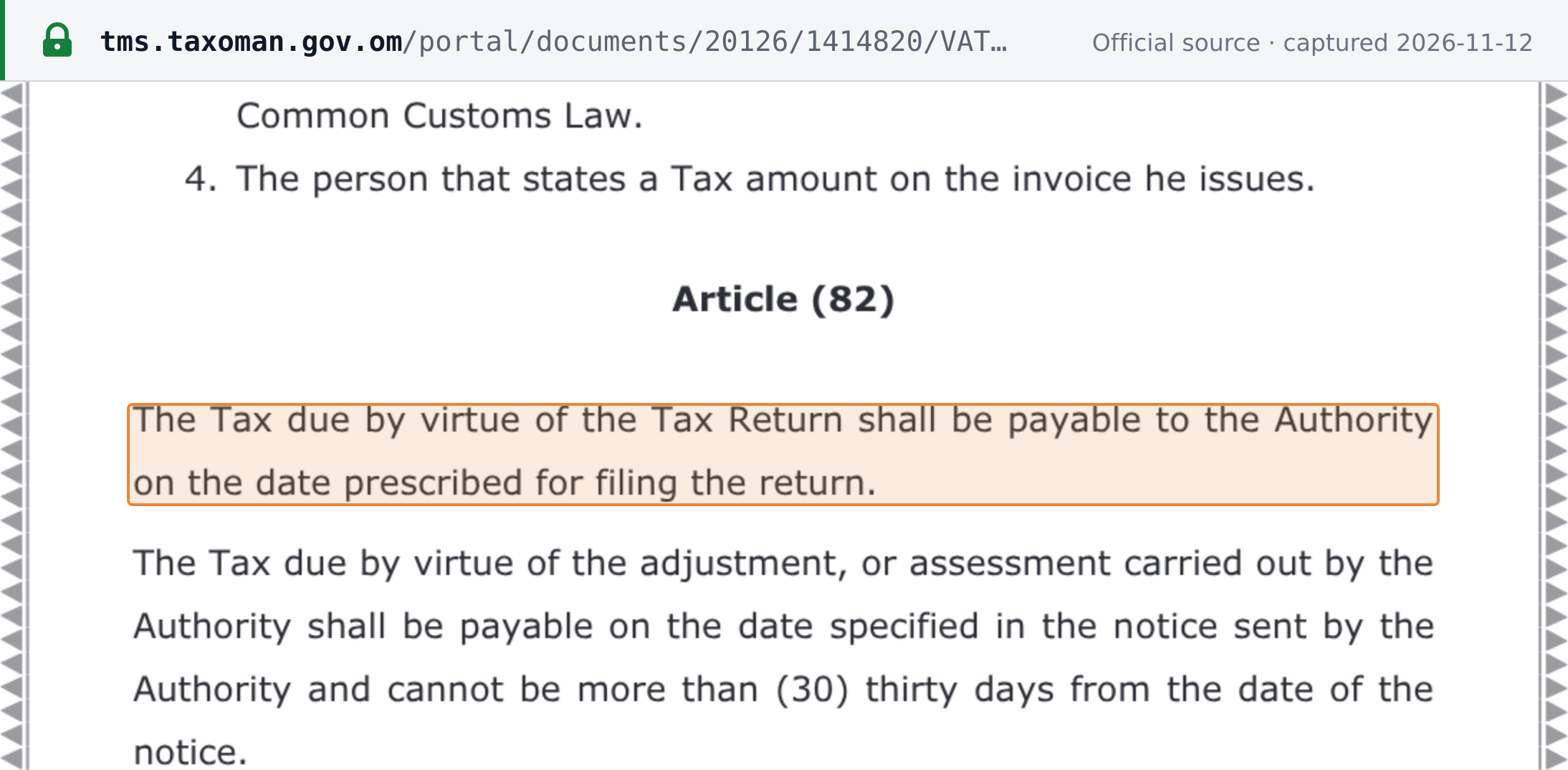
Oman's VAT and excise tax both run on calendar quarters, and each return is due within 30 days after the quarter ends — 30 April, 30 July, 30 October and 30 January — with the tax paid by the same day. Oman's weekend is Friday and Saturday, and neither tax law moves a deadline that falls on a weekend or public holiday, so the dates shown are the statutory days: when the 30th falls on a Friday or Saturday there is no extra day, and the safe course is to file by the Thursday before. Fawtara e-invoicing begins on 1 April 2027 for businesses with annual supplies above OMR 5 million and on 1 October 2027 for the rest, and works invoice by invoice rather than through a periodic return. Import VAT and excise are normally collected by Customs at the border, although a VAT-registered importer approved by the Tax Authority can defer import VAT and declare it on its VAT return instead. Corporate income tax, withholding tax and personal income tax have their own calendars and are not covered here.

“The Tax due by virtue of the Tax Return shall be payable to the Authority on the date prescribed for filing the return.”
Screenshot of the official source stating the rule that governs Oman's deadlines
VAT Law (Royal Decree 121/2020), Tax Authority English translation, Article 82 (PDF p.34) — Tax Authority (جهاز الضرائب), Sultanate of Oman, captured 2026-11-12

What this calendar does not list

  • Not applicable Separate payment deadline — There is no separate payment deadline. VAT Law article 82 makes the tax shown on a return payable on the date prescribed for filing that return, and Excise Tax Law article 34 does the same for excise, so the quarterly return rows carry both.
  • Not applicable Recapitulative listing — Neither the VAT Law and its Executive Regulations nor the excise legislation provide a recapitulative statement, sales or purchase listing, intra-GCC listing or SAF-T file. The excise importer's annual statement is a report of the filer's own imports and is shown as an annual filing instead.
  • Not applicable E-invoicing / e-reporting cycle — Fawtara e-invoicing (Tax Authority Decision 189/2026) starts on 1 April 2027 for taxable persons with annual supplies above OMR 5 million and on 1 October 2027 for everyone else. Each invoice is reported as it is issued — B2B in real time, B2C within 24 hours — so there is no periodic e-invoicing return.

About this calendar

Which Oman tax deadlines does this calendar cover?

12 recurring indirect-tax obligations — VAT and Excise tax returns, payments and related filings — each with the due-date rule, who must file, and the official source that states the deadline. Direct-tax, payroll and company-registry deadlines are out of scope.

How current are these due dates?

Every obligation carries the date it was last verified against its official source (newest: 2026-11-12). Law-change dates come from the weekly Last Week in Taxes scan and link to their full change records.

Do the dates account for weekends and public holidays?

No — the calendar shows the statutory due date. Where the authority shifts deadlines falling on non-working days, the obligation notes say so. Confirm against the linked official source before relying on a date.

Validate tax IDs in 100+ countries

Put these rules into practice — verify VAT, GST, and EIN numbers in real time with the Lookuptax API.