· Abhilash John Philip · Industry · 15 min read
The Inevitable Convergence: Why Every Tax Provider Will Become an E-Invoicing Provider
With over 90 countries implementing e-invoicing mandates, traditional tax software providers face an existential question: adapt or become obsolete.
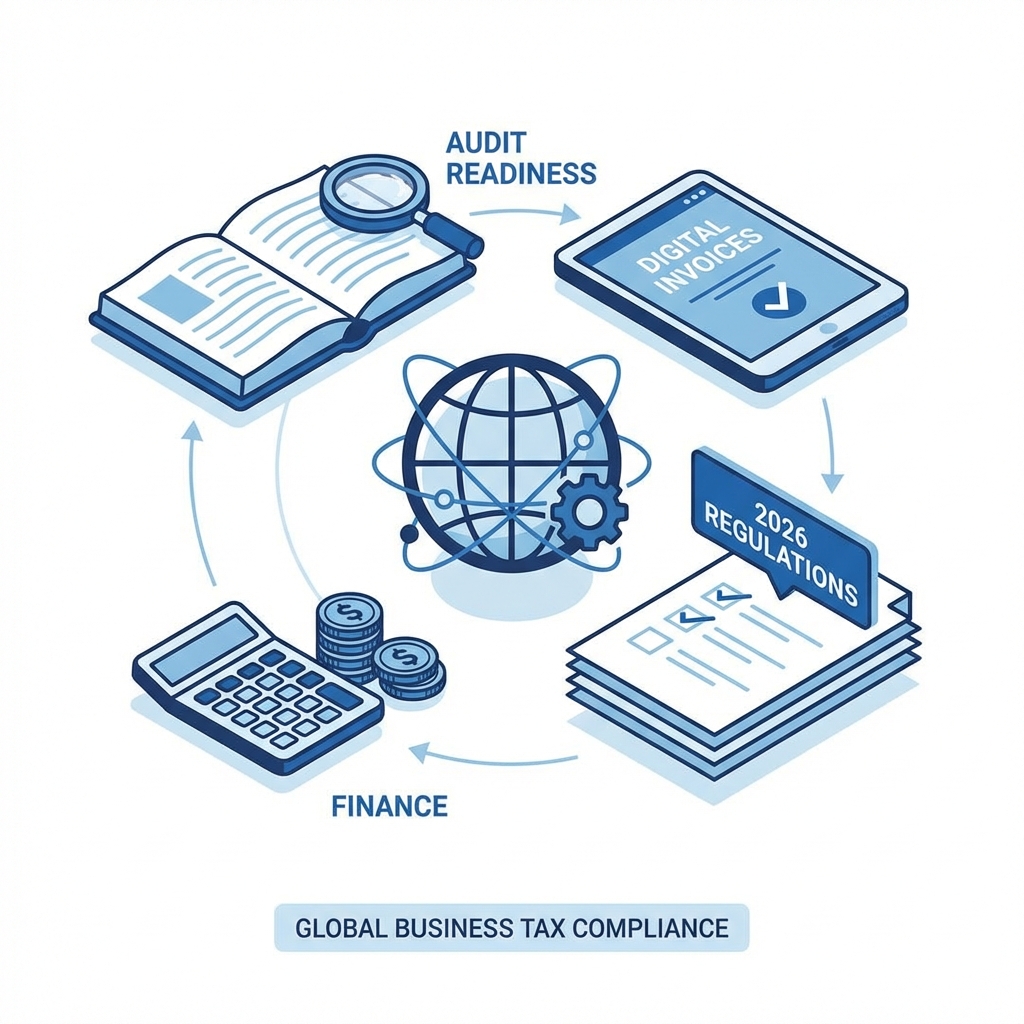
How the Global E-Invoicing Revolution is Reshaping Tax Technology and Why It’s Existential for Tax Software Providers
TL;DR
The tax technology landscape is undergoing its most significant transformation in decades. With over 90 countries implementing or planning e-invoicing mandates by 2030, and the global e-invoicing market projected to reach $68.7 billion by 2033 (growing at 16.8% CAGR), traditional tax software providers face an existential question: adapt or become obsolete.
This isn’t merely about adding a new feature—it’s a fundamental shift in how tax compliance operates. The convergence of tax calculation and e-invoicing capabilities has become a strategic imperative, driven by government-mandated Continuous Transaction Controls (CTCs) that require real-time or near-real-time submission of invoice data to tax authorities. For tax providers, the message is clear: e-invoicing isn’t optional, it’s the future of tax compliance.
The Market Reality: E-Invoicing’s Explosive Growth
The numbers tell a compelling story. The global e-invoicing market has experienced explosive growth:
| Year | Market Size | Growth Driver |
|---|---|---|
| 2024 | $15.9 billion | Initial mandate adoption |
| 2033 | $68.7 billion | Global CTC implementation |
| 2025-2033 | 16.8% CAGR | Regulatory mandates |
Source: IMARC Group, Markets and Markets research 2024-2025
Europe is leading the charge, with the European e-invoicing market valued at $1.9 billion in 2024 and projected to reach $6.5 billion by 2033 (14.77% CAGR). Meanwhile, Asia-Pacific is experiencing the fastest growth as countries like India, China, and South Korea implement comprehensive digital tax frameworks.
Why E-Invoicing is Existential for Tax Providers
1. Government Mandates Are Rewriting the Rules
The shift to e-invoicing isn’t market-driven—it’s government-mandated. Tax authorities worldwide are implementing Continuous Transaction Controls (CTCs) that fundamentally change how businesses report transactions:
Traditional Model: Businesses calculate tax → generate invoices → file periodic returns (monthly/quarterly)
CTC Model: Businesses generate invoice → submit to tax authority in real-time → receive clearance/validation → deliver to customer → automated tax return pre-population
This transition means that invoice generation is no longer just a billing function—it’s a tax compliance function. Over 70 countries have already introduced CTC mandates, with more than 90 expected by 2030.
“By 2030, most countries are expected to adopt a form of CTC. CTCs are expanding beyond invoicing to include various business documents and processes, including accounts payable, logistics, payrolls, and tickets.”
— Fonoa Research Report on Continuous Transaction Controls
2. The Integration Imperative
Tax providers who don’t offer integrated e-invoicing solutions face a critical disadvantage. When businesses select separate vendors for tax calculation and e-invoicing, tax providers:
- Lose visibility into the complete transaction lifecycle
- Create integration complexity and potential points of failure
- Risk customer churn as competitors offer all-in-one solutions
- Forfeit the opportunity to own a larger share of the customer’s tax technology stack
The market validates this trend. When evaluating e-invoicing solutions, companies rank integration capabilities as the second most important factor after cost, according to TaxTech500 research.
3. The Bidding Wars Tell the Story
The strategic importance of e-invoicing is evident in the fierce acquisition battles among tax technology leaders:
| Date | Acquirer | Target / Value |
|---|---|---|
| Apr 2021 | Stripe | TaxJar - $850-900M (foundation for Stripe Tax) |
| Dec 2023 | Vertex | Pagero Group (Sweden) - $564M initial bid |
| Jan 2024 | Thomson Reuters | Pagero Group - $620M counter-bid |
| Jan 2024 | Avalara | Pagero Group - $700M bid |
| Jan 2024 | Thomson Reuters | Pagero Group - $784M final (53.81% stake acquired) |
| Aug 2024 | Vertex | Ecosio (Germany) - $180M ($69M upfront + $111M earn-out) |
| Dec 2024 | Avalara | Oobj Tecnologia (Brazil) - expanding Latin America reach |
Source: Company announcements, CPA Practice Advisor, Accounting Today
These weren’t small investments—they represented some of the largest acquisitions in tax technology history. The message from industry leaders is unmistakable: e-invoicing capabilities are non-negotiable for future competitiveness.
“As many countries move towards legislating for real-time digital tax regulation, the e-invoicing compliance capabilities of Pagero complement and expand Thomson Reuters’ ONESOURCE indirect tax offerings, providing enhanced compliance and workflow automation benefits to customers.”
— Steve Hasker, CEO and President, Thomson Reuters
How Tax Providers Are Approaching the Transition
Tax technology leaders are pursuing diverse strategies to build e-invoicing capabilities. The critical strategic decision—build from scratch, acquire, or partner—reveals why most incumbents choose the acquisition route despite its high cost.
The Build-from-Scratch Challenge: Why Most Don’t
Building a comprehensive e-invoicing platform from the ground up is technically feasible but economically and strategically daunting. Here’s what it actually takes:
| Build Requirement | Investment Required |
|---|---|
| Development Cost | $140,000-$400,000+ for MVP; $1M+ for enterprise-grade solution |
| Time to Market | 18-36 months for first jurisdiction; years for global coverage |
| Government Certifications | Each country requires separate certification process (6-18 months per jurisdiction) |
| Format Support | XML, UBL, EDIFACT, PEPPOL, plus 90+ country-specific schemas |
| Compliance Team | Dedicated staff monitoring regulatory changes in 50+ jurisdictions |
| Infrastructure | Secure transmission, digital signatures, encryption, archival storage (10+ years) |
| Ongoing Updates | Continuous adaptation to changing regulations; average 50+ updates per year |
The Acquisition Math: When Vertex acquired Ecosio for $180 million or Thomson Reuters paid $784 million for Pagero, they weren’t just buying technology—they were buying years of certification work, established government relationships, proven compliance infrastructure, and immediate revenue. The alternative? Spend 3-5 years building, miss market windows, and still face regulatory uncertainty.
This explains why the regional acquisition route dominates. Companies like Pagero, Ecosio, and Oobj spent years navigating certification processes, building relationships with tax authorities, and achieving compliance in specific geographies. You can’t fast-track government approval cycles or shortcut institutional knowledge—you can only buy it.
Strategy 1: Acquisition (The Dominant Path)
Who: Vertex, Thomson Reuters, Avalara, Stripe
Approach: Acquire established e-invoicing platforms or tax automation companies with existing infrastructure, country coverage, and customer bases.
Why This Dominates:
- Immediate market presence with proven, certified technology
- Existing compliance certifications bypass 18+ month government approval cycles
- Built-in customer base and revenue stream offset acquisition costs
- Experienced teams with deep regional expertise and government relationships
- Competitive defense—removing viable acquisition targets from competitors
Stripe’s 2021 acquisition of TaxJar for $850-900 million exemplifies this strategy. Rather than building tax calculation from scratch, Stripe bought proven technology serving 20,000+ businesses, then used it as the foundation for Stripe Tax—which now supports 50+ countries. Similarly, Vertex’s acquisition of Ecosio brought cloud-based global network capabilities and EDI expertise that integrate directly with Vertex’s indirect tax platform.
Strategy 2: Strategic Partnerships (The Bridge)
Who: SAP, mid-tier tax providers
Approach: Partner with specialized e-invoicing networks while maintaining core tax engine capabilities.
Example: In March 2024, SAP partnered with Basware to offer integrated e-invoicing services to their combined customer base, leveraging Basware’s established network while SAP maintains its tax compliance focus.
Reality: Partnership models work as transitional strategies but create integration complexity, divided customer support, and dependency on third-party roadmaps. Most treat partnerships as bridges while building acquisition war chests or internal capabilities.
Strategy 3: Build In-House (The ERP Vendor Path)
Who: Large ERP vendors (SAP, Oracle NetSuite), enterprise billing platforms
Approach: Develop native e-invoicing capabilities integrated directly into existing platforms.
Example: NetSuite announced in July 2025 that its E-Invoicing solution would support the Digital Business Networks Alliance (DBNA) exchange network for U.S. B2B transactions, building on years of internal development.
The ERP Advantage: ERP vendors can justify massive build investments because e-invoicing is table stakes for their platforms—losing it means losing ERP deals. For pure-play tax providers, the calculus favors acquisition.
Strategy 4: API-First, Cloud-Native from Day One (The Disruptor Model)
Who: Fonoa, Stripe Tax, Anrok (tax only—no e-invoicing)
Philosophy: Build tax compliance as unified, developer-friendly infrastructure from the ground up—no legacy systems to maintain.
While traditional providers retrofit e-invoicing onto decades-old tax engines, new-age players are architecting for a CTC-first world. However, their coverage reveals the build vs. buy reality and significant gaps in capabilities:
Fonoa: The Full-Stack Global Player
Founded in 2020 and valued at over $100 million, Fonoa offers tax determination, e-invoicing, VAT validation, and compliance reporting through a single API. Their capabilities:
- Built for CTC from inception: Real-time validation and e-invoicing are native, not bolted on
- API-first architecture: Every feature accessible via REST API—no manual configuration UI
- Compliance-as-code: Regulatory changes deploy as API updates within days, not months
- Thought leadership: Fonoa’s CTC research is frequently cited, though their actual market deployment at scale remains to be proven
Reality check: While Fonoa offers a compelling technical vision, they’re still building out comprehensive country coverage. Unlike Pagero or Ecosio, which spent a decade achieving certifications across 50+ jurisdictions, Fonoa is racing to catch up while also acquiring customers.
Stripe Tax: The Payments + Tax Unification
Built on the $850-900M TaxJar acquisition (April 2021), Stripe Tax integrates tax compliance directly into the payment flow:
- Perfect transaction visibility: Since Stripe processes payments, tax calculation happens at source of truth
- 50+ countries supported: Leveraged TaxJar’s existing infrastructure rather than building from scratch
- Zero-friction adoption: Millions of existing Stripe customers add tax with a few lines of code
- The acquisition advantage: Stripe didn’t build this organically—they bought 10 years of TaxJar’s compliance work
The strategic question: What if tax becomes a feature of payments infrastructure rather than standalone software? This only works if you already control the payment layer.
Anrok: The U.S. Specialist (Tax Only—No E-Invoicing)
Anrok raised $20 million in Series A (2023) focused exclusively on U.S. sales tax for SaaS companies. Critically, Anrok does NOT offer e-invoicing capabilities—a strategic limitation revealing the build challenge:
- Tax-only focus: Provides tax calculation and filing for U.S. jurisdictions but outsources VAT/GST and e-invoicing to partners
- Why no e-invoicing? The U.S. has no CTC mandates yet, and building global e-invoicing infrastructure requires resources beyond most VC-funded startups
- Embedded in billing systems: Integrates into Stripe, Zuora, and Chargebee for automated sales tax, but relies on those platforms or third parties for any international compliance
- The waiting game: Anrok is betting on eventual U.S. mandates while focusing solely on what they can execute now—domestic sales tax automation
The limitation is significant: Anrok cannot serve the global SaaS companies that are their natural customers once those companies need to comply with European VAT or Latin American e-invoicing mandates. This forces customers to either add additional vendors or switch to competitors like Stripe Tax or Fonoa for comprehensive coverage.
How New-Age Players Differ from Incumbents
| Dimension | Traditional Providers | New-Age Players |
|---|---|---|
| Architecture | Tax engine + e-invoicing bolted on | Unified API from inception |
| Integration | Complex ERP integrations, professional services required | Self-service API integration in hours/days |
| Target Market | Enterprise, manufacturing, traditional commerce | SaaS, marketplaces, digital-first businesses |
| Build vs Buy | Acquire regional specialists ($180M-$900M) | Built in-house OR acquired foundation (Stripe/TaxJar) |
| Coverage Gaps | Slower to add new jurisdictions | Limited initial coverage, racing to expand |
| Updates | Quarterly/annual release cycles | Continuous deployment, zero downtime |
| Proven Scale | Decades of enterprise deployments | Limited track record at global enterprise scale |
The Competitive Reality: New-age players offer superior developer experience and faster implementation for digital-native companies. However, they face significant challenges:
- Certification timelines: Even with API-first architecture, government certifications still take 6-18 months per country
- Enterprise requirements: Large enterprises need audit trails, SOC 2 compliance, and dedicated support that startups may not provide
- Coverage limitations: Fonoa and Anrok combined don’t match the jurisdiction coverage of Vertex or Avalara
- Profitability unknowns: Most new-age players are VC-funded and unprofitable; sustainability at scale is unproven
Traditional providers are capturing digital customers through better APIs (Vertex Cloud, Avalara AvaTax), while new-age players struggle to win enterprise deals requiring comprehensive global coverage.
Critical Implications for Billing Systems
The convergence of tax and e-invoicing creates profound implications for billing platforms, ERP systems, and enterprise software architecture. The central strategic question: should billing systems treat invoice documents as core to their product, or should they partner with specialists?
The Invoice Document as Core Product Thesis
Under CTC mandates, invoices are no longer just billing artifacts—they’re legal compliance documents that determine whether a business can operate. This fundamentally changes how billing platforms should think about invoice generation:
Case FOR Invoice-as-Core:
- Existential dependency: If invoices can’t be validated in real-time, businesses can’t bill—making tax/e-invoicing as critical as payment processing
- Competitive moat: Integrated compliance reduces integration complexity and creates switching costs
- Revenue expansion: Tax/e-invoicing becomes a premium feature tier or cross-sell opportunity
- Customer experience: Single vendor for billing + compliance = unified support and seamless workflows
Case AGAINST Invoice-as-Core:
- Certification burden: Achieving government approvals in 90+ jurisdictions requires dedicated compliance teams and years of investment
- Continuous updates: Tax rules change constantly—50+ regulatory updates per year require perpetual maintenance
- Distraction risk: Building e-invoicing infrastructure pulls resources from core billing innovation
- Liability exposure: Tax miscalculations create legal liability—specialists carry insurance and compliance expertise
How Billing Systems Should Derisk Themselves Long-Term
Most billing platforms are choosing a hybrid approach that balances control with specialization:
1. API-First Integration Architecture
Build deep, native integrations with 2-3 tier-one tax/e-invoicing providers (Vertex, Avalara, Fonoa, Stripe Tax) rather than building everything in-house. Expose tax/e-invoicing as configurable modules customers can enable based on their geographic footprint.
Example: BillingPlatform’s BP E-Invoice handles core invoice generation natively for major markets (U.S., EU), but partners with regional specialists for emerging markets (LATAM, APAC, Middle East).
2. Treat Invoice Data as Core, Invoice Compliance as Partnered
Own the invoice data model, generation logic, and customer-facing templates. Partner for regulatory compliance, tax calculation, government transmission, and certification management.
Why this works:
- You maintain control over the invoice experience and data structure
- Tax specialists handle the complex, ever-changing compliance requirements
- You can swap tax providers without rebuilding core invoicing infrastructure
3. Build Compliance Orchestration, Not Compliance Engines
Invest in orchestration logic that routes invoices to appropriate tax/e-invoicing providers based on customer jurisdiction, transaction type, and regulatory requirements. This creates defensibility without the certification burden.
Strategic value:
- You become the intelligent routing layer customers rely on
- You can add new jurisdictions by onboarding new specialist partners
- You avoid technical debt of maintaining 90+ country-specific integrations in-house
4. Create a Multi-Provider Strategy from Day One
Never become dependent on a single tax/e-invoicing provider. Build abstraction layers that allow you to support multiple providers simultaneously and switch providers regionally without breaking customer implementations.
Derisking benefits:
- Protection against provider price increases or service degradation
- Ability to offer customer choice (some prefer Vertex, others prefer Avalara)
- Leverage competition to negotiate better pricing and SLAs
The Bottom Line for Billing Systems: Invoice documents should be treated as core to the product experience—but invoice compliance infrastructure should be strategically partnered. The winners will be platforms that provide seamless, abstracted access to best-in-class tax/e-invoicing providers while maintaining control over the invoice data model and customer relationship.
Billing Systems Must Become Tax-Aware
Traditional billing platforms generated invoices as business documents. Under CTC mandates, invoices are tax compliance documents that must:
- Include precise tax calculations validated in real-time
- Conform to country-specific structured data formats (XML, UBL, etc.)
- Support digital signatures and encryption
- Enable two-way communication with tax authority platforms
- Provide audit trails and immutable records
Integration Architecture Becomes Mission-Critical
The integration between billing systems, tax engines, and e-invoicing platforms must be:
| Requirement | Why It Matters |
|---|---|
| Real-time | CTC mandates require immediate submission; batch processing is obsolete |
| Bidirectional | Tax authorities return validation results, errors, and status updates |
| Error-Resilient | Failed submissions can block business operations; robust retry logic essential |
| Multi-jurisdictional | Each country has unique formats, protocols, and validation rules |
According to ClearTax research, “Clean data reduces e-invoice rejections by nearly 80%,” highlighting how critical data quality becomes in CTC environments.
The Global E-Invoicing Mandate Landscape
Understanding when and where mandates take effect is critical for tax providers’ product roadmaps:
| Region | Status | Key Mandates | Timeline |
|---|---|---|---|
| Europe | Leading adoption | Italy, France, Germany, Poland, Spain, Belgium | 2019-2030 (staggered) |
| Latin America | Mature markets | Brazil, Chile, Mexico, Argentina | Implemented 2014+ |
| Asia-Pacific | Fastest growth | India, Singapore, Malaysia, South Korea | 2020-2027 |
| Middle East | Emerging | Saudi Arabia, UAE, Egypt | 2021-2025 |
| North America | Voluntary/B2G | US pilot programs, Canada exploring | TBD (expected 2026+) |
Europe’s VAT in the Digital Age (ViDA) initiative represents the most comprehensive regulatory framework, requiring all EU businesses to support digital reporting by July 2030 and mandating harmonization with EU standards by January 2035.
Conclusion: E-Invoicing Is Not Optional
The question is no longer whether tax providers should offer e-invoicing capabilities, but when and how they will make the transition. With government mandates accelerating globally, the $68.7 billion market opportunity expanding, and major competitors already positioned, the strategic imperative is clear.
For tax providers, e-invoicing represents:
- An existential requirement for maintaining market relevance
- A significant revenue opportunity as compliance becomes more complex
- A competitive differentiator for those who execute well
- A build-vs-buy decision where acquisition dominates due to certification timelines
For billing systems and ERP platforms, the convergence demands architectural rethinking. Invoice documents must be treated as core to the product—but compliance infrastructure should be strategically partnered. The platforms that successfully balance control with specialization will dominate the next decade.
The convergence has begun, and it’s happening faster than most anticipated. Traditional providers are acquiring capabilities (Vertex/Ecosio, Thomson Reuters/Pagero, Stripe/TaxJar) while new-age players are building API-first infrastructure from scratch (Fonoa) or focusing on narrower segments (Anrok’s U.S.-only sales tax). Both acquisition and build approaches can succeed, but only if executed with urgency and strategic clarity—and with realistic acknowledgment of the gaps and challenges each faces.
The providers who recognize e-invoicing as core to their value proposition—not merely an add-on feature—will lead the next era of tax technology. Those who delay risk obsolescence in a market that’s moving faster than ever before.
“Over the past 40 years, Vertex has been a trailblazer in the field of indirect tax, continuously evolving and pursuing new growth opportunities for our world-class customers. By acquiring Ecosio’s advanced technology and their team’s extensive e-invoicing and EDI experience, we are committed to delivering a differentiated global compliance solution that simplifies both e-invoicing and VAT complexities.”
— David DeStefano, CEO, Vertex Inc.
About Lookuptax
Lookuptax provides comprehensive coverage of global tax technology trends, e-invoicing mandates, and compliance solutions. Stay informed about the latest developments in tax automation and digital transformation.
References & Sources
Market Research:
- IMARC Group - Global E-Invoicing Market Report 2024-2033
- Markets and Markets - Tax Tech Market Analysis 2024-2030
- ScienceSoft - E-Invoicing Development Cost Analysis 2024
- TaxTech500 - Top 10 E-Invoicing Software 2024
Industry Analysis:
- Gartner Research - Develop a Global E-Invoicing Compliance Strategy (July 2025)
- Sovos - Continuous Transaction Controls: The Future of Compliance (September 2024)
- Fonoa - Continuous Transaction Controls Definition & Analysis
- Vertex Inc. - CTC Resources and White Papers
Company Sources:
- Stripe - TaxJar Acquisition Announcement (April 2021, $850-900M)
- Thomson Reuters - Pagero Acquisition Announcement (January 2024)
- Vertex Inc. - Ecosio Acquisition Press Release (August 2024)
- Avalara - Oobj Tecnologia Acquisition (December 2024)
- BillingPlatform - BP E-Invoice Product Documentation
- NetSuite - 2025.2 Release Notes and Product Updates
- Fonoa - Company Website and Product Documentation
- Anrok - Series A Funding and Platform Overview (Sales Tax Only)
- Stripe - Stripe Tax Product Documentation and Updates
Regulatory Resources:
- European Commission - VAT in the Digital Age (ViDA) Initiative
- ClearTax - Global E-Invoicing Mandates Tracker 2025-2030

About the Author
Abhilash John Philip is the co-founder of Lookuptax. He has extensive experience building scalable API infrastructure for fintechs and navigating global tax compliance regulations for digital sales.
Connect on LinkedIn