Belgium proposes near-real-time VAT e-reporting from 2028 and drops the annual client listing
This change is proposed and is not law. The rules below describe what would change if it is adopted.
- Jurisdiction
- Belgium
- Tax
- VAT
- Change type
- E-invoicing
- Status
- Proposed
- Impact
- Watch
- Announced
- 18 July 2026
- Effective
- 1 January 2028
- Authority
- Belgian Federal Government — Council of Ministers
- Verified
- Corroborated against official id · medium confidence
Belgian VAT taxpayers within the new reporting regime, who would also be released from the annual client listing. Separate from the B2B e-invoicing mandate already in force.
No action — monitoring only. Belgian taxpayers already on Peppol for the 2026 e-invoicing mandate should note that a reporting obligation, not just an invoicing one, is proposed for 2028.
The Belgian Council of Ministers approved on 18 July 2026 a preliminary draft law (avant-projet de loi / voorontwerp van wet) amending the VAT Code to introduce mandatory near-real-time electronic reporting of invoice data from 1 January 2028, and to abolish the annual client listing for taxpayers within the new regime. The draft goes to the Data Protection Authority and the Council of State for opinions before being filed with Parliament; no bill number has been assigned. This is separate from the mandatory B2B e-invoicing already in force in Belgium since 1 January 2026.
What changed in detail
The Belgian Council of Ministers approved on 18 July 2026 a preliminary draft law (avant-projet de loi / voorontwerp van wet) amending the VAT Code. The communiqué describes two linked measures: introducing an obligation to report invoice data electronically, and abolishing the obligation to file the annual client listing (jaarlijkse lijst van belastingplichtige afnemers) for taxpayers within the new regime.
The reporting obligation is proposed to apply from 1 January 2028, on a near-real-time basis. The communiqué itself records the approval and the subject; it does not state the commencement date.
This is not law. The draft goes to the Data Protection Authority and the Council of State for opinions before being filed with Parliament, and no bill number has been assigned. It is separate from the mandatory B2B e-invoicing that has been in force in Belgium since 1 January 2026.
What it means
This is a second obligation stacked on the existing e-invoicing mandate: sending a compliant invoice would no longer be the end of it, because the data would also have to be reported. Belgian taxpayers who treated the January 2026 Peppol project as “done” have a second phase coming that touches reporting systems rather than invoicing ones.
Dropping the annual client listing is a genuine trade rather than a sweetener — continuous reporting replaces a periodic return instead of being layered on top of it. That is worth noting because it is the exception: most jurisdictions adding e-reporting have kept the periodic obligations they already had.
Proof
De ministerraad keurt op voorstel van minister van Financiën Jan Jambon een voorontwerp van wet goed tot wijziging van het Wetboek van de belasting over de toegevoegde waarde met het oog op de invoering van de verplichting tot elektronische rapportering en de opheffing van de verplichting tot indiening van de jaarlijkse lijst van belastingplichtige afnemers.On the proposal of Minister of Finance Jan Jambon, the Council of Ministers approves a preliminary draft law amending the VAT Code with a view to introducing an electronic reporting obligation and abolishing the obligation to submit the annual list of taxable customers.
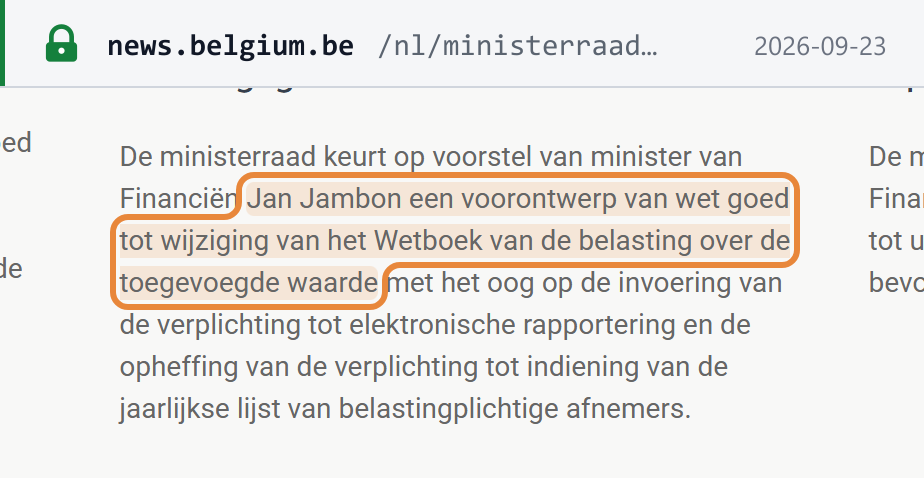 Source snapshot of the official page. Open full size ↗