Botswana: BURS guidance on reporting reverse-charged VAT and recipient-created invoices, from August 2026
This page records one dated change. For the rules in Botswana as they stand today, see the Botswana guide →
- Jurisdiction
- Botswana
- Tax
- VAT
- Change type
- Digital services
- Status
- In force
- Impact
- Action required
- Effective
- 1 August 2026
- Authority
- Botswana Unified Revenue Service
- Systems
- ERP, Invoicing, Tax engine, Reporting
- Verified
- Fetched from official source · high confidence
VAT-registered persons, government entities and large unregistered persons (annual supplies above P 1,000,000) receiving reverse-charged supplies, including remote services from non-resident suppliers.
Issue recipient-created tax invoices for remote services received from August/September 2026 (by tax-period category) and report them through the reverse-charge lines of the VAT return.
ERPInvoicingTax engineReporting
BURS published a Guidance Note dated September 2026 on reporting VAT on reverse-charged supplies by VAT-registered persons, government entities and large unregistered persons (annual supplies above P 1,000,000 who are not ordinarily registered), including remote services from suppliers outside Botswana. A registered recipient must prepare a recipient-created tax invoice (section 59(4), VAT Act 2026) and notify a non-resident remote-services supplier in writing of its registration (section 64). Category A and C registrants report from August 2026, with payment due by 28 October 2026; Category B from September 2026, due 28 November 2026. Supplies received before those months are reported on Form VAT.017.1.
What changed in detail
The Botswana Unified Revenue Service published a Guidance Note dated September 2026 on reporting VAT on reverse-charged supplies. It covers VAT-registered persons, government entities and large unregistered persons (annual supplies above P 1,000,000 who are not ordinarily registered), including remote services from suppliers outside Botswana.
A registered recipient must prepare a recipient-created tax invoice (section 59(4), VAT Act 2026) and notify a non-resident remote-services supplier in writing of its registration (section 64).
Category A and C registrants report from August 2026, with payment due by 28 October 2026; Category B registrants report from September 2026, with payment due 28 November 2026. Supplies received before those months are reported on Form VAT.017.1. These start months are for registrants: government entities and large unregistered persons take their start date from their registration approval letter.
What it means
The recipient carries the paperwork: it must issue its own tax invoice at the time of supply and, for remote services, write to the non-resident supplier about its registration. Registrants should confirm their category, since the reporting start month and payment date differ between Categories A and C and Category B. Supplies received earlier belong on a separate form, Form VAT.017.1, rather than on the new reporting route.
Proof
A registered person liable for VAT in respect of a reverse charged supply shall, at the time of the supply, prepare a recipient-created tax invoice for the supply (Section 59(4) of the VAT Act, 2026).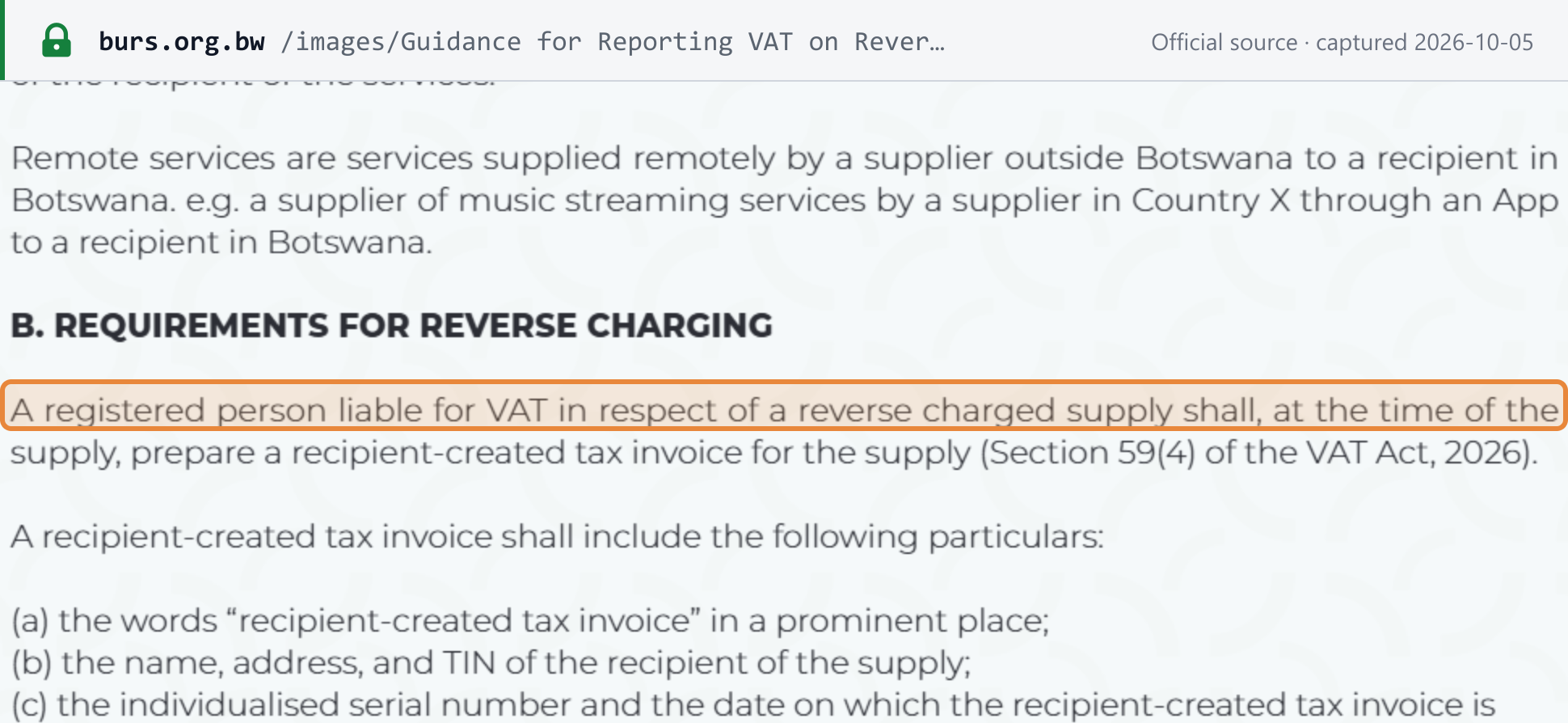 Source snapshot of the official page. Open full size ↗