Chile adds new XML validations to electronic invoicing and three reception outcomes for every DTE
- Jurisdiction
- Chile
- Tax
- VAT (IVA)
- Change type
- E-invoicing
- Status
- Enacted
- Impact
- Plan ahead
- Announced
- 4 September 2026
- Authority
- Servicio de Impuestos Internos (SII), Chile
- Systems
- Invoicing, ERP, Tax engine
- Verified
- Fetched from official source · high confidence
Every Chilean issuer of Documentos Tributarios Electrónicos — both in-house billing systems and market e-invoicing solutions — and anyone whose process branches on a DTE's acceptance status.
Chilean DTE issuers (in-house billing systems and market e-invoicing solutions) should review the SII's published XML validation instructions and update systems to avoid DTE rejection once each validation phase takes effect.
InvoicingERPTax engine
Chile's Servicio de Impuestos Internos (SII) issued Resolución Exenta N° 121 of 4 September 2026, implementing a new set of technical and business validations applied to the XML files of Documentos Tributarios Electrónicos (DTE) during electronic invoicing processing (schema conformity plus prior traceability/business-rule checks), and creating three reception outcomes for submitted DTEs: Aceptado, Aceptado con reparos, and Rechazado. The resolution takes effect upon publication in extract in the Diario Oficial, with the validations phased in per a rollout schedule the SII will publish and update on its e-invoicing help pages.
What changed in detail
Resolución Exenta SII N° 121, issued in Santiago on 4 September 2026 by the Oficina de Documentos Tributarios Electrónicos of the Servicio de Impuestos Internos, implements a set of new technical and business validations over Documentos Tributarios Electrónicos (DTE).
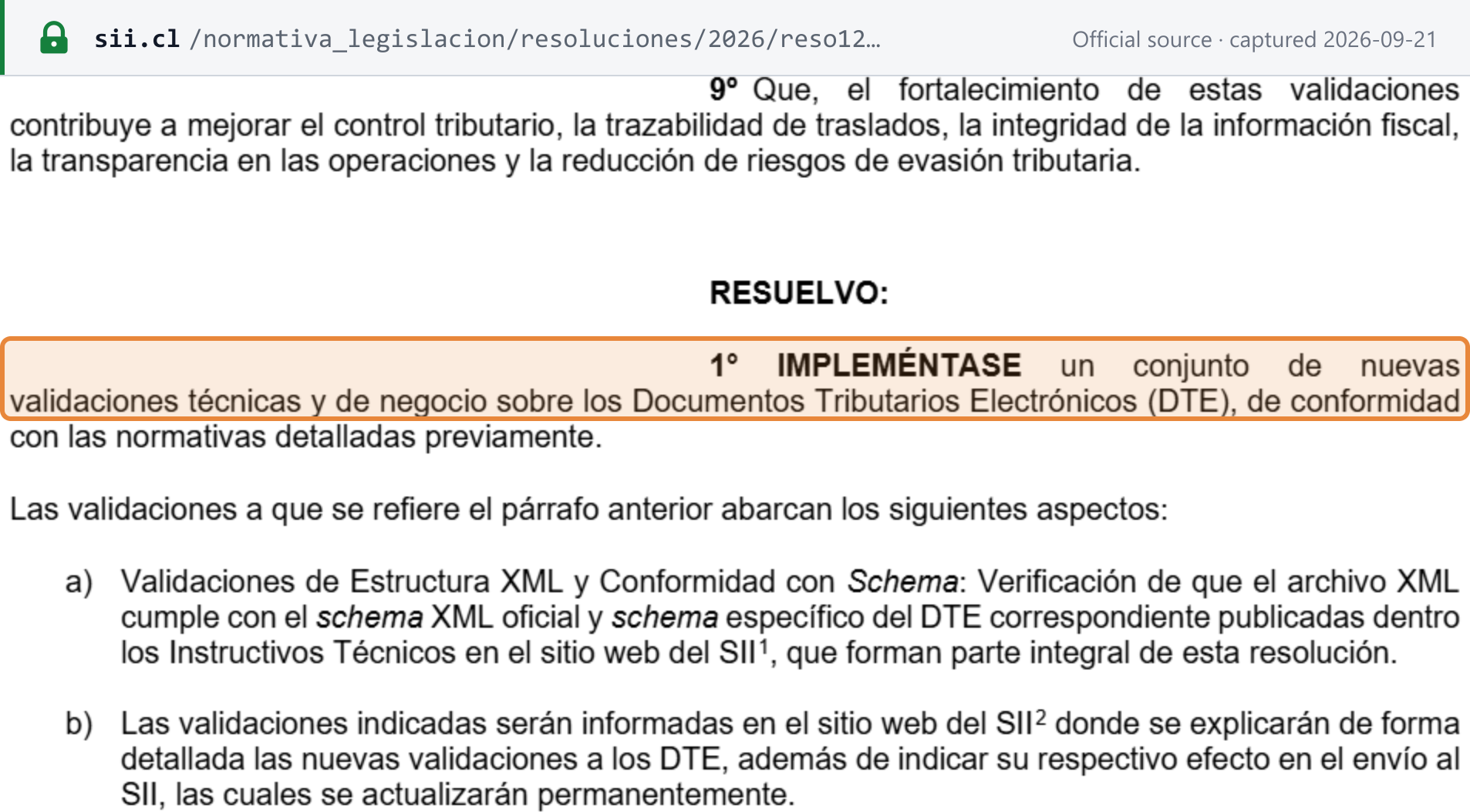
Resolutive 1 sets out what the validations cover. First, XML structure and schema conformity — verification that the file complies with the official XML schema and with the schema specific to the DTE type, as published in the Instructivos Técnicos on the SII website, which the resolution makes an integral part of itself. Second, the validations will be set out in detail on the SII website together with their respective effect on the submission to the SII, and will be updated on an ongoing basis.
Resolutive 2 makes those validations part of the SII’s DTE reception process and gives a received document one of three states. Aceptado: the DTE meets every validation of structure, signature, TED, folio, product description, traceability information where applicable, amounts and additional taxes. Aceptado con reparos: it meets the critical validations but shows minor inconsistencies in complementary information, to be corrected in later documents. Rechazado: it fails one or more critical validations, which prevents its incorporation into the SII’s databases.
Resolutive 3 requires issuers to adapt their systems within the deadlines set by the relevant instruction. Resolutive 4 applies the sanctions of article 97 N° 10 or article 109 of the Código Tributario. The resolution enters into force on publication in extract in the Diario Oficial.
What it means
This is a framework, not a timetable. It names the categories of validation and leaves the phasing to a chronology published on the SII’s e-invoicing help pages and updated continuously — so the date that matters to a billing system is deliberately not in the resolution, and has to be watched on the SII site rather than diarised from this text.
The state worth engineering for is Aceptado con reparos. A rejection is loud and stops the process; a document accepted with observations is accepted, lands in the SII’s base, and quietly obliges you to fix the underlying data in later documents. An ERP that branches only on accepted-or-rejected will read that middle state as success and carry the defect into every invoice that follows.
Proof
1° IMPLEMÉNTASE un conjunto de nuevas validaciones técnicas y de negocio sobre los Documentos Tributarios Electrónicos (DTE), de conformidad con las normativas detalladas previamente.1° THERE IS IMPLEMENTED a set of new technical and business validations over Electronic Tax Documents (DTE), in accordance with the rules detailed above.
 Source snapshot of the official page. Open full size ↗
Archived from the official distribution · Resolución Exenta SII N° 121, Santiago, 04 de septiembre de 2026 — Subdirección de Asistencia al Contribuyente, Oficina de Documentos Tributarios Electrónicos · www.sii.cl
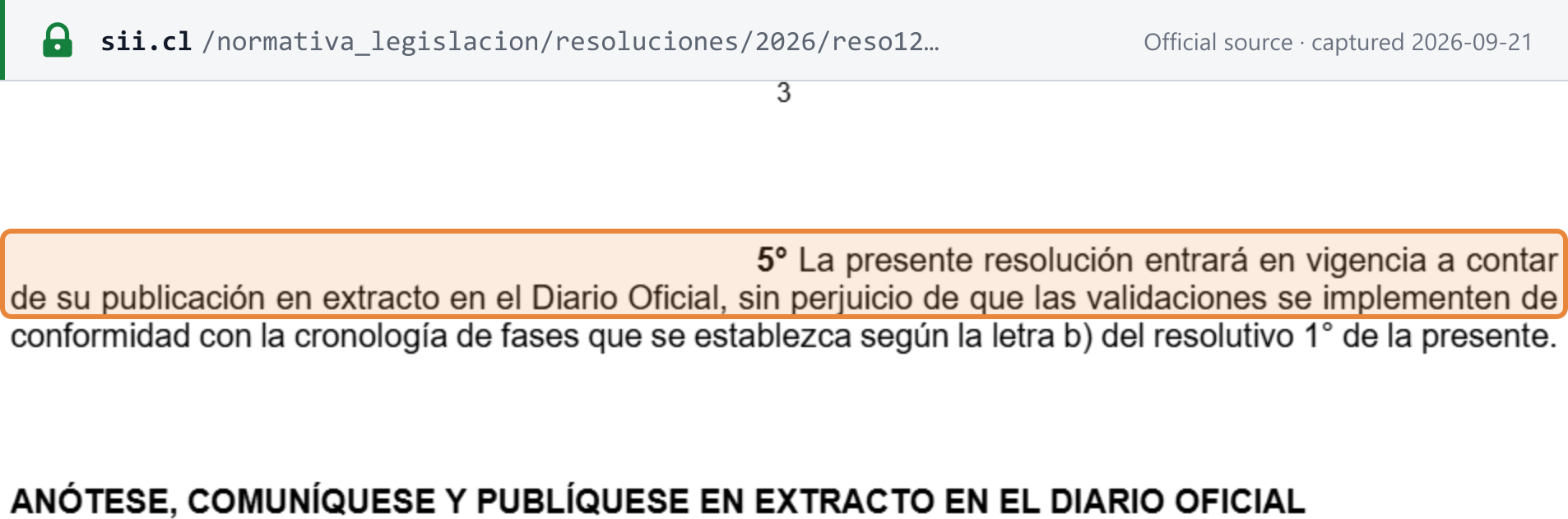
5° La presente resolución entrará en vigencia a contar de su publicación en extracto en el Diario Oficial, sin perjuicio de que las validaciones se implementen de conformidad con la cronología de fases que se establezca según la letra b) del resolutivo 1° de la presente.5° This resolution shall enter into force from its publication in extract in the Diario Oficial, without prejudice to the validations being implemented in accordance with the chronology of phases established under letter b) of resolutive 1° hereof.
 Source snapshot of the official page. Open full size ↗
Archived from the official distribution · Resolución Exenta SII N° 121 of 4 September 2026, resolutivo 5° (page 3) · www.sii.cl