Cyprus zero-rates infant milk, nappies, feminine hygiene products, fresh vegetables and fresh fruit for 2027 (K.D.P. 362/2026)
This page records one dated change. For the rules in Cyprus as they stand today, see the Cyprus guide →
- Jurisdiction
- Cyprus
- Tax
- VAT
- Change type
- Rate change
- Status
- Enacted
- Impact
- Plan ahead
- Announced
- 16 October 2026
- Effective
- 1 January 2027
- Authority
- Cyprus Government Printing Office (Ministry of Finance)
- Systems
- ERP, Invoicing, Tax engine, POS, E-commerce
- Verified
- Fetched from official source · high confidence
Cyprus VAT-registered suppliers of infant milk, children's and adult nappies, feminine hygiene products, and fresh or chilled vegetables and fresh fruit in the listed CN headings.
Update Cyprus VAT rate mapping for infant milk, nappies, feminine hygiene products, fresh vegetables and fresh fruit to the zero rate for 1 January to 31 December 2027.
ERPInvoicingTax enginePOSE-commerce
Cyprus's Council of Ministers issued the Value Added Tax (Amendment of the Fifth and Sixth Schedules) (No. 2) Order 2026 (Κ.Δ.Π. 362/2026, Official Gazette Annex III(I) No. 6053, 16 October 2026). For 1 January 2027 to 31 December 2027 it adds to the Sixth Schedule (zero-rated supplies) infant milk, children's and adult nappies, and feminine hygiene products, and fresh or simply chilled vegetables (CN 0701 to 0709 headings listed) and fresh fruit (CN 0803 to 0810 headings listed). It excludes infant milk, those vegetables and those fruits from the Fifth Schedule paragraph 7 of Table A (reduced-rate food paragraph) and deletes paragraph 14 of Table A of the Fifth Schedule.
What changed in detail
Cyprus’s Council of Ministers issued the Value Added Tax (Amendment of the Fifth and Sixth Schedules) (No. 2) Order 2026 (Κ.Δ.Π. 362/2026), published in Official Gazette Annex III(I) No. 6053 on 16 October 2026. It is made under sections 18(2) and 25(4) of the VAT Law.
From 1 January 2027 to 31 December 2027, the order adds to the Sixth Schedule (zero-rated supplies):
- supplies of infant milk;
- supplies of children’s and adult nappies;
- feminine hygiene products;
- fresh or simply chilled vegetables in the listed headings of CN 0701 to 0709, including potatoes, tomatoes, onions and garlic, cabbages and broccoli, lettuce, carrots and similar roots, cucumbers, leguminous vegetables, and aubergines, peppers, mushrooms, spinach and other listed vegetables;
- fresh fruit in the listed headings of CN 0803 to 0810, including bananas, figs, avocados, citrus fruit, grapes, melons and watermelons, apples and pears, apricots, peaches, cherries, nectarines and plums, strawberries and kiwi fruit.
For the same period, the order excludes infant milk and those vegetables and fruits from paragraph 7 of Table A of the Fifth Schedule, the reduced-rate food paragraph, and deletes paragraph 14 of Table A of the Fifth Schedule.
What it means
These goods move off a reduced-rate code and onto the zero rate for calendar year 2027 only, so a tax engine needs both a start date of 1 January 2027 and an end date of 31 December 2027. The fruit and vegetable scope follows CN headings, several of them “ex” headings, so map by product code rather than by description. This order runs alongside the separate zero-rating of bread, milk, meat, fish and baby food, which has its own end date of 31 May 2027; check each product against the order that covers it.
Proof
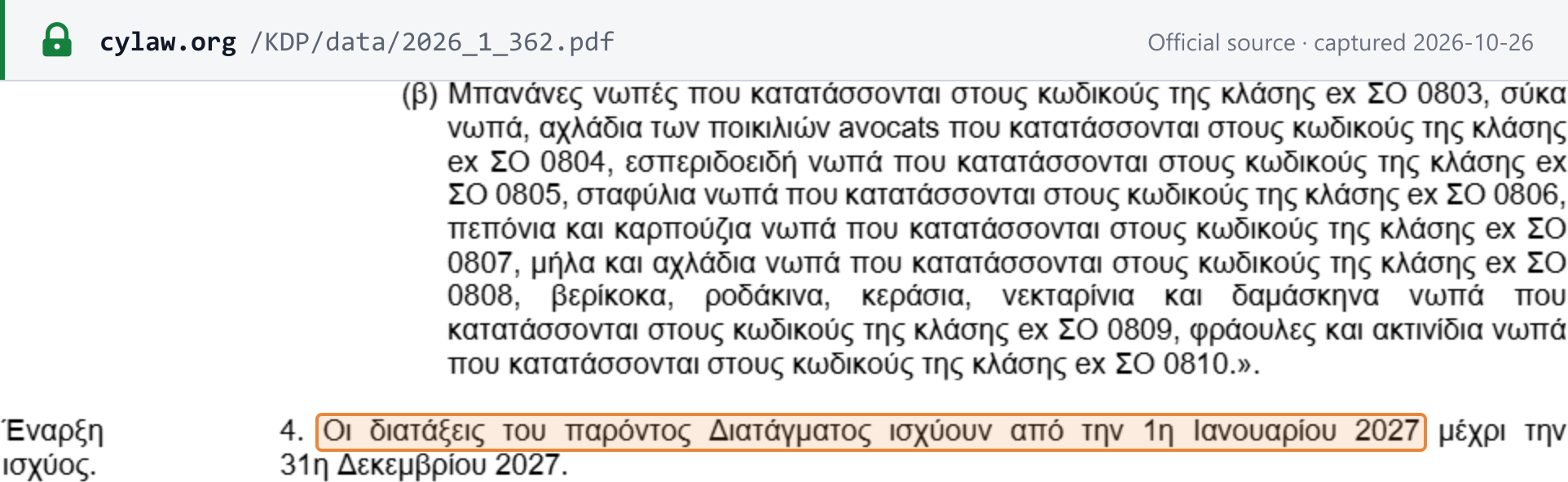
4. Οι διατάξεις του παρόντος Διατάγματος ισχύουν από την 1η Ιανουαρίου 2027 μέχρι την 31η Δεκεμβρίου 2027.4. The provisions of this Order apply from 1 January 2027 until 31 December 2027.
 Source snapshot of the official page. Open full size ↗