Dominican Republic drops ITBIS withholding on payments to authorised e-CF issuers
- Jurisdiction
- Dominican Republic
- Tax
- ITBIS
- Change type
- Compliance
- Status
- In force
- Impact
- Action required
- Announced
- 16 September 2026
- Effective
- 16 September 2026
- Authority
- Dirección General de Impuestos Internos (DGII)
- Systems
- ERP, Invoicing, Tax engine
- Verified
- Fetched from official source · high confidence
Dominican legal persons designated as ITBIS withholding agents under Norma General 02-05, when paying another legal person authorised by DGII as an electronic issuer invoicing by e-CF.
Stop withholding ITBIS under Norma General 02-05 on payments to legal persons that are DGII-authorised electronic issuers invoicing you by e-CF, and rekey your AP and withholding logic to the counterparty's e-CF authorisation.
ERPInvoicingTax engine
DGII Norma General num. 02-2026, issued 16 September 2026, stops ITBIS withholding under Norma General num. 02-05 on payments to another legal person where that payee is authorised by the DGII as an electronic issuer (emisor electronico) and the transaction is invoiced with an e-CF. The exclusion applies from the issuance of the Norma General and is limited to the withholdings set by Norma General num. 02-05 and its amendments; it does not affect withholdings or perceptions under other tax provisions. It followed a public consultation run from 18 June to 20 August 2026 that drew 13 comments.
What changed in detail
DGII Norma General num. 02-2026, issued 16 September 2026, stops ITBIS withholding under Norma General num. 02-05 on payments to another legal person where that payee is authorised by DGII as an electronic issuer (emisor electronico) and the transaction is invoiced with an e-CF. The exclusion applies from the issuance of the Norma General and is limited to the withholdings set by Norma General num. 02-05 and its amendments; it does not affect withholdings or perceptions under other tax provisions. It followed a public consultation run from 18 June to 20 August 2026 that drew 13 comments.
What it means
The condition that matters operationally is the payee’s own e-CF authorisation status, not the nature of the transaction: an accounts-payable process that withholds ITBIS by default now needs to check whether the counterparty is a DGII-authorised electronic issuer and whether the invoice in hand is actually an e-CF, before applying Norma General 02-05’s withholding. Getting that check wrong in either direction is now a live risk - over-withholding from a qualifying e-CF issuer, or under-withholding from one that is not yet authorised.
Proof
no efectuarán las retenciones previstas en dicha norma cuando realicen pagos a otra persona jurídica por operaciones comprendidas en su ámbito de aplicación, siempre que dicha persona jurídica se encuentre autorizada por la Dirección General de Impuestos Internos (DGII) como emisora electrónica y la operación sea facturada mediante un Comprobante Fiscal Electrónico (e-CF), de conformidad con la normativa fiscal vigente.they shall not apply the withholdings under that norm when they make payments to another legal person for transactions within its scope, provided that legal person is authorised by the Direccion General de Impuestos Internos (DGII) as an electronic issuer and the transaction is invoiced by means of an Electronic Tax Receipt (e-CF), in accordance with current tax regulations.
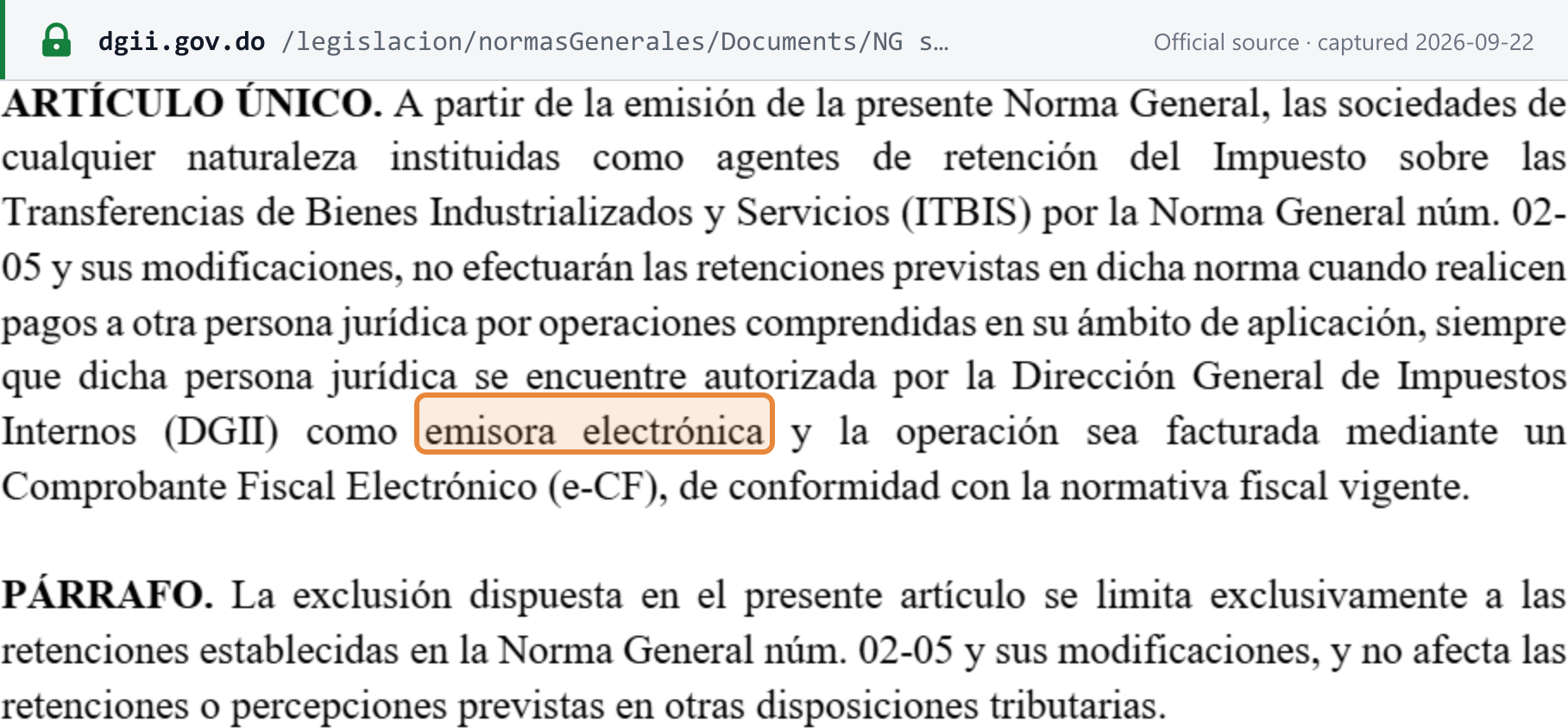 Source snapshot of the official page. Open full size ↗