Dominican Republic Law 30-26 creates an ITBIS perception on informal importers and adds ITBIS-exempt goods
- Jurisdiction
- Dominican Republic
- Tax
- VAT
- Change type
- Compliance
- Status
- In force
- Impact
- Plan ahead
- Announced
- 18 June 2026
- Effective
- 18 June 2026
- Authority
- Dirección General de Impuestos Internos (DGII)
- Systems
- Customs, Tax engine, ERP
- Verified
- Fetched from official source · medium confidence
Importers not registered as taxpayers, Simplified Tax Regime (RST) taxpayers liable for ITBIS, and producers of ITBIS-exempt goods.
Review import flows for non-RNC (informal) importers: DGA/DGII joint implementing rules for the ITBIS perception are still to be issued; check exempt-goods list changes in the tax engine.
CustomsTax engineERP
Law No. 30-26 (Ley de medidas pro-crecimiento económico, simplificación fiscal y mitigación de la crisis internacional), dated in the Senate on 17 June 2026 and the Chamber of Deputies on 18 June 2026 and in force from promulgation and publication, includes a chapter on ITBIS. Article 34 inserts Article 354-1 into the Tax Code (Law 11-92) creating an ITBIS perception regime on imports of taxable goods by informal importers (importers not registered as taxpayers), applied by the DGA at the customs declaration and calculated on the ITBIS taxable base plus 30% gross added value, which the DGII may update by reasoned resolution. Article 35 extends the Simplified Tax Regime (RST) to the ITBIS obligations of RST taxpayers liable for ITBIS. Articles 36 and 38 add tariff subheadings to the lists of ITBIS-exempt goods in Article 343 of the Tax Code, and Article 39 amends paragraphs V and VI of Article 343 on deduction of ITBIS paid on inputs by producers of those goods.
What changed in detail
Law No. 30-26 (Ley de medidas pro-crecimiento económico, simplificación fiscal y mitigación de la crisis internacional), dated in the Senate on 17 June 2026 and the Chamber of Deputies on 18 June 2026, is in force from promulgation and publication. It includes a chapter on ITBIS.
Article 34 inserts Article 354-1 into the Tax Code (Law 11-92), creating an ITBIS perception regime on imports of taxable goods by informal importers, meaning importers not registered as taxpayers. The DGA applies it at the customs declaration, calculated on the ITBIS taxable base plus 30% gross added value, which the DGII may update by reasoned resolution.
Article 35 extends the Simplified Tax Regime (RST) to the ITBIS obligations of RST taxpayers liable for ITBIS. Article 36 adds tariff subheadings to the list of ITBIS-exempt goods in Article 343 of the Tax Code, Article 38 adds subheadings to paragraph III of Article 343, and Article 39 amends paragraph V and adds a new paragraph VI to Article 343 on deduction of ITBIS paid on inputs by producers of those goods.
What it means
The perception is collected by customs at the point of import, so unregistered importers pay it up front rather than through a later return. The 30% uplift on the base means the amount collected exceeds the plain ITBIS on the declared value.
Because the DGII can update the 30% by resolution, the effective cost is not fixed by the law. Registered taxpayers are not the target, but anyone importing through informal channels should expect the charge at clearance.
Proof
Párrafo III.- La percepción se calculará sobre la base imponible del ITBIS más un treinta (30%) de valor agregado bruto.Paragraph III.- The perception will be calculated on the ITBIS taxable base plus thirty percent (30%) of gross added value.
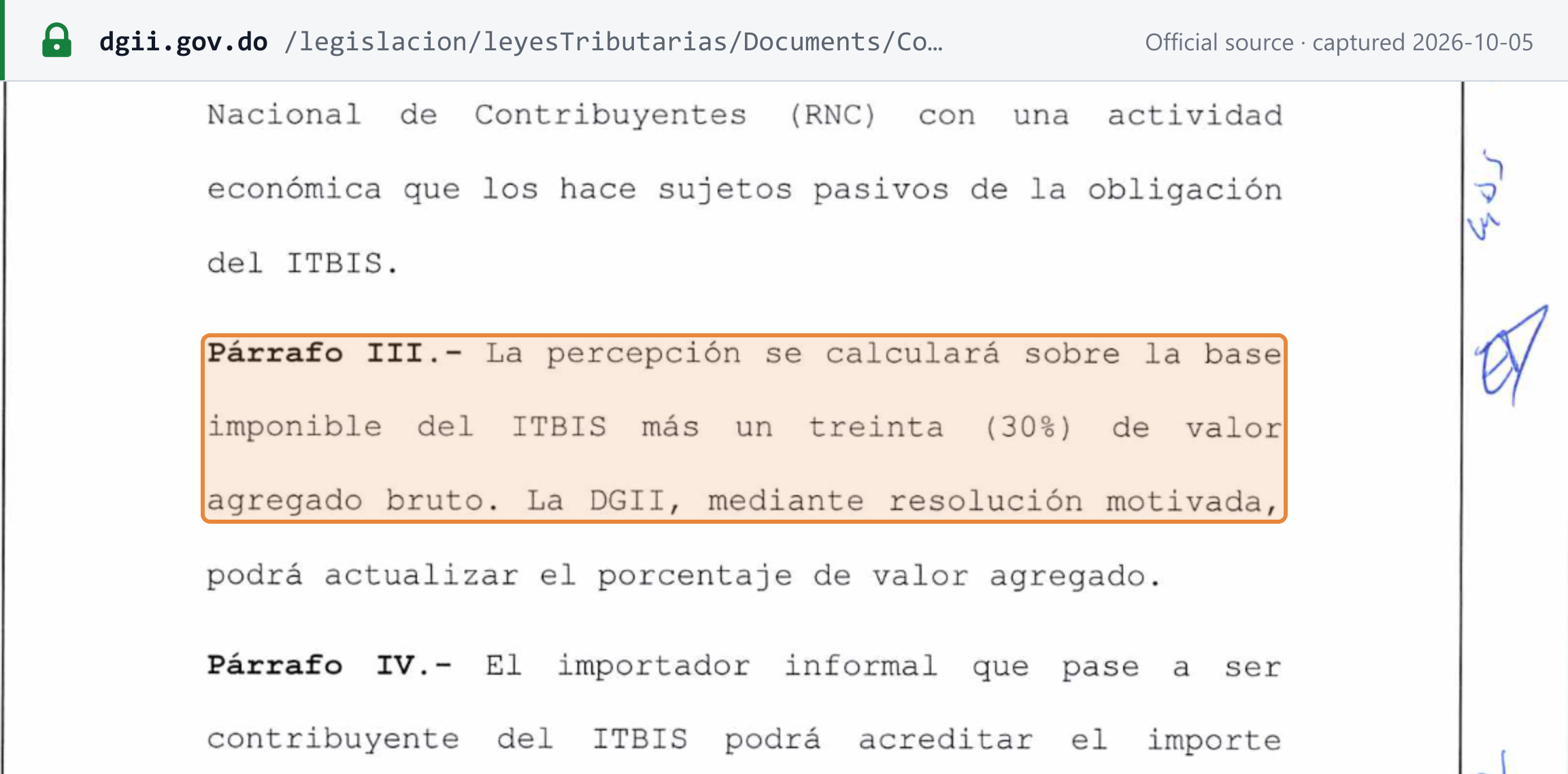 Source snapshot of the official page. Open full size ↗