Ethiopia's Ministry of Revenue issues the Electronic Invoicing System Administration Directive
- Jurisdiction
- Ethiopia
- Tax
- VAT
- Change type
- E-invoicing
- Status
- In force
- Impact
- Plan ahead
- Instrument
- ET-DIRECTIVE-1142-2018
- Authority
- Ministry of Revenue (Ethiopia)
- Systems
- Invoicing, POS, ERP, E-commerce
- Verified
- Fetched from official source · high confidence
Taxpayers issuing invoices under Ethiopian tax law, suppliers of Sales Registration Systems, taxpayers using exclusive or in-house invoicing software, software-as-a-service providers, and e-commerce or digital marketplace operators.
If you issue invoices in Ethiopia, confirm your sales registration system or in-house invoicing software meets the Directive's licensing requirements, and watch for the Authority's phase schedule, which the Directive itself does not contain.
InvoicingPOSERPE-commerce
Ethiopia's Ministry of Revenue issued the Electronic Invoicing System Administration Directive No. 1142/2018 (Ethiopian calendar; signed at Addis Ababa in Hamle 2018 E.C., rendered by the document's own English text as June 2026 G.C.). Article 3 applies it to taxpayers issuing invoices under the tax laws, suppliers of Sales Registration Systems, taxpayers using exclusive or in-house software, software-as-a-service providers, and e-commerce and digital marketplace operators. Article 29(1) makes use of a compliant sales register system within the electronic invoice registration framework mandatory for all taxpayers obliged to maintain books of accounts, implemented according to a schedule issued by the Authority. Article 31 provides that the Directive enters into force on the date of its registration by the Ministry of Justice and its publication on the Ministry of Revenue website. It repeals Articles 8 and 23 of Directive No. 149/2018.
What changed in detail
Ethiopia’s Ministry of Revenue issued the Electronic Invoicing System Administration Directive No. 1142/2018 (Ethiopian calendar; signed at Addis Ababa in Hamle 2018 E.C., rendered by the document’s own English text as June 2026 G.C.). Article 3 applies it to taxpayers issuing invoices under the tax laws, suppliers of Sales Registration Systems, taxpayers using exclusive or in-house software, software-as-a-service providers, and e-commerce and digital marketplace operators. Article 29(1) makes use of a compliant sales register system within the electronic invoice registration framework mandatory for all taxpayers obliged to maintain books of accounts, implemented according to a schedule issued by the Authority. Article 31 provides that the Directive enters into force on the date of its registration by the Ministry of Justice and its publication on the Ministry of Revenue website — both conditions were satisfied by the time this record was written, but the phased rollout schedule itself is not in this document. It repeals Articles 8 and 23 of Directive No. 149/2018.
What it means
The Directive is in force, but “in force” and “your business must comply now” are not the same thing here: Article 29(1) hands the actual implementation timetable to a separate Authority schedule that this Directive does not contain. Confirm that your sales registration system or in-house invoicing software meets the Directive’s licensing requirements, then watch for the Authority’s phase schedule rather than assuming a start date.
Proof
29. Transitional Provisions (1): The use of a compliant sales register system within the electronic invoice registration framework is mandatory for all taxpayers who are obligated to maintain books of accounts. Implementation shall be carried out in accordance with the schedule issued by the Authority.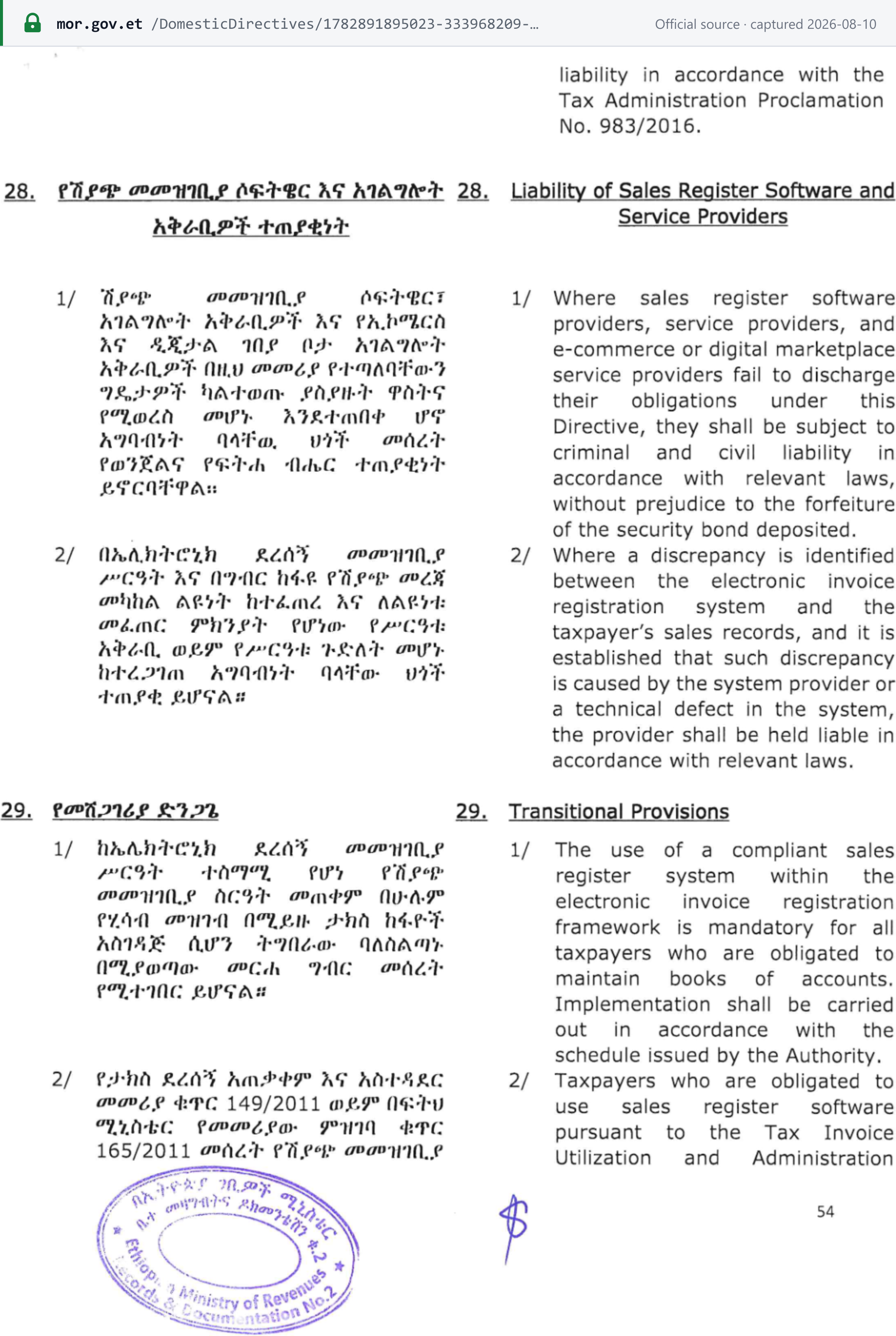 Source snapshot of the official page. Open full size ↗
Archived from the official distribution · Electronic Invoicing System Administration Directive No. 1142/2018 (Ministry of Revenue) · www.mor.gov.et