Fiji introduces a 5% Tourism Services Tax from 1 September 2026
- Jurisdiction
- Fiji
- Tax
- Tourism Services Tax
- Change type
- Rate change
- Status
- In force
- Impact
- Action required
- Announced
- 19 June 2026
- Effective
- 1 September 2026
- Authority
- Fiji Revenue & Customs Service (FRCS)
- Systems
- Invoicing, Tax engine, POS, E-commerce
- Verified
- Fetched from official source · high confidence
Licensed Fijian tourism operators with annual turnover above FJD 2 million — hotels and resorts, licensed tour and activity operators, and the booking and reservation platforms that invoice on their behalf. It sits alongside VAT rather than replacing it, so affected businesses charge both and must show the Tourism Services Tax separately on invoices and receipts. Operators at or below the FJD 2 million threshold are outside the charge.
Licensed Fijian tourism operators with annual turnover above FJD 2 million must charge the 5% Tourism Services Tax on bookings made on or after 1 September 2026 and show it separately from VAT on invoices and receipts. Bookings made before 1 September are outside the charge even where the service is delivered later.
InvoicingTax enginePOSE-commerce
Fiji introduced a Tourism Services Tax at 5% under the 2026-2027 National Budget, applying to licensed tourism operators with annual turnover above FJD 2 million. The Fiji Revenue and Customs Service's Budget Summary states the tax takes effect from 1 September 2026. It is separate from VAT and must be shown separately on invoices and receipts. FRCS has stated that bookings made before 1 September 2026 are not subject to the tax even where the services are provided afterwards.
What changed in detail
Fiji’s 2026-2027 National Budget introduced a Tourism Services Tax (TST) charged at 5%. The Fiji Revenue and Customs Service’s Summary of Revenue Policies for the budget states the rate, the FJD 2 million turnover threshold and the 1 September 2026 commencement date.
Three features distinguish it from a VAT rate change:
- It is a separate tax, not a variation of VAT. Affected operators charge both.
- It must be shown separately on invoices and receipts.
- It bites on the booking date. FRCS has said that bookings made before 1 September 2026 are not subject to the tax even where the services are supplied afterwards.
The measure is framed as running for a twelve-month period.
What it means
The part most likely to break systems is that this is a second tax on the same transaction rather than a new rate on an existing one. Property management, booking and point-of-sale stacks frequently model a single indirect tax per line, and a 5% charge that must appear as its own line beside VAT does not fit that shape without configuration.
The booking-date trigger is the second trap, because it inverts the usual instinct. Time of supply for most consumption taxes follows delivery or invoicing; here the test is when the booking was made, so a stay in December booked in August is outside the charge while the same stay booked in October is inside it. Systems need to retain and reason about the booking date, not just the stay date.
Fiji had no entry in this feed before this change, so the country baseline was reviewed at the same time: the VAT standard rate is 12.5%, reduced from 15% on 1 August 2025.
Proof
It will apply to tourism operators above the $2 million threshold and will be effective from 01 September 2026.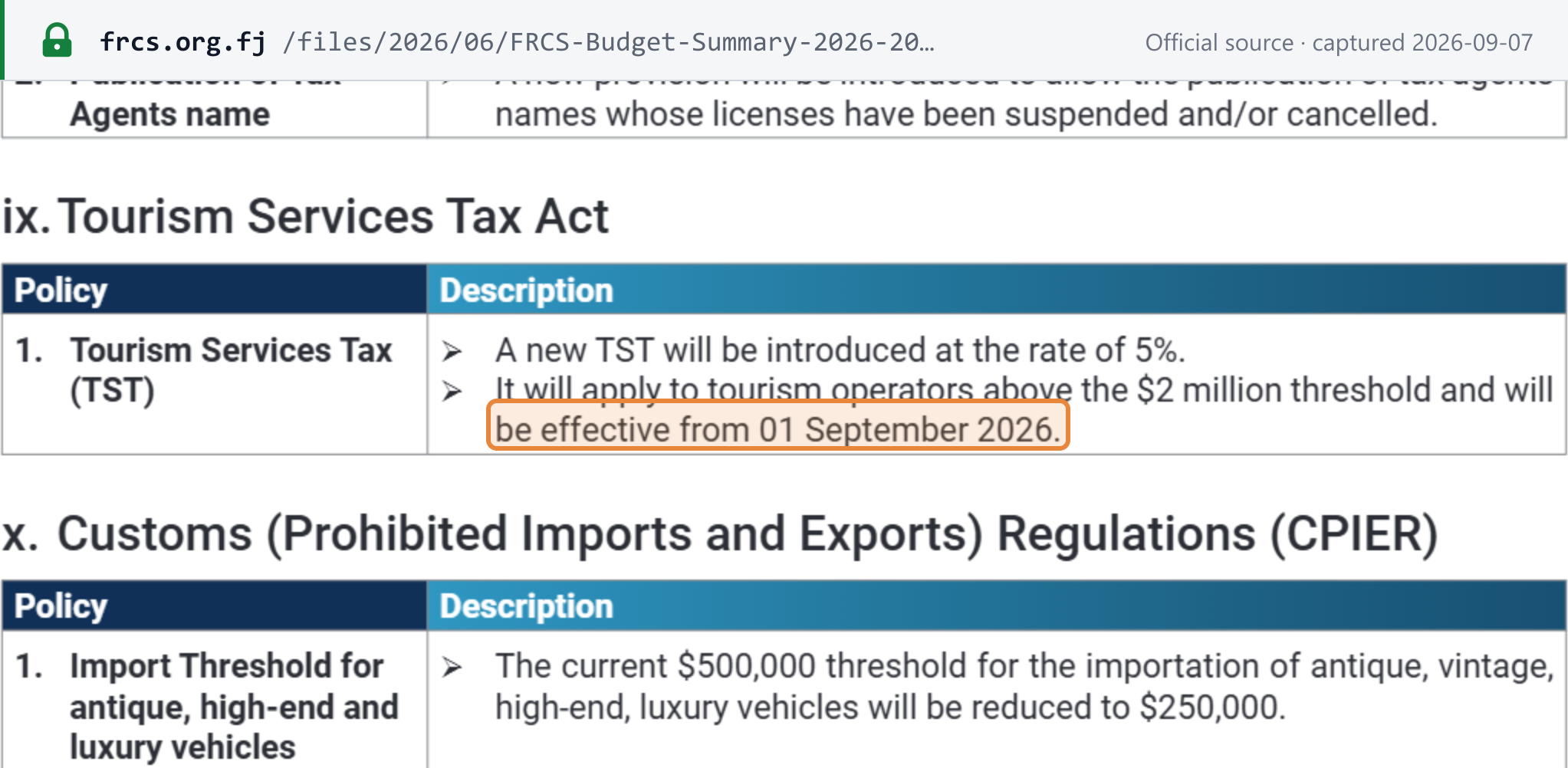 Source snapshot of the official page. Open full size ↗