Gabon makes the normalised electronic invoice the legal basis
- Jurisdiction
- Gabon
- Tax
- VAT
- Change type
- E-invoicing
- Status
- In force
- Announced
- 30 December 2025
- Effective
- 1 July 2026
- Authority
- Gouvernement de la République Gabonaise
- Verified
- Corroborated against official id · high confidence
Gabonese taxpayers, via the DGI DIGITAX platform. The FEN became the legal basis on 1 January 2026 with a six-month grace period during which customs documents were still accepted.
Gabon's Finance Law 2026 (Loi n°041/2025, Journal Officiel n°96-quater du 30 décembre 2025) introduced mandatory e-invoicing via the DGI DIGITAX platform. From 1 January 2026, factures électroniques normalisées (FEN) became the legal basis for transactions; a six-month transitional grace period permitted customs documents as substitute for VAT and income-tax deduction purposes. From 1 July 2026, only compliant e-invoices are accepted to support input VAT credits and deductible expenses. The mandate covers all persons liable to corporate tax, business profits tax, simplified flat tax, or VAT.
What changed in detail
Gabon’s Finance Law 2026 (Loi n°041/2025, Journal Officiel n°96-quater of 30 December 2025) introduced mandatory e-invoicing via the DGI DIGITAX platform. Factures électroniques normalisées (FEN) became the legal basis from 1 January 2026, with a six-month grace period allowing customs documents as a substitute; from 1 July 2026, only compliant e-invoices support input VAT credits and deductible expenses. The mandate covers all persons liable to corporate tax, business profits tax, the simplified flat tax or VAT.
What it means
Gabon’s grace period ends on 1 July 2026 — the same cut-over as Burkina Faso and Congo. After that, only DIGITAX-compliant e-invoices unlock input VAT and deductible expenses, so the cost of not being integrated is lost deductions, not just a penalty.
Proof
faut de déclaration ou le constat d’inexactitudes donne lieu aux sanctions prévues par le Code Général des Impôts. » (Le reste sans changement) LIVRE V : PROCÉDURES FISCALES TITRE 1 : ASSIETTE DE L’IMPOT Chapitre unique : Obligations des contribuables Section 7 : Obligation de facturation « Article P 832 ter : 1) toute opération réalisée par une personne physique ou morale soumise à l’impôt sur les sociétés, à l’impôt sur les bénéfices professionnels, à l’impôt synthétique libératoire ou assujettie à la taxe sur la valeur ajoutée, doit faire l’objet d’une facture électronique normalisée délivr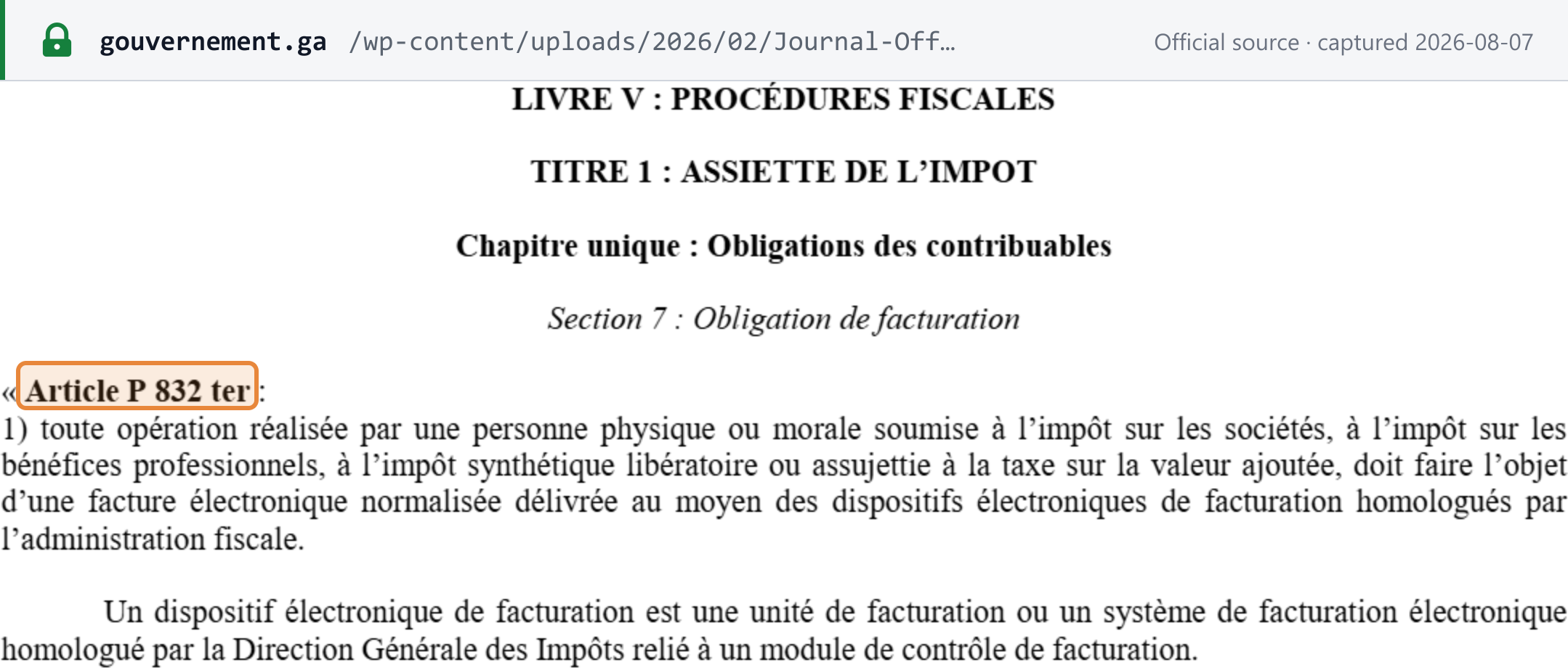 Source snapshot of the official page. Open full size ↗