Georgia restricts Revenue Service e-services for unconfirmed tax invoices from 1 October 2026
- Jurisdiction
- Georgia
- Tax
- VAT
- Change type
- Compliance
- Status
- In force
- Impact
- Action required
- Effective
- 1 October 2026
- Authority
- Revenue Service, Ministry of Finance of Georgia
- Systems
- Tax engine, ERP, Invoicing
- Verified
- Fetched from official source · high confidence
VAT-registered taxpayers in Georgia that receive tax invoices or special tax invoices through the Revenue Service authorised portal, including every sub-user of the account.
Confirm or reject all received tax invoices and special tax invoices via the RS authorised portal by the 5th day of the month following the reporting period, starting from October 2026, to avoid losing access to all e-services except the invoice modules.
Tax engineERPInvoicing
The Revenue Service of the Ministry of Finance of Georgia announced a new procedure restricting access to its electronic services (service.rs.ge) for VAT taxpayers who fail to confirm or reject tax invoices/special tax invoices by the 5th day of the month following the reporting period, effective 1 October 2026.
What changed in detail
The Revenue Service of the Ministry of Finance of Georgia has announced that a new simplified procedure for the timely confirmation of tax invoices enters into force on 1 October 2026.
Under it, if on the 5th day of the month following the month after the end of the reporting period the recipient still has tax invoices and/or special tax invoices pending confirmation, both the primary user and any sub-users of the taxpayer’s authorised account are restricted from using all electronic services, except for the Tax Invoice and Special Tax Invoice modules. Each time a user logs in to the authorised portal a mandatory red notification is displayed, stating that access to the services at www.service.rs.ge has been restricted and that access will be restored immediately upon confirmation or rejection of the invoices concerned.
The Revenue Service gives its reason: because the recipient fails to confirm tax invoices, the issuer is often unable to submit the relevant invoices within the statutory deadline as part of its VAT declaration, and taxpayers then become obliged to file amended declarations.
Ahead of the change, and on a voluntary pilot basis, the Revenue Service is already sending SMS notifications to the authorised user accounts of businesses registered as VAT taxpayers, reminding them to confirm tax invoices on time.
What it means
This is an access sanction rather than a penalty, and that makes it sharper than a fine. Lose the portal and you lose everything on it except the invoice modules — so an unconfirmed purchase invoice can stall unrelated filings, certificates and refund work until someone confirms or rejects it.
It hits the account, not the person responsible. Sub-users are restricted alongside the primary user, so a single stale invoice in one buyer’s queue blocks a whole finance team. The practical answer is an owner and a date: clear the confirmation queue before the 5th of each month, and treat rejection as a valid outcome — the restriction lifts on either action, so a disputed invoice is better rejected than left pending.
The pilot SMS reminders are a courtesy, and will not be a defence after 1 October 2026.
Proof
The Revenue Service introduces a new simplified procedure for the confirmation of tax invoices effective from 1 October 2026 The Revenue Service of the Ministry of Finance informs taxpayers that, taking into account taxpayers’ interests and with the aim of improving the level of voluntary tax compliance, a new simplified procedure for the timely confirmation of tax invoices will enter into force on 1 October 2026.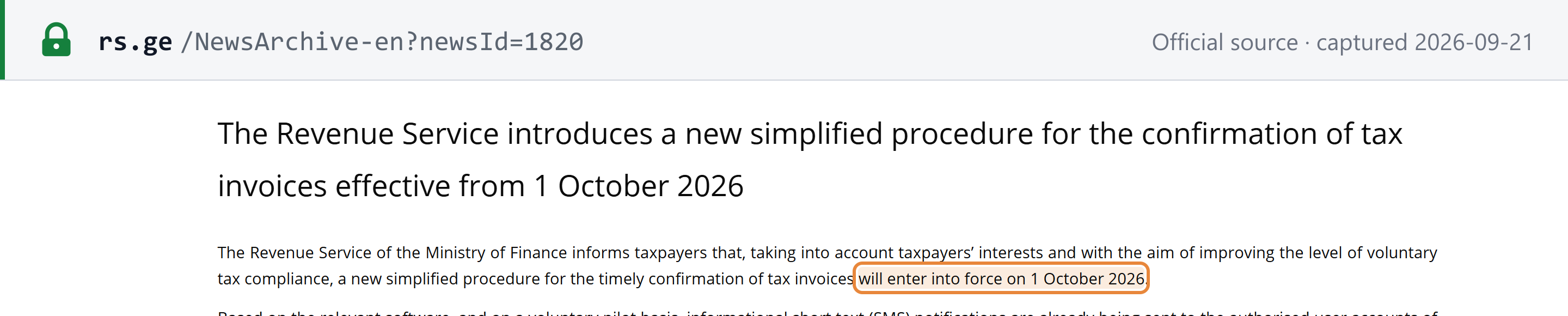 Source snapshot of the official page. Open full size ↗
Specifically, if, as of the 5th day of the month following the month after the end of the reporting period (i.e. on the 5th day of each month), the recipient still has tax invoices and/or special tax invoices pending confirmation, both the primary user and any sub-users of the taxpayer’s authorised account will be restricted from using all electronic services, except for the Tax Invoice/Special Tax Invoice modules. Source snapshot of the official page. Open full size ↗