DRAFT: Germany would end automatic VAT-group formation and require a declaration instead
This change is proposed and is not law. The rules below describe what would change if it is adopted.
This page records one dated change. For the rules in Germany as they stand today, see the Germany guide →
- Jurisdiction
- Germany
- Tax
- VAT
- Change type
- Registration
- Status
- Proposed
- Impact
- Watch
- Announced
- 12 August 2026
- Effective
- 1 July 2029
- Instrument
- DE-JSTG-2026-RE
- Authority
- Bundesministerium der Finanzen
- Systems
- ERP, Tax engine
- Verified
- Fetched from official source · high confidence
Groups of German entities currently relying on the automatic Organschaft (VAT group) qualification test under the Umsatzsteuergesetz. If enacted as drafted, the controlling entity would have to file a declaration with its competent tax office for group treatment — and for adding further members — to take legal effect, from 1 July 2029.
No action — monitoring only. This is a government draft, not law. If enacted as drafted, German VAT groups would form by declaration to the tax office rather than automatically. Plan against 1 January 2030, when the new section would first apply — not 1 July 2029, which is only when it would come into force and the earliest date a declaration could be filed.
ERPTax engine
Germany’s Federal Cabinet approved the government draft of the Jahressteuergesetz 2026 on 12 August 2026, and it was transmitted to the Bundesrat on 14 August 2026 as Bundesrat-Drucksache 447/26. It would insert a new section 2c into the Umsatzsteuergesetz which substantially reproduces the existing financial, economic and organisational integration test for VAT group taxation and adds a further condition to it: the legal effects of an Organschaft, and the addition of further group members, would arise only once the controlling entity files a declaration with its competent tax office, with effect for the future, and the declaration may likewise be revoked prospectively for the whole group or for individual members. The new section would also extend Organgesellschaft status to partnerships. Under Article 32(7) of the draft the provision would enter into force on 1 July 2029, and under draft section 27(42) it would first apply from 1 January 2030, the existing section 2(2) no. 2 continuing to apply until 31 December 2029; a declaration could be filed from 1 July 2029 with effect from 1 January 2030. The bill is before the Bundesrat and is not enacted.
What changed in detail
This is a government draft bill, not enacted law. Germany’s Federal Cabinet approved the government draft (Regierungsentwurf) of the Jahressteuergesetz 2026 on 12 August 2026. As drafted, it would insert a new section 2c into the Umsatzsteuergesetz, replacing the current automatic-qualification test for VAT group taxation (Organschaft): the legal effects of a VAT group, and the addition of further group members, would arise only once the controlling entity files a declaration with its competent tax office, with effect for the future. The declaration could likewise be revoked prospectively, for the whole group or for individual members. Under Article 32(7) of the draft, this provision would enter into force on 1 July 2029. The bill has been introduced into the legislative process and has not been enacted.
What it means
Nothing changes today, and nothing would change for nearly three years even if this passes unamended — 1 July 2029 is the proposed date. The shift itself is structural, though: VAT grouping today forms automatically whenever the qualification test is met, and this draft would replace that with an affirmative filing step, putting the timing of group formation — and its unwinding — under the taxpayer’s own control rather than a backward-looking factual test. Groups relying on automatic qualification should track this bill through the legislative process rather than assume the current mechanism is permanent.
Proof
§ 2 Absatz 2 Nummer 2 in der am 30. Juni 2029 geltenden Fassung ist bis zum 31. Dezember 2029 weiterhin anzuwenden. § 2c in der am 1. Juli 2029 geltenden Fassung ist erstmals ab dem 1. Januar 2030 anzuwenden.Section 2(2) no. 2 in its version in force on 30 June 2029 continues to apply until 31 December 2029. Section 2c in its version in force on 1 July 2029 applies for the first time from 1 January 2030.
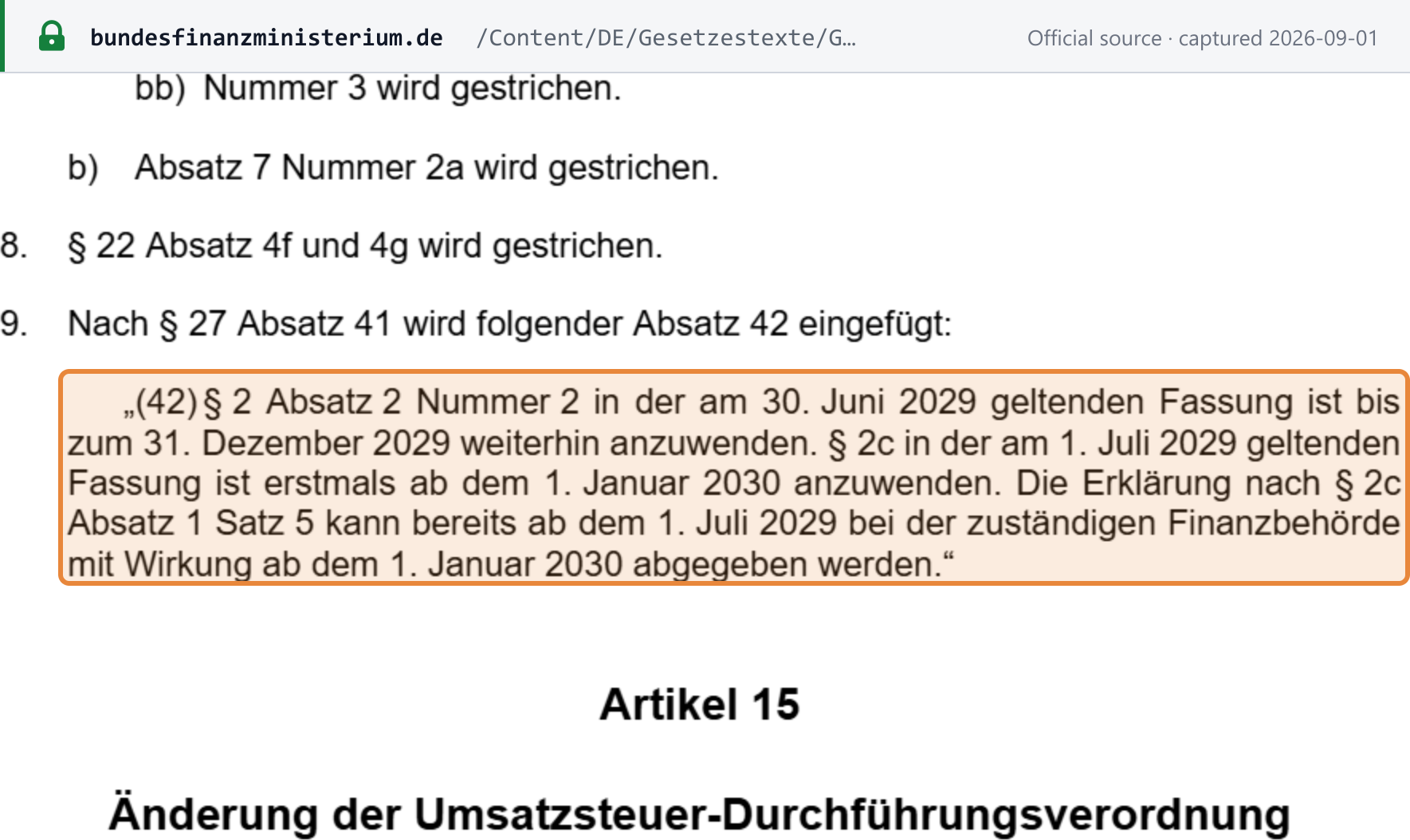 Source snapshot of the official page. Open full size ↗
Archived from the official distribution · www.bundesfinanzministerium.de