Ghana lifts the VAT goods threshold to GHS 750,000
- Jurisdiction
- Ghana
- Tax
- VAT
- Change type
- Threshold
- Status
- In force
- Impact
- Action required
- Announced
- 1 January 2026
- Effective
- 1 January 2026
- Instrument
- GH-LAW-1151-2025
- Authority
- Ghana Revenue Authority
- Systems
- ERP, Tax engine, Invoicing, Reporting
- Verified
- Fetched from official source · high confidence
Ghanaian businesses dealing in goods turning over between GHS 200,000 and GHS 750,000, who fall out of registration. The same Act abolished the COVID-19 Health Recovery Levy and the VAT Flat Rate Scheme, and recoupled NHIL and GETFund so they now qualify for input tax credit.
Set the Ghana VAT registration threshold to GHS 750,000 for goods businesses, remove VAT Flat Rate Scheme logic, and allow input tax credit for NHIL and GETFund — all in force since 1 January 2026.
ERPTax engineInvoicingReporting
Under the Value Added Tax Act, 2025 (Act 1151), effective 1 January 2026, Ghana raised the VAT registration threshold for businesses dealing in goods from GHS 200,000 to GHS 750,000. The Act also abolished the COVID-19 Health Recovery Levy and the VAT Flat Rate Scheme, and recoupled the NHIL and GETFund levies so that they qualify for input tax credit. The VAT rate remains 15% with NHIL and GETFund at 2.5% each.
What changed in detail
Under the Value Added Tax Act, 2025 (Act 1151), effective 1 January 2026, Ghana raised the VAT registration threshold for businesses dealing in goods from GHS 200,000 to GHS 750,000. The Act also abolished the COVID-19 Health Recovery Levy and the VAT Flat Rate Scheme, and recoupled the NHIL and GETFund levies so that they qualify for input tax credit. The VAT rate remains 15% with NHIL and GETFund at 2.5% each.
Proof
• The threshold for VAT registration for businesses who deal in goods has been increased from GH₵200,000 to GH₵750,000.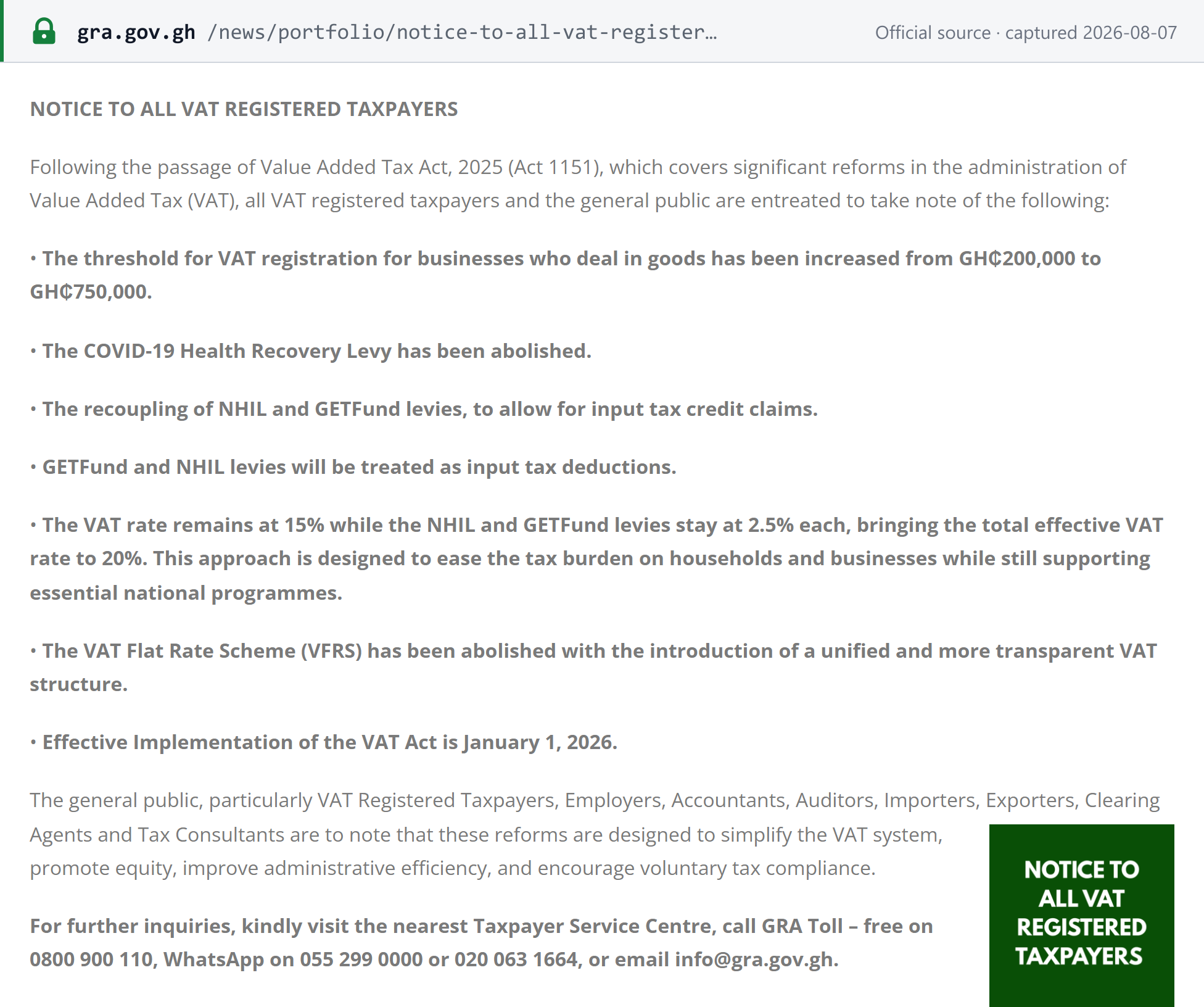 Source snapshot of the official page. Open full size ↗