Gibraltar’s first broad goods tax charges on cost, not shelf price
- Jurisdiction
- Gibraltar
- Tax
- Transaction Tax
- Change type
- Update
- Status
- In force
- Announced
- 23 March 2026
- Effective
- 10 April 2026
- Authority
- HM Government of Gibraltar
- Verified
- Fetched from official source · high confidence
Anyone importing or manufacturing goods for sale in Gibraltar. The base is landed cost price, not retail — the government issued press release 201/2026 on 23 March 2026 precisely because the 15% headline was being read as a 15% price rise. Food, water, pharmaceuticals, books, medical equipment, solar panels and bunkering fuel are at 0%.
Gibraltar introduced a new Transaction Tax on goods under its EU customs-union arrangement - a levy on the cost price of goods imported or manufactured for sale (not a retail sales tax). The standard transitional rate is 15% in year one, rising to 16% and then aligning with the lowest EU VAT rate; a 5% reduced rate and a 0% super-reduced rate (food, water, pharmaceuticals, books, medical equipment, solar panels, bunkering fuel) apply. In force since 10 April 2026; HM Government of Gibraltar issued a July 2026 clarification that the tax is a cost-price import levy, not a 15% retail price rise.
What changed in detail
Gibraltar introduced a new Transaction Tax on goods under its EU customs-union arrangement — a levy on the cost price of goods imported or manufactured for sale, not a retail sales tax. The standard transitional rate is 15% in year one, rising to 16% and then aligning with the lowest EU VAT rate; a 5% reduced rate and a 0% super-reduced rate (food, water, pharmaceuticals, books, medical equipment, solar panels, bunkering fuel) apply. It has been in force since 10 April 2026, and HM Government of Gibraltar issued a clarification on 23 March 2026 (press release 201/2026) that the tax is a cost-price import levy, not a 15% retail price rise.
What it means
Gibraltar has never had VAT; this is its first broad indirect tax on goods, arriving via the post-Brexit EU customs-union treaty. The government’s public clarification signals real confusion in the market — the key point for businesses is that the base is landed cost, not shelf price, so the effective retail impact is well below the headline 15%.
Proof
The new tax will not lead to a 15% increase in the retail price of a product simply because it is levied on the cost price and not the sales price.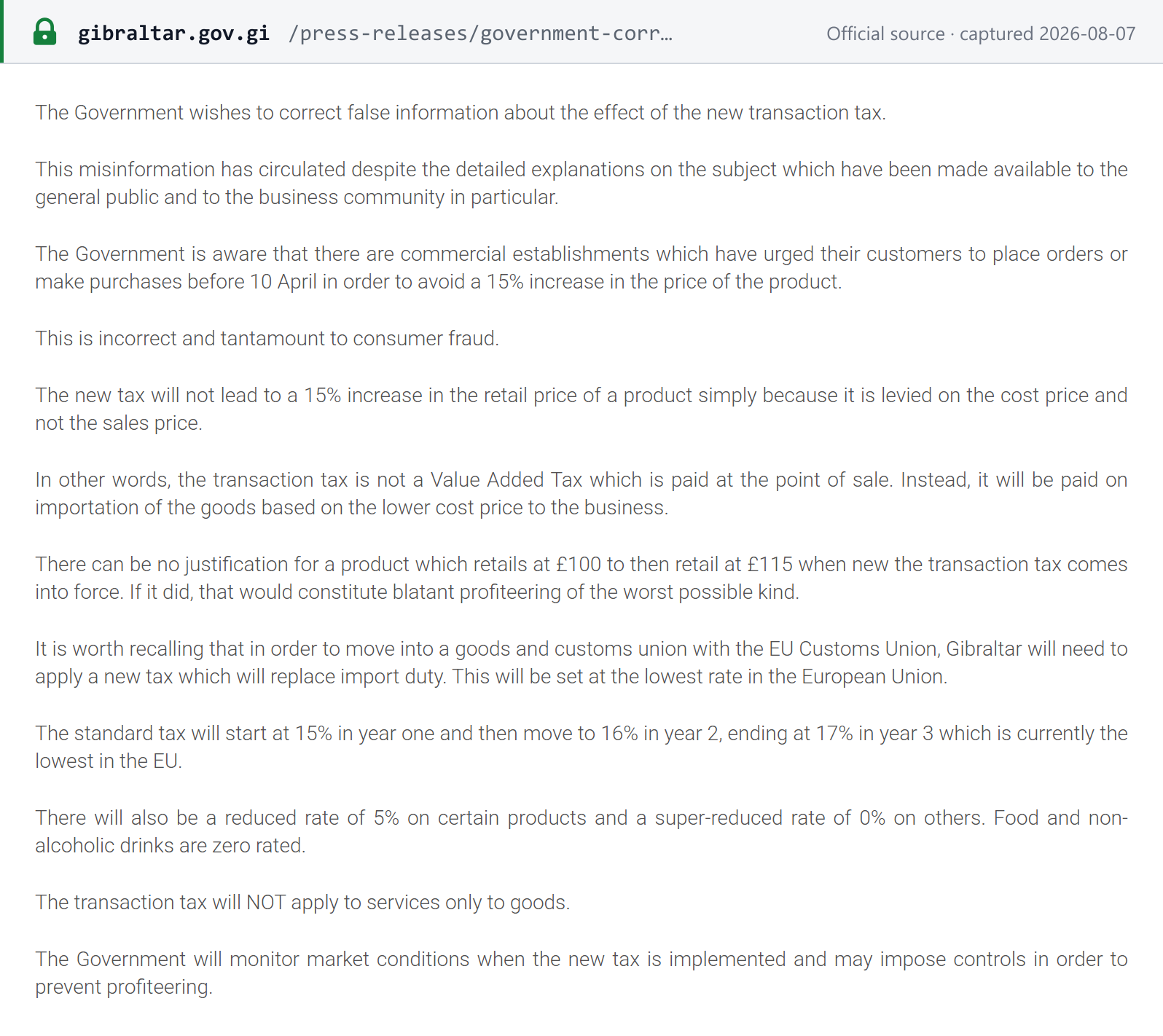 Source snapshot of the official page. Open full size ↗