Greece moves phase-2 B2B e-invoicing start to 2 November 2026, with a gradual period to 31 January 2027
This page records one dated change. For the rules in Greece as they stand today, see the Greece guide →
- Jurisdiction
- Greece
- Tax
- VAT
- Change type
- E-invoicing
- Status
- Enacted
- Impact
- Action required
- Announced
- 30 September 2026
- Effective
- 2 November 2026
- Authority
- Independent Authority for Public Revenue (AADE)
- Systems
- ERP, Invoicing, Reporting
- Verified
- Fetched from official source · high confidence
Greek businesses with gross revenues up to EUR 1,000,000 per the return for the tax year starting in 2023 (second-period businesses).
Re-plan Greek second-period e-invoicing go-live for 2 Nov 2026. By 1 Feb 2027, move all B2B/B2G invoice transmission to a certified provider or the AADE apps, because direct ERP transmission to myDATA ends.
ERPInvoicingReporting
Joint decisions of the Deputy Minister of National Economy and Finance and the Governor of AADE, announced 30 September 2026, move the start of mandatory B2B e-invoicing for second-period businesses from 1 October 2026 to 2 November 2026. These are businesses with gross revenues up to EUR 1,000,000 per the return for the tax year starting in 2023. A gradual-implementation period runs from 2 November 2026 to 31 January 2027, during which ERP systems or the special entry form may still be used in parallel. Businesses using an e-invoicing provider must file the start declaration with an effective date of 2 November 2026. Businesses that issue only through the AADE timologio or myDATAapp apps from 2 November 2026 need not file it. From 1 February 2027, e-invoices (domestic B2B, B2B with non-EU third countries, B2G) and their transmission to myDATA must go only through an e-invoicing provider or the AADE apps.
What changed in detail
Joint decisions of the Deputy Minister of National Economy and Finance and the Governor of AADE, announced on 30 September 2026, set the start of mandatory B2B e-invoicing for second-period businesses at 2 November 2026, instead of 1 October 2026. These are businesses with gross revenues up to EUR 1,000,000 per the return for the tax year starting in 2023.
A gradual-implementation period runs from 2 November 2026 to 31 January 2027, during which ERP systems or the special entry form may still be used in parallel.
Businesses using an e-invoicing provider must file the start declaration with an effective date of 2 November 2026. Businesses that issue only through the AADE timologio or myDATAapp apps from 2 November 2026 need not file it.
From 1 February 2027, e-invoices (domestic B2B, B2B with non-EU third countries, B2G) and their transmission to myDATA must go only through an e-invoicing provider or the AADE apps.
What it means
The start date is now 2 November 2026, and the following three months are a transition rather than a full mandate. Parallel use of ERP or the entry form ends on 31 January 2027.
Businesses using a provider need to file the start declaration with the new date; those issuing only through the AADE apps do not. The hard cut-off to watch is 1 February 2027, when provider or AADE app use becomes the only route.
Proof
Από 2/11/2026 έως 31/1/2027: Χρονικό διάστημα σταδιακής εφαρμογής της ηλεκτρονικής τιμολόγησης, με δυνατότητα παράλληλης χρήσης προγραμμάτων διαχείρισης επιχειρήσεων (εμπορικό / λογιστικό, ERP) ή της ειδικής φόρμας καταχώρισης.From 2/11/2026 to 31/1/2027: Period of gradual implementation of electronic invoicing, with the possibility of parallel use of business management programmes (commercial / accounting, ERP) or the special entry form.
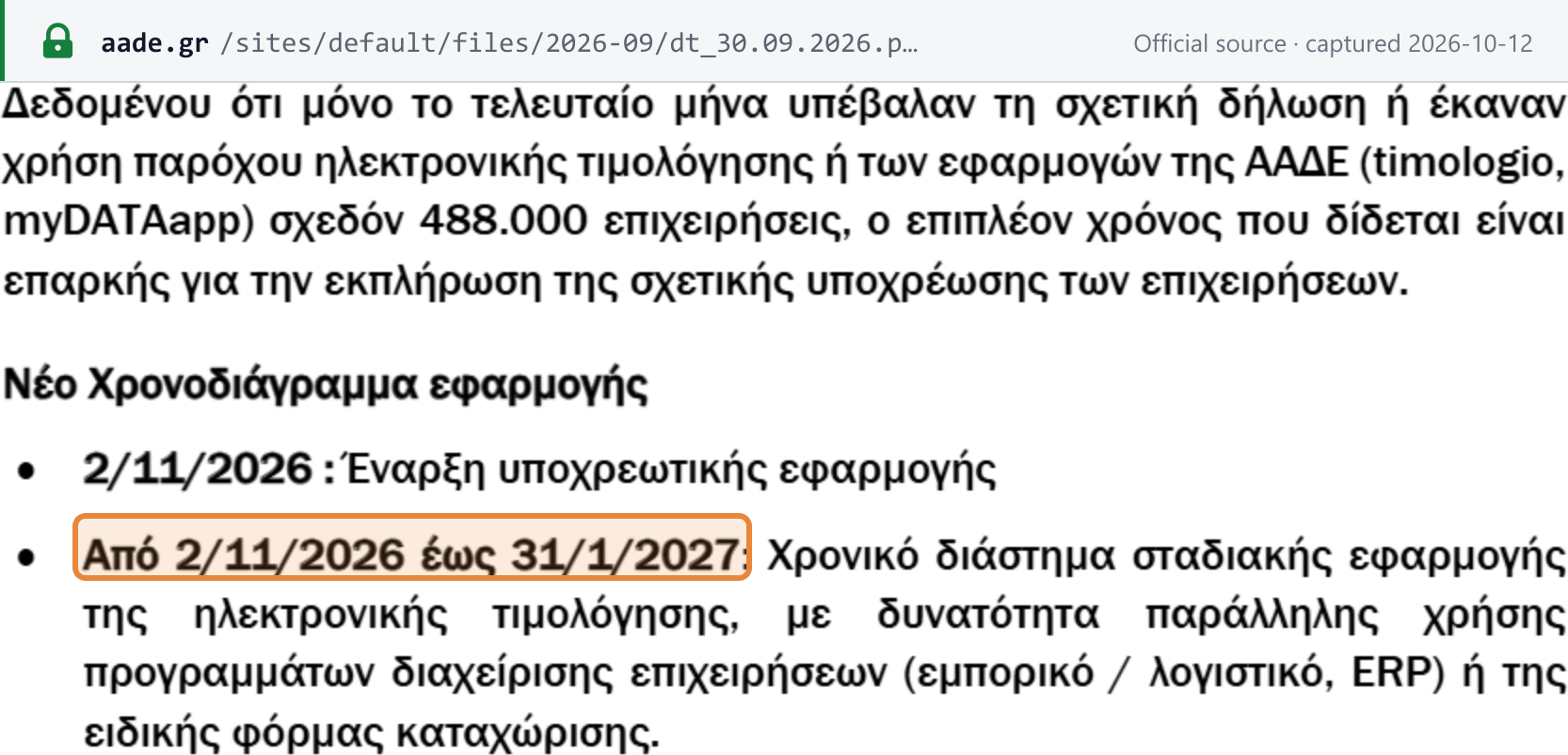 Source snapshot of the official page. Open full size ↗
Από 2/11/2026 έως 31/1/2027: Χρονικό διάστημα σταδιακής εφαρμογής της ηλεκτρονικής τιμολόγησης, με δυνατότητα παράλληλης χρήσης προγραμμάτων διαχείρισης επιχειρήσεων (εμπορικό / λογιστικό, ERP) ή της ειδικής φόρμας καταχώρισης.From 2/11/2026 to 31/1/2027: Period of gradual implementation of electronic invoicing, with the possibility of parallel use of business management programmes (commercial / accounting, ERP) or the special entry form.
Archived from the official distribution · ΑΑΔΕ / ΥΠΕΘΟΟ Δελτίο Τύπου 30.09.2026 · www.aade.gr