Malta: MTCA guidelines set transition rules for supplies moving from VAT-exempt to taxable, including rate and input VAT apportionment
This page records one dated change. For the rules in Malta as they stand today, see the Malta guide →
- Jurisdiction
- Malta
- Tax
- VAT
- Change type
- Compliance
- Status
- In force
- Impact
- Plan ahead
- Announced
- 30 September 2026
- Authority
- Malta Tax and Customs Administration (MTCA)
- Systems
- Tax engine, Invoicing, Reporting
- Verified
- Fetched from official source · high confidence
Maltese businesses whose supplies change from exempt without credit to taxable by an amendment to the VAT Act, in particular those supplying services that span the transition date.
Where a supply becomes taxable on 1 October 2026, apportion consideration and input VAT across the transition date as the MTCA guidelines set out.
Tax engineInvoicingReporting
The Malta Tax and Customs Administration published guidelines dated 30 September 2026, issued under article 75(2) of the VAT Act, on transitory measures where a supply moves from VAT exempt (without credit) to taxable by a change in the VAT Act. For services performed partly before and partly after the transition date, consideration is apportioned and the VAT rate applicable on the date the services were performed applies, regardless of when tax becomes chargeable; input VAT on services spanning the transition date is apportioned between the exempt and taxable periods. The worked examples use a transition date of 1 October 2026.
What changed in detail
The Malta Tax and Customs Administration published guidelines dated 30 September 2026, issued under article 75(2) of the VAT Act, on transitory measures where a supply moves from VAT exempt (without credit) to taxable by a change in the VAT Act.
For services performed partly before and partly after the transition date, consideration is apportioned and the VAT rate applicable on the date the services were performed applies, regardless of when tax becomes chargeable. Input VAT on services spanning the transition date is apportioned between the exempt and taxable periods. The worked examples use a transition date of 1 October 2026.
What it means
Invoicing dates do not decide the rate for spanning services; the date of performance does, so businesses should split billing for long-running services at the transition date. The same split drives how much input VAT can be recovered.
Proof
Where an invoice is raised for the supply of services performed prior to the transition date; however, the tax on the supplies in question becomes chargeable, in accordance with the Fourth Schedule to the VAT Act, on or after the transition date, the VAT rate applicable on the date when the services were performed shall apply.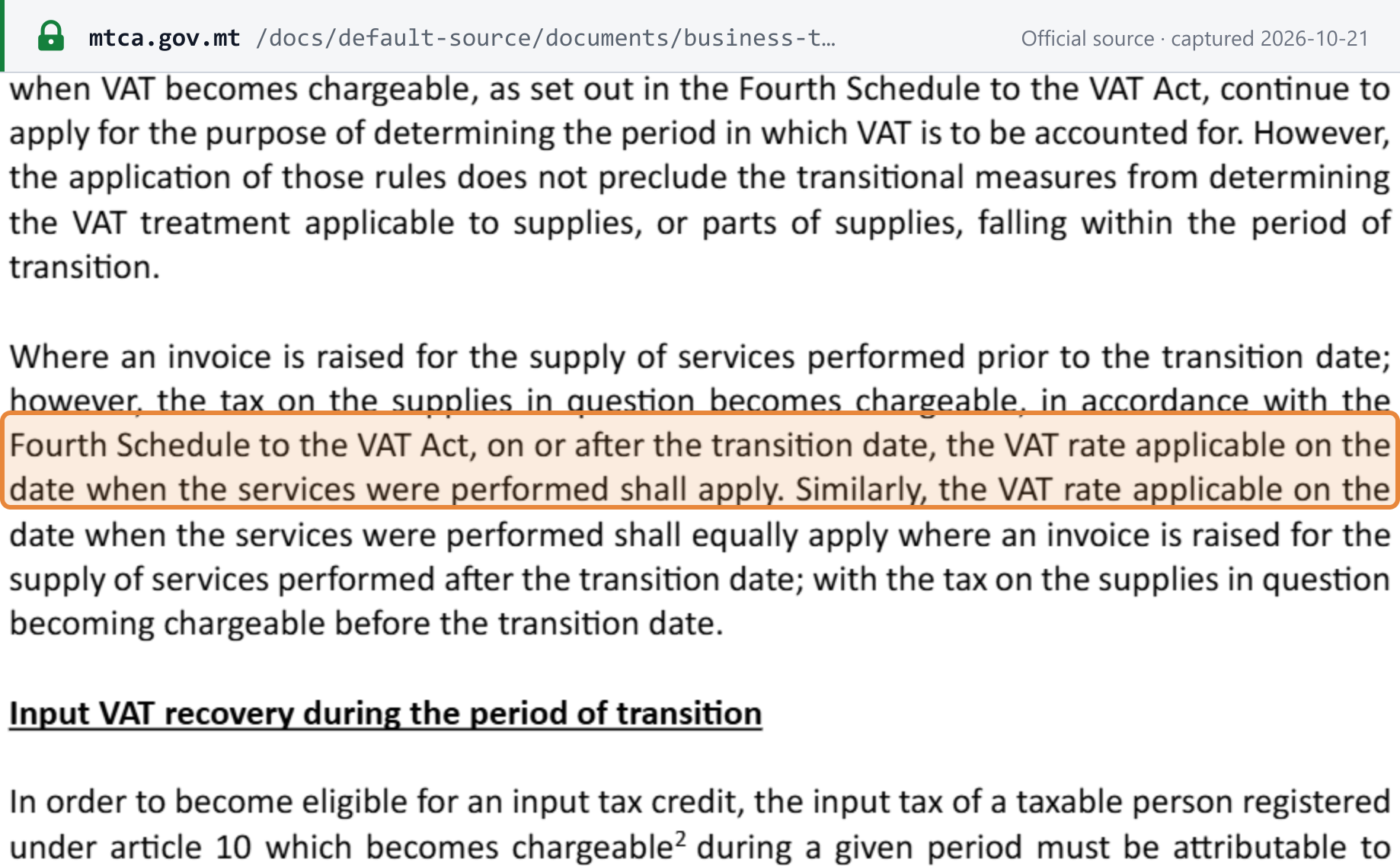 Source snapshot of the official page. Open full size ↗