Mauritania requires non-resident digital-service suppliers and platforms to register for VAT
- Jurisdiction
- Mauritania
- Tax
- VAT
- Change type
- Digital services
- Status
- Enacted
- Impact
- Plan ahead
- Announced
- 10 August 2026
- Authority
- Ministère des Finances - République Islamique de Mauritanie
- Systems
- E-commerce, Tax engine, Reporting
- Verified
- Fetched from official source · high confidence
Non-resident suppliers of digital services (advertising, cloud, hosting, SaaS) used or exploited in Mauritania, and non-resident digital platforms designated as liable parties under Article 221-bis — even without a customer physically located in Mauritania.
Non-resident suppliers of digital services used in Mauritania — online advertising, cloud, hosting, SaaS and platform intermediation — should assess registration and VAT accounting obligations.
E-commerceTax engineReporting
Mauritania's Loi de Finances Rectificative pour l'année 2026 (promulgated 10 August 2026) adds a new paragraph 5 to Tax Code Article 221 and a new Article 221-bis requiring non-resident suppliers of digital services, and non-resident digital platforms designated as liable parties under Article 221-bis, to register with the Mauritanian tax administration (per Article L.4), file the returns required by the Tax Code, and keep records of transactions carried out in Mauritania. Digital platforms become liable for VAT on their intermediation commission in all cases, and become the sole party liable for VAT on the underlying transaction when they meet certain conditions (e.g. collecting payment from the final customer, or setting the transaction's essential terms). Non-resident suppliers/platforms are subject to a simplified registration, filing and payment regime, with implementing modalities to be set by ministerial order (arrêté).
What changed in detail
Mauritania’s Loi de Finances Rectificative pour l’année 2026, promulgated 10 August 2026, adds a new paragraph 5 to Tax Code Article 221 and a new Article 221-bis. Non-resident suppliers of digital services, and non-resident digital platforms designated as liable parties under Article 221-bis, must register with the Mauritanian tax administration under Article L.4, file the returns the Tax Code requires, and keep records of transactions carried out in Mauritania. A digital platform becomes liable for VAT on its own intermediation commission in every case, and becomes the sole party liable for VAT on the underlying transaction where it meets certain conditions — for example, collecting payment from the final customer or setting the transaction’s essential terms. Non-resident suppliers and platforms fall under a simplified registration, filing and payment regime, with implementing detail to be fixed by ministerial order (arrêté).
What it means
The place-of-supply test driving this is “used or exploited in Mauritania” — broader than a simple customer-location test, and broader than the residence-based tests common elsewhere. A supplier with no Mauritanian-located customer can still be in scope if the service is used or exploited there. Platforms carry a double exposure: VAT on their own commission always, and VAT on the underlying transaction itself where they control payment collection or the transaction’s terms — so a marketplace’s liability position can change transaction by transaction depending on who is actually setting those terms.
Proof
5) a) Les fournisseurs non-résidents de services numériques, ainsi que les plateformes numériques non-résidentes désignées redevables en application de l'article 221-bis, sont tenus de s'immatriculer auprès de l'administration fiscale conformément à l'article L.4, de souscrire les déclarations prévues par le présent Code et de conserver les informations relatives aux opérations réalisées en Mauritanie, sans préjudice des dispositions des paragraphes 1 à 4 du présent article.5) a) Non-resident suppliers of digital services, as well as non-resident digital platforms designated as liable parties under Article 221-bis, are required to register with the tax administration in accordance with Article L.4, to file the returns provided for by this Code, and to keep records of the transactions carried out in Mauritania, without prejudice to the provisions of paragraphs 1 to 4 of this article.
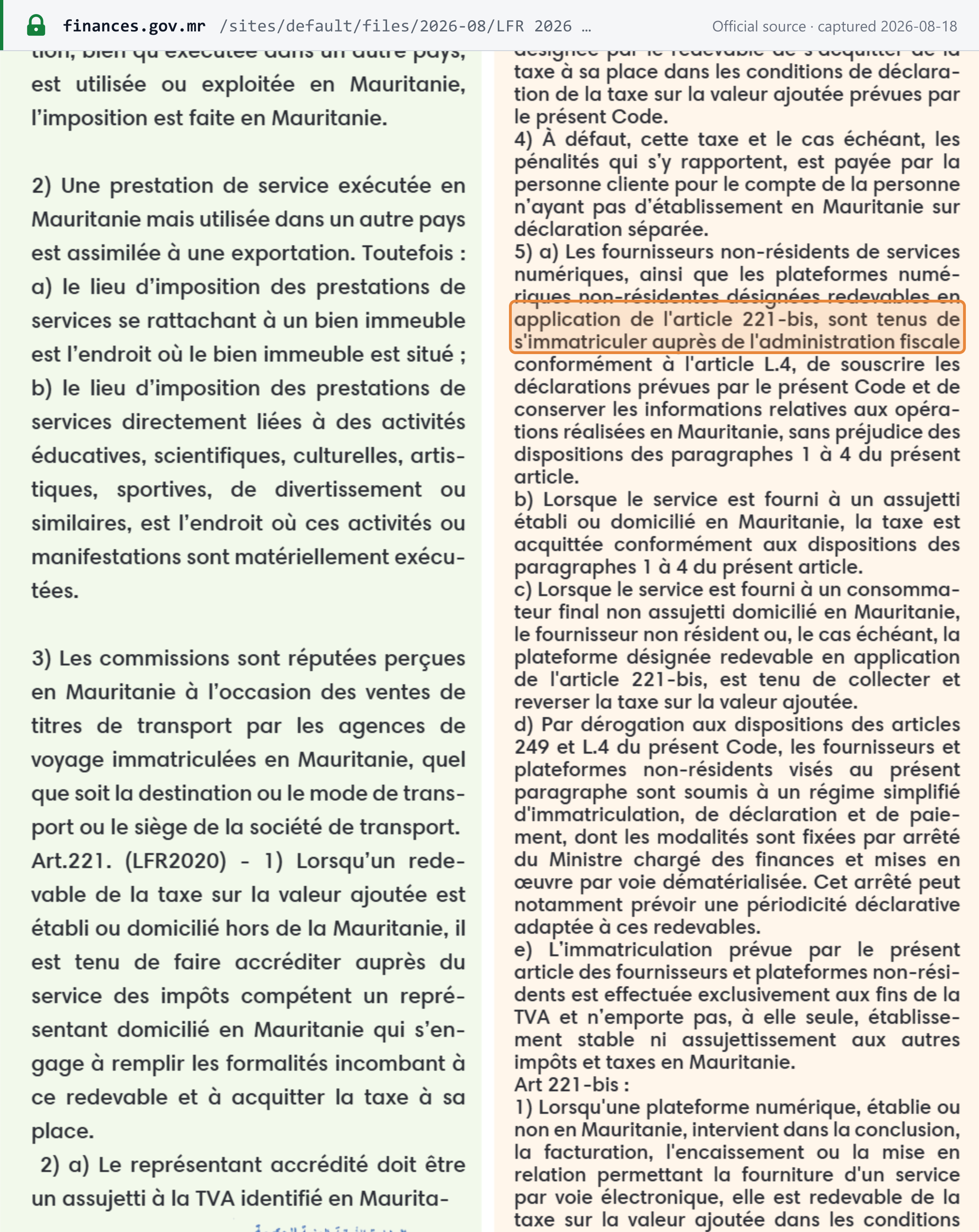 Source snapshot of the official page. Open full size ↗