Dutch cabinet decides on mandatory B2B e-invoicing from 1 July 2030 and reporting from 1 July 2031
This change is proposed and is not law. The rules below describe what would change if it is adopted.
This page records one dated change. For the rules in Netherlands as they stand today, see the Netherlands guide →
- Jurisdiction
- Netherlands
- Tax
- VAT
- Change type
- E-invoicing
- Status
- Proposed
- Impact
- Watch
- Announced
- 11 September 2026
- Effective
- 1 July 2030
- Authority
- Rijksoverheid (Government of the Netherlands)
- Systems
- ERP, Invoicing, Reporting
- Verified
- Fetched from official source · high confidence
Dutch VAT-registered businesses in B2B transactions; businesses in the KOR small-business scheme (turnover up to EUR 20,000) are exempt.
Put Dutch domestic B2B e-invoicing (1 July 2030) and e-reporting (1 July 2031) on the roadmap; watch the autumn 2026 internet consultation for format and platform.
ERPInvoicingReporting
On 11 September 2026 the Dutch cabinet decided to introduce mandatory e-invoicing and transaction reporting for business-to-business transactions. Using the option in the EU 'VAT in the Digital Age' directive, domestic B2B e-invoicing is to be mandatory from 1 July 2030 and domestic reporting from 1 July 2031, alongside cross-border B2B reporting from July 2030. Businesses in the small-business scheme (KOR, turnover of at most EUR 20,000 a calendar year) are exempt, including after July 2030. This is a cabinet policy decision, not law: the draft bill is to go to internet consultation in autumn 2026 and to the Tweede Kamer before summer 2027.
What changed in detail
This is a cabinet policy decision and not law. On 11 September 2026 the Ministry of Finance announced the Dutch cabinet’s decision to introduce mandatory e-invoicing and transaction reporting for business-to-business transactions, using the option in the EU ‘VAT in the Digital Age’ directive.
Domestic B2B e-invoicing is to be mandatory from 1 July 2030 and domestic reporting from 1 July 2031, alongside cross-border B2B reporting from July 2030. Businesses in the small-business scheme (KOR, with turnover of at most EUR 20,000 a calendar year) are exempt from e-invoicing and reporting, including after July 2030.
The draft bill is to go to internet consultation in autumn 2026 and to the Tweede Kamer before summer 2027.
What it means
The dates are a cabinet intention and the bill has yet to be consulted on and sent to Parliament, so details may change. For businesses the useful signal is the sequence: e-invoicing first in 2030, domestic reporting a year later. That leaves time to plan ERP and invoicing changes, with the internet consultation the first chance to influence the design. KOR businesses can treat themselves as outside scope on the current proposal.
Proof
Het kabinet kiest er net als bijvoorbeeld Frankrijk, Duitsland, België, Polen en Italië voor om hier gebruik van te maken en elektronisch factureren (per 1 juli 2030) en rapportage (per 1 juli 2031) ook verplicht te stellen voor deze binnenlandse transacties.Like France, Germany, Belgium, Poland and Italy, for example, the cabinet chooses to use this option and to make electronic invoicing (from 1 July 2030) and reporting (from 1 July 2031) mandatory for these domestic transactions too.
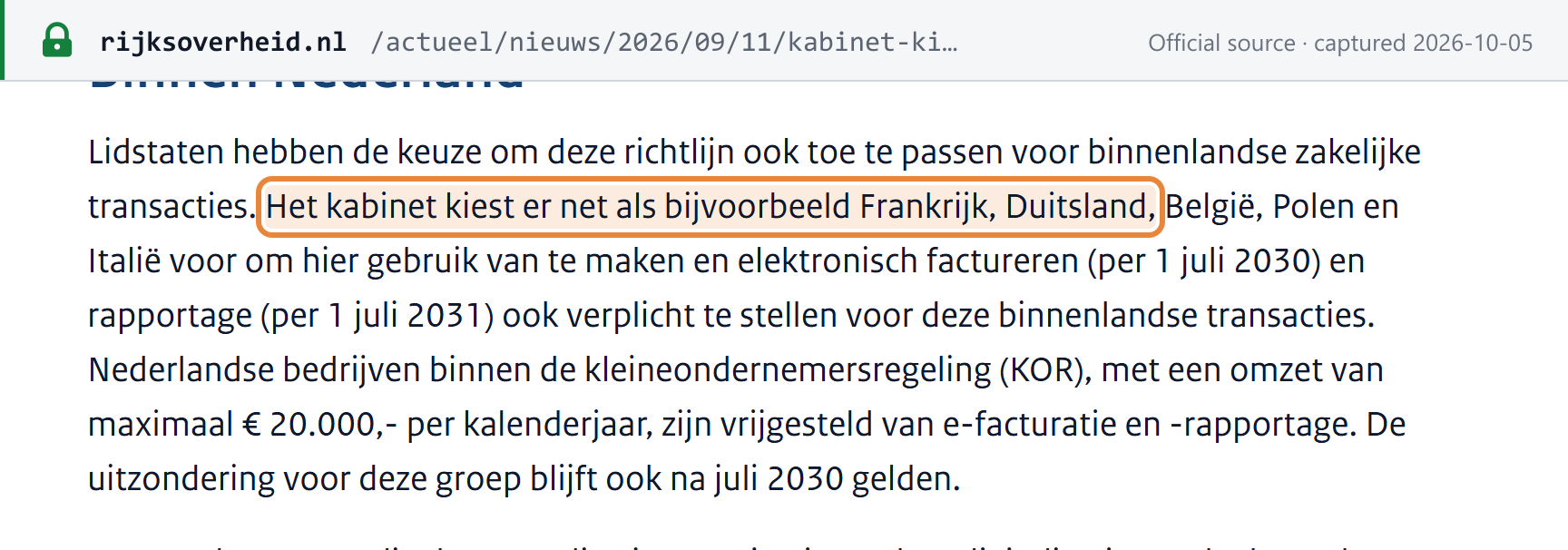 Source snapshot of the official page. Open full size ↗