Saudi Arabia halves the e-invoicing integration threshold to SAR 187,500 for Wave 25
This page records one dated change. For the rules in Saudi Arabia as they stand today, see the Saudi Arabia guide →
- Jurisdiction
- Saudi Arabia
- Tax
- VAT
- Change type
- E-invoicing
- Status
- Enacted
- Impact
- Plan ahead
- Announced
- 24 July 2026
- Effective
- 1 February 2027
- Instrument
- SA-ANN-WAVE25-2026
- Authority
- Zakat, Tax and Customs Authority (ZATCA)
- Systems
- Invoicing, ERP, Tax engine
- Verified
- Fetched from official source · high confidence
Saudi VAT-registered taxpayers whose VAT-taxable revenue exceeded SAR 187,500 in any of 2022, 2023, 2024 or 2025 — roughly USD 50,000 of annual taxable revenue, so sole traders and micro-enterprises are in scope.
If any of your 2022-2025 Saudi VAT-taxable revenue exceeded SAR 187,500, plan Fatoora Phase 2 integration (API onboarding, cryptographic stamping, UUID/hash chaining) to complete before 1 February 2027.
InvoicingERPTax engine
ZATCA published the criteria for Wave 25 of the Fatoora Phase 2 (Integration) e-invoicing mandate on 24 July 2026: taxpayers whose VAT-taxable revenues exceeded SAR 187,500 in any of 2022, 2023, 2024 or 2025 must integrate their e-invoicing solutions with the Fatoora platform by 1 February 2027. The Wave 24 criterion was SAR 375,000. ZATCA states it will notify targeted taxpayers at least six months before their integration date.
What changed in detail
ZATCA published the selection criteria for Wave 25 of the Fatoora Phase 2 (Integration) e-invoicing mandate on 24 July 2026. Taxpayers whose VAT-taxable revenues exceeded SAR 187,500 in any of 2022, 2023, 2024 or 2025 are in scope and must integrate their e-invoicing solutions with the Fatoora platform by 1 February 2027.
The Wave 24 criterion was SAR 375,000, so the threshold has halved. The test is a look-back across four separate years rather than a current-year measure: a business that exceeded SAR 187,500 in 2022 alone is in scope even if its revenue is lower today.
ZATCA states that Phase Two imposes requirements beyond the Generation Phase — integrating the taxpayer’s e-invoicing solution with the Fatoora platform, issuing e-invoices in a specified format, and including additional fields in the invoice. It also states that it notifies each wave’s targeted taxpayers at least six months before their integration date.
What it means
This is the wave that reaches genuinely small businesses. At roughly USD 50,000 of annual taxable revenue, the criterion now catches sole traders and micro-enterprises that have never had to build an API integration, do cryptographic stamping, or maintain UUID/hash chaining.
The four-year look-back is the part most likely to be misread. Scoping off current turnover will under-count: the question is whether any of four historical years crossed the line. Check 2022 through 2025 separately before concluding you are out of scope, and treat ZATCA’s six-month notification as confirmation rather than as the trigger to start work.
Proof
The Zakat, Tax and Customs Authority (ZATCA) determined the criteria for selecting the targeted taxpayers in the Twenty-Fifth Wave for implementing the "Integration Phase " of E-invoicing, as it clarified that the Twenty-Fifth Wave included all taxpayers whose revenues subject to VAT exceeded (SAR 187,500) during 2022, 2023,2024 or 2025.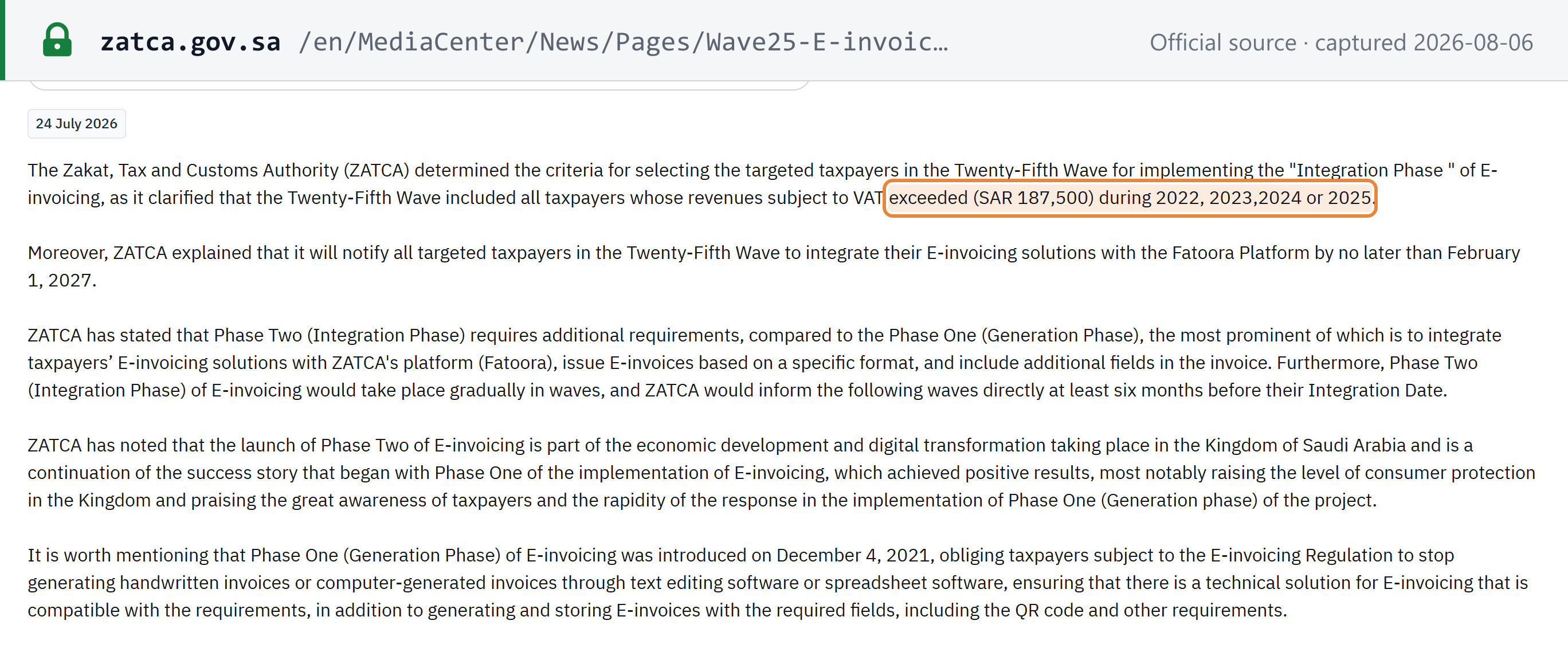 Source snapshot of the official page. Open full size ↗