Slovakia's VAT bill ČPT 1454 would add a penalty-free eFaktúra period in H1 2027
This change is proposed and is not law. The rules below describe what would change if it is adopted.
This page records one dated change. For the rules in Slovakia as they stand today, see the Slovakia guide →
- Jurisdiction
- Slovakia
- Tax
- VAT
- Change type
- E-invoicing
- Status
- Proposed
- Impact
- Watch
- Announced
- 27 August 2026
- Effective
- 1 January 2027
- Authority
- Národná rada Slovenskej republiky
- Systems
- ERP, Invoicing, Tax engine, Reporting
- Verified
- Fetched from official source · high confidence
VAT payers in Slovakia subject to mandatory e-invoicing, and suppliers to security and defence bodies.
Track the first reading and committee deadline (13-16 November 2026); keep 1 January 2027 eFaktúra readiness and Peppol receipt in plan.
ERPInvoicingTax engineReporting
Government bill ČPT 1454 (delivered to the National Council 27 August 2026; awaiting first reading) amends the VAT Act 222/2004. It would keep mandatory eFaktúra from 1 January 2027, add a no-penalty period 1 January to 30 June 2027 for late issuance of e-invoices, delete the buyer's purchase-invoice data reporting obligation (current section 85o(10)), set fines of up to EUR 10,000 (up to EUR 100,000 if repeated) for failures to report invoice data under section 85o(9), and carve out invoices to security/defence bodies and classified supplies. The same bill carries VAT Directive (ViDA) second-step changes: from 1 January 2027, supplies of gas, electricity and heat or cooling are treated as distance sales under the OSS until 30 June 2028; the call-off stock scheme (section 8a) is repealed from 1 July 2028, with a transitional rule keeping it for call-off stock already started until 30 June 2029; other points are dated 1 July 2028 and 1 July 2030. Figures are provisional until enacted.
What changed in detail
This is a government bill, not law. Government bill ČPT 1454 was delivered to the National Council on 27 August 2026 and is awaiting first reading; the committee deadline is 13 November 2026 and the lead committee deadline 16 November 2026. It amends the VAT Act 222/2004.
It would keep mandatory eFaktúra from 1 January 2027 and add a no-penalty period from 1 January to 30 June 2027 for late issuance of e-invoices. Under section 85q(3), fines under section 85o(11) for invoice-data reporting failures are also not imposed for that period. It would delete the buyer’s purchase-invoice data reporting obligation (current section 85o(10)), set fines of up to EUR 10,000 (up to EUR 100,000 if repeated) for failures to report invoice data under section 85o(9), and carve out invoices to security and defence bodies and classified supplies.
The same bill carries ViDA second-step changes. From 1 January 2027, supplies of gas, electricity and heat or cooling would be treated as distance sales under the OSS until 30 June 2028. The call-off stock scheme (section 8a) would be repealed from 1 July 2028, with a transitional rule keeping it for call-off stock already started until 30 June 2029. Most other cross-border points are dated 1 July 2028, and invoicing points 1 July 2030.
What it means
The relief covers the first half of 2027 only: late issuance of e-invoices and the section 85o(11) fines are waived for that period, but the obligation to issue e-invoices from 1 January 2027 stays. Call-off stock users have longer: the scheme would continue until 30 June 2028.
All figures are provisional until enacted. Businesses should prepare for the 1 January 2027 start regardless, because the bill keeps that date; the grace period is a cushion, not a postponement.
Proof
Ak platiteľ podľa § 85o ods. 2 v období od 1. januára 2027 do 30. júna 2027 nevyhotoví elektronickú faktúru podľa § 85o ods. 4 v lehote podľa § 85o ods. 6, daňový úrad mu pokutu podľa osobitného predpisu neuloží.If a taxable person under section 85o(2) does not issue an electronic invoice under section 85o(4) within the period under section 85o(6) between 1 January 2027 and 30 June 2027, the tax office shall not impose a fine under a special regulation.
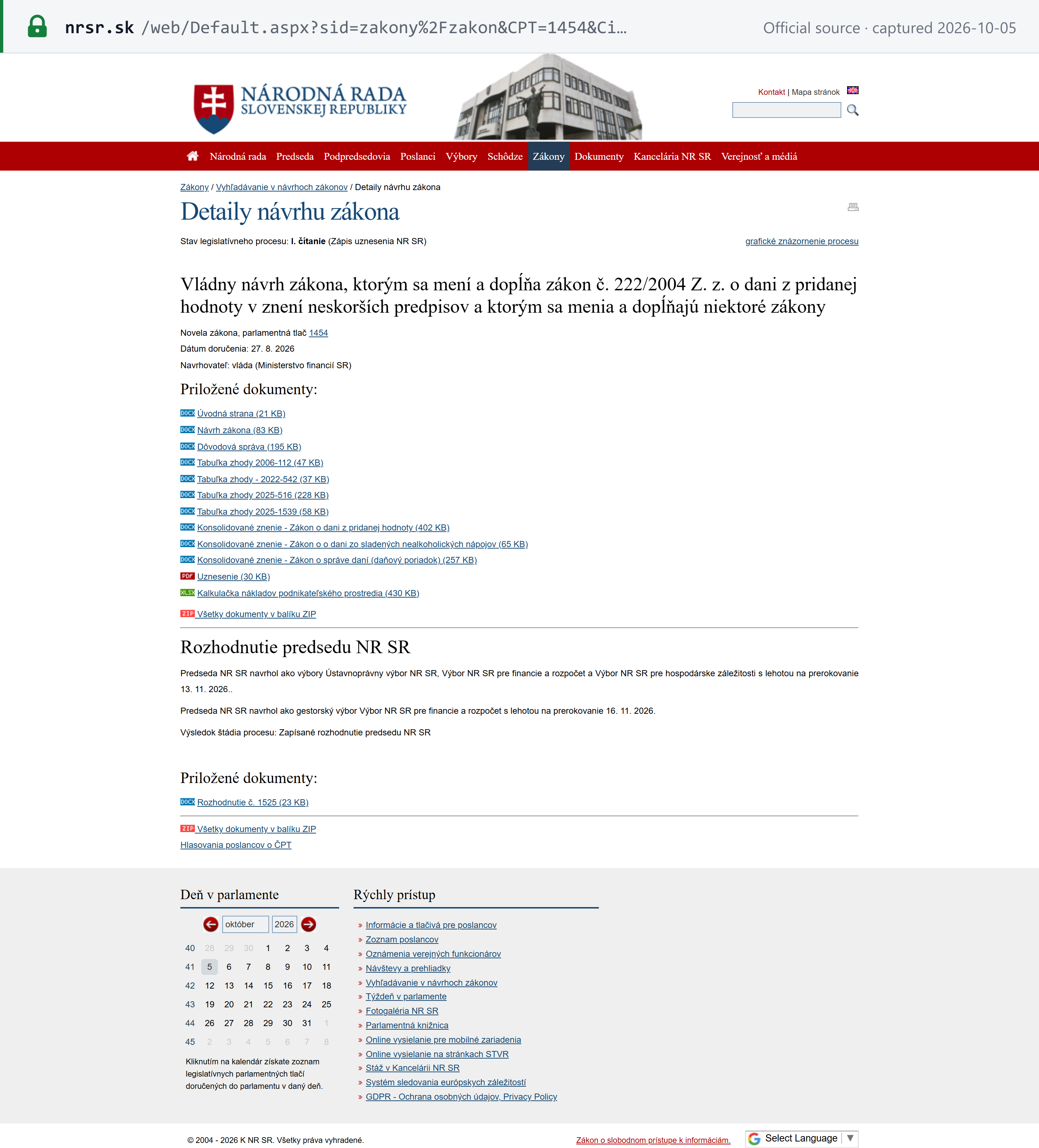 Source snapshot of the official page. Open full size ↗